
A complete issue · 18 pages · 1890
Judge — December 13, 1890
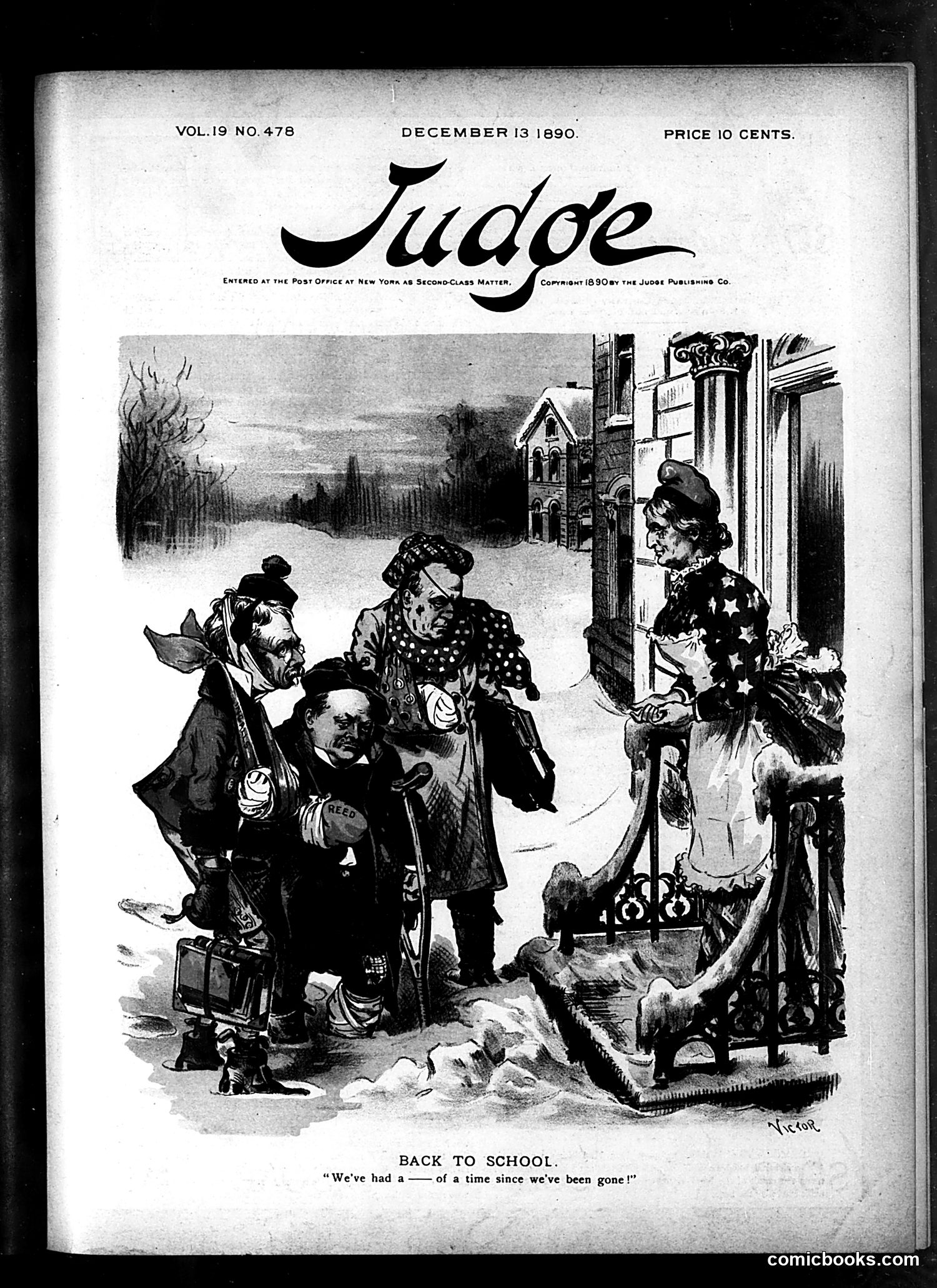
This cartoon satirizes the return to school after winter break. Three disheveled, poorly-dressed figures (appearing to represent working-class or immigrant children) stand in snow outside a schoolhouse gate, speaking to a well-dressed woman at the door—likely a teacher or school official. The caption reads: "We've had a ___ of a time since we've been gone!"—the blank suggesting a mild profanity the 1890 editors wouldn't print. The satire comments on the contrast between the children's rough circumstances and the formal institution of school. The humor derives from the children's rough language and appearance clashing with proper school settings—a common theme in period comedy that reflected anxieties about working-class children's education and assimilation.
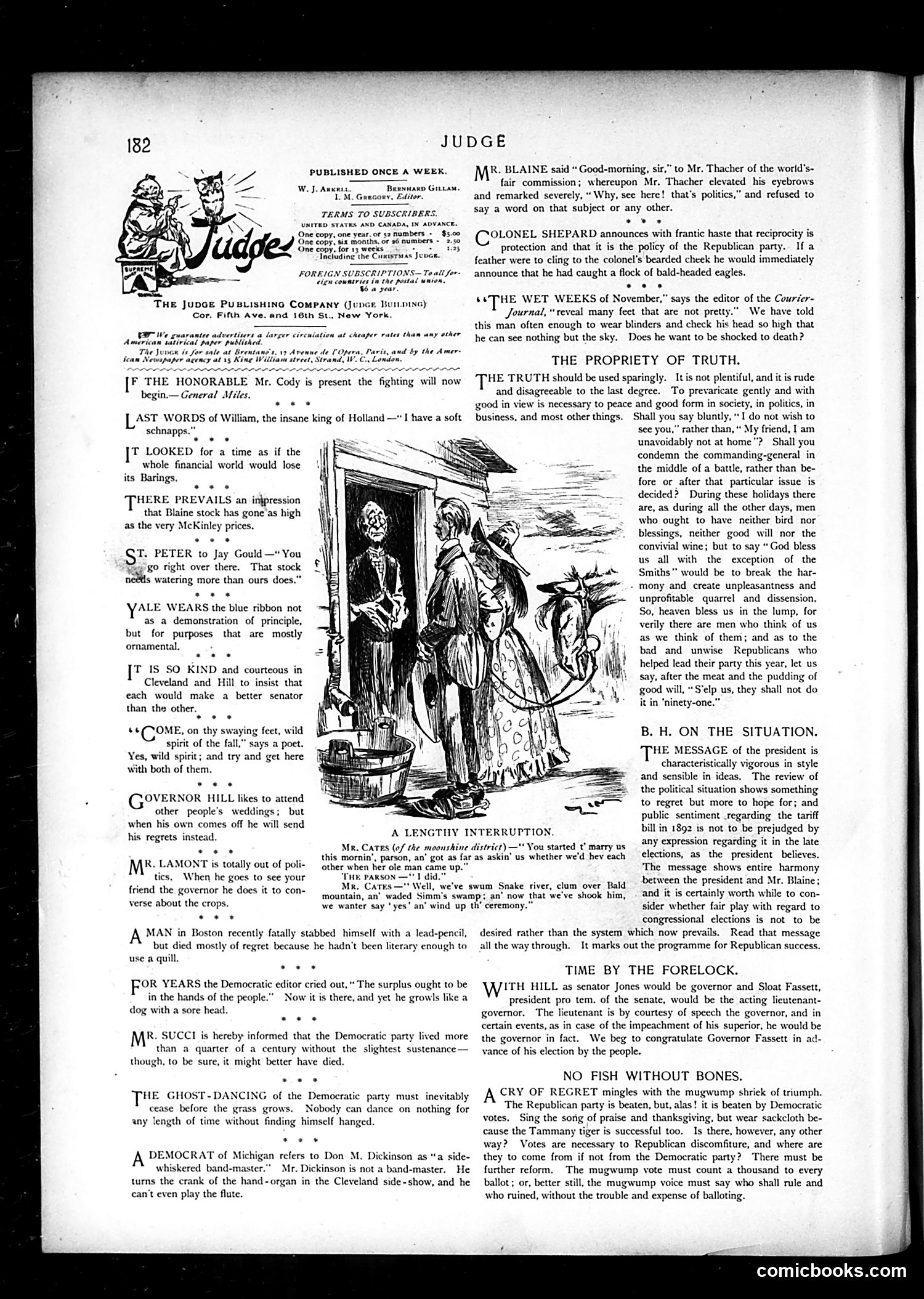
This page from Judge contains political commentary and satirical notes rather than a main cartoon. The central illustration depicts what appears to be a lengthy interruption—possibly a social or political meeting scene with multiple figures. The text references contemporary Republican and Democratic politics, mentioning specific figures like Governor Hill and issues surrounding tariffs and party leadership. References to "the mugwump vote" suggest this dates to the 1880s-90s, when mugwumps (independent Republicans) were politically influential. The satire targets Democratic Party management and strategy, criticizing their approach to gaining votes and power. Several brief quips mock Democratic leadership and political inconsistency. Without clearer identification of specific politicians mentioned, the precise targets remain somewhat unclear, though the overall thrust criticizes Democratic political competence and values.
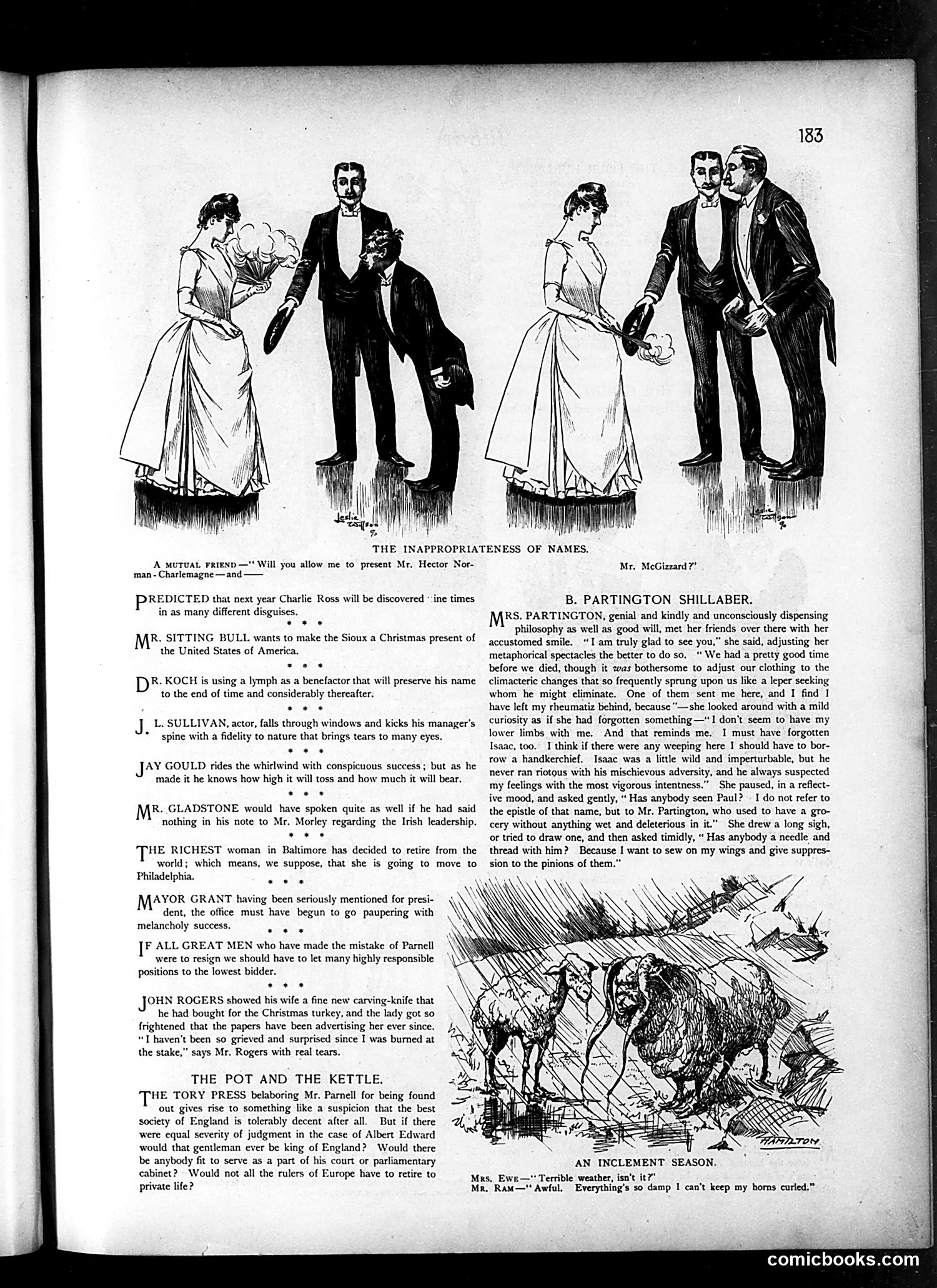
This page contains satirical social commentary typical of Judge magazine. The top illustration, "The Inappropriateness of Names," shows two scenarios mocking the social awkwardness of introductions—a mutual friend presenting "Mr. Hector Norman-Chattanooga" and "Mr. McGizzard," suggesting humor in unfortunate surnames. The text section "B. Partington Shillaber" appears to be a gossipy social column discussing various society figures and their indiscretions. The bottom cartoon, "An Inclement Season," shows a woman and man in harsh weather, with dialogue about curled horses—likely satirizing domestic complaints during bad weather. The page represents Judge's blend of visual satire, social gossip, and humorous commentary on upper-class society and manners in the late 19th/early 20th century.
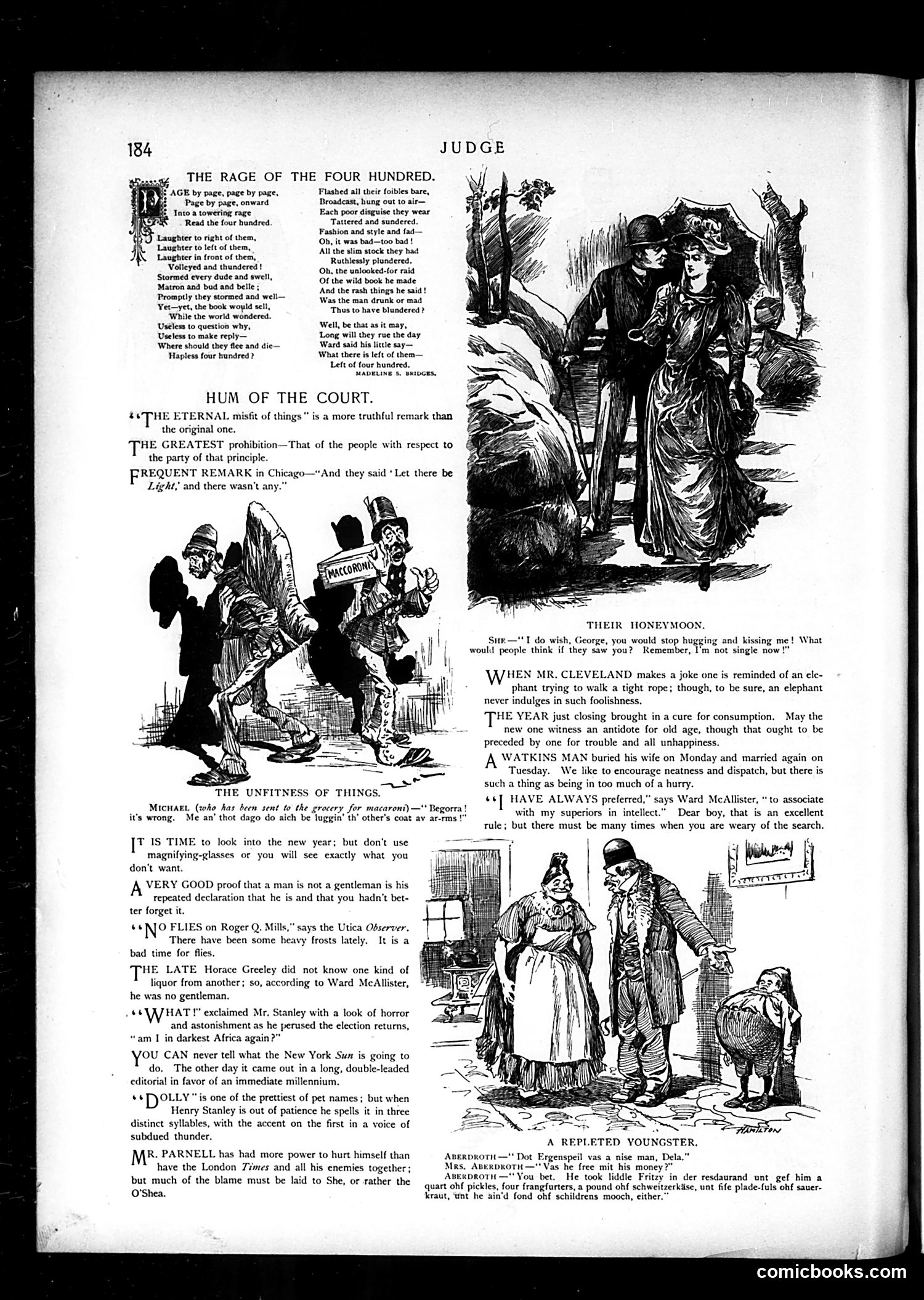
This page satirizes New York's wealthy elite ("the Four Hundred"—a term for the city's most exclusive social circle). The lead poem mockingly depicts their outrage at Ward McAllister's forthcoming exposé book, which threatens to reveal their embarrassing secrets, fashions, and pretensions to public scrutiny. The joke is that despite their fury, the book will likely sell well while society watches their humiliation. The scattered witticisms below target various figures: Cleveland (depicted as clumsy), McAllister himself (mocked for constantly claiming intellectual superiors exist), and politicians like Parnell and Roger Q. Mills. The cartoons illustrate social absurdities—a bride demanding her husband stop displaying affection publicly, an Irishman confused about etiquette. The satire reflects Gilded Age anxieties: the newly wealthy's desperation for respectability, McAllister's gatekeeping role in society, and tension between old money and those seeking admission to elite circles.
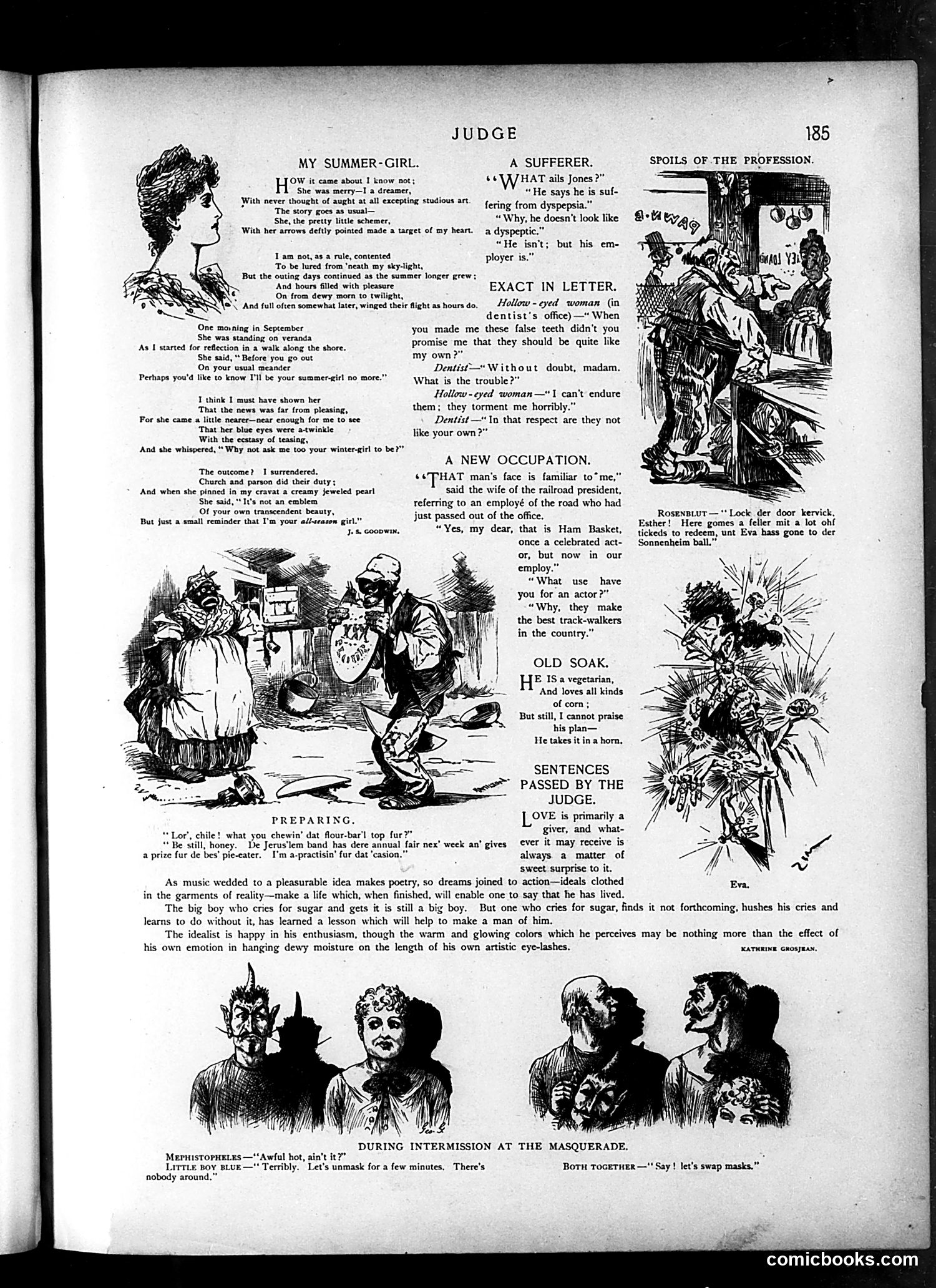
This page contains several unrelated satirical pieces typical of Judge magazine's format: **"My Summer-Girl"** is a romantic poem with accompanying illustration about a man's brief summer romance that ends when the woman asks to become his "winter-girl" too—he surrenders to her proposal. **"A Sufferer"** mocks a dentist patient complaining that false teeth promised to match her own instead torment her—the dentist's retort is that they're no worse than her natural teeth. **"Spoils of the Profession"** features a railroad president's wife recognizing a former actor now employed as a track-walker, joking that actors make "the best track-walkers in the country"—satirizing actors' career decline or the railroad's questionable hiring practices. **"Old Soak"** is a short poem about a vegetarian who consumes corn "in a horn" (whiskey)—mocking prohibition-era drinking disguises. The bottom section includes masquerade ball humor and philosophical musings on idealism versus reality. The illustrations are typical Victorian-era engravings complementing the text.
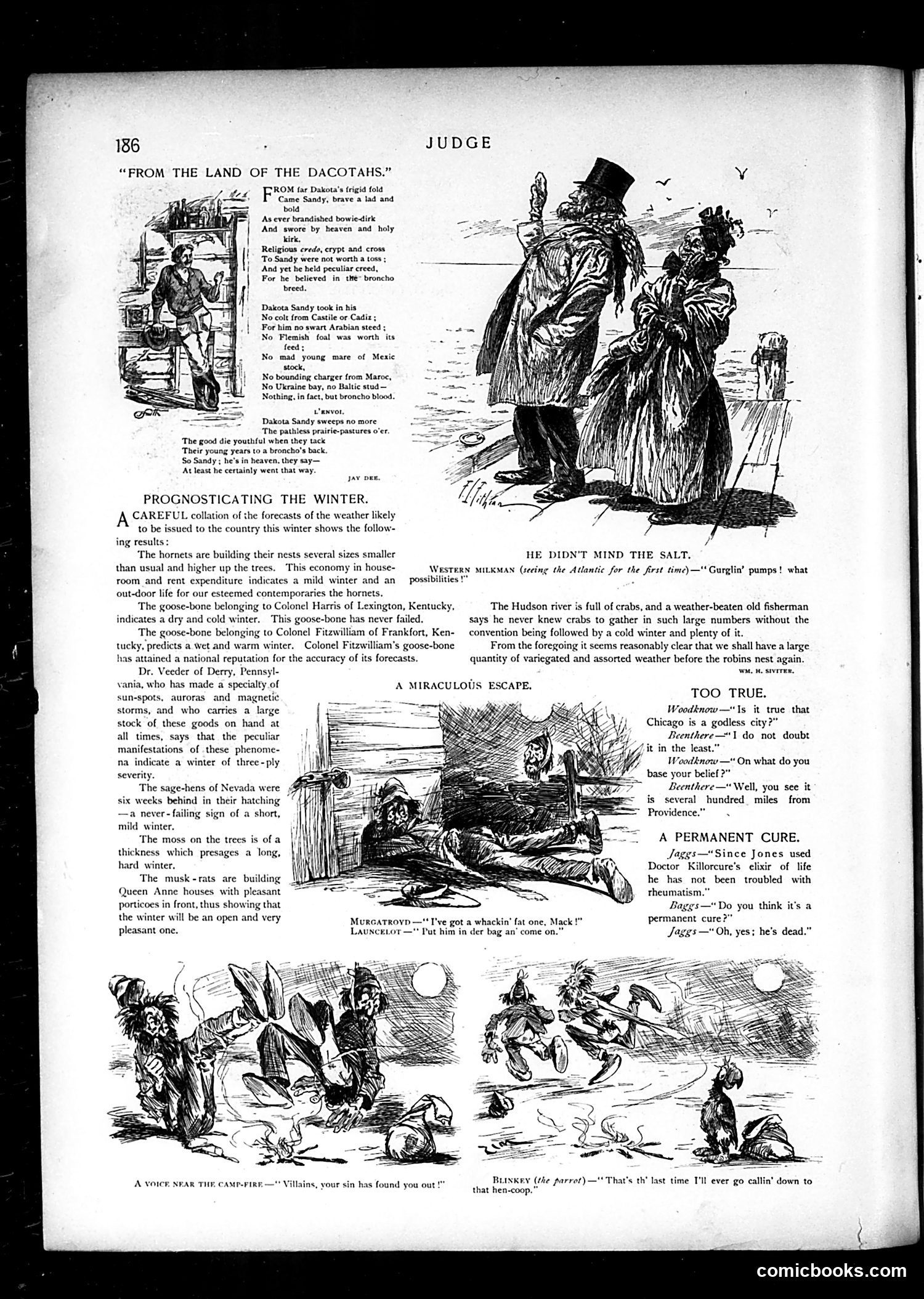
This page contains multiple unrelated satirical pieces typical of 19th-century humor magazines: **"From the Land of the Dacotas"** is a sentimental ballad about "Dakota Sandy," a Dakota pioneer who exclusively bred broncos and died young from a riding accident—mocking both frontier romanticism and the dangerous lifestyle. **"Prognosticating the Winter"** satirizes folk weather forecasting by listing deliberately contradictory "predictions" (hornets' nests, goose bones, moss thickness, musk-rat architecture) that reach opposite conclusions. This mocks the pseudoscience and superstition people relied on before modern meteorology. The remaining cartoons are brief joke illustrations: a milkman seeing the Atlantic for the first time, a conversation about Chicago's godlessness being far from Providence, and dark humor about someone's rheumatism being "cured" by death. The humor relies on absurdity, frontier nostalgia, and the contemporary appeal of rural folklore—reflecting Judge's audience of educated urban readers amused by rural ignorance and outdated practices.
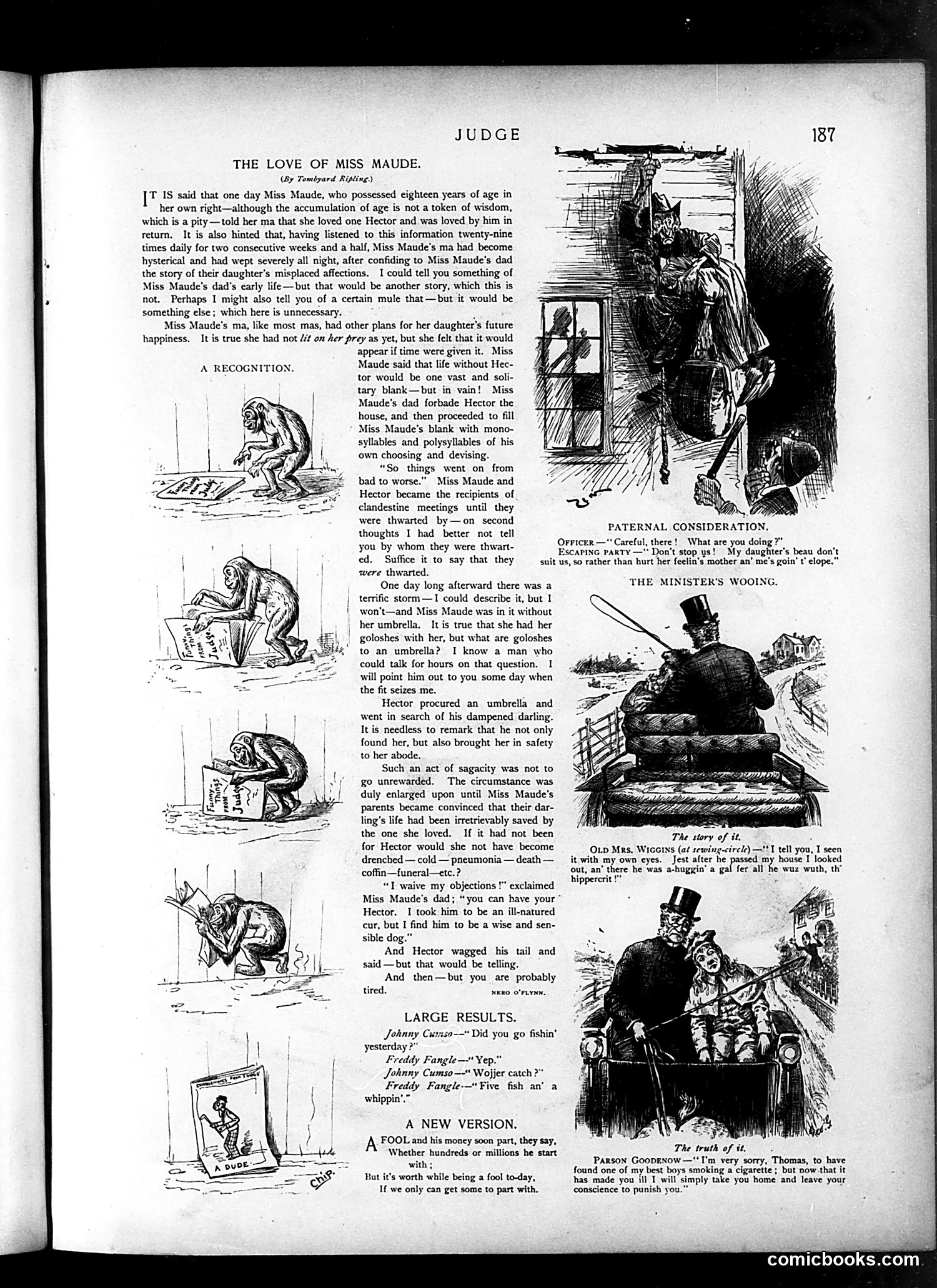
This page contains a serialized humorous story "The Love of Miss Maude" with multiple cartoon vignettes satirizing Victorian courtship conventions and parental control. **Main narrative**: Young Miss Maude loves Hector, but her parents disapprove and forbid the match. When Hector rescues Maude from a storm with an umbrella, her parents reconsider—not because he's proven his character, but because they credit him with saving her life from pneumonia. The satire mocks how Victorian parents judge suitors on trivial circumstances rather than genuine merit, and how easily parental objections crumble. **The joke**: Her father, initially calling Hector "an ill-natured cur," suddenly praises him as "wise and sensible"—simply for providing shelter during rain. The absurdity is heightened by the final line revealing Hector is literally a dog. **Bottom sections** include unrelated jokes about fishing and cigarettes, typical of Judge's miscellaneous humor format. The satire targets rigid parental authority and superficial courtship judgments of the era.
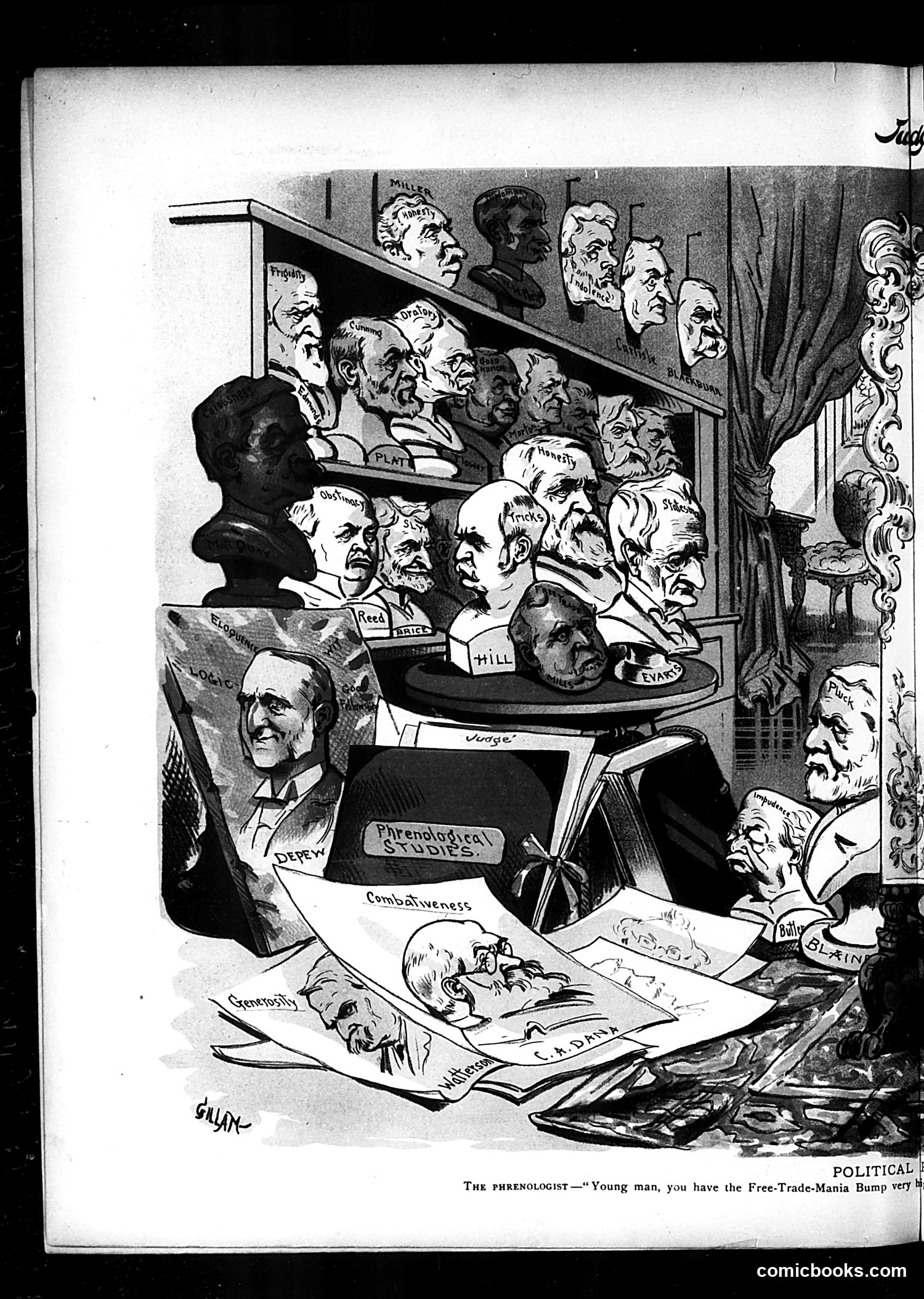
This is a satirical cartoon titled "The Phrenologist," referencing the pseudoscience of phrenology—reading personality traits from skull shapes. A phrenologist examines a young man's head while surrounded by busts and caricatured heads labeled with traits like "Combativeness," "Honesty," and "Generosity." Papers scattered below reference "Free-Trade-Mania" and other political positions. The satire mocks applying pseudo-scientific phrenology to political ideology, suggesting that political beliefs (particularly free-trade positions) are predetermined by innate character rather than reasoned argument. The numerous labeled heads suggest politicians and public figures being categorized this way. The cartoon ridicules both phrenology's false authority and the deterministic thinking behind contemporary political divisions.
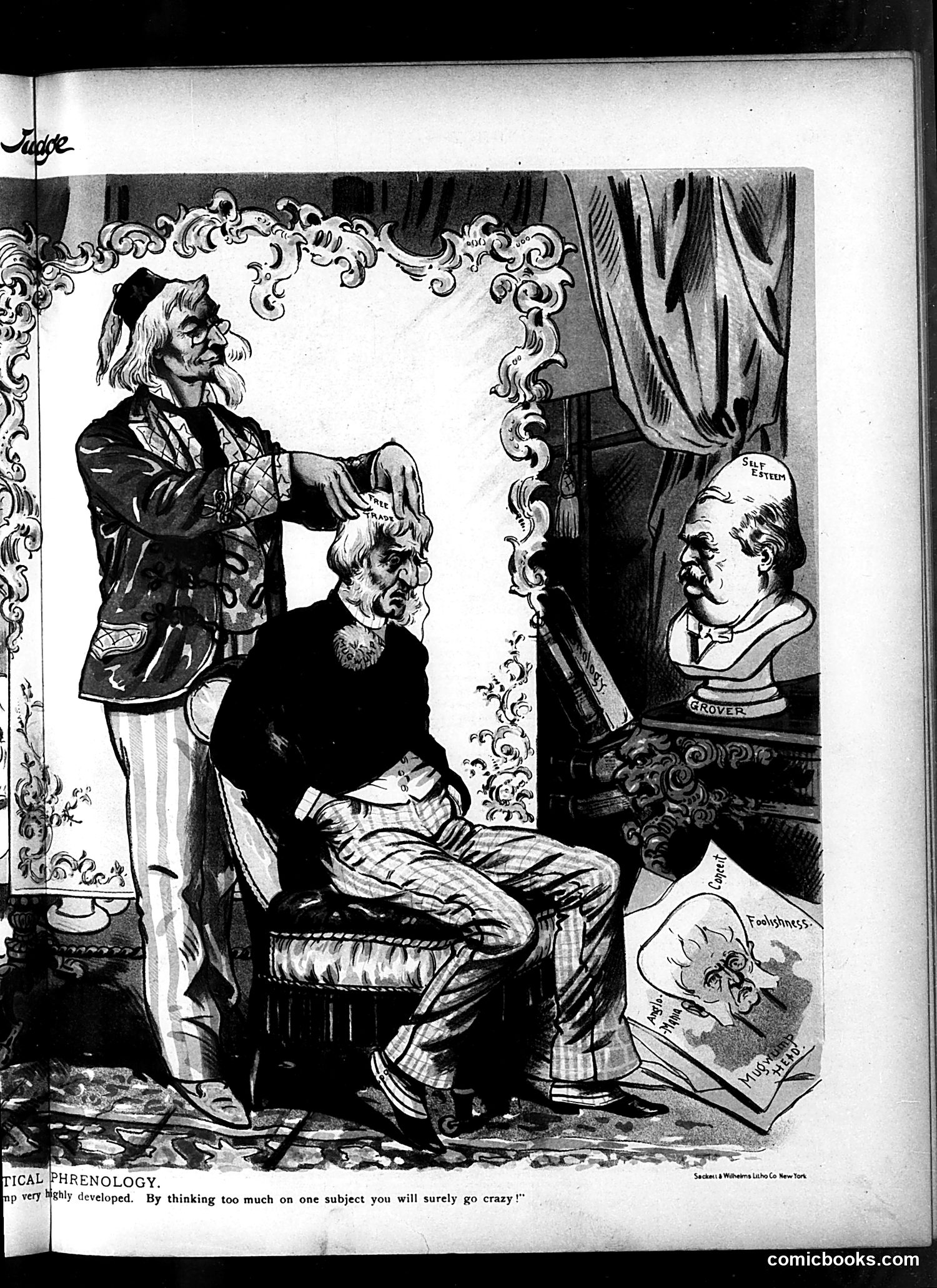
This cartoon satirizes phrenology, the pseudoscience claiming personality traits correlate with skull shape. A phrenologist examines a seated man's head while two bust sculptures labeled "Self Esteem," "Grover," and "Selfishness" hang nearby—likely referencing President Grover Cleveland. The joke mocks both phrenology's absurdity and the political obsession of the era: the phrenologist warns that "thinking too much on one subject will surely go crazy," suggesting political partisans (particularly those fixated on Cleveland or partisan issues) risk madness through excessive focus. The scattered papers with faces suggest the cluttered, obsessive nature of political discourse. Judge uses pseudoscientific pretense to ridicule 19th-century American political zealotry as literally brain-damaging.
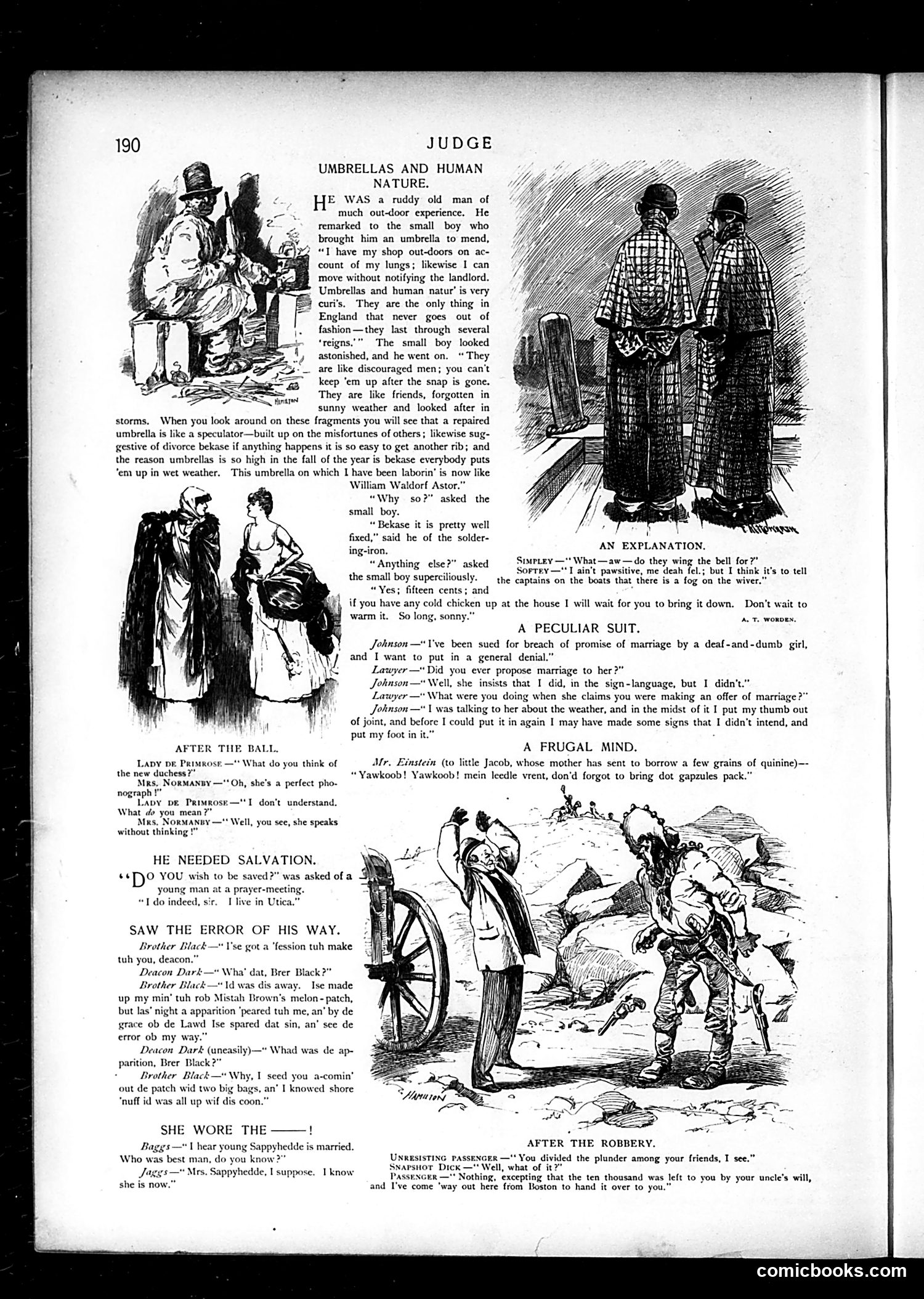
This page from *Judge* contains multiple brief satirical sketches typical of the magazine's humor: **"Umbrellas and Human Nature"** is the featured piece—a philosophical monologue by an umbrella repairman comparing umbrellas to human nature and social types. He likens them to "discouraged men," "friends forgotten in sunny weather," and speculators. The final comparison to William Waldorf Astor (a wealthy American businessman/expatriate) suggests Astor is "well fixed"—a play on his financial status. The remaining items are short joke exchanges, including: - A photographic pun (the duchess "speaks without thinking") - Racial dialect humor depicting African American characters - A breach-of-promise lawsuit involving miscommunicated hand gestures to a deaf woman - Various domestic comedy scenarios The satire targets wealth, marital disputes, social pretension, and everyday foolishness rather than specific political events. The art style and format are characteristic of late 19th/early 20th-century American humor magazines.
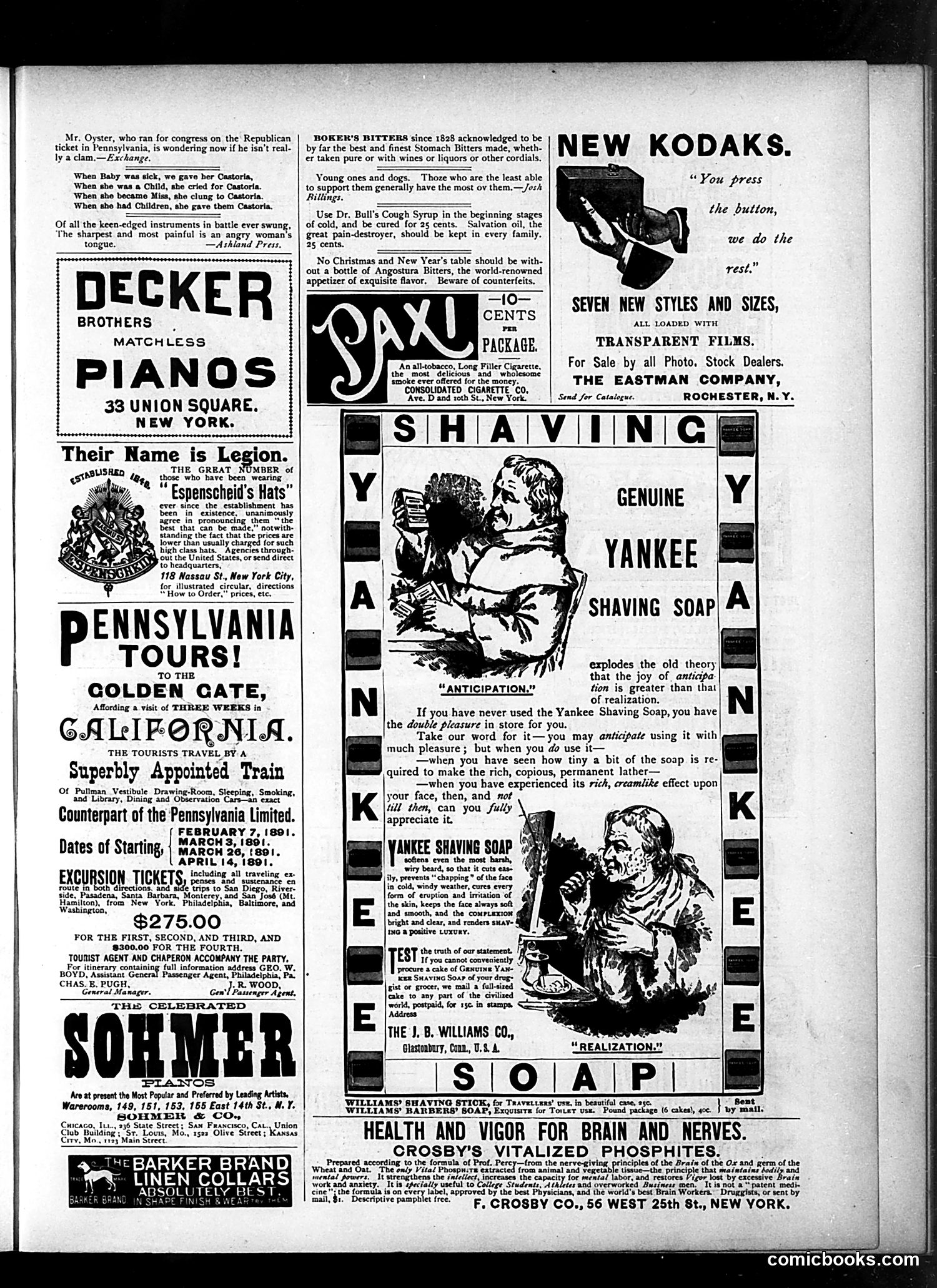
This is primarily an **advertising page** from Judge magazine, circa 1891, with minimal editorial cartoons. ## The Humor The page opens with two brief satirical items: 1. **Mr. Oyster (Pennsylvania Republican)**: The joke relies on oyster/clam wordplay—suggesting the congressional candidate is foolish for questioning his own identity after electoral defeat. Very thin satire. 2. **Women's tongues**: A conventional period joke claiming an angry woman's sharp words are more dangerous than weapons. Misogynistic by modern standards but typical Victorian humor. ## Context This is primarily **commercial space**—full-page advertisements for pianos (Decker, Sohmer), the Kodak camera (with their famous "You press the button, we do the rest" slogan), Yankee shaving soap, and Pennsylvania Railroad tours to California. The ads reveal late-19th-century consumer goods and luxury train travel. The page reflects Judge's role as an advertising vehicle for affluent readers, with genteel humor serving mainly as filler between commercial notices.
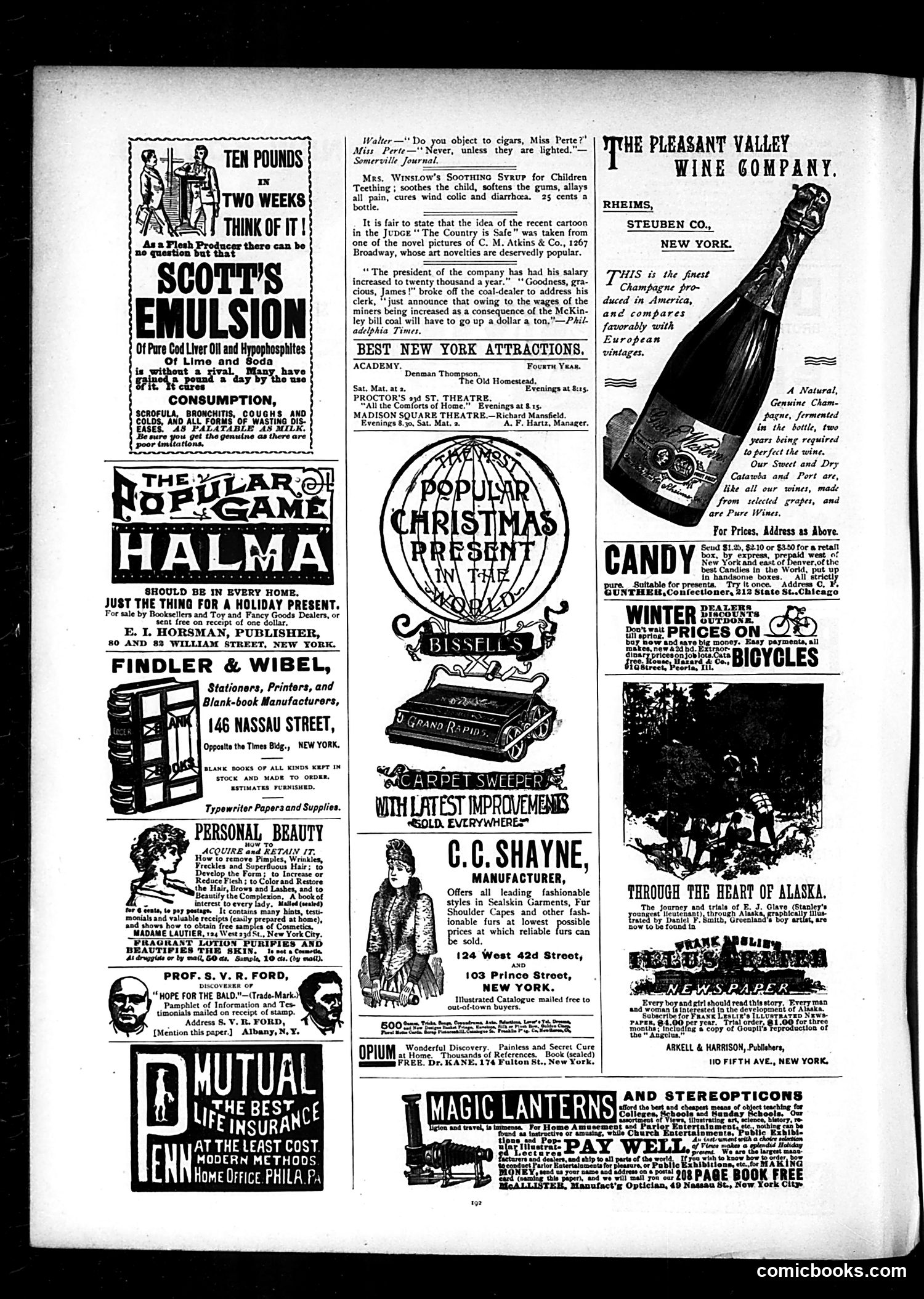
This page is primarily **advertising**, typical of Judge magazine's revenue model. Notable content includes: **The Main Cartoon/Joke** (top left): A brief domestic exchange where a woman (Miss Perte) says she never objects to cigars—"unless they are lighted." This is a mild Victorian-era joke about smoke annoyance. **The McKinley Tariff Reference**: A short item notes that coal dealers claim they must raise prices because the McKinley Tariff increased miners' wages. This references the 1890 McKinley Tariff, a major political controversy—protective tariffs that Republicans supported but which allegedly raised consumer prices. The item mocks this excuse as self-serving. **Everything Else**: Period advertisements for patent medicines (Scott's Emulsion for "consumption"), beauty treatments, life insurance, sealskin garments, champagne, and bicycles. These reflect what Victorian readers actually bought and feared (hair loss, baldness, tuberculosis, freckles). The page demonstrates how Judge subsidized satire through commercial advertising—a business model virtually extinct today.
This page is primarily **advertisements and filler content** rather than political satire. The visible elements include: **Advertisements:** Product ads for perfume (Shandon), champagne (Reihlen), chocolate (Instantaneous), pianos (Fischer), skin treatments (Cuticura), and magazines (Harper's publications). **Humorous Fillers:** Brief jokes about library books, clothing charity, and election results appear scattered throughout. One dialect poem discusses a political campaign's disappointing outcome, mentioning possum and cornbread rather than dwelling on the loss—suggesting resignation or philosophical acceptance of electoral defeat. **Magazine Promotion:** The Harper & Brothers advertisement emphasizes their periodicals as "best for family reading," highlighting their cultural influence. The page lacks identifiable caricatures or specific political figures. The humor is generic rather than topical satire, typical of filler material in 1891 publications.
This page is primarily **advertising content**, not political satire. It consists largely of commercial advertisements from the 1890s era, including: - **Beer and beverage ads** (Greenway's ales, Londonderry Lithia Spring Water) - **Hotel listings** from Judge's National Hotel Guide, covering establishments across major American cities - **Fur goods** (Arnold Constable & Co.) - **Typewriter advertisement** (Remington) - **Medical/patent remedies** (D.L. Dowd's Health Exercisers, deafness cures, Catarrah balm) - **Christmas promotional bond offer** The only illustrative content appears to be a small portrait or facial advertisement related to "facial blemishes" treatments. **No clear political cartoon or satire is visible** on this page. It represents a typical Judge magazine layout of the period, where editorial space was monetized through dense advertising. The ads themselves reflect period concerns (cure-alls, fur fashion, hotel accommodations for traveling salesmen) but contain no apparent satirical intent.
This is primarily an **advertisement page**, not a political cartoon. It contains various commercial ads typical of late 19th-century American magazines, including: **Notable advertisements:** - Evans' Brown Stout beer (emphasizing "American" superiority over imports) - Carl Upmann's Bouquet cigars (with anti-counterfeiting warnings) - Belgian Lamp - Smith Premier typewriter - Various patent medicines (Beecham's Pills, Bane's Dyspepsia Pills, Asthma cure) - The Ward Line shipping service **One editorial brief** appears mid-page: a humorous item about "three sets of twins" born within ten months, mocking exaggerated news stories circulating between newspapers. The page reflects Gilded Age consumer culture and patent medicine promotion (now recognized as quackery). There are no identifiable political cartoons or satirical commentary targeting specific figures or events. The "Judge" masthead suggests this is satirical magazine content, but this particular page is commercial rather than satirical.
This page is primarily **advertising and promotion**, not political cartoons. The substantive content consists of brief humorous anecdotes and a large advertisement for *The New York Ledger*. The two notable jokes touch on contemporary concerns: 1. **"Mr. Repub" dialogue**: A husband sarcastically questions his wife's modest bonnet, and she blames a "tariff reaction." This references **protectionist tariff debates** of the era—apparently a recent tariff policy change had economic consequences affecting consumer goods and prices, making her reluctant to spend on fashion. 2. **The duel anecdote**: A woman recounts a European duel fought over her between a prince and count, punchlined by the guns being unloaded because both men were sober—satirizing the melodramatic pretensions of Americans traveling abroad. The page otherwise contains period advertisements (cocoa, typewriters, jewelry) and subscription promotions for serialized fiction by contemporary authors like Mrs. Amelia E. Barr and George Bancroft.
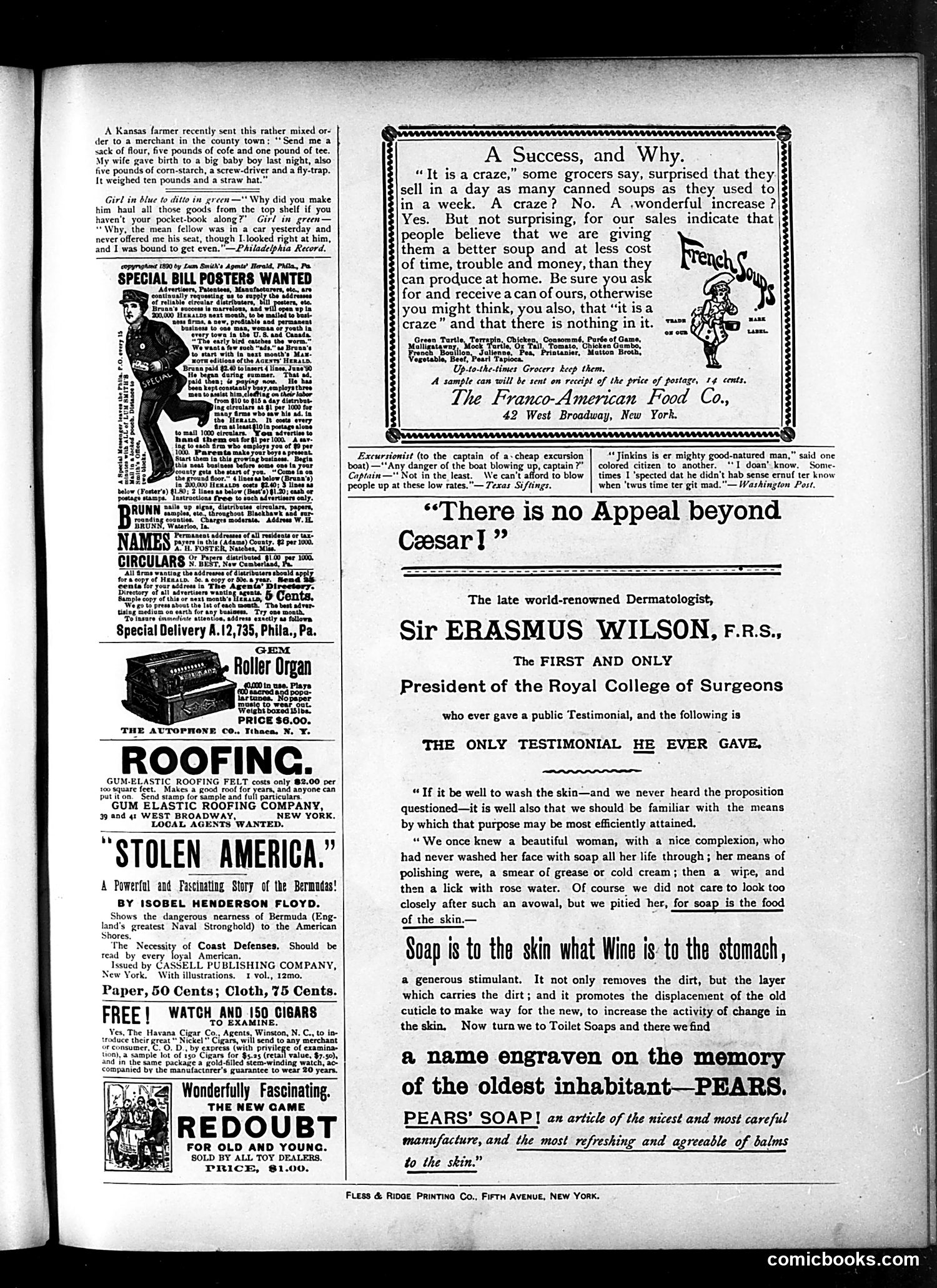
This page is primarily **advertising with marginal humor content**. The main cartoons are brief comic snippets: 1. **"Girl in Blue to Ditto in Green"** — A social commentary joke about gender relations. A woman deliberately makes a male clerk fetch items from high shelves as revenge because he didn't offer her his seat on a streetcar the previous day. The satire targets petty gender tensions and the expectation (unusual for the era) that men should yield seats to women. 2. **"Excursionist to Captain"** — Dark humor about a cheap excursion boat's poor safety standards. The captain admits they can't afford accidents because the fares are too low—implying the vessel is dangerously substandard. 3. **"Jinkins" joke** — Racial humor (containing period offensive dialect) about a Black man's good nature being mistaken for lack of sense. The bulk of the page comprises advertisements for products (roofing, cigars, soaps, books, organs) and Franco-American canned soup, which includes a testimonial allegedly from Sir Erasmus Wilson, a renowned dermatologist, about soap's benefits for skin.
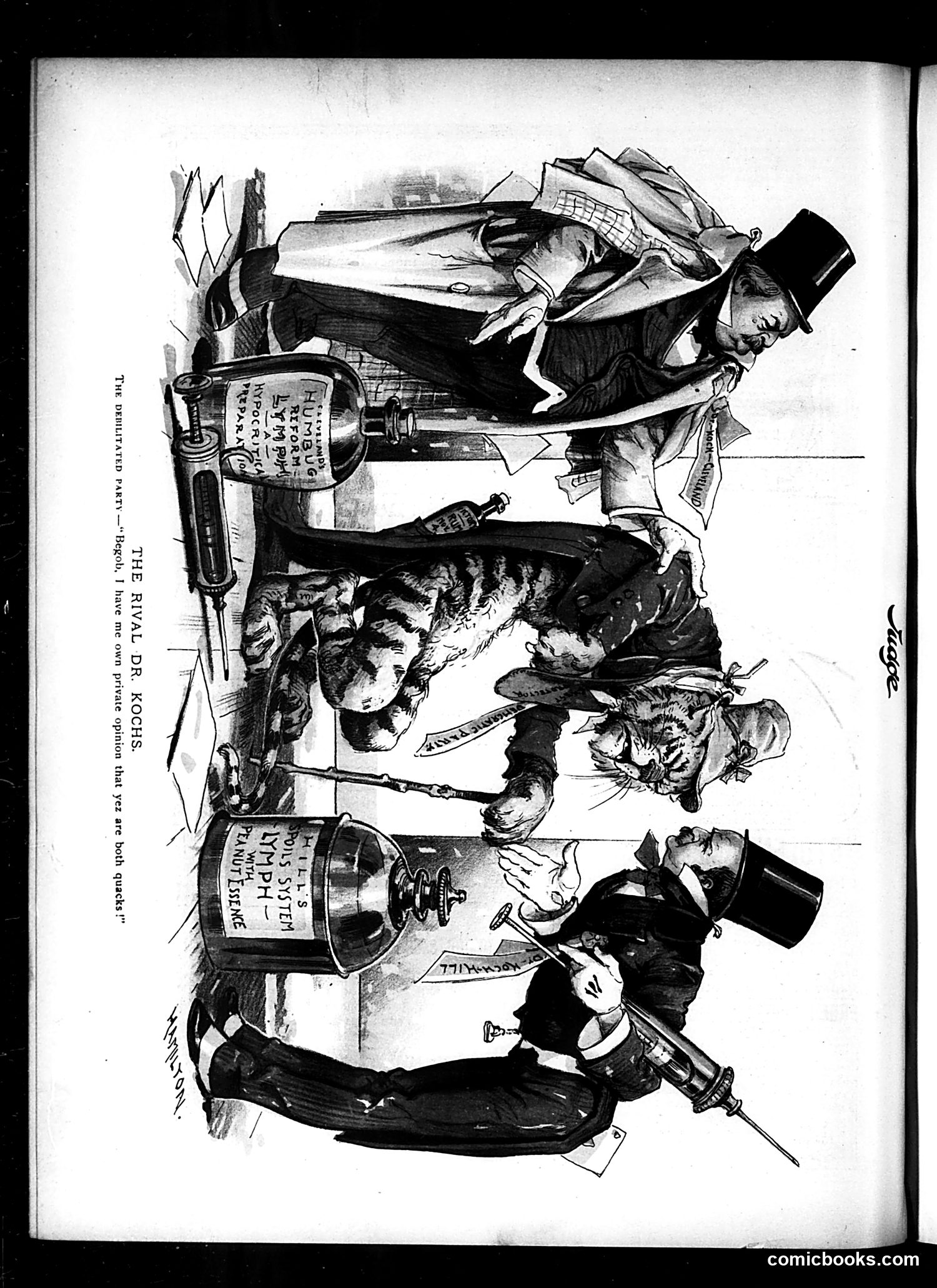
This political cartoon satirizes competing figures within a political party (likely the Democratic Party, given the Irish dialect stereotype). The cartoon depicts two men labeled as "Dr. Koch" treating a sickly patient representing the "Debilitated Party." The patient complains that both doctors are "quacks"—incompetent fraudsters. The satire mocks internal party conflict: rather than unified leadership, the party is caught between rival factions, each claiming to have the cure for the party's problems but both being equally ineffective or dishonest. The medical metaphor reinforces the idea that the party is diseased and desperately needs real solutions, not competing charlatans offering false remedies. The cartoon criticizes divisive leadership during a period of party weakness.