
A complete issue · 16 pages · 1890
Judge — November 15, 1890
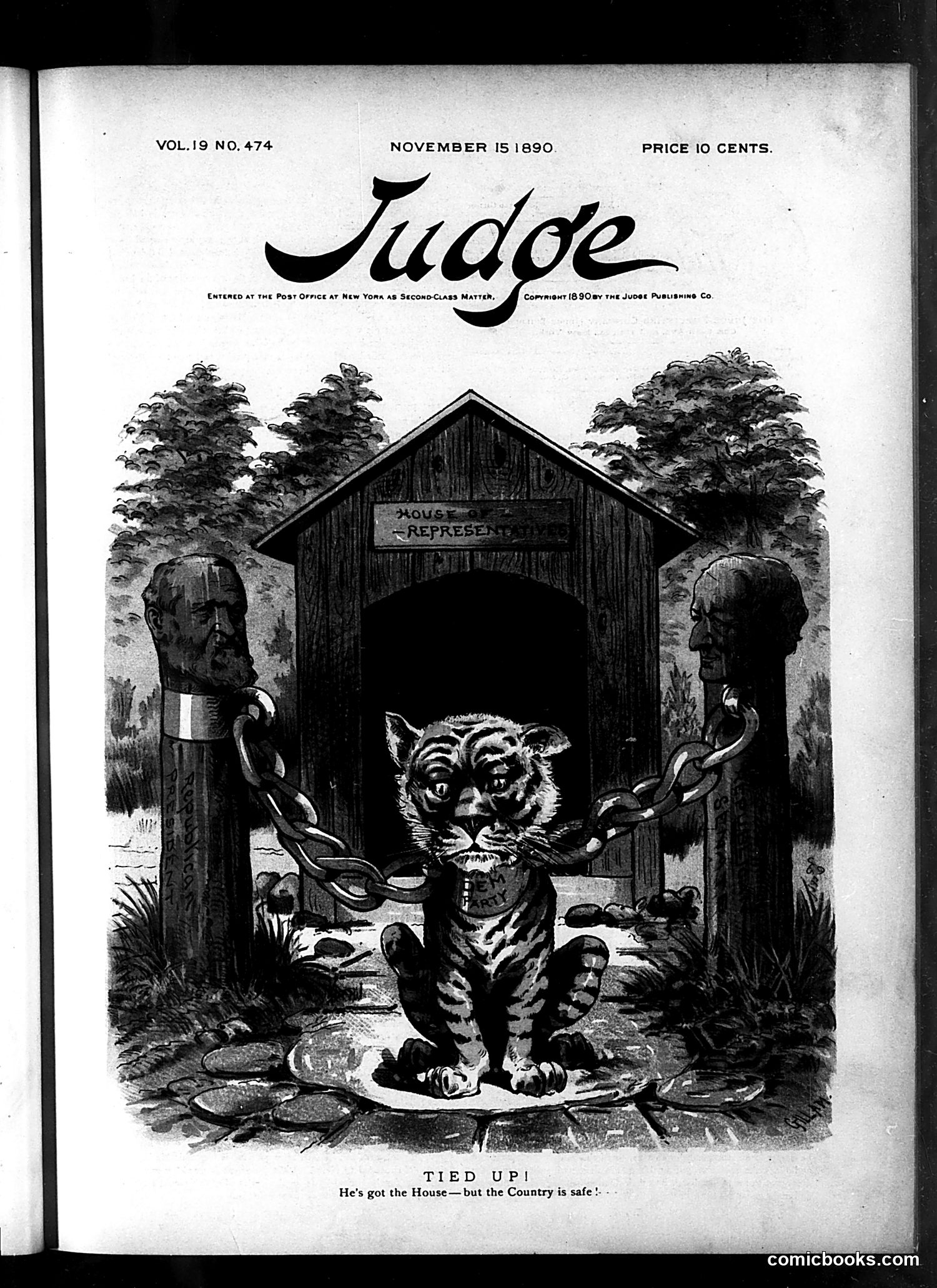
This cartoon depicts a tiger chained between two classical busts, presumably representing political or institutional powers. The tiger—likely symbolizing a dangerous force or threat—is restrained by chains, while the caption reads "He's got the House—but the Country is safe." The "House of Representatives" sign above references the U.S. House of Representatives. The cartoon appears to comment on contemporary political anxieties, suggesting that while some dangerous element (the tiger) has gained control of the House, the nation remains protected by other constitutional checks and balances represented by the flanking busts. Without additional context about 1890 political events, the exact identity of what the tiger represents remains unclear—possibly a political party, leader, or ideology perceived as threatening by Judge magazine's editors.
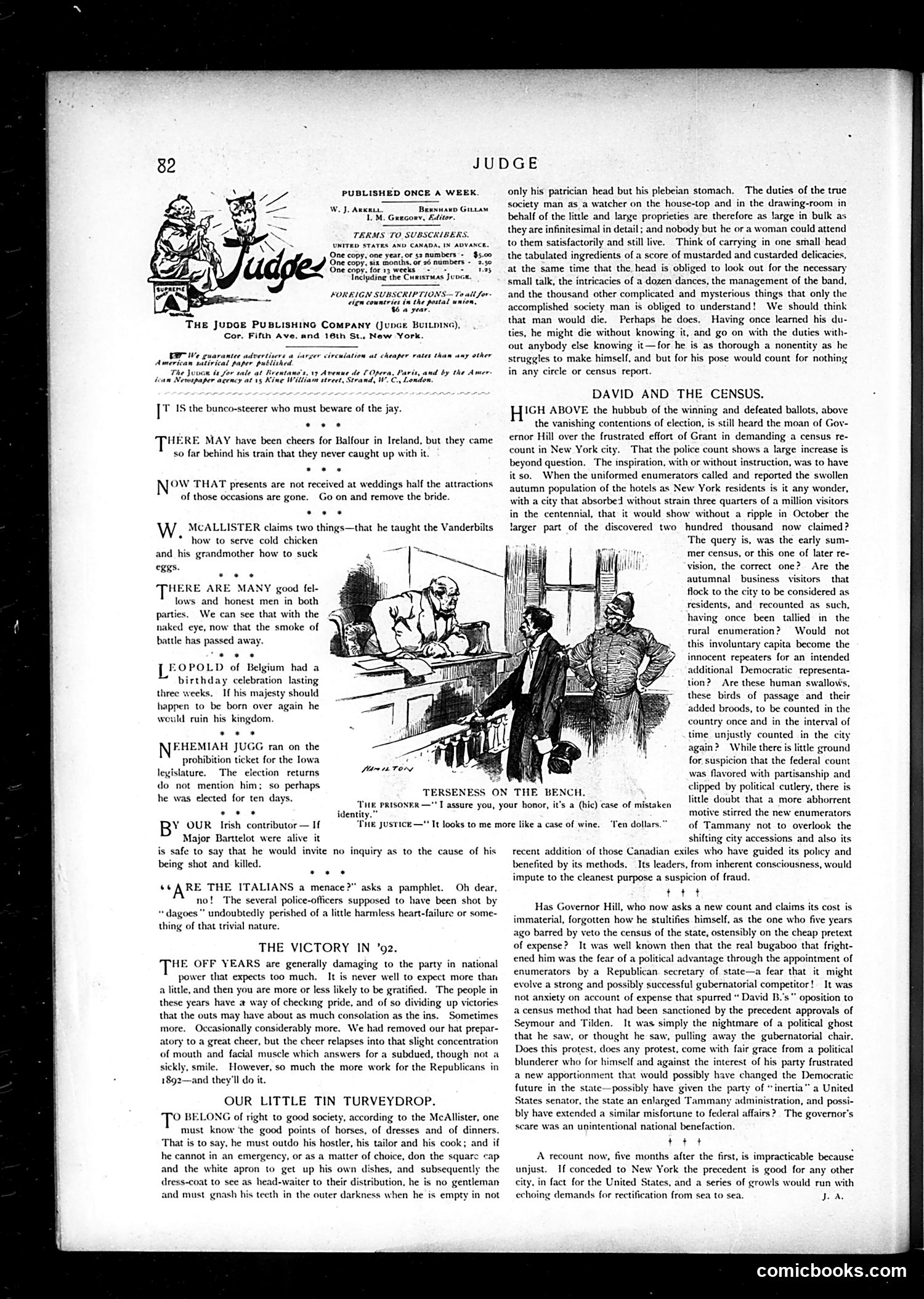
This page contains political commentary on the 1890 U.S. Census and election disputes, particularly referencing Governor David B. Hill of New York. The main cartoon "David and the Census" satirizes controversies over census accuracy and counting methods used for political advantage. The text discusses how census enumerators may have inflated or manipulated population counts—with some rural residents being counted multiple times while city populations were disputed. Hill's administration reportedly challenged the federal census count, likely seeking political advantage. The satire critiques both parties for using census data strategically rather than pursuing accurate enumeration. The cartoon likely depicts Hill (or a representative) examining or manipulating census documents, highlighting the era's widespread suspicion that demographic counts were corrupted by partisan interests rather than conducted impartially.
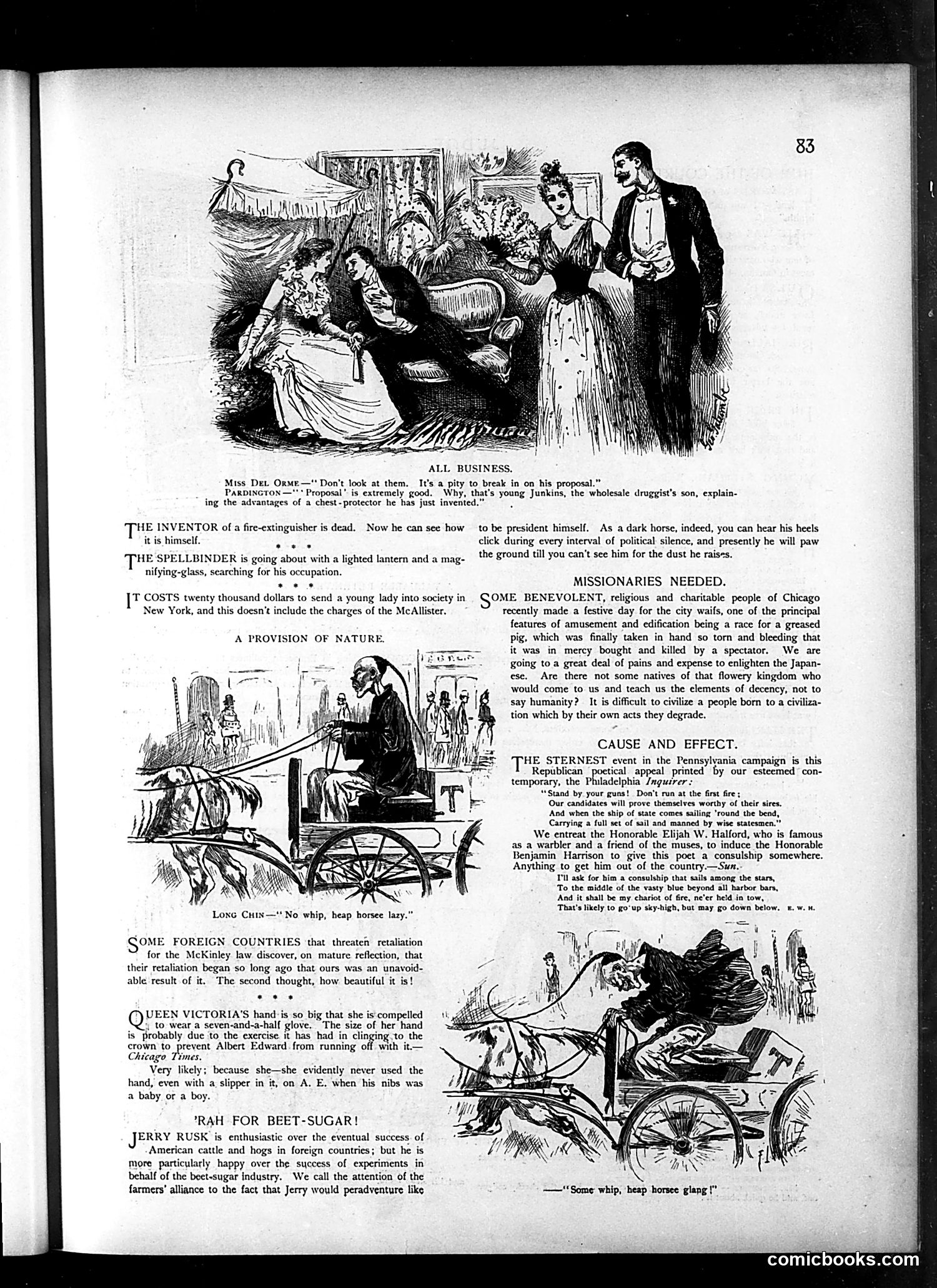
**Top Cartoon ("All Business"):** Shows Miss Del Orme rejecting a marriage proposal from "Proposal," explaining she prefers young Jenkins, a wholesale druggist's son who invented a chest-protector. The satire mocks women's mercenary marriage calculations—valuing a suitor's commercial utility over romantic interest. **Middle Section:** Multiple brief political items, including references to a "dark horse" presidential candidate and Pennsylvania Republican campaign poetry. These appear to be typical satirical commentary on 1890s politics, though specific figures remain unclear without additional context. **Bottom Cartoon ("Some Whip, Keep Horse Giang"):** Depicts a woman falling from a bicycle or carriage, likely satirizing the era's anxieties about women's independence and new technologies like bicycles, presented as physically dangerous or socially destabilizing.
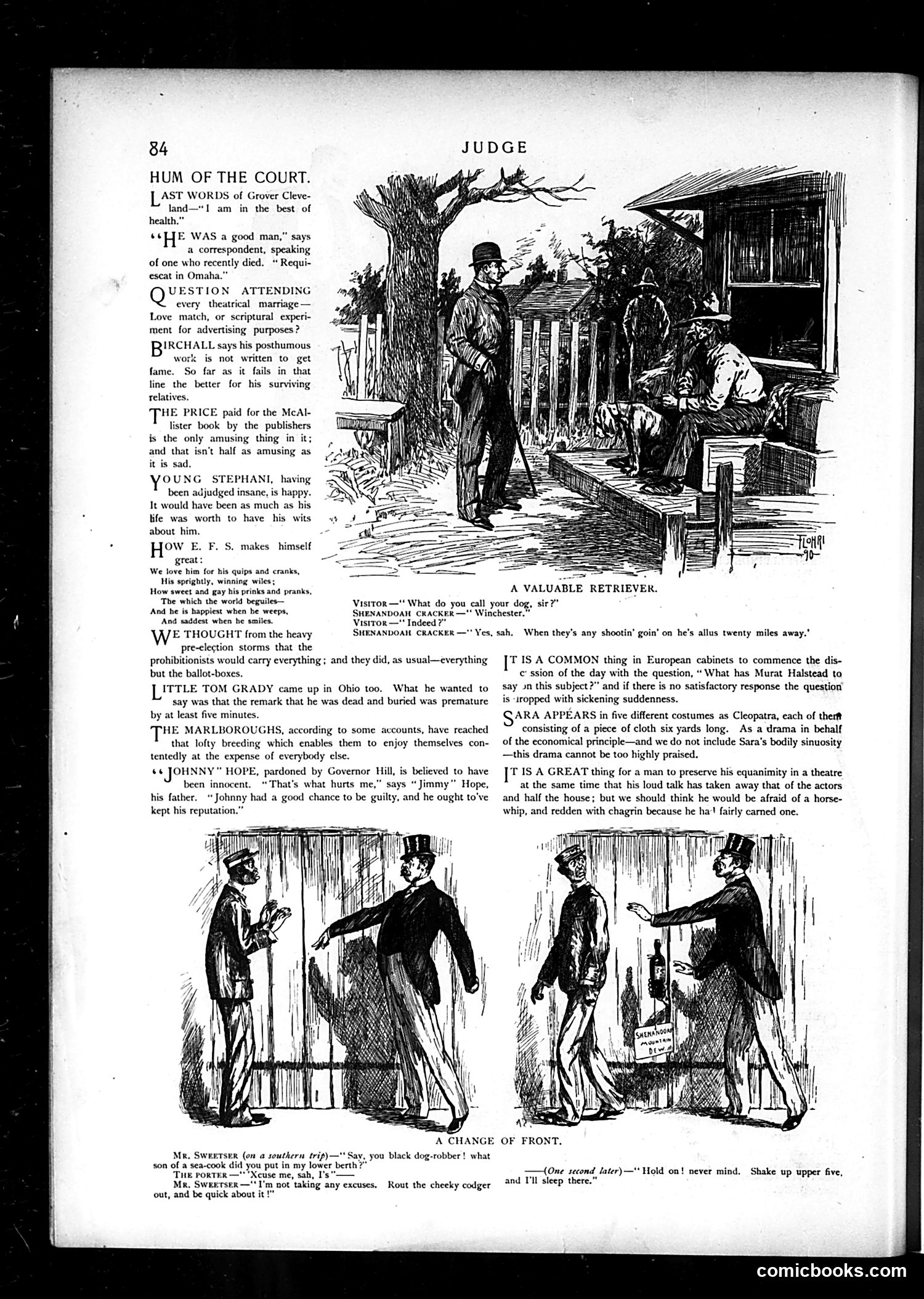
This page collects brief satirical quips and cartoons typical of Judge's format. Key items: **Political references:** Grover Cleveland's claim of good health is mocked as his "last words"—likely referencing political rumors or actual health concerns of the era. **Social commentary:** The cartoons mock class pretension and racial attitudes. "A Change of Front" depicts two gentlemen in top hats—appears to show hypocrisy or inconsistency in their behavior. "A Valuable Retriever" features a Southern character whose dog proves useless, satirizing the region post-Reconstruction. **Theater/entertainment:** References to Sara (likely a contemporary actress appearing in Cleopatra productions) mock excessive minimalism in costume design while praising "economical" theater principles. **Legal/criminal humor:** References to "Johnny Hope" (a pardoned criminal) and various court figures suggest satire of the justice system's apparent failures. The overall tone mocks American social pretension, legal incompetence, and regional stereotypes characteristic of Gilded Age satire.
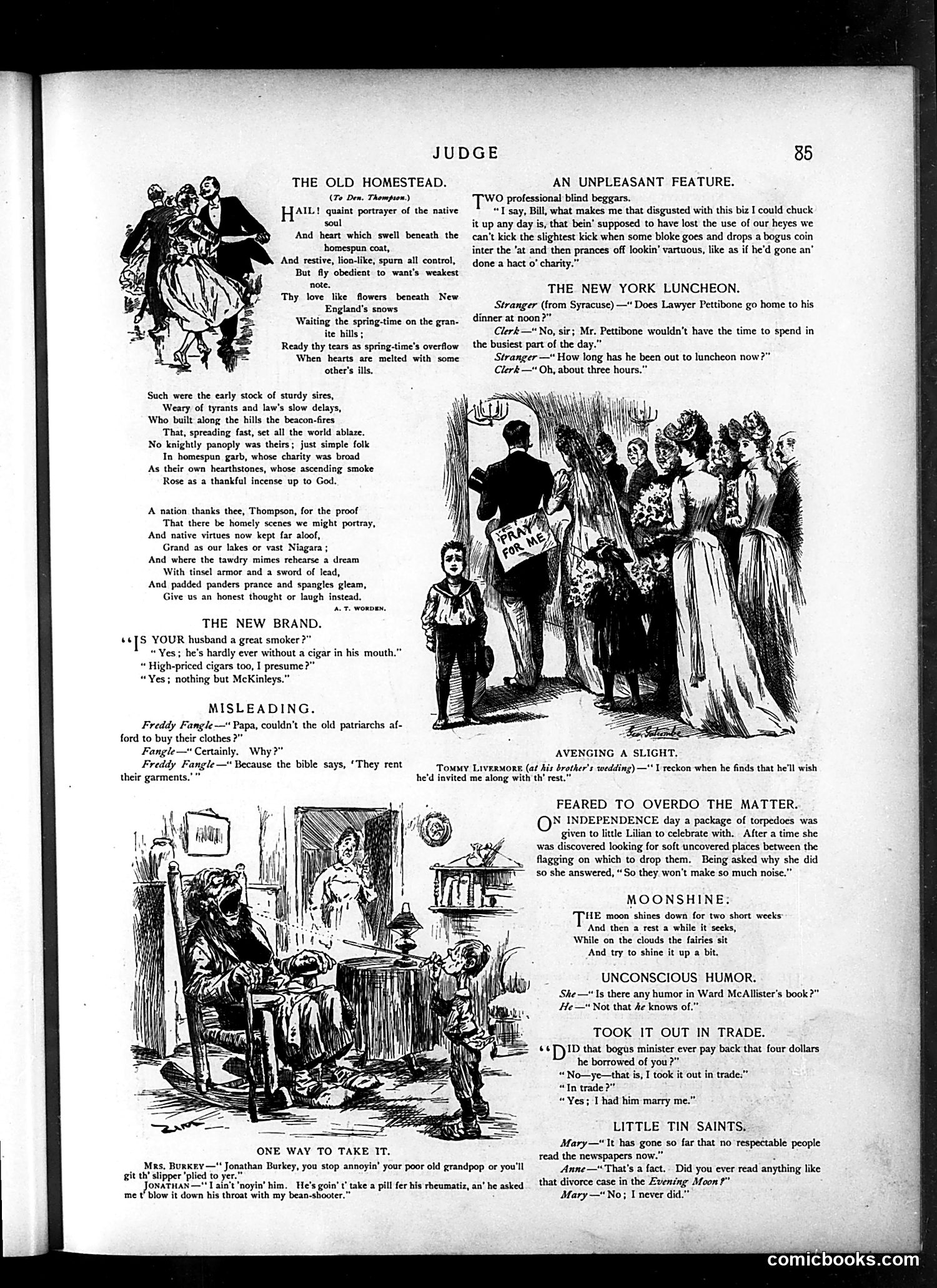
This page contains multiple brief satirical sketches typical of Judge magazine's humor format. **"The Old Homestead"** is a tribute poem to Denman Thompson, playwright of a popular theatrical work celebrating rural American virtue and "homespun" authenticity—contrasting honest native values against theatrical artificiality. **"The New Brand"** jokes about expensive cigars named "McKinleys"—a reference to President William McKinley, suggesting his name had become a commercial product/commodity. **"Misleading"** offers a child's literalist misreading of biblical language ("rent their garments" as purchasing clothes). **"Blind Beggars"** depicts street scammers complaining that fake coins undermine their fraudulent operation. **"The New York Luncheon"** satirizes lawyer Pettibone's three-hour "lunch" absence, implying leisure rather than legal work. The remaining sketches target Independence Day safety negligence, newspaper sensationalism (the "Evening Moon"), and marital/commercial absurdities. The page reflects Gilded Age concerns: commercialism, fraud, theatrical vs. authentic culture, and yellow journalism.
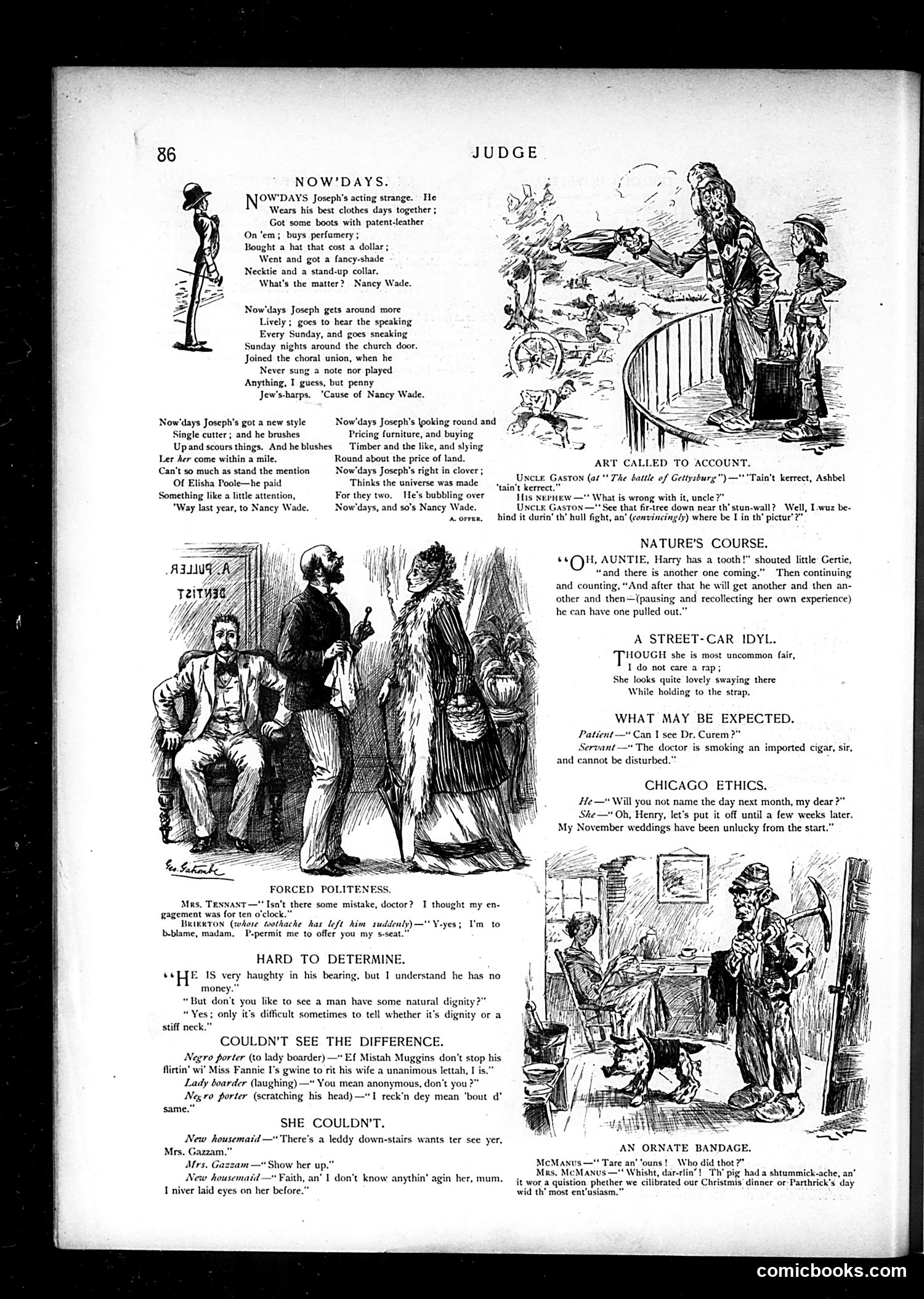
This page from *Judge* contains multiple brief satirical pieces typical of the magazine's humor: **"Now'days"** mocks courtship rituals and social climbing through Joseph's sudden transformation—new clothes, grooming, church attendance, furniture shopping—all triggered by romantic interest in Nancy Wade. The satire targets young men's transparent behavioral changes when pursuing women. **Other sketches** include workplace humor ("Forced Politeness"), racial stereotype humor common to the era (the porter and "anonymous/unanimous" wordplay), and domestic comedy. "Chicago Ethics" jokes about postponing weddings for superstitious reasons. **"Art Called to Account"** appears to reference a Civil War battle painting, with Uncle Gaston critiquing historical accuracy. The cartoons and text collectively represent *Judge*'s formula: gentle mockery of courtship, social pretension, workplace dynamics, and domestic life. The racial humor reflects period attitudes but would be considered offensive today. Overall, it's lighthearted social satire aimed at middle-class American life.
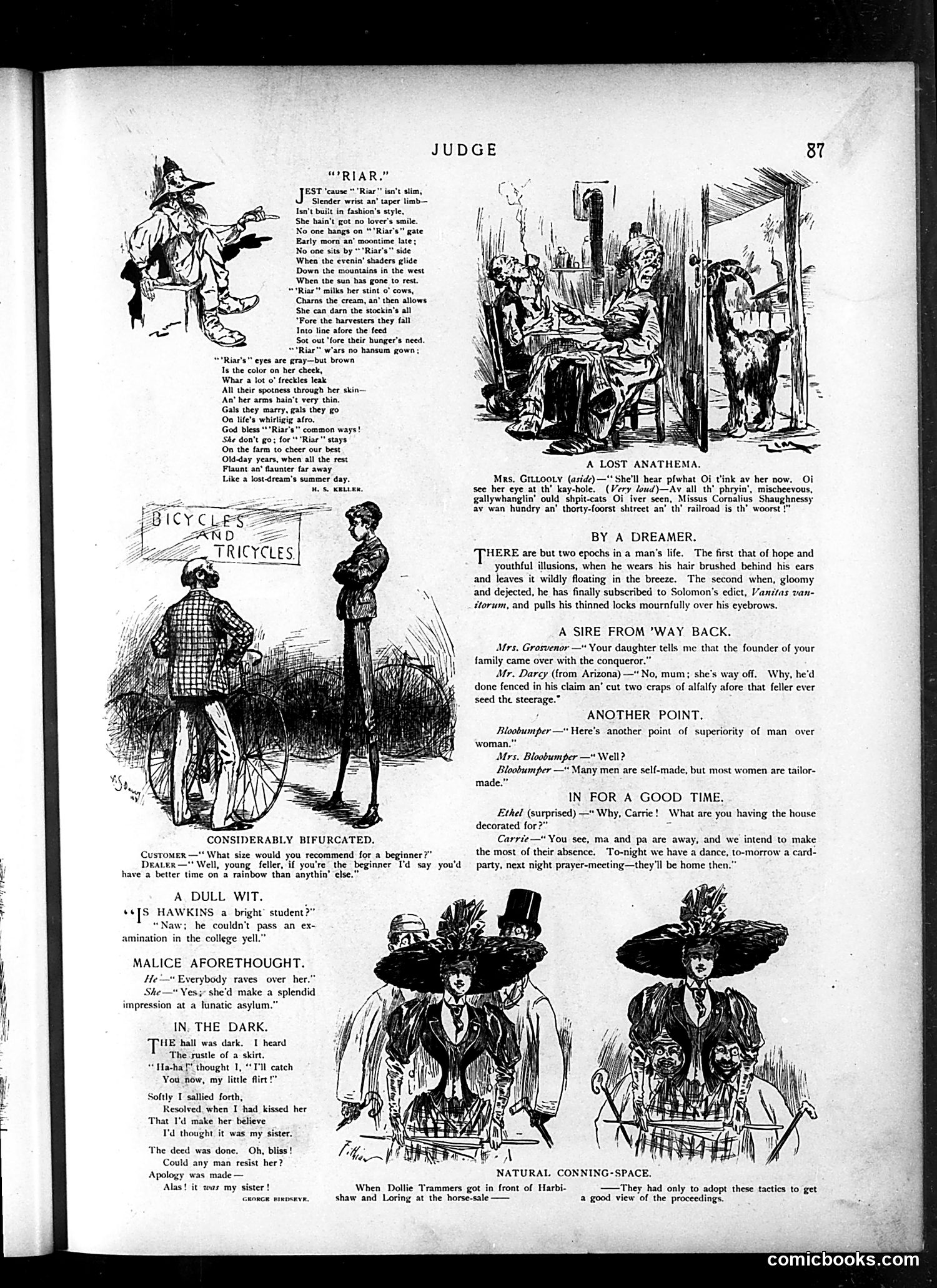
This page contains multiple short humorous pieces typical of early 20th-century American satirical humor: **"Riar"** (top left): A sentimental poem praising a plain, hardworking rural woman who stays home doing farm chores while other girls pursue romance and fashionable city life. The satire mocks both rural simplicity and urban vanity. **Bicycle cartoon**: Two figures with exaggerated proportions discussing tricycles—likely satirizing debates about appropriate exercise equipment for women during an era when cycling was controversial. **Short jokes** throughout mock various targets: incompetent students, insincere flattery, mistaken identity humor, Irish domestic servants (through dialect humor), class pretension, gender stereotypes, and marital assumptions. The final cartoon references a horse sale where a woman's wide hat obscures spectators' views—visual humor about women's fashion excess. Overall, the page reflects period attitudes: mockery of rural life, ethnic/class humor through dialect, traditional gender roles, and physical comedy. The satire is generally gentle rather than biting, targeting universal human foibles rather than specific political events.
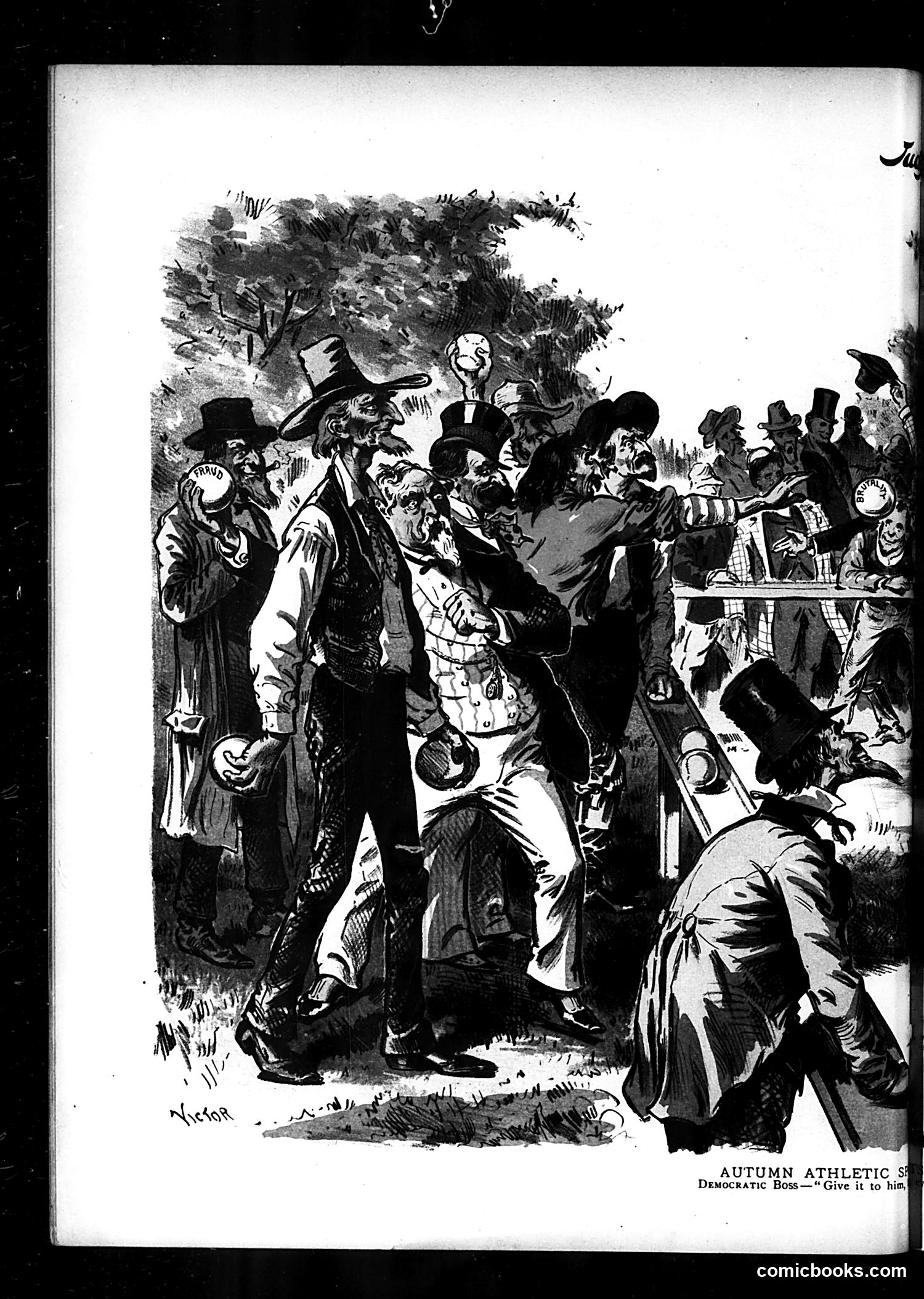
This is a satirical cartoon from *Judge* magazine titled "Autumn Athletic Scene." The caption reads: "Democratic Boss—'Give it to him,'"—suggesting a Democratic party leader urging violence or aggressive action. The image depicts a crowd of well-dressed men in top hats surrounding what appears to be a physical altercation or assault in progress. The "Democratic Boss" figure (likely representing party leadership) is exhorting others to participate in or escalate the violence. The cartoon satirizes Democratic party politics as thuggish and mob-driven, with leadership encouraging brutality. The "autumn athletic scene" framing treats political violence as sport—mocking both the violence itself and the casual acceptance of it within party structures. This reflects late 19th/early 20th-century critiques of urban machine politics and party corruption.
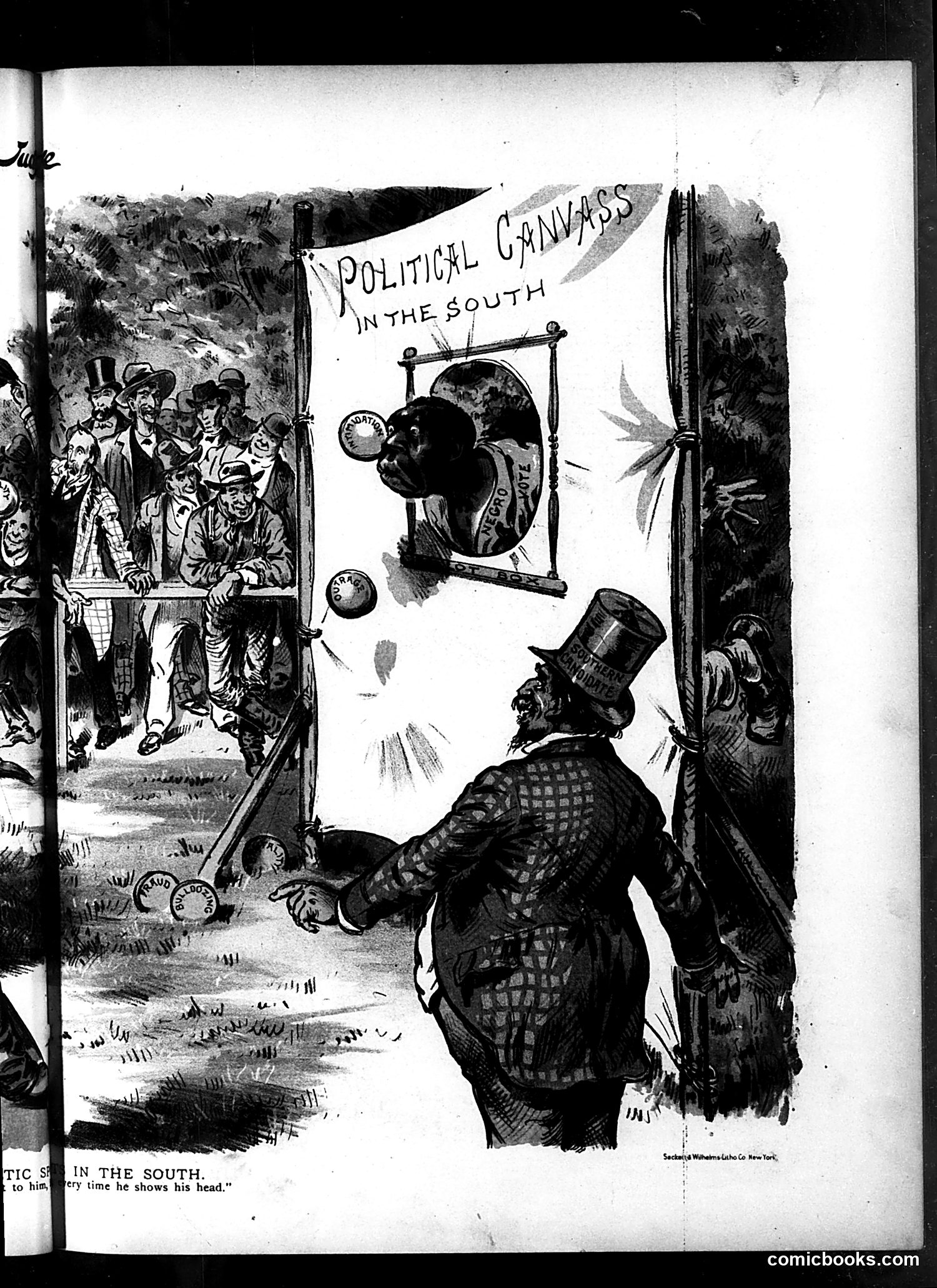
This *Judge* cartoon satirizes post-Reconstruction Southern politics. A caricatured figure in a top hat (likely representing a Northern Republican or carpetbagger) displays himself on a canvas labeled "Political Canvas in the South," with audience members observing from a platform. Cannonballs scatter below, suggesting violence or conflict. The satire targets the volatile, contentious nature of Southern political engagement during Reconstruction era. The "canvas" metaphor suggests Southern politics is a painted artifice—a performance or con rather than genuine governance. The scattered ammunition references the actual violence accompanying Reconstruction-era voting and political organizing. The incomplete caption references showing one's head, implying danger for political figures in the South—reflecting real threats faced by both Black voters and Republican politicians during this period.
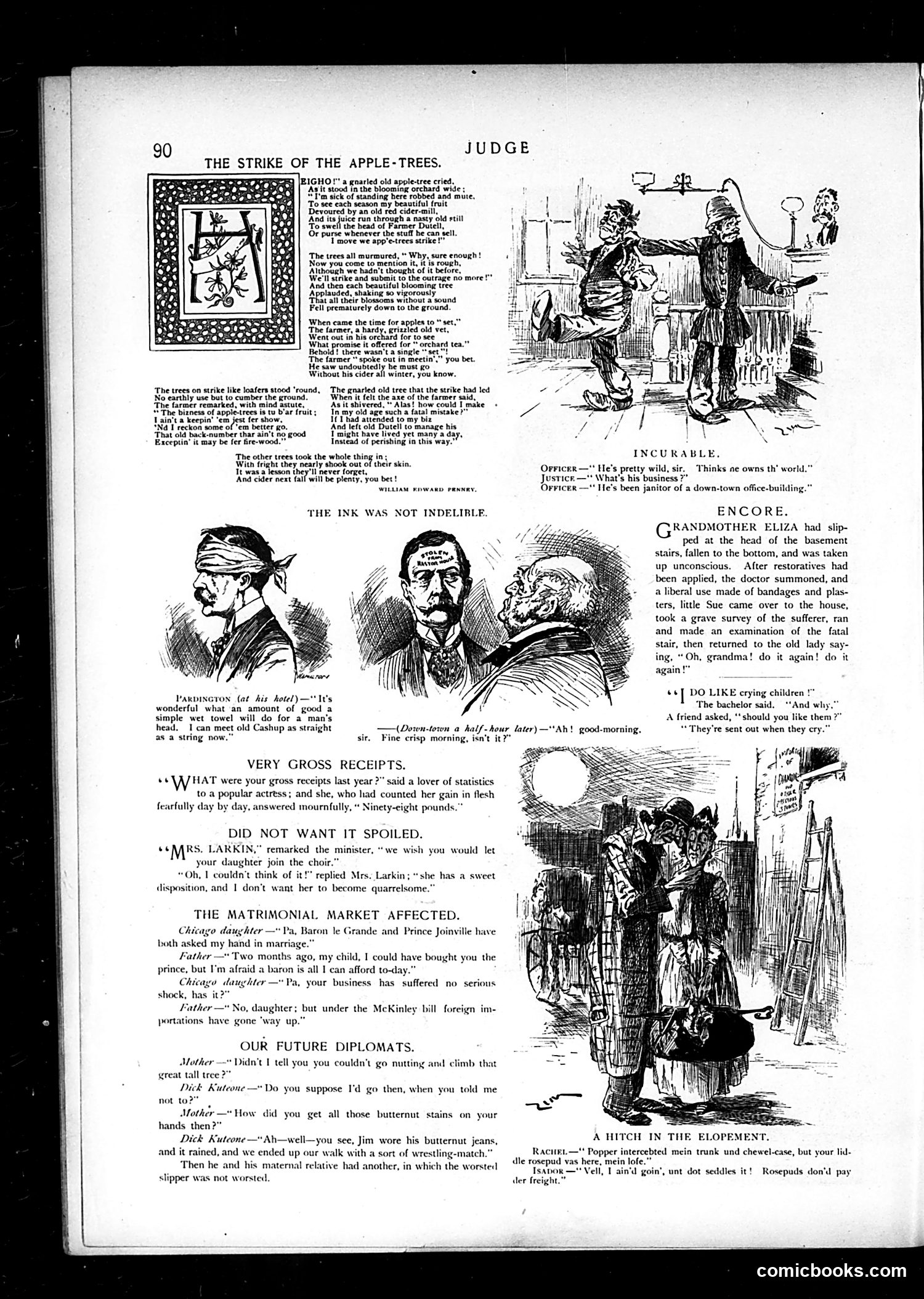
This page contains multiple satirical pieces typical of Judge's social commentary: **"The Strike of the Apple-Trees"** (main poem/narrative): An allegorical critique of labor strikes. Apple trees unionize to protest being harvested for cider, refusing to bear fruit. The farmer responds by cutting down the ringleader. The moral: striking workers harm themselves—the farmer simply destroys the "problem," leaving strikers worse off. This reflects anti-labor sentiment common in Gilded Age publications, treating worker protest as foolish and self-defeating. **Smaller humorous vignettes** satirize contemporary social issues: an "incurable" wild office janitor, a grandmother who enjoys falling downstairs, and economic anxieties (an actress measuring wealth in pounds gained; a Chicago father noting import tariffs affect marriage prospects under McKinley's trade policies). The cartoons use exaggerated facial features and working-class dialect typical of the era's satirical style. Overall, the page reflects Judge's conservative, pro-business perspective dismissing labor organization while poking fun at social pretensions and economic uncertainty.
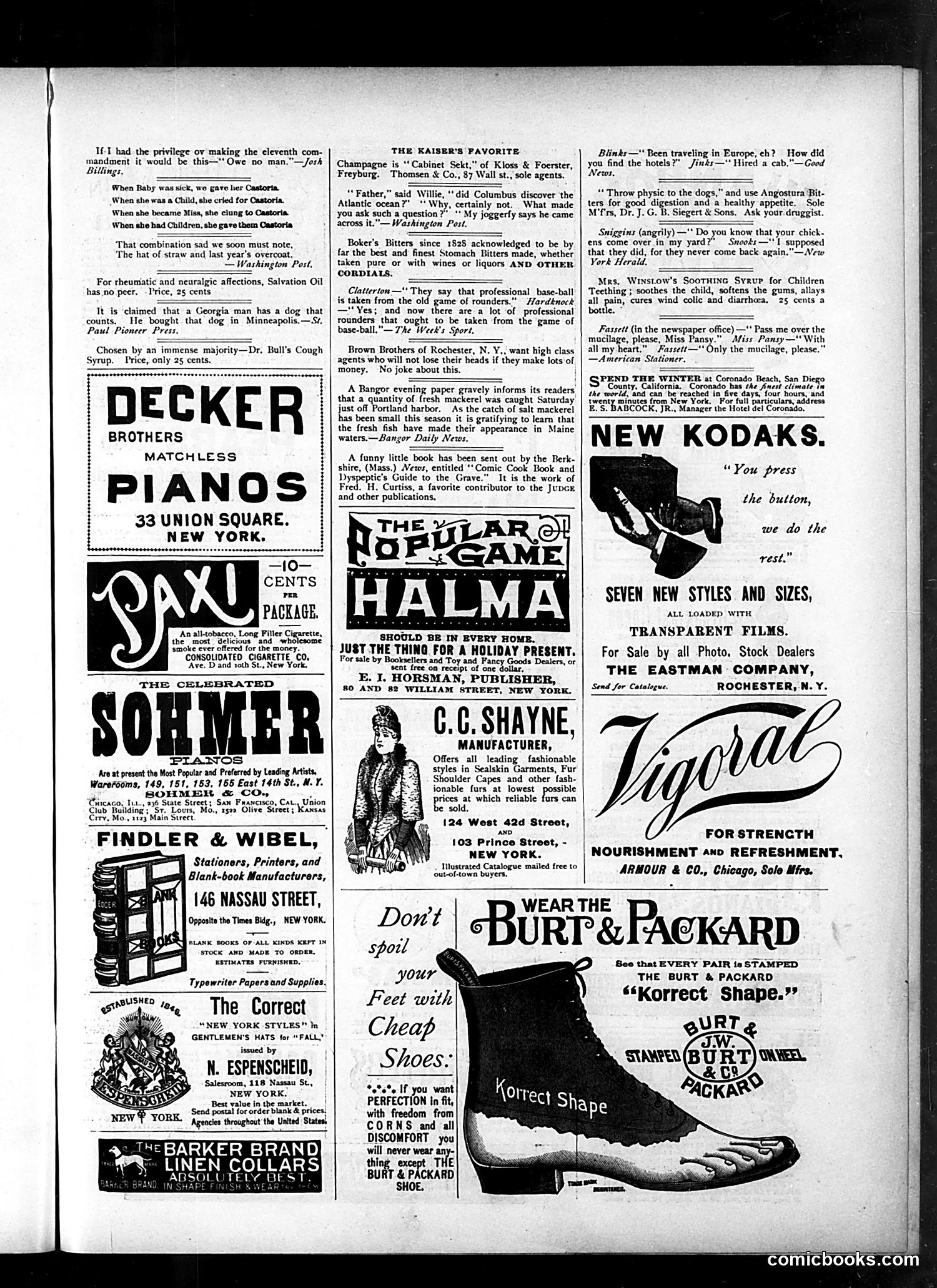
This page is **primarily advertisements** with minimal editorial content. The few satirical items are brief, disconnected observations rather than developed cartoons: **Satirical Content:** - A quip about Columbus discovering the Atlantic Ocean (playing on the phrase "discover America") - A joke contrasting professional baseball's origin in "rounders" with professional gamblers who should be removed from the game - Observations about a Georgia man's counting dog and fresh mackerel appearing in Maine waters **Context for Modern Readers:** These are lightweight humor pieces typical of 19th-century magazines—topical wordplay and social commentary rather than visual satire. The Columbus joke assumes reader familiarity with that historical narrative. The baseball reference reflects late-1800s anxieties about gambling and corruption in sports. **Advertisements dominate**, promoting pianos, hats, shoes, champagne, and patent medicines—standard for Judge's revenue model. The "Kaiser's Favorite" champagne ad appears to reference German imperial preference, likely dating this to the pre-WWI era.
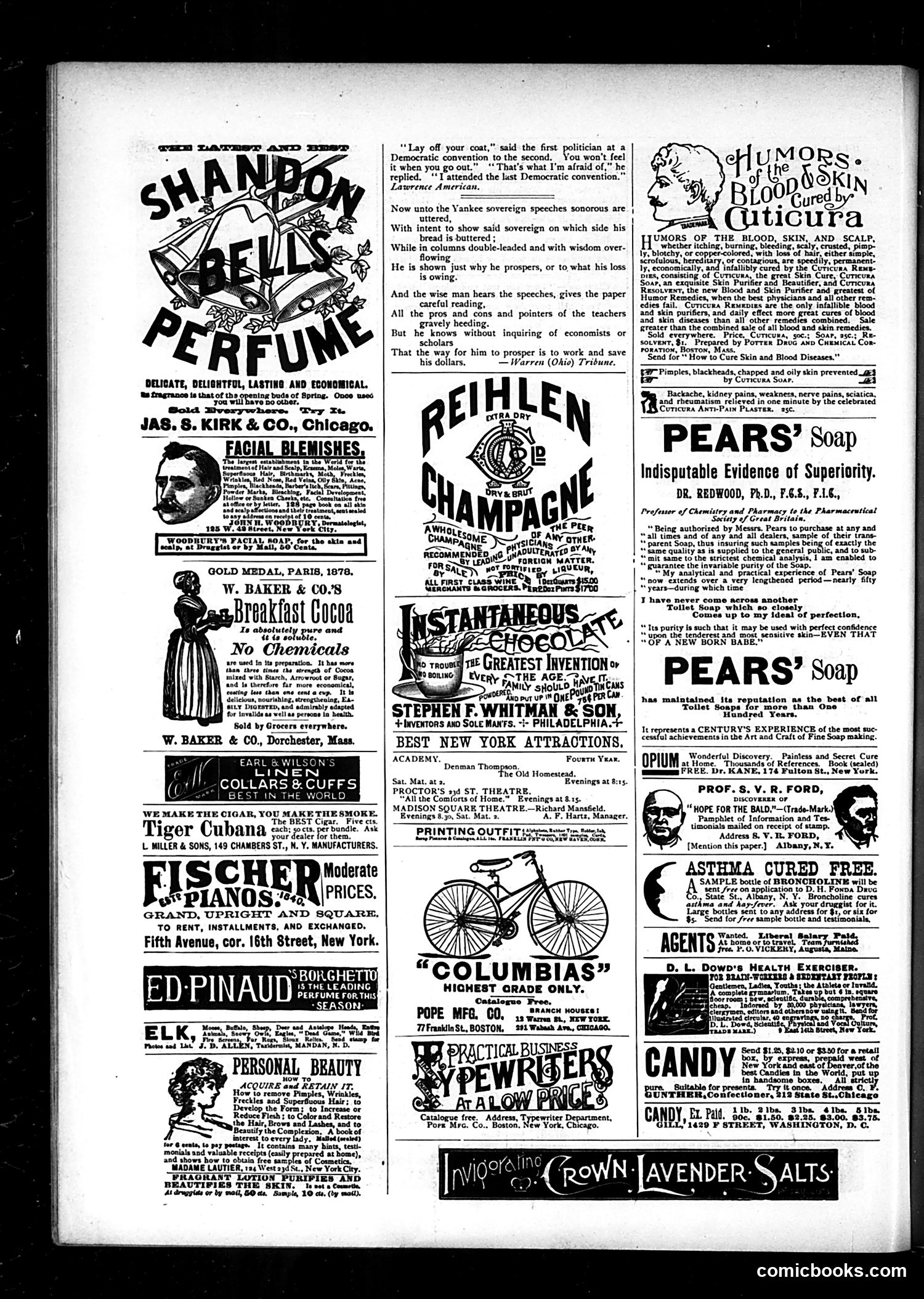
This page is primarily **advertising**, not political satire. The visible content consists almost entirely of commercial advertisements for products like perfume, cocoa, soap, pianos, and patent medicines popular in the late 19th century. However, there is **one brief political joke** embedded among the ads: A dialogue between two politicians at a Democratic convention. The first suggests the second remove his coat before leaving, claiming he won't notice its absence. The second replies he's afraid precisely *because* he attended the last Democratic convention—implying the party stripped him of valuables or left him impoverished. This satirizes the **Democratic Party's perceived financial mismanagement or corruption**, suggesting attendance at Democratic events results in financial loss. The joke relies on contemporary concerns about party politics and economic hardship, likely reflecting late-19th-century partisan tensions. The remaining content is purely commercial.
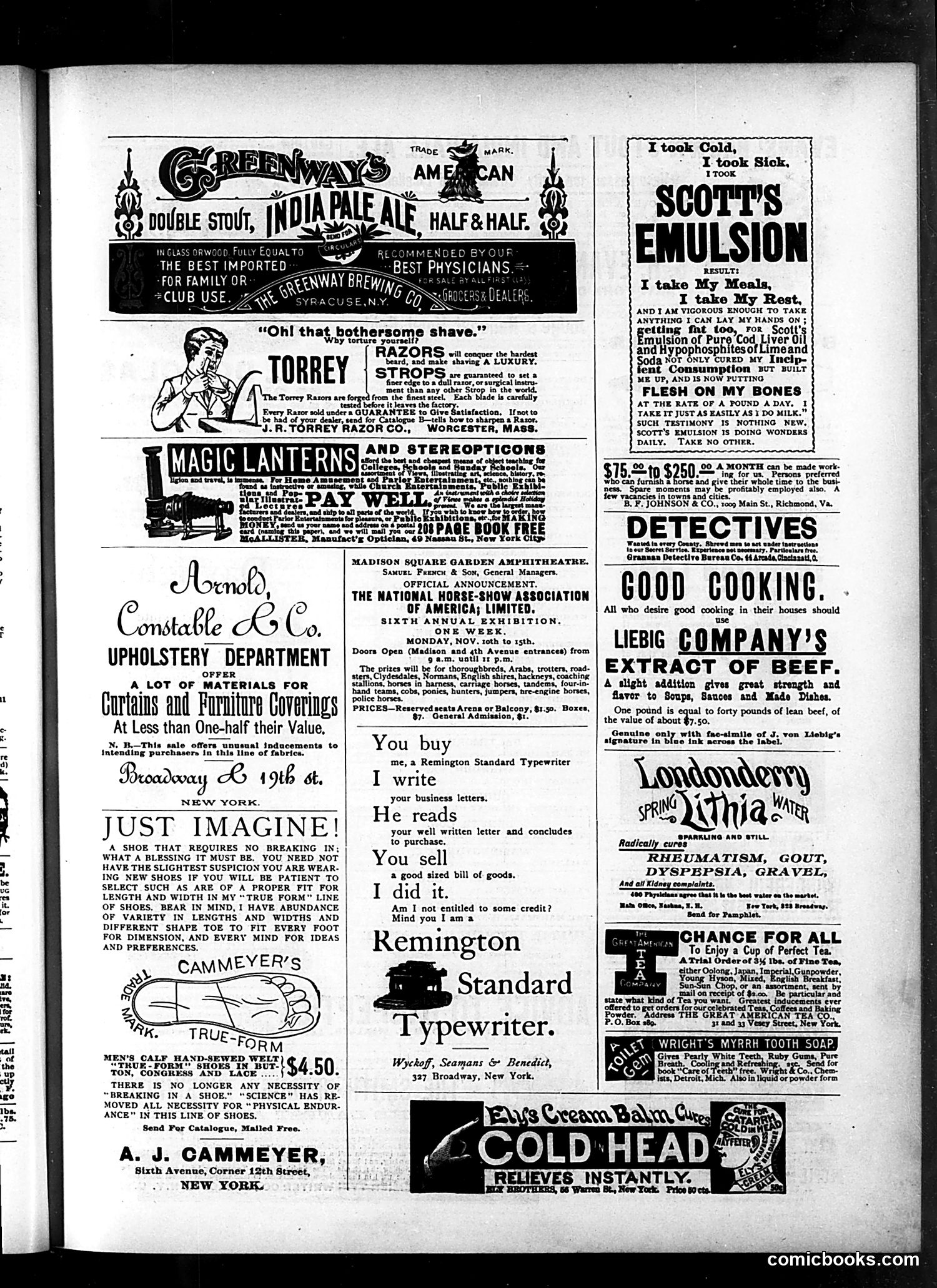
This is primarily an **advertising page** from Judge magazine, not a political cartoon. The page consists almost entirely of commercial advertisements typical of the early 1900s. Notable ads include: - **Greenway's American Ale** (brewing company) - **Torrey Razors** (shaving equipment) - **Magic Lanterns and Stereopticons** (early projection devices for entertainment) - **Remington Standard Typewriter** — featuring a narrative explaining how the typewriter's quality writing helps close business sales - **Scott's Emulsion** (cod liver oil supplement, marketed for tuberculosis/consumption treatment) - **Liebig Company's Extract of Beef** (meat concentrate for cooking) - Various shoe, upholstery, and horse-show advertisements The **Remington ad** is the most narrative-driven, using a cause-and-effect sales pitch: the typewriter produces professional letters → readers are impressed → sales result. There are no significant political cartoons or satire visible on this page.
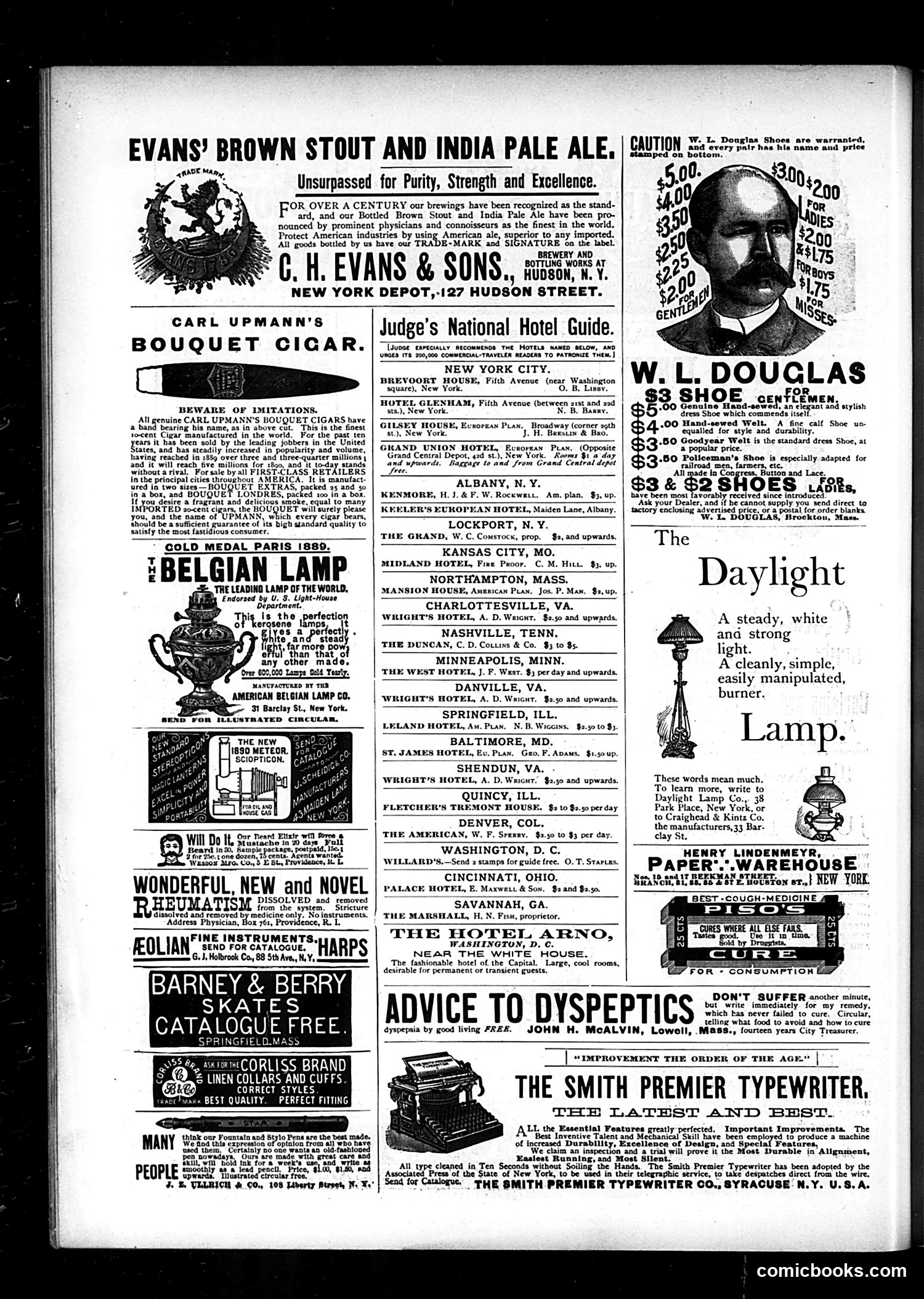
This page consists almost entirely of **period advertisements** rather than editorial cartoons or satirical content. The ads showcase consumer products and services typical of the 1890s: beer, cigars, shoes, lamps, typewriters, patent medicines, and hotels. The only marginally satirical element is the **W.L. Douglas shoe advertisement** featuring a portrait of a well-dressed man labeled "Gentleman"—a straightforward marketing claim about quality footwear. The **Hotel Guide section** functions as editorial content recommending establishments for "commercial-traveler readers"—a nod to the traveling salesman audience. The **"Advice to Dyspeptics"** section at bottom is a typical period medical advertisement promising cures for indigestion through "good living." Overall, this page demonstrates Judge's business model: combining space for advertisements and commercial directories with entertainment content elsewhere in the magazine. Without other editorial material visible, the satirical or political commentary Judge was known for is absent here.
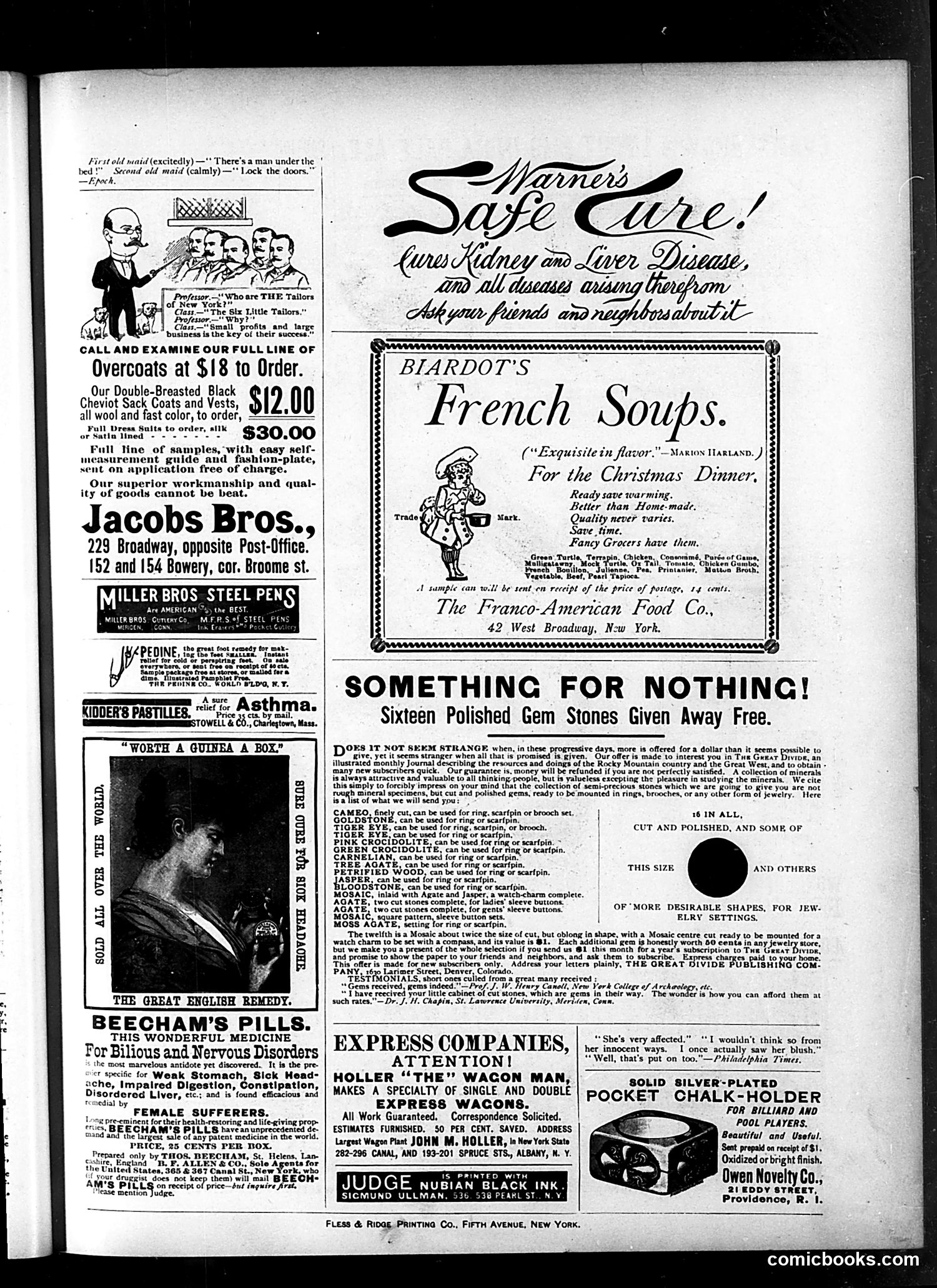
This page is primarily **advertising**, not political satire. The dominant content consists of commercial advertisements for clothing (Jacobs Bros. tailors), food products (Biardot's French Soups, Franco-American Food Co.), patent medicines (Beecham's Pills for digestive complaints), and a promotional offer for polished gemstones. The only cartoon appears at the top—a small, mild joke about two elderly unmarried women discovering an intruder under a bed. One exclaims in alarm; the other calmly suggests locking doors. The humor relies on the innocent (or coy) implication that an unmarried woman finding a man in her bedroom is scandalous. The gemstone promotion ("Something for Nothing!") emphasizes that readers receive actual polished stones suitable for jewelry mounting—not rough specimens—when they subscribe to what appears to be a Western/Rocky Mountain regional publication. This is a typical late-19th or early-20th century magazine layout mixing editorial content with extensive advertising.
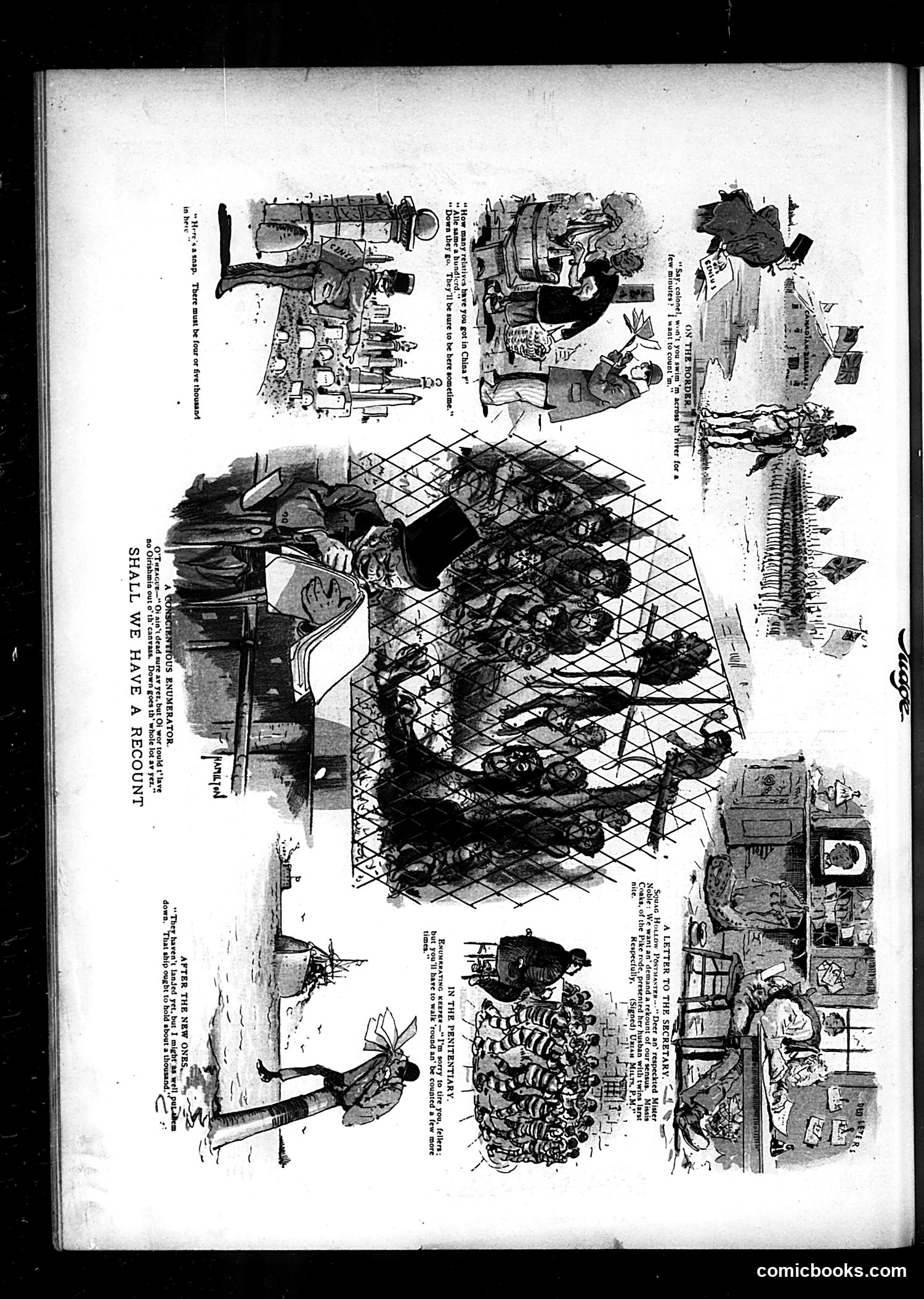
This Judge magazine page contains satirical cartoons about immigration. The central large cartoon depicts a crowded ship arriving with immigrants, surrounded by smaller vignettes showing various scenes of immigrant life and integration in America. The main caption "SHALL WE HAVE A RECKONING?" suggests anxiety about immigration policy and numbers. One visible quote—"That ship ought to hold about a thousand"—indicates satire about the volume of arriving immigrants and questions about American capacity to absorb them. The surrounding illustrations appear to depict stereotypical scenes of immigrant experiences: domestic life, work, cultural practices, and social interactions. This reflects late 19th or early 20th-century American anxieties about immigration waves, particularly from Southern and Eastern Europe. The satire targets both anti-immigrant sentiment and the debate over immigration policy during this era of mass immigration.