
Judge, 1890-11-15 · page 7 of 16
Judge — November 15, 1890 — page 7: what you’re looking at
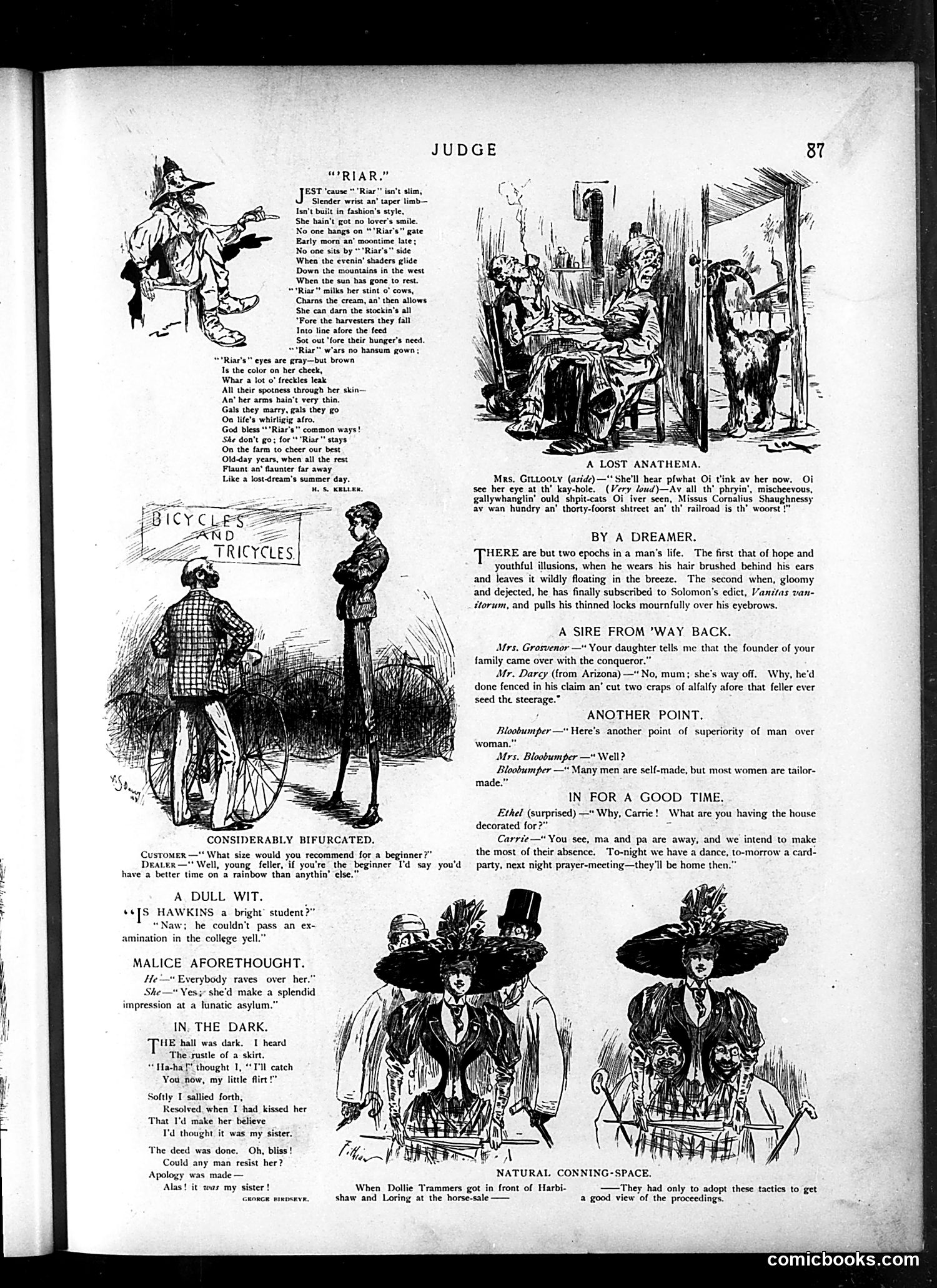
What you’re looking at
This page contains multiple short humorous pieces typical of early 20th-century American satirical humor: **"Riar"** (top left): A sentimental poem praising a plain, hardworking rural woman who stays home doing farm chores while other girls pursue romance and fashionable city life. The satire mocks both rural simplicity and urban vanity. **Bicycle cartoon**: Two figures with exaggerated proportions discussing tricycles—likely satirizing debates about appropriate exercise equipment for women during an era when cycling was controversial. **Short jokes** throughout mock various targets: incompetent students, insincere flattery, mistaken identity humor, Irish domestic servants (through dialect humor), class pretension, gender stereotypes, and marital assumptions. The final cartoon references a horse sale where a woman's wide hat obscures spectators' views—visual humor about women's fashion excess. Overall, the page reflects period attitudes: mockery of rural life, ethnic/class humor through dialect, traditional gender roles, and physical comedy. The satire is generally gentle rather than biting, targeting universal human foibles rather than specific political events.
📄 Transcribed text from this page (OCR, searchable)
Machine-transcribed from the original scan — historical spelling and the odd misread are preserved.
ORIAR.” EST ‘cause “’Riar”’ isn’t slim, Slender wrist an’ taper limb— Isn't built in fashion’s style, She hain’t got no lover's smile. No one hangs on “'Riar's” Early morn an‘ moontime late; When the evenin’ shaders glide Down the mountains in the west ‘When the sun has gone to rest. *'Riar” milks her stint 0° cows, Charns the cream, an’ then allows ‘She can darn the stockin’s all *Fore the harvesters they fall Into line afore the feed Sot out ‘fore their hunger’s need. ‘"Riar” w'ars no hansum gown; “'Riar’s” eyes are gray—but brown Is the color on her cheek, Whar a lot o° freckles leak All their spotness through her skin— ‘An’ her arms hain’t very thin. Gals they marry, gals they go gig afro. Ske don't go; for On the farm to cheer our best Old-day years, when all the rest Flaunt an‘ flaunter far away CONSIDERABLY BIFURCATED. “What size would you recommend for a beginner?” Well, young feller, if you're the beginner I'd say you'd have a better time on a rainbow than anythin’ else.” A DULL WIT. ‘¢]S HAWKINS a. bright” student?” Naw; he couldn't pass an ex- amination in the college yell.” MALICE AFORETHOUGHT. He'— Everybody raves over her.” Yes; she'd make a splendid impression at a lunatic asylum.” IN. THE DARK. THE hall was dark, 1 heard The sustle of a skirt. “Hacha{" thought 1, “TI catch You now, my little flirt !” Softly I sallied forth, Resolved, when I had kissed her That I'd make her believe T'd thought it was my sister. ‘The deed was done. Oh, bliss! Could any man resist her? Apology was made — Alas! it was my sister! A LOST ANATHEMA. Mrs. GILLOOLy (aside)—"' She'll hear pfwhat Oi t'ink av her now. Oi see her eye at th’ kay-hole. (Very loud)—Av all th’ phryin’, mischeevous, gallywhanglin’ ould shpit-cats Oi iver seen, Missus Cornalius Shaughnessy ay wan hundry an’ thorty-foorst shtreet an’ th’ railroad is th’ woorst !” BY A DREAMER. THERE are but two epochs in a man’s life. The first that of hope and youthful illusions, when he wears his hair brushed behind his ears and leaves it wildly floating in the breeze. The second when, gloomy and dejected, he has finally subscribed to Solomon's edict, Vanifas van- #orum, and pulls his thinned locks mournfully over his eyebrows. A SIRE FROM 'WAY BACK. Mrs. Grosvenor —*Your daughter tells me that the founder of your family came over with the conqueror.” Mr. Darcy (from Arizona) —“ No, mum; she’s way off. Why, he'd done fenced in his claim an’ cut two craps of alfalfy afore that feller ever seed the steerage.” ANOTHER POINT. Bloobumper —" Here's another point of superiority of man. over woman.” Mrs. Bloobumper —* Well? Bloobumper —" Many men are self-made, but most women are tailor- made.” IN FOR A GOOD TIME, Ethel (surprised) —" Why, Carrie! What are you having the house decorated for? z Carrie— You see, ma and pa are away, and we intend to make the most of their absence. To-night we have a dance, to-morrow a card- party, next night prayer-meeting—they'll be home then.” NATURAL CONNING-SPACE, CRORGR RIRDSKVE, When Dollie Trammers got in front of Harbi- shaw and Loring at the horse-sale— —They had only to adopt these tactics to get a good view of the proceedings. comicbooks.com