
A complete issue · 17 pages · 1890
Judge — October 4, 1890
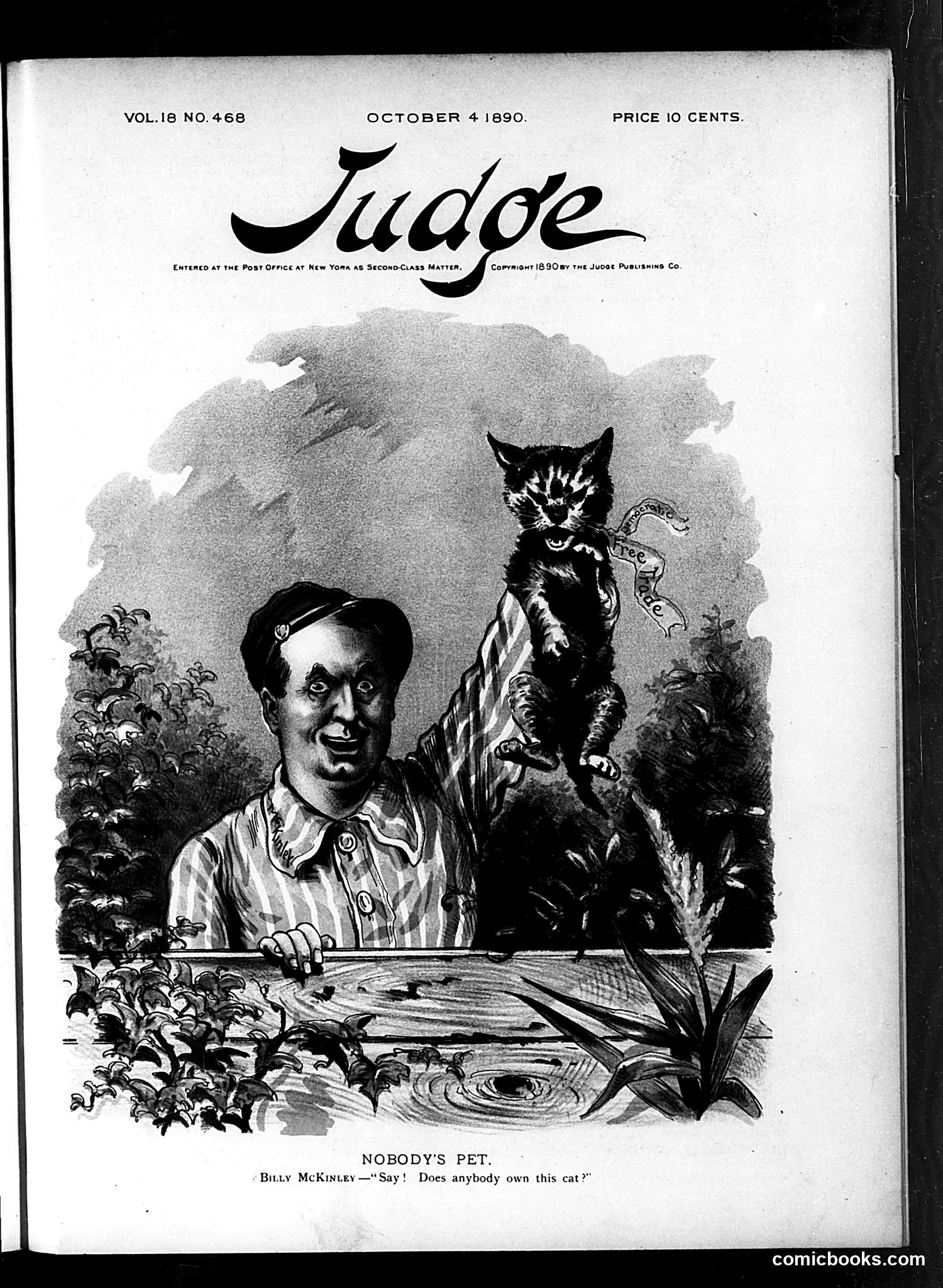
This cartoon features **Billy McKinley** asking "Say! Does anybody own this cat?" The image shows a man in a striped shirt holding a black cat near water with vegetation. The satire likely references **William McKinley**, who would become the 25th U.S. President (elected 1896). At this 1890 moment, McKinley was a prominent Republican congressman. The "stray cat" metaphor appears to be political commentary—possibly suggesting McKinley's political allegiances or status were unclear or shifting, or that he lacked firm party loyalty. The questioning tone implies ambiguity about whose interests he truly served. The exact political context remains somewhat unclear without additional historical documentation, but the humor relies on equating McKinley's political position to an ownerless, undefined entity.
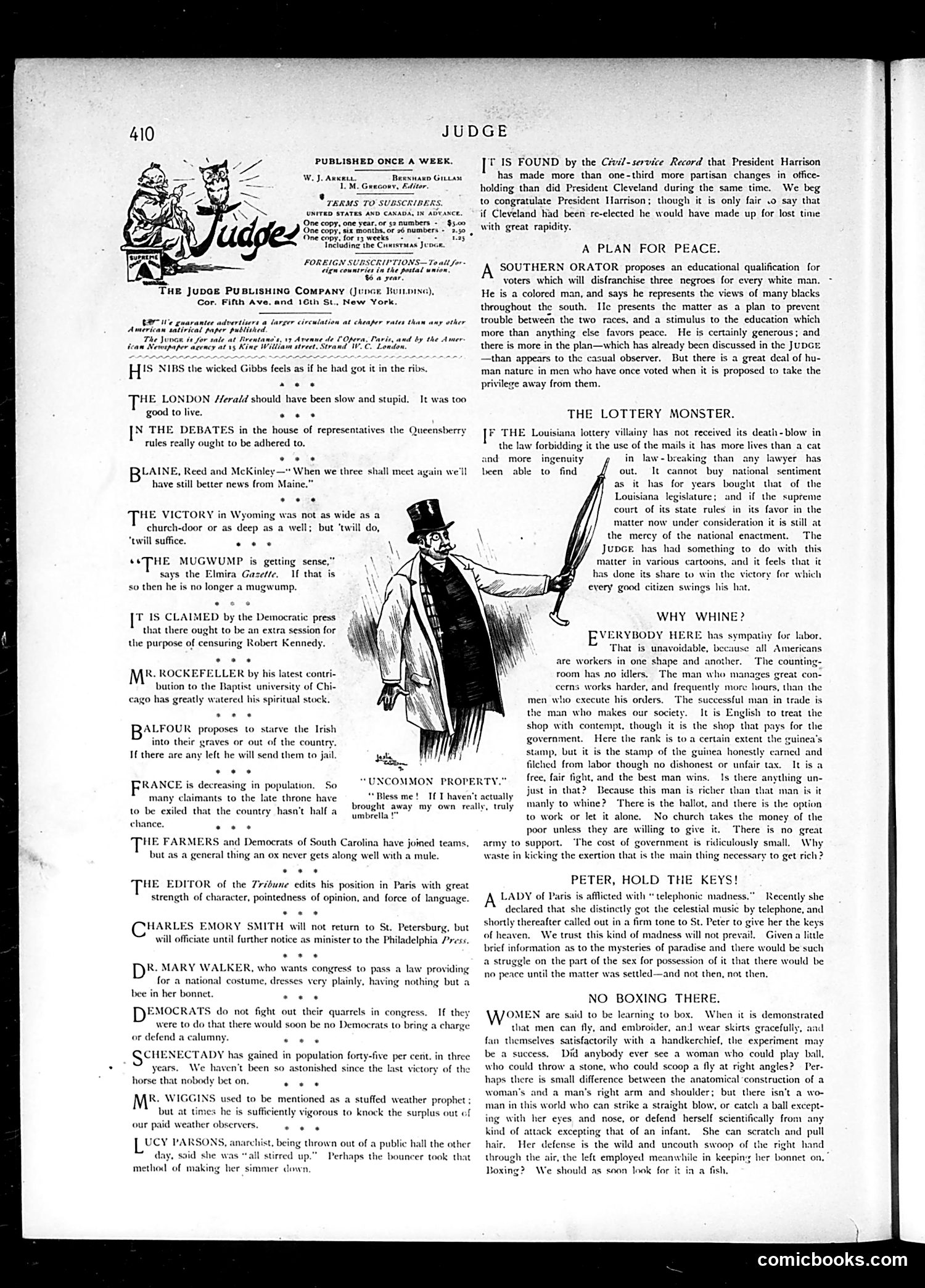
This page contains short editorial commentary typical of Judge magazine's satirical style. The visible cartoon depicts a figure in formal attire holding what appears to be a lottery ticket or gambling implement, labeled "THE LOTTERY MONSTER." This illustrates the article's criticism of Louisiana's state lottery system, which Judge characterizes as morally corrupt and exploitative—comparing it unfavorably to legal challenges faced by lawyers. The editorial snippets address various political topics: President Harrison's partisan office appointments compared to Cleveland's, a Southern proposal for voter "educational qualifications" (likely a veiled reference to discriminatory voting restrictions), and commentary on labor issues and government spending. The overall tone reflects Judge's role as a forum for conservative political criticism during the Gilded Age period.
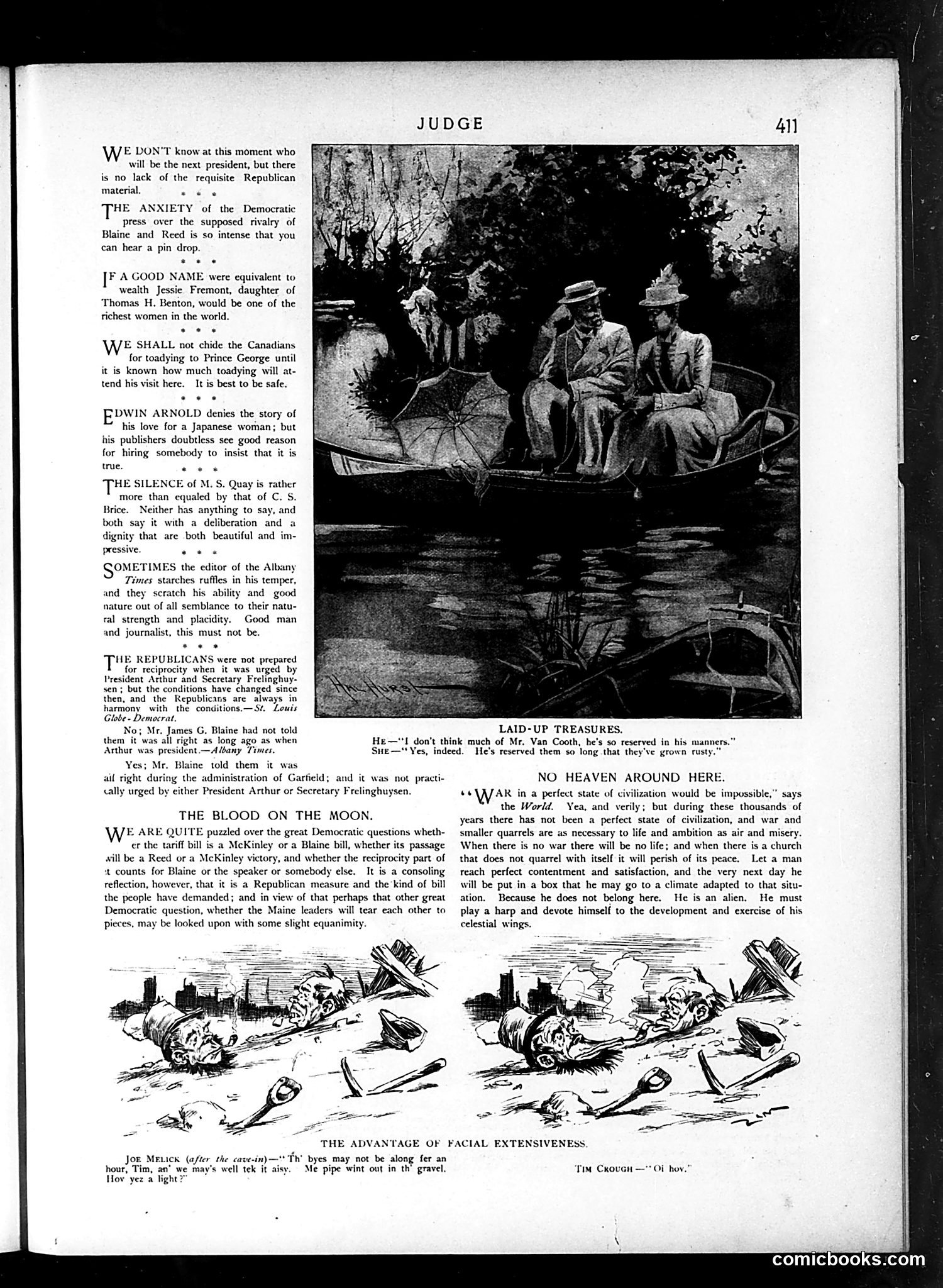
This page contains multiple editorial commentaries and cartoons addressing early 20th-century political topics: **"Laid-Up Treasures"** (top photograph): Shows men in a rowboat, apparently illustrating a comment about Mr. Van Cogh's manners and reserved behavior. **"No Heaven Around Here"** (text section): Discusses war and civilization, arguing that perfect civilization is impossible because war and conflict are necessary constants. The passage suggests that without strife, life becomes stagnant. **"The Advantage of Facial Extensiveness"** (bottom cartoons): Two nearly identical sketches showing wreckage/destruction, with captions by "Joe Melick" and "Tim Crough" making jokes about pipe smoking and survival—likely satirizing differing perspectives on the same disaster. The overall tone reflects Judge's typical satirical approach to contemporary social and political commentary, though specific historical references require additional context.
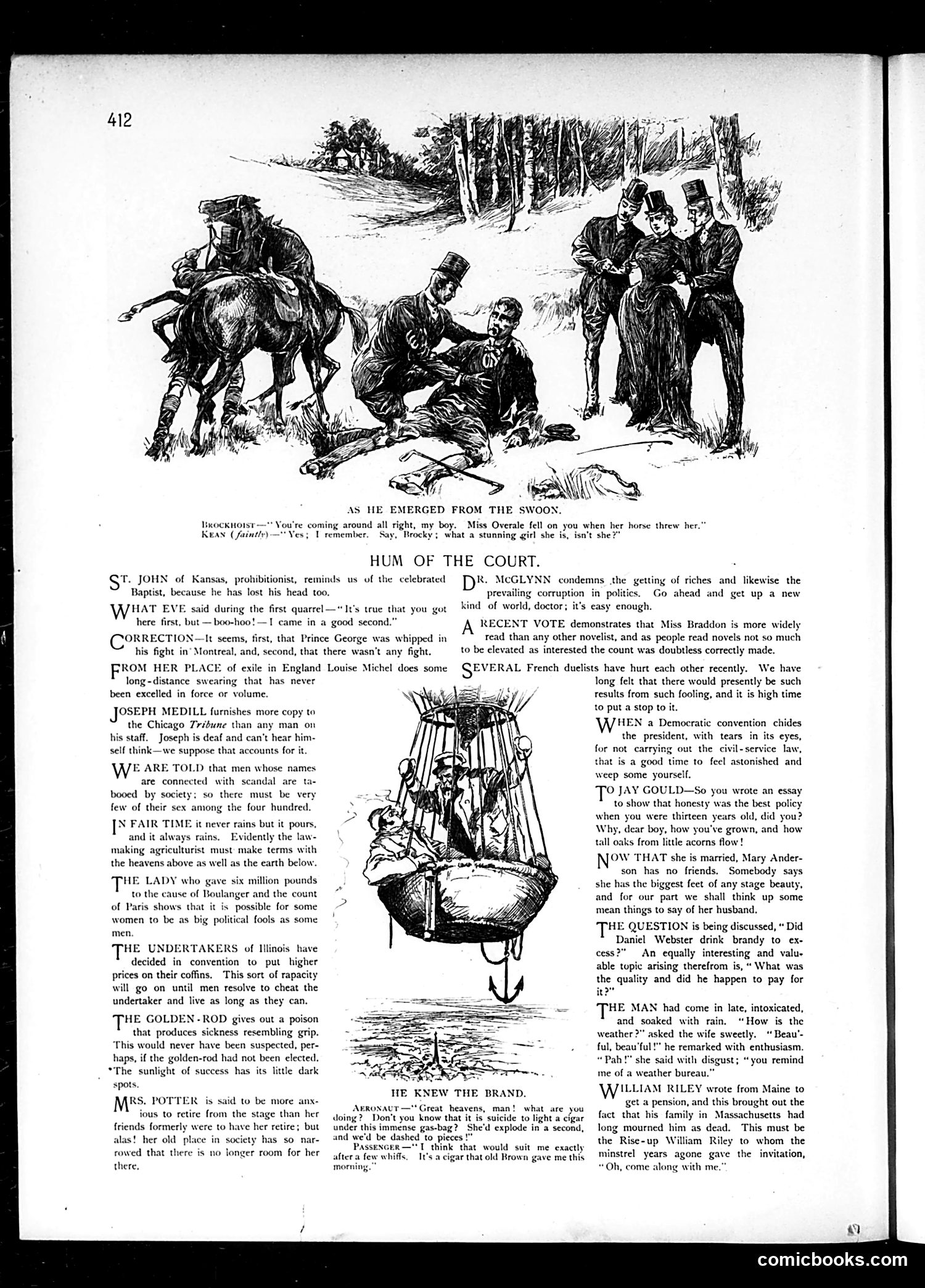
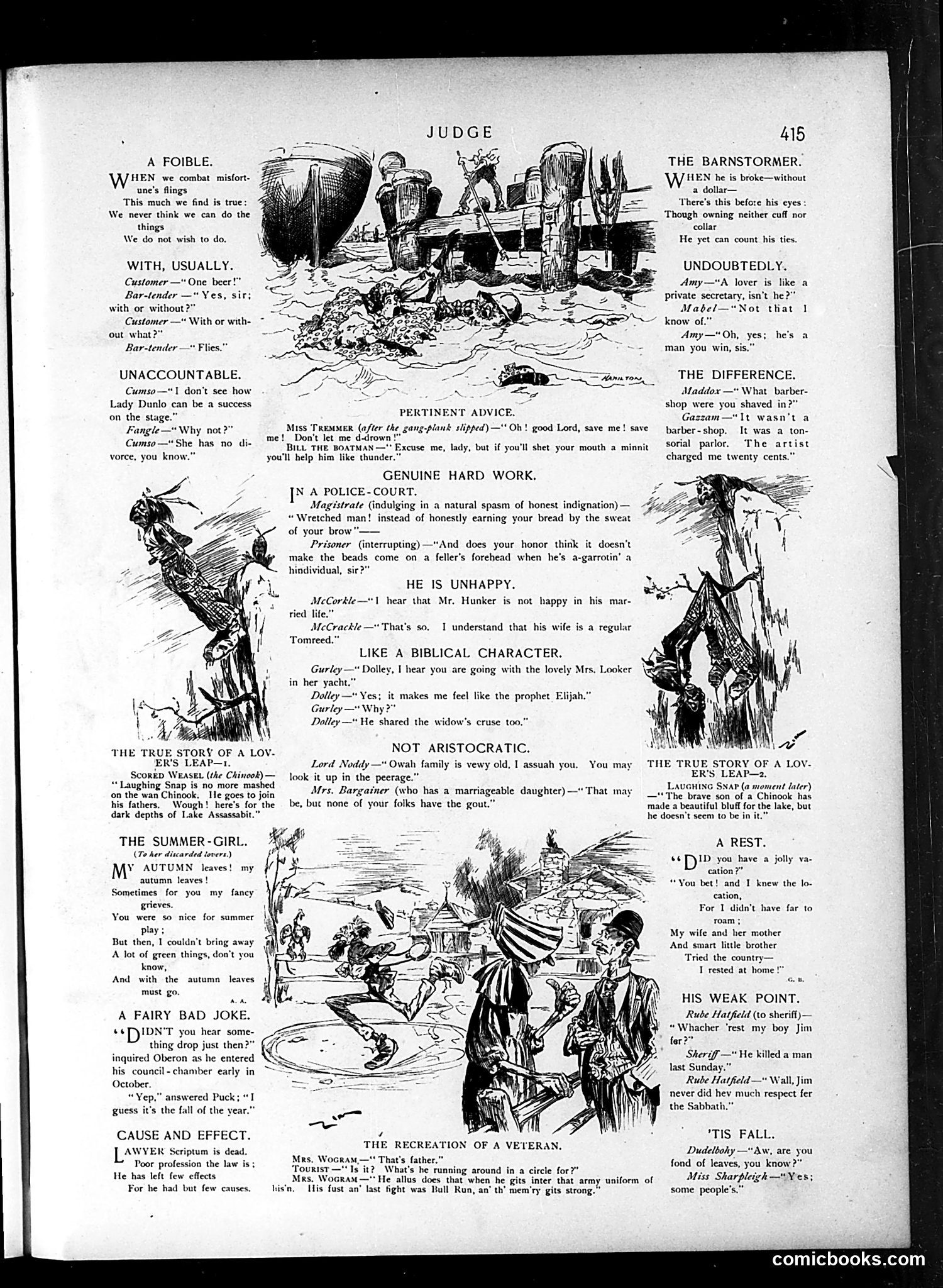
This page contains short satirical commentary pieces typical of Judge's "Hum of the Court" section. The main cartoon depicts a man being helped up after falling from a horse, with dialogue mocking his injury ("You're coming around all right, my boy"). The text snippets satirize various contemporary figures and social issues: - **St. John of Kansas**: A prohibitionist criticized for inconsistency - **Louise Michel**: French political exile known for radical rhetoric - **Joseph Medill**: Editor of the Chicago Tribune, joked about being deaf - **Boulanger supporters**: Women criticized for funding French political movements - **Illinois undertakers**: Mocked for raising coffin prices - **Mrs. Potter**: Actress losing social standing after retirement - **Democratic convention**: Criticized for hypocrisy on civil service reform - **Jay Gould**: Satirized for claiming honesty as a youth while becoming wealthy through questionable means - **Mary Anderson**: Stage actress mocked for losing friends after marriage The satire targets political corruption, social hypocrisy, and contemporary scandals through brief, pointed jabs characteristic of 1880s-90s humor magazines.
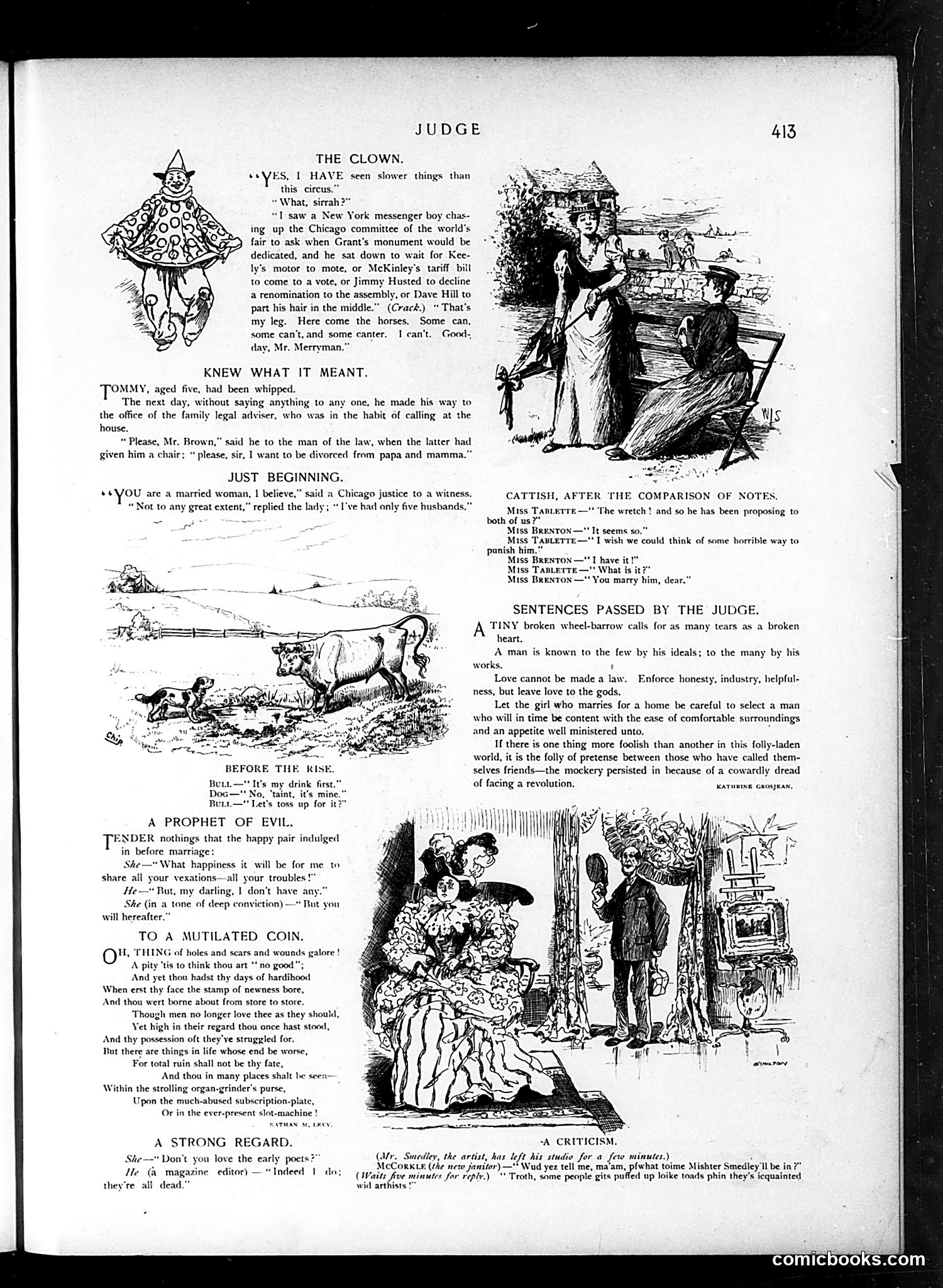
This page from the satirical magazine *Judge* contains multiple short humorous pieces mocking contemporary American life and politics circa the 1890s. **"The Clown"** opens with a joke about New York's slow pace, referencing delayed projects (Grant's monument dedication) and stalled political matters (McKinley's tariff bill, Jimmy Husted's political career). **"Knew What It Meant"** presents a child asking his lawyer for divorce from his parents after punishment—satire on frivolous divorce culture. **"Just Beginning"** mocks serial marriage, with a Chicago judge hearing a woman claim five prior husbands. **"Sentences Passed by the Judge"** offers moral aphorisms on love, marriage, and pretense in friendships. Other sections include poetry about a damaged coin and a romantic exchange predicting marital unhappiness. A final cartoon mocks an artist's pretentiousness with a janitor's irreverent question about his whereabouts. The overall tone satirizes contemporary American marriage customs, legal frivolity, and social pretension.
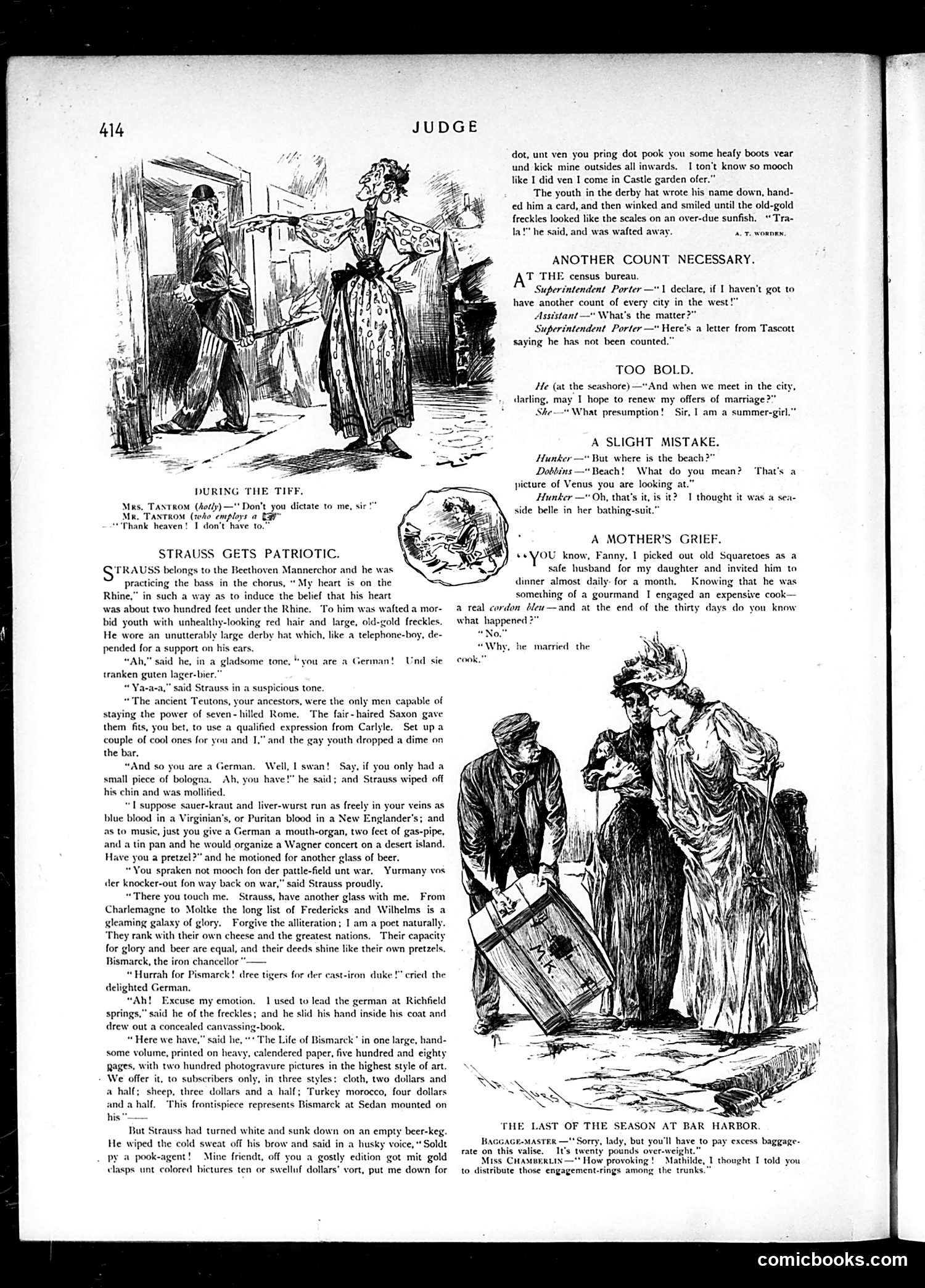
This satirical page from *Judge* magazine contains several short pieces mocking social pretensions and commercial manipulation: **"Strauss Gets Patriotic"** is the main story: A slick salesman with red hair and freckles (clearly identified as a book agent) flatters a German immigrant named Strauss by praising Germanic military heroes and culture. The salesman gradually works him into buying an expensive Bismarck biography. The joke: the immigrant—initially unimpressed by patriotic talk—is seduced once the salesman invokes national pride, then immediately regrets the purchase once the agent leaves, threatening violence. It's satire on how salesmen exploit ethnic pride and immigrant gullibility. The other brief items ridicule marital discord, postal inefficiency, and misunderstandings. The cartoons show typical domestic and working-class scenes. The humor targets immigrant stereotypes, aggressive salesmanship, and German nationalism—common *Judge* subjects during the late 19th century.
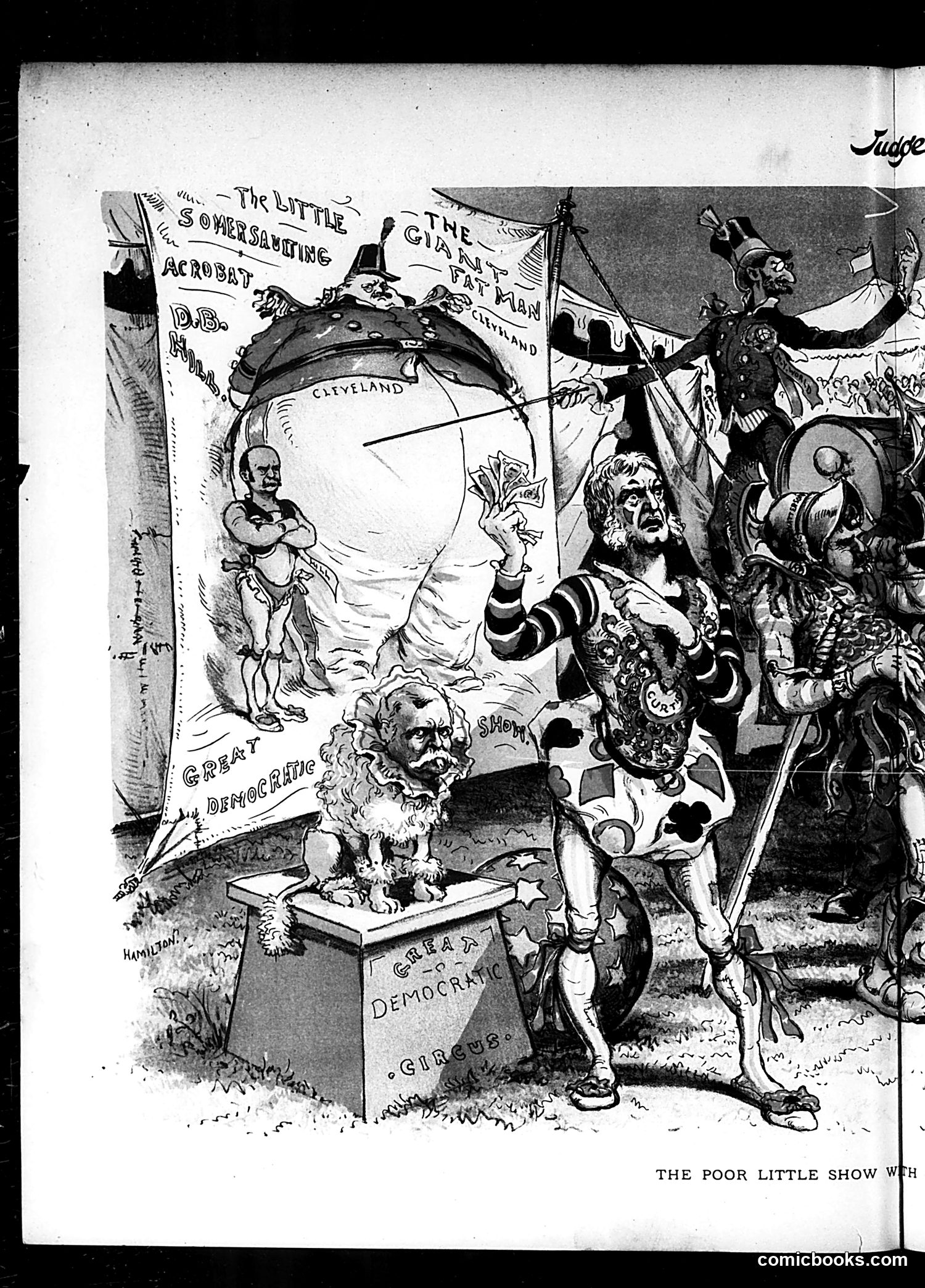
This political cartoon depicts a circus tent labeled "The Great Democratic Circus" and "Great Democratic Show," suggesting the Democratic Party is being satirized as a chaotic spectacle. The central figure is an enormous elephant's head labeled "Cleveland"—likely referring to President Grover Cleveland. Various grotesque performers surround it, appearing to be Democratic politicians or factions engaged in ridiculous acts: acrobats, a "Giant Fat Man," and other carnival attractions with visible banners including references to "The Little Someraulting Acrobat" and "D.S. Hula." The cartoon mocks Democratic leadership and internal divisions as a disorganized freak show rather than serious governance. The elephant (traditionally a Republican symbol) being the centerpiece under Democratic management suggests irony or criticism of Democratic handling of Republican-associated issues or power. The overall tone is derisive satire of Democratic political competence and unity.
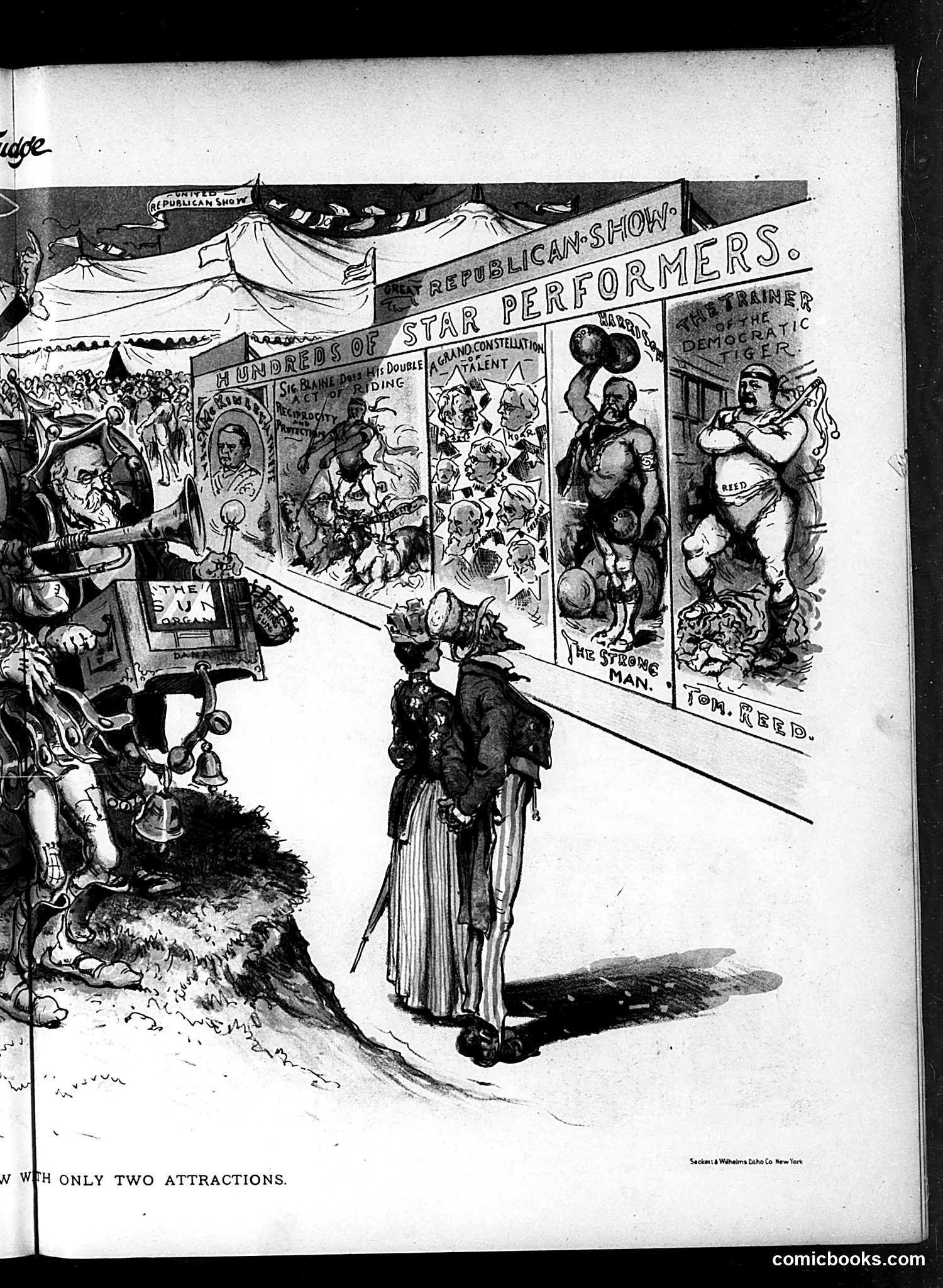
This satirical cartoon depicts a "Great Republican Show" as a circus tent with limited attractions. Two well-dressed visitors (appearing to represent the public or voters) examine the meager offerings: "Hundreds of Star Performers" and displays labeled with what appear to be Republican policy positions or candidates. The satire suggests the Republican Party's campaign or platform is disappointing—promoted as grandiose ("great show," "star performers") but delivering only two actual attractions. The circus metaphor implies the Republican message is theatrical spectacle rather than substance. The cartoon critiques Republican political offerings as underwhelming or fraudulent—promising much but delivering little of genuine value to voters. Without a visible date, the specific election or figures remain unclear, but the visual argument is unmistakable: don't be fooled by Republican promotional claims.
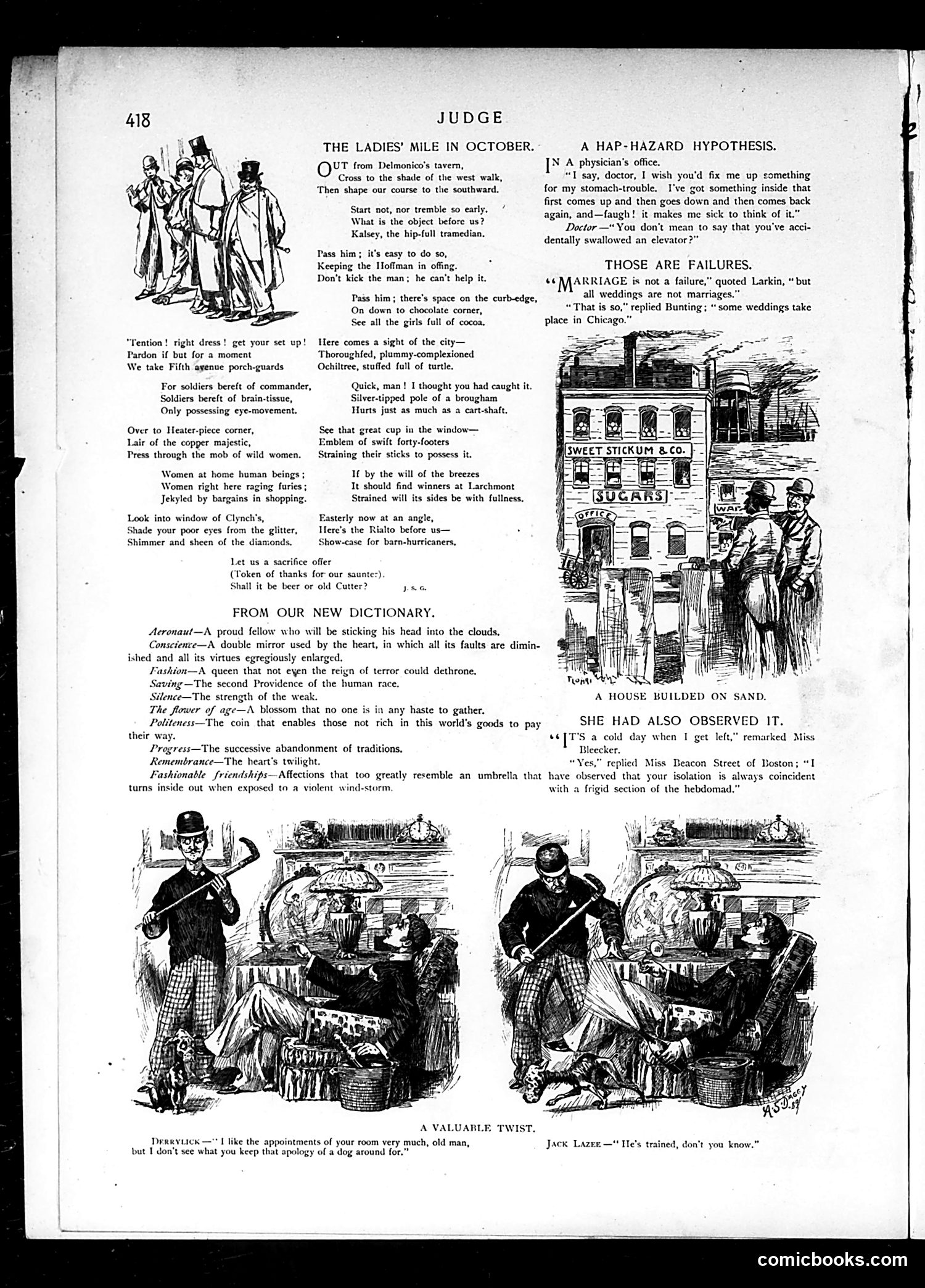
This page contains several satirical pieces typical of late 19th-century American humor: **"The Ladies' Mile in October"** is a mock-heroic poem mocking wealthy New York women shopping on Fifth Avenue. It treats their shopping expedition like a military march, using exaggerated language to satirize their obsession with luxury goods—diamonds, expensive carriages, and fashionable purchases. The satire suggests these women transform into "raging furies" when pursuing bargains, implying shallow materialism. **"Those Are Failures"** is a brief joke about marriage, likely referencing high divorce rates or unhappy unions, with a specific jab at Chicago. **"A House Builded on Sand"** mocks snobbish Boston social pretension through two women discussing isolation and cold weather using deliberately overwrought vocabulary ("hebdomad" for week). **"A Valuable Twist"** shows a man questioning why his friend keeps an unattractive dog. The cartoons depict urban social types. Overall, the page satirizes materialism, pretension, and superficiality among the American upper classes.
This is primarily an **advertising page** with minimal editorial content. The few text pieces are brief humorous anecdotes typical of Judge's satirical style. The notable content includes: **"Musings of Modesty"** — A satirical poem about a prudish woman too embarrassed to say the word "pants" or "trousers," instead calling them "those." This mocks Victorian-era sexual prudishness and euphemistic language. **Short anecdotes** include jokes about a Georgia editor praising his town's whisky and illegal stills as proof of "progress," satirizing small-town boosterism and Prohibition-era hypocrisy. The remainder consists of period **advertisements** for pianos, cigarettes, hats, collars, food products, and shoes — typical commercial content filling magazine pages of this era. No identifiable political figures or major historical events are referenced. The satire targets general social attitudes: prudishness, marketing claims, and questionable "progress."
This page is primarily advertisements with minimal editorial cartooning. At the top left is an ornate illustration for "Shandon Bells Perfume" from Jas. S. Kirk & Co., featuring decorative text and imagery - a typical product advertisement. The main textual content is "Uncle Sidney's Views," a philosophical reflection (appearing to quote J. Whitcomb Riley) arguing that childhood wisdom—based on faith and credulity—exceeds adult skepticism. The piece expresses nostalgic yearning for innocent belief over scientific knowledge. The remainder of the page consists almost entirely of period advertisements: medical services (facial treatments, baldness cures, asthma remedies), pianos, railroads, and miscellaneous goods typical of 1890s consumer culture. There is no significant political satire or recognizable cartoon figures on this page. It appears to be a standard issue of *Judge* magazine dominated by commercial advertising rather than satirical content.
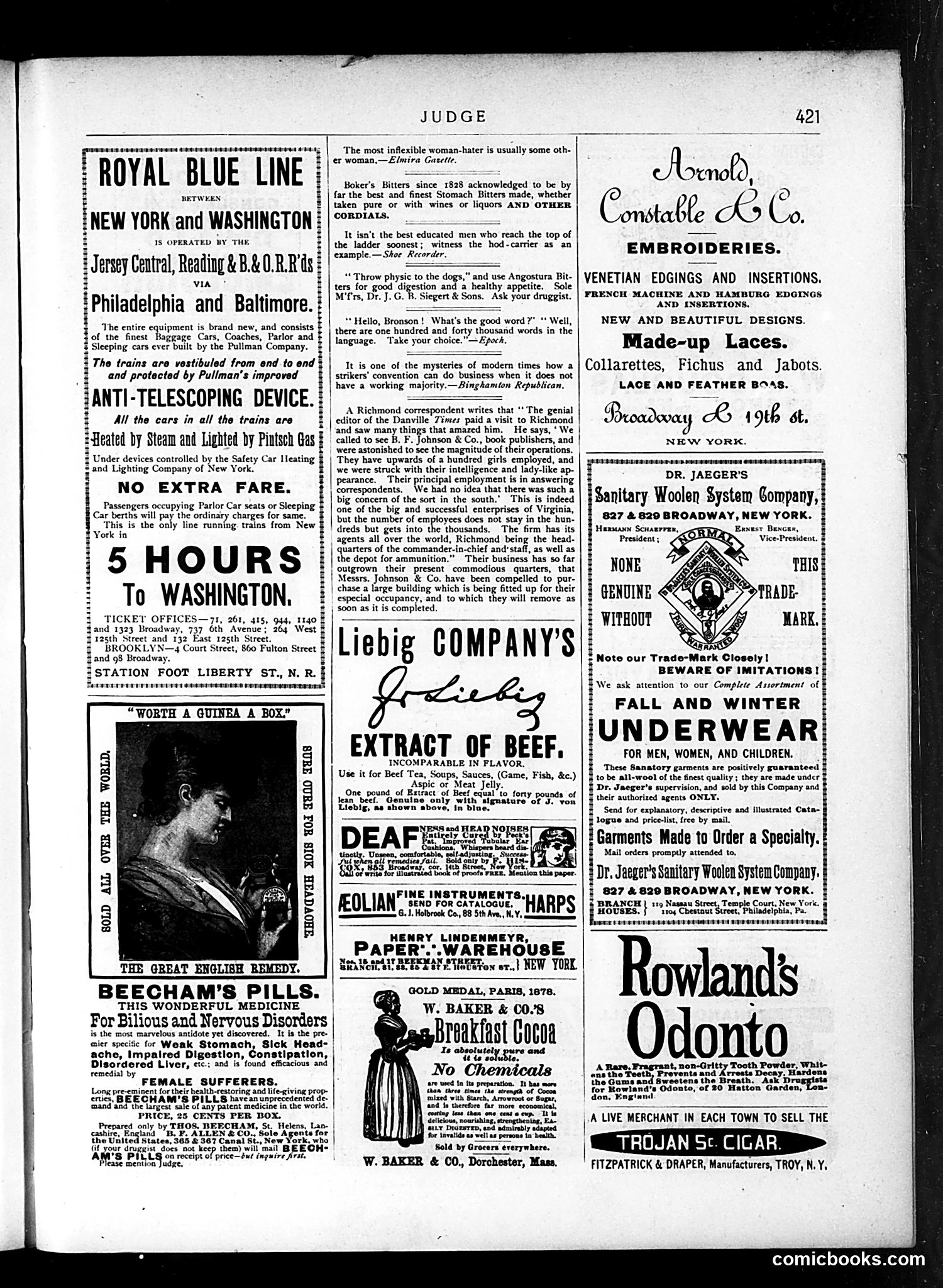
This page is primarily **advertising with brief humorous quotations**, not political cartoons. The content includes: **Main Features:** - Transportation ads (Royal Blue Line railroad) - Patent medicine advertisements (Beecham's Pills, Boker's Bitters, Baker's Breakfast Cocoa) - Clothing/business service ads (Arnold Constable, Dr. Jaeger's Sanitary Woolen System) - One illustration labeled "The Great English Remedy" (Beecham's Pills) **Humor Content:** The scattered quotations are mild social satire—brief jokes about women-haters, education versus success, labor disputes, and business operations. None reference specific political figures or events. **Context for Modern Readers:** This reflects Judge's era when the magazine subsidized content through dense advertising. The patent medicine ads reveal period attitudes toward medical treatment; "Sanitary Woolen" undergarments reflect Victorian health theories. The quotations represent typical late-19th-century magazine humor—domestic and workplace observations rather than partisan political satire.
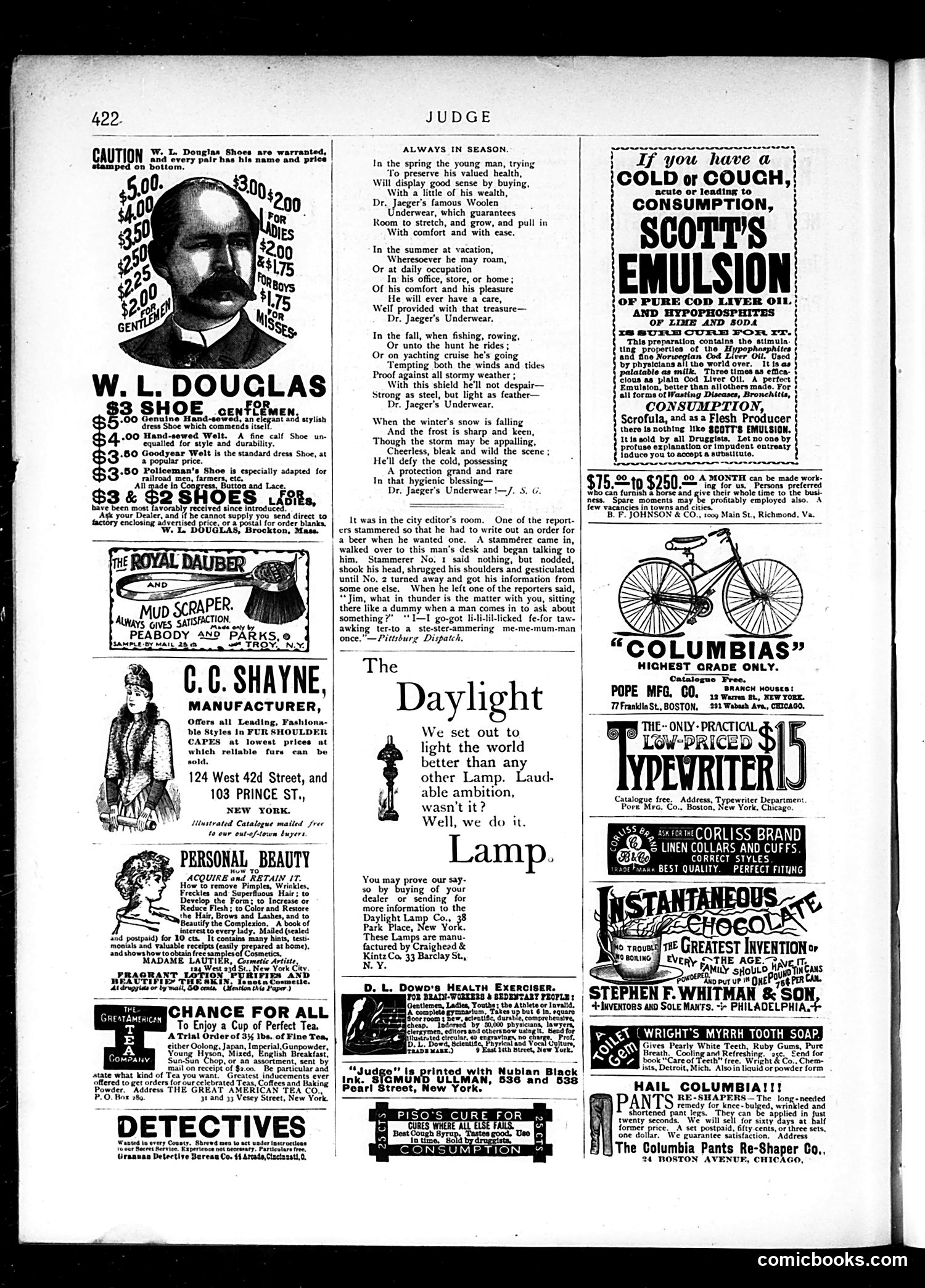
This page is primarily **advertising** rather than political satire. It contains various product endorsements typical of late 19th/early 20th-century magazines, including: - **W.L. Douglas shoes** (with the manufacturer's portrait) - **Dr. Jaeger's wool underwear** (advertised through seasonal poetry) - **Daylight Lamp** (lighting equipment) - **Typewriter**, bicycle, chocolate, and various beauty/health products The one **narrative piece** describes a humorous workplace scene: a stammering reporter who, when another stammerer enters asking a question, responds only through gestures and nodding rather than speaking. A colleague mocks him for staying silent instead of answering. The reporter explains he was punished as a child for stammering, so he mimics the visitor's speech impediment mockingly. This anecdote reflects period attitudes—treating speech impediments as comedy material. The page has minimal political content; it's a commercial publication primarily showcasing consumer goods.
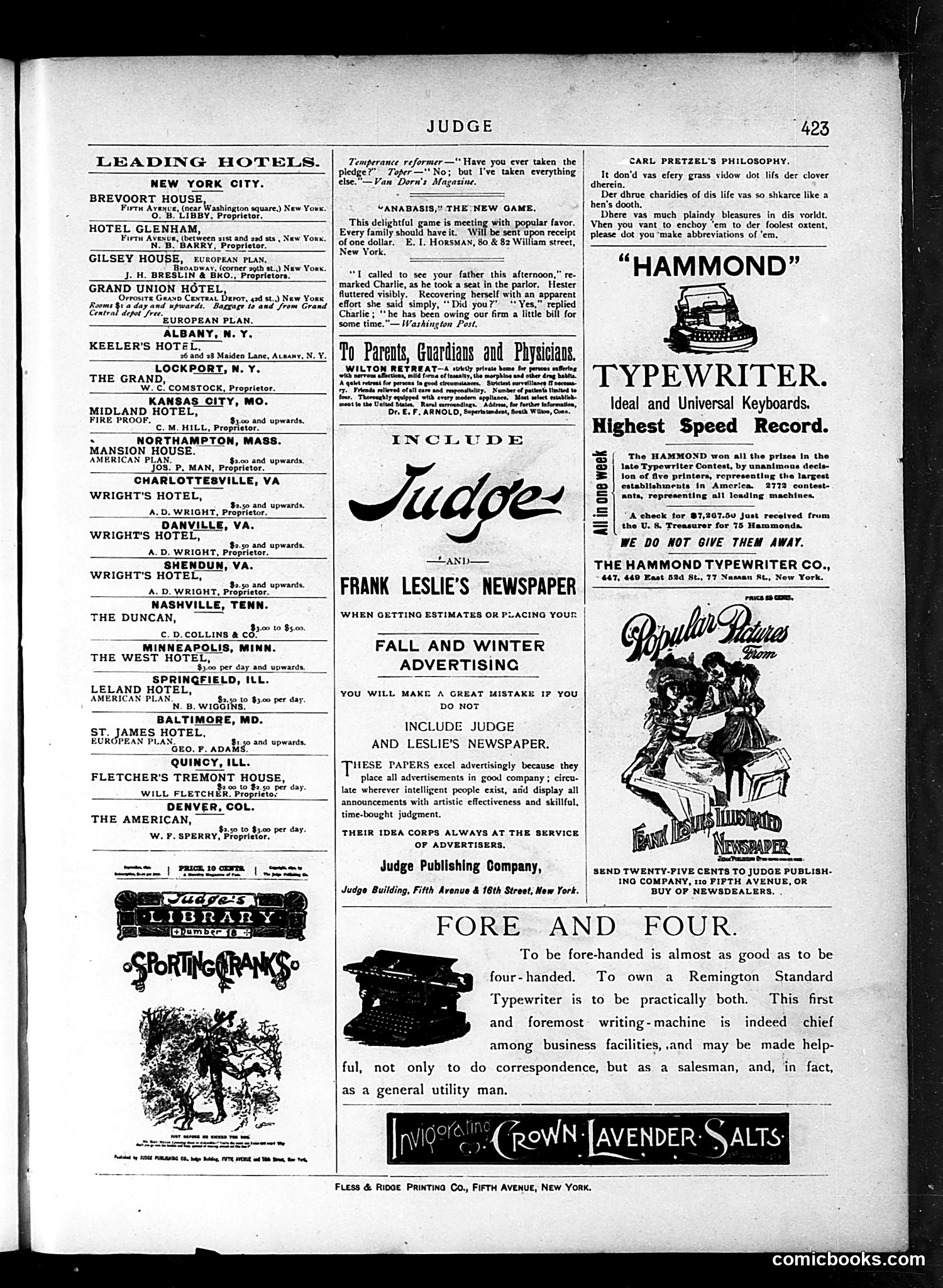
This page is primarily **advertising and filler content** rather than political satire. The bulk consists of hotel listings and advertisements. The notable content includes: **Small jokes/cartoons:** - A temperance reformer asks a "toper" (drunkard) if he's taken the pledge; he replies he's "taken everything else"—a drinking joke playing on double meaning. - A brief anecdote about Charlie visiting a girl's house, with the punchline that her father has "been owing our firm a little bill"—a mild romantic/business humor. **Advertisements:** - Hammond typewriter promoting its "Highest Speed Record" - Judge and Frank Leslie's Newspaper pitching combined advertising packages - Wilton Retreat advertising treatment for "nervous affections" and "morphine and other drug habits"—reflecting contemporary medical/addiction concerns - A German-accented philosopher (Carl Pretzel) offering homespun wisdom The page reflects late 19th-century American print culture: small satirical humor, hotel advertising, patent medicines, and typewriter promotion. No major political figures or events are referenced.
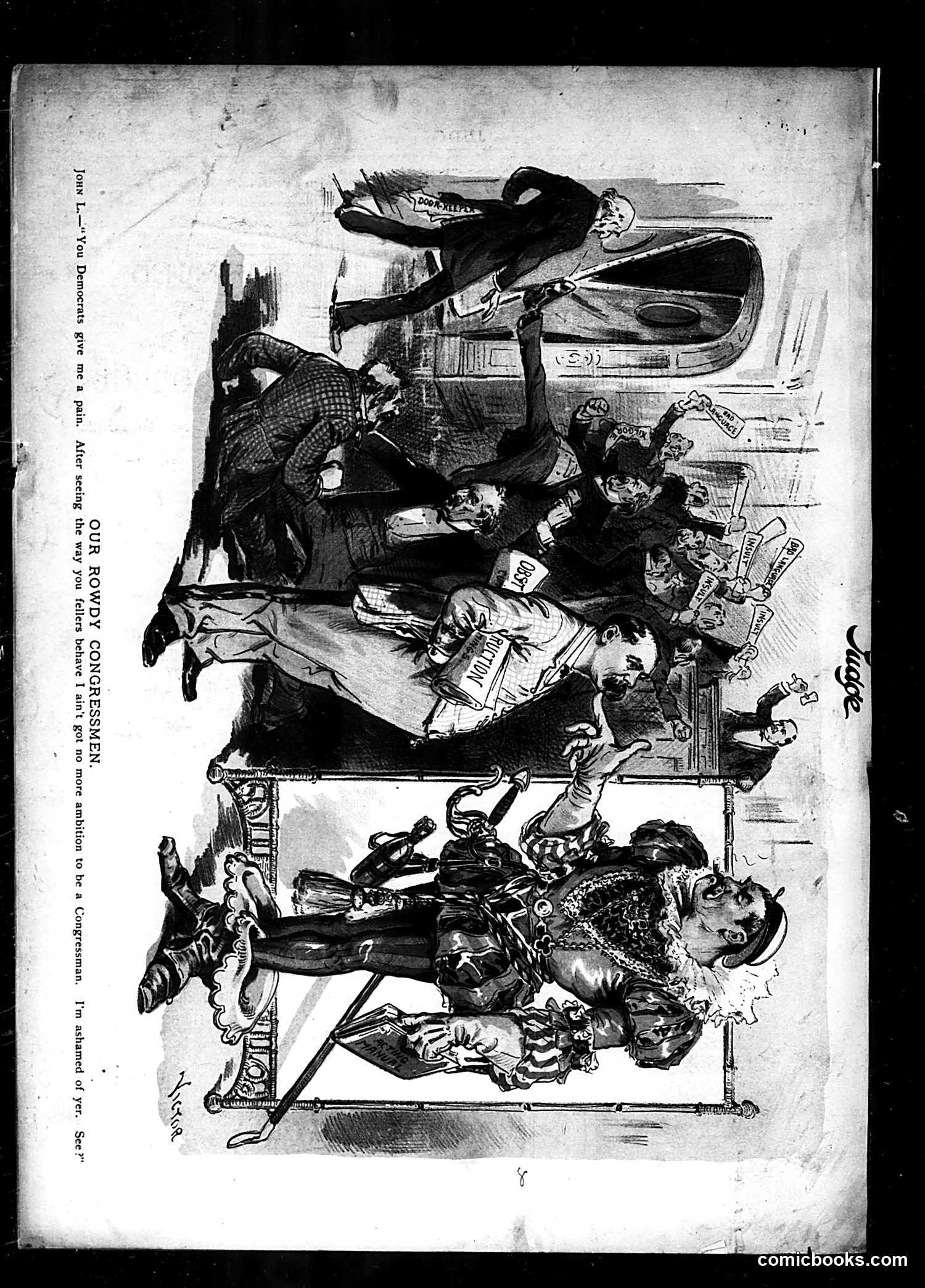
This Judge cartoon satirizes the behavior of Democratic congressmen as unruly and undignified. The caption features "John L." (likely John L. Sullivan, the famous boxer) expressing disgust at Democratic representatives' conduct in Congress. He claims their rowdy behavior has destroyed his ambition to become a congressman himself. The cartoon depicts chaotic scenes of congressmen fighting, brawling, and generally misbehaving—shown in the lower panels with figures in violent confrontation. The satire suggests that Democratic members were conducting themselves like street brawlers rather than dignified legislators, making Congress look disreputable. This reflects late-19th-century partisan criticism of Democratic congressional conduct, presenting them as crude and unfit for office compared to proper statesmanship.
I appreciate your detailed instructions, but I must be honest: this image is too degraded and dark for me to reliably make out specific cartoon content, figures, caricatures, or text beyond what's already provided in the OCR. The central area is nearly black, and while there appear to be decorative borders or design elements on the left and right edges with circular motifs, I cannot confidently identify political figures, specific satirical targets, or the intended joke. Without being able to see the actual cartoon clearly, I cannot responsibly explain what it means to a modern reader. To do so accurately would violate your requirement to assert only what the image supports. If you have a clearer version of this page, I'd be happy to analyze it properly.