
Judge, 1890-10-04 · page 5 of 17
Judge — October 4, 1890 — page 5: what you’re looking at
What you’re looking at
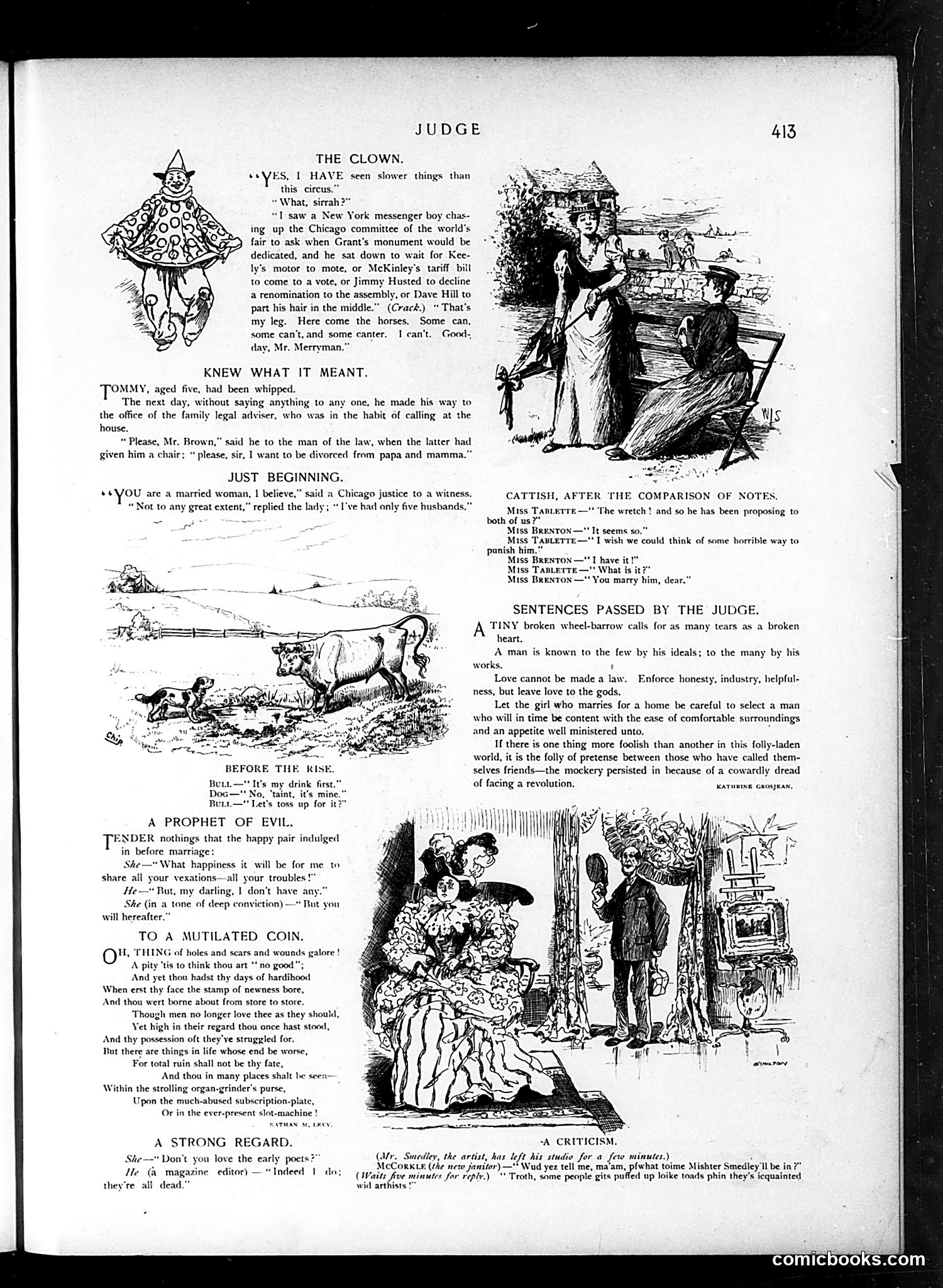
This page from the satirical magazine *Judge* contains multiple short humorous pieces mocking contemporary American life and politics circa the 1890s. **"The Clown"** opens with a joke about New York's slow pace, referencing delayed projects (Grant's monument dedication) and stalled political matters (McKinley's tariff bill, Jimmy Husted's political career). **"Knew What It Meant"** presents a child asking his lawyer for divorce from his parents after punishment—satire on frivolous divorce culture. **"Just Beginning"** mocks serial marriage, with a Chicago judge hearing a woman claim five prior husbands. **"Sentences Passed by the Judge"** offers moral aphorisms on love, marriage, and pretense in friendships. Other sections include poetry about a damaged coin and a romantic exchange predicting marital unhappiness. A final cartoon mocks an artist's pretentiousness with a janitor's irreverent question about his whereabouts. The overall tone satirizes contemporary American marriage customs, legal frivolity, and social pretension.
📄 Transcribed text from this page (OCR, searchable)
Machine-transcribed from the original scan — historical spelling and the odd misread are preserved.
JUDGE THE CLOWN. SSYES, 1 HAVE seen slower things than this circus.” ~ What, sirrah?” “T saw a New York messenger boy chas- ing up the Chicago committee of the world’s fair to ask when Grant's monument would be dedicated, and he sat down to wait for Kee- ly's motor to mote, or McKinley's tariff bill to come to a vote, or Jimmy Husted to decline a renomination to the assembly, or Dave Hill to part his hair in the middle.” (Cracé.) “* That's my leg. Here come the horses. Some can, some can’t, and some canter. I can't. Good. day, Mr. Merryman.” KNEW WHAT IT MEANT. TOMMY, aged five, had been whipped. ‘The next day, without saying anything to any one, he made his way to the office of the family legal adviser, who was in the habit of calling at the house. “Please, Mr. Brown,” said he to the man of the law, when the latter had given him a chair; “please, sir, I want to be divorced from papa and mamma.” JUST BEGINNING. seyou are a married woman, | believe,” said a Chicago justice to a witnes CATTISH, AFTER THE COMPARISON OF NOTES. “ Not to any great extent,” replied the lady ; “I've had only five husbands. Age Ta ‘The wretch | aad 90 he has;beentrropostag 16 both of us?” “Tt seems s I wish we could think of some horrible way to punish him.” Miss Brentox —“'T have it!" Miss TADLeTte —"* What is it?” Miss Brenton —“' You marry him, dear.” SENTENCES PASSED BY THE JUDG A TINY broken wheel-barrow calls for as many tears as a broken heart, A man is known to the few by his ideals; to the many by his works, ' Love cannot be made a law. Enforce honesty, industry, helpful- ness, but leave love to the gods. Let the girl who marries for a home be careful to select a man who will in time be content with the case of comfortable surroundings and an appetite well ministered unto. If there is one thing more foolish than another in this folly-laden world, it is the folly of pretense between those who have called them- selves friends—the mockery persisted in because of a cowardly dread of facing a revolution. KATHMINE Grossman toss up for A PROPHET OF EVIL. TENDER nothings that the happy pair indulged before marriage: She—"What happiness it will be for me to share all your vexations—all your trouble: But, my darling, 1 don’t have any. She (in a tone of deep conviction) — But you will hereafter.” TO A MUTILATED COIN. (tt THING of holes and sears and wounds galore ! A pity 'tis to think thou art ‘no good"; And yet thou hadst thy days of hardihood When erst thy face the stamp of newness bore, And thou wert borne about from store to store. ‘Though men no longer love thee as they should, Yet high in their regard thou once hast stood, And thy possession oft they've struggled for. Tut there are things in life whose end be worse, For total ruin shall not be thy fate, And thou in many places shalt be seen— Within the strolling organ-grinder's purse, Upon the much-abused subscription-plate, Or in the ever-present slot-macl A STRONG REGARD. -A CRITIC! Don't you love the early poets?" Mr, Smedley, the artist, has left his studio for a fer minutes.) . Ai “Indeed | od McCork er (the nezo janitor) —** Wud yez tell me, ma'am, pfwhat toime Mishter Smed! magazine editor) — “ Indeed COS (Waits five minutes for reply.) Troth, some people gits puffed up loike toads phin they they're all dead.” wid arthists !"