
A complete issue · 16 pages · 1890
Judge — September 13, 1890
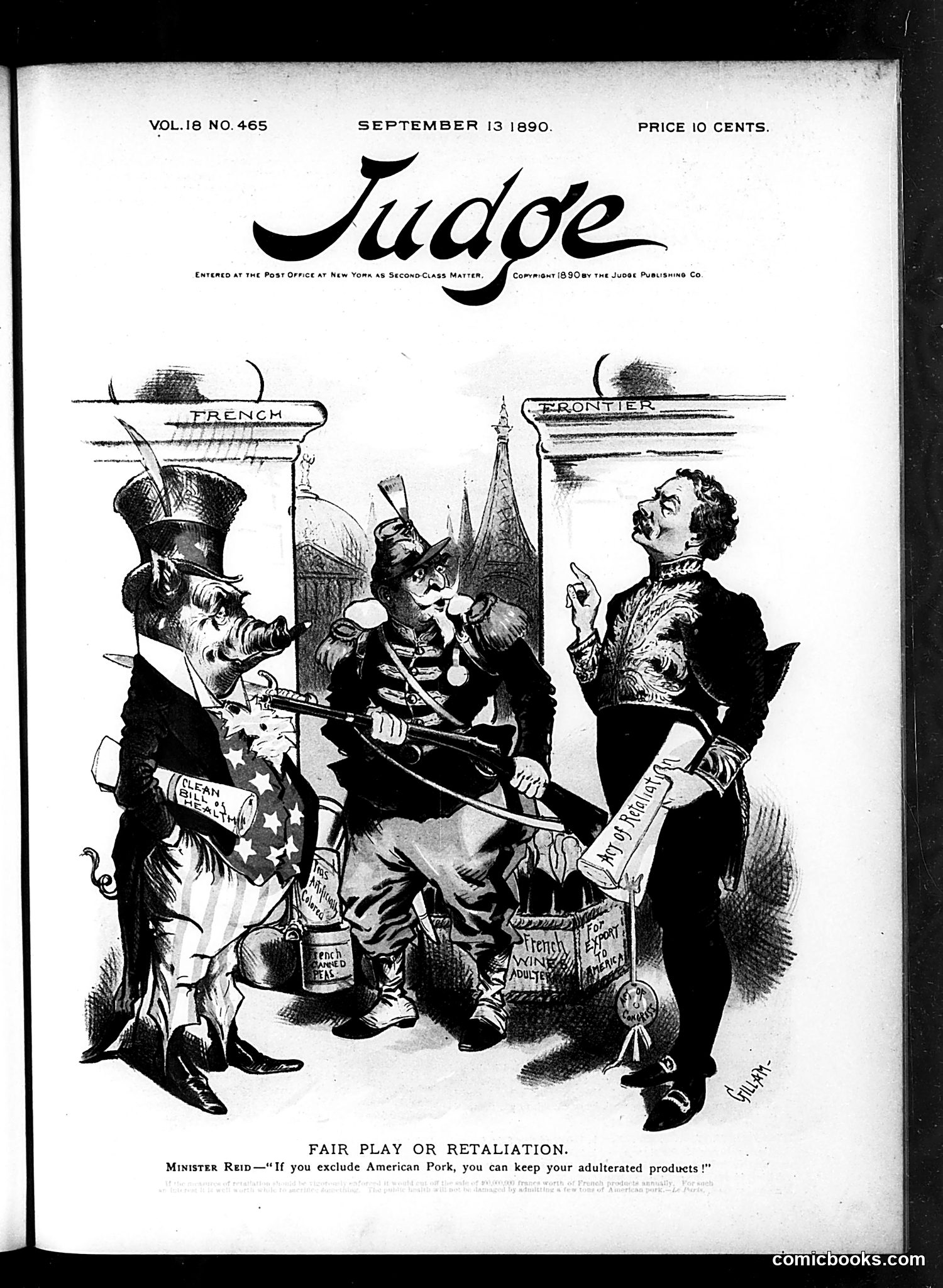
This political cartoon depicts three caricatured figures in military/diplomatic dress engaged in a confrontation. The central figure wields a rifle, while the left figure (labeled "BRITAIN") and right figure (labeled "MY POLICY") represent competing positions. The caption quotes "Minister Reid" warning: "If you exclude American Pork, you can keep your adulterated products!" This satirizes an 1890s trade dispute over American pork exports. Britain had banned U.S. pork, citing quality concerns. The cartoon frames this as retaliatory trade policy—American officials threatening to exclude British goods unless pork access was restored. The "Frontier" sign suggests westward American agricultural interests at stake. The satire mocks the confrontational, gun-wielding approach to commercial negotiation.
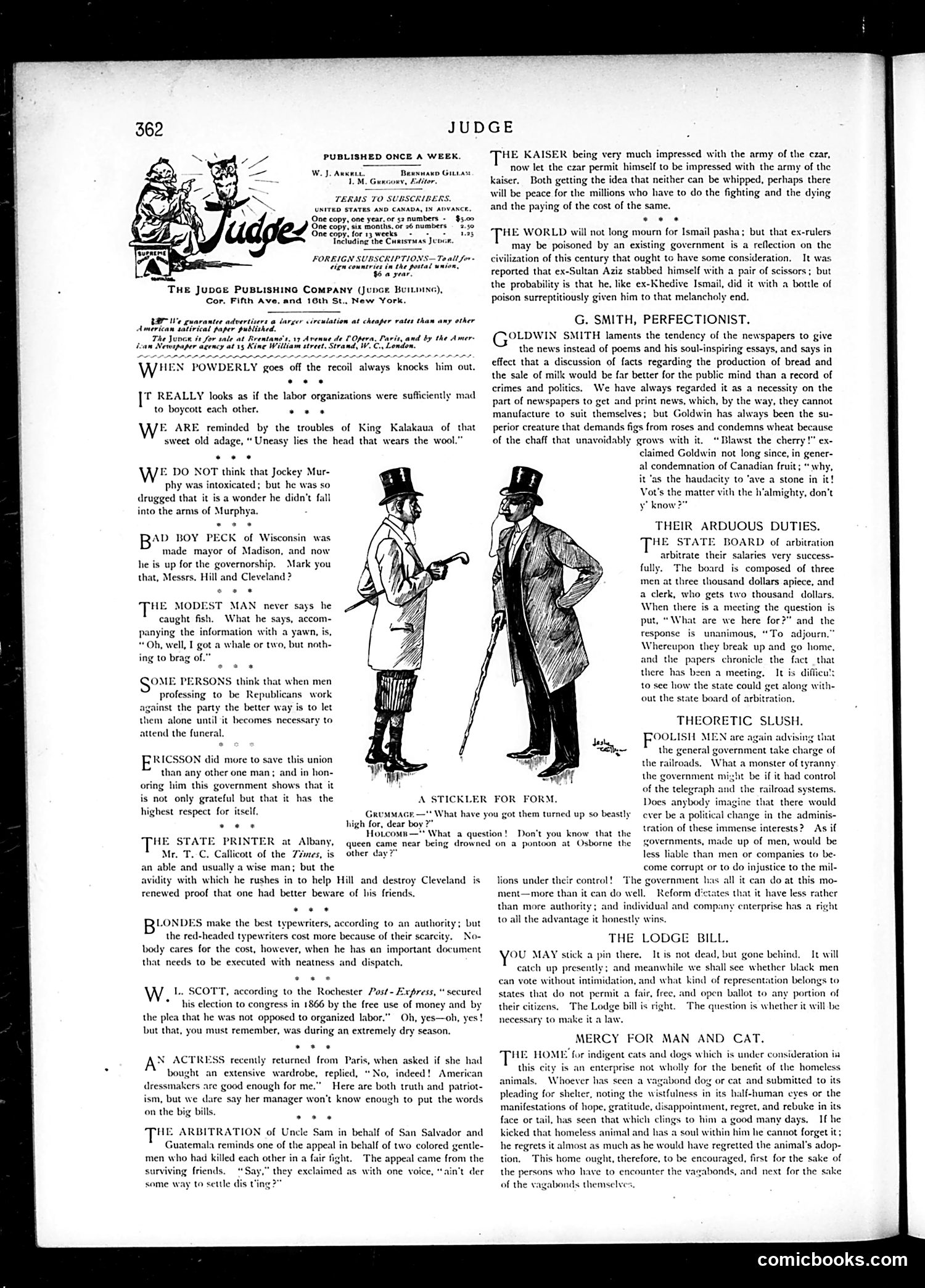
The main cartoon titled "A Stickler for Form" depicts two men in formal dress discussing a horse. The dialogue references Queen Anne being "drowned on a ponton at Osborne the other day" — likely referring to a recent news incident involving a royal horse at Queen Anne's estate. The satire criticizes excessive formality and bureaucratic procedure. One figure insists on proper protocols despite a practical emergency (a drowned horse), exemplifying how rigid adherence to rules can obstruct common sense. The surrounding editorial sections address contemporary issues: labor disputes, government railroad control, arbitration boards, and animal welfare. The tone mocks both reformers and established institutions for their impractical approaches to social problems.
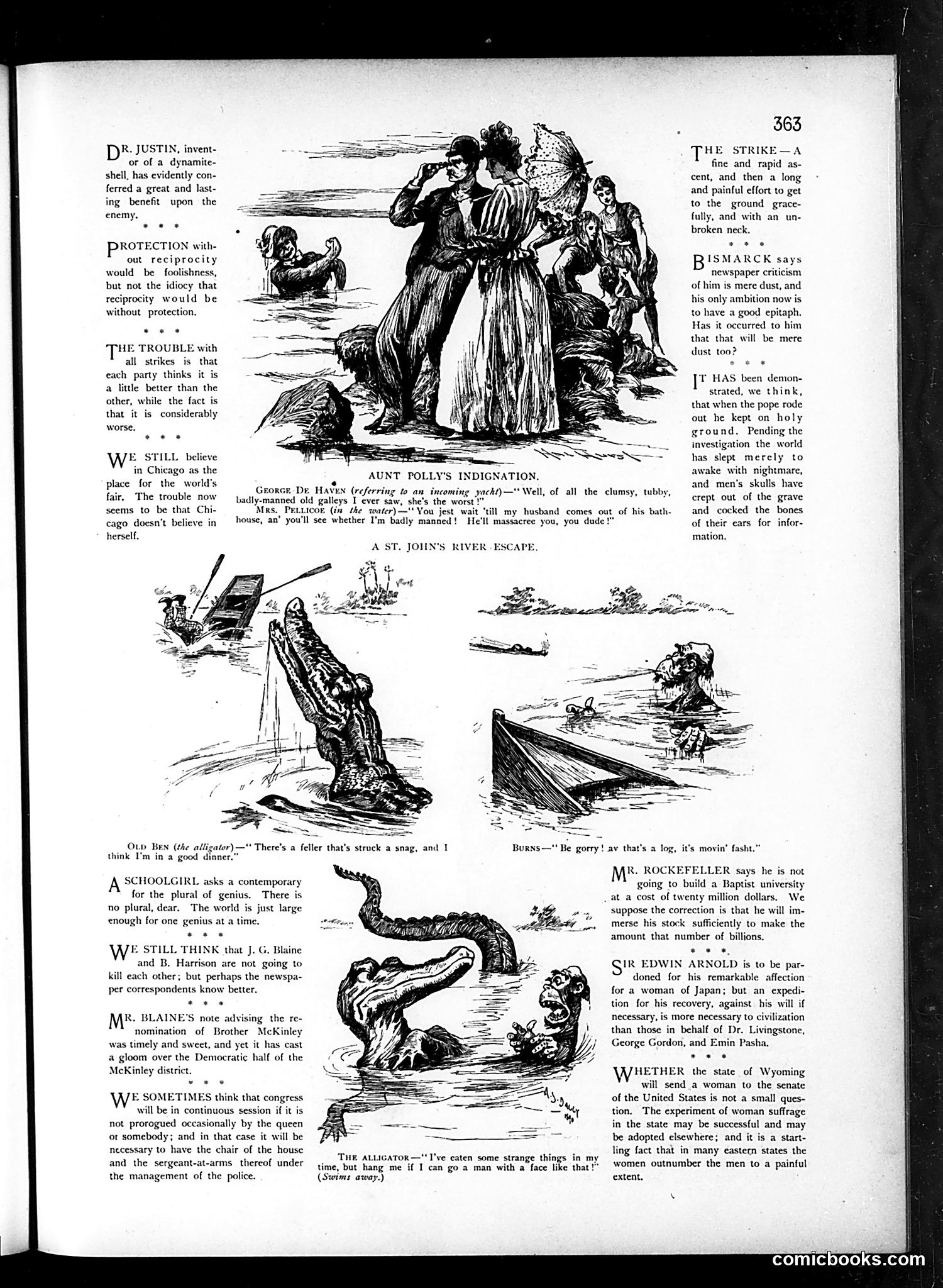
This page mixes political commentary with humorous sketches. The main cartoon "Aunt Folly's Indignation" depicts a woman scolding poorly-dressed children, satirizing working-class or immigrant families—a common Judge trope mocking lower classes. The river scenes with alligators appear to reference the American South, likely mocking regional stereotypes about danger and backwardness. The text snippets offer brief editorial jabs: Bismarck criticized as dust-obsessed; De Havilland mocked as clumsily mannered; references to Roosevelt's Baptist university plans and Wyoming women's suffrage. These target contemporary political figures and progressive initiatives. The overall tone is dismissive of social reform while reinforcing class and regional stereotypes typical of Judge's late-19th/early-20th-century satirical approach—humor meant to reinforce establishment perspectives against change.
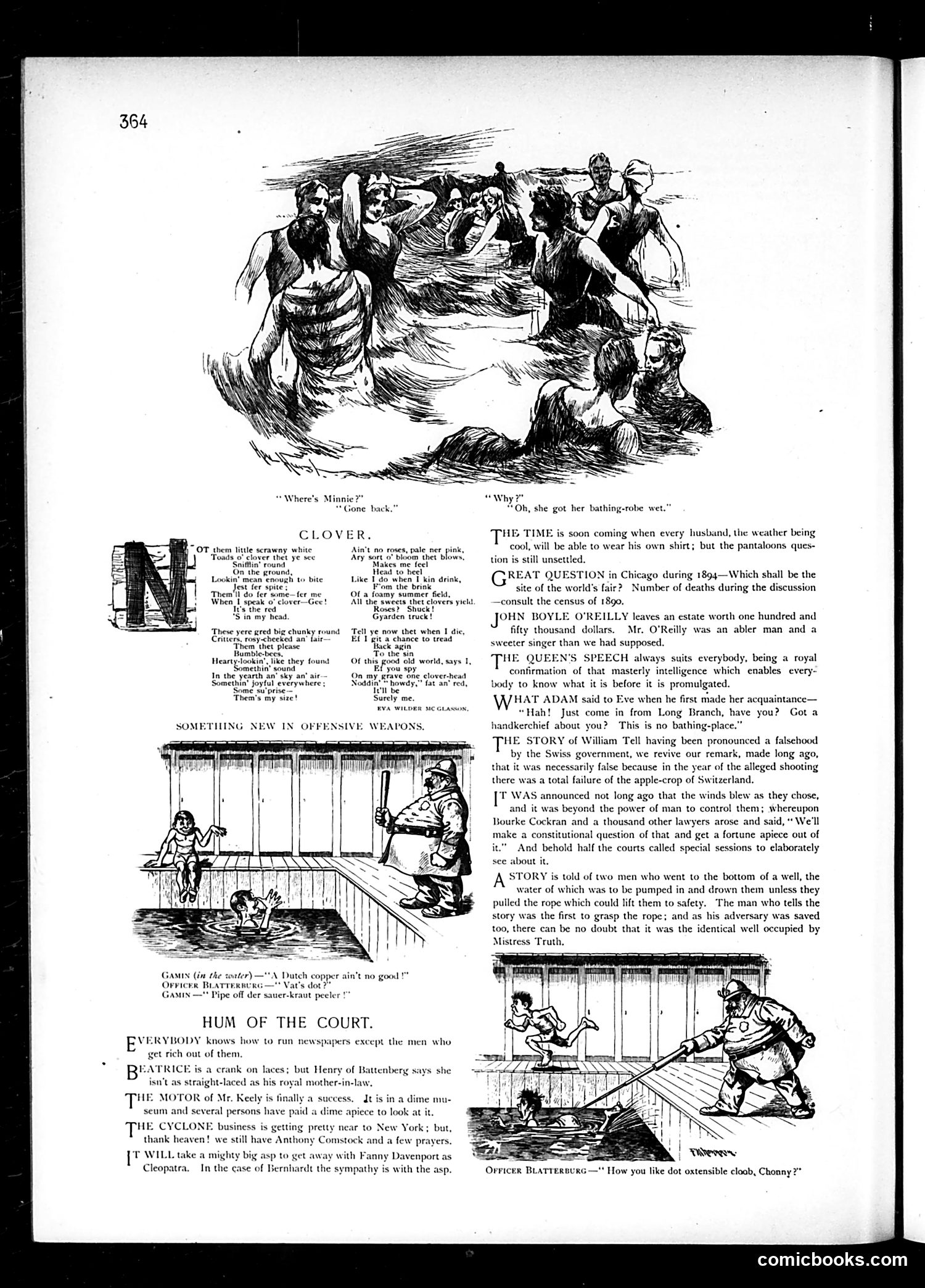
This page contains multiple short satirical items typical of Judge's humor. The top cartoon shows a beach scene where a woman ("Minnie") has gotten her bathing robe wet—the joke playing on Victorian propriety and bathing costume anxieties. The text items mock contemporary figures and events: John Boyle O'Reilly's estate; the Queen's predictable speeches; the William Tell legend (recently debunked by Swiss scholars); and legal disputes over wind control (referencing lawyer Bourke Cockran's litigious nature). "Hum of the Court" satirizes newspaper management, Princess Beatrice's strictness versus her mother-in-law Queen Victoria, Keely's failed "perpetual motion" motor (now relegated to dime museums), and the cyclone threat approaching New York. The lower cartoon depicts two Dutch characters in what appears to be workplace banter, using thick ethnic dialect humor typical of the era. Overall, the page reflects 1890s American concerns: technological fraud, weather anxiety, and class/immigrant stereotyping.
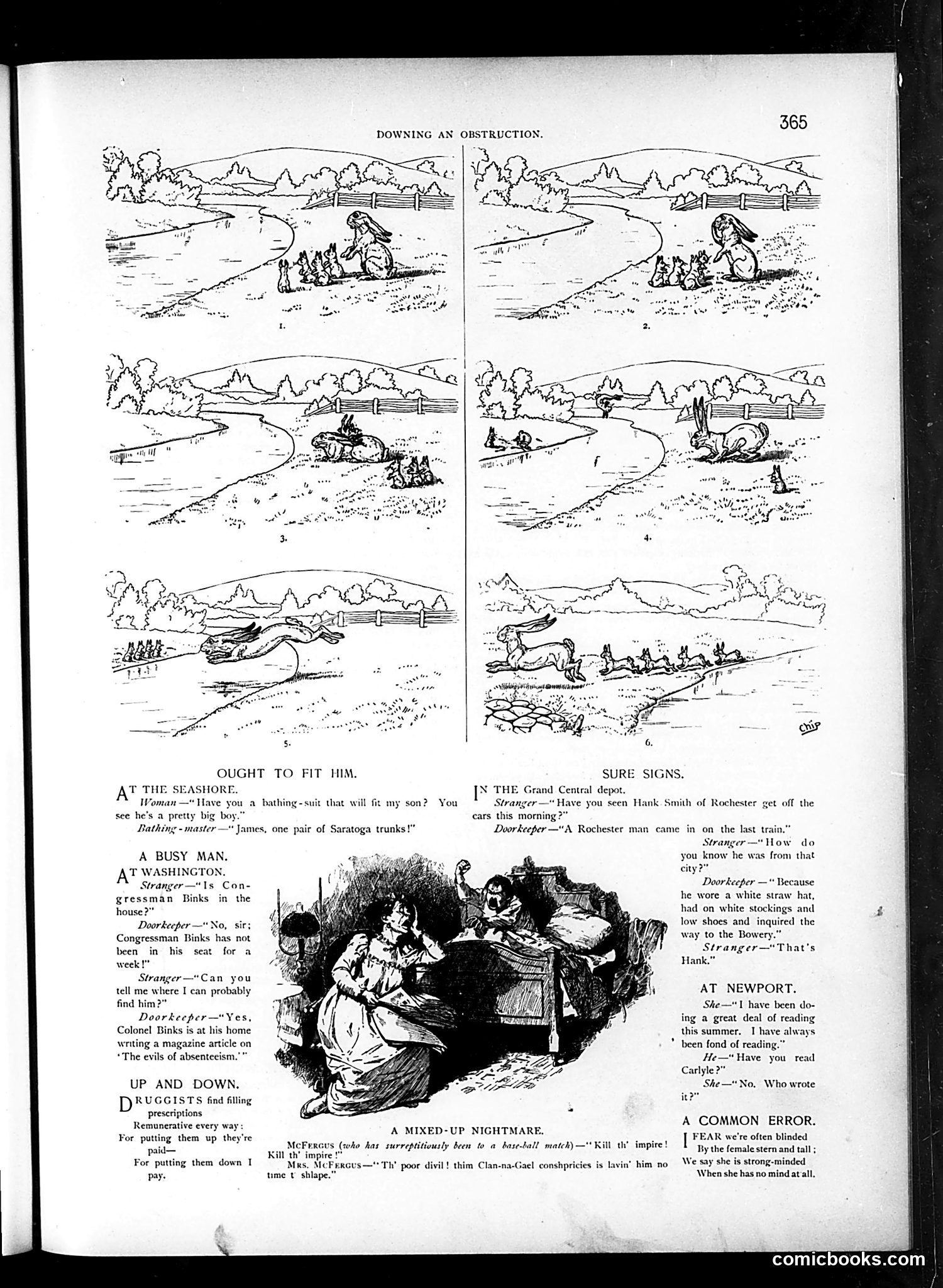
This page contains six separate satirical sketches mocking American social types and pretensions circa the late 19th century: **"Ought to Fit Him"** jokes about oversized children requiring enormous bathing suits ("Saratoga trunks"). **"A Busy Man"** satirizes Congressional absenteeism—a congressman is absent from his seat while supposedly writing an article condemning absenteeism itself. **"Sure Signs"** mocks ethnic stereotyping: a stranger identifies "Hank Smith of Rochester" solely by his white straw hat, white stockings, and asking directions to the Bowery—crude markers of rural/working-class origin. **"Up and Down"** contains a drug joke about paying pharmacists to fill prescriptions but also to "put them down" (settle/reduce bills). **"At Newport"** satirizes upper-class pretension—a woman claims devotion to reading but hasn't read Carlyle and doesn't know who wrote it. **"A Common Error"** critiques assumptions about tall women being intellectually capable. The humor relies on period social hierarchies, class anxieties, and stereotypes now considered offensive.
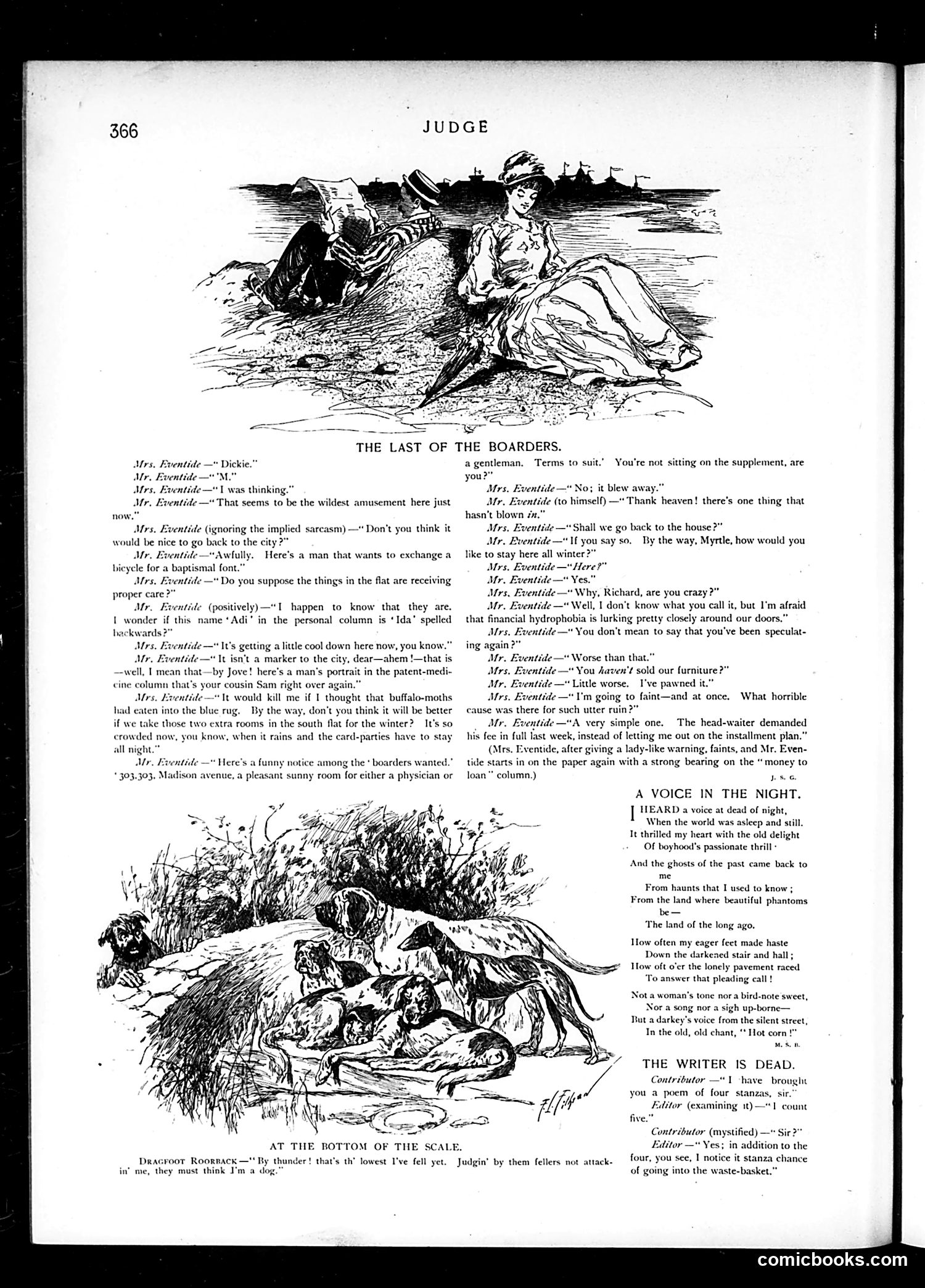
This satirical dialogue depicts an upper-middle-class couple, Mr. and Mrs. Eventide, vacationing at a seaside resort while anxious about their urban flat. The humor targets genteel anxieties about property, servants, and financial instability during what appears to be an economic downturn. Mrs. Eventide frets over household maintenance; Mr. Eventide obsessively reads newspaper personal ads and patent-medicine notices—suggesting idle, anxious preoccupation. The punchline reveals his financial ruin: he's pawned their furniture to pay a hotel head-waiter, having speculated badly and exhausted credit. The satire mocks both the couple's pretensions and the precariousness of middle-class respectability—one bad financial decision collapses their social standing. The accompanying cartoons and short items (including "The Writer is Dead," mocking rejected poetry) reinforce Judge magazine's standard targets: social climbing, financial anxiety, and literary mediocrity.
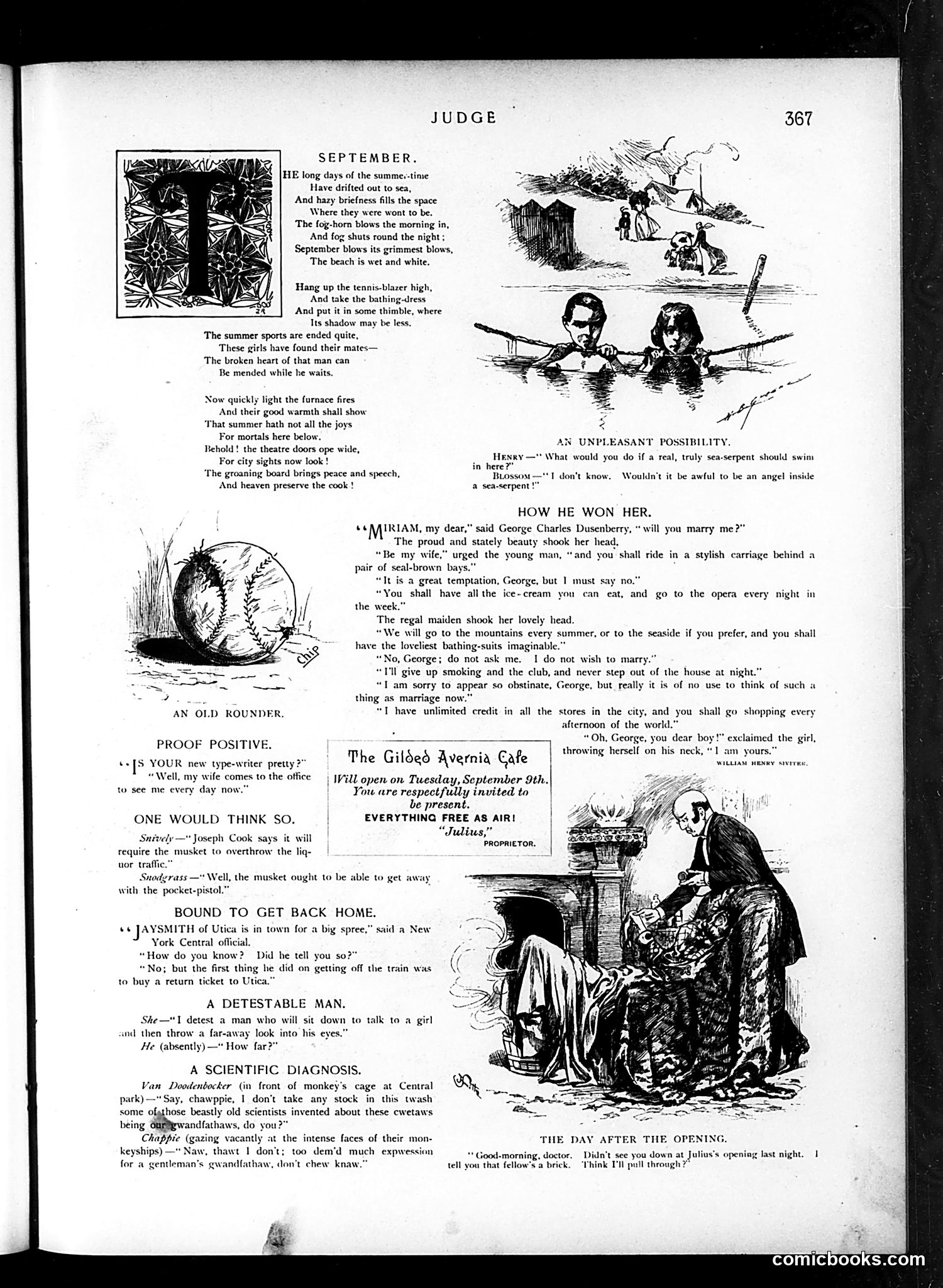
This page contains multiple short humorous sketches typical of Judge's satirical style: **"How He Won Her"** depicts a marriage proposal where a suitor (George Charles Dusenberry) offers increasingly extravagant inducements—carriages, ice cream, opera, travel, shopping privileges—to win "Miriam." She refuses each, finally accepting only when he promises to give up smoking, clubs, and nightlife. The satire mocks both the superficiality of courtship negotiations and the conflicting desires men claimed to have (social freedom versus domestic commitment). **Other brief jokes** target contemporary issues: typewriter technology, alcohol prohibition debates, and pseudo-scientific racism (the "monkey ancestry" discussion referencing Darwinism). The "September" poem is atmospheric seasonal verse; "The Gilded Avernia Cafe" is a straightforward advertisement. The overall tone reflects Gilded Age American attitudes—focused on social climbing, consumerism, and leisured society rather than substantive political content. Without specific date context, the exact historical references remain somewhat opaque to modern readers.
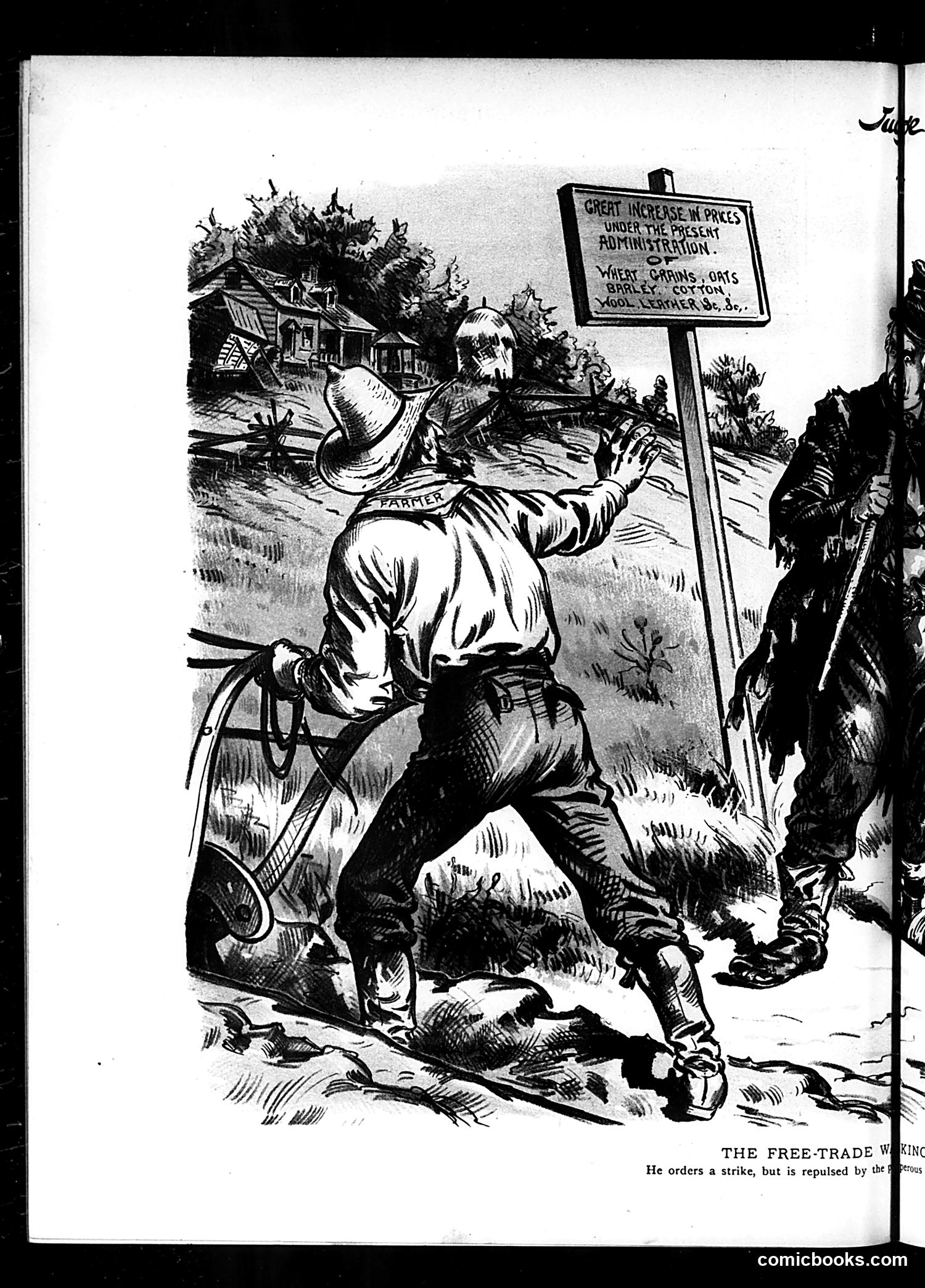
This political cartoon depicts a farmer confronting what appears to be a wealthy figure (labeled "FARMER") about agricultural price increases. The sign reads: "GREAT INCREASE IN PRICES UNDER THE PRESENT ADMINISTRATION OF WHEAT, OATS, BARLEY, COTTON, WOOL, LEATHER, &C., &C." The cartoon satirizes the tension between free-trade policy and agricultural interests. The farmer points accusingly at the wealthy man (likely representing a free-trade advocate or administration official), suggesting that while prices have risen, farmers aren't benefiting—they're being "repulsed" despite the administration's policies. The rural homestead in the background emphasizes the agricultural perspective. This reflects late 19th-century debates over tariff policy and which groups actually profited from economic changes.
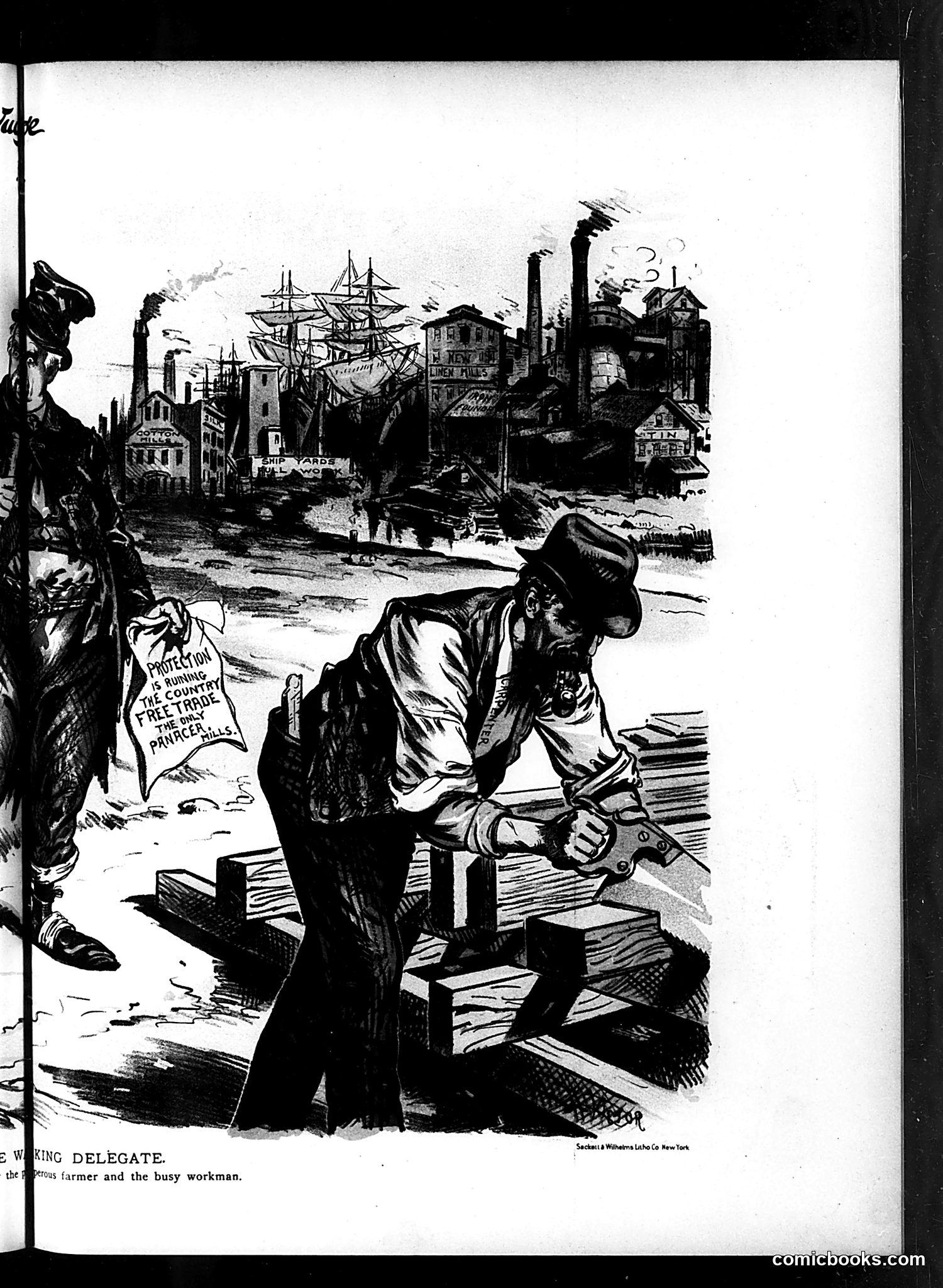
This Judge magazine cartoon satirizes a "working delegate"—likely a labor union representative or political figure claiming to represent farmers and workers. The central figure, dressed in worn clothes and a hat, is depicted hammering or working at a dock or industrial waterfront setting. The sign he carries references "the trade" and "princess mills," suggesting labor disputes or factory conditions. The satire appears critical: despite his claim to represent ordinary working people ("the busy workman" and "pious farmer"), the cartoon suggests he's disconnected from or exploitative of those he purports to serve. The industrial backdrop with smoking factories and ships indicates this concerns labor conditions during America's industrial era. The caricatured facial features and exaggerated portrayal reinforce the satirical critique of his authenticity or motives.
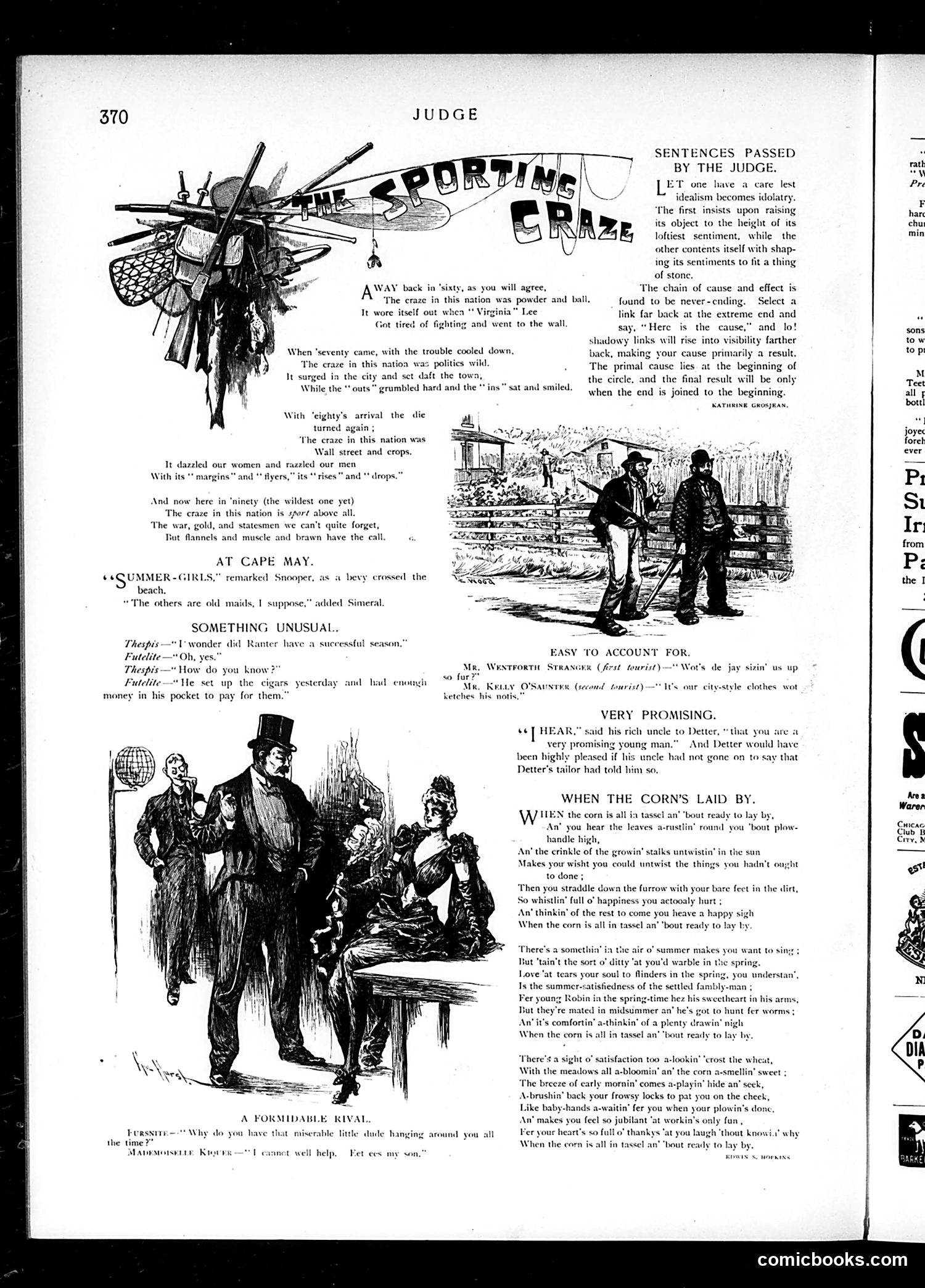
This page from Judge presents several humorous sketches and poems typical of 1890s American satire: **"The Sporting Craze"** (top) traces national obsessions across decades: the 1860s focused on Civil War ("Virginia Lee"), the 1870s on politics, the 1880s on Wall Street speculation, and the 1890s on sports—suggesting American society chases fads obsessively. **The cartoon vignettes** mock everyday absurdities: a theater manager's financial success measured by cigar-buying; tourists' city clothes drawing attention; a wealthy uncle's promise to a nephew named Detter. **"When the Corn's Laid By"** is a sentimental rural poem celebrating the farmer's satisfaction during harvest season, contrasting spring's romantic yearning with summer's domestic contentment and hard work. The page reflects Judge's formula: mixing social commentary on American trends with gentle humor about class, urban versus rural life, and human nature—all targeting educated, middle-class readers.
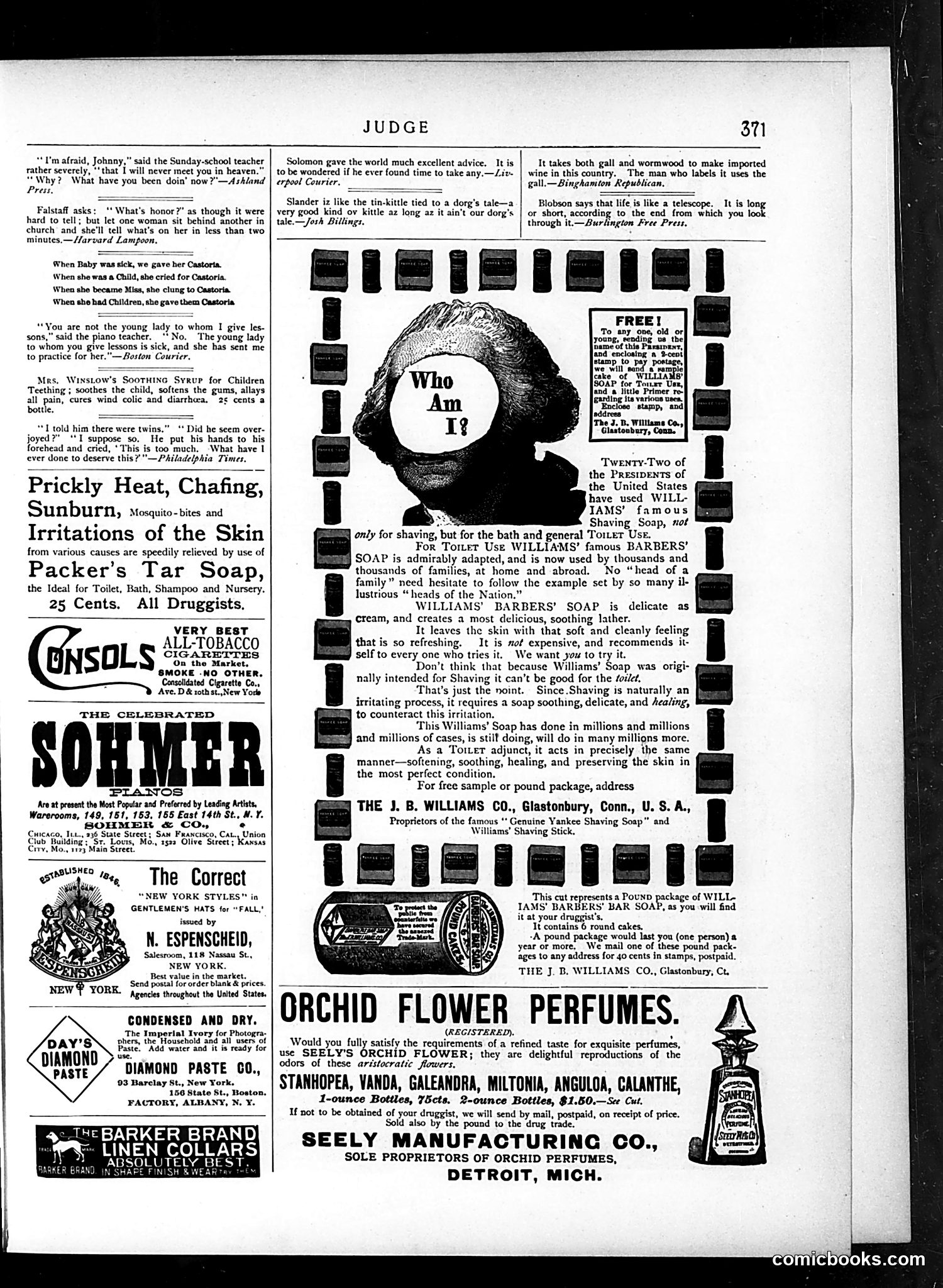
This page is primarily **advertising**, typical of late-19th/early-20th-century American magazines. The bulk consists of product advertisements (Castoria, Mrs. Winslow's Syrup, Packer's Tar Soap, Williams' Shaving Soap, Seely's Orchid Flower Perfumes, etc.). The small text items at top are brief **humorous anecdotes** rather than political satire: - A Sunday school teacher threatens a misbehaving boy with damnation - A joke about women's priorities in church seating - References to piano lessons and childbirth complications The central illustration is titled **"Who Am I?"**—a large portrait head whose identity isn't revealed in visible text, surrounded by product boxes. Without caption clarity, the figure's identity is **unclear**. This page contains **no apparent political cartoon or significant social commentary**. It represents how Judge monetized content through advertising while filling space with light, family-friendly humor typical of the era.
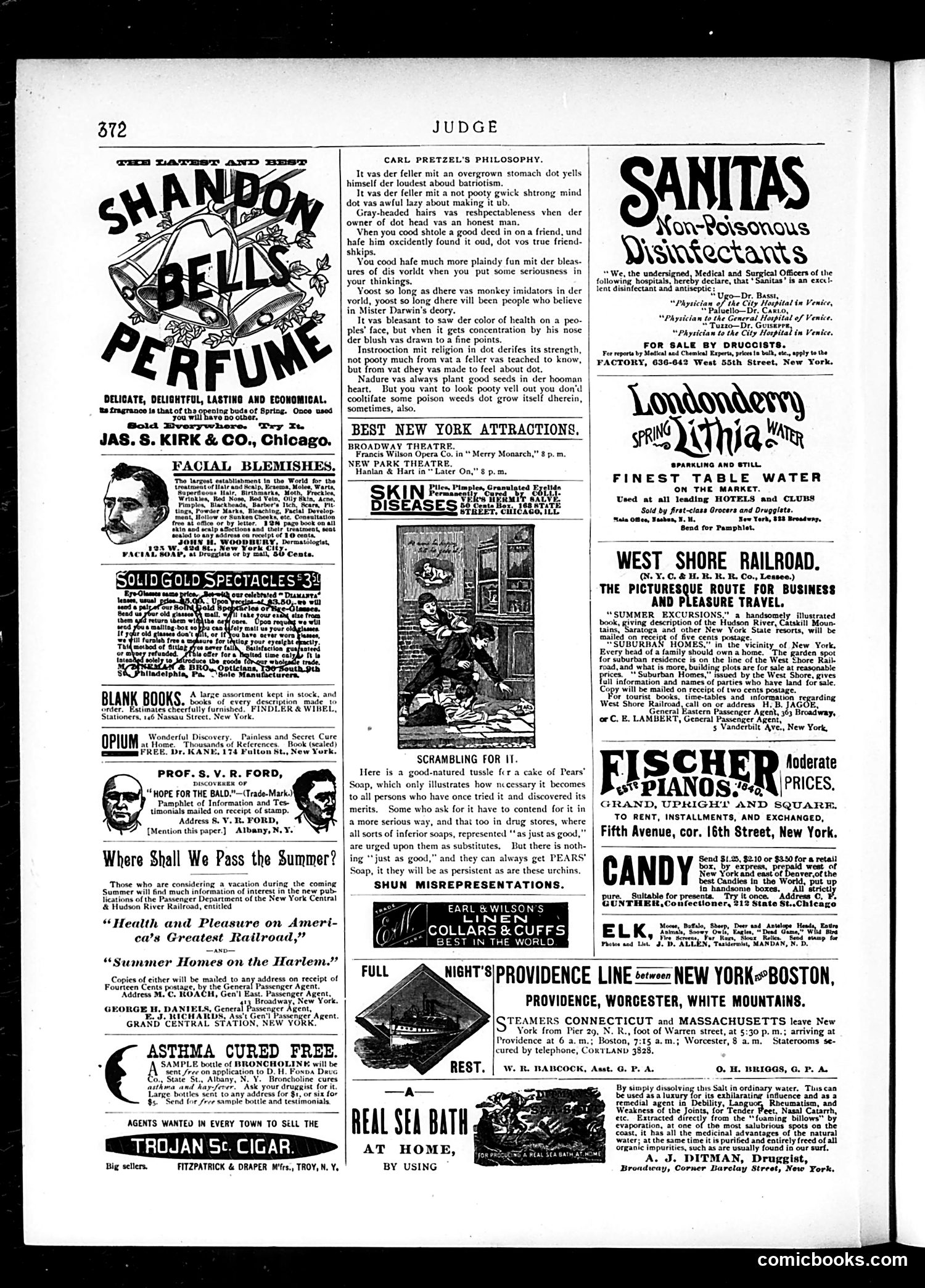
This page is primarily **advertising**, featuring patent medicines, theatrical listings, and commercial products typical of late 19th-century American magazines. The only satirical content is **"Carl Pretzel's Philosophy,"** a humor column written in exaggerated German-accented English. "Carl Pretzel" was a recurring Judge character—likely a German immigrant stereotype used for social commentary. His aphorisms mock various targets: self-righteous patriots with big bellies, lazy people, evolutionary theory ("Darwin's theory"), and drunkenness (the nose "concentration" joke). The humor relies on both the fractured dialect and cynical observations about human nature. The advertisements reveal period anxieties: baldness cures, facial blemish treatments, asthma remedies, and opium treatments. These reflect genuine medical concerns and the era's patent medicine industry, which often made dubious claims. The Pears' Soap advertisement humorously depicts people fighting over soap, treating it as desirable luxury goods.
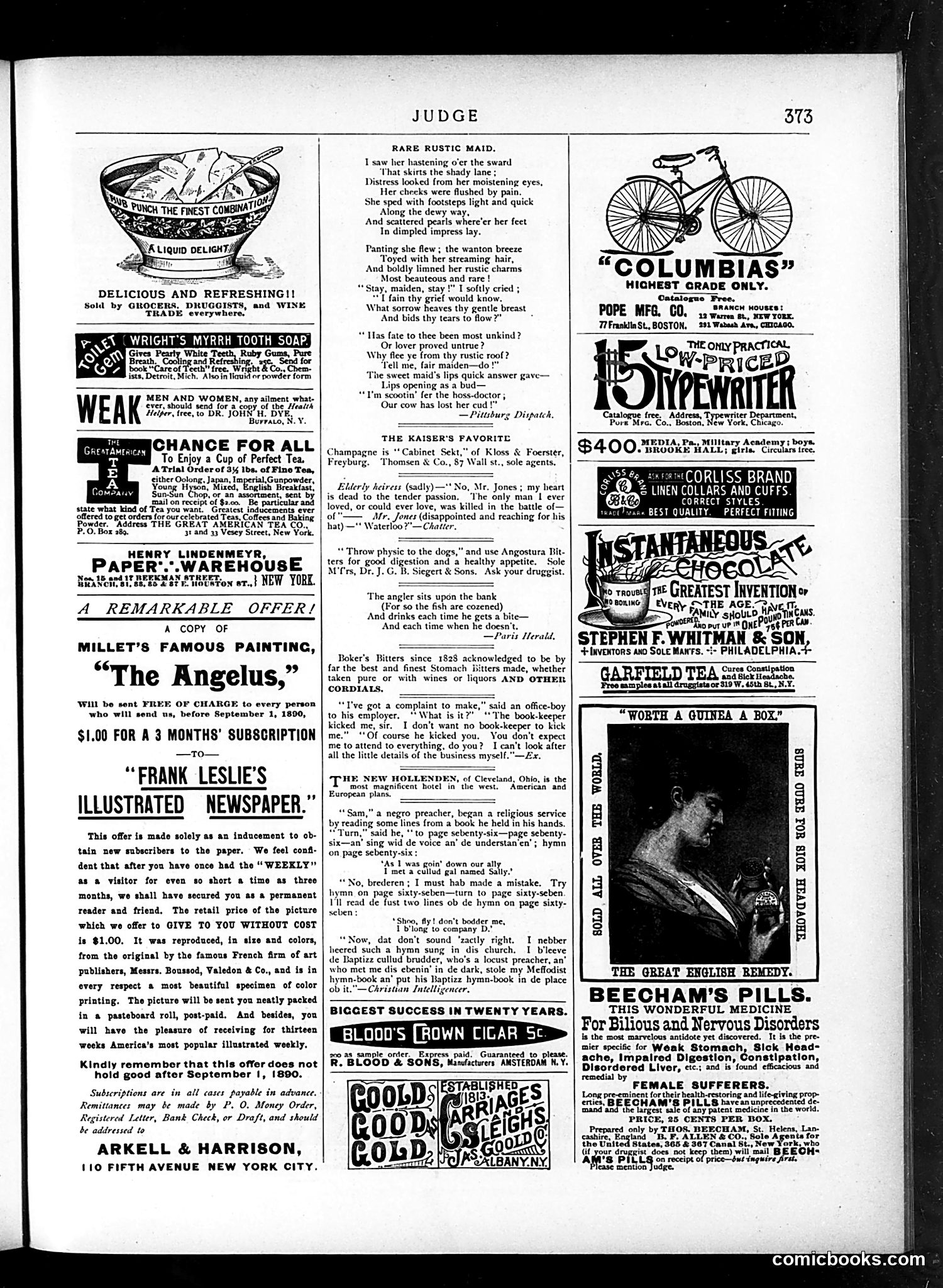
This page is primarily **advertisements and light verse**, not political satire. The main content includes: **"Rare Rustic Maid"** — A sentimental poem about a countryman encountering a distressed young woman. The joke's twist: she's rushing not from romantic tragedy but because their cow has lost her cud (digestive ability). This is rural humor playing on expectations of melodrama. **"The Kaiser's Favorite"** — A champagne advertisement referencing German Emperor Wilhelm II's purported taste. **Miscellaneous ads** for patent medicines, tea, soap, and Frank Leslie's Illustrated Newspaper (offering Millet's "The Angelus" painting free). **Two brief humorous anecdotes** about elderly widows and romantic disappointment. The page reflects late-19th-century American magazine culture: mixing genteel poetry, sentimental humor, and aggressive patent-medicine advertising. There is no significant political commentary or social satire present—just commercial content and light entertainment typical of Judge's lighter pages.
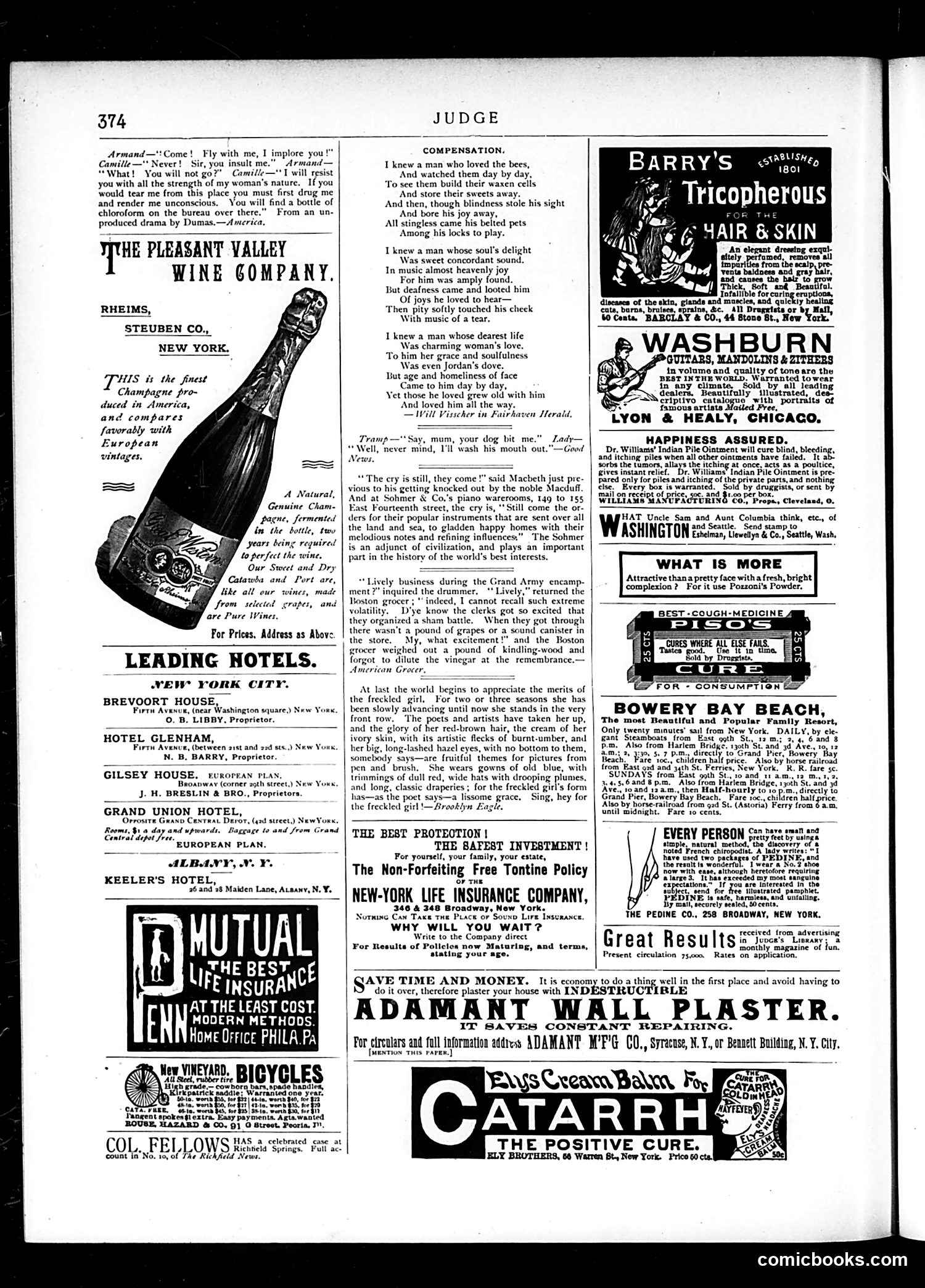
This page is primarily **advertisements and filler content** rather than political satire. The opening dialogue appears to be a humorous parody of melodramatic theater—specifically mimicking Alexandre Dumas's style of romantic French drama, where a character resists seduction by sarcastically suggesting her pursuer use chloroform. It's satirizing overwrought theatrical conventions. The rest of the page contains: - Wine and hotel advertisements - Insurance company ads - A bicycle advertisement - A poem titled "Compensation" about a man who loses various joys (sight, hearing, love) but finds comfort—sentimental Victorian verse - Brief humorous anecdotes (a tramp claiming a dog bit him; a Boston grocer's excitement during an encampment) - Product advertisements (pianos, plasters, tonics, catarrh cure) **There is no significant political or social satire evident.** This appears to be a typical late-19th-century magazine page mixing modest humor, sentimental poetry, and commercial advertisements—the standard format for Judge magazine filler space.
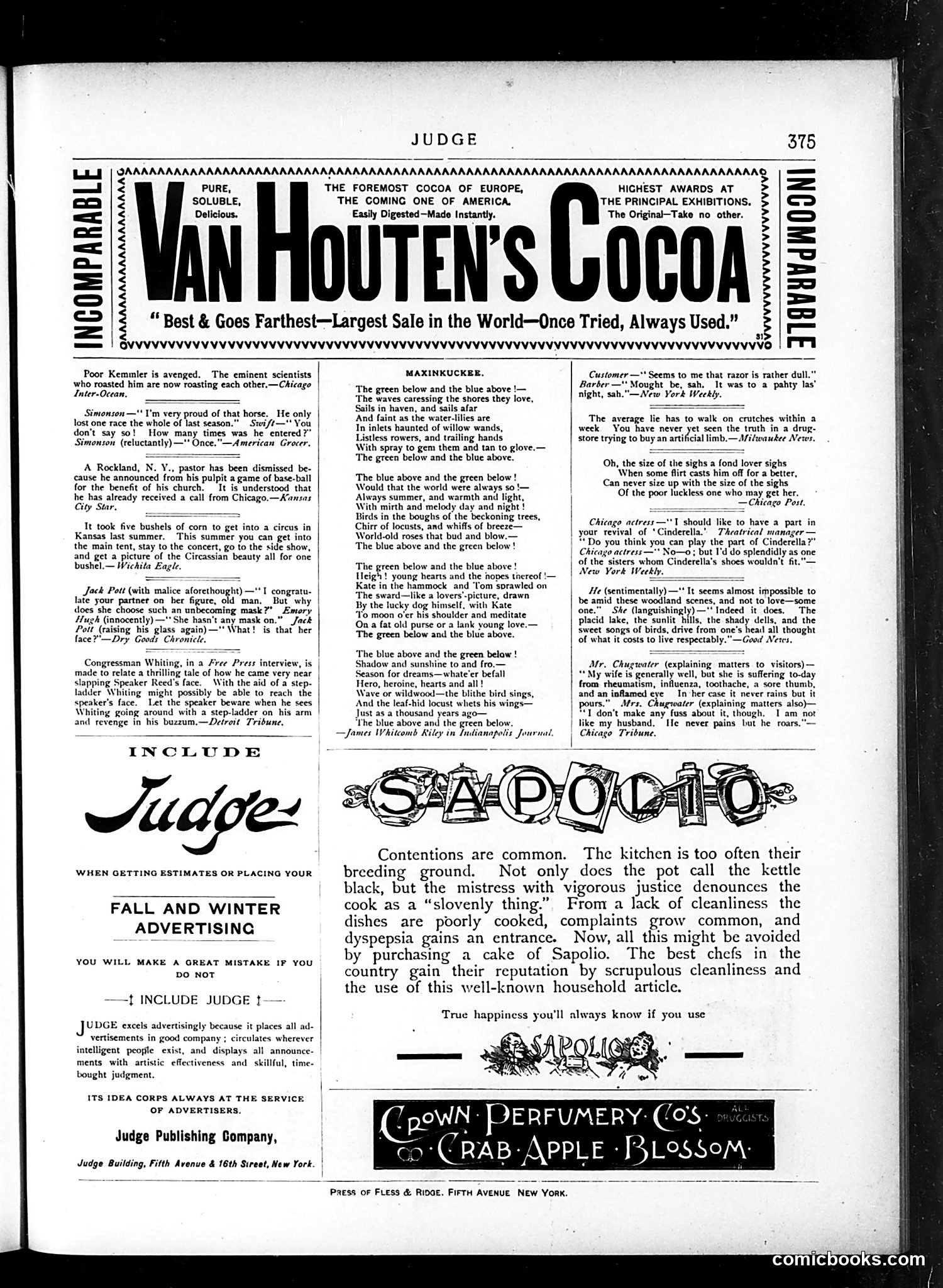
This page is primarily **advertising and poetry**, not political satire. The dominant content includes advertisements for Van Houten's Cocoa (a Dutch chocolate brand claiming international awards) and Sapolio soap, positioned around lighter filler content. The brief jokes/anecdotes scattered throughout address minor social topics: a pastor dismissed for organizing a baseball benefit (mocking clerical propriety), Kansas farmers bartering corn for circus admission (rural economics humor), and a reference to "Poor Kemmler" being "avenged" by quarreling scientists—likely referencing William Kemmler, executed by electric chair in 1890, with scientists debating electrocution's validity. The substantial poetic piece "Maxinkuckee" (a lake in Indiana) is nostalgic nature verse about summer romance—typical Judge filler material. There's a self-promotional section encouraging advertisers to use Judge magazine, claiming its intelligent readership and artistic presentation. Overall, this appears to be a standard Judge issue mixing light humor, advertising, and sentimental verse rather than sharp political commentary.
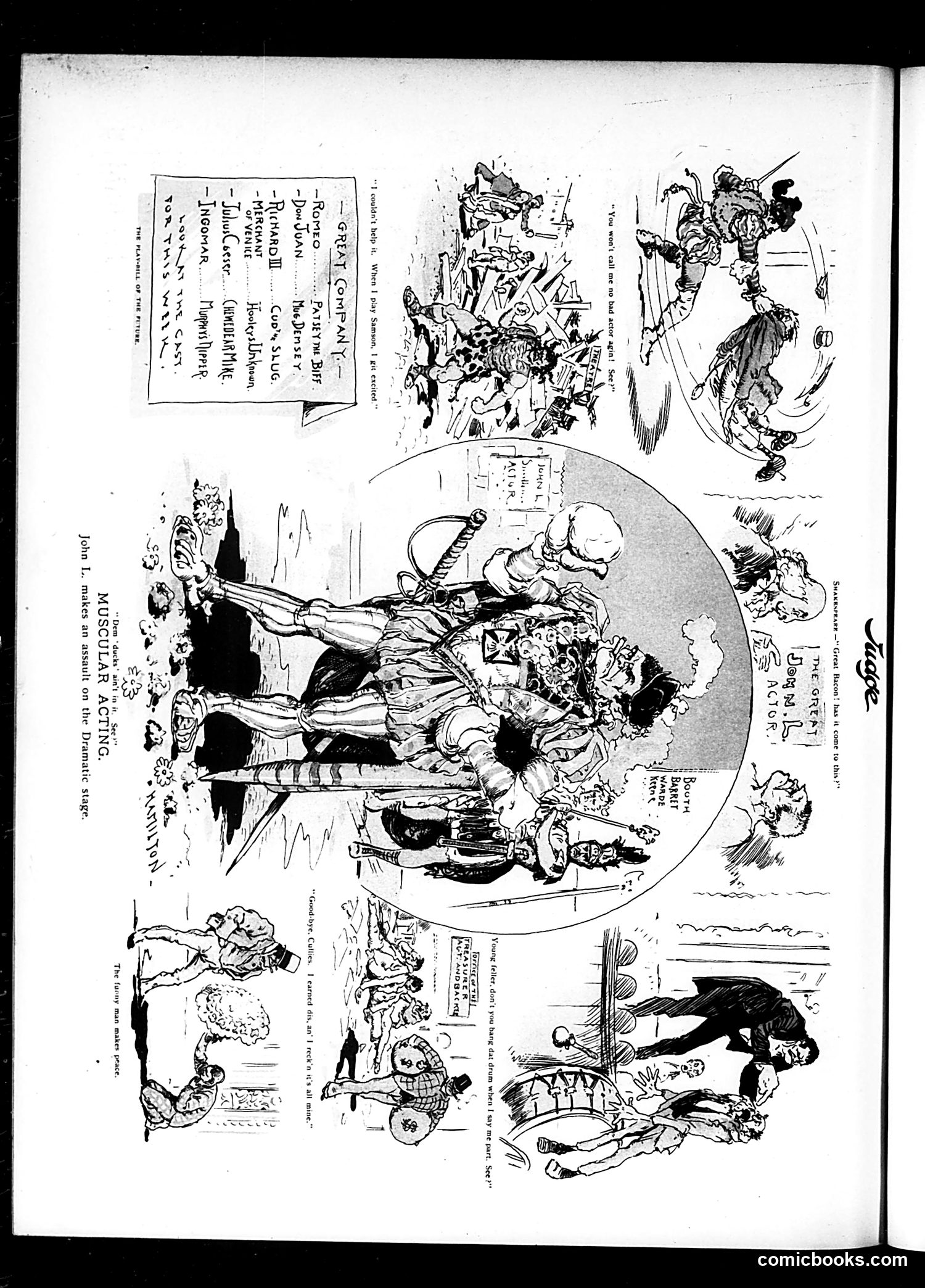
This cartoon satirizes **John L. Sullivan**, the famous heavyweight boxing champion, attempting to become a stage actor. The title "Muscular Acting" mocks his transition from the ring to theater. The central circular vignette depicts Sullivan in various dramatic roles (Romeo, Don Juan, Samson, etc.) performing with exaggerated physical violence rather than theatrical finesse. His quote—"I couldn't help it. When I play Samson, I git excited"—suggests he relies on brute strength rather than dramatic skill. The surrounding smaller panels show chaotic destruction, implying Sullivan's "muscular" approach destroys the play and injures fellow actors. The phrase "Dem 'ducks' ain't in it" uses boxing slang, emphasizing his unfitness for legitimate theater. This reflects late-19th-century class anxiety: a working-class prizefighter invading elite theatrical culture, bringing violence and vulgarity rather than refined artistry. The satire mocks both Sullivan's presumption and contemporary celebrity culture.