
A complete issue · 16 pages · 1890
Judge — August 30, 1890
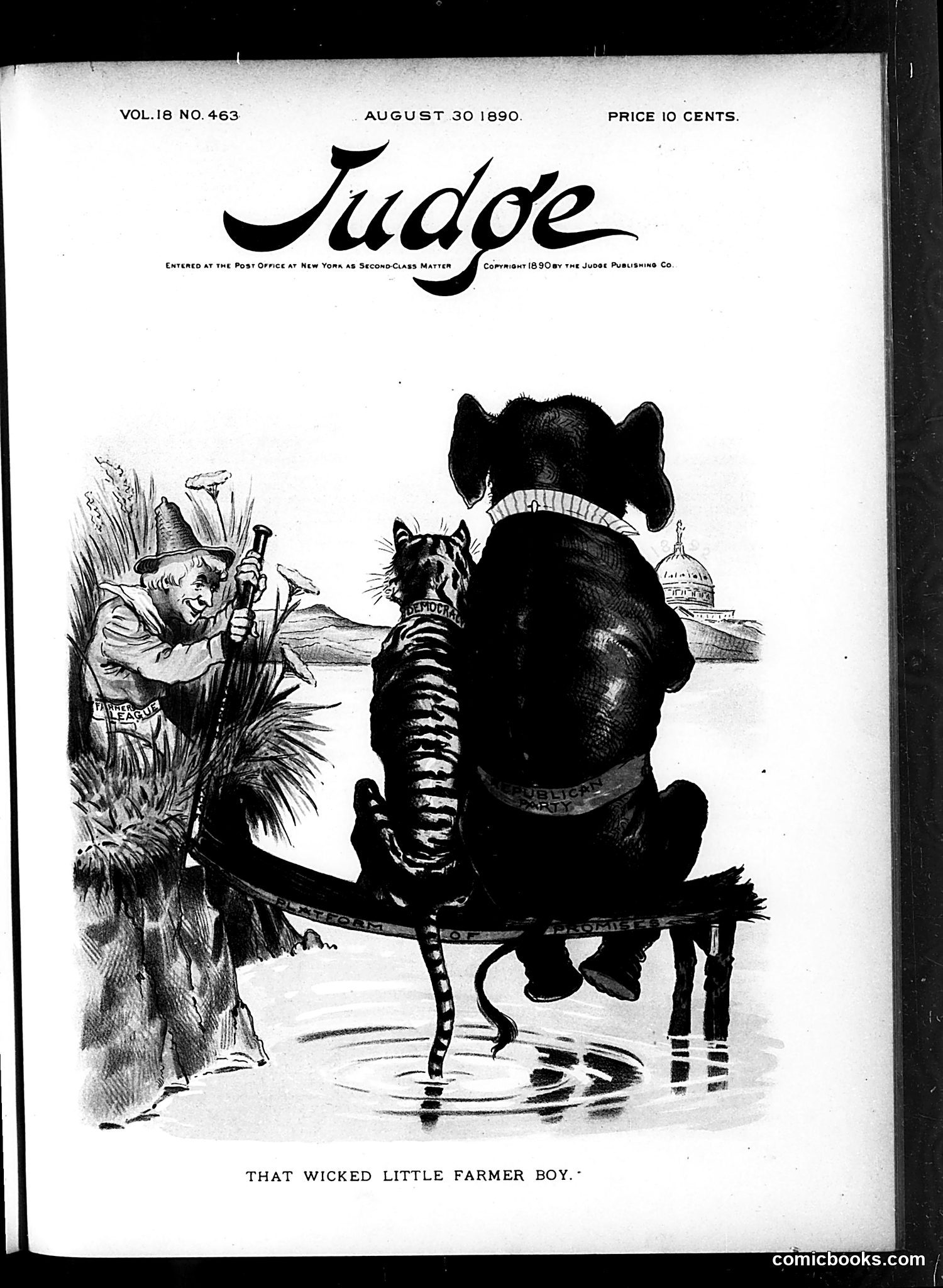
This political cartoon depicts an elephant (the Republican Party symbol) being manipulated by a small farmer figure on the left. The elephant, wearing what appears to be formal dress and a Capitol dome visible in the background, is being controlled like a puppet or toy. The title suggests criticism of agricultural or rural political influence—possibly referencing farmers' growing political power during the 1880s-90s, a period of agrarian discontent. The "wicked little farmer boy" likely represents populist or farming-class movements challenging Republican establishment control. The satire appears to mock either the unexpected influence of farm-based politics on national government, or conversely, warns of dangerous rural manipulation of traditional power structures. Without more specific context about 1890 agricultural politics, the exact target remains somewhat unclear.
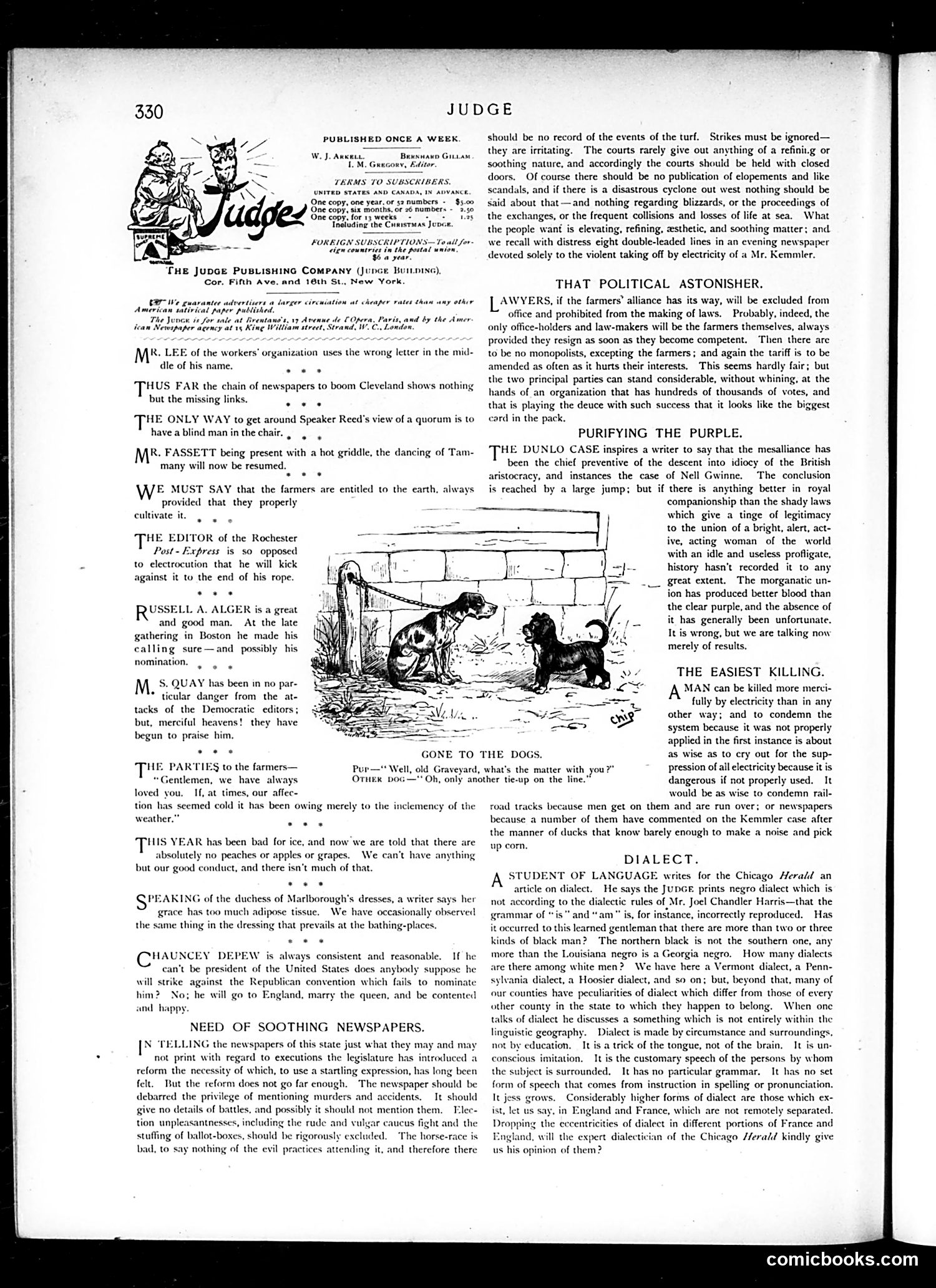
The main cartoon depicts two dogs having a conversation beside a fence. One dog asks the other, "Well, old Graybeard, what's the matter with you?" The other responds, "Oh, nothing—just been on the fence." This is a visual pun playing on the phrase "sitting on the fence"—meaning political indecision or neutrality. The cartoon satirizes politicians or public figures who avoid taking clear positions on issues. By literally depicting dogs on/beside a fence, Judge makes the metaphor concrete and absurd, mocking the wishy-washy nature of such fence-sitting behavior. The surrounding editorial content discusses farmers' political allegiances and Speaker Reed's controversial positions, suggesting this cartoon comments on broader political evasiveness during this era.
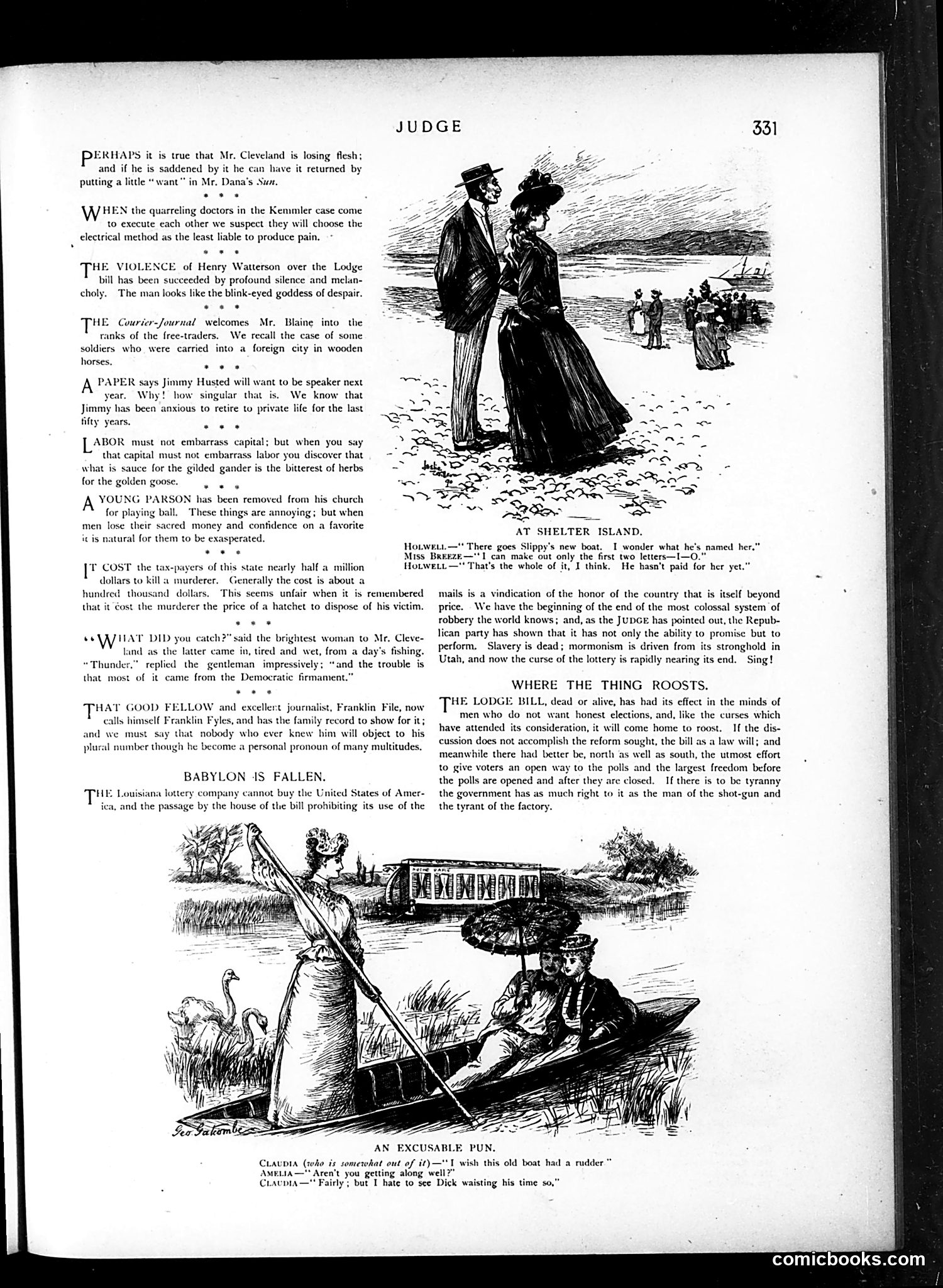
This page contains political commentary and cartoons from Judge magazine's "Judge" section. The top cartoon titled "At Shelter Island" depicts two men and a woman in conversation, with accompanying dialogue about a woman named Skippy and marriage prospects—appearing to be social satire about courtship and relationships among the wealthy. The bottom cartoon, "An Excusable Pun," shows characters named Claudia and Amelia in a boat with a man, making jokes about a "rudder" and someone named Dick. This appears to be gentle domestic humor rather than political satire. The text blocks discuss various topics including Cleveland (likely President Grover Cleveland), capital punishment, Jimmy Haskel as a potential speaker, and commentary on the Louisiana lottery company and state governance. The overall page mixes social commentary with topical political critique typical of late-19th century Judge magazine content.
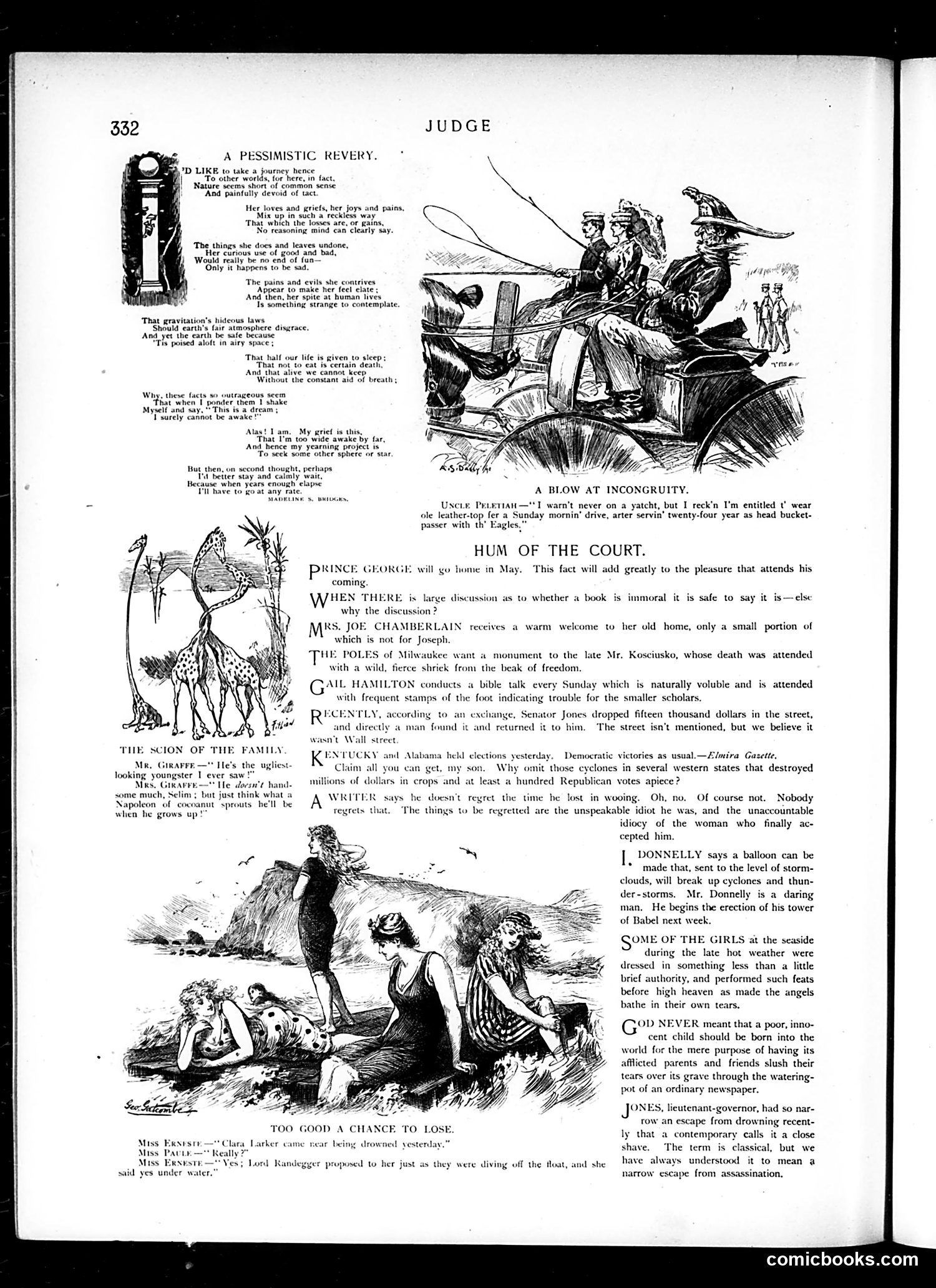
This page contains miscellaneous satirical commentary typical of Judge's "Hum of the Court" section—brief, disconnected jokes on social and political topics. **Key items:** - **"A Pessimistic Revery"**: A philosophical poem mocking nature's apparent irrationality and life's absurdities (sleep, eating, breathing as necessities). - **"A Blow at Incongruity"**: A farmer claims he can wear fancy leather-top boots to Sunday service because he served twenty-four years as a "bucket-passer" on a ship—satirizing false social pretension. - **Court Humorous Notes**: Brief jabs at contemporary figures including Prince George's May visit, Mrs. Joe Chamberlain, Milwaukee's monument to Kosciusko, Gail Hamilton's Bible talks, and electoral matters in Kentucky/Alabama. - **Illustrations**: Satirical sketches accompanying various quips, including beach scenes and family scenarios. The page demonstrates Judge's style: sharp one-liners targeting social hypocrisy, pretension, and contemporary public figures, with supporting cartoons and literary commentary. Without specific date attribution, precise identifications of some figures remain unclear.
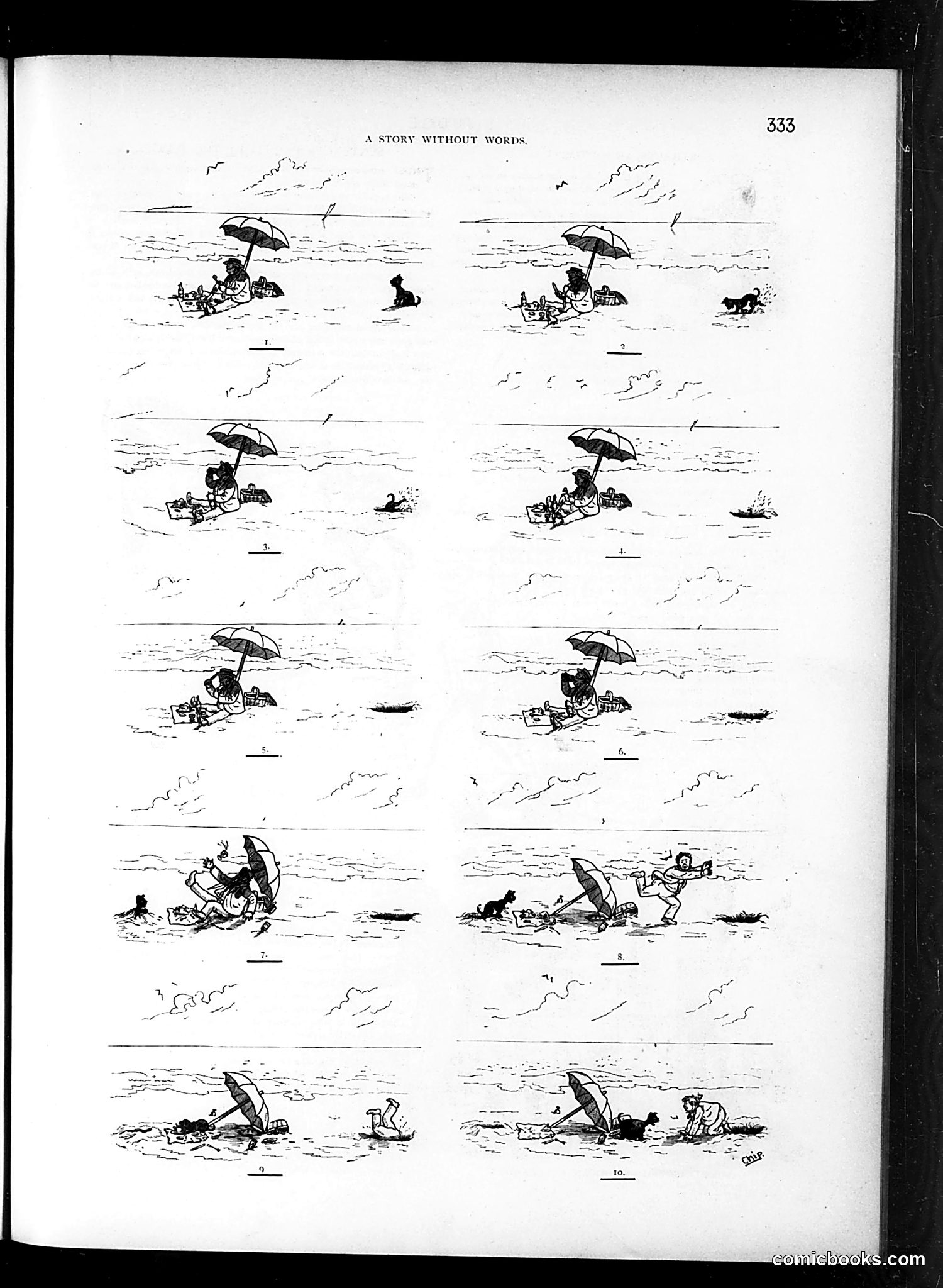
This is a sequential comic strip telling a silent narrative through ten numbered panels. The story depicts a beach scene where a figure sits under an umbrella with picnic supplies while another person (appearing to be a dog or animal) approaches from the water. The sequence shows an escalating conflict: the visitor repeatedly steals or disrupts the seated figure's possessions and umbrella through various comedic interactions. The final panels show the confrontation becoming physical, with both figures tumbling and fighting over the disputed items. The satire appears to comment on property rights, personal boundaries, or social conflict over shared public spaces—common themes in Gilded Age humor. Without dialogue, the visual gags rely entirely on slapstick and physical comedy to convey the joke about territorial disputes or uninvited intrusion.
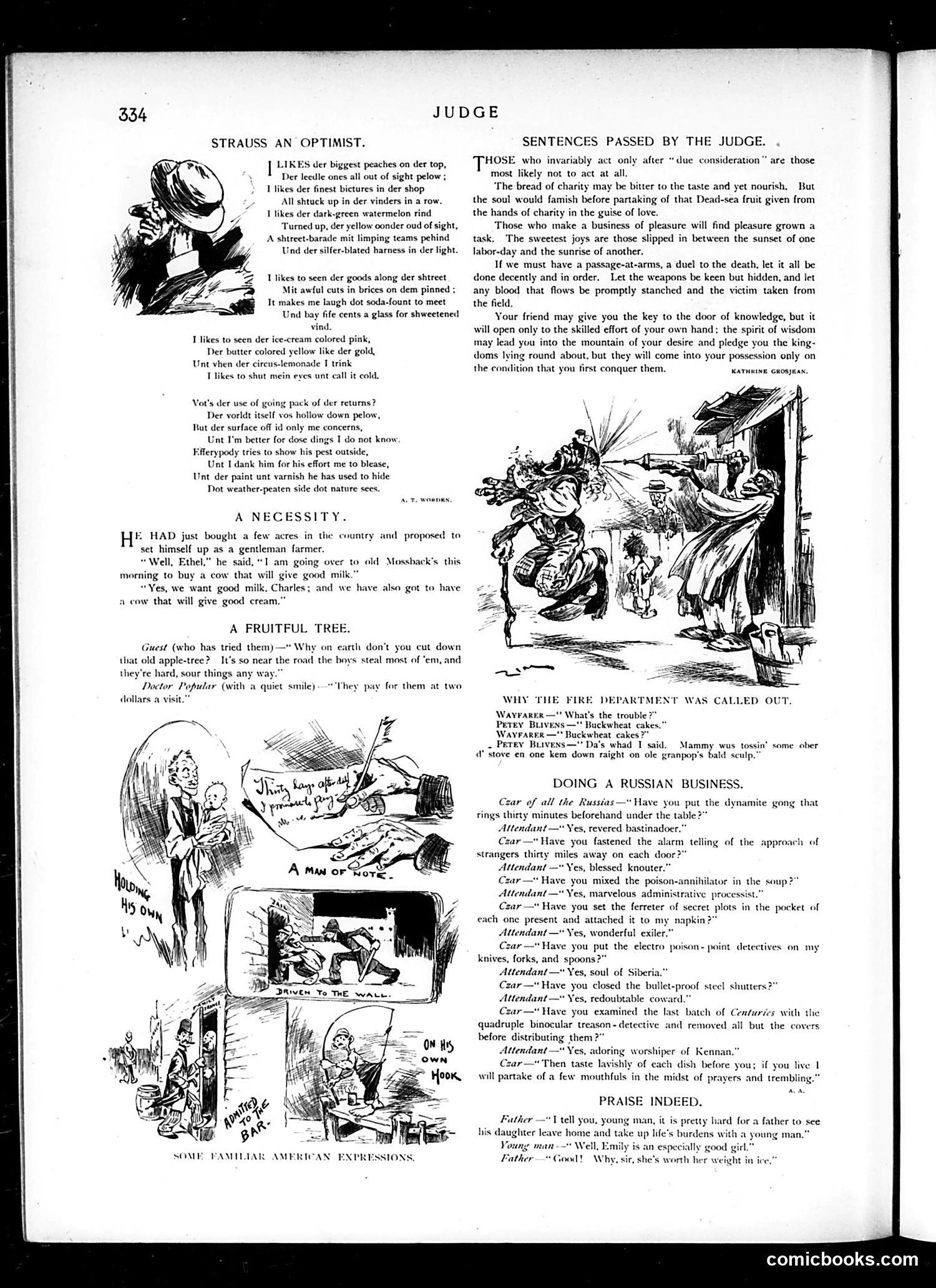
This page contains several satirical pieces reflecting late-19th/early-20th century American humor: **"Strauss an Optimist"** mocks German-American dialect speech (rendered phonetically), depicting an immigrant who sees only the attractive surfaces of things while ignoring their flaws—a commentary on willful naiveté or self-deception. **"A Necessity" and "A Fruitful Tree"** are brief comedic dialogues about rural/farming life, poking fun at domestic concerns and practical matters. **"Doing a Russian Business"** satirizes Czarist Russia's notorious secret police apparatus and paranoia. The "Czar" obsessively implements absurd, theatrical security measures—dynamite under tables, poison in soup, secret detectives everywhere. This mocks Russian autocracy's reputation for oppression and surveillance, likely referencing real contemporary political repression. The page also includes moralistic "Sentences Passed by the Judge"—philosophical maxims about charity, pleasure, and knowledge delivered in judge-like pronouncements. The overall tone is lighthearted domestic satire mixed with political commentary on autocracy.
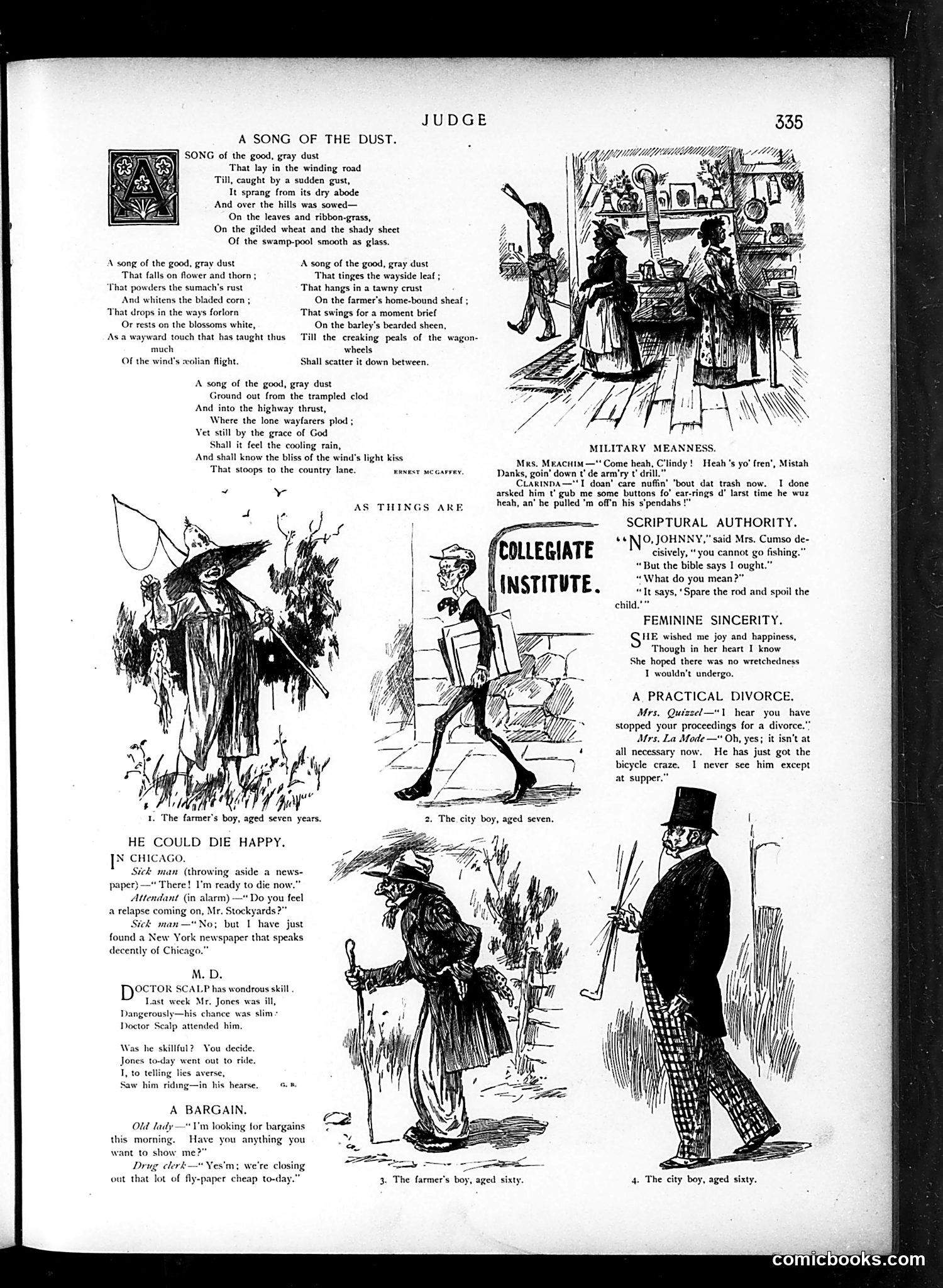
This page contains multiple satirical pieces typical of Judge's humor. The main content includes: **"A Song of the Dust"** — A sentimental poem romanticizing dust, likely satirizing overly earnest Romantic poetry through mundane subject matter. **"As Things Are"** — A series contrasting rural and urban life: a farmer's boy and city boy at ages seven and sixty, suggesting both lifestyles produce similar outcomes (childhood play vs. adult idleness). **Various short jokes** mocking: - A Chicago resident who dies happy upon reading positive coverage - A quack doctor whose patient dies despite treatment - Racial dialect humor (typical of the era, now offensive) about a woman angry her boyfriend used uniform buttons as gifts - Gender stereotypes about women's insincerity and divorce motivated by bicycle obsession The page reflects early 1900s American satirical magazine conventions: mixing social commentary with period-standard racist humor, targeting urban pretension, medical incompetence, and domestic relations.
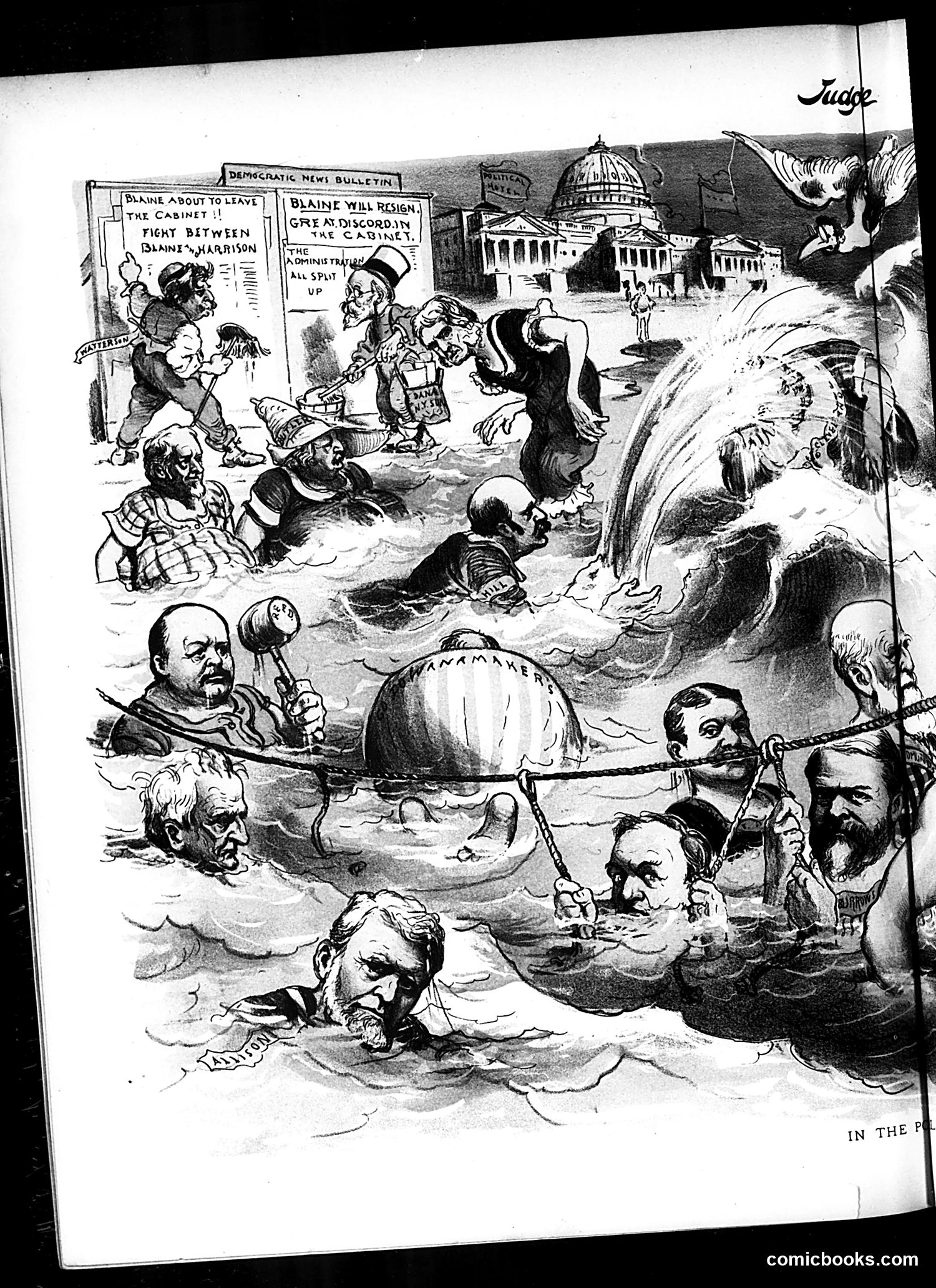
This Judge cartoon satirizes turmoil within President Harrison's Cabinet, specifically targeting James G. Blaine (Secretary of State). The "Democratic News Bulletin" mockingly announces Blaine's imminent resignation due to "great discord in the cabinet." The image depicts political figures drowning or struggling in water beneath the Capitol building—a visual metaphor for the administration sinking into chaos. The caricatures represent competing Cabinet members and political factions literally submerged by internal conflict. The satire suggests the Republican administration is in crisis, with Blaine's position untenable. By presenting this as "Democratic" gossip, Judge ironically suggests Democrats are gleefully anticipating Republican collapse. The drowning figures emphasize how destructive infighting threatens governmental stability and effectiveness.
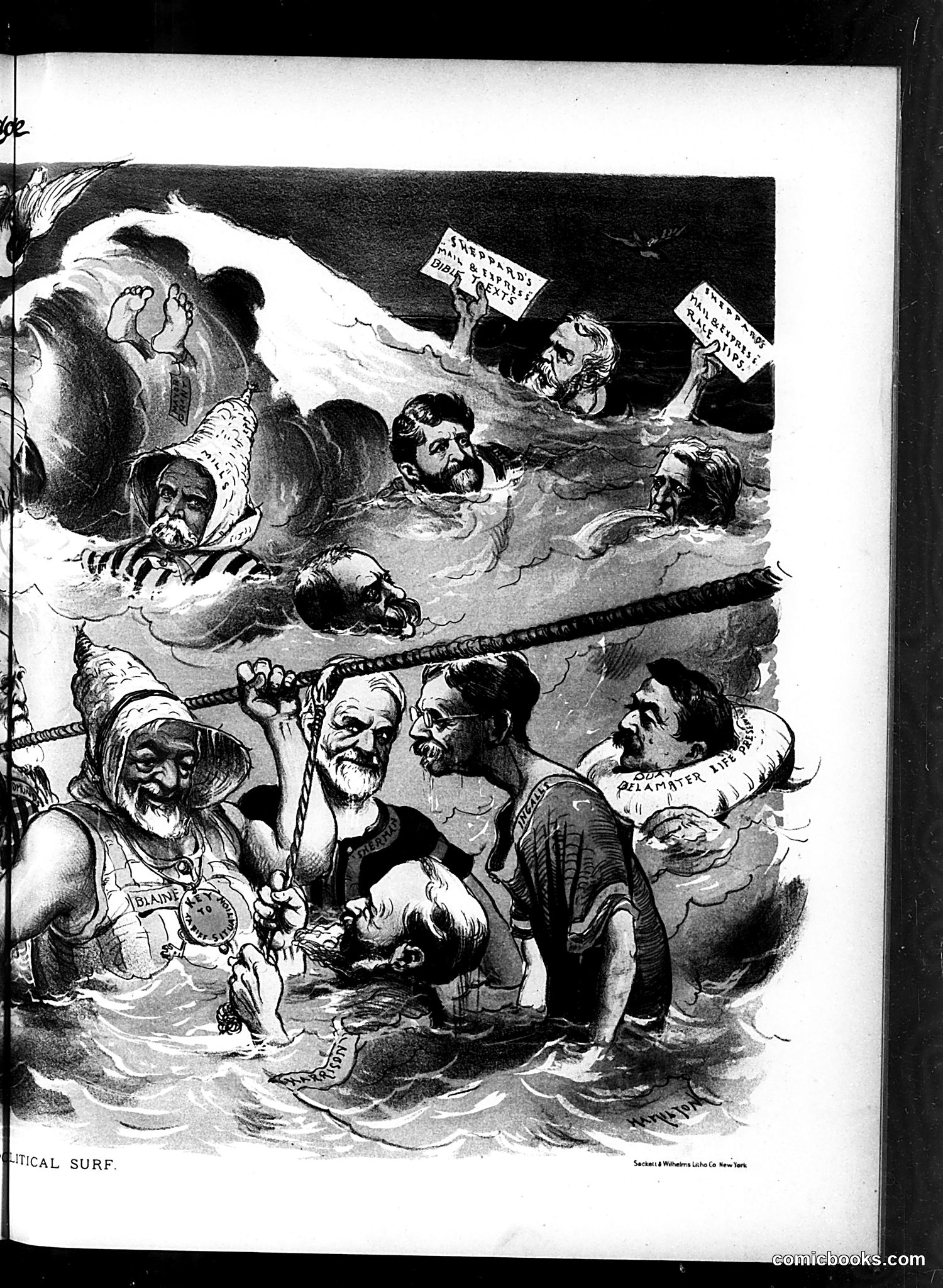
This satirical cartoon depicts multiple figures struggling in turbulent water, labeled "Political Surf." Several swimmers hold signs reading what appears to be political positions or policies (text is partially illegible in the image). The figures are caricatured with exaggerated features typical of late 19th/early 20th-century political cartoons. The satire suggests that contemporary politicians are "drowning" or struggling amid chaotic political waters—likely referencing a turbulent period of political controversy or conflict. The swimmers clinging to various signs suggests politicians desperately holding onto specific positions or platforms while being overwhelmed by larger political currents beyond their control. Without clearer text on the signs and a specific date, the exact political situation referenced remains unclear, though the metaphor of political turmoil as dangerous waters was common in this era's editorial cartooning.
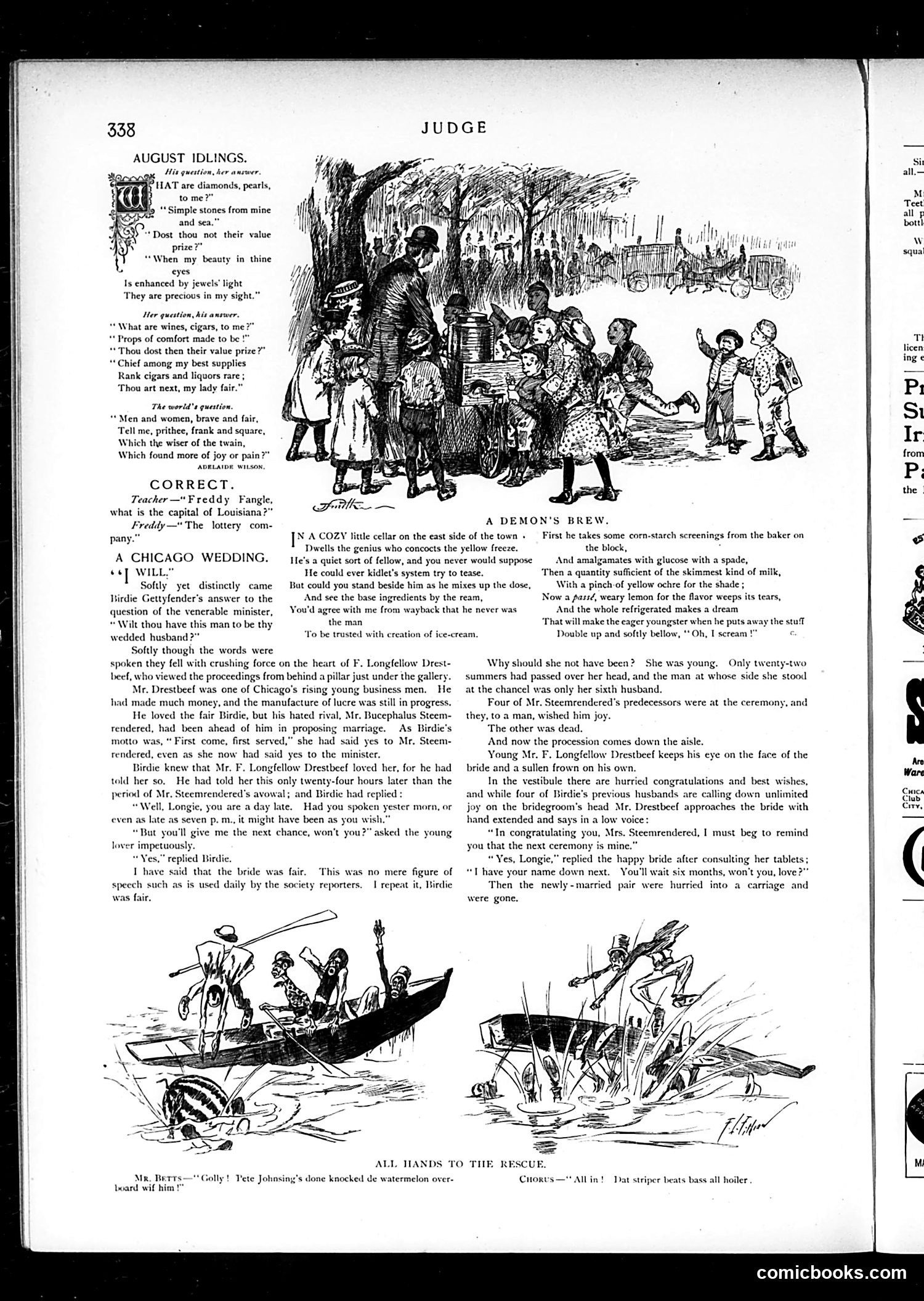
This page contains several satirical pieces typical of Judge's humor: **"August Idlings"** presents dialogue contrasting how men and women value luxury—women prize jewels for enhancing beauty, while men rank cigars and liquor above their romantic partners, placing the woman "next." **"A Chicago Wedding"** satirizes wealthy Chicago businessmen and serial marriage. The bride, Birdie, has married her sixth husband while a rejected suitor watches from the gallery. The joke's punch: she married this man despite having only six previous husbands—implying casual, frequent remarriage among the wealthy elite. The story mocks both the frivolous wealthy and the disposability of husbands in this social circle. **"A Demon's Brew"** ridicules cheap ice cream made from industrial byproducts (corn-starch screenings, glucose, skimmed milk, yellow ochre for coloring, old lemon juice)—satirizing food adulteration and unsafe manufacturing practices common in the Gilded Age. The cartoons and verses target class pretension, marital infidelity among the rich, and food safety fraud.
This page is primarily a collection of vintage advertisements and humorous short items typical of Judge magazine from the late 19th/early 20th century. The cartoons or satirical content are minimal. The main textual humor includes: **"The Old-Timer"**: A nostalgic poem lamenting how modern beverages (champagne, claret, beer, sauterne) pale compared to the simple pleasure of red lemonade at the circus during childhood—a sentimental critique of sophistication replacing innocent pleasures. **Brief jokes scattered throughout**, mostly puns and wordplay about digestion, thermometers, and Irish dialect humor (typical of the era's comedy style). **Bethlehem Hay-Fever Convention joke**: A pun where sneezing delegates voting create the sound "Ach-ach-ach," so the Chairman declares "The nose have it" instead of "ayes." The page is dominated by advertisements for products like Packer's Tar Soap, Sohmer pianos, Castoria (a children's laxative), and various other period goods. There appears to be no significant political satire or substantive cartoon illustration on this particular page.
This is primarily an **advertising page** with one notable literary contribution: a poem titled "The Sailing to Bermuda," credited to R. Kipling (Rudyard Kipling), presented as a parody of his "Barrack-Room Ballads" style. **The Poem's Satire:** The verse mocks British imperial military life through dialogue between soldiers ("Tommy-on-parade") and a color-sergeant. It satirizes the emotional toll of overseas deployment—soldiers being shipped to Bermuda for two years of tedious labor ("a-weedin' onions"), leaving behind grieving wives and sweethearts. The repeated refrain "the grenadiers are sailin' to Bermuda" emphasizes the routine, almost comical nature of colonial military service despite its human cost. **The Satire's Target:** The poem gently ridicules British military bureaucracy and the romantic notion of soldiering, using Kipling's own vernacular style against imperial pretensions. **The Rest:** The page consists entirely of period advertisements for patent medicines, cosmetics, railroads, and other commercial products typical of 1890s magazines.
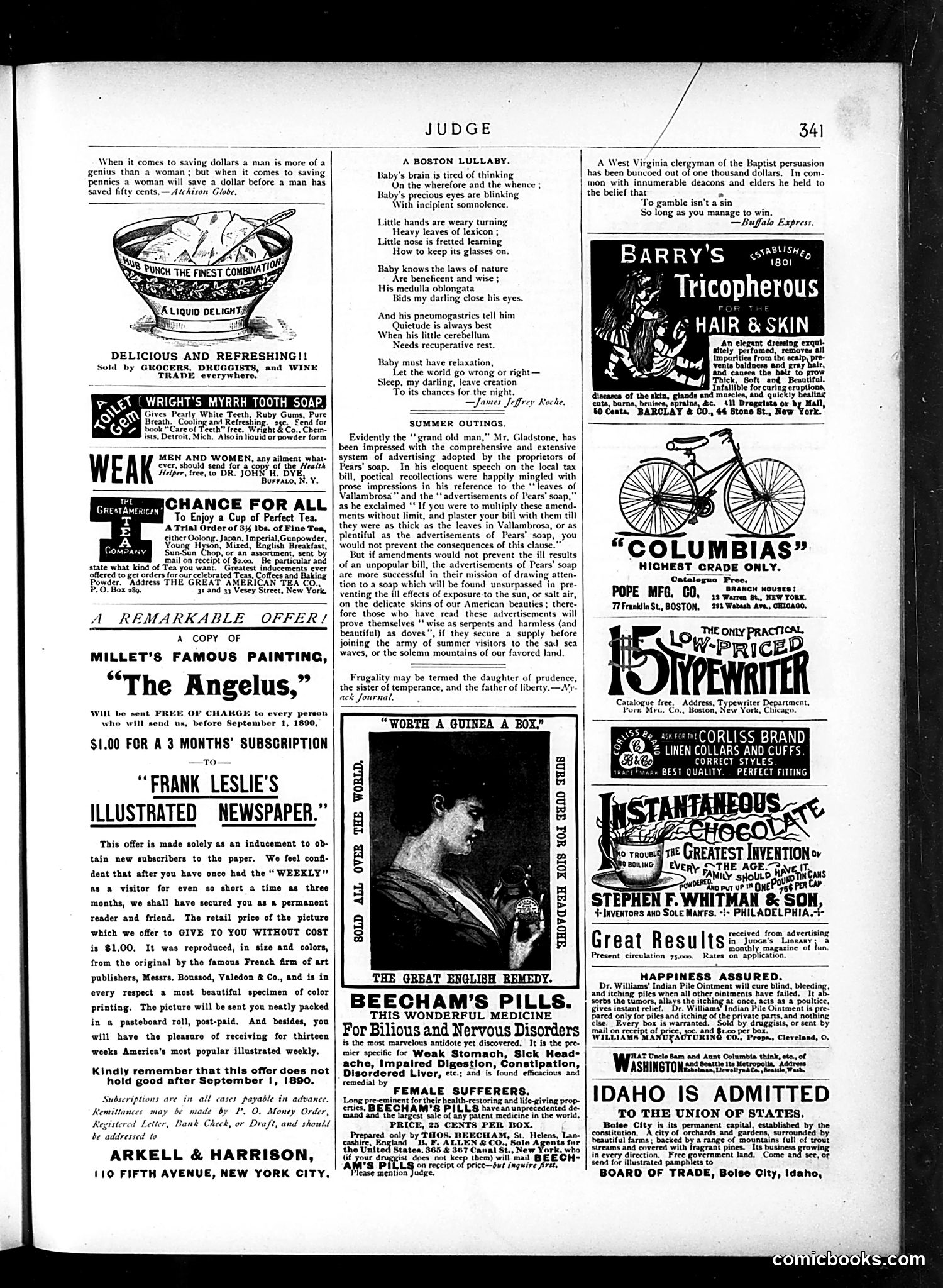
This page is primarily **advertising with minimal editorial content**. The layout showcases various 19th-century commercial products: tooth soap, tea companies, patent medicines, and bicycles. The notable editorial content includes "A Boston Lullaby," a humorous poem satirizing overwrought parental concern. It mocks Boston intellectuals who burden children with excessive education—referencing anatomical terms like "medulla oblongata" and "pneumogastrics"—presenting a satirical contrast between pseudo-scientific child-rearing philosophy and simple sleep needs. The brief commentary on **Gladstone and Pears' soap** appears to reference a political figure's speech where soap advertisements were humorously compared to classical literary references ("Vallambrosa"), poking fun at how ubiquitous advertising had become in public discourse. The opening quote about gender and money-saving reflects typical Victorian-era gender stereotypes about financial habits. Overall, this is characteristic **Judge magazine content**: light satirical social commentary wrapped around commercial advertising.
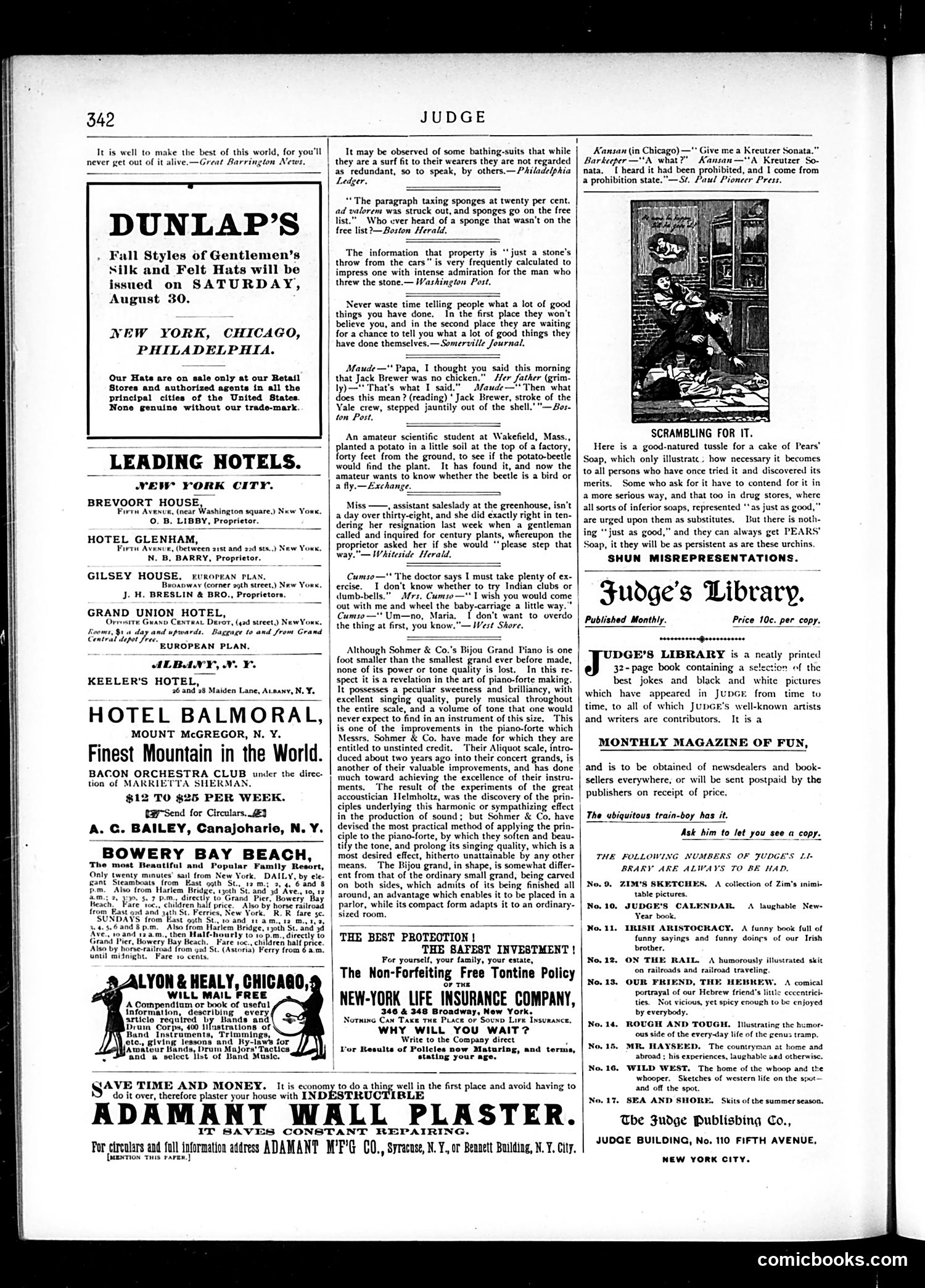
This page consists almost entirely of **advertisements and filler content**, not political satire. The main elements are: **Advertisements:** - Dunlap's hat company (New York, Chicago, Philadelphia) - Multiple hotel promotions (Brevoort House, Hotel Glenham, Grand Union, etc.) - Bowery Bay Beach resort - Lyon & Healy music company (Chicago) - Adamant Wall Plaster - New-York Life Insurance Company **Comic Filler Items:** Short humorous observations reprinted from other newspapers, touching on mundane topics: bathing suits, sponge tariffs, train proximity claims, boasting, a pun about "Jack Brewer" (Yale crew member), and a potato beetle experiment. These appear to be space-fillers rather than Judge's original satirical content. **No significant political cartoons** are visible. The small illustration labeled "Scrambling for It" appears unrelated to the surrounding text and lacks clear political meaning on this page. This is primarily an **advertising-heavy issue** with minimal satirical content.
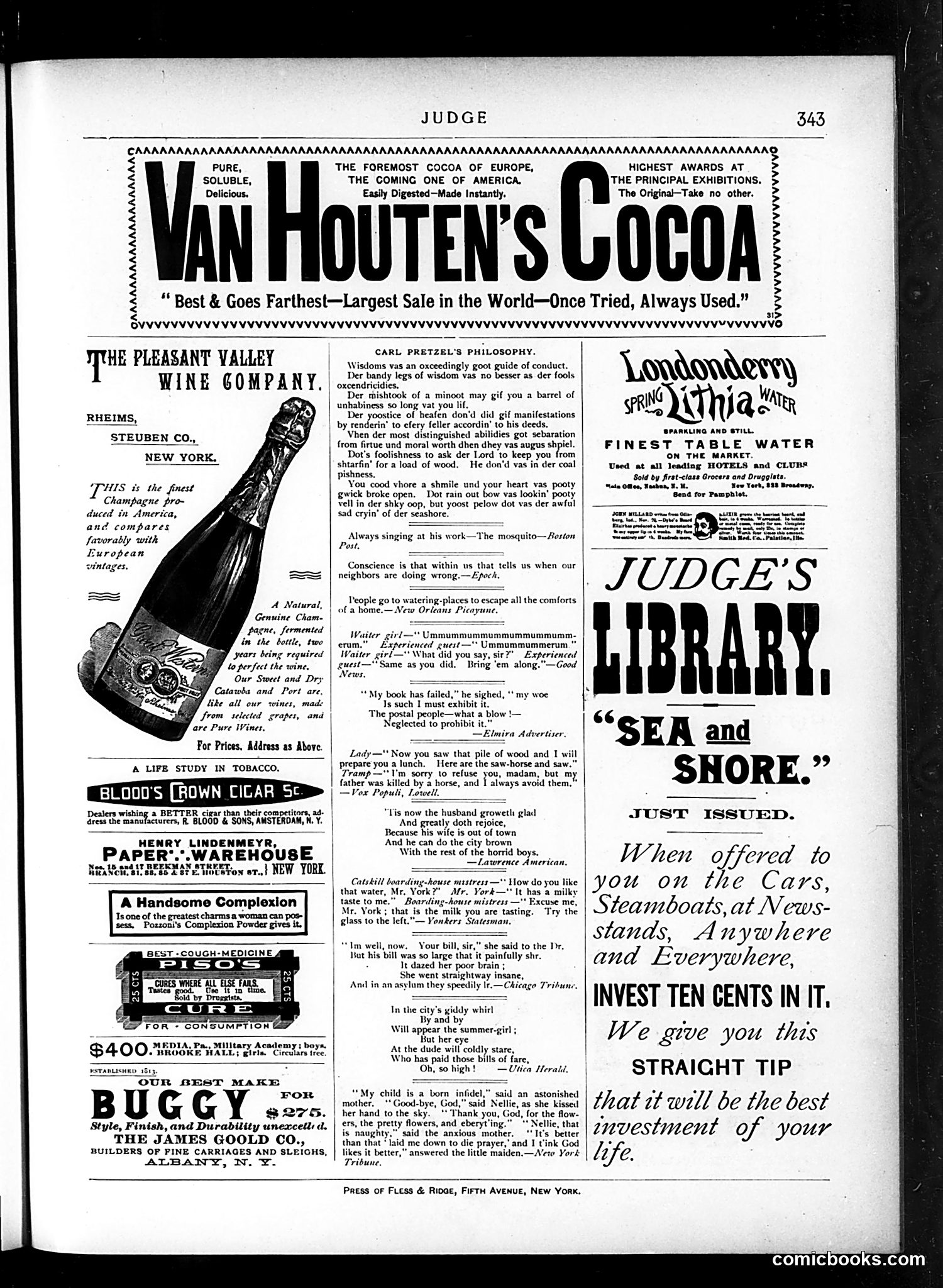
This page is primarily **advertisements and filler content** rather than political satire or editorial cartoons. The layout features commercial ads for products like Van Houten's Cocoa, Pleasant Valley Wine, Blood's Crown Cigars, and buggies. The substantive content is "Carl Pretzel's Philosophy"—a humor column featuring a character with a German accent offering folksy wisdom in broken English. This appears to be ethnic comedy typical of the era, using dialect humor for entertainment. Pretzel dispenses observations about wisdom, conscience, and human nature through malapropisms and fractured grammar ("Der yoostice of beafen..."). Below that are several short joke items and witticisms on topics like postal failures, boarding-house meals, and a doctor's bill causing insanity—light, topical humor with no apparent political agenda. The large "Judge's Library: Sea and Shore" advertisement on the right promotes a book available at newsstands.
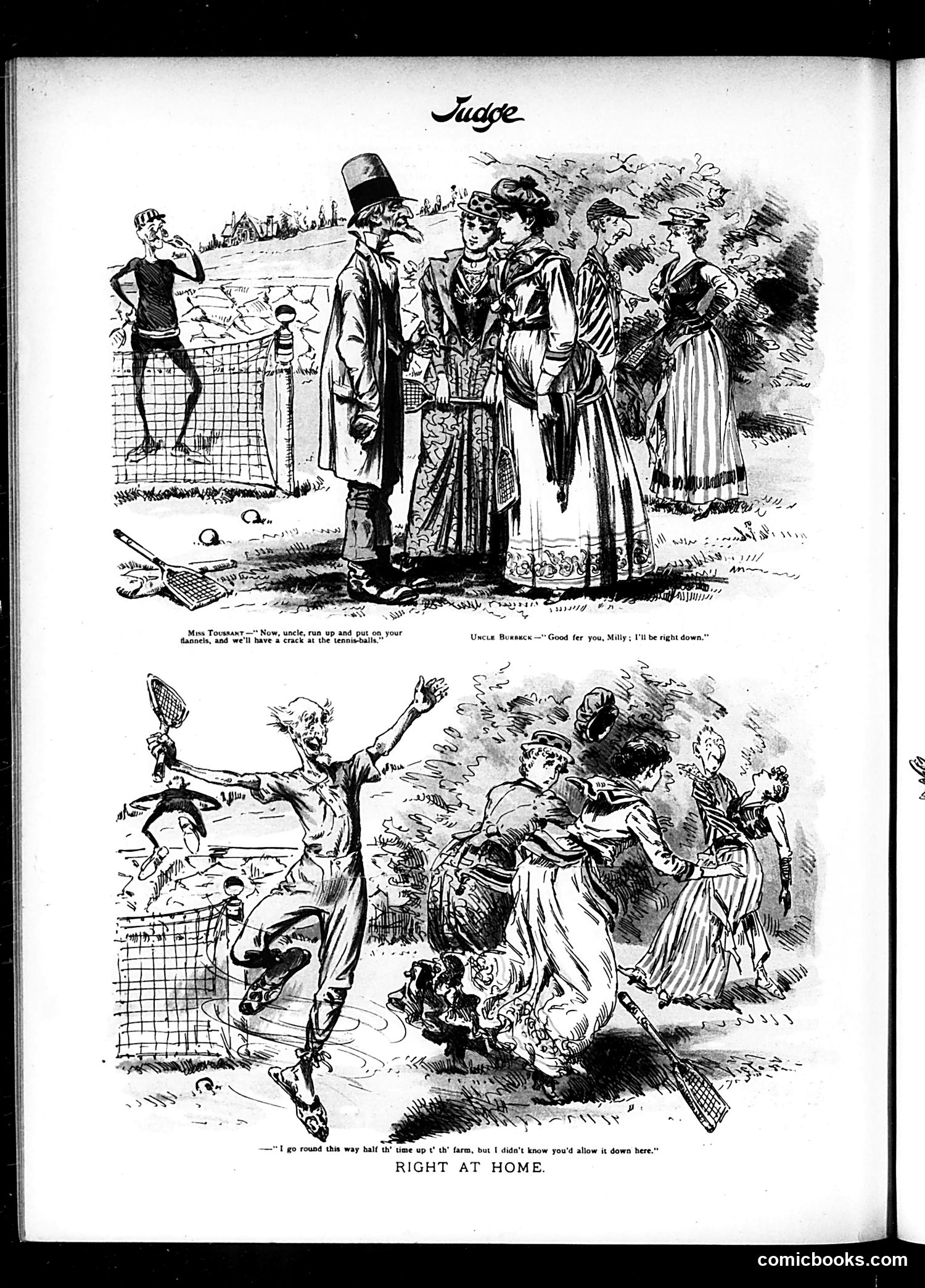
This page contains two separate satirical cartoons about tennis and social class in what appears to be the late 19th or early 20th century. **Top cartoon:** A young woman (Miss Tousan) invites her uncle to play tennis, assuming he'll dress properly in "flannels" (white tennis wear). The humor lies in the contrast between her genteel expectations and the casual athleticism she proposes. **Bottom cartoon ("Right at Home"):** A rustic farm visitor is shown playing tennis in an ungainly, unrefined manner. His caption reveals he regularly takes "this way" through a farm, unaware such behavior wouldn't be tolerated in more refined, upper-class settings. The satire mocks the clash between rural informality and urban/aristocratic social conventions—the idea that country people lack awareness of proper decorum in polite society. Both cartoons target class differences and social pretension through depictions of tennis, which was then an exclusive upper-class sport.