
A complete issue · 20 pages · 1890
Judge — August 2, 1890
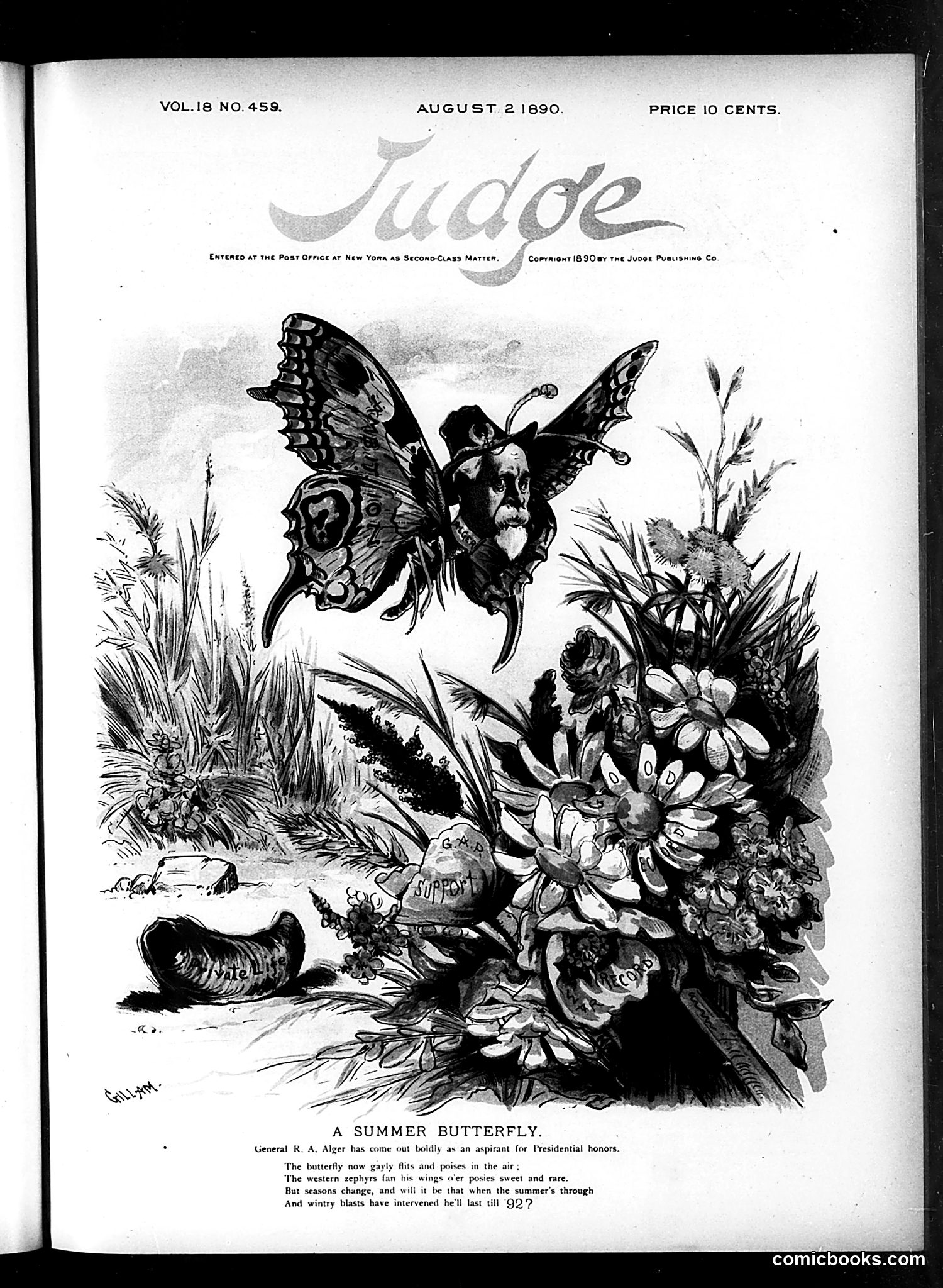
This political cartoon satirizes **General R. A. Alger**, who is depicted as an aspirant for Presidential honors. The image shows Alger with a human head and butterfly wings, surrounded by flowers and plants, representing him as a fragile, showy creature of summer rather than a serious political figure. The accompanying verse mocks his candidacy, suggesting he merely "flits and poises in the air" and lacks substance. The satire implies Alger is an ephemeral, superficial political figure—impressive in appearance but insubstantial and temporary, destined to fade when "winter blasts have intervened." This reflects Judge's skepticism toward Alger's presidential ambitions during the 1890 political season.
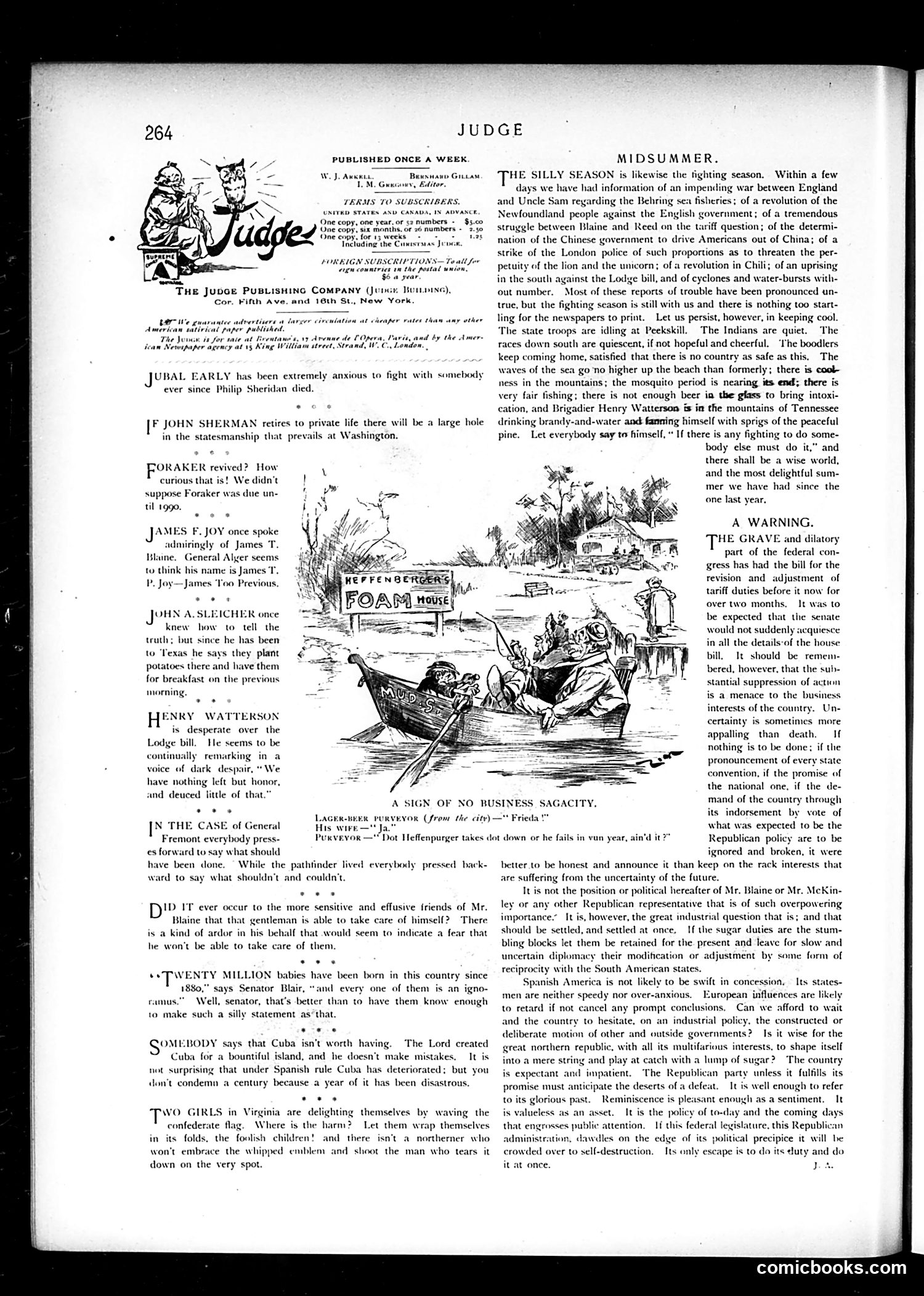
The main cartoon, titled "A Sign of No Business Sagacity," depicts two figures in a small boat near "Burger's Foam House." The image satirizes poor business judgment during what appears to be the midsummer season. The text discusses political uncertainties of the era, referencing Republican policy concerns and references to figures like Mr. McKinley. The broader commentary critiques hesitation and indecision in government—particularly regarding tariff duties and Senate actions—suggesting that excessive caution or delay on important national matters threatens business confidence. The cartoon appears to mock businessmen or politicians who fail to act decisively, using the boat scene as metaphor for being adrift without direction. The "foam house" detail suggests frivolous or insubstantial enterprise.
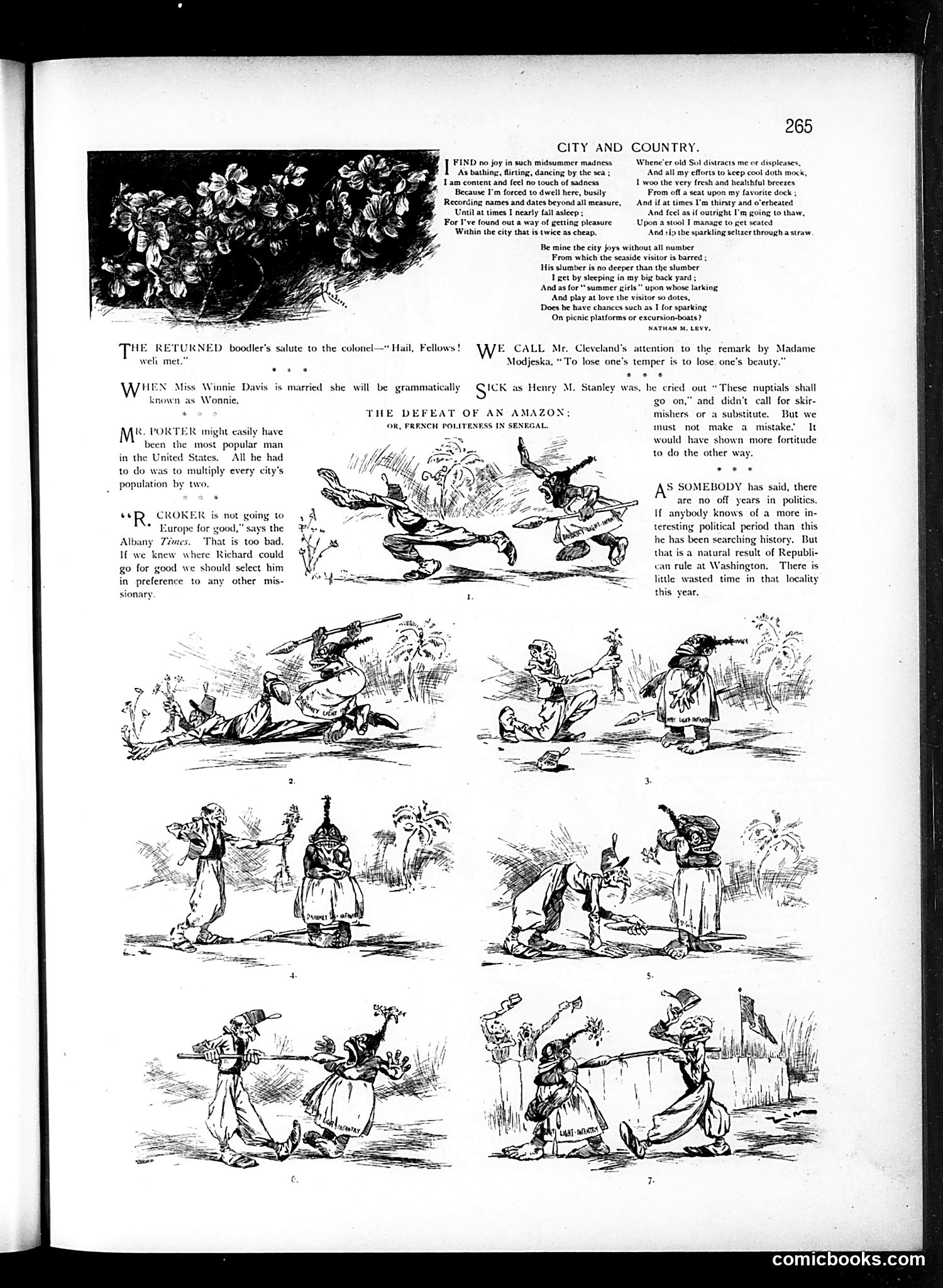
This satirical cartoon sequence depicts a military encounter, likely referencing French colonial conflicts in Senegal. The series of six numbered scenes shows what appears to be a female warrior ("Amazon") being progressively defeated or subdued through a sequence of physical confrontations. The satire's point seems to be mocking either French military prowess or, conversely, French "politeness" in colonial warfare—suggested by the subtitle. The imagery plays on 19th-century racial and gendered stereotypes common in satirical publications of the period. Without additional historical context about specific Senegalese conflicts or French colonial campaigns, the exact political reference remains unclear, though the cartoon likely commented on contemporary imperial military adventures that Judge's readers would have recognized.
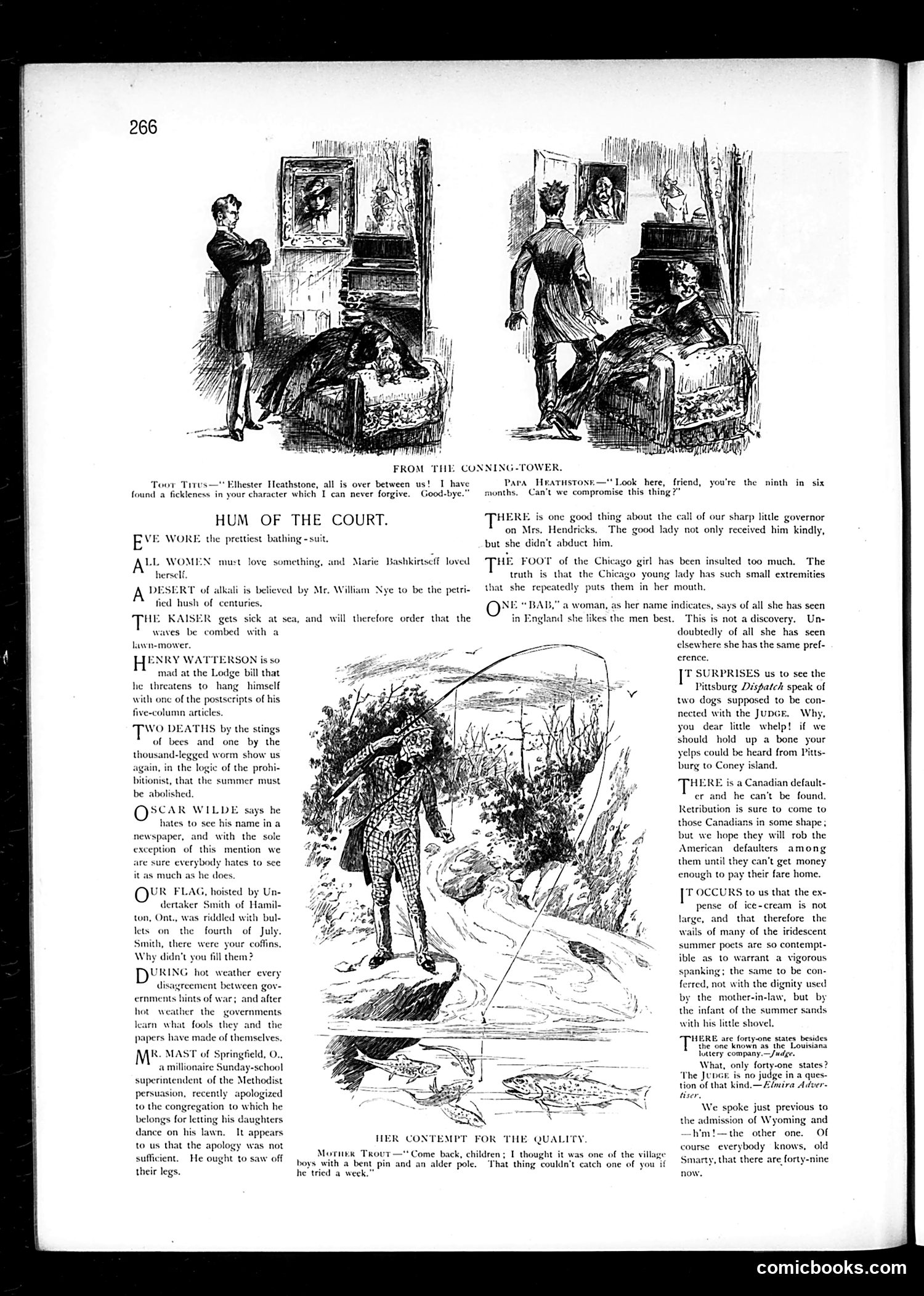
This page collects brief satirical quips and jokes targeting public figures and social issues of the era. Key targets include: **Political figures**: Henry Watterson (editor, angry at the Lodge Bill), Oscar Wilde (complaining about newspaper mentions), and references to a "sharp little governor" calling on Mrs. Hendricks. **Social commentary**: Jokes about women's fashions (bathing suits, small feet), Chicago women's behavior, and English preferences. A mock-serious piece about a "Canadian defaulter" who robbed Americans. **Humor**: The main cartoon depicts a figure fishing, illustrating a quote about boys with pins and fishing poles. Various brief jokes mock contemporary morality (daughters dancing on lawns), weather-related war talk, and the newly-admitted state of Wyoming (referenced as the 42nd state). The overall tone is light mockery of Victorian social pretensions and political absurdities, typical of Judge's satirical approach.
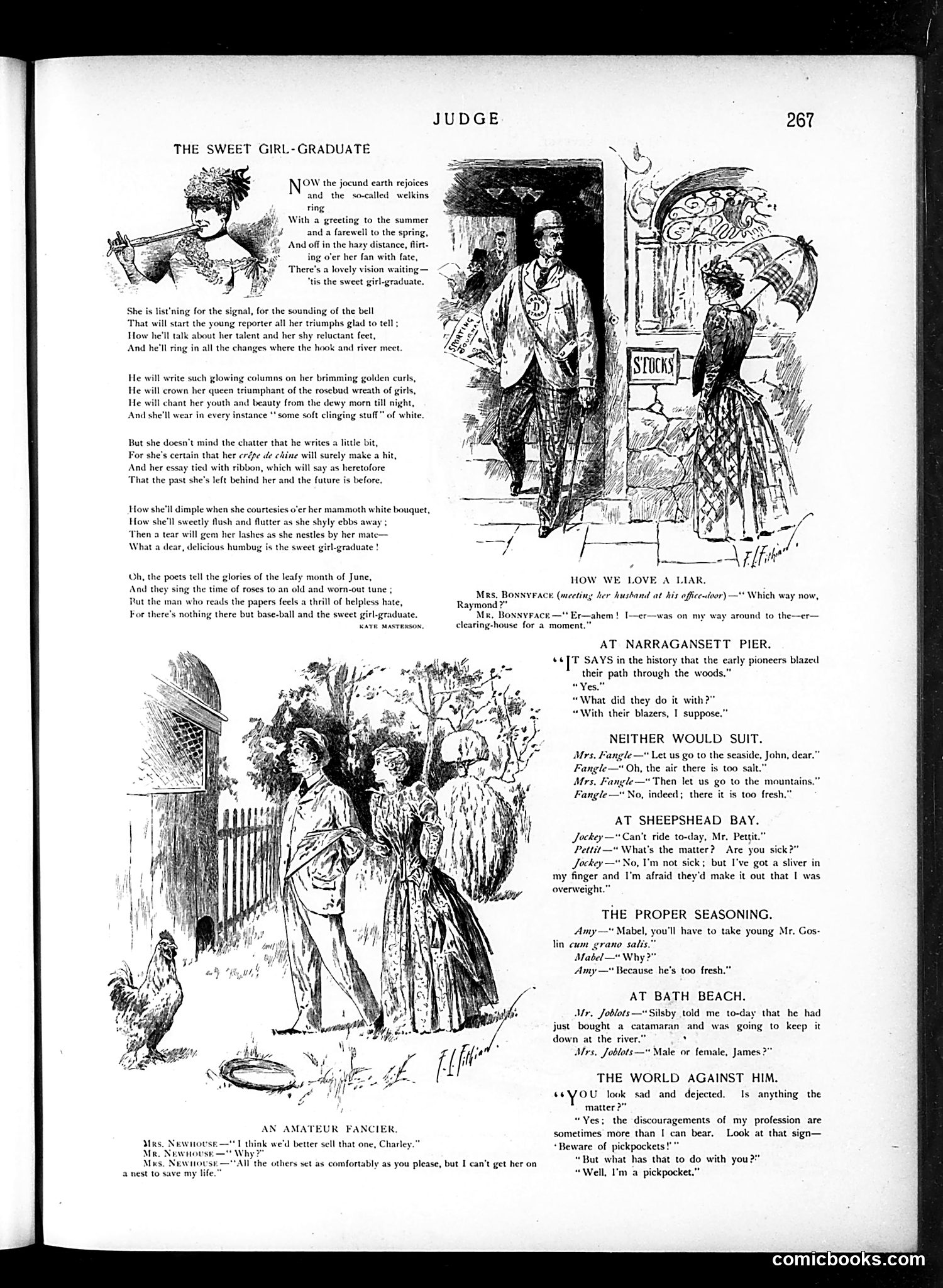
This page contains multiple brief satirical sketches mocking American social conventions of the era (likely early 1900s). **"The Sweet Girl-Graduate"** is the main feature—a poem satirizing the shallow sentimentality surrounding female college graduates. It mocks the flowery press coverage of young women completing their education, their theatrical displays of emotion (dimpling, blushing, tears), and their obsession with appearance ("soft clinging stuff" of white). The satire targets both the graduates' vanity and the newspapers' fawning coverage. The remaining items are one-liners exploiting wordplay and double meanings: a wife catching her husband in a lie; puns on "blazers" and "fresh"; a jockey claiming a finger sliver causes "overweight" problems; someone warning a woman about pickpockets despite being one himself. These sketches represent *Judge*'s typical humor: genteel mockery of middle-class manners, gender relations, and contemporary absurdities. The tone is lighthearted rather than biting—poking fun at predictable social rituals rather than serious critique.
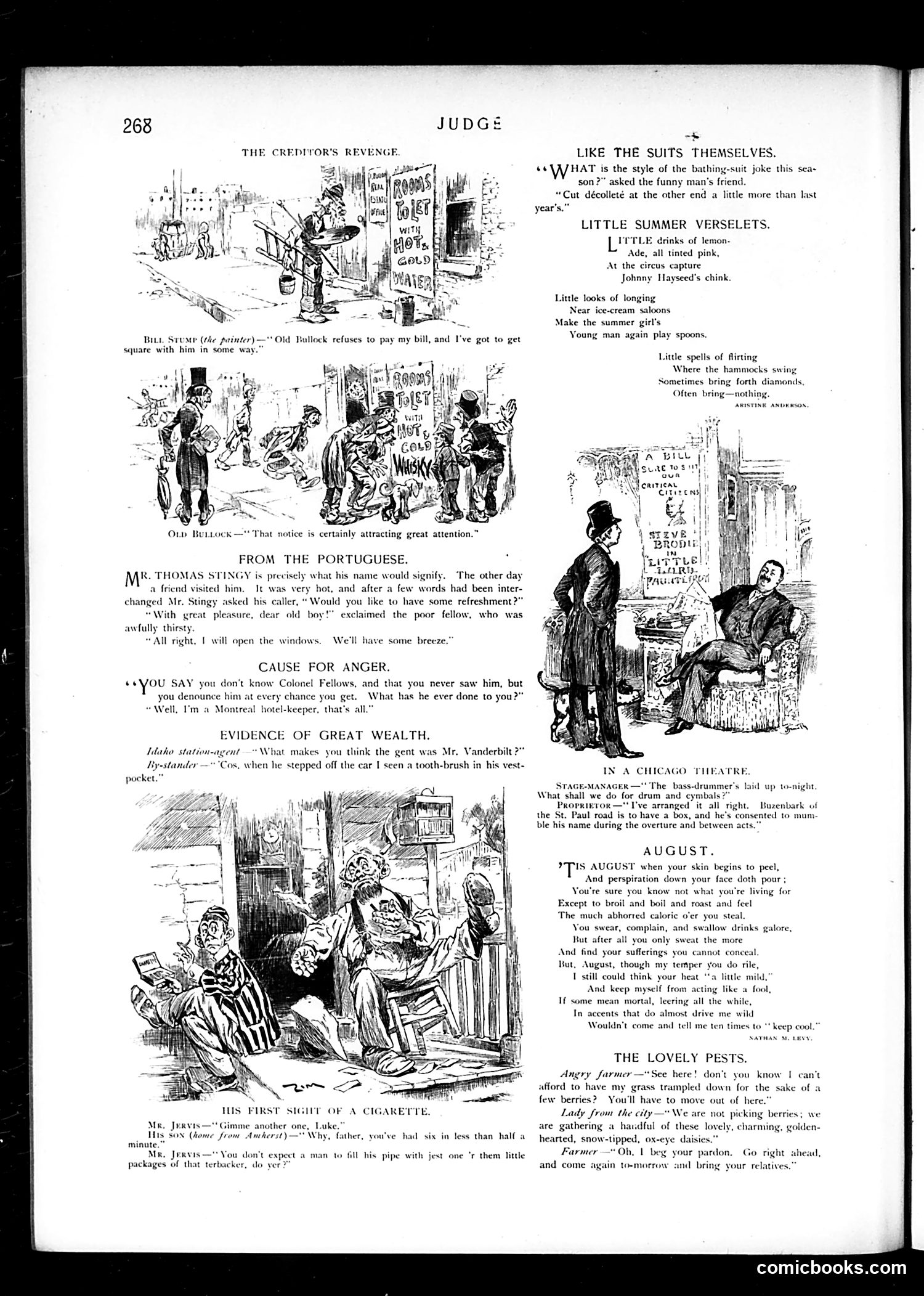
This page contains several brief satirical sketches typical of late 19th/early 20th-century American humor: **"From the Portuguese"** mocks miserly behavior—Mr. Stingy refuses to provide refreshment to a guest, instead offering to "open the windows" for a breeze. **"Cause for Anger"** jokes about a hotel-keeper's irrational grudge against Colonel Fellows, whom he's never met, simply because the man is a guest. **"Evidence of Great Wealth"** satirizes assumptions about wealth—a bystander judges someone rich because he spotted a toothbrush in the man's vest pocket. **"His First Sight of a Cigarette"** depicts a father complaining his son smokes too much in too short a time. The page also includes light verse about summer discomforts (August heat) and "The Lovely Pests"—city people trespassing on farms to pick wildflowers, annoying the farmer. These represent typical Judge content: class-based humor, observations about daily absurdities, and gentle social satire rather than hard political commentary.
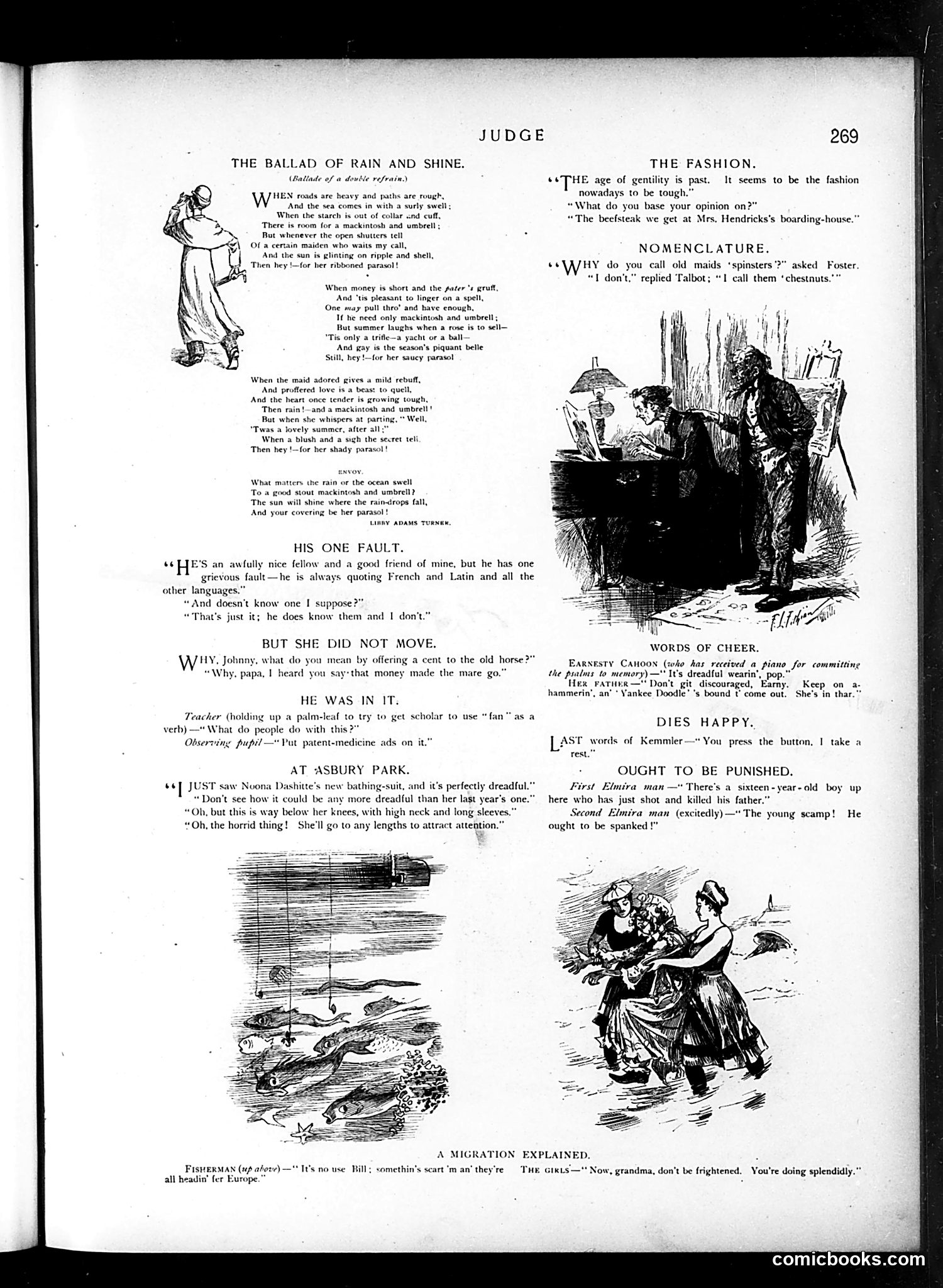
This page collects miscellaneous satirical items typical of Judge's format. Key pieces include: **"The Ballad of Rain and Shine"**: A romantic poem contrasting practical concerns (mackintosh raincoats, umbrellas) with romantic attraction to a woman's parasol—satirizing how love overrides practicality. **"His One Fault"**: A joke about a pedantic man who constantly quotes French and Latin, poking fun at pretentious intellectuals. **"At Asbury Park"**: Social satire mocking women's bathing fashions, specifically criticism of a woman's modest new suit (with sleeves and high neckline) as excessive modesty designed to attract attention—absurdist humor about fashion contradictions. **"The Fashion"**: Mocks declining gentility, using poor boarding-house food as evidence society has become "tough." **"Dies Happy"**: Dark humor about an execution (Kemmler reference suggests William Kemmler, first electric chair execution, 1890), juxtaposed with an Elmira man's comment that a boy who killed his father "ought to be spanked"—grim commentary on disproportionate punishment. The page exemplifies Judge's satirical style: social observation, wordplay, and dark humor targeting manners, fashion, and contemporary issues.
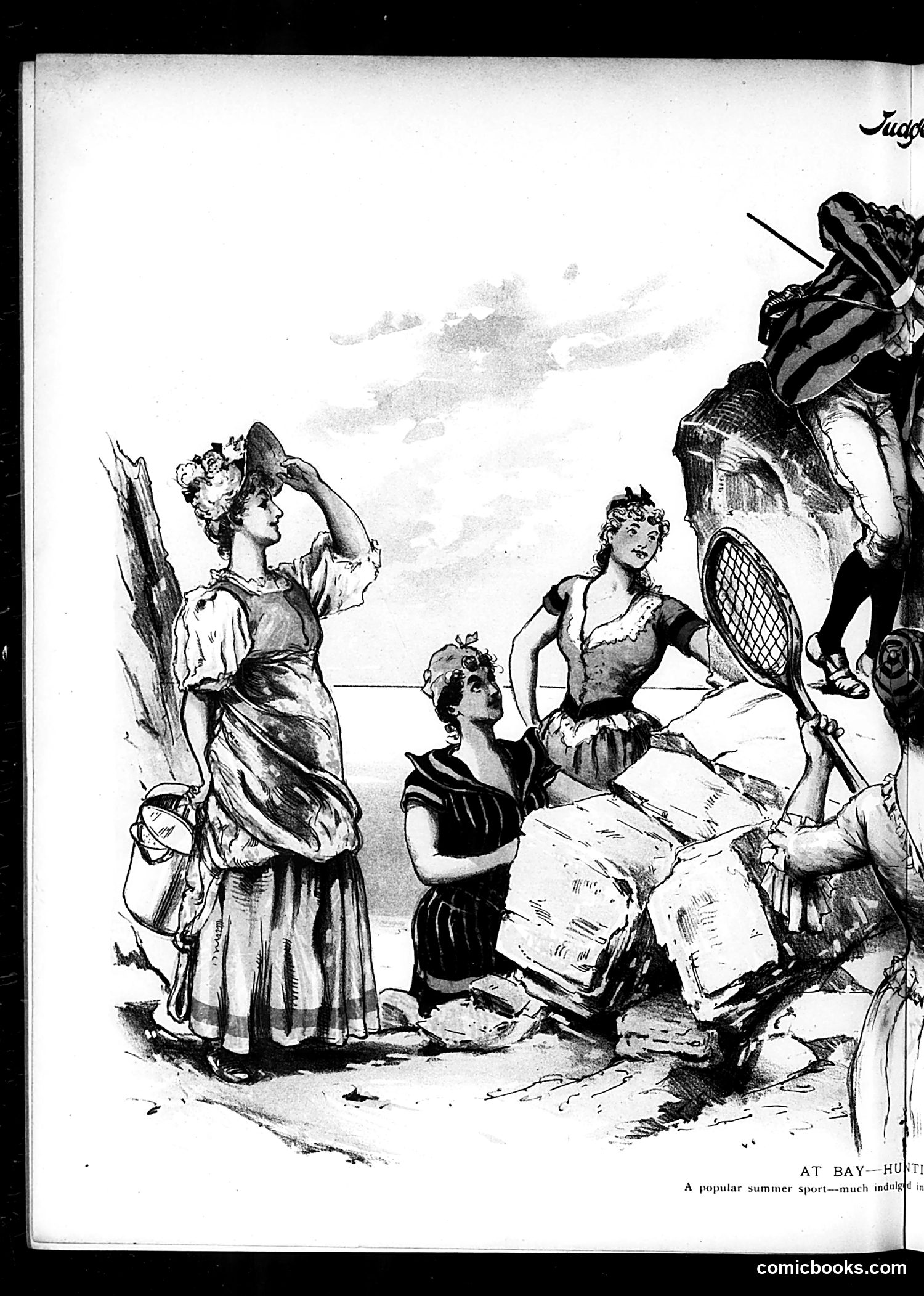
This appears to be a satirical illustration about summer beach or seaside activities. The incomplete caption describes "a popular summer sport—much indulg[ed] in," likely with ironic intent typical of *Judge* magazine's social commentary. The image shows several fashionably-dressed women at what appears to be a beach or seaside location, with tennis rackets visible. The composition and the title "At Bay—Hunting" suggest the satire concerns women being pursued or "hunted" by men during summer leisure activities—a commentary on romantic/social dynamics of the era. The women's elaborate period dress (appearing to be late 19th or early 20th century) contrasts with the casual beach setting, emphasizing the social pretense of such outings. The satire likely mocks both the formal courtship rituals and gender relations of the time.
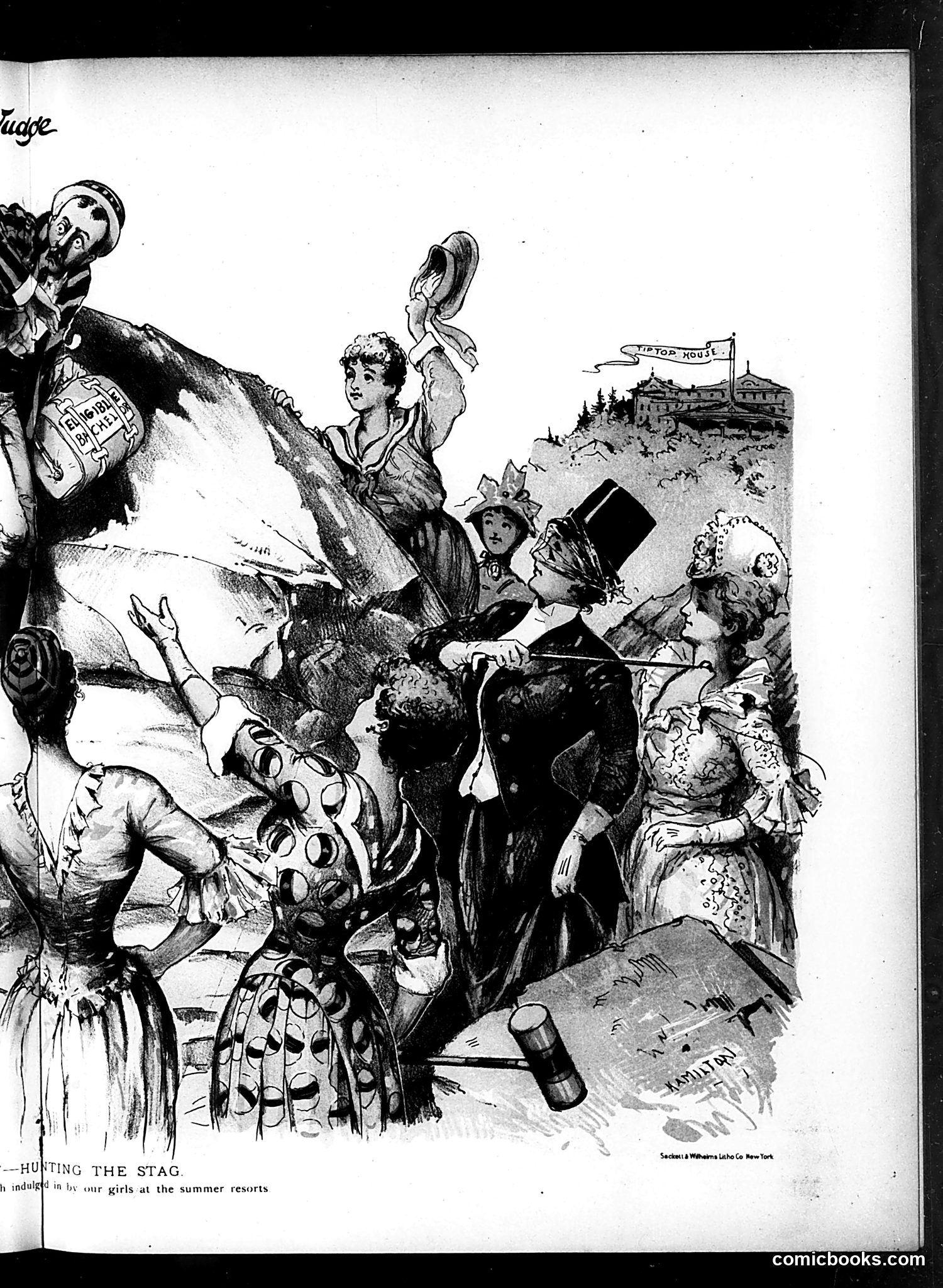
This cartoon satirizes courting behavior at summer resorts. The caption indicates young women are "hunting the stag"—slang for pursuing eligible bachelor men. The scene shows fashionably dressed women at what appears to be a resort (note the "TOP HOUSE" building in the background) actively pursuing well-dressed men in top hats. The exaggerated, energetic poses of the women—some reaching out, gesturing dramatically—mock the aggressive courtship tactics of the era's marriageable women. The humor relies on role-reversal: traditionally men were expected to pursue women. By depicting women as the active "hunters" and men as the quarry being "hunted," the cartoon satirizes changing gender dynamics in turn-of-the-century courtship, particularly among the leisure class at resort destinations where young people gathered during summer season.
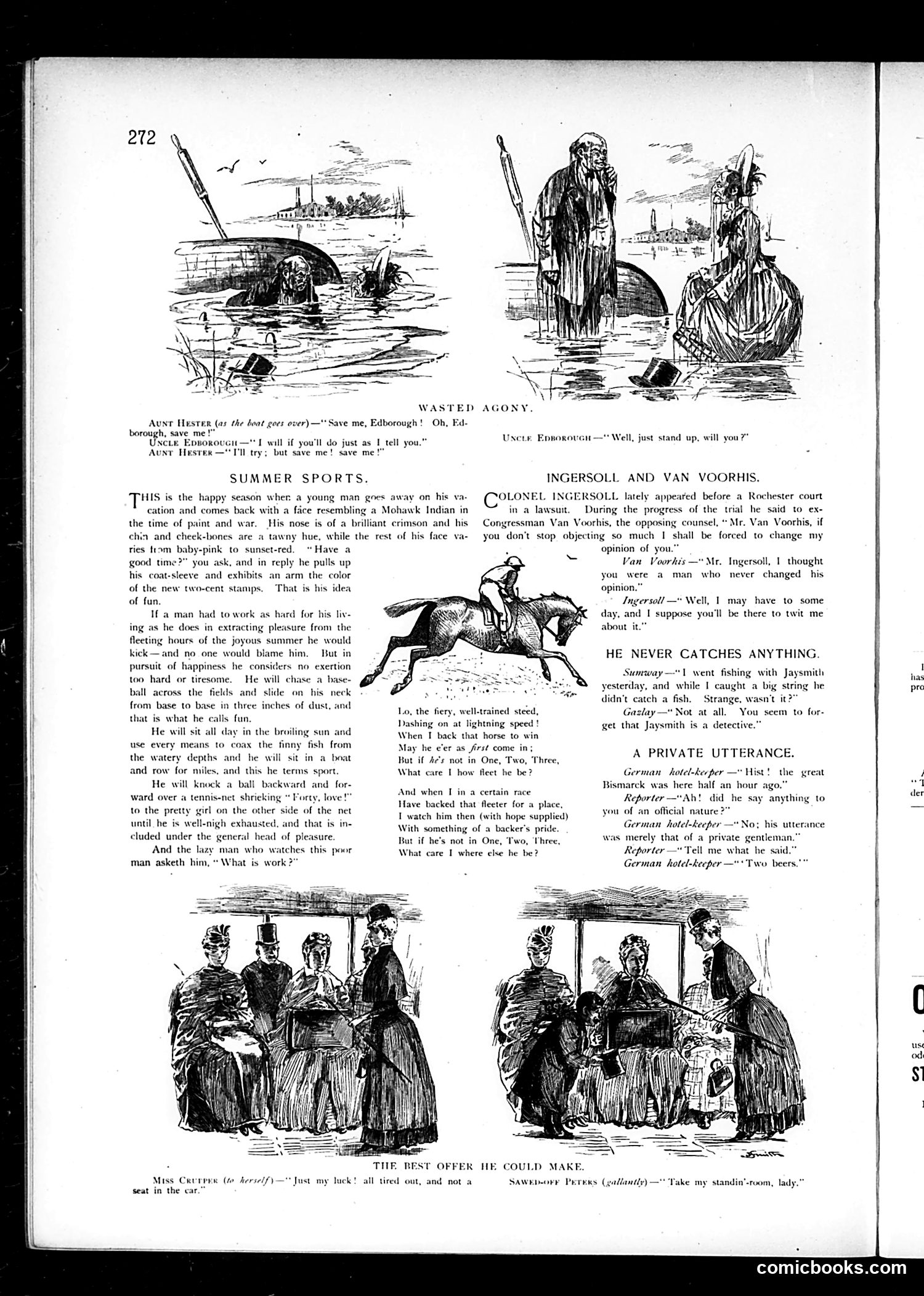
This page contains multiple satirical cartoons and humor pieces typical of late-19th-century American satire: **"Wasted Agony"** depicts a drowning woman coercing her rescuer into obedience—satirizing manipulative behavior masquerading as distress. **"Summer Sports"** mocks vacationers who return sunburned and exhausted, treating leisure activities with absurd intensity despite minimal actual enjoyment. **"Ingersoll and Van Voorhis"** references a real court case between Robert Ingersoll (a famous agnostic lawyer/orator known for unwavering positions) and Congressman Van Voorhis. The joke exploits Ingersoll's reputation for consistency by having him threaten to change his opinion—an obvious absurdity to contemporaries familiar with his public persona. **"He Never Catches Anything"** satirizes the futility of detective work through a character named Jaysmith who never succeeds. **"A Private Utterance"** jokes about Bismarck's visit to a German hotel, playing on his formidable reputation. **"The Best Offer"** contains two brief gags about social desperation and courtesy. The page emphasizes class-based humor and recognizable public figures.
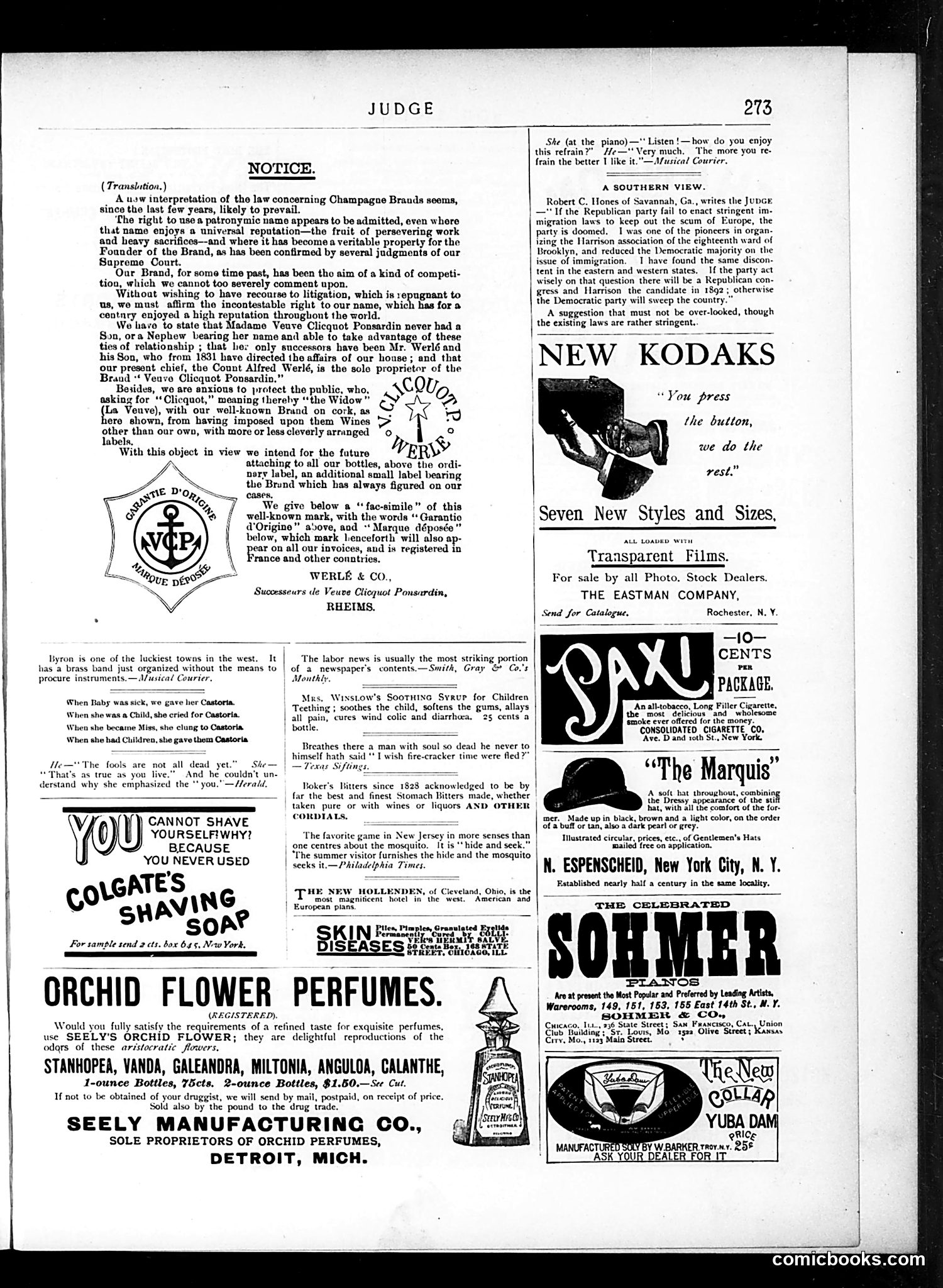
This page is primarily **advertising**, not political satire. The dominant content is commercial notices and product advertisements typical of late 19th-century publications. The one substantive item is a formal **legal notice** from Werle & Co., successors to the Veuve Clicquot champagne house in Rheims, France. They're asserting trademark rights against counterfeiters. The notice clarifies that the "Veuve Clicquot Ponsardin" brand belongs solely to Count Alfred Werlé (the current proprietor), not to any descendant of the widow Clicquot herself. They announce they'll attach security labels to future bottles to protect consumers from fraudulent imitations. The remainder consists of period advertisements: Colgate's shaving soap, Seely's orchid perfumes, Sohmer pianos, Kodak cameras, and various patent medicines—standard Judge magazine filler that generated revenue. There is **no political cartoon or satire visible** on this page.
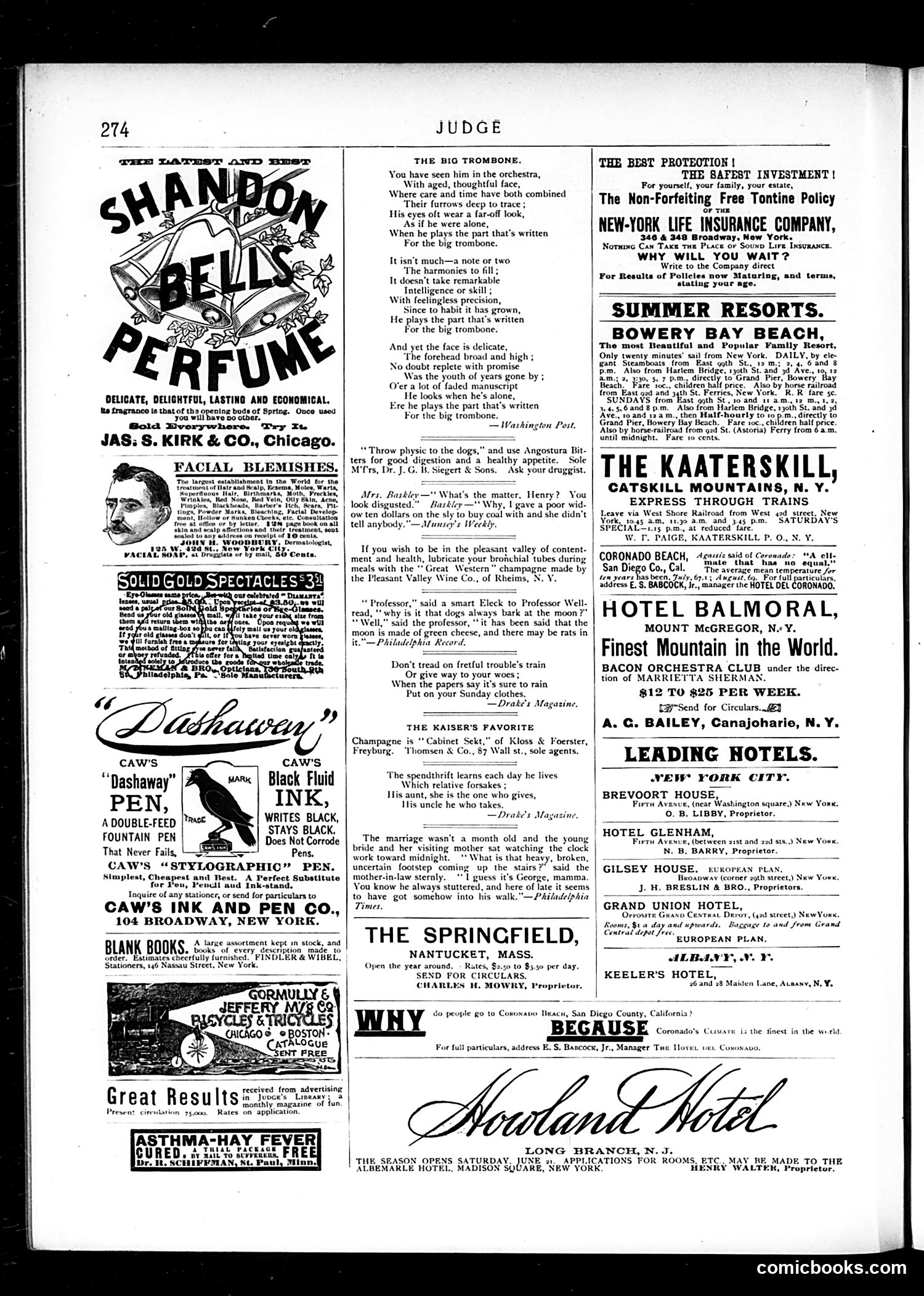
This page is primarily **advertisements and light humor**, not political satire. The content includes: **Main Poem: "The Big Trombone"** (from *Washington Post*) — A sentimental verse about an aging orchestra musician playing minor notes. It romanticizes his unfulfilled promise, suggesting his youthful potential (evidenced by his "delicate" face and "broad" forehead) was never realized. The satire is gentle and melancholic rather than biting. **Small Jokes** scattered throughout mock domestic life and human foibles—a man giving charity but receiving no credit; a new husband with a speech impediment that's somehow transferred to his walk. These are mild observational humor typical of the era. **Advertisements** dominate: fountain pens, perfume, champagne, insurance, and resort hotels. Several ads use pseudo-endorsements (the "Kaiser's Favorite" champagne, for instance) typical of period marketing. There are **no identified political figures or cartoons** with clear satirical intent on this page. It's essentially a standard Judge issue mixing light verse, anecdotes, and commercial advertising.
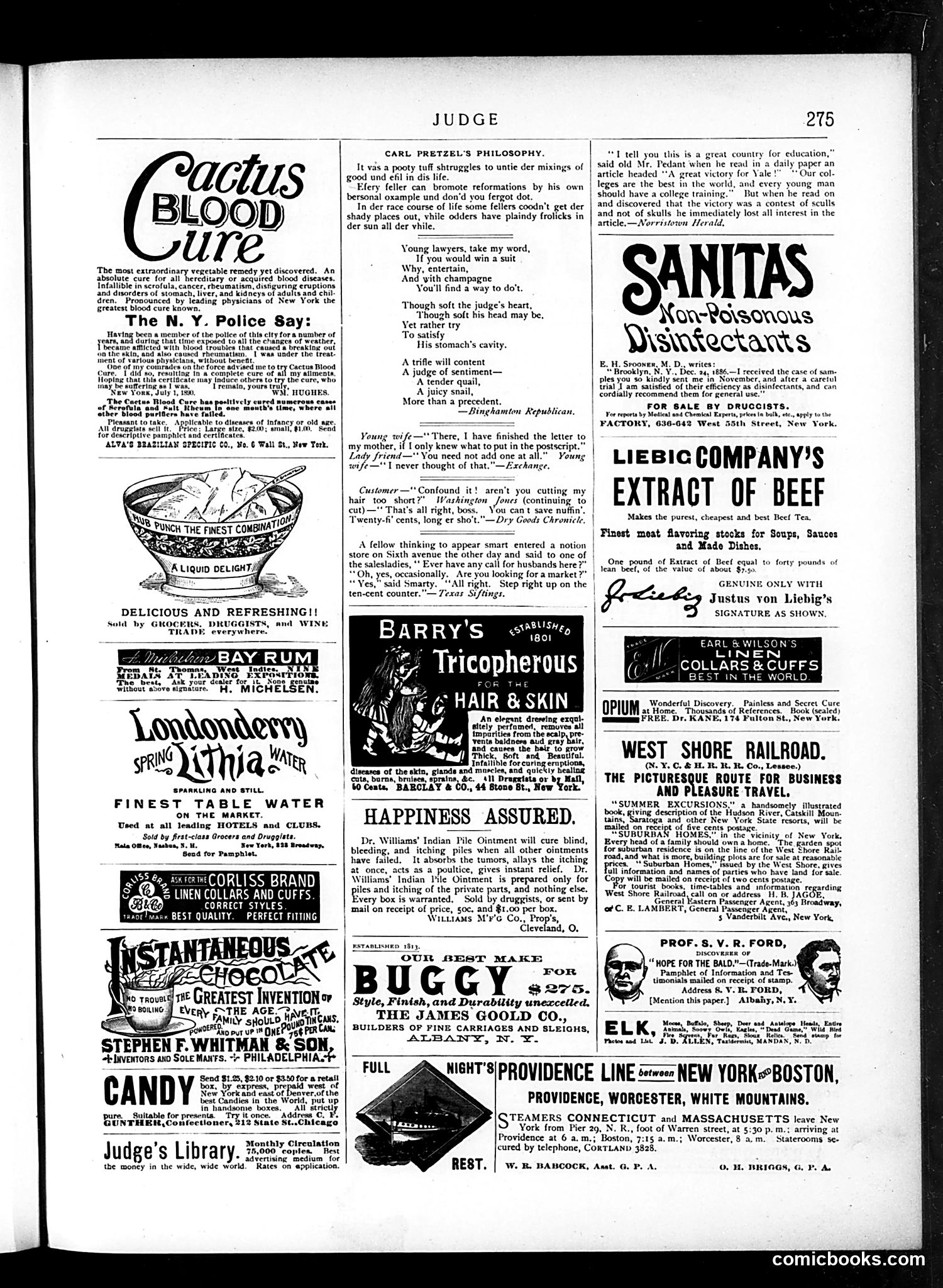
This page is **primarily advertisements** with some satirical content. The main visual element is a "Cactus Blood Cure" advertisement featuring a testimonial from an N.Y. police officer claiming the product cured his blood ailments. The satirical content includes **"Carl Pretzel's Philosophy,"** featuring a German-accented character offering cynical observations about law and society. The humor targets **judicial corruption**: judges can be swayed by entertainment and fine food (quail, snails) rather than legal precedent. Young lawyers are advised to wine and dine judges to win cases. This satirizes the common 19th-century perception that the legal system favored the wealthy who could afford such inducements. Additional humor sections mock everyday situations—a barber's indifference to customer complaints, a woman's lack of postscript ideas, a salesman's dismissal of a man seeking husbands—representing typical comedic observations of the era. The page reflects Judge's dual function as both satirical magazine and advertising vehicle, targeting educated, affluent readers.
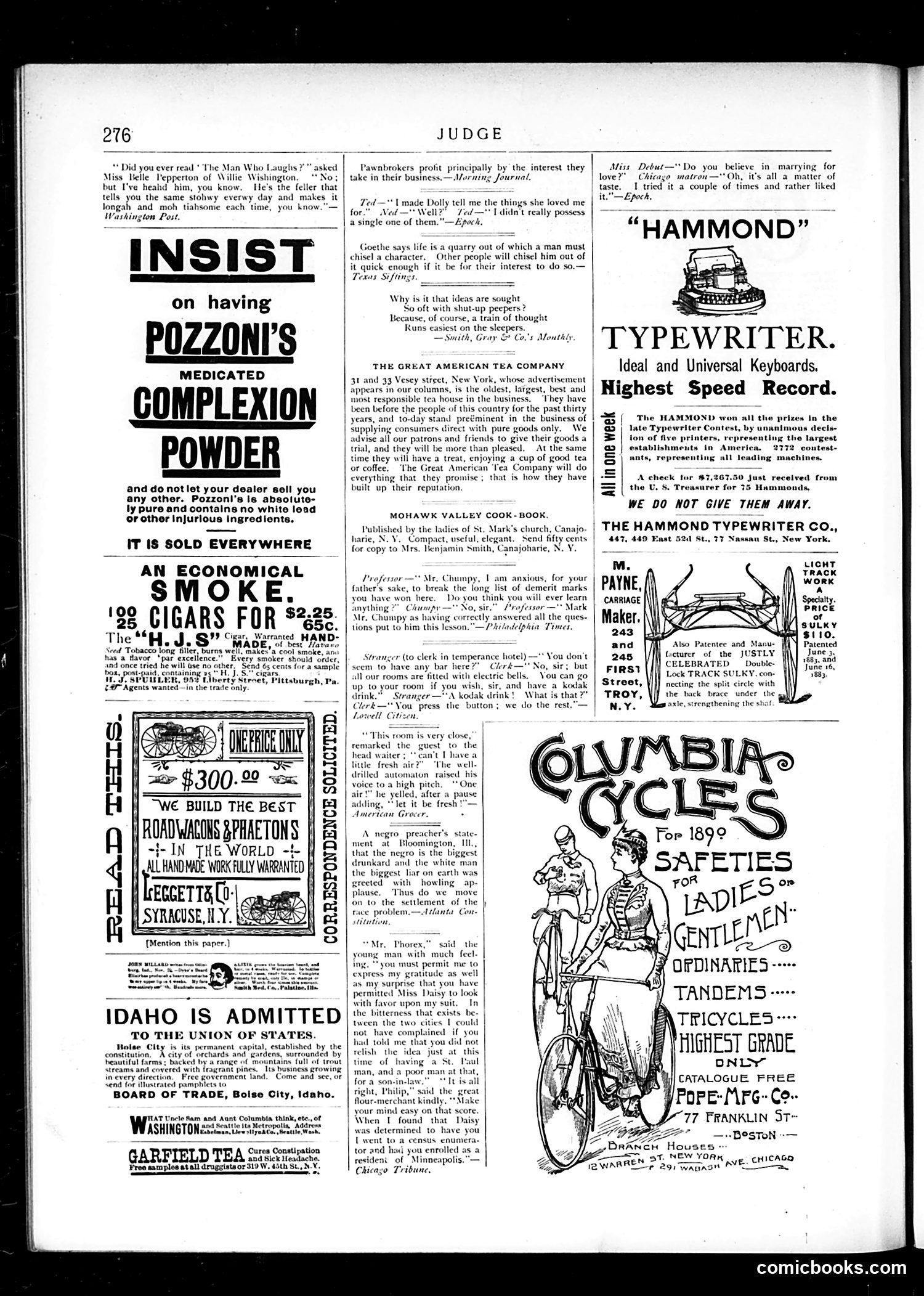
This page is **primarily advertising** with brief humorous anecdotes interspersed. The cartoons/jokes are minimal and incidental to the commercial content. The main satirical content includes: 1. **Pawnbroker joke**: A pun on pawnbrokers profiting from "interest"—both financial interest and personal concern in their business. 2. **Goethe paraphrase**: Social commentary suggesting people will exploit you for their own benefit if given opportunity—a cynical observation about human nature. 3. **Bar/Kodak joke**: Wordplay on "Kodak" (the camera brand) and "no bar"—the temperance hotel clerk suggests photographing a drink instead of serving alcohol, mocking prohibition-era strictness. 4. **Race problem anecdote**: References an Illinois preacher's controversial statement that "the negro is the biggest drunkard" of any race—presented with heavy irony ("Thus do we move on to the settlement of the race problem"), criticizing such inflammatory rhetoric. The page mostly comprises product advertisements (tea, powder, cigars, typewriters, cycles) typical of 1890s periodical advertising.
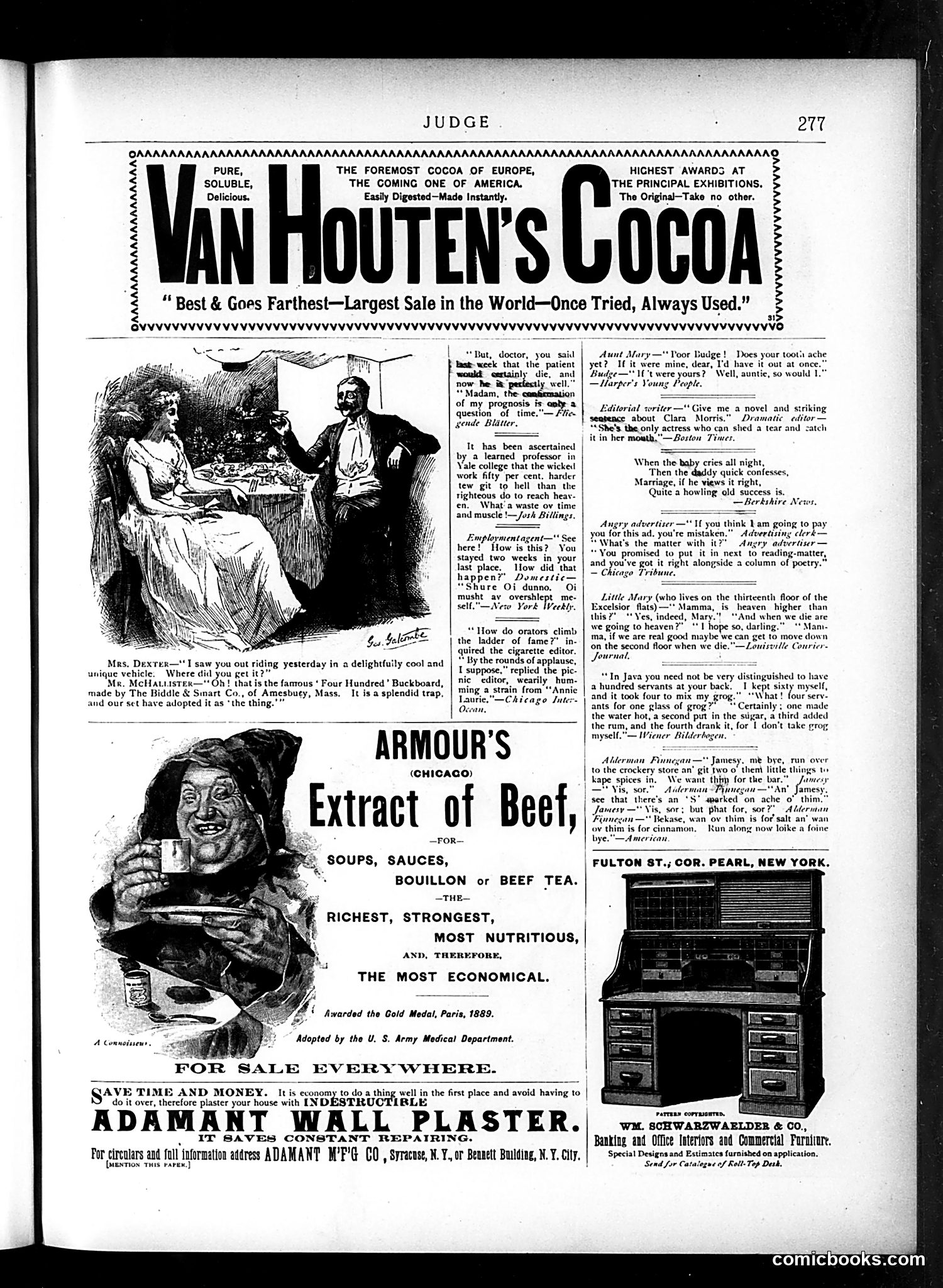
This page is primarily **advertising**, not political satire. Judge magazine used its pages to feature both humor and paid advertisements. The main content includes: 1. **Van Houten's Cocoa ad** (top): A European cocoa brand marketing itself as America's coming premium product, claiming awards and superiority. 2. **A cartoon dialogue** (left side): Shows a social scene where Mrs. Dexter and Mr. McAllister discuss a fashionable "Four Hundred Buckboard" carriage—a reference to New York's elite "400" social circle (the wealthy families admitted to Mrs. Astor's ballroom). 3. **Armour's Extract of Beef ad** (center): Advertises beef extract for soups and bouillon, claiming nutritional economy. 4. **Various humor columns** (right): Short jokes about teeth, marriage, babies, and servants—typical period humor. 5. **Adamant Wall Plaster ad** (bottom): A building material advertisement. The page reflects Gilded Age consumer culture and upper-class social hierarchies, with advertisements targeting wealthy readers.
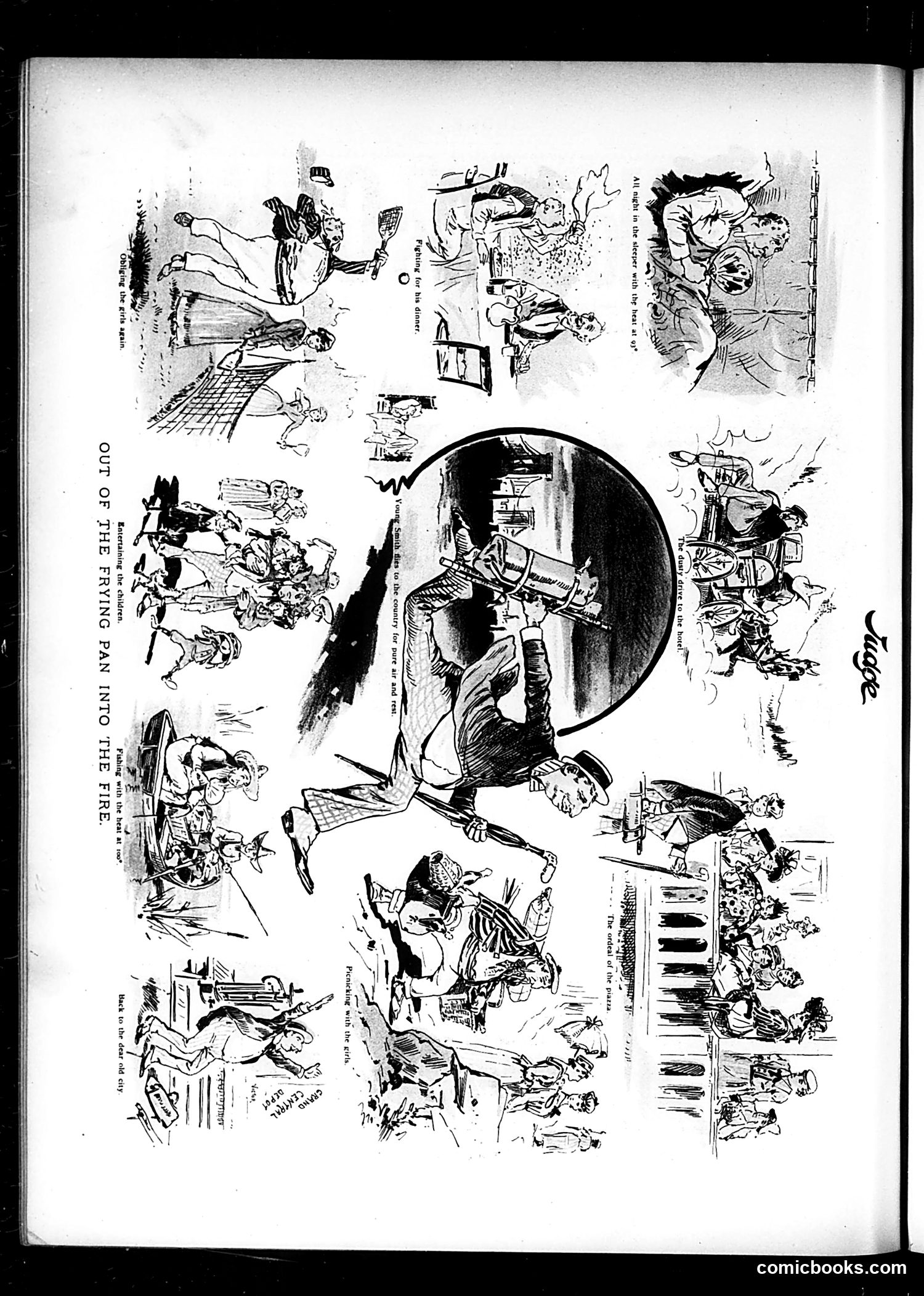
I cannot reliably identify the specific figures, events, or satirical references in this page. The OCR text is heavily corrupted and largely illegible, making it impossible to determine the intended political or social commentary. What is visible: This appears to be a multi-panel satirical illustration page typical of *Judge* magazine's format, with a large central circular vignette surrounded by smaller cartoon scenes. The style suggests early-to-mid 20th century American editorial cartooning, depicting various characters in comedic or dramatic situations. **To accurately explain the satire and historical context, I would need:** legible text captions identifying the figures, clear date information, and visible publication details from the page itself. I cannot responsibly speculate about political meanings without reliable textual support.
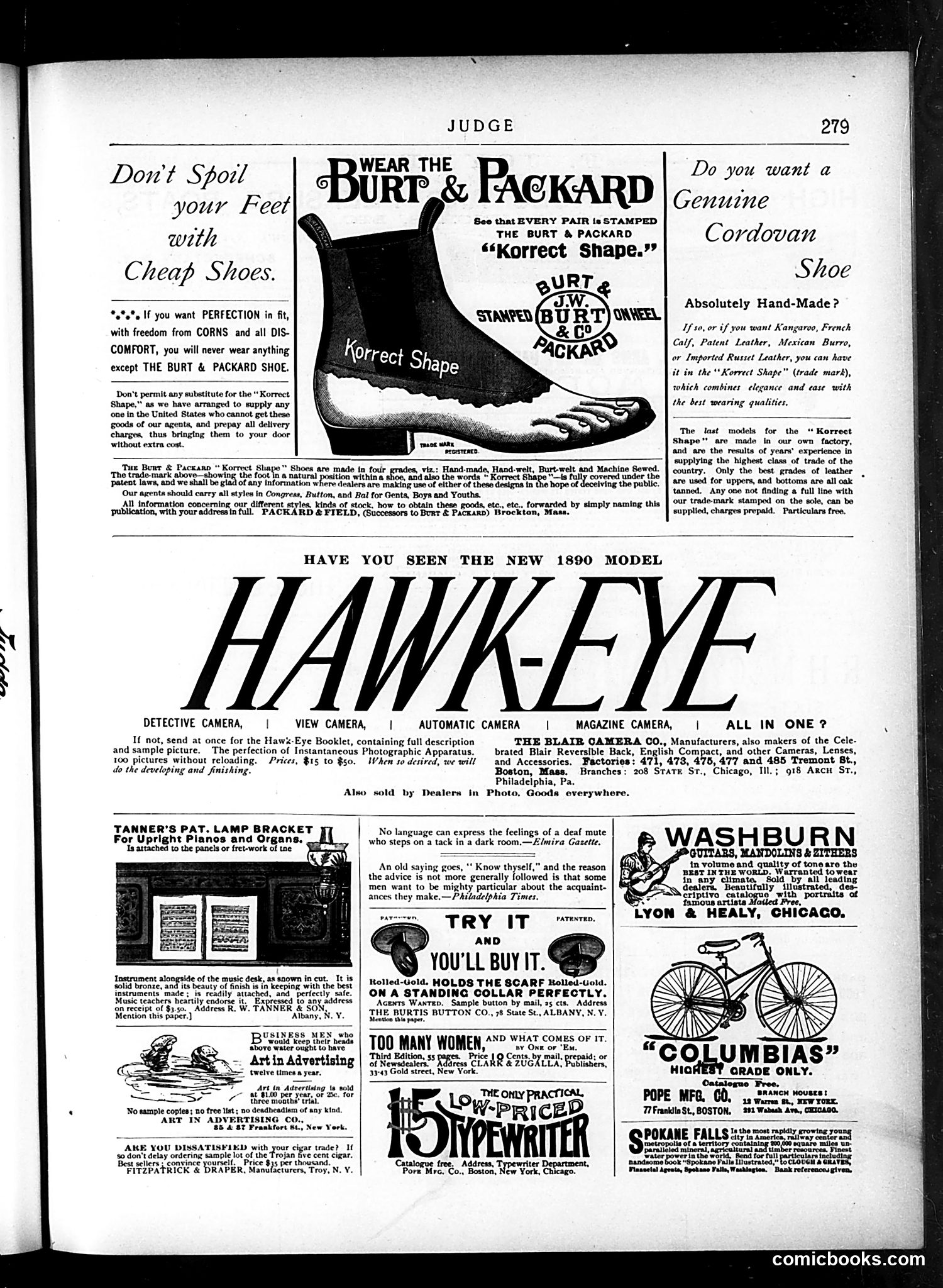
This page is primarily **advertising content** rather than political satire. It contains multiple product advertisements typical of an 1890s American magazine: **Main advertisements include:** - **Burt & Packard shoes** - promoting their "Korrect Shape" branded footwear as superior quality, hand-made in multiple styles - **Hawk-Eye camera** - advertising a new 1890 model described as a multi-function "detective camera" with interchangeable capabilities - **Washburn guitars, mandolins & zithers** - musical instruments - **Tanner's lamp bracket** - a device for piano/organ lighting - **Columbia bicycles** - "highest grade only" - **Miscellaneous items** - including a typewriter, scarf holder, and other products The page includes typical period advertising copy emphasizing American manufacturing, quality materials, and direct-order availability. There is minimal political or social satire; the content reflects consumer culture and technological products of the 1890s era.
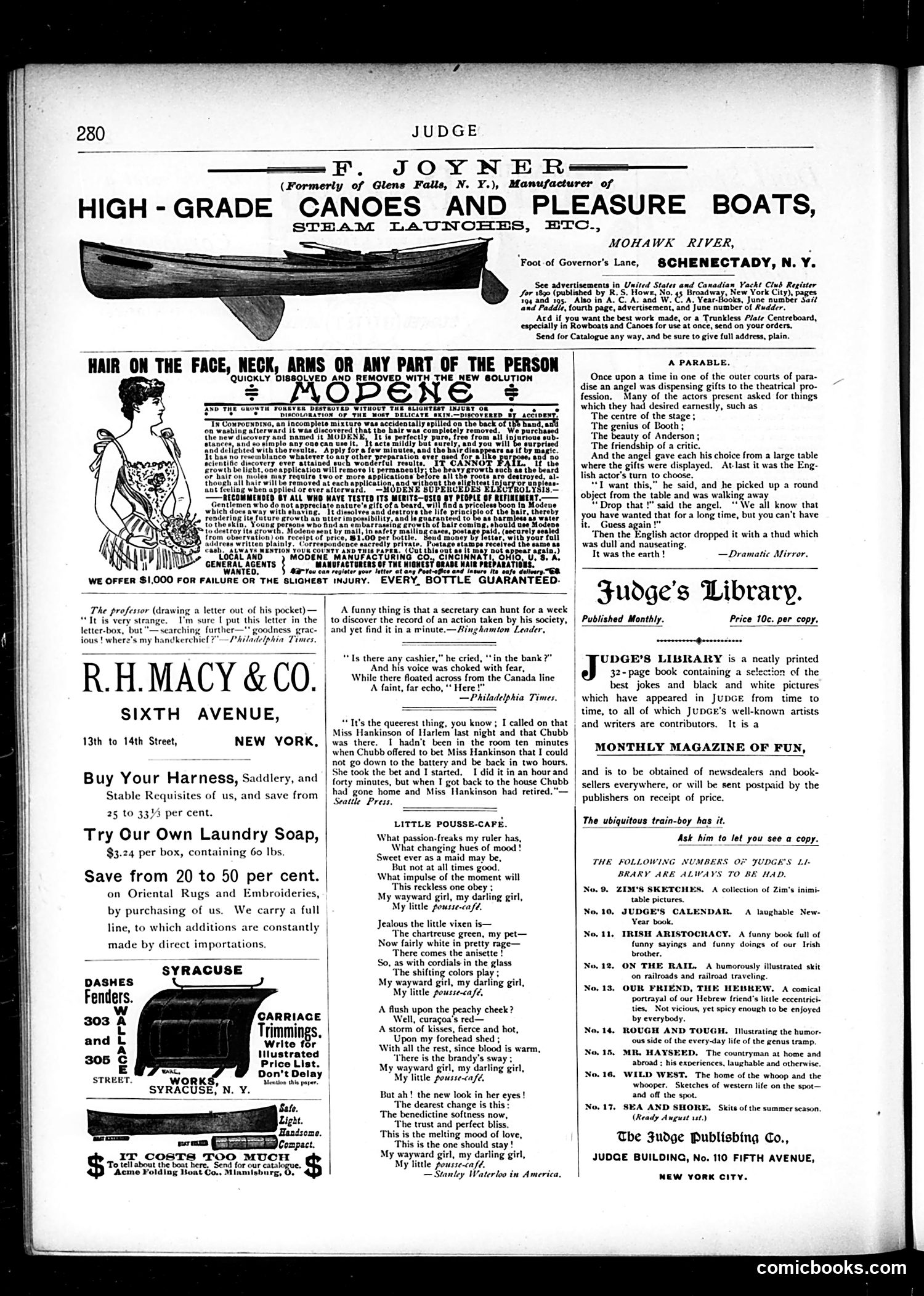
This page is primarily **advertising and filler content** with minimal political satire. The dominant features are: 1. **Commercial ads**: F. Joyner's canoe/boat manufacturer, R.H. Macy & Co., hair removal product "Modene," and various other merchants dominate the space. 2. **Small humor pieces**: Brief anecdotes about absent-minded professors, banking mishaps, and romantic complications—typical light magazine filler of the era with no apparent political content. 3. **"Little Pousse-Café" poem**: A sentimental verse about a "wayward girl" with "changing moods"—period romantic verse. The page contains **no identifiable political cartoons or satirical commentary** on contemporary figures or events. It represents typical Judge magazine content: a mix of advertisements, genteel humor, and light verse aimed at affluent readers interested in boats, fine goods, and romantic sentimentality.
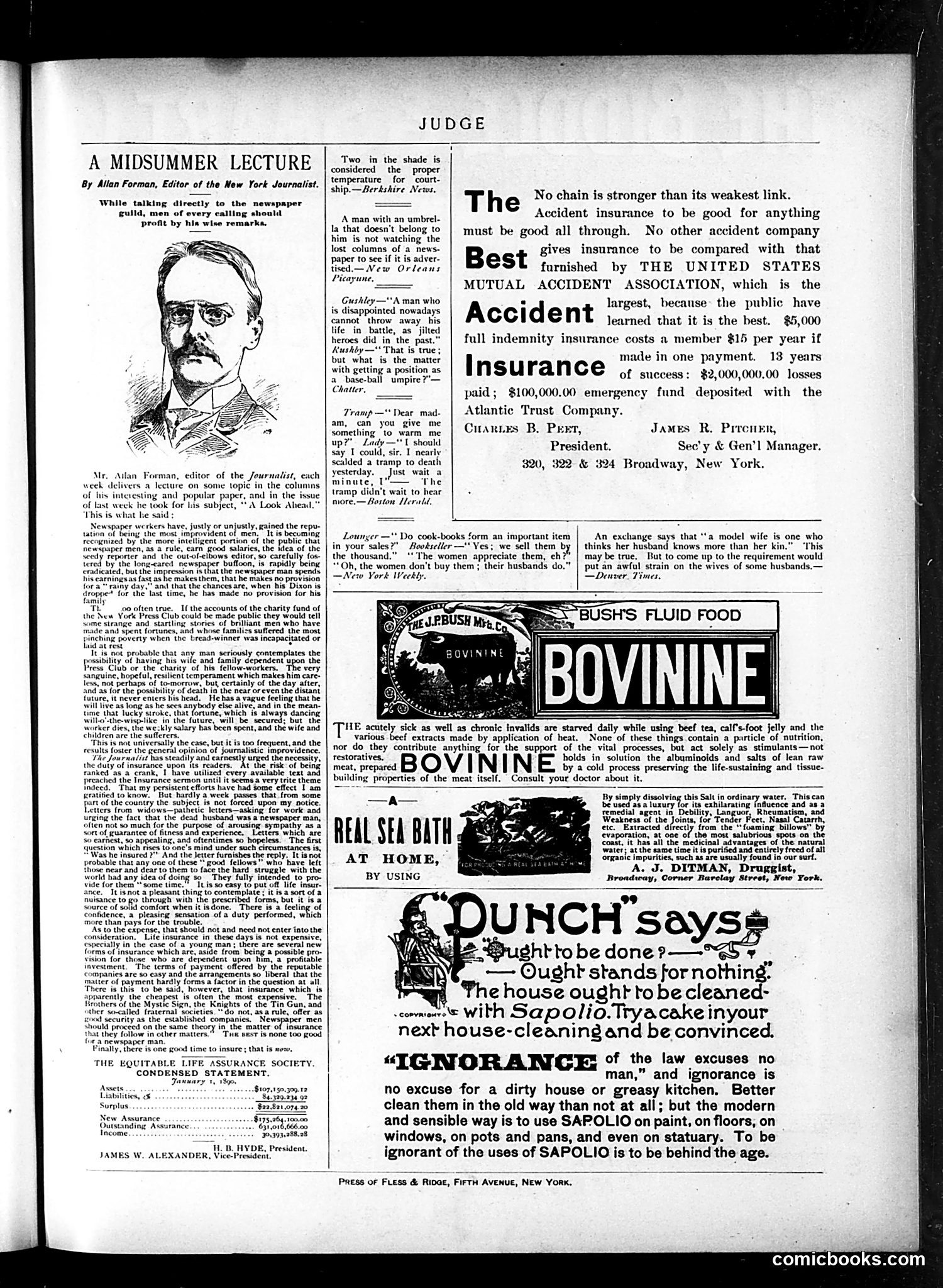
This page features **Allan Forman**, editor of the New York Journalist, delivering a satirical lecture on newspaper workers' financial irresponsibility. The main cartoon (left) shows Forman's portrait alongside comic dialogue snippets mocking various social types: a disillusioned man, a tramp seeking warmth, and others. **The satire's point**: Newspaper workers—despite earning decent salaries—are portrayed as financially reckless, living paycheck-to-paycheck without providing for their families. Forman argues they foolishly rely on charity funds and the Press Club rather than planning ahead for death or hardship. This critiques both the profession's culture and workers' lack of foresight. The page also contains period advertisements (Bovinne, Sapolio cleaner) typical of Judge's revenue model. These ads' messaging about health tonics and household products reflects late-19th-century consumer culture assumptions the magazine's audience would recognize.
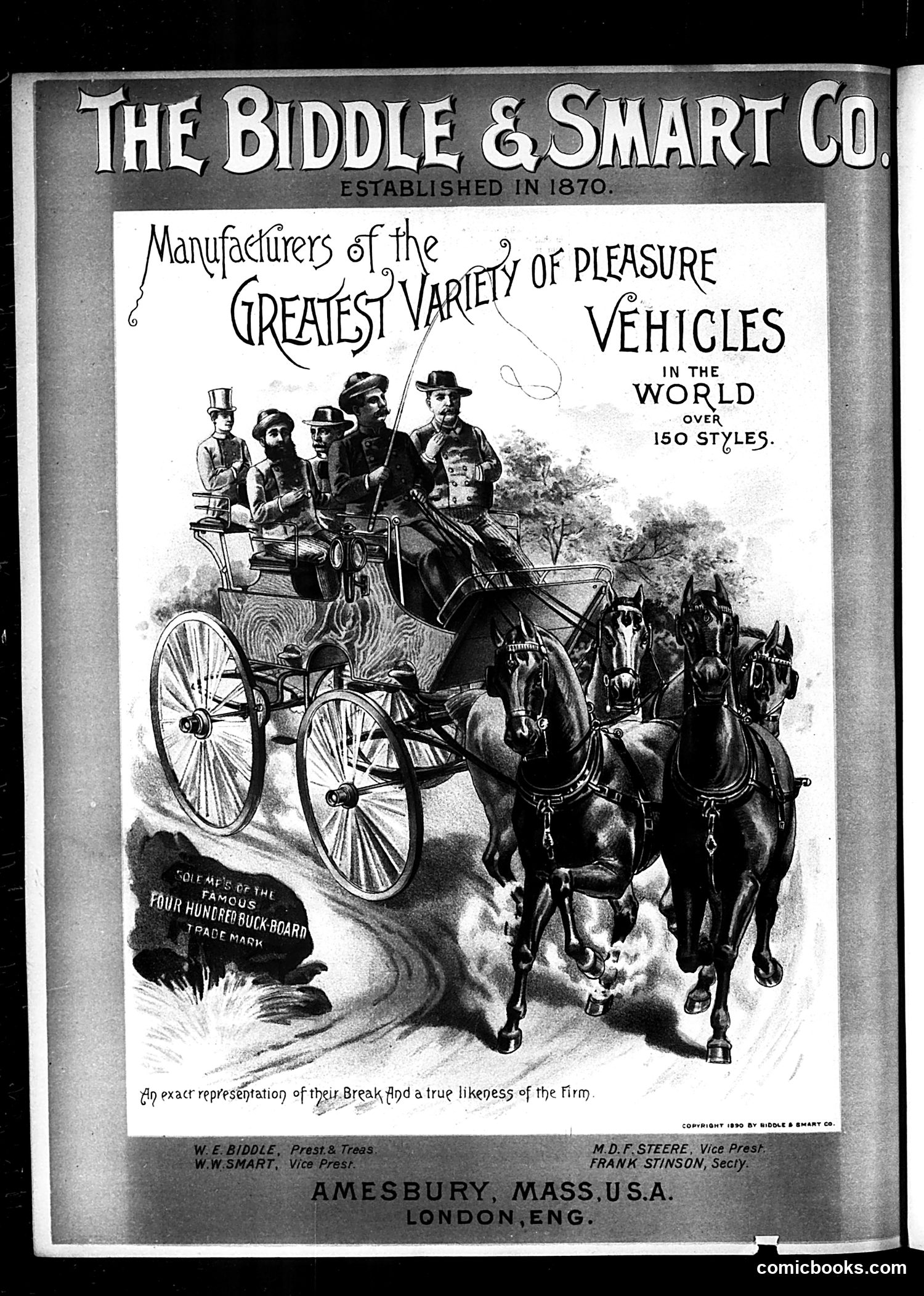
This is primarily a **trade advertisement**, not political satire. The Biddle & Smart Company, established 1870, showcases their carriage manufacturing business to a modern reader. The image depicts a four-horse carriage laden with well-dressed Victorian passengers, presented as "an exact representation of their Break and a true likeness of the Firm." The "Break" was a large pleasure carriage designed for leisure outings. The advertisement claims they manufacture "the greatest variety of pleasure vehicles in the world over 150 styles," positioning them as a major carriage producer serving affluent customers. The page lists company officers and locations (Amesbury, Massachusetts and London, England), indicating this was a substantial international business during the horse-drawn vehicle era, before automobiles dominated transportation.