
Judge, 1890-08-02 · page 2 of 20
Judge — August 2, 1890 — page 2: what you’re looking at
What you’re looking at
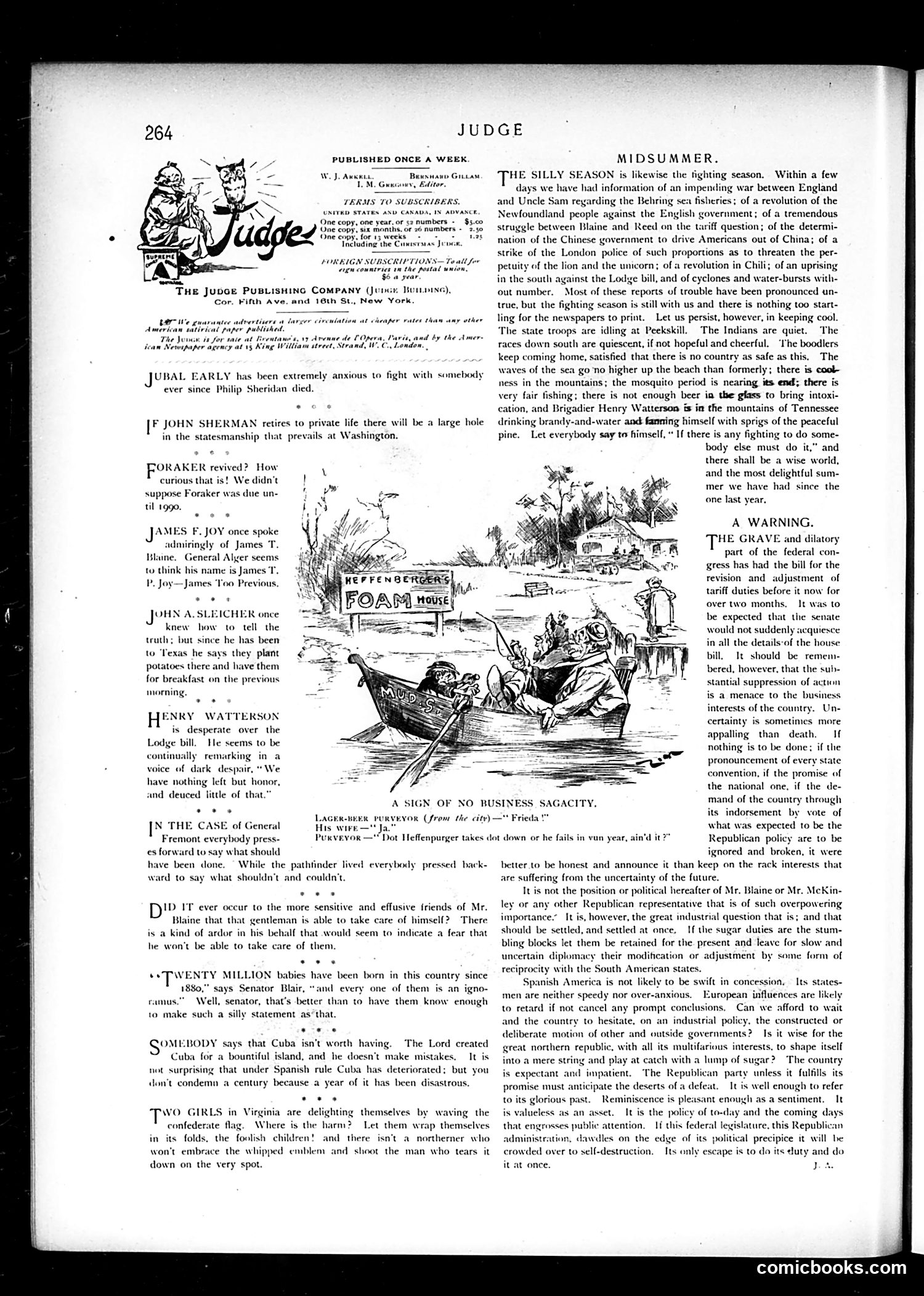
The main cartoon, titled "A Sign of No Business Sagacity," depicts two figures in a small boat near "Burger's Foam House." The image satirizes poor business judgment during what appears to be the midsummer season. The text discusses political uncertainties of the era, referencing Republican policy concerns and references to figures like Mr. McKinley. The broader commentary critiques hesitation and indecision in government—particularly regarding tariff duties and Senate actions—suggesting that excessive caution or delay on important national matters threatens business confidence. The cartoon appears to mock businessmen or politicians who fail to act decisively, using the boat scene as metaphor for being adrift without direction. The "foam house" detail suggests frivolous or insubstantial enterprise.
📄 Transcribed text from this page (OCR, searchable)
Machine-transcribed from the original scan — historical spelling and the odd misread are preserved.
JUDGE PUBLISHED ONCE A WEEK. W. J. Amante 1M. Gren Baxnann Gricast v, Editor. TERMS TO SUBSCRIBERS, UNETRD STATES AND CANADA, IN ADVANCE ‘One copy, one year. of s2 numbers = $5.co ‘Une copy. six months. or 26 numbers 2.50 ‘One copy forty weeks = Hae Including the Cumistatas Jeper. y SUBSCRIPTION dren countries tn the postal wi $5 4 year, THE JUDGE PUBLISHING COMPANY (Jupcr IulLpiNe), Cor. Fifth Ave. and 16th St, New York. C paper published. Tihe Sonus ts for saie at Lirentane'a. 17 Avenue de C Oper icam Newspaper agency at 1s King William strect, Strand, WC ig and by the Amer Loniton., UBAL EARLY has been extremely anxious to fight with somebody ever since Philip Sheridan died. [F JOHN SHERMAN retires to private life there will be a large hole in the statesmanship that prevails at Washington, ORAK curious that suppose Foraker til 1990. R revived? How 1 We didn’t due un- JAMES F. JOY once spoke udmiringly of James T. Blaine. General Alyer seems to think his name is James T. P, Joy—James ‘Too Previous, JOHN A.SLEICHER once knew tell the truth; but since he has been to ys they plant potatoes there and have them for breakfast on the previous morning. H ZNRY WATTERSON is desperate over the Lodge bill, He seems to be continually remarking in a voice of dark "We have nothing left but honor, and deuced little of that.” how to ‘exas he s des| A SIGN OF NO BU! N THE CASE of General Fremont everybody press- ¢s forward to say what should have been done. “While the pathfinder lived everybody pressed back- ward to say what shouldn't and couldn't, Dp IT ever occur to the more sensitive and effusive friends of Mr. Blaine that that gentleman is able to take care of himself? There is a kind of ardor in his behalf that would seem to indicate a fear that he won't be able to take care of them. His wire — Ja.” seTWENTY MILLION babies have been born in this country since 1880,” says Senator Blair, “and every one of them is an igno- Well, senator, that’s better than to have them know enough to make such a silly statement as’that. ramus.” OMEBODY says that Cuba isn’t worth having. The Lord created Cuba for a bountiful island, and he doesn’t make mistakes. It is not surprising that under Spanish rule Cuba has deteriorated; but you don’t condemn a century because a year of it has been disastrous. WO GIRLS in Virginia are delighting themselves by waving the confederate flag. Where is the harm? Let them wrap th in its folds, the foolish children! and there a northerner who won't embrace the whipped emblem and shoot the man who tears it down on the very spot. mselves isn’t LAGER-MEER PURVEYOR (from the city) —" Frieda!" Purvevor — Dot Heffenpurger takes dot down or he fails in vun year, ain’d MIDSUMMER. HE SILLY SEASON is likewise the fighting season. Within a few days we have had information of an impending war between England and Uncle Sam regarding the Behring sea fisheries; of a revolution of the Newfoundland people against the English government; of a tremendous struggle between Blaine and Reed on the tariff question; of the determi nation of the Chinese government to drive Americans out of China; of a strike of the London police of such proportions as to threaten the per- petuity of the lion and the unicorn; of a revolution in Chili; of an uprising in the south against the Lodge bill, and of cyclones and water-bursts with- out number. Most of these reports of trouble have been pronounced un- true, but the fighting season is still with us and there is nothing too start- ling for the newspapers to print. Let us persist, however, in keeping cool. ‘The state troops are idling at Peekskill. The Indians are quiet. ‘The races down south are quiescent, if not hopeful and cheerful. ‘The boodlers keep coming home, satisfied that there is no country as safe as this. The waves of the sea go no higher up the beach than formerly; there is cook ness in the mountains; the mosquito period is nearing its end; there i very fair fishing; there is not enough beer in the glass to bring intoxi- cation, and Brigadier Henry Watterson is in the mountains of Tennessee drinking brandy-and-water and fanning himself with sprigs of the peaceful pine. Let everybody say ta himself, “ If there is any fighting to do some- body else must do it,” and there shall be a wise world, and the most delightful sum- mer we have had since the one last year, A WARNING. HE GRAVE and dilatory part of the federal con- gress has had the bill for the revision and adjustment of tariff duties before it now for over two months. It was to be expected that the senate would not suddenly acquiesce in all the details-of the house bill, It should be remem- bered, however, that the s stantial suppression of action is a menace to the business interests of the country. Un- certainty is sometimes more appalling than death. If nothing is to be done; if the pronouncement of every state convention, if the promise of the national one, if the de- mand of the country through its indorsement by vote of what was expected to be the Republican policy are to be ignored and broken, it were better to be honest and announce it than keep on the rack interests that are suffering from the uncertainty of the future. It is not the position or political hereafter of Mr. Blaine or Mr. McKin- ley or any other Republican representative that is of such overpowering importance’ It is, however, the great industrial question that is; and that should be settled, and settled at once, If the sugar duties are the stum- bling blocks let them be retained for the present and leave for slow and uncertain diplomacy their modification or adjustment by some form of reciprocity with the South American states. Spanish America is not likely to be swift in conces Its states- men are neither speedy nor over-anxious. European isifluences are lil to retard if not cancel any prompt conclusions. Can we afford to wait and the country to hesitate, on an industrial policy, the constructed or deliberate motion of other and outside governments? Is it wise for the great northern republic, with all its multifarious interests, to shape itself into a mere string and play at catch with a lump of sugar? The country is expectant and impatient. The Republican party unless it fulfills its promise must anticipate the deserts of a defeat. It is well enough to refer to its glorious past. Reminiscence is pleasant enough as a sentiment. It is valueless a It is the policy of to-day and the coming days that engrosses public attention. If this federal legislature, this Republican administration, dawdles on the edge of its political precipice it will be crowded over to self-destruction, it at once. La GACITY, ion, lori an asset. Its only escape is to do its duty and do comicbooks.com