
A complete issue · 24 pages · 1890
Judge — May 31, 1890
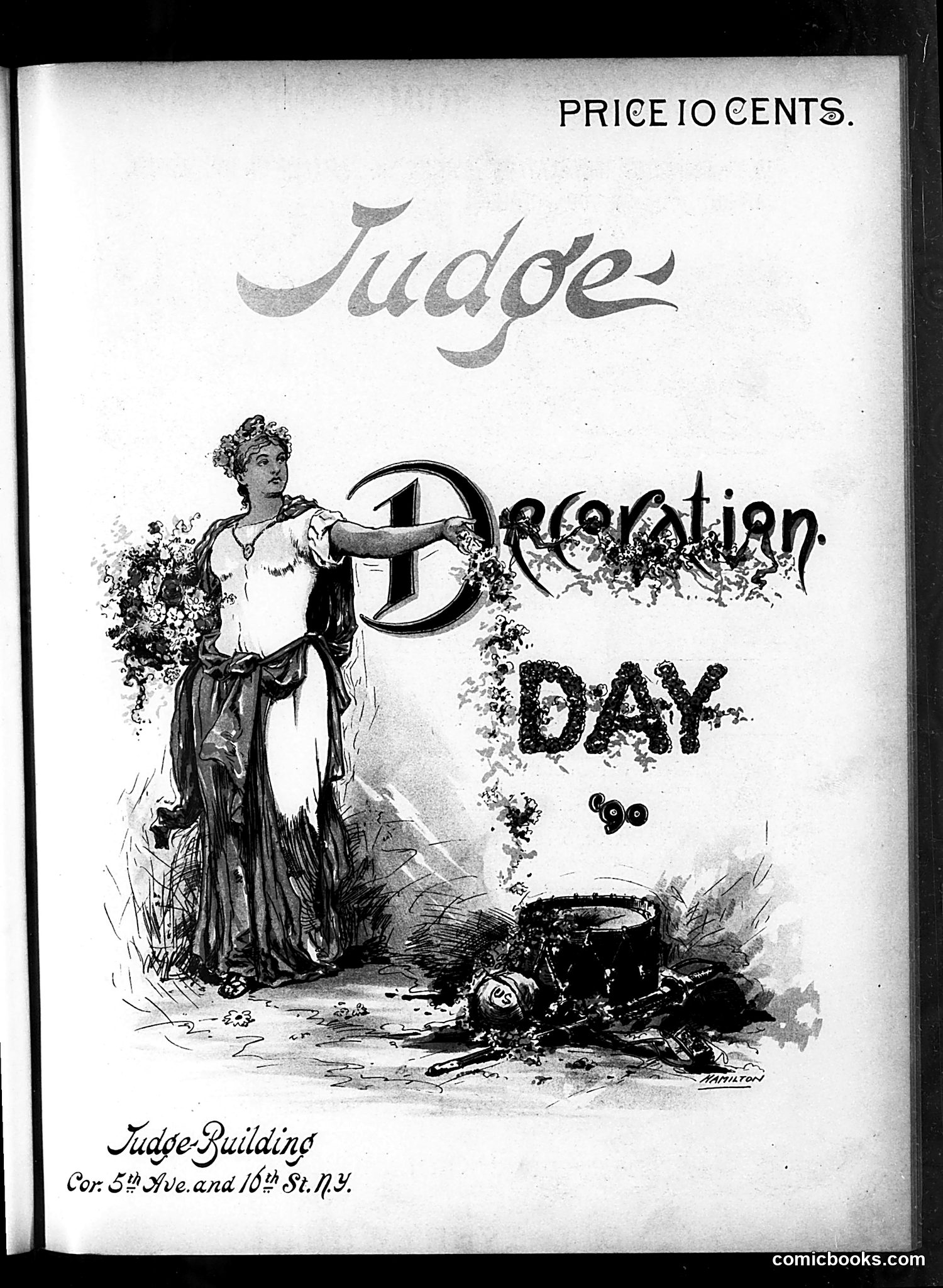
This appears to be a cover for Judge magazine's Decoration Day (now Memorial Day) issue, priced at 10 cents. The illustration depicts a classical female figure (likely Lady Justice or Columbia, representing America) holding a large circular wreath or laurel. She gestures toward burned or destroyed objects at her feet—possibly representing battlefield destruction or casualties. The satire's precise political meaning is unclear without additional context, but the composition suggests commentary on how America commemorates its war dead. The contrast between the idealized classical figure and the grim destruction below may critique the gap between patriotic rhetoric and war's actual devastation, a common satirical theme in turn-of-the-century American magazines.
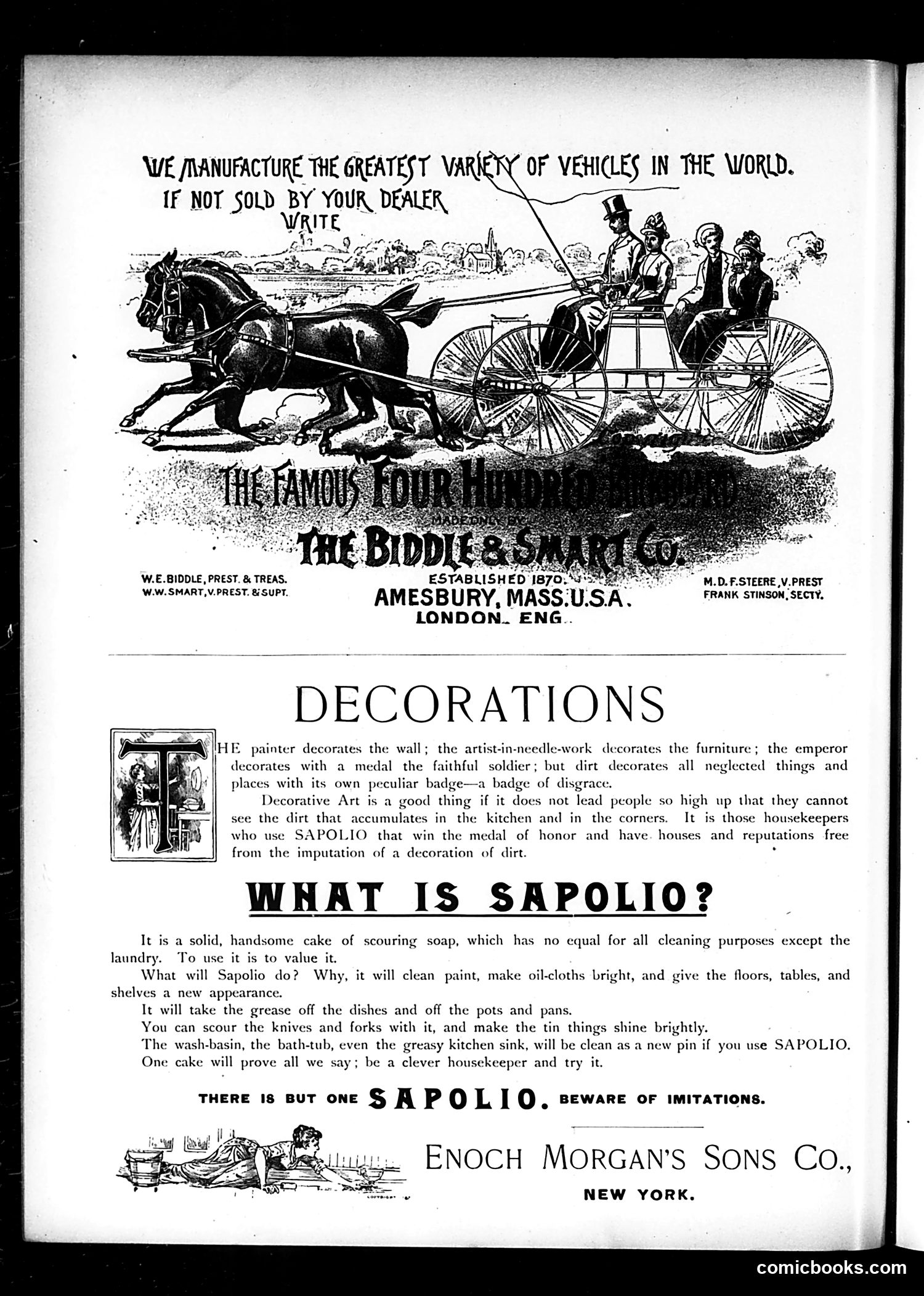
This page is primarily **advertising**, not political satire. The top half advertises Biddle & Smart Co., a carriage manufacturer established 1870, based in Amesbury, Massachusetts and London. The image shows a horse-drawn carriage with well-dressed passengers—a standard business advertisement showcasing their product. The bottom half advertises Sapolio, a scouring soap by Enoch Morgan's Sons Co. of New York. The "Decorations" section uses humorous comparison—dirt is the only "decoration" housekeepers want to avoid—to pitch the cleaning product's effectiveness on paint, floors, dishes, and kitchen surfaces. No political figures or satire are present. This is straightforward commercial advertising from the Judge magazine, likely early 20th century based on typography and style.
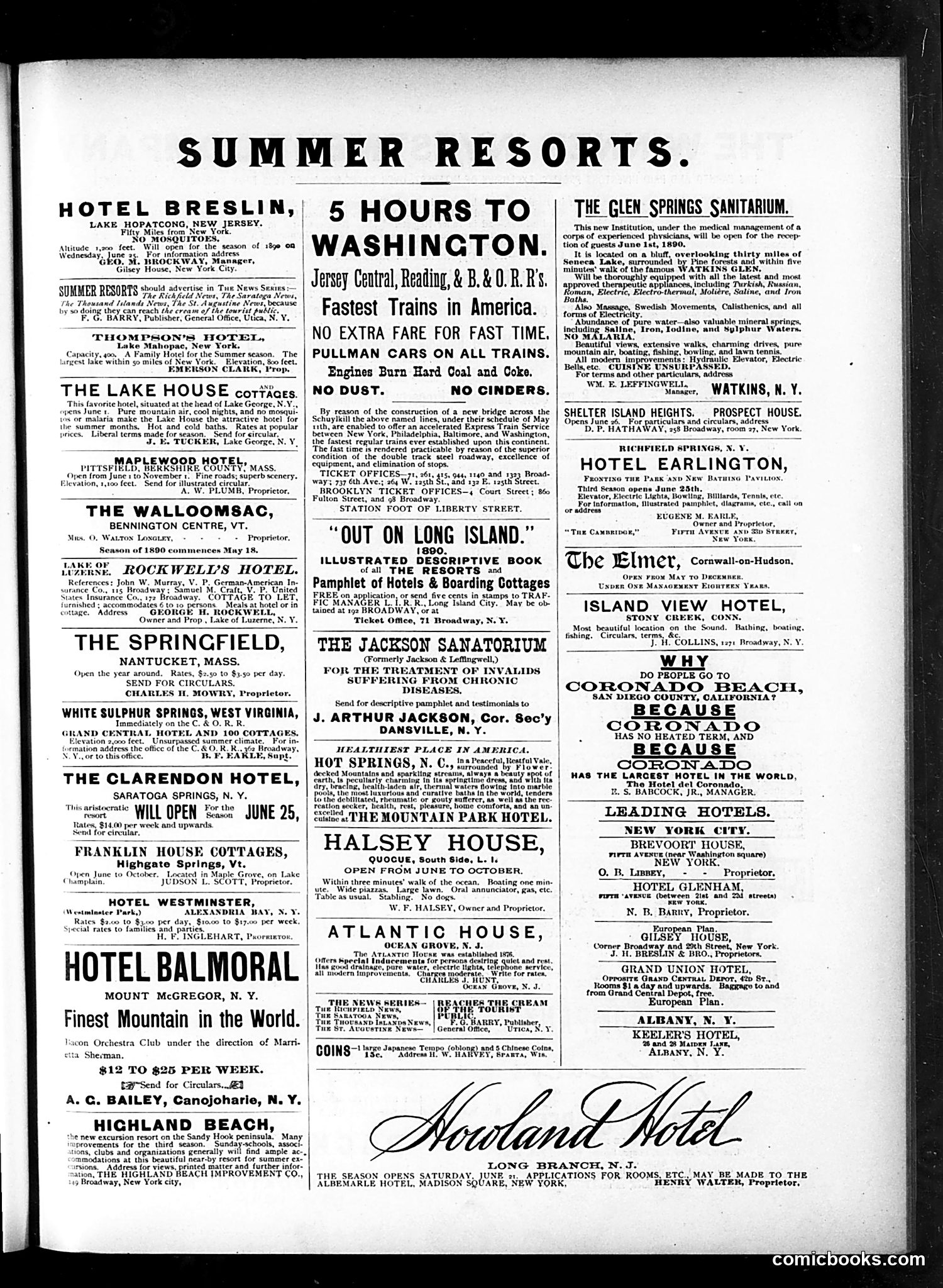
This page is primarily **advertising**, not editorial content or cartoons. It consists almost entirely of hotel and resort advertisements for summer destinations across the northeastern United States and beyond—including establishments in New Jersey, New York, Massachusetts, West Virginia, North Carolina, and other locations. The ads emphasize amenities typical of the Gilded Age leisure industry: mineral springs, thermal baths, orchestras, mountain views, and railway accessibility. One notable ad for Hotel Balmoral in Mount McGregor, N.Y. advertises rates of "$12 to $25 per week." There are **no political cartoons visible** on this page. Judge magazine here functions as a vehicle for upscale resort marketing rather than satire or social commentary.
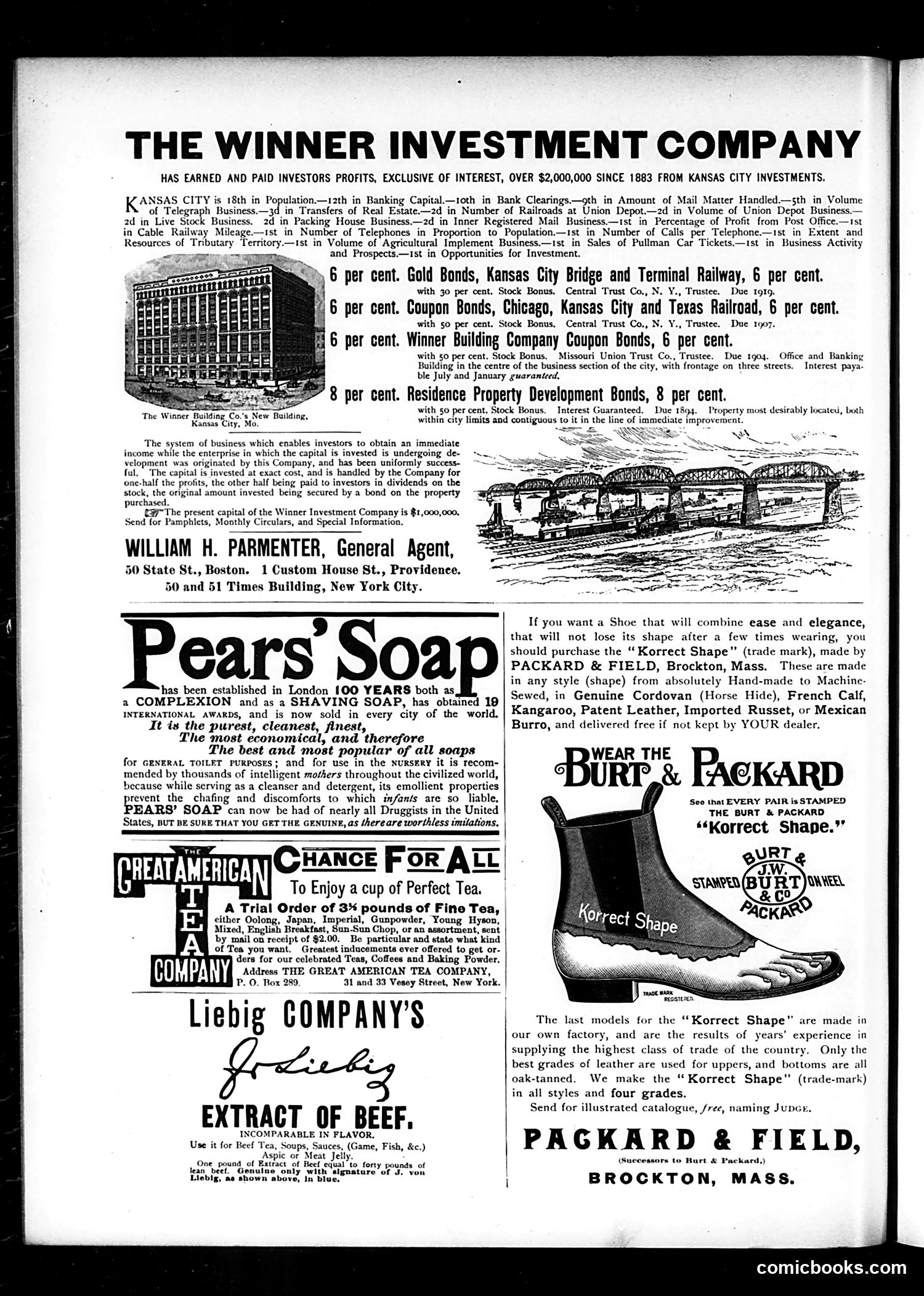
This page is **primarily advertisements**, not satirical content. It contains four major commercial promotions: 1. **Winner Investment Company** (top): A Kansas City investment firm advertising bonds and stock offerings (6-8% returns) secured by real estate and infrastructure projects. The text boasts Kansas City's economic rankings to attract investors. 2. **Pears' Soap**: Claims 100 years of establishment and 19 international awards, marketed as superior for complexion and nursery use. 3. **Great American Tea Company**: Promotes fine tea and coffee sales by mail order. 4. **Packard & Field Shoes**: Advertises "Korrect Shape" branded footwear made in Brockton, Massachusetts, emphasizing hand-crafted quality in various leather types. **No political satire is evident.** This appears to be a standard advertising section from Judge magazine's back pages, typical of late 19th-century publications that relied heavily on paid advertisements rather than editorial content to generate revenue.
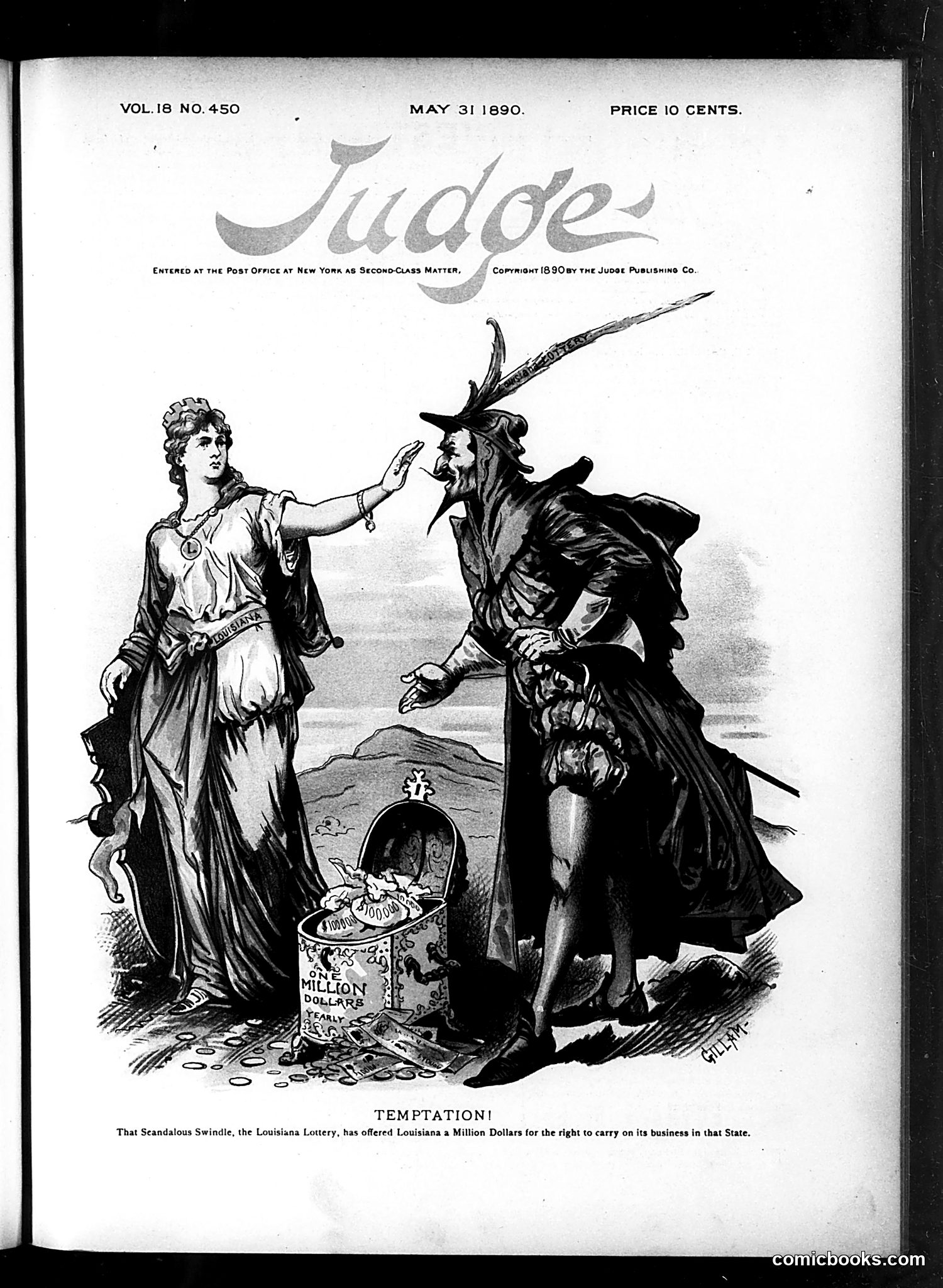
This political cartoon satirizes the Louisiana Lottery's attempted bribery of the state. The allegorical figure on the left represents Louisiana (shown as a classical female personification), while the demonic figure on the right represents the lottery operators. The devil-like character tempts Louisiana with a chest labeled "Million Dollars" in exchange for operating rights. The cartoon critiques what Judge frames as a "scandalous swindle"—the lottery's offer of a million-dollar payment to Louisiana for permission to continue its operations. This was a real historical controversy: the Louisiana Lottery was notorious for fraud and corruption, and this cartoon warns Louisianans against accepting the bribe, depicting the choice as a moral test between virtue and corruption. The devil imagery emphasizes the moral depravity Judge associates with the lottery scheme.
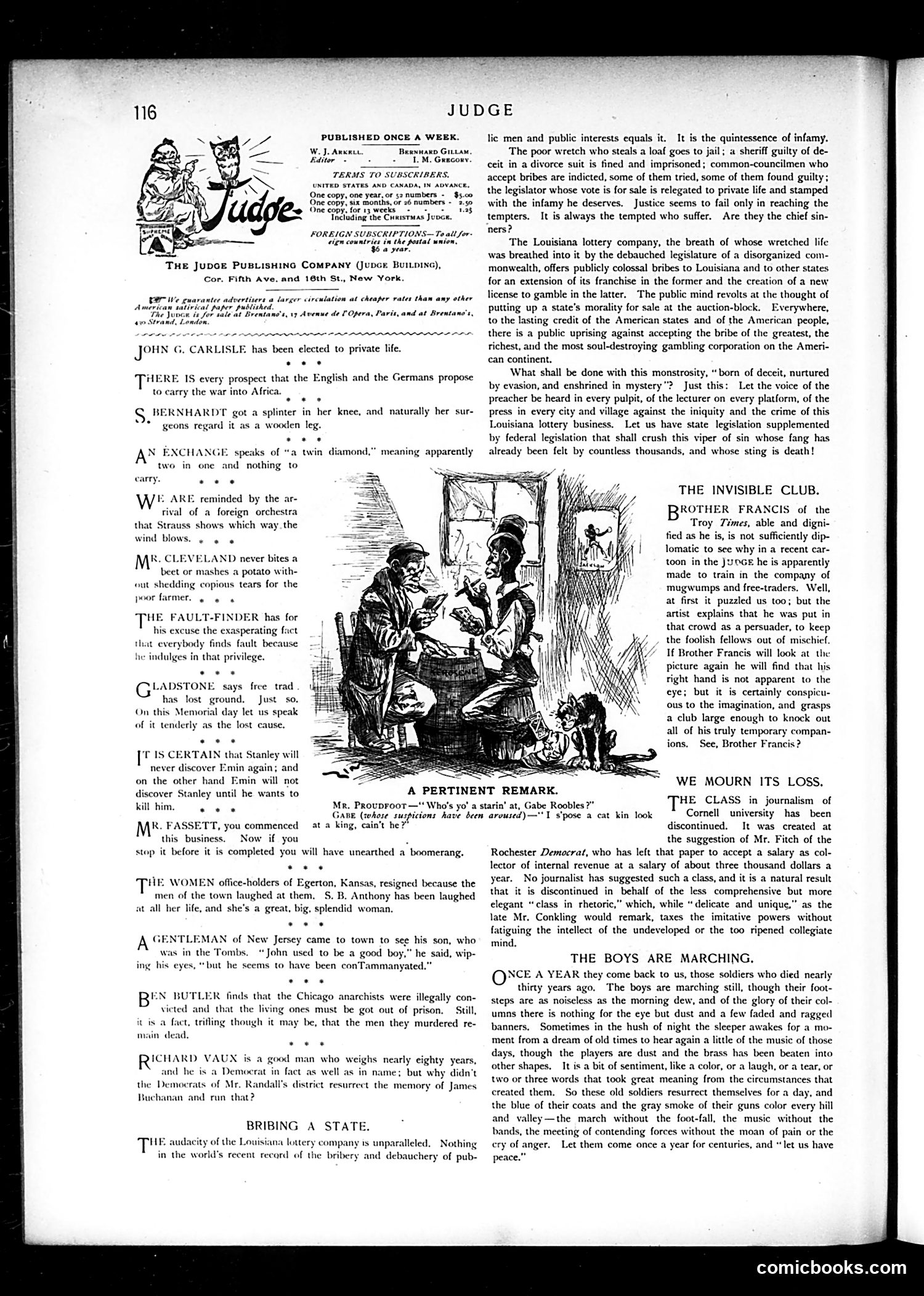
This page from the satirical magazine Judge contains several brief political jokes and one substantive editorial critique. **The Main Editorial ("Bribing a State")** condemns the Louisiana Lottery Company's corruption of state legislatures. The editorial attacks the hypocrisy of American justice: petty criminals (bread thieves, corrupt sheriffs, bribed councilmen) face prosecution, but wealthy corporations who bribe legislators escape punishment. Judge argues the lottery company—which obtained its charter through legislative bribery—now offers massive bribes for franchise extensions in Louisiana and other states. The piece calls this "the quintessence of infamy" and praises public outcry against it, suggesting widespread disgust with corporate corruption of state morality. **The other items** are typical Judge humor: John Carlisle's retirement, Bernhardt's injury, Cleveland's crocodile tears for farmers, and local political jabs. The cartoon appears to depict street-level fraud or deception, though its specific reference is unclear from context alone. The page reflects Judge's progressive-era outrage at Gilded Age corruption.
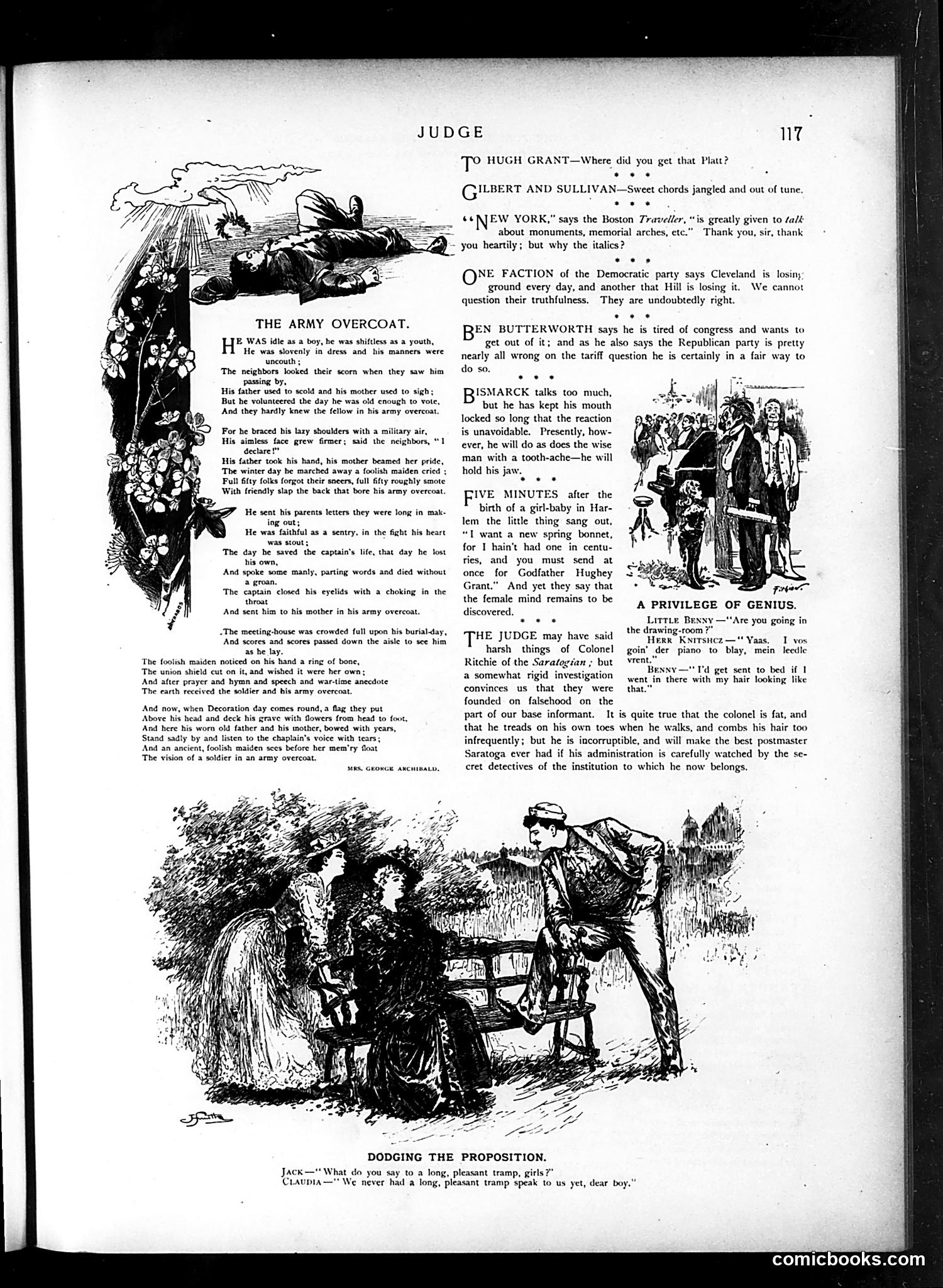
This page from Judge magazine (undated but likely 1890s based on references) contains several distinct satirical items: **"The Army Overcoat"** is a sentimental poem about a shiftless young man who gains dignity and purpose through military service, ultimately dying heroically. It's touching rather than satirical—celebrating military virtue. **Political Jabs** mock contemporary figures: Hugh Grant (likely NYC mayor), Gilbert and Sullivan (the composer team), Cleveland and Hill (competing Democratic politicians), and Ben Butterworth (congressman). These are brief, topical zingers typical of Judge's format. **"A Privilege of Genius"** cartoon mocks Herr Kyffhäuser (German musician), suggesting that artistic temperament excuses poor grooming—a dig at pretentious foreign artists. **The cartoons** use period illustration styles to comment on contemporary politics and social types. The overall page reflects Judge's mix of sentimental nationalism, political satire, and social mockery aimed at educated American readers familiar with current events and public figures.
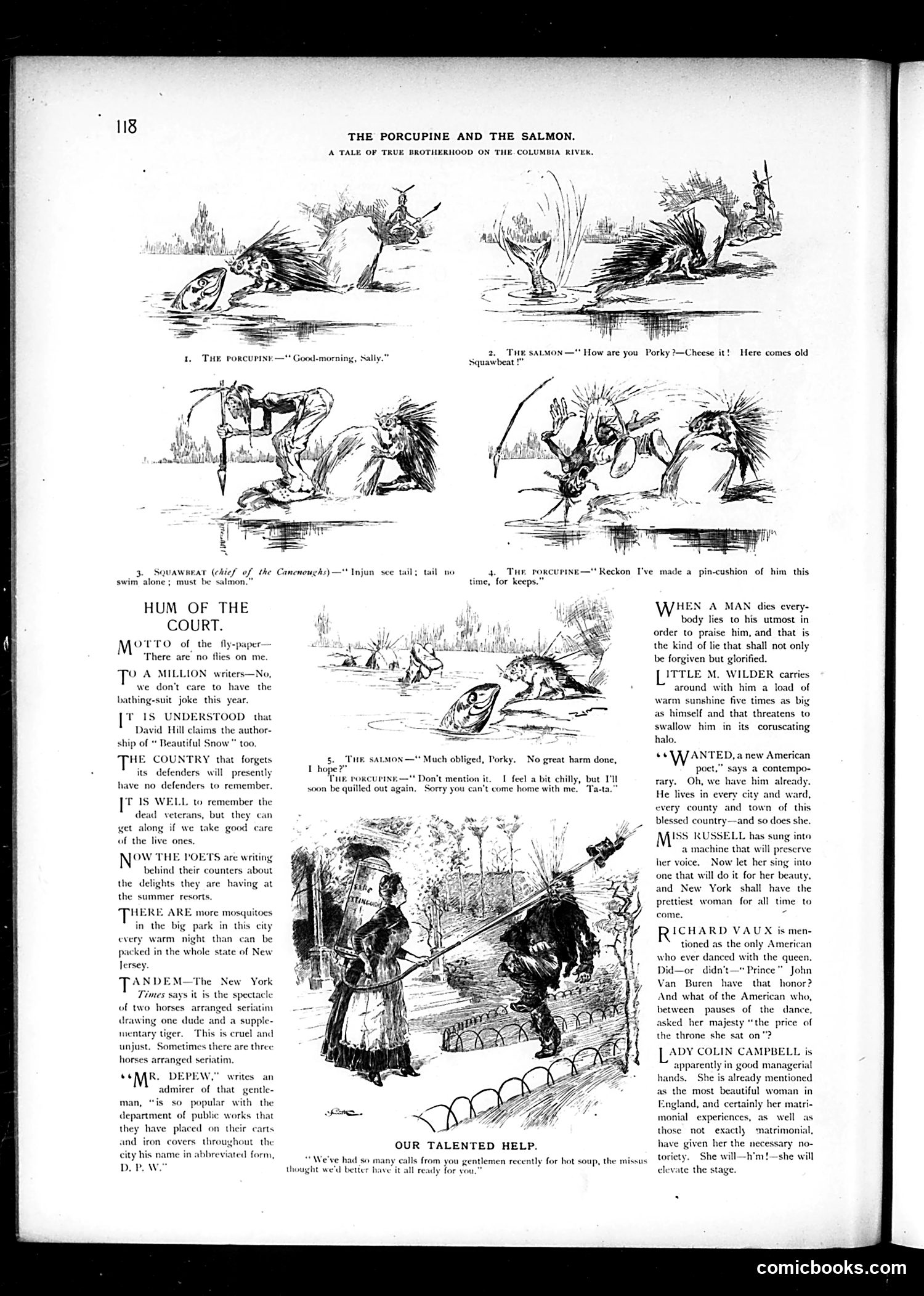
This illustrated story depicts two animal characters on the Columbia River engaging in humorous dialogue. The **porcupine** (called "Porky") and **salmon** appear to be Native American ("Injun") stereotypes, suggested by references to "Squawbeat" (a chief) and the dialect used. The cartoon's humor relies on: 1. **Animal wordplay**: Quills/being "quilled" references the porcupine's spines 2. **Friendship despite differences**: The animals warn each other of danger ("Cheese it! Here comes old Squawbeat!") 3. **Fish/cooking jokes**: References to "hot soup" suggest the salmon fears becoming food The surrounding text on the page includes unrelated items—society gossip about figures like Richard Vaux and Lady Colin Campbell, humorous observations about New York mosquitoes and carriages, and commentary on public figures like Chauncey Depew. This appears to be typical **Judge magazine content**: light satirical humor mixing social commentary with illustrated animal fables, likely from the 1880s-90s.
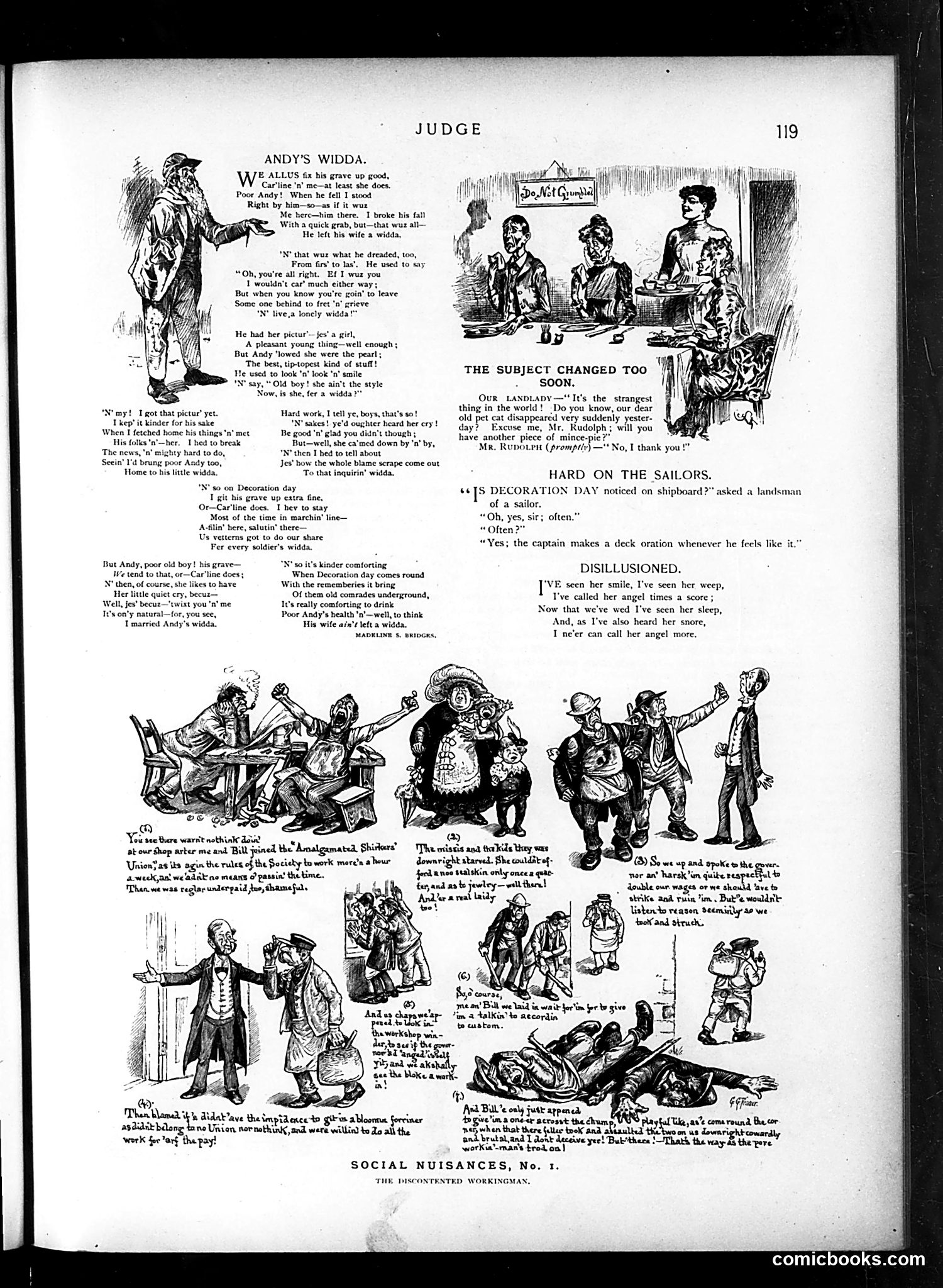
This page contains three distinct satirical pieces: **"Andy's Widda"** (top left): A sentimental narrative poem about a soldier who dies, leaving his wife a widow. A fellow veteran describes attending to Andy's grave on Decoration Day and reveals he's now married the widow himself—a humorous twist on the melancholic premise. **"The Subject Changed Too Soon"** (top right): A brief comic sketch where a landlady discusses her missing cat while offering mince-pie to Mr. Rudolph, who refuses it suspiciously. The implication is darkly comedic—the cat may have met an unfortunate fate in the pie. **"Social Nuisances, No. 1: The Discontented Worksman"** (bottom): This section satirizes labor unionization. It depicts workers who joined a union, then struck demanding higher wages, only to find themselves worse off financially. The satire critiques both the union's restrictions and workers' unrealistic wage demands, suggesting labor activism creates hardship rather than improvement. All pieces use working-class vernacular and dark humor typical of *Judge's* satirical style.
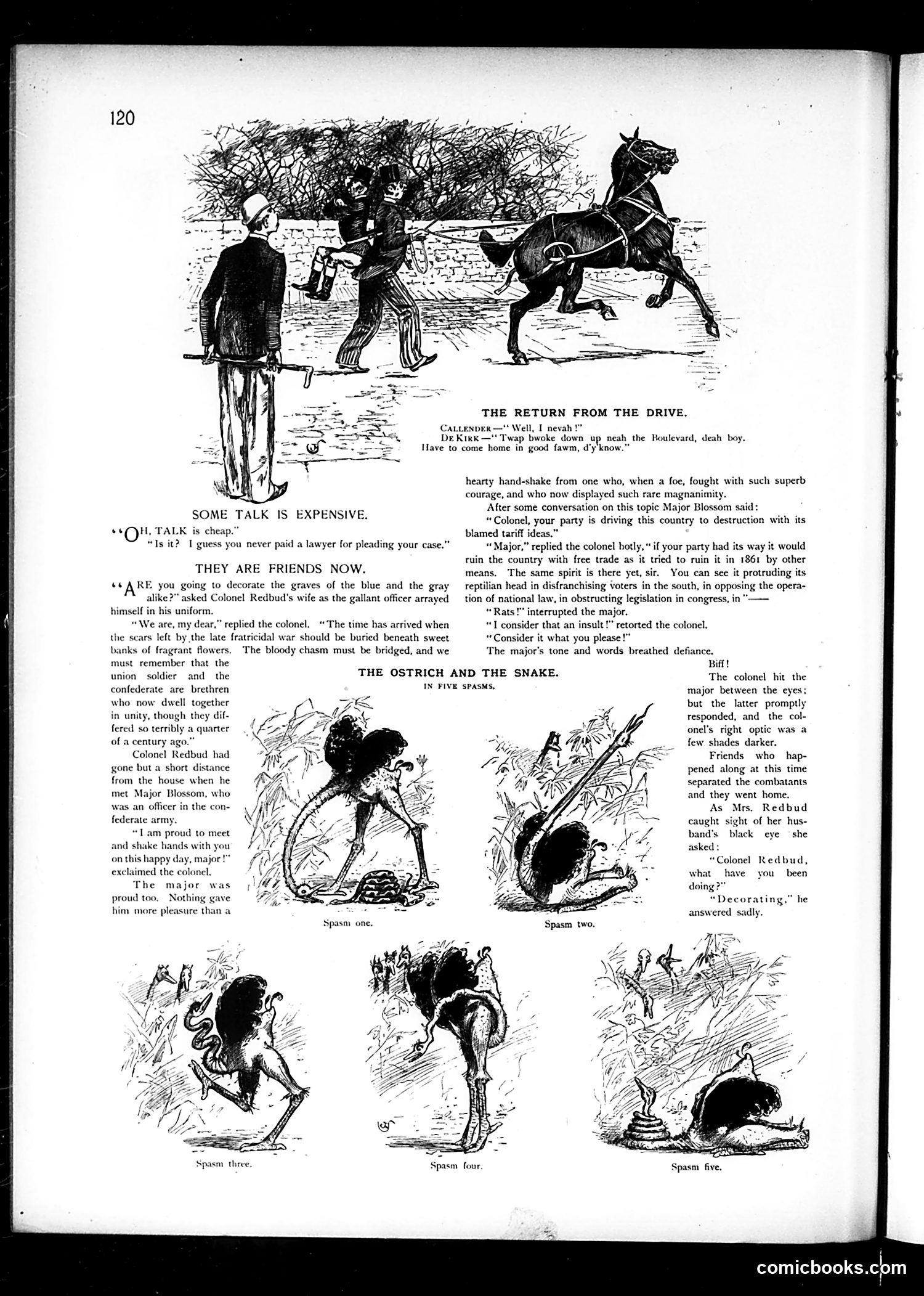
This page satirizes late-19th-century American sectional politics through two cartoons. **"They Are Friends Now"** depicts Union Colonel Redbud and Confederate Major Blossom greeting warmly—symbolizing post-Civil War reconciliation. However, their reconciliation immediately collapses into violence when they dispute tariff policy. The Colonel accuses the Major's (Democratic) party of free-trade destruction and voter suppression in the South; the Major retorts with "Rats!" They fight, leaving the Colonel with a black eye he euphemistically calls "decorating." The satire's point: American sectional "friendship" is superficial and fragile, instantly shattered by partisan economic disagreements. The cartoon mocks both sides' inability to move past Civil War animosity despite proclaimed unity. **"The Ostrich and the Snake"** (five-panel sequence below) appears to be an unrelated fable illustration, its satirical meaning unclear from this page alone.
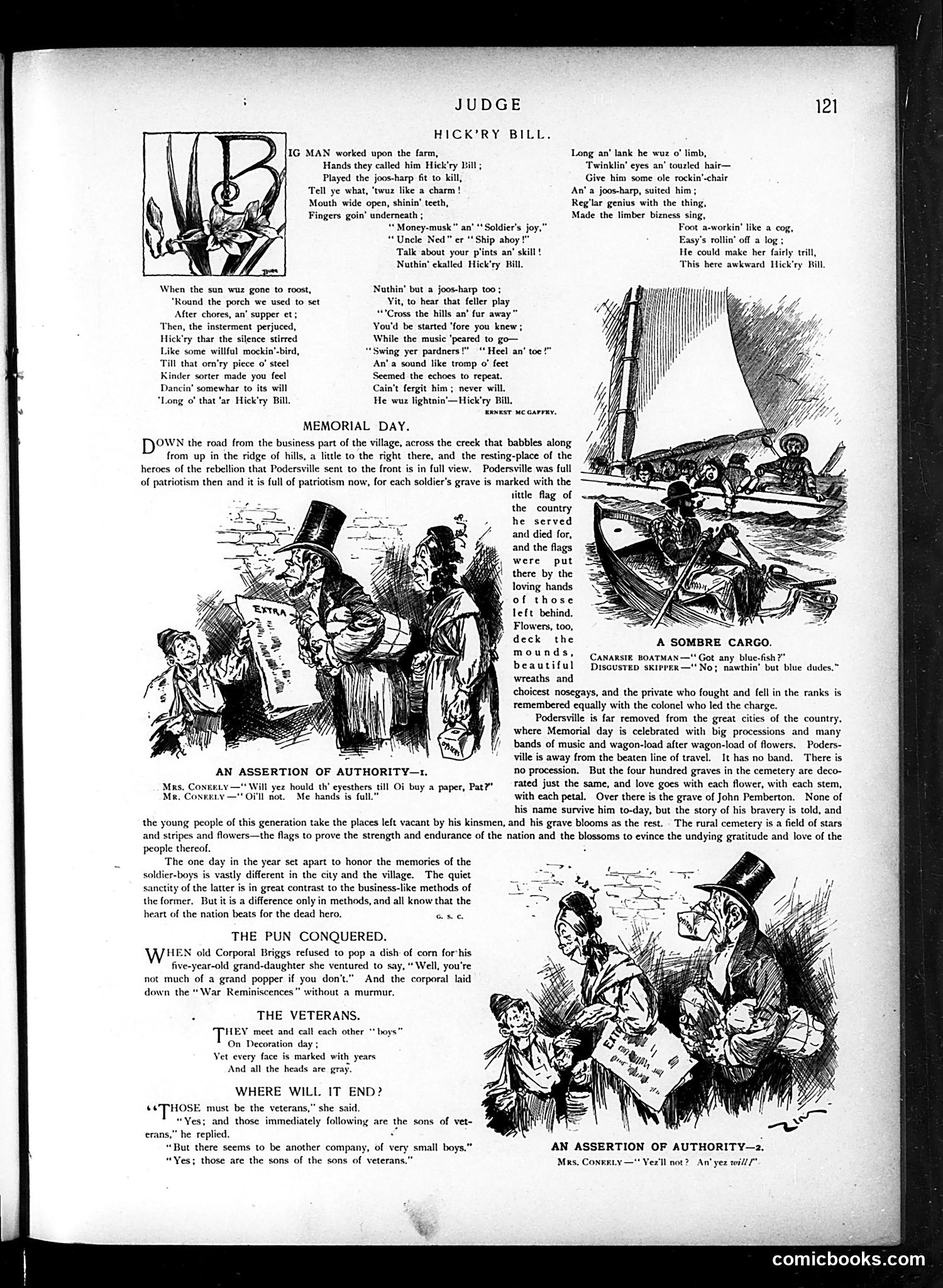
This page contains three main items: 1. **"Hick'ry Bill"** (top): A sentimental rural poem celebrating an unskilled farm laborer whose talent with a jaw harp (musical instrument) brings joy to his community. It romanticizes rustic American life and working-class dignity. 2. **"Memorial Day"** (center): A patriotic essay contrasting how small towns like Podersville honor fallen soldiers with humble cemetery decorations versus grand city processions. It emphasizes that rural communities show equal respect and love for their dead heroes. 3. **"An Assertion of Authority"** (bottom): A brief comic exchange where Mrs. Conley asks Mr. Conley to hold oysters while she buys a newspaper, but he refuses because his hands are full—a simple domestic humor bit about marital disagreement. The illustrations depict scenes of rural/working-class life and small-town patriotism, reflecting Judge's mix of sentimental Americana and gentle social satire typical of early 20th-century American magazines.
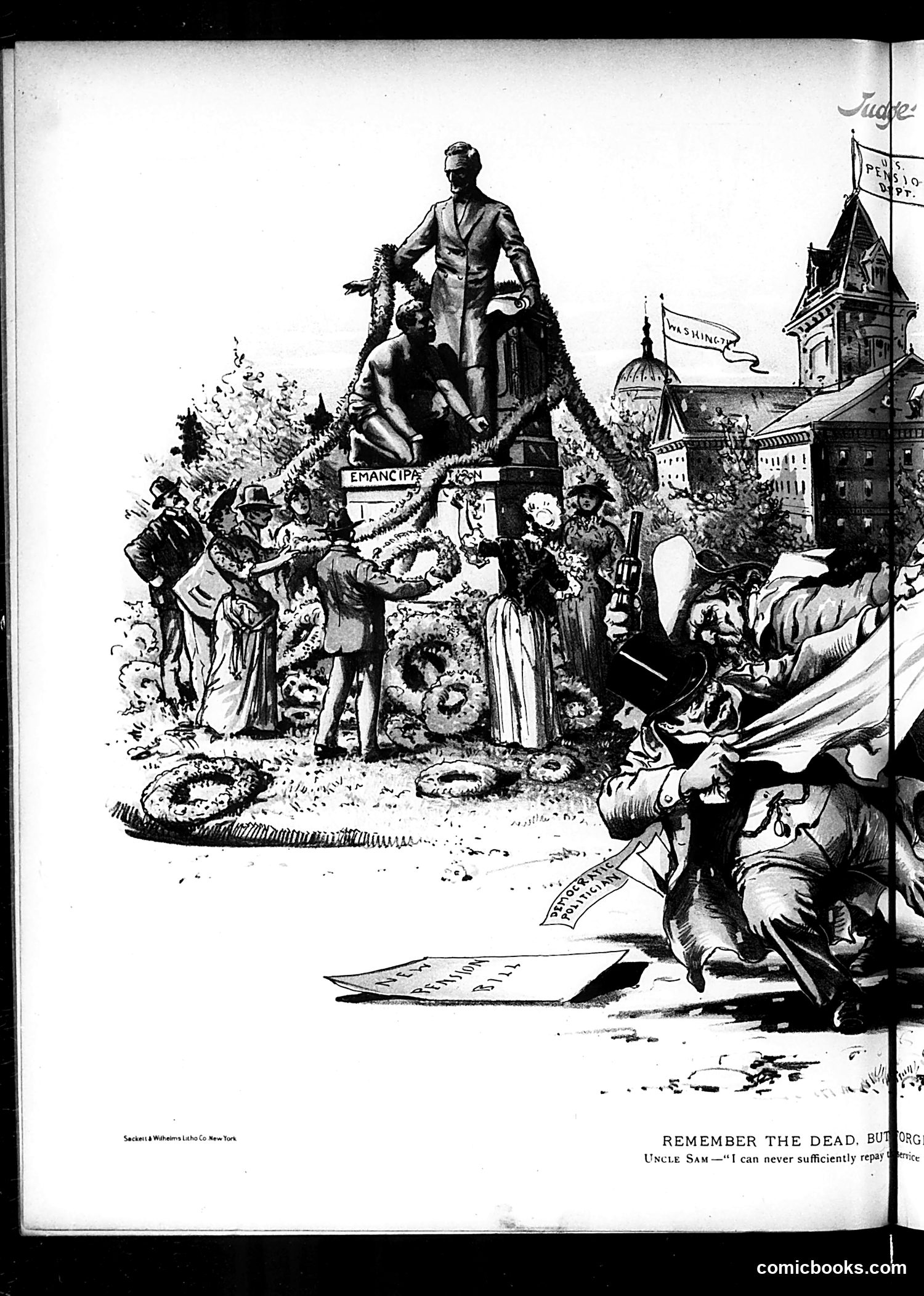
This Judge magazine cartoon depicts Uncle Sam (representing the United States) at a monument labeled "EMANCIPATION," surrounded by grieving figures. The incomplete caption states Uncle Sam cannot "sufficiently repay" debts to the dead. The satire appears to reference American casualties—likely from a war or conflict—and critiques the nation's failure to adequately honor or compensate for losses. The monument's "Emancipation" label suggests connection to Civil War themes or liberation struggles, though the specific historical moment is unclear from visible text alone. The crowded scene with mourning figures emphasizes collective grief and suggests governmental obligation to remember sacrifices. The partially cut-off caption prevents full interpretation of the intended message.
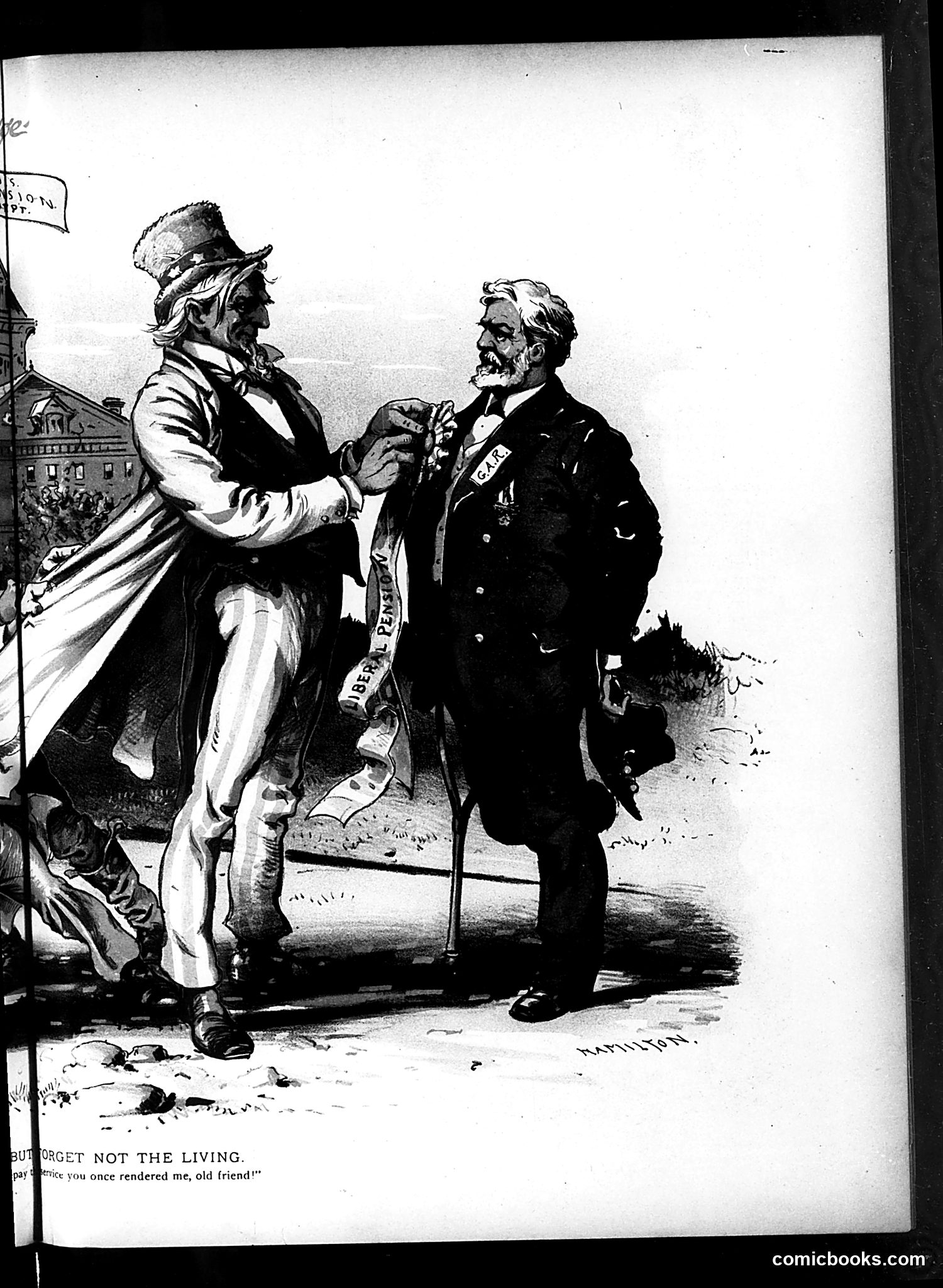
This political cartoon depicts two men in formal dress shaking hands. The caption reads "FORGET NOT THE LIVING" with dialogue "Since you once rendered me, old friend!" The left figure wears patriotic/military regalia with a hat and sash, appearing to represent Uncle Sam or American authority. The right figure is dressed formally in civilian attire. Their interaction suggests reconciliation or debt repayment between two parties. The title's emphasis on "the LIVING" implies criticism of someone prioritizing memorials to the dead while neglecting obligations to living citizens or colleagues. The "old friend" reference suggests past favors or assistance being invoked. Without visible publication date or additional context, the specific historical reference remains unclear, though the cartoon appears to critique selective memory or misplaced priorities in governance or public service.
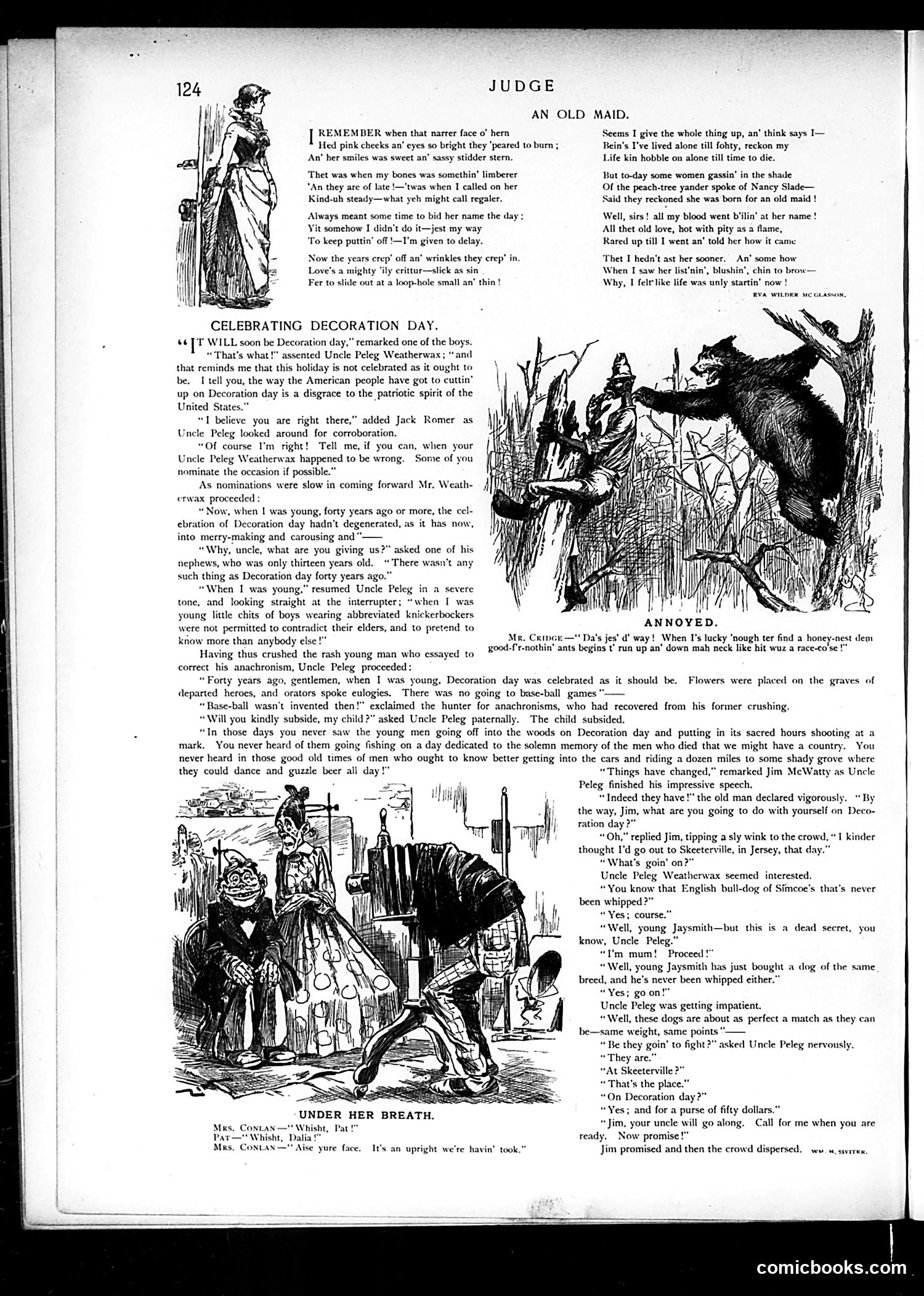
This page contains two separate pieces satirizing American social customs. **"An Old Maid"** (top): A sentimental dialect poem about an elderly man who loved a woman named Nancy Slade in his youth but delayed proposing through procrastination. Hearing gossip that she'd become an old maid, his dormant passion reignites. He finally confesses his feelings, only to discover—too late—what his hesitation cost them both. The satire targets male indecision and missed romantic opportunity. **"Celebrating Decoration Day"** (bottom): Uncle Peleg Weatherwax nostalgically complains that modern Decoration Day (Memorial Day) celebrations have degraded into frivolous activities—baseball games, picnics, dancing—rather than solemn remembrance. A precocious young nephew repeatedly fact-checks his claims about "forty years ago," pointing out anachronisms (Decoration Day and baseball didn't exist then). The satire mocks both curmudgeonly nostalgia and how each generation romanticizes its past while dismissing youth as disrespectful.
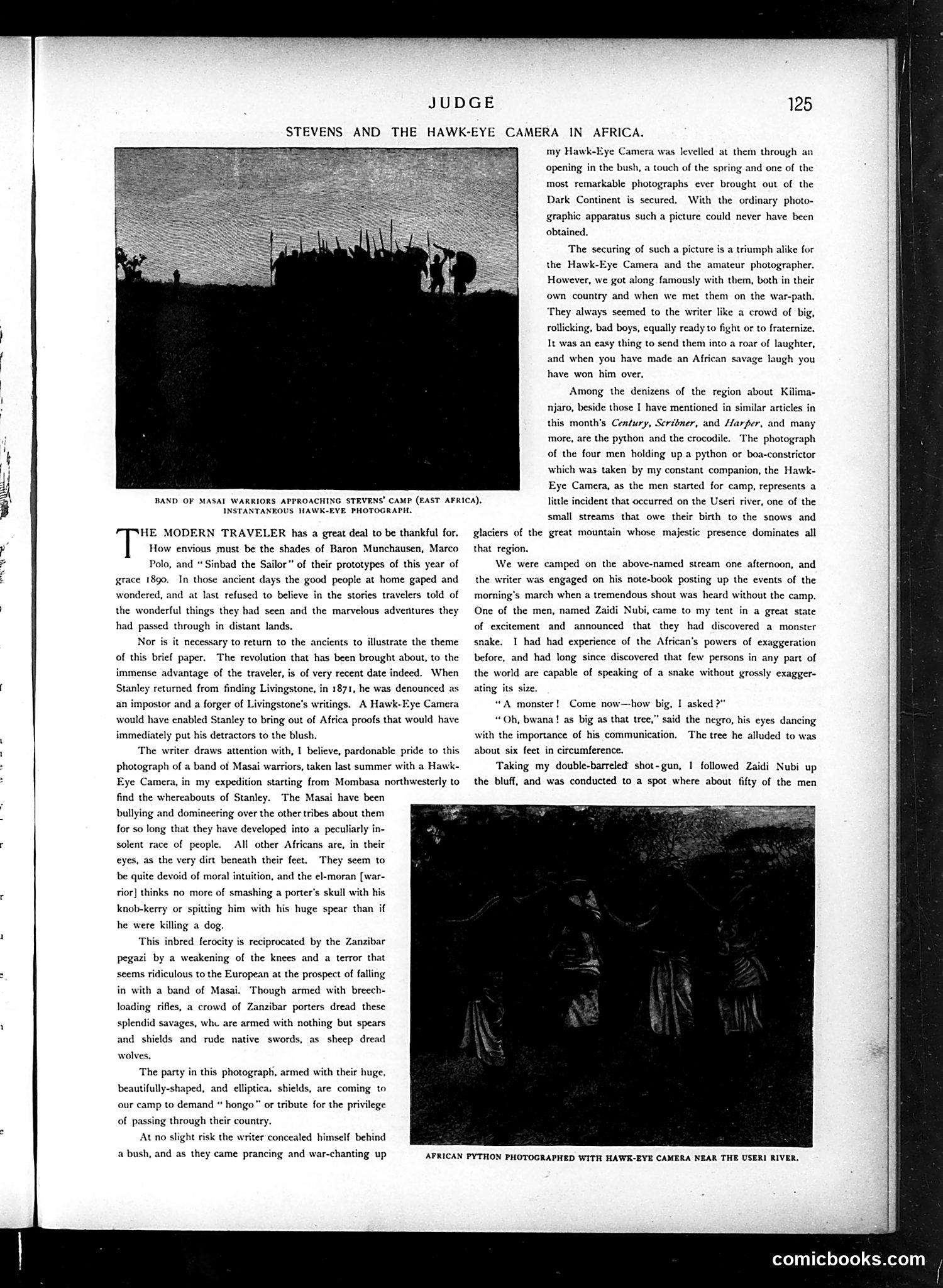
This is an advertisement disguised as travel journalism, promoting the Hawk-Eye Camera by framing it as essential equipment for documenting African expeditions. The page presents two photographs allegedly taken during an East African expedition to find Stanley. The "satire" is subtle: Judge uses a fictionalized traveler's account to mock both the camera's practical limitations and period attitudes toward African peoples. The text presents Masai warriors in deeply stereotypical, dehumanizing terms—describing them as naturally ferocious and devoid of morality—while simultaneously celebrating the photographer's "triumph" in capturing them with modern technology from hiding. The joke appears to be that the camera, meant to provide proof where travelers' tales were once doubted, is being used to commercially exploit exotic imagery. The breathless praise for photographing warriors and pythons reflects the era's commodification of colonial subjects, while the "Hawk-Eye" branding suggests technology solving the problem of credibility.
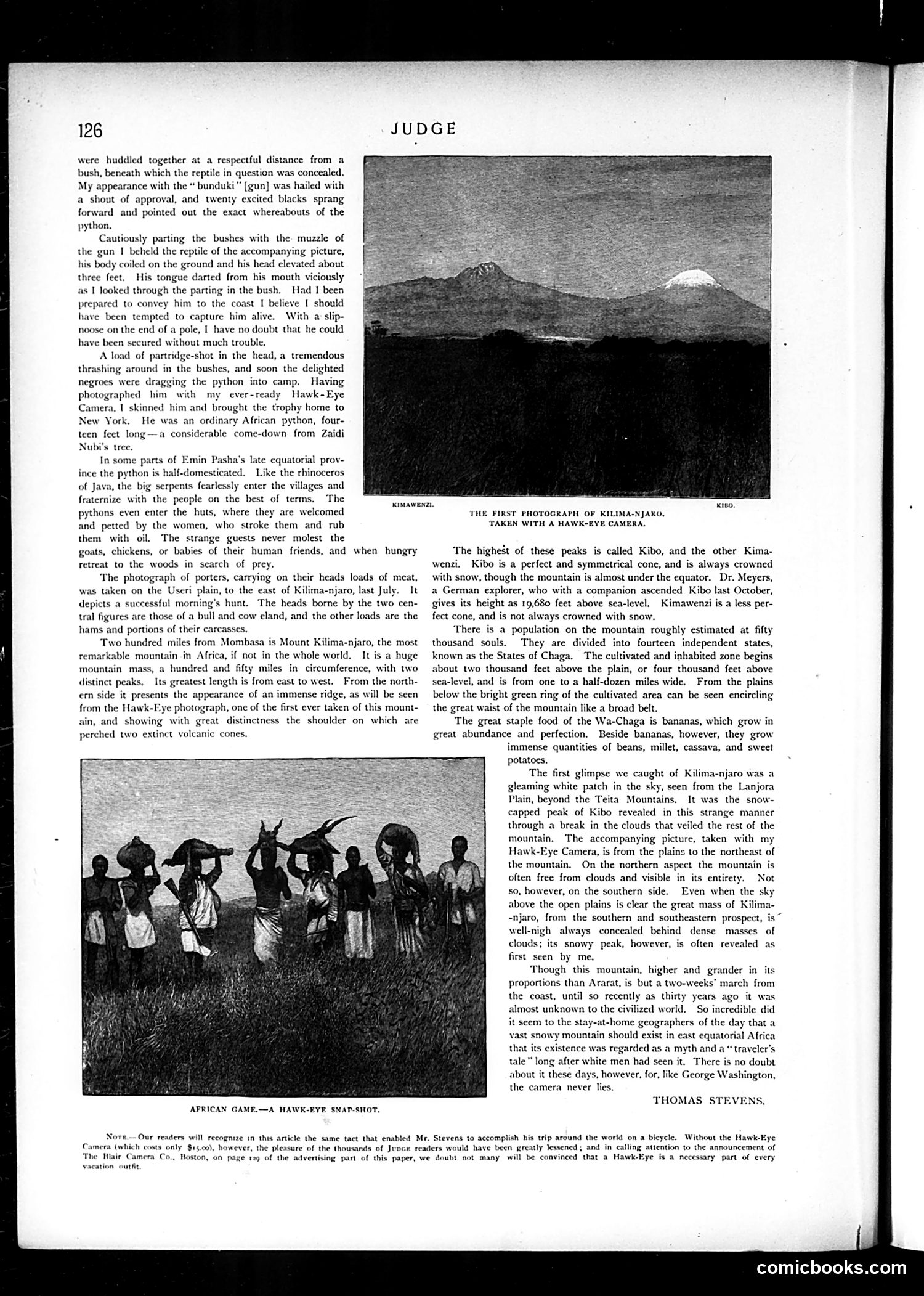
This page contains travel writing by Thomas Stevens describing an African expedition, accompanied by photographs taken with a Hawk-Eye Camera—which is prominently advertised throughout. **The Content:** Stevens describes hunting a 14-foot African python and photographing it with his portable camera. He also details Mount Kilima-njaro (Kilimanjaro) and local Chaga people carrying game from a hunt. **The Satire/Purpose:** This isn't primarily political satire. Rather, it's adventure journalism designed to advertise the Hawk-Eye Camera by demonstrating its capabilities in exotic locations. The repeated mentions of photographing distant mountains and wildlife with the camera serve as product endorsement disguised as travel narrative. The subtext celebrates technological progress and colonial exploration—documenting "exotic" African landscapes and peoples for American readers. **For Modern Readers:** This reflects Victorian-era attitudes: adventure tourism, exoticization of Africa, and the camera as a tool of documentation and conquest. The casual tone about hunting and the objectifying descriptions of local people reflect period colonial perspectives.
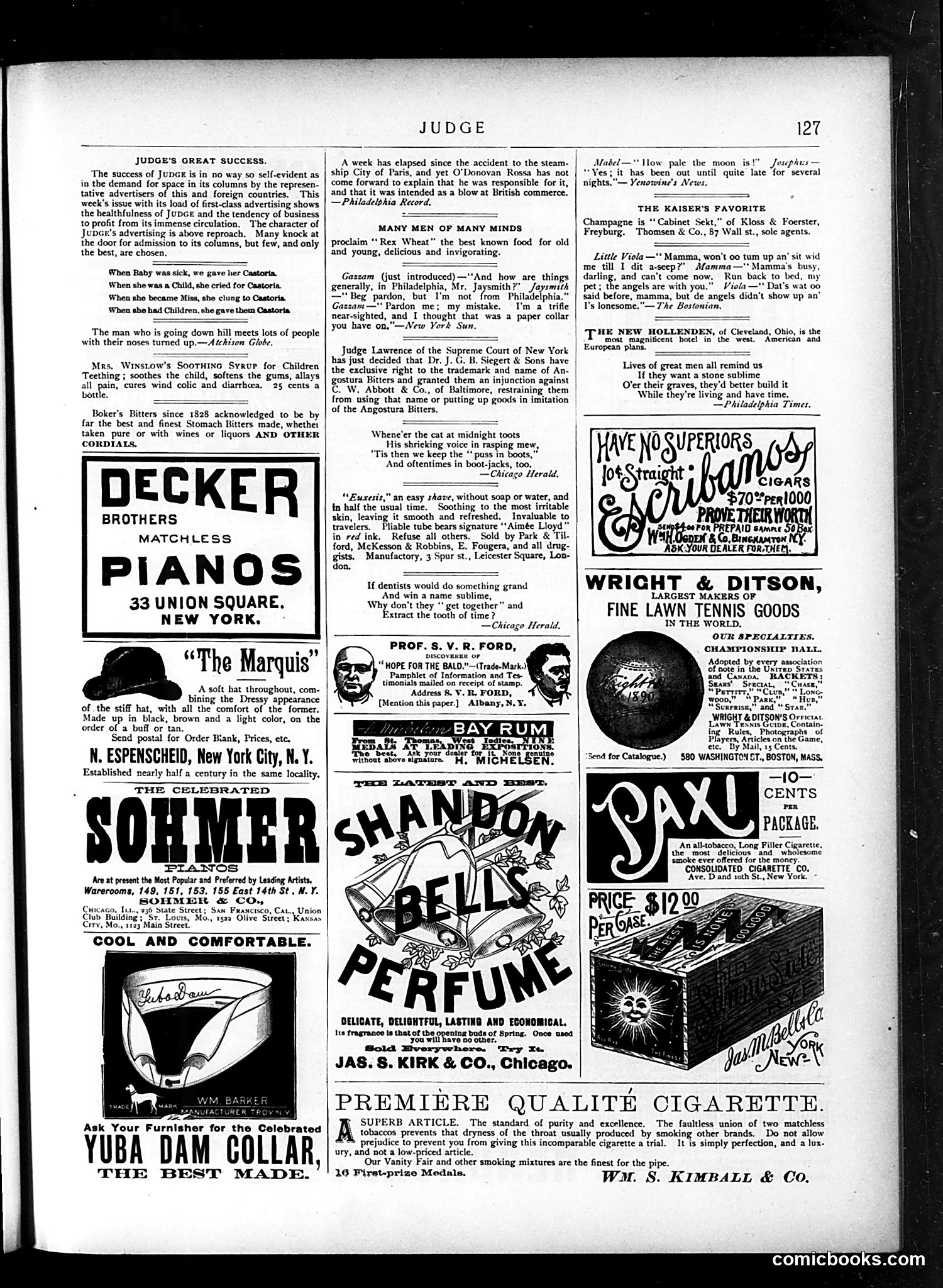
This page is primarily **advertising**, not editorial or satirical content. Judge magazine itself appears only in a brief self-promotional notice at the top, celebrating its commercial success and the quality of its advertisers. The bulk of the page consists of period advertisements for products like Castoria (children's medicine), Mrs. Winslow's Soothing Syrup, Sohmer pianos, Decker Brothers pianos, various bitters and tonics, cigars, and collars. There is one brief satirical item: a joke about a man named Jaysmith who is mistaken for someone from Philadelphia because of his appearance—a mild social observation about regional identity markers. The only topical reference appears in the opening paragraph mentioning "O'Donovan Rossa" and the steamship *City of Paris* accident, likely alluding to Irish-American nationalist tensions with Britain, but this receives minimal coverage here.
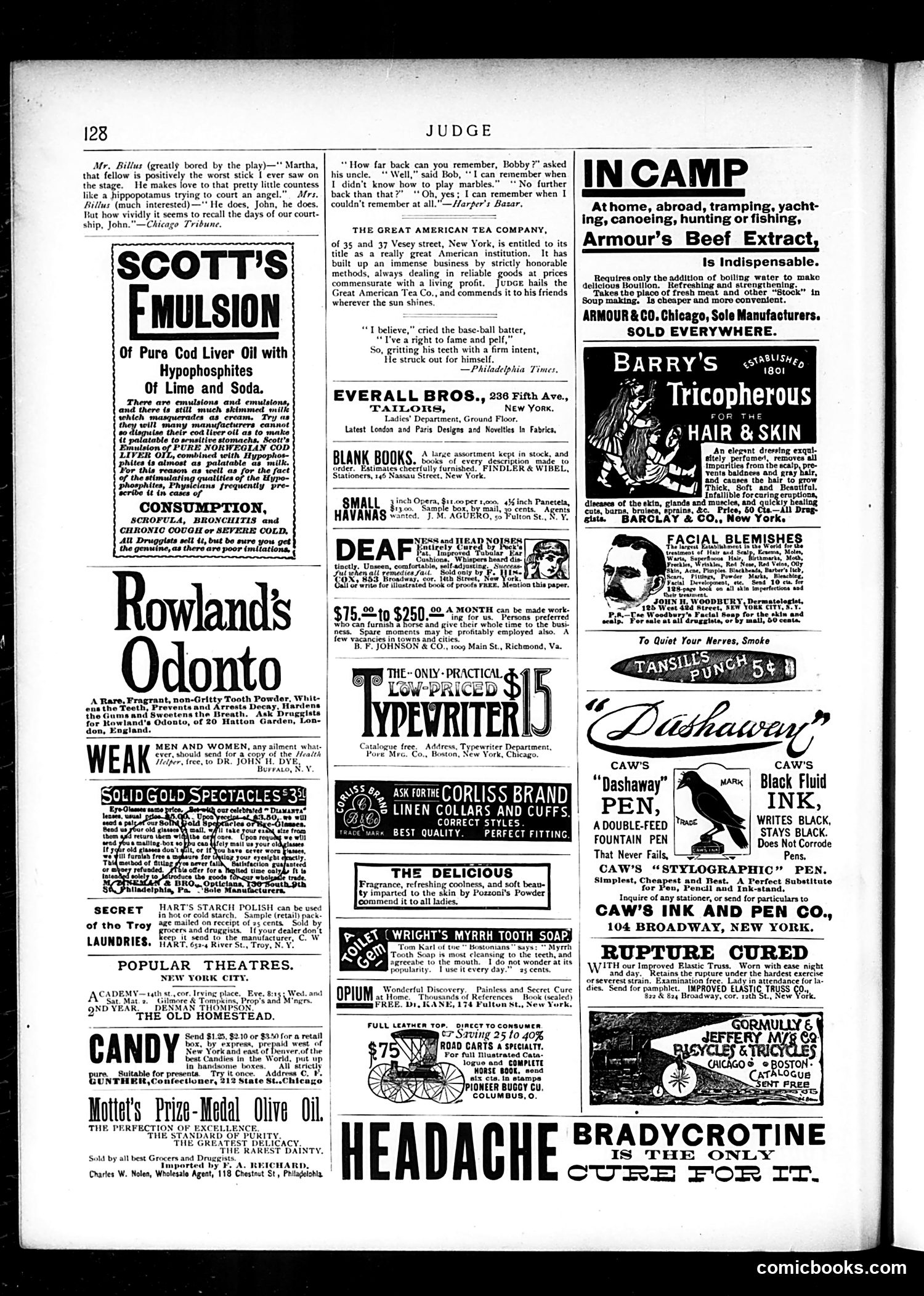
This page is **primarily advertising** with minimal editorial cartoon content. The few joke items present are brief, topical humor pieces typical of Judge's format. The opening dialogue depicts a husband criticizing an actor's wooden romantic performance, with the wife noting it ironically mirrors their own courtship—a gentle marital satire about faded romance. The baseball poem plays on the batter's determination to "strike out for himself," a pun on both baseball failure and self-reliance, likely reflecting turn-of-the-century American individualism. The remainder of the page consists of advertisements for patent medicines (Scott's Emulsion for consumption), typewriters, dental products, starch polish, and various other goods—typical of Judge's revenue model. These ads reflect era-specific ailments and consumer products (bromide facial treatments, opium-based products) that would be considered dubious or dangerous today. The page itself contains **no significant political satire or social commentary**—it's essentially a commercial product showcase dressed in light humor.
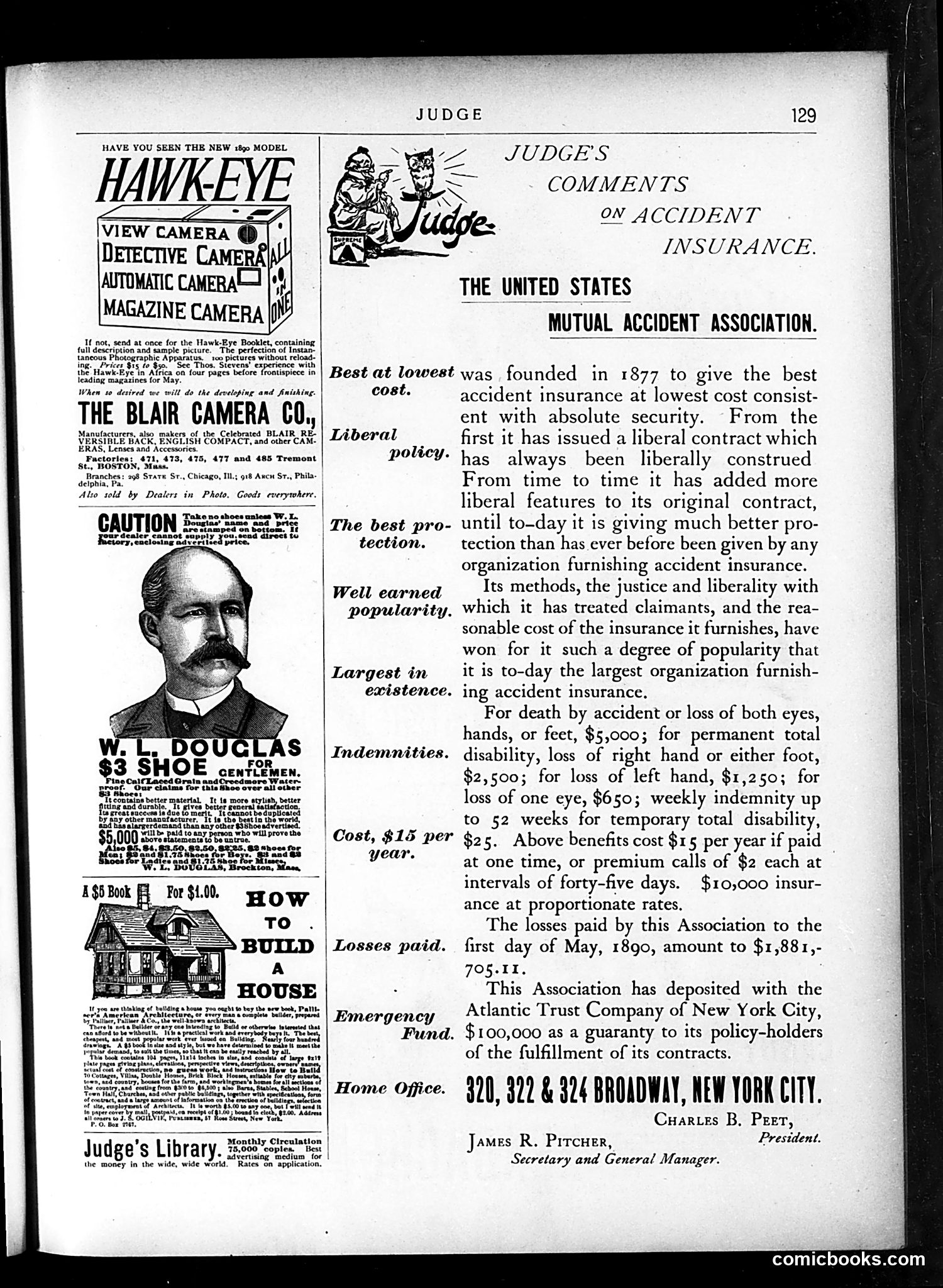
This page is primarily **advertising**, not satire or political commentary. The main content is an advertisement for the United States Mutual Accident Association, a life and disability insurance company founded in 1877. The piece emphasizes the company's reliability and generosity through italicized marketing language ("Best at lowest cost," "Liberal policy," "Well earned popularity"). It lists specific indemnity payouts: $5,000 for accidental death, $2,500 for permanent total disability, and $650 for loss of one eye, among others—benefits costing $15 annually. Surrounding this are typical period advertisements for cameras (Hawk-Eye, Blair), W.L. Douglas shoes ($3), and a home-building guide ($1). The illustration shows a judge-like figure, consistent with Judge magazine's branding, though it serves no satirical function here—merely decorative identity marking. This represents Judge functioning as a conventional advertising vehicle alongside its satirical editorial content.
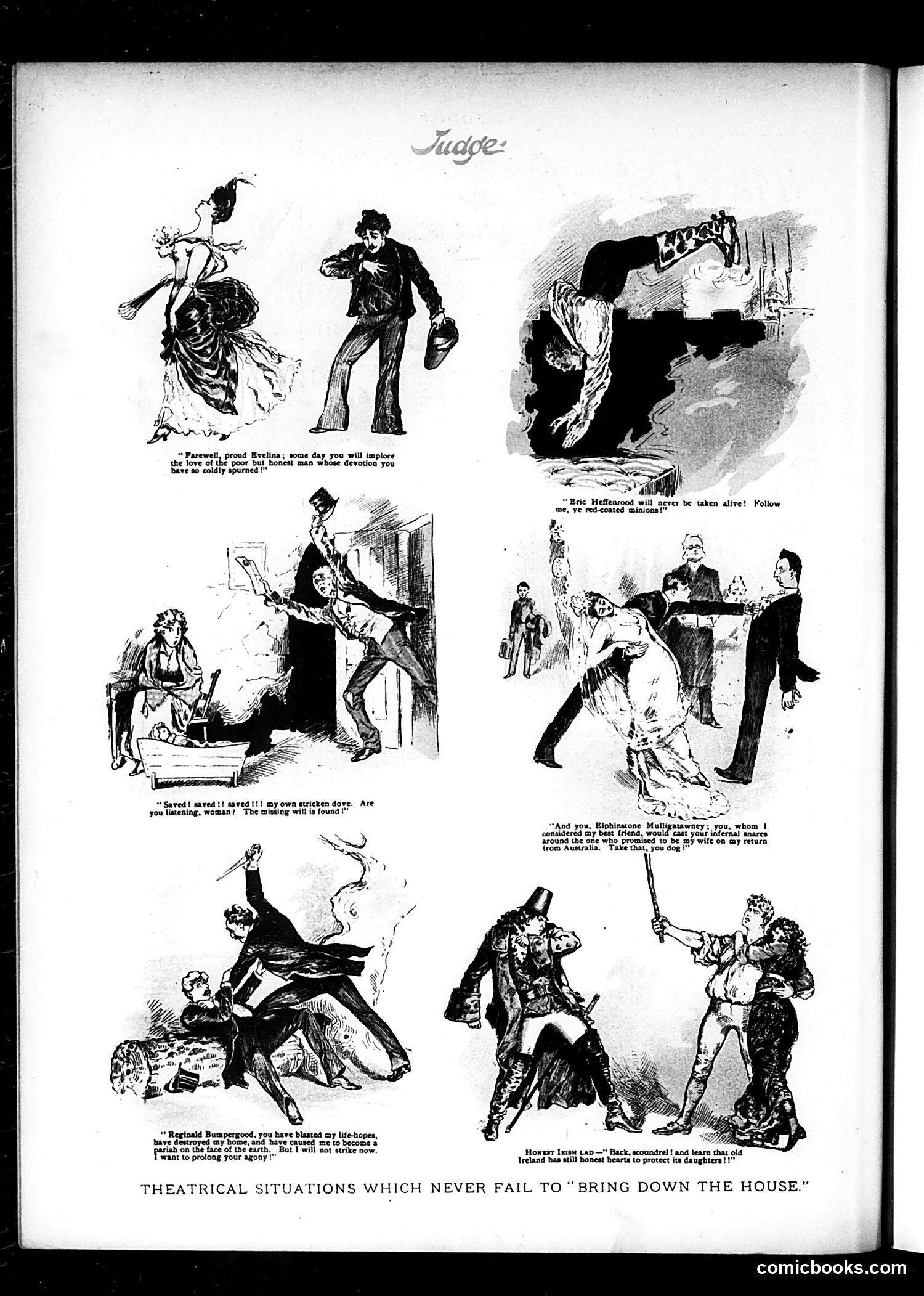
This page satirizes melodramatic Victorian theater tropes—stock scenes guaranteed to provoke audience applause. Each illustration depicts exaggerated theatrical moments: spurned lovers delivering emotional denunciations ("Farewell, proud Evelina"), last-minute plot reversals (discovered wills saving the day), betrayals by trusted friends, revelations of ruin and shame, and righteous defenses of feminine virtue (an Irishman protecting his daughter's honor). The satire mocks both the predictable, overwrought scenarios playwrights relied upon and audiences' reliable emotional responses to them. These clichéd situations—seduction, financial ruin, infidelity, honor—were theatrical staples designed to manipulate viewers into applause regardless of artistic merit. The page is essentially making fun of formulaic theater's cheap emotional manipulation.
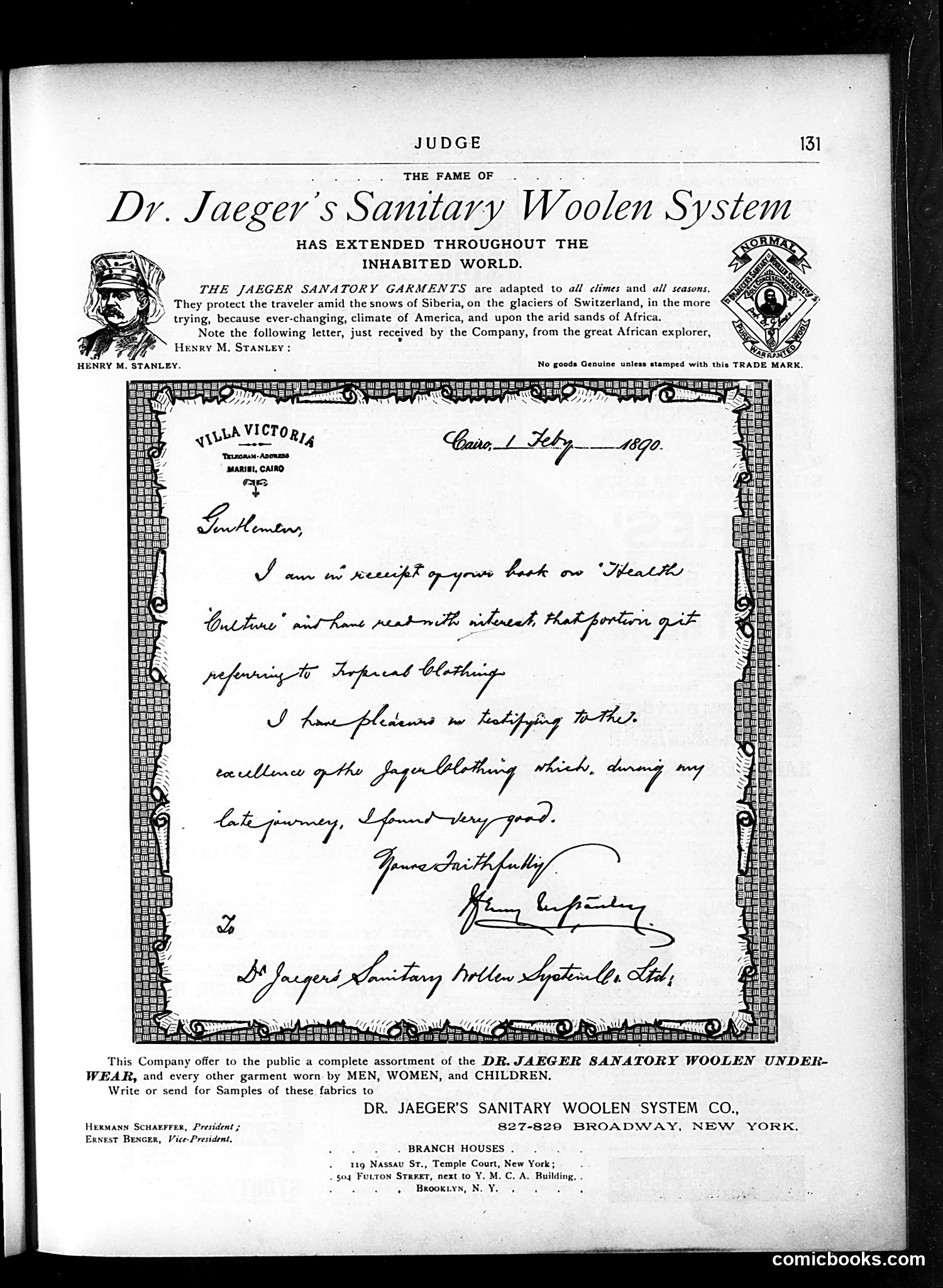
This is **not a cartoon or satire**—it's a genuine advertisement published in *Judge* magazine. The page features an endorsement letter, allegedly from explorer Henry M. Stanley, praising Dr. Jaeger's wool undergarments for performance in extreme climates (Siberia, Switzerland, Africa). The advertisement uses Stanley's prestigious name and African exploration credentials to market the clothing as scientifically superior thermal wear. The ornate letterhead and formal presentation lend credibility. For modern readers: this represents 19th-century marketing relying on celebrity endorsement and pseudo-scientific health claims (the "sanitary" branding suggests germ-prevention benefits). Such advertisements were common in *Judge*, which mixed satire with commercial content. Whether Stanley actually wrote this letter or the endorsement was fabricated remains unclear from the image alone.
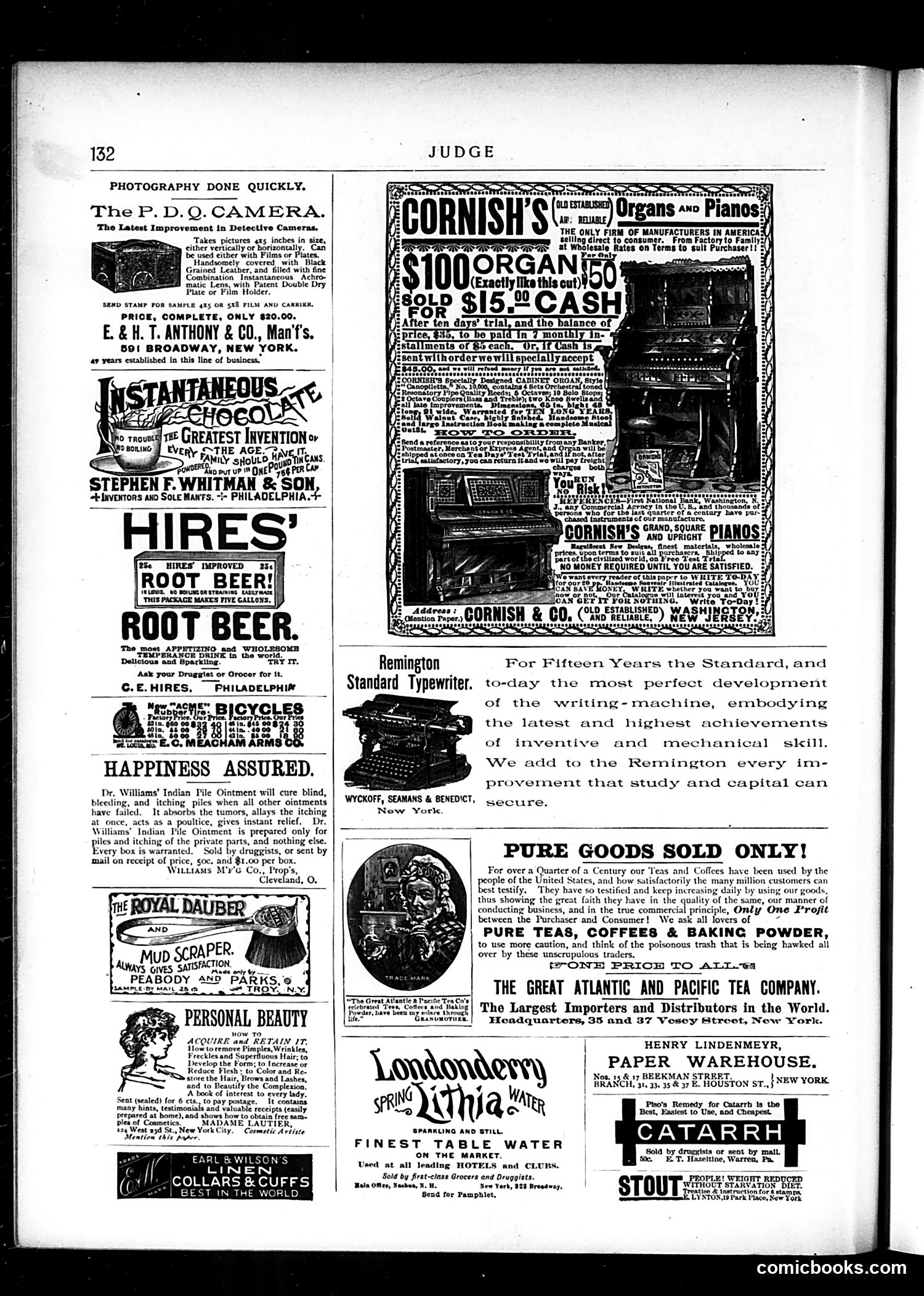
This is primarily an **advertising page** from Judge magazine, with no political cartoons or satirical content to analyze. The page showcases late-19th-century consumer products and services typical of the era: photography equipment (P.D.Q. Camera), chocolates, root beer, bicycle parts, medical treatments (Indian Pile Ointment), beauty products, collars, typewriters, organs and pianos, tea, and mineral water. The advertisements reveal period attitudes: remedies promised miraculous cures for embarrassing ailments; beauty guides taught women to "acquire and retain" attractiveness; and manufacturers emphasized direct-to-consumer sales ("factory to family") to undercut middlemen. The **Cornish organs and pianos ad** is notably large and elaborate, suggesting significant advertiser investment. The Remington typewriter receives prominent placement, reflecting the machine's growing importance in business. No satirical commentary or political figures appear on this page—it functions as a commercial space rather than editorial content.
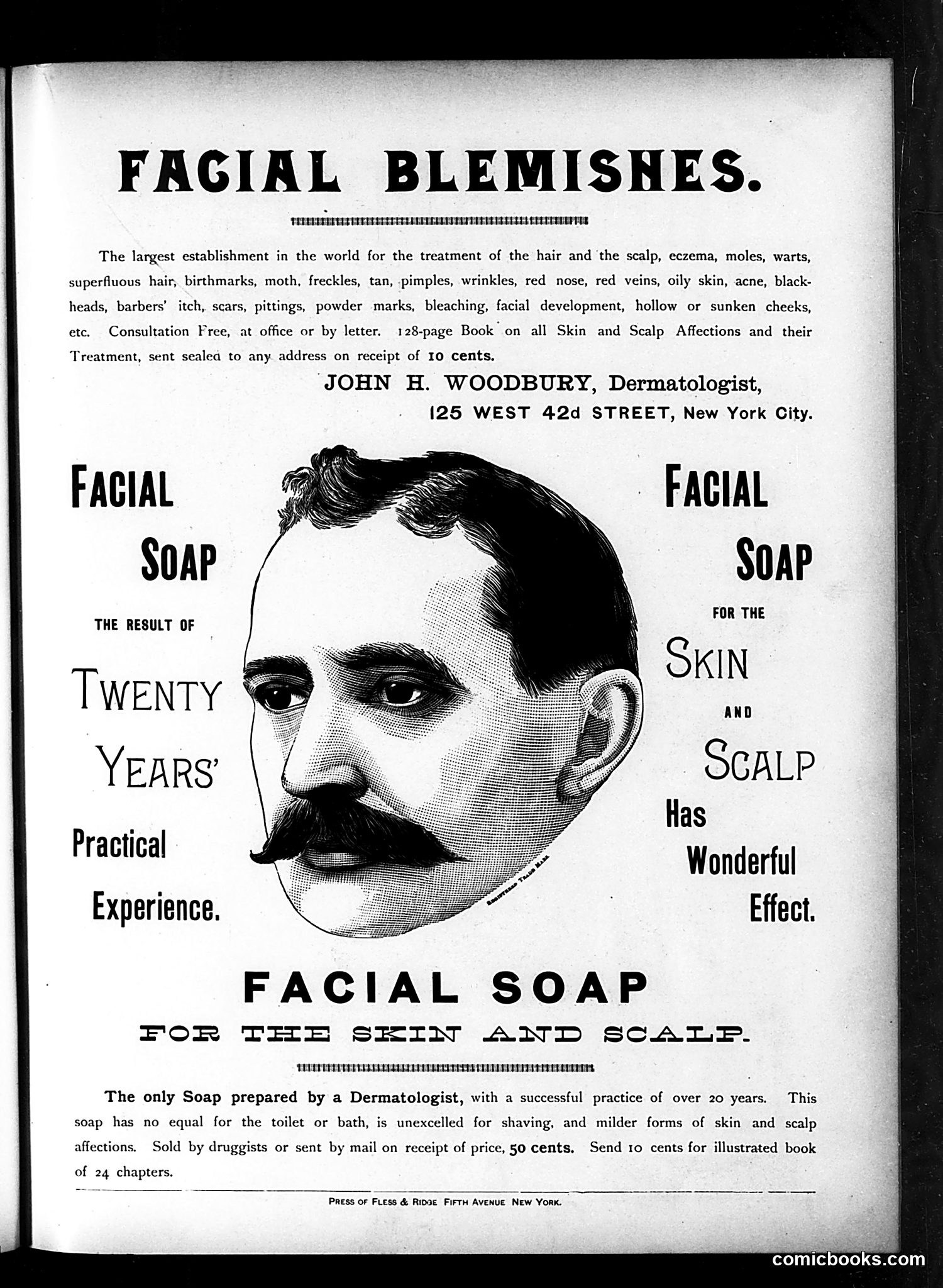
This is a full-page advertisement, not a cartoon. It promotes John H. Woodbury's dermatological practice and facial soap, located at 125 West 42nd Street in New York City. The page features a portrait of a mustachioed man (presumably Woodbury himself) and advertises treatment for numerous skin conditions: acne, eczema, freckles, wrinkles, birthmarks, and others. The ad emphasizes Woodbury's credentials as a dermatologist with over 20 years of experience. The soap is marketed as "the only Soap prepared by a Dermatologist," claiming superiority for bathing, shaving, and treating skin afflictions. Pricing is listed as 50 cents for the soap, with a 10-cent charge for an illustrated book of 24 chapters on skin conditions. This reflects turn-of-the-century medical advertising that positioned specialized treatments as scientifically authoritative—a common marketing strategy when dermatology was establishing itself as a legitimate medical field.
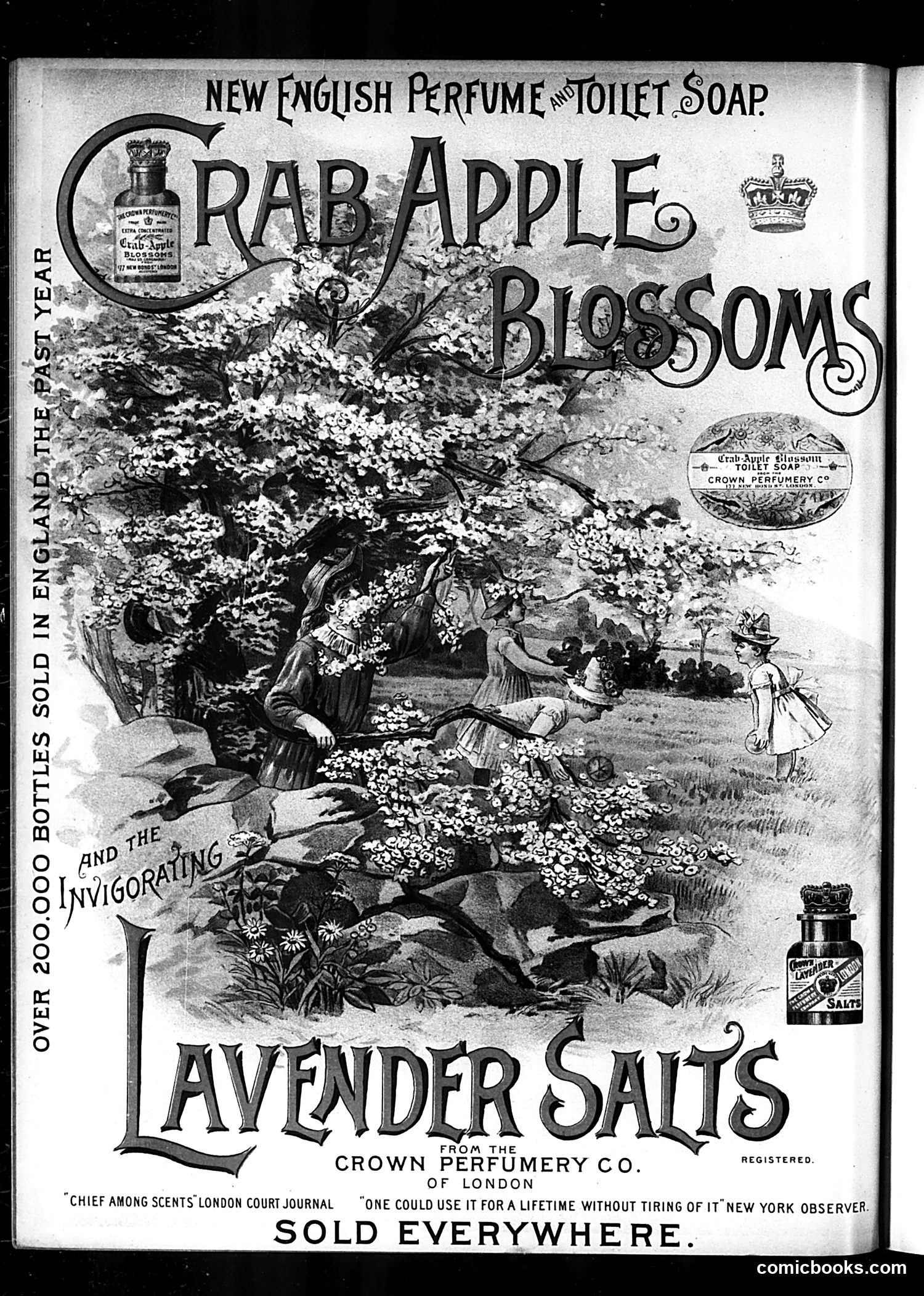
This is **primarily a full-page advertisement**, not political satire. It promotes "Crab Apple Blossoms" perfume and "Lavender Salts" from London's Crown Perfumery Co. The imagery is purely decorative: an idealized Victorian scene of people gathering beneath flowering crab apple trees, with children playing nearby. The aesthetic appeals to genteel, romantic sensibilities popular in late 19th-century advertising. The page includes two product bottles illustrated at top-left and bottom-right, along with testimonial quotes positioning the products as refined and long-lasting. The text "Sold Everywhere" emphasizes mass availability despite the products' claims to exclusivity and quality. There is **no political commentary or satirical content** visible—this is straightforward consumer advertising using pastoral imagery and endorsements to market luxury toiletries to middle and upper-class readers of *Judge* magazine.