
Judge, 1890-05-31 · page 7 of 24
Judge — May 31, 1890 — page 7: what you’re looking at
What you’re looking at
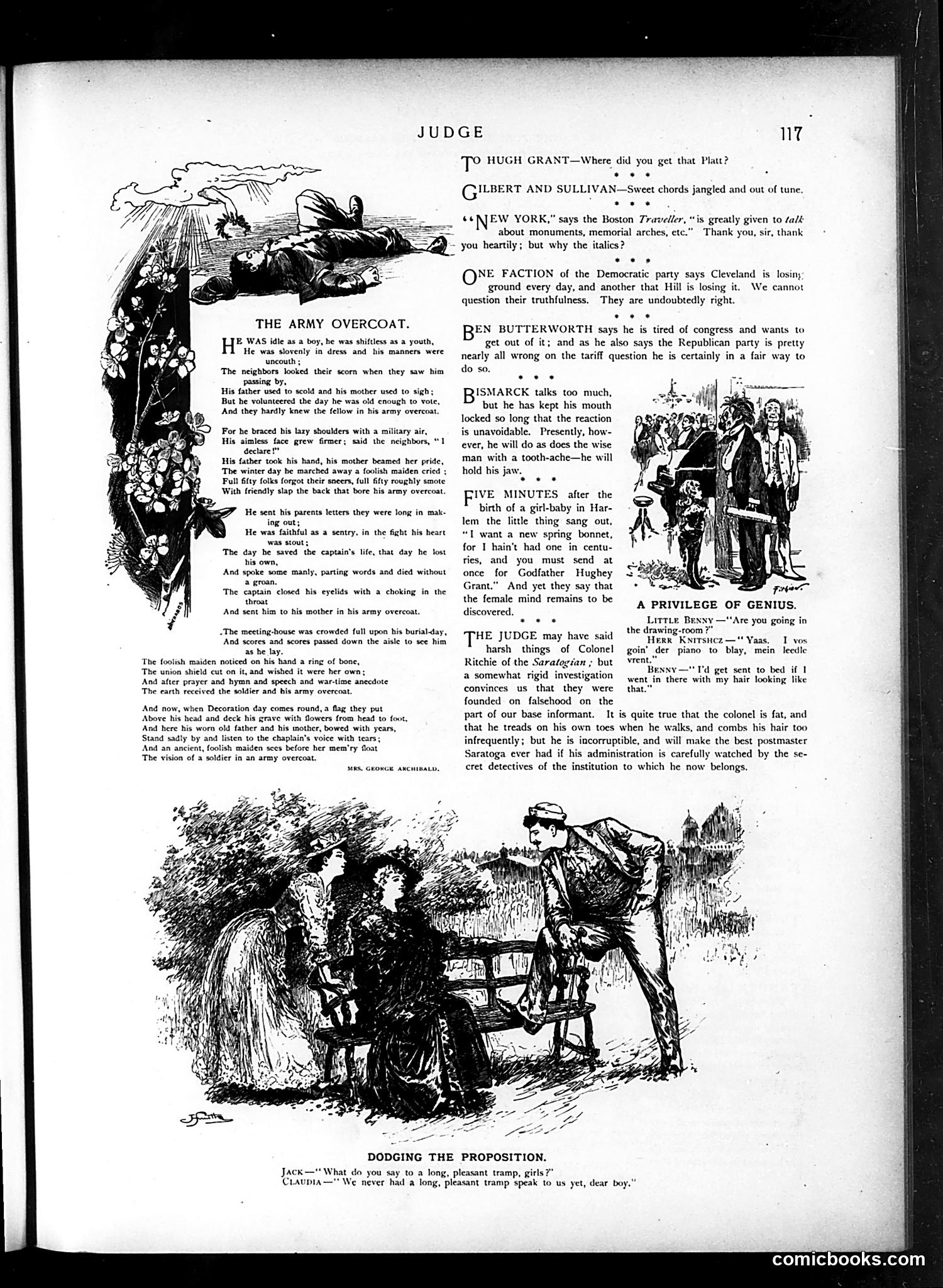
This page from Judge magazine (undated but likely 1890s based on references) contains several distinct satirical items: **"The Army Overcoat"** is a sentimental poem about a shiftless young man who gains dignity and purpose through military service, ultimately dying heroically. It's touching rather than satirical—celebrating military virtue. **Political Jabs** mock contemporary figures: Hugh Grant (likely NYC mayor), Gilbert and Sullivan (the composer team), Cleveland and Hill (competing Democratic politicians), and Ben Butterworth (congressman). These are brief, topical zingers typical of Judge's format. **"A Privilege of Genius"** cartoon mocks Herr Kyffhäuser (German musician), suggesting that artistic temperament excuses poor grooming—a dig at pretentious foreign artists. **The cartoons** use period illustration styles to comment on contemporary politics and social types. The overall page reflects Judge's mix of sentimental nationalism, political satire, and social mockery aimed at educated American readers familiar with current events and public figures.
📄 Transcribed text from this page (OCR, searchable)
Machine-transcribed from the original scan — historical spelling and the odd misread are preserved.
JUDGE THE ARMY OVERCOAT. E WAS idle as a boy, he was shiftless as a youth, He was slovenly in dress and his manners were uncouth ; The neighbors looked their scorn when they saw him passing by, His father used to scold and his mother used to sigh; But he volunteered the day he was old enough to vote, And they hardly knew the fellow in his army overcoat. For he braced his lazy shoulders with a military air, His aimless face grew firmer; said the neighbors, “1 declare His father took his hand, his mother beamed her pride, ‘The winter day be marched away a foolish maiden cried ; Full fifty folks forgot their sneers, full fifty roughly smote With friendly slap the back that bore his army overcoat. He sent his parents letters they were long in mak- ing out; He was faithful as a sentry, in the fight his heart was stout: ‘The day he saved the captain's life, that day he lost his own, And spoke some manly, parting words and died without a groan, The captain closed his eyelids with a choking in the throat And sent him to his mother in his army overcoat. ~The meeting-house was crowded full upon his burial-day, ‘And scores and scores passed down the aisle to see him as he lay. The foolish maiden noticed on his hand a ring of bone, The union shield cut on it, and wished it were her own; And after prayer and hymn and speech and war-time anecdote The earth received the soldier and his army overcoat. And now, when Decoration day comes round, a flag they put Above his head and deck his grave with flowers from head to foot, ‘And here his worn old father and his mother, bowed with years, Stand sadly by and listen to the chaplain’s voice with tears; And an ancient, foolish maiden sees before her mem'ry float The vision of a soldier in an army overcoat. MRS, GHOKGHE AXCHIBALD. T° HUGH GRANT—Where did you get that Platt? eee a GILBERT AND SULLIVAN—Sweet chords jangled and out of tune. eee ‘+ NEW YORK,” says the Boston Traveller, “is greatly given to falk about monuments, memorial arches, ete.” Thank you, sir, thank - you heartily; but why the italics? ers QNE FACTION of the Democratic party says Cleveland is. losin; ground every day, and another that Hill is losing it. We cannot question their truthfulness. They are undoubtedly right. EN BUTTERWORTH says he is tired of congress and wants to get out of it; and as he also says the Republican party is pretty nearly all wrong on the tariff question he is certainly in a fair way to do so. BISMARCK talks too much, but he has kept his mouth locked so long that the reaction is unavoidable. Presently, how- ever, he will do as does the wise man with a tooth-ache—he will hold his jaw. eee FIVE MINUTE after the birth of a girl-baby in Har- lem the little thing sang out, “1 want a new spring bonnet, for I hain't had one in centu- ries, and you must send at once for Godfather Hughey Grant.” And yet they say that eae the female mind remains to be A PRIVILEGE OF GENIUS. discovered. a6 8 Littie Bexxy —"‘Are you going in , have «aig the drawing-room 7 THE JUDGE may have said Herr Kytrsicz—“ Yaas. I vos harsh things of Colonel in’ der piano to blay, mein leedic Ritchie of the Saratogian ; but tk ; atch AEA ea y—"T'd get sent to bed if 1 a somewhat rigid investigation went in there with my hair looking like convinces us that they were that.” founded on falsehood on the part of our base informant. It is quite true that the colonel is fat, and that he treads on his own toes when he walks, and combs his hair too infrequently; but he is incorruptible, and will make the best postmaster Saratoga ever had if his administration is carefully watched by the se- cret detectives of the institution to which he now belongs. DODGING THE PROPOSITION. K—"What do you say to a long, pleasant tramp, girl CLAUDIA—" We never had a long, pleasant tramp speak to us yet, dear boy." comicbooks.com