
Judge, 1890-05-31 · page 16 of 24
Judge — May 31, 1890 — page 16: what you’re looking at
What you’re looking at
This page contains travel writing by Thomas Stevens describing an African expedition, accompanied by photographs taken with a Hawk-Eye Camera—which is prominently advertised throughout. **The Content:** Stevens describes hunting a 14-foot African python and photographing it with his portable camera. He also details Mount Kilima-njaro (Kilimanjaro) and local Chaga people carrying game from a hunt. **The Satire/Purpose:** This isn't primarily political satire. Rather, it's adventure journalism designed to advertise the Hawk-Eye Camera by demonstrating its capabilities in exotic locations. The repeated mentions of photographing distant mountains and wildlife with the camera serve as product endorsement disguised as travel narrative. The subtext celebrates technological progress and colonial exploration—documenting "exotic" African landscapes and peoples for American readers. **For Modern Readers:** This reflects Victorian-era attitudes: adventure tourism, exoticization of Africa, and the camera as a tool of documentation and conquest. The casual tone about hunting and the objectifying descriptions of local people reflect period colonial perspectives.
📄 Transcribed text from this page (OCR, searchable)
Machine-transcribed from the original scan — historical spelling and the odd misread are preserved.
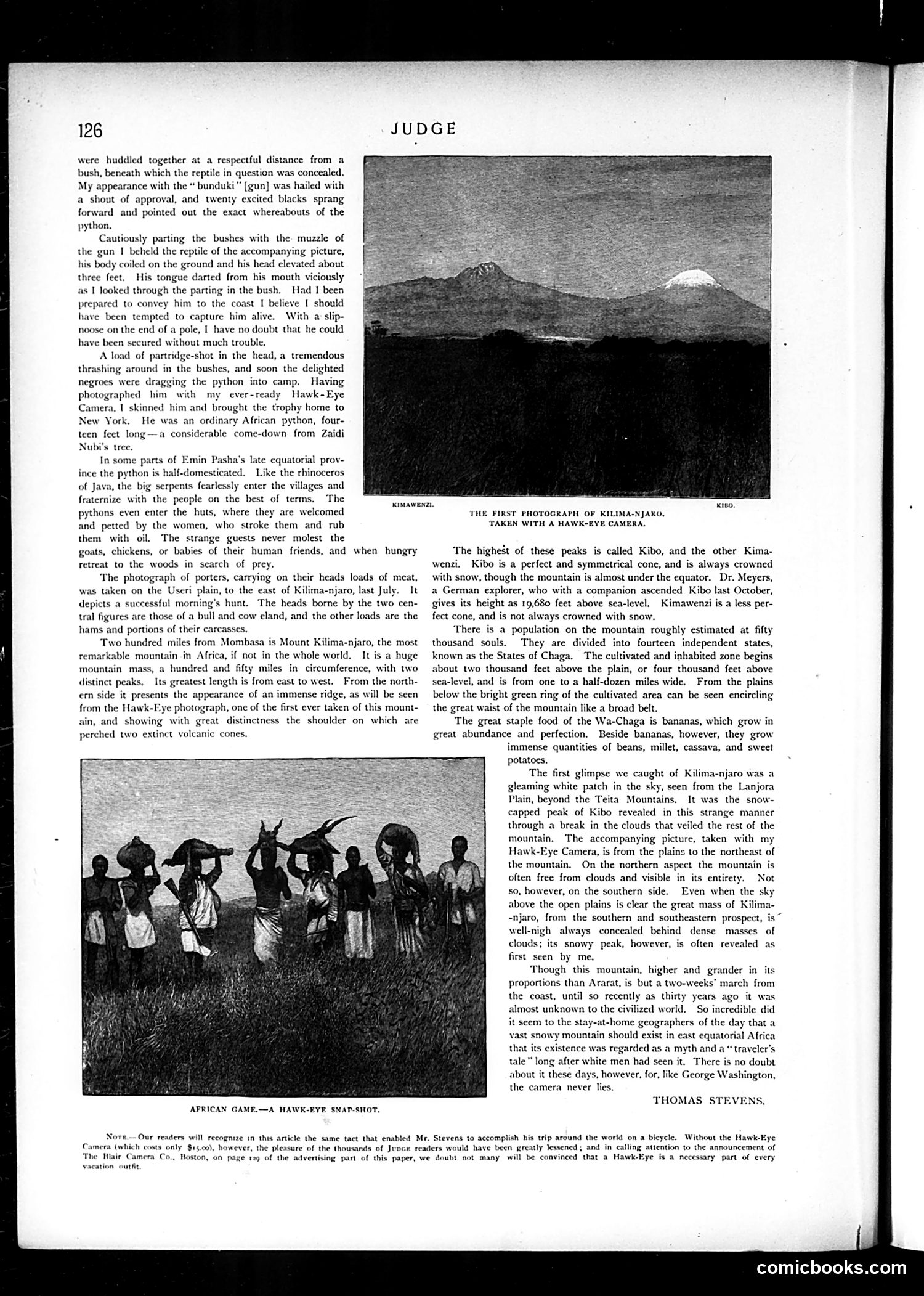
126 were huddled together at a respectful distance from a bush, beneath which the reptile in question was concealed. My appearance with the “ bunduki" [gun] was hailed with a shout of approval, and twenty excited blacks sprang forward and pointed out the exact whereabouts of the python. Cautiously parting the bushes with the muzzle of the gun I beheld the reptile of the accompanying picture, his body coiled on the ground and his head elevated about three feet. His tongue darted from his mouth viciously as I looked through the parting in the bush. Had I been prepared to convey him to the c have been tempted to capture him alive. noose on the end of a pole, | have no doubt that he could have been secured without much trouble. A load of partridge-shot in the head, a tremendous thrashing around in the bushes, and soon the delighted negroes were dragging the python into camp. Having photographed him with my ever-ready Hawk-Eye Camera, I skinned him and brought the trophy home to New York, He was an ordinary African python, four- teen feet long—a considerable come-down from Zaidi Nubi's tree, In some parts of Emin Pasha’s late equatorial prov- ince the python is half-domesticated. Like the rhinoceros of Java, the big serpents fearlessly enter the villages and fraternize with the people on the best of terms, The pythons even enter the huts, where they are welcomed and petted by the women, who stroke them and rub them with oil. The strange guests never molest the goats, chickens, or babies of their human friends, and when hungry retreat to the woods in search of prey. The photograph of porters, carrying on their heads loads of meat, as taken on the Useri plain, to the east of Kilima-njaro, last July. It depicts a successful morning's hunt. The heads borne by the two cen- al figures are those of a bull and cow cland, and the other loads are the hams and portions of their carcasses. Two hundred miles from Mombasa is Mount Kilima-njaro, the most remarkable mountain in Africa, if not in the whole world, It is a huge mountain mass, a hundred and fifty miles in circumference, with two distinct peaks. Its greatest length is from east to west. From the north- em side it presents the appearance of an immense ridge, as will be seen from the Hawk-Eye photograph, one of the first ever taken of this mount- ain, and showing with great distinctness the shoulder on which are perched two extinct volcanic cones. AFRICAN GAMP.—A HAWK-EYR SNAP-SHOT, Camera (wh ‘The Blair Camera Co., Hoston, on page 1 vacation outfit, Our readers will recognize in this article the same tact that enabled Mr. costs only $15.00), however, the pleasure of the thousands of Jvocx readers would have been greatly lessened ; and in calli KIMAWENZL. VHE FIRST PHOTOGRAPH OF KILIMA-NJAKO, TAKEN WITH A HAWK-RYE CAMERA. The highest of these peaks is called Kibo, and the other Kima- Kibo is a perfect and symmetrical cone, and is always crowned with snow, though the mountain is almost under the equator. Dr. Meyers, a German explorer, who with a companion ascended Kibo last October, Kimawenzi is a less per- wenzi. gives its height as 19,680 feet above sea-level. fect cone, and is not always crowned with snow. There is a population on the mountain roughly estimated at fifty thousand souls, They are divided into fourteen independent states, known as the States of Chaga. The cultivated and inhabited zone begins about two thousand feet above the plain, or four thousand feet above sea-level, and is from one to a half-dozen miles wide. From the plains below the bright green ring of the cultivated area can be seen encircling the great waist of the mountain like a broad belt. The great staple food of the Wa-Chaga is bananas, which grow in great abundance and perfection. Beside bananas, however, they grow immense quantities of beans, millet, cassava, and sweet potatoes. The first glimpse we caught of Kilima-njaro was a gleaming white patch in the sky, seen from the Lanjora Plain, beyond the Teita Mountains. It was the snow- capped peak of Kibo revealed in this strange manner through a break in the clouds that veiled the rest of the mountain, The accompanying picture, taken with my Hawk-Eye Camera, is from the plains to the northeast of the mountain. On the northern aspect the mountain is often free from clouds and visible in its entirety. Not so, however, on the southern side. Even when the sky above the open plains is clear the great mass of Kilima- -njaro, from the southern and southeastern prospect, is ~ well-nigh always concealed behind dense masses of clouds; its snowy peak, however, is often revealed as first seen by me. Though this mountain, higher and grander in its proportions than Ararat, is but a two-weeks’ march from the coast, until so recently as thirty years ago it was almost unknown to the civilized world. So incredible did it seem to the stay-at-home geographers of the day that a vast snowy mountain should exist in east equatorial Africa that its existence was regarded as a myth and a “traveler's tale" long after white men had seen it. There is no doubt about it these days, however, for, like George Washington, the camera never lies. THOMAS ST! ‘tevens to accomplish his trip around the world on a bicycle. Without the Hawk-Eye i attention to the announcement of of the advertising part of this paper, we doubt not many will be convinced that a Hawk-Eye is a necessary part of every comicbooks.com