
Judge, 1890-05-31 · page 15 of 24
Judge — May 31, 1890 — page 15: what you’re looking at
What you’re looking at
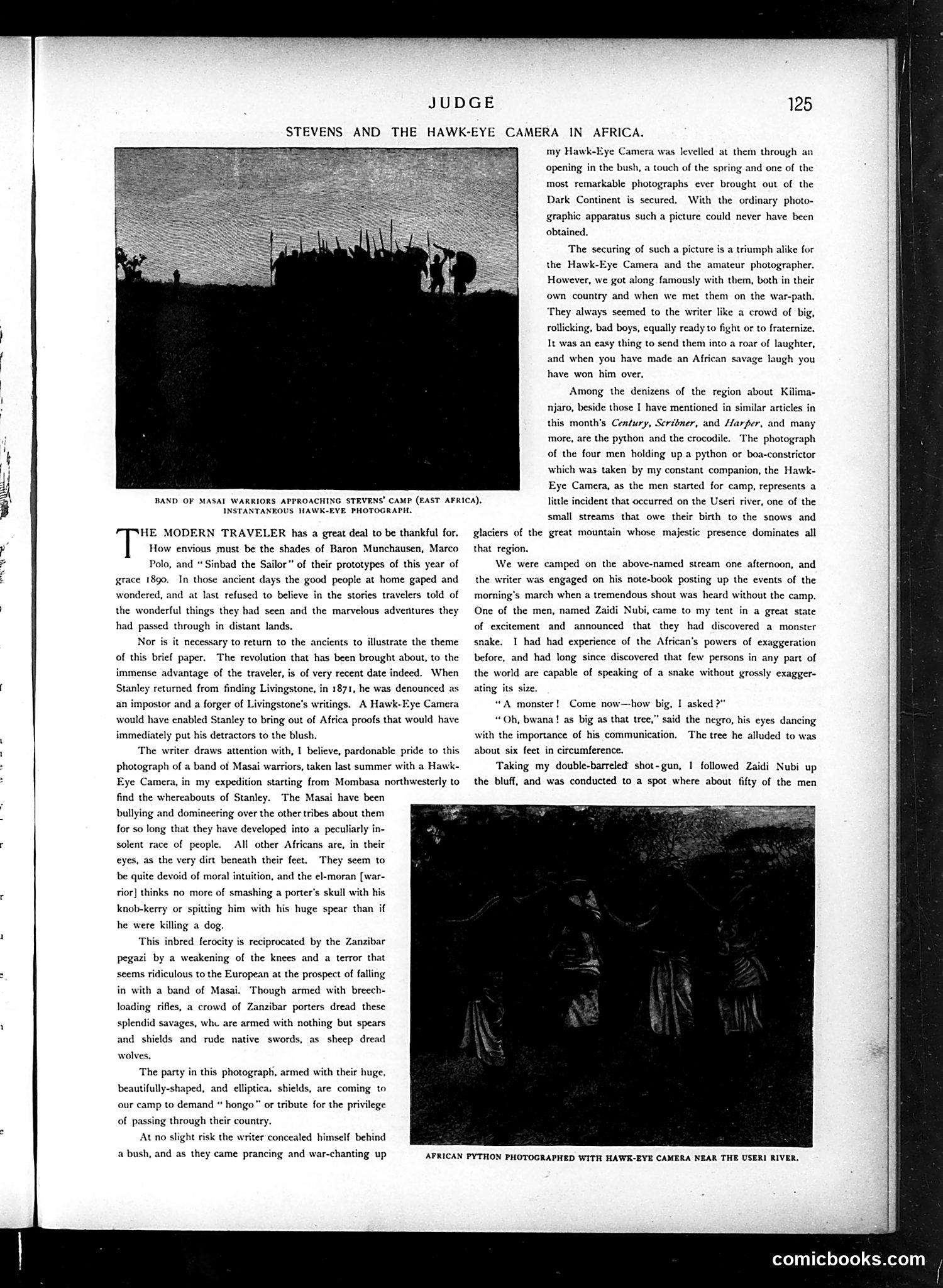
This is an advertisement disguised as travel journalism, promoting the Hawk-Eye Camera by framing it as essential equipment for documenting African expeditions. The page presents two photographs allegedly taken during an East African expedition to find Stanley. The "satire" is subtle: Judge uses a fictionalized traveler's account to mock both the camera's practical limitations and period attitudes toward African peoples. The text presents Masai warriors in deeply stereotypical, dehumanizing terms—describing them as naturally ferocious and devoid of morality—while simultaneously celebrating the photographer's "triumph" in capturing them with modern technology from hiding. The joke appears to be that the camera, meant to provide proof where travelers' tales were once doubted, is being used to commercially exploit exotic imagery. The breathless praise for photographing warriors and pythons reflects the era's commodification of colonial subjects, while the "Hawk-Eye" branding suggests technology solving the problem of credibility.
📄 Transcribed text from this page (OCR, searchable)
Machine-transcribed from the original scan — historical spelling and the odd misread are preserved.
JUDGE 125 BAND OF MASAI WARRIORS APPROACHING STEVENS’ CAMP (EAST AFRICA). INSTANTANEOUS HAWK-EVE PHOTOGRAPH. HE MODERN TRAVELER has a great deal to be thankful for. T How envious must be the shades of Baron Munchausen, Marco Polo, and “Sinbad the Sailor” of their prototypes of this year of grace 1890, In those ancient days the good people at home gaped and wondered, and at last refused to believe in the stories travelers told of the wonderful things they had seen and the marvelous adventures they had passed through in distant lands. Nor is it necessary to return to the ancients to illustrate the theme of this brief paper. The revolution that has been brought about, to the immense advantage of the traveler, is of very recent date indeed. When Stanley returned from finding Livingstone, in 1871, he was denounced as an impostor and a forger of Livingstone’s writings. A Hawk-Eye Camera would have enabled Stanley to bring out of Africa proofs that would have immediately put his detractors to the blush. The writer draws attention with, I believe, pardonable pride to this photograph of a band of Masai warriors, taken last summer with a Hawk- Eye Camera, in my expedition starting from Mombasa northwesterly to find the whereabouts of Stanley. The Masai have been bullying and domineering over the other tribes about them for so long that they have developed into a peculiarly in- solent race of people. All other Africans are, in their eyes, as the very dirt beneath their feet. They seem to be quite devoid of moral intuition, and the el-moran [war- rior] thinks no more of smashing a porter’s skull with his knob-kerry or spitting him with his huge spear than if he were killing a dog. This inbred ferocity is reciprocated by the Zanzibar pegazi by a weakening of the knees and a terror that seems ridiculous to the European at the prospect of falling in with a band of Masai. Though armed with breech- loading rifles, a crowd of Zanzibar porters dread these splendid savages, whe are armed with nothing but spears and shields and rude native swords, as sheep dread wolves. The party in this photograph, armed with their huge, beautifully-shaped, and elliptica. shields, are coming to our camp to demand “ hongo™ or tribute for the privilege of passing through their country. At no slight risk the writer concealed himself behind a bush, and as they came prancing and war-chanting up THE HAWK-E AFRICAN PYTHON PHOTOGRAPHED WITH HAWK-EYE CAMERA NEAR THE USERI RIVER. CAMERA IN AFRICA. my Hawk- Zye Camera was levelled at them through an opening in the bush, a touch of the spring and one of the most remarkable photographs ever brought out of the Dark Continent is secured. With the ordinary photo- graphic apparatus such a picture could never have been obtained. The securing of such a picture is a triumph alike for the Hawk-Eye Camera and the amateur photographer. However, we got along famously with them, both in their own country and when we met them on the war-path, They alw seemed to the writer like a crowd of big, rollicking, bad boys, equally ready to fight or to fraternize. It was an easy thing to send them into a roar of laughter, and when you have made an African savage laugh you have won him over. Among the denizens of the region about Kilima- njaro, beside those I have mentioned in similar articles in this month's Century, Scribner, and Harper, and many hn of the four men holding up a python or boa-constrictor more, are the python and the crocodile. The photog which was taken by my constant companion, the Haw Eye Camera, as the men started for camp, represents a little incident that occurred on the Useri river, one of the small streams that owe their birth to the snows and glaciers of the great mountain whose majestic presence dominates all that region. We were camped on the above-named stream one afternoon, and the writer was engaged on his note-book posting up the events of the morning's march when a tremendous shout was heard without the camp. One of the men, named Zaidi Nubi, came to my tent in a great state of excitement and announced that they had discovered a monster snake. I had had experience of the African’s powers of exaggeration before, and had long since discovered that few persons in any part of the world are capable of speaking of a snake without grossly exagger- ating its size. “A monster! Come now—how big, I asked ?” “Oh, bwana ! as big as that tree,” said the negro, his eyes dancing with the importance of his communication. The tree he alluded to was about six feet in circumference. Taking my double-barreled shot-gun, I followed Zaidi Nubi up the bluff, and was conducted to a spot where about fifty of the men comicbooks.com