
A complete issue · 16 pages · 1890
Judge — April 26, 1890
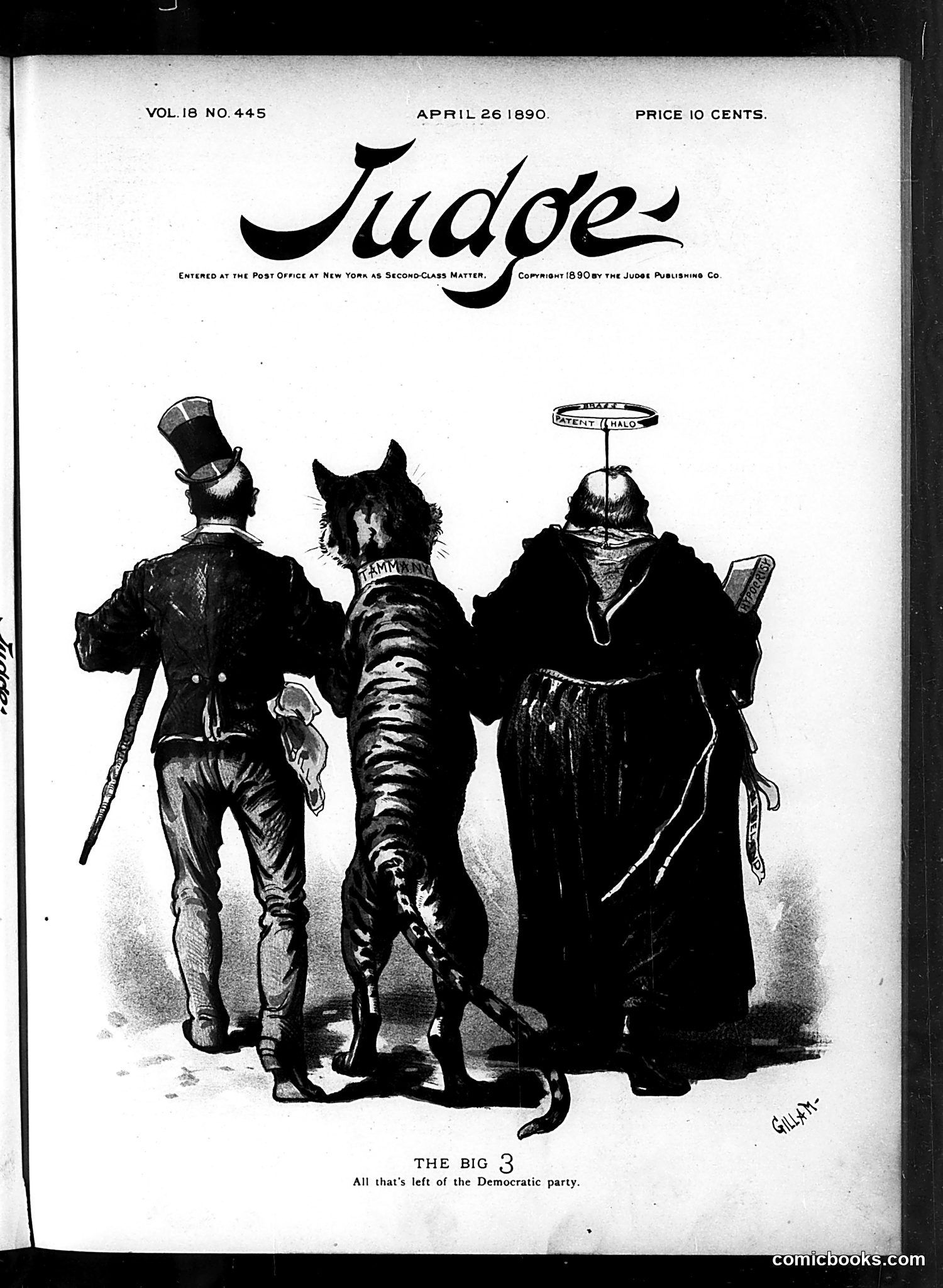
This 1890 *Judge* cartoon satirizes the Democratic Party's weakness by depicting three figures from behind: a military officer (left), an elephant labeled "Tammany" (center), and a figure wearing a "Patent Halo" (right). The elephant represents Tammany Hall, the powerful New York Democratic political machine. The "Patent Halo" figure likely represents a morally questionable Democratic leader claiming virtue. The military officer's identity is unclear from the image alone. The cartoon's message: these three elements—military interests, urban machine politics, and dubious moral authority—constitute all that remains of the once-dominant Democratic Party, suggesting its severe decline or fragmentation in 1890. The mocking tone indicates Republican editorial contempt for Democratic remaining influence.
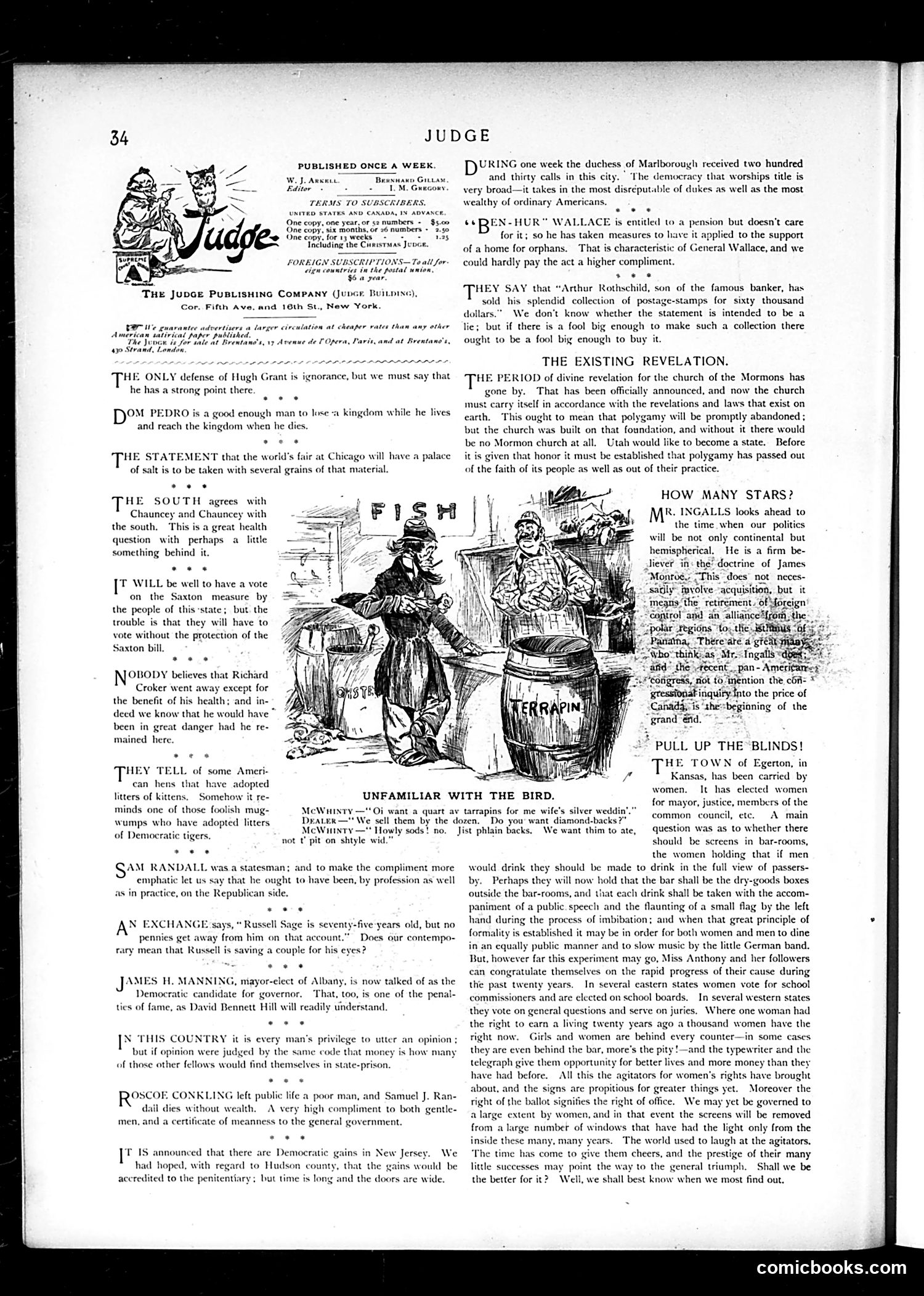
This cartoon depicts a street scene with a vendor selling what appears to be poultry or game birds. The caption "UNFAMILIAR WITH THE BIRD" suggests the humor involves someone unfamiliar with a particular type of fowl or perhaps unfamiliar with a slang term. The dialogue references "diamond-backs" (likely rattlesnakes) and "plain backs," implying confusion about what animal is being sold. This appears to be social satire about urban-rural cultural differences—possibly mocking city dwellers unfamiliar with country provisions or rural commerce. The specific bird or reference remains unclear without additional historical context, but the cartoon satirizes ignorance about common goods or terminology among certain social classes or regional groups in early 20th-century America.
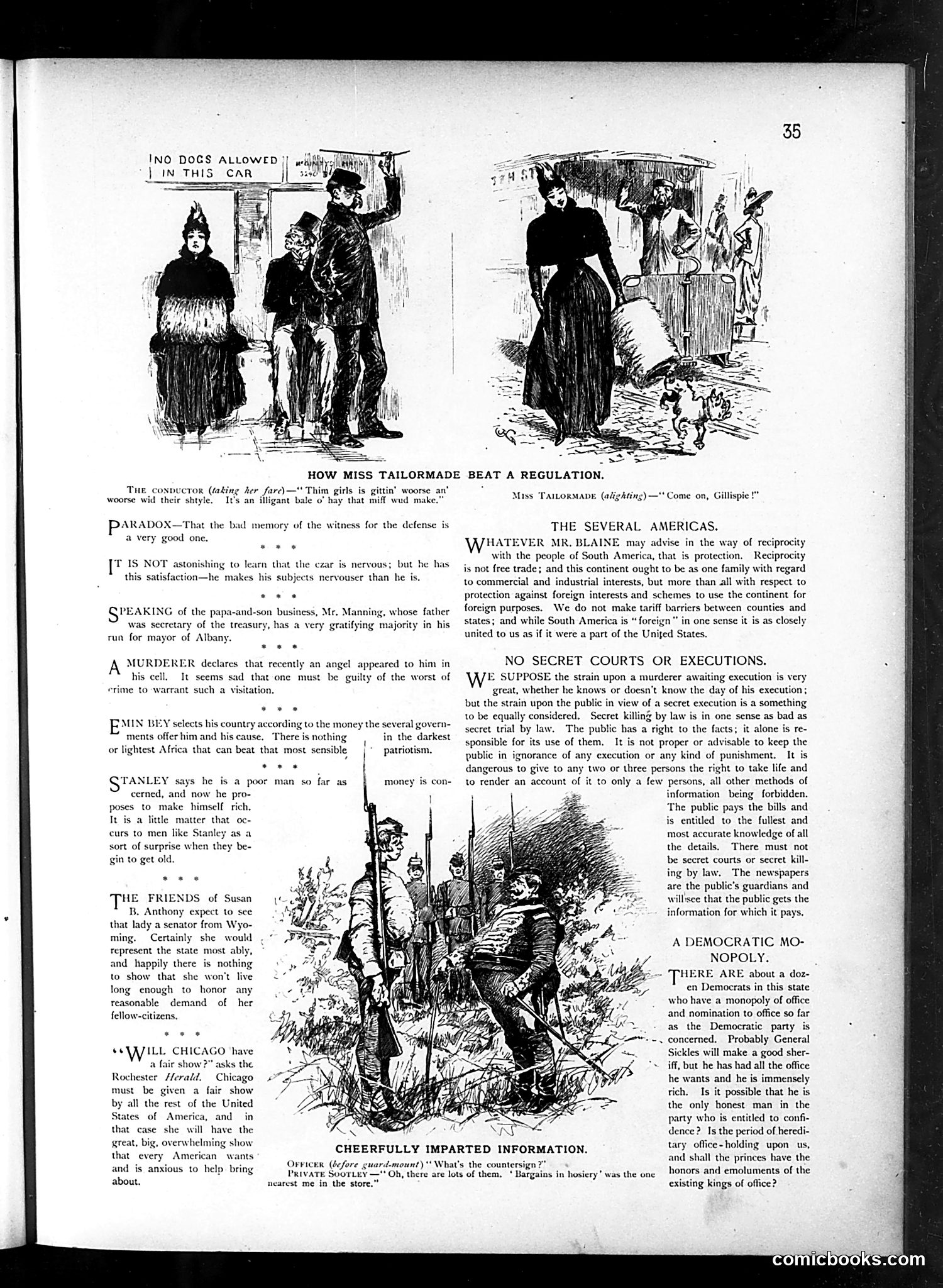
**Top Cartoons:** "How Miss Tailormade Beat a Regulation" depicts a woman with a small dog entering a railway car marked "No Dogs Allowed." The joke satirizes how wealthy or fashionable women circumvent rules—she apparently succeeds by dressing the dog as a person or hiding it. This mocks both the absurdity of strict regulations and the privilege of those who can ignore them. **Bottom Cartoon:** "Cheerfully Imparted Information" shows what appears to be a street vendor or officer being questioned. The satire likely targets either misinformation spread by public figures or the gap between official statements and reality—common Judge targets during this era. The page also contains political commentary on topics like judicial secrecy and democratic monopolies, reflecting Progressive Era debates about transparency and corruption.
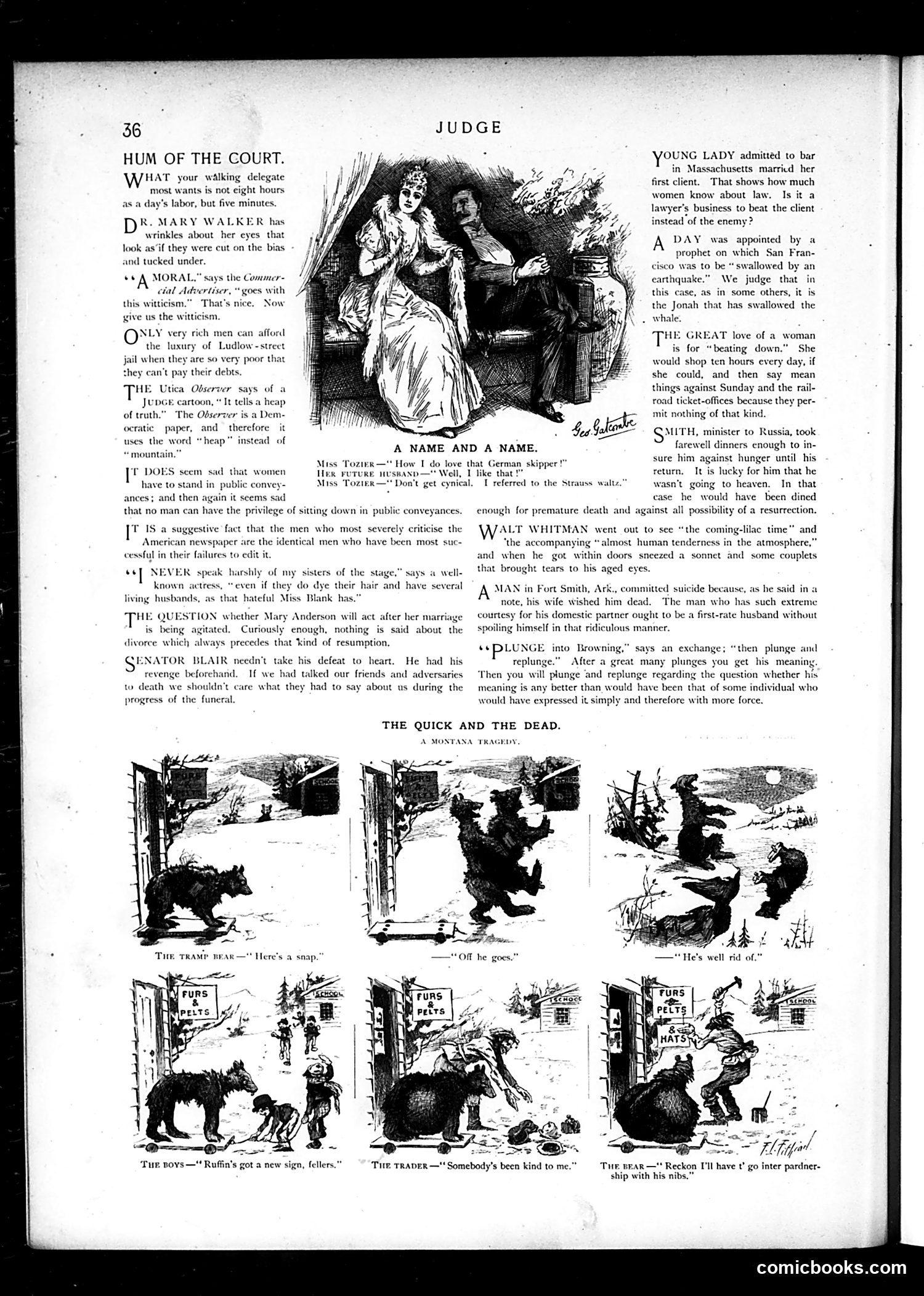
This page from Judge contains miscellaneous short satirical quips ("Hum of the Court") mocking contemporary figures and social pretenses, plus a comic strip titled "The Quick and the Dead." The verbal satire targets: - **Dr. Mary Walker**: A likely reference to the controversial Civil War surgeon and women's rights advocate, mocked for her appearance - **Walking delegates**: Labor organizers criticized as lazy - **Mary Anderson**: An actress whose marriage prompted gossip - **Senator Blair**: A defeated politician - **Walt Whitman**: The poet ridiculed for overwrought, incomprehensible verse - Various hypocrites: women who complain about shopping while loving it; a suicide note writer; a Russian minister The comic strip shows a tramp encountering a bear at a store—a slapstick sequence where the bear chases away customers and the tramp ultimately partners with the trader to profit from the chaos. The humor relies on contemporary references Judge's readers would recognize, targeting pretension, failed ambitions, and social absurdities of the era.
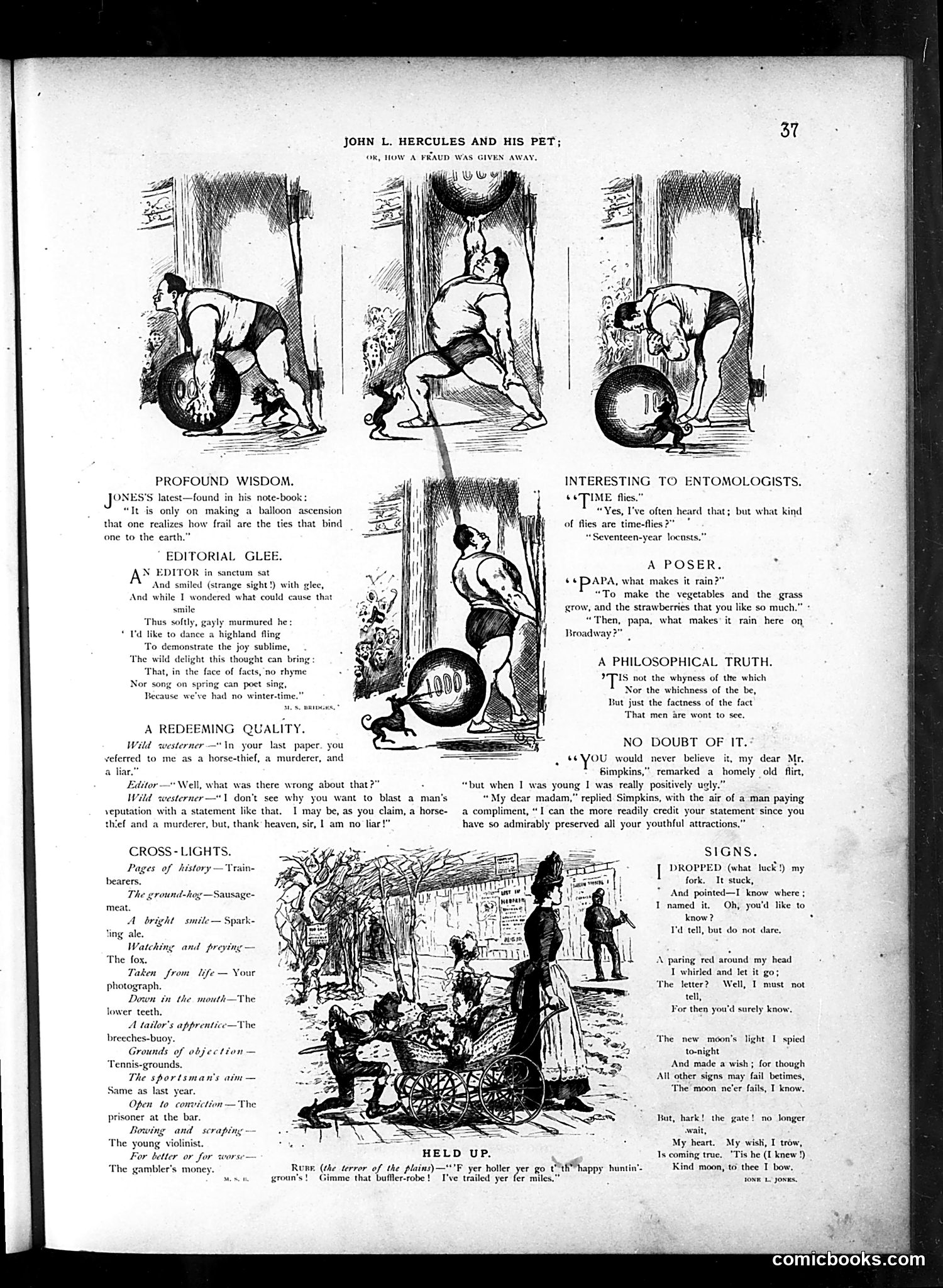
This page contains miscellaneous short humor pieces typical of Judge's satirical style. The main cartoon "John L. Hercules and His Pet" appears to reference **John L. Sullivan**, the famous heavyweight boxer, depicted performing acrobatic feats with a large balloon—likely satirizing both his celebrity status and the era's fascination with balloon ascensions as novelty entertainments. The surrounding text pieces mock contemporary social pretensions and logical absurdities: a "profound wisdom" quote about balloon ascensions, editorial commentary, and various puns ("Cross-Lights"). A dialogue mocks a "Wild Westerner" claiming honesty despite admitting to theft and murder. Other pieces include children's naive questions ("what makes it rain on Broadway?") and romantic verses about omens. The humor relies on wordplay, logical paradoxes, and gentle mockery of human vanity and foolishness—typical Judge fare targeting middle-class readers' pretensions and everyday absurdities rather than specific political events.
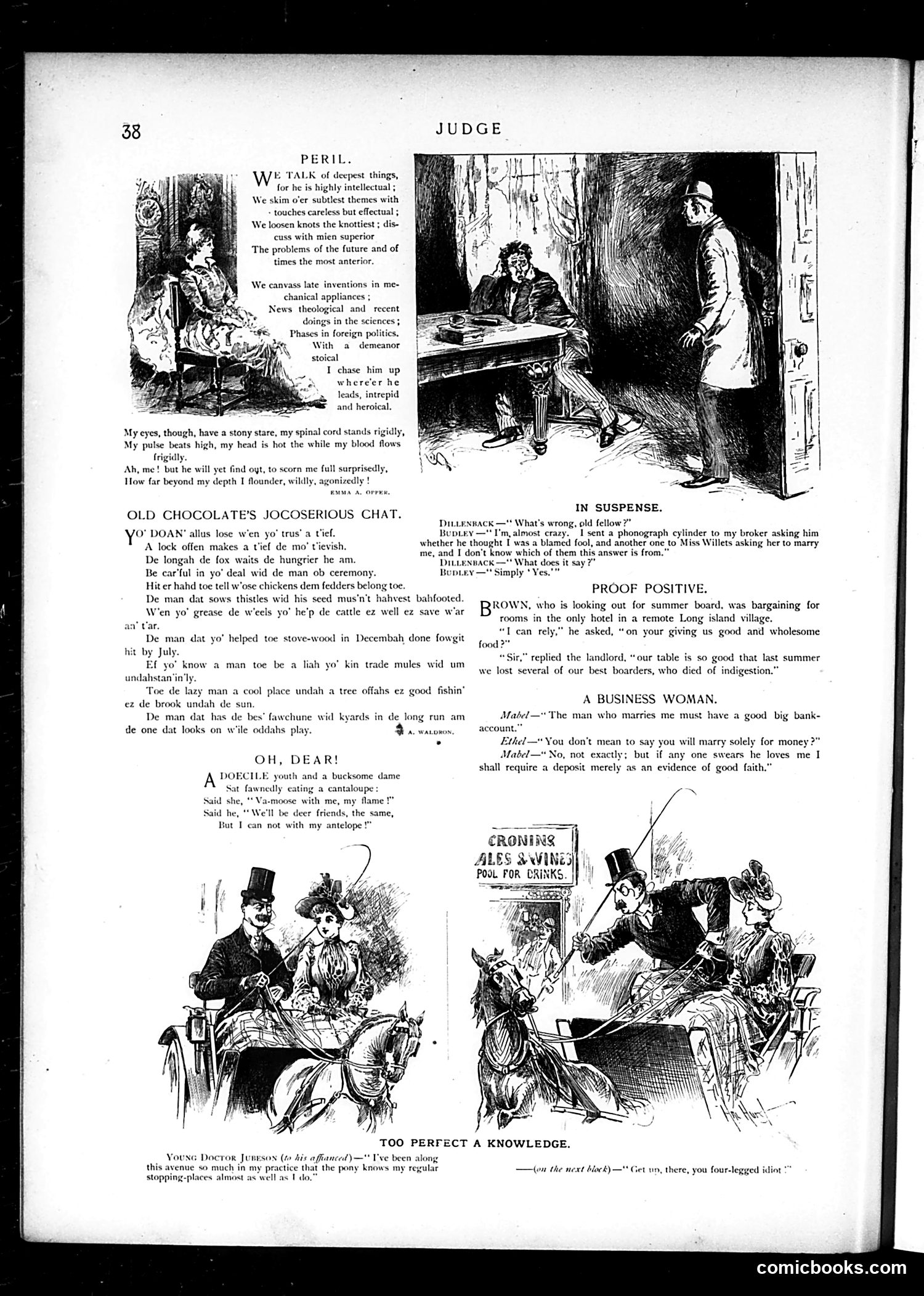
This page contains multiple unrelated satirical pieces typical of Judge magazine's format: **"Peril"** (top left): A poem mocking intellectual pretension—a speaker boasts of discussing profound topics with confident superficiality, but admits to deep inner anxiety and confusion he hides behind affected composure. It's satire on bluffing intellectuals. **"Old Chocolate's Jocoserious Chat"**: Dialect humor presenting African American folk wisdom in exaggerated speech patterns—common (if offensive by modern standards) period entertainment. **"In Suspense"**: A man accidentally sent his marriage proposal and a critical message to his broker to the wrong recipients, creating confusion. Humor from early phonograph technology mishaps. **"Proof Positive" and "A Business Woman"**: Brief romantic/financial satires about mercenary marriage attitudes. **"Too Perfect a Knowledge"**: A doctor's horse knows the route so well it stops at regular houses automatically—satire on routine, predictable professional life. The page is primarily light satirical humor with no apparent major political content, though the racial dialect material reflects period attitudes.
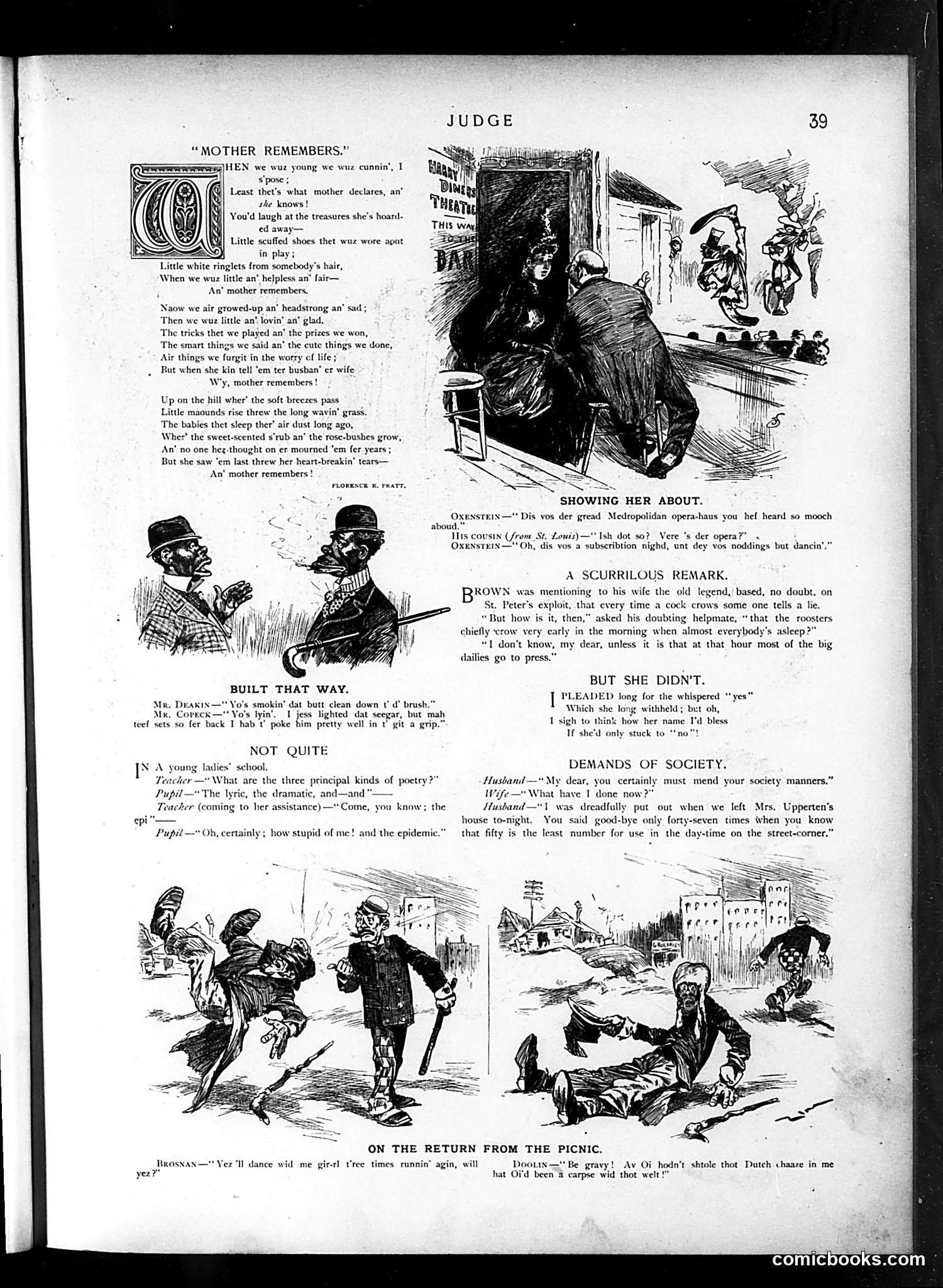
This page from the satirical magazine *Judge* contains several unrelated humorous pieces typical of the publication's format: **"Mother Remembers"** is a sentimental poem about maternal nostalgia, contrasting mothers' cherished memories of their children's youth with children's forgetfulness—a common theme in period humor. **"Showing Her About"** depicts a Jewish character (Oxenstein, indicated by dialect) taking his cousin from St. Louis to the Metropolitan Opera House. The humor relies on ethnic stereotyping and broken English: the cousin expects opera but finds only dancing on subscription night, a mild joke about expectations versus reality. **"A Scurrilous Remark"** jokes about newspaper credibility: when Brown's wife asks why roosters crow early when everyone sleeps, he quips it's when "the big dailies go to press"—satirizing newspapers as sources of lies. Other brief pieces ("Built That Way," "Not Quite," "Demands of Society," "On the Return from the Picnic") use dialect humor and domestic/social situations for comedy. The ethnic stereotyping and gender dynamics reflect period attitudes rather than refined satire.
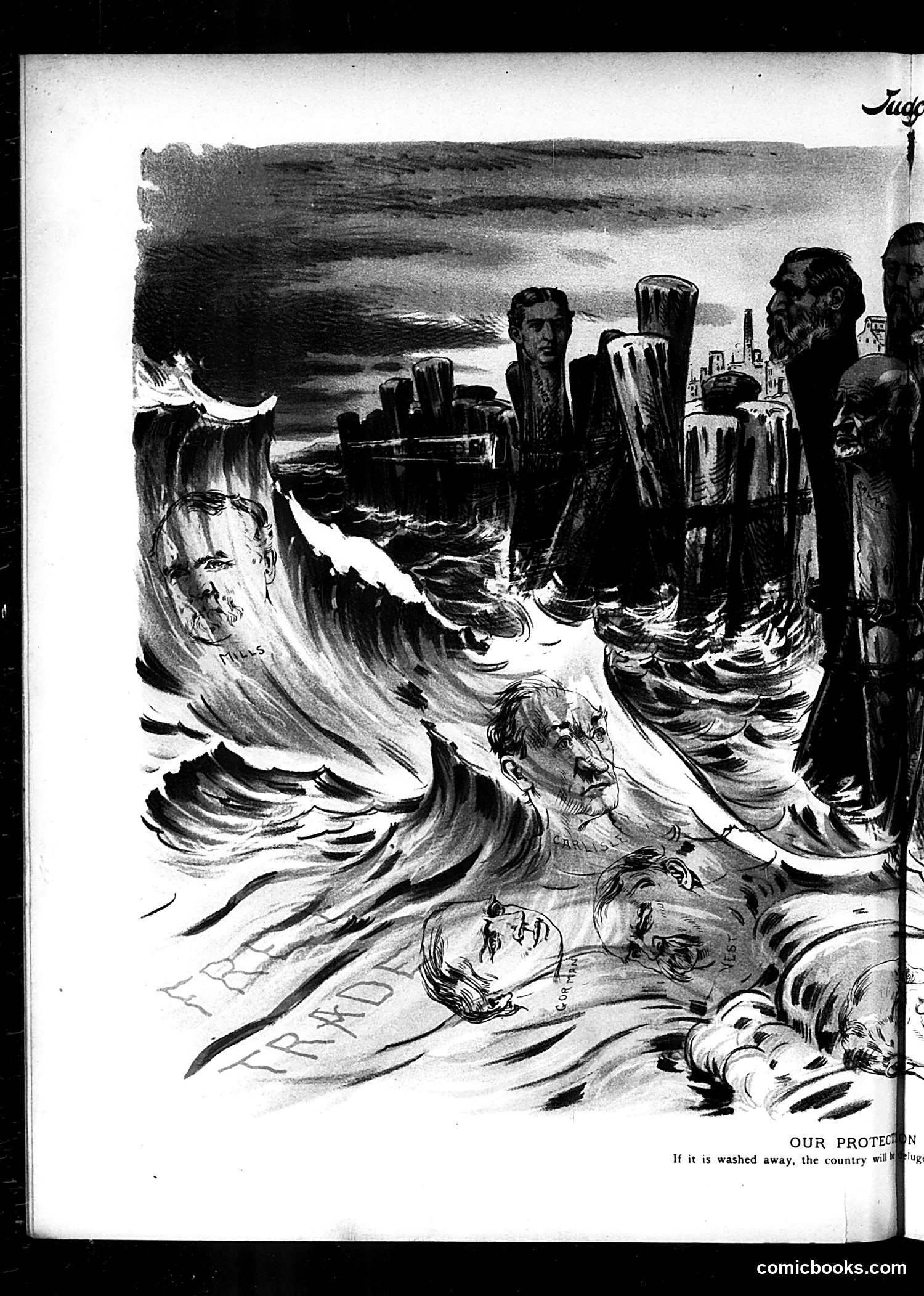
This appears to be a satirical cartoon titled "OUR PROTECTION" with the caption "If it is washed away, the country will [text cut off]." The image depicts figures standing on what appears to be an eroding shoreline or riverbank, with water and swirling currents threatening to wash away the land beneath them. The cartoonist seems to represent the nation's protective barriers or defenses as literally crumbling into water. Without clearer text or visible dates, the specific historical reference is uncertain. However, the visual metaphor suggests commentary on governmental protections—possibly tariffs, immigration policy, or national security measures—being undermined or destroyed. The threat of erasure by water suggests these protections are fragile and require vigilant maintenance to preserve national welfare.
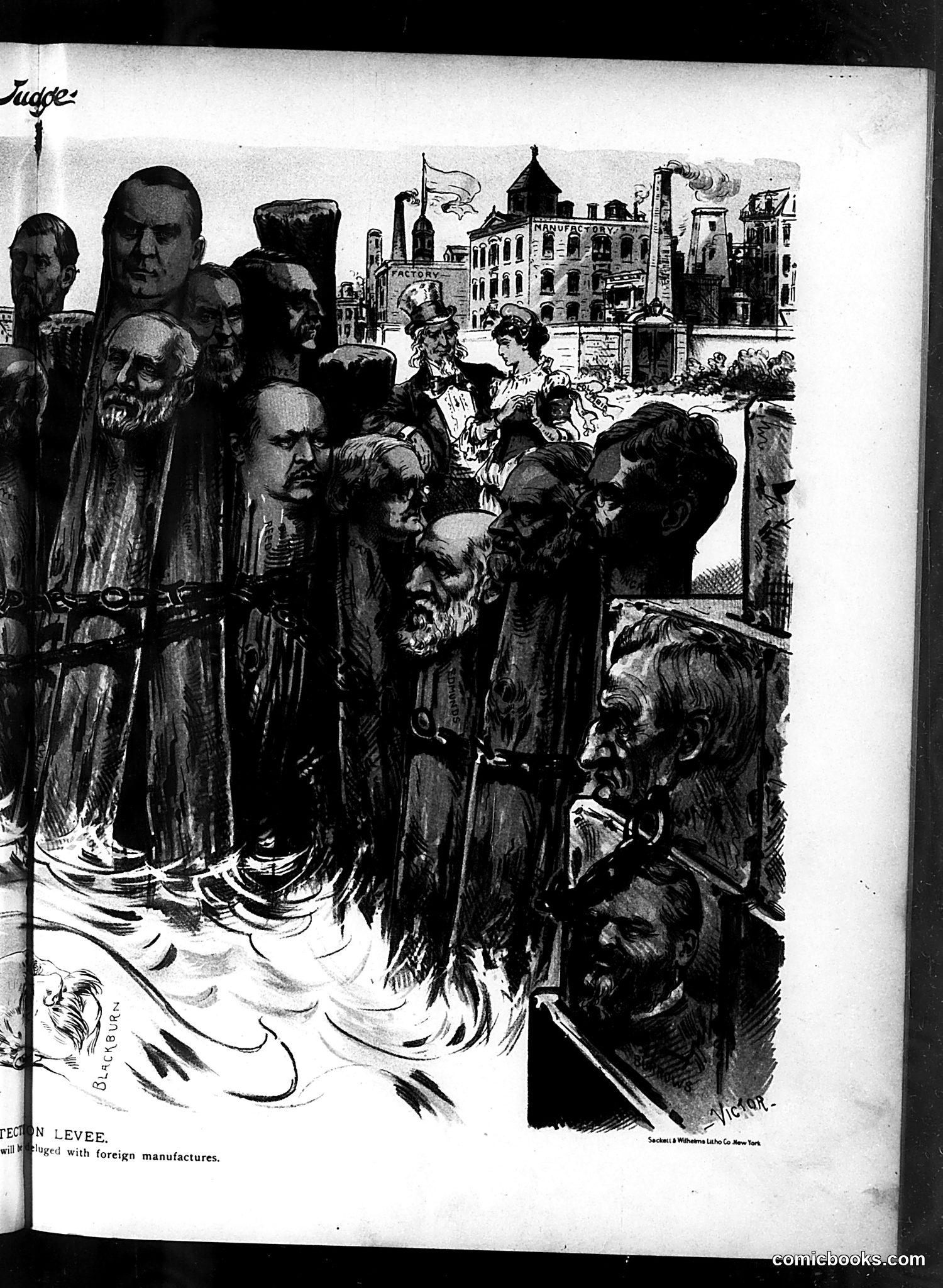
This Judge magazine cartoon depicts a crowd of working-class men (rendered in the exaggerated style typical of the era) gathered near industrial buildings. The partially visible caption references being "clogged with foreign manufactures," suggesting commentary on trade protectionism or labor concerns. The well-dressed figures in the background (appearing to be wealthy industrialists or politicians) contrast sharply with the working men in the foreground, emphasizing class divide. The cartoon likely critiques either: 1. Foreign competition threatening American jobs and wages, or 2. Wealthy manufacturers' reliance on cheap foreign goods at workers' expense Without the complete caption and publication date visible, the specific political context remains unclear, though the imagery suggests labor or trade policy critique common to Gilded Age American satire.
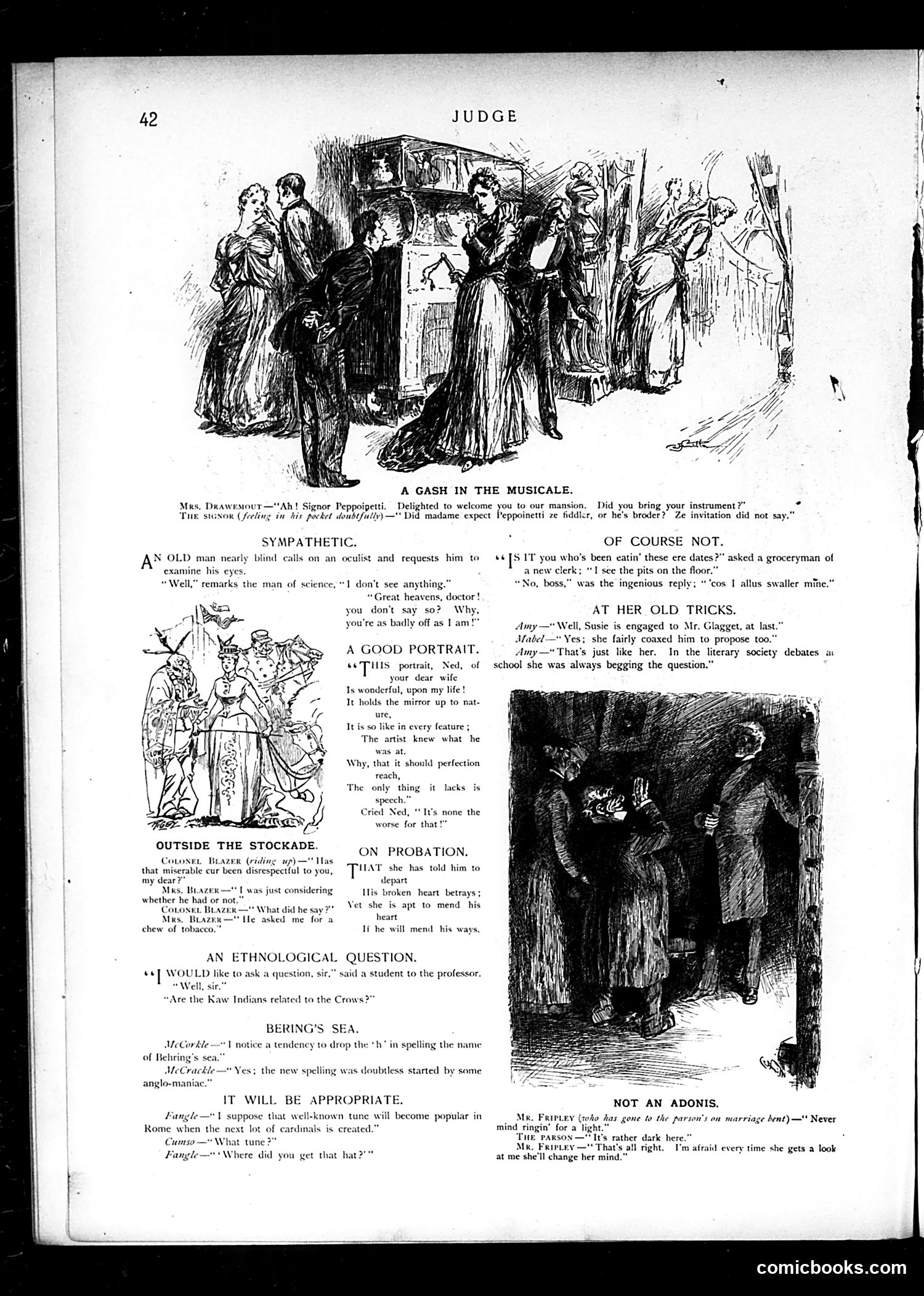
This page contains multiple brief comic sketches typical of 1890s satirical humor. Key items: **"A Gash in the Musicale"**: A society hostess greets an Italian musician (Signor Peppoipetti), asking if he brought his instrument. He nervously pats his pockets—the joke being he may have forgotten it, embarrassing himself at her formal musical evening. **"A Good Portrait"**: A man praises a portrait of his friend's wife for its accuracy, then notes it only lacks speech. The friend replies it's better without it—mocking the wife's chattiness. **"Outside the Stockade"**: A colonel's wife admits her husband only asked for chewing tobacco before leaving, implying marital discord or his indifference. **"An Ethnological Question"**: A student asks if Kaw Indians relate to Crows—a pun on bird species names. **"Bering's Sea"**: Wordplay about dropping the 'h' in "Behring's" due to "Anglo-mania" (Americanization trends). **"Not an Adonis"**: A groom worries his bride will reconsider when she sees him in good light—self-deprecating humor about his appearance.
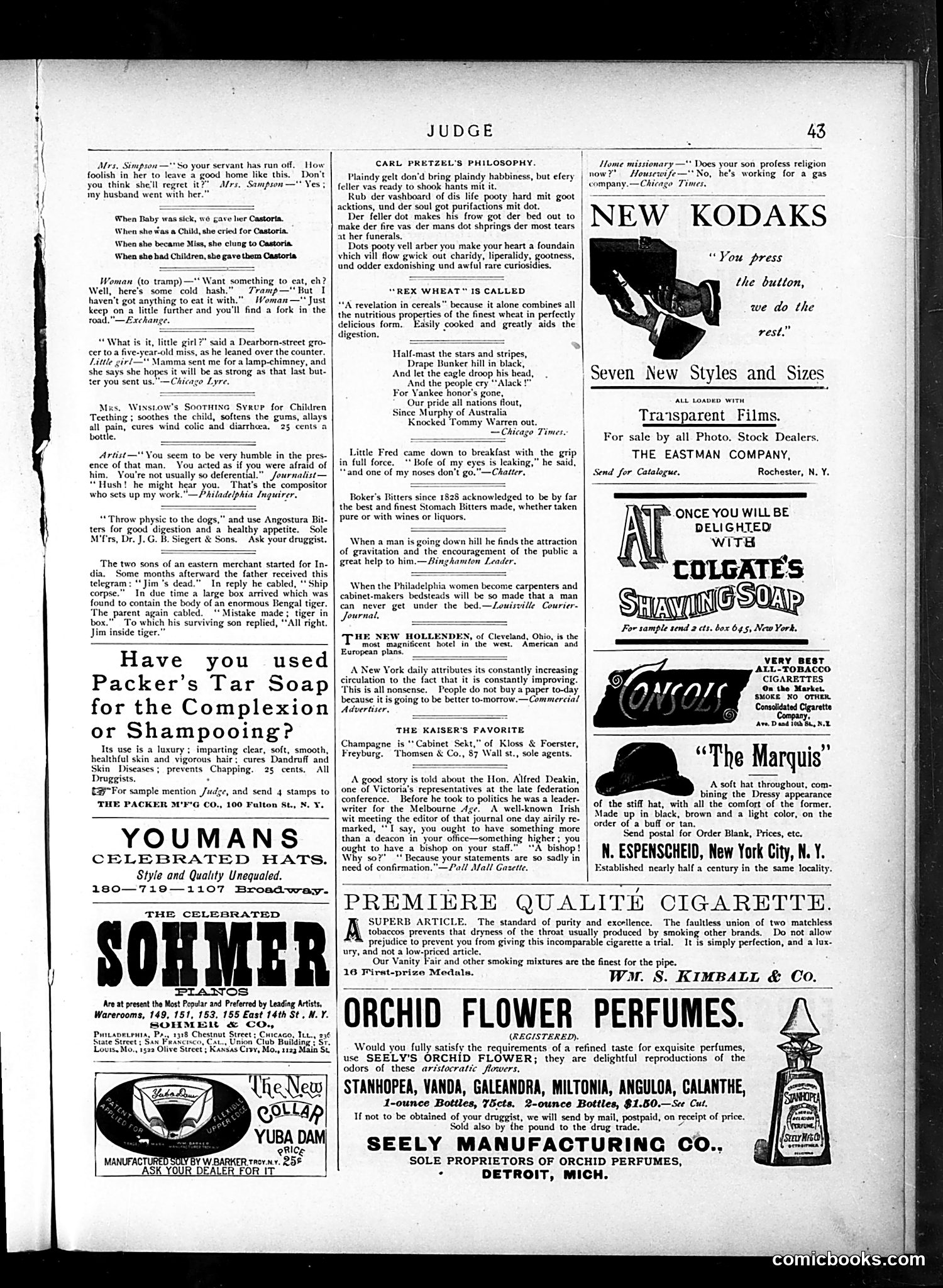
This page is primarily **advertising with minimal editorial content**. The few comic items are brief one-liners: **The Main Joke:** A woman tells a visitor her servant ran away—the punchline reveals the husband left with her, implying marital infidelity. This is a standard Victorian humor format about unfaithful marriages. **"Carl Pretzel's Philosophy"** presents a German-accented character offering folk wisdom in broken English ("plaindy gelt don'd bring plaindy habbiness"). This reflects the period's ethnic humor stereotyping. **Sports Reference:** One item mentions "Murphy of Australia / Knocked Tommy Warren out"—a boxing match treated as a national embarrassment for American pride. **Otherwise:** The page is dominated by product advertisements (Castoria, Packer's Tar Soap, pianos, hats, cigarettes, perfumes) interspersed with brief humorous anecdotes and advertising copy. No significant political cartoons or satire appear visible on this particular page.
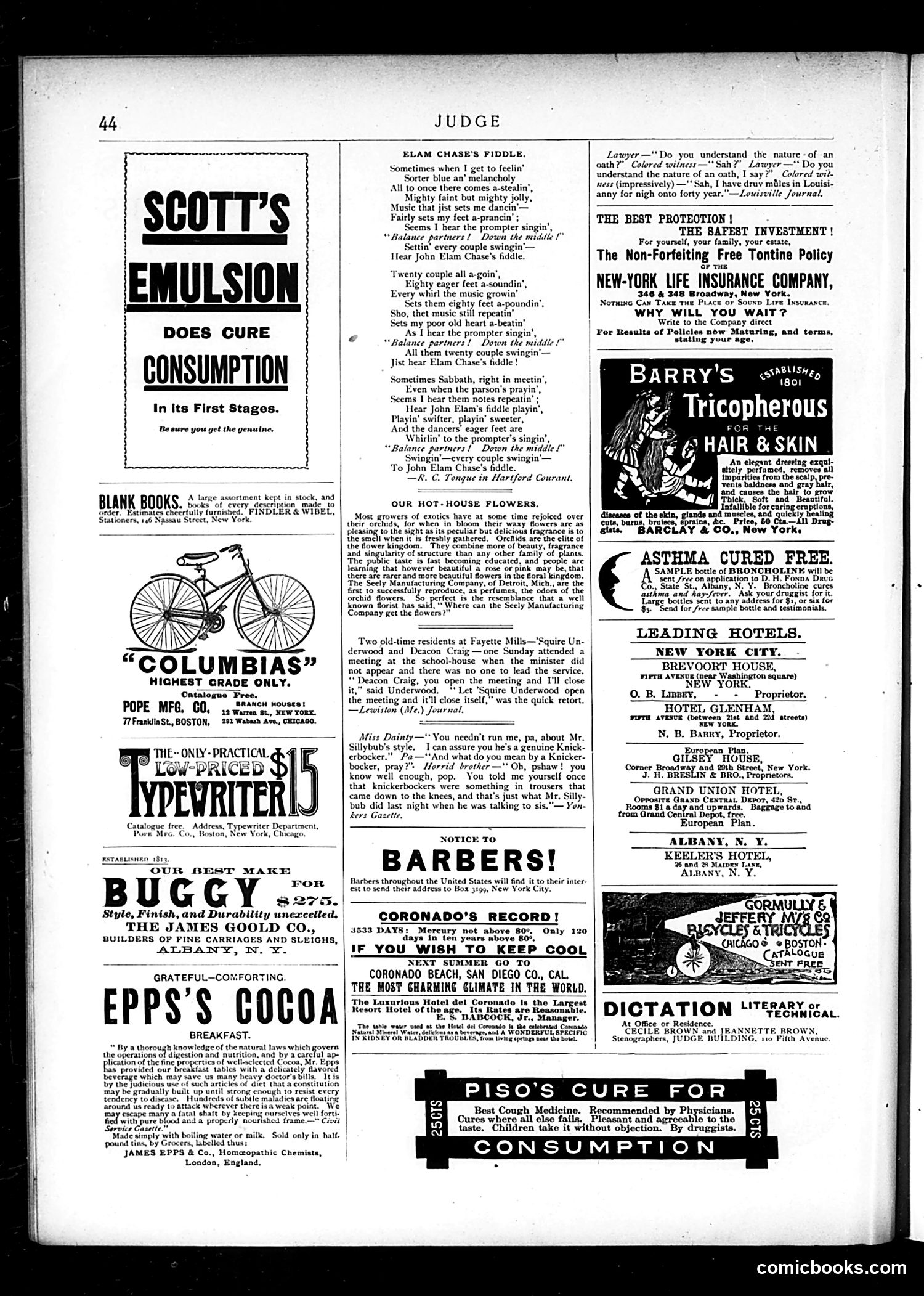
This page is primarily advertisements and entertainment content for Judge magazine, not political cartoons. The main pieces include a poem called "Elam Chase's Fiddle" (a sentimental ballad about a fiddler evoking dance memories), and a brief article on hot-house orchid flowers. The advertisements promote contemporary products—Scott's Emulsion (a consumption remedy), bicycles, typewriters, carriages, and Epps's Cocoa—using marketing language typical of the 1890s. The "Notice to Barbers" and Coronado's climate advertisement suggest this is general-interest editorial content rather than satirical material. Without visible political cartoons or caricatures on this particular page, it represents Judge magazine's mixed format of humor, poetry, and commercial advertising rather than pointed social satire.
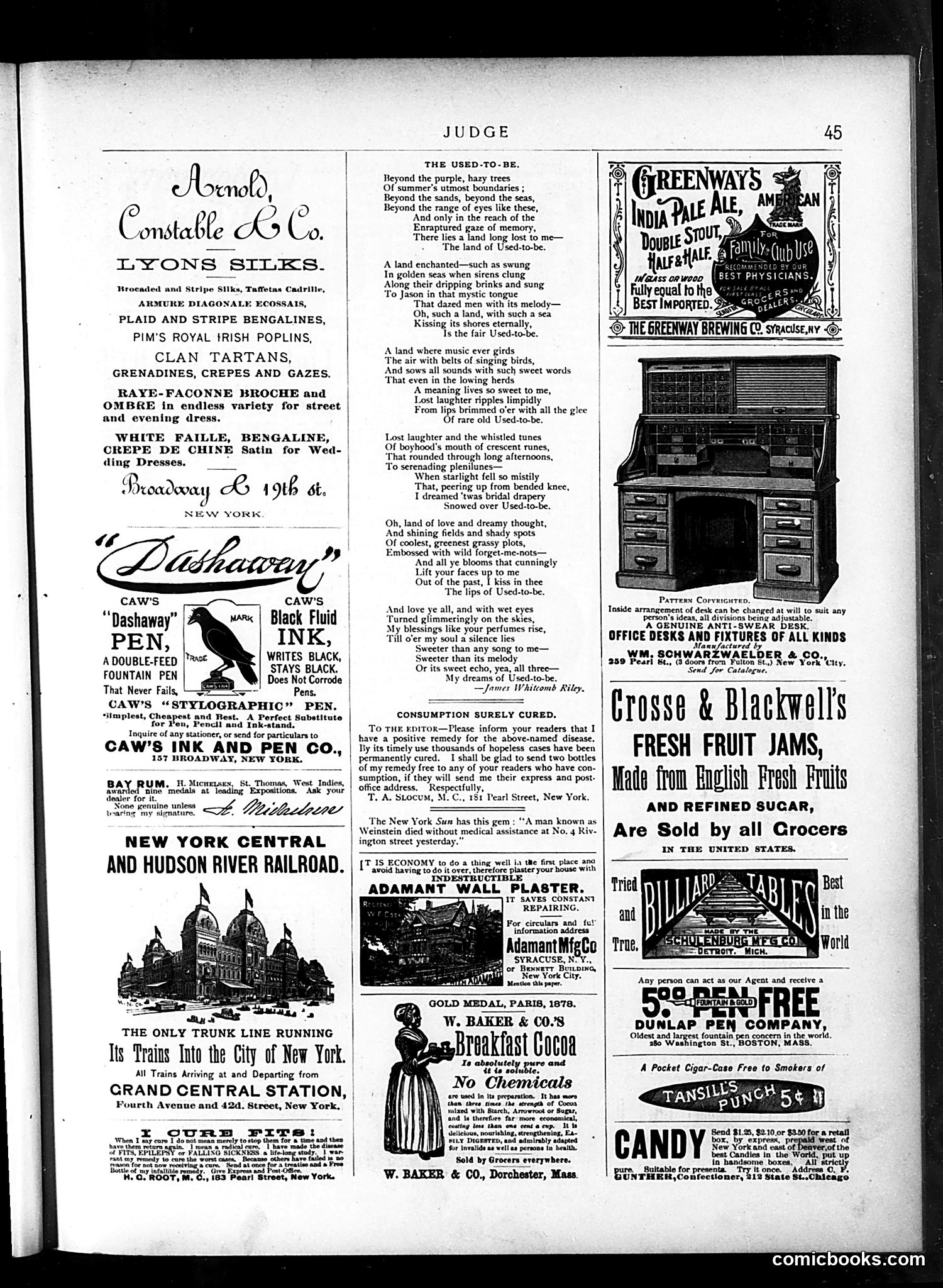
This page is primarily **advertisements and poetry**, not political cartoons. The dominant content is a nostalgic poem, "The Used-to-Be" by James Whitcomb Riley, a sentimental piece about lost youth and memory—typical of Judge's literary content alongside humor. The advertisements reflect turn-of-the-century commerce: silk manufacturers (Arnold Constable), fountain pens (CAW's brand), the New York Central Railroad, and patent medicines. Most notably, there's a dubious medical ad claiming to cure consumption (tuberculosis) by mail—a common fraud of the era exploiting desperate patients before antibiotics existed. The page contains **no identifiable political satire or caricature**. It represents Judge's mixed format: serious poetry, commercial ads, and implicit social commentary through the ads themselves (the consumption cure ad satirizes medical quackery by its very existence in a humor magazine).
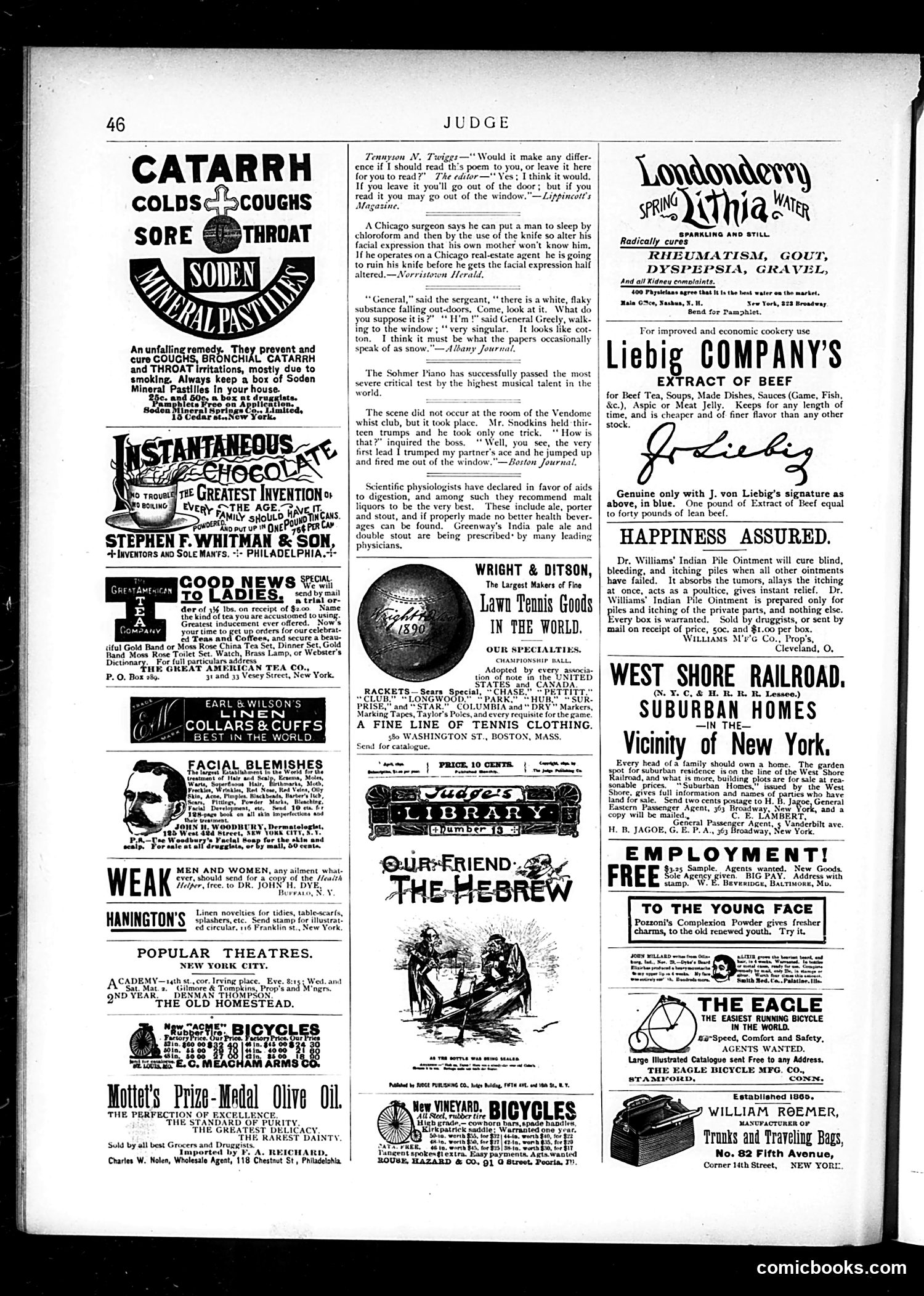
This page is primarily **advertising**, not political satire. It's from Judge magazine but contains commercial ads for consumer products (cough remedies, tea sets, collars, bicycles, olive oil, etc.) and small humorous filler jokes rather than political cartoons. The few jokes present are mild domestic humor: one about a poet threatening to read aloud (forcing someone to jump out a window), another about a whist player trumping his partner's ace and being thrown out a window. A third jokes about a Chicago surgeon altering criminals' faces, and another about General Greely's unlucky bridge hand. These are generic, non-political jokes typical of period magazines' filler content—playing on exaggeration and word-play without referencing specific political figures or current events. The page reflects late-19th-century advertising practices and light humor conventions rather than satirical commentary.
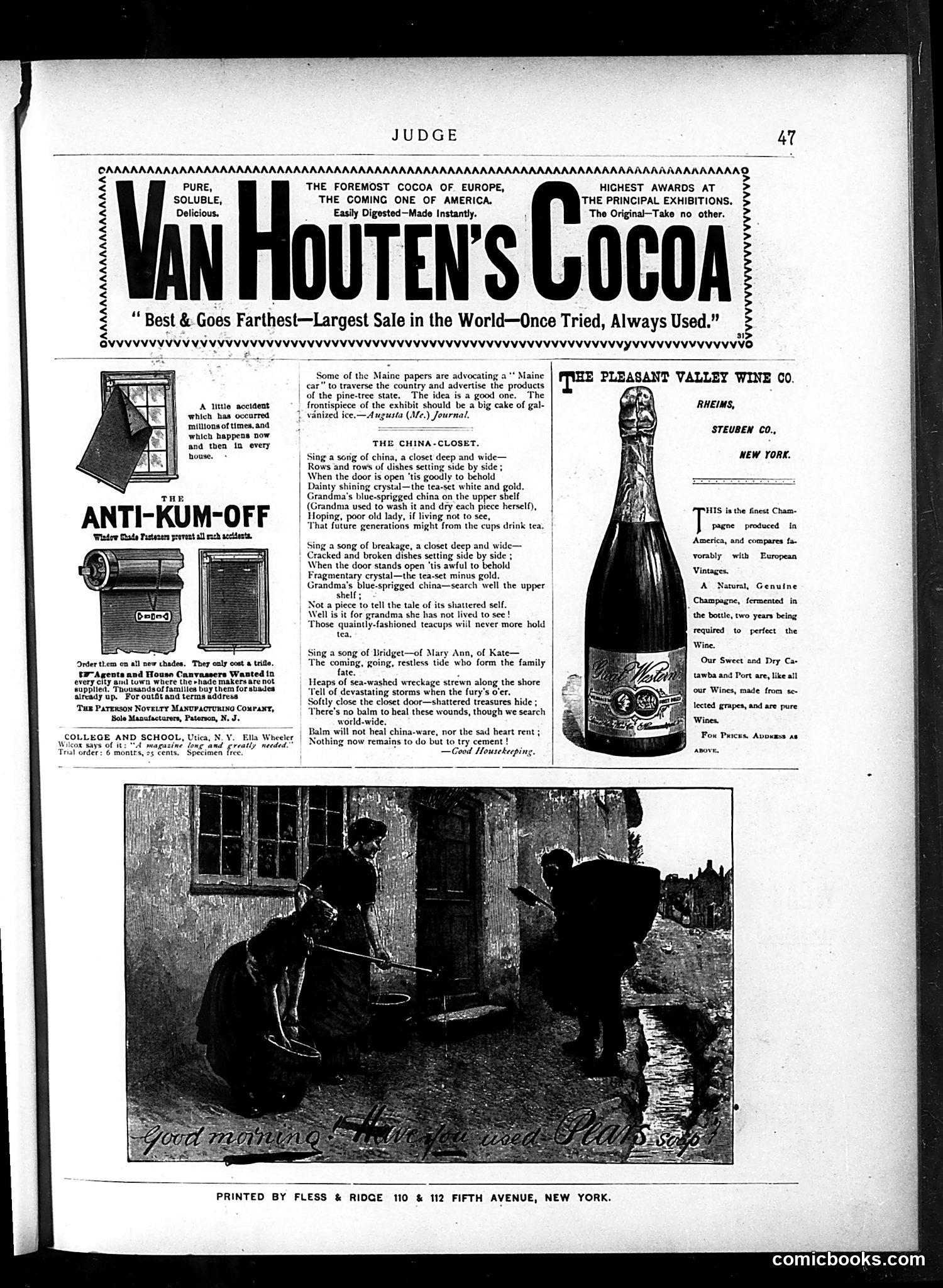
This page is primarily **advertising**, not satire or political commentary. It features: **Main Advertisement:** Van Houten's Cocoa dominates the top, claiming to be "the foremost cocoa of Europe, the coming one of America" with highest awards. The tagline promises it "goes farthest" with largest worldwide sales. **Secondary Ads:** - "Anti-Kum-Off" window shade product - Pleasant Valley Wine Co. champagne - College/school shade offer **Editorial Content:** "The China-Closet" is a sentimental poem about household breakage—dishes breaking in a china cabinet—likely playing on domestic anxiety and the expense of household goods. It's gentle humor about everyday domestic life rather than political satire. **Bottom Image:** A candid street photograph (unclear caption) showing what appears to be working-class people. The page reflects *Judge* magazine's mix of advertising revenue, light domestic humor, and consumer products marketed to middle-class readers.
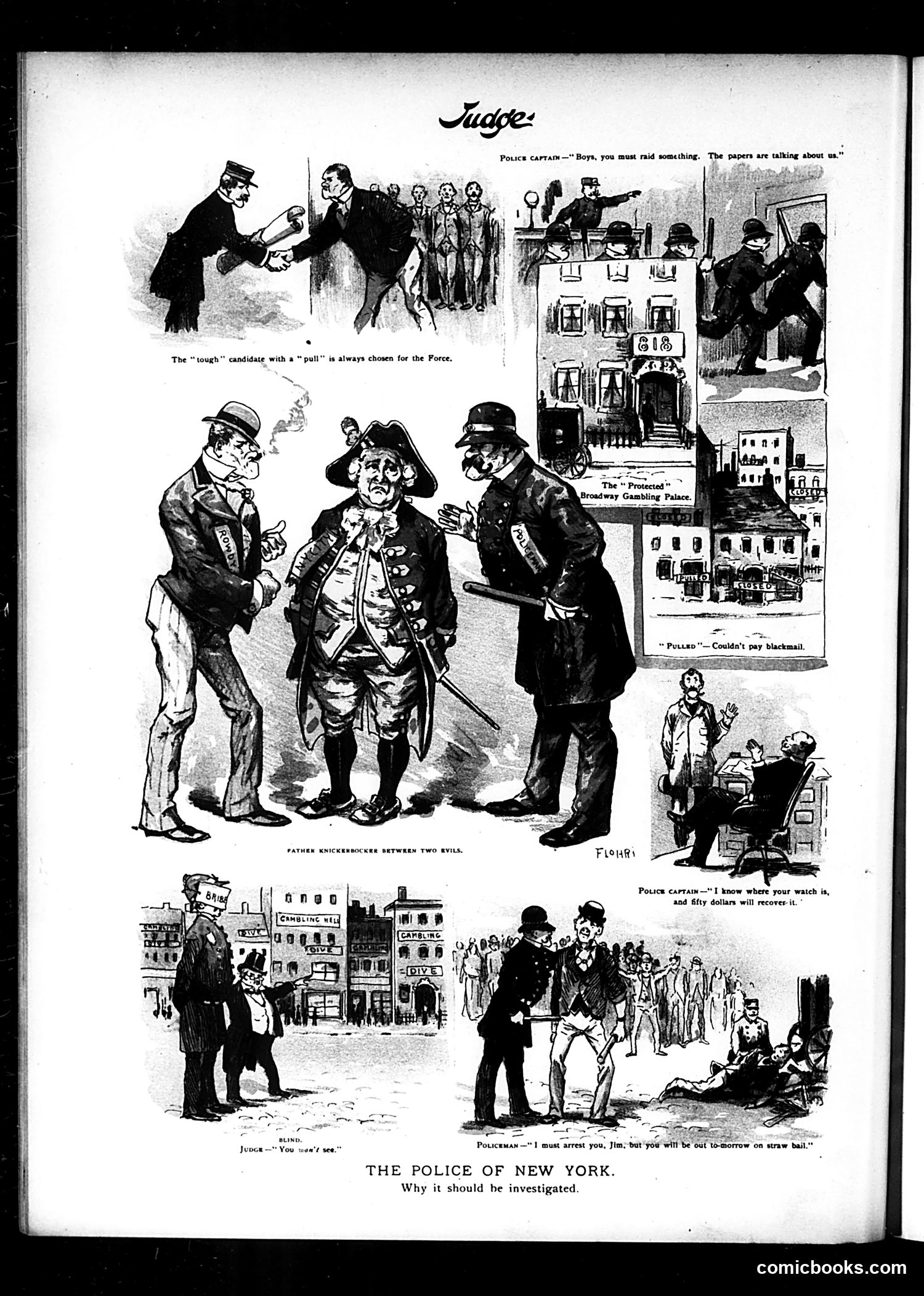
This satirical Judge page critiques New York Police Department corruption through multiple vignettes. The cartoons depict: 1. **Police raids for show**: Officers are instructed to "raid something" because newspapers are discussing them—suggesting staged raids for public relations rather than genuine law enforcement. 2. **Extortion/blackmail**: A police captain knows a citizen's stolen watch location and demands fifty dollars for its "recovery"—implying police involvement in theft or cooperation with criminals. 3. **Bribery and fixed bail**: An arrested man is assured he'll be released "on straw bail" (worthless bail)—satirizing a corrupt system where criminals can purchase quick release. 4. **Institutional corruption**: The title "The Police of New York: Why it should be investigated" frames these as systemic problems requiring official inquiry. The page attacks police involvement in crime, extortion schemes, and a rigged judicial system where money determines outcomes rather than justice.