
Judge, 1890-04-26 · page 7 of 16
Judge — April 26, 1890 — page 7: what you’re looking at
What you’re looking at
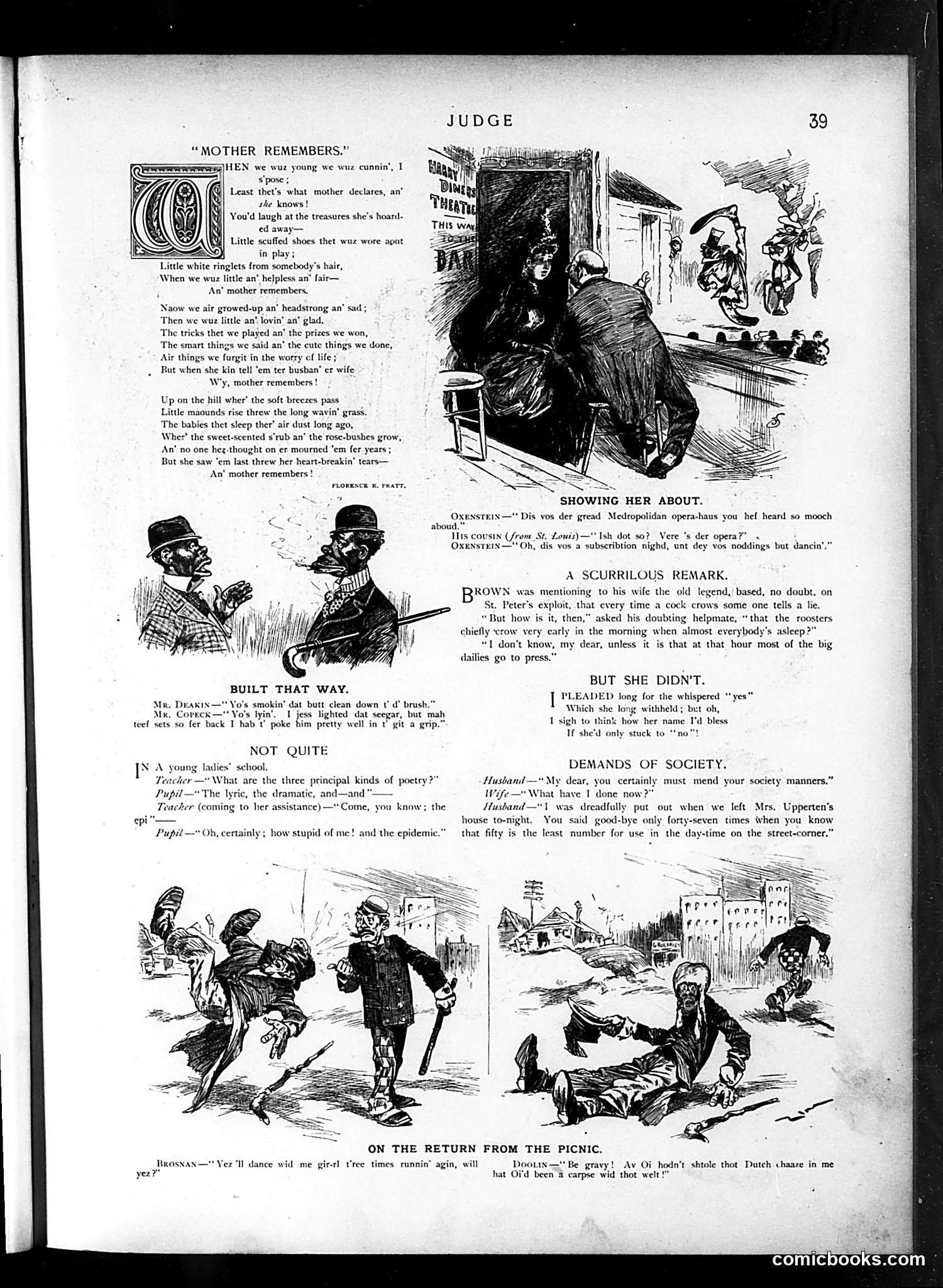
This page from the satirical magazine *Judge* contains several unrelated humorous pieces typical of the publication's format: **"Mother Remembers"** is a sentimental poem about maternal nostalgia, contrasting mothers' cherished memories of their children's youth with children's forgetfulness—a common theme in period humor. **"Showing Her About"** depicts a Jewish character (Oxenstein, indicated by dialect) taking his cousin from St. Louis to the Metropolitan Opera House. The humor relies on ethnic stereotyping and broken English: the cousin expects opera but finds only dancing on subscription night, a mild joke about expectations versus reality. **"A Scurrilous Remark"** jokes about newspaper credibility: when Brown's wife asks why roosters crow early when everyone sleeps, he quips it's when "the big dailies go to press"—satirizing newspapers as sources of lies. Other brief pieces ("Built That Way," "Not Quite," "Demands of Society," "On the Return from the Picnic") use dialect humor and domestic/social situations for comedy. The ethnic stereotyping and gender dynamics reflect period attitudes rather than refined satire.
📄 Transcribed text from this page (OCR, searchable)
Machine-transcribed from the original scan — historical spelling and the odd misread are preserved.
“MOTHER REMEMBERS.” BJHEN we wuz young we wuz cunnin’, T s'pose ; Least thet’s what mother declares, an’ she knows! You'd laugh at the treasures she’s hoard- ed away— S y in play; Little white ringlets from somebody's hair, When we wuz little an’ helpless an’ fair— An’ mother remembers. Naow we air growed-up an’ headstrong an’ sad ; hen we wuz little an’, lovin’ an’ glad, ‘The tricks thet we played an’ the prizes we won, we said an’ the cute things we done, Air things we furgit in the worry ef life ; But when she kin tell ‘em ter busban’ er wife Wry, mother remembers ! Up on the hill wher’ the soft breezes pass Little maounds rise threw the long wavin’ grass. ‘The babies thet sleep ther’ air dust long ago, Wher! the sweet-scented s'rub an’ the rose-bushes grow, An’ no one heg-thought on er mourned ‘em fer years ; But she saw ‘em last threw her heart-breakin’ tears— An’ mother remembers! FLORENCE . PRAT, SHOWING HER ABOUT. Dis vos der gread Medropolidan opera-haus you hef heard so mooch His cousin (from St. Louis)—‘* Ish dot so? Vere ’s der opera?” OxexsTEtN—"'Oh, dis vos a subscribtion nighd, unt dey vos noddings but dancin’.” A SCURRILOUS REMARK. BROWN was mentioning to his wife the old legend,’ based, no doubt, on St. Peter's exploit, that every time a cock crows some one tells a lie. “But how is it, then,” asked his doubting helpmate, “that the roosters chiefly crow very carly in the morning when almost everybody's asleep?” “1 don’t know, my dear, unless it is that at that hour most of the big dailies go to press.” BUT SHE DIDN'T. [ PLEADED long for the whispered Which she long withheld ; bet oh, BUILT THAT WAY. in’ dat butt clean down ¢( d’ brush.” o's lyin’. I jess lighted dat seegar, but mah e ance teef sets so fer back I hab t’ poke him pretty well in t” git a grip.” I sigh to think how her name I'd bless If she'd only stuck to ‘no Mx. Coreck NOT QUITE DEMANDS OF SOCIETY. Husband —" My dear, you certainly must mend your society manners.” rhe lyric, the dramatic, and—a = i What have I done now?” Teacher (coming to her assistance) —" Come, you know; the Husband —"\ was dreadfully put out when we left Mrs. Upperten’s house to-night. You said good-bye only forty-seven times (hen you know ; how stupid of me! and the epidemic.” that fifty is the least number for use in the day-time on the street-corner.” ON THE RETURN FROM THE PICNIC. Brosnan —" Yez ‘Il dance wid me gir-rl tree times runnin’ agin, will Dootin—"* Be gravy! Ay Oi hodn't shtole thot Dutch chaaze in me yez?" hat Oi'd been a carpse wid thot welt !”