
A complete issue · 16 pages · 1890
Judge — March 8, 1890
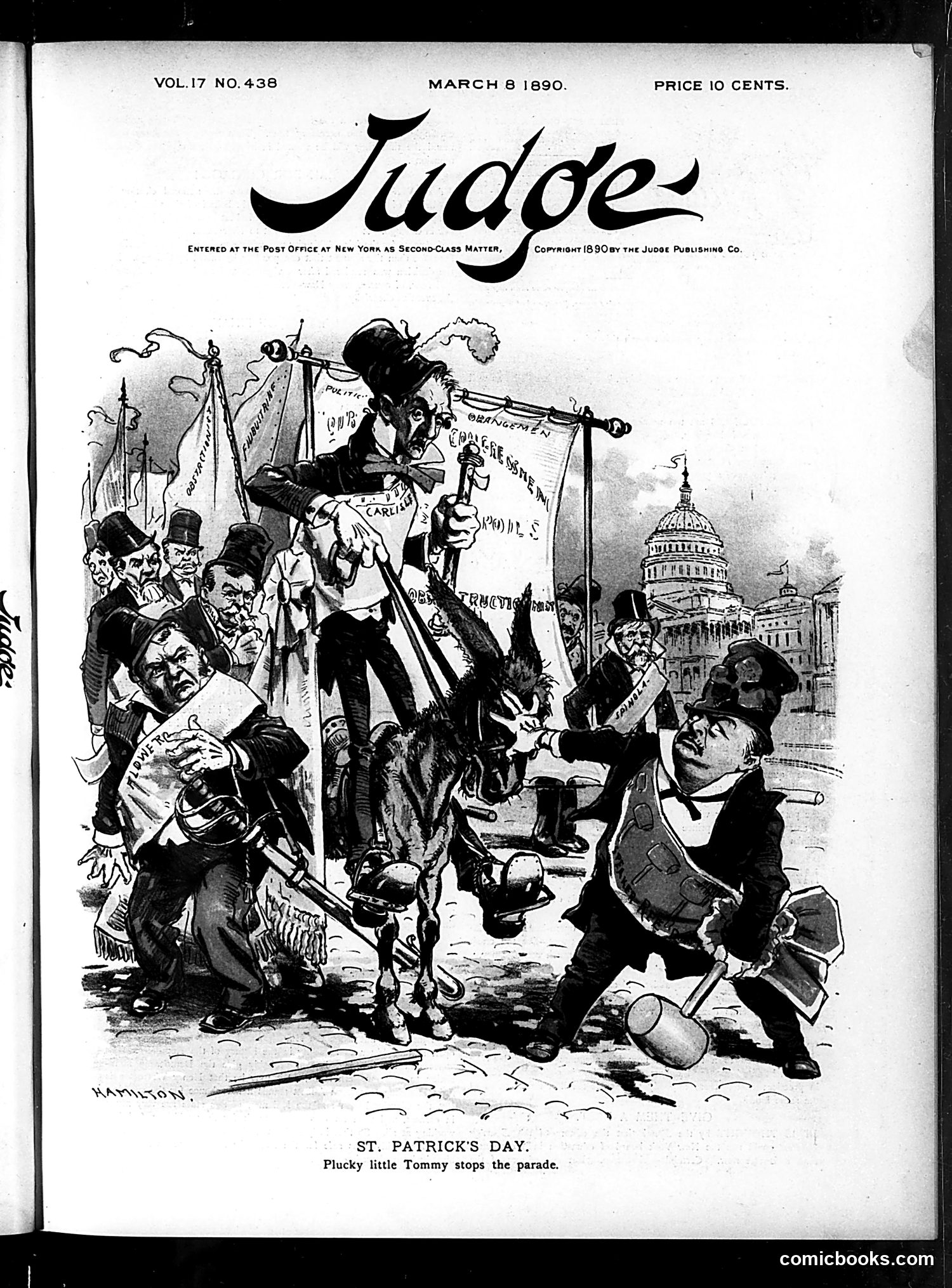
**Cartoon: "St. Patrick's Day - Plucky little Tommy stops the parade"** This satirical cartoon depicts St. Patrick's Day parade proceedings in Washington, D.C. (the Capitol building visible in background). A small figure labeled "Tommy" appears to be disrupting or "stopping" what looks like a political parade or procession featuring politicians and dignitaries carrying banners and flags. The satire likely mocks either Irish-American political influence or a specific contemporary political dispute. The phrase "plucky little Tommy" suggests David-versus-Goliath commentary—a small figure opposing established political power. Without identifying the specific individuals caricatured or the exact political conflict referenced, the core joke appears to be about an underdog disrupting official proceedings, presented as humorous commentary on 1890s American politics.
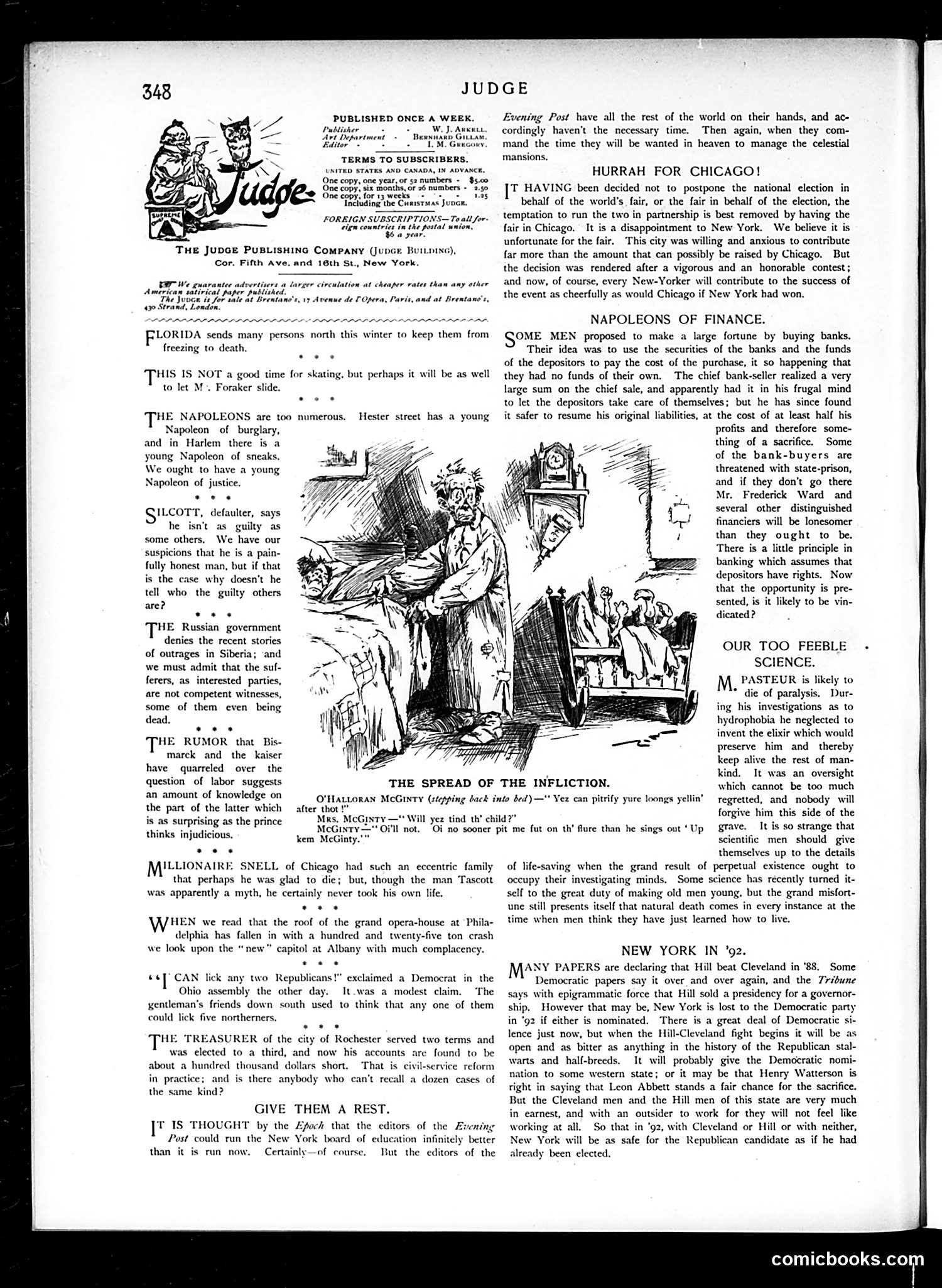
This cartoon depicts a scene of urban social contamination, showing figures in period dress (late 1800s) where disease or moral corruption spreads through a city neighborhood. The caption references "O'Halloran McCurry" and dialogue about children and cleanliness ("Will yez tind it? child?" / "Oh no sooner pit me fut on it'there than he sings out"). The satire appears to target poor urban living conditions and how disease (likely cholera or similar epidemics common to densely-packed immigrant neighborhoods) spreads through unsanitary circumstances. The exaggerated dialect suggests Irish immigrant characters, reflecting contemporary anxieties about public health and immigration. The "infection" metaphor criticizes both literal disease vectors and broader social concerns about urban poverty spreading its problems through communities.
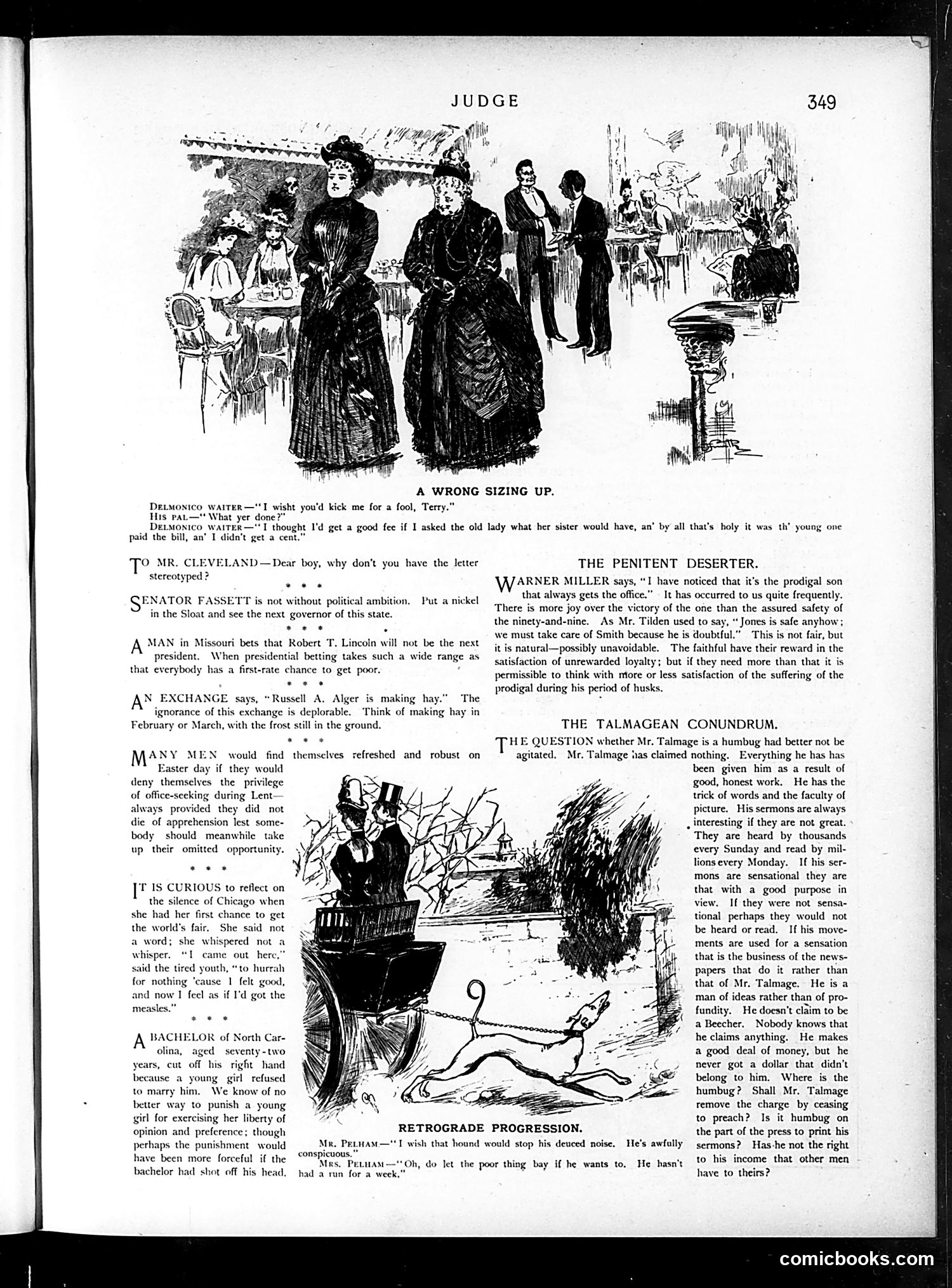
**"A Wrong Sizing Up"** (top cartoon): A Delmonico waiter and patron discuss a tip dispute—satire on class pretension and social awkwardness. **Political items** reference Cleveland (likely President Grover Cleveland), Senator Fassett's gubernatorial ambitions, and Robert T. Lincoln's potential presidency—standard 1880s-90s political gossip. **"The Penitent Deserter"** discusses Warner Miller's political advantage; the text suggests a prodigal-son narrative about restored political fortunes. **"The Talmagean Conundrum"** critiques Reverend Talmage's sensationalist preaching and commercial success—mocking evangelical showmanship and the press's role in amplifying his celebrity despite questionable substance. **"Retrograde Progression"** (bottom): A carriage mishap cartoon about literal backward movement—likely social/political commentary through physical humor. The page reflects 1890s elite anxieties about money, status, and public morality.
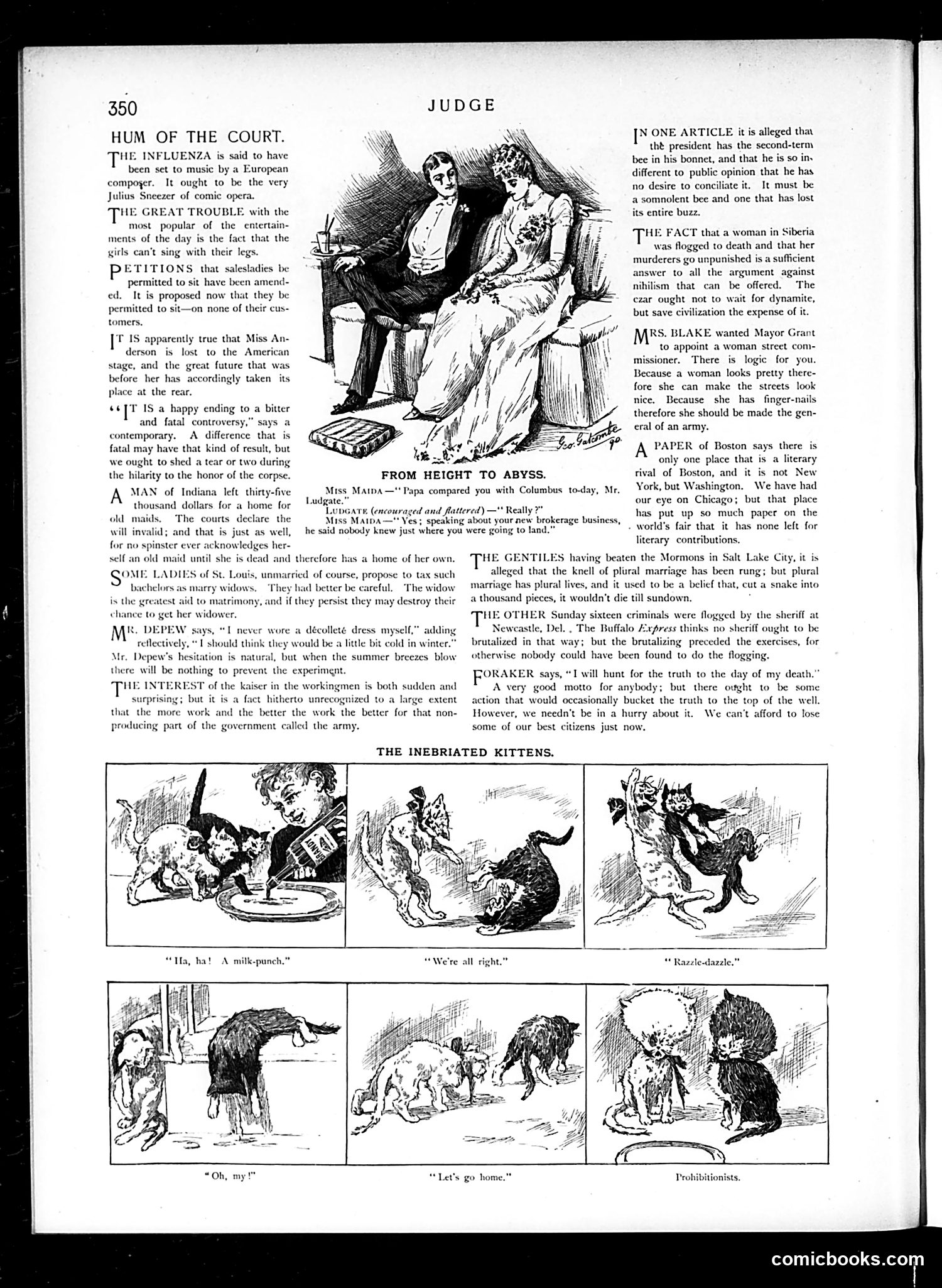
This page from *Judge* (a satirical weekly) contains brief editorial quips and two illustrated features mocking contemporary figures and social issues. **"Hum of the Court"** section offers short jabs at various topics: influenza, performers (Miss Anderson), Indiana's bequest to "old maids," and social controversies. The humor is lightweight—playing on wordplay and incongruity rather than targeting specific individuals. **"From Height to Abyss"** depicts a social climber named Ludgate being deflated. A woman compliments him by comparing him to Columbus—but only because, like Columbus, nobody knows where he's going with his brokerage business. It's a gentle mockery of nouveau riche pretension. **"The Inebriated Kittens"** is a six-panel comic strip showing anthropomorphic cats in various drunken mishaps, apparently after consuming milk punch. The humor is slapstick and visual rather than political. The page targets no specific politicians or major events—instead offering light satire of social manners, gender roles (mocking proposals for women street commissioners), and personal foibles typical of period magazines.
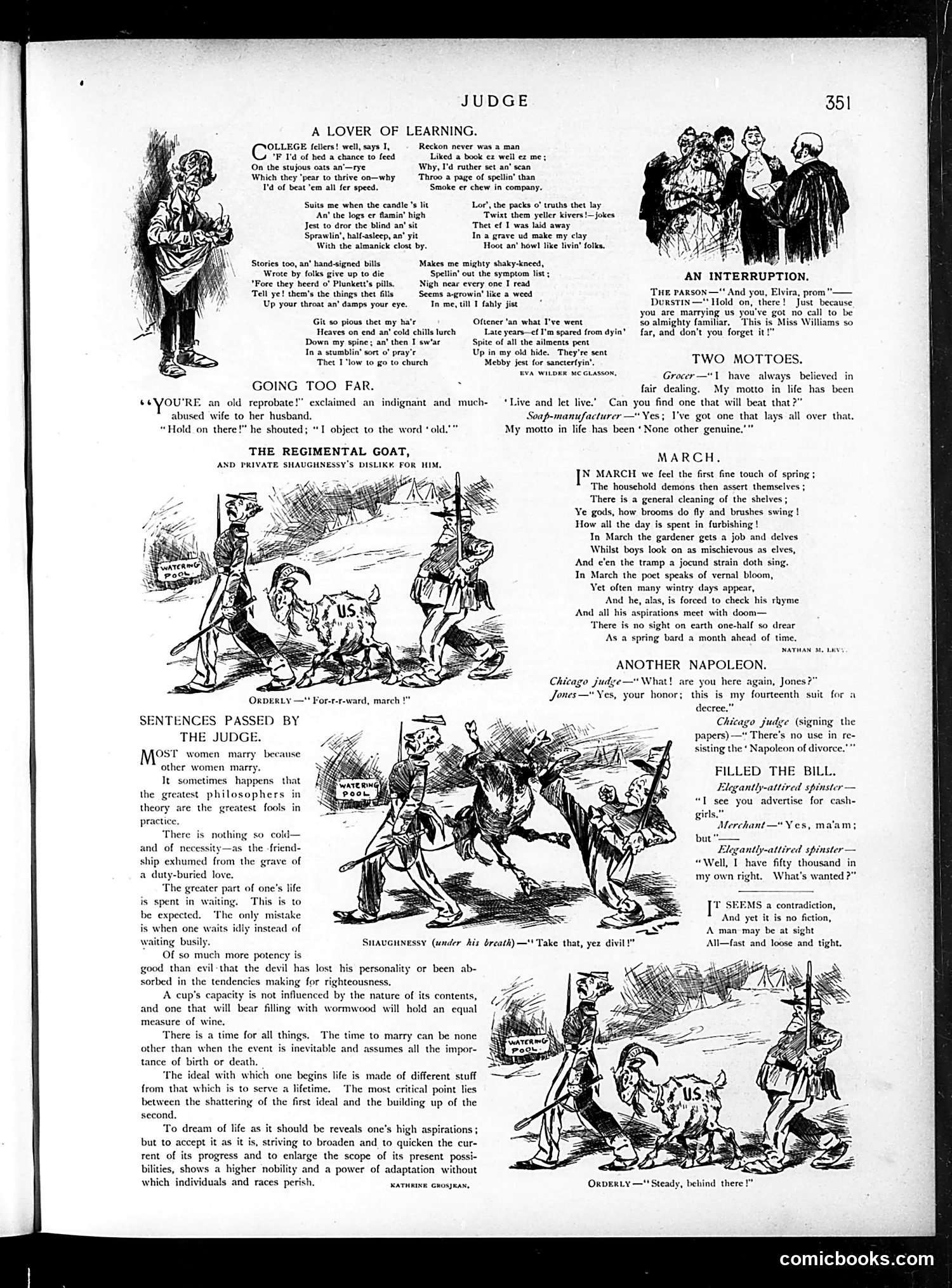
This page from Judge contains several satirical pieces typical of the magazine's humor: **"A Lover of Learning"** presents a rural character's humble reverence for books and reading—the satire gently mocks both his earnest sentimentality about literature and his dialect-heavy speech. **"Going Too Far"** is a domestic squabble joke: a wife calls her husband an "old reprobate," and he objects specifically to being called "old"—the humor lies in his missing the real insult. **"The Regimental Goat"** and related military cartoons appear to satirize military life and soldiers' relationships with camp animals, though specific context is unclear without more information. **"Two Mottoes"** contrasts a grocer's honest motto ("Live and let live") with a soap manufacturer's cynical one ("None other genuine")—satirizing commercial dishonesty and the irony of selling soap while claiming authenticity. **"March"** is sentimental poetry about spring, while various other brief pieces mock divorce courts, unmarried women seeking wealthy husbands, and judges' repetitive cases.
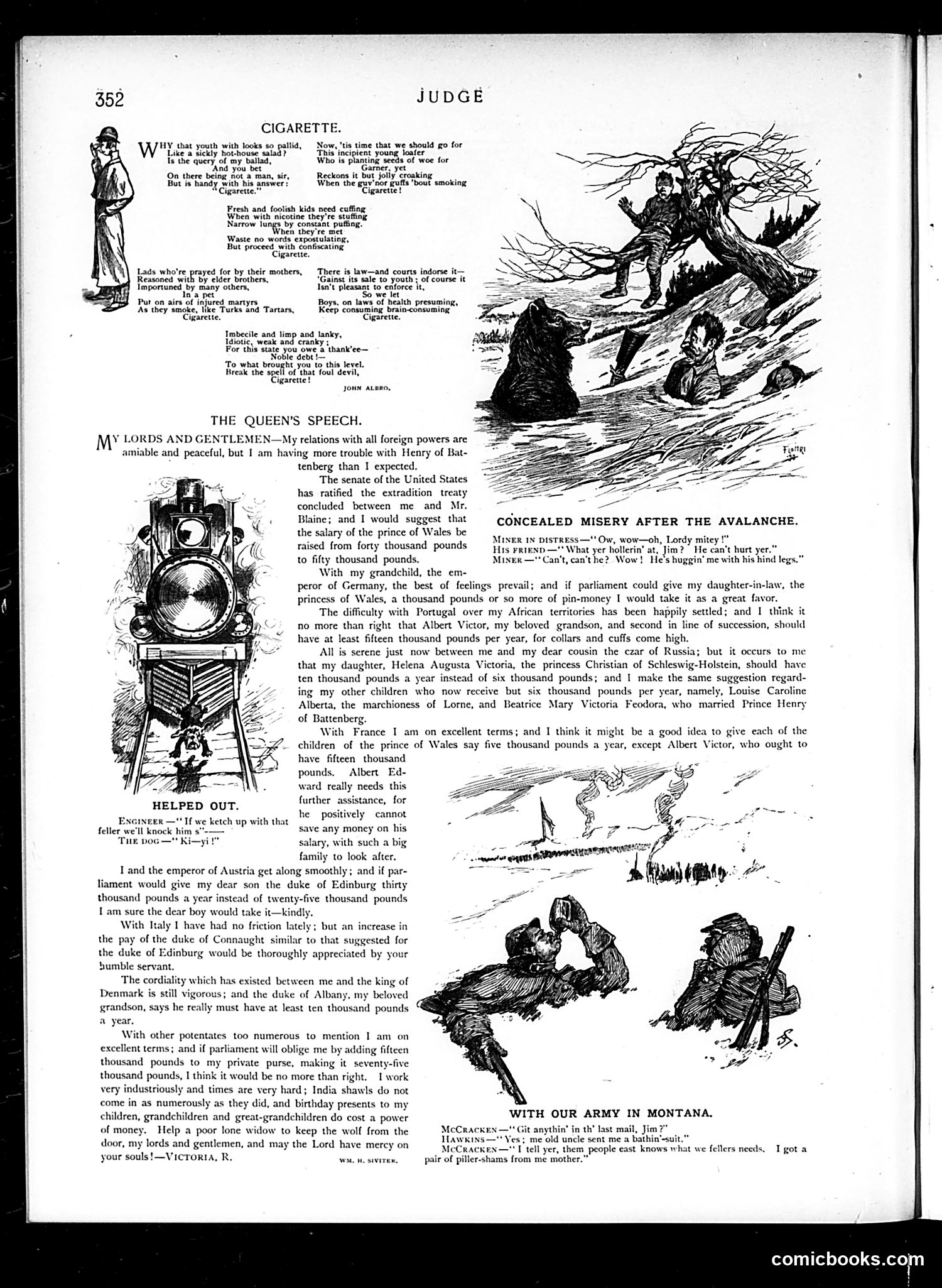
This page contains two distinct pieces of satire: **"Cigarette"** (poem): A moral screed mocking youth smoking cigarettes. The joke appears to be the overwrought, self-righteous tone—treating cigarette use as a grave social evil requiring parental intervention and legal enforcement. The satire targets Victorian anxieties about youth corruption through this "foul devil" of tobacco. **"The Queen's Speech"** (satirical monologue): Attributed to Queen Victoria, this mock-parliamentary address ridicules royal financial demands by having Victoria repeatedly interrupt serious diplomatic matters (extradition treaties, foreign relations) to request salary increases for various family members—the Prince of Wales, Prince Albert Victor, various daughters and their husbands. The satire exposes the monarchy's apparent self-interest and constant lobbying for taxpayer money, presenting Victoria as comically mercenary despite claiming international harmony. The accompanying illustrations depict avalanche rescue and soldiers in Montana, likely illustrating unrelated articles.
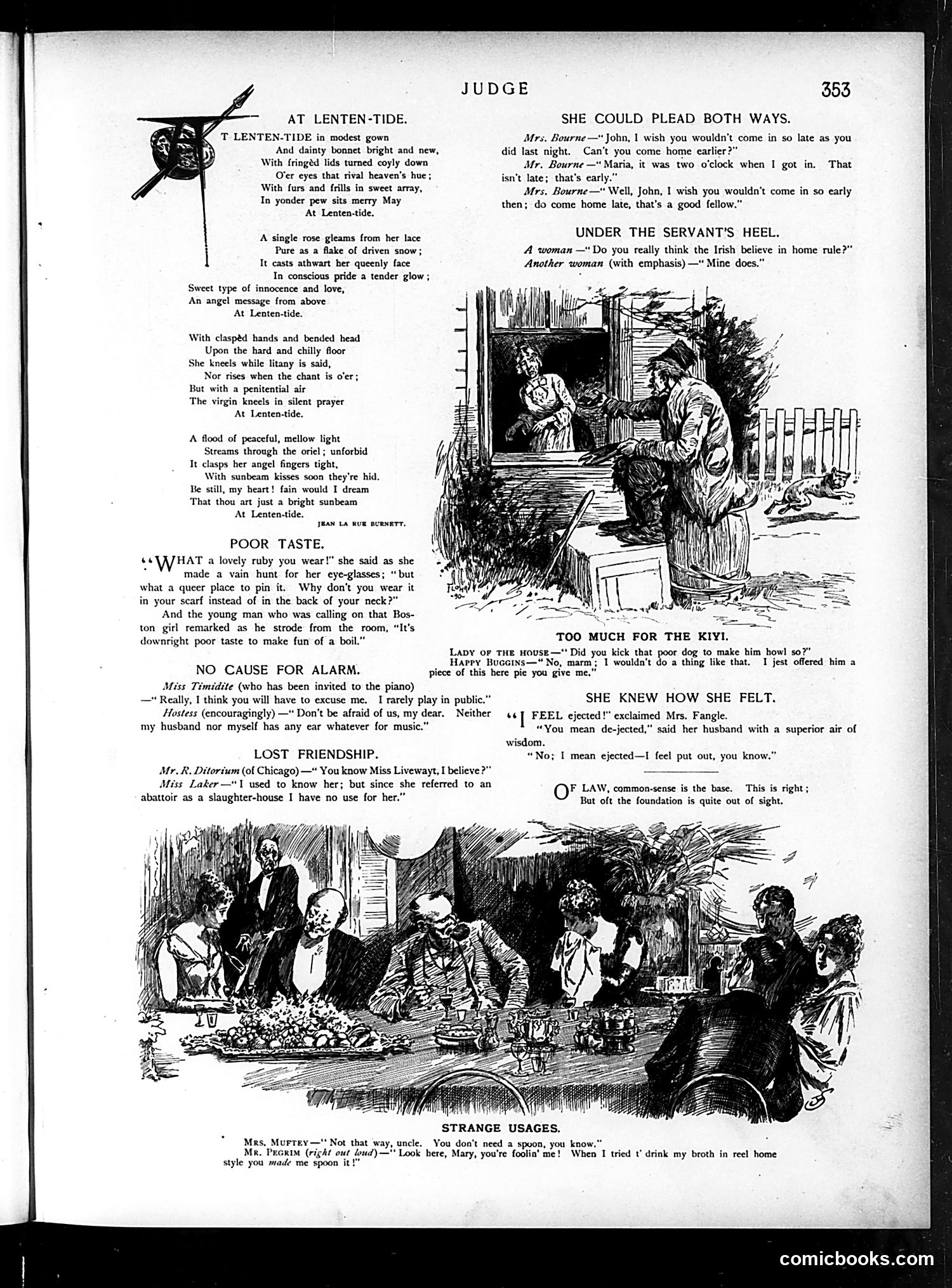
This page from *Judge* contains multiple short humorous sketches satirizing Victorian-era social conventions and domestic life: **"At Lenten-Tide"** mocks the performative piety of upper-class women who dress fashionably and ostentatiously for church during Lent while claiming spiritual devotion—the contrast between their "modest gown" and "dainty bonnet" versus conscious vanity. **"Poor Taste"** satirizes a Boston woman's cruel mockery of a suitor's boil, highlighting how the wealthy could be thoughtlessly insulting. **"She Could Plead Both Ways"** jokes about a nagging wife who contradicts herself—complaining her husband comes home too late, then too early. The remaining brief sketches mock marital disputes, servants' behavior, and class differences (notably "Under the Servant's Heel" jokes about Irish domestic workers). Overall, the page satirizes Victorian hypocrisy, marital discord, and class tensions through domestic scenarios—typical *Judge* fare targeting middle and upper-class readers' social pretensions.
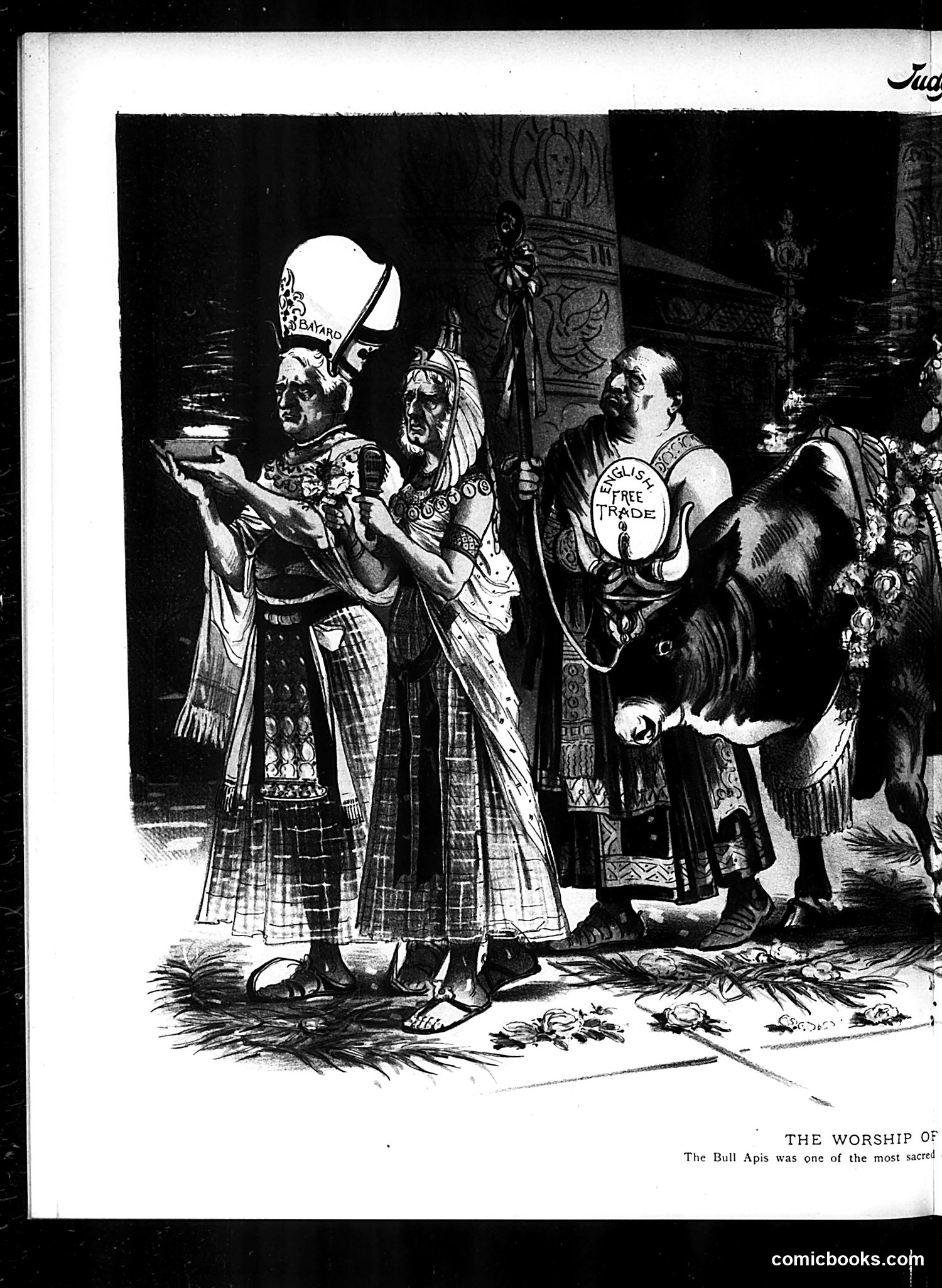
This illustration satirizes the "Worship of the Bull Apis"—an ancient Egyptian religious practice—as an allegory for contemporary commerce and trade policy. The figure on the left, dressed in classical Egyptian regalia with an elaborate headdress, appears to represent a political or business leader. The other figures, including one prominently displaying a "FREE TRADE" shield, likely represent competing economic interests or nations. The satire suggests that advocates of free trade worship commerce with the same reverence ancients showed religious idols. By comparing trade policy debate to pagan bull worship, Judge mocks what it views as the quasi-religious fervor surrounding free trade advocacy—treating economic ideology as blind faith rather than rational policy. The exact historical context and specific targets remain unclear without additional publication information.
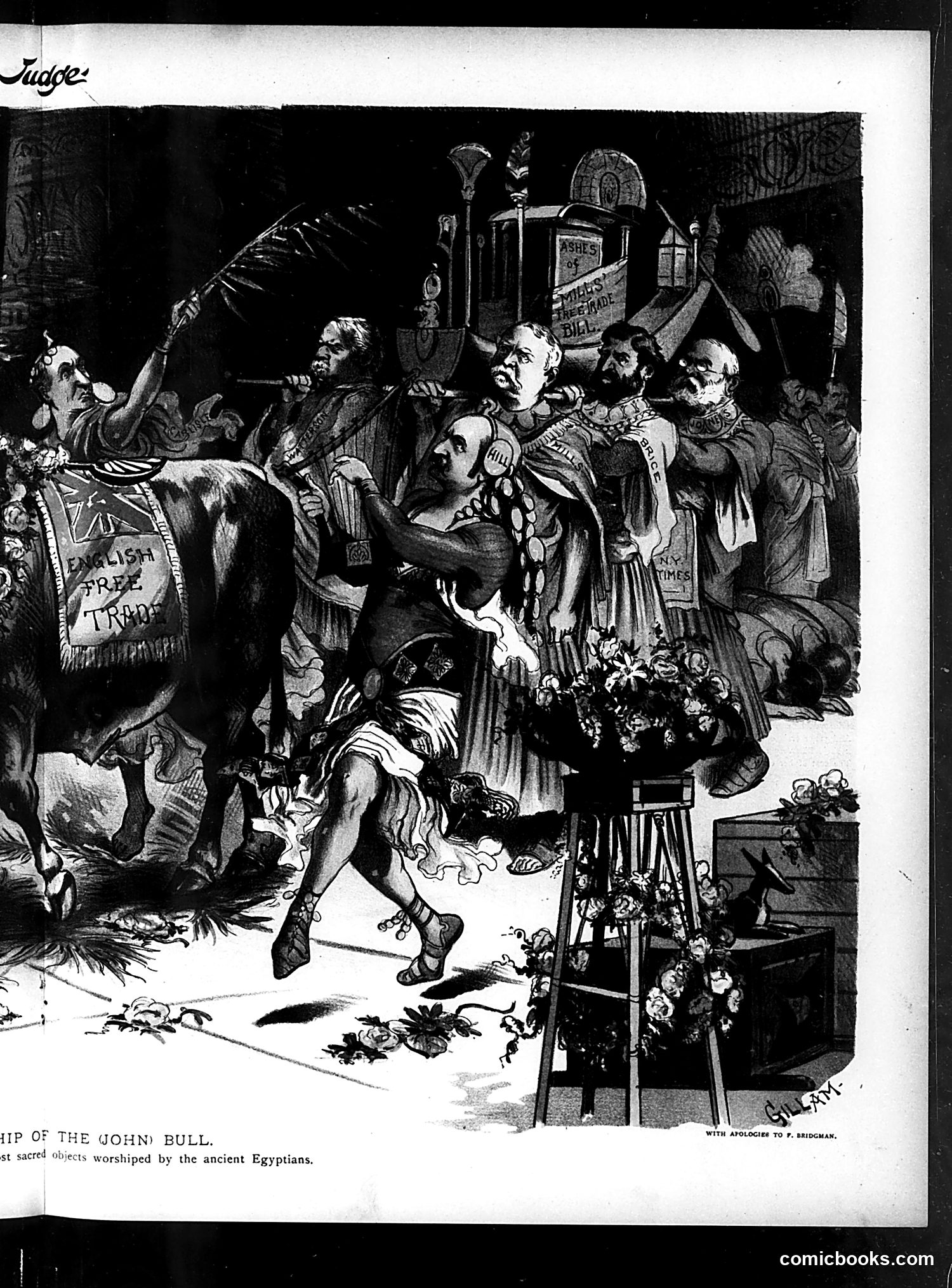
This satirical cartoon depicts what appears to be a religious ceremony with multiple figures in formal dress and military uniforms worshipping around a central altar or shrine. The title references "the John Bull," a symbol traditionally representing Britain or British identity. The satire likely critiques either British imperialism or blind nationalism—comparing reverent worship of British power/identity to ancient Egyptian religious practices. The ornate ceremonial elements, formal dress, and altar setup mock the quasi-religious fervor with which some regard national symbols. One figure on the left wears a banner reading "ENGLISH PRIDE" (partially visible), reinforcing the satire on nationalistic fervor. The elaborate staging suggests Judge magazine is mocking excessive patriotism or jingoism as superstitious idol-worship. The exact historical context remains unclear without the full publication date.
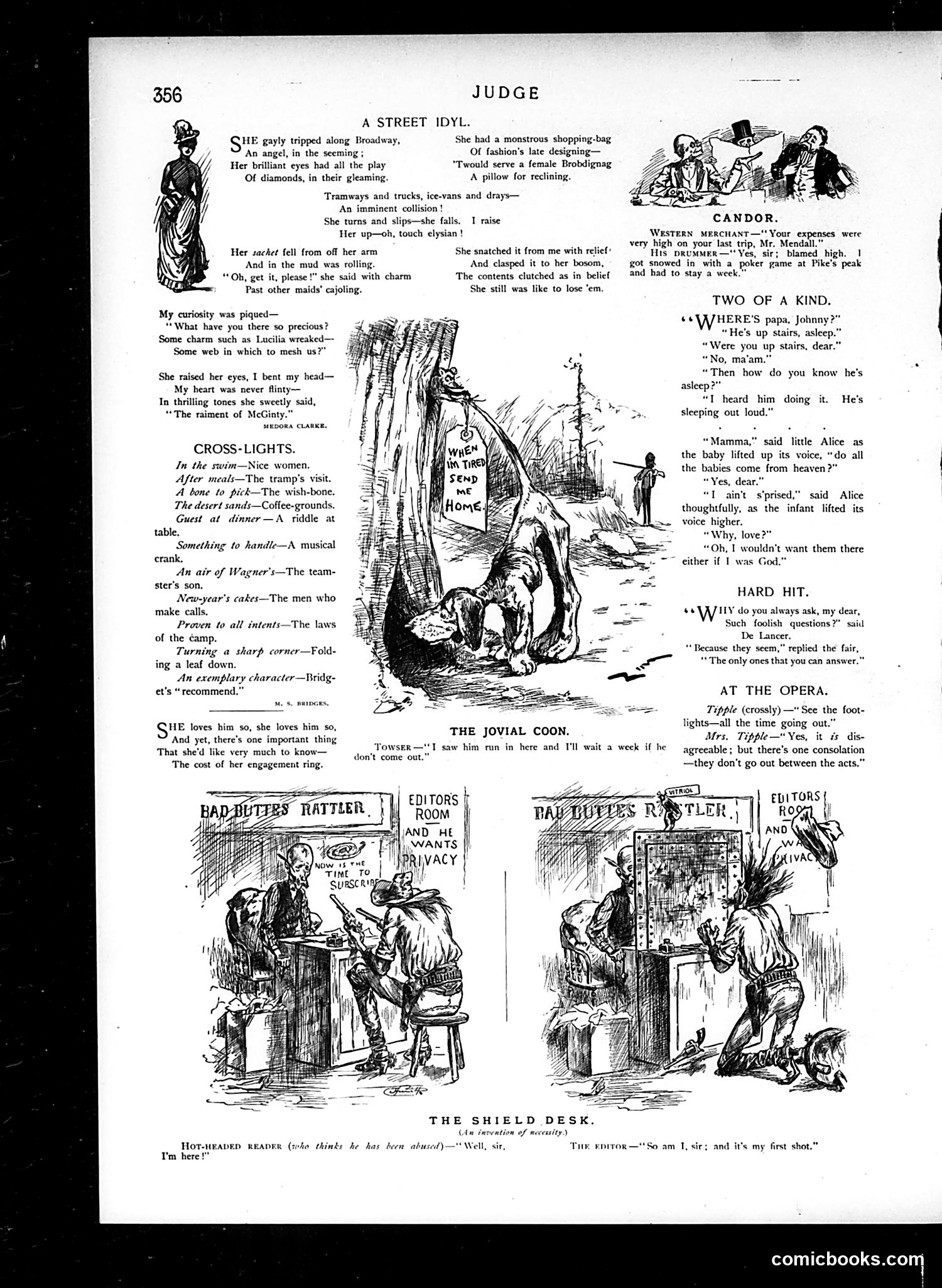
This is a **humor and satire page** from Judge magazine featuring multiple brief comedic pieces targeting 1890s-era American society. **Main content:** "A Street Idyl" mocks romantic sentimentality—a man helps a fashionable woman who's dropped her precious handbag on Broadway, expecting something valuable inside. Instead, it contains "the raiment of McGinty" (cheap clothing), deflating his romantic fantasy. **"The Jovial Coon"** and **"Bad Butties Rattler"** cartoons appear to feature racial caricature and office humor typical of the era's Judge. **Smaller pieces** satirize everyday absurdities: a woman obsessing over her engagement ring's cost ("Two of a Kind"), children's innocent theological logic ("Hard Hit"), and opera-goers complaining about footlights. **"Cross-Lights"** presents wordplay riddles mocking conventional society figures. The overall tone reflects Judge's satirical stance toward bourgeois pretension, consumerism, and social hypocrisy of the Gilded Age.
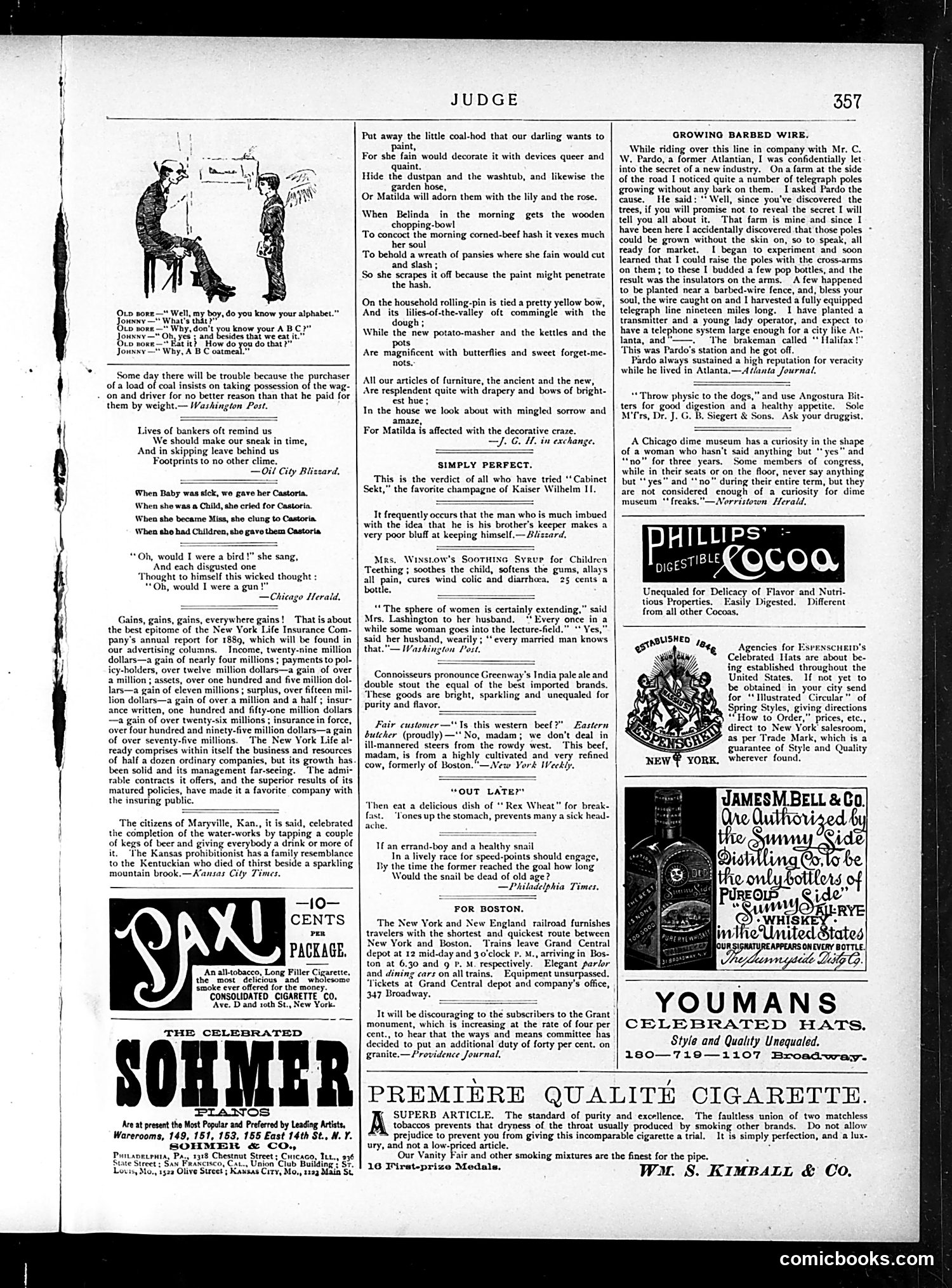
This page is primarily **advertisements and light humor columns** rather than political satire. The main content includes: **The Illustrated Poem "Growing Barred Wire"** describes a humorous anecdote about telegraph poles decorated with artistic designs and bows by someone named Matilda—a satirical commentary on excessive Victorian domestic decoration invading practical household items and farm equipment. **Scattered Jokes** mock: - A child's confusion about "ABC oatmeal" - Coal purchasers demanding possession of delivery wagons - Bankers absconding with funds - A Kansas town celebrating water completion with beer (ironic given Kansas prohibitionism) **The Cartoons** (top left) appear to show two figures in conversation, likely illustrating one of the brief anecdotes, though the specific reference is unclear from the image quality. The page reflects **late-19th-century American humor**: gentle domestic satire, insurance company boasting, and anti-prohibition jabs—typical of Judge's middle-class, Republican-leaning editorial voice.
This page is primarily **advertising**, dominated by patent medicine and consumer product ads typical of 1890s magazines. The visible satirical content consists of brief joke excerpts scattered throughout. The humorous items include: - A quip about European vacations being cheaper than buying ice (commentary on summer heat/ice costs) - Domestic dialogue jokes about romantic indifference and wardrobe excuses - A jab at Canada's "ornamental" governor-general and commissioner (political satire on colonial administration) - A landlord joke about "conveniences" Most substantive is "GEORGE HAD IT," apparently a letter-to-editor about a medical/historical reference involving Dr. John Warren (1790) and an epidemic, though the full context is cut off. The ads reflect period medical pseudoscience (Scott's Emulsion for consumption, Liebig's meat extract) and consumer culture. No major political cartoons or identifiable caricatures appear on this page.
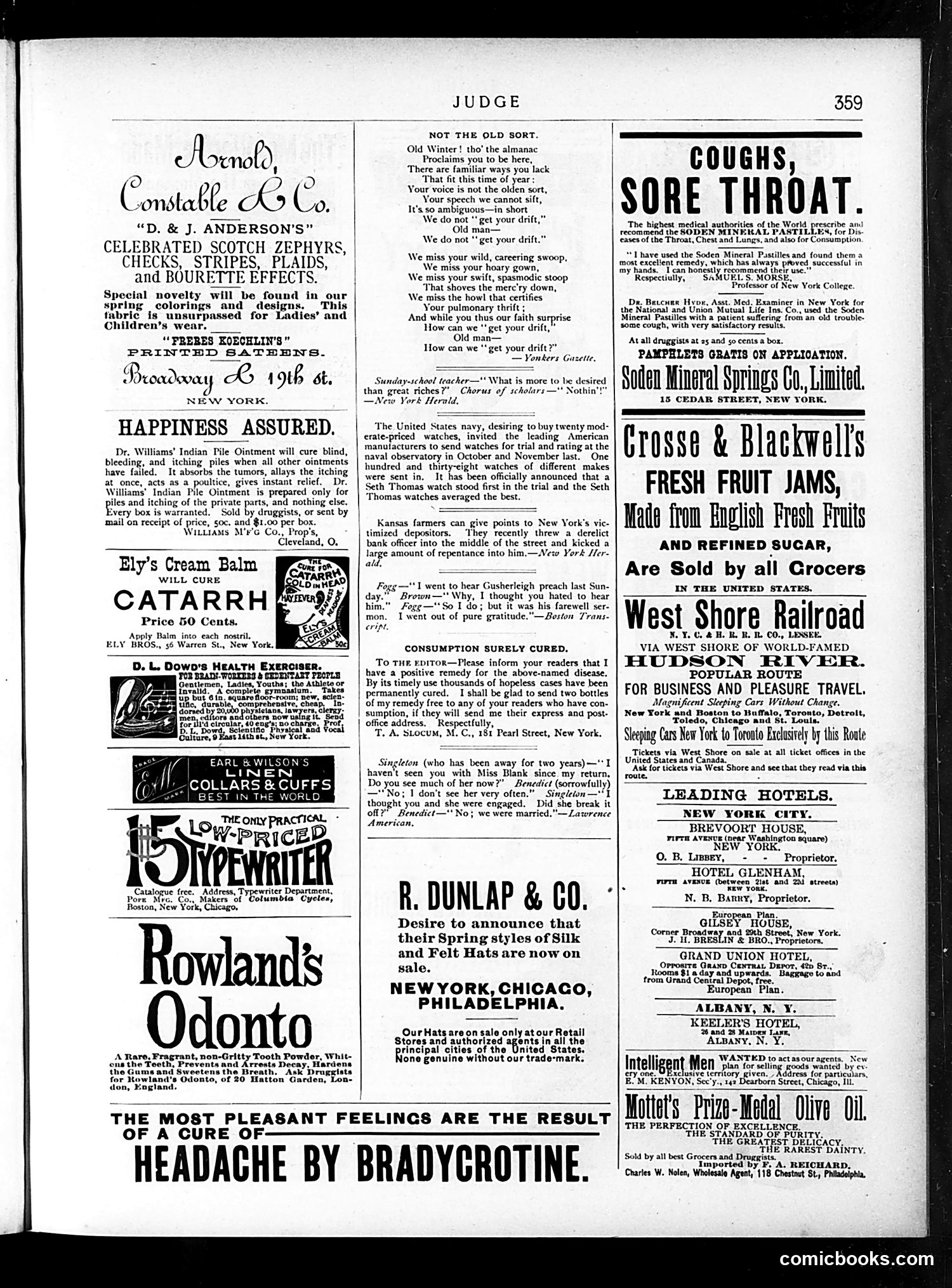
This page is primarily **advertising** with minimal editorial content. The main satirical piece is a poem titled "NOT THE OLD SORT," lamenting that winter no longer behaves like traditional winters—it lacks the violent snowstorms, extreme cold, and dramatic weather ("wild, careering swoop," "hoary gown," "swift, spasmodic stoop") that characterized historical winters. The speaker complains they cannot "get your drift" (a pun on snow drifts), expressing nostalgia for more severe, predictable seasonal weather. The page includes brief humorous items about Seth Thomas watches winning naval trials and Kansas farmers violently expelling a corrupt banker—typical Judge satirical content mocking incompetence and dishonesty. The overwhelming majority consists of period advertisements for patent medicines (cough remedies, pile ointments), fabric goods, tooth powder, and other commercial products, reflecting Judge's revenue model.
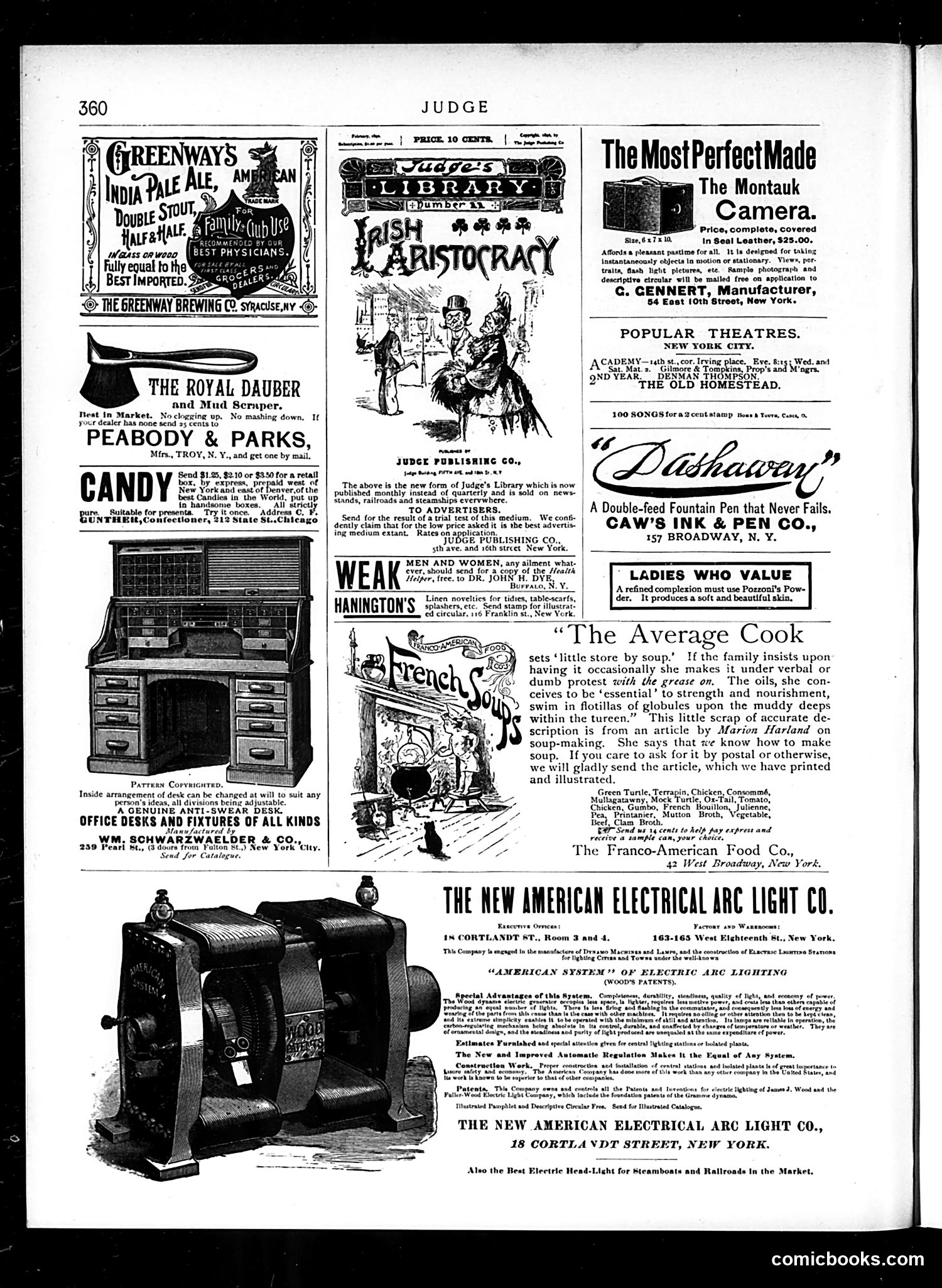
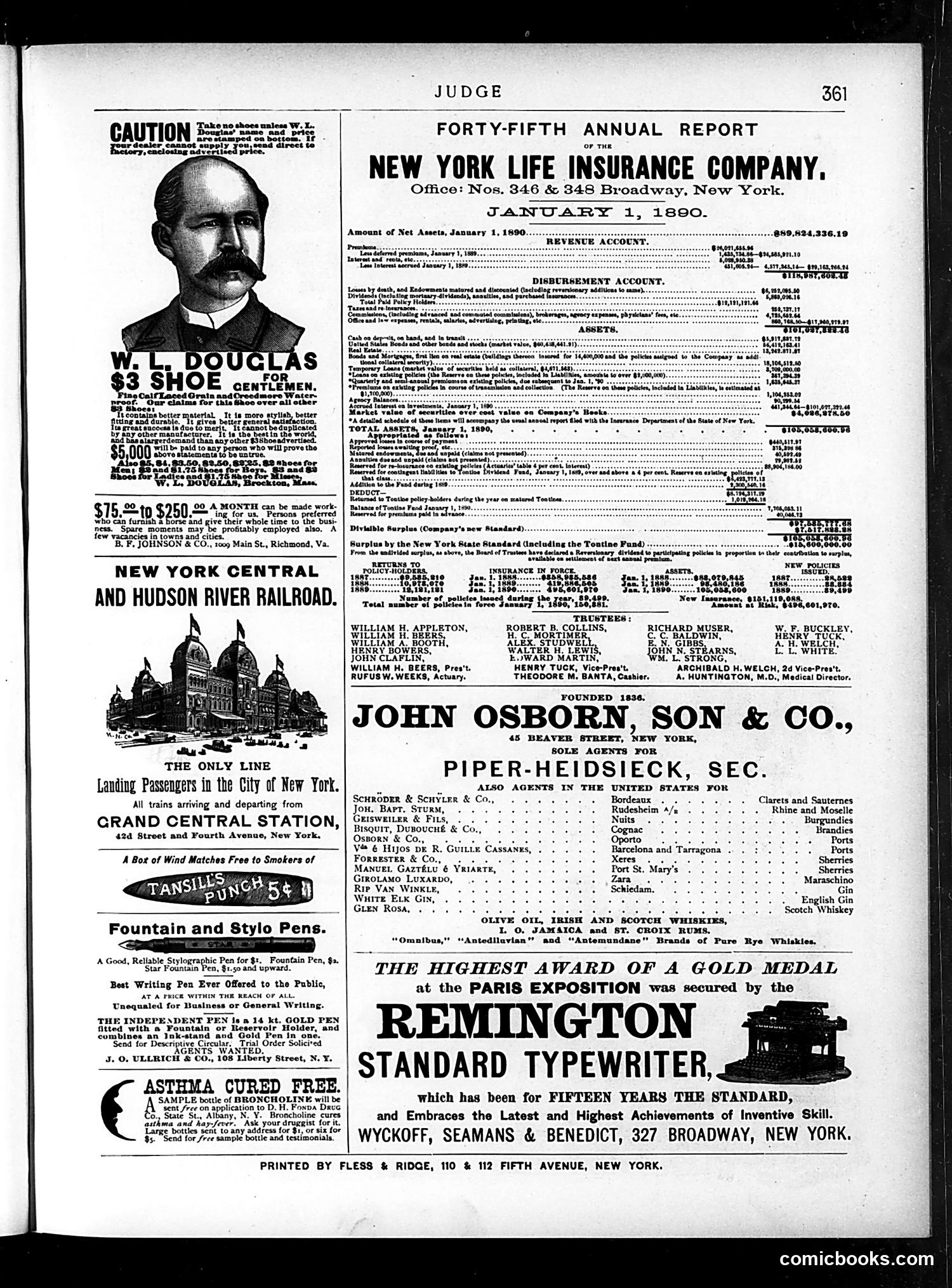
This page is primarily a **title page for Judge's Forty-Fifth Annual Report** (January 1, 1890), featuring the New York Life Insurance Company financial statements and trustees. The only cartoon element is a **portrait photograph of W.L. Douglas** (upper left), promoting his "$5 shoe" — a work boot advertised as superior quality. The accompanying text is a self-promotional "caution" claiming Douglas's shoe outperforms competitors and offering "$5,000" to anyone proving otherwise. This is **product advertising disguised as competitive boasting**, typical of late-19th-century trade claims. The remainder consists entirely of **advertisements and insurance company data**: railroad services, fountain pens, patent medicines (asthma cure), champagne distributors, and typewriters. The Remington typewriter claims a gold medal from the Paris Exposition, emphasizing it's been "the standard" for fifteen years. This represents how Judge monetized its publication through advertising, with commercial announcements dominating editorial space — a common practice in 1890s magazines.
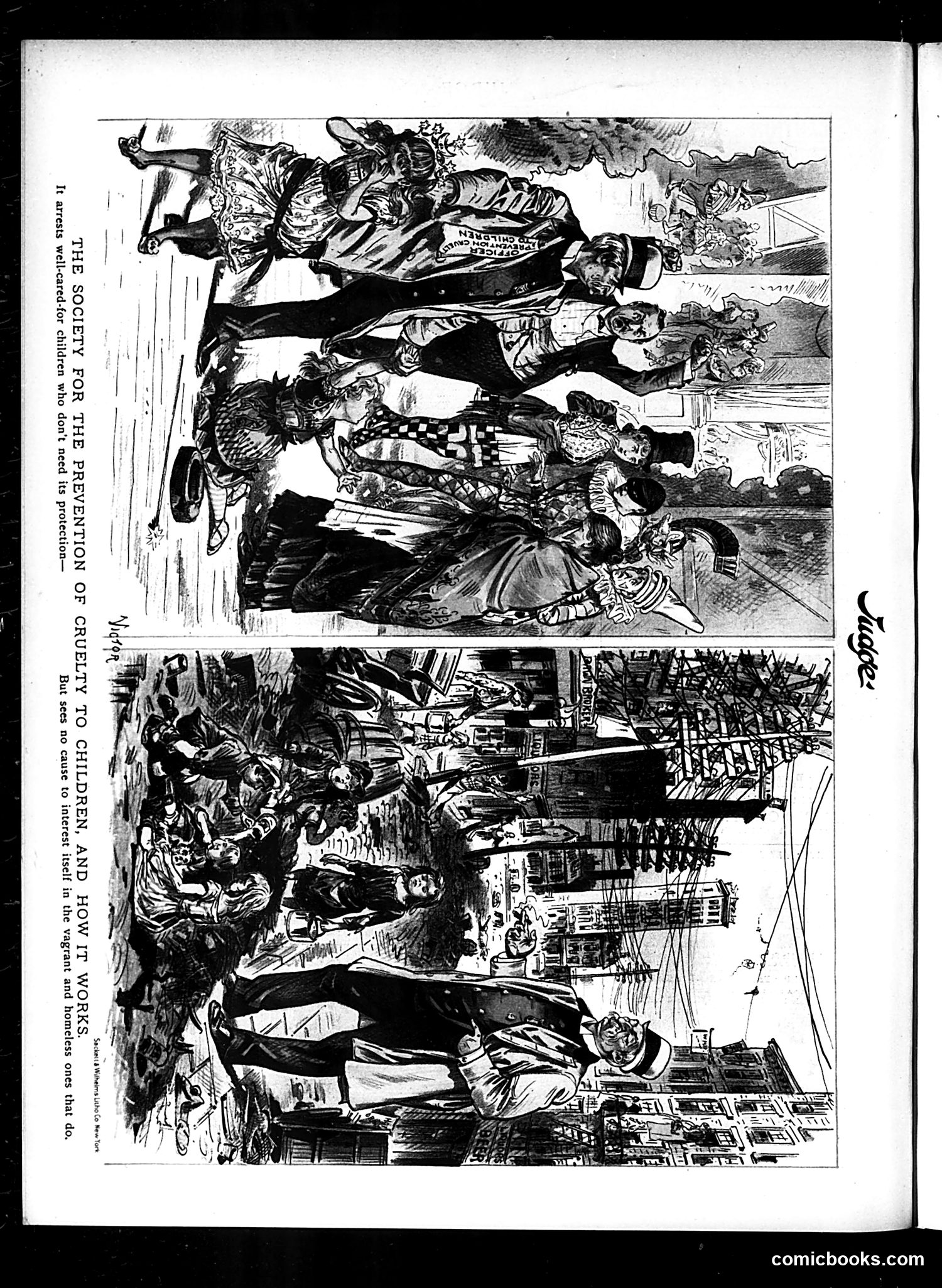
This page contains two satirical illustrations critiquing child welfare and charity practices in late 19th/early 20th-century America. **Top cartoon:** Depicts well-dressed, presumably wealthy figures distributing charity to impoverished children. The satire appears to mock performative or condescending charity—the donors' elaborate dress and gestures contrast sharply with the ragged, desperate children receiving aid. **Bottom cartoon:** Shows an institutional or official setting where children are being processed or managed, likely satirizing inadequate orphanage or poorhouse conditions. The crowded, chaotic scene suggests bureaucratic indifference to children's welfare. The OCR text is severely corrupted/reversed, making specific details unclear, but both illustrations critique how "polite society" handled poverty and child welfare—either through insufficient charity or institutional neglect. This reflects Progressive Era concerns about child labor, orphans, and social responsibility that Judge's middle-class readership would recognize and debate.