
A complete issue · 16 pages · 1890
Judge — February 8, 1890
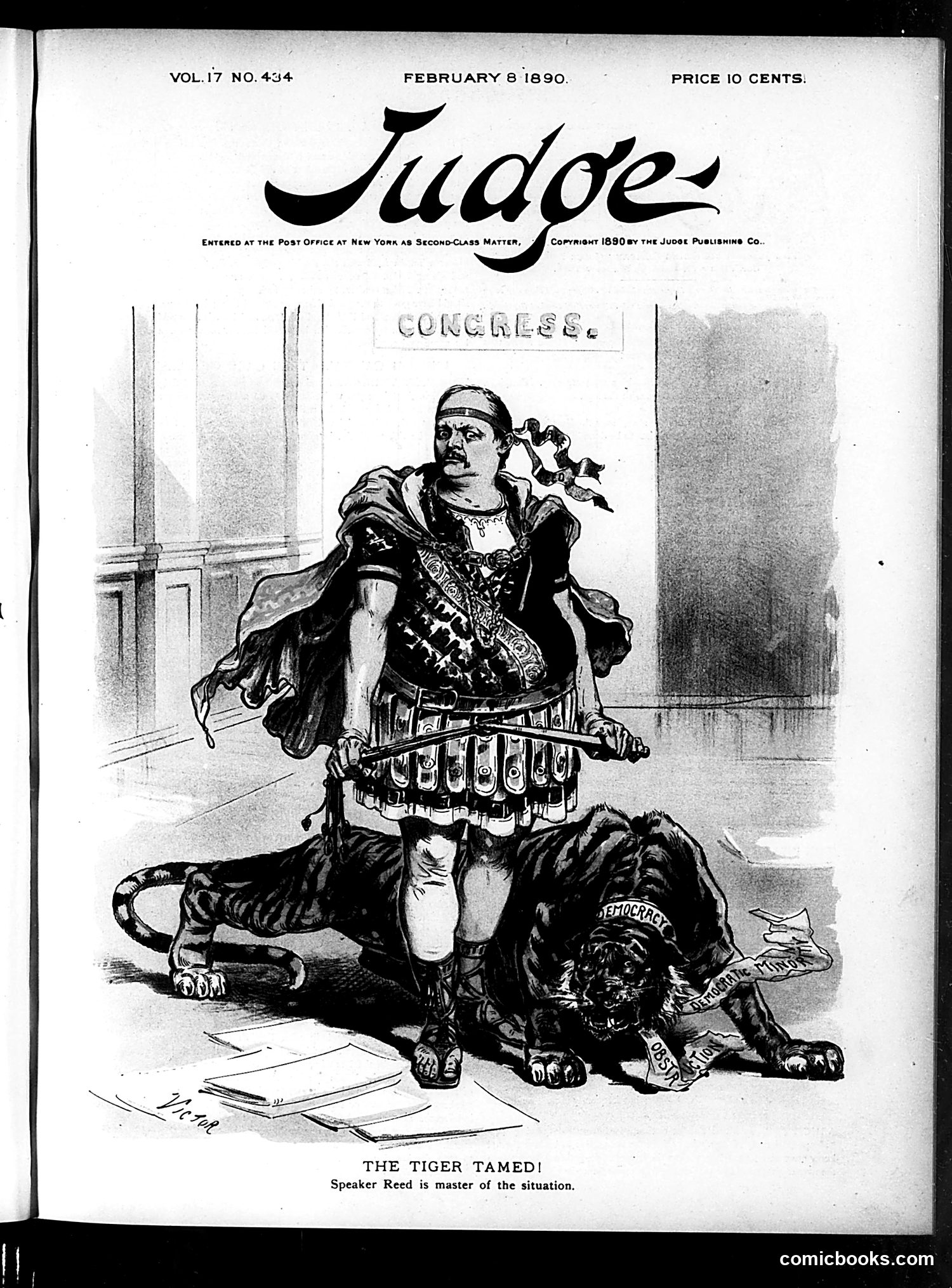
This political cartoon depicts a figure in classical Roman/military costume standing triumphantly over a tiger labeled "Democracy." The caption states "Speaker Reed is master of the situation." **Context:** Thomas Brackett Reed served as Speaker of the House in 1889-1891. The "tiger" represents the unpredictable, wild force of Democratic opposition in Congress. Reed's reputation for firm control and parliamentary tactics—particularly his controversial "Reed Rules" that restricted minority obstruction—is being celebrated here as successfully disciplining the Democratic party's chaotic resistance. The classical styling suggests Reed has achieved a conquering, dominant position over political opposition. This is satirical praise of his aggressive procedural dominance in the House chamber during this period.
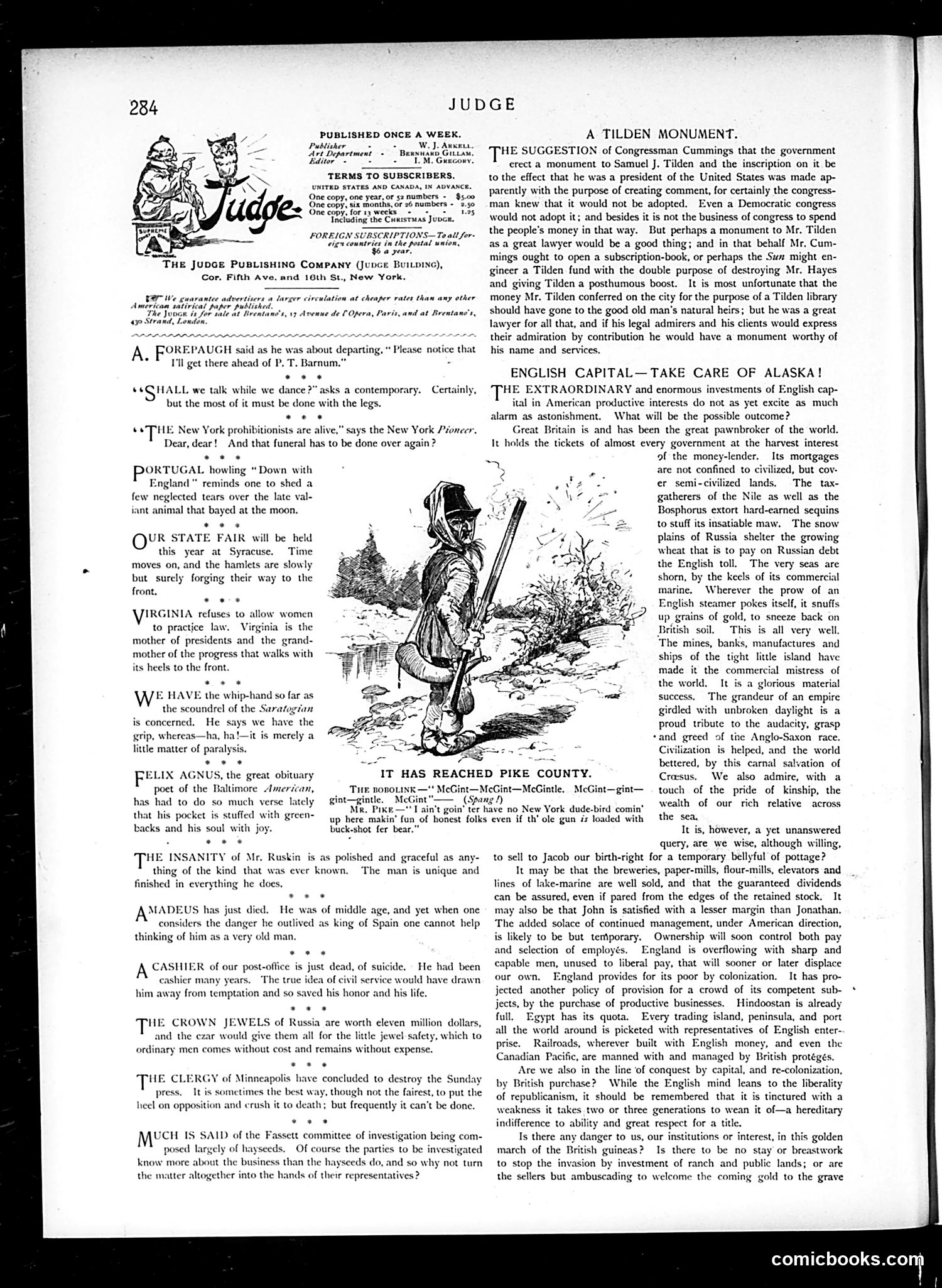
The cartoon depicts a frontiersman with a rifle in rough terrain, illustrating a humorous piece about the spread of the Saratoga (presumably a type of gossip or social phenomenon). The caption "It Has Reached Pike County" suggests something is spreading from urban/sophisticated areas into rural America. The text plays on the contrast between civilized society and frontier life, using Pike County—a rural, working-class region—as the punchline for how far some social trend has penetrated. The accompanying verse parodies frontier dialect and sensibilities. This reflects late 19th-century urban humor mocking rural Americans as backwards or unsophisticated, while satirizing how supposedly refined urban trends eventually reach even the most remote areas. The joke relies on class-based stereotypes common in Judge magazine's satirical approach.
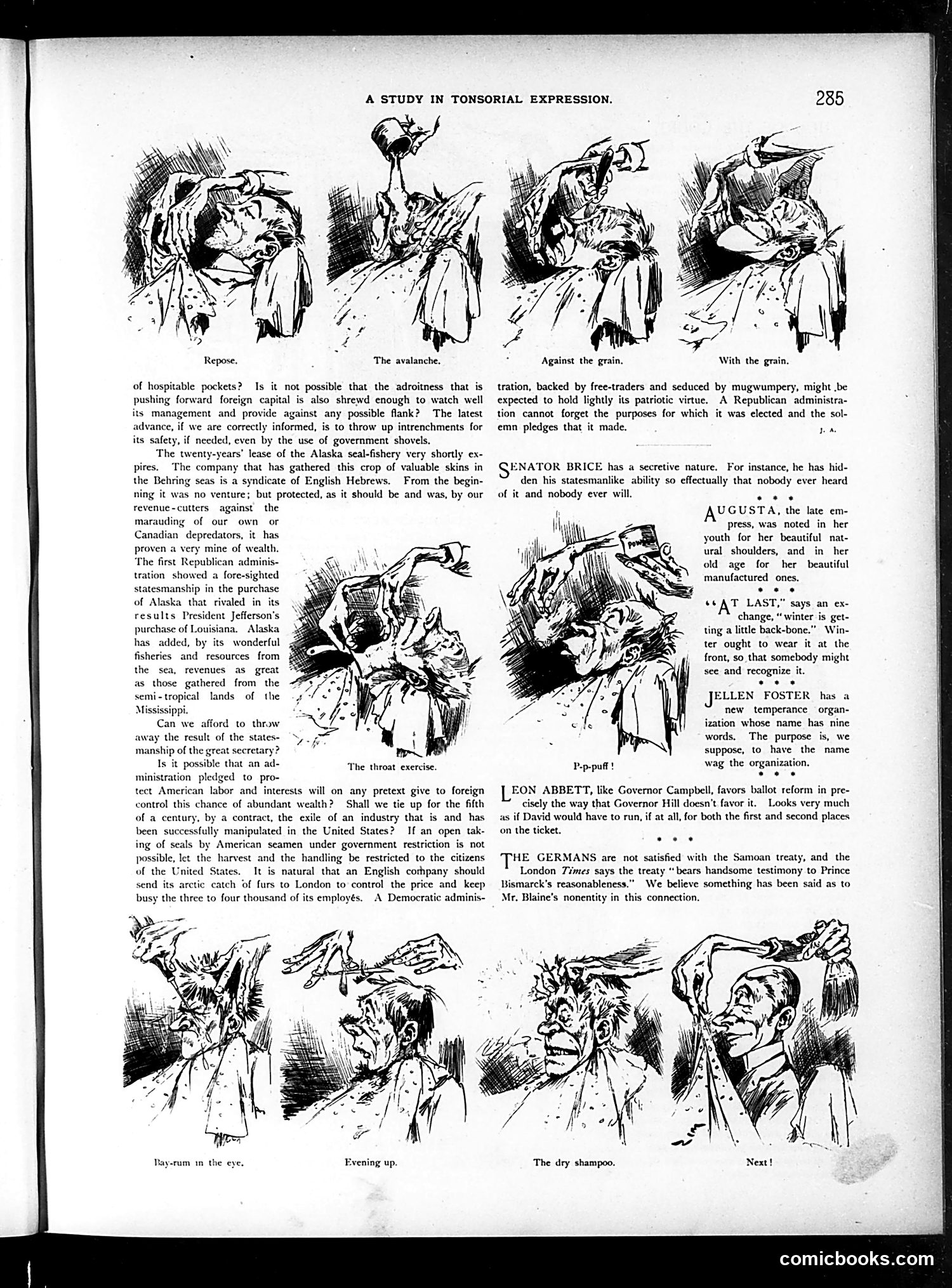
This page contains satirical sketches demonstrating facial expressions and physical comedy—what the header calls "A Study in Tonsorial Expression" (tonsorial = barbering/hairdressing). The captioned vignettes depict exaggerated reactions to barbershop experiences: "Repose," "The avalanche," "Against the grain," "With the grain," "The throat exercise," "P-p-puff!," "Ray-rum in the eye," "Evening up," "The dry shampoo," and "Next!" The article text discusses political matters including Senator Brice, Alaska fisheries, President Jefferson's Louisiana Purchase, and German treaty negotiations—typical Judge editorial commentary. However, the primary visual focus is the sequential humor of barbershop misadventures, using grotesque facial caricature to mock everyday discomforts of shaving and haircuts. This exemplifies the magazine's use of physiognomy-based comedy popular in early 20th-century American satire.
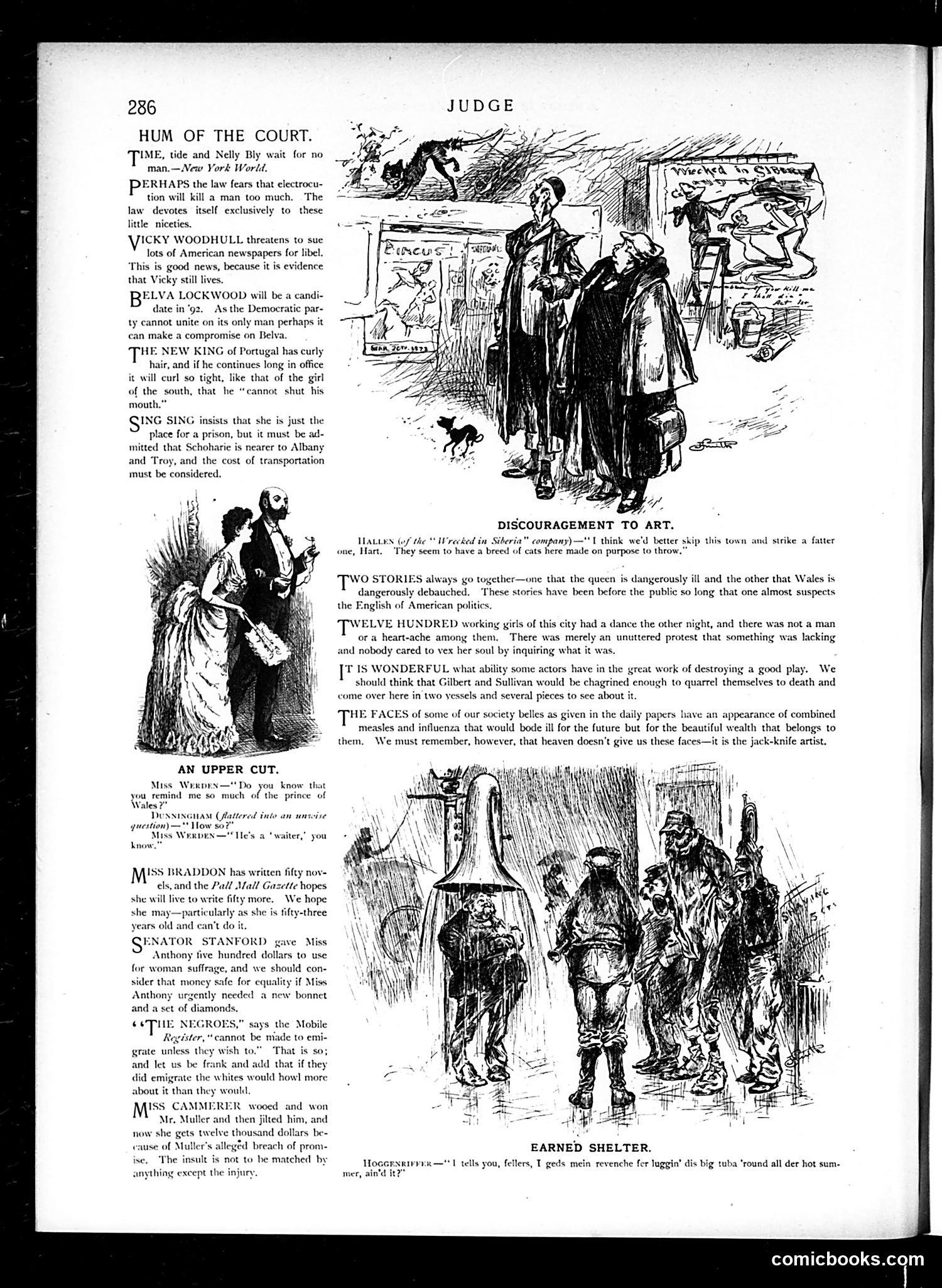
This page from Judge satirizes various social and political issues of the 1880s-90s era: **"Discouragement to Art"** mocks theatrical producers touring America, suggesting provincial audiences lack sophistication (they throw things at actors). **Multiple brief commentary pieces** target: - **Victoria Woodhull** and **Belva Lockwood**: early women's rights activists and political candidates, presented skeptically - **Gilbert and Sullivan**: famous operetta composers, criticized for their theatrical work - **Society women**: their faces allegedly artificially altered by "jack-knife artists" (cosmetic procedures) - **Woman suffrage**: Senator Stanford's donation to women's causes treated dismissively - **Race relations**: commentary on Black emigration desires, reflecting period racial attitudes The cartoon illustrations depict working-class and immigrant characters in period dress. "Earned Shelter" shows someone seeking refuge from summer heat. The page reflects Judge's conservative editorial stance mocking progressive causes while using humor about contemporary social anxieties.
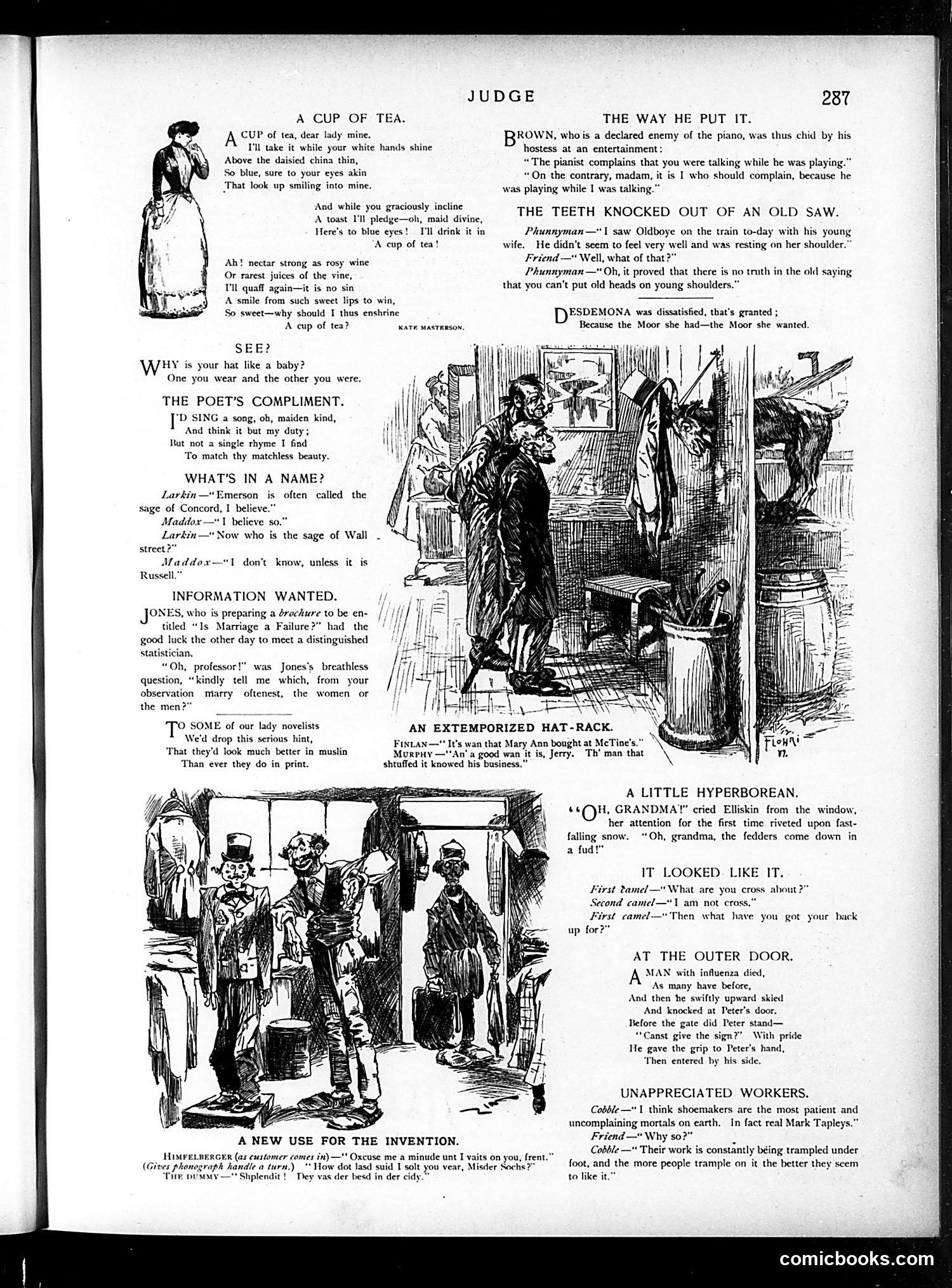
This page contains multiple brief comedic sketches typical of Judge's format. The main pieces include: **"A Cup of Tea"** and **"The Way He Put It"**: Romantic poetry contrasted with a blunt retort about a pianist—satire on affected courtship dialogue versus practical rudeness. **"The Teeth Knocked Out of an Old Saw"**: Mocks the proverb "you can't put old heads on young shoulders" by showing an elderly man resting on his young wife's shoulder, suggesting the saying has no truth. **"Desdemona"**: A brief quip about Shakespeare's *Othello*, joking that Desdemona was unhappy because she had "the Moor" but wanted "the Moor" (unclear wordplay). Other sketches poke fun at poetry, riddles, marriage statistics, shoemakers' patience, and Irish-accented dialect humor. The illustrations accompany light social humor rather than sharp political satire. The overall tone targets everyday absurdities and human nature rather than specific current events.
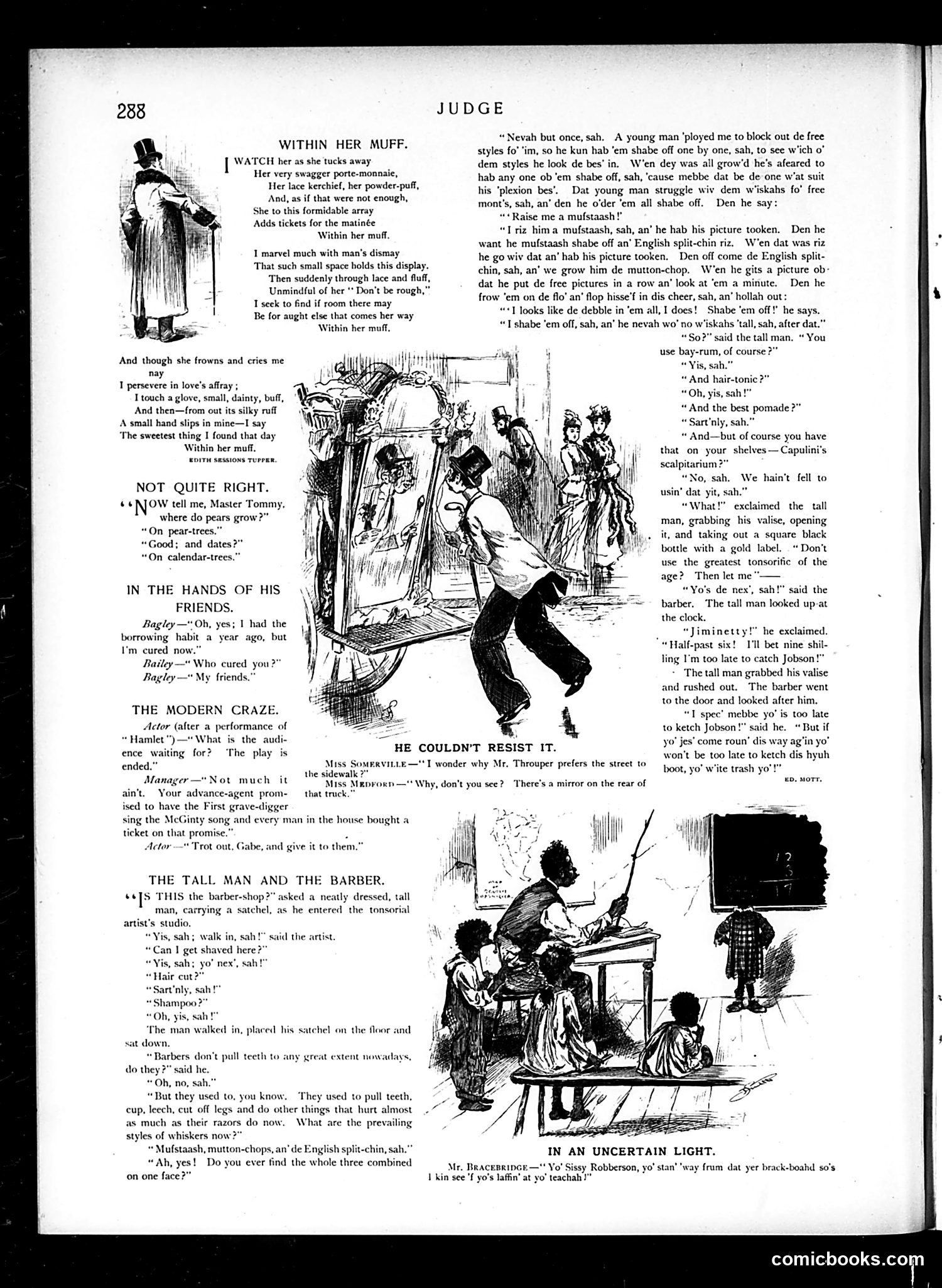
This page contains several short satirical pieces typical of Judge's humor circa early 1900s: **"Within Her Muff"** is a romantic poem playing on double entendre—"muff" refers both to a woman's hand warmer and serves as innuendo about what else might fit inside. **"The Tall Man and the Barber"** uses dialect humor (common but now offensive) to satirize male vanity. A customer spends months trying different facial hair styles—mustache, mutton-chops, English split-chin—before deciding none suit him and shaving completely. The joke mocks indecisive fashion-consciousness and male grooming obsession, particularly the emerging market for hair products (bay-rum, hair-tonic, pomade, "Capulini's scalpitarium"). **"The Modern Craze"** mocks theatrical conventions where audiences demand performers sing popular songs (the "McGinty song") even after the show ends. The remaining pieces are simple puns and observational humor. The page reflects Judge's focus on contemporary social foibles and emerging consumer culture around personal grooming.
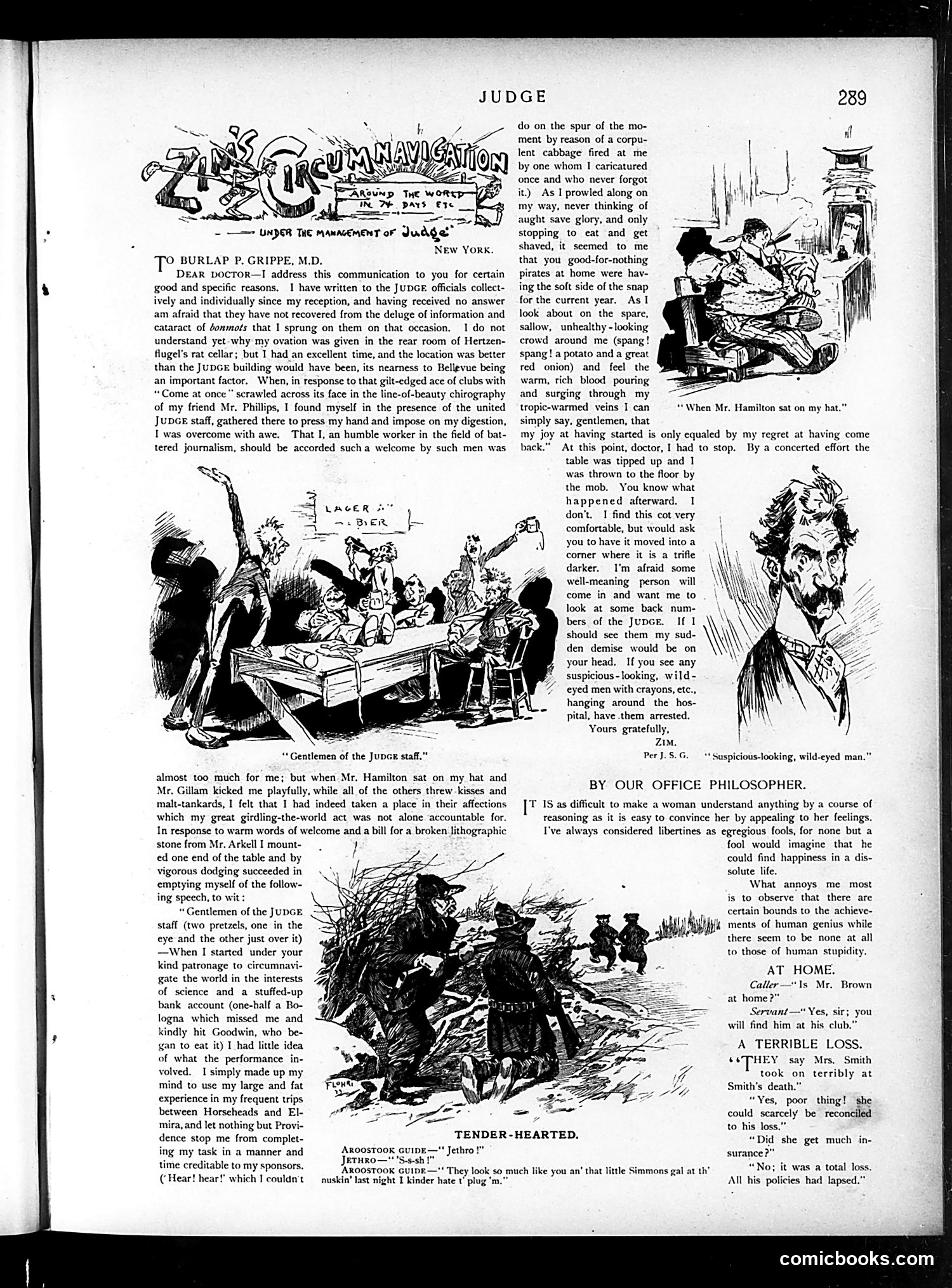
This page satirizes the *Judge* magazine's editorial staff and their reception of a visiting journalist/adventurer. The main letter (left column) is a humorous complaint to "Dr. Burlap P. Grippe" describing a chaotic welcome party where the *Judge* staff allegedly assaulted the visitor—sitting on his hat, kicking him, throwing food. The accompanying illustrations show the rowdy celebration and the battered correspondent afterward. The satire targets the magazine's own staff as crude, uncouth "pirates" who treated the visitor roughly while he was away on a world expedition. It's self-deprecating humor about *Judge's* internal culture and reputation for rowdiness. The sketches of the "Gentlemen of the Judge staff" and the battered visitor reinforce the joke that these editors are more interested in physical comedy than respectability. The rural dialect piece at bottom ("Tender-Hearted") appears unrelated topical humor.
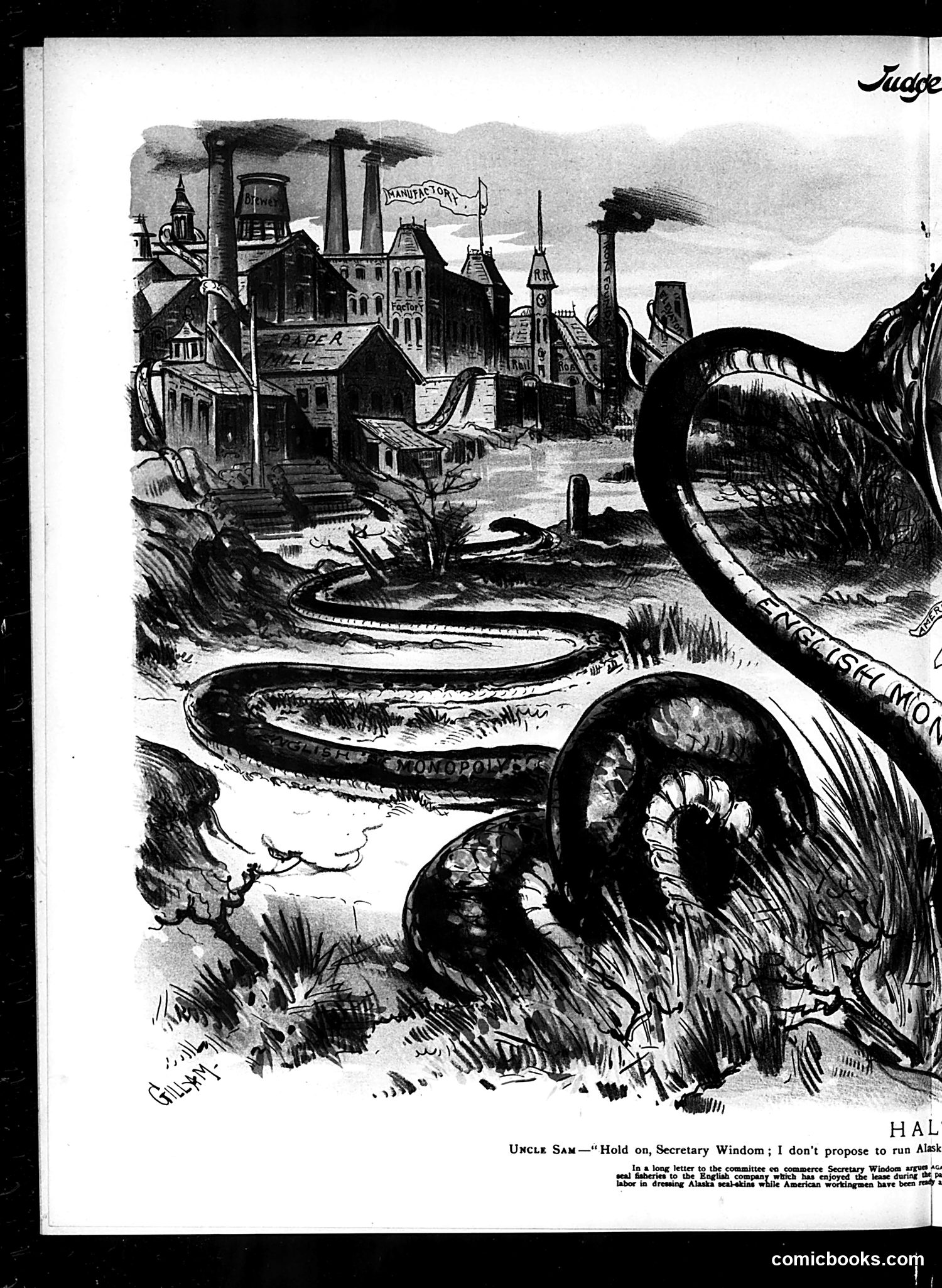
This political cartoon depicts Uncle Sam (representing the United States) restraining Secretary of the Treasury Windom from pursuing Alaska seal-hunting operations. The satire criticizes Windom's proposal to allow a British company to continue harvesting seals in Alaska while American workers remained unemployed. The industrial cityscape in the background represents American manufacturing and labor. The large seal pelts in the foreground symbolize the contested resource. The cartoon's message: Uncle Sam shouldn't prioritize foreign commercial interests over domestic American jobs and workers. It's a labor-rights critique against what the cartoonist viewed as unfair trade policies favoring British interests at American workers' expense.
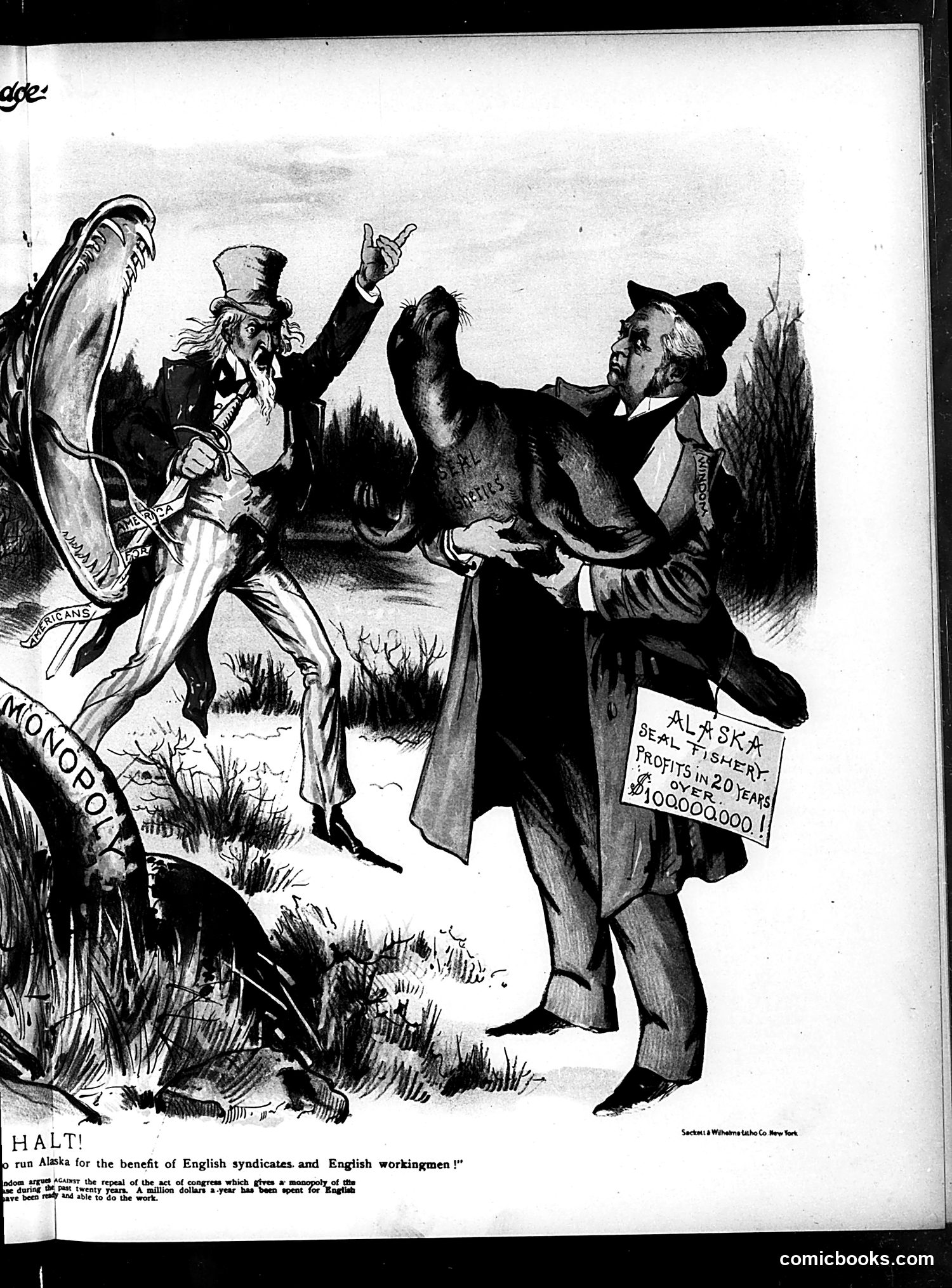
This Puck magazine cartoon satirizes American policy regarding Alaska's resources. The figure on the left, labeled "Uncle Sam," is being stopped by another character holding a sign reading "Alaska Seal Fishery Profits 20 Years $100,000,000!!" The satire criticizes the granting of monopoly rights over Alaska's seal fishery to English syndicates and investors rather than benefiting American workers. The cartoon protests that a Congressional act awarded exclusive fishing rights that generated enormous profits ($100 million over twenty years) while enriching foreign business interests instead of American laborers or the public. The "HALT!" command suggests stopping this exploitative arrangement. This reflects late 19th-century American anxieties about foreign corporate control of natural resources and concerns that American workers were being excluded from economic benefits of territorial expansion.
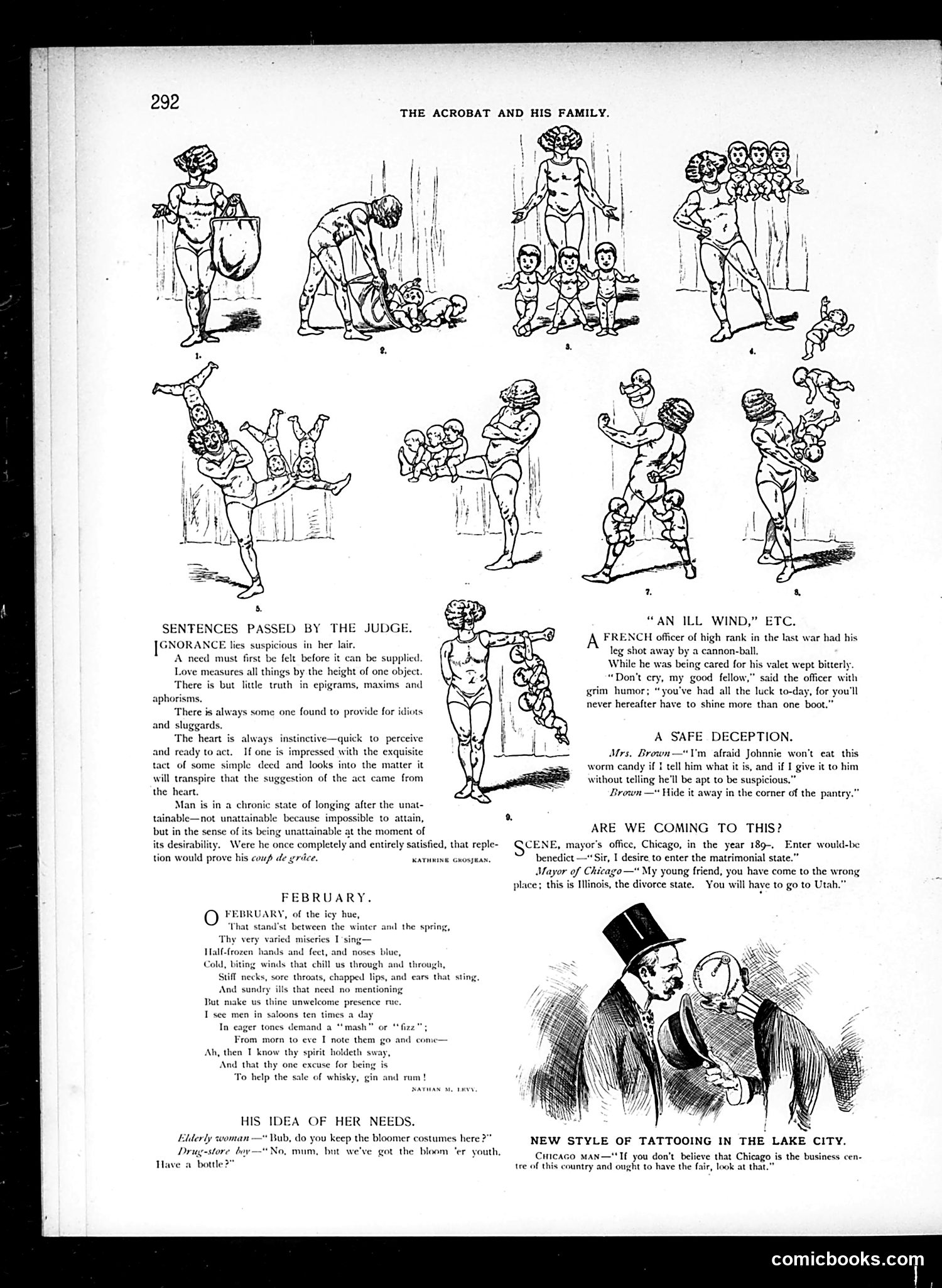
This page mixes humorous anecdotes, philosophical musings, and satirical commentary typical of Judge magazine's format. **"An Ill Wind"** presents a gallows-humor joke about a French officer who lost a leg in war—the valet's silver lining is he'll now only need to polish one boot. It's dark comedy about disability. **"Sentences Passed by the Judge"** offers aphoristic observations on human nature (ignorance, love, the heart's instinctiveness), presented as judicial wisdom. **"Are We Coming to This?"** satirizes Chicago's reputation as the "divorce state." A man seeks to marry there, but the mayor redirects him to Utah, suggesting Chicago's permissive divorce laws make it unsuitable for matrimony—social commentary on changing marriage/divorce culture. **"New Style of Tattooing in the Lake City"** jabs at Chicago's boastfulness, implying the fair itself (likely the 1893 World's Columbian Exposition) is merely a tattoo—superficial ornamentation promoting the city's false claims to importance. The acrobat illustrations appear decorative, unrelated to accompanying text.
This page primarily features **"McAllister's Ball,"** a satirical poem mocking Ward McAllister, a prominent New York society figure known for organizing exclusive high-society events for the city's wealthy elite (the "Four Hundred"). **The Satire's Target:** The poem attacks McAllister and wealthy society's shallow priorities—lavish balls and obsession with "blue blood" status while poor people starve nearby ("scores of poor devils must hunger and freeze / In reach of the lights of McAllister's ball"). **Key Mockery:** - McAllister is portrayed as embodying snobbery and frivolous excess - The wealthy are caricatured as vapid, morally corrupt ("whose pastime deceit") - Fashion and dress are depicted as hollow idols ("idol of noodiery's slave / Who kneels at the sanctified altar of dress") **Context:** Late 19th-century Judge used satire to critique American class inequality and the conspicuous consumption of the Gilded Age elite, particularly New York's pretentious aristocracy. The rest of the page contains advertisements and brief humorous items—typical of the magazine's format.
This page is primarily **advertising**, featuring numerous product and service ads (Scott's Emulsion, Liebig's Extract of Meat, Columbia Cycles, etc.) interspersed with several brief humorous snippets—the actual satirical content. The jokes include: 1. **"Museum of Religions"**: A husband and wife observe a Shinto temple display containing only white paper and mirrors. The wife quips that the founder was "spiritual" because he "knew how to attract men"—satirizing both shallow religious understanding and women's superficiality. 2. **Photographer's "Sillyhoot"**: A woman requests her portrait show a silly expression ("sillyhoot"), frustrating the photographer, who tears out his hair in exasperation. 3. **Grammar and Sentiment**: Three women debate whether "a kiss is but a common noun"—wordplay mixing grammar with romantic banter, concluding that a kiss is "hard to be declined." 4. **Stenographers on trains**: Notes the Pennsylvania Railroad is adding stenographers to its Limited train service for businessmen. These are light, domestic humor pieces typical of Judge's satirical style—no specific political figures or major events are referenced.
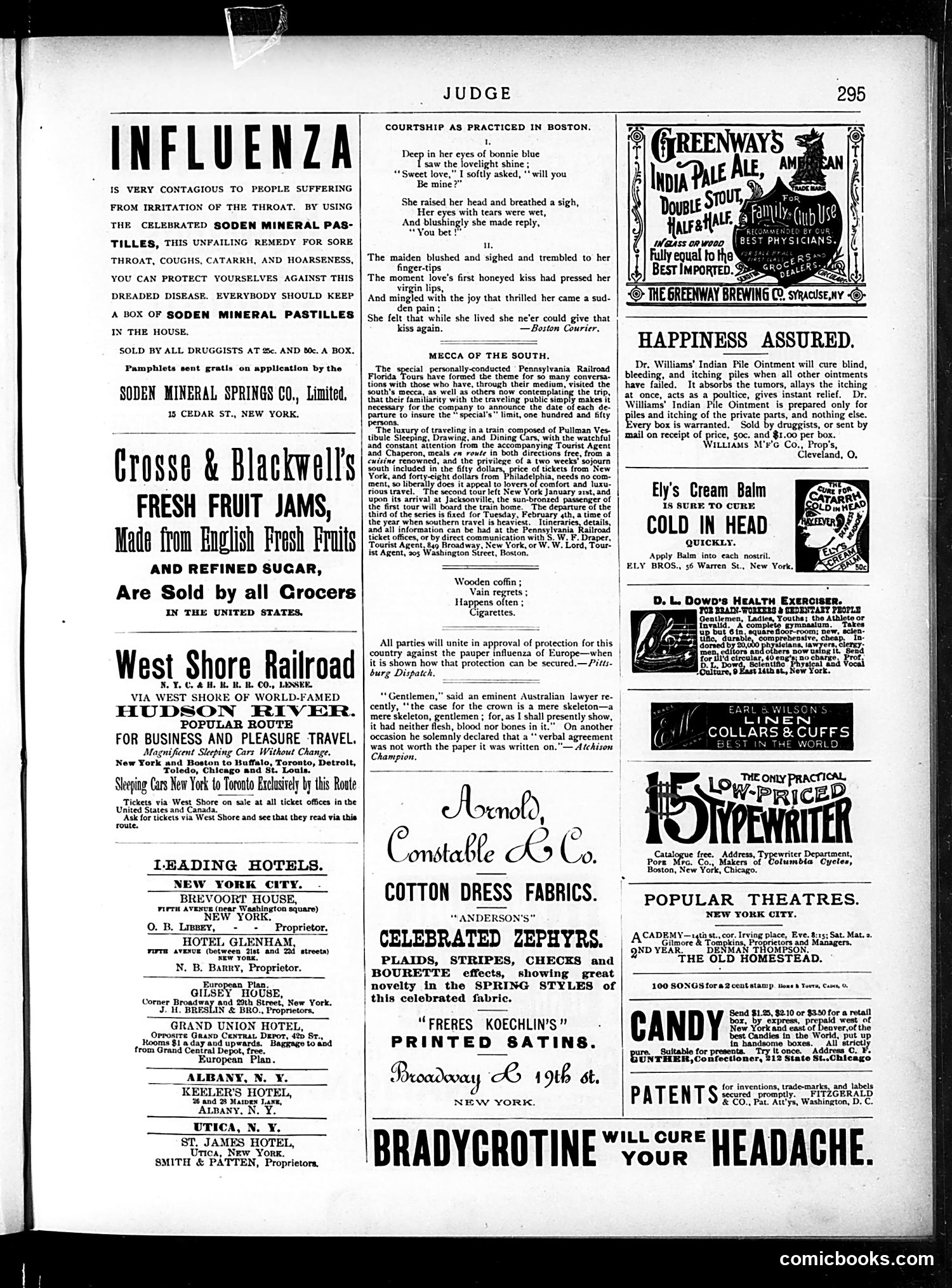
This page is **primarily advertising**, with only minor satirical content. The main items of note: **The Cartoons/Satire:** Two brief, humorous poems appear under "COURTSHIP AS PRACTICED IN BOSTON" and include a "MECCA OF THE SOUTH" section. These are gentle social commentary rather than sharp political satire—the Boston courtship poem uses the punchline "You bet!" as supposedly typical New England female romanticism, while the second section humorously lists life's inevitable sequence: coffin, regrets, and cigarettes. **Historical Context:** The page dates to when influenza was a serious public health concern (likely WWI era, based on the medical anxiety), and shows how patent medicines and mineral pastilles were marketed as preventatives. The railroad advertisements reflect America's extensive 19th-century rail network development. **Overall:** This is a typical Judge page mixing light humor with commercial advertising rather than hard-hitting political satire.
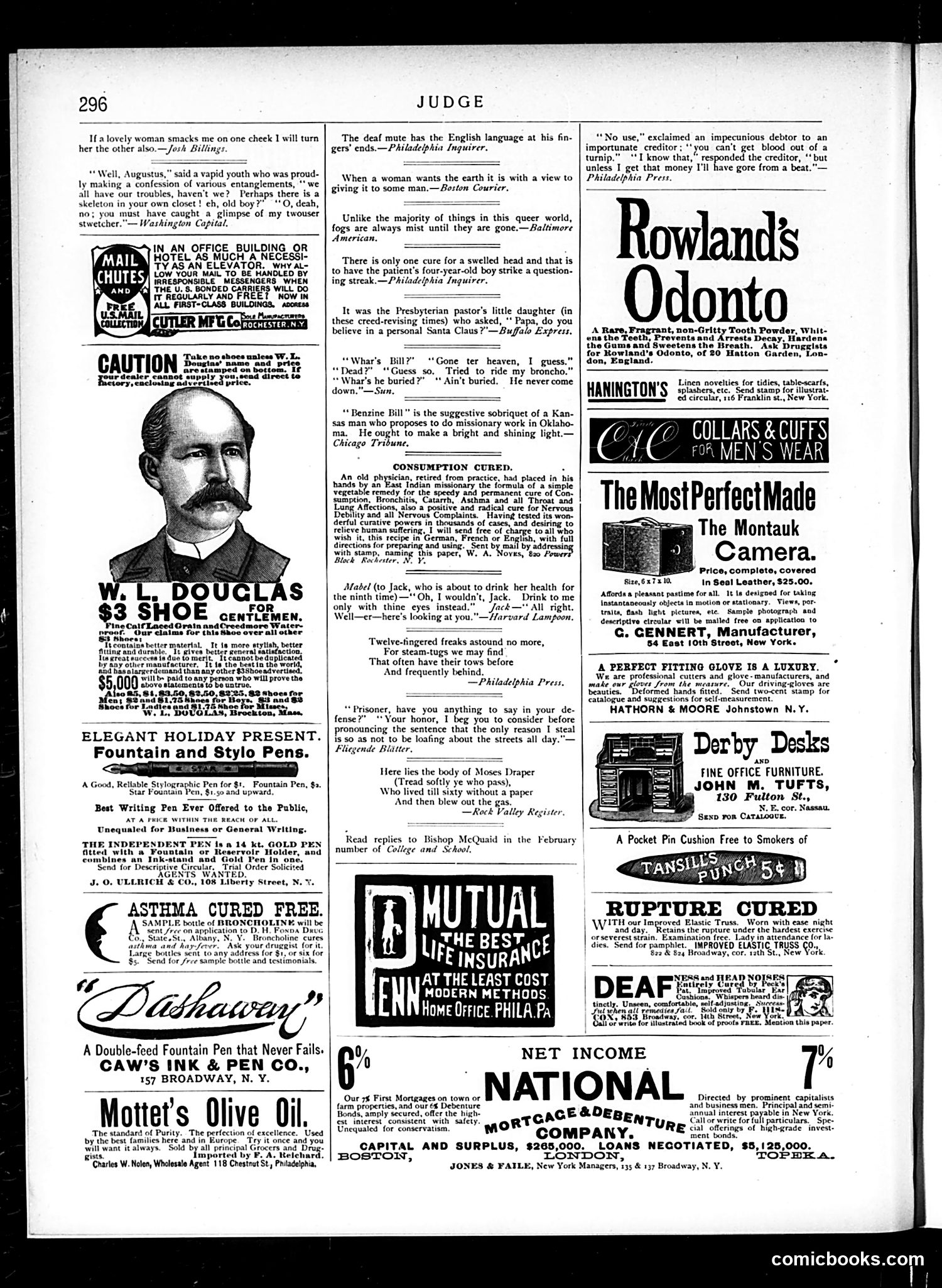
This page is primarily **advertising**, with scattered short satirical jokes typical of Judge magazine's format. The main visual element is a large advertisement for **W.L. Douglas shoes** ($3), featuring a portrait photograph meant to convey respectability and quality. The shoe ad emphasizes durability and value. The scattered text jokes mock contemporary social pretensions and regional dialect humor: - A vapid youth brags about his romantic "troubles"; his companion jokes about having a "trouser stretcher" instead of skeleton in his closet—mocking affectation and vanity - "Benzine Bill," a Kansas man doing missionary work in Oklahoma, is called a "bright and shining light"—likely sarcastic wordplay given "benzine" (gasoline) - Regional humor about a deceased cowboy ("He never come down") uses frontier dialect for comic effect The remaining content consists of patent medicine and pen advertisements common to the era, making no particular political statement. **The page lacks significant political cartooning or sustained satirical commentary.**
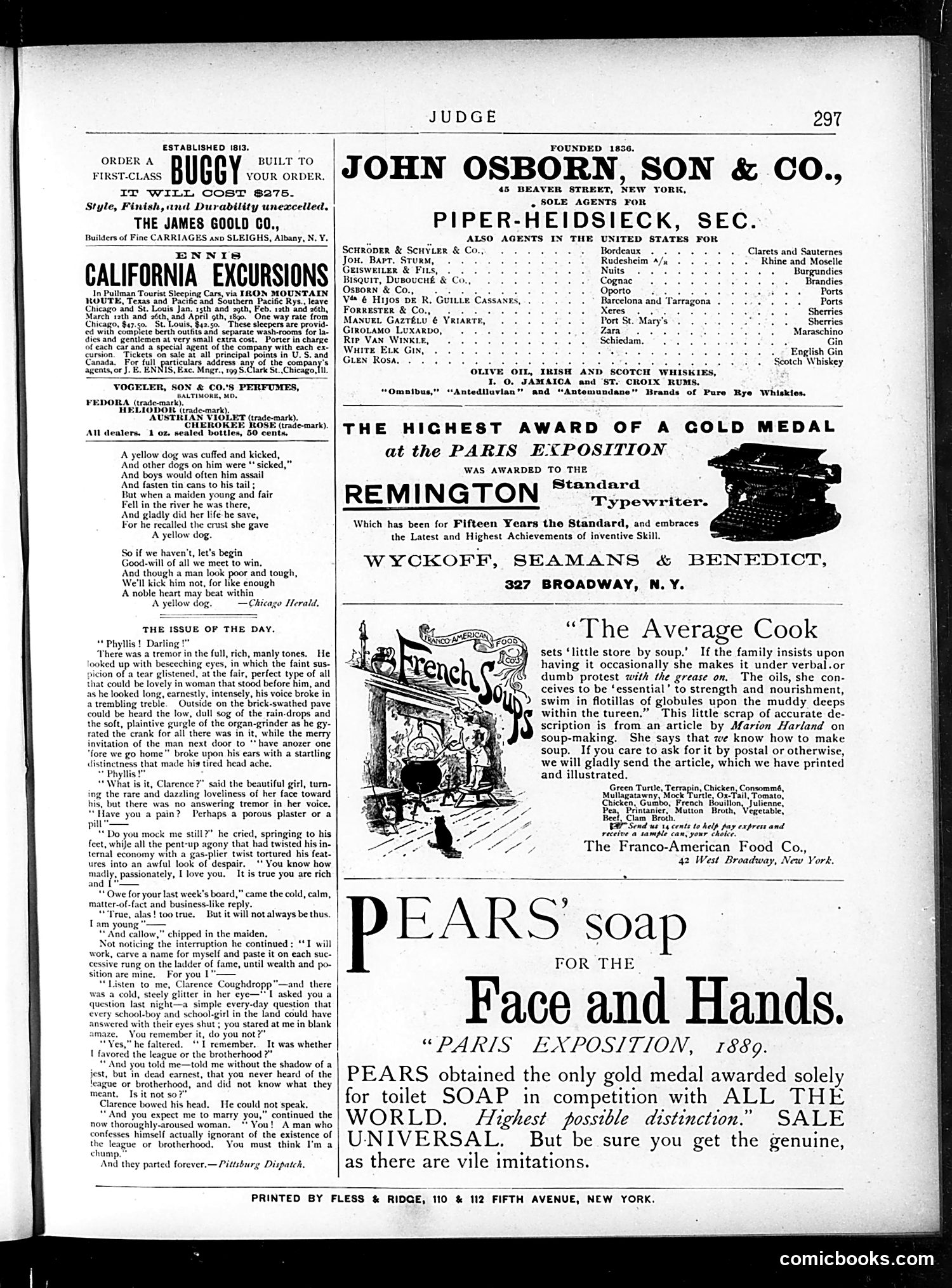
This page is primarily **advertising with embedded fiction and poetry**, not political satire. The main content includes: 1. **"The Issue of the Day"** — A melodramatic short story parody mocking sentimental Victorian romance fiction. A lovesick suitor named Clarence Coughdropp attempts an earnest declaration to "Phyllis," but is repeatedly interrupted by mundane realities (a landlady demanding rent, street noise). The satire targets overwrought romantic literature by contrasting flowery emotional language with harsh practical concerns. 2. **"A Yellow Dog"** — A sentimental poem (reprinted from *Chicago Herald*) celebrating a dog's loyalty and kindness, likely included as uplifting filler content. 3. **Extensive advertisements** for carriages, travel excursions, perfumes, soap, food products, and a typewriter — the magazine's primary revenue source. The page reflects *Judge*'s typical format: mixing light satirical fiction mocking literary conventions with commercial advertising. There are no identifiable political figures or events referenced here.
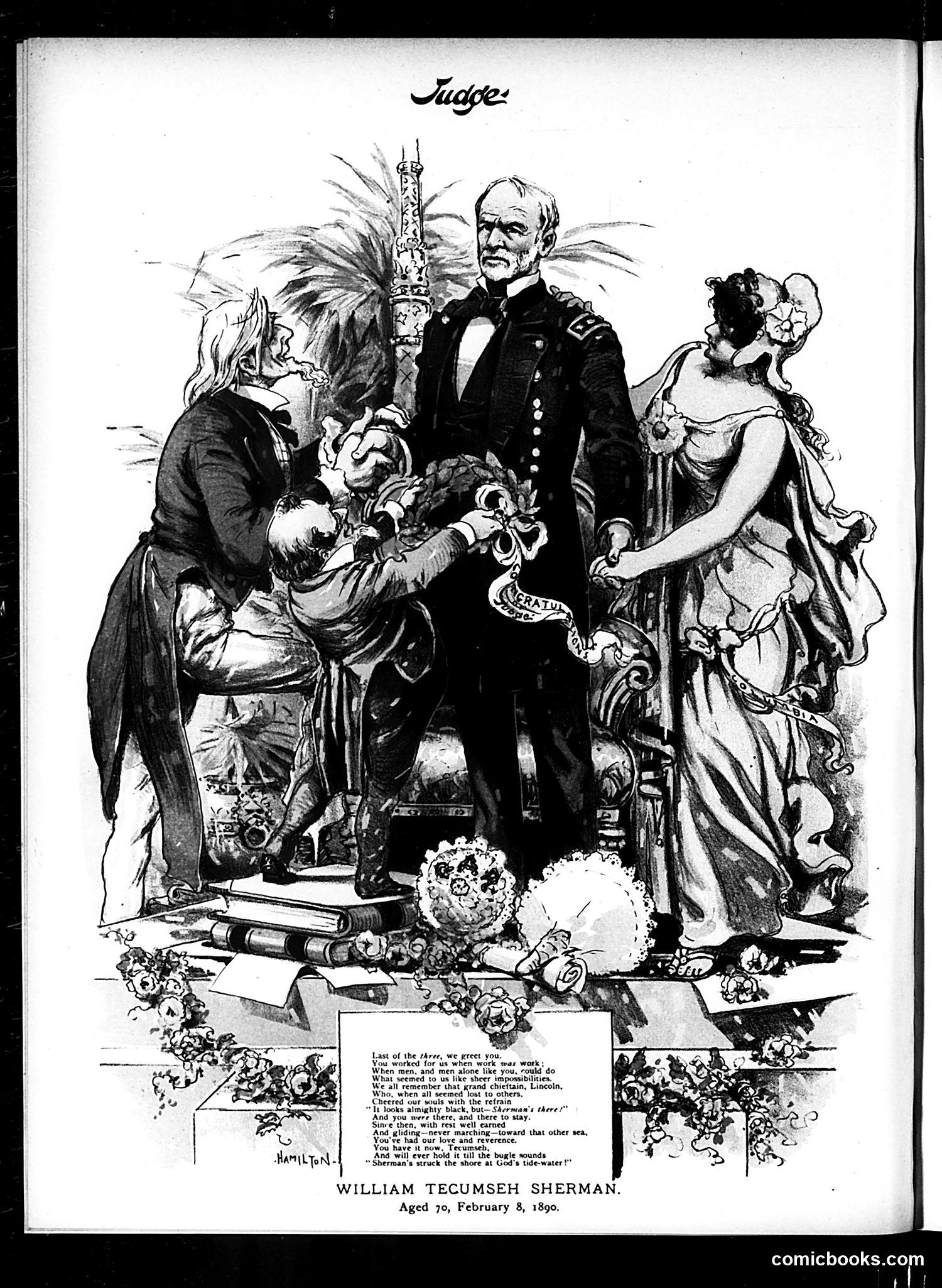
This is a commemorative illustration for **General William Tecumseh Sherman**, dated February 8, 1890—likely marking his death or a significant anniversary. The central military figure in uniform is surrounded by allegorical female figures representing concepts like Victory, Peace, and America, along with military symbols (cannons, flags, wreaths). The poem beneath praises Sherman's Civil War legacy, referencing his famous March to the Sea and military campaigns. The satirical magazine *Judge* is presenting this as a respectful tribute to the Union general, celebrating his role in preserving the nation during the Civil War—a subject still politically sensitive in 1890, twenty-five years after the war's end. The ornate, reverent treatment suggests Sherman was viewed as a national hero worthy of veneration by the magazine's audience.