
A complete issue · 16 pages · 1890
Judge — January 18, 1890
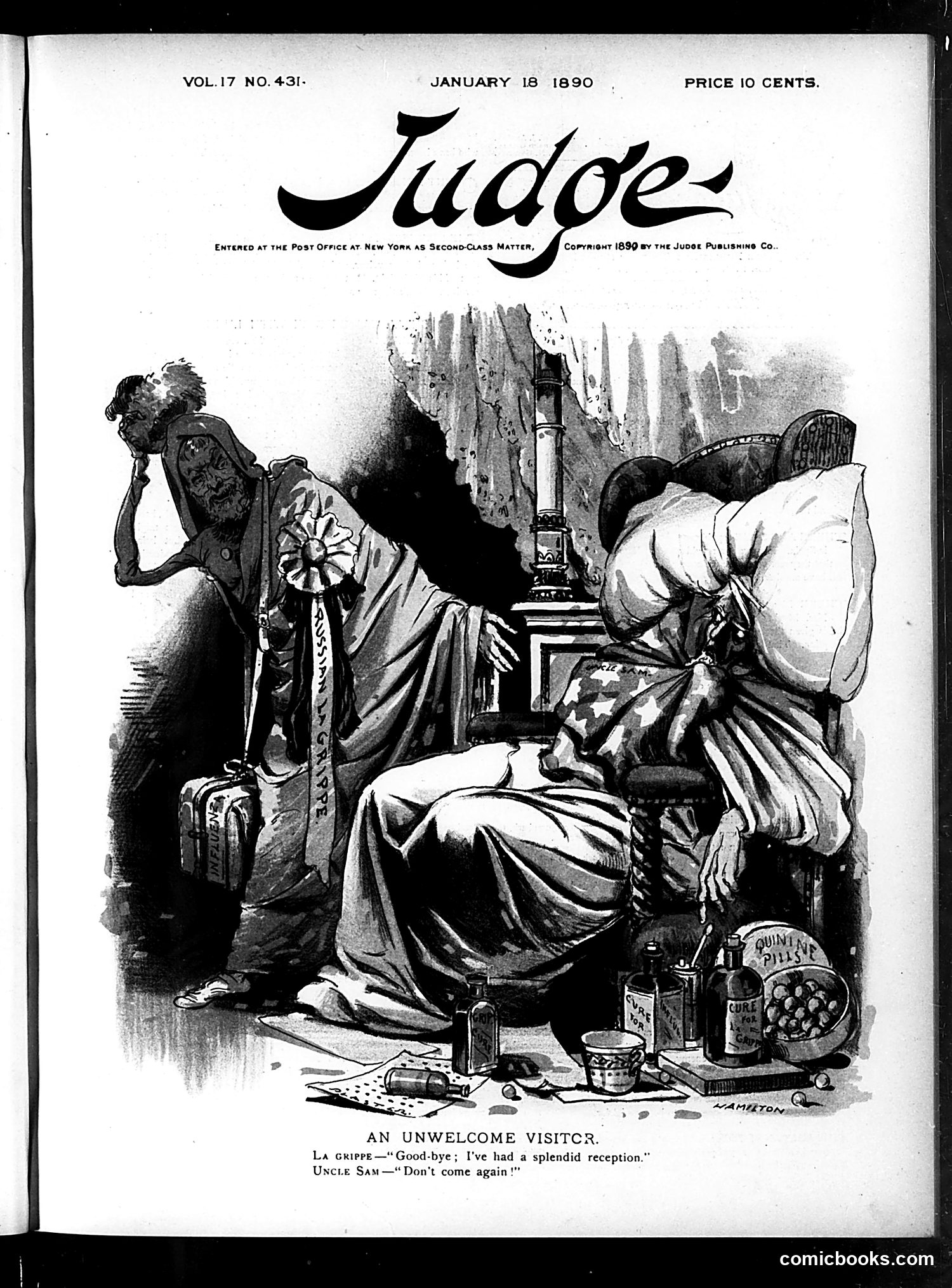
This political cartoon depicts "La Grippe" (influenza) as a personified disease visiting "Uncle Sam" (America). The sick figure on the right represents the United States suffering from illness, surrounded by medicinal bottles and pills. The departing figure on the left, labeled "La Grippe," says "Good-bye; I've had a splendid reception," while Uncle Sam responds "Don't come again!" The satire comments on a widespread flu epidemic affecting America during this period. By personifying the disease as a visiting dignitary who's "had a splendid reception," Judge mocks how extensively the illness spread through the population—suggesting Americans unwittingly welcomed it. The accompanying medicine bottles underscore the public health crisis and ineffective treatments of the era.
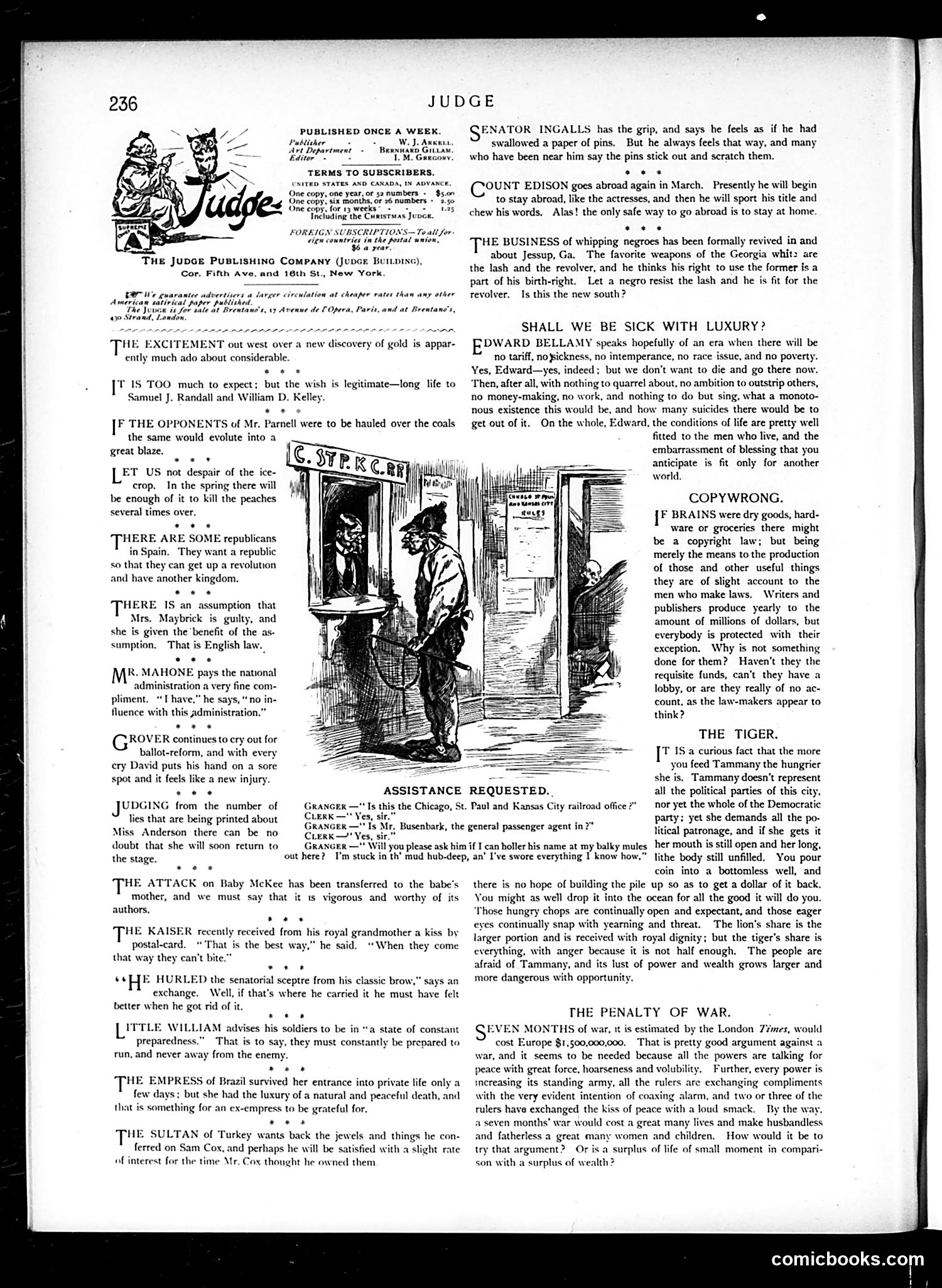
The central cartoon titled "Assistance Requested" depicts a dialogue between a railroad clerk and what appears to be a passenger or customer at a Chicago, St. Paul and Kansas City Railroad office. The humor seems to derive from a man requesting help locating his "bulky mules" at the office, with the clerk responding about a "general passenger agent." The satire likely mocks railroad customer service inefficiency or bureaucratic confusion—a common complaint during the Gilded Age when rail companies faced criticism for poor service. The absurdity of searching for livestock at a railroad office amplifies the joke about institutional disorganization. Without additional context identifying specific individuals or historical railroad incidents, the broader satirical target appears to be railroad company incompetence rather than specific political figures.
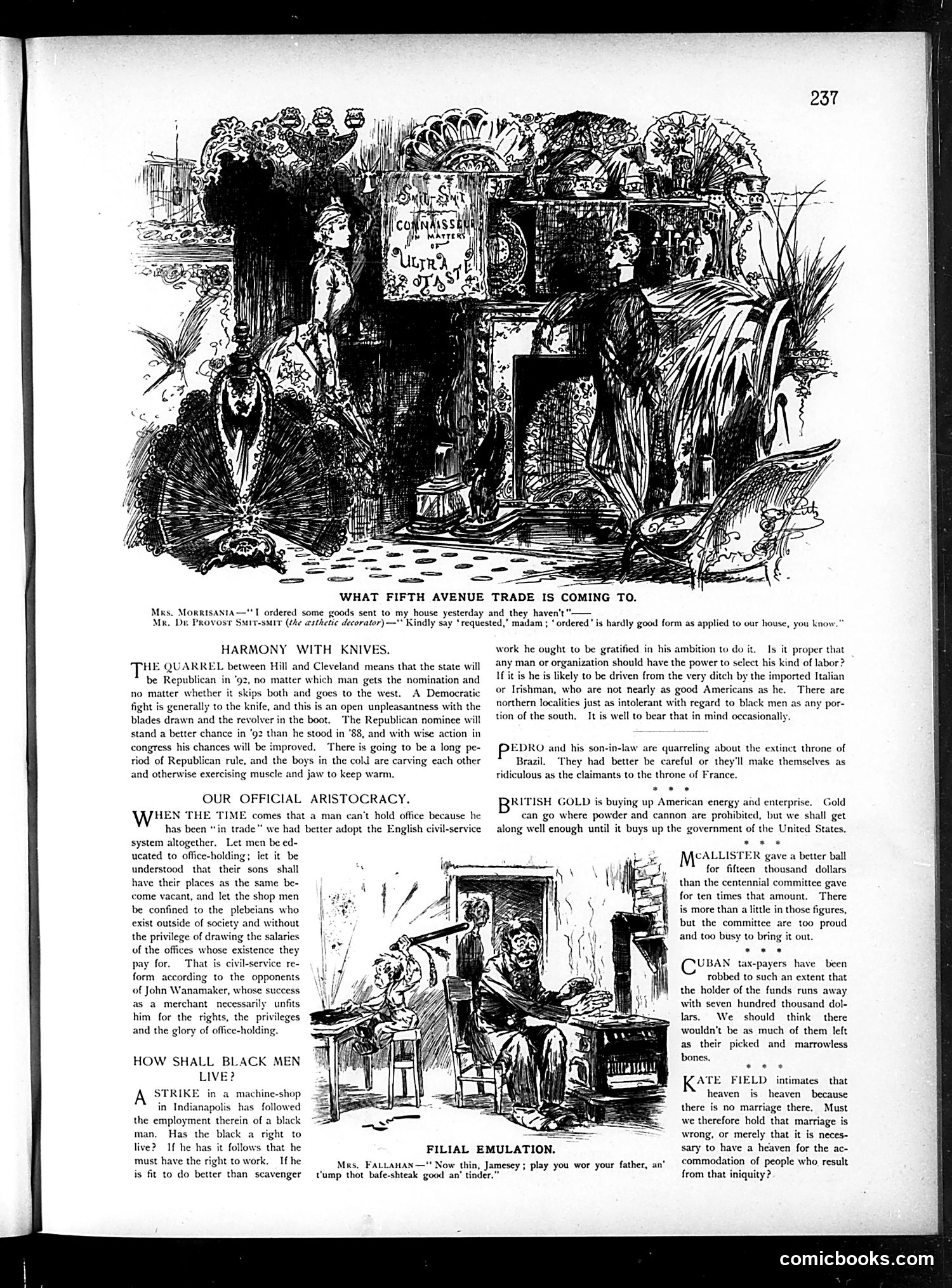
The top cartoon, "What Fifth Avenue Trade Is Coming To," satirizes New York's wealthy elite. Mrs. Morrisania complains to Mr. De Provost Smit-Smit (labeled "the artistic decorator") about ordering items for her house. The joke mocks the pretentious language and affectations of both wealthy clients and decorators—she notes that "ordered" is "hardly good form" in their social circle, preferring euphemistic language befitting aristocratic manners. The remaining text columns discuss contemporary political and social issues: Republican nomination politics, British investment in American enterprise, Cuban tax problems, and debates about Black workers' employment rights. These are opinion pieces rather than comics, reflecting Judge's satirical commentary on 1870s-80s American society and politics.
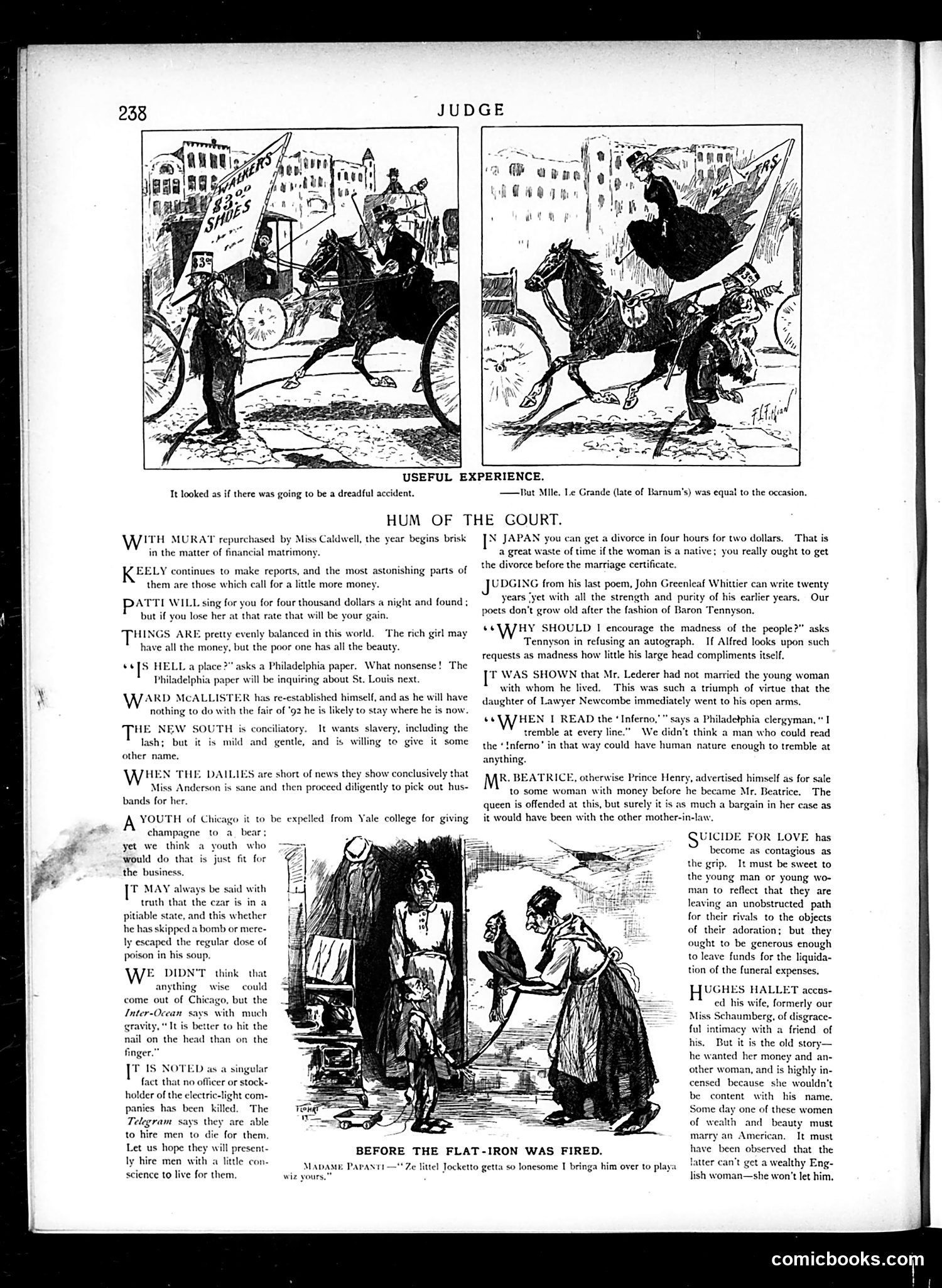
This page from *Judge* magazine contains brief satirical commentary on contemporary 1890s social and political topics, rather than a single unified cartoon. The top illustration labeled "Useful Experience" depicts an accident involving a horse-drawn carriage, referencing "Mlle. Le Grande (late of Barnum's)"—apparently a performer from Barnum's circus known for handling such situations. The "Hum of the Court" section consists of short jokes about: - Wealthy marriages (Murat's remarriage, Adelina Patti's expensive singing fees) - Divorce laws in Japan - Poet John Greenleaf Whittier's continued vitality - Alfred Tennyson's refusal to sign autographs - Various scandals involving named individuals (Lederer, Prince Henry/Mr. Beatrice) - Social commentary on wealth, divorce, and relationships The satire targets hypocrisy, excessive wealth, and absurdities in high society and celebrity culture of the Gilded Age. Most references are to now-obscure contemporary figures and events.
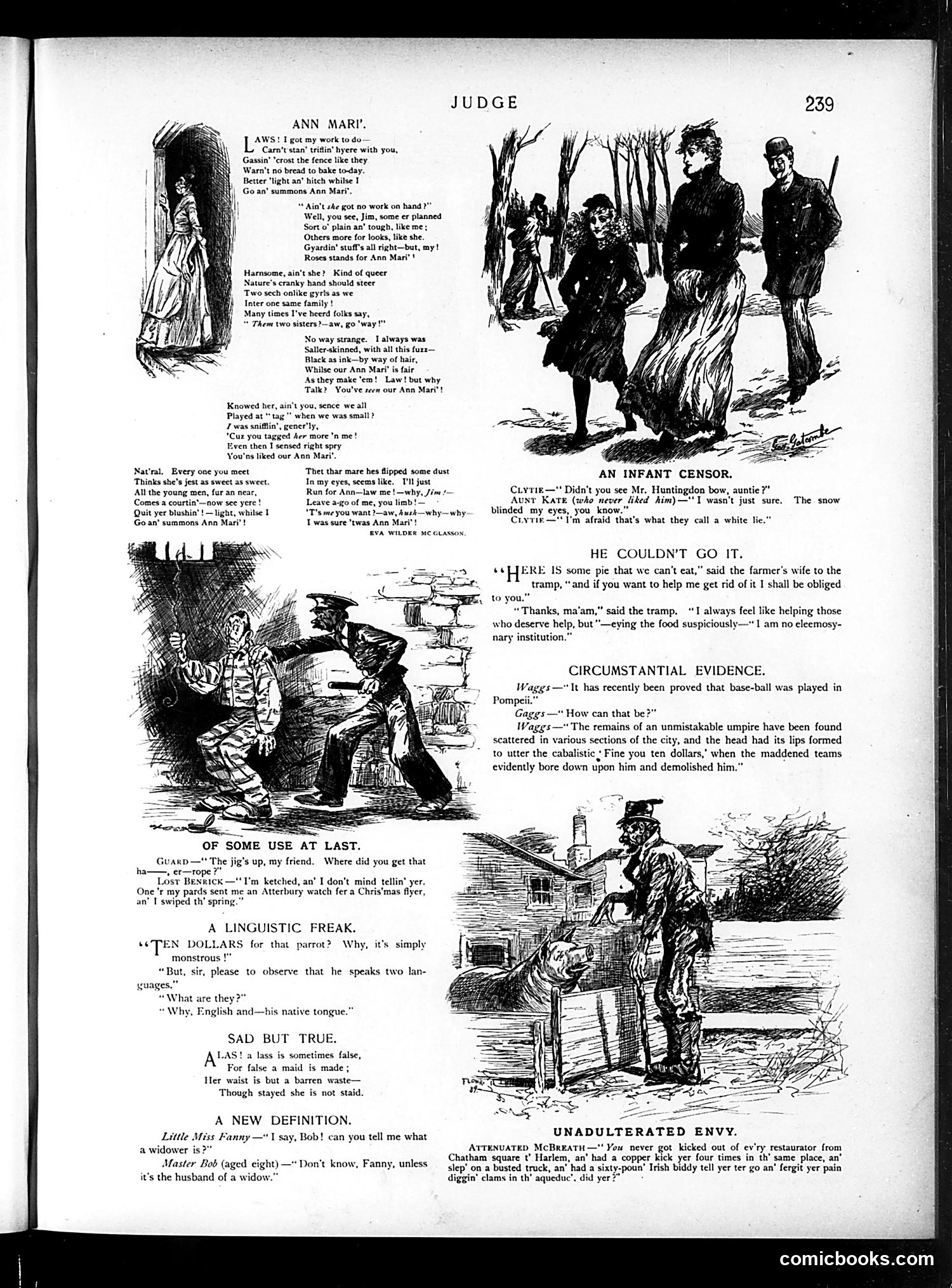
This page contains multiple short satirical pieces typical of Judge's humor: **"Ann Mari'"** (top): A dialect poem about two sisters—one plain and hardworking, one beautiful. The joke plays on class/appearance stereotypes and rural speech patterns common in period humor. The narrator resents that suitors prefer the attractive sister. **"An Infant Censor"** (right): A child notices a man's bow and innocently calls it a "white lie," suggesting the adult's gesture was dishonest or insincere. This satirizes both childhood innocence and social pretense. **"Circumstantial Evidence"**: A joke claiming baseball was played in ancient Pompeii because scattered remains of an umpire were found—with his lips still forming the phrase "Fine you ten dollars." This mocks both umpires' authority and archaeological interpretation. **Minor pieces** include jokes about tramping, linguistic freaks, and definitions—all light observational humor about class, gender, and social manners typical of Judge's satirical voice. The dialect and character types reflect turn-of-century American popular humor conventions.
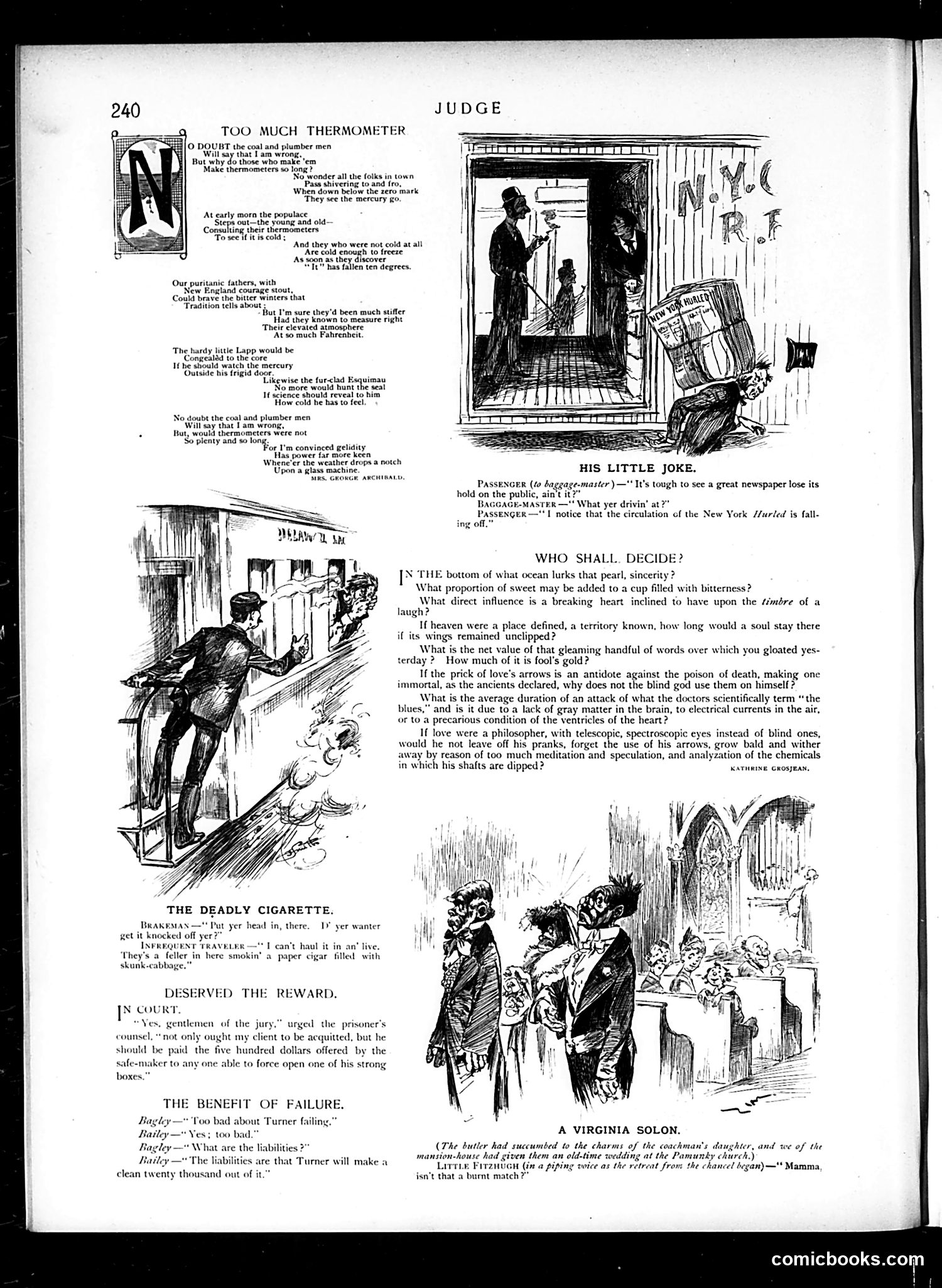
This page contains several satirical pieces typical of Judge's humor: **"Too Much Thermometer"** mocks how thermometers psychologically influence people's perception of cold. The poem argues that knowing the exact temperature makes people *feel* colder than they actually are, unlike hardy ancestors who endured winters without scientific measurement. It's social satire on modern anxiety and over-reliance on data. **"His Little Joke"** shows a newspaper vendor claiming circulation losses—likely referencing contemporary newspaper competition or declining readership. **"The Deadly Cigarette"** depicts workers discussing a dangerous cigarette, possibly satirizing workplace hazards or adulterated products. **"Deserved the Reward"** jokes about a prisoner's lawyer arguing the client should receive reward money for cracking a safe—absurdist legal satire. **"Who Shall Decide?"** presents philosophical riddles about love, death, and happiness—whimsical existential humor. **"A Virginia Solon"** appears to mock a Southern gentleman's servant at a wedding, likely playing on class and regional stereotypes common to the era.
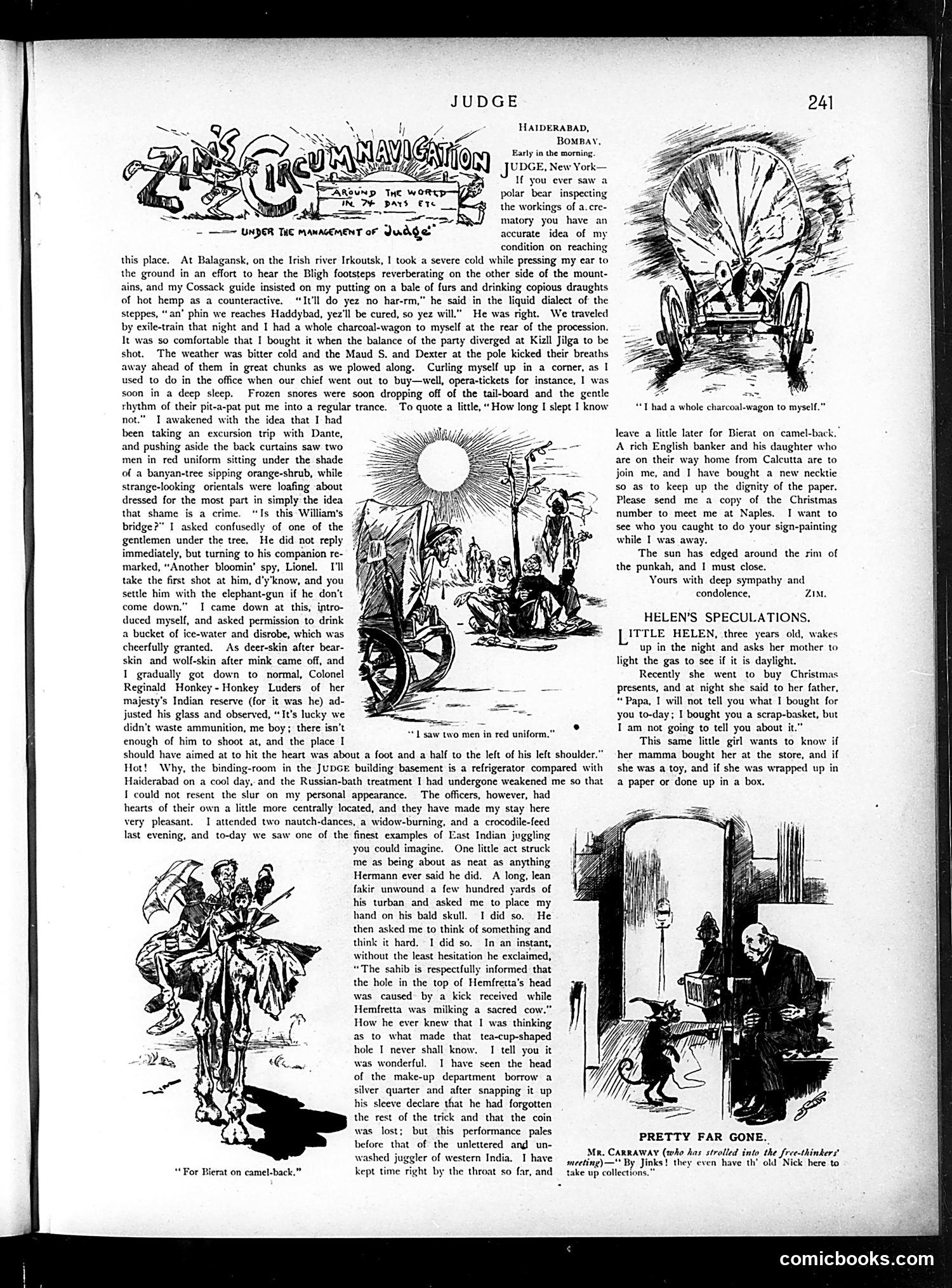
This page contains a humorous travel narrative titled "Circumnavigation in 70 Days" — the author's account of an expedition through remote regions (Russia, India). The satire targets several things: **The Content:** The writer describes absurd hardships (extreme cold, drinking "hot hemp," sleeping in a charcoal wagon) mixed with exaggerated encounters in India — meeting military officers, attending "nautch-dances" and "widow-burning," and witnessing a fakir's (holy man's) supposedly miraculous trick. **The Satire:** The joke mocks Victorian-era travel narratives and explorers' tall tales. The author presents increasingly implausible events (soldiers calling him a "spy," references to famous racehorses) with deadpan sincerity, parodying how colonial travelers sensationalized their experiences for American audiences. **The Point:** This is gentle mockery of Orientalism and the genre of adventure literature — poking fun at how exotic locales were dramatized for domestic entertainment. The illustrations depict scenes from the narrative with matching satirical absurdity.
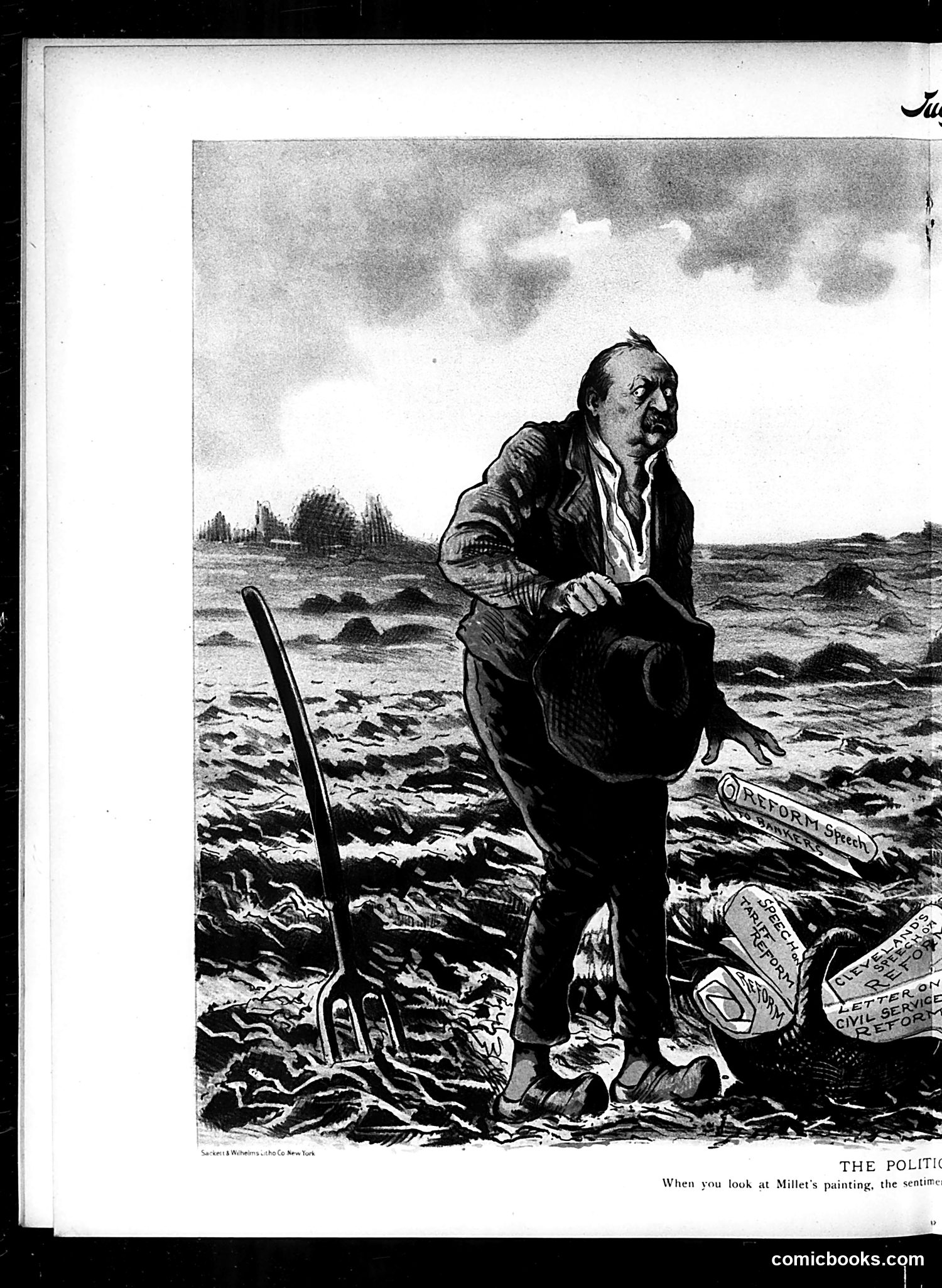
This is a political cartoon satirizing a figure standing on a desolate, trash-strewn beach. The man appears distressed and contemplative, holding a farming fork. The visible text references "Millet's painting," likely alluding to Jean-François Millet's famous 1857 work "The Gleaners" or similar rural imagery celebrating peasant labor. The scattered debris on the ground includes labels mentioning "Civil Service" and what appears to be "Oxford Street," suggesting urban political corruption or failed institutions. The cartoon appears to critique a political figure through ironic contrast—juxtaposing the romantic sentiment of Millet's agrarian imagery against the sordid reality of urban political waste and decay. The figure's posture conveys despair or resignation. Without the complete text, the specific political target remains unclear, but the satire clearly involves disappointed idealism meeting political reality.
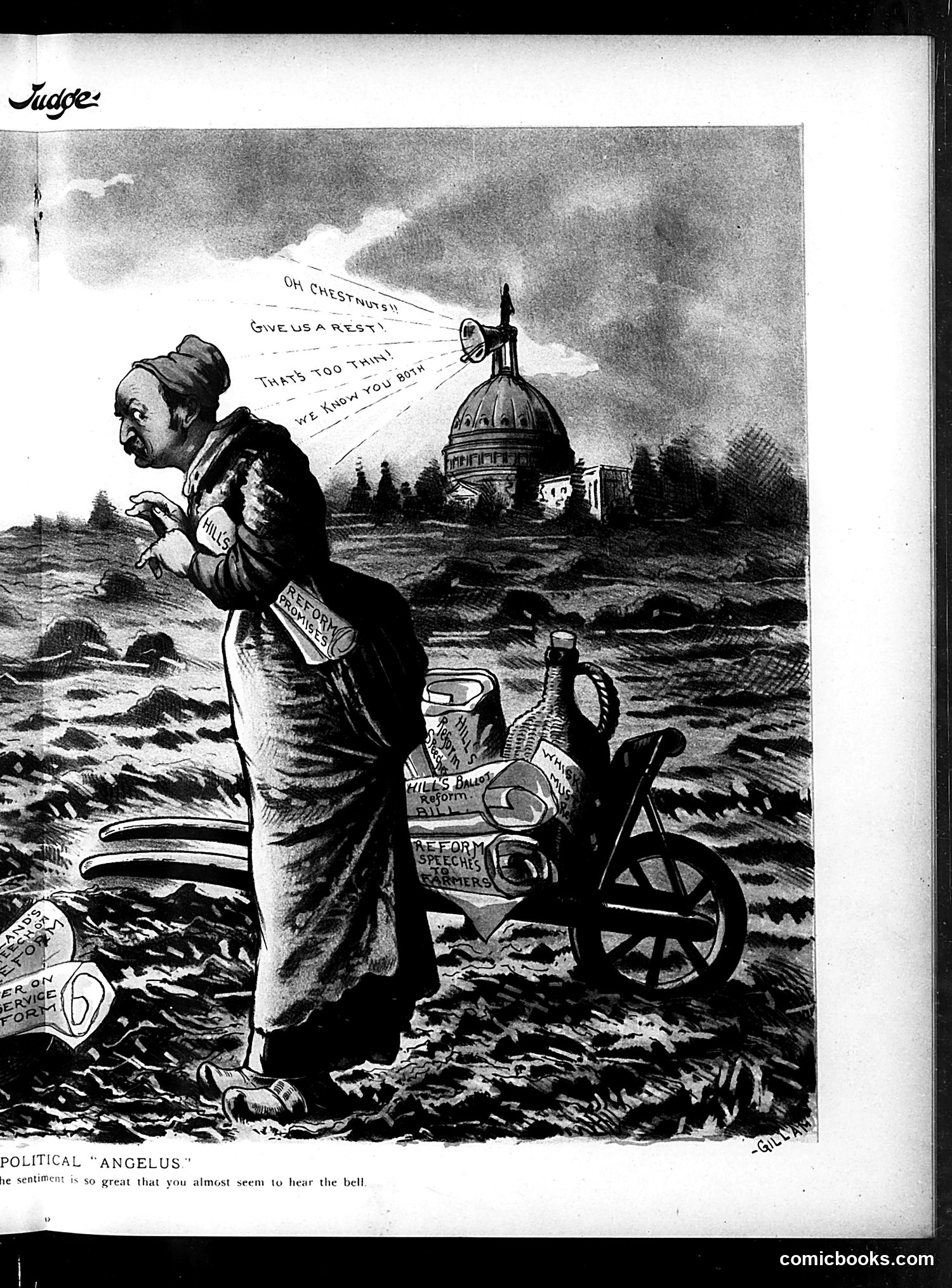
This political cartoon satirizes a figure (identity unclear from visible text) kneeling in prayer-like posture before the Capitol building, with a searchlight beam emanating from above labeled with phrases including "Oh Chestnut," "Give us a rest," "That's too thin," and "We know you both." The cartoon's title references Millet's famous painting "The Angelus," which depicts peasants in reverent prayer. The satire suggests the subject is hypocritically performing religious sentiment or moral piety while engaged in political maneuvering. The various labels on the beam indicate public criticism or exposure of the figure's claims and statements. Various reform-related labels appear on objects at the figure's feet, suggesting this concerns political reform rhetoric versus actual practice. The overall message criticizes performative morality in politics.
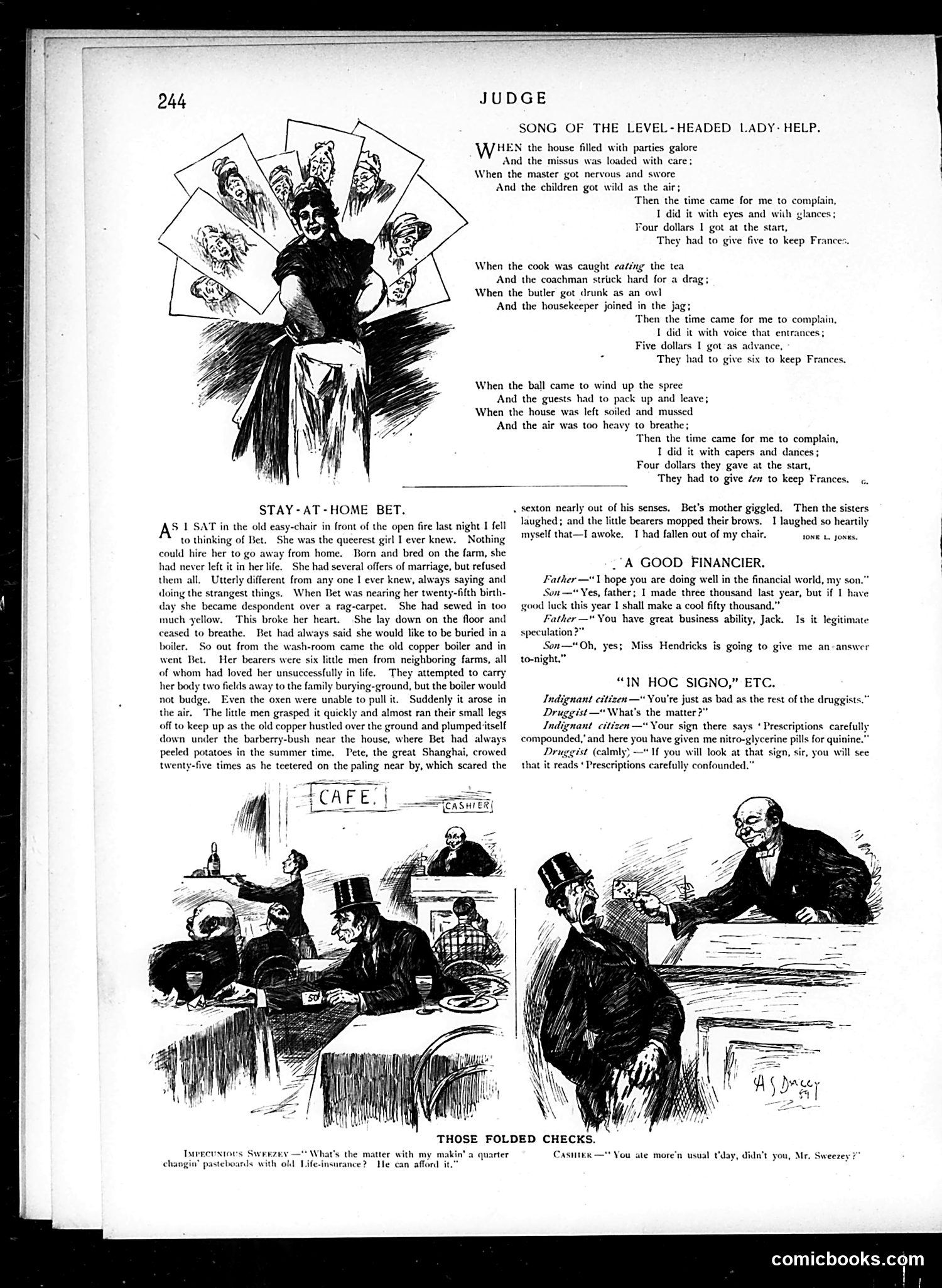
This satirical poem mocks a domestic servant (likely a lady's maid or housekeeper) who repeatedly demands wage increases by threatening to quit. The humor lies in her escalating demands—she starts at $4/month, then $5, then $6, finally $10—each time extracting raises by complaining about household chaos (drunken staff, wild parties, dirty house). The running refrain "They had to give [amount] to keep Frances" suggests she's indispensable and knows her value, turning the tables on employers who typically held all power over servants. The accompanying sketches satirize other labor/financial negotiations: a druggist accused of mislabeling prescriptions (charging for careful work while delivering careless results), and a financier father impressed by his son's dubious business ethics. The page collectively mocks both working-class wage demands and upper-class hypocrisy about honest dealings.
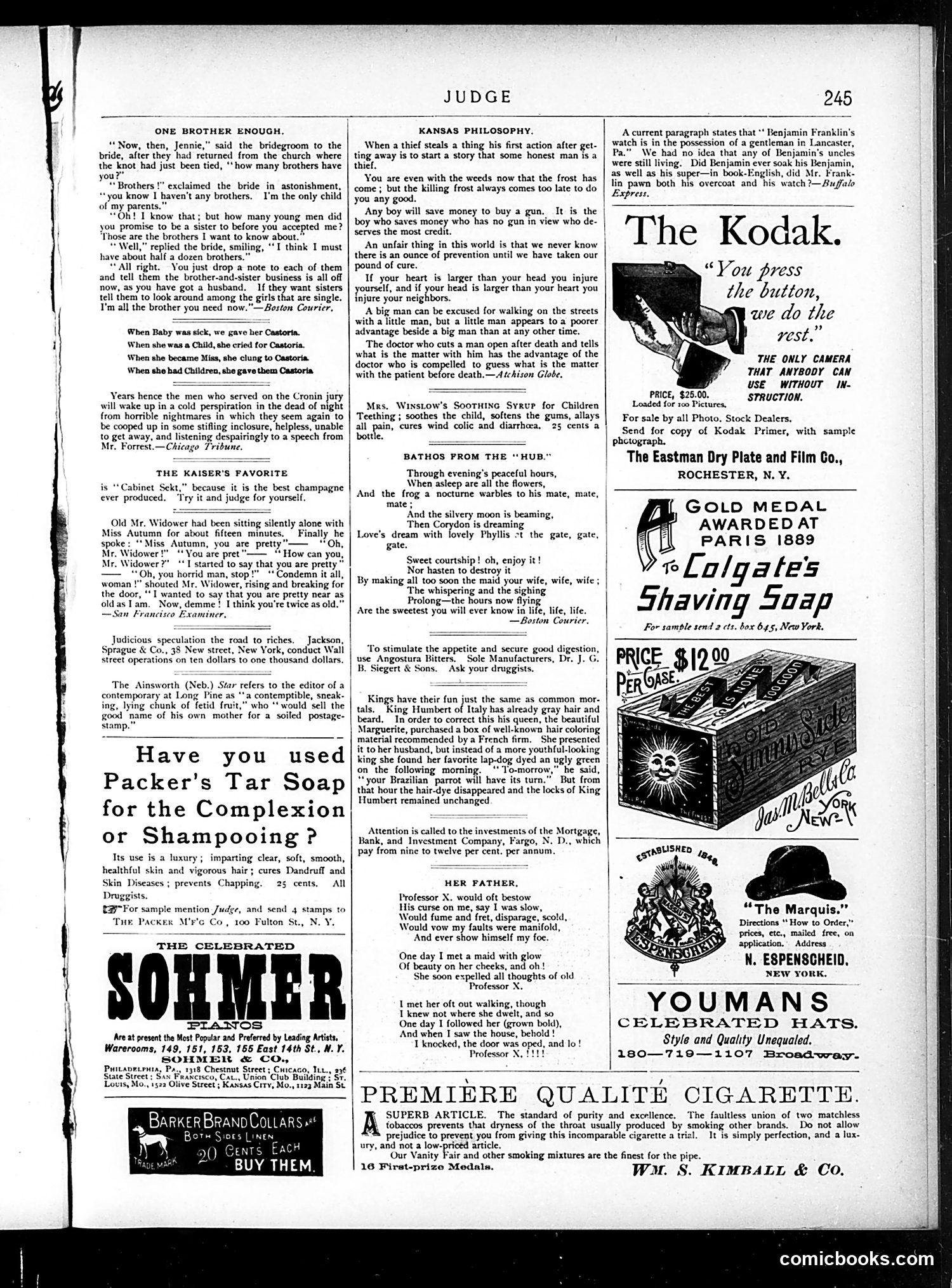
This page is primarily **advertising and humor columns** rather than political cartoons. The main satirical content includes: 1. **"One Brother Enough"**: A newlywed husband demands his bride sever "brother-sister" relationships with other men—a joke about courtship conventions where young women maintained platonic friendships with unmarried men. The humor lies in the husband's jealous reframing of innocent friendships as problematic. 2. **"Kansas Philosophy"**: Folk wisdom observations about rural life—thieves deflecting blame, frost arriving too late for weeds, boys' priorities regarding guns. These appear to mock Kansas stereotypes. 3. **"The Widower and Miss Autumn"**: An elderly widower's clumsy compliment backfires when Miss Autumn misinterprets his attempts to say she's "pretty" as romantic flattery, leading to accusation of impropriety. The humor derives from miscommunication and age-gap awkwardness. The remainder is **period advertisements** (Kodak cameras, Colgate's soap, Sohmer pianos, etc.) typical of Judge's revenue model.
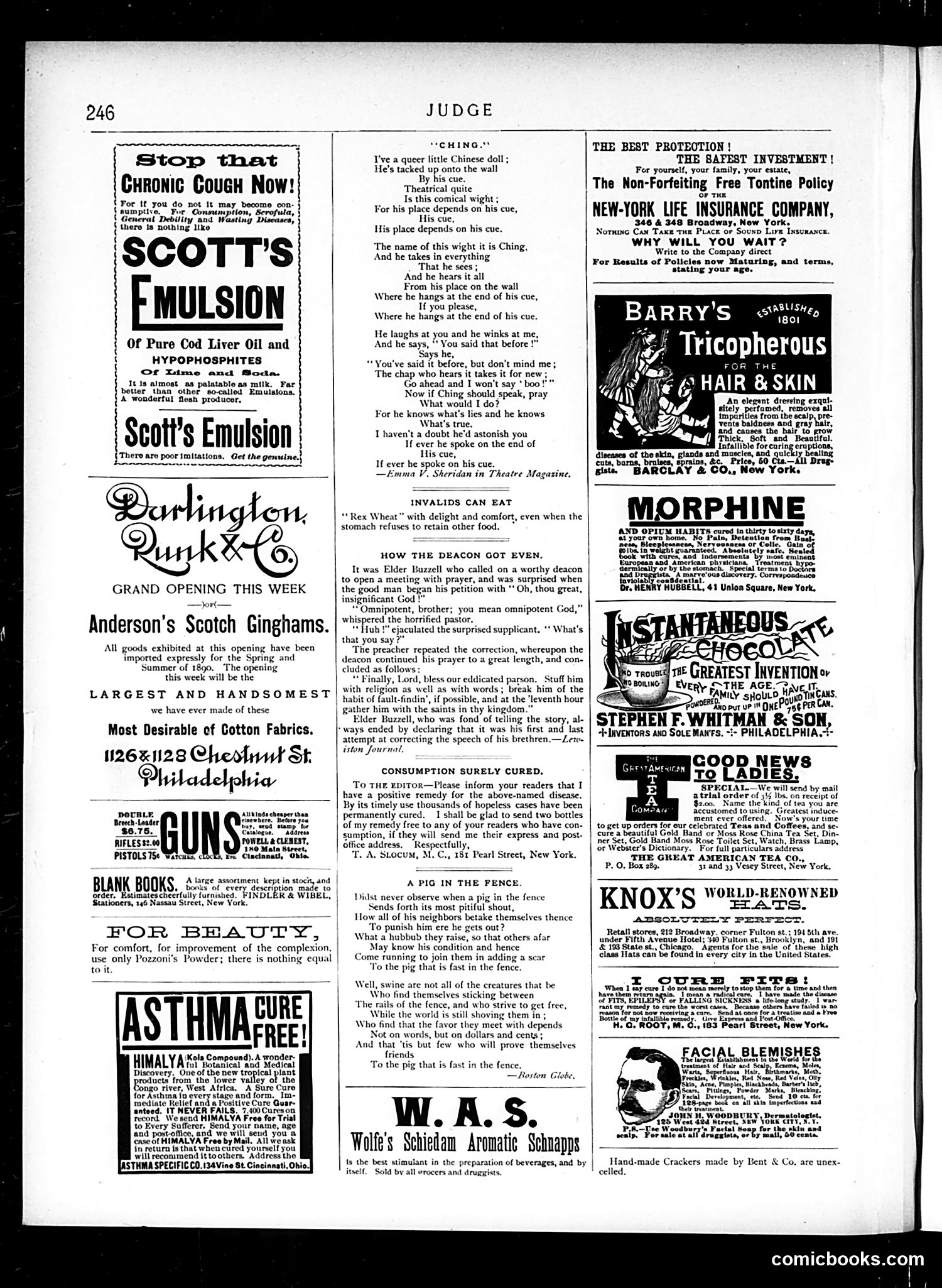
This page is primarily **advertising**, typical of Judge magazine's revenue model. The content includes: **Main Editorial Content:** - A poem titled "Ching" about a Chinese doll hung by its queue (a braided hairstyle), using the doll as a metaphor for observation and judgment - A humorous anecdote, "How the Deacon Got Even," where a deacon deliberately misuses vocabulary ("insignificant" instead of "omnipotent") to mock a pedantic pastor who corrected him during prayer **Social Context:** The "Ching" poem reflects late-19th-century attitudes toward Chinese immigrants—depicting them as curiosities for entertainment. The deacon story satirizes class tensions between educated clergy and working-class congregants. **Advertisements:** Numerous patent medicines (Scott's Emulsion, Himalya for asthma), fabric sales, firearms, and cosmetics dominate the page—typical of Judge's commercial mix during this era.
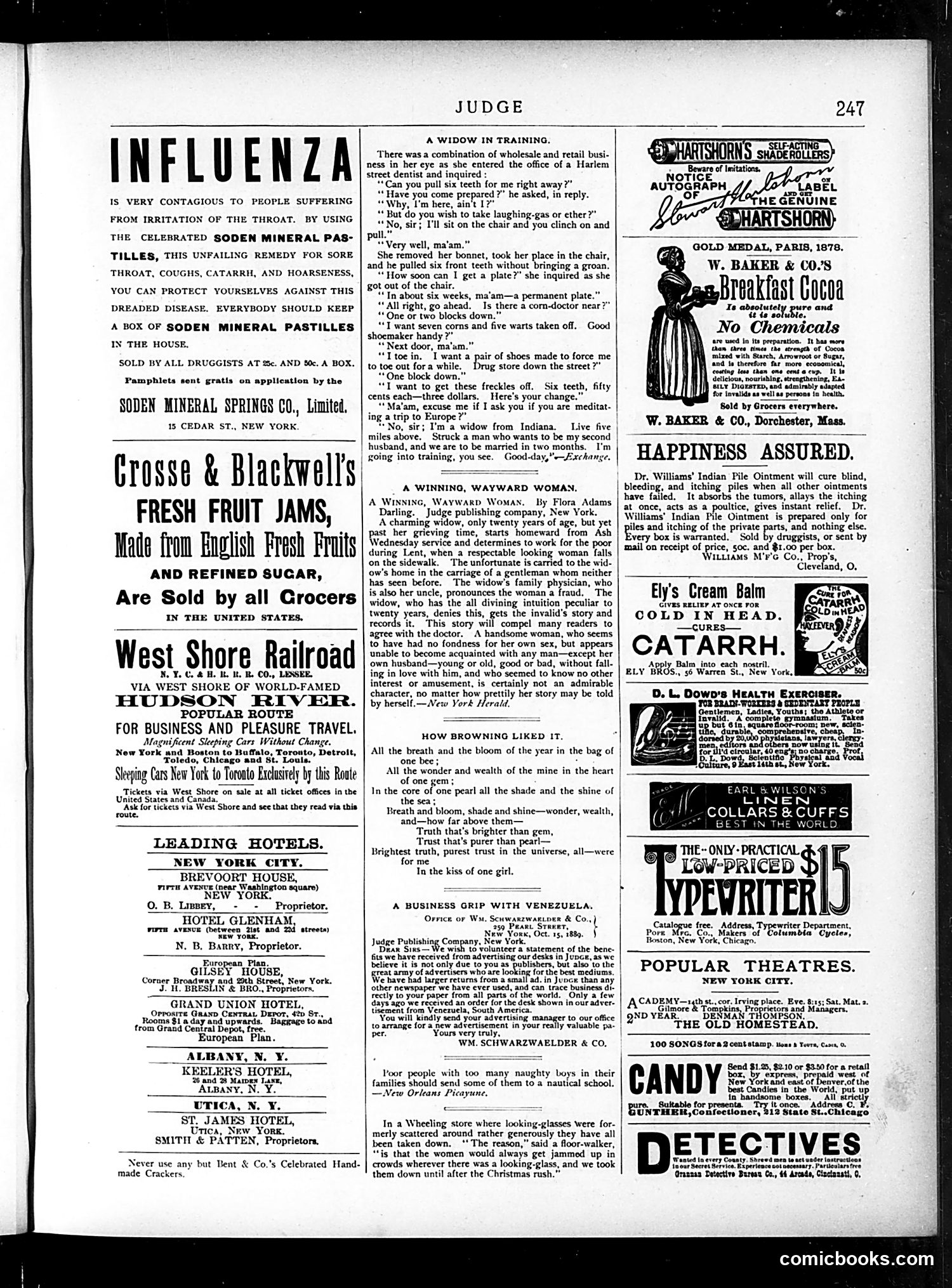
This page is primarily **advertisements and hotel listings** interspersed with brief humorous stories, not political cartoons. The main content includes a sketch titled "A WIDOW IN TRAINING"—a comedic anecdote about a widow from Indiana preparing herself for remarriage by undergoing rapid, no-nonsense dental and cosmetic work (teeth extraction, corn removal, freckle treatment) with brutal efficiency and zero sentimentality. The humor lies in her treating her body like a business transaction—obtaining quotes, comparing providers, and enduring pain stoically as "training" for her upcoming wedding. Below is a book advertisement for *A Winning, Wayward Woman* by Flora Adams Darling, describing a young widow's charitable adventures. The page reflects turn-of-century American concerns: marriage, class, commerce, and women's agency. The widow's pragmatism—valuing efficiency over feminine delicacy—likely amused contemporary readers accustomed to more sentimental portrayals of women.
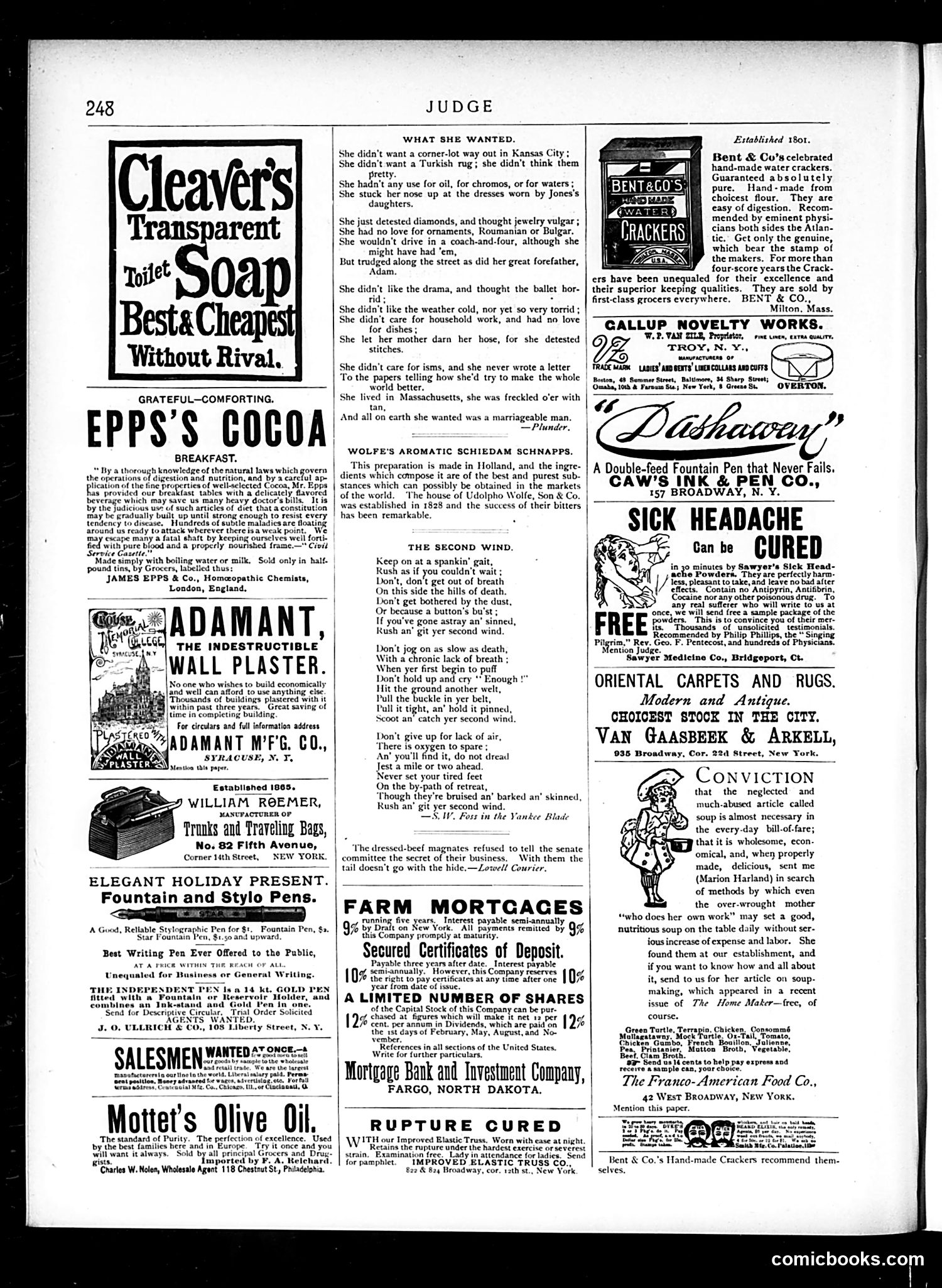
This page is primarily advertising with one notable satirical poem titled "What She Wanted." The poem humorously catalogs what a Massachusetts woman *doesn't* want—wealth, luxury goods, fashionable entertainments, domestic labor, and social activism—before revealing the punchline: all she actually desires is "a marriageable man." The satire mocks both excessive materialism and the pretense of female independence. By listing what she rejects (Turkish rugs, diamonds, coach-and-fours, even her "great forefather, Adam"), the poem suggests women's declared indifference to such things is hypocritical. The freckled, plain Massachusetts woman walking the streets like Adam represents Puritan simplicity—yet her true goal remains traditional: marriage. The joke reflects late-19th-century anxieties about women's changing roles, suggesting that despite new opportunities and rhetoric about female independence, women's fundamental ambition remained domestic and matrimonial. It's both anti-feminist and anti-materialist satire combined.
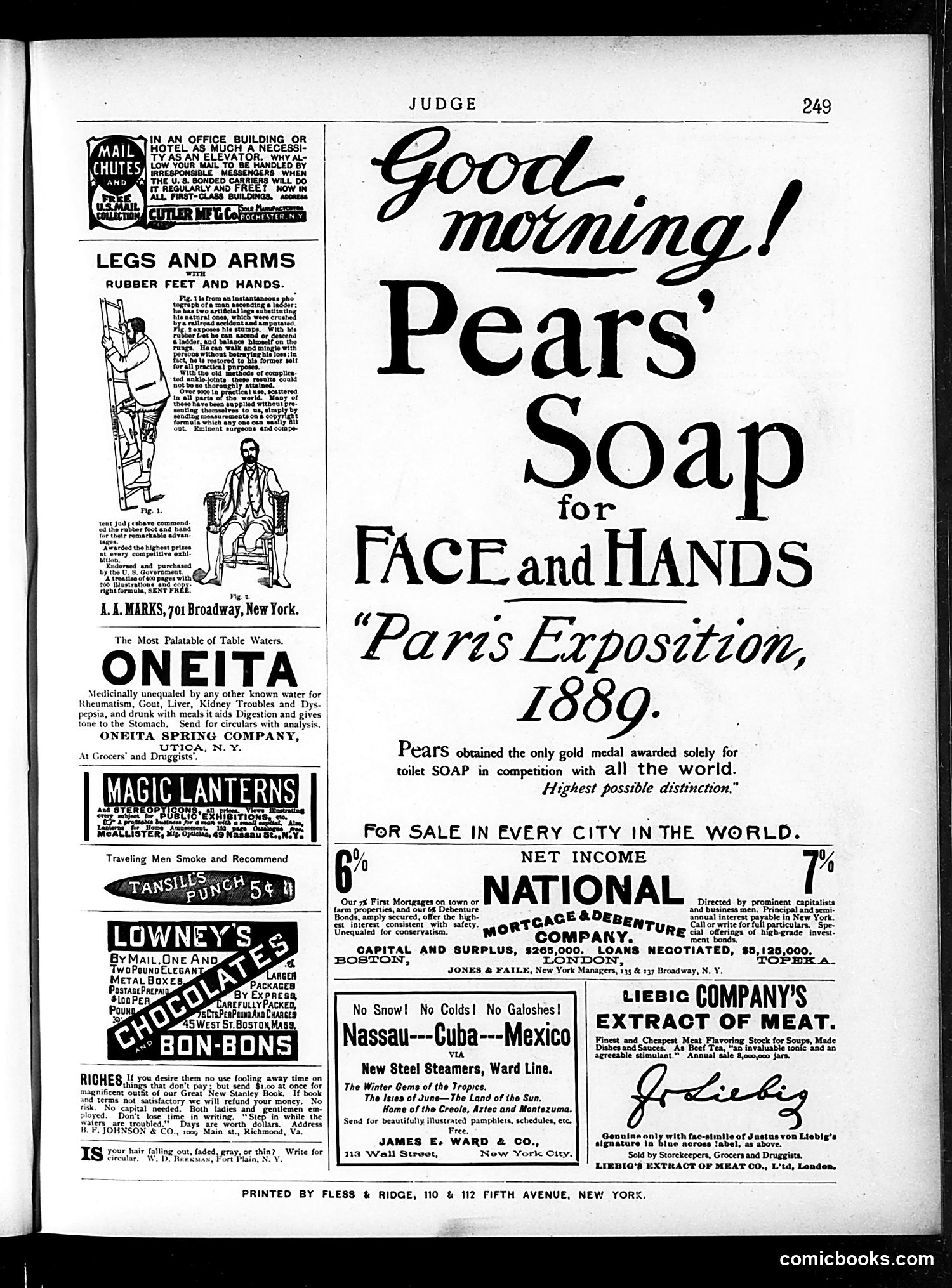
This page is primarily **advertising, not editorial content or political satire**. It features vintage commercial advertisements from approximately 1889, the era indicated by the Pears' Soap reference to the Paris Exposition. The main advertisements include: - **Pears' Soap**: Prominently advertised as a gold-medal winner for toilet soap at the 1889 Paris Exposition - **Oneita Spring Water**: Marketed for medicinal purposes (rheumatism, gout, kidney troubles) - **Magic Lanterns**: For public exhibitions - **Liebig's Extract of Meat**: A popular meat flavoring product - **Nassau-Cuba-Mexico cruises** via Ward Line steamers - **National Mortgage & Realty Company**: Investment opportunity - Various patent medicines and entrepreneurial schemes The left sidebar includes instructional diagrams labeled "Legs and Arms with Rubber Feet and Hands" by A.L. Marks, apparently for artificial limbs. **No political cartoon or satire is present.** This is a typical Judge magazine commercial page showcasing period consumer products and services aimed at middle and upper-class readers.
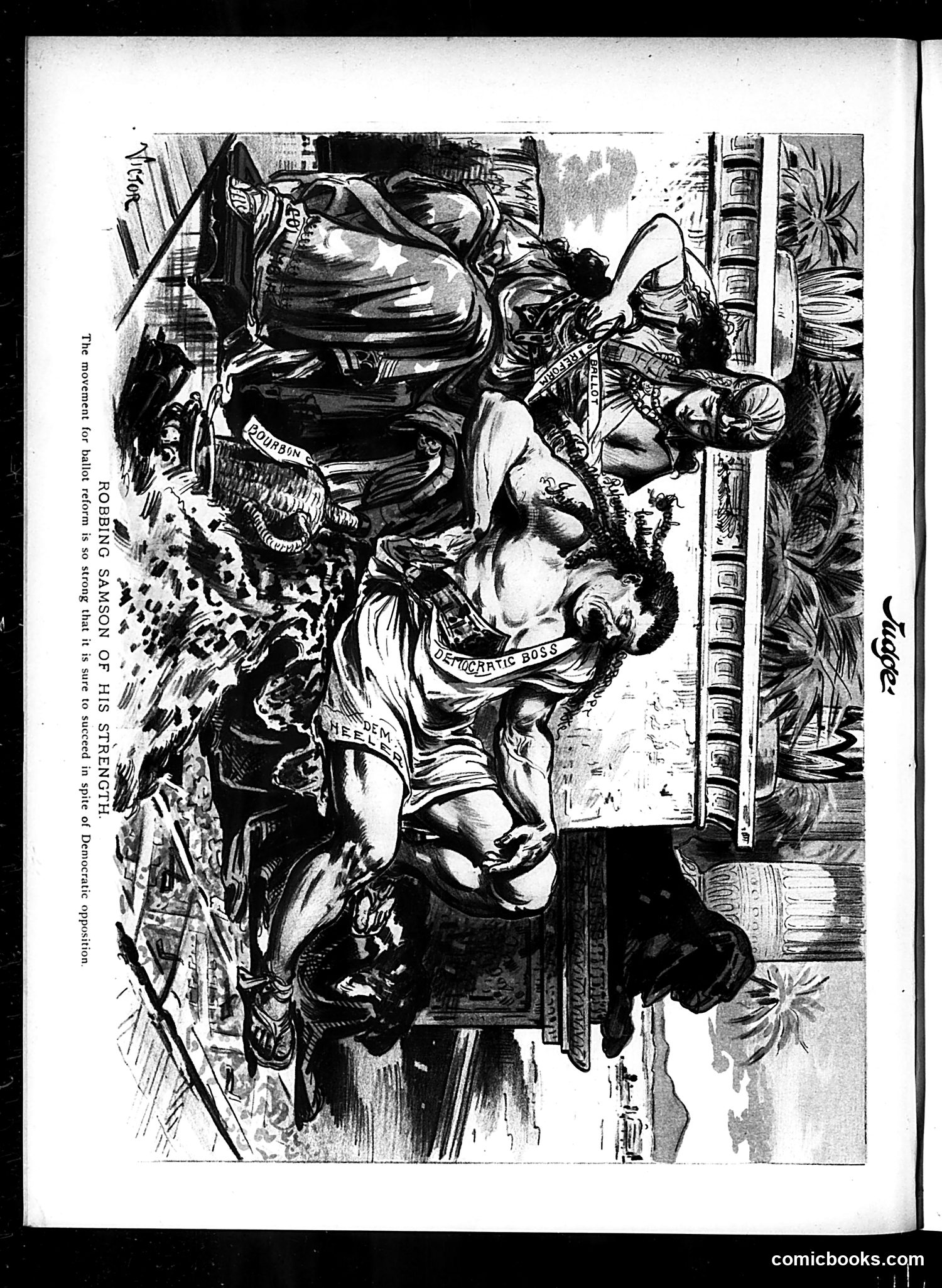
This appears to be a Judge magazine political cartoon, though the OCR text is largely corrupted and unreadable, making precise interpretation difficult. The image shows a dramatic scene with multiple figures in what appears to be a chaotic indoor setting. One figure is labeled "DEMOCRATIC BOSS" on their clothing. The composition suggests satirical commentary on political corruption or backroom dealings, likely mocking Democratic Party leadership or machine politics of the era. The style and presentation indicate this is critiquing political power structures—possibly depicting a "boss" figure dominating or manipulating other characters. Without legible text, I cannot identify specific individuals, events, or the exact satirical point being made. The theatrical rendering and caricature style are typical of Judge's political satire from the late 19th/early 20th century, but the specific context remains unclear from this reproduction.