
A complete issue · 16 pages · 1890
Judge — January 4, 1890
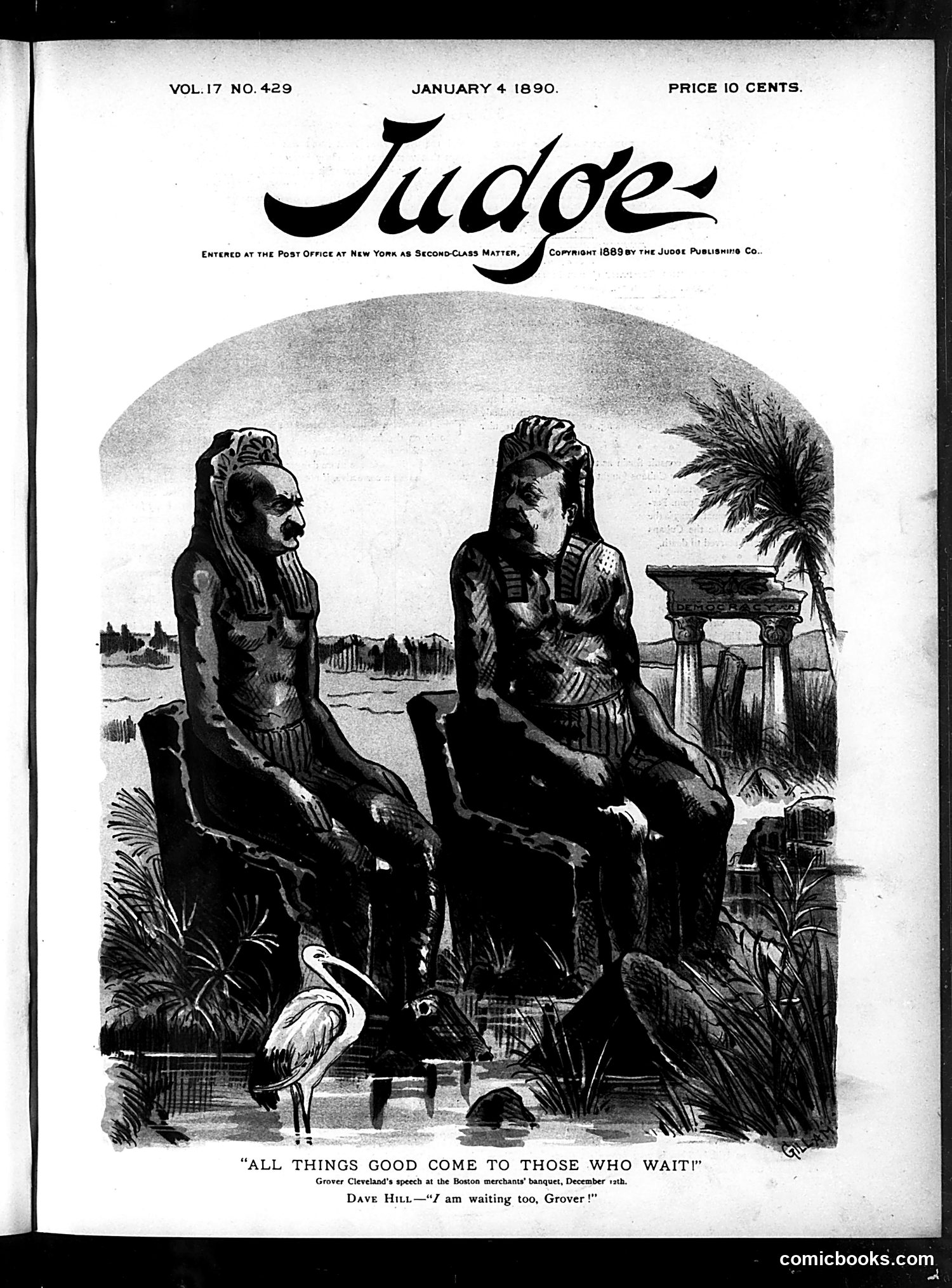
This January 1890 *Judge* cartoon depicts two Egyptian sphinx statues seated by the Nile, with a heron in the foreground. The caption quotes Grover Cleveland's December 1889 speech at a Boston merchants' banquet, with Dave Hill (likely a contemporary political figure) responding "I am waiting too, Grover!" The satire targets Cleveland's political position during a period of waiting or inaction—possibly regarding tariff policy, currency issues, or other divisive matters of his second administration (1893-1897). The sphinx imagery suggests Cleveland's enigmatic or passive stance on pressing national issues. The cartoon implies that critics like Hill are also "waiting" to see if Cleveland will take decisive action, with the eternal sphinx as a symbol of patient but ultimately immobile waiting.
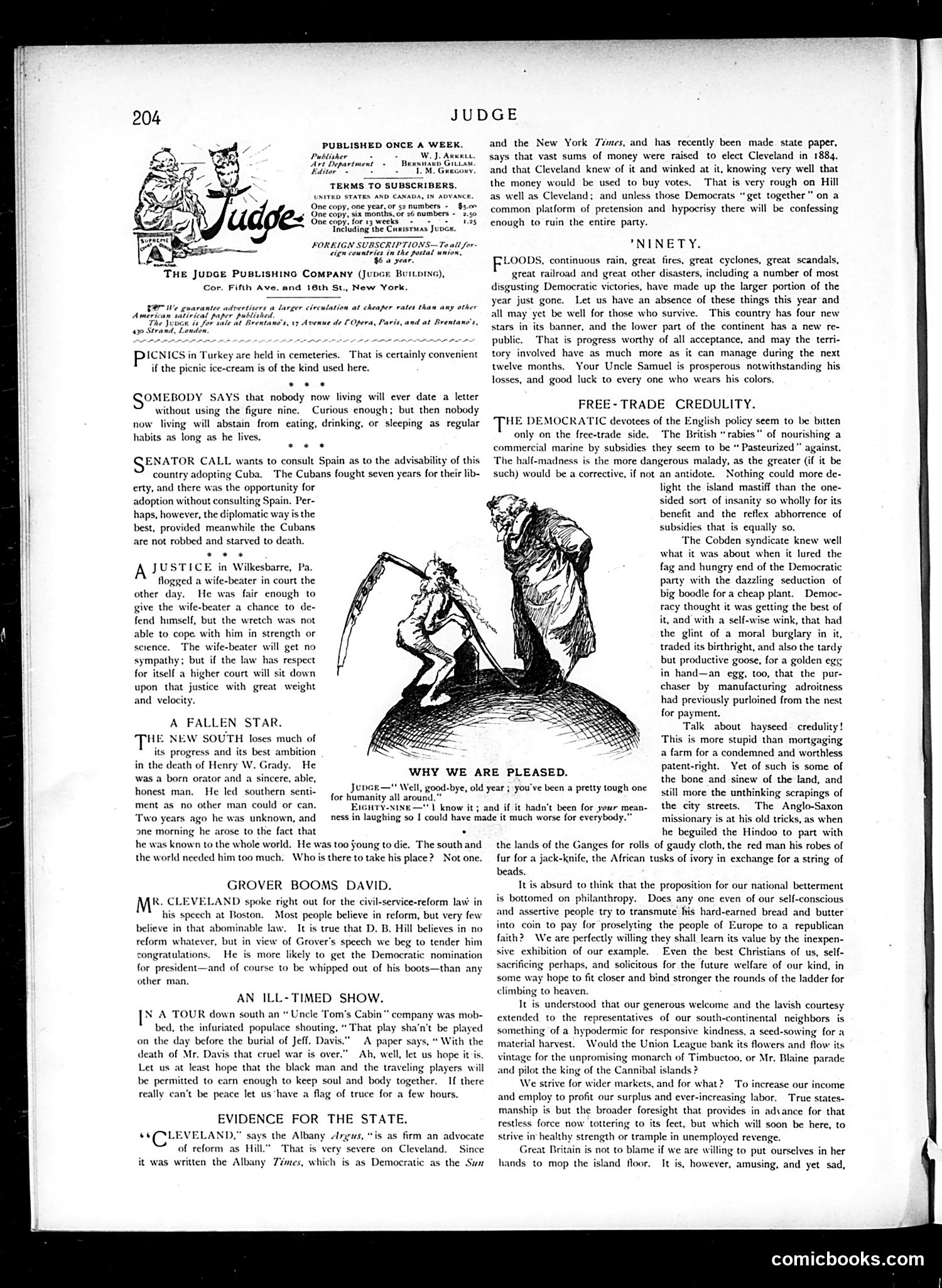
The main cartoon, titled "WHY WE ARE PLEASED," depicts a figure labeled "Judge" conversing with what appears to be a political opponent. The accompanying text suggests this relates to Democratic Party politics and recent electoral defeats. The article "FREE-TRADE CREDULITY" satirizes Democratic support for free-trade policies, suggesting Democrats were naively seduced by false economic promises. The text mocks the party's belief that free trade would benefit them, comparing it to selling a "golden egg" for cheap. Additional items mock Cleveland administration policies and Democratic leadership, including criticism of Cleveland's civil-service reform efforts. The overall page presents satirical political commentary typical of Judge magazine's Republican-leaning editorial stance during the Gilded Age.
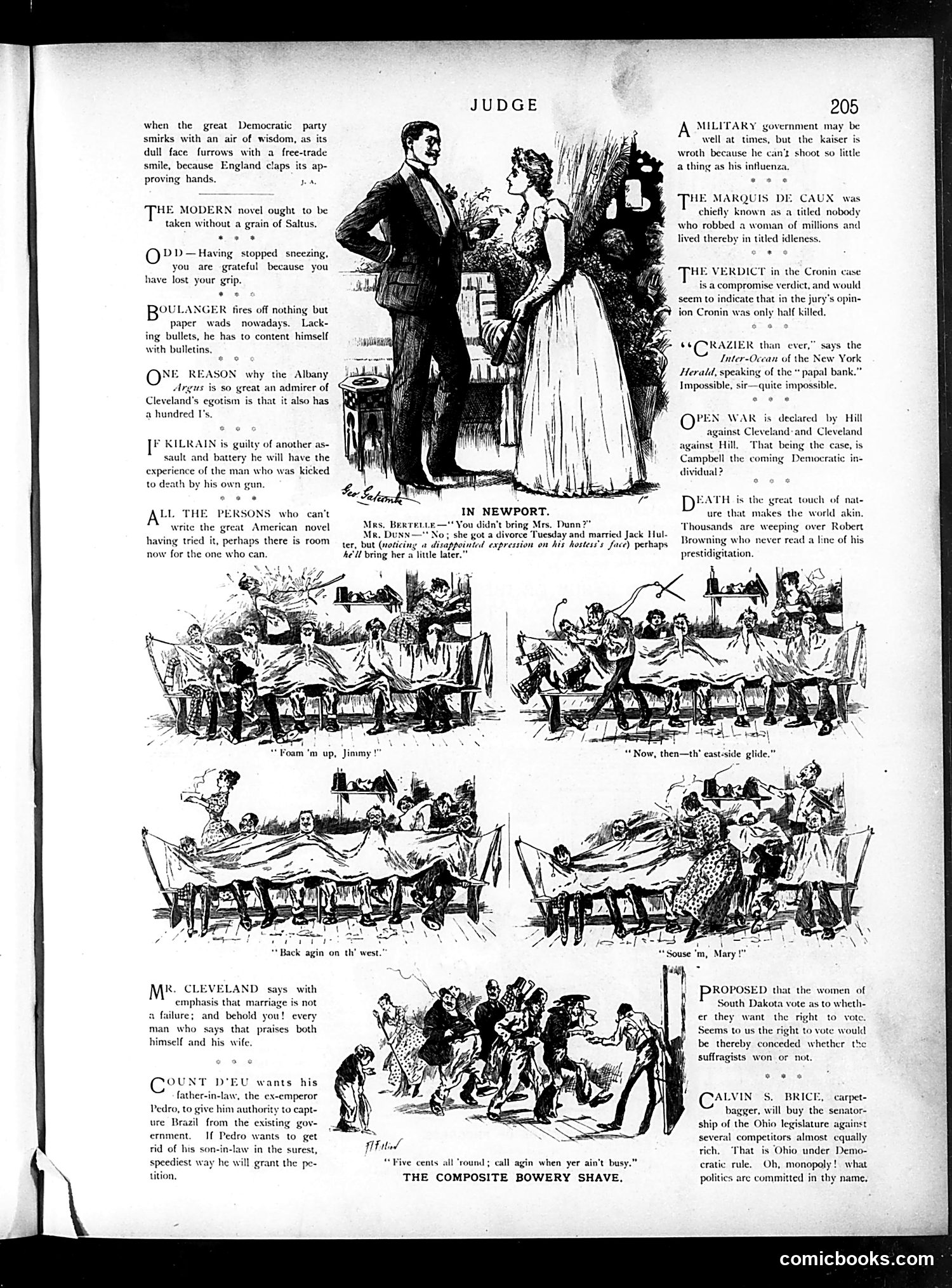
The upper cartoon "In Newport" depicts a social scandal involving wealthy Newport society figures. Mrs. Dunn explains she obtained a divorce Tuesday and married Jack Halsey Wednesday—with commentary from Mrs. Beerbelle noting the quick remarriage. The series of four panels below shows a "Composite Bowery Shave," satirizing Irish immigrant working-class culture through exaggerated depictions of barber-shop scenes with crude humor. The text snippets scattered throughout mock various political figures and issues: Cleveland's character, debates over women's suffrage in South Dakota, and criticism of Democratic political corruption in Ohio. The overall tone is characteristic of Gilded Age satirical humor targeting wealthy society, political hypocrisy, and immigrant stereotypes.
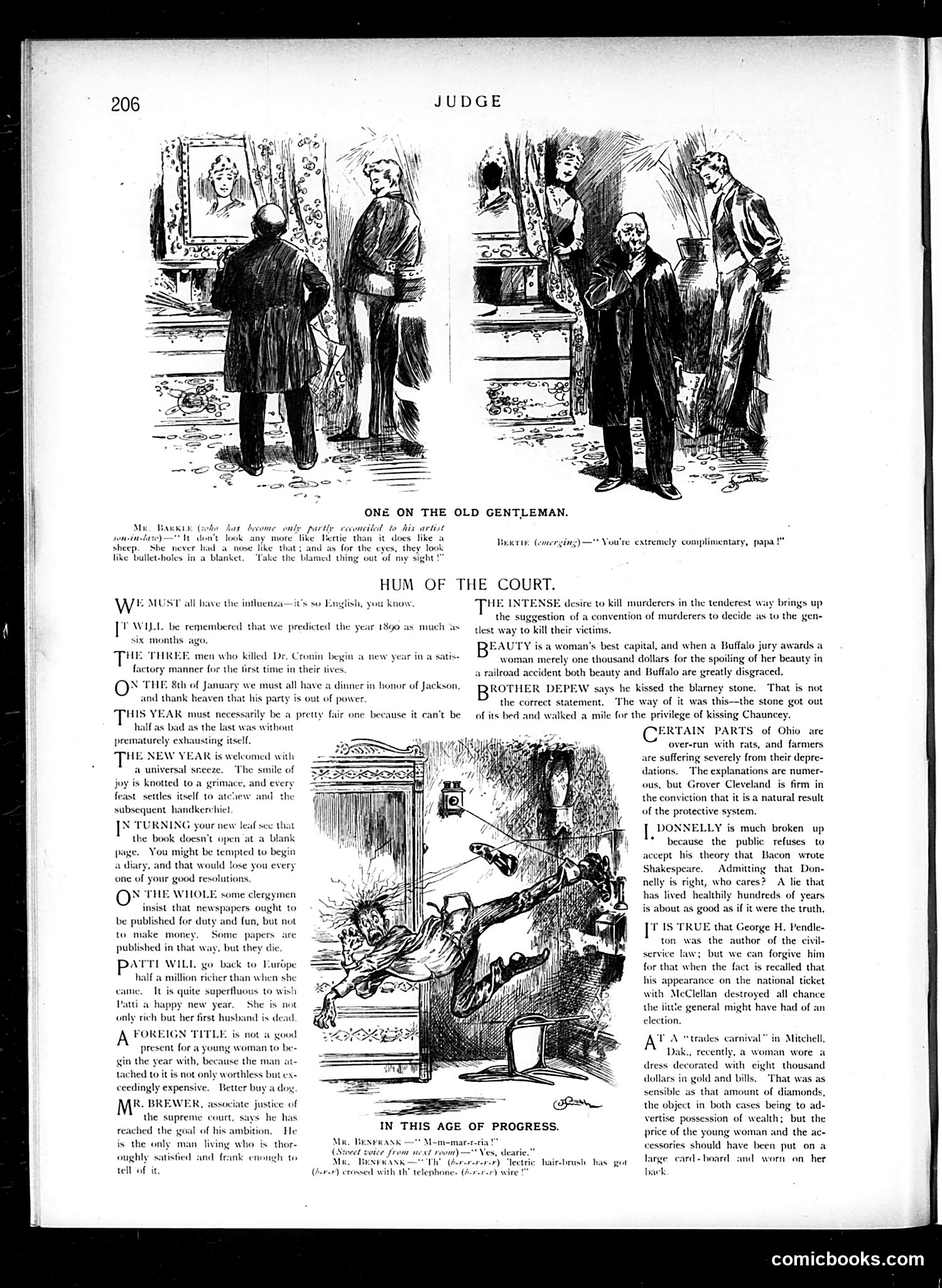
This page from Judge magazine contains several short satirical pieces typical of late 19th-century American humor. **"One on the Old Gentleman"** depicts a father criticizing his daughter Bertie's appearance (comparing her unfavorably to her portrait), only to be rebuked when she emerges—the joke being his hypocrisy. **"Hum of the Court"** is a collection of brief social commentary, including jabs at the influenza's "English" fashionability, references to the murder of Dr. Cronin (a contemporaneous crime), and mockery of various public figures and trends. Notable: criticism of Grover Cleveland's protectionist tariff policies (blamed for Ohio's rat problem), skepticism about Donnelly's Bacon-Shakespeare theory, and commentary on George Pendleton's failed 1864 vice-presidential run. **"In This Age of Progress"** (bottom cartoon) appears to satirize modern technology or social change, though the OCR is unclear on specifics. The page reflects Judge's role as a forum for elite, Republican-leaning political commentary and upper-class social satire circa the 1890s.
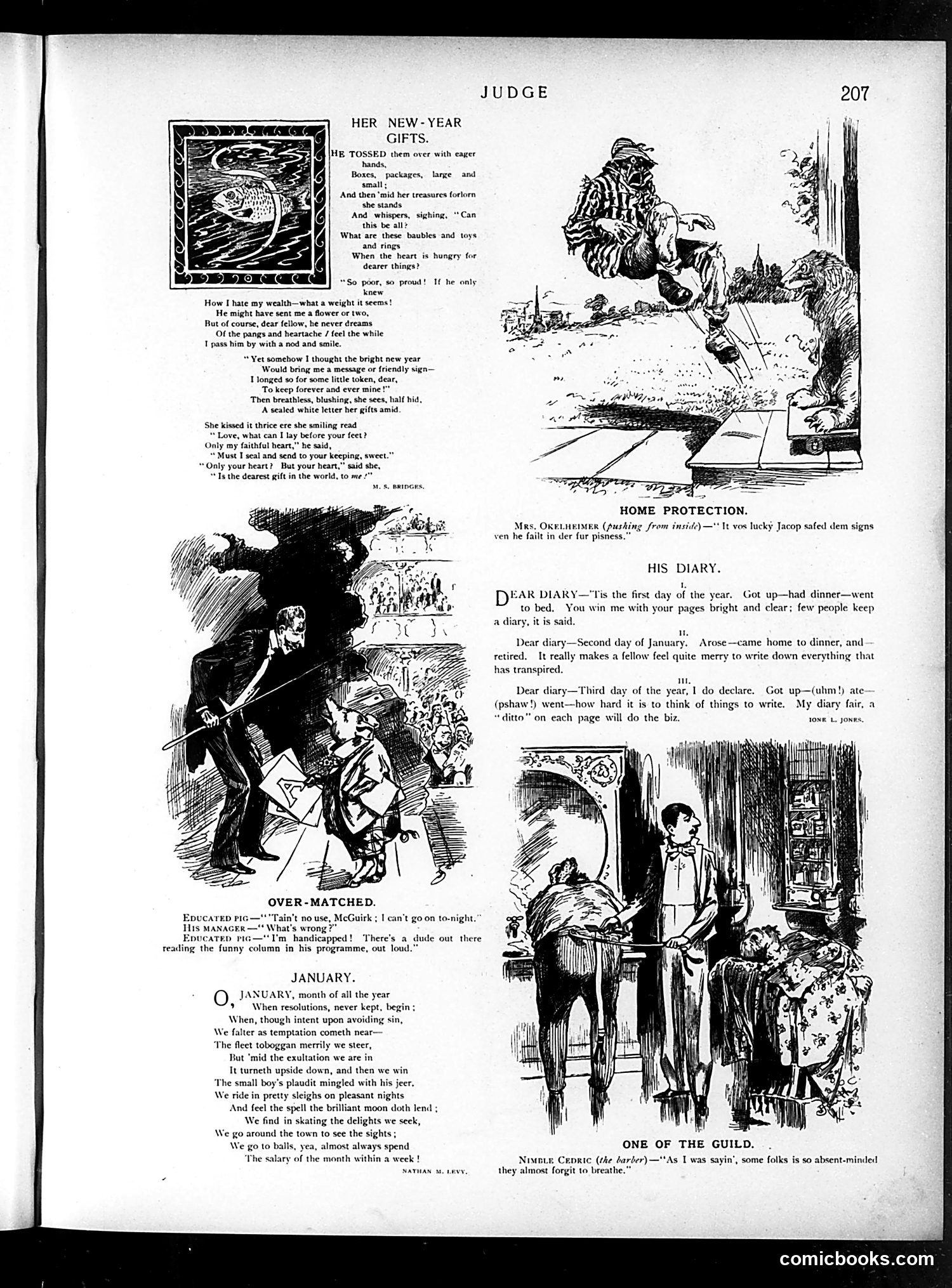
This *Judge* page contains several satirical pieces about romance, poverty, and daily life: **"Her New-Year Gifts"** satirizes a wealthy woman's emotional poverty. Despite receiving material luxuries, she craves genuine affection—ideally a love note from a poor suitor who cannot afford gifts. The joke mocks both her materialism and sentimental longing. **"Home Protection"** features Mrs. Okelheimer (a Jewish immigrant character, indicated by dialect spelling), boasting that her husband Jacob "saved those signs when he failed in the fur business"—suggesting he kept business signage despite bankruptcy, implying either thrift or fraud. The humor relies on ethnic stereotyping. **"His Diary"** mocks the New Year's resolution to keep a journal. The diarist quickly abandons meaningful entries for repetitive "dittos," satirizing people's failure to maintain resolutions. **"Over-Matched"** jokes that a comedian cannot perform because audience members reading the funny paper aloud drown him out. **"January"** is sentimental poetry about winter pleasures and broken resolutions, while "One of the Guild" presents a barber's humorous observation about absent-minded customers.
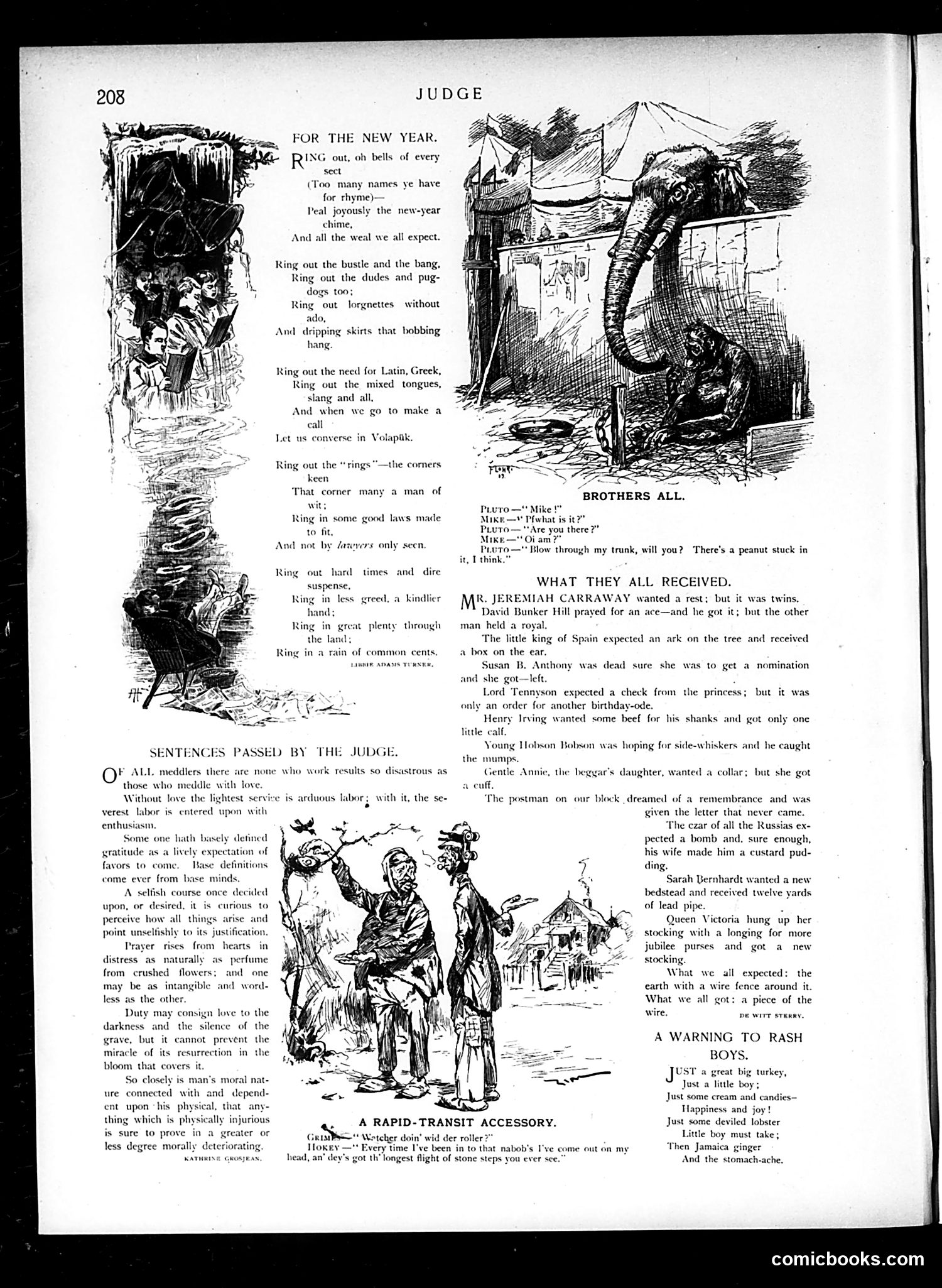
This page contains New Year's themed humor from Judge magazine. The central content includes: **"For the New Year"** — A satirical poem "ringing out" contemporary annoyances (dudes, lorgnettes, mixed languages, hard times, greed) while "ringing in" idealized replacements (good laws, plenty, common sense). It's social commentary on 1880s-90s American society's perceived excesses and moral failings. **"What They All Received"** — Humorous vignettes where famous figures and ordinary people receive the opposite of their desires: Jeremiah Carraway wanted rest but got twins; Susan B. Anthony expected a nomination but got rejection; the Czar's wife gave him custard pudding instead of a bomb. The joke mocks both specific individuals and universal human disappointment. **"Brothers All"** — An elephant helps remove a peanut from its trunk, titled as commentary on universal kinship. The satire targets both public figures and social types, using ironic reversals and contemporary references to mock Victorian-era pretensions and unfulfilled expectations.
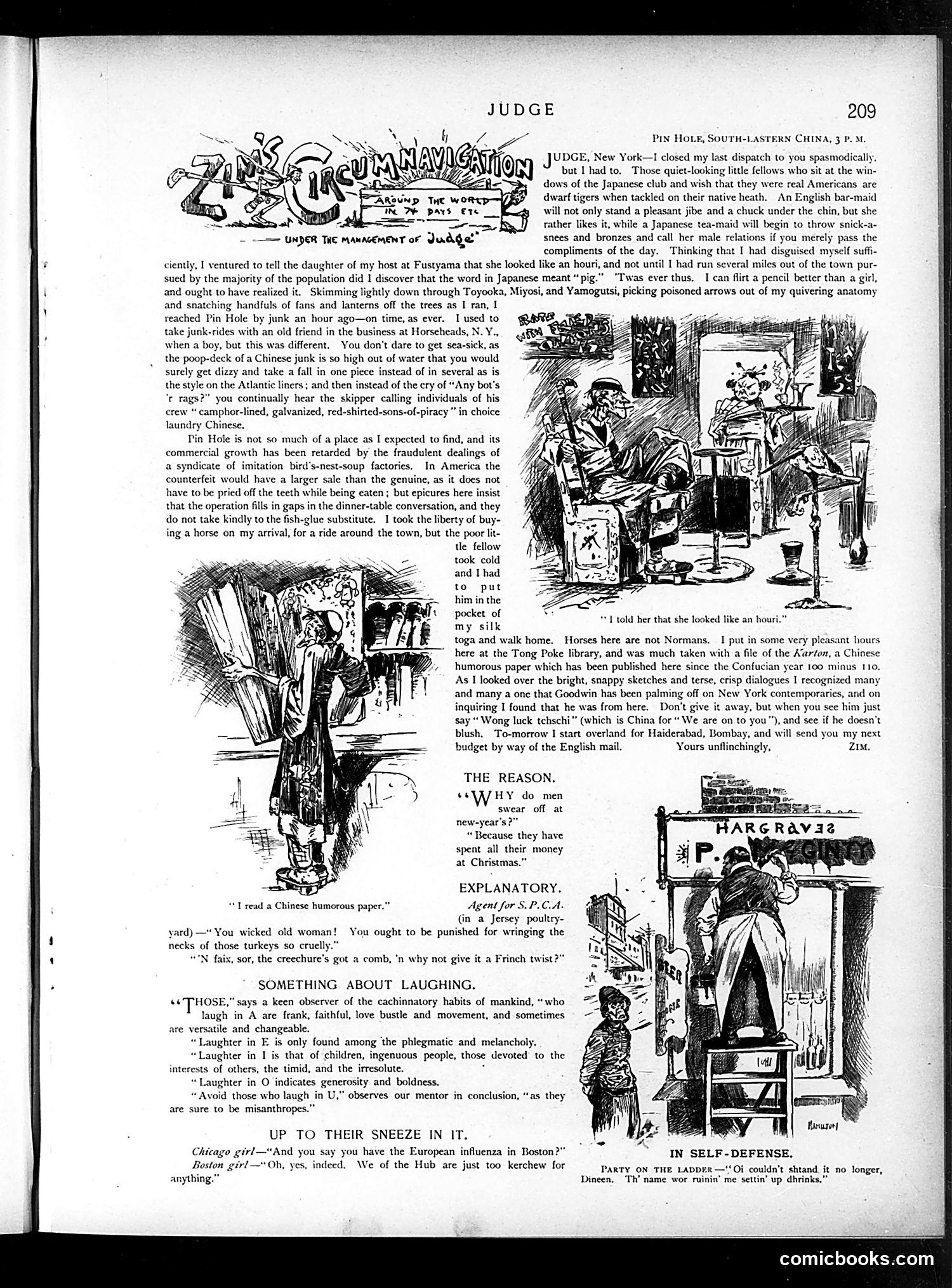
This page presents a travel humor column from "Pin Hole, South-Eastern China" by a correspondent named Zim. The main satire concerns **cultural misunderstandings between Westerners and Japanese people**. The writer recounts inadvertently insulting a Japanese woman by calling her an "houri" (beautiful woman), only to discover the word means "pig" in Japanese—resulting in him being chased by townspeople. The humor derives from the clash between Western flirtation customs and Japanese responses to perceived disrespect. The column also mocks the author's own incompetence: his horse gets sick from a carriage ride, and he absurdly carries it home in his silk robe. **Secondary content** includes brief joke sections: "The Reason" (why men swear off after Christmas), an SPCA agent scolding an Irish woman for mistreating turkeys, and advertisements including "Hargraves" (partially visible). The cartoons illustrate the travel narrative with period sketches of Asian scenes and characters, rendered in typical Judge magazine style.
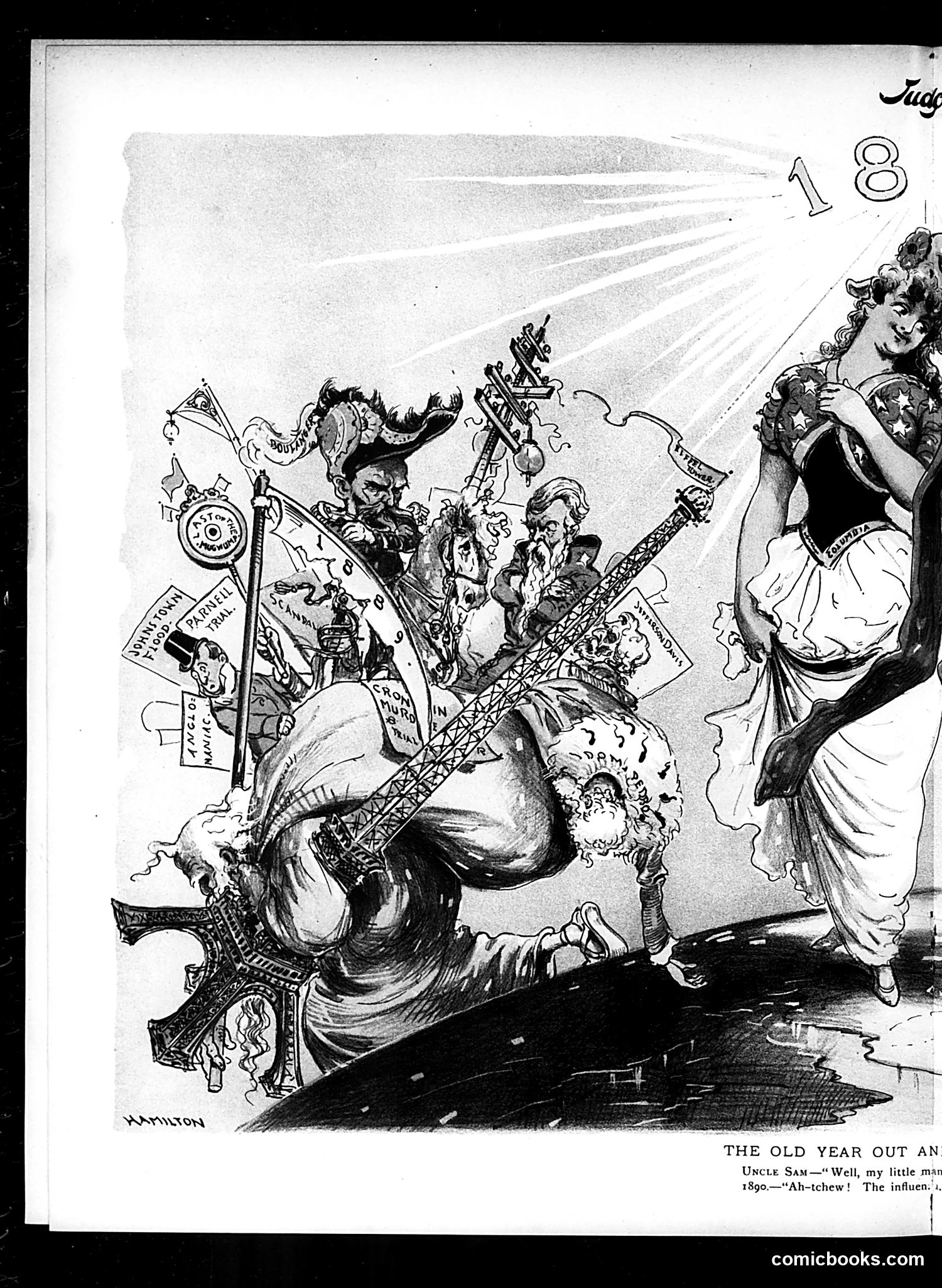
This satirical illustration shows Uncle Sam (representing the United States) sneezing out the year 1890, depicted as chaotic figures and demons emerging from his nose. The caption references "the influenza," suggesting the cartoon uses illness as a metaphor for the problems and troubles that plagued 1890. The swirling mass of grotesque figures likely represents various political scandals, social problems, or economic troubles from that year. The artist (Hamilton, visible as signature) employs the common satirical device of personifying abstract troubles as demons or monsters being expelled. The cherub-like figure on the right appears to represent the incoming new year or hope for improvement. The overall message is darkly humorous: 1890 was such a disaster that even Uncle Sam needs to physically purge it from his system.
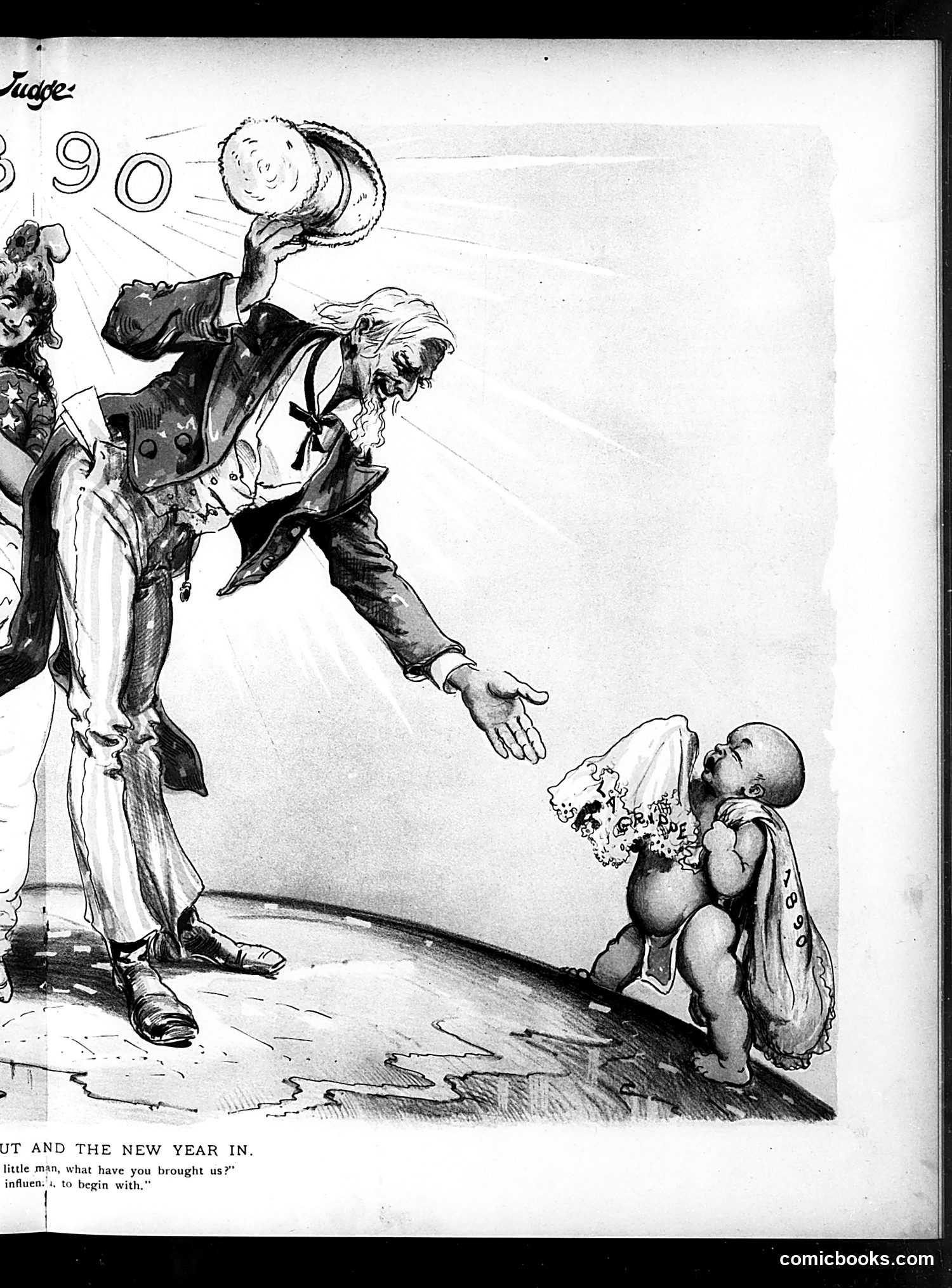
This cartoon depicts the transition between Old Year and New Year, a common Judge theme. An elderly, somewhat decrepit figure (the outgoing year) stands elevated, tossing down a globe or spherical object labeled "1890" toward a small, innocent child-like figure (the incoming new year) below. The dialogue—"little man, what have you brought us?" with the response mentioning "influen[za]"—references a contemporary health crisis. This appears to satirize how the new year arrives not with promise, but carrying disease or misfortune inherited from the previous year's problems. The caricatured style and exaggerated features were typical of Judge's satirical approach to current events. Without a precise date visible, the "influenza" reference suggests this likely comments on a specific flu outbreak affecting America during the 1890s.
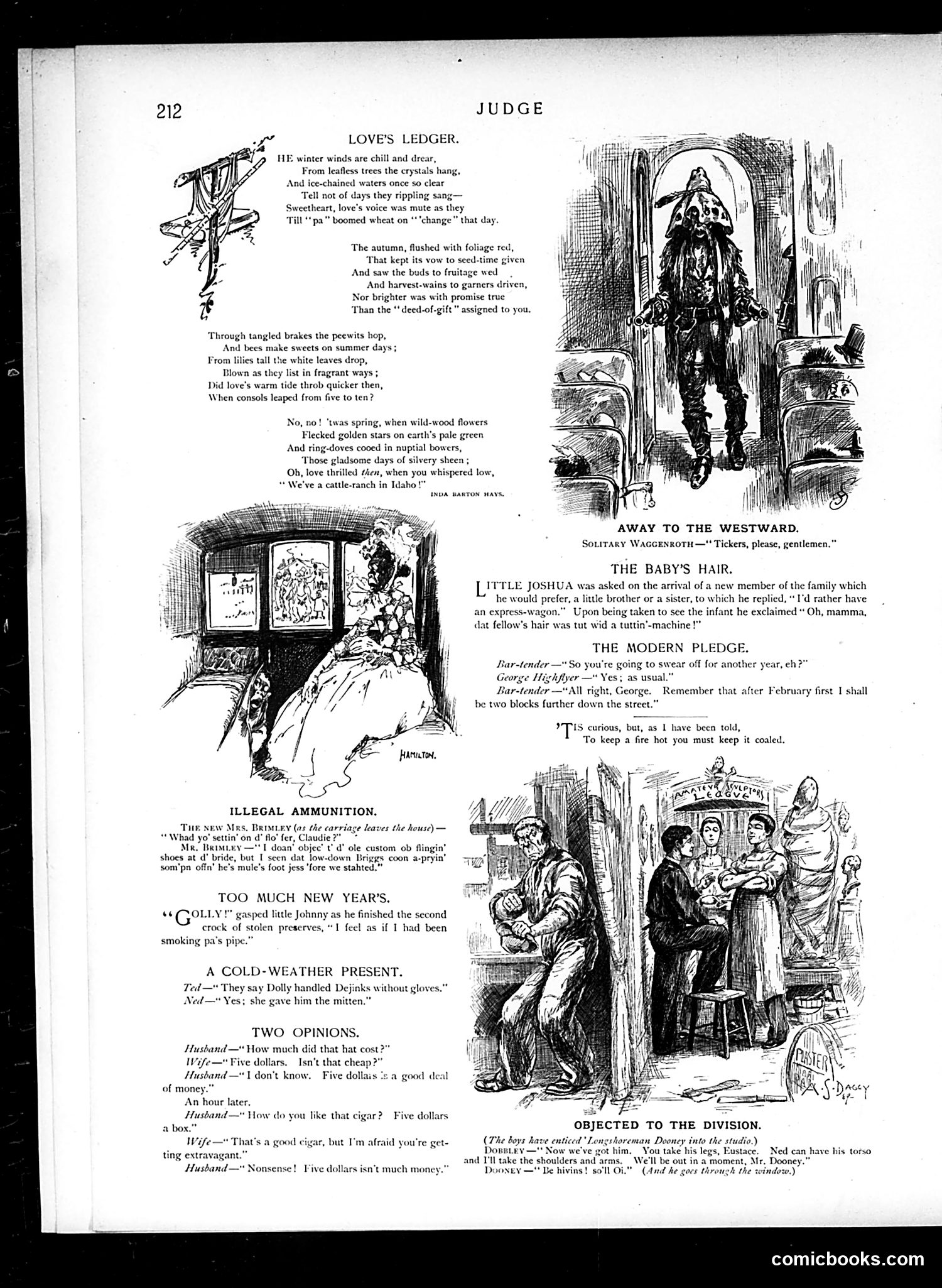
This page collects satirical poems and humorous sketches. "Love's Ledger" mocks romantic sentiment by suggesting a woman's affection only truly kindled when her suitor obtained wheat profits on the grain exchange ("'change") and gifted her a cattle ranch in Idaho—equating love with financial gain rather than genuine emotion. Other sketches target contemporary social foibles: a child's blunt observation about a baby's oddly-textured hair; a man's hypocrisy about spending (criticizing his wife's hat while purchasing expensive cigars); and various working-class characters and domestic scenes. "Away to the Westward" references westward expansion fever, showing a character eagerly heading west. The sketches employ ethnic dialect humor common to the period, reflecting Judge's audience expectations, though this material now reads as dated and offensive. The overall tone satirizes materialism, male double standards, and the absurdities of daily life among middle and working classes.
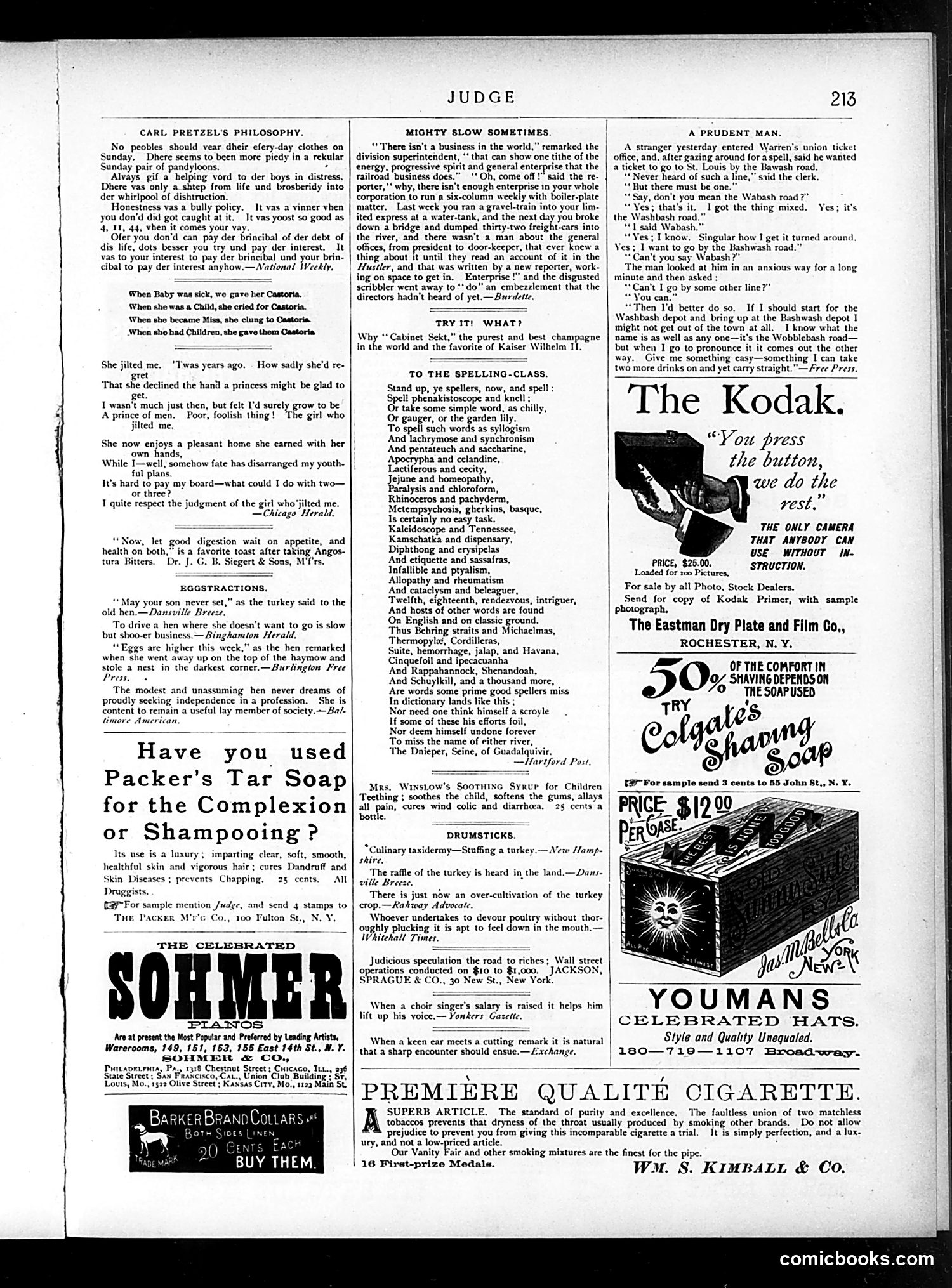
This page is primarily **advertisements and filler content** from *Judge* magazine, with minimal political cartooning. The main textual content includes: **"Carl Pretzel's Philosophy"** — A humorous column written in exaggerated German-accented English, mocking immigrant speech patterns. It offers absurd advice ("always give helping word to der boys in distress"). **"Mighty Slow Sometimes"** — A satirical anecdote where a railroad superintendent boasts about his industry's enterprise, but a reporter lists comic disasters (gravel trains hitting express trains, bridge collapses) that company leadership learned about only from newspaper reporting. The joke: the railroad's claimed "enterprise" is contradicted by their obvious incompetence and poor internal communication. The remainder consists of advertisements for products like Castoria (a children's laxative), Sohmer pianos, Packer's Tar Soap, Colgate's Shaving Soap, and Kodak cameras—typical of *Judge's* revenue model. The page lacks significant political cartooning or social satire beyond the gentle railroad mockery.
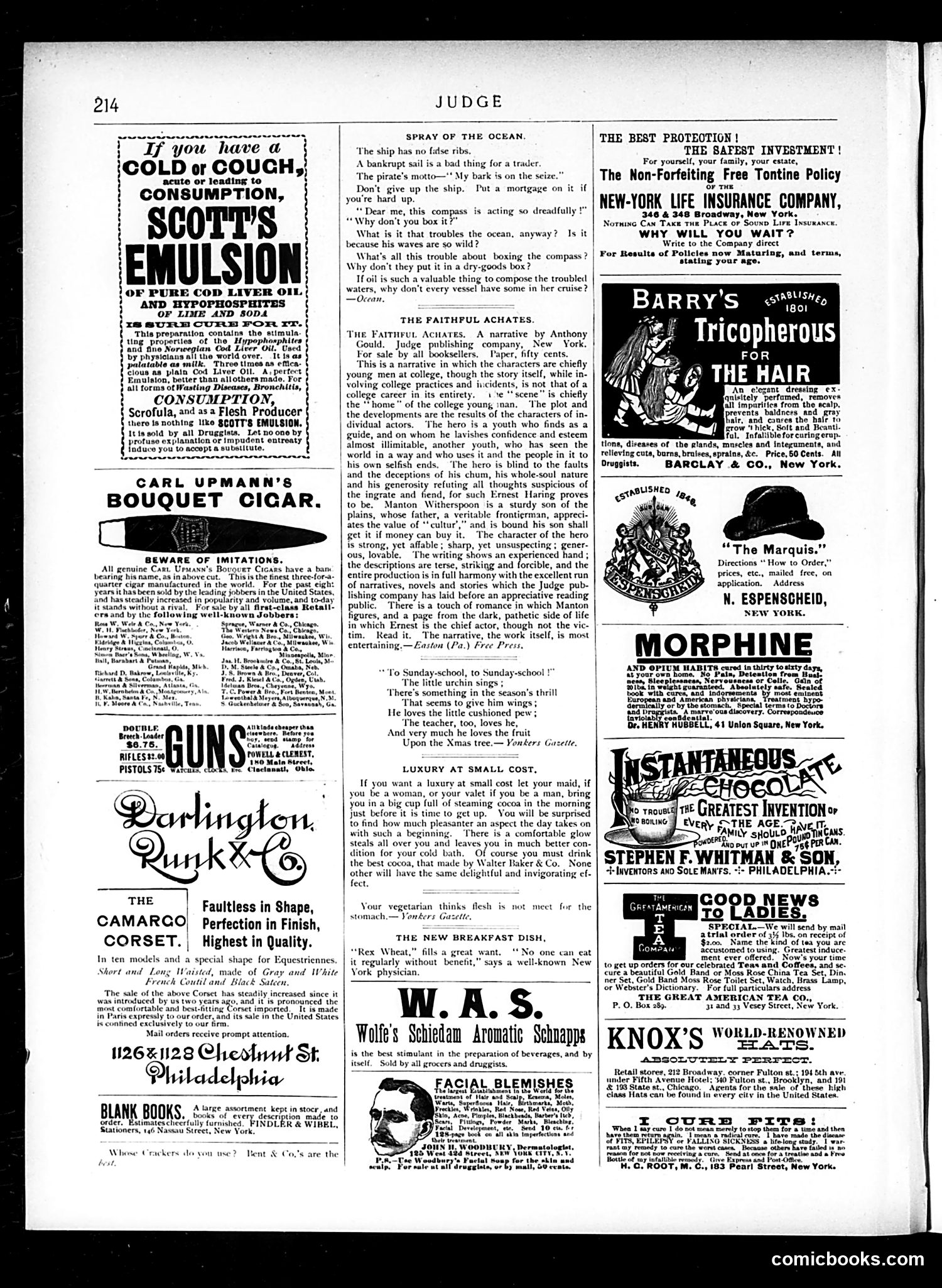
This page is primarily **advertising**, not satirical content. It's from Judge magazine (an American satirical publication), but this particular page showcases commercial advertisements rather than political or social commentary. The visible ads include: - **Scott's Emulsion** (cod liver oil remedy for consumption/tuberculosis) - **Carl Upmann's Bouquet Cigar** - **Powell & Clement firearms** (rifles and pistols) - **Camargo Corset** - **Blank books/stationery** There is one brief section titled **"Spray of the Ocean"** with nautical puns ("bankrupt sail," "bark is on the seize," "boxing the compass"), which appears to be light humor. Additionally, there's a book review of **"The Faithful Achates"** — a narrative about college-aged men and themes of betrayal and friendship. The page lacks the political cartoons or satirical social commentary typical of Judge's editorial content.
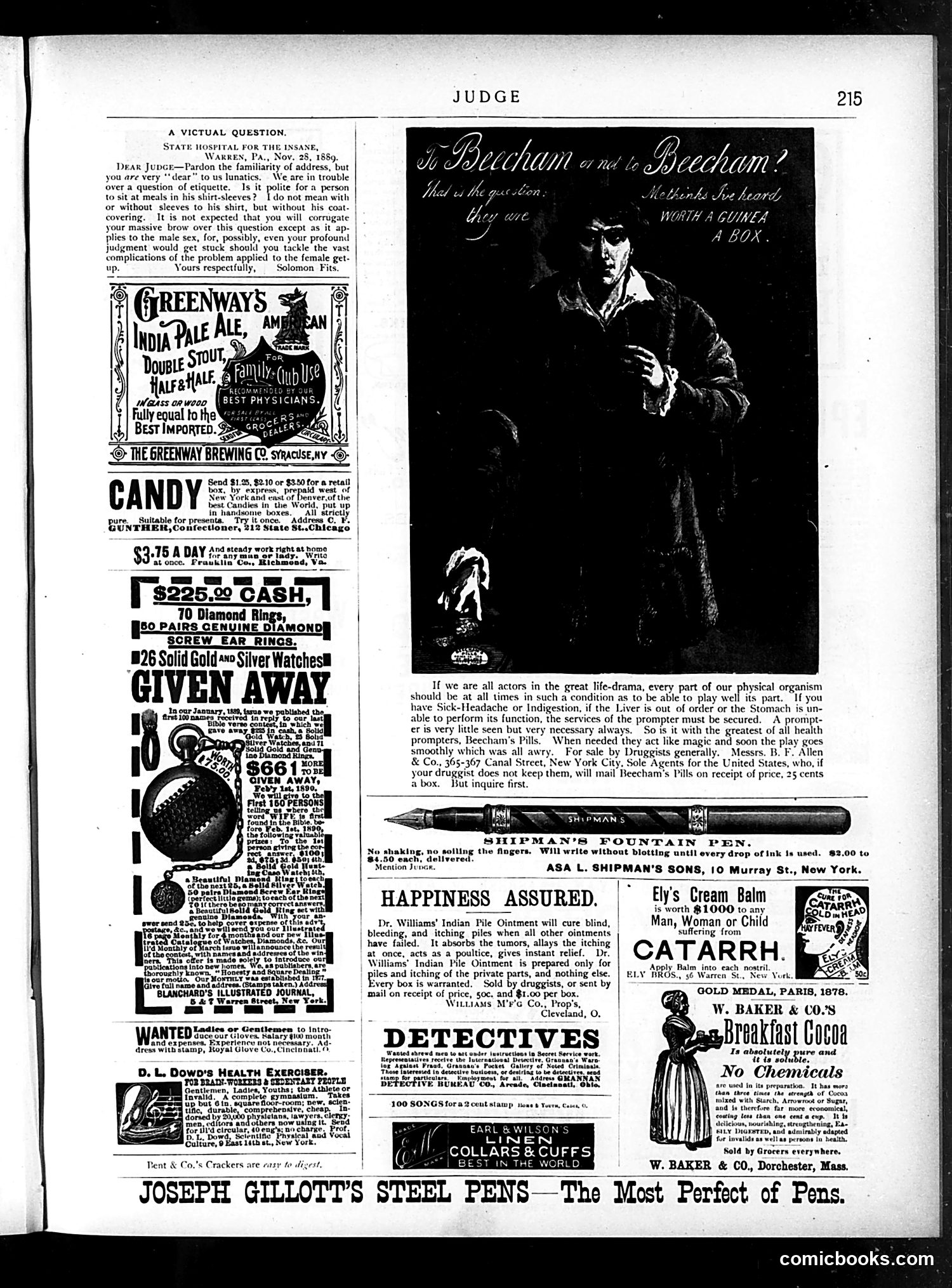
This page is primarily **advertising**, typical of Judge magazine's revenue model. The main visual content is a theatrical advertisement ("In Beecham or not to Beecham?") promoting what appears to be a stage production, showing a dramatic figure in period costume. The only editorial content is a humorous letter from "Solomon Fitz" at a Pennsylvania state hospital asking whether it's proper etiquette for men to eat meals without jackets—a question about 19th-century social conventions. Judge's response (not fully visible) likely treated this earnestly while the absurdity of debating such minutiae provided the satire. The surrounding advertisements—for patent medicines (Beecham's Pills, Williams' Indian Pile Ointment), pens, breakfast cocoa, and various dubious mail-order schemes—reflect typical late-1880s magazine advertising, many promoting products of questionable efficacy.
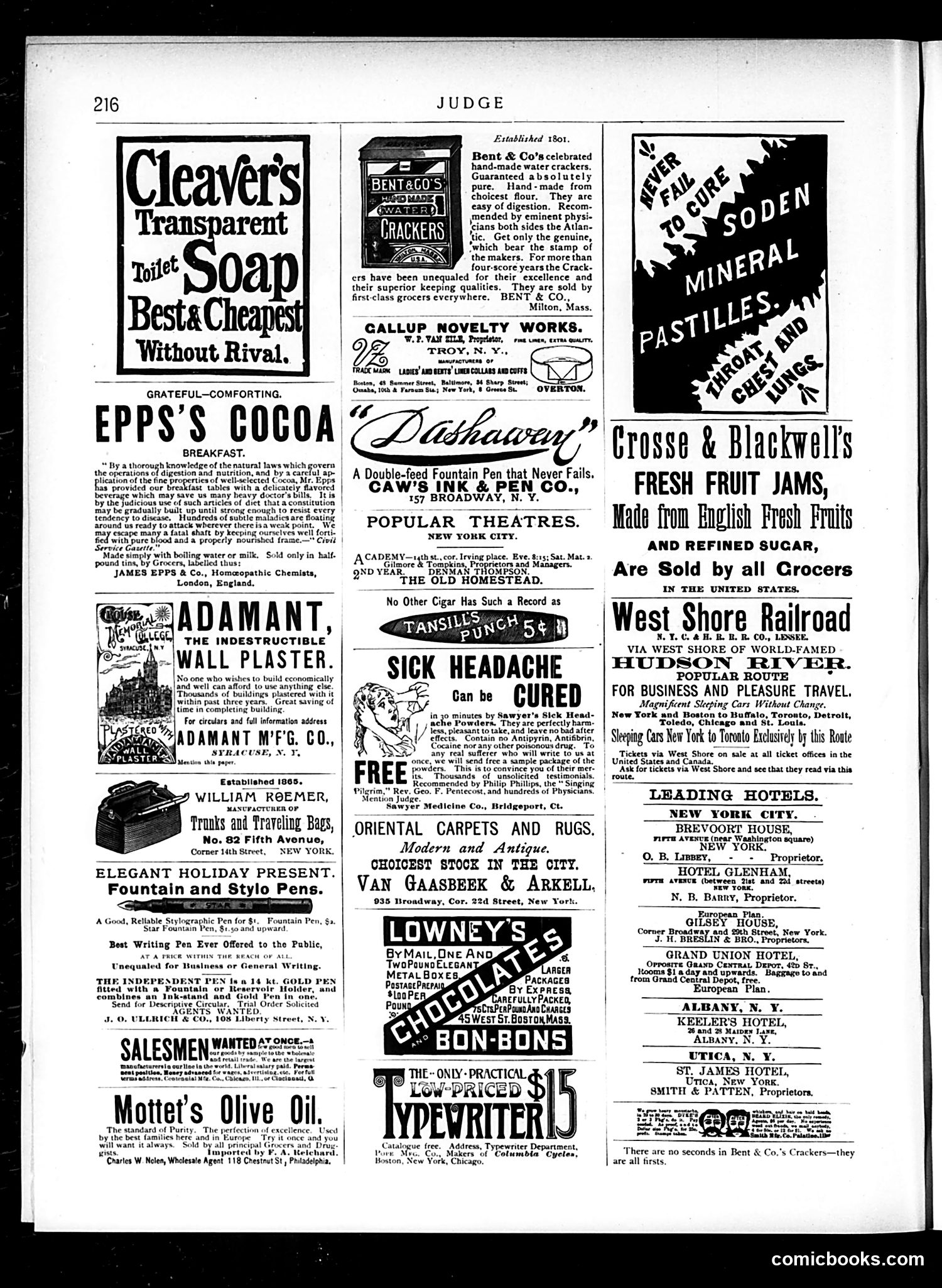
This is primarily an **advertising page** from Judge magazine (page 216), with no editorial cartoons or satirical content visible. It consists entirely of period advertisements for consumer goods and services. The ads reflect late-19th century commercial life: Cleaver's soap, Epps's cocoa (marketed with pseudo-scientific health claims), Bent & Co. crackers, theater listings, furniture polish, traveling trunks, fountain pens, carpets, and typewriters. Notable is the **Sawyer's Sick Headache Powders advertisement**, which today reveals problematic medical marketing of the era—the powders explicitly claim to contain *no cocaine*, suggesting cocaine-containing medicines were commonplace and required reassurance of their absence. The **typewriter ad** for a "$15 LOW PRICED" model signals the technology's emergence as a consumer product. These ads collectively document consumer culture, medical practices, and technological adoption of the Gilded Age—offering modern readers insight into what products existed, how they were marketed, and what health and business concerns preoccupied the period.
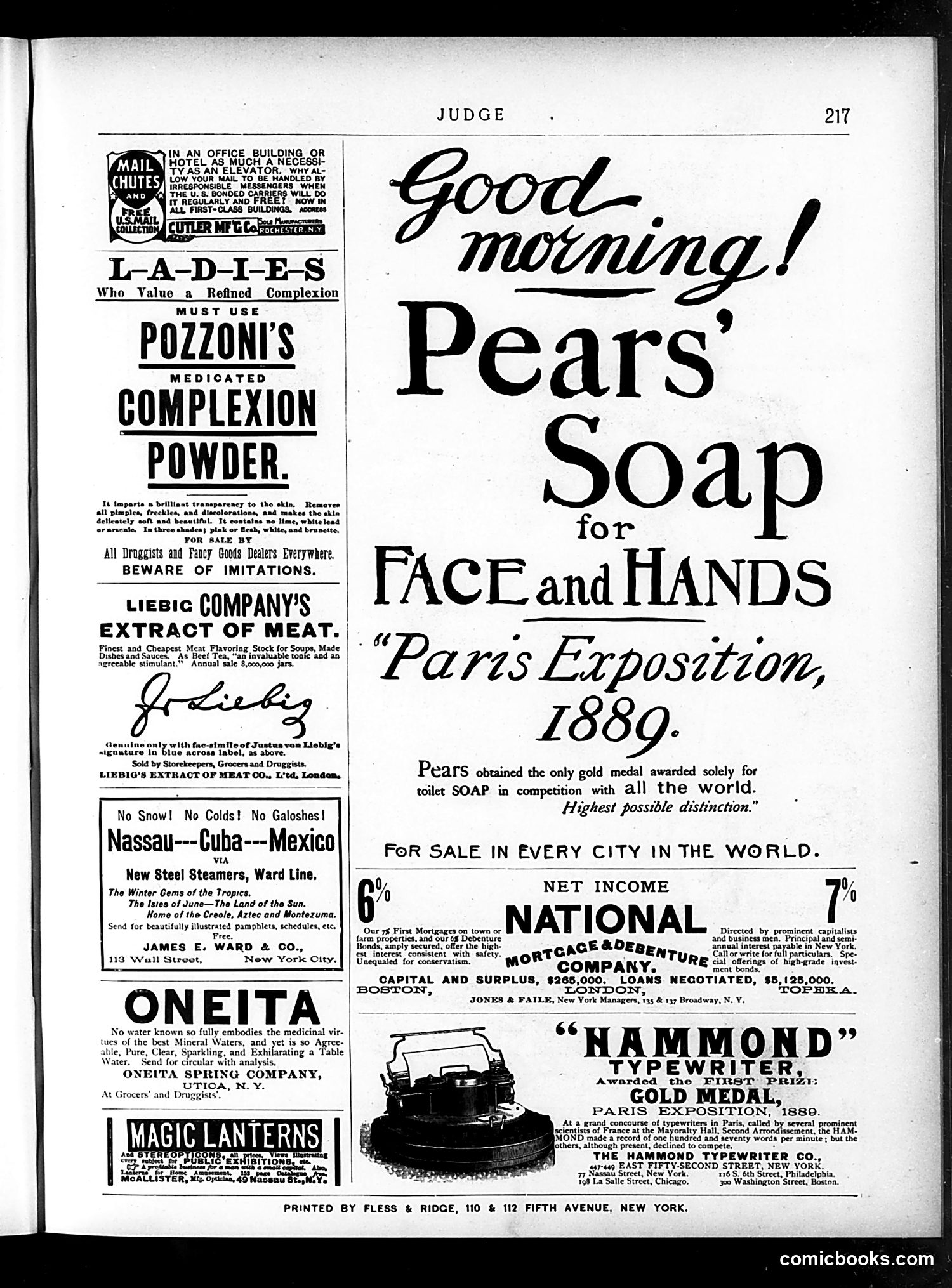
This page is **primarily advertising**, not satire or editorial content. It features numerous product advertisements typical of late-19th-century American magazines, with no visible political cartoons. Notable ads include: - **Pozzoni's Complexion Powder** and **Pears' Soap**: beauty products emphasizing refined complexions—reflecting period anxieties about appearance and class status - **Liebig's Extract of Meat**: a popular meat-based flavoring product - **Hammond Typewriter**: prominently advertises winning a gold medal at the 1889 Paris Exposition, claiming superior speed (170 words per minute) - **Ward Line Steamers**: tropical vacation packages to Nassau, Cuba, Mexico - **Oneita Spring Water** and various financial services The **Hammond Typewriter** ad is notable for competitive boasting—claiming other typewriters "declined to compete" at the Paris Exposition, a common advertising tactic of the era. The overall page reflects Gilded Age consumerism and emerging technologies like typewriters becoming commercial products.
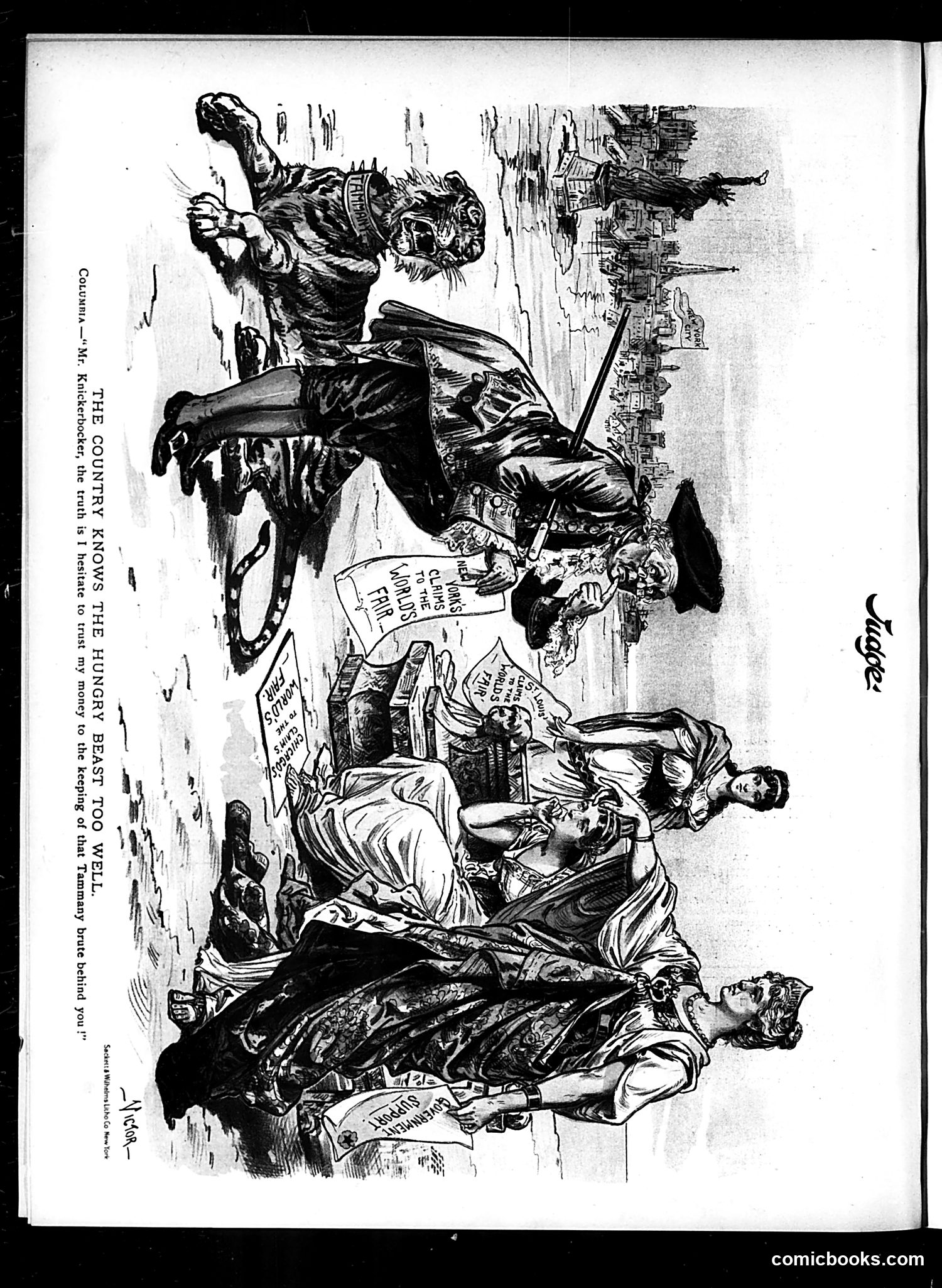
This is a satirical cartoon criticizing **Tammany Hall**, the Democratic political machine that controlled New York City politics. The image depicts Tammany as a ravenous beast—literally a hungry, aggressive creature—menacing respectable citizens and their finances. The dialogue references "Mr. Knickerbocker" (representing old-money New York establishment) expressing fear that Tammany will corrupt or steal deposited money. The cartoon's title, "The Country Knows the Hungry Beast Too Well," suggests Tammany's reputation for corruption and greed was already well-established. This reflects late 19th-century reformist sentiment against Tammany's notorious patronage system and financial malfeasance. The beast metaphor emphasizes how contemporaries viewed the organization as dangerous and predatory toward public funds and honest citizens.