
A complete issue · 16 pages · 1889
Judge — October 19, 1889
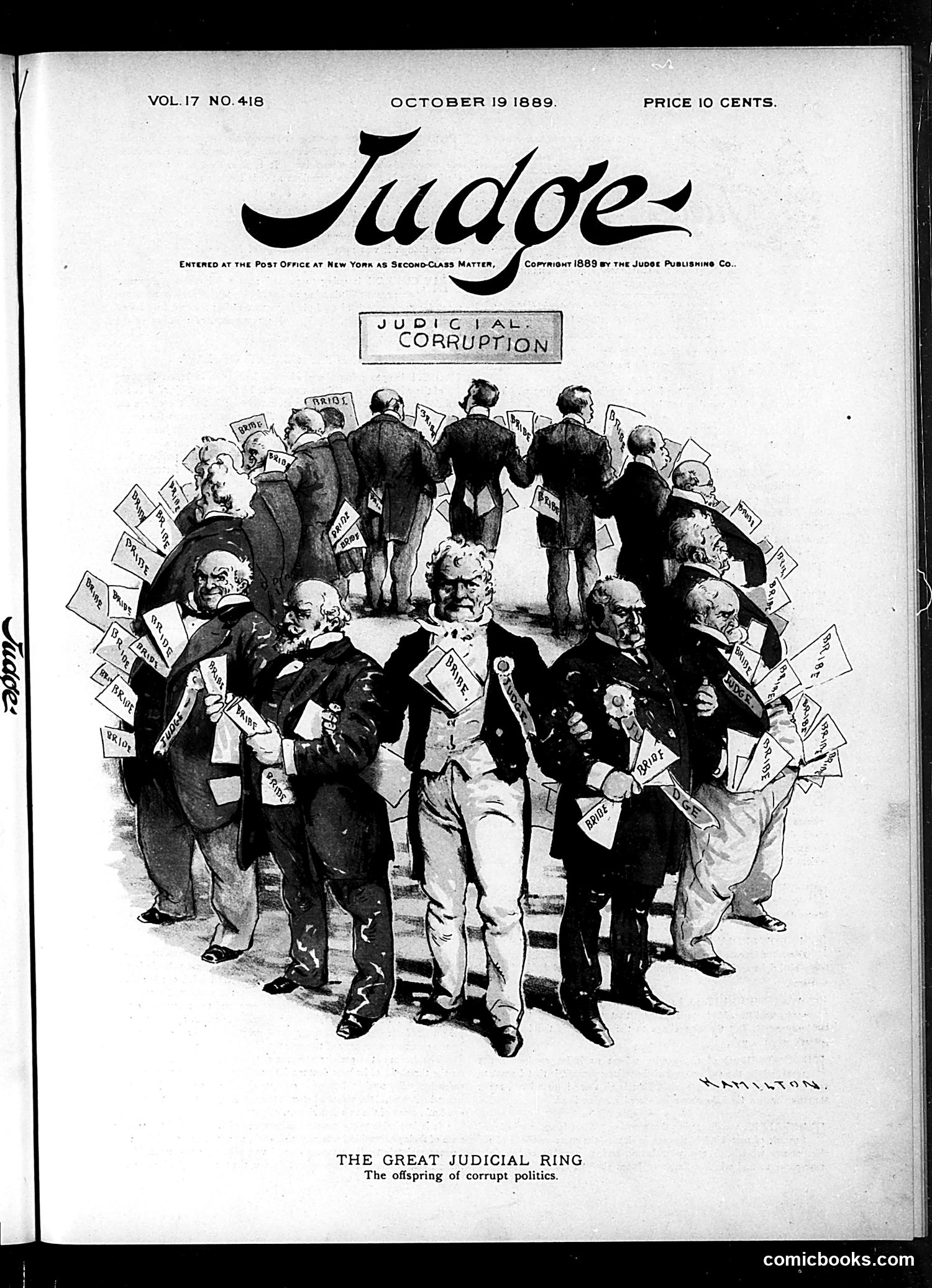
This October 1889 *Judge* cartoon satirizes **judicial corruption** as "the offspring of corrupt politics." The illustration depicts a "ring"—a closed circle of corrupt officials profiting together—composed of judges and politicians exchanging what appear to be bribes or corrupt favors (represented by labeled documents held by the figures). The circular composition suggests an interconnected corrupt system where judicial officials are implicated in political misconduct. The caricatured faces and exaggerated features typical of 19th-century satirical art emphasize the personal culpability of specific (though unnamed here) individuals. The cartoon targets the widespread belief that courts had become compromised by political machines and corruption—a genuine Progressive Era concern about institutional integrity and the judiciary's independence from political influence.
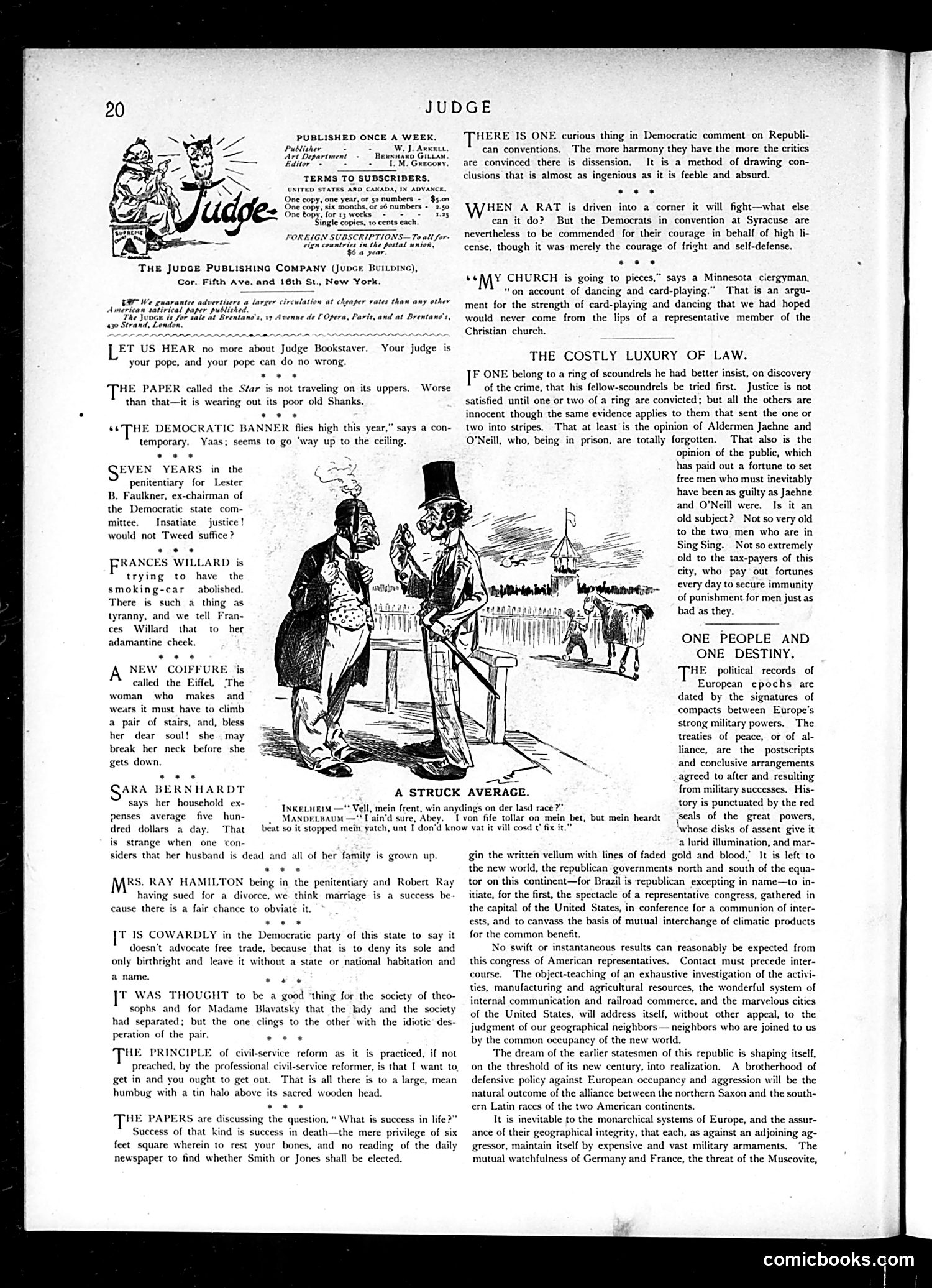
This cartoon depicts two men in what appears to be a betting or gambling scenario. The dialogue indicates they're making a wager, with one character saying he won "life tollar on mein bet" while the other claims he won "life tollar on mein bet, but mein heardt beat his it longest mit noch unch, unt I don't know vat it vill cod t'fix it." The exaggerated dialect and caricatured features suggest these are immigrant characters, likely German or Eastern European. The cartoon satirizes working-class immigrant gambling culture and the "struck average"—a compromise or middle ground between competing claims. The joke appears to mock both the gambling itself and the immigrants' speech patterns, reflecting period attitudes toward turn-of-century immigration.
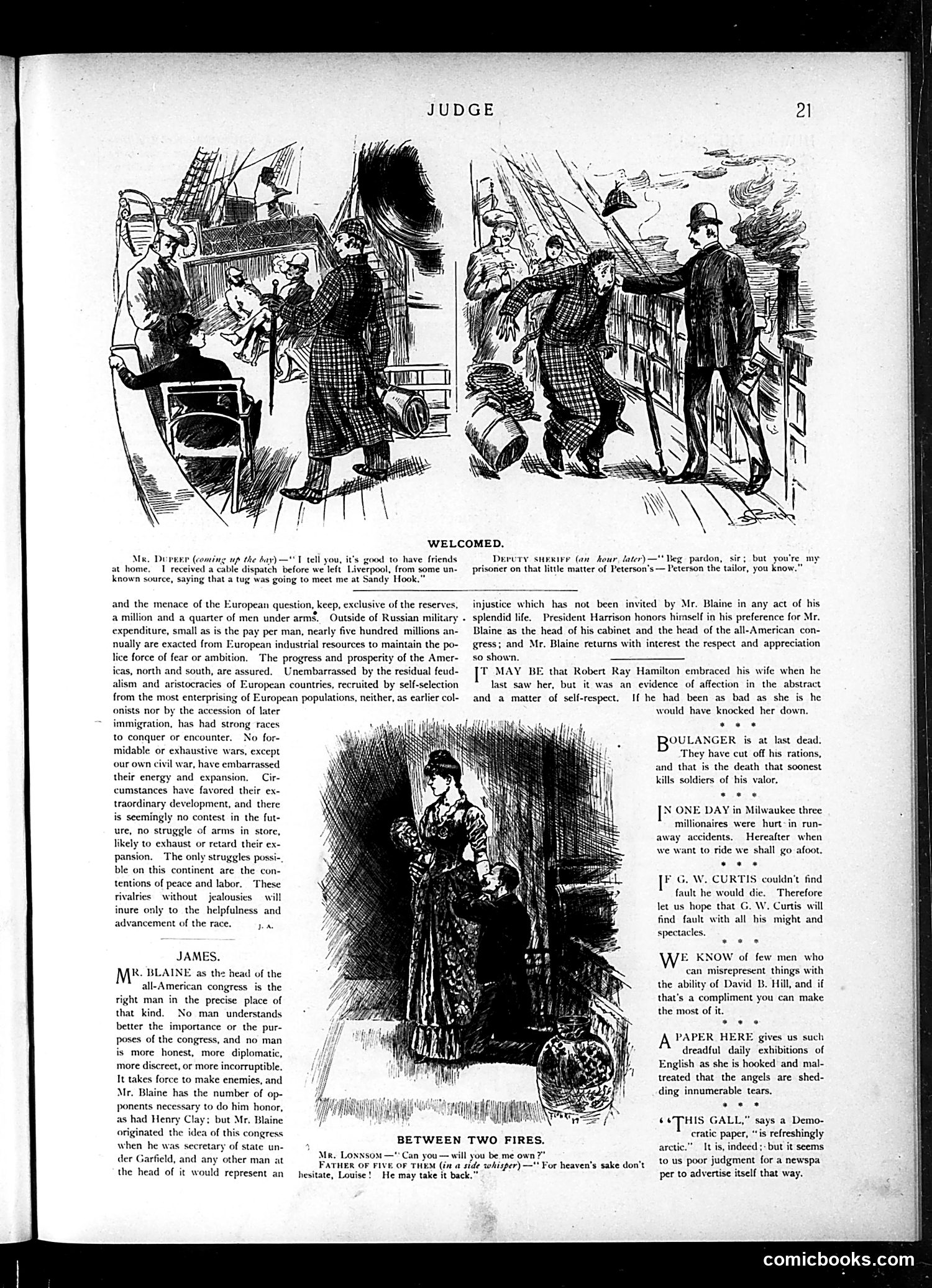
This page contains multiple brief satirical commentaries typical of Judge's format. The top cartoons depict a prominent arrival (likely a politician or notable figure) being "welcomed" at a dock, with the humor involving unexpected complications—the figure is greeted as a guest but is then reminded he's actually a prisoner regarding a tailor's debt. The text pieces that follow mock various political figures and social observations of the era. They reference **James G. Blaine** (Secretary of State under Garfield, later a presidential candidate), praising his leadership of an "all-American congress"; **General Boulanger**, a French military figure recently deceased; **G.W. Curtis**, a prominent editor; and **David B. Hill**, a New York politician. The commentary is light political mockery rather than hard-hitting satire—poking fun at aristocratic pretension, hypocritical morality, and editorial pomposity. The "Between Two Fires" sketch appears to satirize marital discord or infidelity among the wealthy. The overall tone is genteel, upper-class humor aimed at Judge's educated readership.
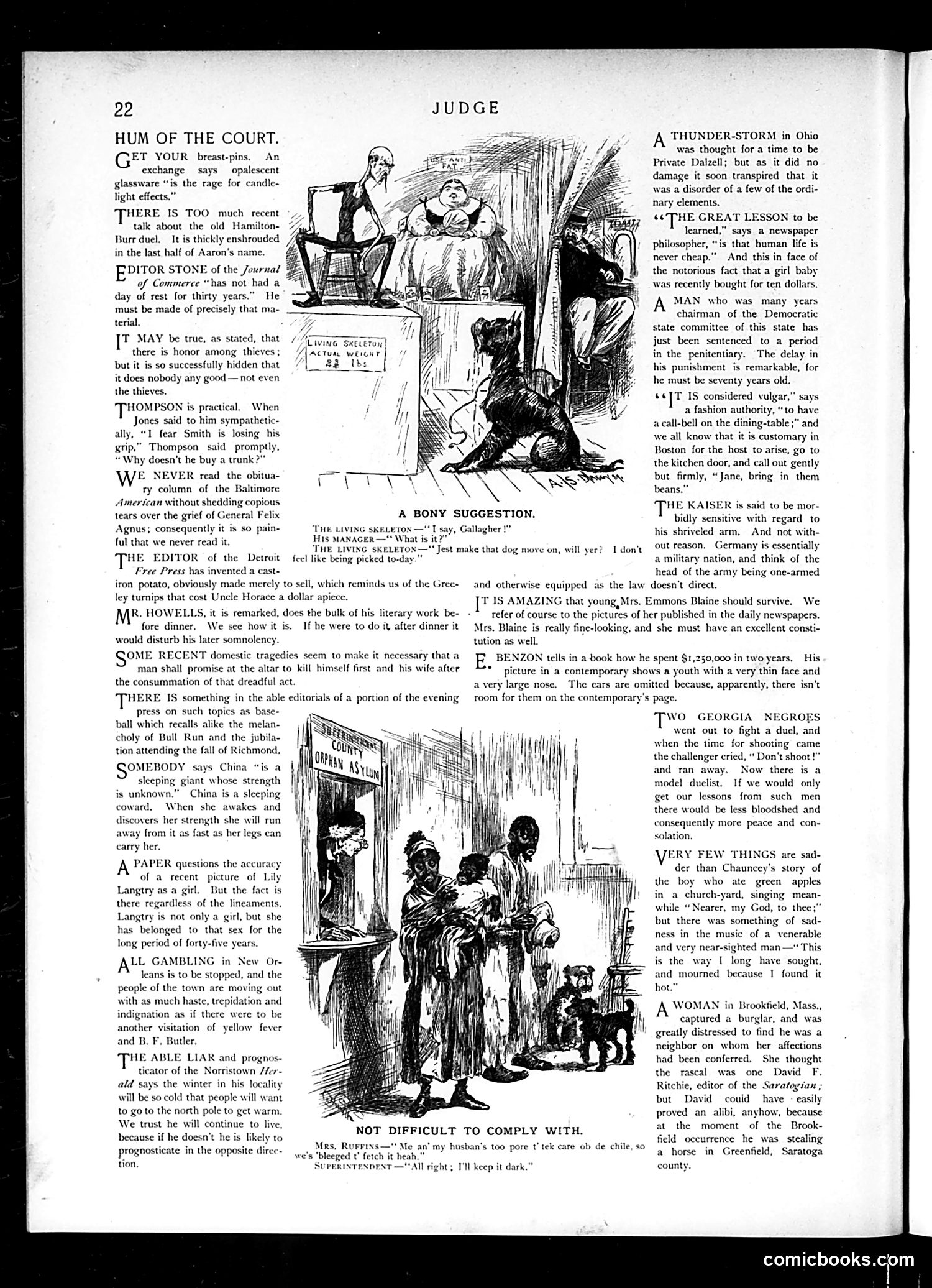
This page from Judge presents various satirical commentary and visual jokes typical of late-19th-century American humor: **"A Bony Suggestion"** depicts a conversation between a "Living Skeleton" (a carnival exhibit, popular at the time) and a manager, making crude jokes about the performer's extreme thinness. **"Not Difficult to Comply With"** shows a Black woman bringing a child to what appears to be a poorhouse or institution, with a superintendent agreeing to keep the matter "dark"—satirizing the difficult circumstances forcing poor families to institutionalize children, likely critiquing both poverty and racial inequities. The text snippets above mock various targets: political figures (references to Hamilton-Burr duels, General Felix Agnus), newspaper editors, military history (Bull Run), and social pretensions. The humor is often mean-spirited by modern standards, including racial stereotypes in the dialect used. The overall tone reflects Judge's role as a vehicle for elite, establishment satire—poking fun at lower classes, politicians, and social absurdities from a privileged perspective.
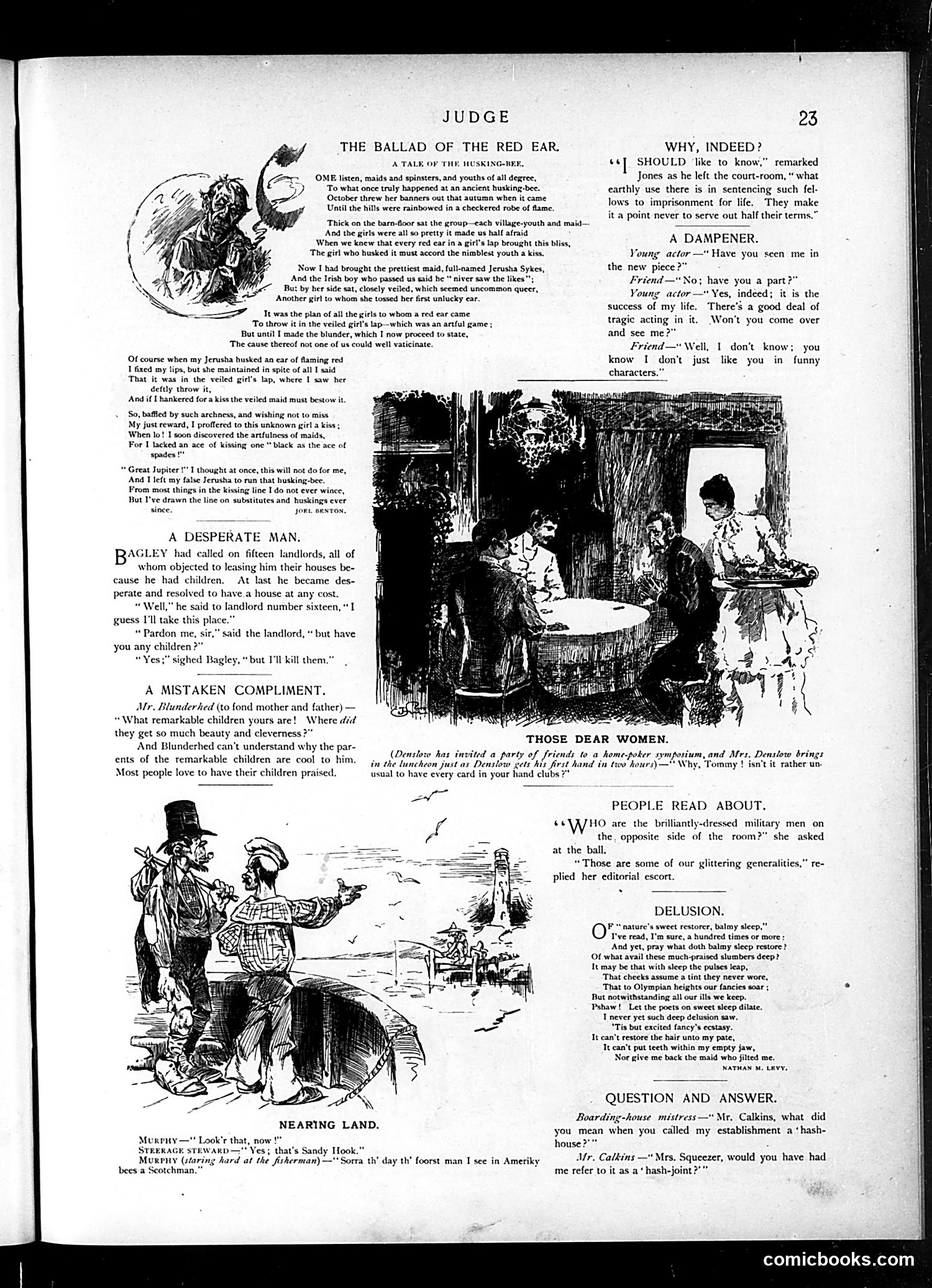
This page contains several satirical pieces typical of late-19th-century American humor: **"The Ballad of the Red Ear"** is a humorous poem about a husking-bee (corn-husking social gathering), a common rural custom where finding a red ear entitled one to a kiss. The narrator is tricked when his intended recipient secretly passes the ear to an unattractive veiled girl, forcing him to kiss her instead. The satire mocks the deceptions of courtship and romantic gaming among young people. **"A Desperate Man"** jokes darkly about housing discrimination against families with children—a real social problem. Bagley's exasperated claim he'll "kill" his children to secure lodging is dark humor about landlords' prejudice. **"A Mistaken Compliment"** satirizes how parents misinterpret flattery about their children's appearance and intelligence, expecting praise while actually becoming offended. The remaining pieces are brief social commentary on theatrical pretension, military display, and domestic life. Overall, the page targets middle-class social conventions and hypocrisies through gentle mockery rather than hard political satire.
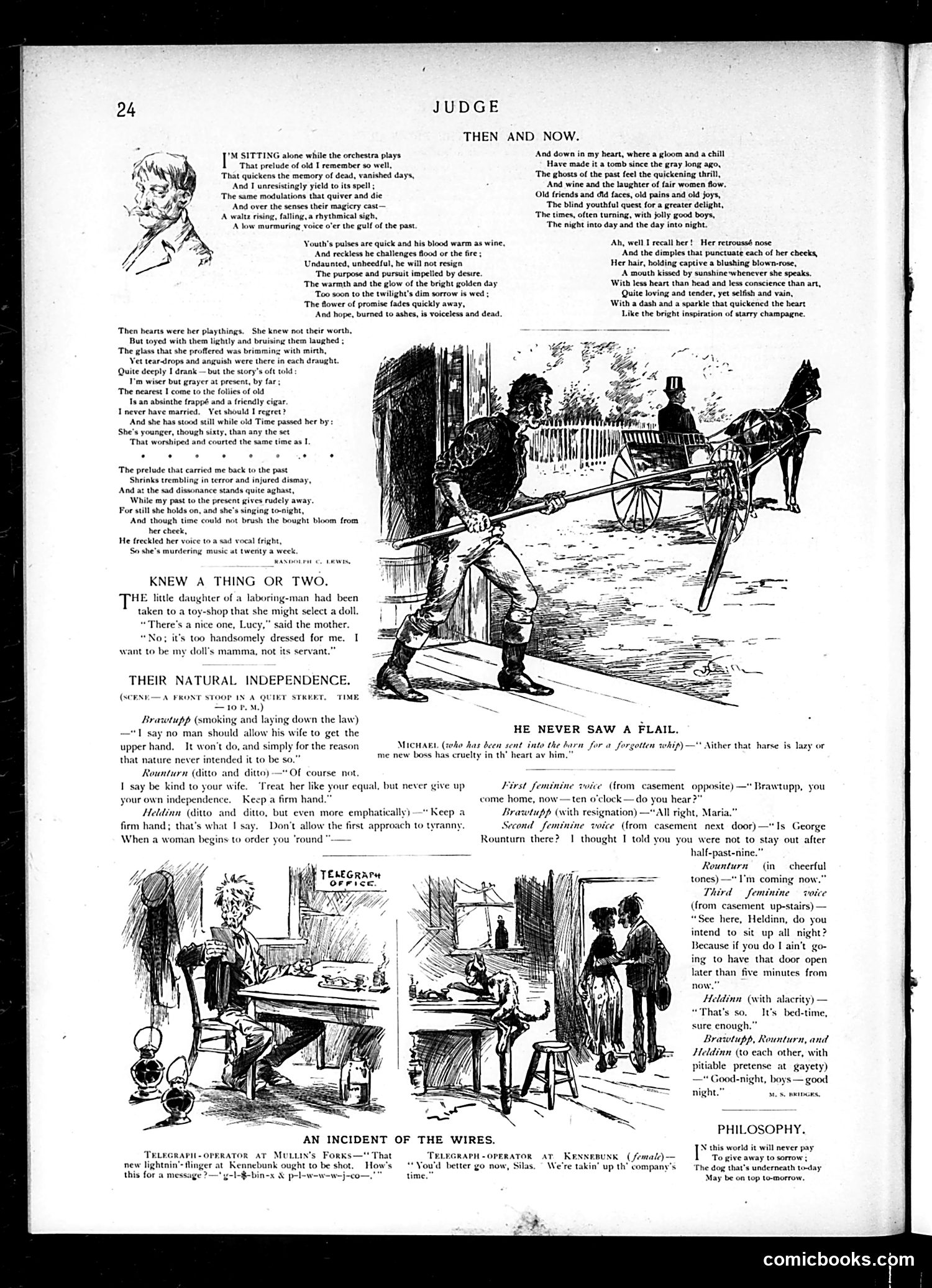
This page combines romantic poetry with social satire about gender relations and technology. **"Then and Now"** is a nostalgic poem about aging and lost love—a man recalls a youthful romance with a woman he didn't marry. The twist: she's now 60, still performs as a singer, but her voice has been ruined by time ("freckled her voice to a sad vocal fright"), forcing her to work cheaply. The satire mocks both the narrator's self-pitying nostalgia and society's cruel treatment of aging women performers. **"Knew a Thing or Two"** jokes about a working-class girl refusing a fancy doll, wanting to be its mother rather than servant—subtle commentary on class consciousness and children's independence. **"Their Natural Independence"** satirizes three men mansplaining about controlling wives, each offering contradictory advice about "keeping the upper hand" while claiming to be reasonable. The humor lies in their obliviousness to their own hypocrisy. **"An Incident of the Wires"** mocks telegraph operators' garbled transmissions and miscommunications. The overall theme: social pretension, aging, gender dynamics, and technological folly.
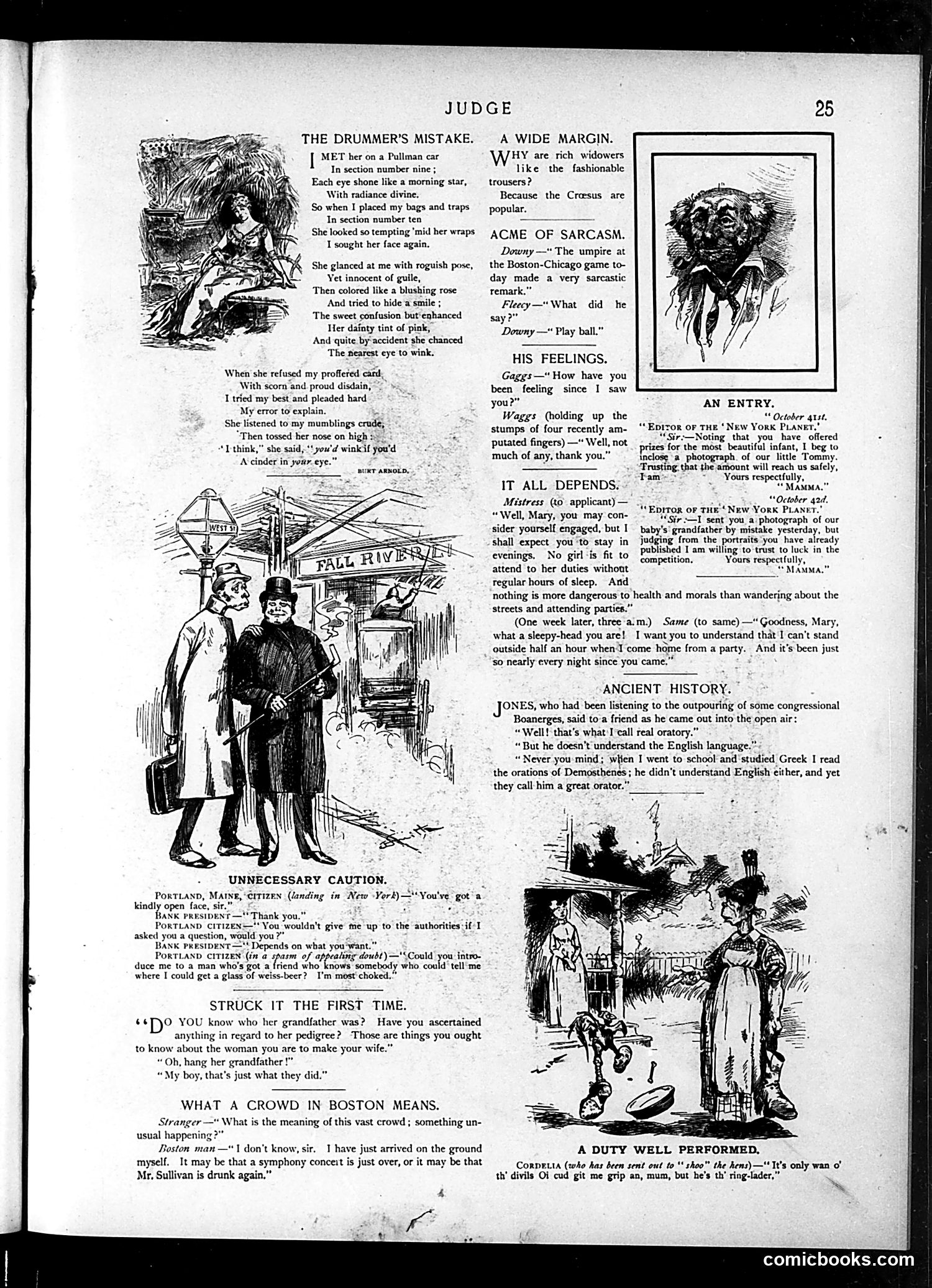
This page from *Judge* contains several brief satirical pieces typical of the magazine's humor: **"The Drummer's Mistake"** depicts a traveling salesman's embarrassing misreading of a woman's signals on a train—she winks due to dust in her eye, not flirtation. The satire mocks the confidence of traveling salesmen ("drummers"), a common target in period humor. **"Unnecessary Caution"** jokes about Prohibition-era desperation: a Portland visitor asks a New York banker increasingly circuitous questions to locate illegal beer, fearing arrest. **"Struck It the First Time"** uses dark gallows humor about a woman's ancestry—"they did" hang her grandfather—suggesting a scandalous family history. Shorter gags mock wealthy widows, baseball umpires, and Irish politician "Mr. Sullivan's" drinking habits. An editorial item about baby photo contests satirizes vanity. The cartoons accompany these jokes with relevant illustrations. Overall, the page reflects turn-of-the-century American concerns: Prohibition enforcement, class anxieties, transportation culture, and urban Irish-American stereotypes.
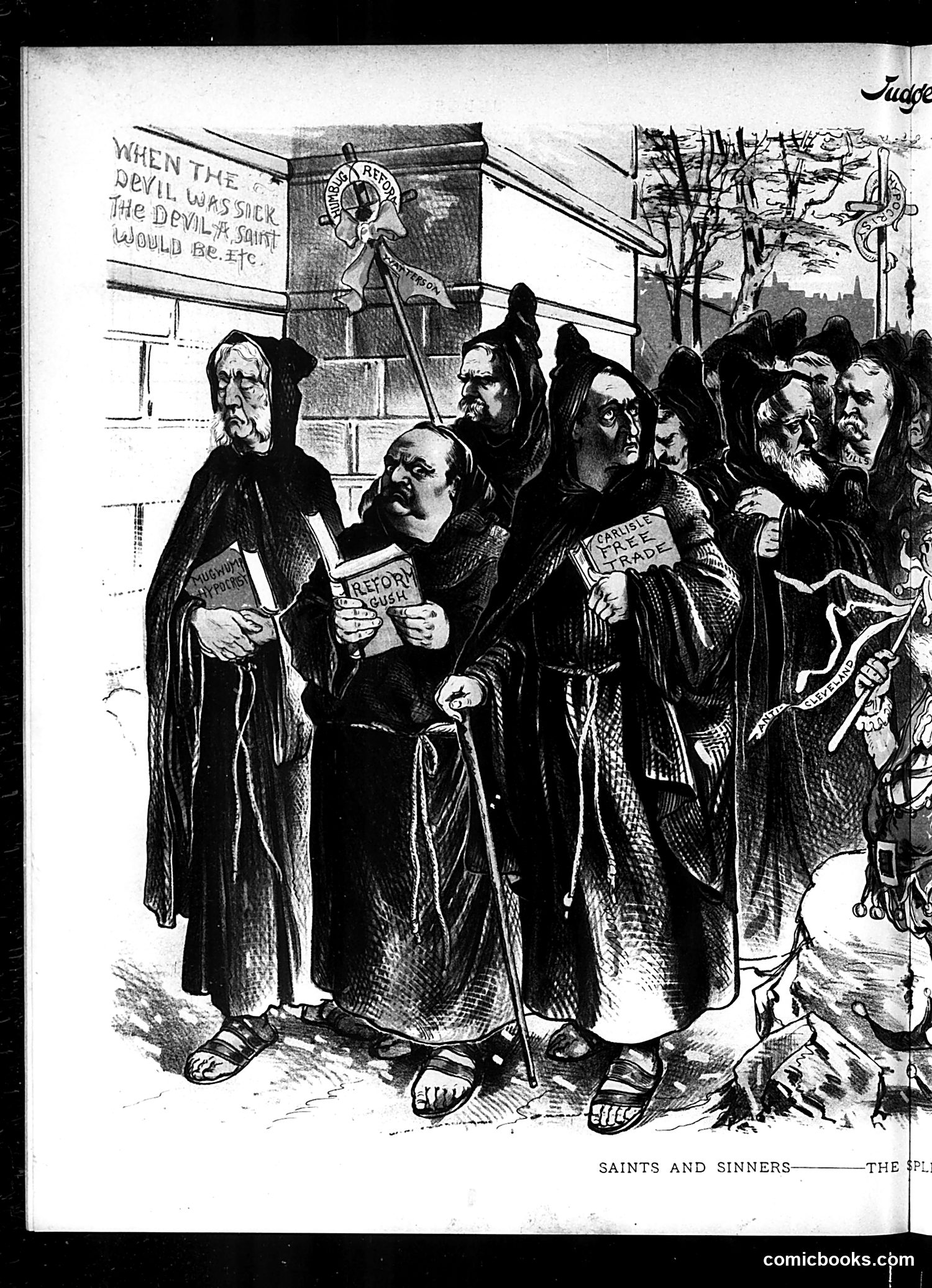
This Judge magazine cartoon satirizes religious hypocrisy. The image shows a group of clergy and religious figures in dark robes gathered around a pole or post bearing religious symbols. The caption text reads: "When the Devil was sick, the Devil a Saint would be, etc."—referencing an old proverb about insincere conversion during hardship. Several figures hold papers labeled "Reform" and "Gush," suggesting they're promoting moral reform rhetoric while remaining morally questionable. The cartoon critiques religious leaders who adopt sanctimonious positions opportunistically rather than from genuine conviction. The medieval-style dress and the caricatured faces emphasize the satirist's contempt for their pretended piety. This attacks institutional religious corruption—a common Gilded Age theme in Judge magazine.
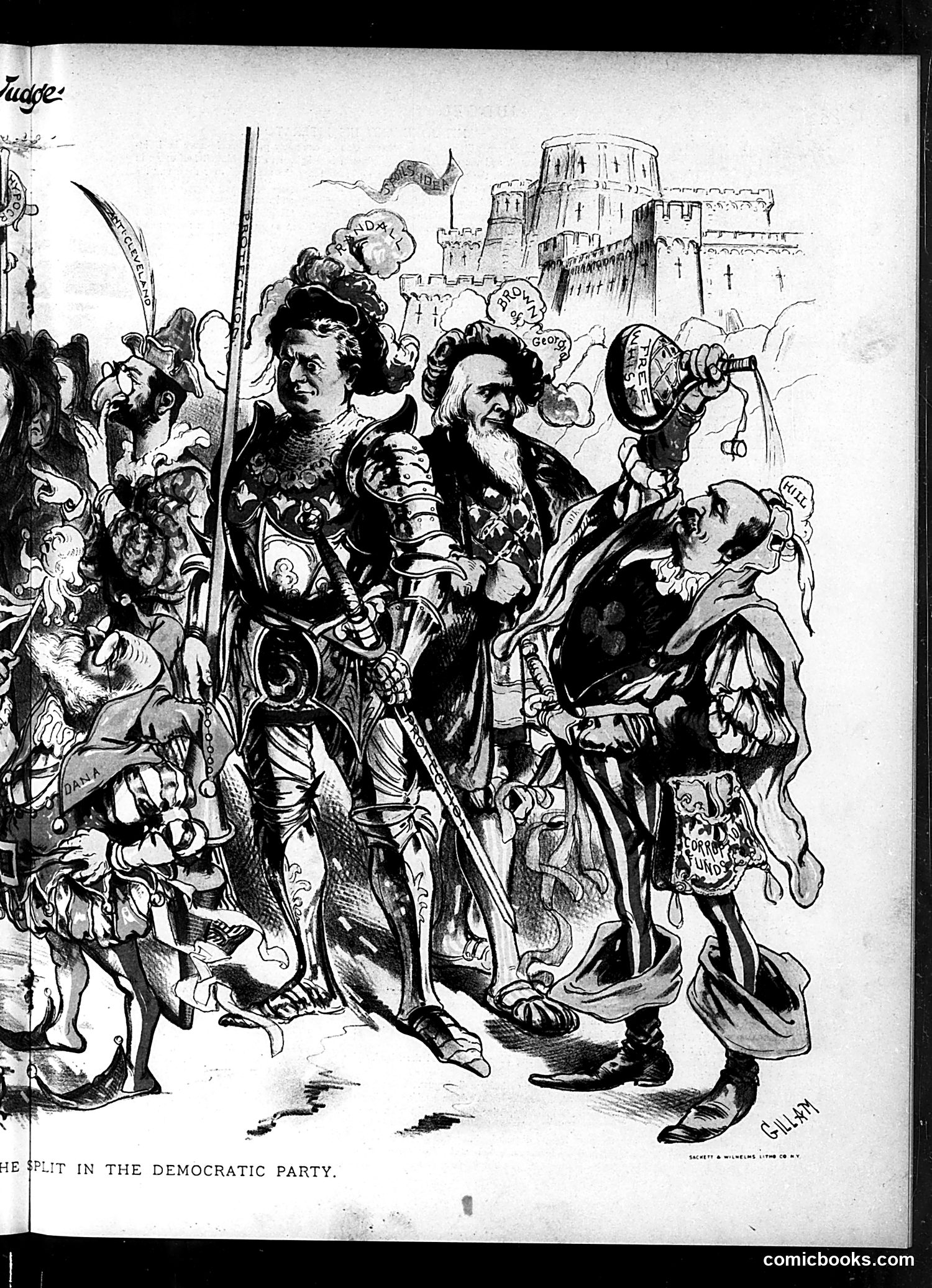
This political cartoon depicts a dramatic schism within the Democratic Party, shown as armored medieval figures in conflict before a fortified castle. The central figures appear to be party leaders or factions in disagreement, with smaller figures (possibly representing party members or political operatives) surrounding them in chaos. The medieval imagery—armor, weapons, castle—emphasizes the severity and violence of the party division. The labels visible on figures ("DADA," "GEORGE," and others) likely reference specific Democratic politicians or factions contemporary to the publication, though their exact identities are unclear from the image alone. The satire suggests the Democratic Party was experiencing internal warfare that threatened its unity and electoral viability. Without knowing the specific publication date, the exact political moment remains uncertain, though such splits occurred multiple times in American Democratic history.
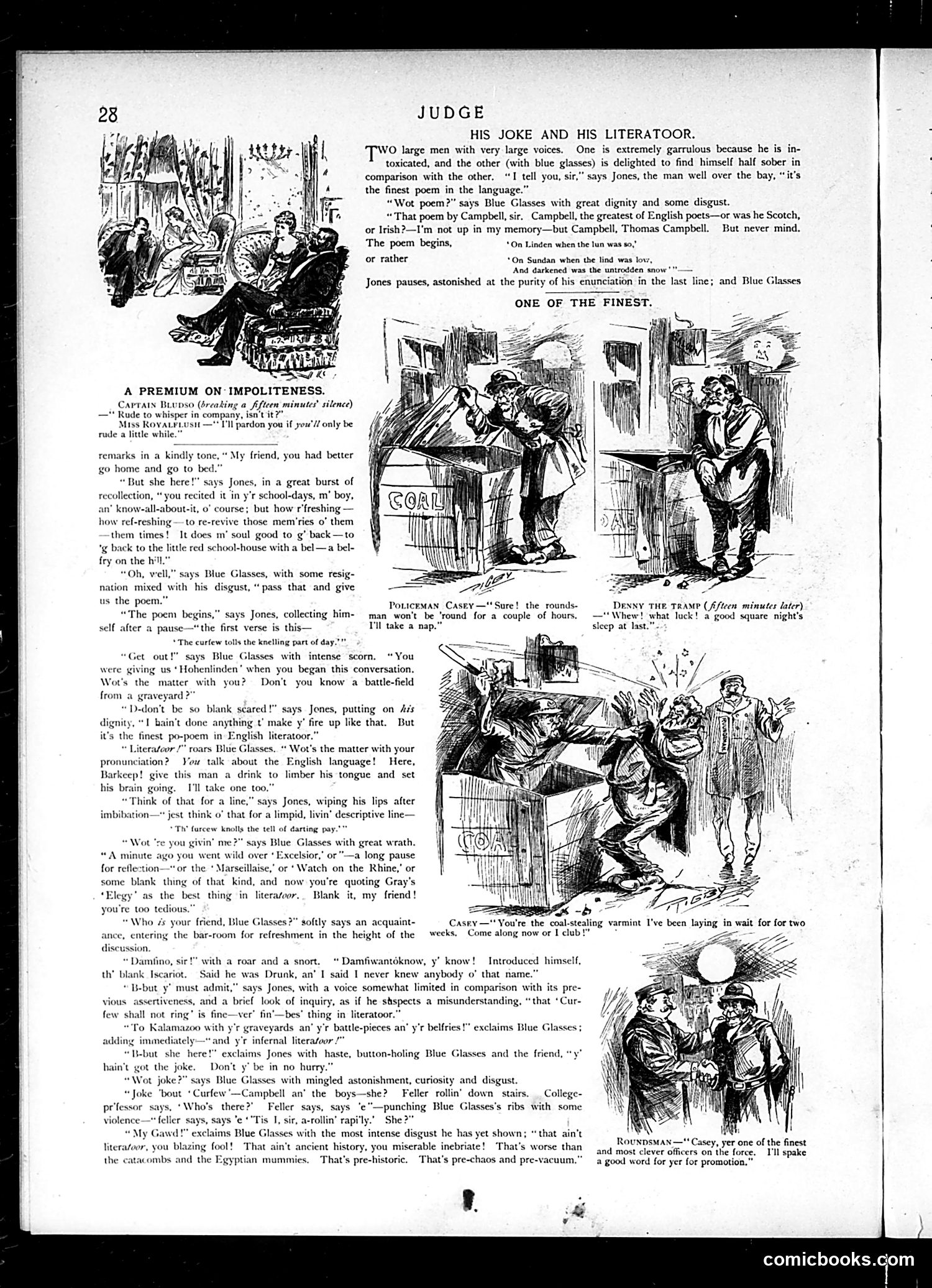
This page satirizes two drunk men debating English poetry. One man (Jones) is intoxicated and misquotes Thomas Gray's "Elegy Written in a Country Churchyard," repeatedly garbling the opening line ("The curfew tolls the knell of parting day"). His companion, wearing blue glasses, grows increasingly exasperated, pointing out Jones keeps switching between different poems—first claiming it's by Campbell, then reciting Gray. The humor targets drunken pomposity: Jones insists his mangled recitation is "the finest poem in the language," while mispronouncing "literature" as "literatoor." The cartoons show various characters encountering Jones's drunkenness—a policeman, a tramp grateful for lodging, and others. The satire mocks both alcoholic pretension and the inability to maintain coherent thought while intoxicated.
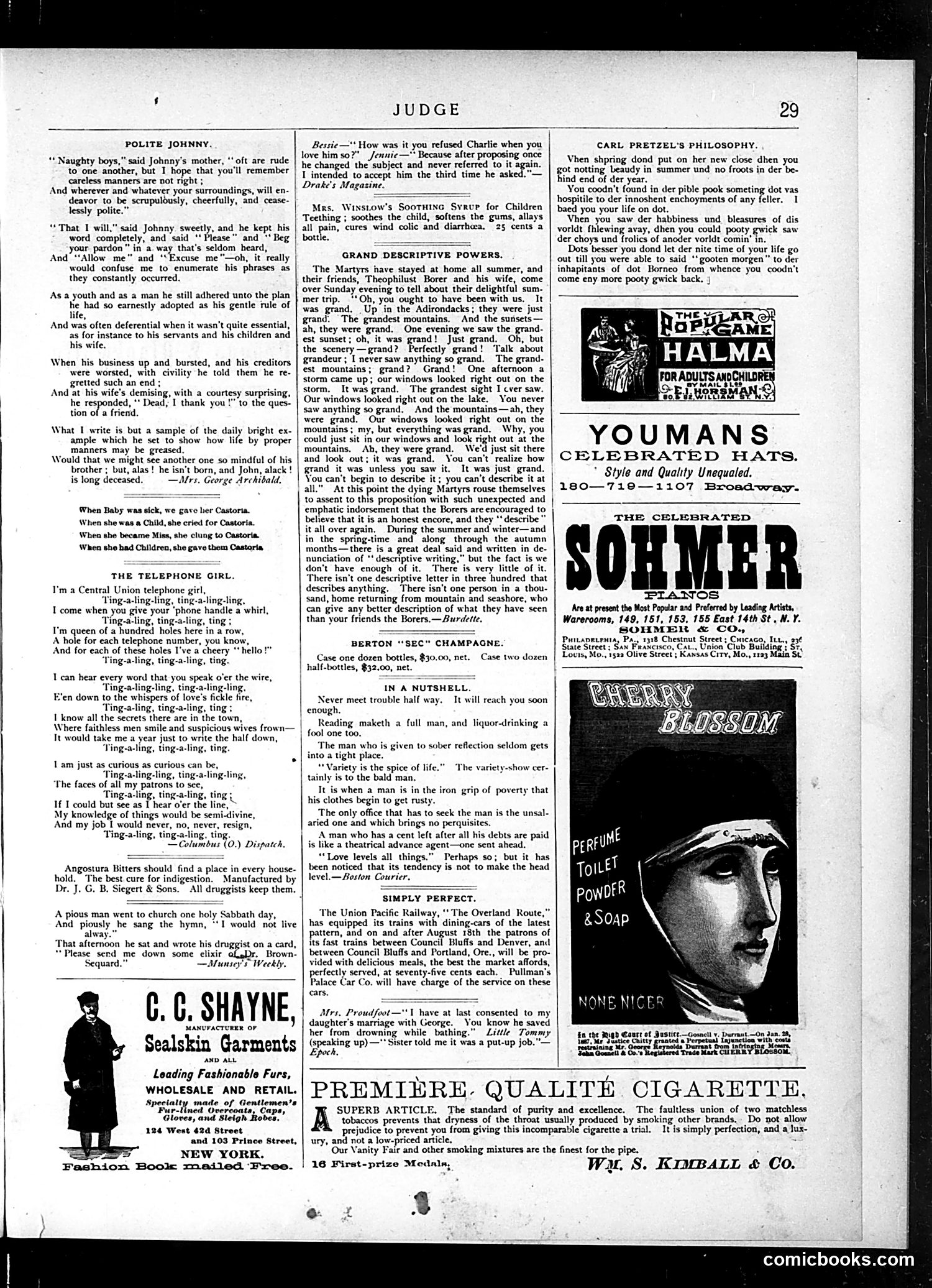
This page contains two main satirical pieces: **"Polite Johnny"** (left column) is a poem mocking excessive politeness. It narrates the life of a man so obsessively courteous that he remains deferential even when it's absurd—apologizing to creditors when his business fails, thanking people politely about his wife's death. The satire suggests that rigid adherence to manners, taken to extremes, becomes ridiculous and prevents authentic human response to genuine hardship. The joke: politeness divorced from sincere feeling becomes a hollow social performance. **"The Telephone Girl"** (center) satirizes the newfound power of telephone operators who could listen to calls and thus access private information about affairs, secrets, and scandals in their communities. The operator boasts she "knows all the secrets" and hears "whispers of love's fickle fire." This reflects contemporary anxiety about technology enabling invasions of privacy and the gossip potential of operators who literally controlled communication. The rest is period advertising for products like Castoria (a laxative), Angostura Bitters, and furs.
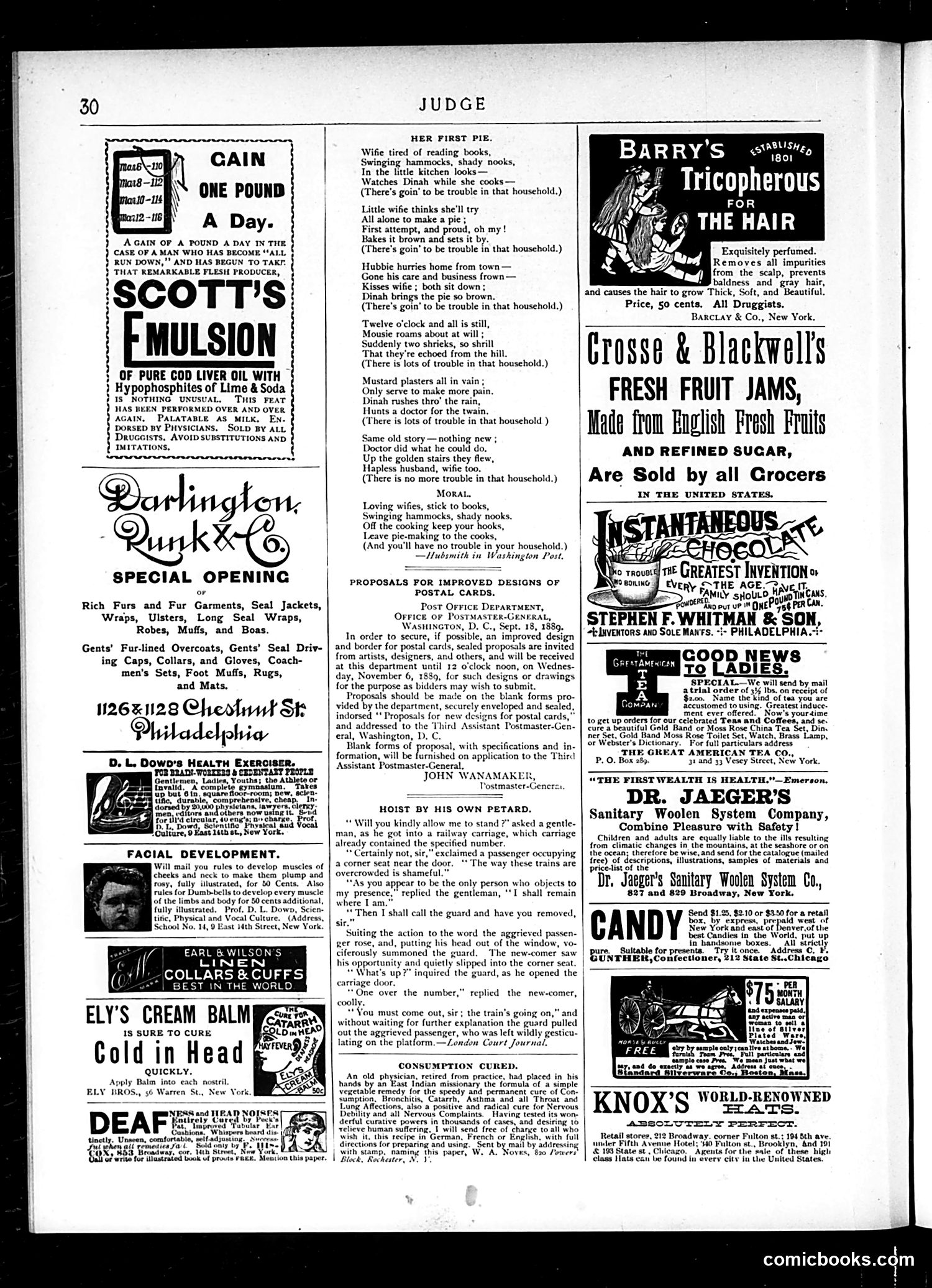
This page is dominated by a humorous narrative poem satirizing the "New Woman" — the late-19th-century figure challenging domestic conventions. The story mocks a wife who abandons traditional feminine activities (reading, hammock-swinging) to attempt cooking a pie herself rather than trusting the servant "Dinah." The joke's escalation is darkly comic: the homemade pie poisons both husband and wife, requiring a doctor, and ultimately kills them both. The moral warns women to "stick to books" and "leave pie-making to the cooks" — satirizing the anxiety men felt about women stepping outside prescribed roles. This reflects genuine Victorian fears about female independence and competence. The poem uses grotesque exaggeration (death from bad pie) to ridicule both ambitious wives and the notion they could handle domestic labor previously managed by servants. The remainder consists of period advertisements for corsets, hair treatments, and medical devices — typical Judge magazine content.
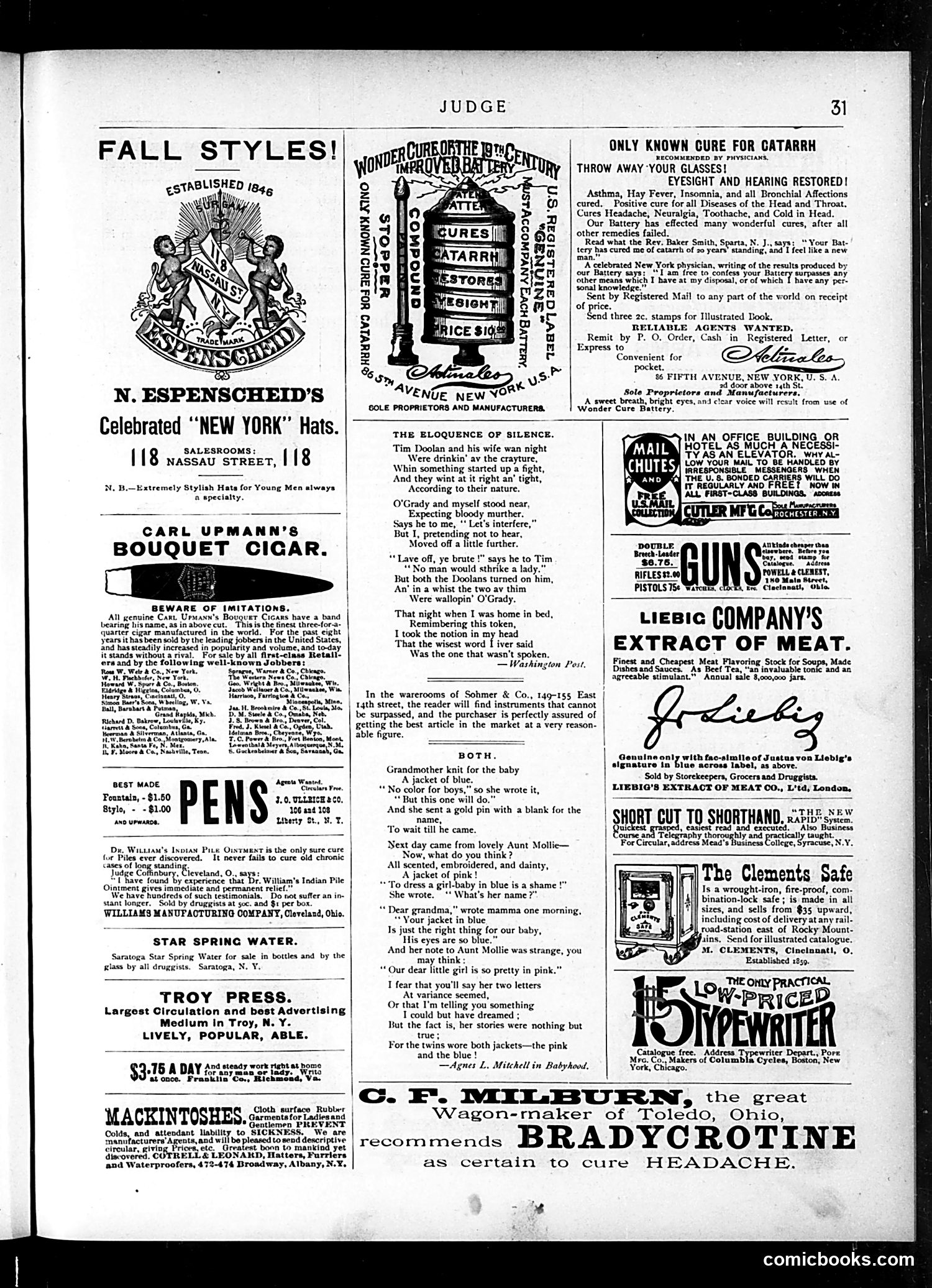
This page is primarily **advertising**, with one notable literary poem titled "The Eloquence of Silence." The poem depicts an Irish immigrant incident: O'Grady and the narrator witness a fight between two men (apparently named Tim and Doolan). The narrator chooses not to intervene, believing silence is wise. That night, he realizes his restraint was correct—"the one that wasn't spoken" proved most eloquent. The **satire targets Irish stereotypes**: the broken dialect ("drinkin' av the crayture"), working-class violence, and the valorization of non-intervention. The poem frames silence as philosophically superior to involvement, a gentle mockery of Irish-American street culture. The page is dominated by advertisements for dubious patent medicines (catarrh battery, Bradycrotine for headaches), hats, cigars, and firearms—typical late-19th-century American commerce. These ads themselves represent period attitudes toward unregulated medical claims and consumer products.
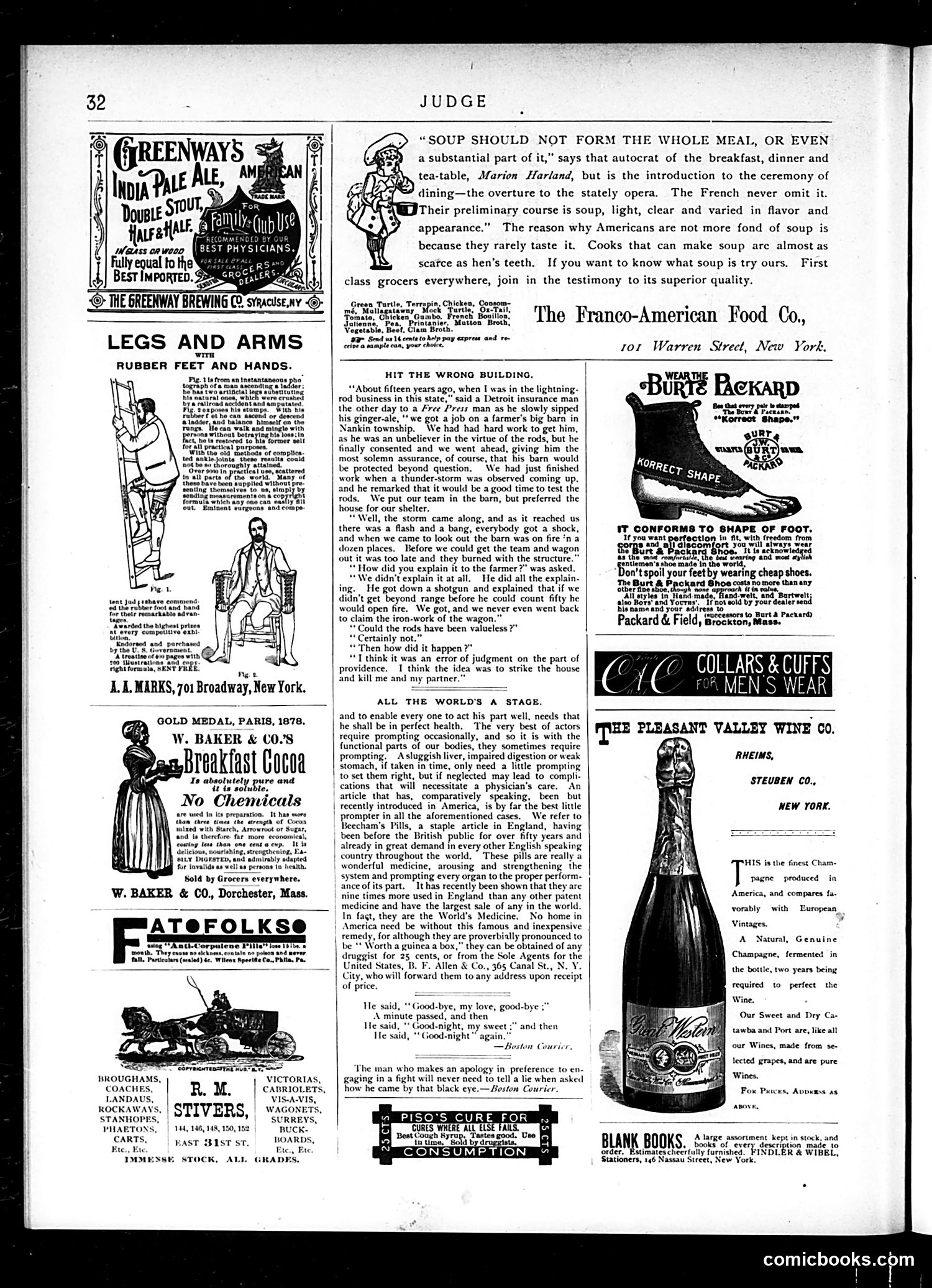
This page is primarily **advertising with one humorous anecdote**, typical of Judge's format. The main content is "Hit the Wrong Building," a comic story about a lightning-rod salesman whose installation fails catastrophically during a storm, burning the farmer's barn and team. The farmer's angry response—threatening to shoot them if they don't flee—provides the humor through exaggeration and the salesmen's absurd explanation that "Providence" simply miscalculated which building to strike. The satire targets **unscrupulous salesmen** and their defensive excuses when products fail, while mocking the farmer's superstitious belief in lightning rods' protective powers. The remaining content consists of period advertisements: Greenway's Ale, rubber prosthetics ("Legs and Arms"), W. Baker Cocoa, carriage manufacturers, and food products. The Franco-American Food Company includes editorial advocacy praising French soup culture while dismissing American indifference to it. The CYC Collars advertisement and other merchant notices round out a typical late-19th-century magazine page mixing editorial content with revenue-generating ads.
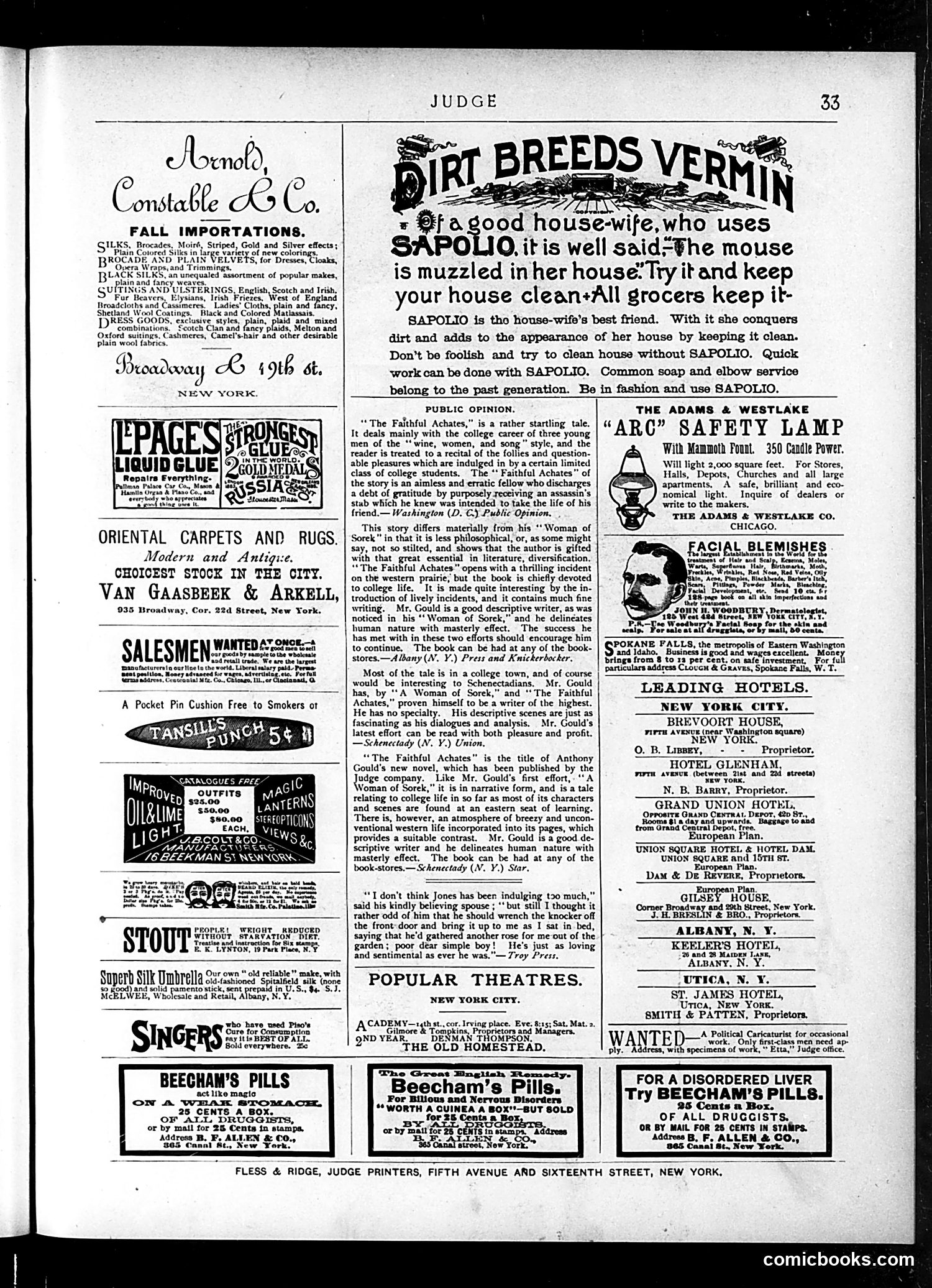
This is primarily an **advertising page** with minimal editorial content. The bulk consists of classified and display advertisements typical of late-19th-century American magazines. Notable advertisements include: - **Arnold Constable & Co.** (top left): Fall textile importations - **Sapolio cleaning product** (top center): Marketed to housewives; the ad's humor plays on the idea that a mouse is "muzzled" (kept away) by cleanliness - **Various hotel listings** (right side): New York City establishments - **Patent medicines** (bottom): Beecham's Pills and similar remedies - **Miscellaneous goods**: Carpets, umbrellas, pianos, corsets The **"Public Opinion"** section reviews a novel called *"The Faithful Achates"* by an author named Gould, discussing its college-life narrative and literary merits. There is **no political satire** visible on this page—it lacks Judge magazine's typical comedic illustrations and social commentary. This appears to be a revenue-generating advertising section rather than an editorial one.
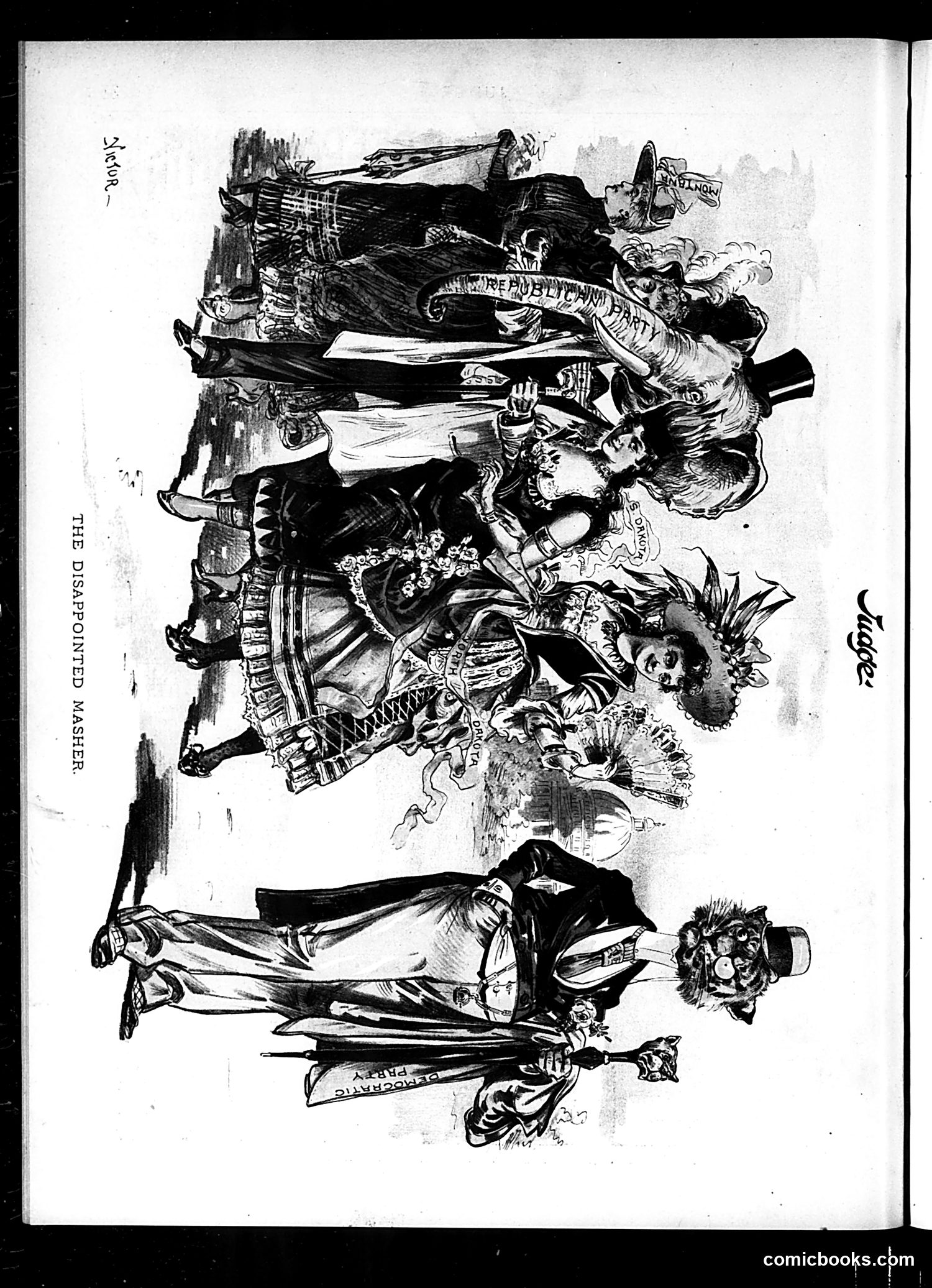
This cartoon appears to satirize a fashionable man ("masher" being period slang for a flirtatious gentleman) whose romantic advances have failed. The image shows him in formal dress at bottom, appearing dejected, while above are depicted various women and social scenes—likely representing his unsuccessful attempts at courtship or romantic conquest. The satire likely mocks the vanity of men who considered themselves irresistible to women, showing the gap between their self-regard and actual romantic success. The chaotic, overlapping composition of figures above emphasizes the confusion and disappointment of his situation. Without a clear date visible, this appears to be late 19th or early 20th-century commentary on gender relations and masculine pretension in American society.