
A complete issue · 17 pages · 1889
Judge — October 5, 1889
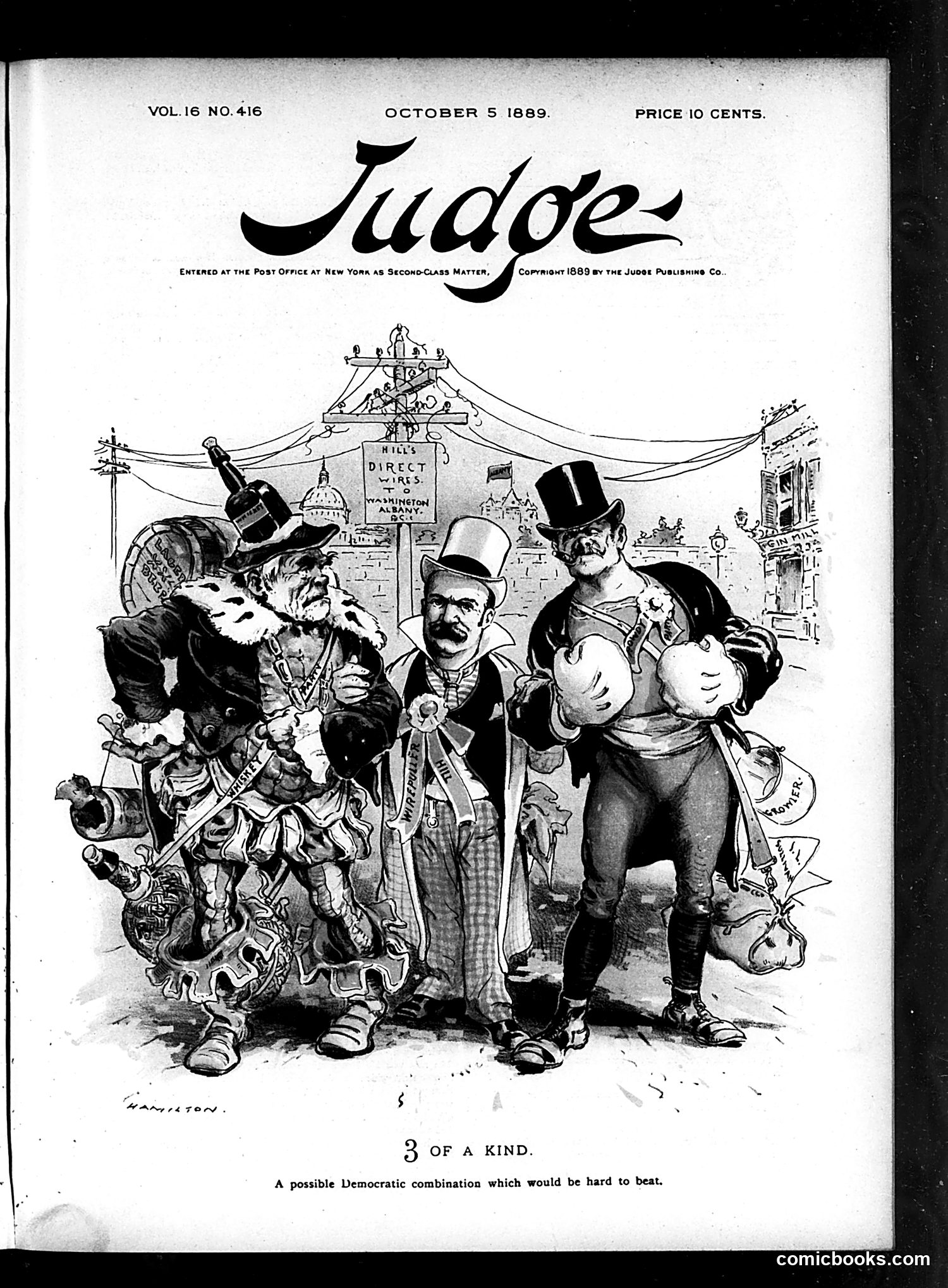
This satirical cartoon depicts three caricatured male figures in formal attire wearing top hats, positioned beneath the Brooklyn Bridge. The caption reads "A possible Democratic combination which would be hard to beat." The cartoon's meaning is unclear without identifying the specific figures. However, the phrase "3 of a kind" and reference to a "Democratic combination" suggest this mocks potential Democratic political alliances or candidates from 1889. The exaggerated facial features and grotesque caricaturing styles were typical of 19th-century political satire. The Brooklyn Bridge backdrop (completed in 1883) may reference New York politics specifically. Without confirmed identifications of the three figures, the precise political targets and satirical point remain uncertain, though the tone is clearly derisive toward Democratic prospects.
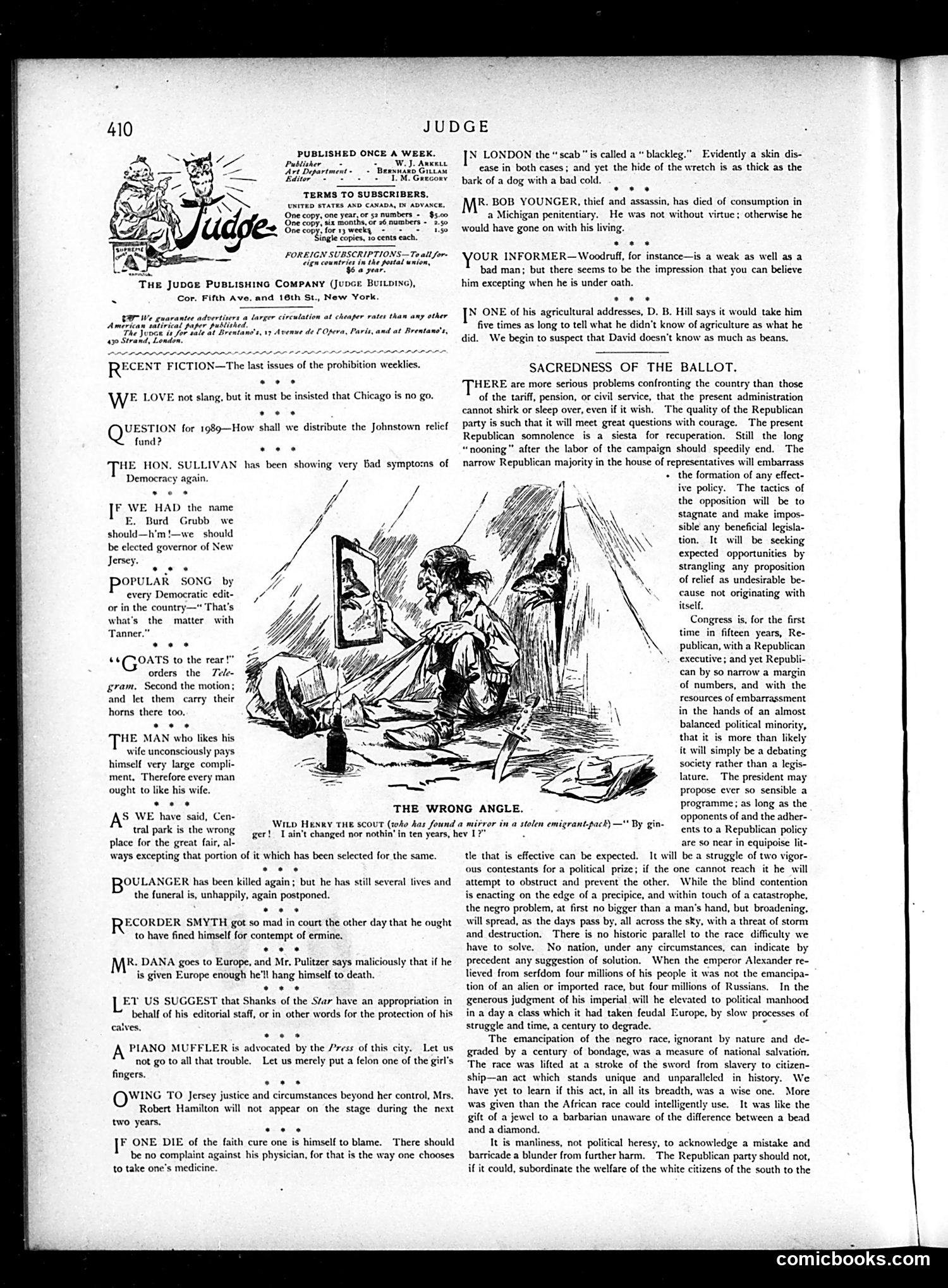
This cartoon appears to critique Republican approaches to the "negro problem" during the post-Reconstruction era. The accompanying text discusses how the Republican Party, now controlling Congress, faces the challenge of addressing racial issues—specifically the status of Black Americans in the South. The figures likely represent Republican politicians viewing this complex social problem from an inadequate or misguided perspective (hence "the wrong angle"). The text argues that Republicans risk either stagnating progress or making counterproductive legislative attempts. The satire suggests that political maneuvering and narrow partisan interests prevent sensible solutions to racial inequality. The cartoon criticizes the party's inability or unwillingness to genuinely address Black citizenship rights and welfare beyond rhetorical positioning.
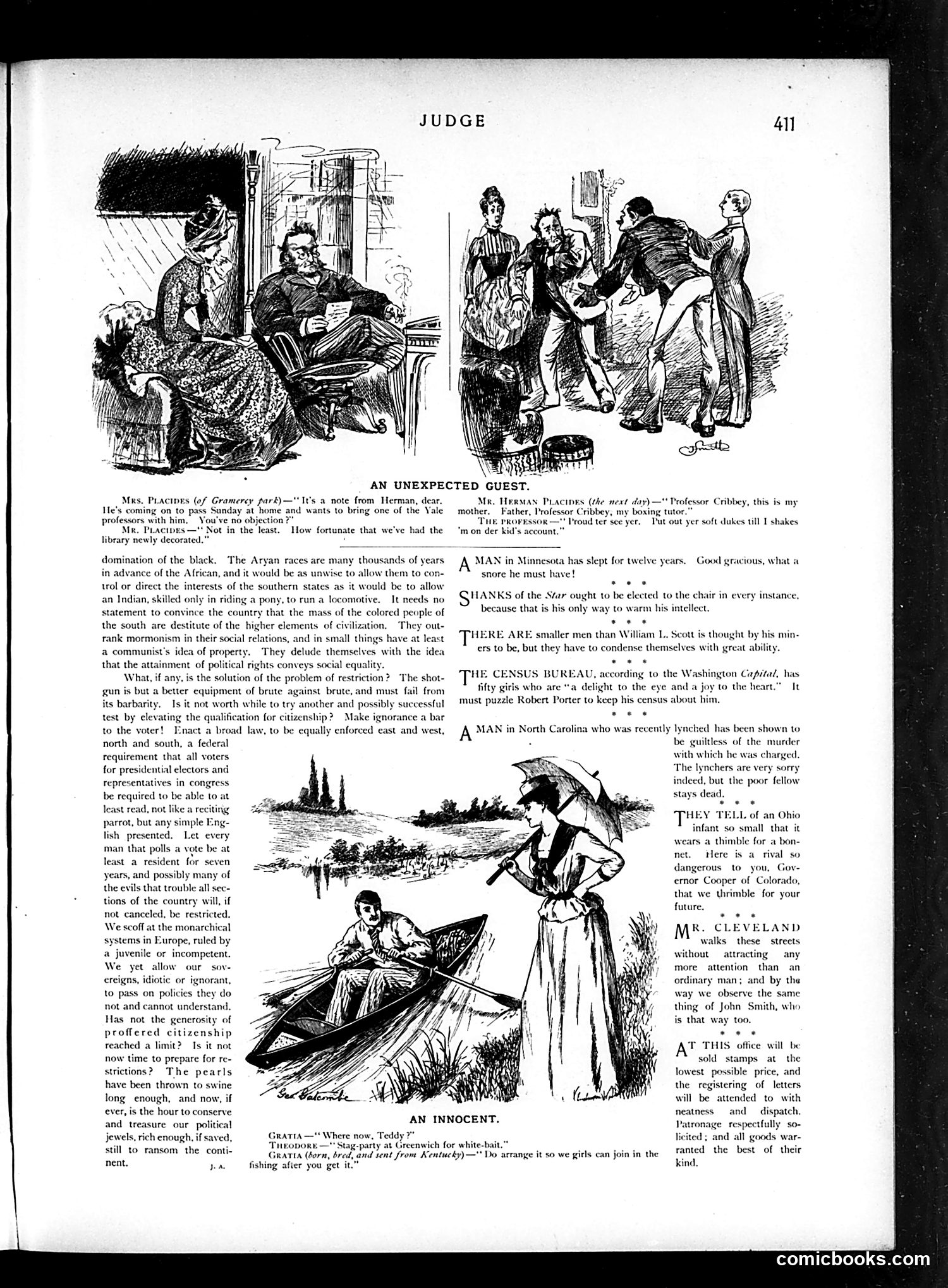
This page from *Judge* satirizes anti-Black racial pseudoscience and restrictive voting policies circa the Gilded Age. **"An Unexpected Guest"** (top): A Yale professor, invited to Sunday dinner, launches into a racist tirade about "Aryan races" being naturally superior and "colored people of the south" being unfit for political participation. The cartoon mocks such guests who weaponize pseudoscientific racism in polite company. **The editorial text** argues for literacy and residency requirements for voting—framed as "elevating the question of citizenship" but clearly designed to disenfranchise Black voters and immigrants. The author attacks both European monarchies and American "sovereigns, idiotic or ignorant," while paradoxically advocating restrictions that would exclude precisely those deemed "ignorant." **"An Innocent"** (center): depicts a fishing scene with a caption about a lynched North Carolina man posthumously proven innocent—dark satire on mob violence and its irreversible consequences. The page's various brief items mock contemporary follies: an Ohio infant's tiny size, Cleveland's unremarkable ordinariness, census-taking absurdities.
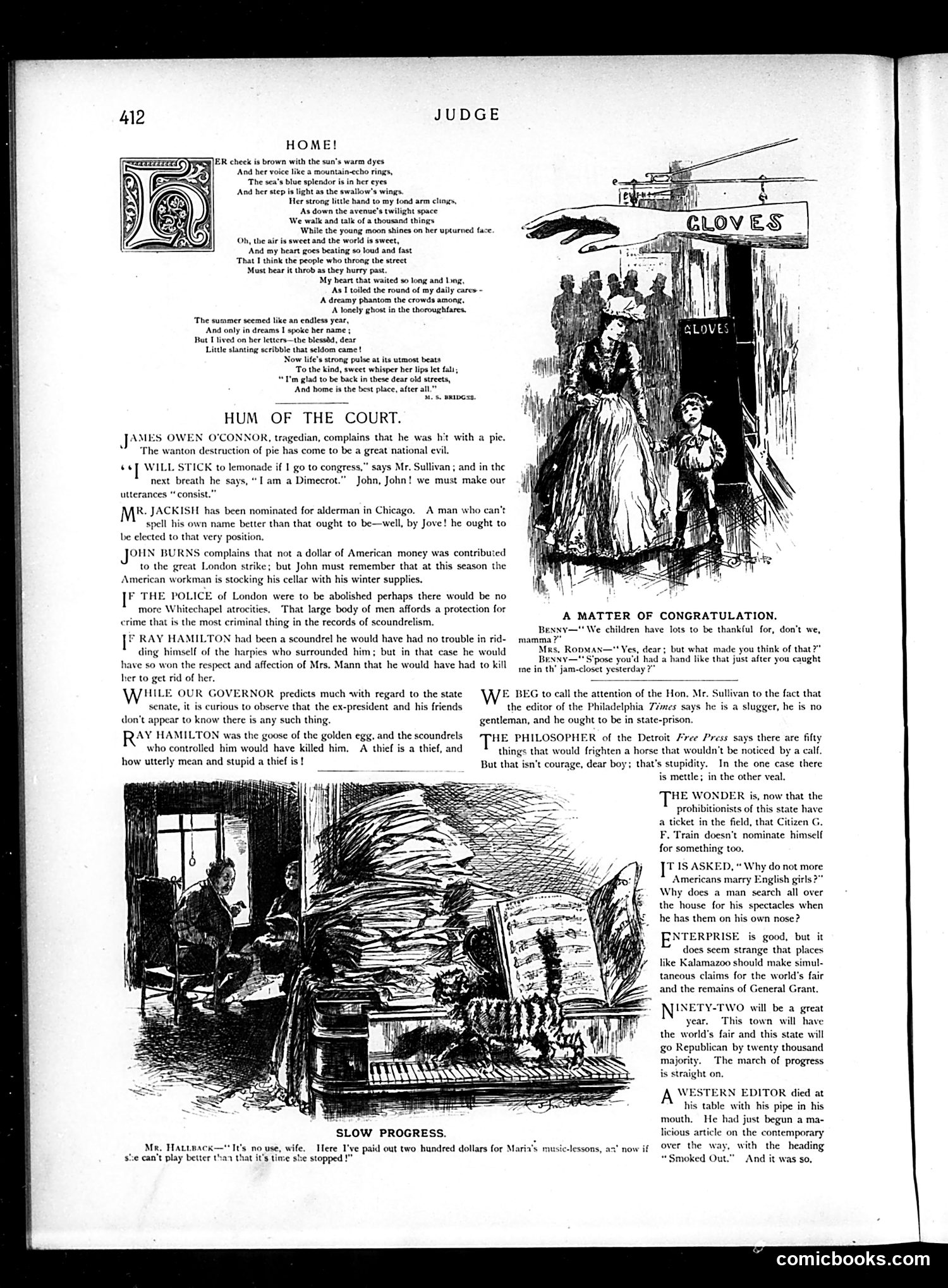
This page from Judge combines romantic poetry with political satire. The lead poem "Home!" sentimentally describes a soldier or worker's return to his beloved, celebrating domestic tranquility—likely reflecting late-19th-century American values around home and family. The "Hum of the Court" section offers brief satirical jabs at contemporary figures and issues: - **James Owen O'Connor** (an actor) complained about being hit with a pie—Judge mocks this as trivial - **Mr. Sullivan** is criticized for inconsistent statements about lemonade and being a "Dimecrat" (Democrat) - **Ray Hamilton** and references to **Mrs. Mann** appear to reference a scandal (unclear from text alone) - **London police** are criticized regarding Whitechapel crimes - **John Burns** is mocked for American workers allegedly not supporting London strikes because they're buying winter supplies The cartoons illustrate these brief political commentaries through satirical scenes. The overall tone is typical Judge humor: mocking politicians, celebrities, and social inconsistencies through wordplay and exaggeration.
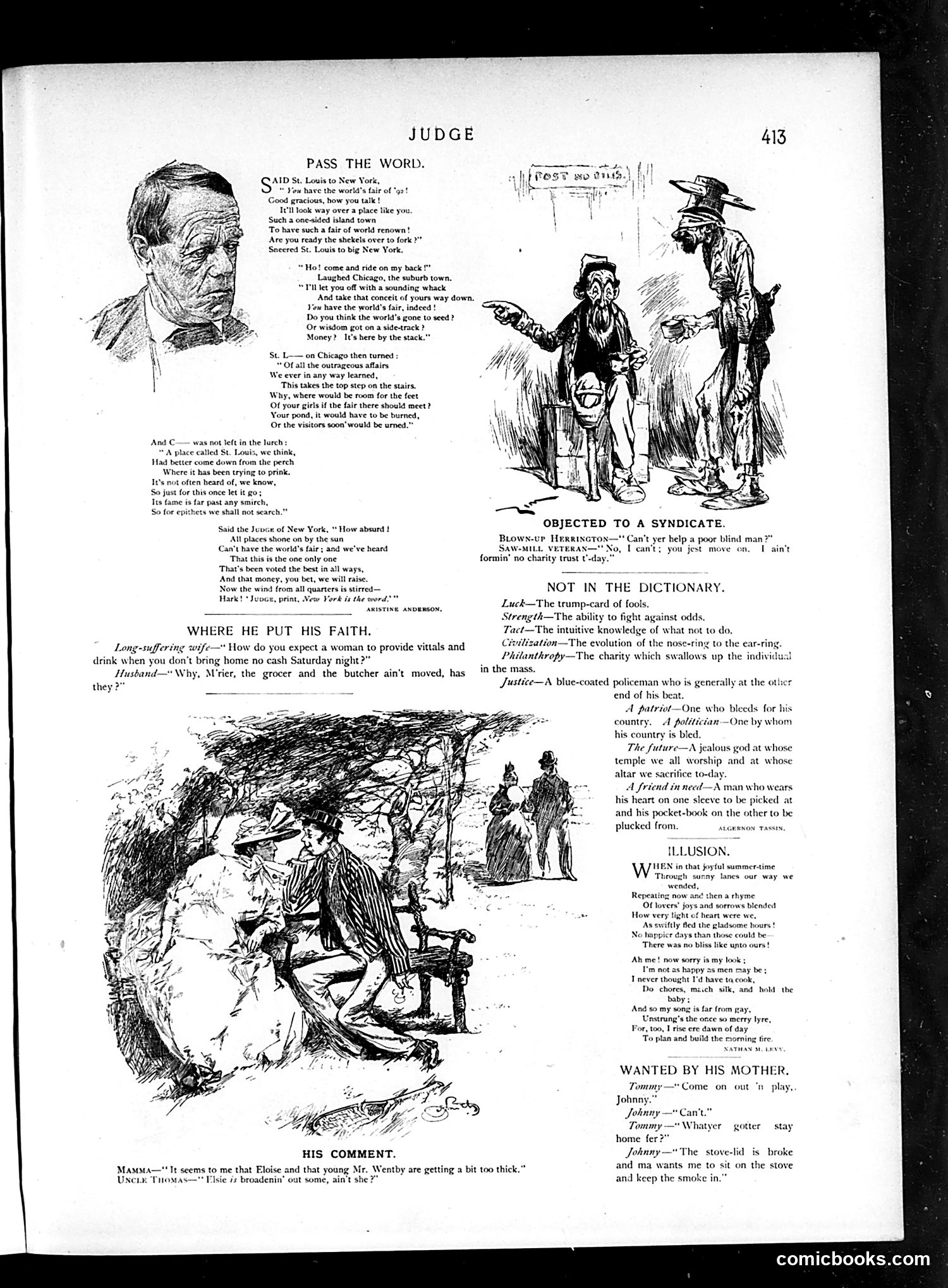
This page from Judge magazine contains multiple satirical pieces reflecting late-19th-century American concerns: **"Pass the Word"** depicts a rivalry between American cities competing to host the World's Fair. St. Louis, Chicago, and New York each boast about their qualifications, with the Judge (representing New York authority) dismissing St. Louis as an obscure "suburb town" unworthy of hosting. This reflects real competition among cities for the 1893 World's Columbian Exposition (ultimately held in Chicago). **"Where He Put His Faith"** mocks a husband's naive belief that grocers and butchers will extend credit indefinitely—satirizing working-class financial delusion during economic hardship. The remaining pieces are brief satirical definitions and domestic comedy sketches typical of Judge's format: "Not in the Dictionary" cynically redefines concepts like Justice and Patriot, while "Wanted by His Mother" offers gentle humor about childhood. The overall tone reflects Gilded Age anxieties: urban competition, class economics, and changing domestic life.
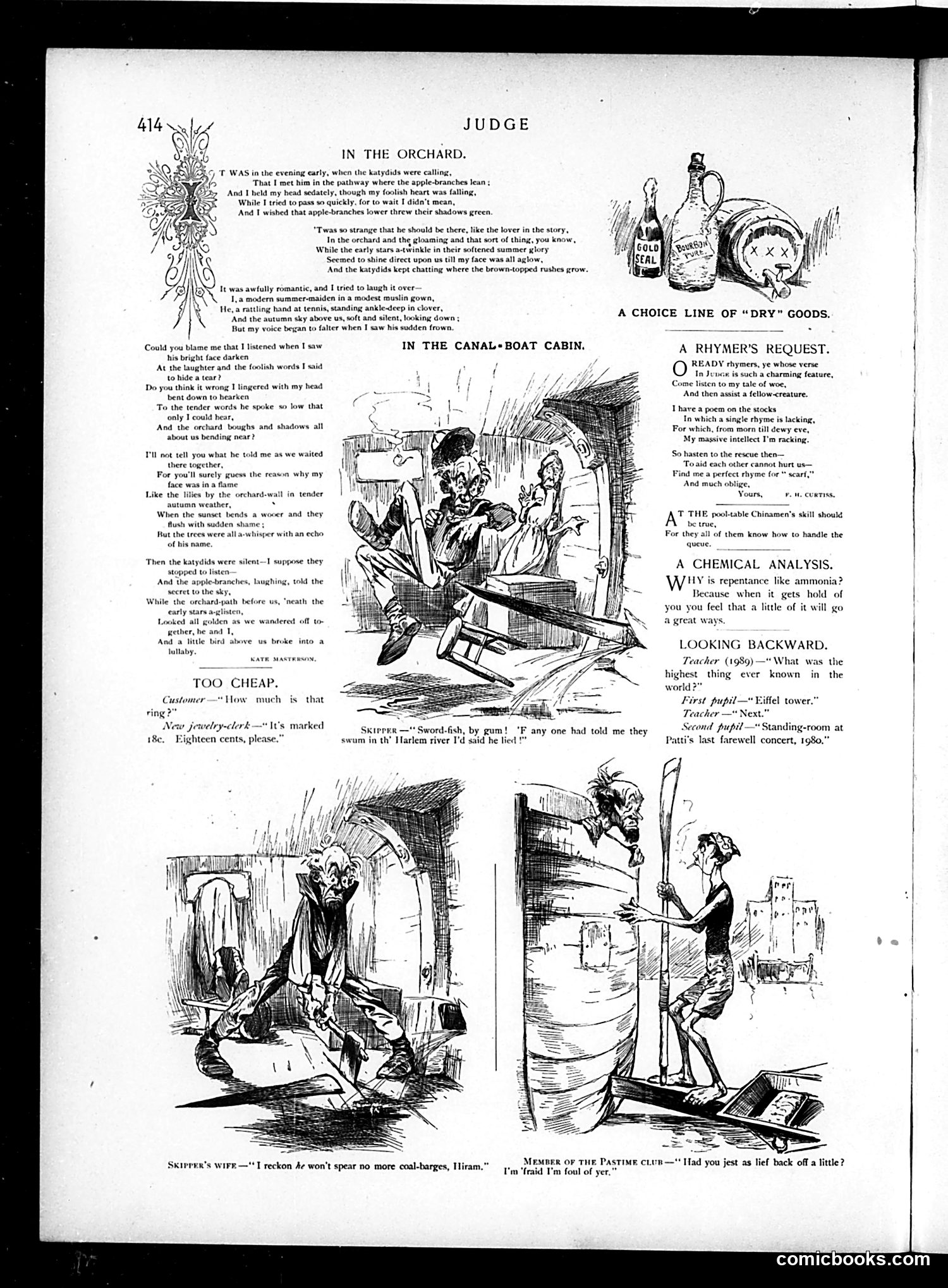
This page contains primarily **romantic poetry and light humor** rather than political satire. The main content is "In the Orchard," a sentimental poem about a young woman's chance encounter with a suitor in an apple orchard at dusk—standard Victorian romantic verse. The smaller items are **genteel comic sketches**: - **"Too Cheap"**: A jewelry clerk's joke about marked-down prices - **"In the Canal-Boat Cabin"**: A humorous request for help rhyming "scarf" - **"A Rhymer's Request"**: Meta-humor about finding rhymes - **"Looking Backward"**: A schoolroom joke confusing the Eiffel Tower with a concert hall (likely Patti's farewell performance, circa 1880) - **"Skipper's Wife" and "Pastime Club"**: Working-class domestic humor The advertisements feature "dry goods" (merchandise). This page reflects *Judge*'s mix of sentimental literature, gentle domestic humor, and advertising rather than sharp political commentary.
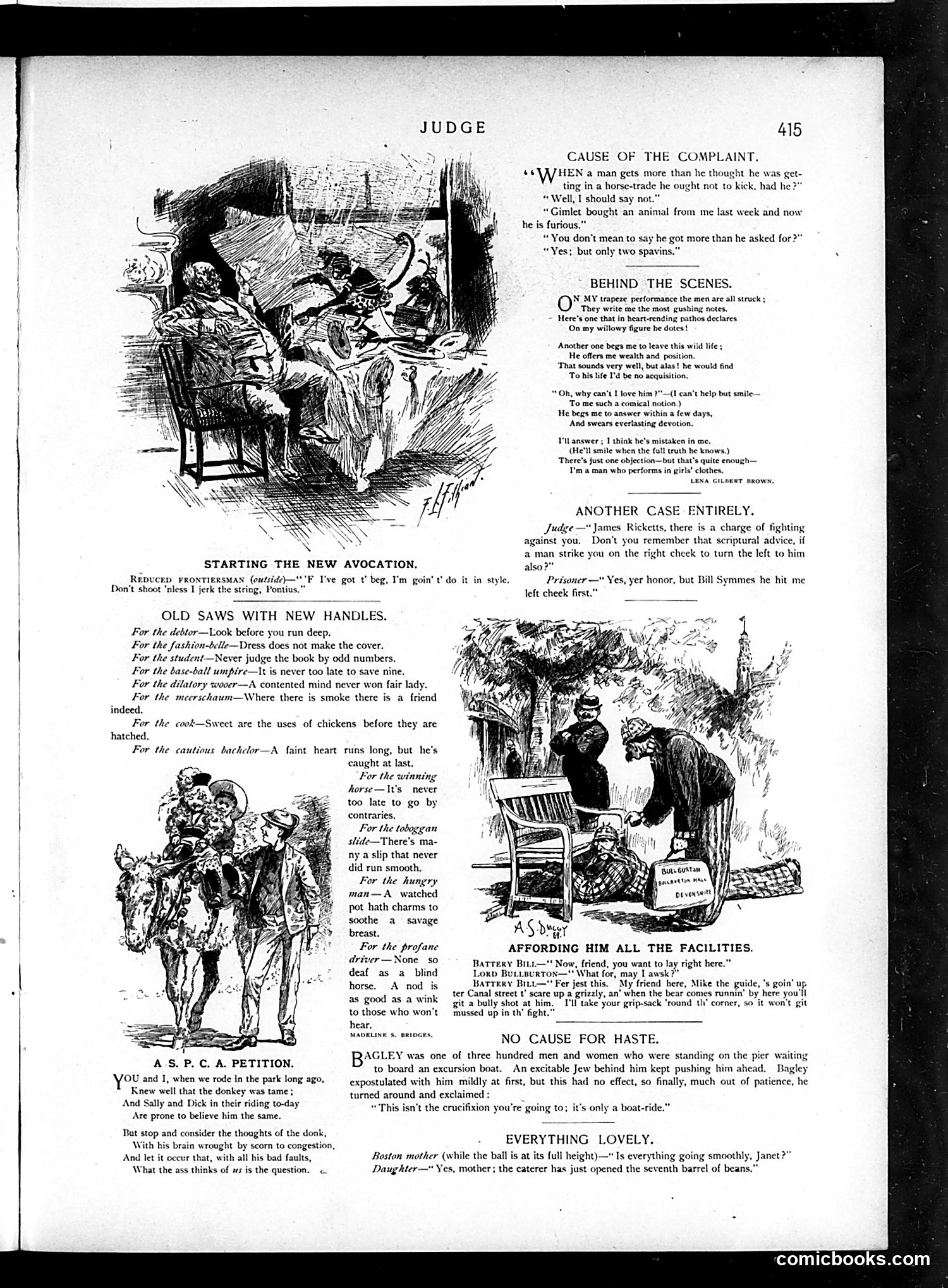
This page from *Judge* contains several satirical pieces typical of late 19th/early 20th-century American humor: **"Cause of the Complaint"** jokes about a horse trade where the buyer received more defects (spavins—a leg disease) than expected, yet still complains. **"Behind the Scenes"** reveals a trapeze performer receiving love letters from admirers, with the punchline that the performer is actually a man in women's clothing—mocking theatrical cross-dressing and the gullibility of male admirers. **"Another Case Entirely"** is a courtroom joke about biblical justice: a defendant is charged with fighting but claims the other man struck first, so he was merely following scripture's command to "turn the other cheek." **"Old Saws with New Handles"** presents humorous twisted proverbs for various professions. **Other pieces** include ethnic humor (an "excitable Jew" stereotype) and general situational comedy. The overall tone reflects period attitudes toward gender performance, religion, and ethnic groups—perspectives that would be considered offensive today.
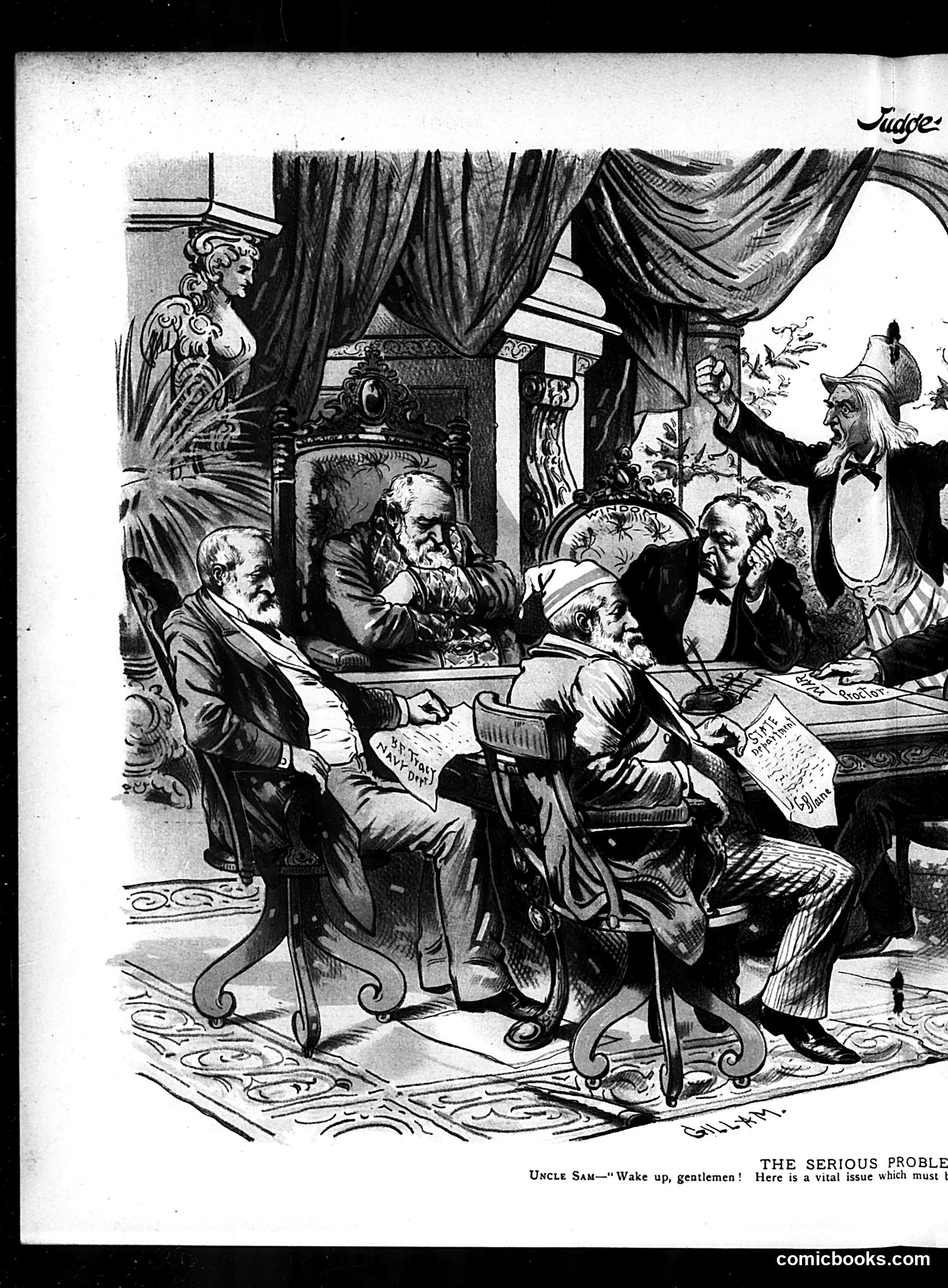
This Judge magazine cartoon depicts **Uncle Sam** (representing the United States government) addressing a group of seated men at what appears to be an official meeting or conference. The men, rendered with exaggerated facial features typical of period caricature, seem drowsy or inattentive despite Uncle Sam's urgent plea about "a vital issue." The satire criticizes government leaders or politicians for negligence—they're literally sleeping through important national business. The ornate interior setting and formal dress suggest this depicts an actual government body, likely Congress or a similar legislative assembly. Without the complete caption, the specific issue remains unclear, but the cartoon's message is straightforward: American leaders are failing to address crucial problems facing the nation, choosing complacency over action.
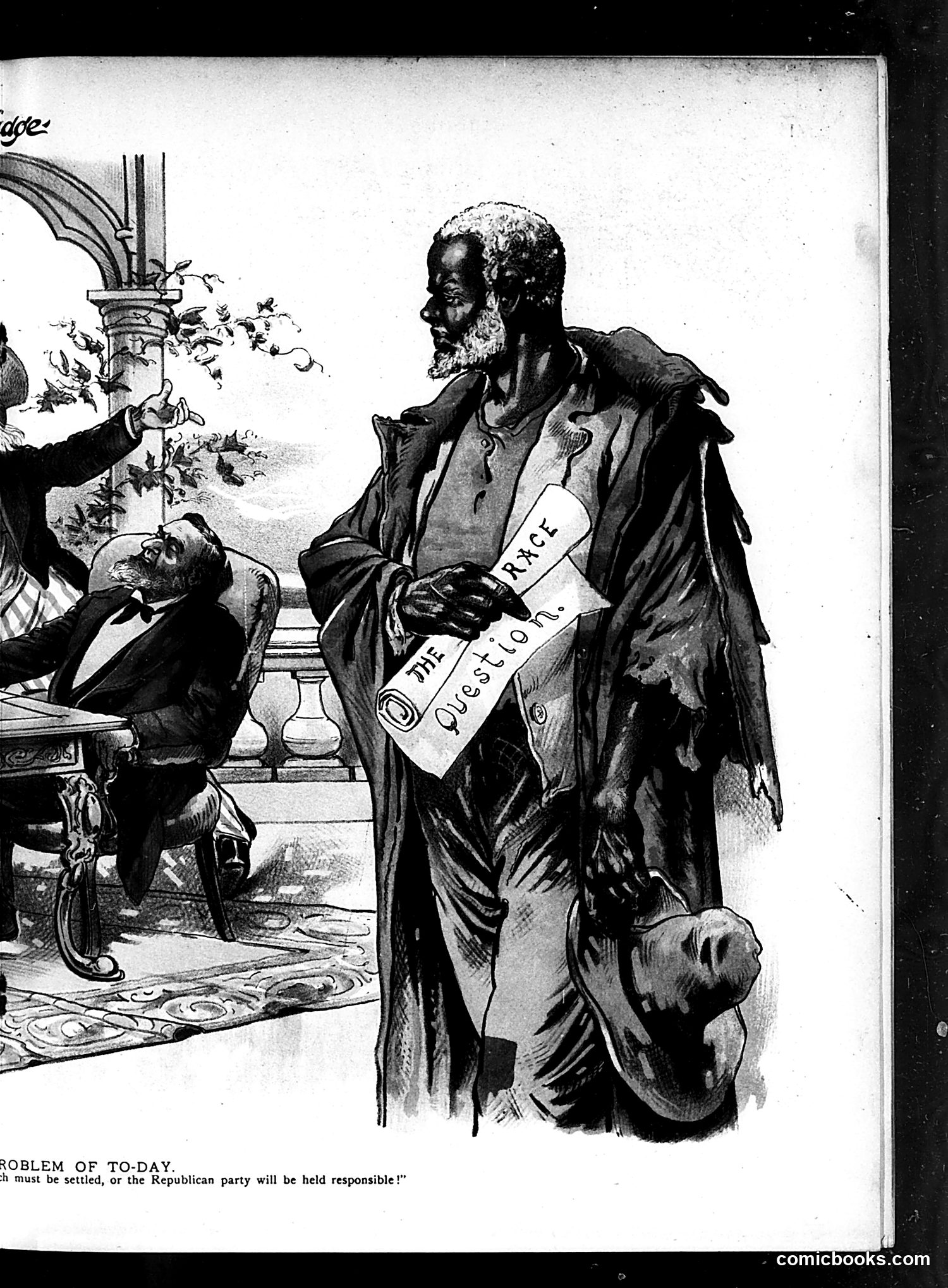
This satirical cartoon from *Judge* magazine depicts a skeletal, death-like figure holding a scroll labeled "THE QUESTION" confronting a seated politician or businessman. The threatening skeleton warns that some urgent matter "must be settled, or the Republican party will be held responsible!" The cartoon uses the personification of Death/skeletal imagery to represent an unresolved crisis or social problem demanding immediate political attention. The figure's gaunt appearance emphasizes the severity and urgency of the issue. The specific problem isn't entirely clear from the visible text, but the cartoonist is using fear imagery to pressure Republican leadership into action, suggesting their party faces blame if they fail to address whatever pressing matter this represents.
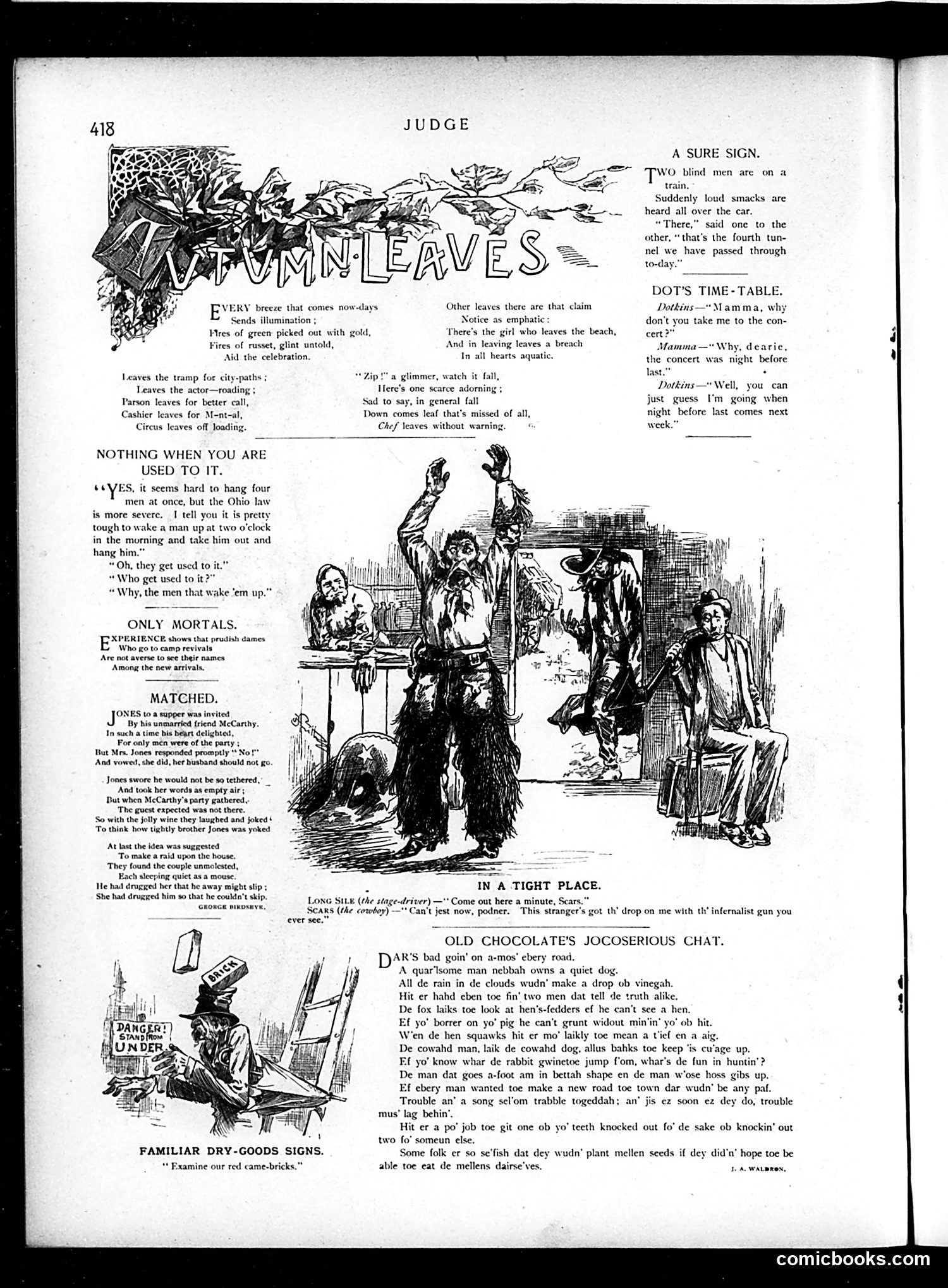
This page contains several brief humorous pieces typical of Judge magazine's satirical style: **"A Sure Sign"** jokes about blind men on a train mistaking tunnel passages for something else—likely a crude reference to sexual activity. **"Nothing When You Are Used to It"** presents dark humor about Ohio's execution laws, suggesting hangmen become desensitized to their work. **"Only Mortals"** mocks prudish women who publicly condemn camp revivals while secretly attending them. **"Matched"** tells of a husband who drugs his wife to attend a bachelor party, only to be found sleeping peacefully when friends raid his house—the joke being his extreme measures were unnecessary. The illustrated sections include a Western saloon scene and "Old Chocolate's Jocoserous Chat," which appears to be dialect humor featuring African American vernacular speech offering folk wisdom—typical of period publications, though reflecting problematic racial stereotyping common to the era. The content reflects early 20th-century American humor values: marital conflict, executions, racial caricature, and crude sexual innuendo.
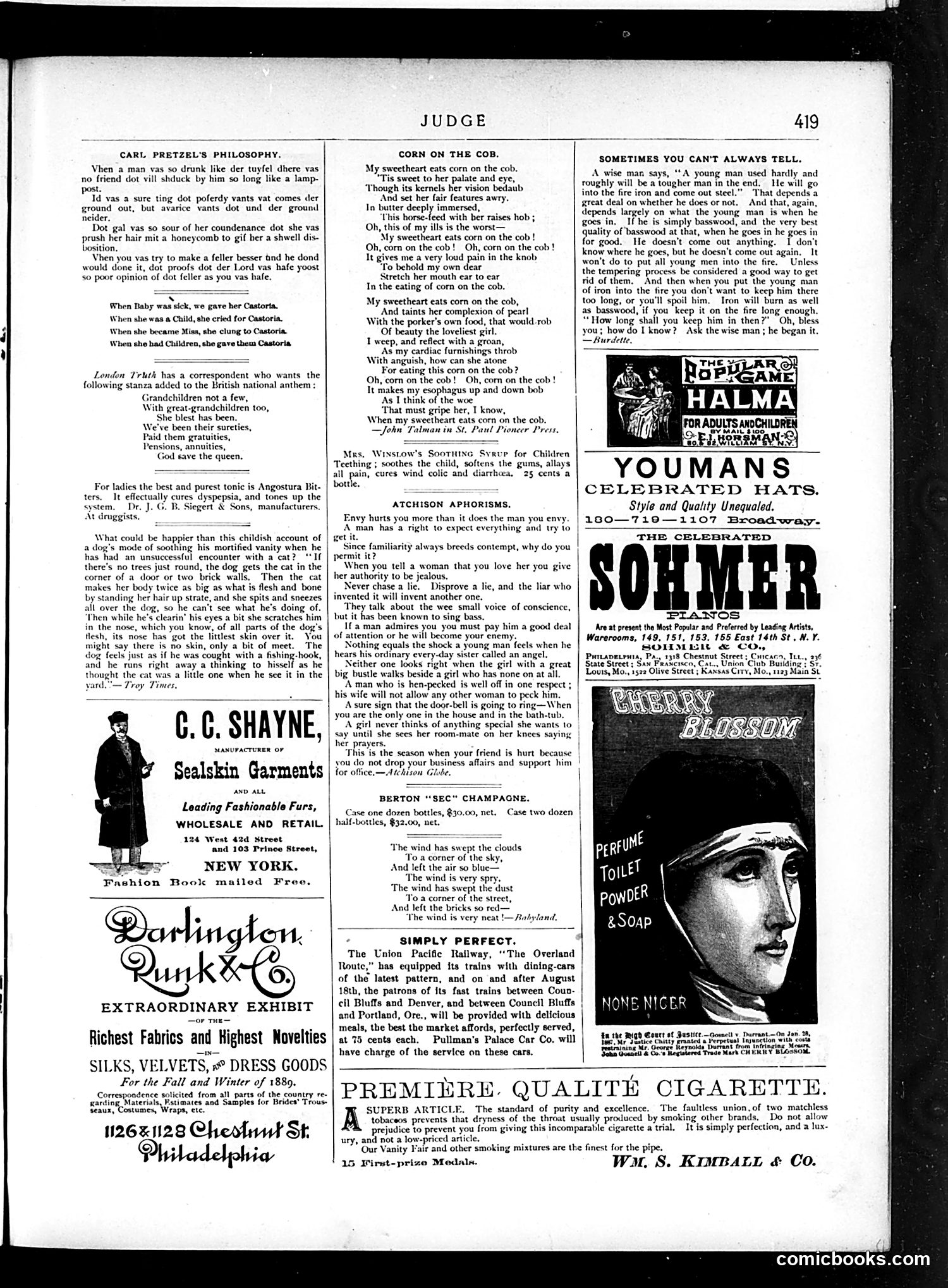
This page is primarily **advertising and light verse**, not political satire. The main content includes: **"Carl Pretzel's Philosophy"**: Ethnic humor featuring a German-accented character offering folksy observations ("Ven a man vas so drunk..."). This reflects Judge's common use of ethnic stereotypes for comedy—appealing to readers familiar with immigrant dialects. **"Corn on the Cob"**: A humorous poem about a suitor distressed that his sweetheart eats corn on the cob in an unflattering manner, stretching her mouth and getting butter on her face. The joke is the exaggerated romantic dismay over her eating habits. **Advertisements**: The page is filled with period product ads (Castoria, Angostura Bitters, sealskin garments, fabrics) interspersed with editorial content—standard Judge magazine format. There is **no significant political cartoon or substantive satire** on this page. It represents Judge's lighter, commercial side rather than its satirical commentary.
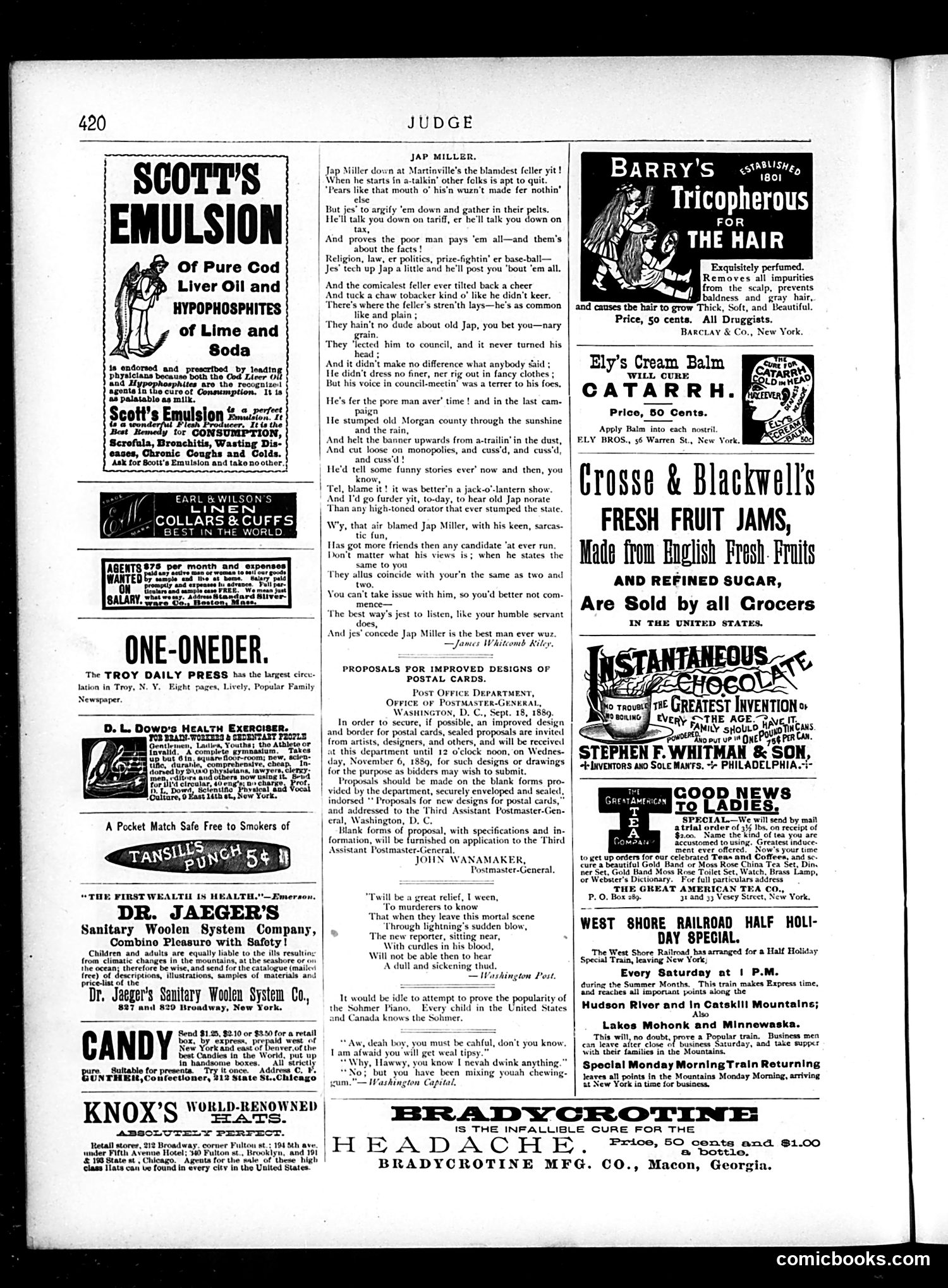
This page is primarily **advertisements** with a lengthy **poem** by James Whitcomb Riley (a celebrated American poet of the era), titled "Jap Miller." ## The Poem's Context The poem celebrates a folksy, unrefined but persuasive local politician named Jap Miller from Martinville. Riley presents him as: - A charismatic orator who wins arguments on tariffs, taxes, politics, religion, and base-ball - Refreshingly ordinary—he "didn't dress no finer" - Effective in council despite (or because of) his common manner - Someone who "stumped old Morgan county" campaigning for the poor ## The Satire Riley gently satirizes democratic politics: a plainspoken, tobacco-chewing everyman proves more persuasive than educated orators. The humor lies in the contradiction—Jap's very lack of refinement makes him trustworthy and effective. "You can't take issue with him," the poem concludes, because his views somehow align perfectly with whatever the listener already believes. This reflects **Gilded Age skepticism about political rhetoric** and the surprising electoral power of the "common man" persona.
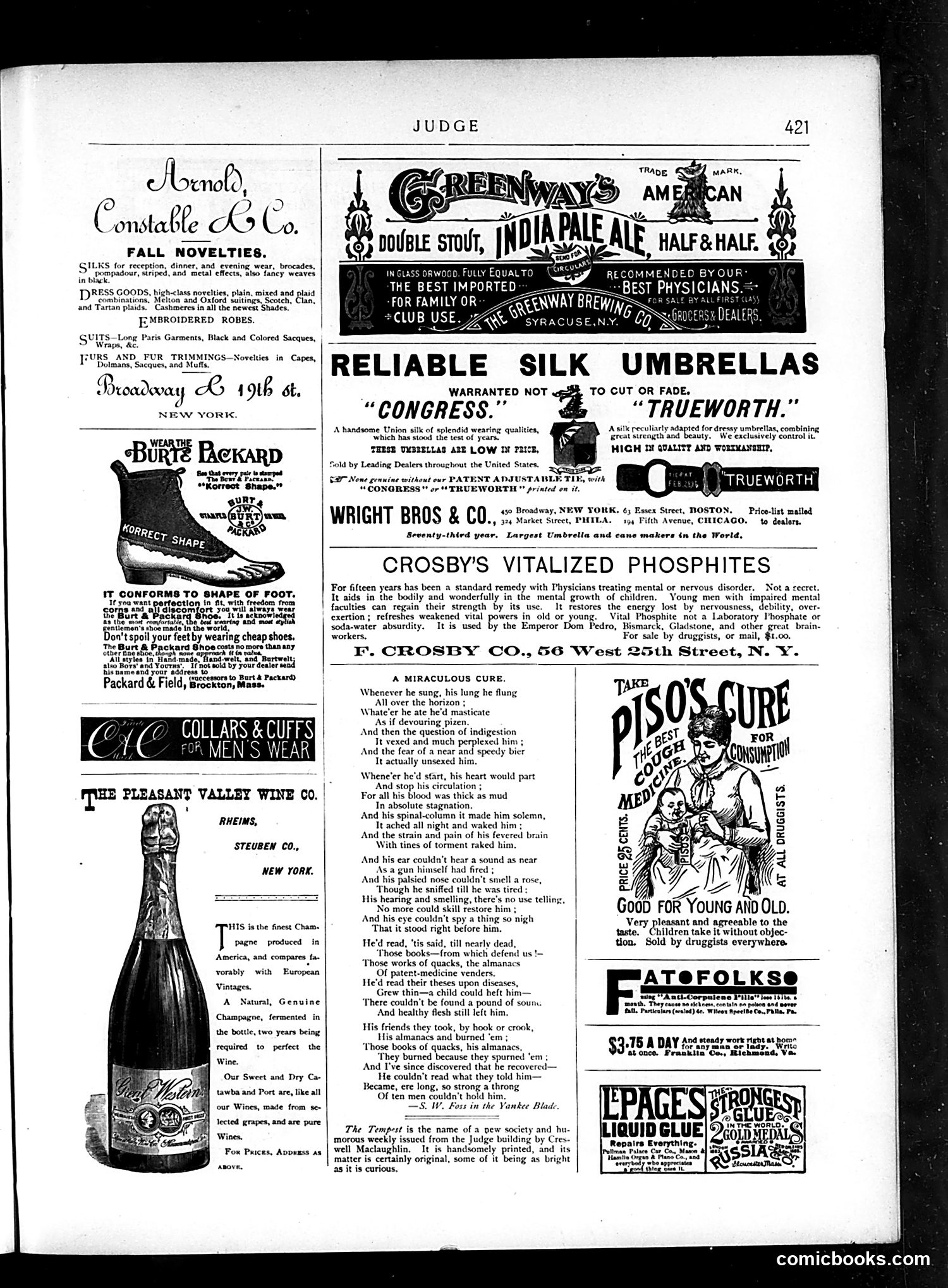
This page is primarily **advertising** rather than political satire. It contains commercial advertisements for various consumer products typical of the late 19th/early 20th century: **Key advertisements include:** - Silk umbrellas ("Congress" and "Trueworth" brands) - Greenway's India Pale Ale and Double Stout beer - Burt & Packard shoes - Wine from Pleasant Valley Wine Co. - Crosby's Vitalized Phosphites (a patent medicine) - Piso's Cure for consumption - Various clothing items (silks, dress goods, furs) **The only notable editorial content** is a lengthy humorous poem titled "A Miraculous Cure" (center-right), which satirizes a man suffering multiple ailments—indigestion, circulatory problems, spinal issues, sensory loss—apparently resolved by the advertised patent medicine. The poem's exaggerated symptoms and miraculous recovery mock the dubious health claims common in period advertising. The page reflects Judge's business model: mixing entertainment with lucrative patent medicine advertising, a controversial but widespread practice of that era.
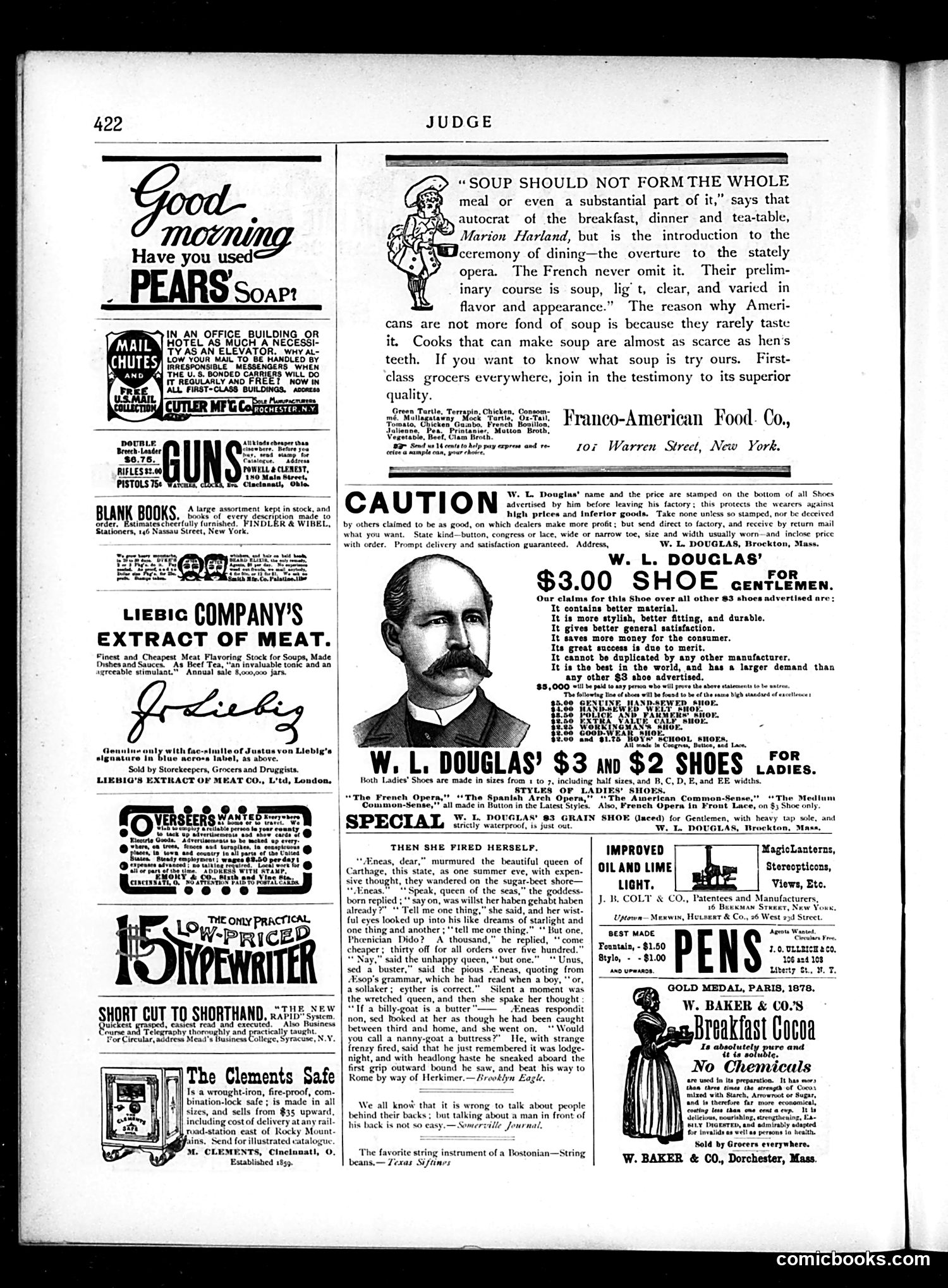
This page is primarily **advertising**, not political satire. It contains multiple commercial advertisements from the 1890s era, including: - **Pears' Soap** greeting ad - **Mail chutes** for office buildings - **Liebig's Extract of Meat** (soup/food product) - **W.L. Douglas shoes** (the largest ad, featuring his portrait and detailed product claims) - Various other products: safes, blank books, shorthand instruction, pens The only narrative content is a brief story titled **"Then She Fired Herself"** about a queen of Carthage who wandered on sugar-beet shores—this appears to be entertainment filler rather than political commentary. There are **no political cartoons** visible on this page. The W.L. Douglas shoe advertisement, while substantial and featuring a businessman's portrait, is purely commercial promotion, not satire. The page represents typical Judge magazine format: mixing advertising revenue with minimal editorial content.
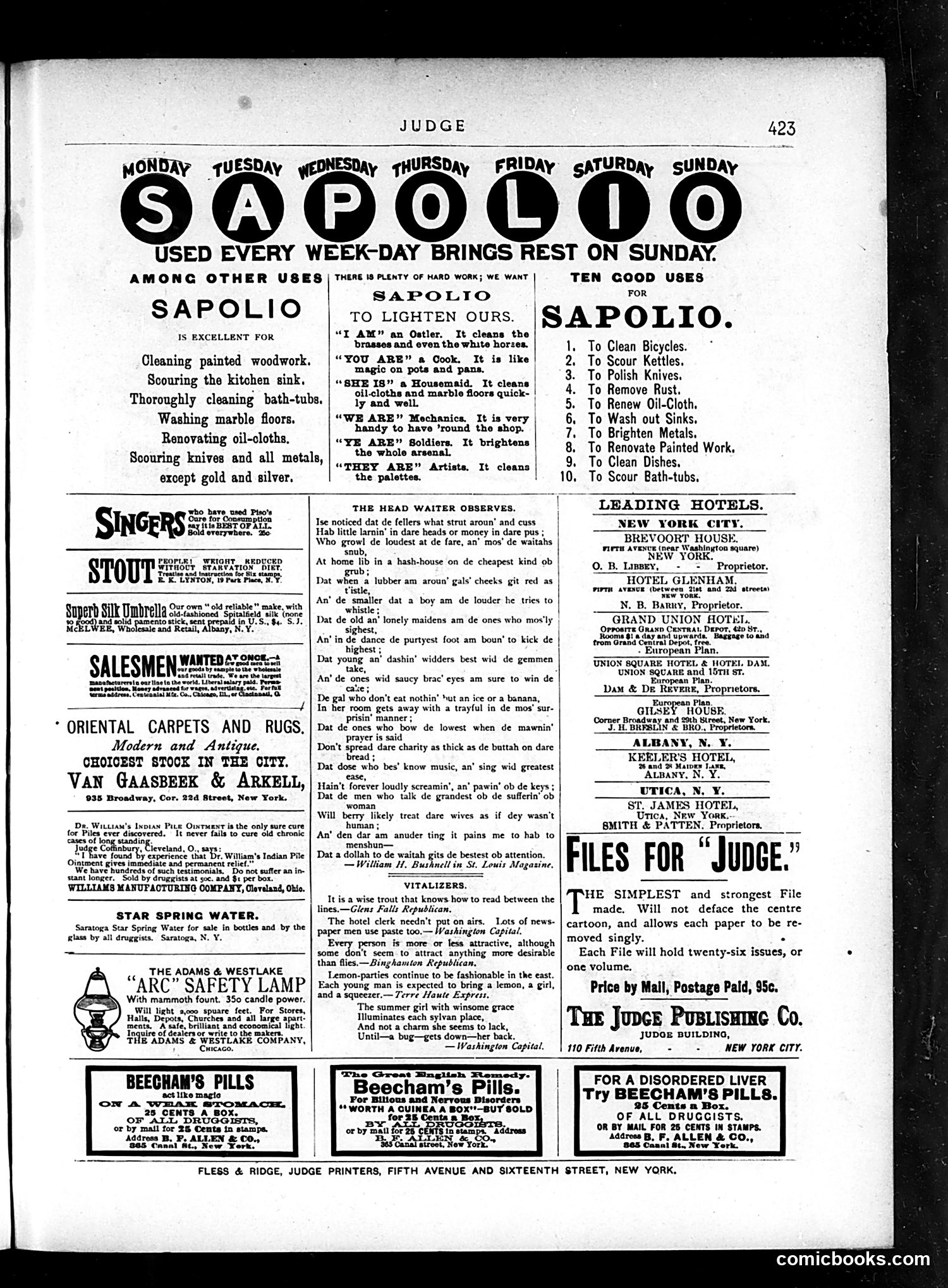
This is primarily an **advertising page** from Judge magazine, not a political cartoon. The page is dominated by product advertisements (Sapolio cleaning powder, Beecham's Pills, various hotels, etc.) typical of late 19th-century periodicals. The only substantive content is "The Head Waiter Observes," a humorous dialect piece featuring an African American waiter's observations about human behavior—observations meant to be witty social commentary (e.g., loud, boastful men lack education or money; modest women are most attractive). The dialect writing reflects period racial stereotyping common in such publications. The piece uses exaggerated phonetic spelling ("dat," "fellers," "aroun'") to create comic effect, a convention of the era. While entertaining to contemporary readers, it perpetuates harmful racial caricatures through language and presumed comedic voice. The "Sapolio" section lists the cleaning product's various household uses in a straightforward advertising manner.
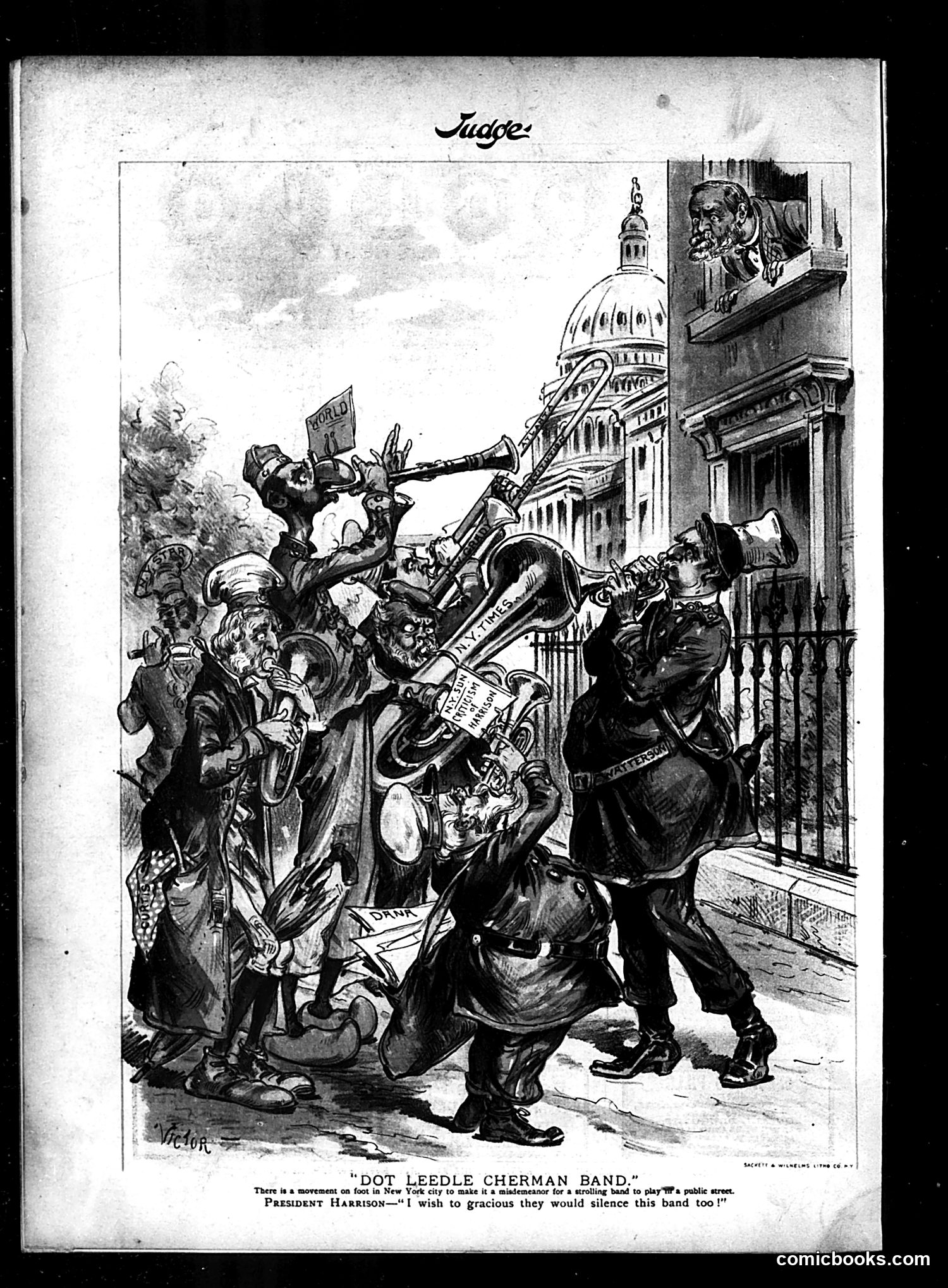
This Judge cartoon satirizes President Harrison's complaint about street musicians in New York City. The cartoon depicts a chaotic "German band" (characterized by exaggerated German accents in the title and captions) playing loudly on a public street near what appears to be a government building with its Capitol dome visible. The joke targets Harrison's hypocrisy: he wishes New York would silence these street musicians, but the cartoon suggests his own political "band"—likely referring to his administration or party—is equally annoying and disruptive to the public. The satire uses the immigrant German musicians as a stand-in for broader political noise and incompetence. The caricatured figures and deliberate dialect reinforce period stereotypes about German immigrants common to 1890s American political satire.

I'm unable to provide a reliable analysis of this image. The photograph is heavily degraded with significant grain, damage, and deterioration that makes it extremely difficult to discern specific details, text, or cartoon elements clearly. While I can see there appear to be borders or frames on the left and right sides with some decorative elements, and a largely dark central area, I cannot confidently identify specific figures, caricatures, or satirical content with the accuracy your rules require. To properly analyze this Judge magazine page, a clearer or higher-resolution version would be necessary. I apologize that I cannot provide the detailed political and historical context you've requested.