
A complete issue · 16 pages · 1889
Judge — September 21, 1889
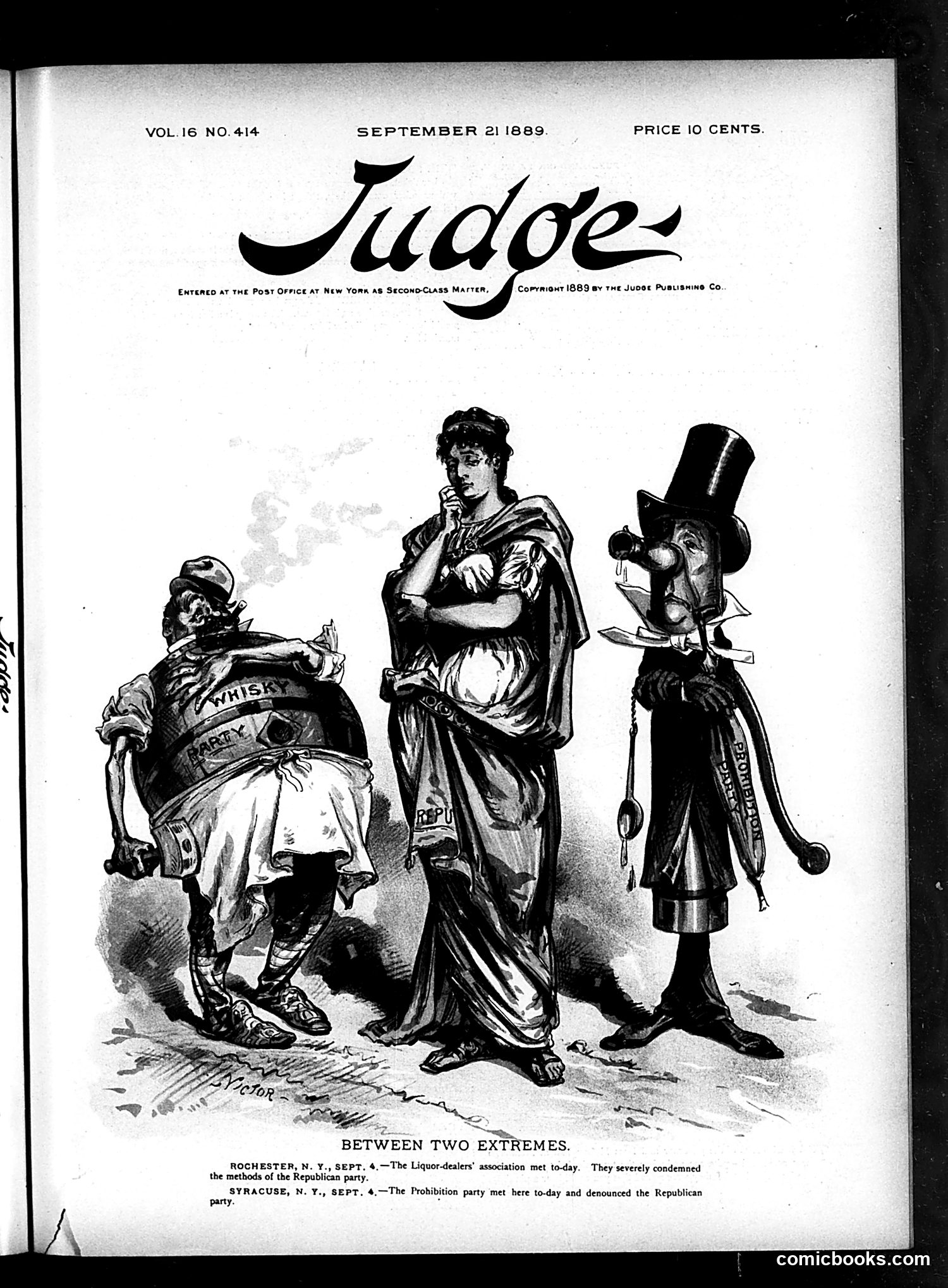
This satirical cartoon titled "Between Two Extremes" depicts a woman (likely representing a political issue or constituency) caught between two opposing forces. On the left stands a figure labeled "Whisky" representing the liquor industry; on the right is a formally-dressed gentleman representing the Prohibition movement. The accompanying text references contemporary political tensions: the liquor-dealers' association condemned Republican Party methods in Rochester, N.Y., while the Prohibition party denounced Republicans in Syracuse, N.Y. The cartoon satirizes how Republicans faced criticism from both the alcohol industry and temperance advocates—they were politically trapped "between two extremes," unable to satisfy either faction. This reflects the genuine political struggle over alcohol regulation during the Gilded Age.
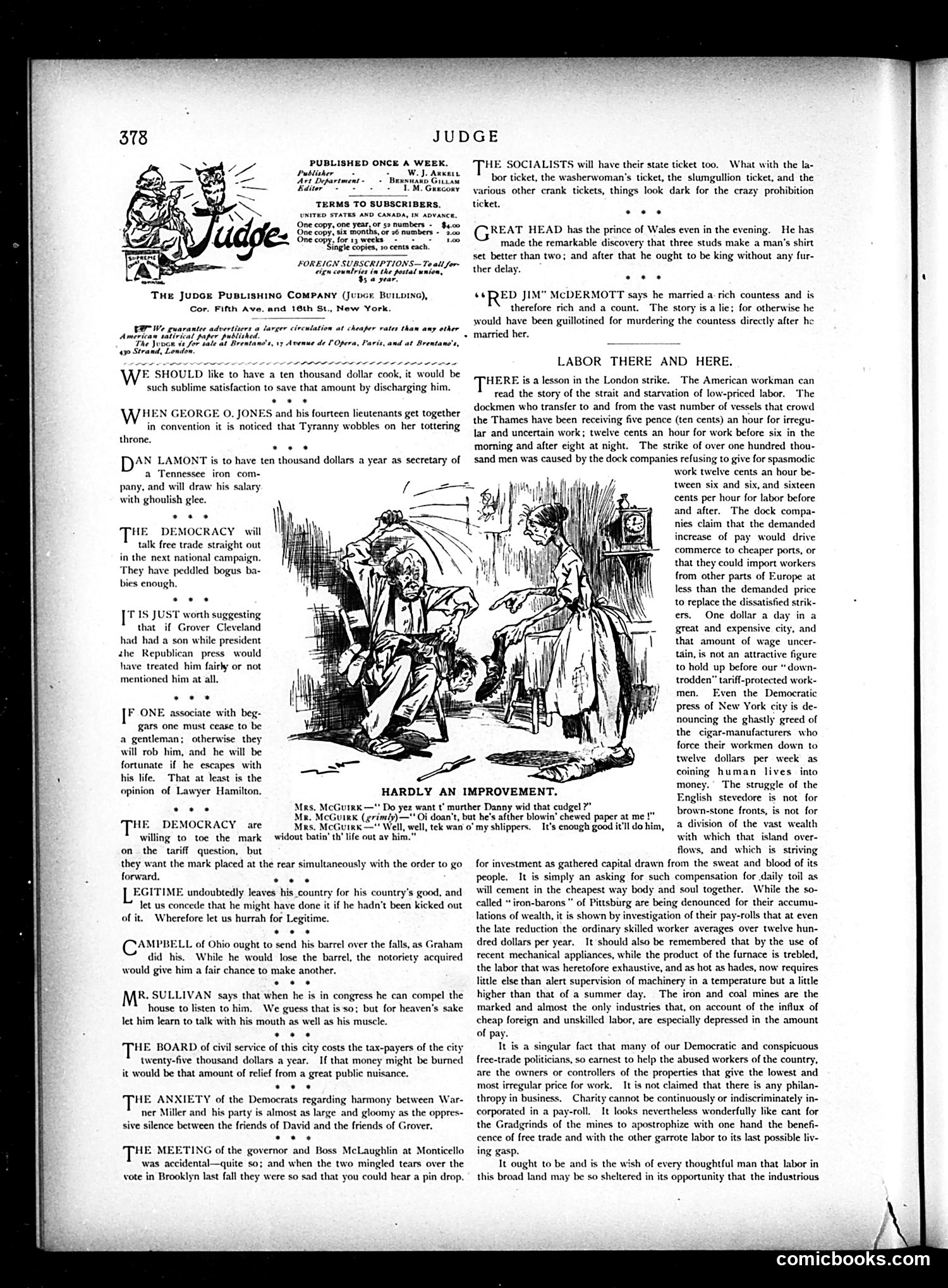
This cartoon satirizes labor conditions in London's docklands. The illustration shows dock workers in apparent distress or poverty—figures in worn clothing gathered around what appears to be meager circumstances. The accompanying article discusses low wages for dock workers (five pence per hour for irregular work, twelve cents per hour for certain shifts) and debates whether modest pay increases would genuinely improve their situations. The piece critiques both the dock companies' resistance to wage increases and Democratic politicians' inconsistent free-trade positions, which supposedly harm working-class interests. The cartoon's title "Hardly an Improvement" suggests that proposed wage reforms would do little to meaningfully address the workers' genuine hardship and exploitation.
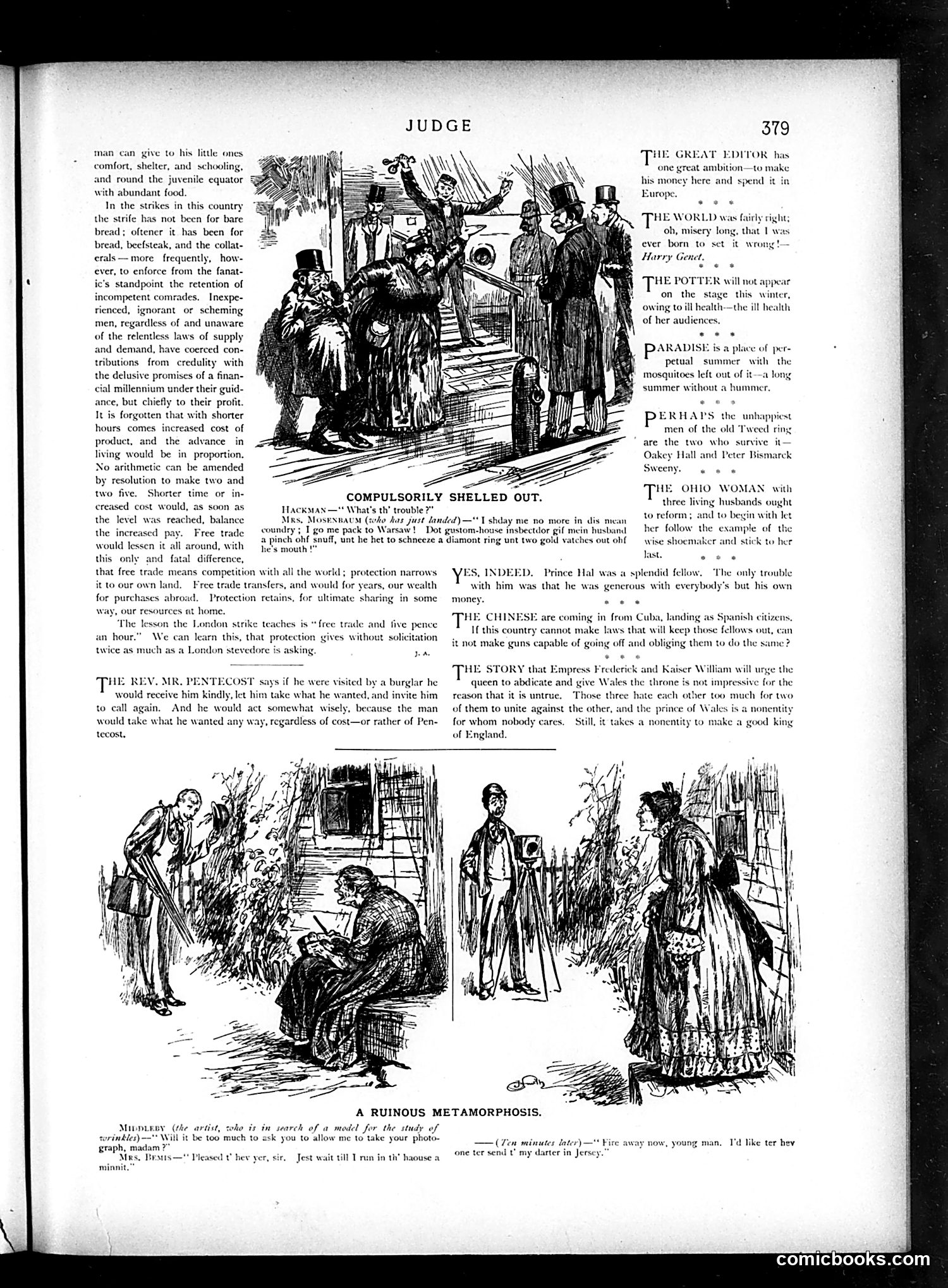
This page contains political and social commentary typical of late 19th-century American satirical journalism. **Top cartoon** ("Compulsorily Shelled Out"): Depicts working-class immigrants being forcibly extracted of their money by labor organizers. The Yiddish-accented figure's complaint suggests satire against labor unions, portraying them as exploitative rackets that extract dues from workers under false promises. **Bottom cartoon** ("A Ruinous Metamorphosis"): Shows an artist requesting a working-class woman as a model, only to return later finding her transformed into a wealthy, fashionably-dressed lady. This satirizes sudden social mobility or pretense. **Editorial text** criticizes labor strikes as motivated by demands beyond necessity (wanting "beefsteak" not just "bread"), attacks unions for retaining "incompetent comrades," and defends protectionism over free trade. References to Tweed Ring, the Empress Frederick, and various social figures reflect contemporary concerns about political corruption and international affairs. The overall tone reflects upper-class skepticism toward labor organizing and working-class aspirations.
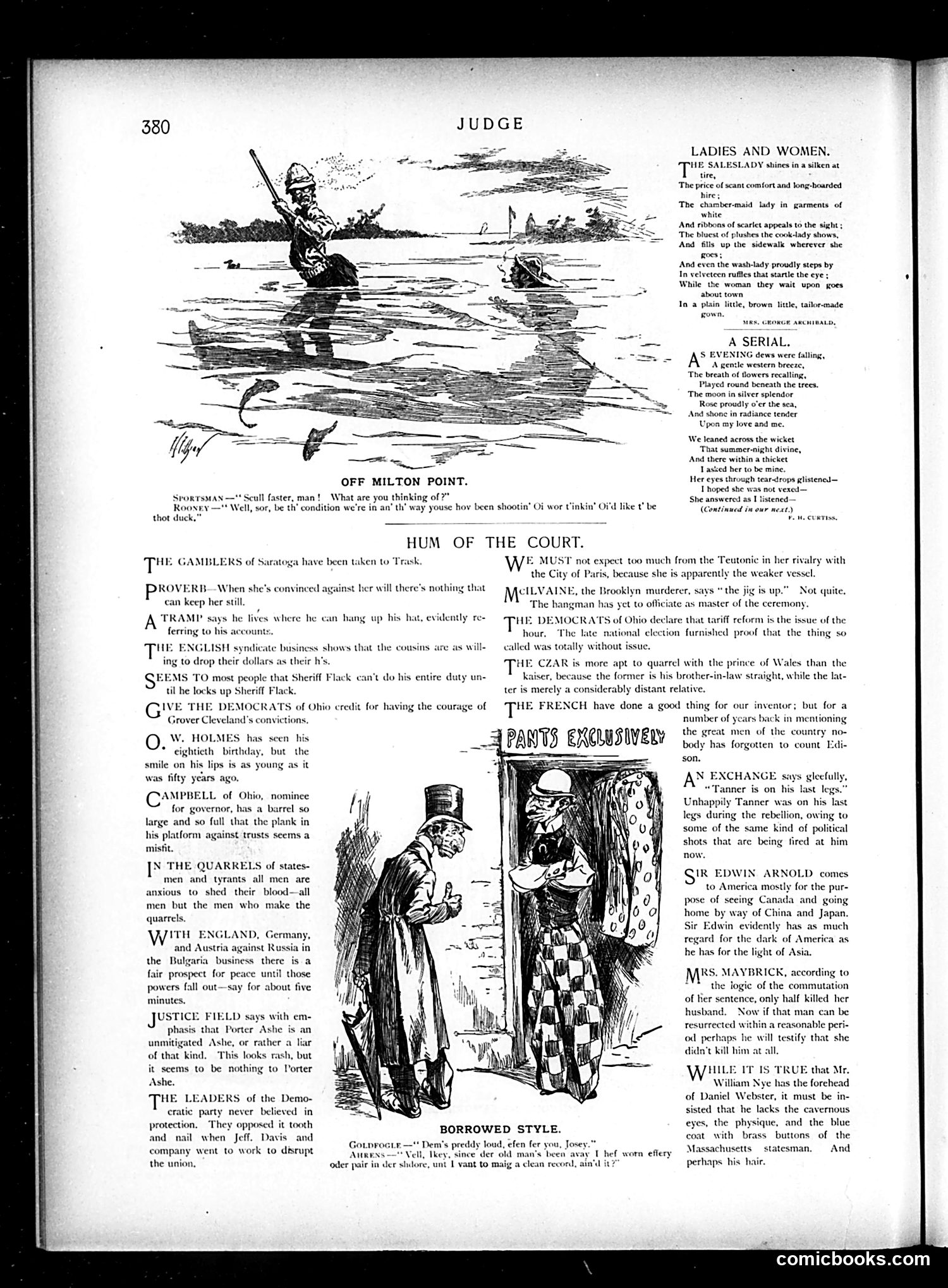
This page from Judge magazine contains multiple satirical pieces targeting contemporary politics and society (circa 1880s-90s). **"Ladies and Women"** mocks the fashion obsession of working-class women (salesladies, maids, cooks) who dress extravagantly in silks and velvets, while the wealthy women they serve dress plainly. The satire critiques both the aspirational vanity of workers and the irony of servant excess. **"Off Milton Point"** is a humorous dialogue between a sportsman and rower (Rooney, rendered in Irish dialect), where the rower admits he'd rather be the duck they're hunting than continue their disastrous rowing expedition. **"Hum of the Court"** contains brief political jabs: references to Saratoga gamblers, the Brooklyn murderer Melvaine, Ohio Democrats' tariff reform debate, and Sir Edwin Arnold's travels. These are topical one-liners targeting current events and public figures. **"Borrowed Style"** depicts someone borrowing formal attire—satirizing class pretension and fake respectability. The overall tone is lighthearted mockery of contemporary social foibles, politics, and fashion trends.
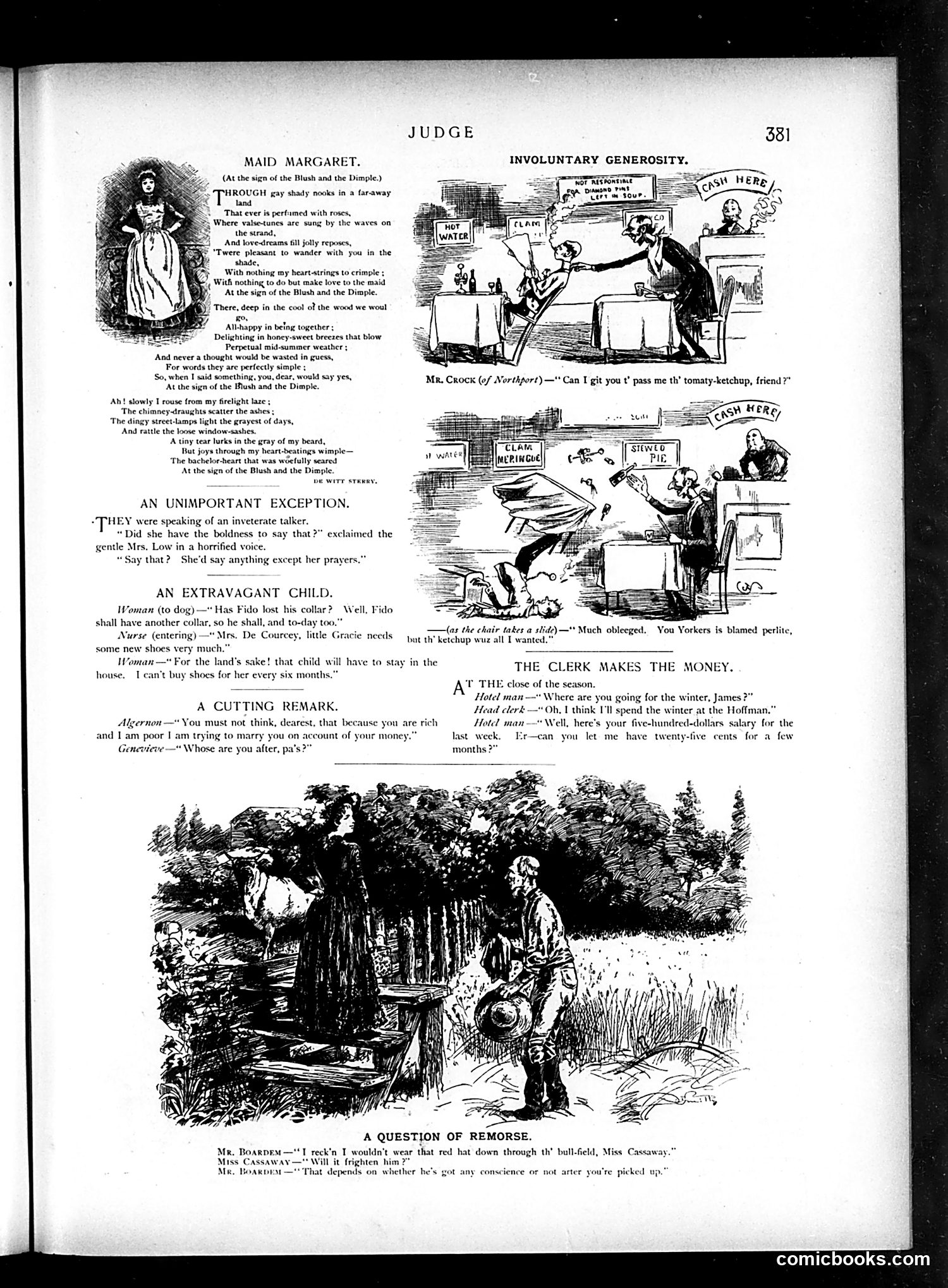
This page contains multiple short humorous sketches typical of Judge's satirical format: **"Maid Margaret"** is a sentimental poem about a bachelor romanticizing a young woman, contrasting idealized fantasy with his lonely reality. **"An Unimportant Exception"** jokes about a woman's incessant talking—she'll say anything *except* prayers, implying her talkativeness is almost irreverent. **"An Extravagant Child"** satirizes wasteful children and permissive parenting: a child demands constant new shoes; the mother indulges her. **"Involuntary Generosity"** shows a diner accidentally spilling ketchup on himself and a server, sarcastically thanking him for the "generosity." **"The Clerk Makes the Money"** depicts a hotel clerk earning more than the manager—a comment on wage disparities or the clerk's importance to operations. **"A Question of Remorse"** is a rural joke: a woman wearing a red hat in a bull field risks danger, and whether the bull charges depends on whether it has conscience—implying the animal lacks moral restraint. The cartoons mock social pretension, parenting, class dynamics, and human folly.
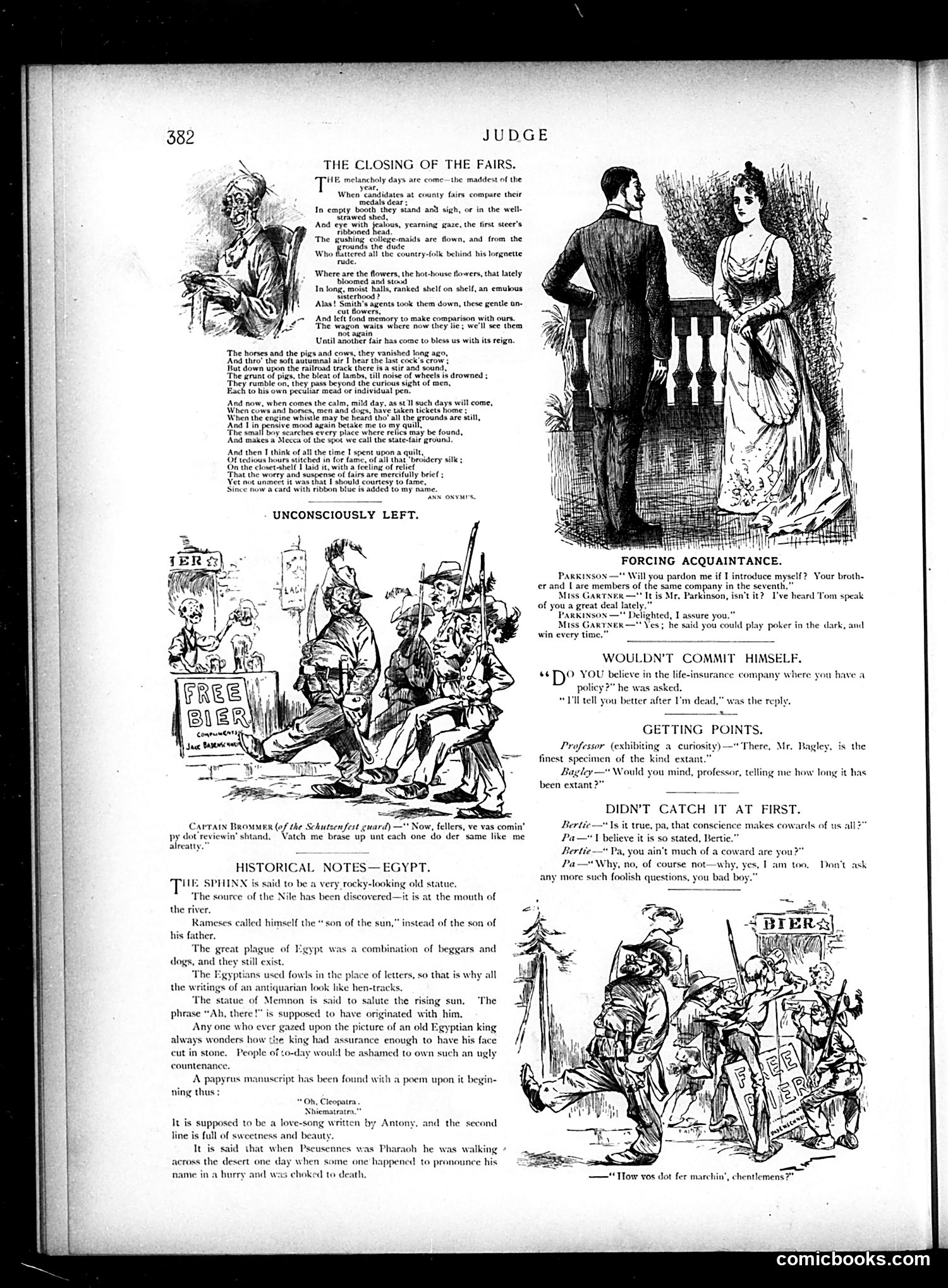
This page from *Judge* contains several unrelated satirical pieces typical of late 19th-century American humor magazines. **"The Closing of the Fairs"** is a sentimental poem lamenting the end of county fair season—the departure of livestock, flowers, socialites, and the "college-maids." The satire appears gentle, poking fun at fair-goers' nostalgia and small-town life. **"Unconsciously Left"** is a brief cartoon joke featuring a German character (indicated by dialect: "ve vas comin'") boasting about his military bearing at what appears to be a German social gathering (Schützenpost/shooting club). **"Historical Notes—Egypt"** offers pseudo-scholarly humor about Egyptian antiquities, making absurd etymological "explanations" (fowls as letters, the Sphinx's "appearance," etc.). The remaining items are short joke segments about life insurance, poker-playing soldiers, and museum curiosities—standard *Judge* filler humor. The cartoons are crude wood engravings typical of the era.
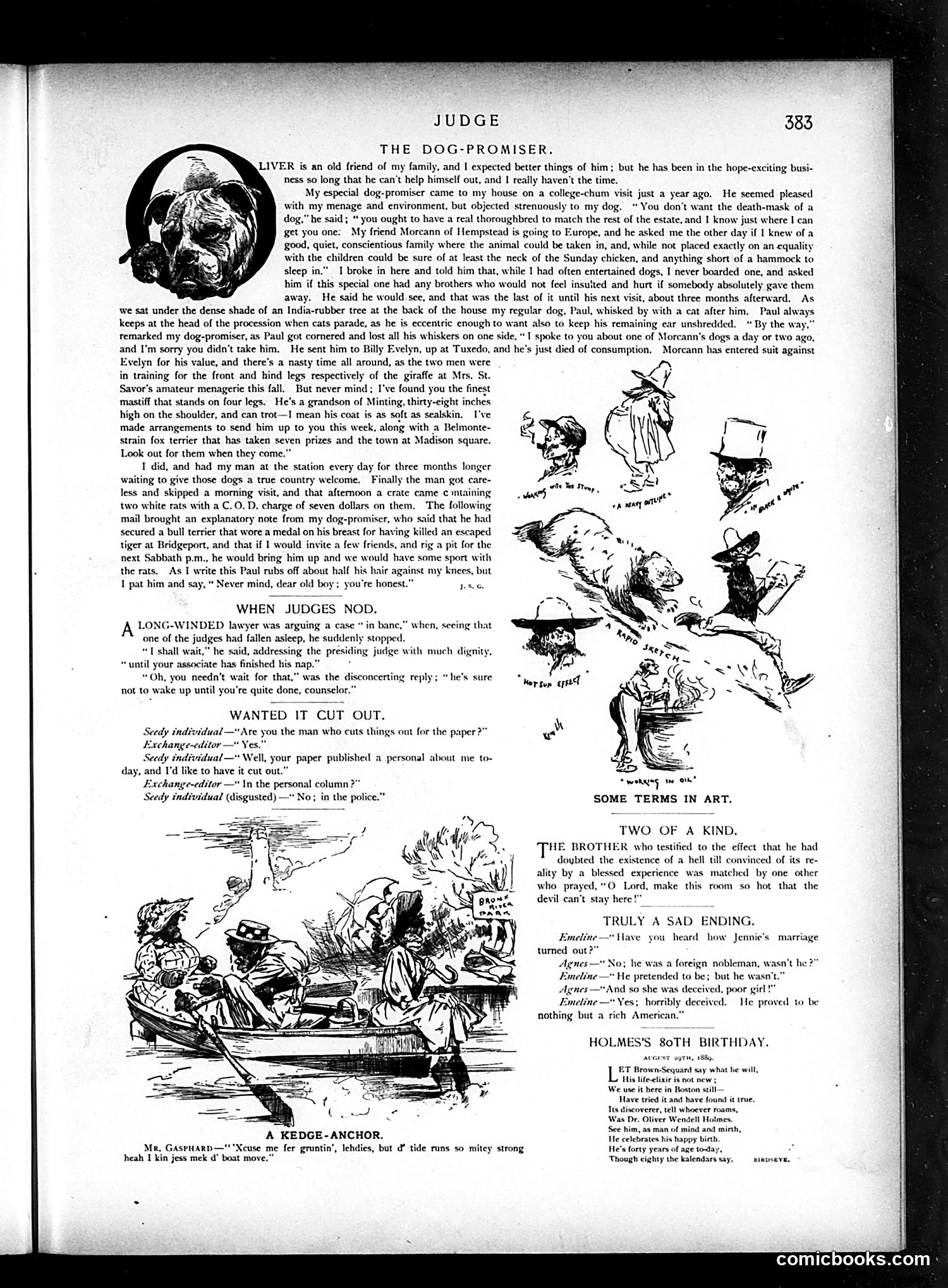
This humorous story ridicules a social type: the chronic promise-maker who never delivers. The narrator's college friend repeatedly vows to provide superior dogs—first a thoroughbred mastiff, then a prize-winning fox terrier, finally a medal-bearing bull terrier—yet consistently fails to deliver anything of value. Instead, the narrator receives white rats on a C.O.D. charge. The satire targets not malice but thoughtlessness: the promiser genuinely believes his own exaggerations and gets distracted by new schemes. He's trapped in "the hope-exciting business" of making grand assurances. The joke culminates in the narrator's loyal, honest mutt Paul being more dependable than any promised pedigree. The accompanying "When Judges Nod" cartoon depicts a drowsy judge during courtroom proceedings—a brief jab at judicial inattention.
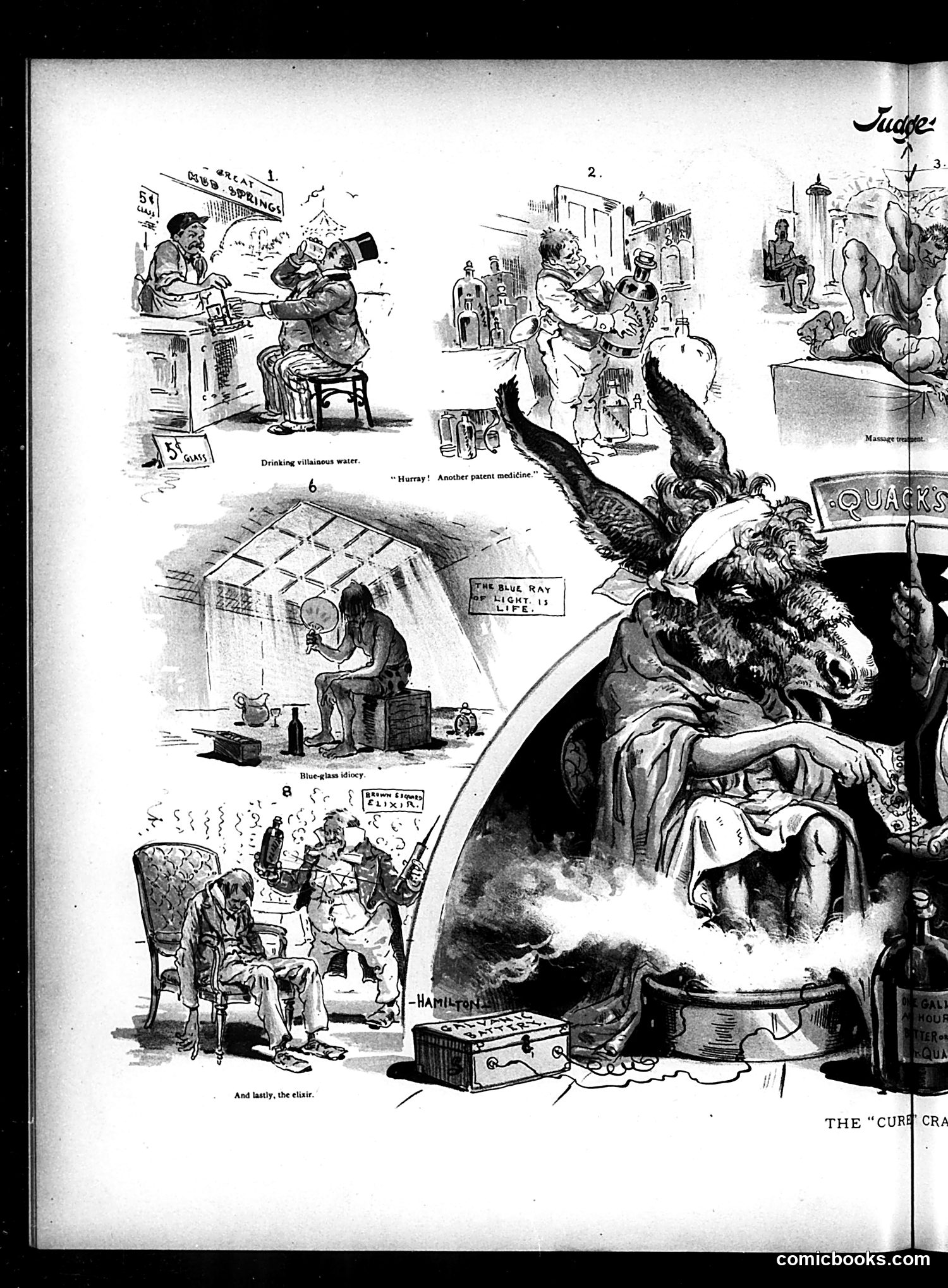
This appears to be a satirical comic series mocking patent medicines and medical quackery, likely from the late 19th or early 20th century. The panels depict various fraudulent "cures": 1. "Drinking villainous water" - a charlatan selling fake medicinal water 2. "Hurray! Another patent medicine" - celebrating dubious remedies 3. "Blue-glass idiocy" - referencing the false belief that blue glass had healing properties 4. "And lastly, the elixir" - the final con, showing a witch-like figure and cauldron, suggesting these medicines are pure magic/nonsense The large illustration on the right depicts "Quacks" preying on desperate, gullible people with fake treatments. The satire attacks the widespread fraud of patent medicine manufacturers who exploited public desperation with unregulated, often worthless or harmful products sold with exaggerated health claims. This was a major social problem until regulatory reforms like the Pure Food and Drug Act (1906).
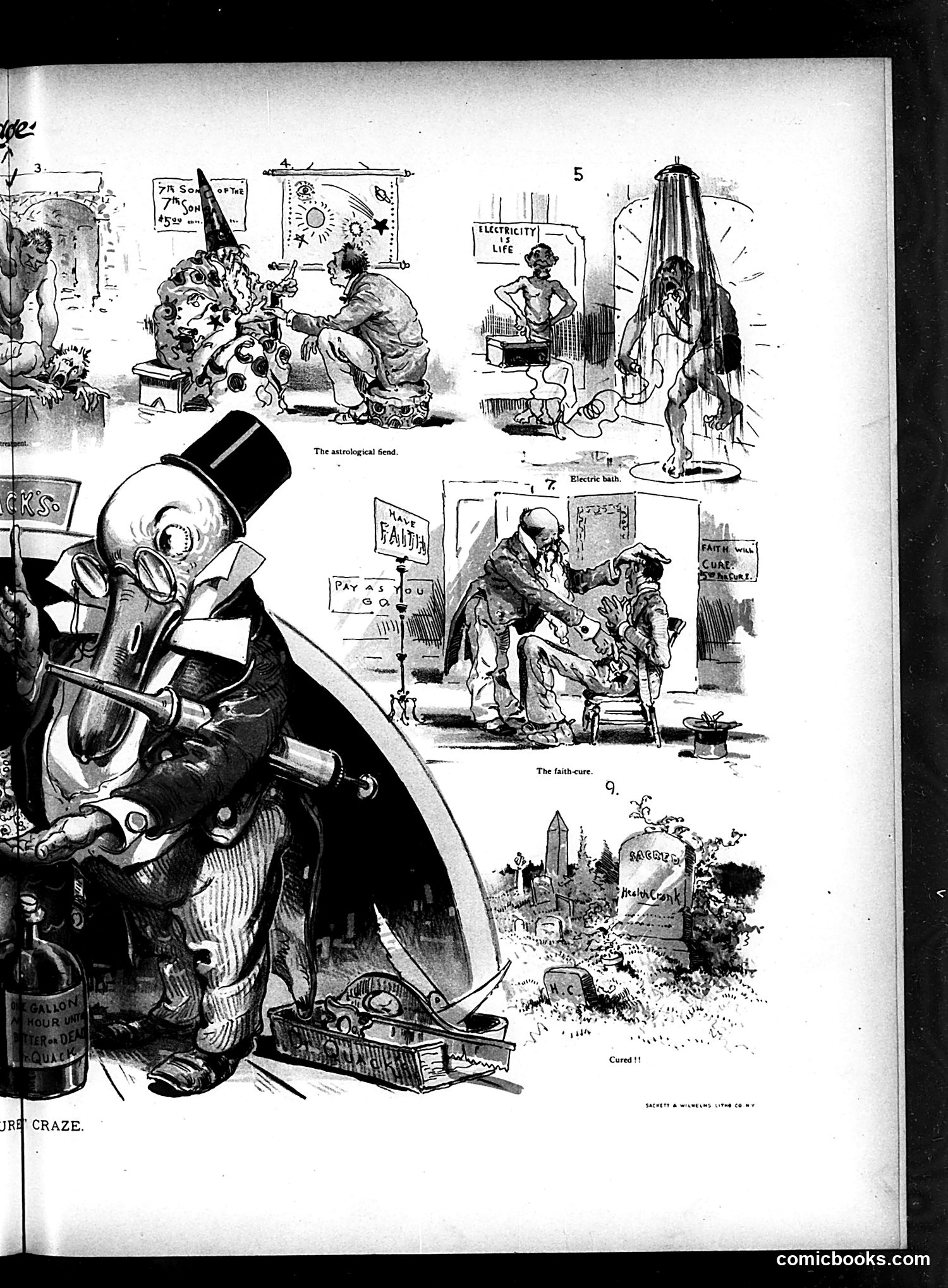
This page satirizes various dubious medical and pseudo-scientific "cure" fads of the era. The visible cartoons mock quack treatments: **"The astrological fiend"** (top): ridicules astrology-based medicine. **"Electricity life"** (right): lampoons electrotherapy scams—passing electrical current through patients as purported cure-all. **"The faith-cure"** (bottom center): satirizes faith healing charlatans exploiting the desperate and gullible. **"Cured!!"** (bottom): shows a cemetery headstone, darkly suggesting these fraudulent treatments kill patients. The large left figure appears to be a charlatan doctor/quack with various dubious devices and potions, embodying the era's medical scams. The page's title references a general "craze" for unproven remedies. Judge magazine regularly exposed consumer fraud and scientific humbug to inform and entertain readers about dangerous medical hoaxes.
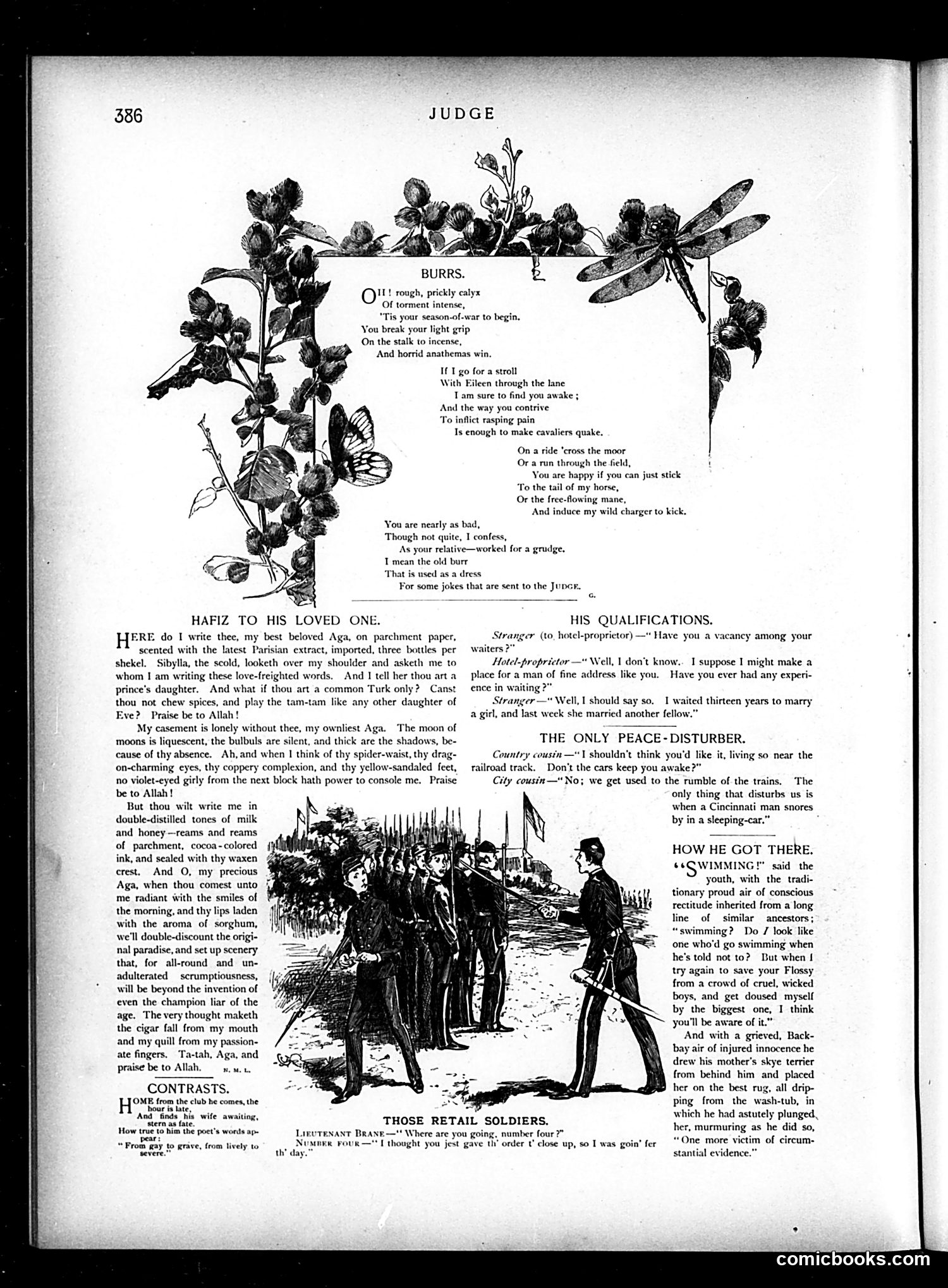
This page contains several satirical pieces typical of late-19th/early-20th century American humor: **"Burrs"** (top): A poem mocking burrs as nature's annoyance—they cling to clothing, get tangled in horses' manes, and cause cavaliers discomfort. The satire appears to be simple physical humor about rural/outdoor inconveniences. **"Hafiz to His Loved One"**: Parodies orientalist romantic writing popular in the era, with exaggerated flowery language about a Turkish woman ("Aga"), mocking both romance literature and stereotyped depictions of the Ottoman world. **Other brief satirical pieces** include "Contrasts" (married life humor), "Those Retail Soldiers" (military incompetence joke), "His Qualifications" (a waiter's experience is waiting for marriage rather than customers), and "The Only Peace-Disturber" (Cincinnati residents' snoring as worse than train noise). The page exemplifies Judge's mix of light social satire, ethnic stereotyping, and domestic/workplace humor typical of the period—generally punching at predictable targets: romance, marriage, immigrants, and military inefficiency.
This page from the satirical magazine **Judge** contains primarily **short humorous anecdotes and advertisements** rather than political cartoons. ## Key Content: The "**Prohibition Item**" joke satirizes hypocrisy in dry towns: a traveling salesman asks a righteous local where he can find liquor, and the man admits *he himself* is the bootlegger—profiting from illegal sales while condemning others. The humor targets the contradiction between prohibition laws and actual town behavior. Other items are brief, pithy jokes about contemporary life (grasshoppers and "hops," newspaper stamps as observatories, etc.)—typical of Judge's satirical humor column format. ## Advertisements: The page features prominent ads for **C.C. Shayne's sealskin garments**, **Halma** board game, **Youmans hats**, **Sohmer Pianos**, and patent medicines (Angostura Bitters, etc.)—revealing commercial culture of the 1890s era. The page lacks major political figures or overt political satire, focusing instead on social humor and commerce.
This page is primarily **advertising with minimal editorial content**. The dominant features are commercial notices for Victorian-era products: soups, safes, tea, jams, and railroad excursions. The only substantive editorial pieces are two short items: 1. **"The Angling Ananias"** — A humorous poem about an elderly fisherman who sits down to write tall tales about fishing exploits (a common trope in angling literature), only to realize he's already heard every fish story worth telling. The joke: fishing lies are so exhausted that even a chronic liar has run out of material. 2. **"A Philosopher in Love and in Uniform"** — A fragment discussing how military uniforms and brass buttons appeal romantically to women in fiction and real life. The piece appears incomplete on this page. Neither piece engages directly with contemporary politics. This appears to be a **society/humor-focused issue** rather than one emphasizing Judge's typical satirical commentary on public affairs.
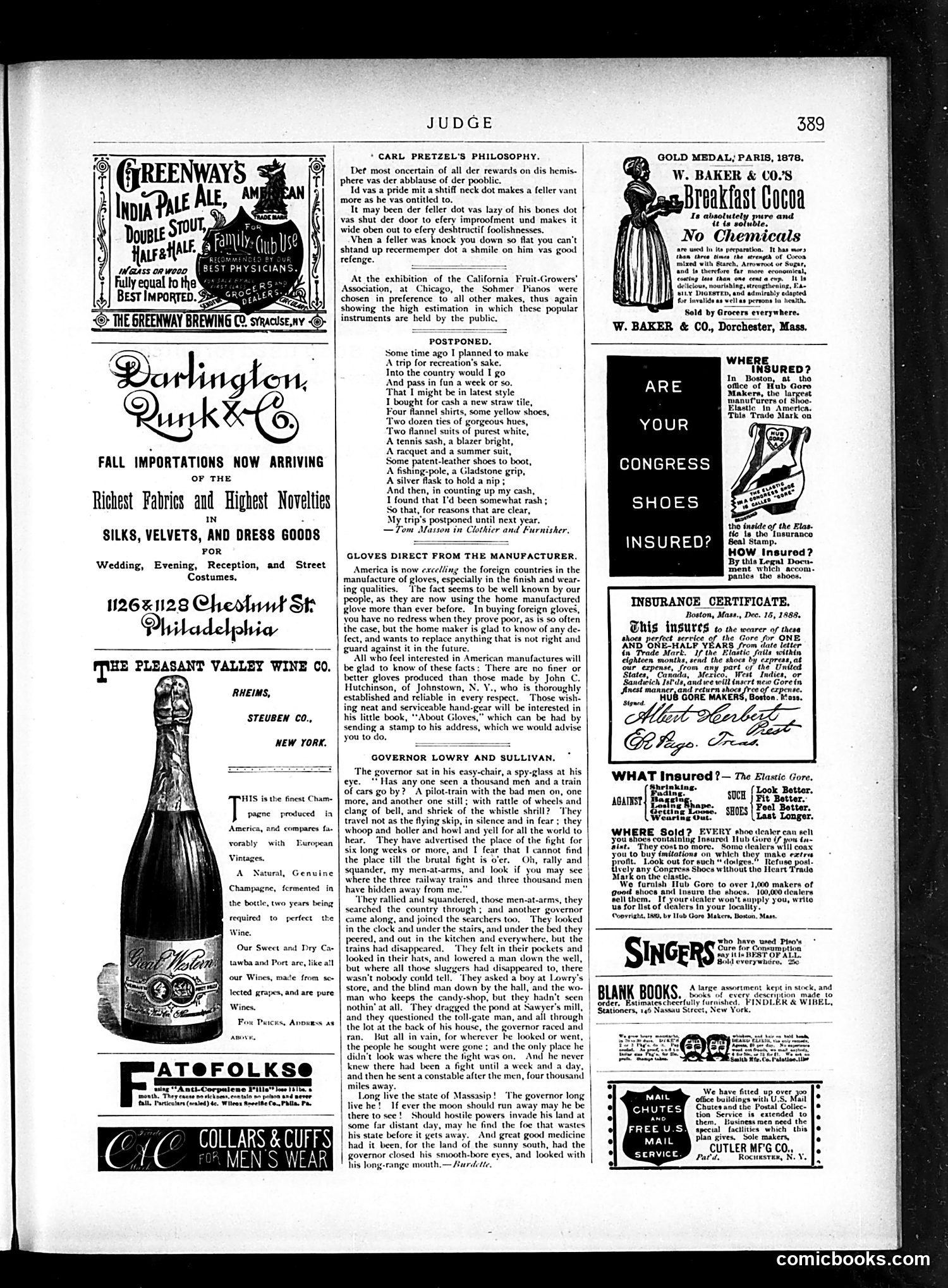
This is primarily a **commercial advertisement page** from Judge magazine, not a political cartoon page. The layout contains various luxury product advertisements (champagne, fabrics, collars, cocoa) typical of late 19th-century publications. The notable text content includes **"Carl Pretzel's Philosophy,"** a humorous column written in exaggerated German-immigrant dialect, offering folksy wisdom about public approval and pride. This reflects Judge's satirical approach to immigrant stereotypes common to the era. The page also features **"Governor Lowry and Sullivan,"** an incomplete narrative poem about a governor observing railway activity and anticipating some kind of public fight or event. Without the full text or illustration, the specific political reference remains unclear—it may reference contemporary political figures or events, but definitive identification isn't possible from this fragment. The overall page demonstrates Judge's mix of advertising revenue and light satirical content, rather than hard political commentary.
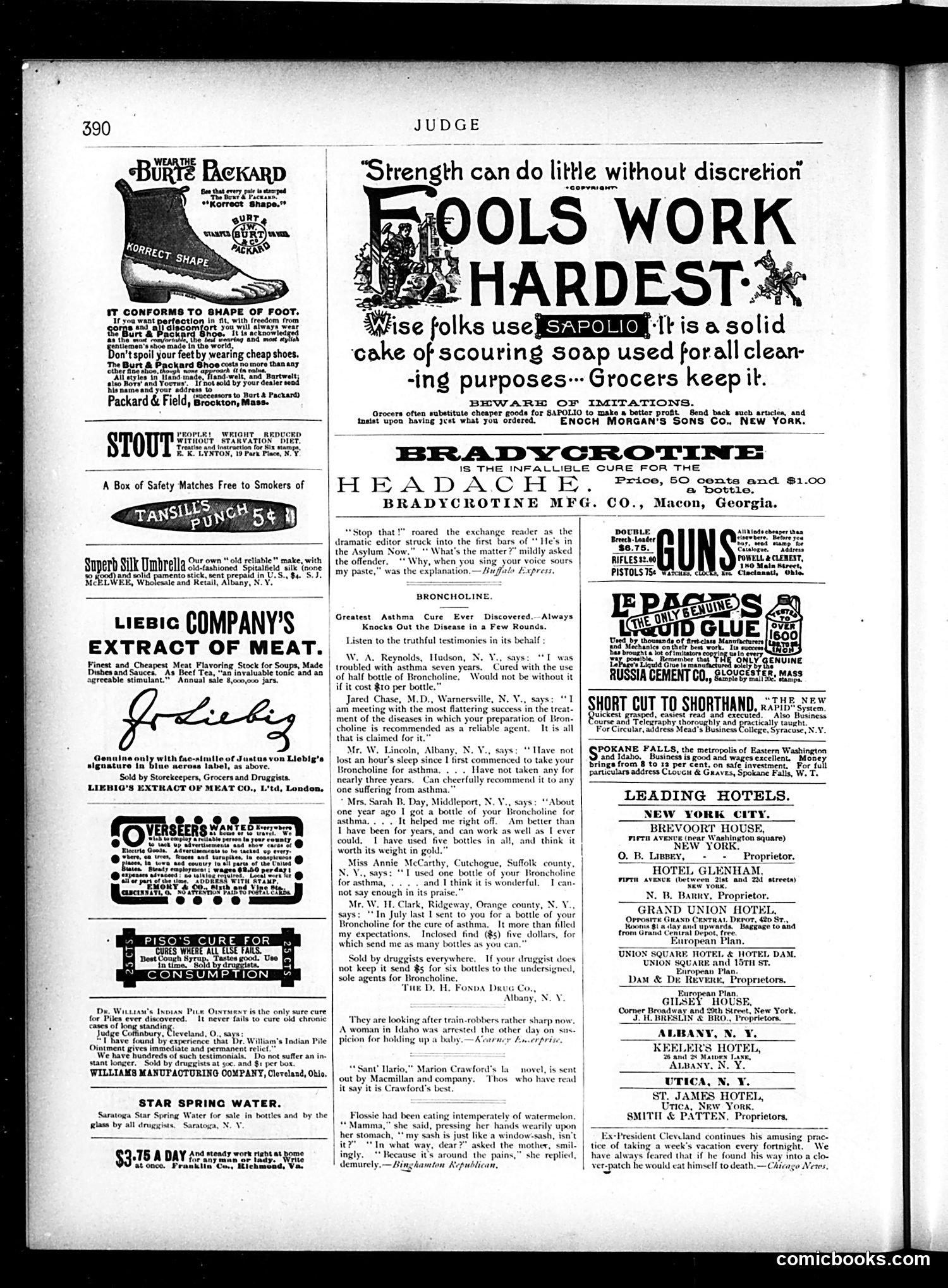
This page is **primarily advertisements**, not editorial cartoons. The main content includes ads for patent medicines (Bradycrotine for headaches, Broncholine for asthma), shoe polish, soap, and hotels. The only cartoon element appears to be a small comic exchange at top: a dramatic/theatrical editor playing music loudly while an exchange reader (newspaper worker) protests—a mild workplace joke about noise and annoying colleagues. The page reflects **turn-of-century America's patent medicine culture**. Products like Broncholine and Bradycrotine were heavily advertised with testimonials claiming to cure serious illnesses (asthma, headaches). These were largely unregulated and often ineffective—a practice that persisted until the FDA gained stronger regulatory powers in the early 1900s. The advertisements assume readers will trust celebrity endorsements and personal testimonials over scientific evidence—a marketing strategy that remains recognizable today, though now regulated.
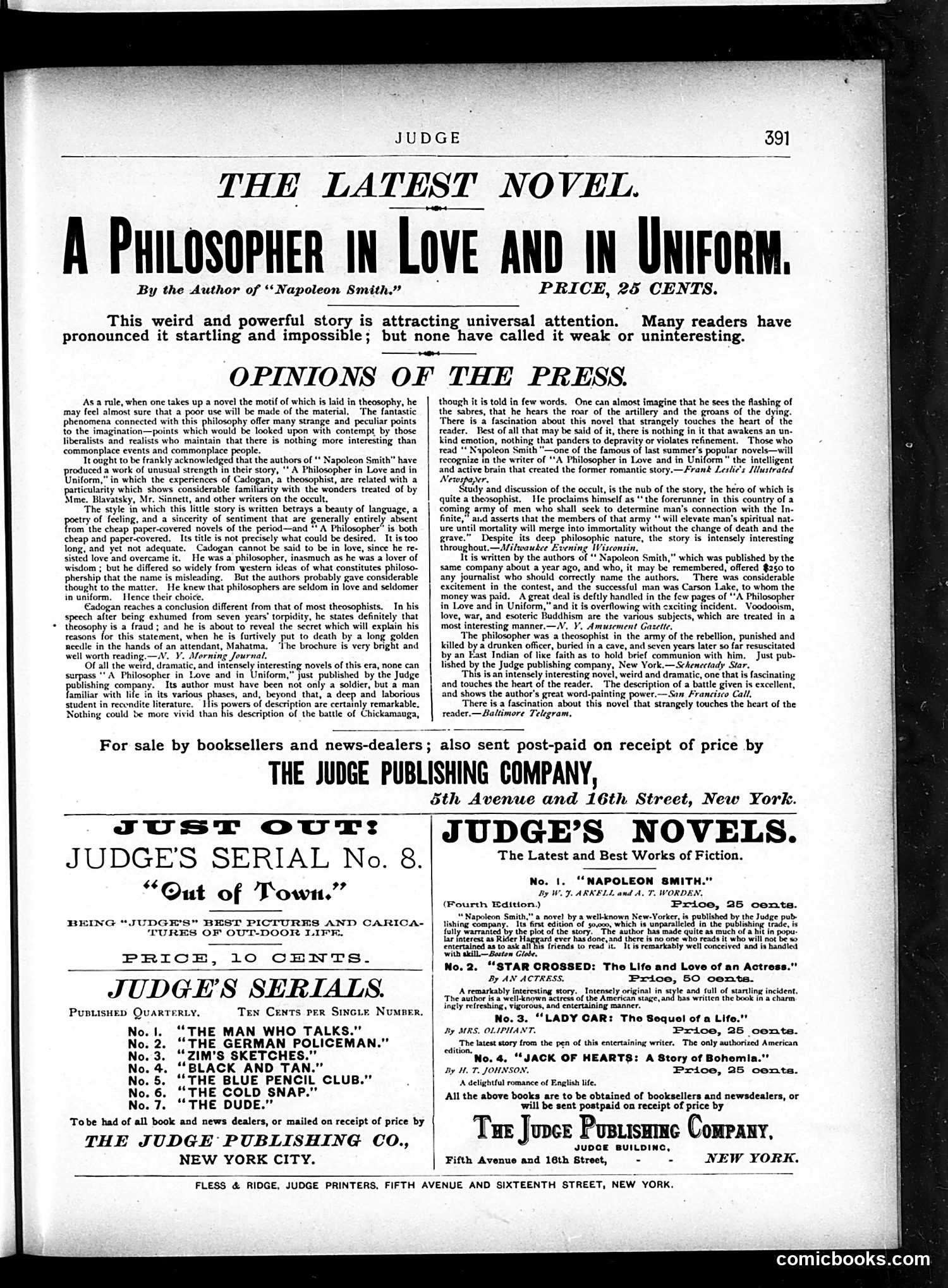
This page is primarily **advertising**, not a political cartoon. It announces a novel titled *A Philosopher in Love and in Uniform* by the author of *Napoleon Smith*, priced at 25 cents. The content consists of glowing press reviews excerpted from contemporary publications (New York Morning Journal, Frank Leslie's Illustrated Newspaper, etc.). The reviews praise the novel as "weird and powerful," noting its treatment of **Theosophy**—the occult philosophy associated with figures like Madame Blavatsky and Mr. Sinnett. The reviews highlight dramatic battle scenes (specifically the "battle of Chickamauga," likely referring to the Civil War) and praise the author's descriptive powers. The novel apparently involves a protagonist named Cadogan who is a theosophist, experiences mystical "torpidity" lasting seven years, and ultimately concludes theosophy is fraudulent. For modern readers: this reflects late 19th-century fascination with occultism and spiritualism as serious intellectual subjects worthy of literary treatment—a now-obscure cultural moment.
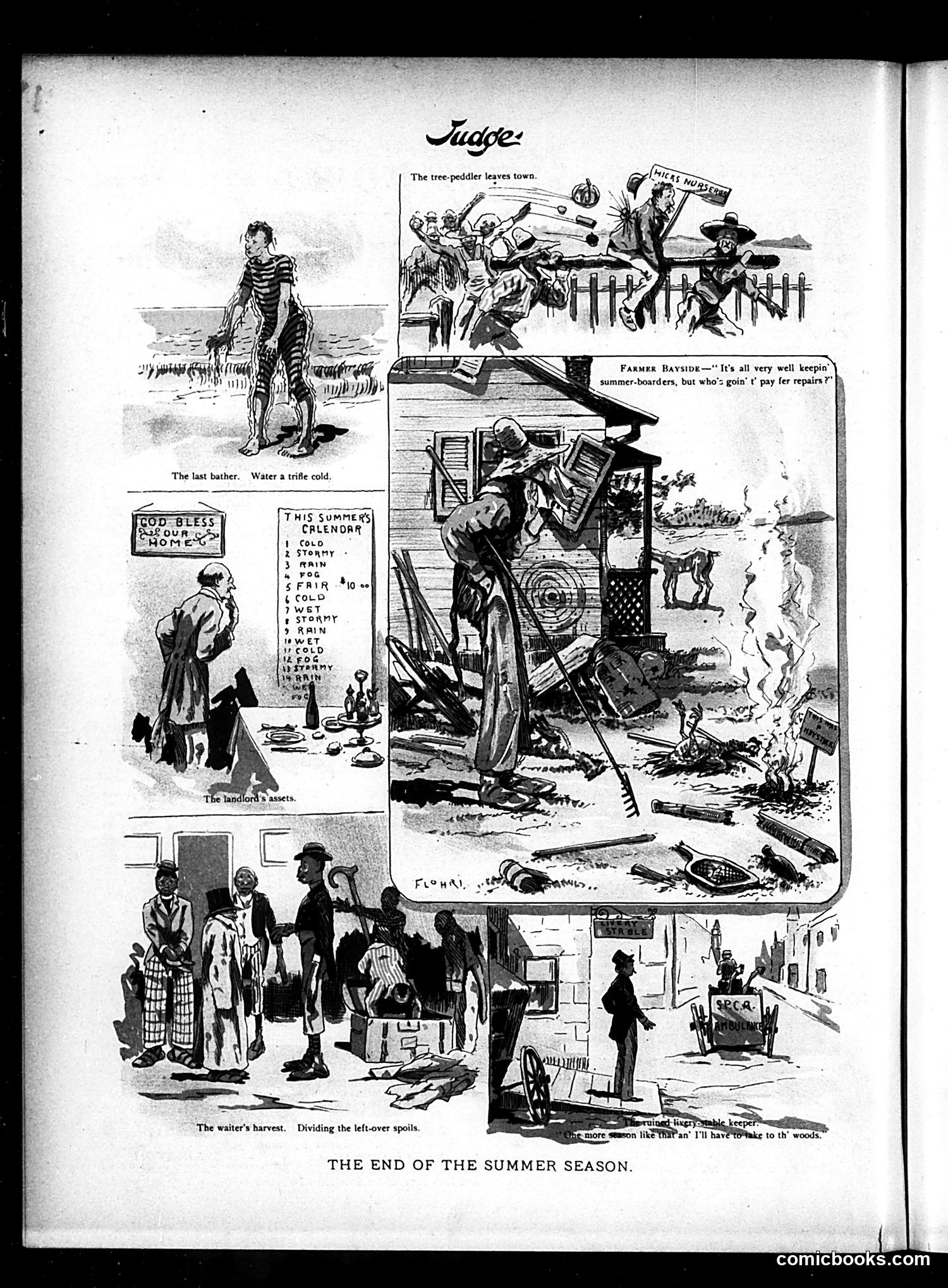
This Judge cartoon satirizes the end of summer vacation season (likely late 1800s) and its economic consequences. The central figure is a rural farmer frustrated by "summer-boarders"—wealthy urbanites who rented countryside lodgings during hot months. While these visitors provided income, they damaged property (shown by the destroyed cabin, scattered belongings, and fire). The farmer complains nobody will pay for repairs. Side panels show the exploitation trickle-down: a landlord's meager assets, waiters dividing tips and "left-over spoils," and street children scavenging remnants. The "summer calendar" listing only cold and stormy weather mocks the season's actual poor conditions despite tourism's appeal. The satire critiques both working-class dependence on seasonal tourism and the destructive carelessness of wealthy visitors—showing how summer leisure for the rich meant economic chaos and hardship for rural communities left with the damage.