
A complete issue · 16 pages · 1889
Judge — July 27, 1889
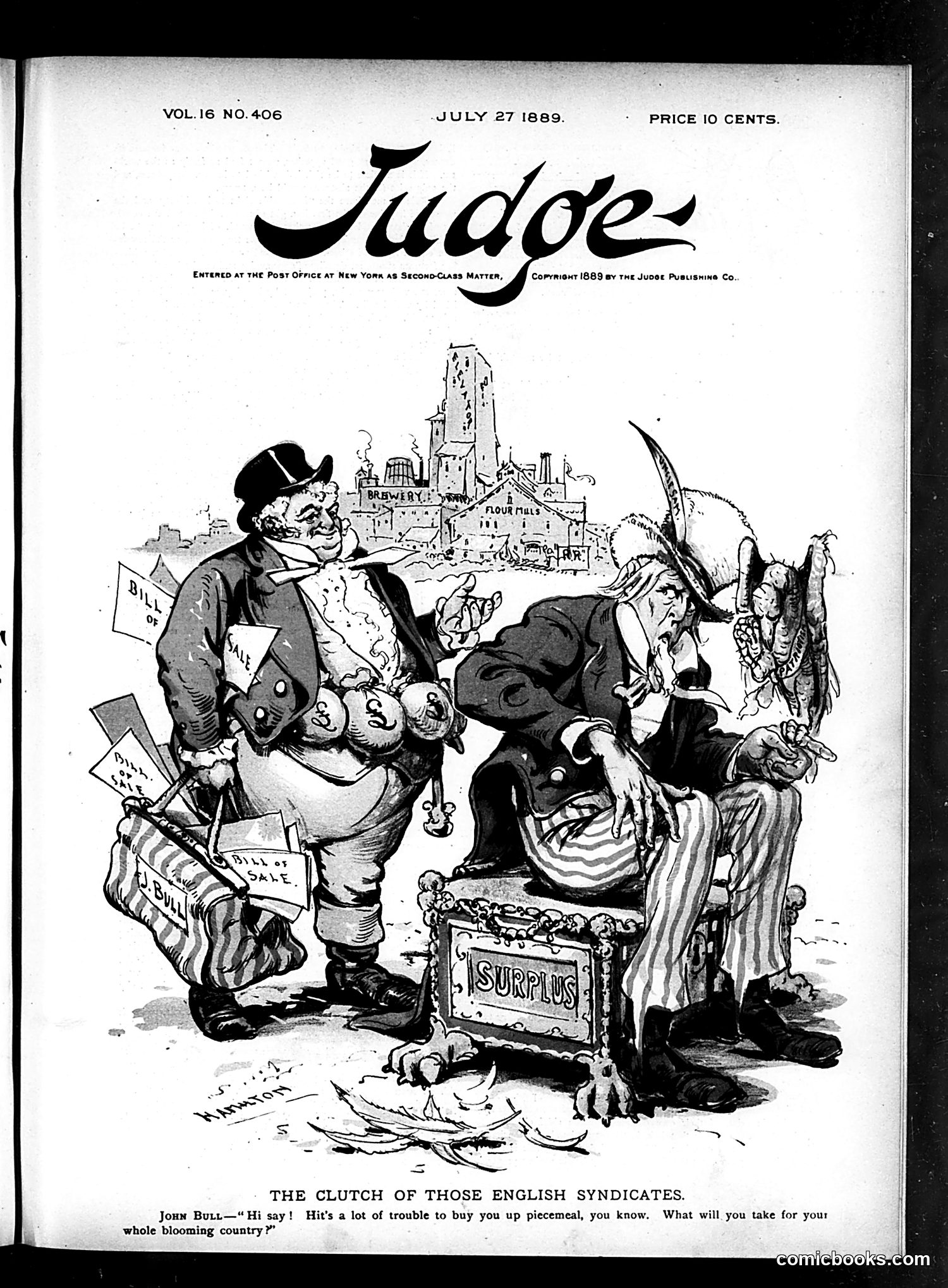
This 1889 Judge cartoon satirizes foreign economic control of American industry. The obese figure labeled "John Bull" (personification of Britain) clutches America's throat while extracting wealth. He holds bills of sale and stands over a box labeled "SURPLUS"—suggesting British syndicates are buying up American assets and profits. The industrial cityscape in background represents American manufacturing capacity. The caption's dialogue mocks the predatory nature of these foreign investments: British syndicates are literally purchasing America "piecemeal." The cartoon reflects late-19th-century American anxiety about foreign (particularly British) financial interests acquiring controlling stakes in U.S. companies during a period of rapid industrialization and consolidation. It expresses nationalist concern that American prosperity was being transferred abroad through syndicate ownership.
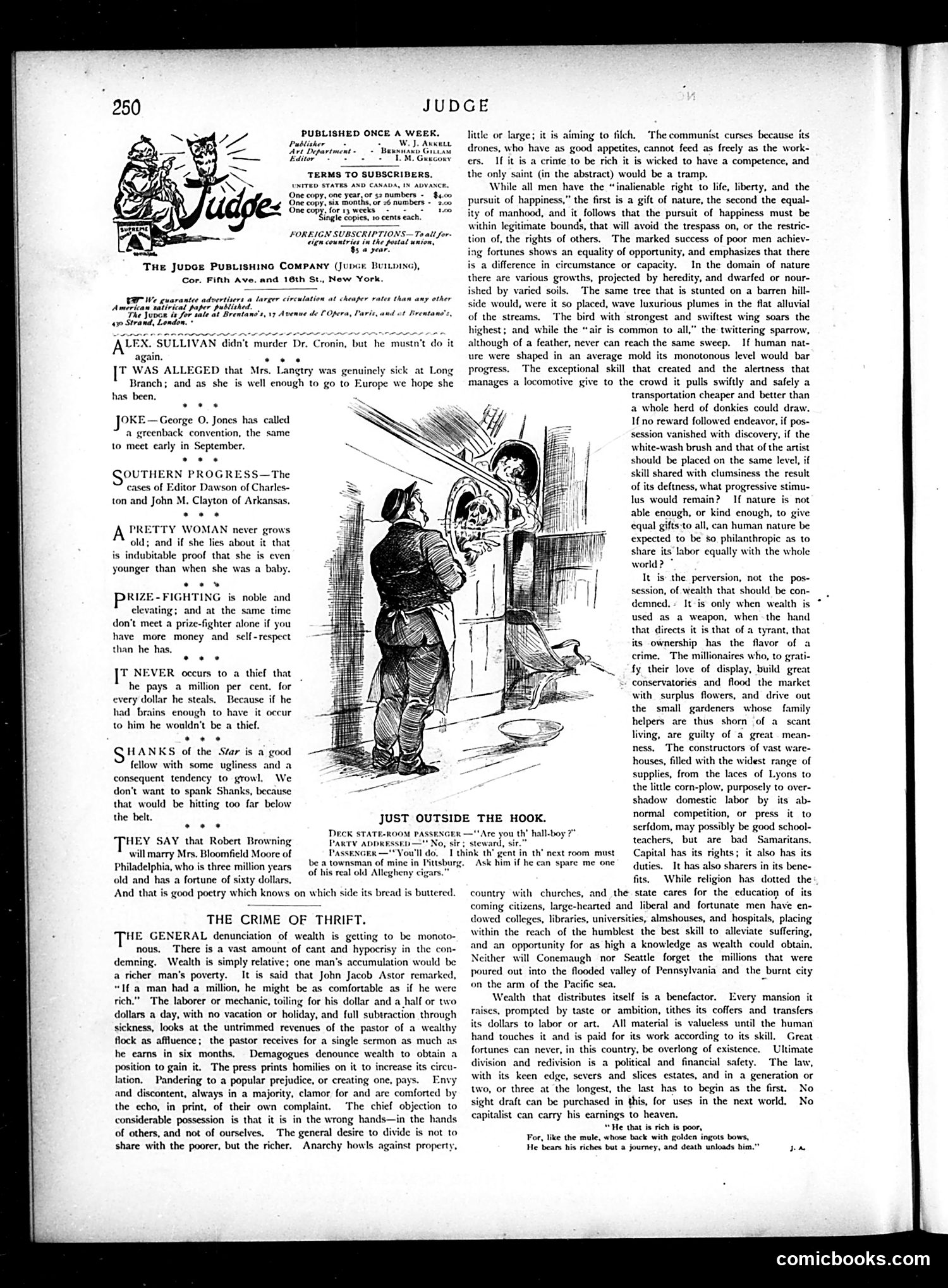
The main illustration, titled "Just Outside the Hook," depicts a man in work clothes at a doorway, appearing to be a tradesman or laborer. The accompanying dialogue suggests he's seeking entry or attempting a transaction. The page primarily contains brief satirical commentary items rather than a single integrated cartoon. Topics include: - Alex Sullivan and a Dr. Cronin (likely referencing a historical crime) - Mrs. Lantry's alleged illness and European travel - Editor Daveson of Charleston and John M. Clayton of Arkansas - Prize-fighting commentary - Social commentary on wealth distribution and charity The longer essay "The Crime of Thrift" critiques wealth accumulation and argues against viewing poverty as a moral failing, suggesting wealthy individuals have responsibility toward the less fortunate. Without clearer historical context or dates visible, specific references remain partially unclear.
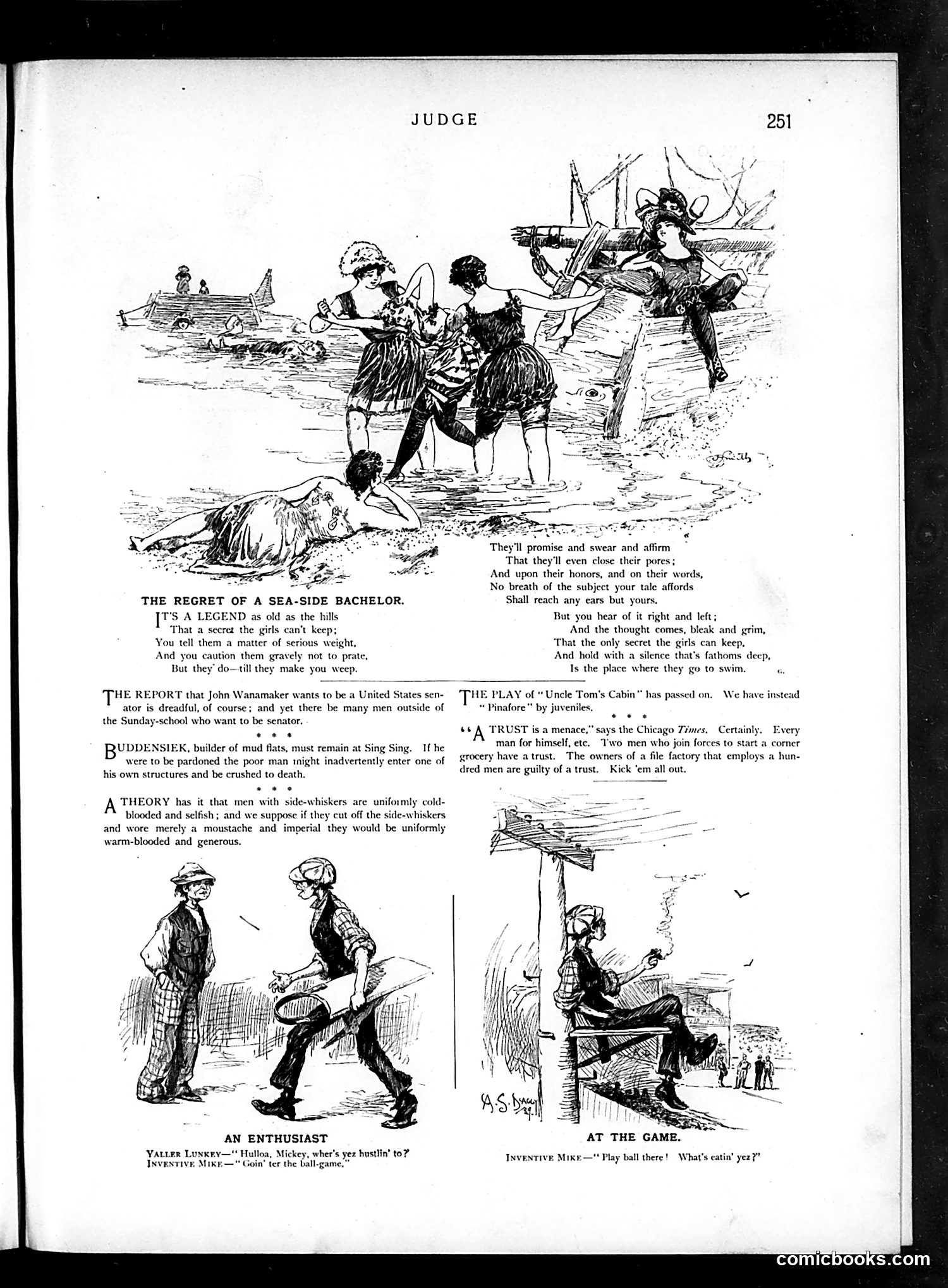
This page contains multiple short satirical pieces typical of Judge magazine's style: **"The Regret of a Sea-Side Bachelor"** mocks the cliché that women cannot keep secrets, claiming the only secret girls reliably keep is "the place where they go to swim"—a reference to segregated bathing areas and the modesty taboos surrounding women's swimming. **Brief political/social jabs** include mockery of John Wanamaker's alleged senatorial ambitions and commentary on a builder named Buddensiek imprisoned at Sing Sing. **Other observations** ridicule the notion that men with side-whiskers are inherently cold-blooded, and sarcastically comment on theatrical productions and business "trusts" (monopolies), sarcastically equating small grocers with large industrial monopolies. **Two cartoon vignettes** show common street scenes: an enthusiastic youth asking about baseball ("Hallo, Mickey, where's yez hustlin' to?") and an impatient fan demanding action at a game ("Play ball there!"). These capture turn-of-the-century American vernacular and pastimes.
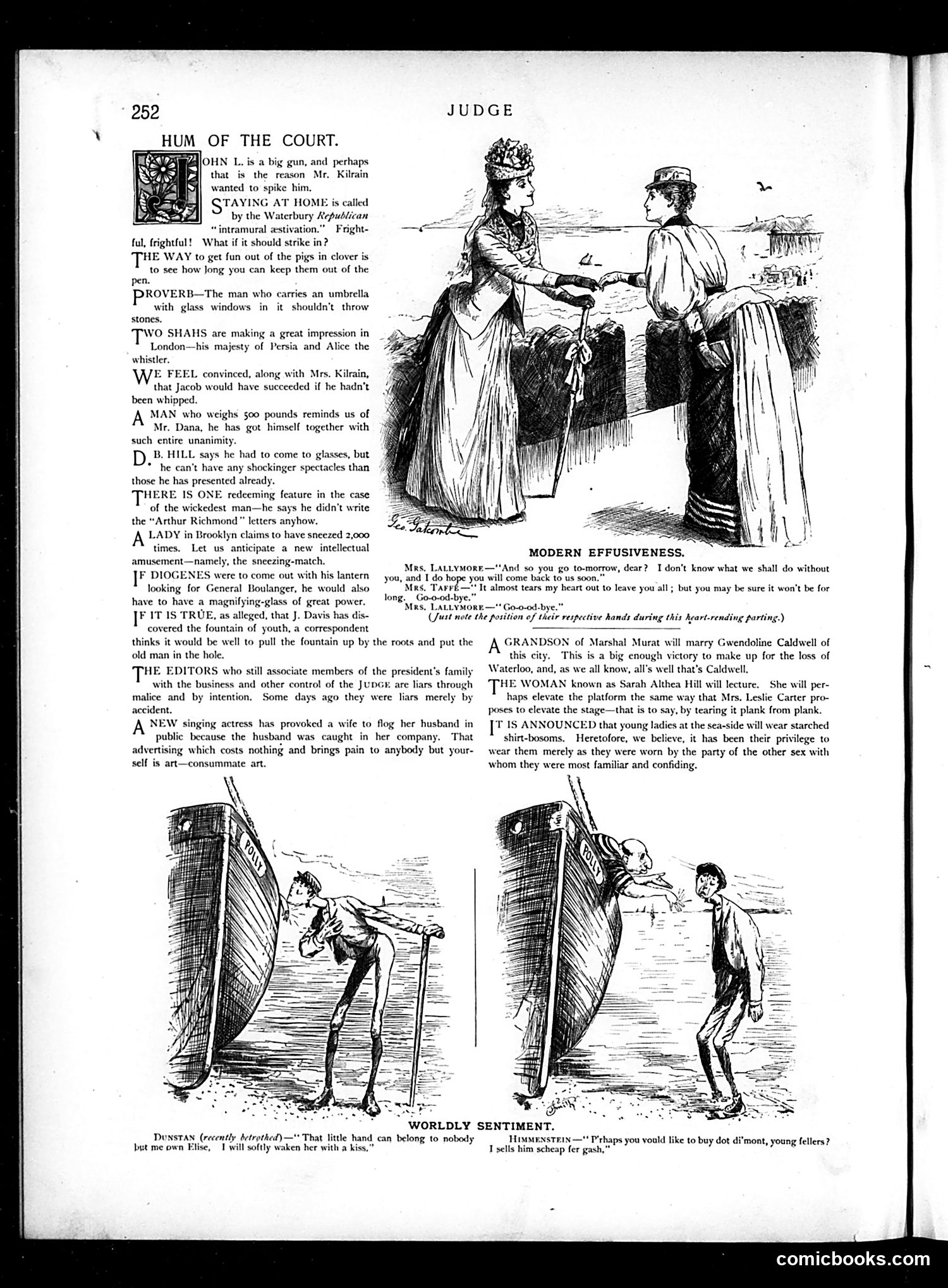
This page from Judge magazine contains miscellaneous short humorous observations and several cartoon illustrations typical of 1880s satirical commentary. **Key References:** - **"John L." and Kilrain**: Refers to boxer John L. Sullivan and his rival Jake Kilrain, with wordplay on "spiking" (a boxing term) - **General Boulanger**: The French military figure, referenced as so obscure he'd require Diogenes' lantern to find - **J. Davis**: Appears to reference Jefferson Davis, with a joke about discovering "fountain of youth" - **Marshal Murat and Gwendoline Caldwell**: A contemporary society marriage, with a Waterloo reference - **Sarah Althea Hill**: A woman involved in a notorious legal case, compared to actress Mrs. Leslie Carter **Cartoons:** - "Modern Effusiveness" satirizes exaggerated emotional farewells between a woman and man - "Worldly Sentiment" shows two scenes of a man with a woman and a man selling diamonds—mocking romantic melodrama versus mercenary sentiment The page mostly comprises brief satirical quips about contemporary society, politics, and personalities of the 1880s.
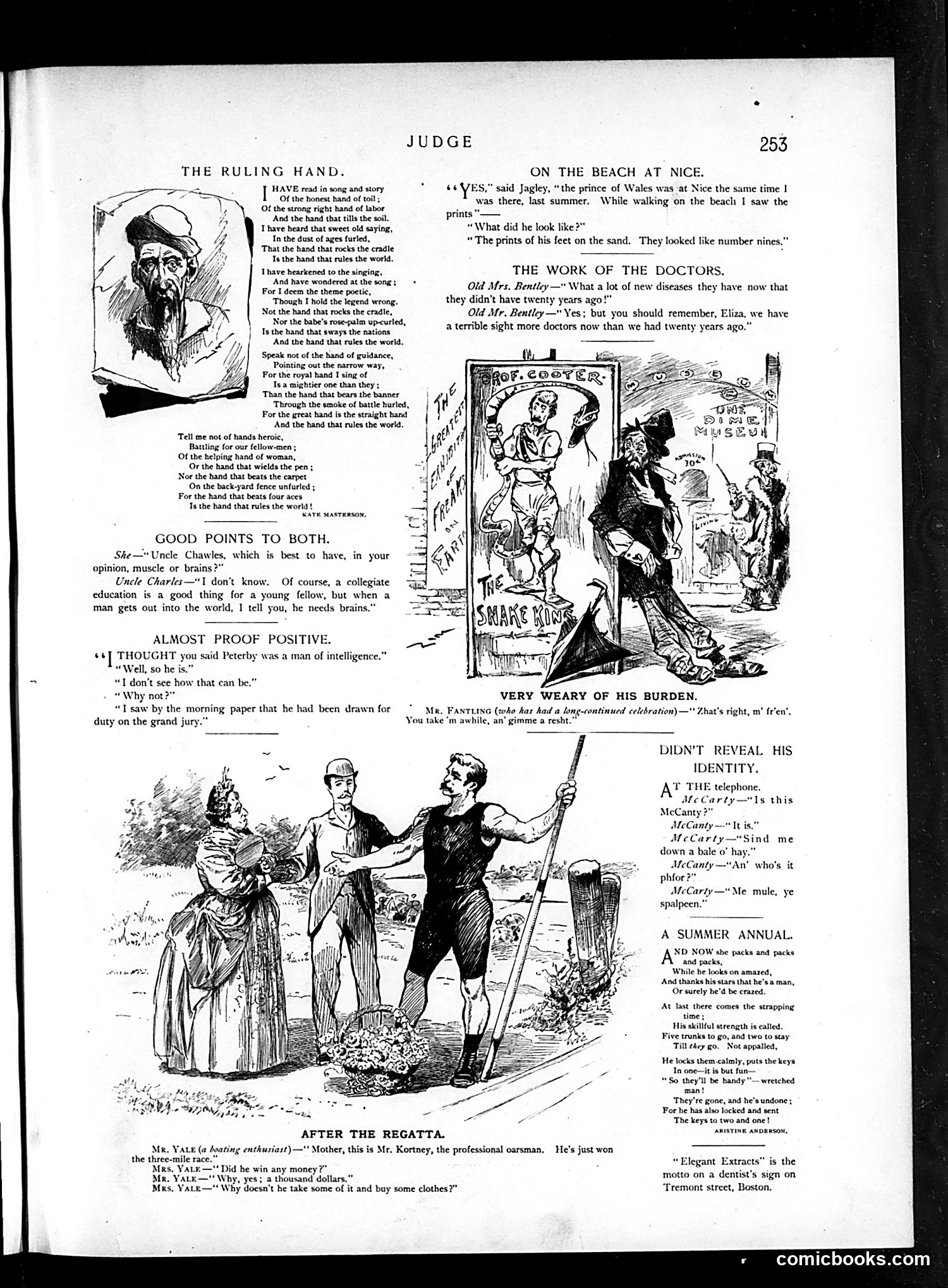
This page contains several brief satirical pieces typical of Judge's humor: **"The Ruling Hand"** is a mock-heroic poem suggesting that money (specifically "four aces"—a poker hand) truly rules the world, not labor, motherhood, or heroism. It's cynical social commentary disguised as verse. **The short dialogues mock** various American pretensions: Uncle Charles's contradictory advice about education, the assumption that jury duty proves intelligence (clearly ironic), and Mrs. Yale's practicality about her husband wasting a thousand-dollar racing prize instead of buying clothes. **"The Work of the Doctors"** jokes that modern medicine merely invented new diseases to justify proliferating physicians—a common skepticism about medical expansion in this era. **"Summer Annual"** humorously depicts the chaos of packing trunks for vacation, ending with slapstick irony when the husband locks the keys inside the sent luggage. The cartoons illustrate these pieces with period-appropriate illustrations. Overall, the page reflects Judge's characteristic middle-class anxieties about money, social mobility, and practical domesticity.
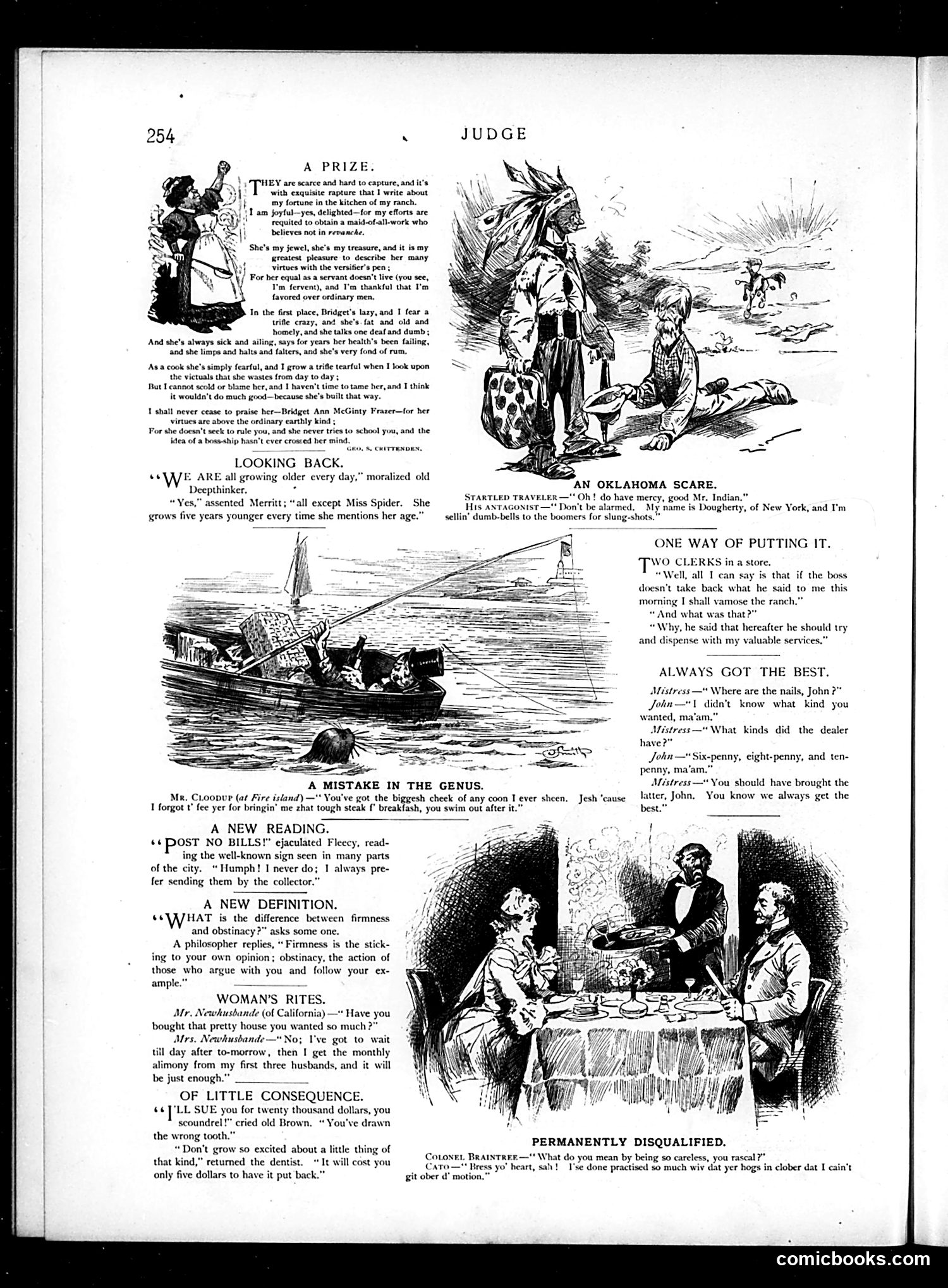
This page contains multiple brief satirical items typical of Judge's humor circa the late 19th century. **"A Prize"** mocks wealthy ranch owners' complaints about domestic help. The narrator ironically praises his worthless servant "Bridget Ann McGinty Frazer"—lazy, old, homely, drunk, and unable to cook—as a "treasure" simply because she doesn't "boss" him around. The satire targets employer hypocrisy: they'll tolerate incompetence to avoid being managed by staff. **"An Oklahoma Scare"** plays on period anxieties about Native Americans and frontier dangers, revealing the "antagonist" is merely "Dougherty, of New York" selling dumbbells—a con man, not a threat. **"A Mistake in the Genus"** uses racial dialect humor (common but offensive by modern standards) about a Black servant. Other items ("Looking Back," "One Way of Putting It," etc.) are brief joke vignettes about marriage, business, and domestic life, typical of Judge's formula. The overall tone reflects 1890s-1900s America: class anxieties, servant-master dynamics, and minstrel-style racial humor that was standard magazine fare then.
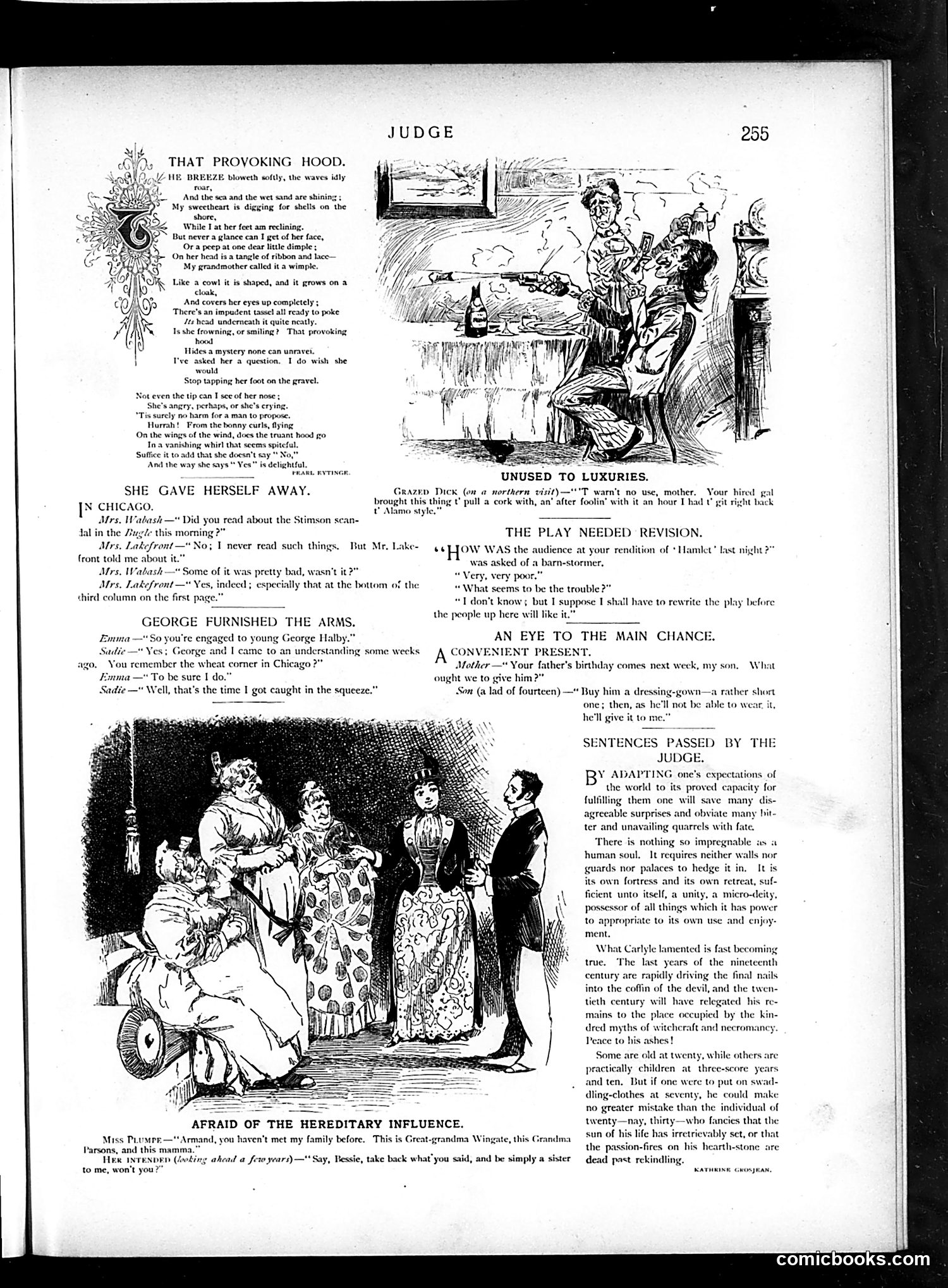
This page contains multiple satirical vignettes typical of Judge magazine's humor: **"That Provoking Hood"** - A romantic poem mocking the fashion of women wearing large bonnets/hoods that completely obscure their faces. The frustrated suitor cannot see his sweetheart's expression or features, only her covered head. The satire targets both the impracticality of the fashion and male befuddlement. **"She Gave Herself Away"** - A brief joke where Mrs. Wabash claims not to read scandal, but her husband reveals she actually knows details, thus contradicting herself—the humor lies in her hypocrisy about avoiding gossip. **"George Furnished the Arms"** and **"Afraid of the Hereditary Influence"** - Short romantic comedies playing on courtship anxieties and family concerns. **"Unused to Luxuries"** and **"Eye to the Main Chance"** - Economic humor about working-class struggles and parental practicality. The page primarily showcases Judge's specialty: quick-hit social satire on fashion, manners, courtship, and class, rather than sustained political commentary.
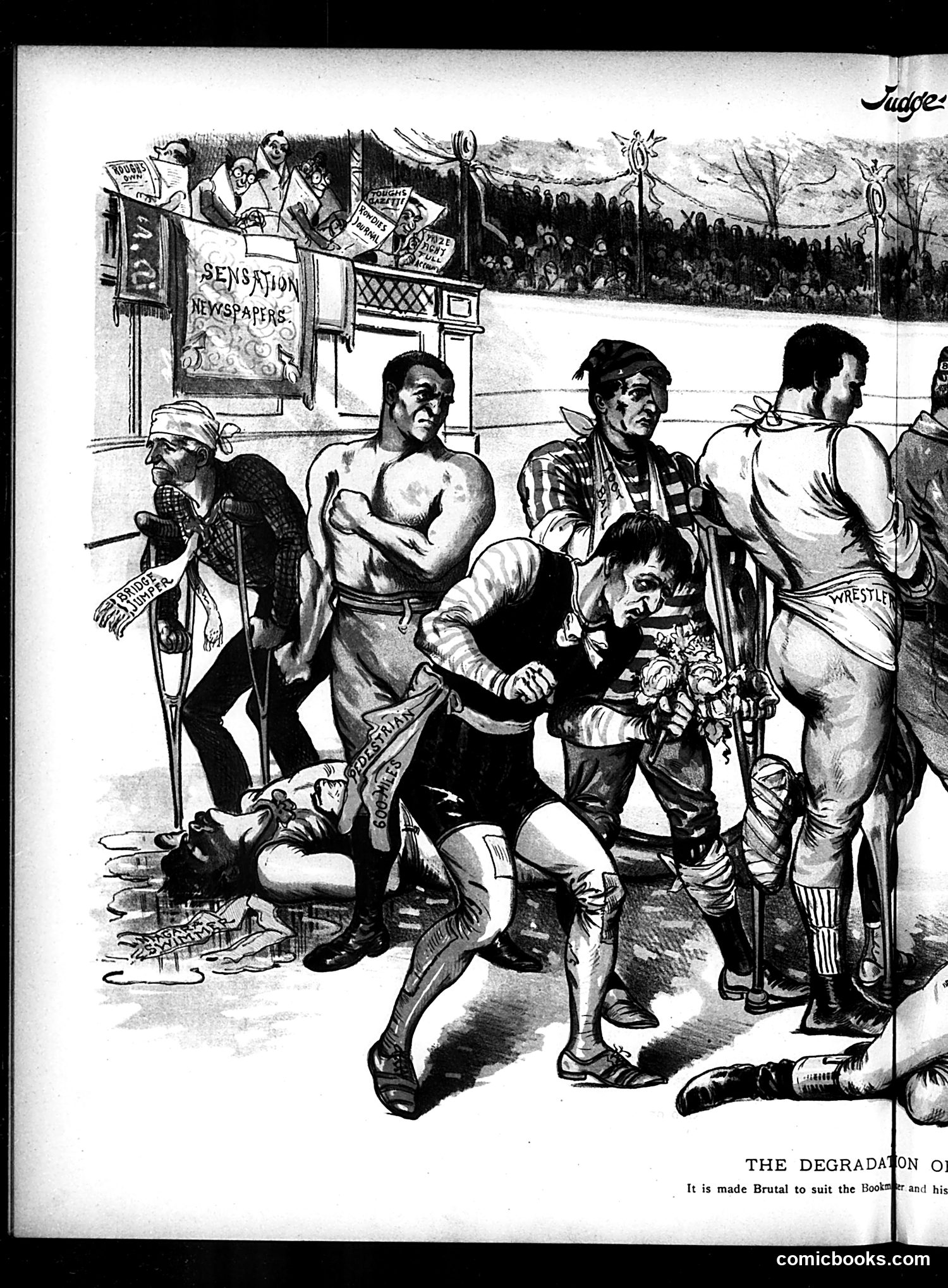
This appears to be a satirical cartoon titled "The Degradation of..." (title cut off). The image shows wrestlers and carnival/circus performers in a stadium or arena setting with spectators in the background. A "Sensation Newspapers" booth is visible, suggesting media sensationalism is the target. The satire likely critiques how newspapers profit from promoting wrestling as entertainment—depicting it as a degrading spectacle. The various performers and their exaggerated physiques suggest mockery of the wrestling industry's theatrical nature. However, without the complete title and full OCR text, I cannot definitively identify specific individuals being caricatured or pinpoint exact historical events referenced. The cartoon clearly attacks sensationalist media coverage of wrestling entertainment, but the precise political or social context remains unclear from this fragmentary page.
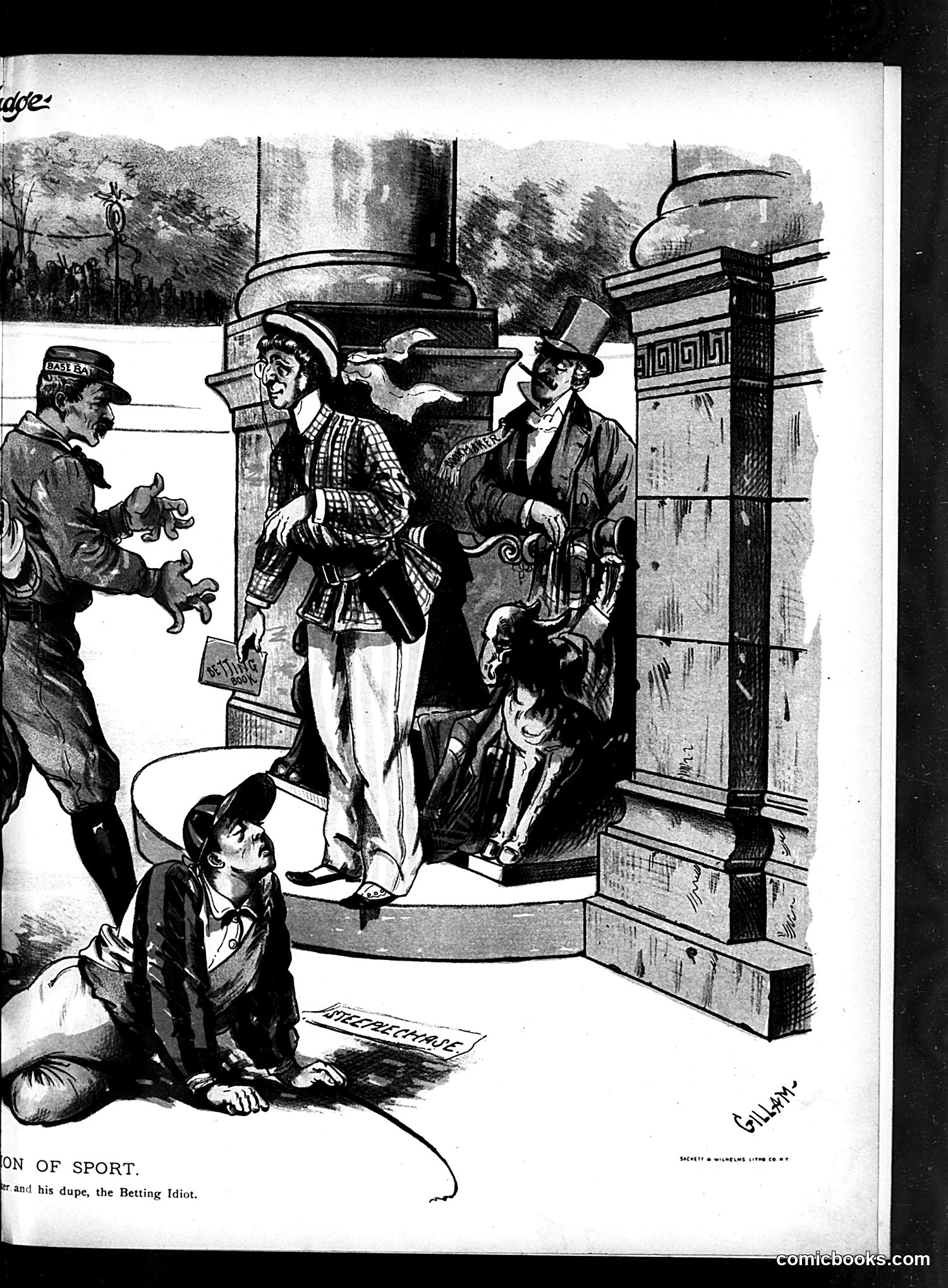
This satirical cartoon critiques gambling culture, specifically horse racing betting. The visible text identifies "the Betting Idiot" as a central figure—likely the well-dressed man in the center being exploited or manipulated. The scene appears set at a betting establishment or racetrack, with elegantly dressed con artists or bookmakers surrounding a gullible bettor. The poor man crouching in the foreground labeled "BETTING IDIOT" represents the foolish gambler being duped by more sophisticated operators. The elaborate classical architecture and formal attire emphasize the "respectable" facade masking predatory gambling schemes. The cartoon mocks both the naïve bettor and satirizes organized gambling as a system designed to separate fools from their money. This reflects late 19th/early 20th-century concerns about vice and financial exploitation.
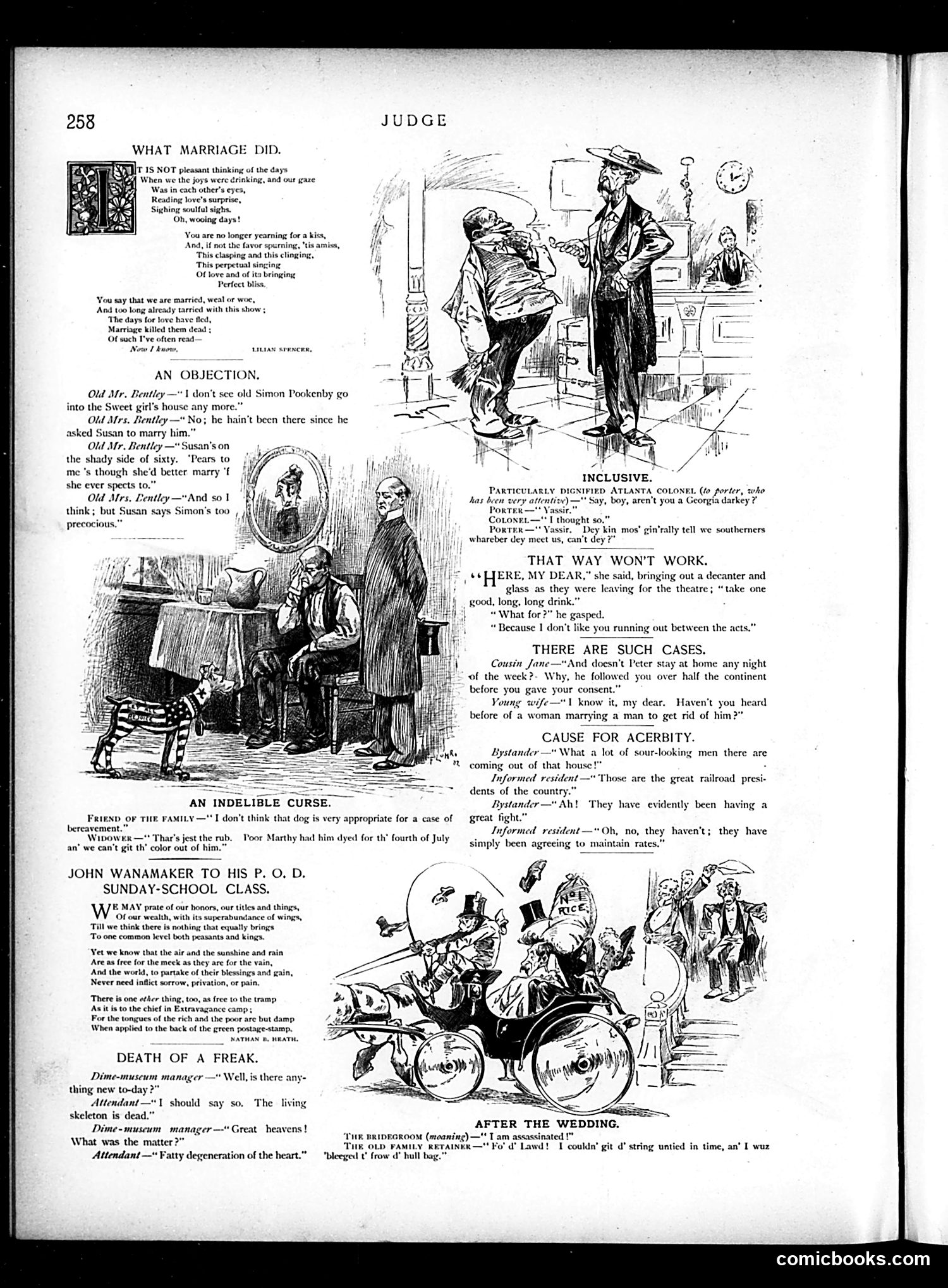
This page collects multiple brief satirical pieces typical of Judge's humor: **"What Marriage Did"** presents a poem lamenting how marriage kills romantic passion—a common theme in turn-of-century humor about domesticity's dampening effect on passion. **"An Objection"** jokes about a young woman rejecting a suitor as "too precocious"—satirizing how even youth and eagerness become liabilities in courtship. **"Inclusive"** features racial stereotyping: a porter is identified by an Atlanta colonel as "a Georgia darkey," reflecting the casual racism of the era. **"That Way Won't Work"** depicts a wife trying to prevent her husband from leaving during intermission by getting him drunk—mocking marital control tactics. **"After the Wedding"** shows an elderly Black servant unable to untie a knot on the bride's departure bag, making light of incompetence. The page emphasizes marriage as disappointing, courtship as absurd, and relationships as adversarial—typical satirical targets. The racial humor reflects period attitudes without critique.
This page contains primarily **humorous verse and light satirical pieces** rather than political cartoons. **"The Workings of the Infant Mind"** is a meta-joke: the author deliberately creates an anachronistic scene where young Thomas Jefferson uses baseball slang that didn't exist in his era, then defends this by claiming modern fiction doesn't require historical accuracy. The humor lies in this self-aware literary criticism. **"The Injun"** presents a darker satire on Native American displacement. A formerly dignified Indigenous man, corrupted by "white civilization" (poker, whiskey, sandwiches), now begs on Denver streets. The bitter irony: he thanks white colonizers for "civilizing" him, when colonization destroyed his way of life. This reflects 19th-century attitudes about "civilization" while simultaneously critiquing its destructive impact. **"Breaking the Day in Two"** is sentimental verse about a mother comforting her child with naps and lullabies. The remaining pieces are brief, mild anecdotes about dyspepsia, stuffy train cars, and a boy negotiating payment for holding a horse. The page is predominantly **advertisements** for patent medicines, cigars, and consumer goods.
This page is primarily **advertising**, not political satire. It features commercial notices for premium bonds, food products (Liebig's meat extract, Grosse & Blackwell's jams, Uncle Sam's corn salve), and other goods typical of late 19th-century American magazines. The only editorial content is a poem titled "Life Is All Right," attributed to **James Whitcomb Riley** (visible at bottom). This sentimental, rural-themed verse celebrates nature's resilience and divine Providence—typical of Riley's popular nostalgic poetry. A brief "Commencement Season" poem fragment appears below, apparently satirizing newly-graduated college men who "annihilate...trusts and men." The page contains **no political cartoons or caricatures**. Judge, though known for satire, devoted significant space to revenue-generating advertisements. This particular page represents the magazine's commercial rather than editorial function.
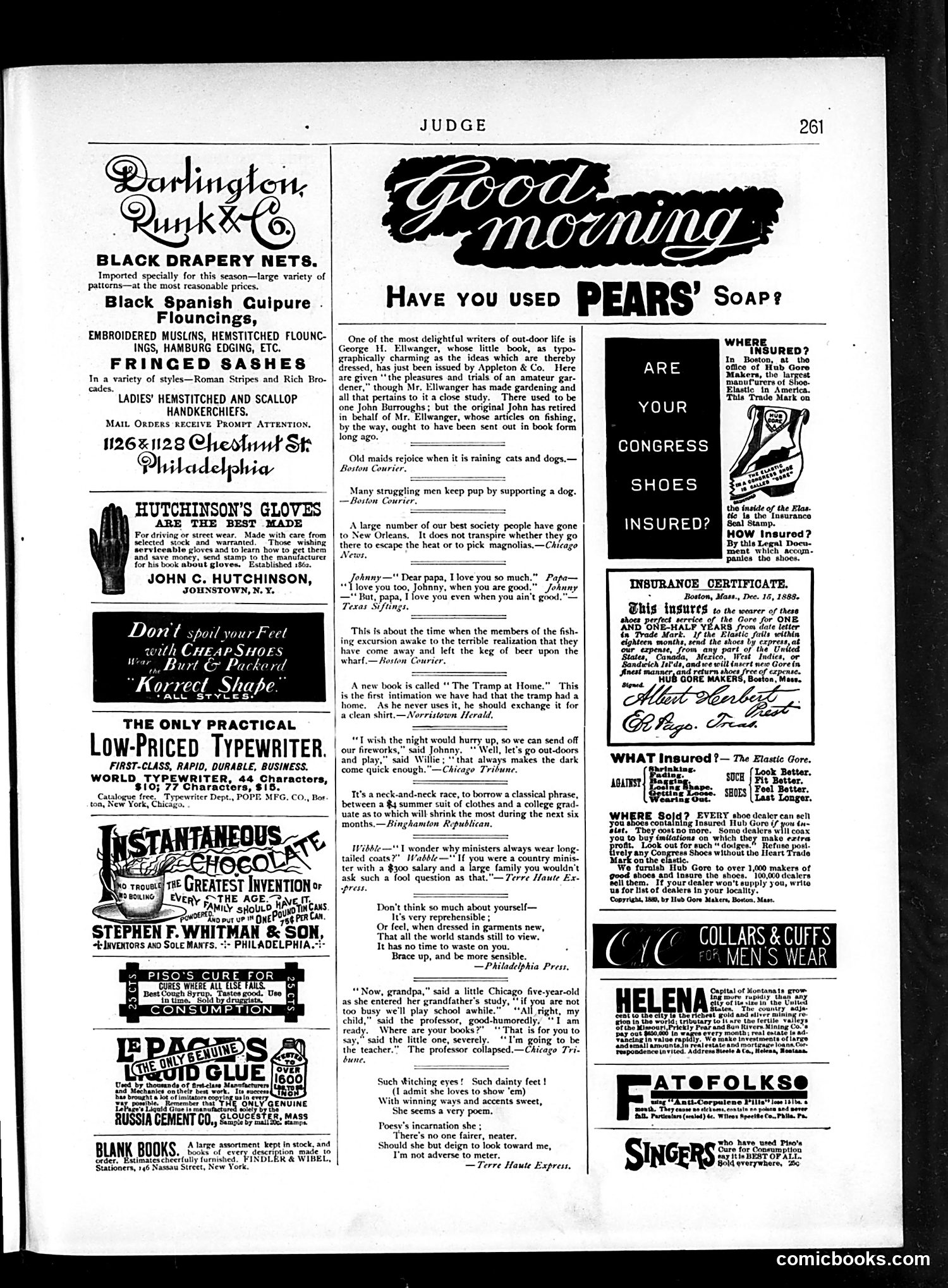
This page is primarily **advertisements and filler content**, not political cartoons. The main satirical material consists of brief humorous snippets and observations: The text includes lighthearted social commentary typical of Judge magazine's era—jokes about unmarried women enjoying rainy weather, wealthy people traveling to New Orleans, children's conversations with parents, fishing excursions, and the shrinking of summer clothes. One piece mocks country ministers' long coats given their modest $300 salaries. The large advertisement for **Pears' Soap** features an article about outdoor writer George H. Ellwanger, comparing him to naturalist John Burroughs—representing contemporary literary taste. The remaining content is commercial: typewriters, gloves, shoes, chocolates, and other consumer goods. The **"Are Your Congress Shoes Insured?"** advertisement is notably whimsical, suggesting even footwear needs insurance. There are **no identifiable political figures or events** satirized here. This is a typical Judge page blending light domestic humor with era-appropriate advertising.
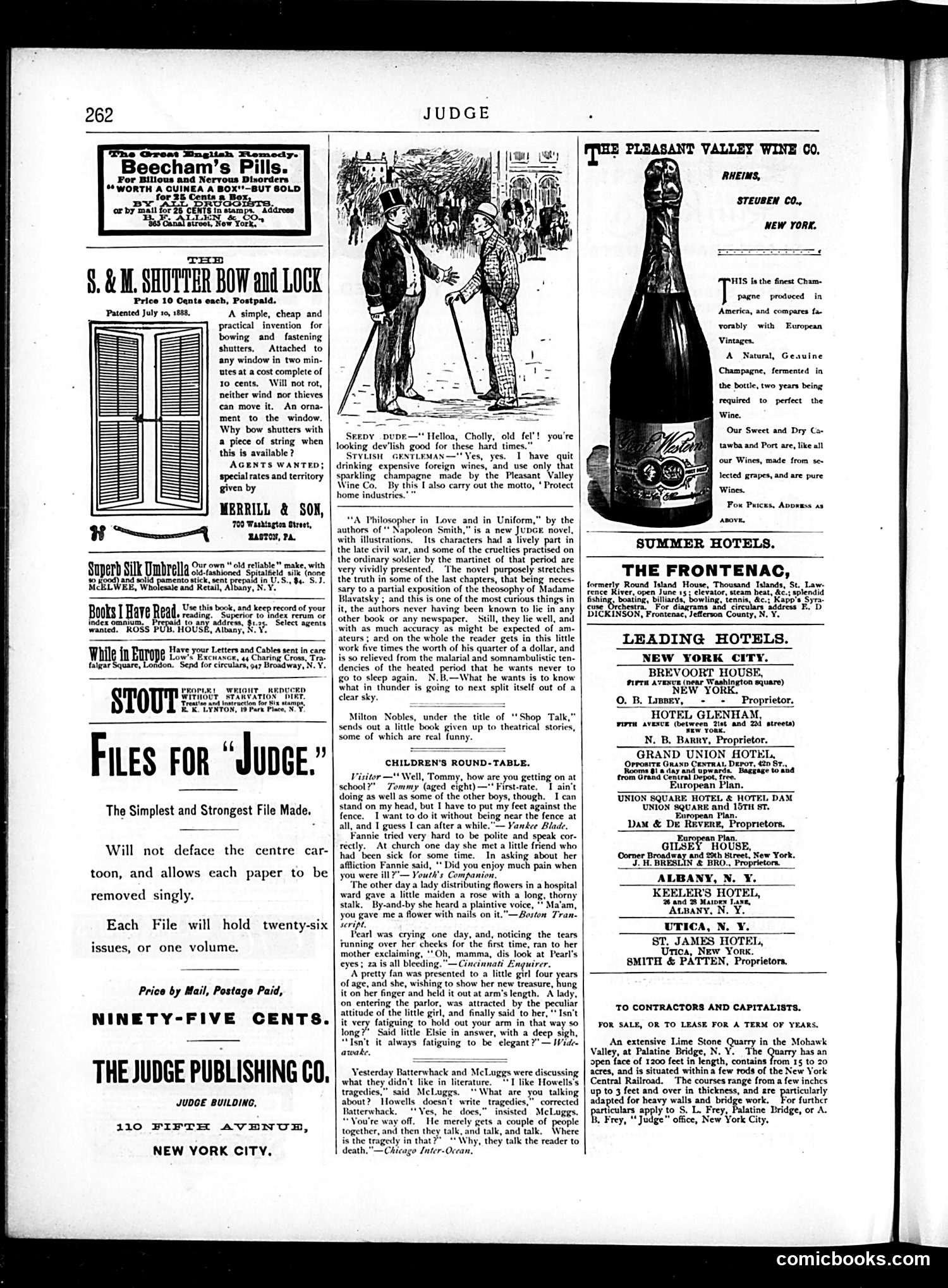
This is primarily an **advertising and miscellaneous content page** from *Judge* magazine, not a political cartoon page. The main illustrated cartoon shows two fashionably dressed men in conversation. The caption labels them "Seedy Dude" and "Stylish Gentleman." The joke is a **promotional plug for Pleasant Valley Wine Co.**: the well-dressed man explains he's quit expensive imported French wines and now drinks only American champagne from Pleasant Valley, framing this as supporting domestic industry ("Protect home industries"). This is **satirical advertising disguised as editorial content**—mocking both the obvious product placement and the patriotic-protectionist rhetoric used to justify choosing inferior domestic products over foreign ones. The implication is that the "stylish" man is actually making a financially-motivated choice dressed up in nationalist language. The rest of the page contains book reviews, advertisements (files, shutters, pills, umbrellas), and children's humor—standard magazine filler of the era.
This is primarily an **advertising page** for Judge Publishing Company's novels and serials, not a political cartoon. It showcases five fiction titles the company published, priced affordably at 25-50 cents. The titles reveal Judge's satirical interests: "Napoleon Smith" (a popular New York novel), "Star-Crossed: The Life and Love of an Actress" (by an actual actress), "Lady Car," "Jack of Hearts," and "A Philosopher in Love and in Uniform." The page also advertises **Judge's Serials**—quarterly pictorial collections featuring "The Dude" (depicting wealthy, fashionable "swell life"), alongside humorous sketches like "The Man Who Talks" and "The German Policeman." This reflects Judge's dual purpose: a satirical magazine that also published and sold literary works mocking contemporary society, particularly urban high society and "dude" culture. The affordable pricing suggests broad public appeal for their satirical content about American social life.
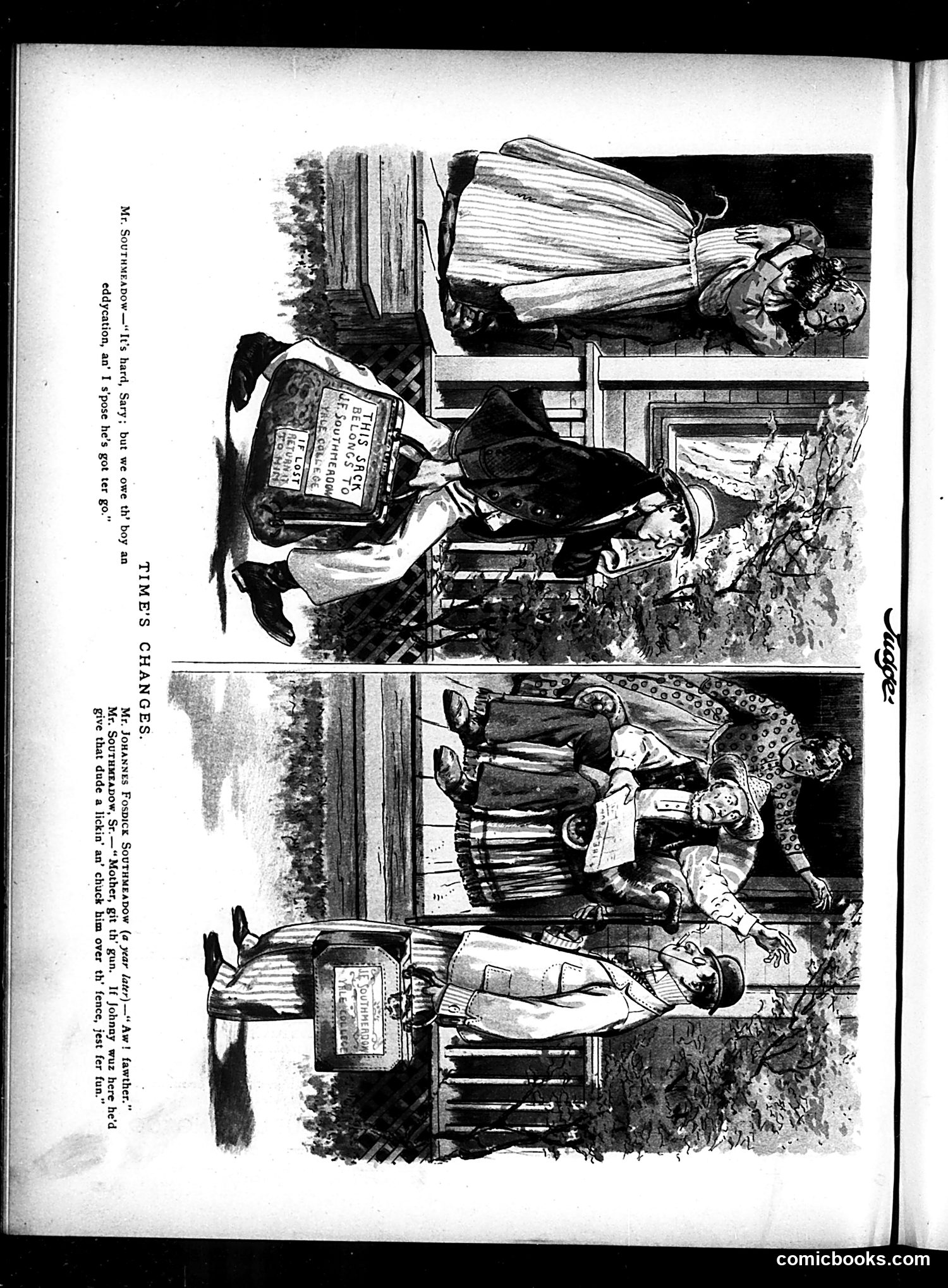
This three-panel cartoon satirizes how education transforms working-class youth into something their parents find unrecognizable and objectionable. **The narrative:** A rural father (Mr. Southmeadow) reluctantly sends his son "Johnay" away for education, viewing it as necessary despite the sacrifice. A year later, the educated son returns as a refined "dude" in fancy dress. The father is horrified—he now wishes his son were still the rough country boy who would fight and roughhouse with strangers "jest fer fun." **The satire:** Judge mocks both parental anxiety about social mobility and the stereotype of education producing effete, dandified young men disconnected from working-class masculinity. The irony is that what the father wanted (education for his son) produces exactly what he despises (a genteel "dude"). The comic captures late-19th/early-20th-century class tensions about whether education elevated or emasculated working-class boys.