
A complete issue · 16 pages · 1889
Judge — June 29, 1889
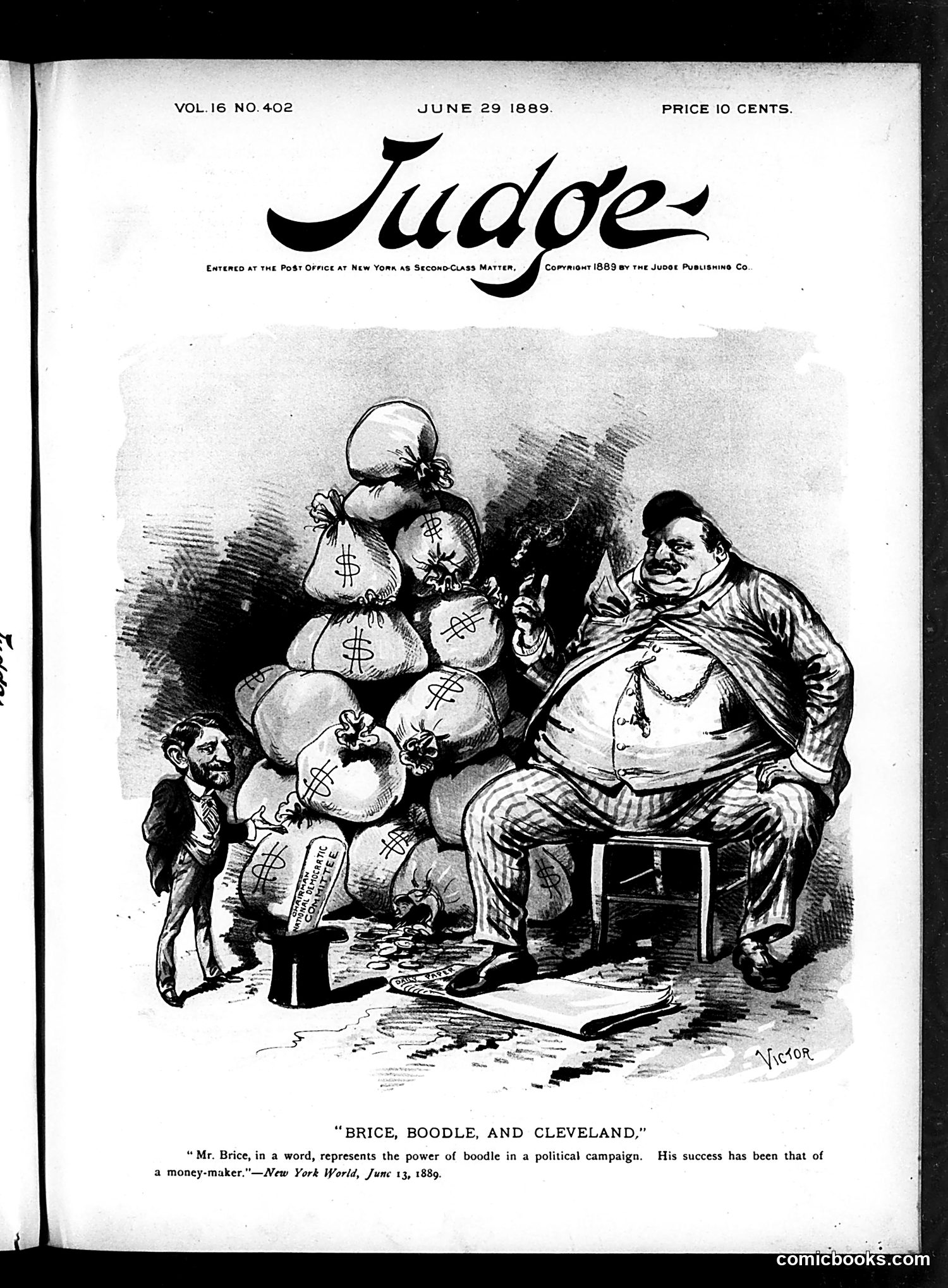
This 1889 *Judge* cartoon satirizes the relationship between political corruption and the presidency. The image shows a large, wealthy man (likely a political operative or financier) sitting atop an enormous pile of money bags marked with dollar signs. A smaller figure appears to be Mr. Brice, referenced in the caption as representing "the power of boodle in a political campaign." The caption quotes the *New York World* (June 13, 1889), stating that "Mr. Brice...represents the power of boodle in a political campaign. His success has been that of a money-maker." "Boodle" was period slang for bribery money or political corruption. The cartoon critiques how wealthy financiers like Brice wielded disproportionate influence over politics, particularly regarding President Cleveland's administration.
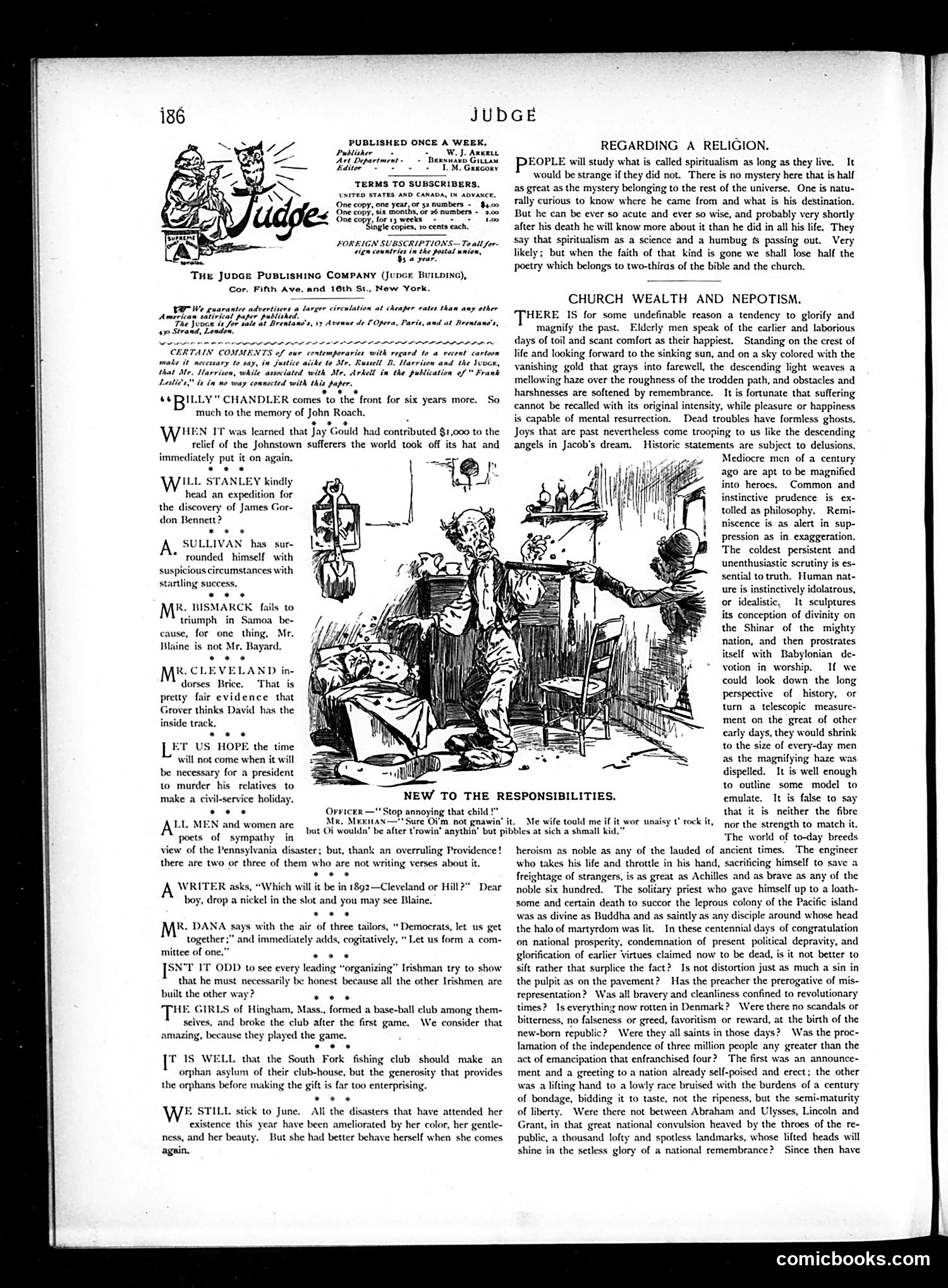
This page combines editorial commentary with satirical news briefs typical of Judge magazine's format. The main illustration, captioned "NEW TO THE RESPONSIBILITIES," depicts a man (likely a newly elected or appointed official) receiving instruction from an older, experienced figure—suggesting the transition of power or mentorship in government positions. The text briefs mock various political and social figures of the era. References include Cleveland, Bismarck, and Dana, though specific contexts remain unclear without dates. The commentary criticizes nepotism ("Mr. Cleveland"), questions competence, and contains generic political jabs at Democrats and officeholders. The page's dominant theme appears to be inexperience in governance and the absurdities of American political appointments during the Gilded Age.
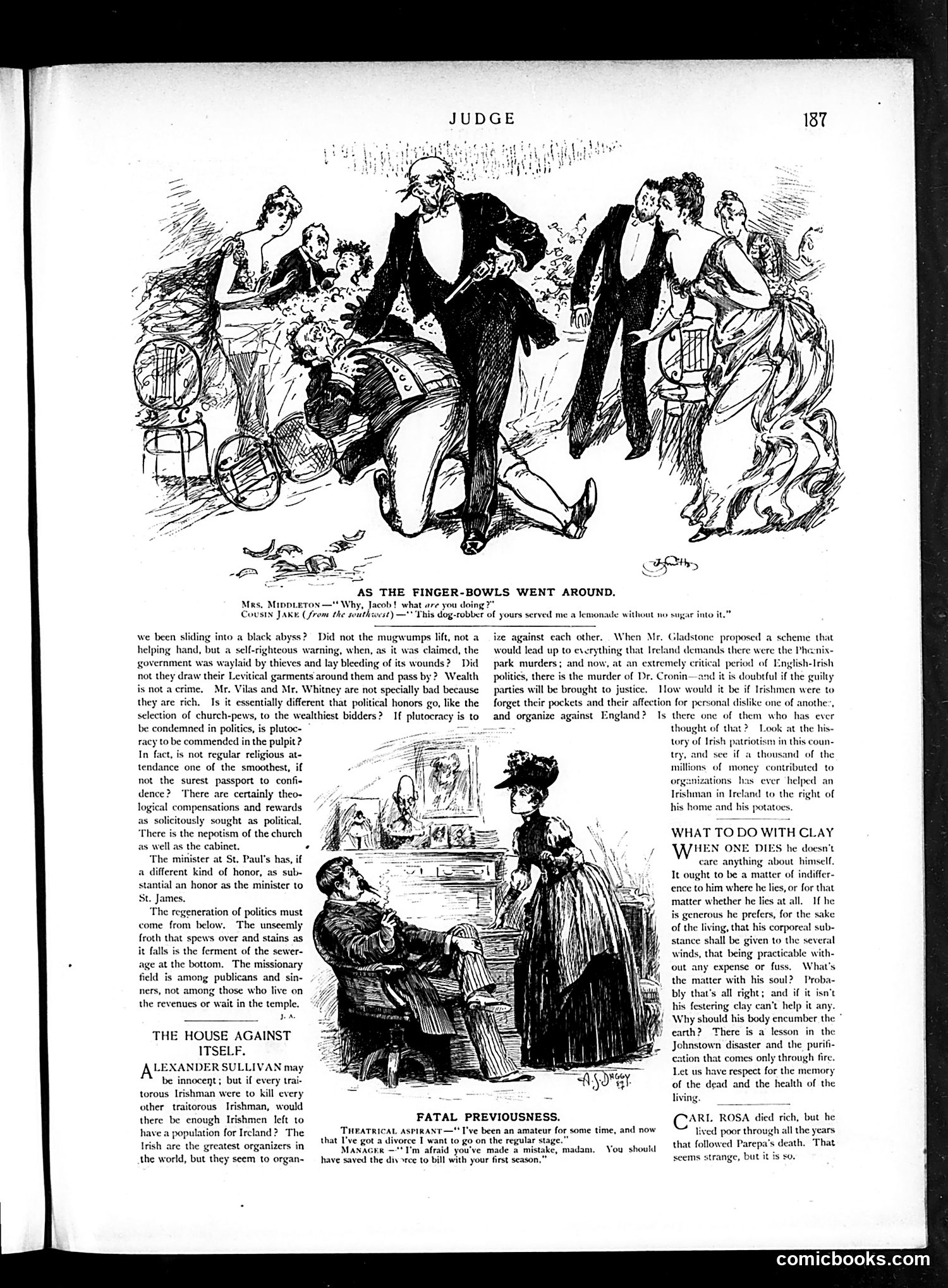
This page satirizes late 19th-century American political and social hypocrisy through multiple cartoons: **Top cartoon ("As the Finger-Bowls Went Around"):** Depicts wealthy dinner guests discussing a servant's lemonade while the accompanying text criticizes plutocracy in politics. It mocks how the wealthy (likely referencing politicians Vilas and Whitney) are treated with deference despite their questionable ethics, while similar corruption in religious institutions goes unchallenged. **"The House Against Itself":** References Alexander Sullivan and Irish-American internal conflicts, likely alluding to the 1889 Dr. Cronin murder case (a prominent Irish-American assassination). The satire criticizes Irish-Americans for organizing against each other rather than unified causes, contrasting their organizational talents with their destructive factionalism. **Bottom cartoons:** Brief social jokes about theatrical ambitions and burial practices. The page's overarching theme: American elites—political, religious, and social—practice the corruption they publicly condemn, while marginalized groups squander their potential through internal division.
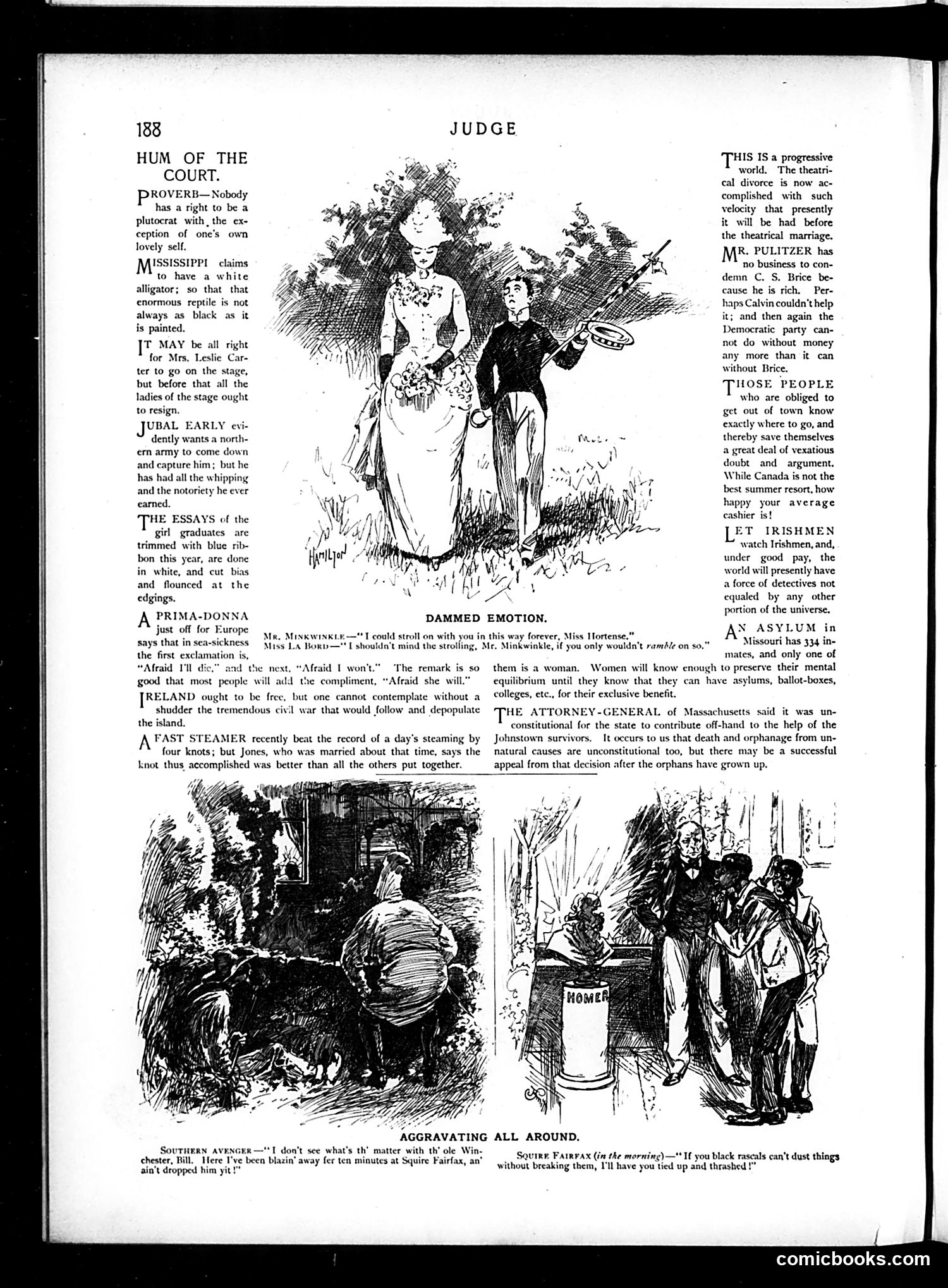
This page from Judge (likely 1880s-90s, given references to Johnstown and theatrical divorces) contains satirical commentary on contemporary American society, plus three cartoon vignettes. **Top cartoon "Dammed Emotion"** shows a couple courting, with the woman annoyed that her suitor won't stop talking—satirizing verbose romantic behavior. **The text items** mock various targets: theatrical divorces happening too quickly; plutocrats' hypocrisy; Irish political figure Jubal Early; wealthy industrialist Pulitzer's criticism of rich man C.S. Brice; and Massachusetts' refusal to aid Johnstown disaster survivors (the 1889 flood). **Bottom cartoons** depict: a rural Southerner frustrated missing his hunting shot at a white landowner, and that same landowner threatening to beat Black workers for breaking things—depicting both the absurdity and cruelty of antebellum-era Southern race relations. The magazine's satire targets hypocrisy across classes while casually perpetuating racial stereotypes common to the era.
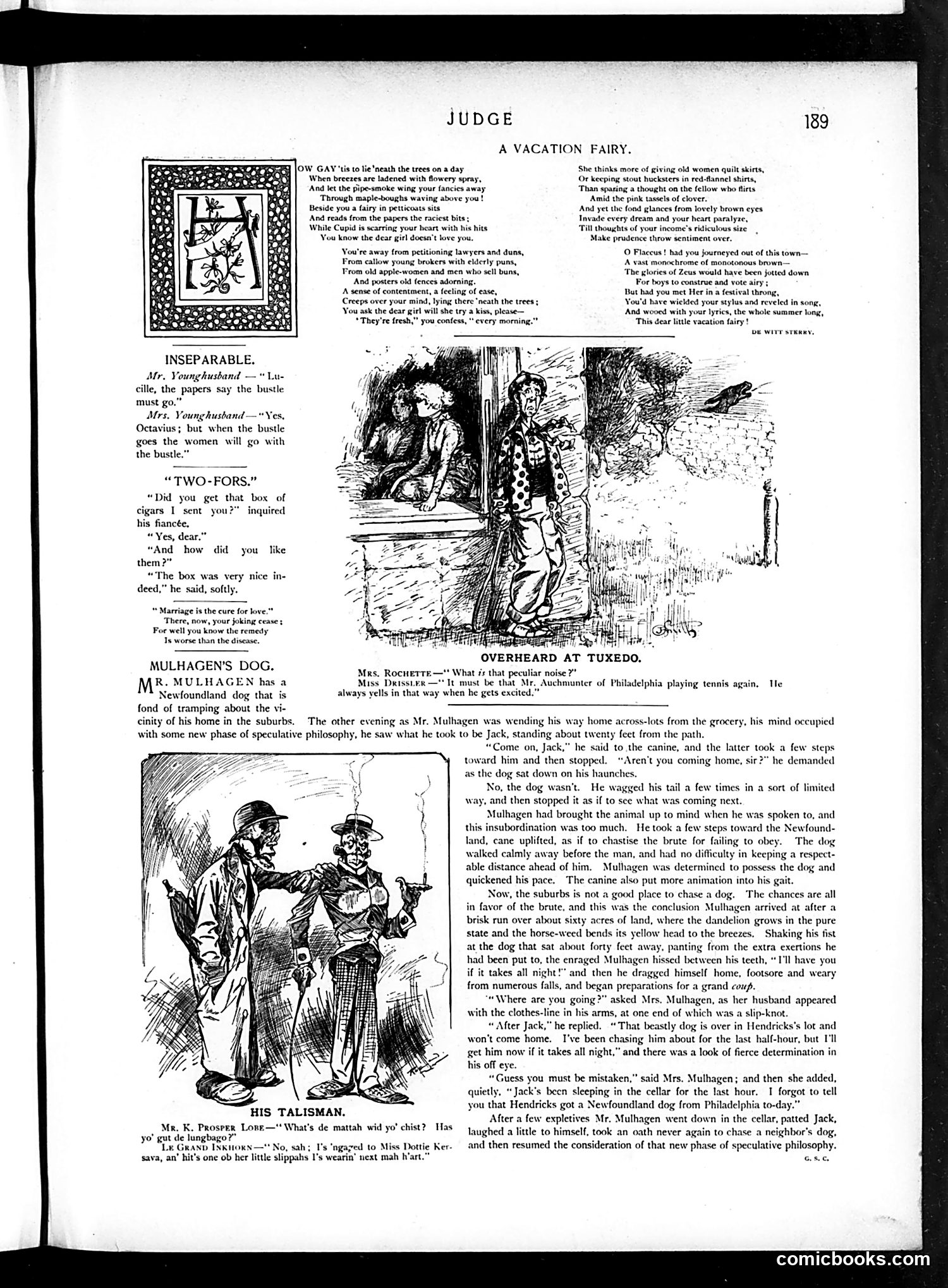
This humorous story satirizes a man's futile attempt to discipline his disobedient Newfoundland dog. Mr. Mulhagen, returning home from the grocery while contemplating philosophy, encounters his dog Jack refusing to obey commands. Despite Mulhagen's threats with a cane and determined chasing across sixty acres of suburban terrain, the dog consistently maintains a respectful distance, ultimately outwitting him. The satire targets the gap between human authority and animal instinct—Mulhagen's intellectual preoccupations don't prepare him for practical domestic challenges. His elaborate "speculative philosophy" proves useless against a dog's simple stubbornness. The story mocks both the pomposity of philosophical men and the humbling reality that even pets won't submit to human will unconditionally. It's gentle domestic humor typical of Judge magazine's social commentary.
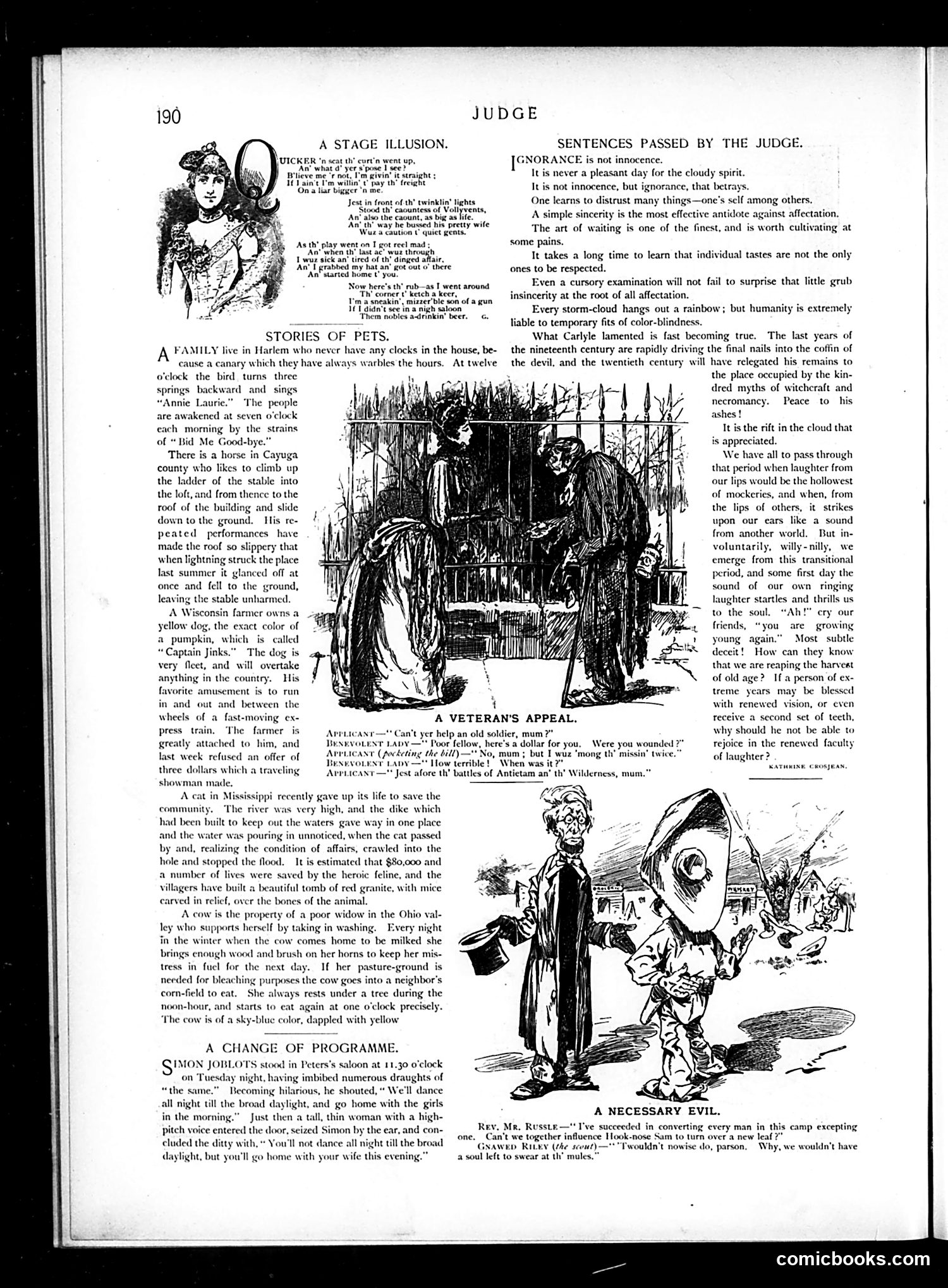
This page contains several satirical pieces typical of late 19th-century American humor: **"A Stage Illusion"**: A working-class narrator describes attending a theatrical performance featuring European nobility (a "countess" and "count"). The satire mocks the pretension of high society—the narrator is disgusted to discover these same nobles drinking beer in a saloon afterward, revealing their ordinariness beneath theatrical glamour. **"Stories of Pets"**: Humorous anecdotes about animals with unusual abilities (a canary that tells time, a horse that climbs roofs, a fast dog). These are light, whimsical pieces with no clear political content. **"A Veteran's Appeal"**: A disabled soldier solicits charity from a benevolent lady. The satire appears gentle—the woman gives generously, though her assumption that his injuries came from combat is subtly questioned, suggesting some veterans may exploit sympathy dishonestly. **Philosophical Sentences**: Moralistic observations about ignorance, sincerity, and emotional resilience—typical Judge editorial matter. The overall tone reflects period anxieties about class authenticity and working-class experiences.
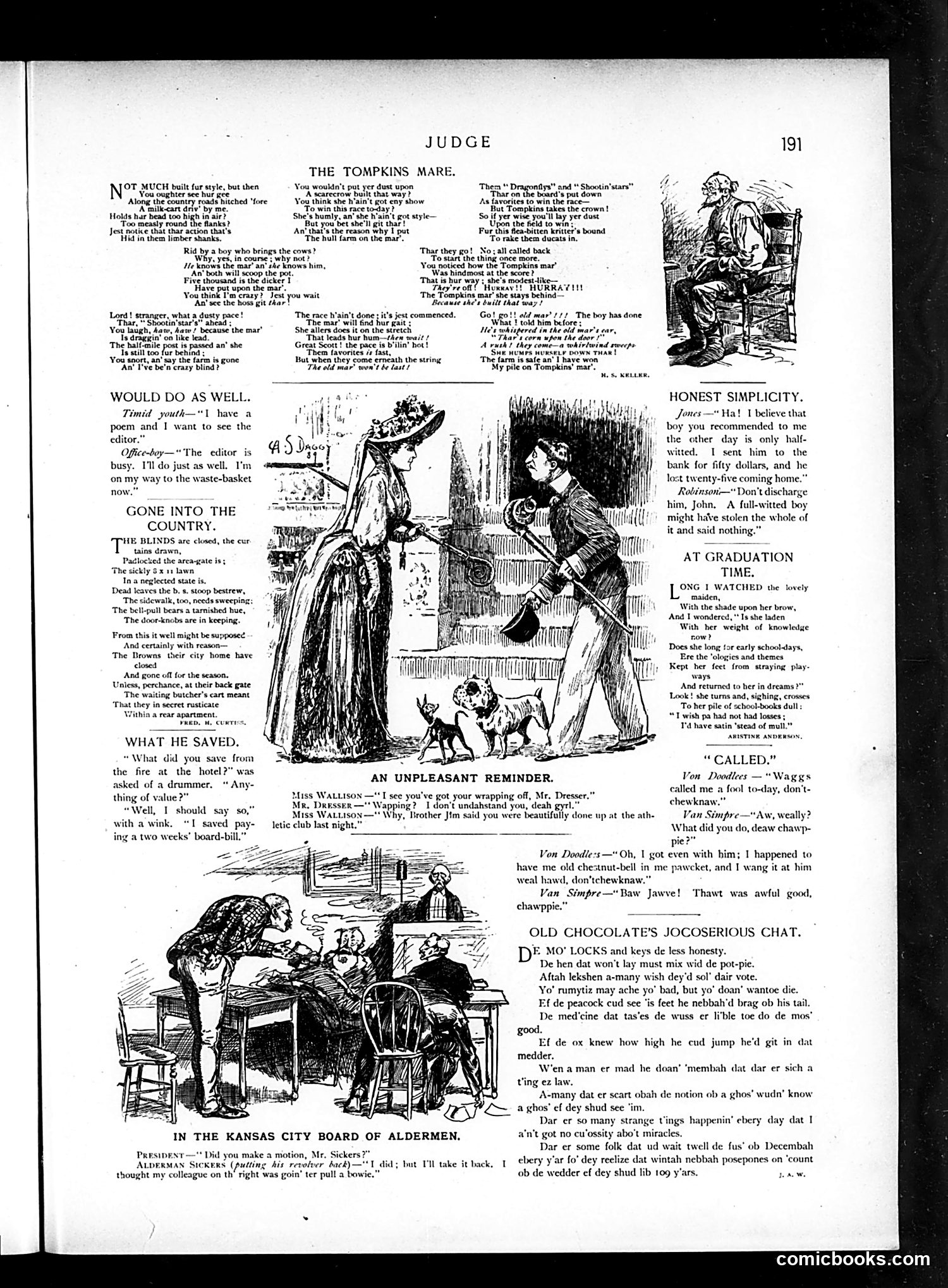
This page contains several satirical pieces typical of late 19th-century American humor: **"The Tompkins Mare"** (top): A humorous poem about a farmer betting his entire farm on an ugly, unprepossessing horse in a race. The joke relies on the folk-wisdom premise that appearances deceive—despite expert opinion favoring flashier competitors, the homely Tompkins mare wins, validating the farmer's faith in her hidden qualities. This reflects rural American racing culture and gambling habits. **Other pieces** include office humor ("Would Do As Well"), domestic comedy about closed-up city homes during vacation season, and ethnic dialect humor ("Old Chocolate's Jocose Chat" and Kansas City Board meeting scene) representing working-class and immigrant characters—common Judge staples. The "Honest Simplicity" sketch plays on servant incompetence as comedy. The overall tone emphasizes vernacular speech, visual exaggeration, and gentle mockery of ordinary people's foibles rather than political satire.
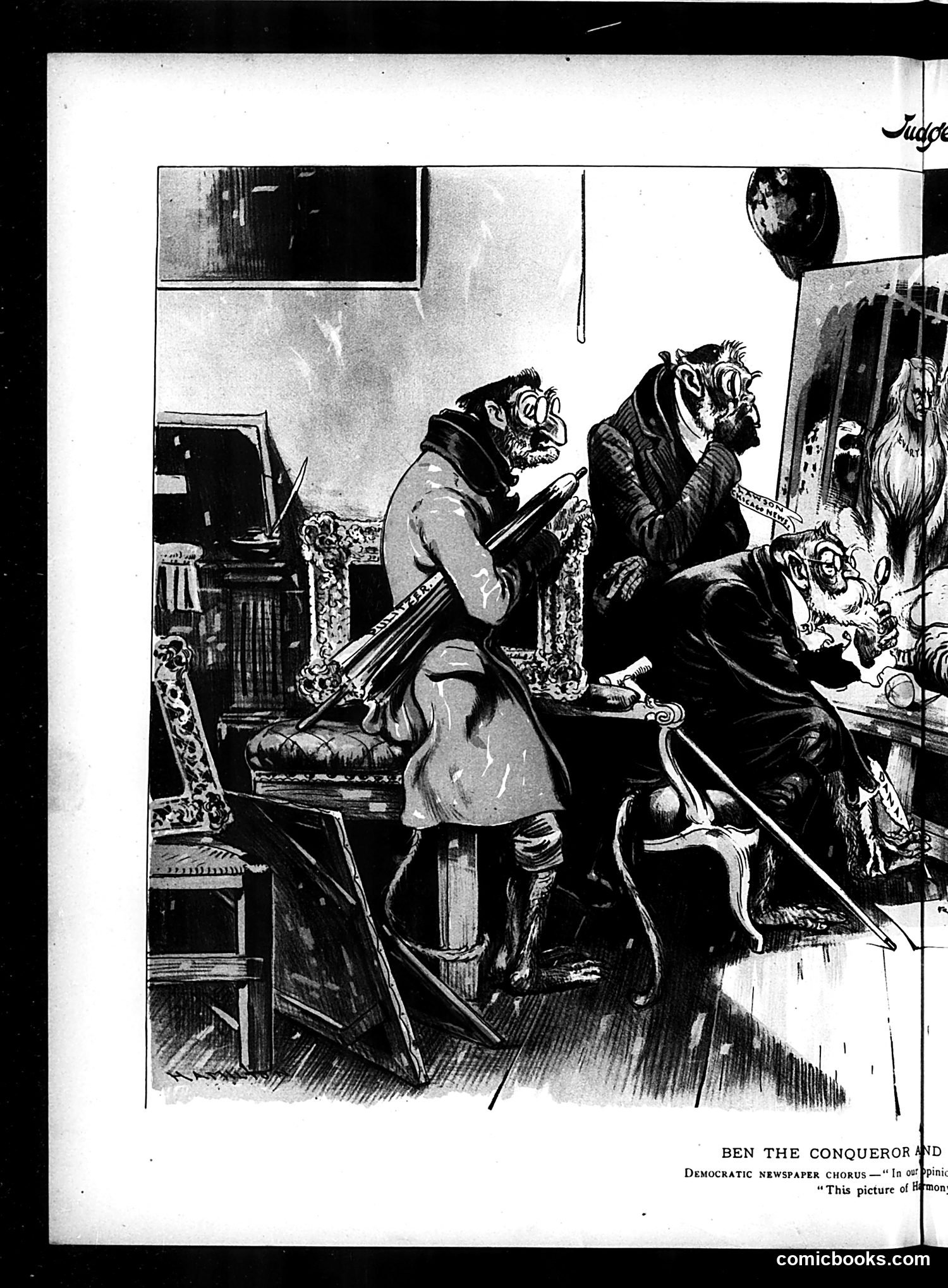
This is a political cartoon from *Judge* magazine satirizing "Ben the Conqueror" and Democratic newspaper responses to him. The image shows caricatured figures with exaggerated facial features (appearing to be of simian character, common in period satire) playing musical instruments in what seems to be a chorus or band setting. The OCR text is fragmentary and unclear, but the cartoon appears to mock Democratic newspapers' reaction to someone named Ben (likely a political figure) through the metaphor of a "chorus" — suggesting coordinated or synchronized media response. The specific historical context—which Ben this references, what panic is mentioned, and the particular political moment—cannot be reliably determined from the visible text alone. The satirical point seems critical of Democrats' unified messaging or sensationalism.
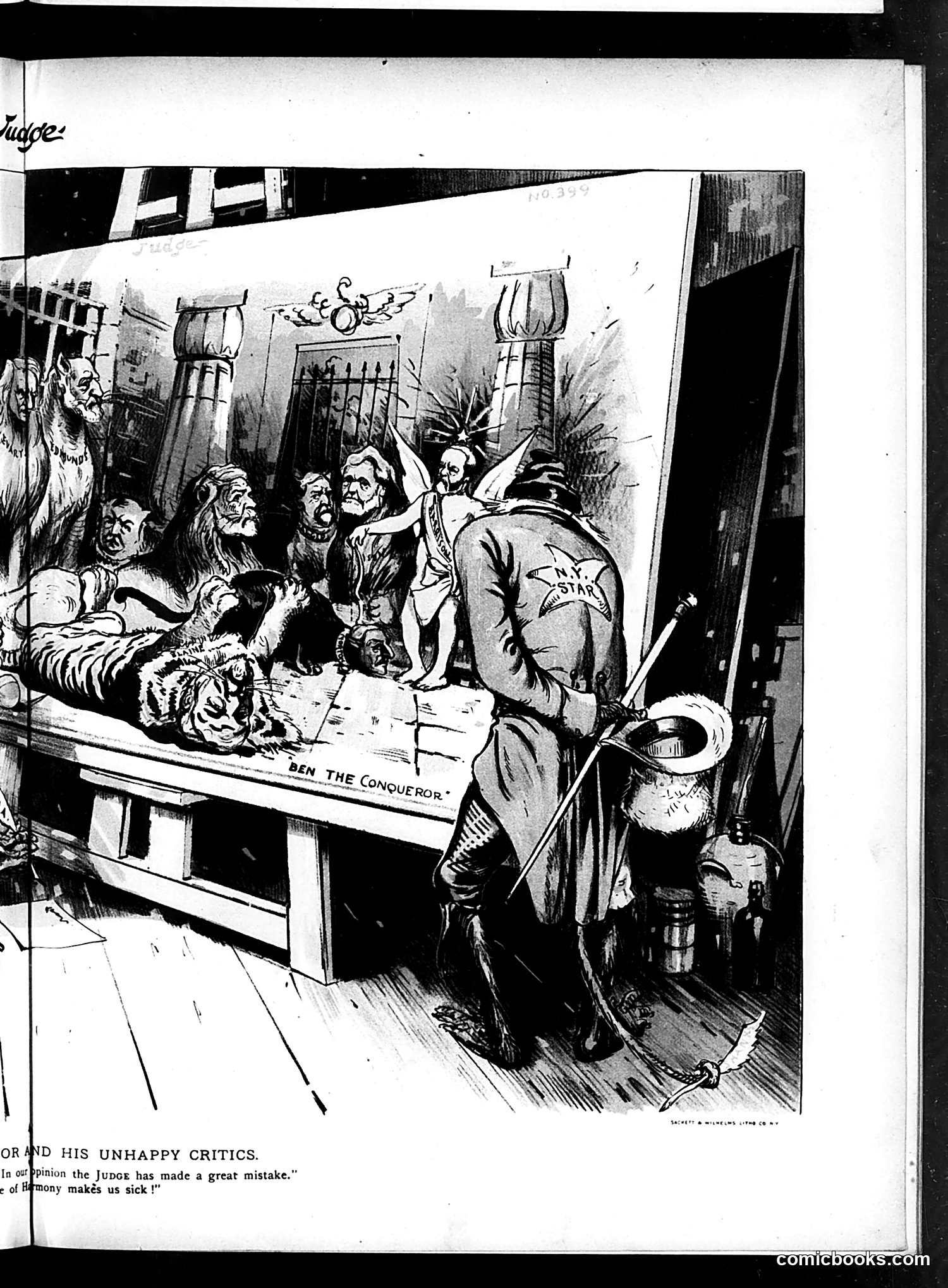
This political cartoon depicts "Ben the Conqueror" (visible on the display panel) surrounded by caricatured critics or opponents. The figure on the right appears to be a military or political leader confronting these detractors. The caption quotes critics claiming "the Judge has made a great mistake" and that "harmony makes us sick"—suggesting satirical commentary on public opposition to some policy or decision. The ornate setting with decorative urns and formal architecture suggests a governmental or institutional context. Without clearer dating or identification of "Ben," the specific historical reference remains unclear, though the cartoon appears to mock critics as ungracious or unreasonable in their opposition to authority or policy.
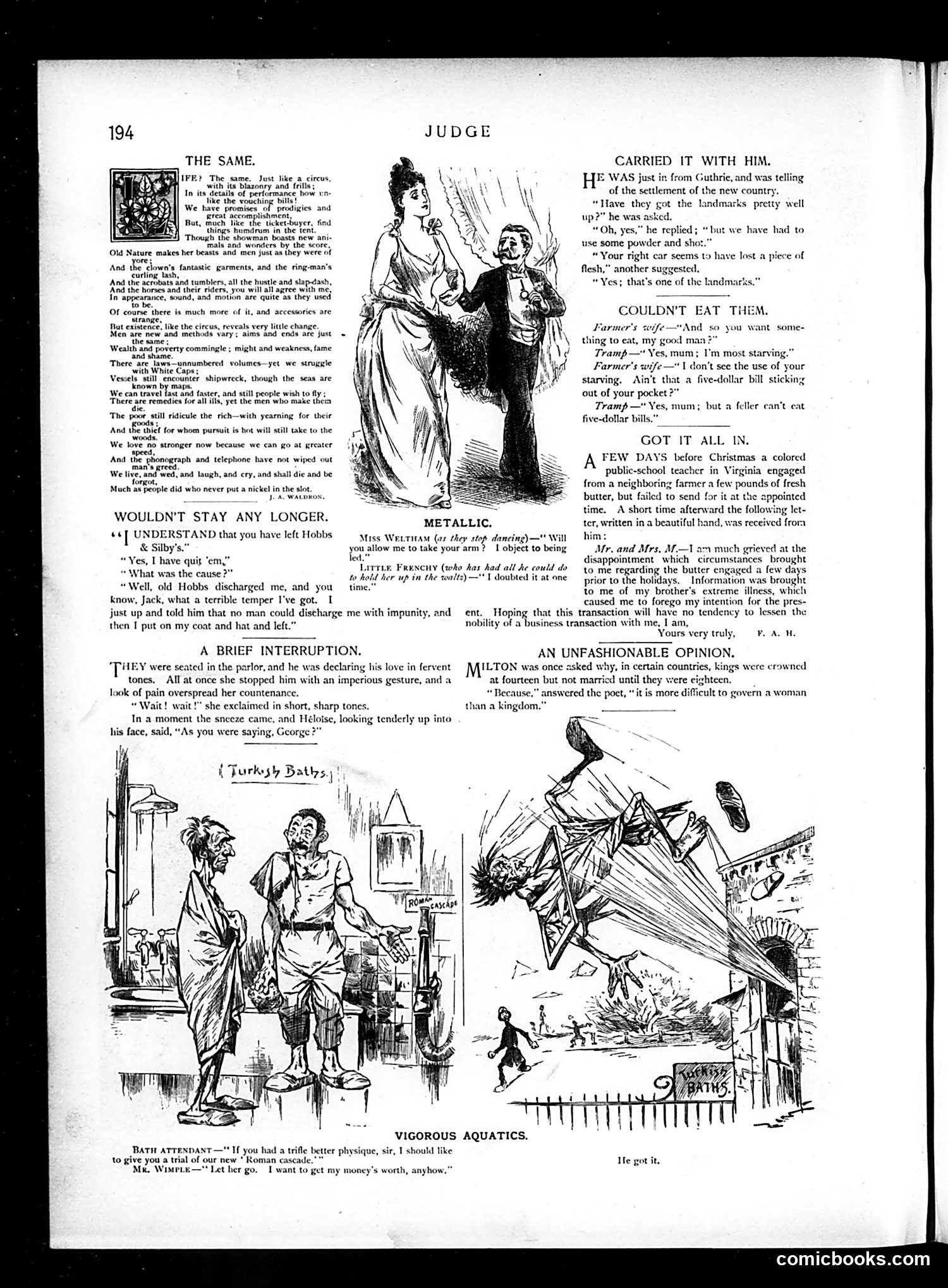
This page from *Judge* contains several humorous short pieces typical of the magazine's satirical style: **"The Same"** is a philosophical poem by J.A. Waldron arguing that despite modern progress (railroads, telephones, photography), human nature remains unchanged—poverty, greed, and mortality persist as they always have. **"Wouldn't Stay Any Longer"** is a brief joke about a worker who quit after being fired, claiming no man could discharge him "with impunity." **"A Brief Interruption"** is a gentle romantic humor piece where a woman stops her suitor mid-proposal to sneeze. **"Metallic"** features a dance-floor exchange about a woman's dancing ability. **"Carried It With Him"** is frontier humor about Oklahoma settlement landmarks. **"Couldn't Eat Them"** jokes about a beggar with five dollars claiming he can't eat money. **"Got It All In"** begins a letter from someone apologizing for missing a butter delivery due to family illness. The illustrations are typical period sketch-work accompanying the humor—domestic scenes and character types recognizable to contemporary readers.
This page is primarily **advertising and filler content** from Judge magazine, not political satire. The main text consists of: - **Whimsical poetry** about finding dreams in imaginary places ("Lollipop lane," "valley of Overthere") - **"Carl Pretzel's Philosophy"** — ethnic humor featuring a German-accented character dispensing folk wisdom - **Literary parody** of Tennyson's "The Splendor Falls," rewritten to mock urban vice (gambling, fighting, police corruption) - **Advertisements** for Kodak cameras, Sohmer pianos, Youmans hats, and mucilage The only satirical content is the Tennyson parody, which gently mocks turn-of-the-century city life—crooked gambling, police indifference, and street crime. There are no identified political figures or current events being targeted. This appears to be a typical Judge issue mixing light verse, ethnic stereotypes, and commercial advertising.
This page is primarily **advertisements and satirical short pieces**, not political cartoons. The main satirical content is titled "WEED-WEARERS"—a series of jokes about widows. The humor trades on Victorian-era assumptions that widows (women in mourning "weeds") quickly remarry or flirt after their husbands' deaths, contradicting their solemn appearance. One joke mocks a rustic girl who adopts pretentious Boston speech to describe fetching milk, leaving a traveling salesman ("drummer") confused and speechless. The "Belated Spring Poem" section appears to continue this theme of romantic misadventure. The remainder consists of period advertisements for bonds, meat extract, bank notes, chocolate, jams, and patent medicines—typical Judge magazine filler. No identifiable political figures or events are referenced on this page. The satire is social commentary about courtship customs and class pretension rather than politics.
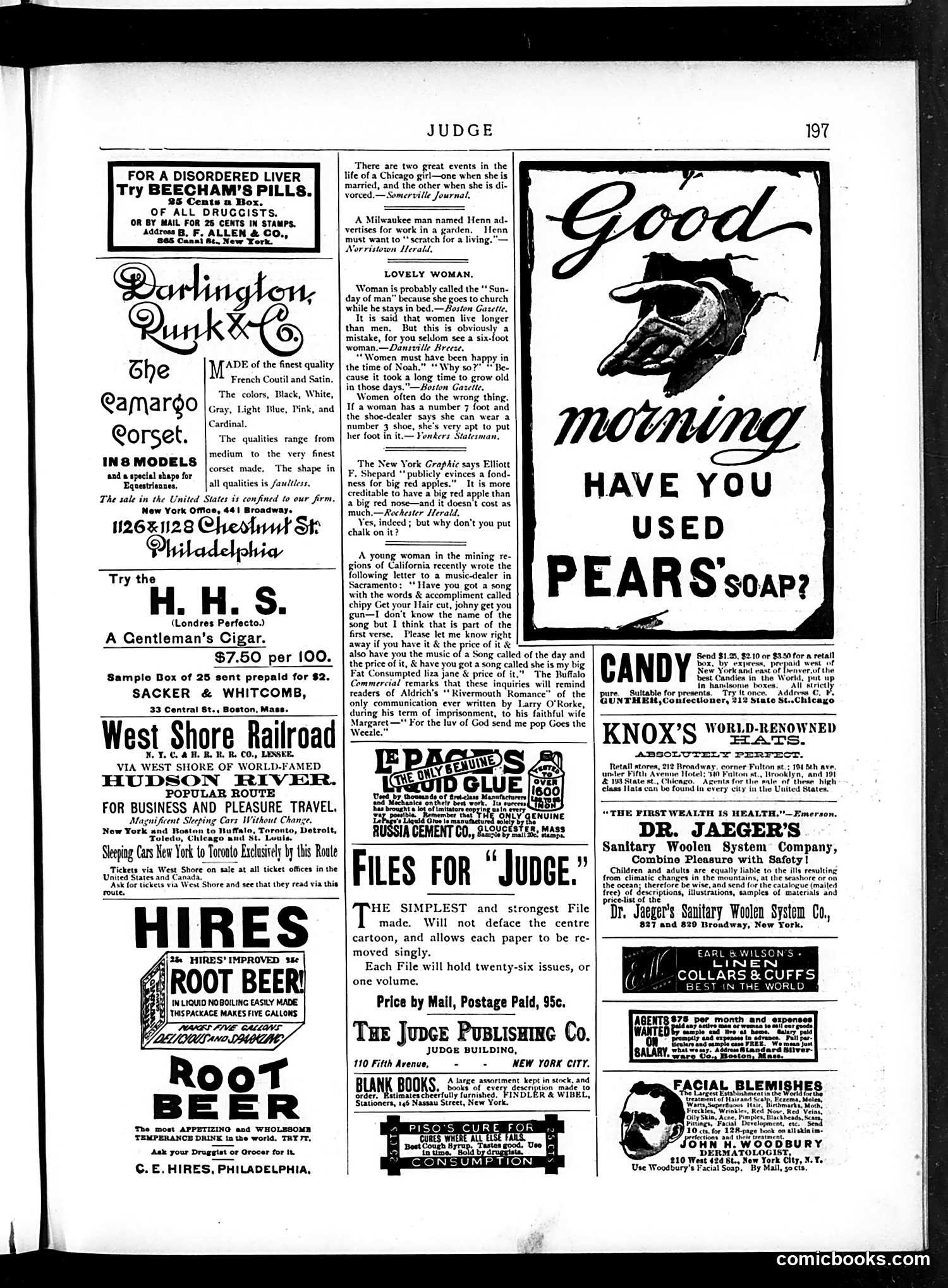
This page is primarily **advertisements and filler content** typical of Judge magazine's business model, rather than political satire. The modest satirical content consists of brief **humorous one-liners** about contemporary social observations: - **Chicago divorce joke**: References the prevalence of divorce among urban women - **Milwaukee gardening pun**: A play on "scratch for a living" - **"Lovely Woman" section**: Series of jokes about women's behavior—their church attendance, longevity, shoe-fitting choices, and a lengthy anecdote about a barely-literate California woman requesting song titles from a music dealer The tone is **gently mocking of women**, reflecting common early 20th-century attitudes. The jokes assume female irrationality and vanity as humor sources. The bulk of the page consists of **patent medicines, corsets, railroads, and root beer advertisements**—the magazine's actual revenue source. The "Files for Judge" at bottom advertises the publication's own product for organizing copies. No specific political figures or events are referenced. This appears to be a typical non-satirical issue focused on commercial advertising.
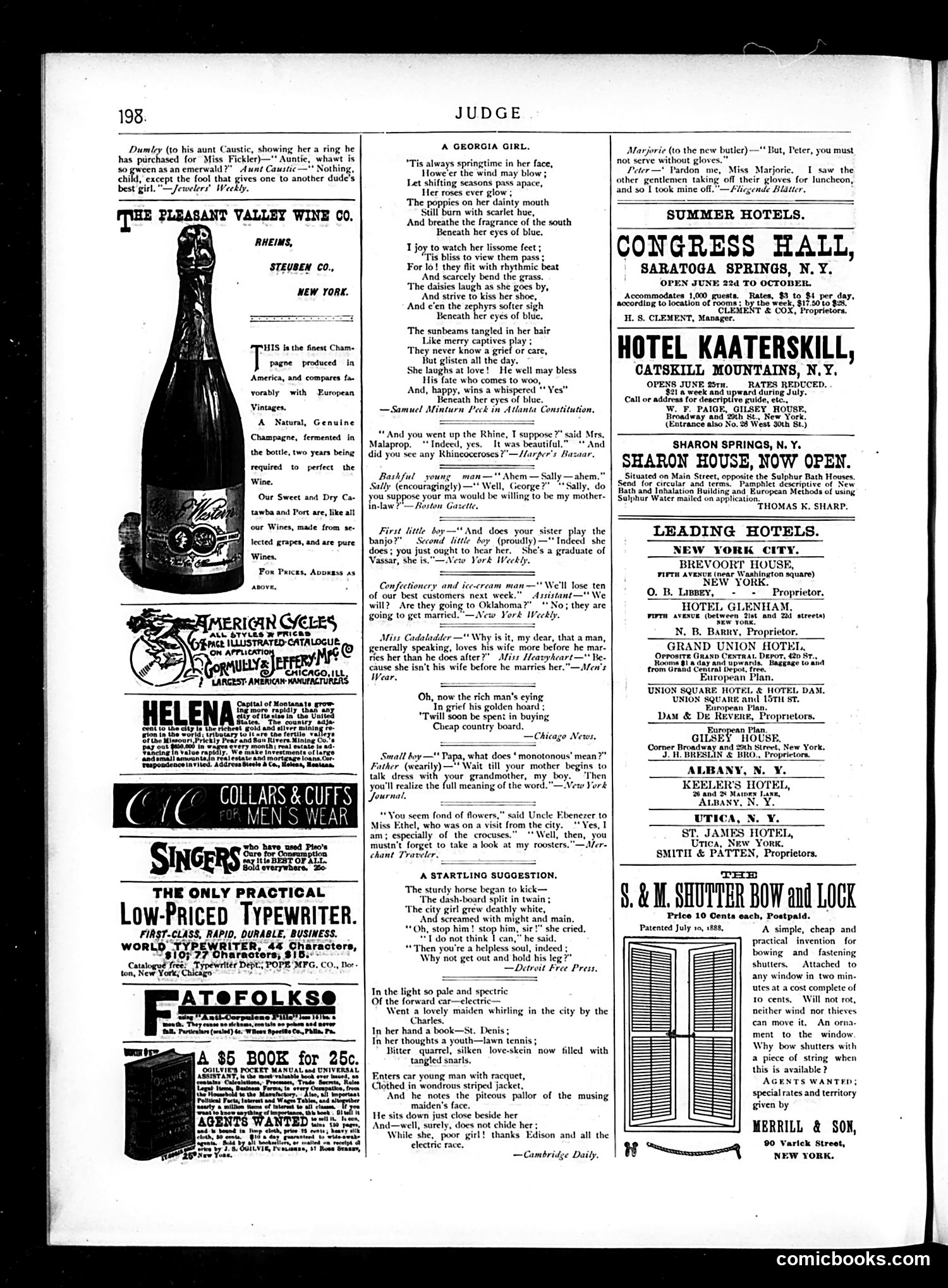
This page is primarily **advertising** with light satirical content interspersed. The main cartoons are brief one-liners: 1. **"Dumtey" joke**: A young man shows his aunt an emerald ring for "Miss Fickler," and she cynically responds that an emerald means "nothing, child, except the fool that gives one to another dude's best girl." This satirizes male romantic foolishness and materialism in courtship. 2. **"A Georgia Girl"**: A sentimental poem romanticizing Southern femininity—not satirical but representative of period nostalgia for antebellum Southern beauty. 3. **Various brief jokes**: Include wordplay (Mrs. Malaprop asking about "Rhineoceroses" on the Rhine), observations about marriage ("a man loves his wife more before marriage"), and domestic humor ("monotonous" defined through a nagging wife stereotype). The bulk of the page features advertisements for wines, bicycles, typewriters, and hotels—typical Judge revenue. The satire is mild and domestic, targeting courtship customs and marriage dynamics rather than political issues.
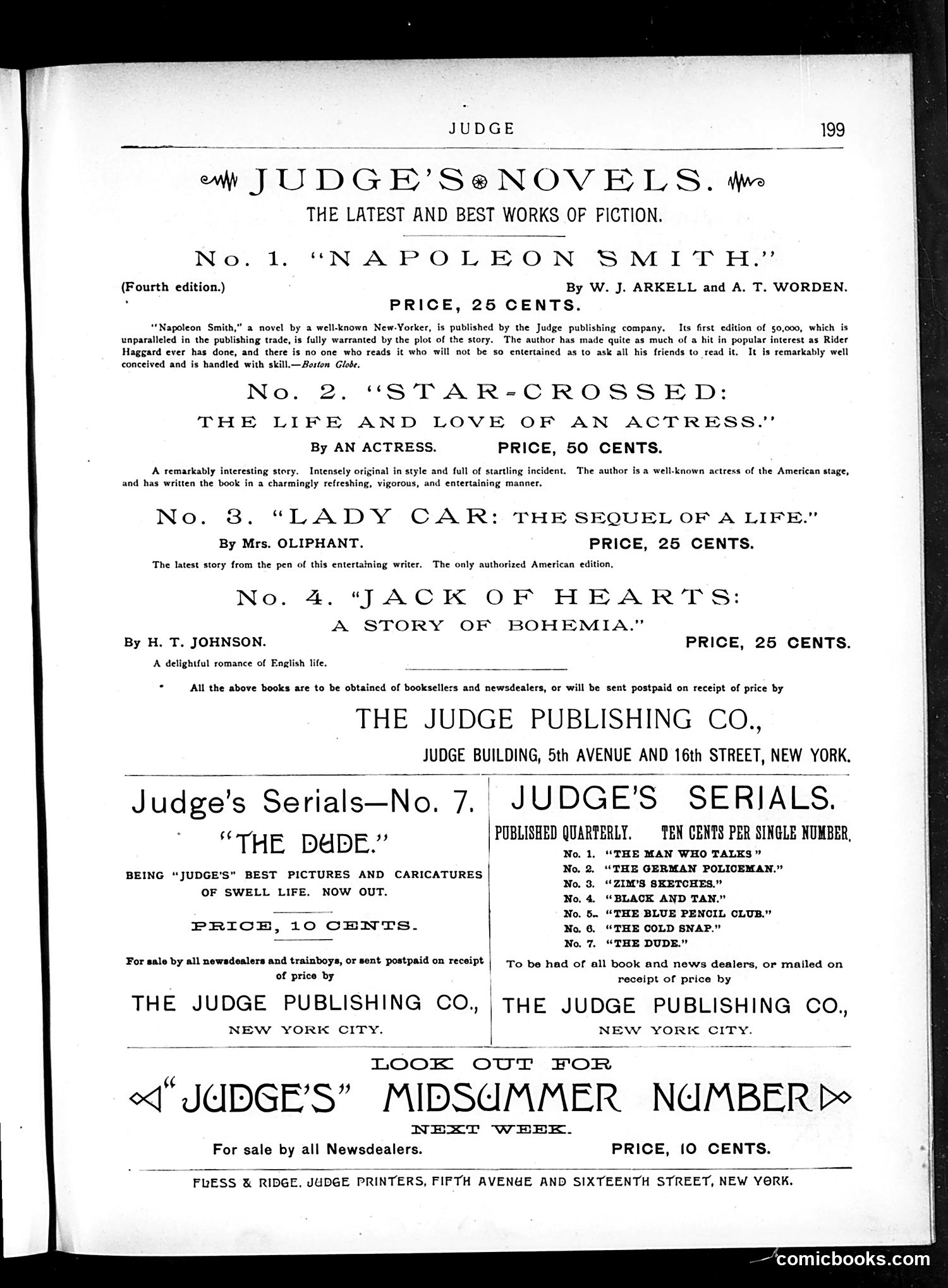
This is entirely an **advertising page** for Judge Publishing Company's books and serials, not a political cartoon or satirical content page. The page advertises four novels (priced 25-50 cents) and serialized content called "Judge's Serials," particularly "The Dude" series focusing on caricatures of wealthy social life. The novels include "Napoleon Smith" (noted as a bestseller with 50,000 first edition copies) and "Star-Crossed: The Life and Love of an Actress" by an anonymous actress-author. The serials titles—"The Man Who Talks," "The Dude," "Black and Tan," "The Blue Pencil Club"—suggest Judge's focus on satirizing contemporary urban social types and leisure-class behavior, but no actual cartoons appear on this page to analyze. It's essentially a business/publishing announcement.
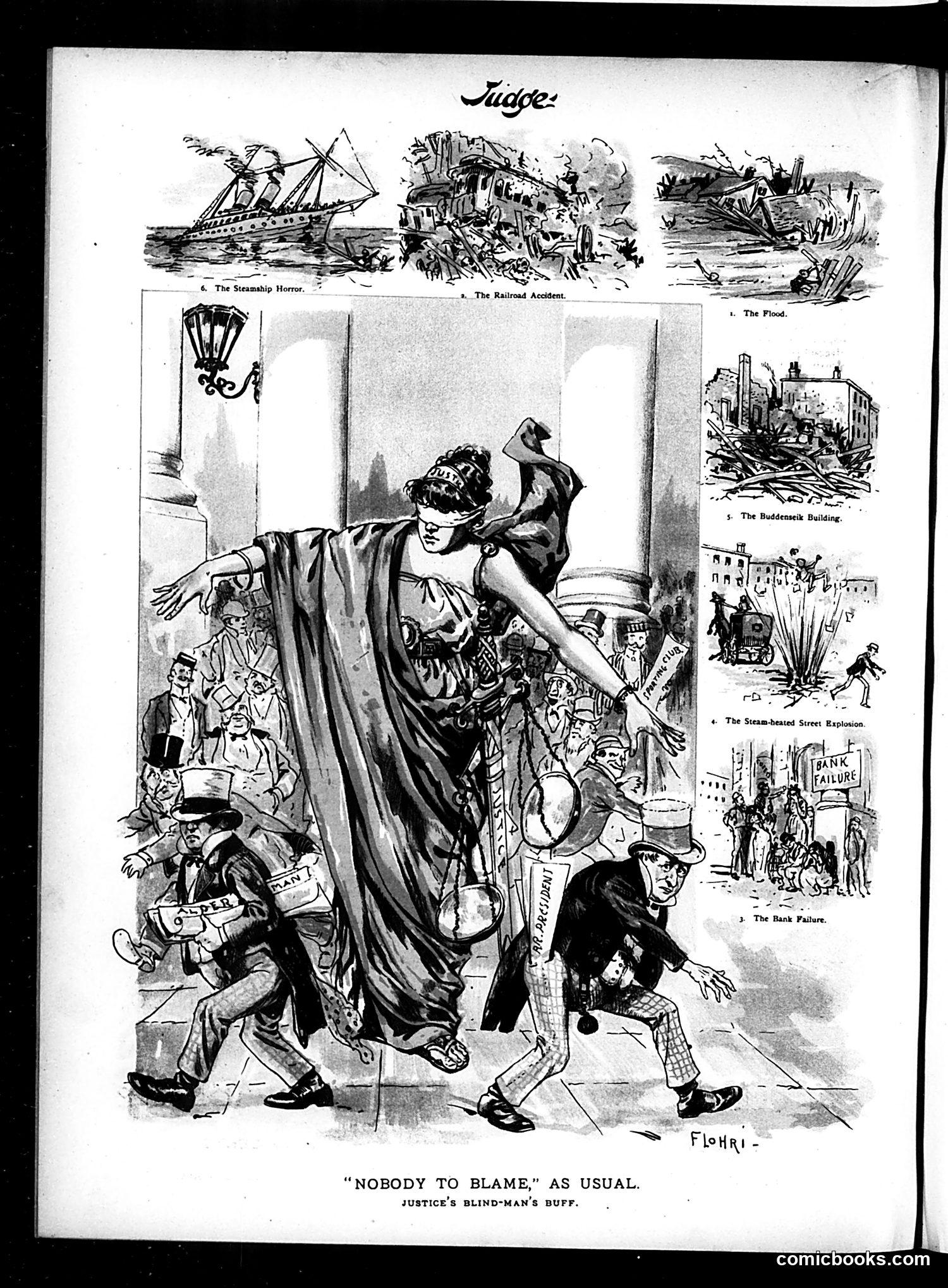
This political cartoon satirizes the failure of the justice system to hold anyone accountable for disasters. The central figure is Justice (blindfolded woman), depicted playing "blind man's buff" while surrounded by small figures representing responsible parties for various catastrophes. The surrounding vignettes show: a steamship disaster, railroad accident, flood, building collapse, street explosion, and bank failure. Each represents real tragedies of the era. The cartoon's message—"Nobody to Blame, as Usual"—mocks how investigations into major disasters consistently failed to assign responsibility or punish wrongdoing. Justice appears helpless and ineffective, literally blindfolded and stumbling, unable to identify or catch the guilty parties who scatter around her. This reflects late-19th/early-20th century frustration with corporate malfeasance and regulatory failures going unpunished.