
Judge, 1889-06-29 · page 2 of 16
Judge — June 29, 1889 — page 2: what you’re looking at
What you’re looking at
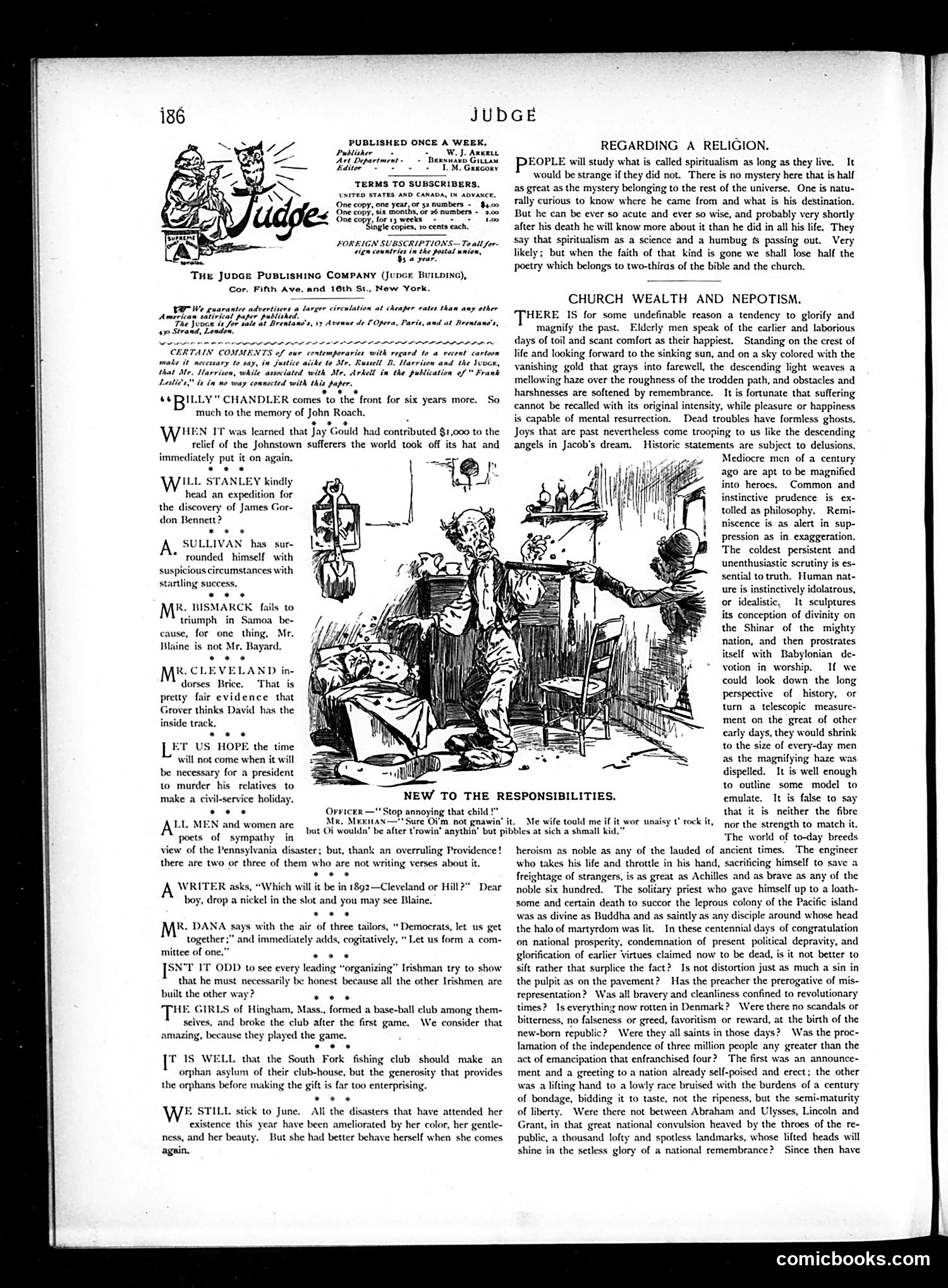
This page combines editorial commentary with satirical news briefs typical of Judge magazine's format. The main illustration, captioned "NEW TO THE RESPONSIBILITIES," depicts a man (likely a newly elected or appointed official) receiving instruction from an older, experienced figure—suggesting the transition of power or mentorship in government positions. The text briefs mock various political and social figures of the era. References include Cleveland, Bismarck, and Dana, though specific contexts remain unclear without dates. The commentary criticizes nepotism ("Mr. Cleveland"), questions competence, and contains generic political jabs at Democrats and officeholders. The page's dominant theme appears to be inexperience in governance and the absurdities of American political appointments during the Gilded Age.
📄 Transcribed text from this page (OCR, searchable)
Machine-transcribed from the original scan — historical spelling and the odd misread are preserved.
JUDGE PUBLISHED ONCE A WEEK. Publisher ~ Art Department - Baitor ne TERMS TO SUBSCRIBERS. UNITED STATES AND CANADA, IN ADVANCE, One copy, one year, or 52 numbers - 84.00 ‘One copy, six months, or 26 numbers - "3.0 One copy for ty weeks oO he ingle copies, 10 cents each, FOREIGN SUBSCRIPTIONS—To all for- ign countries in the postal union, $3 @ year. THe JUDGE PUBLISHING COMPANY (Jupce BurLpinc), Cor. Fifth Ave. and 16th St., Now York. gic advertvrs g larger circulation at cheaper rates tham any ether Amipican sativtcal paper published. The Wooue ts for sale at Brentano's, 17 Avenue de LOfera, Paris, and at Brentane'r tp Strand, Landon. CERTAIN COMMENTS of our contemporaries with regard to a recent cartoon make it necessary t0 say, in justice acike to Mr, Russell B, Harriton and the Jvocr, that Mr. Harrison, while astociated with Mr, Arkell in the publication of “ Frank Latlie's," is im mo way connected with this paper. 6s BILLY” CHANDLER comes to the front for six years more. So much to the memory of John Roach. HEN IT was learned that Jay Gould had contributed $1,000 to the relief of the Johnstown sufferers the world took off its hat and immediately put it on again, head an expedition for the discovery of James Gor- don Bennett? eee A, SULLIVAN has sur- * rounded himself with suspicious circumstances with startling success, eee R. BISMARCK fails to triumph in Samoa be- cause, for one thing, Mr. Blaine is not Mr, Bayard. eee ME. CLEVELAND in- dorses Brice. ‘That is pretty fair evidence that Grover thinks David has the inside track. Lt US HOPE the time will not come when it will be necessary for a president to murder his relatives to make a civil-service holiday. oe Ovricer—"'Stop annoying that child ! Ik, MEEHAN —'*Sure Oi'm not gnawi ns and women are 4+ Oj woulda’ be after poets of sympathy in view of the Pennsylvania disaster; but, thank an overruling Providence! there are two or three of them who are not writing verses about it. A WRITER asks, “Which will it be in 1892—Cleveland or Hill?" Dear boy, drop a nickel in the slot and you may see Blaine. see R, DANA says with the air of three tailors, “Democrats, let us get together;” and immediately adds, cogitatively, “Let us form a com- mittee of one.” ‘8 6 [SN'T IT ODD to see every leading “organizing” Irishman try to show that he must necessarily be honest because all the other Irishmen are built the other way? THE GIRLS of Hingham, Mass., formed a base-ball club among them- seives, and broke the club after the first game. We consider that amazing, because they played the game. eee T IS WELL that the South Fork fishing club should make an orphan asylum of their club-house, but the generosity that provides the orphans before making the gift is far too enterprising. eee E STILL to June. All the disasters that have attended her existence this year have been ameliorated by her color, her gentle- ness, and her beauty. But she had better behave herself when she comes again, NEW TO THE RESPONSIBILITIES. rowin’ anythin’ but pibbles at sich a shmall REGARDING A RELIGION. PEOPLE will study what is called spiritualism as long as they live. It would be strange if they did not. ‘There is no mystery here that is half as great as the mystery belonging to the rest of the universe. One is natu- rally curious to know where he came from and what is his destination. But he can be ever so acute and ever so wise, and probably very shortly after his death he will know more about it than he did in all his life. They say that spiritualism as a science and a humbug passing out. Very likely; but when the faith of that kind is gone we shall lose half the poetry which belongs to two-thiras of the bible and the church. CHURCH WEALTH AND NEPOTISM. HERE IS for some undefinable reason a tendency to glorify and magnify the past. Elderly men speak of the carlier and laborious days of toil and scant comfort as their happiest. Standing on the crest of life and looking forward to the sinking sun, and on a sky colored with the vanishing gold that grays into farewell, the descending light weaves a mellowing haze over the roughness of the trodden path, and obstacles and harshnesses are softened by remembrance. It is fortunate that suffering cannot be recalled with its original intensity, while pleasure or happiness is capable of mental resurrection. Dead troubles have formless ghosts. Joys that are past nevertheless come trooping to us like the descending angels in Jacob's dream. Historic statements are subject to delusions. Mediocre men of a century ago are apt to be magnified into heroes. Common and instinctive prudence is ex- tolled as philosophy. Re: niscence is as alert in sup- pression as in. exaggeration. The coldest persistent and unenthusiastic scrutiny is es- sential to truth, Human nat- ure is instinctively idolatrous, or idealistic, It sculptures its conception of divinity on the Shinar of the mighty nation, and then prostrates itself with Babylonian de- votion in worship. If we could look down the long perspective of history, or turn a telescopic measure- ment on the great of other carly days, they would shrink to the size of every-day men as the magnifying haze was dispelled. It is well enough to outline some model to emulate. It is false to say that it is neither the fibre nor the strength to match it. The world of to-day breeds heroism as noble as any of the lauded of ancient times. The engineer who takes his life and throttle in his hand, sacrificing himself to save a freightage of strangers, is as great as Achilles and as brave as any of the noble six hundred. ‘The solitary priest who gave himself up to a loath- some and certain death to succor the leprous colony of the Pacific island was as divine as Buddha and as saintly as any disciple around whose head the halo of martyrdom was lit. In these centennial days of congratulation on national prosperity, condemnation of present political depravity, and glorification of earlier Virtues claimed now to be dead, is it not better to sift rather that surplice the fact? Is not distortion just as much a sin in the pulpit as on the pavement? Has the preacher the prerogative of mis- representation? Was all bravery and cleanliness confined to revolutionary times? _ Is everything now rotten in Denmark? Were there no scandals or bitterness, no falseness or greed, favoritism or reward, at the birth of the new-born republic? Were they all saints in those days? Was the proc- lamation of the independence of three million people any greater than the act of emancipation that enfranchised four? The first was an announce- ment and a greeting to a nation already self-poised and erect; the other was a lifting hand to a lowly race bruised with the burdens of a century of bondage, bidding it to taste, not the ripeness, but the semi-maturity of liberty. Were there not between Abraham and Ulysses, Lincoln and Grant, in that great national convulsion heaved by the throes of the re- public, a thousand lofty and spotless landmarks, whose lifted heads will shine in the setless glory of a national remembrance? Since then have Me wife tould me if it wor unaisy t' rock it, comicbooks.com