
Judge, 1889-06-29 · page 10 of 16
Judge — June 29, 1889 — page 10: what you’re looking at
What you’re looking at
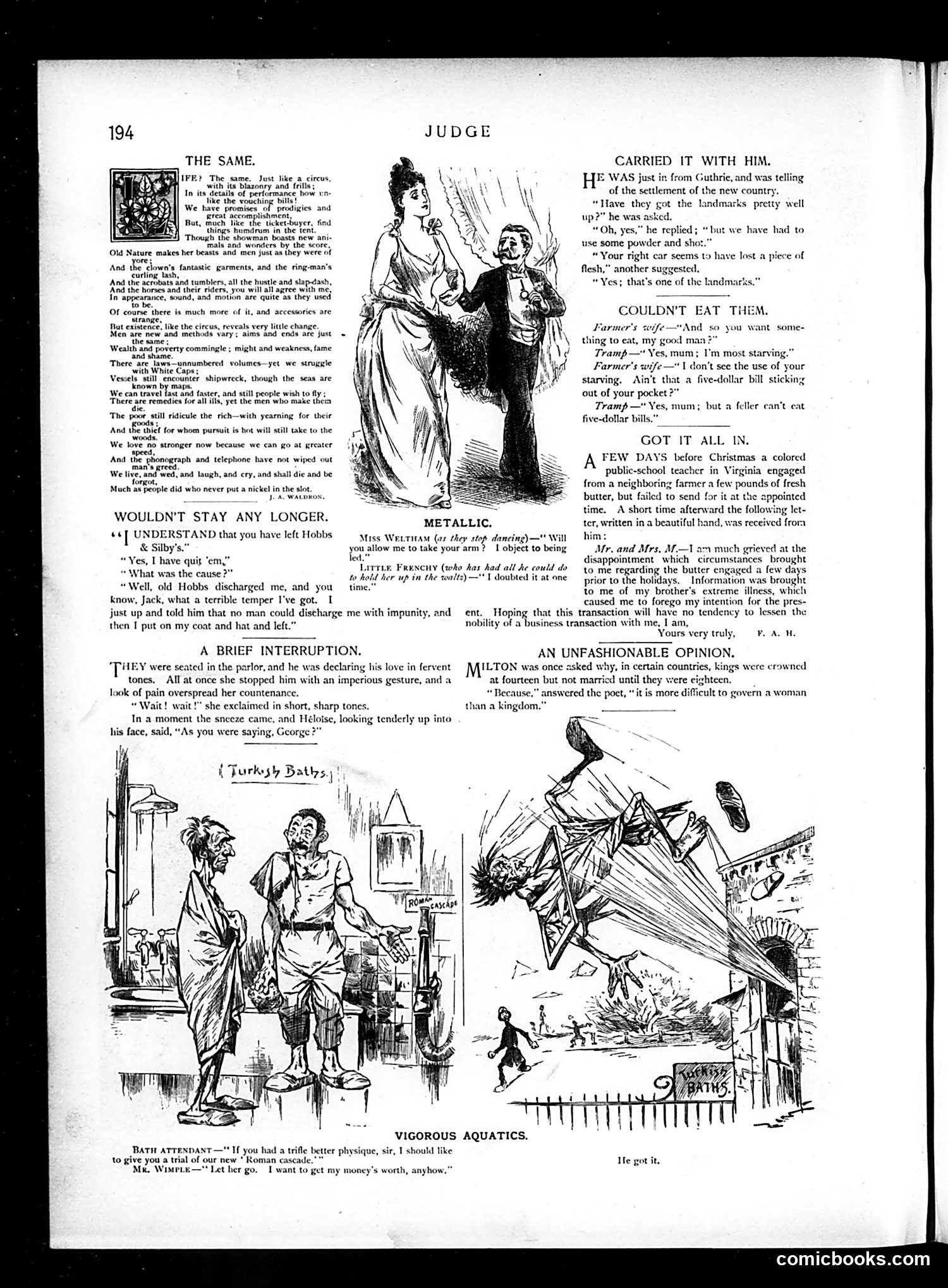
This page from *Judge* contains several humorous short pieces typical of the magazine's satirical style: **"The Same"** is a philosophical poem by J.A. Waldron arguing that despite modern progress (railroads, telephones, photography), human nature remains unchanged—poverty, greed, and mortality persist as they always have. **"Wouldn't Stay Any Longer"** is a brief joke about a worker who quit after being fired, claiming no man could discharge him "with impunity." **"A Brief Interruption"** is a gentle romantic humor piece where a woman stops her suitor mid-proposal to sneeze. **"Metallic"** features a dance-floor exchange about a woman's dancing ability. **"Carried It With Him"** is frontier humor about Oklahoma settlement landmarks. **"Couldn't Eat Them"** jokes about a beggar with five dollars claiming he can't eat money. **"Got It All In"** begins a letter from someone apologizing for missing a butter delivery due to family illness. The illustrations are typical period sketch-work accompanying the humor—domestic scenes and character types recognizable to contemporary readers.
📄 Transcribed text from this page (OCR, searchable)
Machine-transcribed from the original scan — historical spelling and the odd misread are preserved.
THE SAME. 2 The same. Just like a circus with iG Dlazonry and fills In its details of performance how ‘vouching. bills ve promises. of prod ‘Accomplishment, ke the ticket-buyer, find thing's humdrum in. the tent. Though the showman boasts new ani- ‘mals and wonders by the score, Old Nature makes her beasts and men just as they were of And the clown’s fantastic garments, and the ring-man's ‘curling lash, ‘And the acrobats and tumblers, all the hustle and slap-dash, ‘And the horses and their fiders, you will all agree with me: Tm appearance, sound, and motion are quite as they used to be. Of course there is much more of it, and accessories are strange, fut existence, like the circus, re als very little change. Men are new and methods var ims and ends are just the same; ‘Wealth and poverty commingle ; might and weakness, fame me. There are laws—unnumbered volumes—yet we struggle with White Caps: Vessels still encounter shipwreck, though the seas are known by maps. We can travel fast and faster, and still people wish to fly ; ‘There are remedies for all ills, yet the men who make them die. The poor And the thi woods. We love no stronger now because we can go at greater II ridicule the rich—with yearning for their for whom pursuit is hot will still take to the speed, And the plionograph and telephone have not wiped out man's greed. We live, and wed, and laugh, and cry, and shall die and be forgot. Much as people did who never put a nickel in the slot. J. A. WALDRON: WOULDN'T STAY ANY LONGER. ¢¢] UNDERSTAND that you have left Hobbs & Silby’s. “Yes, I have quit ‘em,"” “What was the cause ?” “Well, old Hobbs discharged me, and you know, Jack, what a terrible temper I've got. I just up and told him that no man could discharge me with impunity, and then T put on my coat and hat and left.” A BRIEF INTERRUPTIOD HEY were seated in the parlor, and he was declaring his love in fervent tones. All at once she stopped him with an imperious gesture, and a look of pain overspread her countenance. he exclaimed in short, sharp tones. In a moment the sneeze came, and Heloise, looking tenderly up into his face, said, “As you were saying, Georg {Turkish Baths.) METALLIC, ter, Miss Wettitast (as they stop dancingy—" Will h you allow me to take your arm? I object to being led.” Lirris, Frencny (who has had all he could do LH her up in the walts)—" 1 doubted it at one CARRIED IT WITH HIM. HE WAS just in from Guthrie, and was telling of the settlement of the new country, “Have they got the landmarks pretty well up?” he was asked. “Oh, yes,” he replied use some powder and st “Your right car seems to have lost a flesh,” another suggested. ; that’s one of the landmarks.”* but we have had to COULDN'T EAT THEM. Farmer's “And so you want some- thing to eat, my good maz Tramp — I'm most starving.” Farmer's wife—" \ don't see the use of your starving. Ain't that a five-dollar bill stic out of your pocket 2” Tramp — Yes, mum; but a feller can’t eat five-dollar bills,” GOT IT ALL IN. FEW DAYS before Christmas a colored public-school teacher in Virginia engaged from a neighboring farmer a few pounds of fresh butter, but failed to send for it at the appointed time. A short time afterward the following let- vritten in a beautiful hand, was received from Mr, and Mrs, M-—1 arn much grieved at the disappointment ‘which circumstances brought to me regarding the butter engaged a few days prior to the holidays. _ Informatio: brought to me of my brother's extreme illness, which caused me to forego my intention for the pres- ent. Hoping that this transaction will have no tendency to lessen the nobility of a business transaction with me, I am, Yours'very truly, FL ALM. AN UNFASHIONABLE OPINION, ILTON was once asked why, in certain countries, ki at fourteen but not marricd until they were eighteen. Because,” answered the poet, “it is more difficult to govern a woman than a kingdom.” were crowned VIGOROUS AQUATICS. BAtit ATTENDANT —"* If you had a trifle better physique, sir, I should like to give you a trial of our new “Roman cascade." Ma. Wintrie—"' Let her go. I want to get my money's worth, anyhow,” Ie got it, comicbooks.com