
A complete issue · 16 pages · 1889
Judge — June 15, 1889
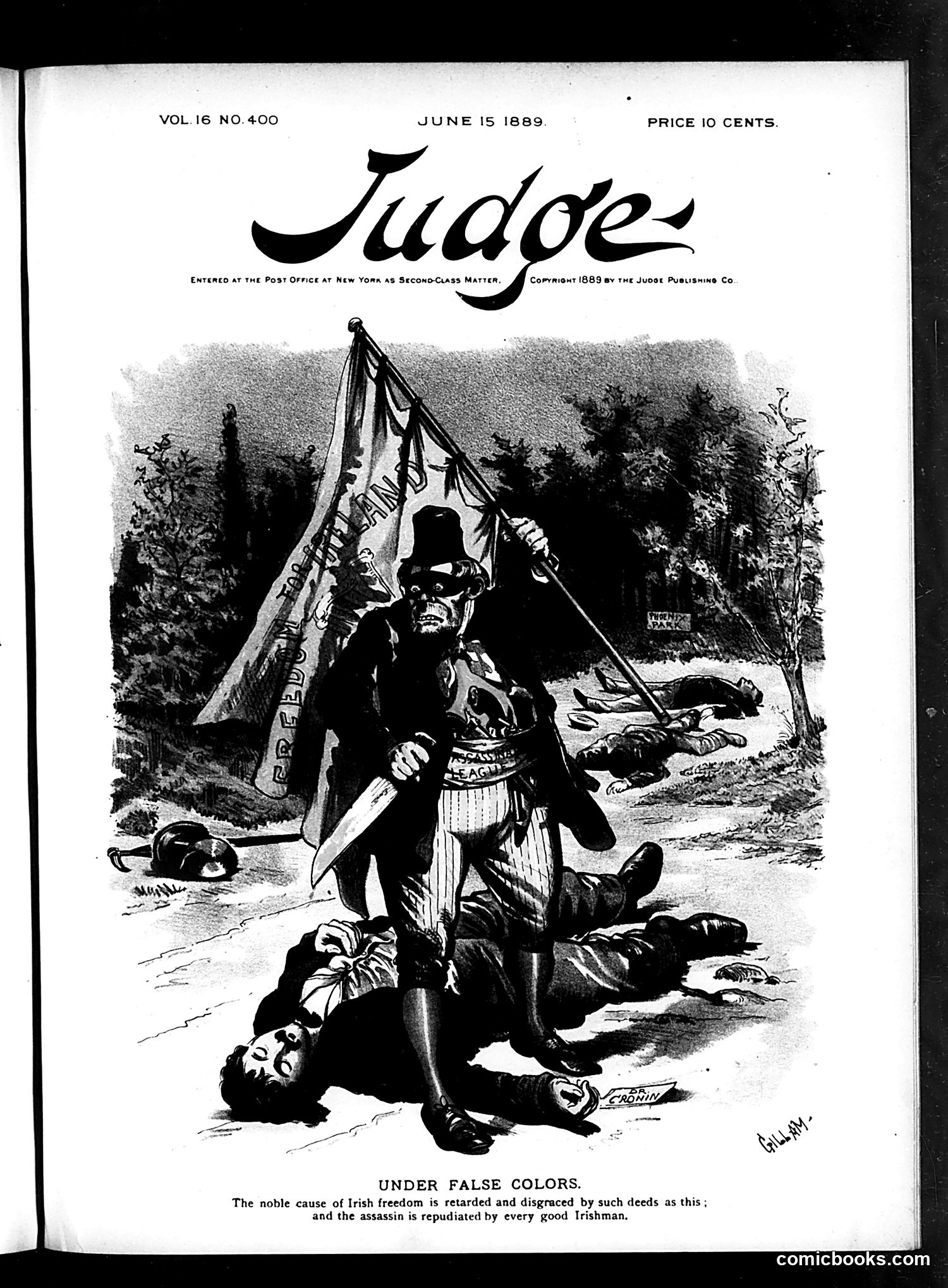
**The Cartoon:** This political satire, titled "Under False Colors," depicts a figure in military dress and top hat standing among fallen bodies. The caption states: "The noble cause of Irish freedom is retarded and disgraced by such deeds as this; and the assassin is repudiated by every good Irishman." **The Meaning:** The cartoon criticizes violence committed in the name of Irish independence. The military figure appears to represent someone claiming to act for Irish freedom while perpetrating murder. The satire suggests that such violent tactics—likely referring to terrorism or assassination campaigns of Irish nationalist movements—actually harm the cause they purport to serve and are rejected by respectable Irish people. The work reflects 1880s debates about political violence and Irish-American activism.
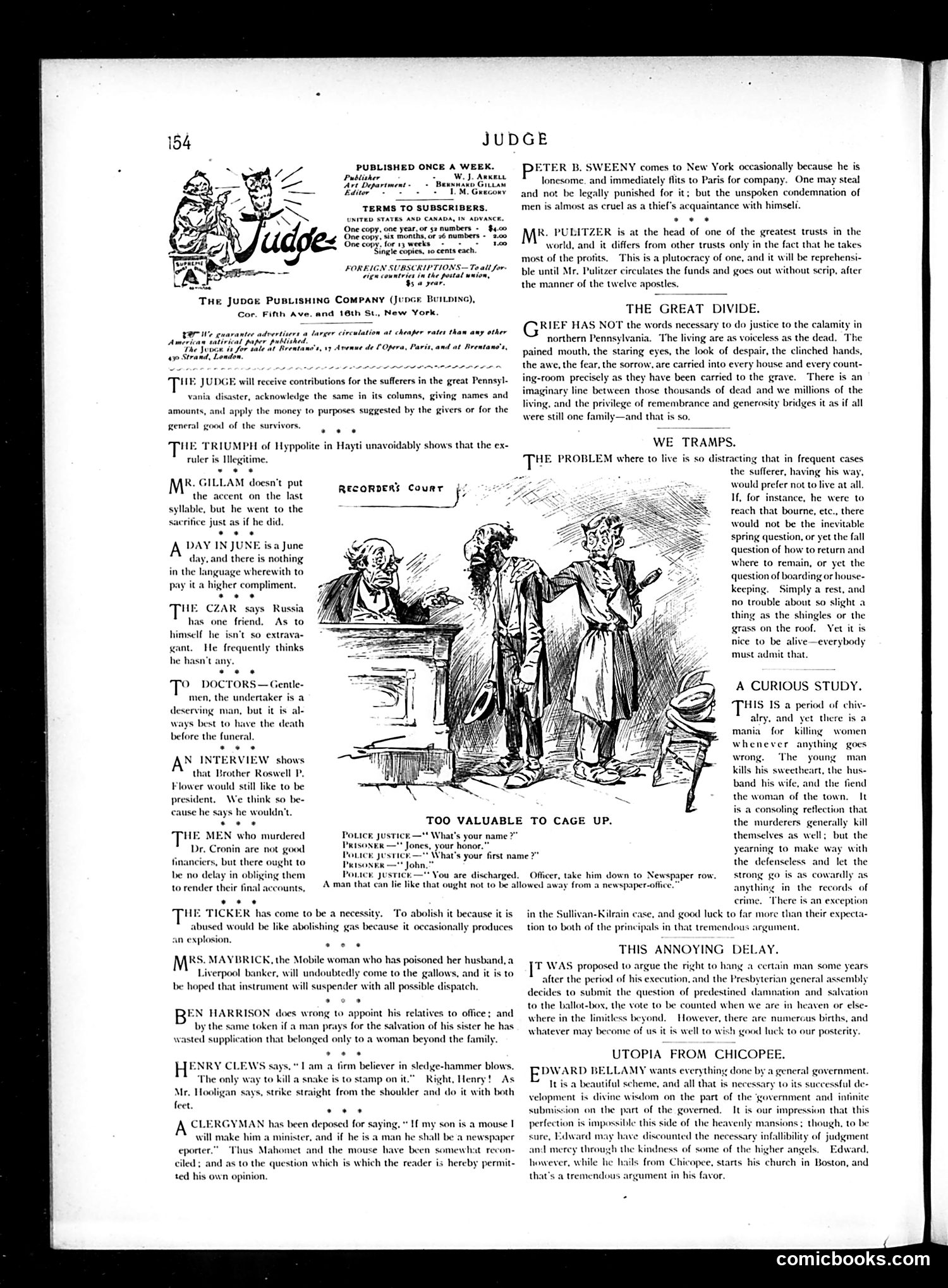
This page contains editorial commentary and brief satirical items rather than a single political cartoon. The main visual is titled "TOO VALUABLE TO CAGE UP," depicting a Recorder's Court scene where a police officer presents a prisoner to a judge, with dialogue about the prisoner's name. The satire appears to mock judicial inefficiency—specifically, a prisoner being released or transferred rather than properly detained, suggesting the justice system wastes resources on bureaucratic procedures instead of actual punishment. The surrounding text items are social commentary on various topics: Pennsylvania poverty, doctor-patient relationships, and romantic murders. Without specific historical context about the cases or figures referenced, the precise targets of satire remain unclear, though the overall tone criticizes institutional failures and social problems of the era.
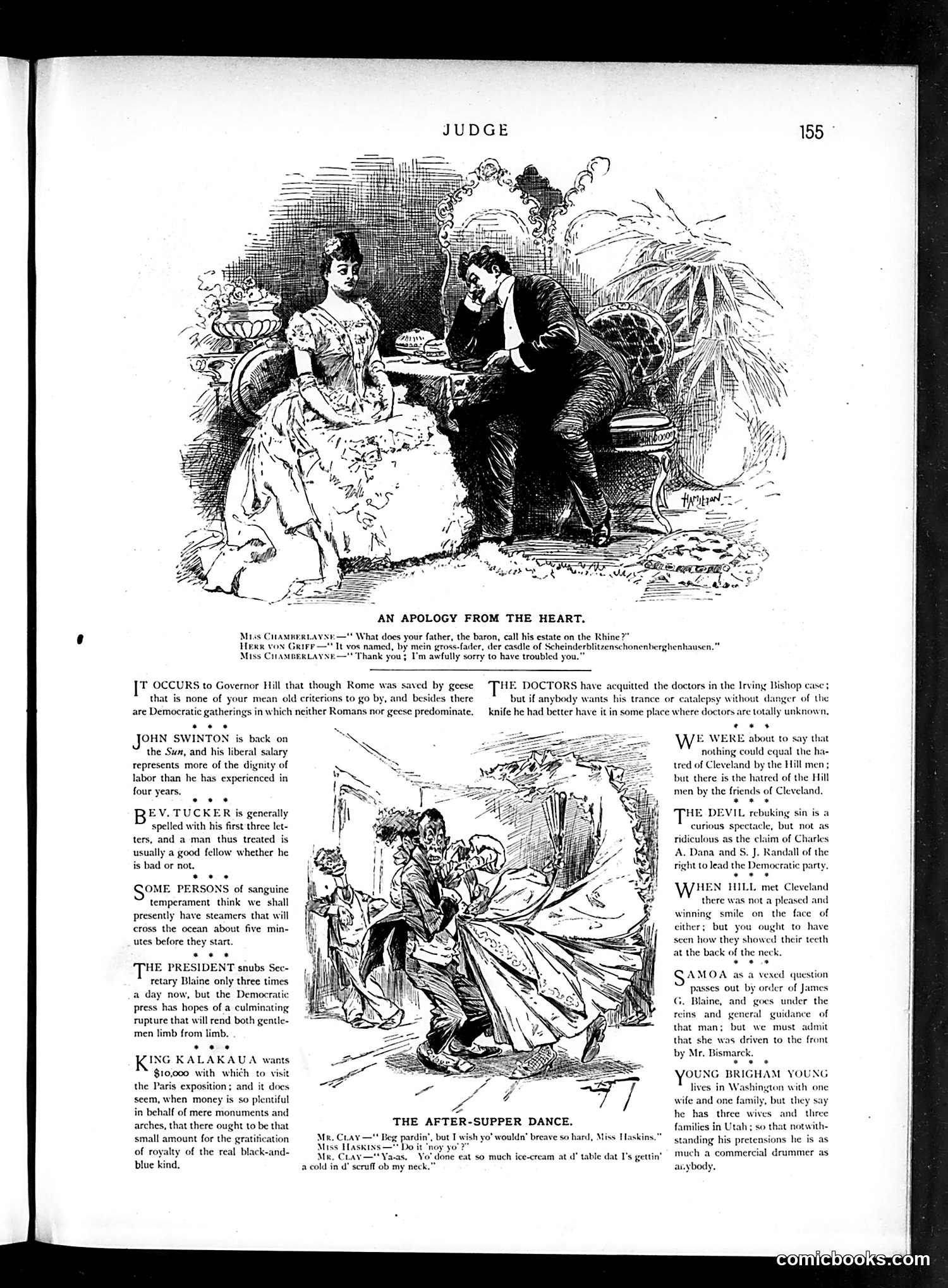
This page contains brief satirical commentary on contemporary political figures and events, circa 1880s: **Top cartoon:** A German baron's daughter apologizes for troubling someone; the satire mocks pretentious European nobility and their inflated titles. **Political items include:** - **Governor Hill** and Rome/geese metaphor (unclear reference without date) - **John Swinton** returning to newspaper work at good salary - **President Blaine** relations—jokes about Democratic press hoping for rupture between president and secretary - **Cleveland vs. Hill men**—references factional conflict within Democratic Party - **Charles Dana and S.J. Randall**—criticized for claiming leadership of Democratic party - **Samoa question** under Bismarck's influence - **Brigham Young**—polygamy joke about his multiple families in Utah while in Washington **Bottom cartoon:** "The After-Supper Dance" depicts a man (Mr. Clay) complaining to Miss Haskins that she's eaten so much ice cream he caught a cold from her breath—a crude joke about proximity and dining etiquette. The page mixes political satire with social humor typical of Gilded Age magazines.
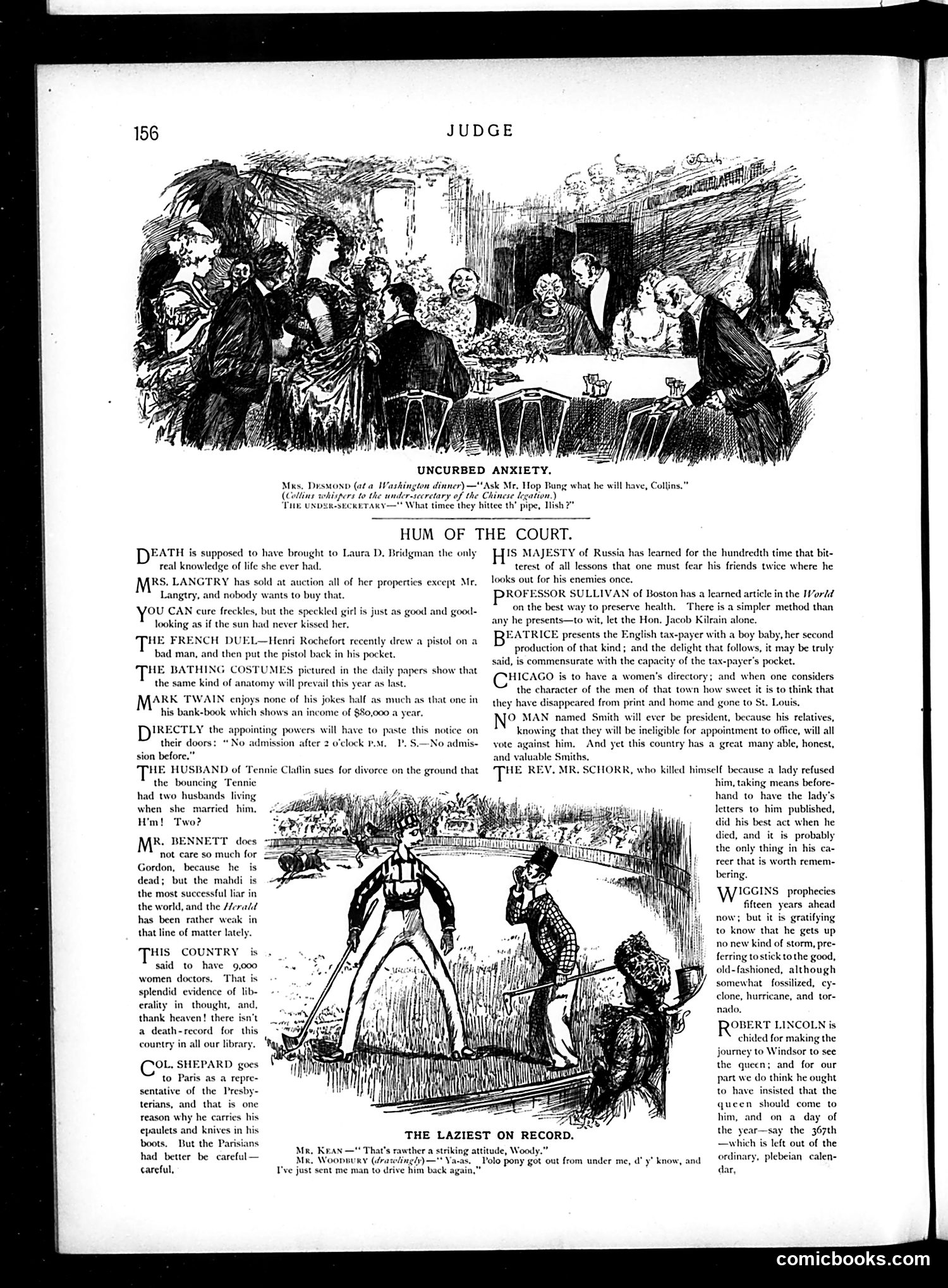
This page from *Judge* magazine contains satirical commentary on contemporary public figures and social issues, typical of the publication's humor. **Top Cartoon ("Uncurbed Anxiety"):** Shows a Washington dinner where someone asks a Chinese legation official what he'll have, creating awkward anxiety about dining etiquette. **"Hum of the Court" section:** A collection of brief satirical jabs at notable figures including: - Laura D. Bridgman (deaf-blind woman) - Lily Langtry (actress/socialite, mocked for selling her properties) - Mark Twain (ridiculed for his bank account rather than his wit) - Tennie Claflin (divorcing over bigamy) - Beatrice (likely Princess Beatrice, criticized for having a second child) - Robert Lincoln (President Lincoln's son, chided for visiting the Queen) **"The Laziest on Record" cartoon:** Shows polo players, with humor about a horse throwing a rider. The satire targets Victorian-era celebrities, politicians, and social absurdities, using caustic wit typical of Gilded Age humor magazines.
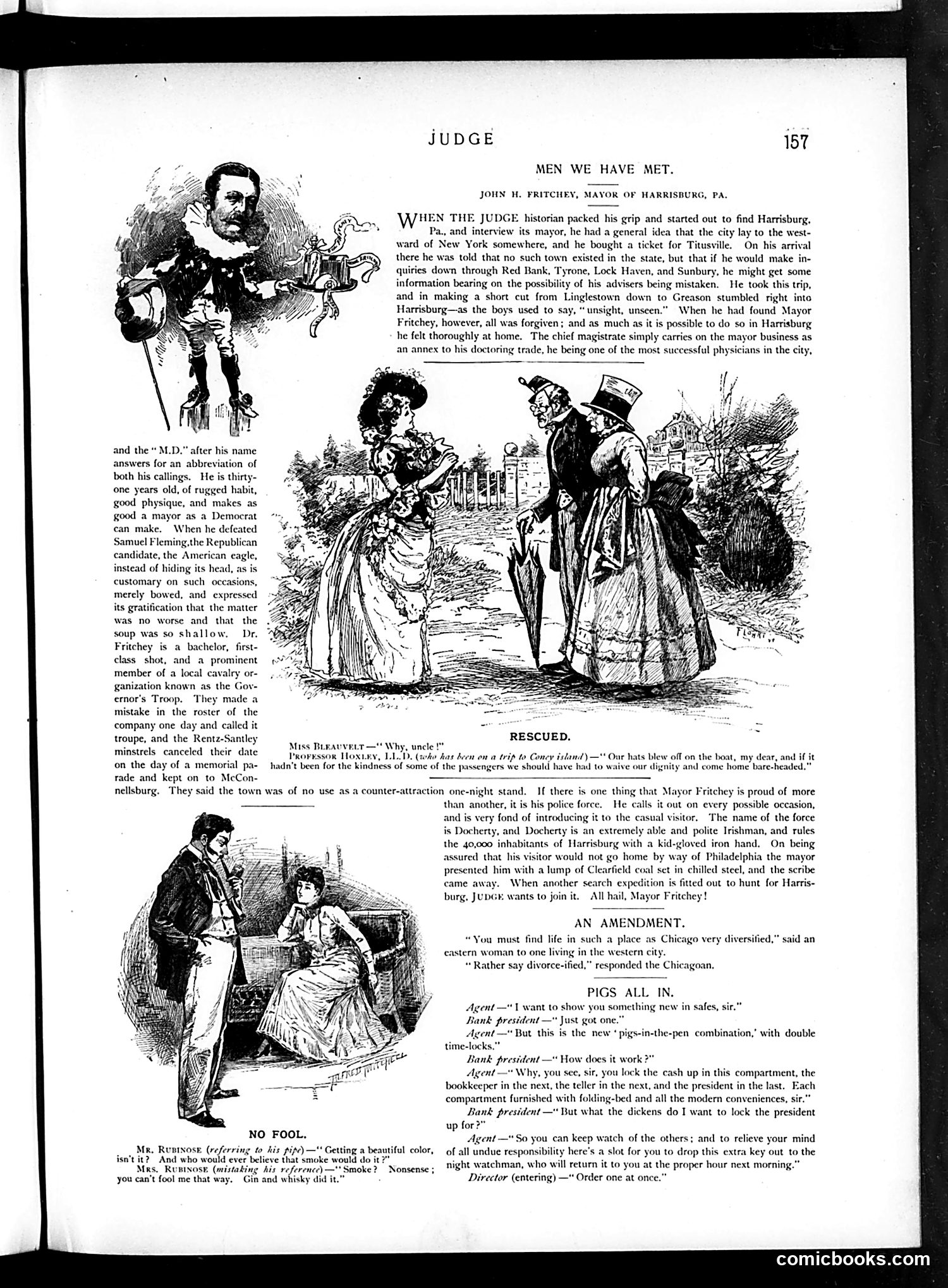
This page from Judge magazine contains satirical pieces about American life circa the 1880s-90s. The main feature profiles **John H. Fritchey, Mayor of Harrisburg, Pennsylvania**—a physician who runs the city as a sideline to his medical practice. The satire mocks his dual role and the difficulty the Judge reporter had locating this obscure Pennsylvania town. The accompanying illustrations show Harrisburg citizens and social scenes. Secondary pieces include: **"An Amendment"**: A joke about Chicago being "divorce-ified" rather than diversified, satirizing the city's high divorce rate. **"Pigs All In"**: A humorous pitch for a bank safe with compartments for locking up all employees—the cashier, bookkeeper, teller, and president—suggesting widespread distrust of bank staff and embezzlement concerns. **"No Fool"**: A brief joke about smoke and hair coloring. The humor reflects period anxieties about municipal governance, urban vices, and financial dishonesty.
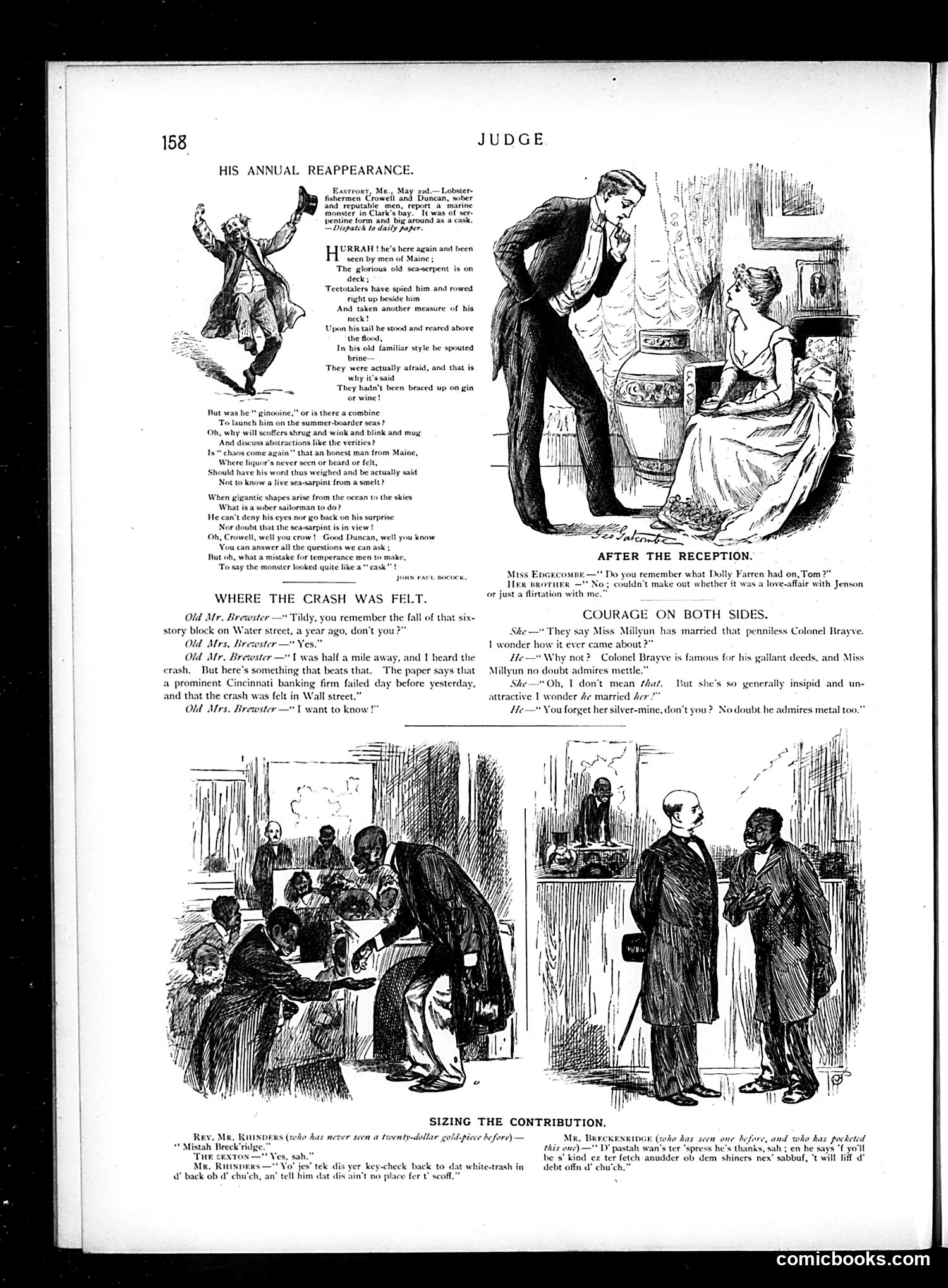
This page contains several satirical pieces typical of late 19th-century American humor: **"His Annual Reappearance"** mocks the recurring legend of the sea serpent supposedly sighted off Maine. The poem ridicules credulous witnesses and suggests the creature is either a hoax or fabrication to attract summer tourists. The satire targets both gullible believers and the newspapers that amplify dubious "sightings." **"Where the Crash Was Felt"** references a financial panic or banking collapse (likely the 1893 depression, given the Cincinnati banking firm mentioned). The joke contrasts the dramatic Wall Street impact with provincial indifference—a rural couple discusses the news casually while city folks panic. **"Courage on Both Sides"** and **"After the Reception"** are society-page jokes about wealthy marriages and romance. **"Sizing the Contribution"** satirizes racial stereotypes through dialect humor about a Black church sexton refusing an insufficient donation, playing on period minstrelsy tropes. The cartoons employ typical Judge-era satirical approaches: deflating pretension, mocking financial speculation, and (problematically) racial caricature.
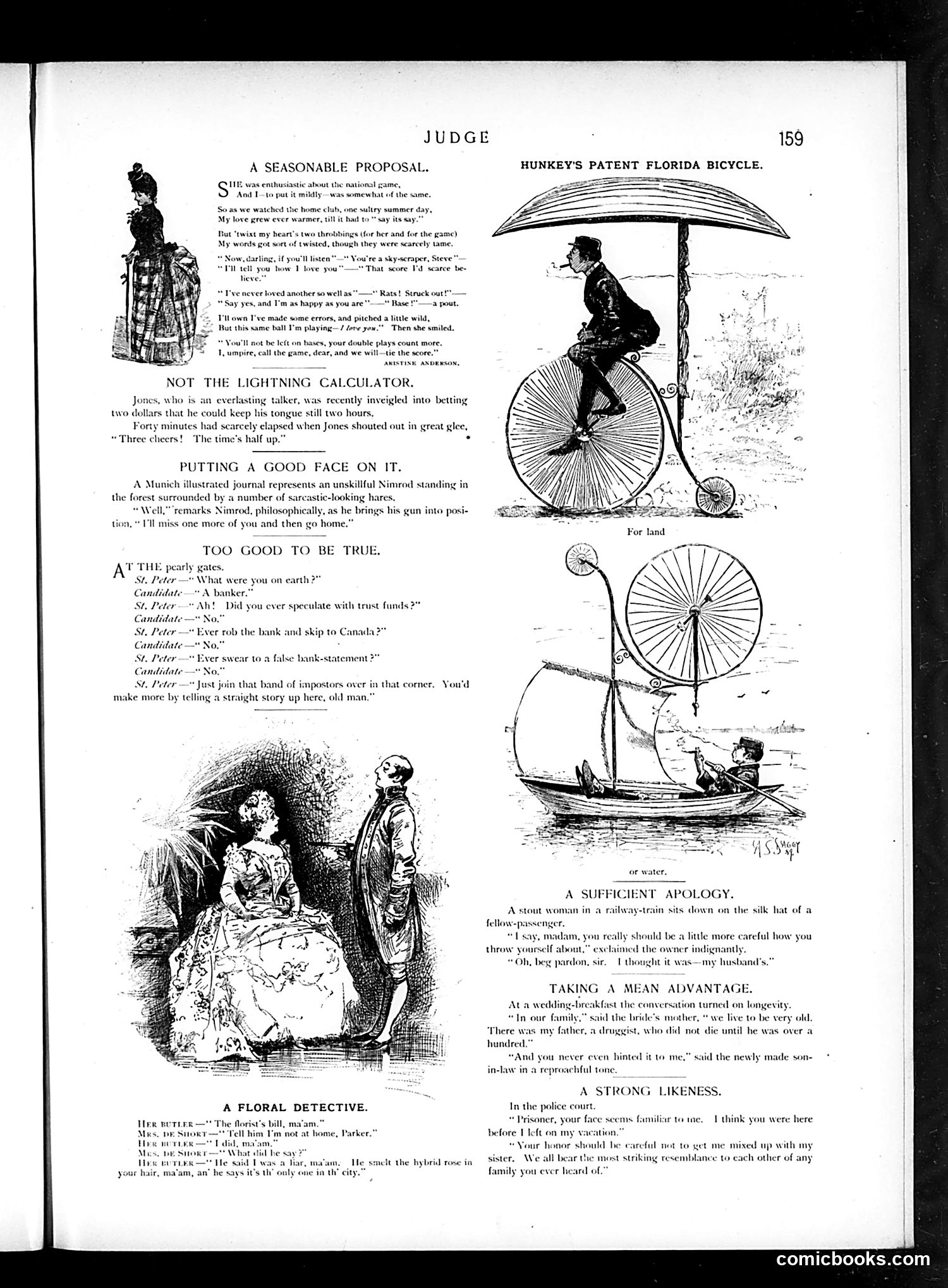
This page contains multiple short humorous pieces typical of Judge's satirical format: **"A Seasonable Proposal"** uses baseball metaphors to describe romantic confession—a man expresses love using baseball terminology ("double plays," "tie the score"), playing on the era's baseball enthusiasm. **"Not the Lightning Calculator"** mocks a chronic talker who loses a bet to stay silent for two hours but breaks after forty minutes, making a pun on his inability to control his speech. **"Hunkey's Patent Florida Bicycle"** is an advertisement illustrated with absurdist inventions—bicycles adapted for land and water travel—poking fun at the bicycle craze and dubious patent innovations of the period. The remaining pieces are brief joke formats: "Too Good to Be True" uses a heaven's gate scenario to satirize dishonesty; others parody everyday social situations (losing composure at a train incident, marital advantage-taking, courtroom mistaken identity). These represent Judge's typical light satirical approach—social observation and domestic humor rather than political commentary.
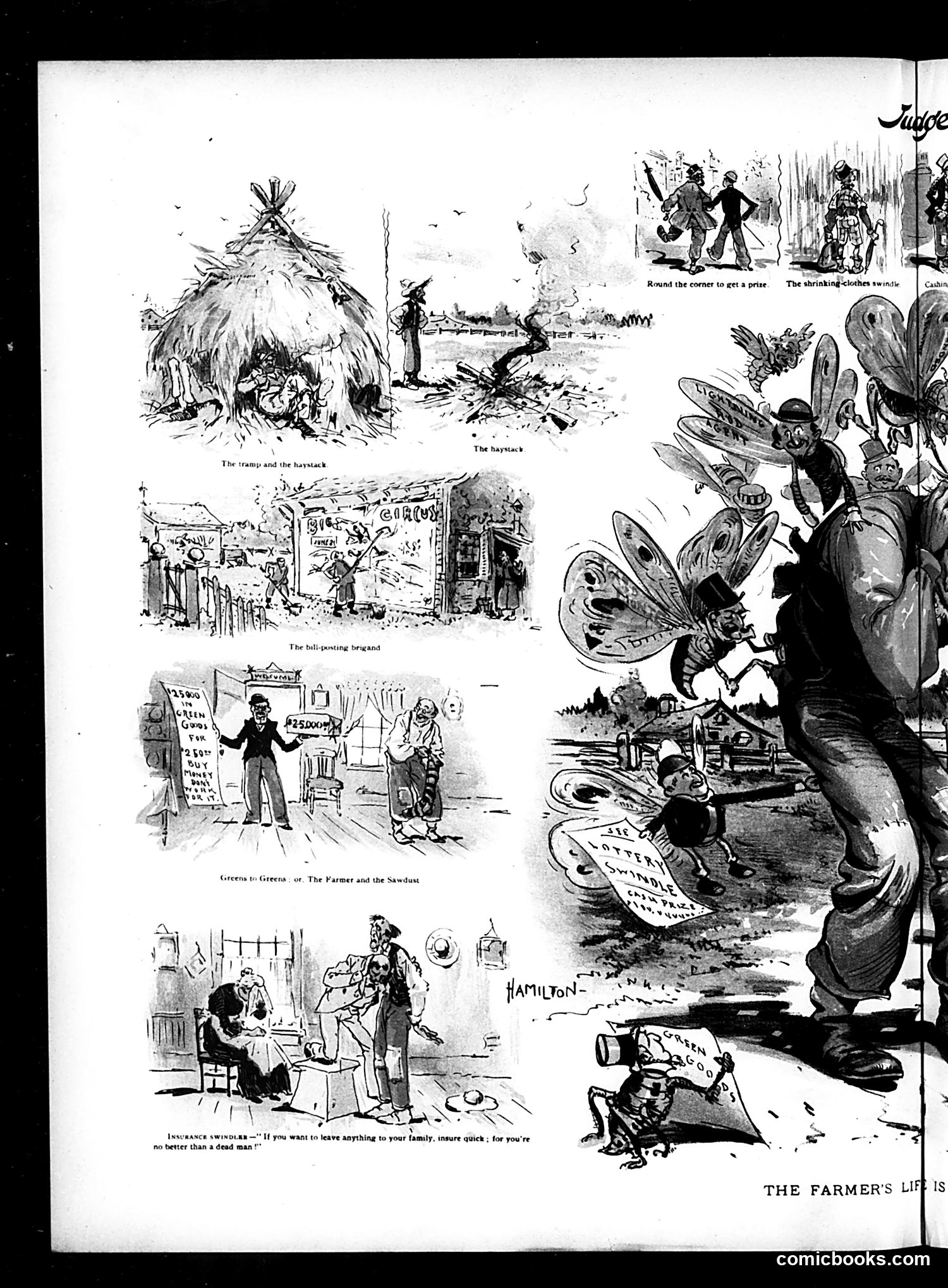
This page from *Judge* contains multiple satirical vignettes about rural and working-class life. The cartoons mock common scams and hardships: "The haystack" and "The tramp and the haystack" appear to depict rural poverty or vagrancy. "The shrinking-clothes swindle" satirizes consumer fraud. "Greene to Greene, or The Farmer and the Sawdust" references either a con artist named Greene or a general scam targeting farmers. The "Insurance swindler" panel warns farmers they're "no better than a dead man" if uninsured—mocking aggressive insurance sales tactics. The large illustration on the right, labeled "Hamilton," appears to be a separate feature. The overall message critiques how rural populations face multiple exploitative schemes: from clothing fraud to insurance pressure. The tone suggests farmers are particularly vulnerable to predatory business practices.
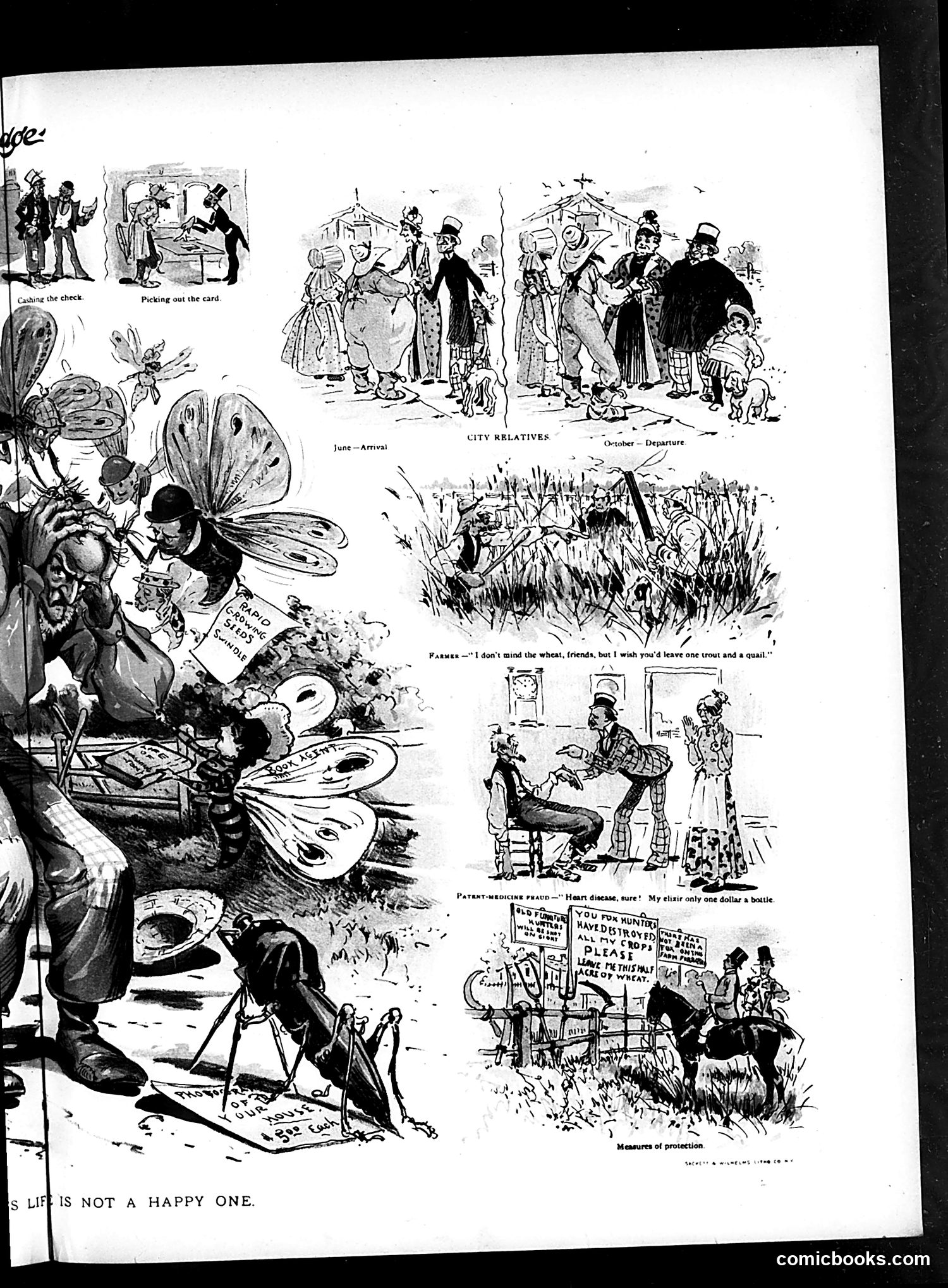
This page satirizes rural hardship and city-country migration. The top panels show "City Relatives"—a June arrival and October departure, suggesting temporary visits. The large left illustration depicts a rural family's struggles: poverty, large insects (possibly grasshoppers or locusts), and meager harvests. The middle and bottom panels show a farmer's frustrated complaints about urban medicine and money troubles ("Heart disease, sure? My liver only one dollar a bottle") and signs reading "HAVE DIRTIED ALL MY CROPS" and "PLEASE DON'T TRESPASS." The title "This Life Is Not a Happy One" directly addresses rural poverty and desperation. The satire critiques both the disconnect between city and country life and the farmer's inability to escape poverty despite hard work. This reflects late-19th/early-20th-century anxieties about agricultural decline.
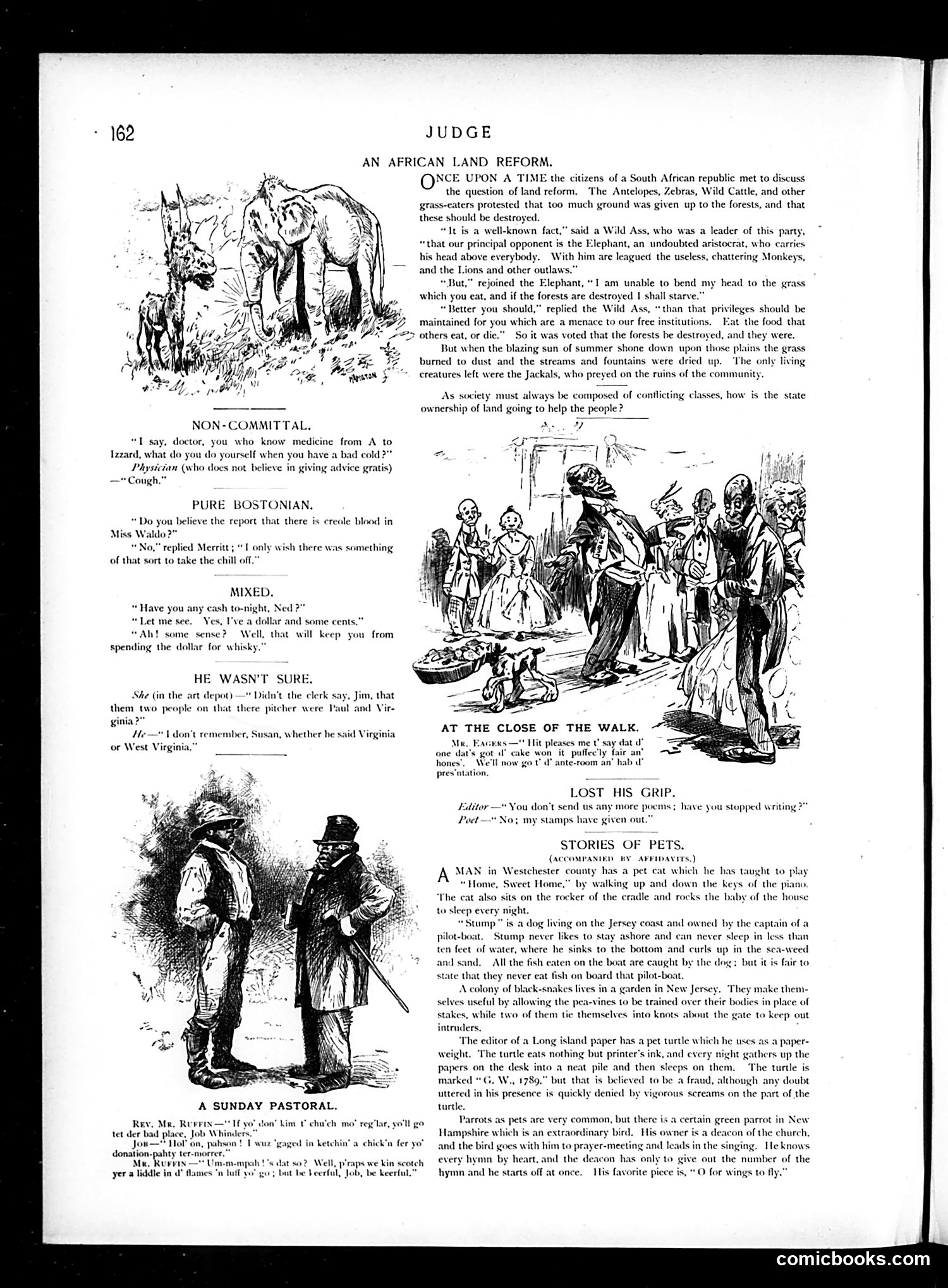
This page from Judge contains several satirical pieces mocking various social attitudes of the era. **"An African Land Reform"** is an animal fable criticizing democratic land redistribution. Animals debate whether to destroy forests favoring elephants (representing aristocrats) to give grassland to common herbivores. They destroy the forests, but this backfires—the grass burns in summer sun, water sources dry up, and only jackals (predatory scavengers) survive. The satire suggests that redistributing property to benefit the poor classes ultimately harms everyone, including the supposed beneficiaries. The lower section contains brief joke vignettes: a non-committal doctor, racial humor about "creole blood," and commentary on economic class. **"Stories of Pets"** presents absurdist anecdotes about animals with impossible talents (a cat playing piano, a dog that catches fish, snakes tying themselves in knots), likely parodying the credulous "pet stories" that filled period newspapers and magazines. The cartoons employ 19th-century visual stereotypes and reflect conservative skepticism toward democratic reform and land redistribution movements.
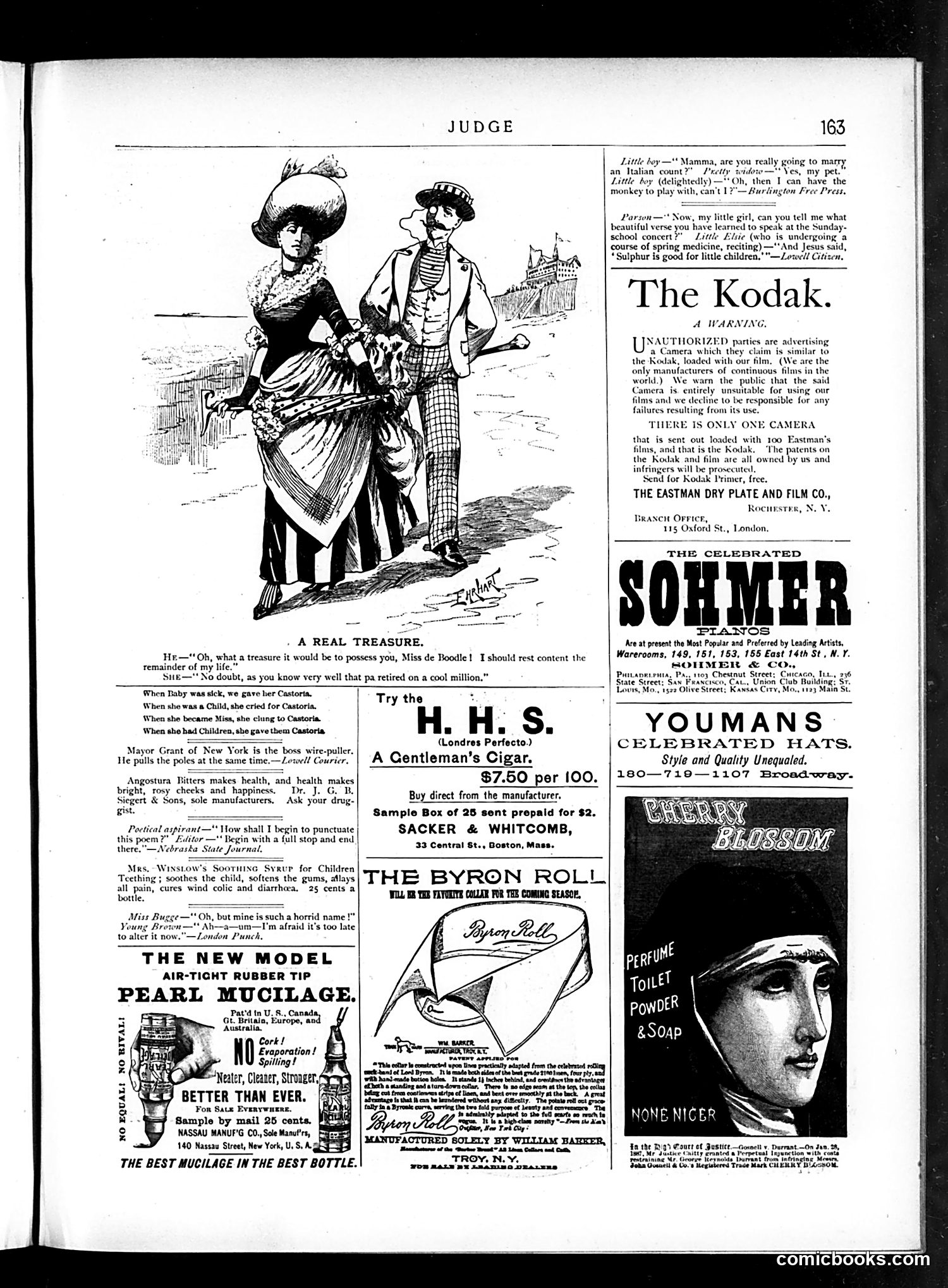
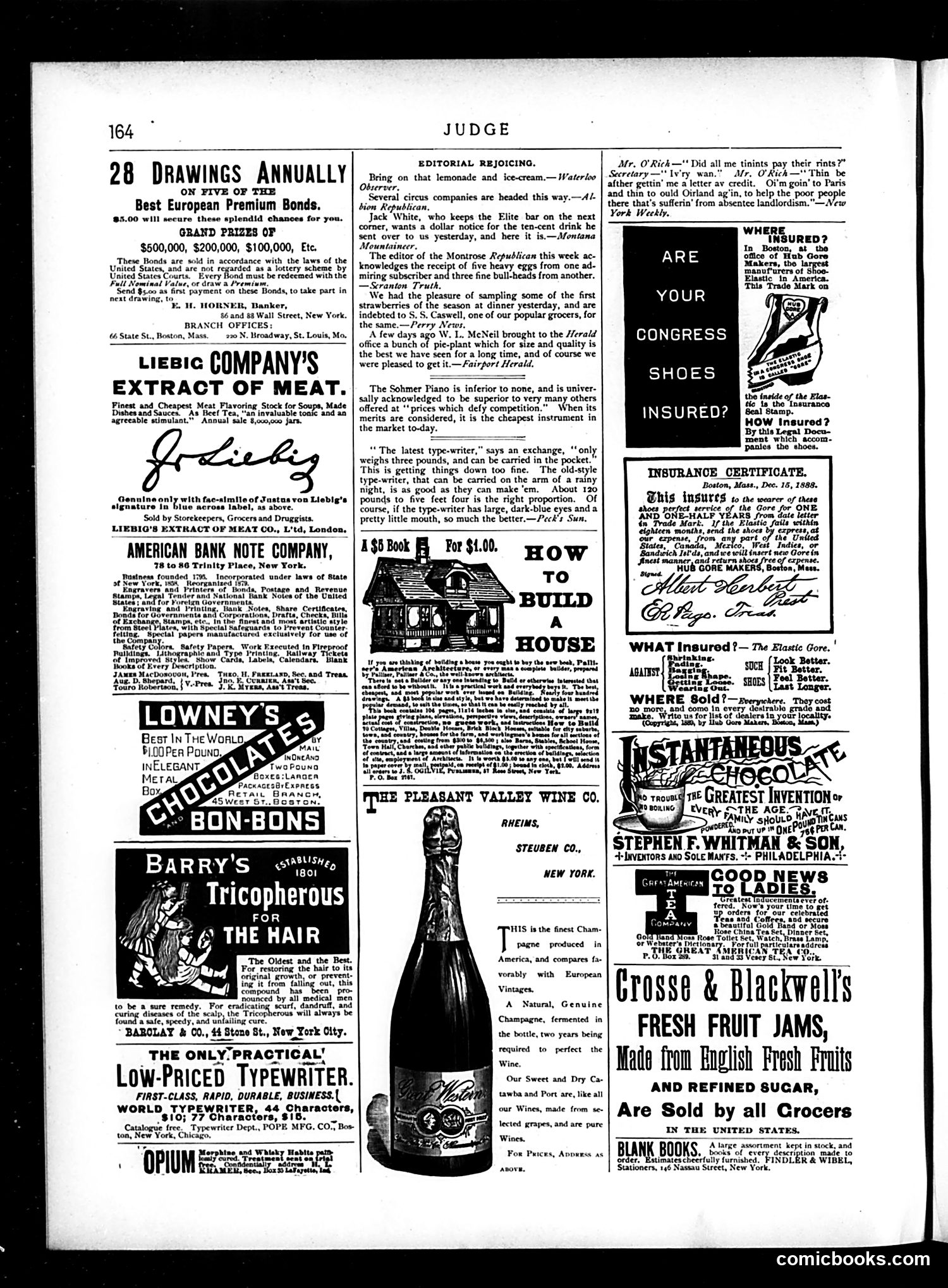
This is primarily an **advertising page** from *Judge* magazine, not a satirical cartoon page. The bulk consists of commercial advertisements for products (Liebig's meat extract, typewriters, hair tonic, wine) and financial services (European premium bonds, bank notes). The small section titled "EDITORIAL REJOICING" is satirical **filler content**—it mocks rural newspaper editors who shamelessly give free publicity to local merchants in exchange for small gifts (eggs, strawberries, rhubarb). Each quoted "editor" breathlessly thanks someone for sending them food or drink, then announces it in print as news. The satire targets the unprofessionalism and corruption of small-town journalism, where editorial independence is compromised by petty bribes. The final joke about a three-pound pocket typewriter being "getting things down too fine" is just wordplay on absurdity.
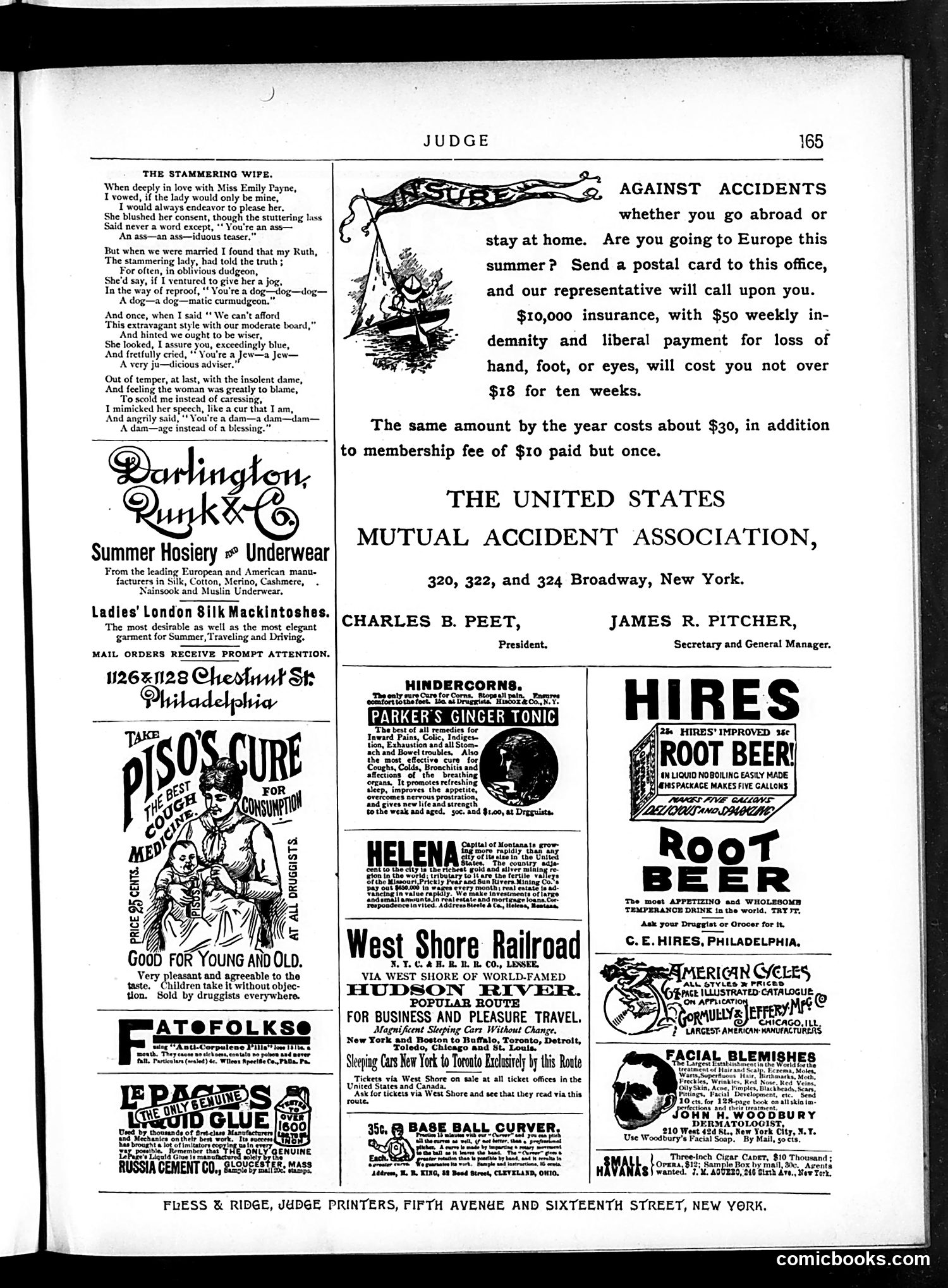
This page features a humorous poem mocking a marriage where the wife's speech impediment becomes a vehicle for wordplay and insult. The unnamed narrator marries Emily Payne, a stammering woman, only to discover her stutter allows her to deliver cutting remarks disguised as verbal tics. The satire works through puns: when she stammers "You're an ass—ass—iduous teaser," she's calling him both an ass and an assiduous one. Similar patterns repeat with "dog—dog—matic," "Jew—dicious," and "dam—age." The joke reflects period attitudes treating stuttering as comedic material and assumes readers will find humor in a woman's verbal cleverness being reframed as mere speech impediment. The poem's resolution—the husband mockingly mimicking her—suggests exasperation at being verbally bested by his wife, though the satire's ultimate target remains ambiguous: whether Judge ridicules stammering, nagging wives, or marital discord generally. The page is otherwise filled with period advertisements for medicines, railroads, and consumer goods.
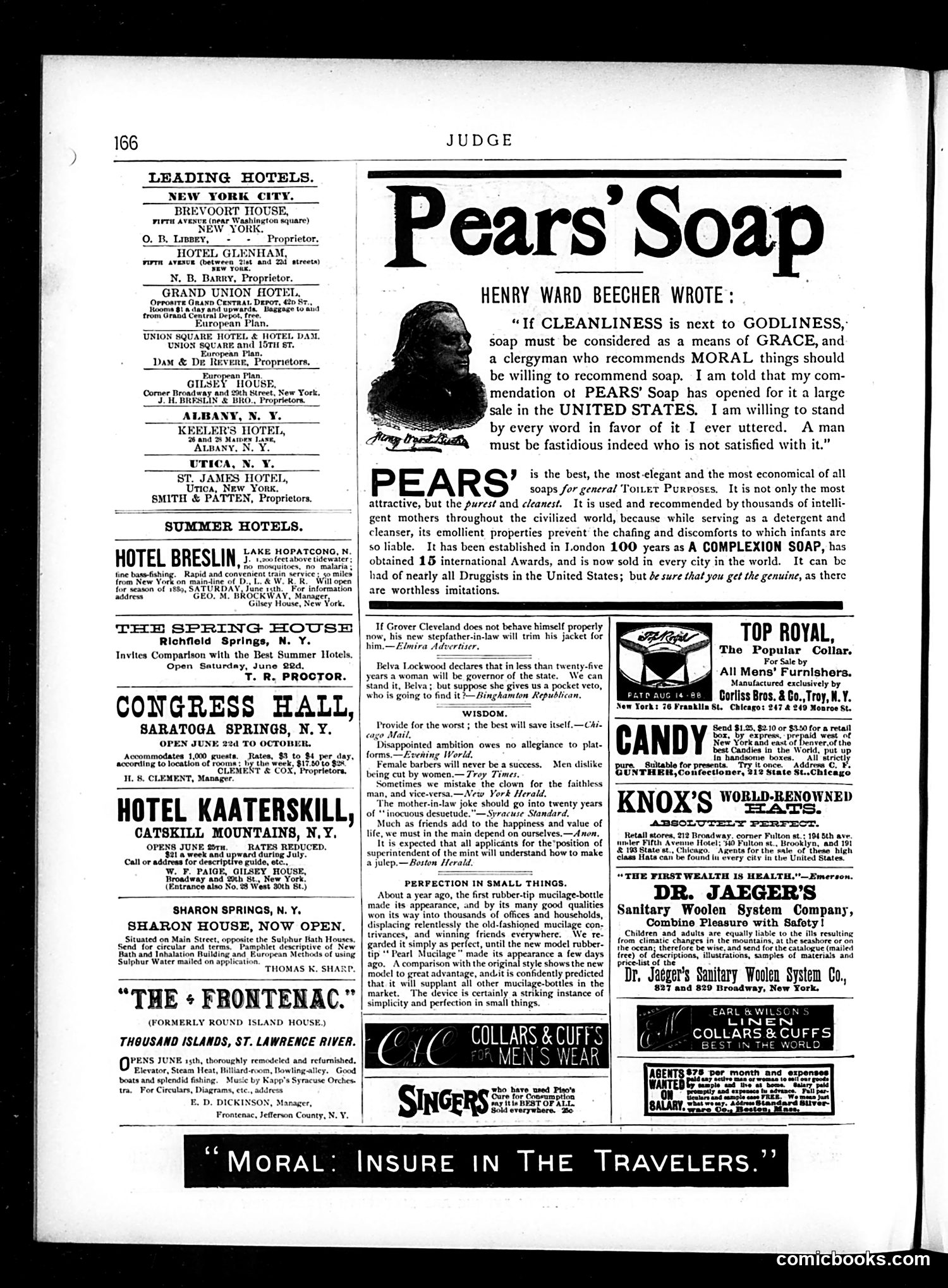
This is primarily a **hotel and business directory page** from Judge magazine (page 166), not a political cartoon page. The dominant content consists of advertisements for New York and regional hotels and summer resorts, along with a prominent **Pears' Soap advertisement** featuring an endorsement attributed to Henry Ward Beecher (a famous 19th-century clergyman). The few small satirical items at the bottom are brief quips: one references **Grover Cleveland** and his "stepfather-in-law" (likely related to Cleveland's recent marriage), and another jokes about women governors and "pocket vetoes." There are no significant political cartoons or caricatures on this page—it's essentially a commercial publication page with minor humorous asides typical of Judge's format.
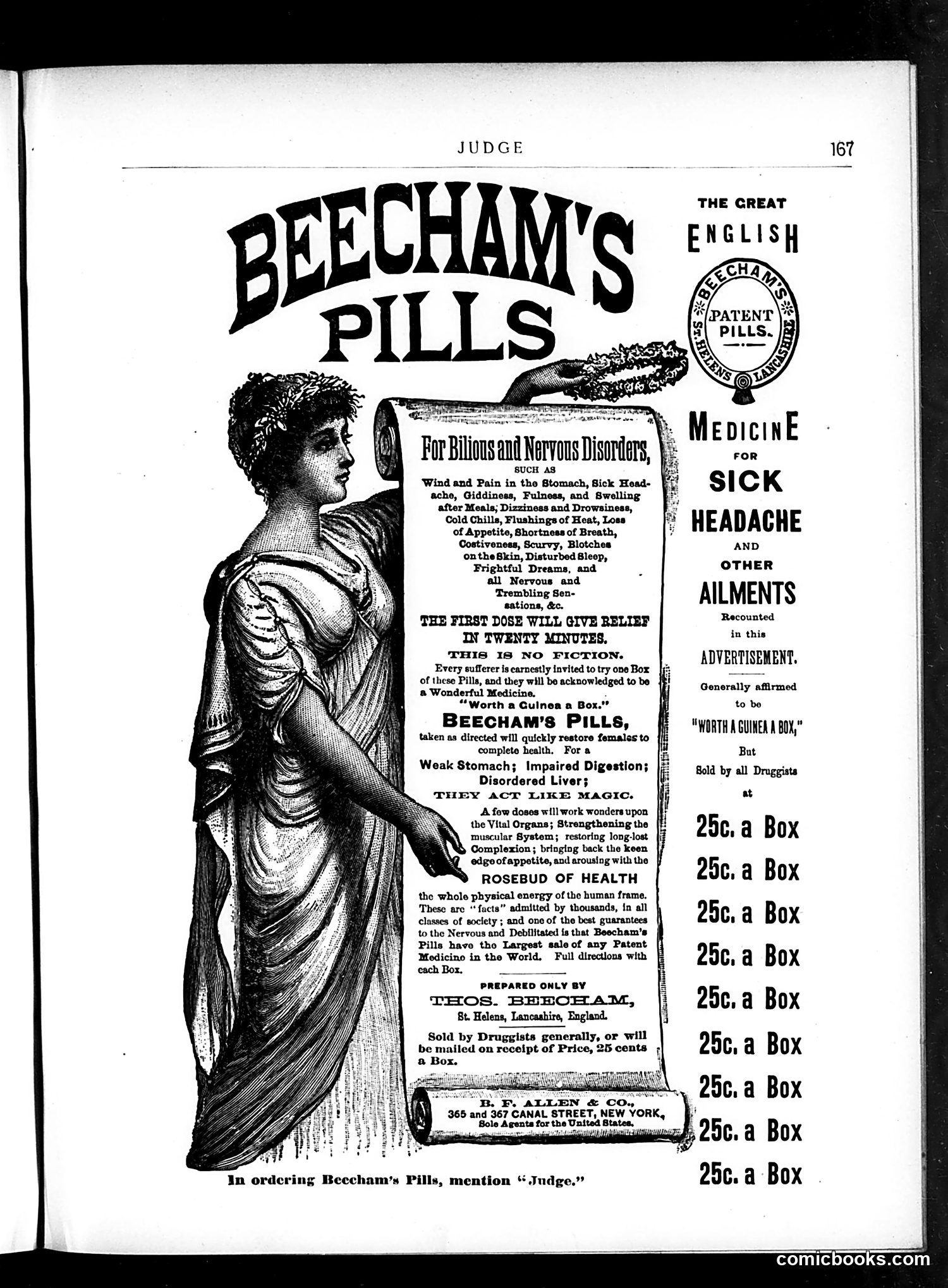
This is a **full-page advertisement**, not political satire. It promotes Beecham's Pills, a British patent medicine sold in America through New York agents. The image features a classical female figure (representing health or wellness) alongside dense text making extraordinary medical claims: the pills allegedly cure "bilious and nervous disorders," provide relief in twenty minutes, and restore "females to complete health." The ad emphasizes the product's massive sales as proof of efficacy. **The satire lies in Judge magazine's implicit critique**: by running this ad prominently, the publication lampoons the era's rampant medical quackery and false advertising. Patent medicines made absurd, unsubstantiated claims while charging inflated prices (advertised as "worth a guinea" but sold for 25 cents). The breathless language and vague symptom lists are characteristic of snake-oil marketing that preyed on consumer desperation—the real joke being that Judge's readers would recognize the hollowness of such promises.
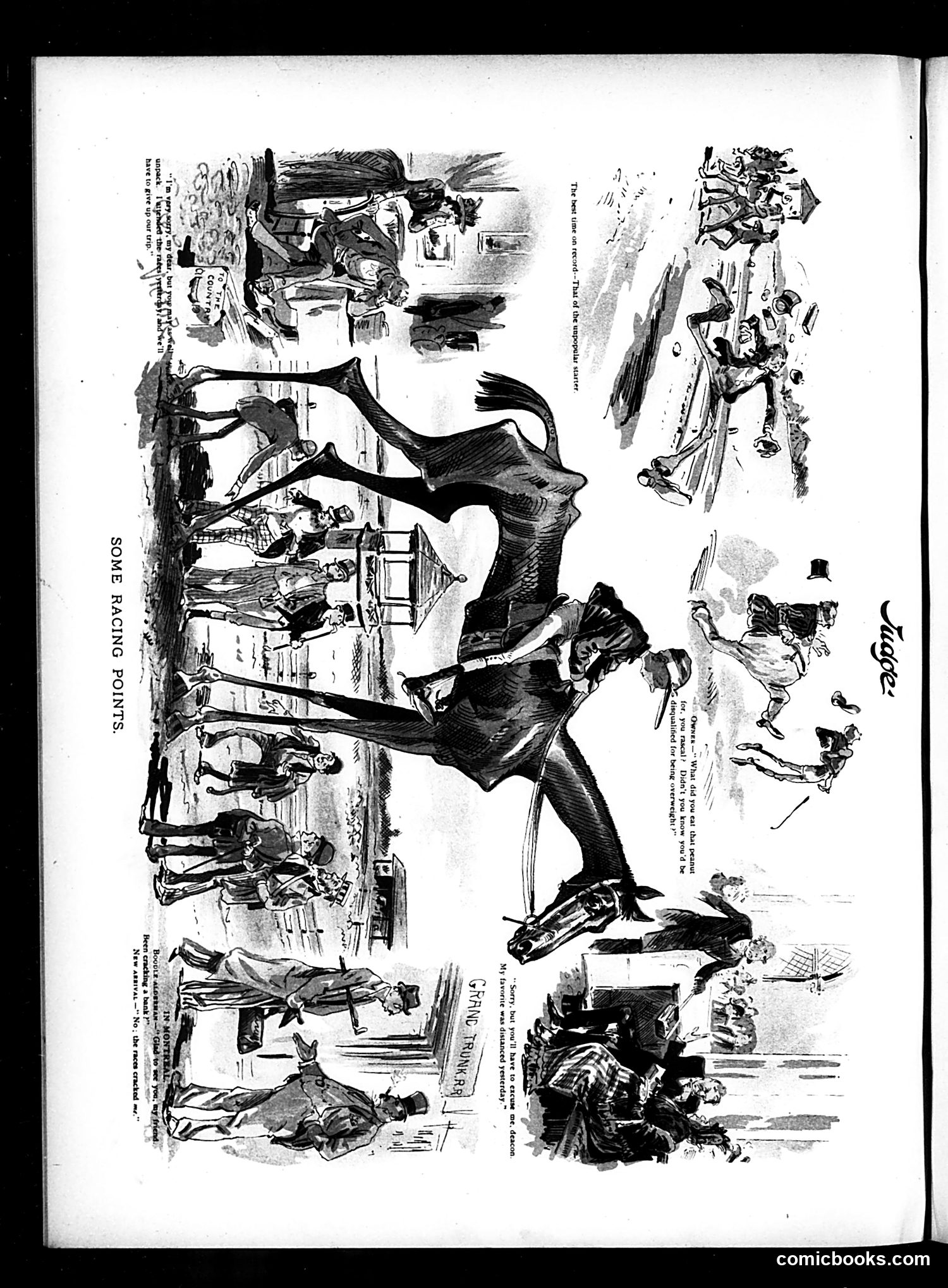
This page appears to be from Judge magazine and contains satirical cartoon content, though the OCR text is severely corrupted and largely illegible, making precise identification difficult. The visible illustrations show exaggerated figures in what appears to be social or political satire typical of Judge's style. The central image depicts a elongated, caricatured figure in formal dress in a dramatic pose, surrounded by smaller figures in various scenes. Without legible OCR text, I cannot definitively identify the specific figures, political references, or satirical targets. The page layout suggests multiple related vignettes around a main cartoon, common for Judge's format, but the actual subject matter—whether addressing politicians, social trends, or public figures—**remains unclear from this image alone**. The handwritten or stylized headers are also too illegible to decipher with confidence.