
Judge, 1889-06-15 · page 10 of 16
Judge — June 15, 1889 — page 10: what you’re looking at
What you’re looking at
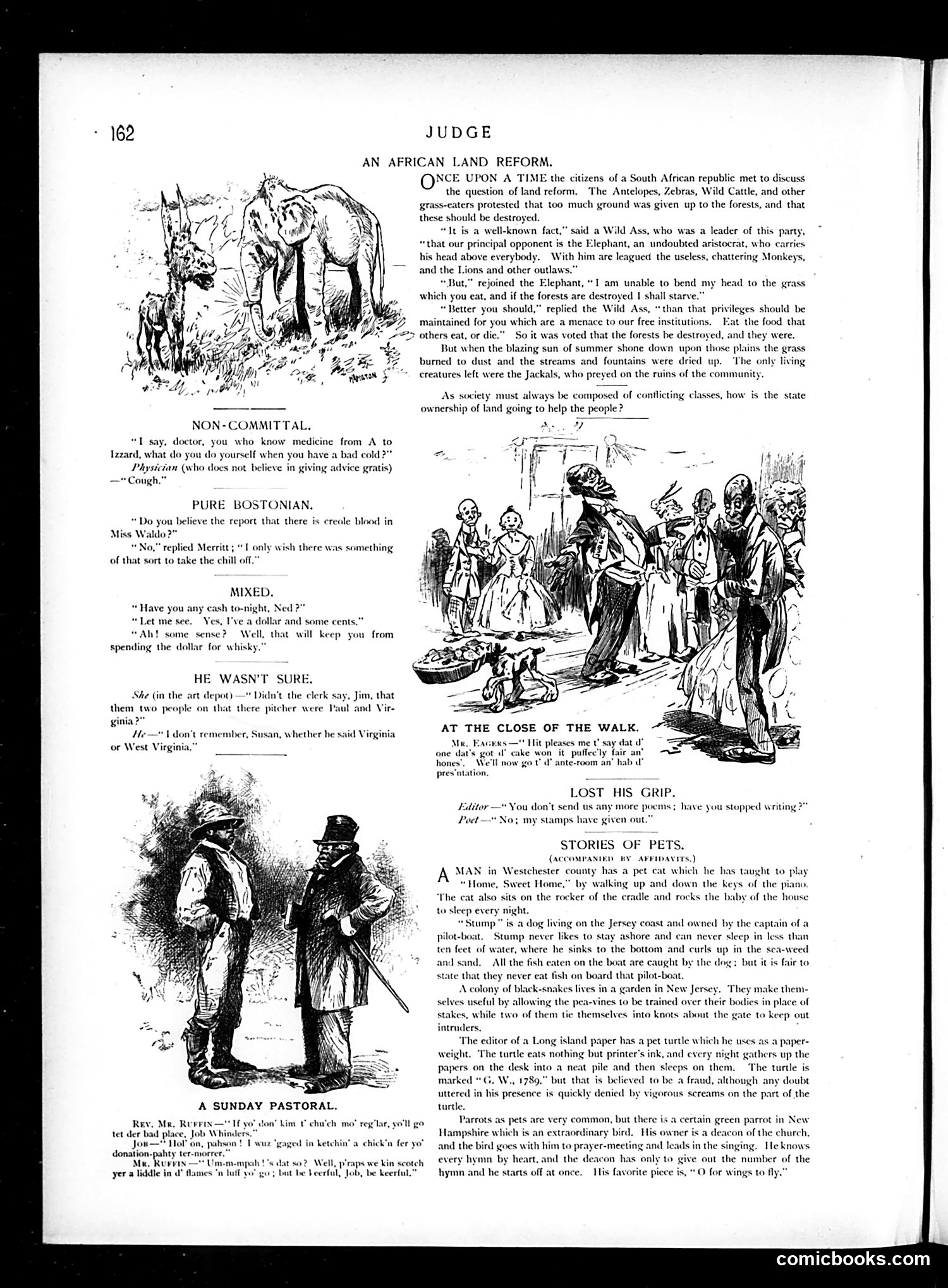
This page from Judge contains several satirical pieces mocking various social attitudes of the era. **"An African Land Reform"** is an animal fable criticizing democratic land redistribution. Animals debate whether to destroy forests favoring elephants (representing aristocrats) to give grassland to common herbivores. They destroy the forests, but this backfires—the grass burns in summer sun, water sources dry up, and only jackals (predatory scavengers) survive. The satire suggests that redistributing property to benefit the poor classes ultimately harms everyone, including the supposed beneficiaries. The lower section contains brief joke vignettes: a non-committal doctor, racial humor about "creole blood," and commentary on economic class. **"Stories of Pets"** presents absurdist anecdotes about animals with impossible talents (a cat playing piano, a dog that catches fish, snakes tying themselves in knots), likely parodying the credulous "pet stories" that filled period newspapers and magazines. The cartoons employ 19th-century visual stereotypes and reflect conservative skepticism toward democratic reform and land redistribution movements.
📄 Transcribed text from this page (OCR, searchable)
Machine-transcribed from the original scan — historical spelling and the odd misread are preserved.
JUDGE AN AFRICAN LAND REFORM. UPON A TIME the citizens of a South African republic met to discuss the question of land reform, ‘The Antelopes, Zebras, Wild Cattle, and other grass-eaters protested that too much ground was given up to the forests, and that these should be destroyed. “It is a well-known fact,” said a Wild Ass, who was a leader of this party, “that our principal opponent is the Elephant, an undoubted aristocrat, who carries his head above everybody. With him are leagued the useless, chattering Monkeys, and the Lions and other outlaws.” “But,” rejoined the Elephant, “Iam unable to bend my head to the grass which you eat, and if the forests are destroyed I shall starve. “Better you should,” replied the Wild Ass, “than that privileges should be maintained for you which are a menace to our free institutions. Eat the food that others eat, or die.” So it was voted that the forests be destroyed, and they were. But when the blazing sun of summer shone down upon those plains the grass burned to dust and the streams and fountains were dried up. ‘The only living creatures left were the Jackals, who preyed on the ruins of the community. As society must always be composed of conflicting classes, how is the state ownership of land going to help the people ? NON-COMMITTAL, “1 say, doctor, you who know medicine from A to Izzard, what do you do yourself when you have a bad cold ?” Physician (who docs not believe in giving advice gratis) PURE BC ONIAN. “Do you believe the report that there is creole blood in Miss V “No,” replied Merritt ; “I only wish there was something MIXED. dollar and some cents, “Ah! some sense? Well, that will keep you from spending the dollar for whisky.” HE WASN'T SURE, She (in the art depot) —" Didn't the clerk say, Jim, that them two people on that there pitcher were Paul and Vir- ginia ?” . ore AT THE CLOSE OF THE WALK. don't remember, Susan, whether he said Vir; rose Vinwtates® F * Hit pleases me t' say dat ¢ oe West Virgings one dat’s got’ cake won it puffec'ly fair an™ hones’ We'll now go ' d’ ante-room an’ hab d° pres'e LOST HIS GRIP. Editor —*You don't send us any more poems; have you stopped writing ?” “Noj my stamps have given out.” STORIES OF PETS. (ACCOMPANIED RY AFFIDAVITS.) A MAN in Westchester county has a pet cat which he has taught to play Home, Sweet Home,” by walking up and down the keys of the piano, ‘The cat also sits on the rocker of the cradle and rocks the baby of the house to sleep every night, “Stump” is a dog living on the Jersey coast and owned by the captain of a pilot-boat. Stump never likes to stay ashore and can never sleep in less than ten feet of water, where he sinks to the bottom and curls up in the sea-weed and sand. All the fish eaten on the boat are caught by the dog; but it is fair to te that they never eat fish on board that pilot-boat. A colony of black-snakes lives in a garden in New Jersey. They make them- s useful by allowing the p c ¢ ct bodies in plac while two of them tie themselves into knots about the gate to keep out intruders. ‘The editor of a Long island paper has a pet turtle which he uses as weight. ‘The turtle eats nothing but printer's ink, and every night gathers up the papers on the desk into a neat pile and then sleeps on them. The turtle is marked “G. W., 1789.” but that is believed to be a fraud, although any doubt uttered in his presence is quickly denied by vigorous screams on the part of the A SUNDAY PASTORAL. turtle, Rev, Mr. Rerrix—"'If yo" don’ kim t’ chu’ch mo’ reg'lar, yo" Parrots as pets are very common, but there isa certain green parrot in New rs." Hampshire which is an extraordin: 1. His owner is a deacon of the church, and the bird goes with him to prayer-meeting and leads in the singing. He knows yewekin scotch every hymn by heart, and the deacon has only to give out the number of the be keerful.” hymn and he starts off at once. His favorite piece is, “0 for wings to fly.” comicbooks.com