
A complete issue · 16 pages · 1889
Judge — June 8, 1889
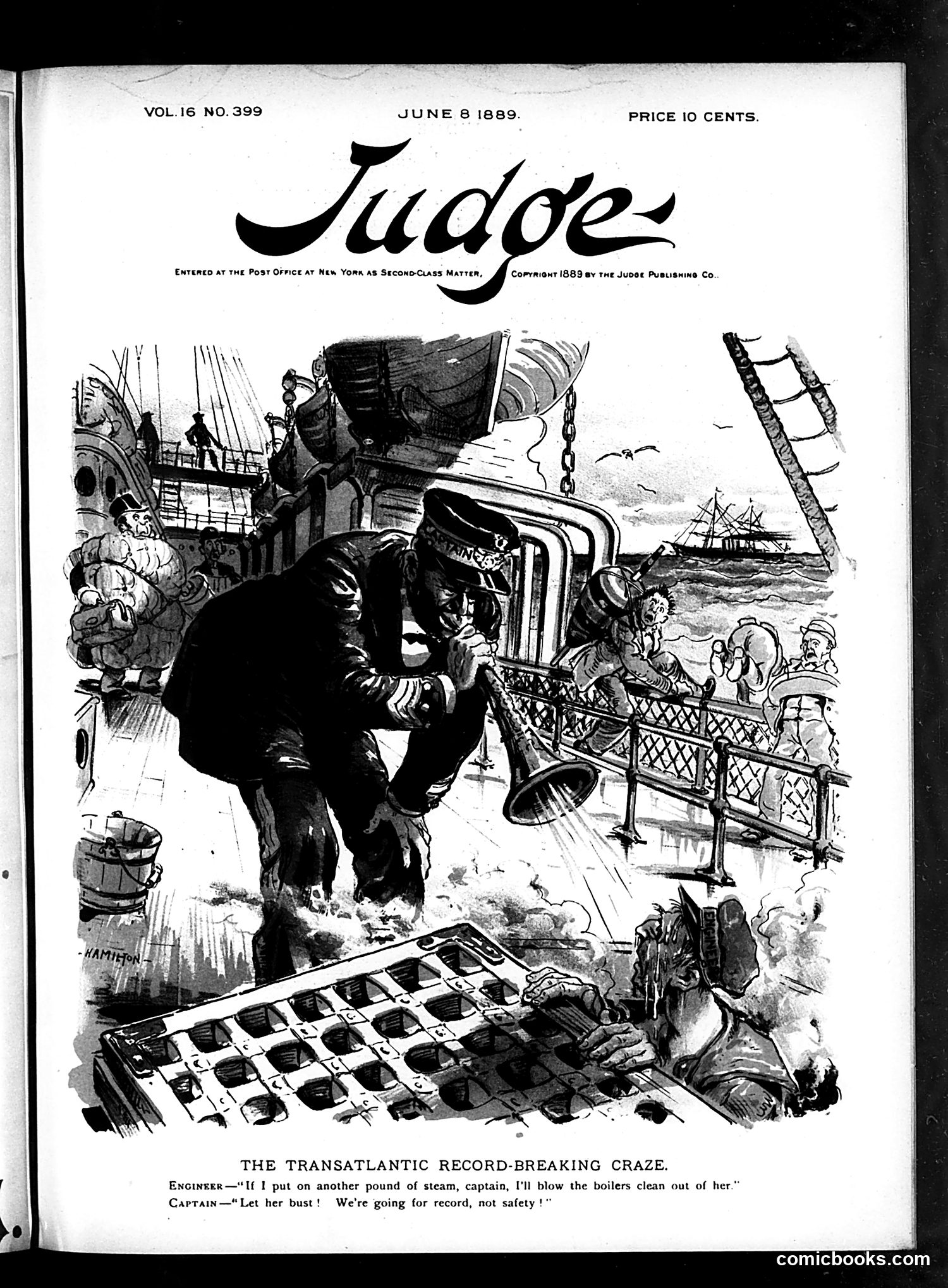
This 1889 Judge cartoon satirizes the dangerous obsession with breaking transatlantic steamship speed records. The central scene depicts a ship's bridge where an engineer warns the captain that adding more steam pressure will "blow the boilers clean out of her," while the captain recklessly responds "Let her bust! We're going for record, not safety!" The surrounding imagery shows chaos: passengers alarmed, cargo shifting, rigging failing. The satire criticizes the era's competitive mania for maritime speed records—achieved through dangerously high steam pressures—prioritizing commercial prestige over passenger safety. The cartoon warns that this obsession with "record-breaking" prioritizes profit and glory over human life and vessel integrity, a timely critique of industrial-age recklessness.
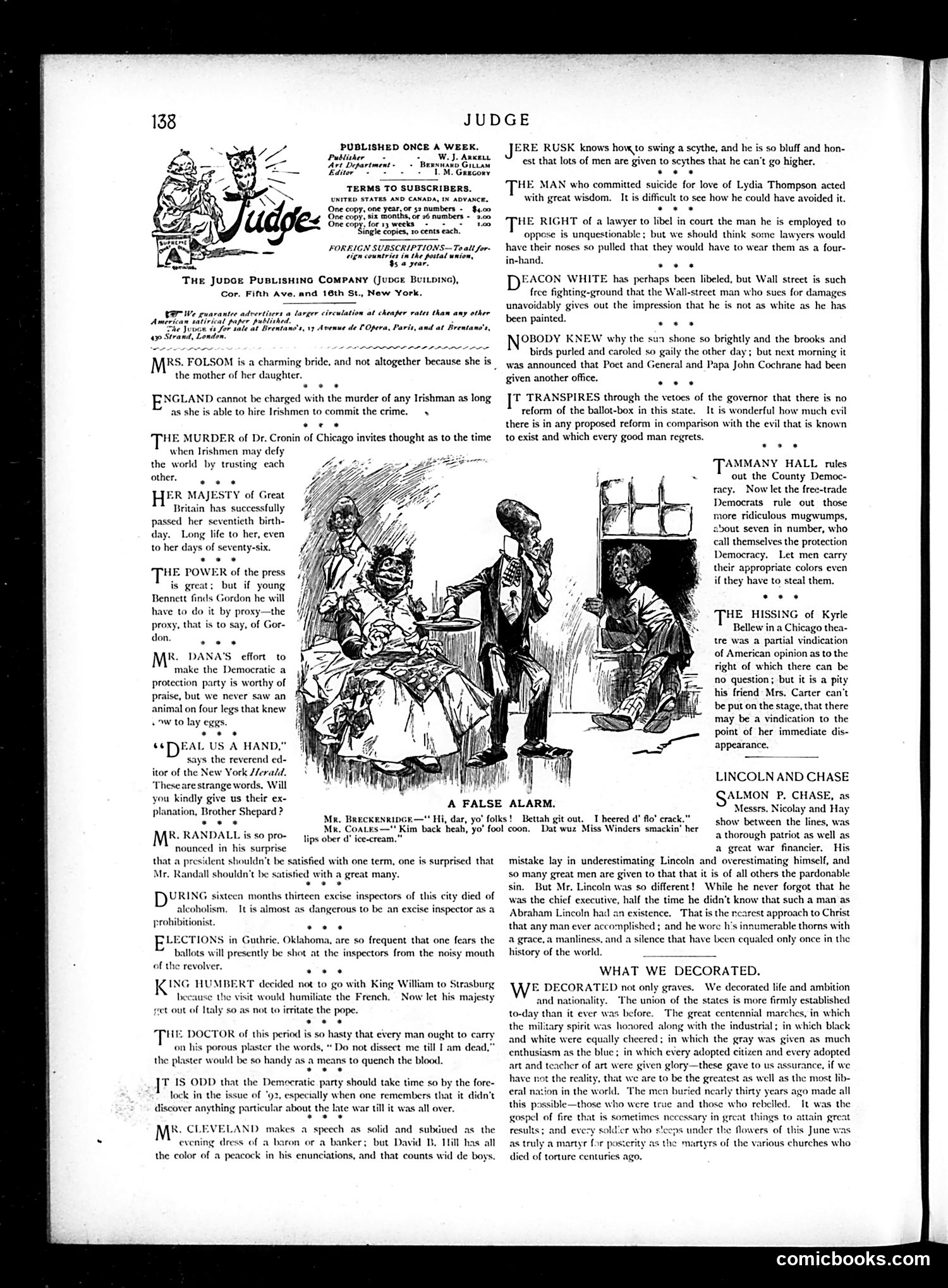
The main cartoon titled "A FALSE ALARM" depicts a domestic scene where a man (labeled "Mr. Breckenridge") appears startled, saying "Hi dar, yo' folks! Ittah git out. I heerd d' flo' crack." A woman responds about Miss Winders causing a commotion. The satire appears to address racial anxieties and domestic panic, likely from the late 19th or early 20th century. The dialect and domestic setting suggest commentary on racial fears or labor disputes, though without clearer visual identification of the figures, the specific historical event remains uncertain. The surrounding text discusses various political topics including press power, electoral reform, and commemorative monuments, typical Judge magazine fare of social criticism.
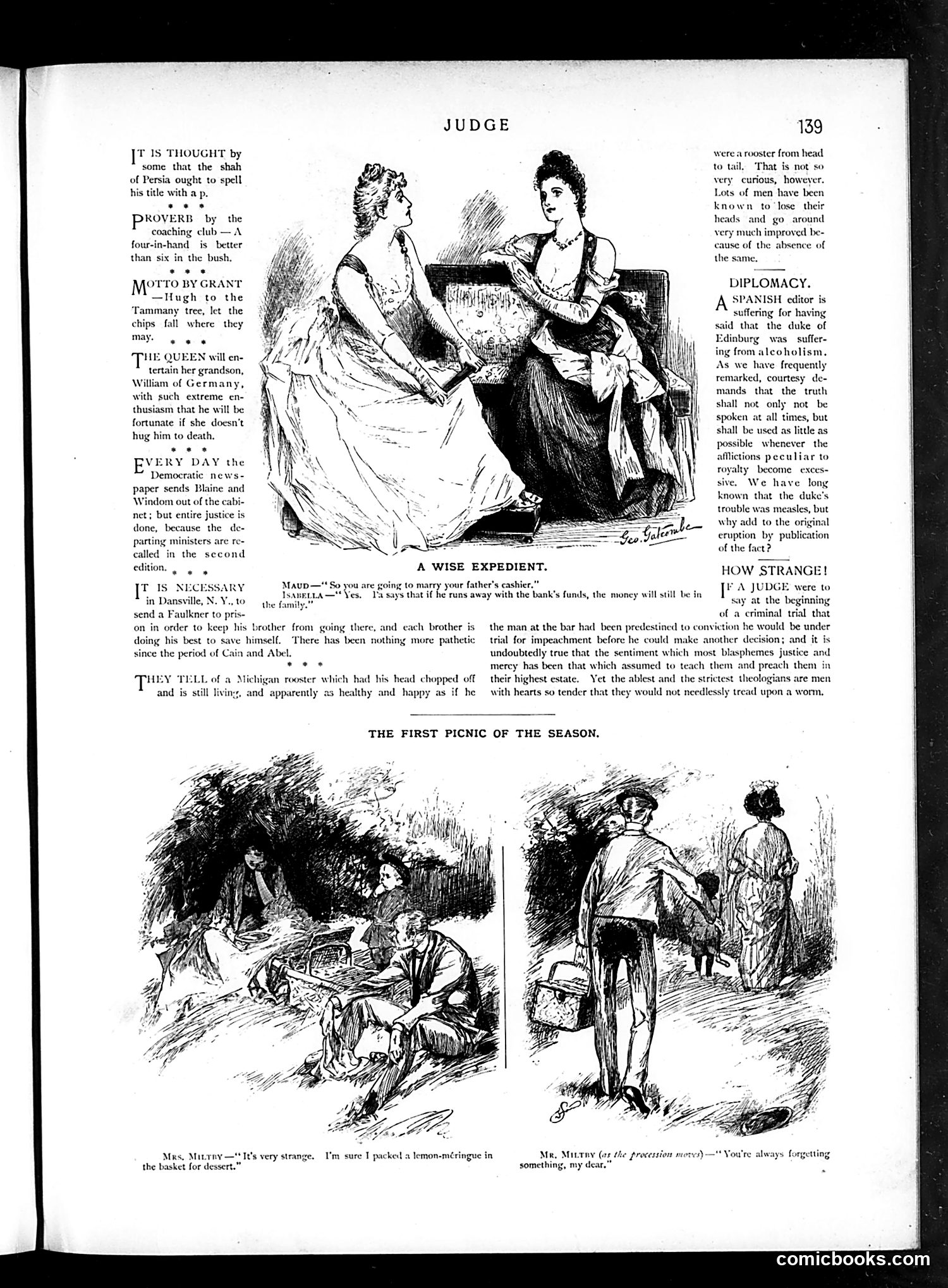
This page contains satirical commentary on contemporary 1880s American politics and society: **Top Section ("A Wise Expedient"):** A joke about a woman marrying her father's cashier—the implication being that if he embezzles bank funds, at least the money stays "in the family." **"Diplomacy" Section:** Satirizes diplomatic hypocrisy regarding the Duke of Edinburgh. A Spanish editor faced consequences for publicly stating the Duke suffered from alcoholism, which Judge notes was actually measles. The satire mocks how courtly etiquette demands suppressing inconvenient truths about royalty. **"How Strange!":** Critiques judicial and religious hypocrisy—judges who prejudge defendants, and theologians who preach mercy while being "tender-hearted" about trivial matters. **"The First Picnic of the Season":** Two comic vignettes about Mr. and Mrs. Mintny on an outing, where Mrs. Mintny chronically forgets items and Mr. Mintny perpetually reminds her. The page blends political satire with domestic humor typical of Judge's editorial approach.
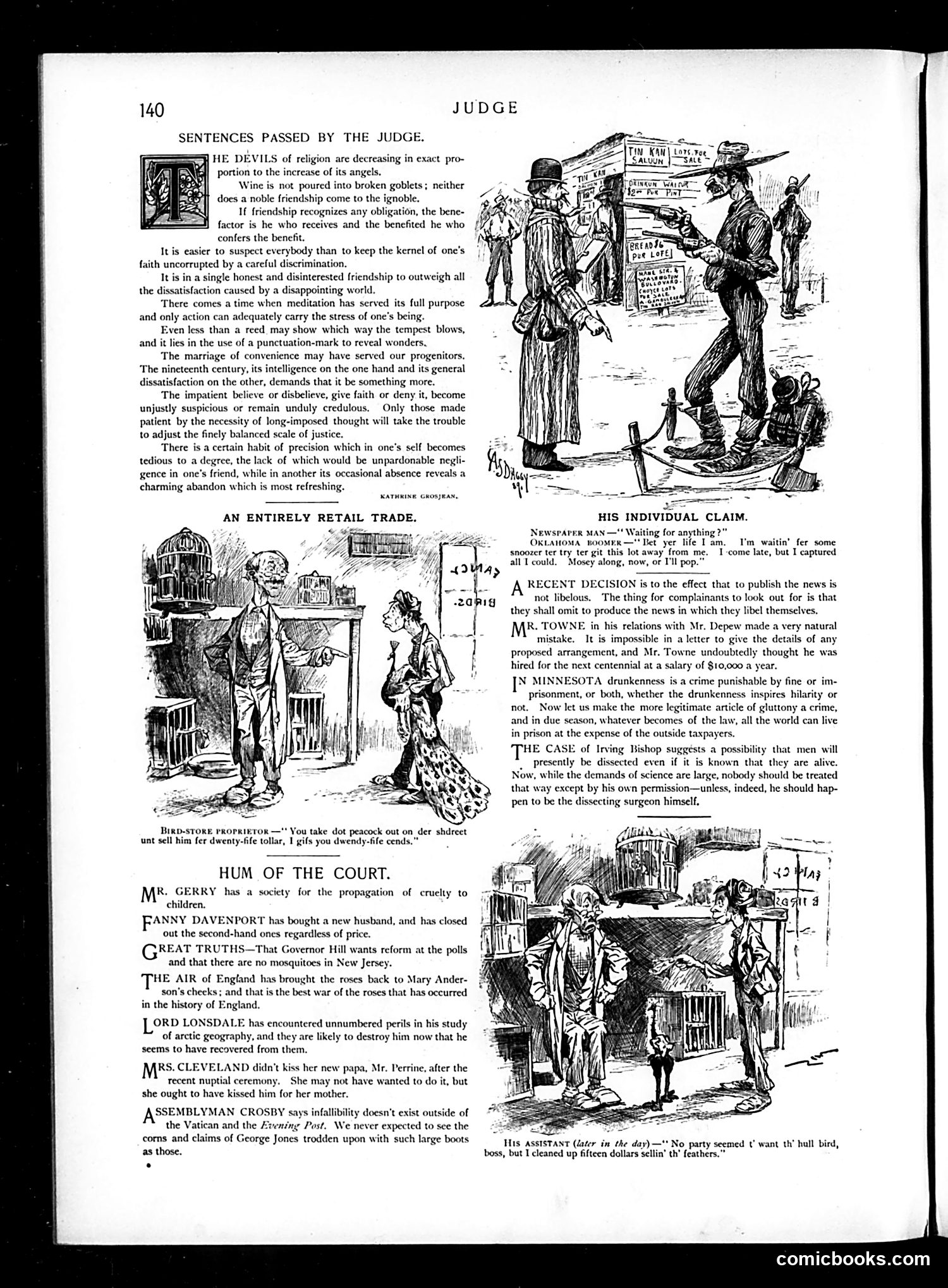
This page from *Judge* (a 19th-century satirical weekly) contains philosophical aphorisms and brief satirical items mocking contemporary figures and events. **"Sentences Passed by the Judge"** opens with moral observations about religion, friendship, and character—apparently the magazine's editorial voice dispensing wisdom. **"His Individual Claim"** lampoons an Oklahoma homesteader claiming land during the Oklahoma Land Rush, speaking in exaggerated frontier dialect. **"An Entirely Retail Trade"** shows a bird-store owner scheming to resell a peacock. **"Hum of the Court"** includes quick jabs: mocking "Mr. Gerry" (likely the Society for Prevention of Cruelty to Children founder), actress Fanny Davenport's remarriage, Governor Hill's reform promises, and actress Mary Anderson's improved complexion from English air. The cartoon illustrations accompany these items with period engravings depicting the scenarios. The overall tone is light social commentary targeting public figures, reformers, and everyday absurdities of the era.
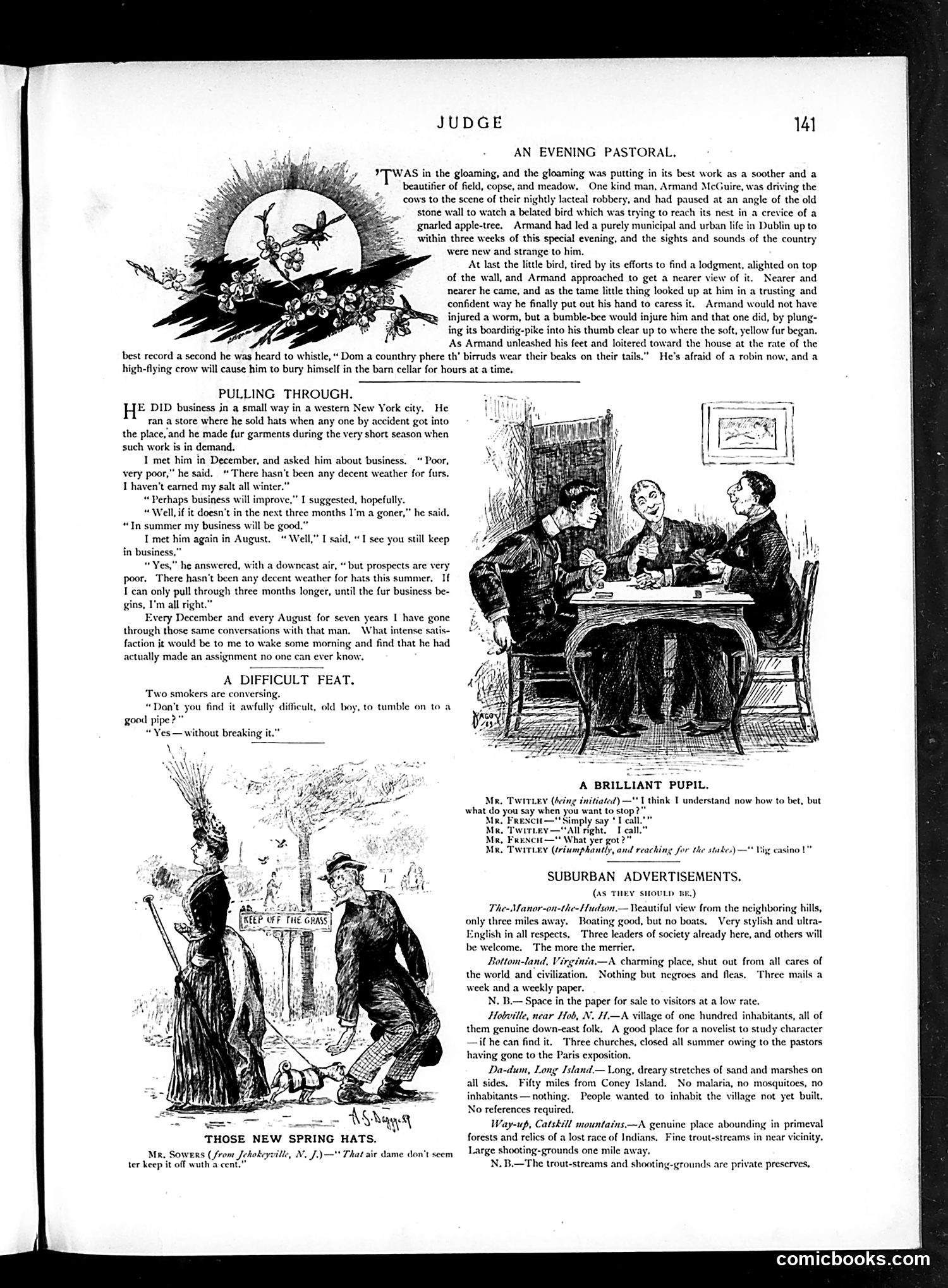
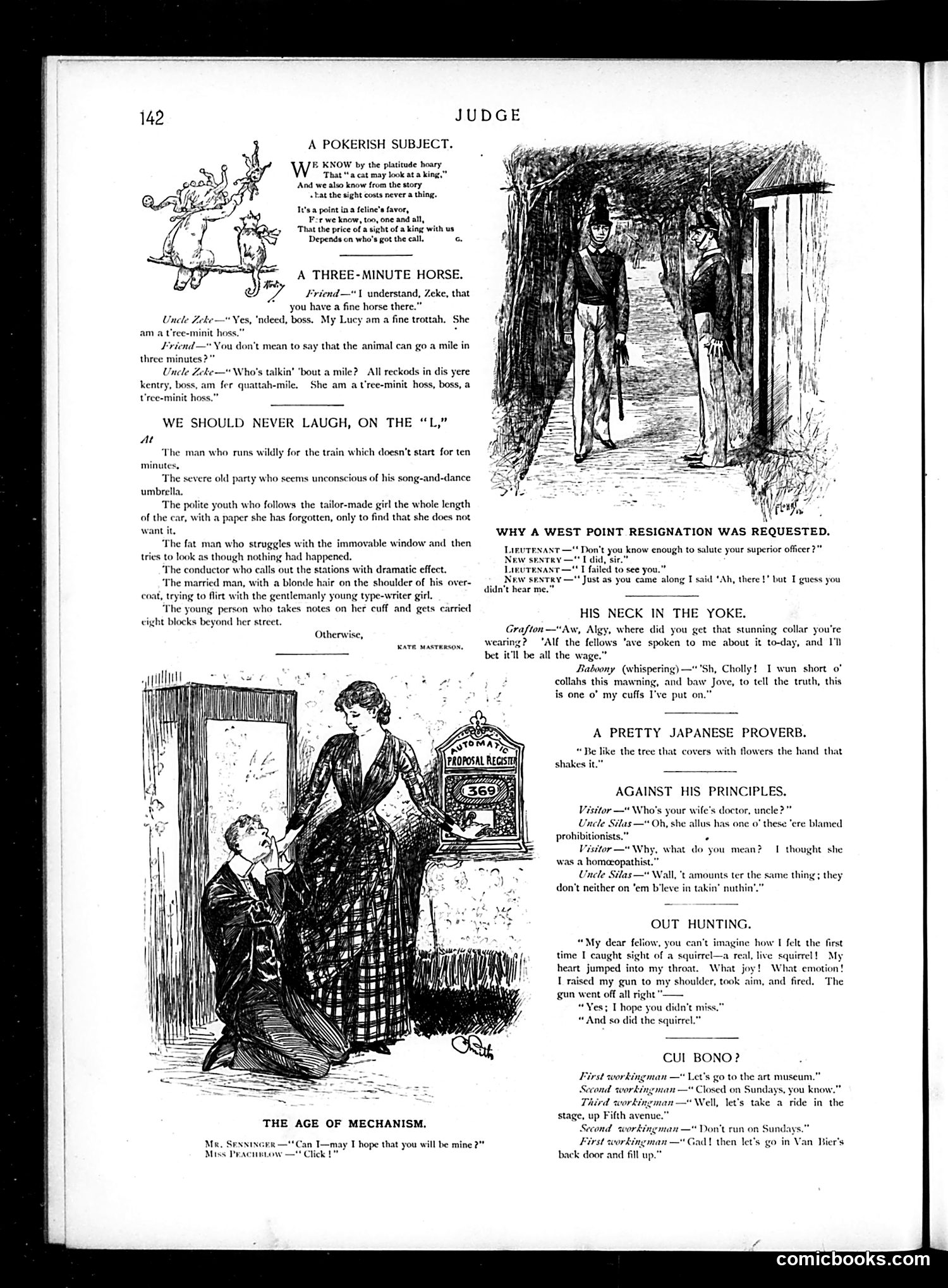
This page contains multiple brief satirical pieces typical of early 20th-century humor: **"A Three-Minute Horse"** mocks dialect-humor stereotypes common to the era, featuring "Uncle Zeke" claiming his horse is a "three-minute hoss"—fast only for a quarter-mile, not a full mile. The joke plays on exaggeration and miscommunication. **"We Should Never Laugh, On the 'L'"** catalogs absurd behaviors on elevated trains (the "L" being Chicago's transit system), including the married man with blonde hair on his coat—suggesting infidelity—and various awkward commuter situations. **"The Age of Mechanism"** shows a woman with a mechanical "proposal register," satirizing the reduction of romance to transactional efficiency. **West Point cartoon** jokes about military protocol and saluting failures. **"Out Hunting"** features ironic humor about a hunter missing a squirrel. The page reflects turn-of-the-century American humor: class-based jokes, ethnic dialect comedy, observations of urban life, and gentle mockery of social conventions and modern inconveniences.
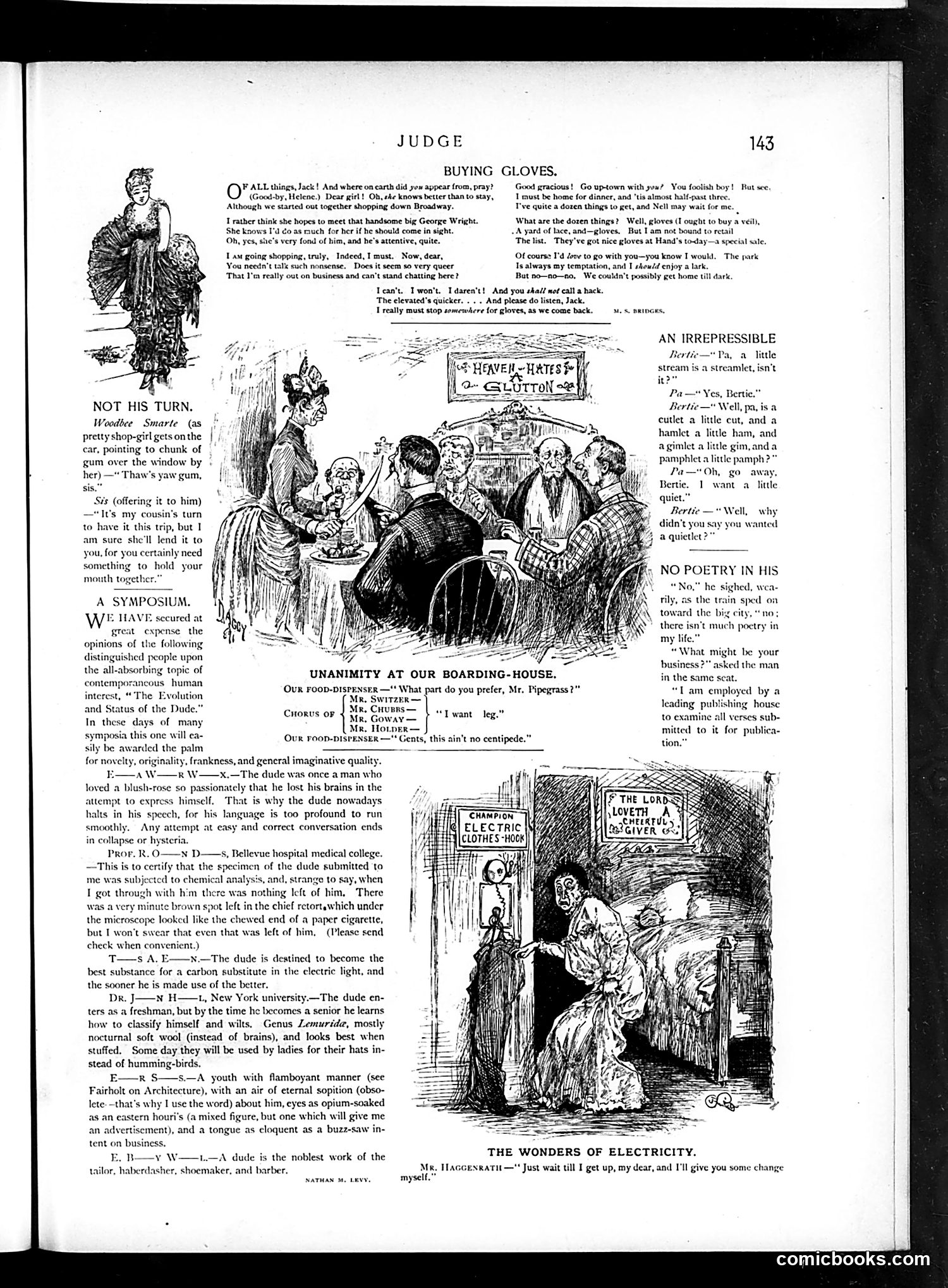
This page contains several brief satirical sketches typical of late 19th-century humor magazines: **"Buying Gloves"** depicts a woman dismissing her male companion's shopping request, citing urgent errands—buying gloves being her primary excuse, repeated throughout. The satire targets women's shopping habits and their use of elaborate pretexts to avoid male company. **"Not His Turn"** shows a streetcar exchange where a working-class girl offers chewing gum to a man, claiming it's her cousin's turn to share it. The humor relies on crude hygiene jokes and class-based mockery. **"A Symposium"** presents mock-academic opinions defining "the Dude"—a contemporary figure representing an affected, intellectually vacant young man. Multiple supposed experts (professors, physicians) provide absurdist definitions suggesting the dude lacks substance entirely. The remaining sketches ("An Irrepressible," "No Poetry in His") are brief comedic dialogues about wordplay and a publishing house employee who examines submitted poetry. These reflect period prejudices about gender, class, and social types through punching-down humor.
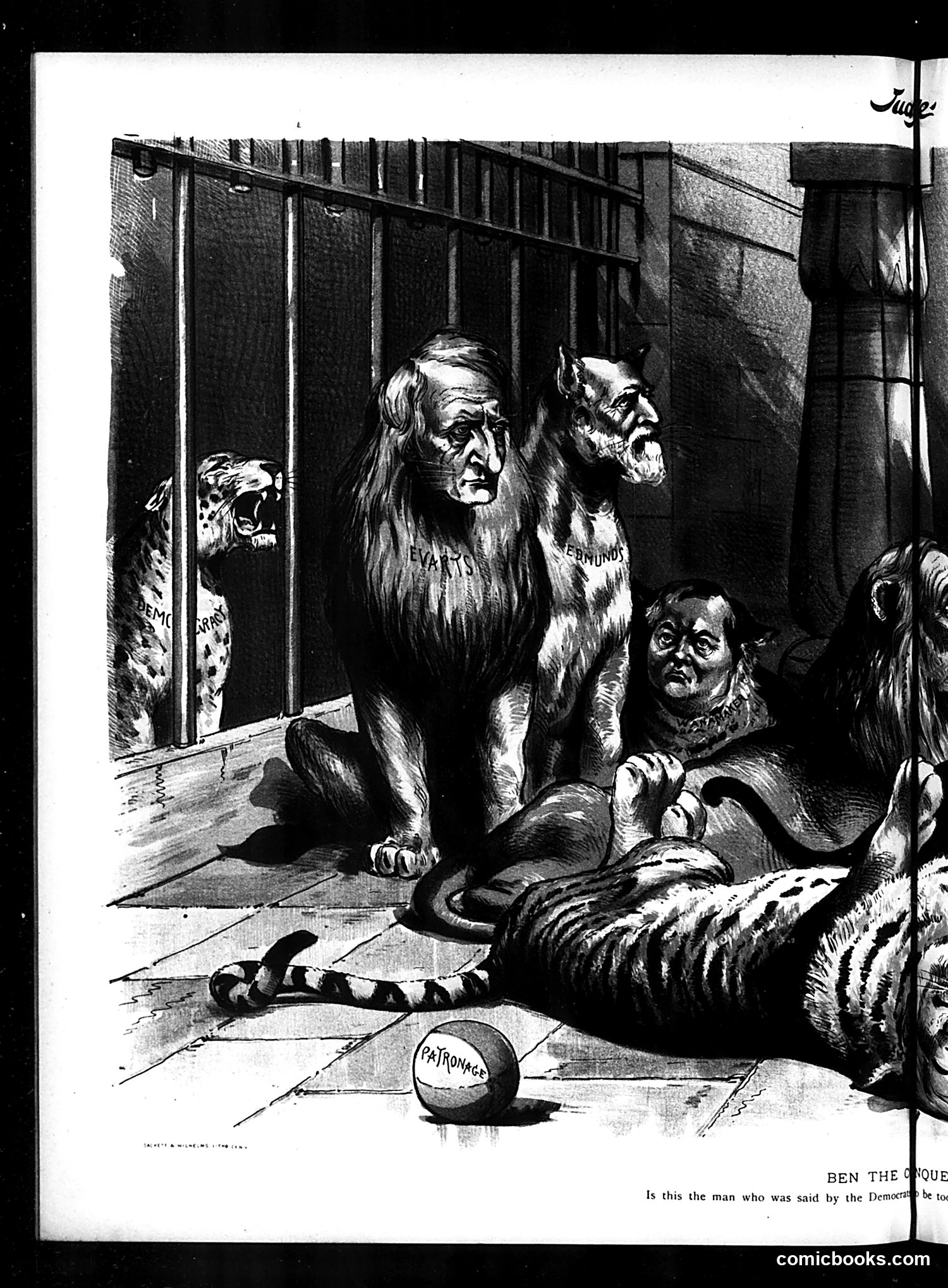
This is a satirical cartoon titled "BEN THE GNQUE" (likely "Ben the Unique"). The image depicts a man with exaggerated facial features in what appears to be a jail or cage setting, surrounded by grotesque animal-like figures. A ball labeled "PATRONAGE" sits on the floor. The cartoon appears to reference a Democratic political attack, as suggested by the incomplete caption: "Is this the man who was said by the Democrats be to..." The satire likely critiques either the character or appearance of a specific political figure, using exaggeration and animalistic imagery typical of 19th-century political commentary. Without more context or a complete caption, the specific identity and full political meaning remain unclear, though the "patronage" reference suggests criticism of political favoritism or corruption.
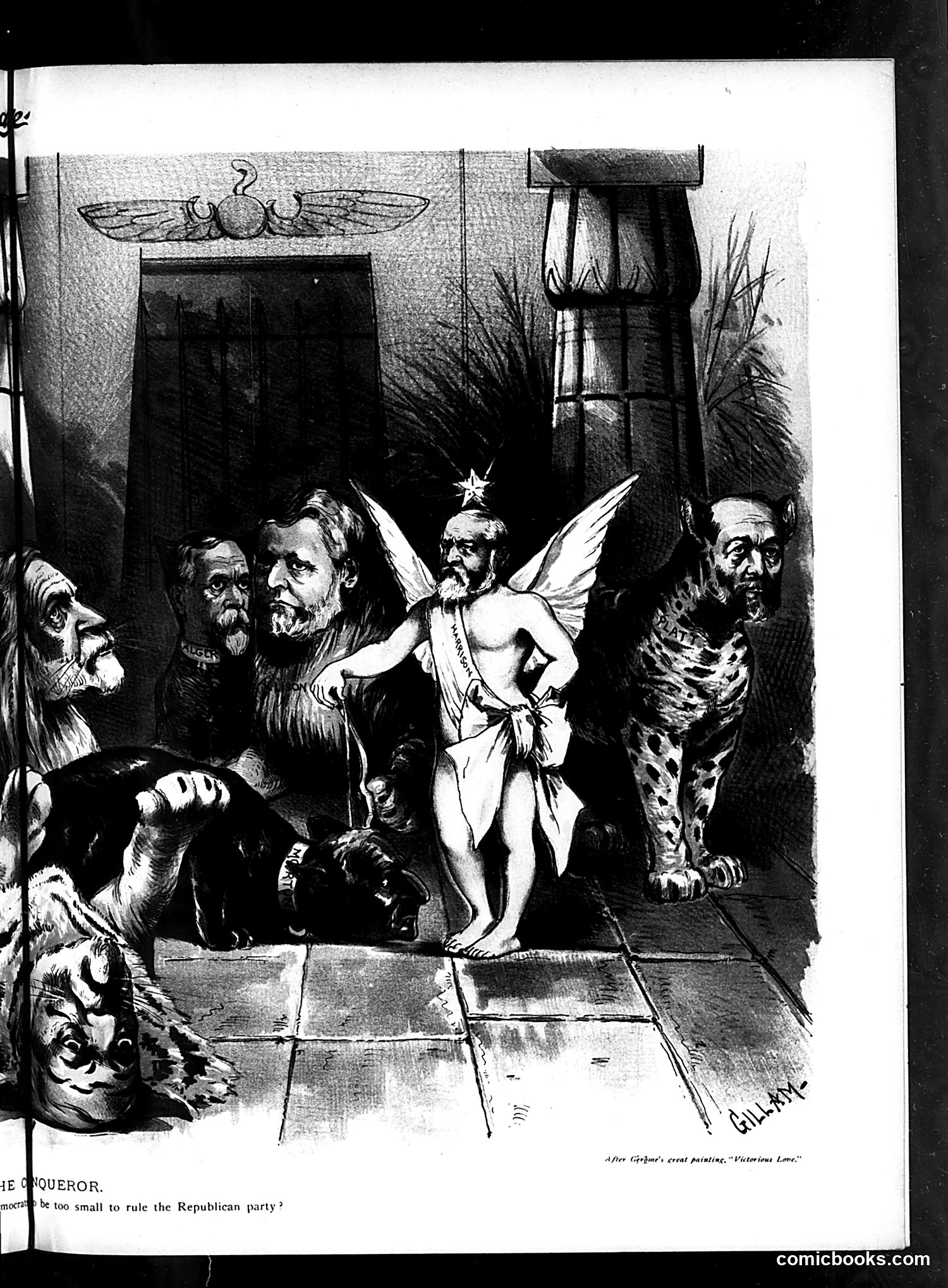
This political cartoon appears to reference a painting called "Victorious Love," reimagined as a satirical commentary on Republican Party leadership. The image shows an angelic or cupid-like central figure surrounded by bearded men in what appears to be an Egyptian or classical setting (suggested by the winged scarab symbol above). The caption "be too small to rule the Republican party?" suggests the cartoon is mocking someone's fitness to lead the party—likely commenting on a specific Republican figure of the era deemed too insignificant or weak for party leadership. The parody of a classical "victorious love" painting, combined with the rhetorical question, indicates Judge magazine is satirizing internal Republican Party politics, though without additional context, the specific figure and historical moment remain unclear.
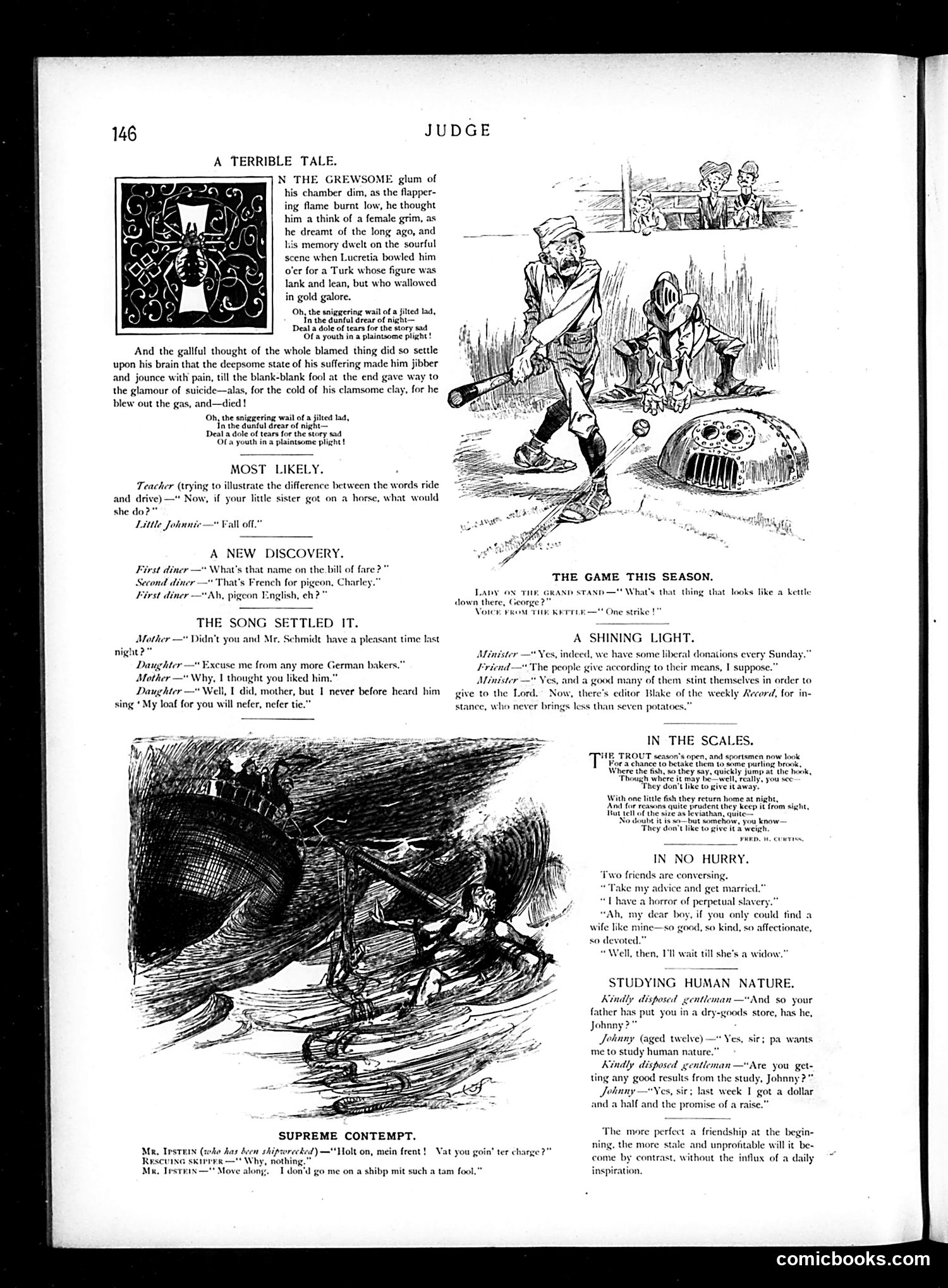
This page from *Judge* contains several short satirical pieces typical of early 20th-century American humor: **"A Terrible Tale"** mocks melodramatic poetry about a jilted lover who commits suicide over a woman who left him for a wealthy Turk. The exaggerated language ("grewsome glum," "plaintsome plight") parodies overwrought Romantic literature. **Other brief jokes** include classroom humor ("Most Likely"), ethnic stereotypes (German bakers, a Jewish character named Stein in "Supreme Contempt"), and observations about human nature—such as fishermen who exaggerate their catches' sizes and a boy learning "human nature" through retail work. **"In the Scales"** jokes about sportsmen's dishonesty regarding their fishing exploits, playing on the phrase "weigh" versus "way." The material reflects period attitudes: casual ethnic humor, cynicism about marriage, and gentle mockery of class pretension and human vanity. Most humor relies on wordplay, puns, and observation rather than political commentary.
This page is primarily **advertisements and poetry/humor pieces**, not political cartoons. The content includes: **Literary Content:** - A romantic poem "A Song" by Eugene Field about Cupid - Several brief humorous anecdotes (small jokes about children, marriages, domestic situations) - "The Four Wishes"—a whimsical poem expressing desire to be various animals (robin, poodle, bluefly) to receive affection the narrator believes they deserve **Political/Social References:** The editorial excerpt mentions Judge's "double-page picture of the four hundred swell New Yorkers bowing down in worship to an English dude, with Washington looking on in disgust"—criticizing wealthy Americans for imitating English fashion and manners. This reflects late-19th-century anxiety about American cultural identity and class affectation. **Advertisements:** Packer's Tar Soap, Pearl Mucilage, Byron Roll, Kodak cameras, pianos, and patent medicines dominate the page. The humor is genteel Victorian domestic comedy rather than sharp political satire.
This page is primarily comprised of classified advertisements and brief humorous quotations rather than political cartoons. The advertisements promote products typical of the 1880s: patent medicines (Barry's Tricopherous hair tonic, Epps's Cocoa), bicycles (Columbia), and financial schemes (European premium bonds and lottery-style bond drawings). The scattered quotations appear to be reprinted joke submissions from various sources (labeled "Merchant Traveler," "Hotel Mail," etc.), offering light social humor about stutterers, Native Americans, business practices, and domestic mishaps. These short quips represent early Reader's Digest-style humor content. The most substantial text piece discusses rheumatism treatments and credits Brooklyn pharmacist Charles Dinnin with developing a "certain cure," likely referring to patent medicine pseudoscience common to the era. Overall, this page reflects Judge's function as a magazine containing advertisements alongside humorous filler content rather than featuring satirical political cartoons.
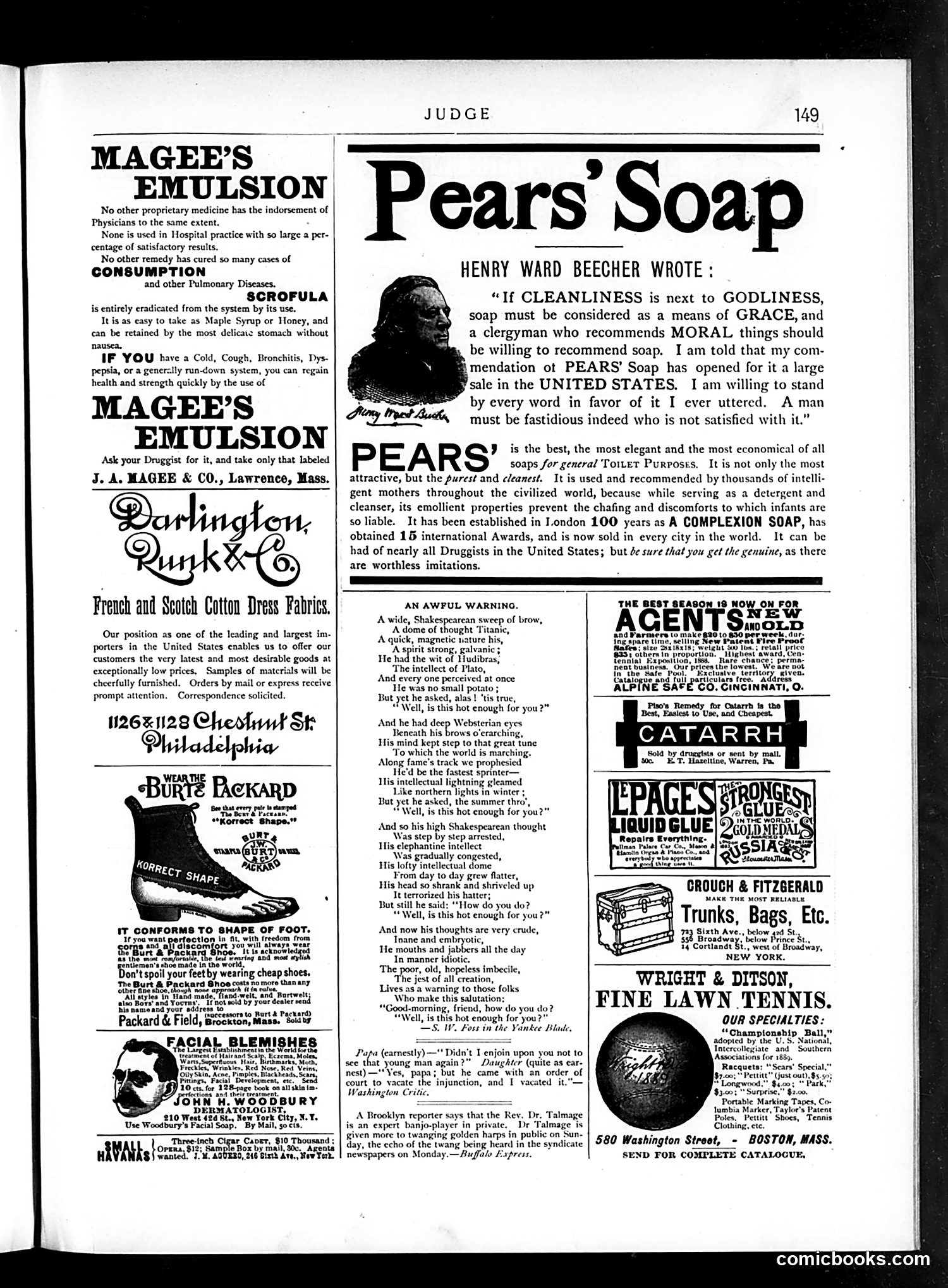
This page is primarily **advertising**, not political satire. It contains multiple product advertisements typical of Judge magazine's era (likely late 1800s). The main featured ad is for **Pears' Soap**, which includes an endorsement attributed to Henry Ward Beecher (a famous 19th-century clergyman) linking cleanliness to godliness. The ad emphasizes the soap's elegance, international awards, and suitability for infants. Below that is a poem titled "An Awful Warning"—a humorous cautionary tale about an intellectually brilliant man (described with hyperbolic classical references: "Shakespearean," "Titanic," "Plato," "Hudibras") who repeatedly asks "Well, is this hot enough for you?"—apparently a tedious conversational habit that undermines his otherwise impressive qualities. Other ads include Magee's Emulsion (a patent medicine for consumption and pulmonary disease), Burr & Packard shoes, Woodbury's facial soap, and various other products. The page reflects the era's embrace of patent medicines and product testimonials as marketing tools.
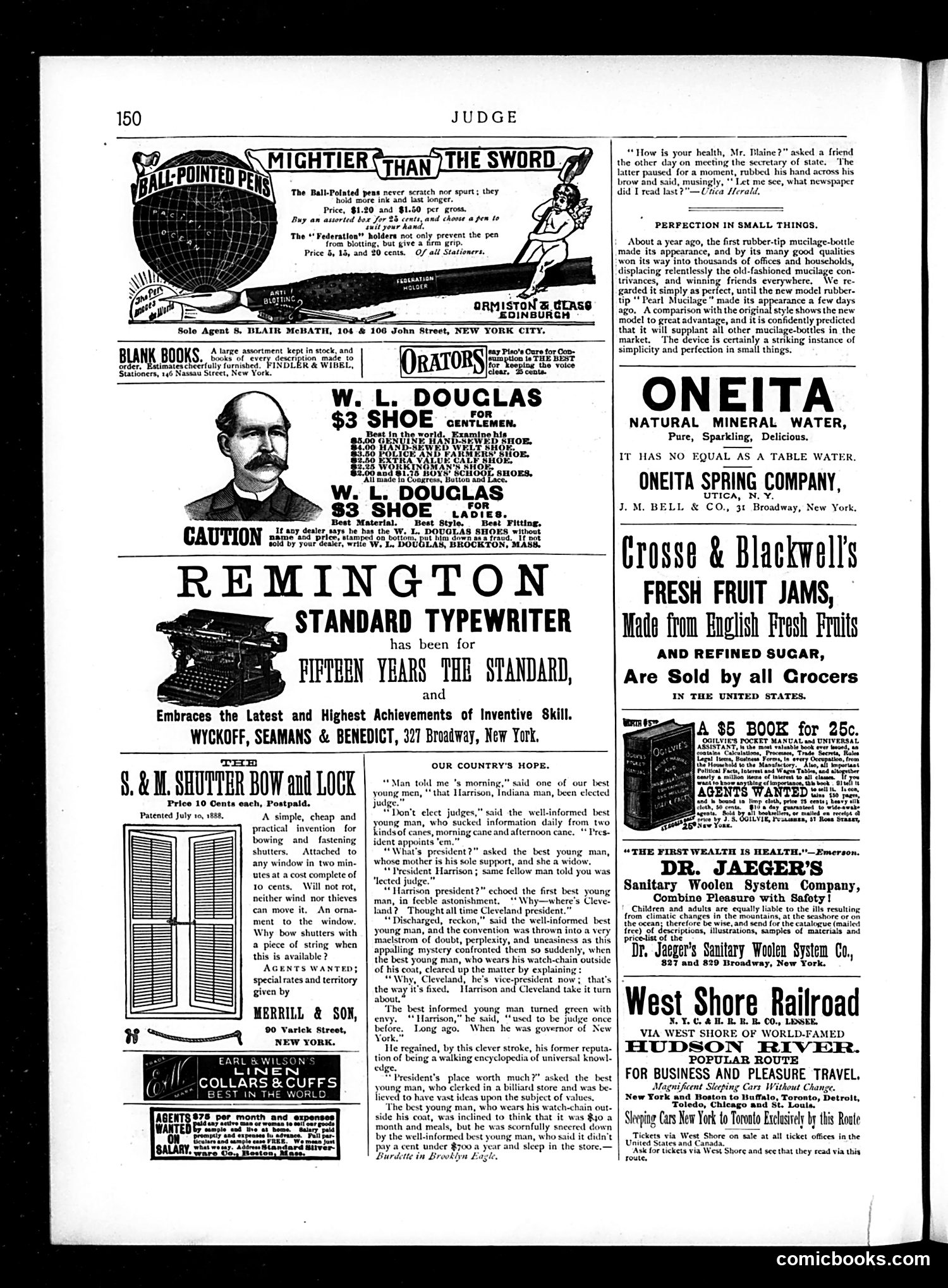
This is primarily an **advertising page** from Judge magazine, with one notable satirical piece titled "Our Country's Hope." The main cartoon/article satirizes American political ignorance among young men during the 1888 presidential election (Harrison vs. Cleveland). It depicts a fictional conversation where poorly-informed youths discuss politics, with comic misunderstandings: one character thinks Cleveland and Harrison "take turns" being president, another believes the presidency pays only "$40 a month and meals." The satire targets **widespread civic ignorance**—the young men rely on gossip from "two bits of canes, morning cane and afternoon cane" (unclear reference, possibly slang) rather than actual knowledge. The joke is that these supposedly "best young men" are shockingly uninformed about basic governmental structure. The rest of the page contains typical period advertisements (typewriters, shoes, jams, books), with minimal satirical content. The small humor piece at bottom about Secretary Blaine making a joke about reading newspapers is unrelated.
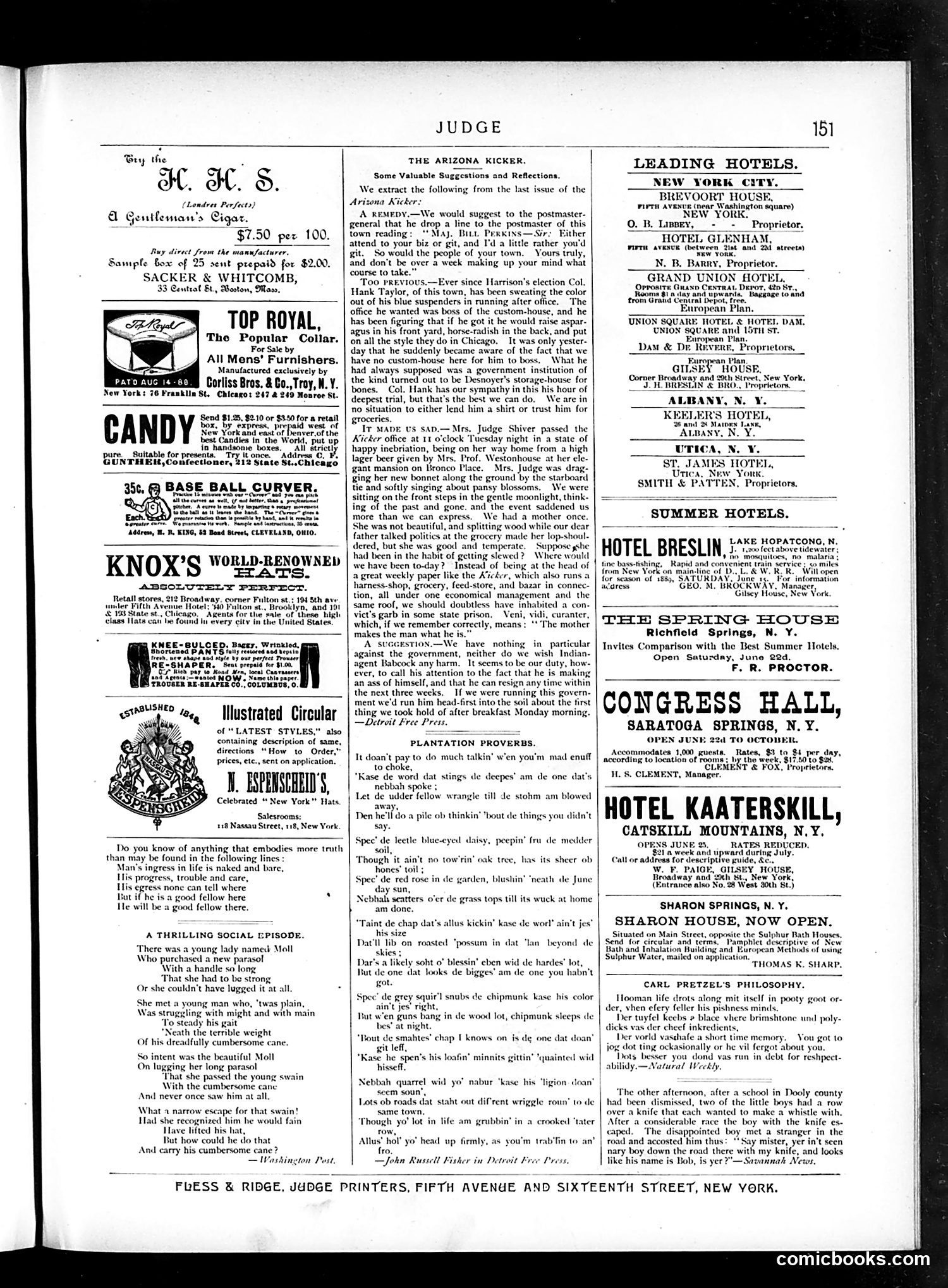
This page is primarily **advertising and filler content**, not political satire. It contains numerous commercial advertisements for cigars, collars, candy, baseball equipment, hats, and patent devices typical of late 19th-century magazines. The only substantive editorial content includes: 1. **"The Arizona Kicker"** column—satirical frontier commentary mocking a local postmaster's incompetence and a Colonel's premature job-seeking after Harrison's election, suggesting disappointment that the town lacks expected federal offices. 2. **"A Thrilling Social Episode"** poem—a humorous narrative about a young woman with an unwieldy parasol passing an intoxicated man with a cumbersome cane, neither noticing the other. 3. **Philosophical verse** on human mortality and morality. The "Arizona Kicker" implies criticism of post-election patronage expectations and bureaucratic incompetence, but lacks specific identifying figures. The overall page reflects Judge's mix of advertising revenue with light satirical commentary rather than hard-hitting political cartoons.
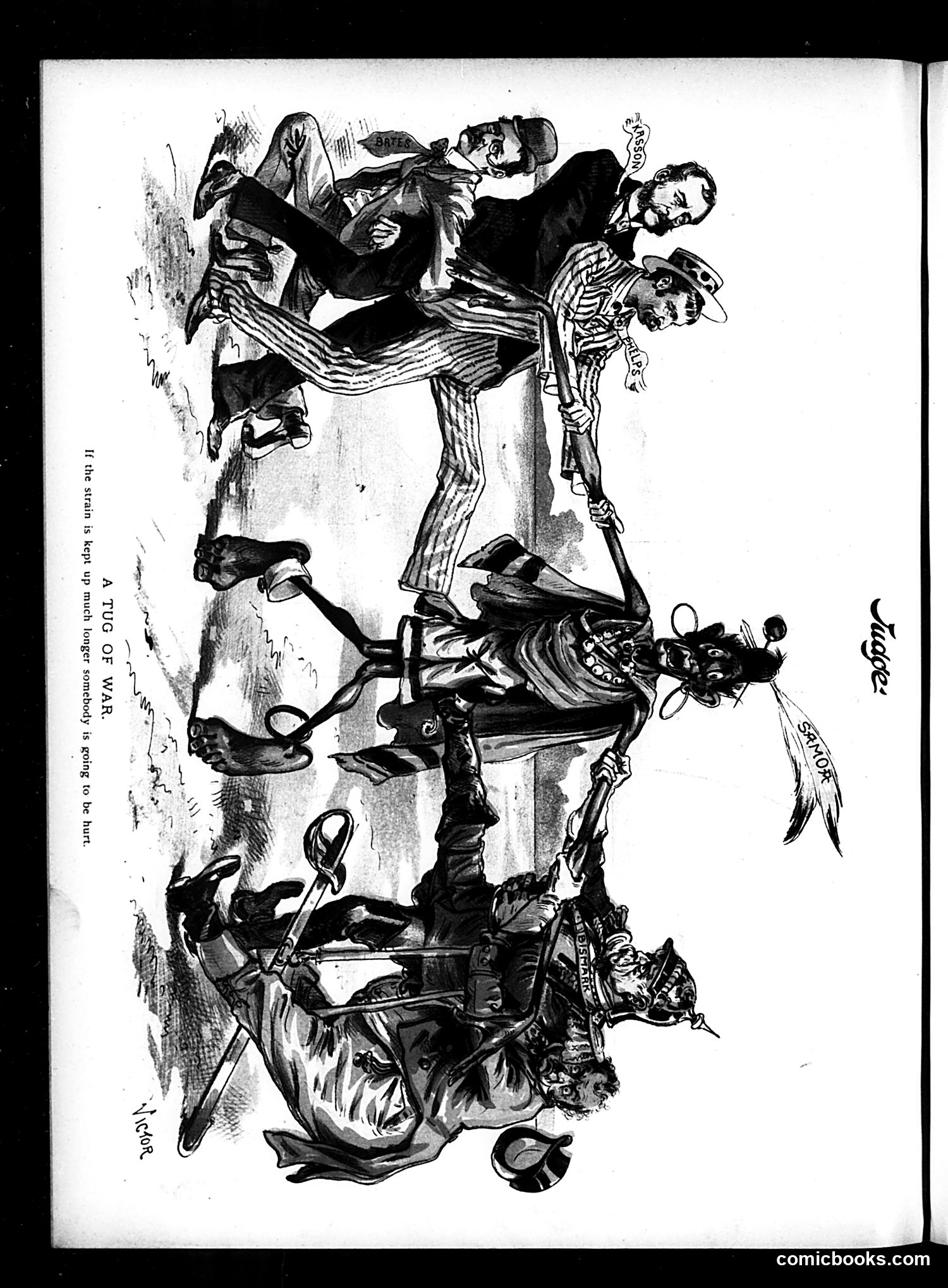
This Judge cartoon satirizes political conflict through a literal tug-of-war. The image shows multiple figures engaged in a struggle over what appears to be a disputed object or position, with the caption warning that "if the strain is kept up much longer somebody is going to be hurt." The cartoon likely references a high-stakes political dispute of its era—possibly a cabinet conflict, power struggle within government, or contested election. The exaggerated physical depiction emphasizes how various political factions are tearing apart the body politic through their intense rivalry. Without a visible date or additional identifying text, the specific controversy remains unclear, but the central message warns that sustained political conflict threatens harm to the nation or its institutions.