
A complete issue · 18 pages · 1889
Judge — June 1, 1889
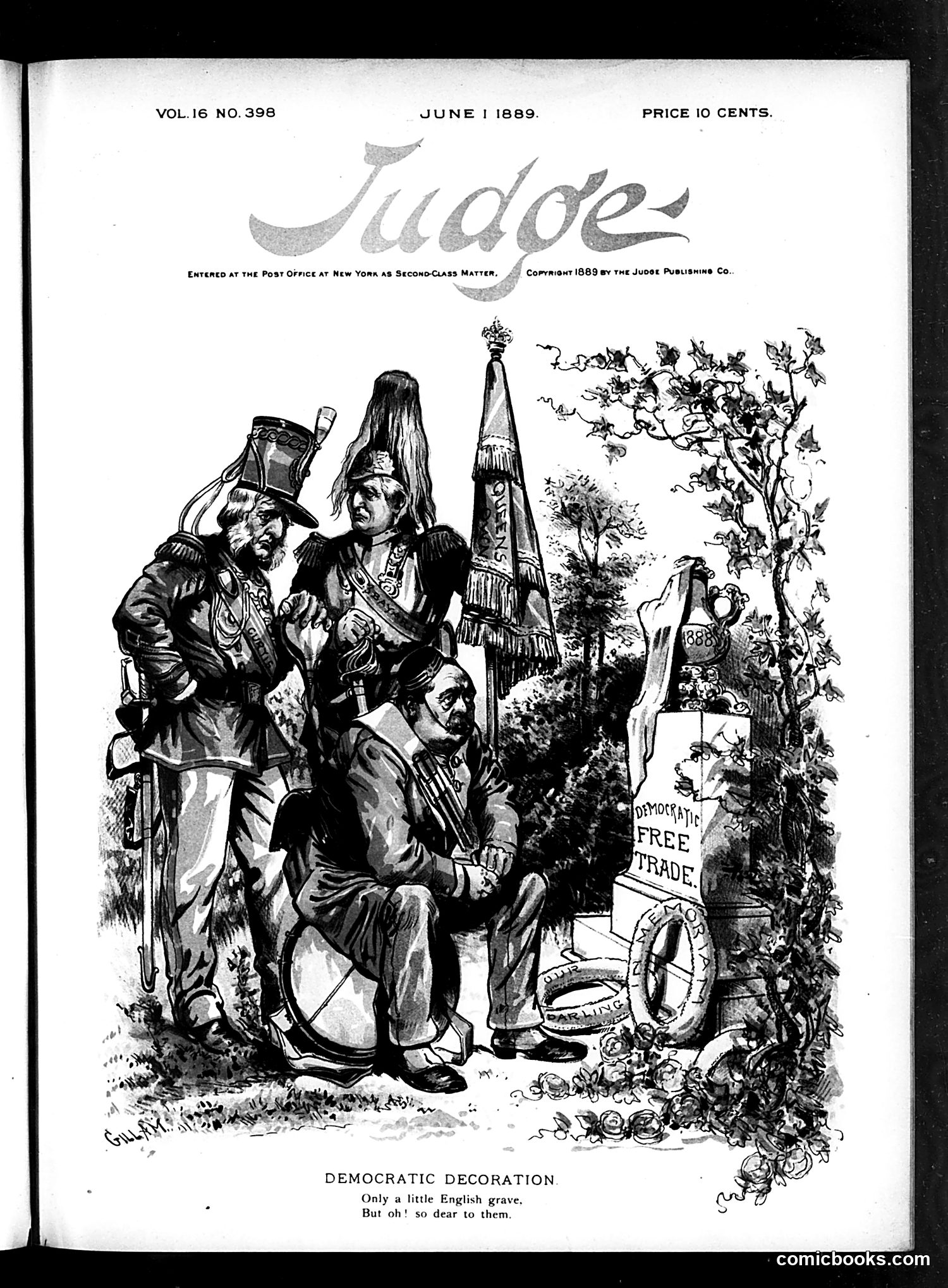
This cartoon from Judge (June 1, 1889) satirizes Democratic Party leadership through military imagery. The caption reads "Only a little English grave, / But oh! so dear to them." The illustration shows what appear to be Democratic leaders in ornate military dress uniforms standing over a grave marked "Democratic / Free Trade" with a "Barring" (tariff barrier) symbol. The elaborate uniforms and formal poses mock the party's pretension, while the grave suggests the Democrats consider protective tariffs—a key Republican policy—as something they've defeated or buried. The satire critiques Democrats for celebrating what Republicans viewed as economically harmful policies. The "English grave" reference appears to mock the Democrats' alignment with free-trade ideology associated with British economics, which opponents saw as detrimental to American industry.
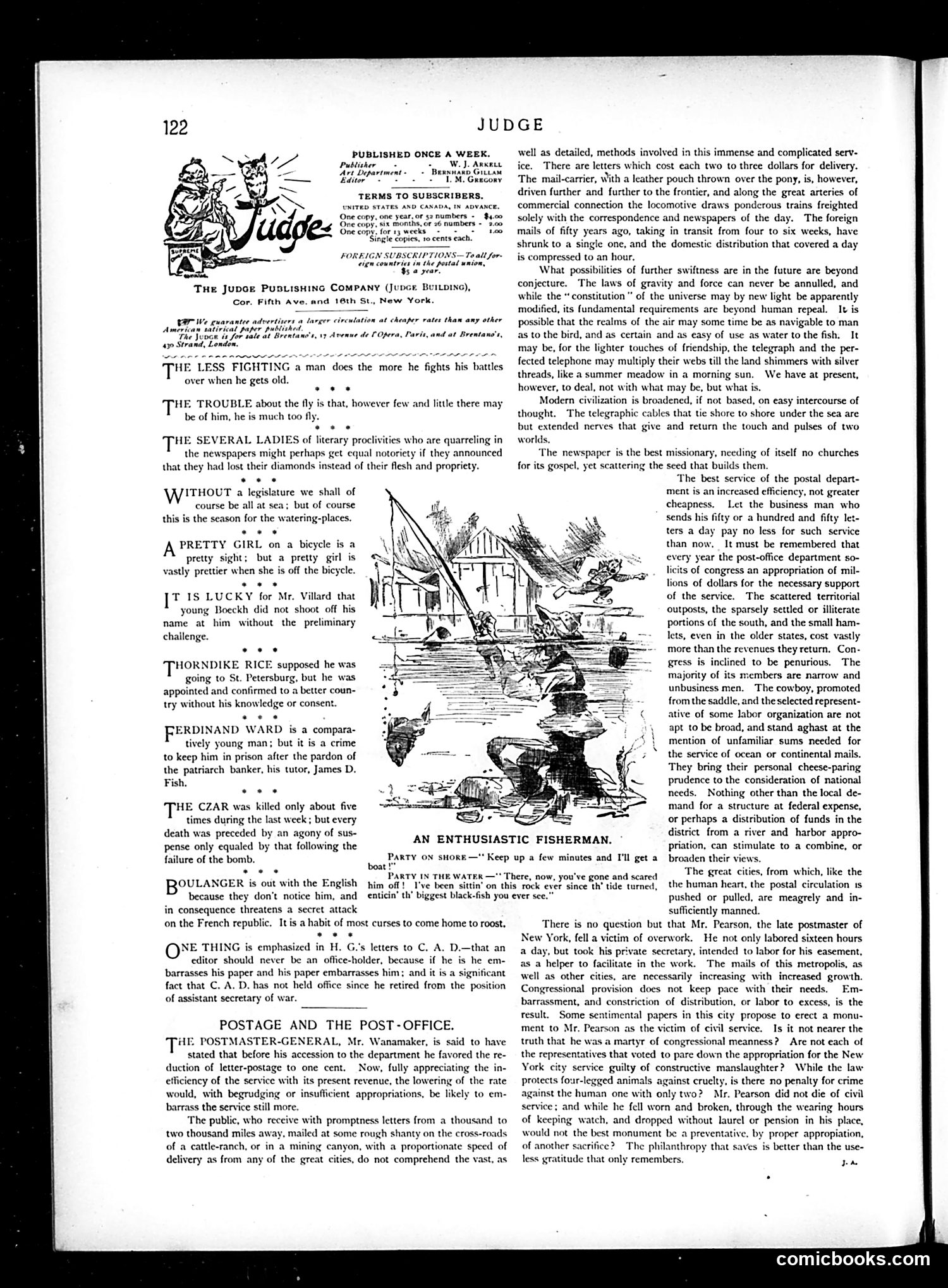
This page contains editorial commentary rather than political cartoons. The main illustration depicts "An Enthusiastic Fisherman" — a humorous scene of someone fishing from rocks, likely serving as a visual break in the text rather than satire. The written pieces address various contemporary topics: postal service inefficiency (the Postmaster-General's failure to improve letter-postage), concerns about congressional representatives from Southern states, and critiques of business and labor practices. One section discusses Mr. Pearson, the late New York postmaster, as a victim of political mismanagement. The satire targets governmental incompetence and the disconnect between congressional promises and actual service delivery — recurring themes in Judge's social criticism. Without clearer visual caricatures or dated references, the specific political figures remain unclear.
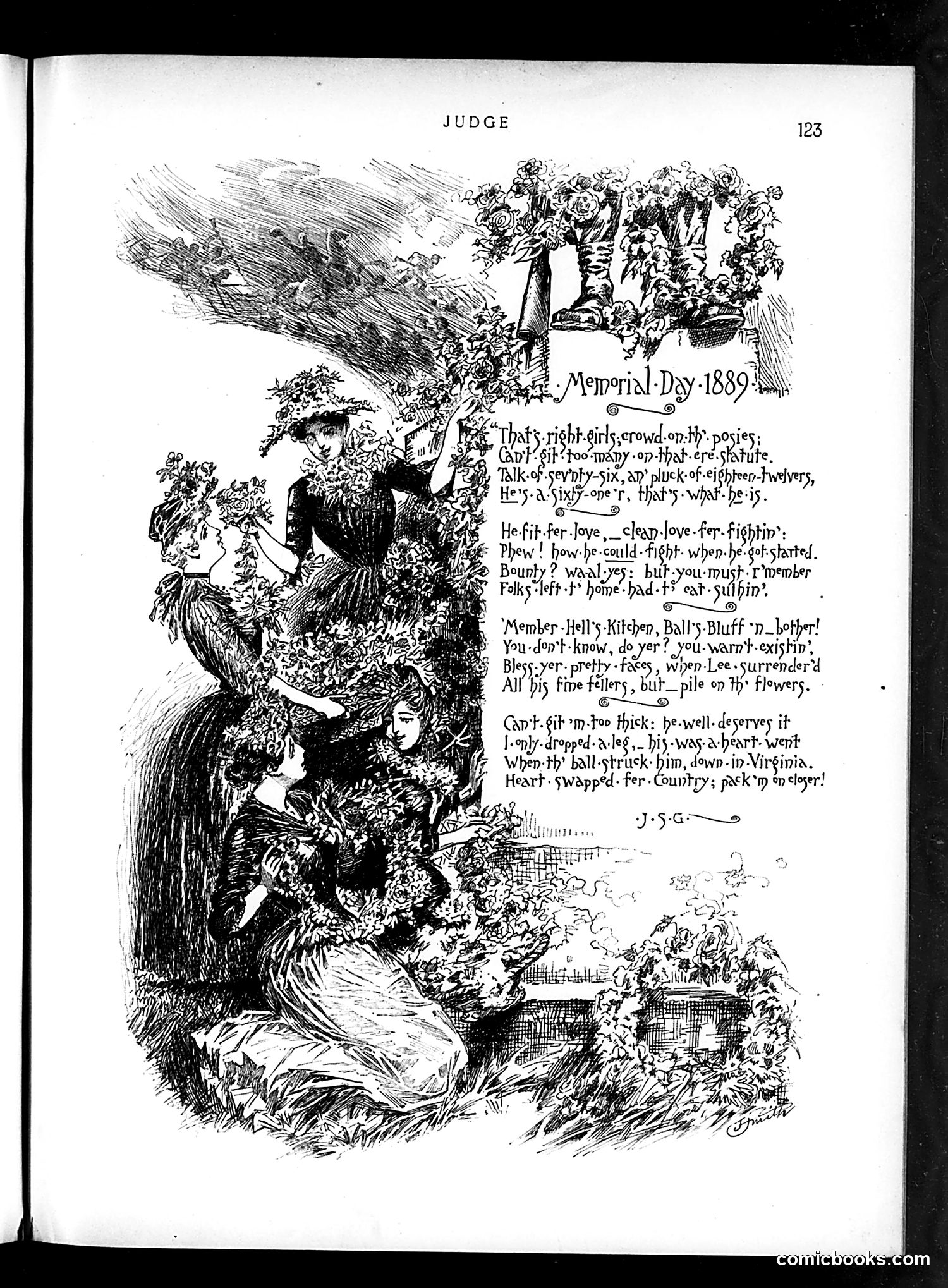
This is a sentimental Memorial Day cartoon from 1889, four years after the Civil War ended. The illustration shows women decorating a soldier's grave with flowers while an elderly veteran recounts his comrade's service. The text uses dialect verse to recall a fallen soldier—references to "Hell's Kitchen" and "Ball's Bluff" (actual Civil War battle sites), mentions of enlistment bounties, and combat details. The veteran emphasizes the soldier's sacrifice: he lost a leg in battle ("dropped a leg") in Virginia, yet gave his life for his country. The satire appears gentle—honoring working-class soldiers ("seventy-six") while perhaps suggesting that common soldiers deserved more recognition than officers received. The emotional, vernacular tone makes the tribute democratic rather than elite, capturing how ordinary Americans memorialized their war dead.
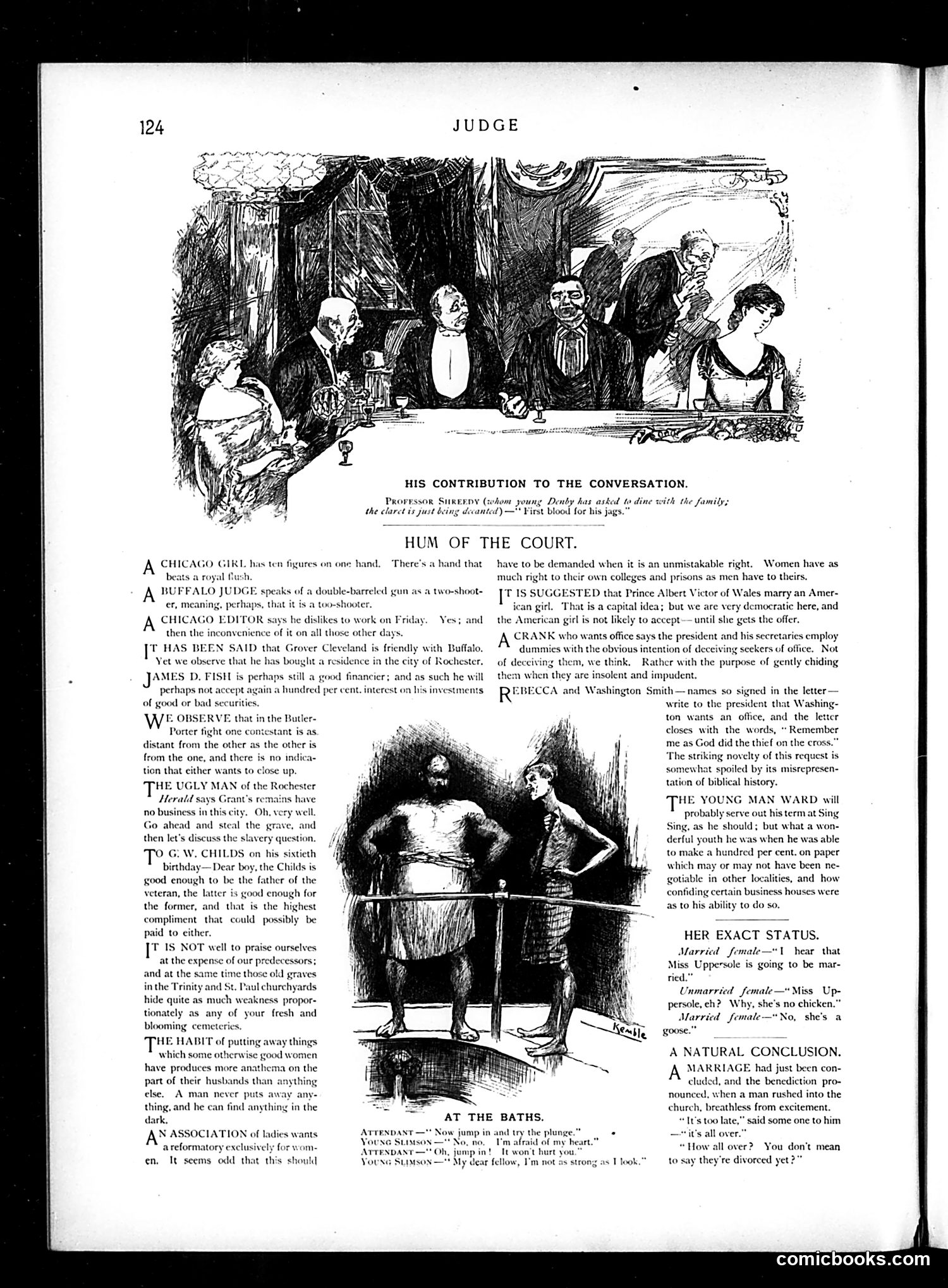
This page from the satirical magazine *Judge* contains multiple short jokes and commentary on 1880s American society: **"His Contribution to the Conversation"** mocks a pedantic professor who dominates dinner conversation with pretentious wine knowledge. **"Hum of the Court"** collects brief satirical observations: a Chicago girl's wealth, a Buffalo judge's malapropisms, Grover Cleveland's property dealings, and commentary on financial speculation (likely referencing James D. Fish and financial scandals). **"At the Baths"** humorously depicts a nervous young man hesitant to swim, claiming heart concerns while admitting weakness. **"Her Exact Status"** plays on the ambiguous social position of unmarried women—called "no chicken" when single, dismissed as a "goose" when married. **"A Natural Conclusion"** depicts the darkly comedic moment when a latecomer asks if the wedding is "all over," with someone misinterpreting this as asking about divorce. The cartoons and brief items reflect era-specific concerns: class anxieties, gender roles, financial schemes, and social propriety—typical *Judge* content targeting educated urban readers.
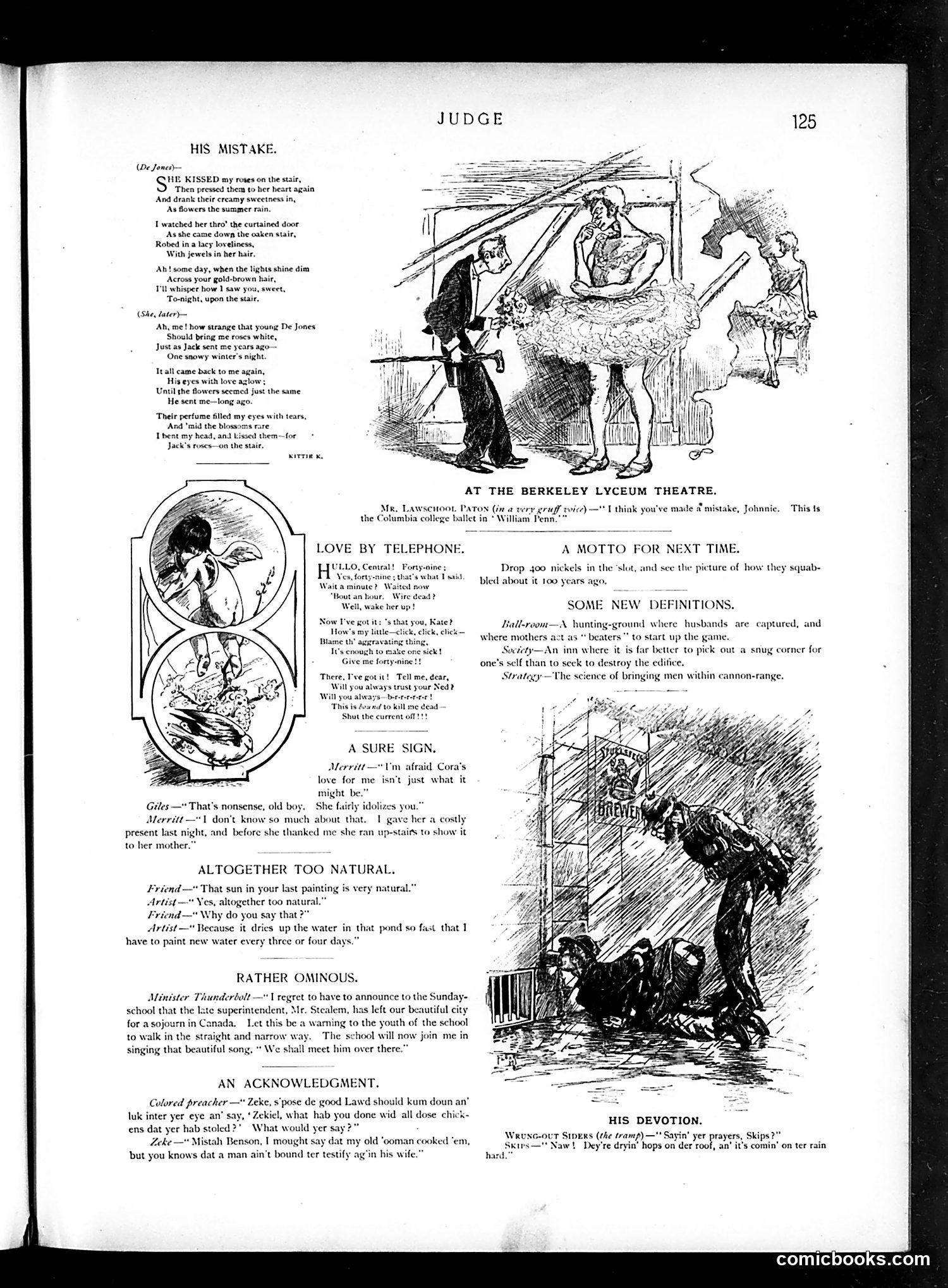
This page contains multiple short humorous pieces typical of early 20th-century satirical magazines: **"His Mistake"** presents a romantic misunderstanding: a man (De Jones) believes a woman appreciated his roses when she actually mistook them for flowers from an old love (Jack), creating ironic pathos. **"Love by Telephone"** mocks the novelty of telephone technology and early cinema, suggesting lovers argue about trivial matters. **"At the Berkeley Lyceum Theatre"** appears to reference a specific ballet performance, likely poking fun at pretentious cultural institutions. The remaining sections—"A Sure Sign," "Altogether Too Natural," "Rather Ominous," and "An Acknowledgment"—are brief comic dialogues exploiting stereotypes: a woman's materialism, an artist's impracticality, an embezzling superintendent, and racist dialect humor involving Black characters. **Social commentary:** These pieces reflect period attitudes toward courtship, emerging technology, class pretension, and unfortunately, deeply offensive racial stereotyping common to the era.
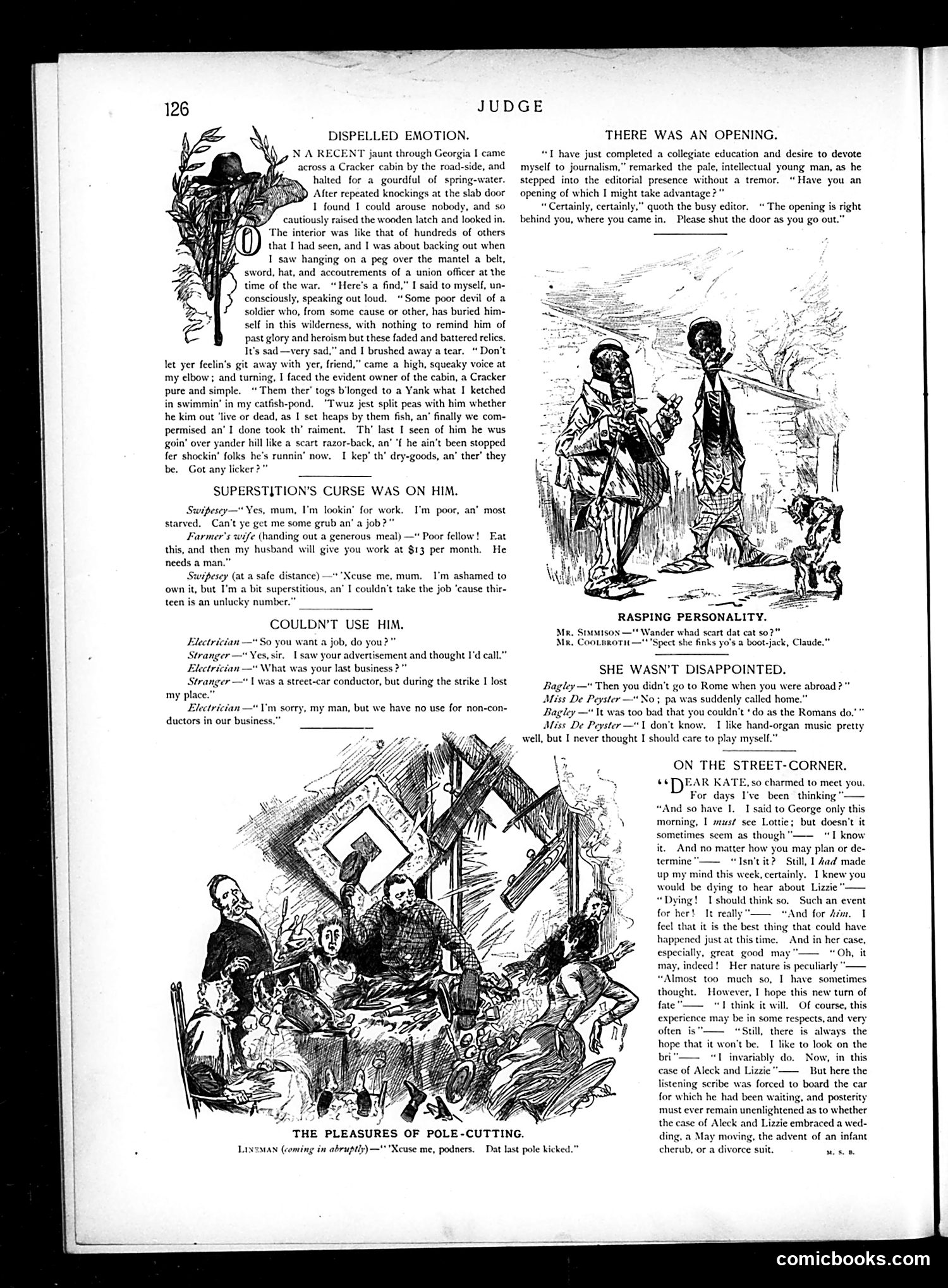
This page contains several satirical short pieces typical of Judge magazine's humor: **"Dispelled Emotion"** depicts a Northerner's sentimental misreading of a Union officer's uniform in a cabin. A poor Southern "Cracker" reveals he actually stole the uniform from a Yankee soldier he caught swimming—deflating the romantic notion of Civil War sacrifice with crude frontier pragmatism. The satire mocks both Northern sentimentality about the war and Southern rural stereotypes. **Other brief comedic sketches** include: - A superstitious job-seeker refusing work due to the unlucky number thirteen - A former streetcar conductor rejected by an electrician (pun on "non-conductors") - A young journalist told the "opening" is the door he should exit through - Various social humor about personality quirks and miscommunication The cartoons use working-class and rural characters as vehicles for wordplay and social observation. The illustrations are detailed pen-and-ink sketches in Judge's typical style. Overall, the page represents genteel Victorian-era American humor aimed at urban, educated readers.
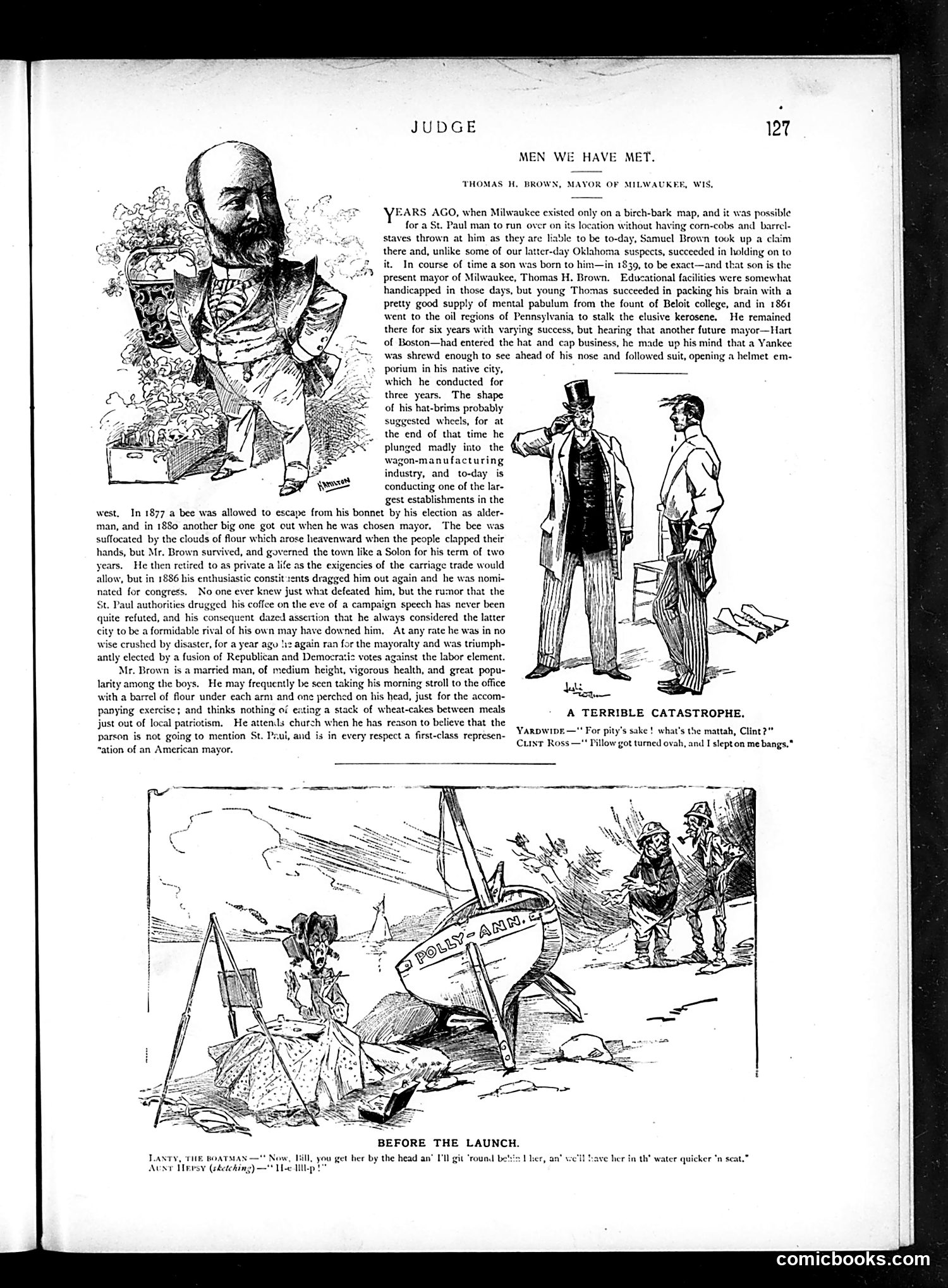
This is a biographical profile of Thomas H. Brown, Milwaukee's mayor, written in Judge's characteristic satirical style. The text traces Brown's rise from frontier origins through various business ventures (kerosene, hats, wagons) to political success. The satire lies in the exaggerated heroic tone applied to mundane accomplishments—his election described as "bees escaping from his bonnet," his defeated congressional bid blamed on drugged coffee by rival St. Paul. The final jab mocks his civic boosterism: he's devoted to his city except when it involves St. Paul, and eats enormous quantities of wheat-cakes as patriotic exercise. The two cartoons below provide comic relief: one shows a domestic disaster (a pillow mishap), the other depicts confused boatmen launching a vessel—unrelated humor typical of Judge's format.
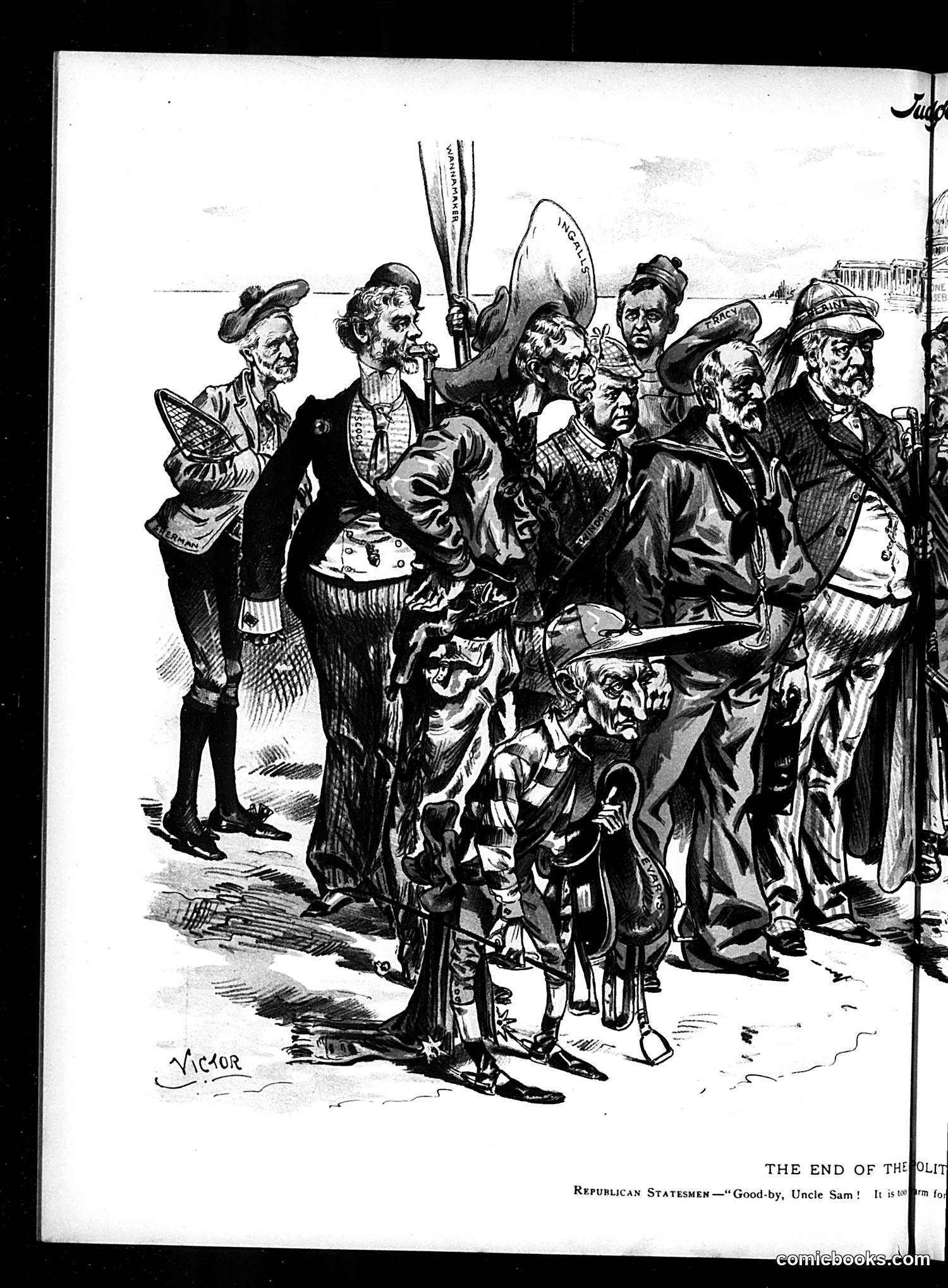
This political cartoon, titled "The End of the [Republican] Statesmen," depicts a group of well-dressed men bidding farewell to Uncle Sam (the figure in military dress in the center). The caption reads: "Good-by, Uncle Sam! It is..." The image satirizes Republican politicians departing or abandoning their principles. The caricatured figures represent various Republican statesmen, drawn with exaggerated features typical of late 19th/early 20th-century satirical art. The elaborate flag or banner they carry suggests political pageantry being abandoned. Without the complete caption, the specific historical moment is unclear, but the cartoon critiques Republican leadership during a period of political transition. The phrase "end of the" suggests either the end of Republican dominance, the end of an administration, or the end of a particular political era. This type of satire was common in *Judge* magazine's commentary on American politics.
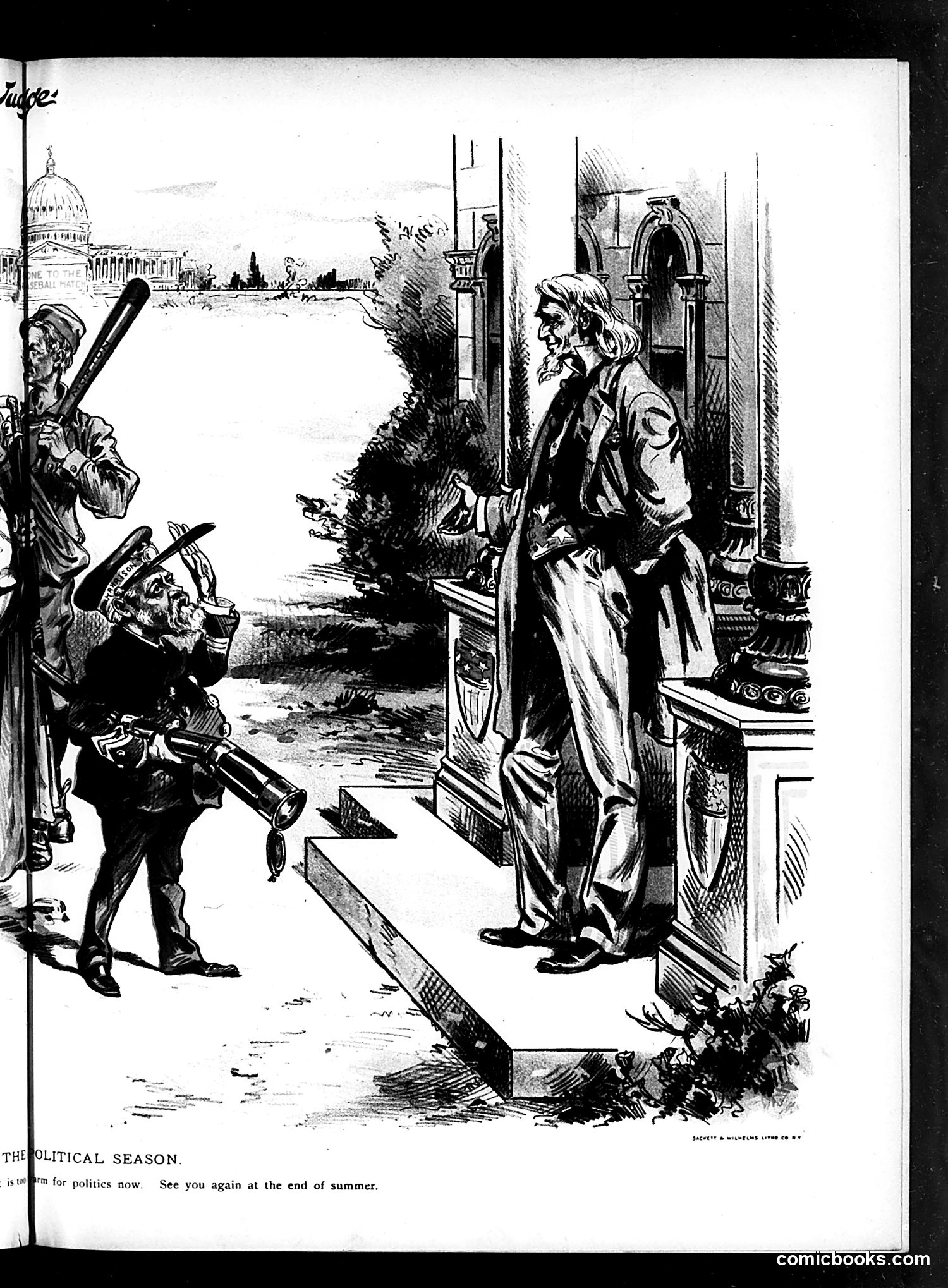
This cartoon satirizes the American political calendar. A well-dressed gentleman (likely representing a politician or political insider) is being ushered out a Capitol building door by a military or uniformed figure, with the caption suggesting it's now off-season for politics—"See you again at the end of summer." The joke references the historical pattern where serious political activity concentrated in specific seasons, with summer traditionally being slower for legislative work. The cartoon mocks how politicians effectively disappear during recess periods, treating politics as a seasonal occupation rather than year-round governance. The Capitol building visible in the background confirms the Washington, D.C. setting. The caricatured figure being ejected suggests political elites treating their duties as temporary employment rather than continuous public service.
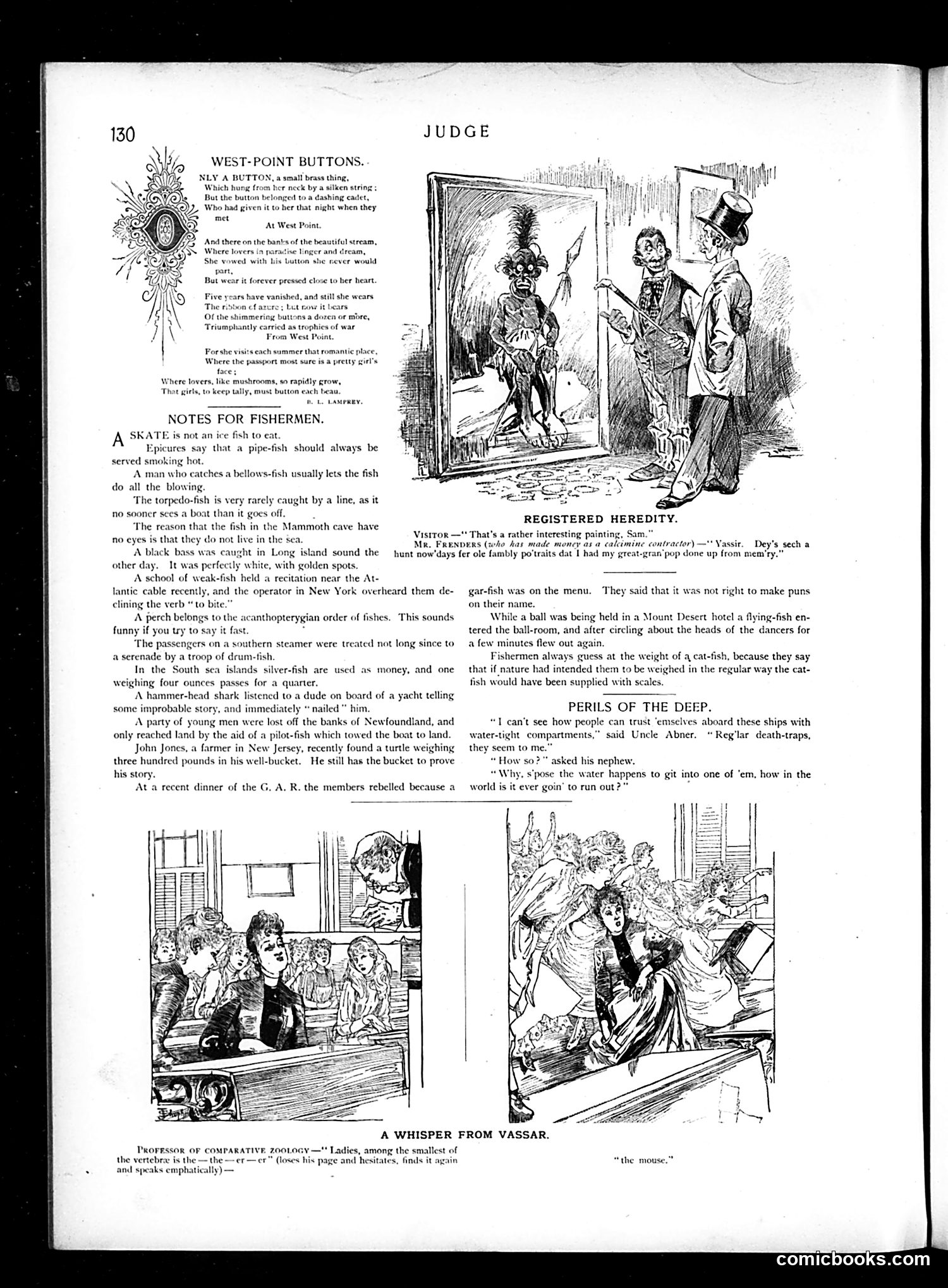
This page contains several distinct satirical pieces typical of Judge's humor: **"West Point Buttons"** (top): A poem mocking young women who collect military uniform buttons from West Point cadets as romantic souvenirs, treating them as trophies of conquest. The satire targets both the frivolous sentimentality of female visitors and the predictable behavior of male cadets. **"Notes for Fishermen"** (middle): Humorous fake "facts" about fish, exploiting puns and absurdities—a common Judge format. Examples include jokes about fish that "decline the verb 'to bite'" and catfish lacking scales because nature didn't intend them to be weighed. **"Registered Heredity"** (right): A brief joke about a man commissioning a portrait painter to copy an ancestor's painting, implying inherited ugliness runs in families. **"Perils of the Deep"** (bottom): Uncle Abner comically misunderstands water-tight compartments on ships, imagining water trapped inside with nowhere to escape. The illustrations depict social scenes and character types typical of 1890s-era satire. The page exemplifies Judge's blend of gentle social mockery, wordplay, and visual humor.
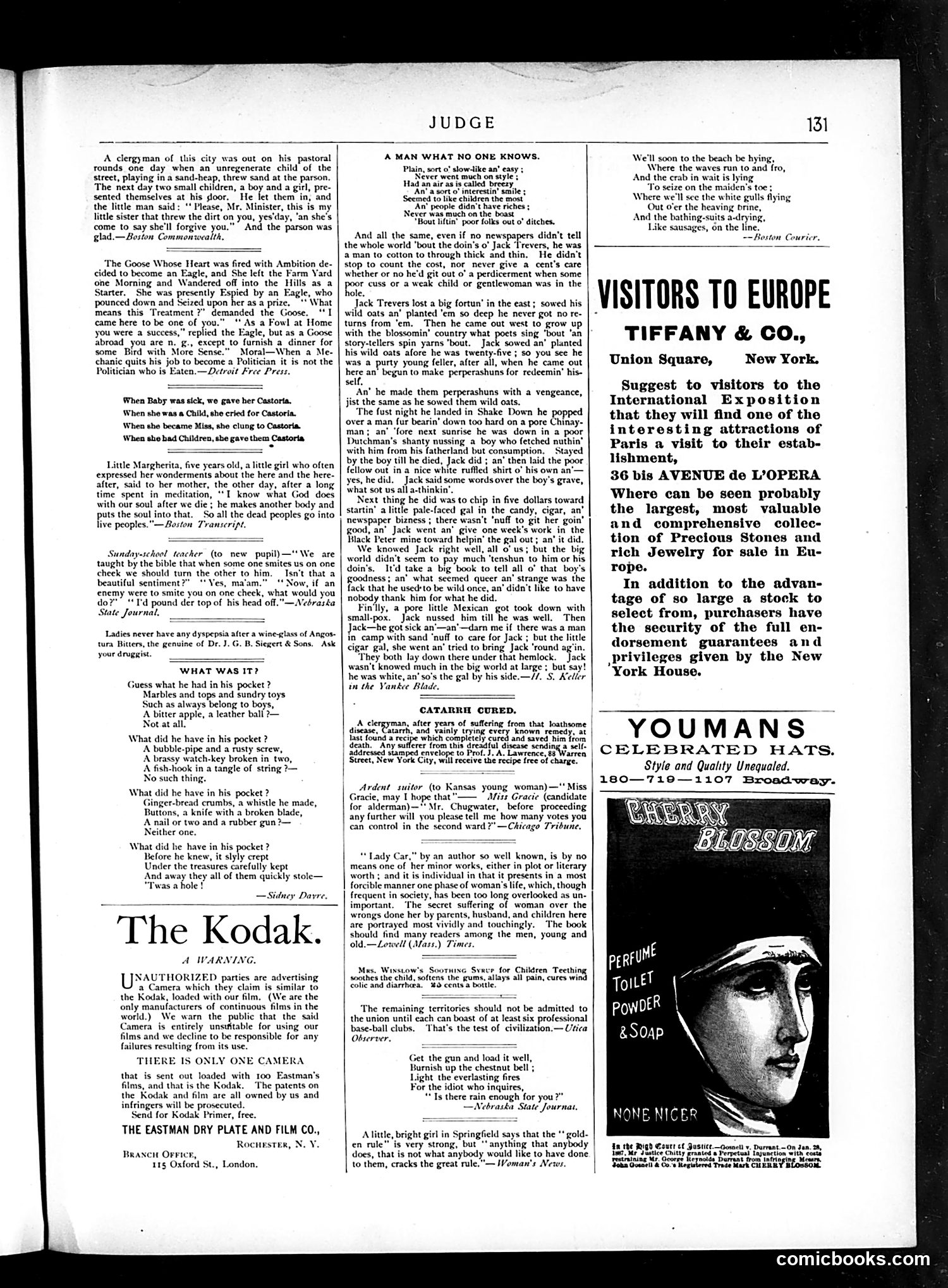
This page primarily contains **advertisements and humorous anecdotes** rather than political cartoons. The content reflects turn-of-the-century American life: **Main Features:** 1. **Short humorous stories** about everyday situations—a clergyman forgiving a child, a goose attempting social climbing, Sunday school lessons—typical of Judge's light satirical humor targeting middle-class morality and behavior. 2. **"The Kodak" section**: A warning advertisement protecting Eastman's Kodak camera monopoly against inferior imitators claiming compatibility. This reflects late-1890s patent disputes over photography technology. 3. **Multiple product advertisements**: Castoria (children's medicine), perfume, soap—standard period advertising. 4. **"What Was It?"**: A children's riddle poem with the punchline that a boy's pocket contains a hole—innocent wordplay humor. The page represents Judge's blend of satirical commentary on social pretensions with commercial advertising and family-friendly humor, typical of American magazines from this industrial era.
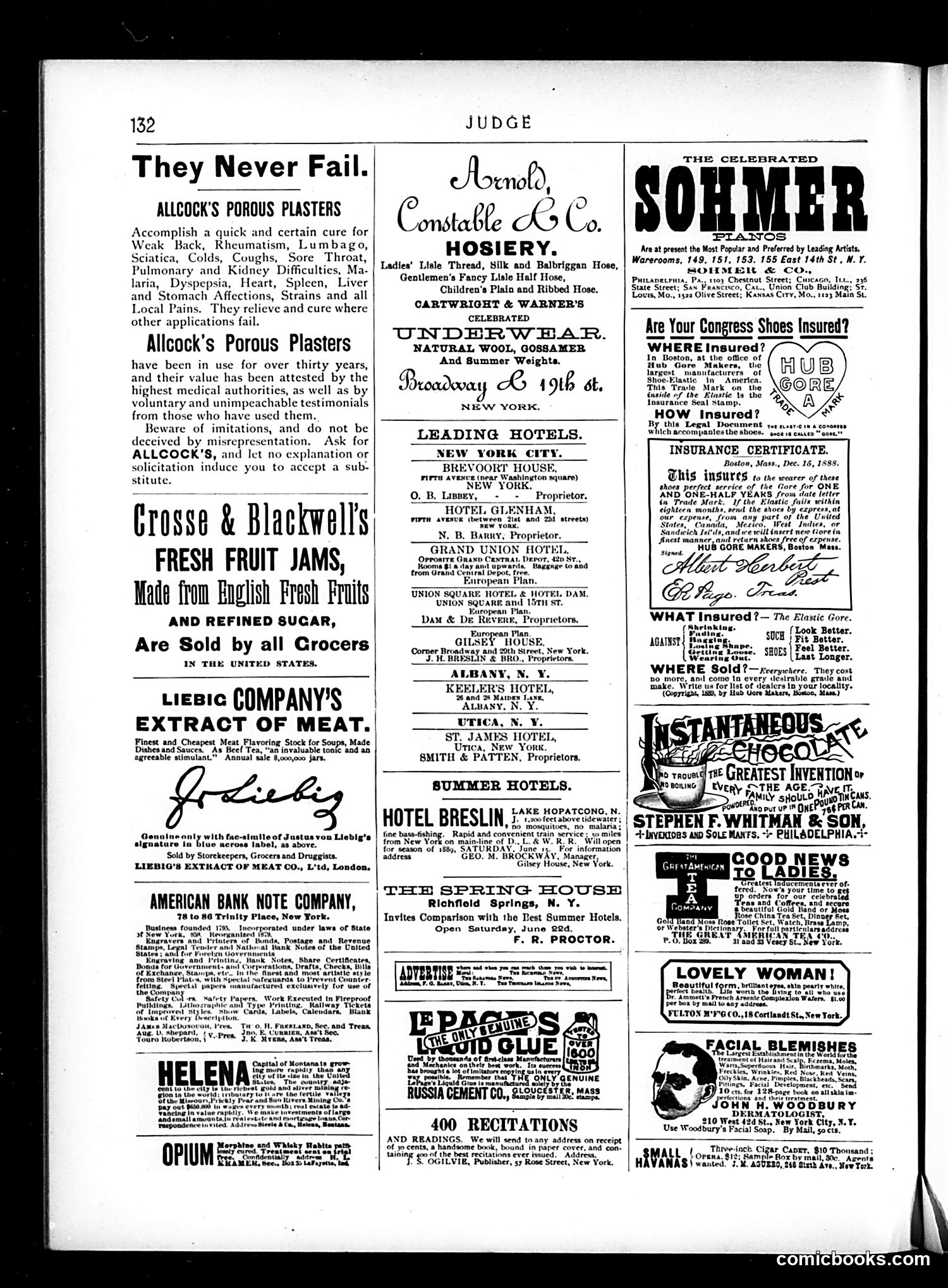
This page is **primarily advertising**, with no political cartoon or satire visible. Judge magazine here functions as a vehicle for commercial announcements rather than humor or social commentary. The ads promote period consumer goods: medical plasters (Allcock's), food products (jams, meat extract), financial services (bank notes), hotels across the northeastern U.S., piano manufacturers (Sohmer & Co.), and notably, **Congress brand shoes** with an innovative insurance guarantee—shoes damaged within 18 months would be replaced. The only potentially satirical element is subtle: the "Congress Shoes Insurance Certificate" appears to mock or highlight the novelty of product warranties, treating shoe durability as something requiring formal legal protection. This suggests either consumer skepticism about shoe quality or clever marketing positioning durability as an unusual selling point. Otherwise, this is a straightforward advertising page reflecting 1880s American commerce and consumer culture.
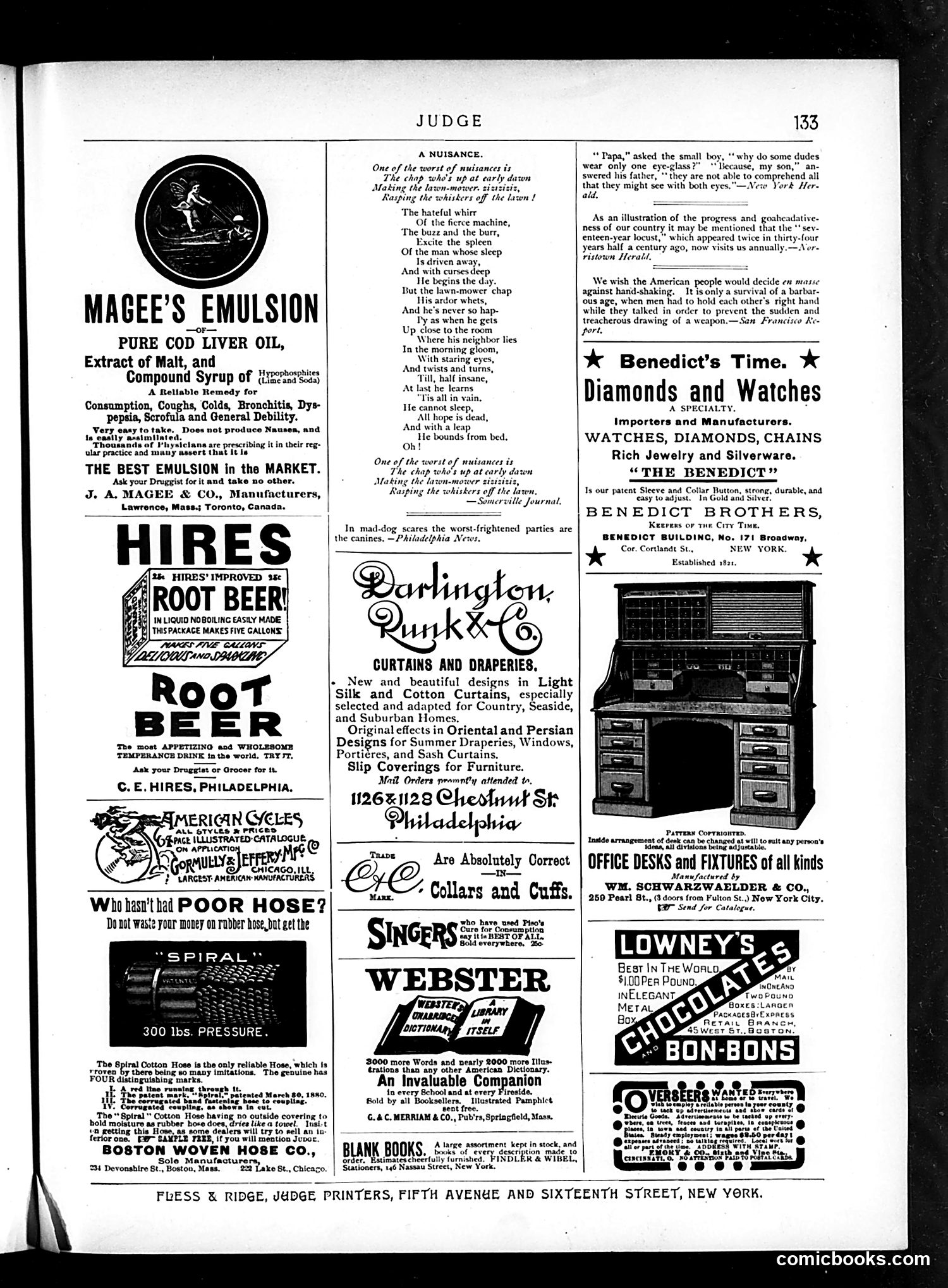
This page is **primarily advertisements** with minimal editorial cartoons. The dominant content includes ads for patent medicines (Magee's Emulsion, Hires Root Beer), household goods (Spiral hoses, American Cycles), and reference works (Webster's Dictionary). The few editorial pieces are brief satirical items: 1. **"A Nuisance"**: A humorous complaint poem about early-morning lawn-mower noise disturbing neighbors' sleep—a relatable domestic annoyance. 2. **Small jokes** about social behavior: A father explains to his son that men wear monocles because they lack intelligence to understand everything they see; another quip notes that the seventeen-year locust now appears annually instead of every 50 years, supposedly proving American "progress." These items represent light, genteel satire typical of Judge's humor—poking fun at minor social irritations and contemporary trends rather than sharp political commentary. The page reflects the magazine's mixed editorial-advertising format common in late 19th/early 20th-century publications.
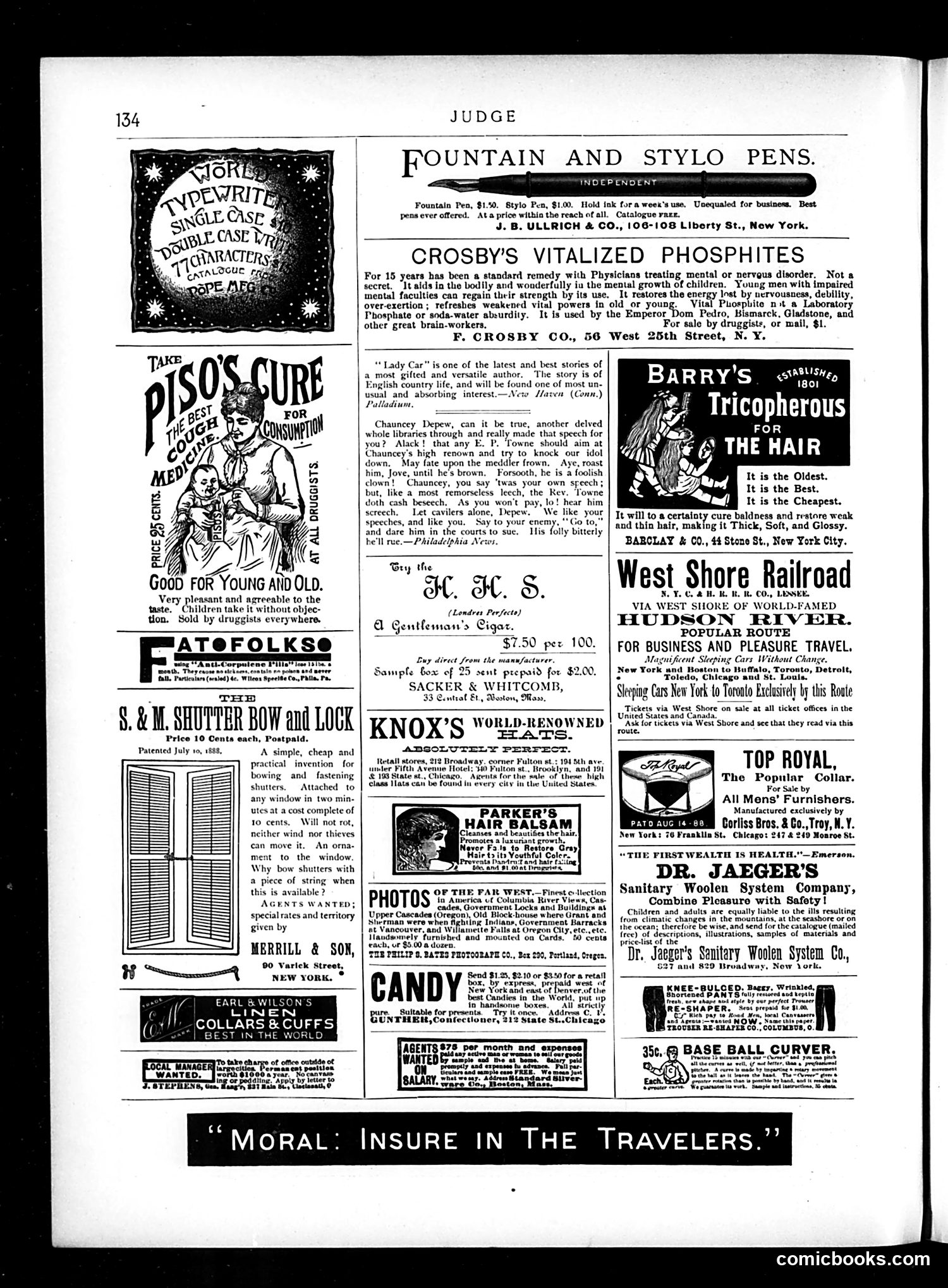
This is primarily an **advertising page** from Judge magazine, not a political cartoon. The page contains numerous commercial advertisements typical of late 19th-century American publications. Notable content includes: **Products advertised:** Fountain pens, hair treatments (Barry's Tricopherous), patent locks, collars and cuffs, patent medicines (Crosby's Vitalized Phosphites), cigars, railroad travel, and hats. **One satirical item** appears mid-page: a brief verse mocking **Chauncey Depew**, a prominent Gilded Age politician and railroad executive. The satire suggests someone ghostwrote Depew's speeches and questions whether he'll admit it—a commentary on his reputation as an orator. The poem uses humorous rhyming couplets to tease him. The remainder consists of standard late-1800s patent medicine claims, travel promotions, and product pitches—reflective of Judge's primary revenue model relying on advertising rather than solely satirical content.
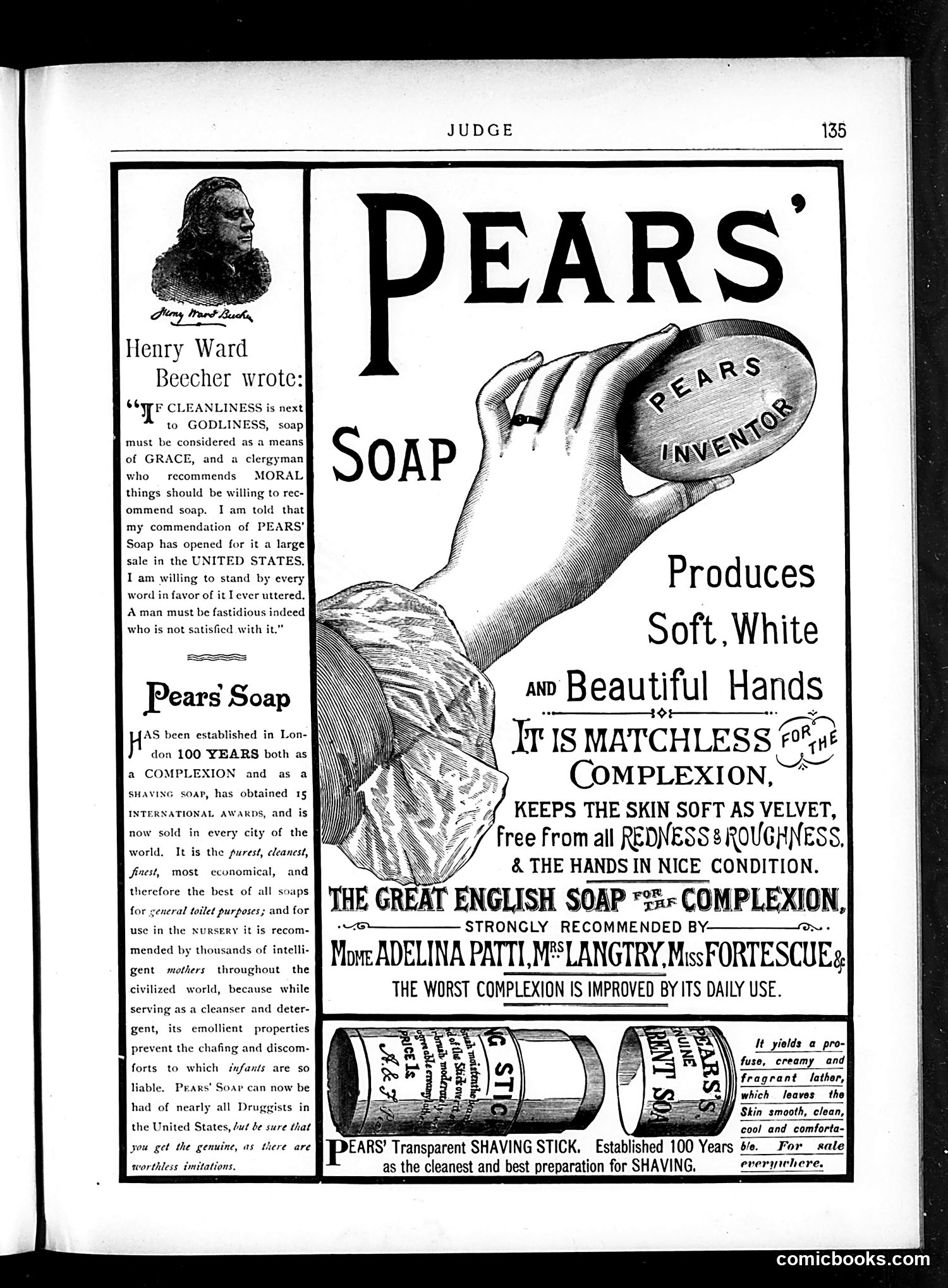
This page is **primarily a product advertisement** rather than political satire. It promotes Pears' Soap, a real British brand established 100 years prior to publication. The advertisement leverages celebrity endorsement and moral authority: Henry Ward Beecher, a famous American clergyman, is quoted claiming cleanliness is "next to Godliness" and praising Pears' Soap's sales success in the United States. The ad also cites endorsements from celebrities (Mme. Adelina Patti, Mrs. Langtry, Miss Fortescue), likely popular entertainers of the era. The satire, if any, is gentle: the implicit joke appears to be that a clergyman—someone concerned with moral and spiritual matters—is enthusiastically recommending *soap*, humorously elevating a mundane product to quasi-religious status. However, this is advertisement copy, not editorial satire. The page's inclusion in *Judge* magazine likely reflects the publication's model of selling ad space to prominent brands.
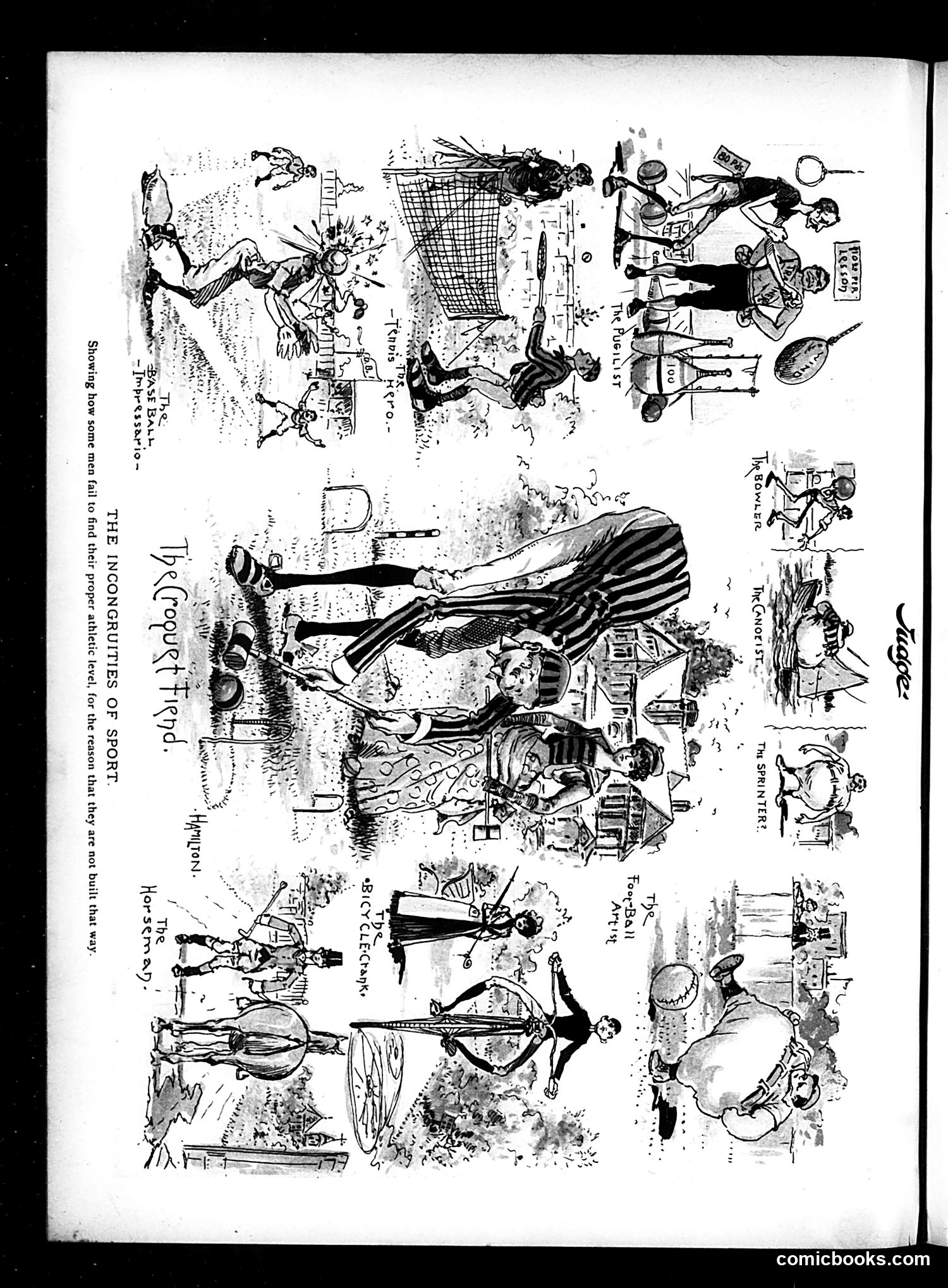
This Judge page satirizes mismatches between people's body types and their chosen sports. The central cartoon shows a heavyset man in a striped bathing suit attempting to dive—an absurd image given his physique. Surrounding vignettes mock similar incongruities: an overweight boxer, a portly cyclist, a stout tennis player, and other misaligned athletes. The satire targets not specific public figures but rather the general human tendency to pursue activities unsuited to one's physical build. The humor relies on exaggeration and visual contrast—the cartoonist emphasizes the gap between athletic aspiration and bodily reality. This reflects period attitudes about body types and fitness, poking fun at those ignoring their "proper athletic level," as the subtitle states. The overall message is gently mocking: know thyself and choose appropriate activities.
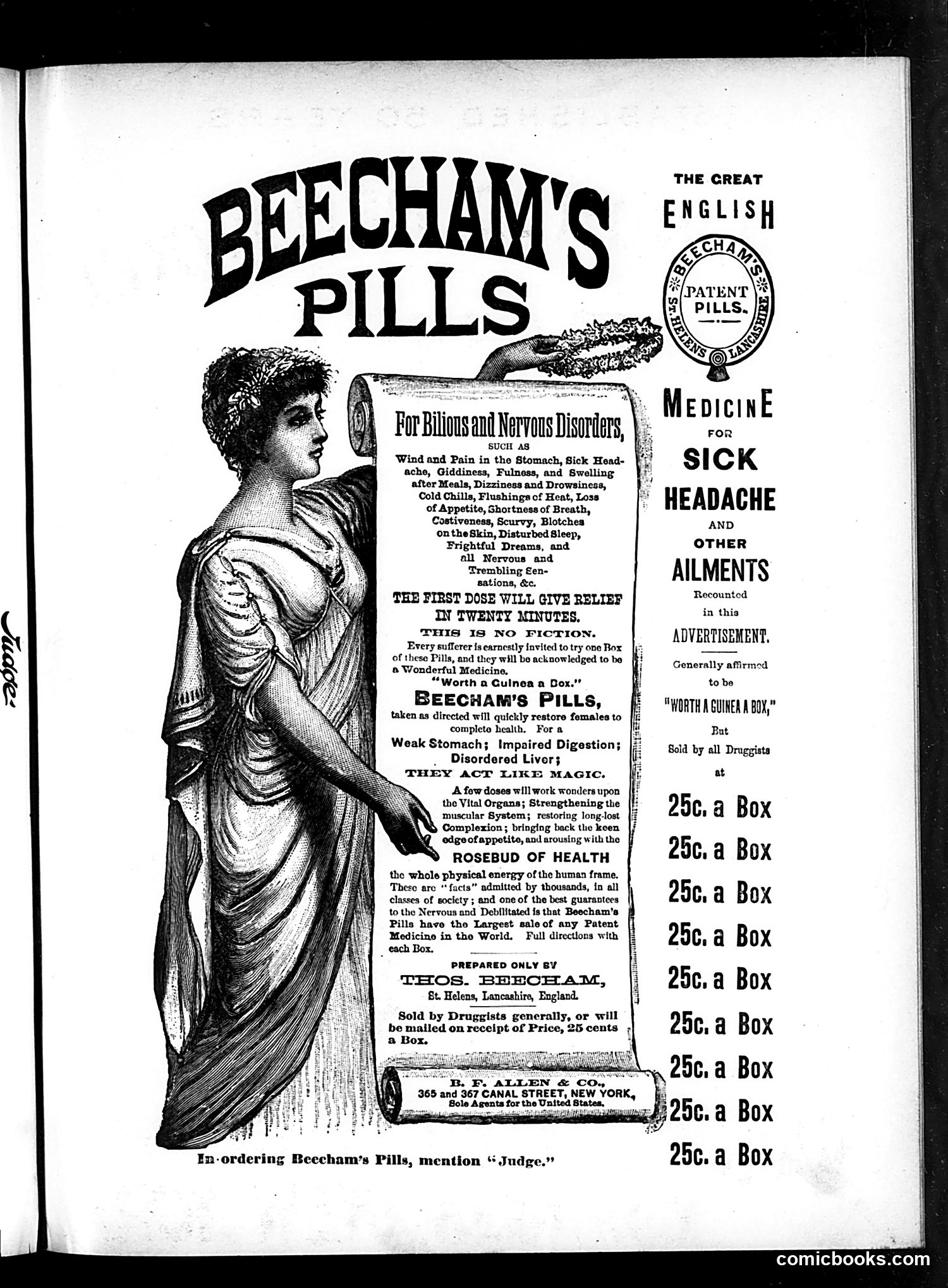
This page is primarily a **patent medicine advertisement**, not political satire. It promotes Beecham's Pills, a British laxative remedy claiming to cure numerous ailments—from indigestion and headaches to nervousness and poor complexion. The advertisement uses a classical female figure (likely representing Health or Wellness) as decorative imagery, typical of late 19th-century marketing. The text employs exaggerated medical claims common to the era: pills that provide relief "in twenty minutes," "act like magic," and restore "the Rosebud of Health." The repeated "$0.25 a box" pricing emphasizes affordability. The phrase "Worth a Guinea a Box" (a guinea being British currency) suggests premium quality despite the cheap American price. This reflects an era when **patent medicines faced minimal regulation** and made wildly unsubstantiated health claims. Judge magazine's inclusion of such advertisements reveals contemporary advertising practices, though it's unclear if Judge itself was satirizing or simply profiting from patent medicine promotions.
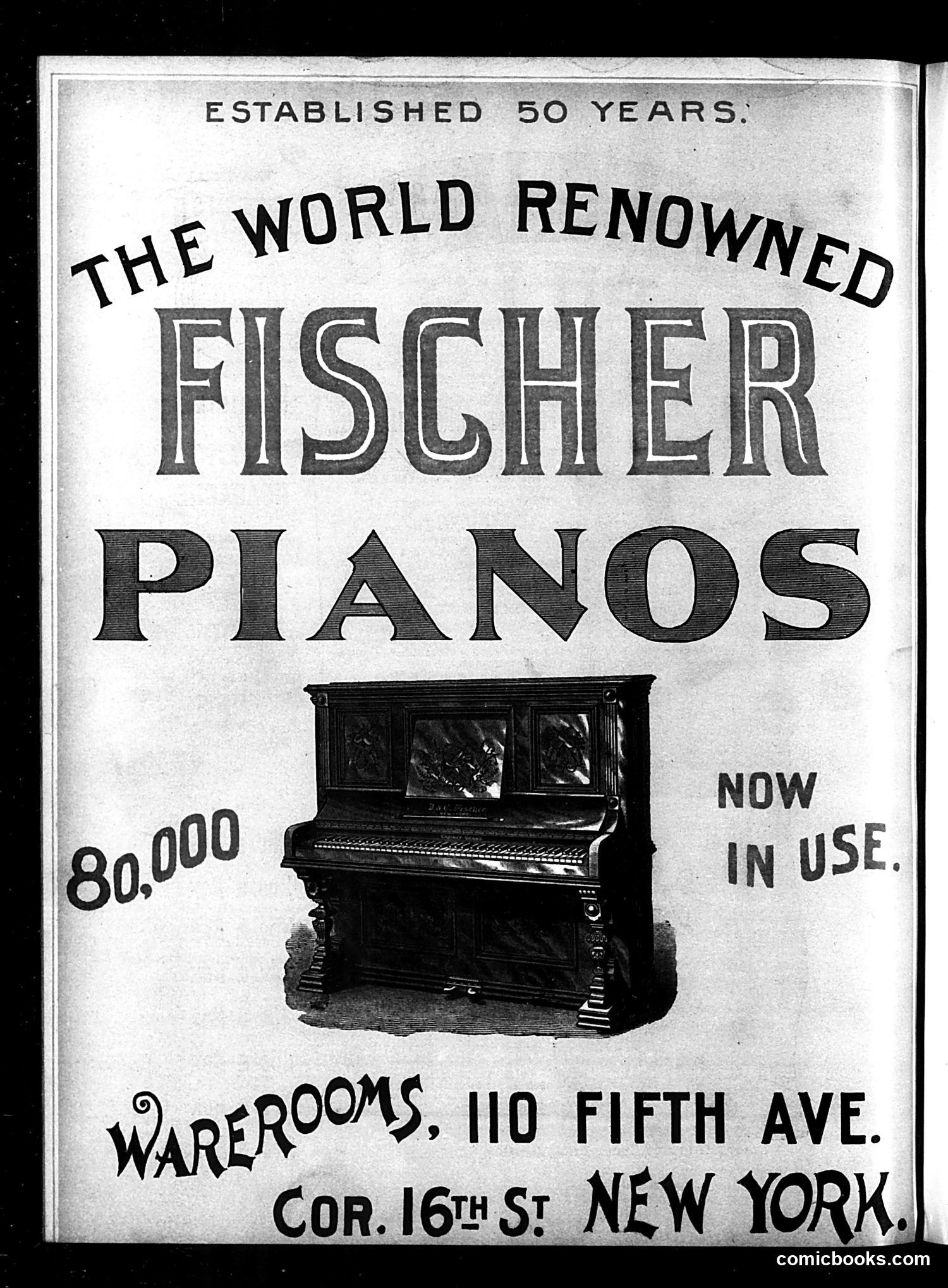
This is a **full-page advertisement**, not editorial content. It promotes Fischer Pianos, emphasizing the company's 50-year establishment and current market dominance ("80,000 now in use"). The ad features a photograph of an upright piano and lists their warehouse location at 110 Fifth Avenue, corner of 16th Street in New York City. There is **no cartoon or satire** on this page. It's a straightforward commercial advertisement typical of Judge magazine's revenue model—the publication sold advertising space to businesses. The emphasis on longevity and widespread adoption was standard marketing rhetoric of the era, appealing to consumer desire for proven, established products. This reflects the piano's status as a desirable household luxury item in early 20th-century America.