
Judge, 1889-06-01 · page 2 of 18
Judge — June 1, 1889 — page 2: what you’re looking at
What you’re looking at
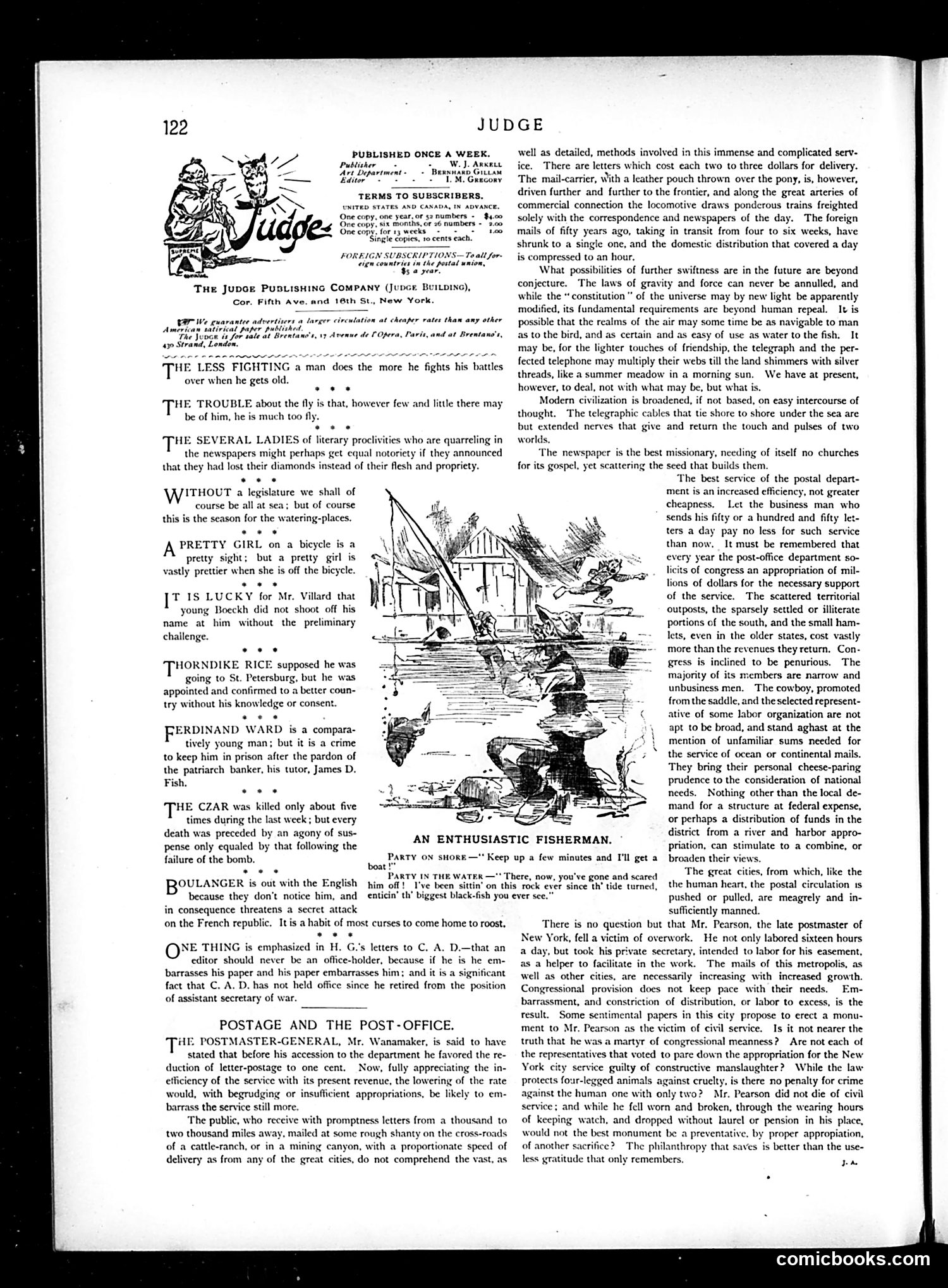
This page contains editorial commentary rather than political cartoons. The main illustration depicts "An Enthusiastic Fisherman" — a humorous scene of someone fishing from rocks, likely serving as a visual break in the text rather than satire. The written pieces address various contemporary topics: postal service inefficiency (the Postmaster-General's failure to improve letter-postage), concerns about congressional representatives from Southern states, and critiques of business and labor practices. One section discusses Mr. Pearson, the late New York postmaster, as a victim of political mismanagement. The satire targets governmental incompetence and the disconnect between congressional promises and actual service delivery — recurring themes in Judge's social criticism. Without clearer visual caricatures or dated references, the specific political figures remain unclear.
📄 Transcribed text from this page (OCR, searchable)
Machine-transcribed from the original scan — historical spelling and the odd misread are preserved.
JUDGE PUBLISHED ONCE A WEEK. Publisher ys Wed Ret Department «+ “Bannnann Giucan tir i's: Geecony TERMS TO SUBSCRIBERS. UNITED STATES AND CANADA, IN ADVANCE, One copy, one year. or s2 numbers - $4.00 One copy, six months, or 26 numbers = 3.00 ‘One copy: for 13 weeks + + + too ‘Single copies, 10 cents each. FOREIGN SUBSCRIPTIONS—Te all for- ‘ign countries in the postal union, $3 @ year. THe Jupoe PuntisHinc ComPANy (Jupcr Buitpixe), Cor. Fifth Ave. and 16th St., New York. 490 Strand, London. nd at Brentano's, HE LESS FIGHTING a man does the more he fights his battles over when he gets old. JHE TROUBLE about the fly is that, however few and little there may be of him, he is much too fly, HE SEVERAL LADIES of literary proclivities who are quarreling in the newspapers might perhaps get equal notoriety if they announced that they had lost their diamonds instead of their flesh and propriety. ITHOUT a legislature we shall of course be all at sea; but of course this is the season for the watering-places. A PRETTY GIRL on a bicycle is a pretty sight; but a pretty girl is vastly prettier when she is off the bicycle. T IS LUCKY for Mr. Villard that young Boeckh did not shoot off his name at him without the preliminary chailenge. cee HHORNDIKE RICE supposed he was going to St. Petersburg, but he was appointed and confirmed to a better coun- try without his knowledge or consent. ERDINAND WARD is a compara- tively young man; but it is a crime to keep him in prison after the pardon of the patriarch banker, his tutor, James D. Fish. wae THE CZAR was killed only about five times during the last week; but every death was preceded by an agony of sus- pense only equaled by that following the failure of the bomb. BOULANGER is out with the English because they don’t notice him, and in consequence threatens a secret attack on the French republic, It is a habit of most curses to come home to roost, NE THING is emphasized in H. G.'s letters to C. A. D.—that an editor should never be an office-holder, because if he is he em- barrasses his paper and his paper embarrasses him: and it is a significant fact that C. A.D, has not held office since he retired from the position of assistant secretary of war. boat POSTAGE AND THE POST-OFFICE. THE POSTMASTER-GENERAL, Mr. Wanamaker, is said to have stated that before his accession to the department he favored the re- duction of letter-postage to one cent. Now, fully appreciating the in- efficiency of the service with its present revenue, the lowering of the rate would, with begrudging or insufficient appropriations, be likely to em- barrass the service still more. The public, who receive with promptness letters from a thousand to two thousand miles away, mailed at some rough shanty on the cross-roads of a cattle-ranch, or in a mining canyon, with a proportionate speed of delivery as from any of the great cities, do not comprehend the vast, as AN ENTHUSIASTIC FISHERMAN. PARTY ON SHORE—"*Keep up a few minutes and I'll get a ARTY IN THE WATER —* There, now, you've gone and scared him off! I've been sittin’ on this rock ever since th’ tide turned, enticin’ th’ biggest black-fish you ever sce.” well as detailed, methods involved in this immense and complicated serv- ice. There are letters which cost each two to three dollars for delivery. The mail-carrier, With a leather pouch thrown over the pony, is, however, driven further and further to the frontier, and along the great arteries of commercial connection the locomotive draws pondcrous trains freighted solely with the correspondence and newspapers of the day. The foreign mails of fifty years ago, taking in transit from four to six weeks, have shrunk to a single one, and the domestic distribution that covered a day is compressed to an hour. What possibilities of further swiftness are in the future are beyond conjecture. The laws of gravity and force can never be annulled, and while the “constitution” of the universe may by new light be apparently modified, its fundamental requirements are beyond human repeal. It is possible that the realms of the air may some time be as navigable to man as to the bird, and as certain and as easy of use as water to the fish. It may be, for the lighter touches of friendship, the telegraph and the per- fected telephone may multiply their webs till the land shimmers with silver threads, like a summer meadow in a morning sun. We have at present, however, to deal, not with what may be, but what is. Modern civilization is broadened, if not based, on easy intercourse of thought. The telegraphic cables that tie shore to shore under the sea are but extended nerves that give and return the touch and pulses of two world: The newspaper is the best missionary, needing of itself no churches for its gospel, yet scattering the seed that builds them. The best service of the postal depart- ment is an increased efficiency, not greater cheapness. Let the business man who sends his fifty or a hundred and fifty 1 ters a day pay no less for such service than now, It must be remembered that every year the post-office department so- licits of congress an appropriation of mil- lions of dollars for the necessary support of the service. The scattered territorial outposts, the sparsely settled or illiterate portions of the south, and the small ham- lets, even in the older states, cost vastly more than the revenues they return. Con- gress is inclined to be penurious. The majority of its members are narrow and unbusiness men, The cowboy, promoted from the saddle, and the selected represent- ative of some labor organization are not apt to be broad, and stand aghast at the mention of unfamiliar sums needed for the service of ocean or continental mails. They bring their personal cheese-paring prudence to the consideration of national needs. Nothing other than the local de- mand for a structure at federal expense, or perhaps a distribution of funds in the district from a river and harbor appro- priation, can stimulate to a combine, or broaden their view The great cities, from which, like the the human heart, the postal circulation 1s pushed or pulled, are meagrely and in- sufficiently manned. There is no question but that Mr. Pearson, the late postmaster of New York, fell a victim of overwork. i He not only labored sixteen hours a day, but took his private secretary, intended to labor for his easement, as a helper to facilitate in the worl The mails of this metropolis, as well as other cities, are necessarily increasing with increased growth. Congressional provision docs not keep pace with their needs. Em- barrassment, and constriction of distribution, or labor to excess, is the result. Some sentimental papers in this city propose to erect a monu- ment to Mr. Pearson as the victim of civil service. Is it not nearer the truth that he was a martyr of congressional meanness? Are not each of the representatives that voted to pare down the appropriation for the New York city service guilty of constructive manslaughter? While the law protects four-legged animals against cruelty, is there no penalty for crime against the human one with only two? Mr. Pearson did not die of civil service; and while he fell worn and broken, through the wearing hours of keeping watch, and dropped without laurel or pension in his place, would not the best monument be a preventative. by proper appropiation, of another sacrifice? The philanthropy that saves is better than the use- less gratitude that only remembers. be comicbooks.com