
A complete issue · 16 pages · 1889
Judge — May 4, 1889
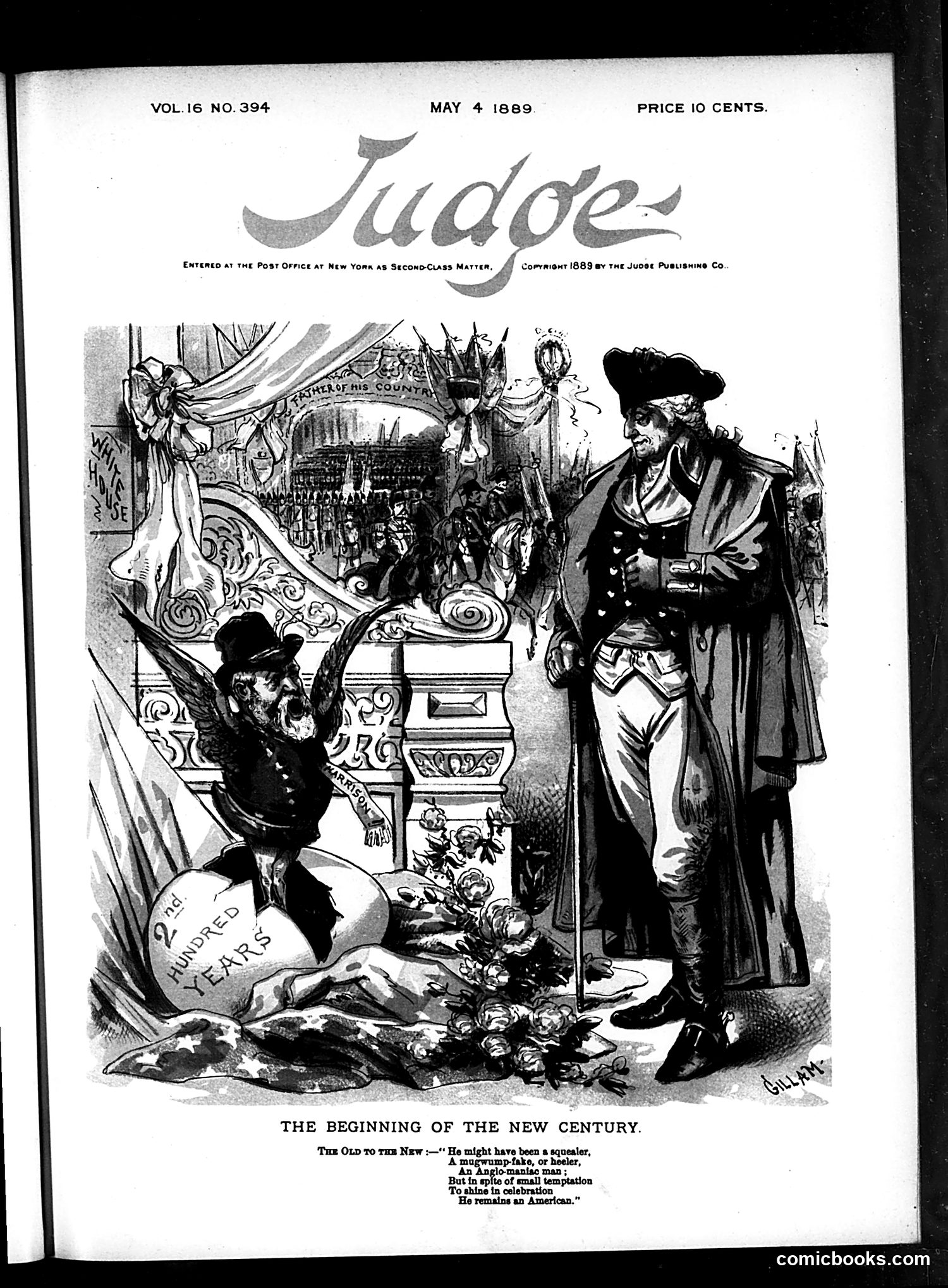
This May 4, 1889 *Judge* cartoon depicts the transition from the 19th to 20th century. The left figure represents the "Old" century—depicted as a worn, disheveled man in tattered clothes sitting on a bag labeled "Hundred Years"—symbolizing age and exhaustion. The right figure represents the "New" century—a robust, well-dressed gentleman in fine coat and hat, standing confidently amid celebratory pageantry and crowds. The accompanying verse suggests the old century, despite being a "squealer" and troublemaker, will "shine in celebration" and "remain an American"—implying continuity and pride in national heritage despite the old era's flaws. The contrast embodies optimistic Victorian attitudes about modernity and progress replacing the previous century's problems.
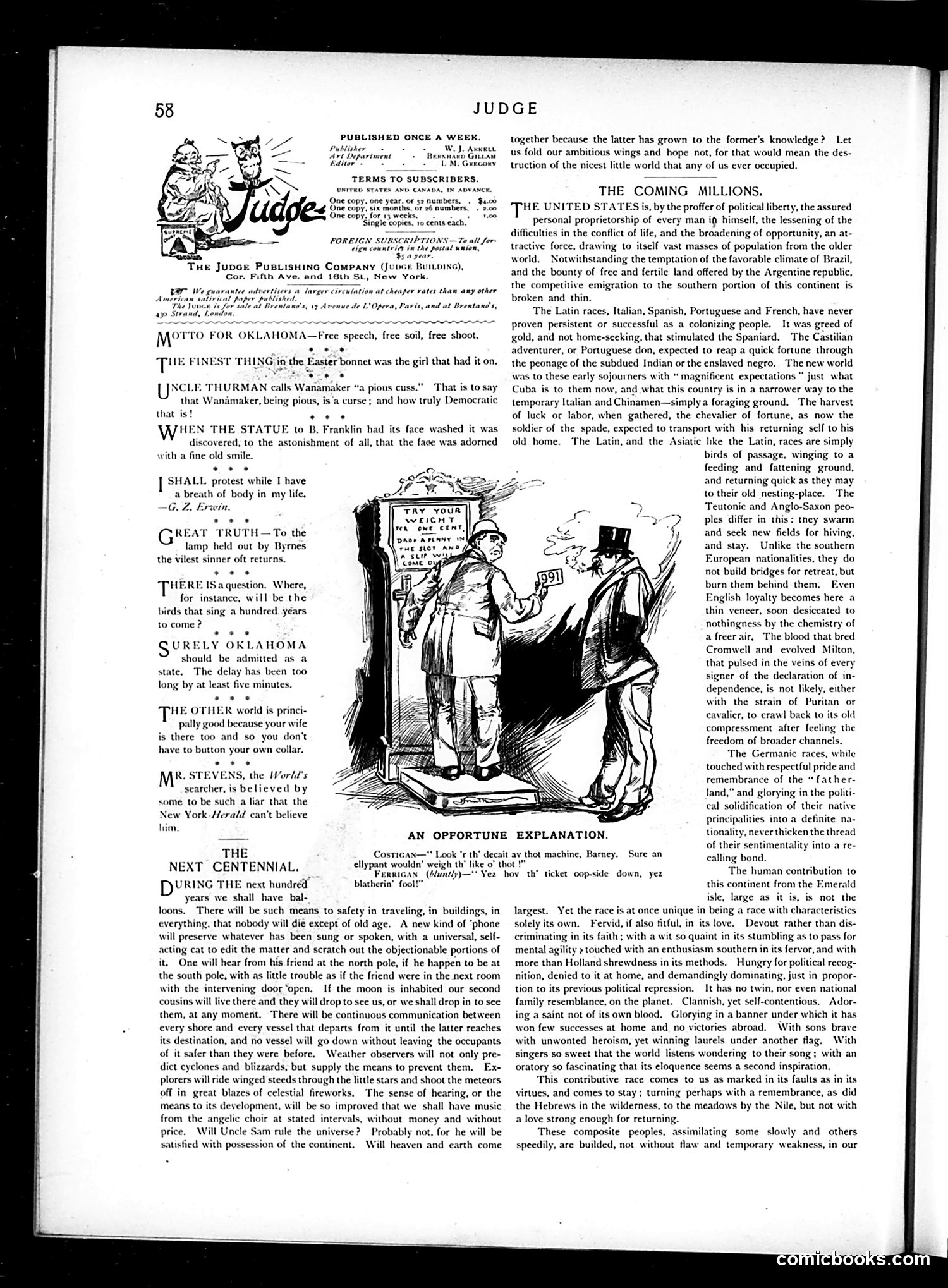
This cartoon satirizes a conversation between two figures at a voting machine labeled "1891." The well-dressed gentleman (appearing to be a political operative or party boss) is explaining something to a woman holding a sign reading "RAY YOUR TICKET" (likely "MARK YOUR TICKET"). The joke appears to mock voter manipulation or instruction—the man is presumably explaining how to vote "correctly" or for the "right" candidate. The woman's confused expression and the title "An Opportune Explanation" suggest the satire targets political corruption and the coaching of voters, likely by party machines. This reflects Gilded Age concerns about election fraud and the lack of secret balloting, when political operatives openly influenced how citizens voted.
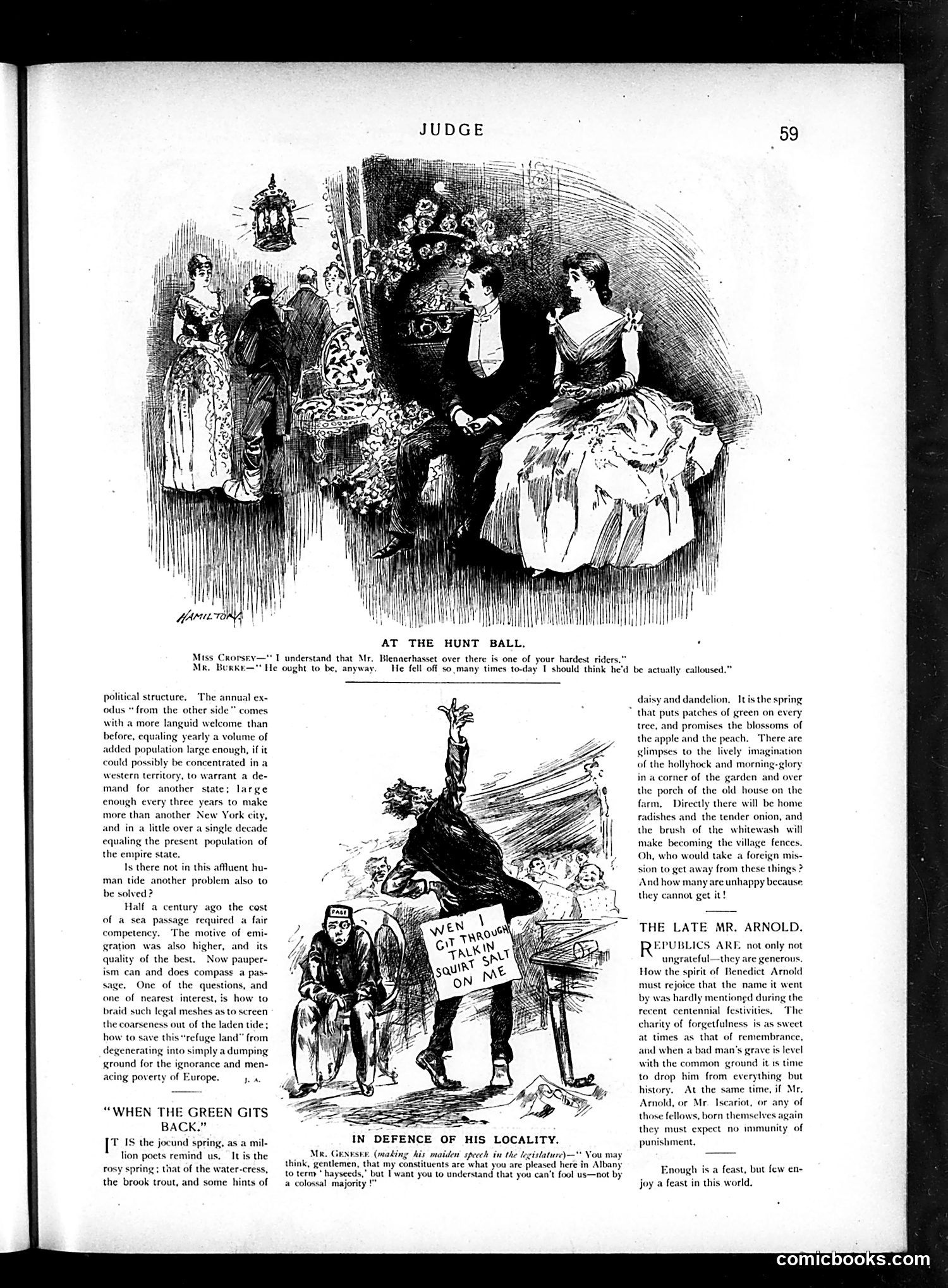
This page contains three satirical pieces typical of Gilded Age American commentary: **"At the Hunt Ball"** mocks the upper class. Mr. Burke's comment about Mr. Blenaerhasset falling repeatedly from his horse satirizes wealthy sportsmen who pursue fashionable activities (fox hunting) despite lacking actual competence. **"In Defence of His Locality"** features a newly elected legislator from rural areas (called "hayseeds" by Albany politicians) defending his constituents' intelligence. The satire targets urban condescension toward rural voters while also gently mocking provincial defensiveness. **"When the Green Gits Back"** and related text discuss spring and immigration policy. The editorial passages critique mass European immigration, framing incoming poor as a "refuge" potentially degrading America into a "dumping ground for the ignorance and menacing poverty of Europe"—reflecting period anxieties about immigrant populations and their social impact. These pieces collectively satirize class divisions, urban-rural tensions, and nativist concerns prevalent in late 19th-century America.
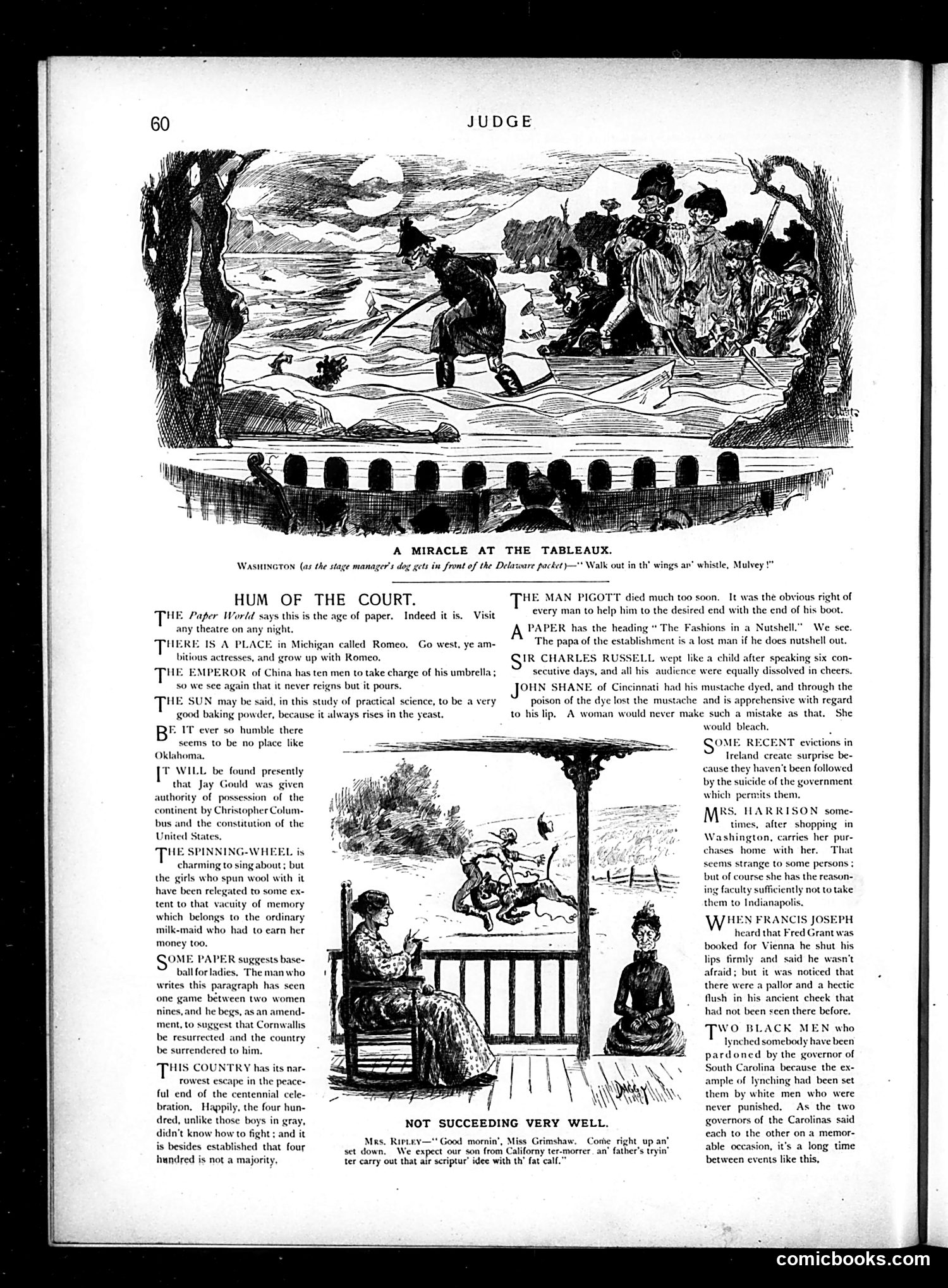
This page contains satirical commentary on contemporary events circa the 1880s-90s. **Top cartoon** ("A Miracle at the Tableaux"): Shows a Washington stage manager instructing an actor named Mulvey to create theatrical effects, mocking the artificiality of political spectacle. **Text sections** include brief satirical jabs at various figures and issues: - Pigott's death (likely referring to Richard Pigott, involved in the forged "Parnell letters" scandal) - Charles Russell weeping after courtroom speeches - Jay Gould's questionable land authority claims - Women's baseball and fashion commentary **Bottom cartoon** ("Not Succeeding Very Well"): Working-class dialogue about a son returning from California, satirizing either immigration expectations or economic hardship. **Right column** references include Francis Joseph I (Austro-Hungarian emperor) and Fred Grant's Vienna posting, plus South Carolina's pardoning of lynch mobs while unpunished white perpetrators went free—sharp social criticism of racial hypocrisy and violence. The page mixes light humor with pointed political critique typical of Judge's satirical approach.
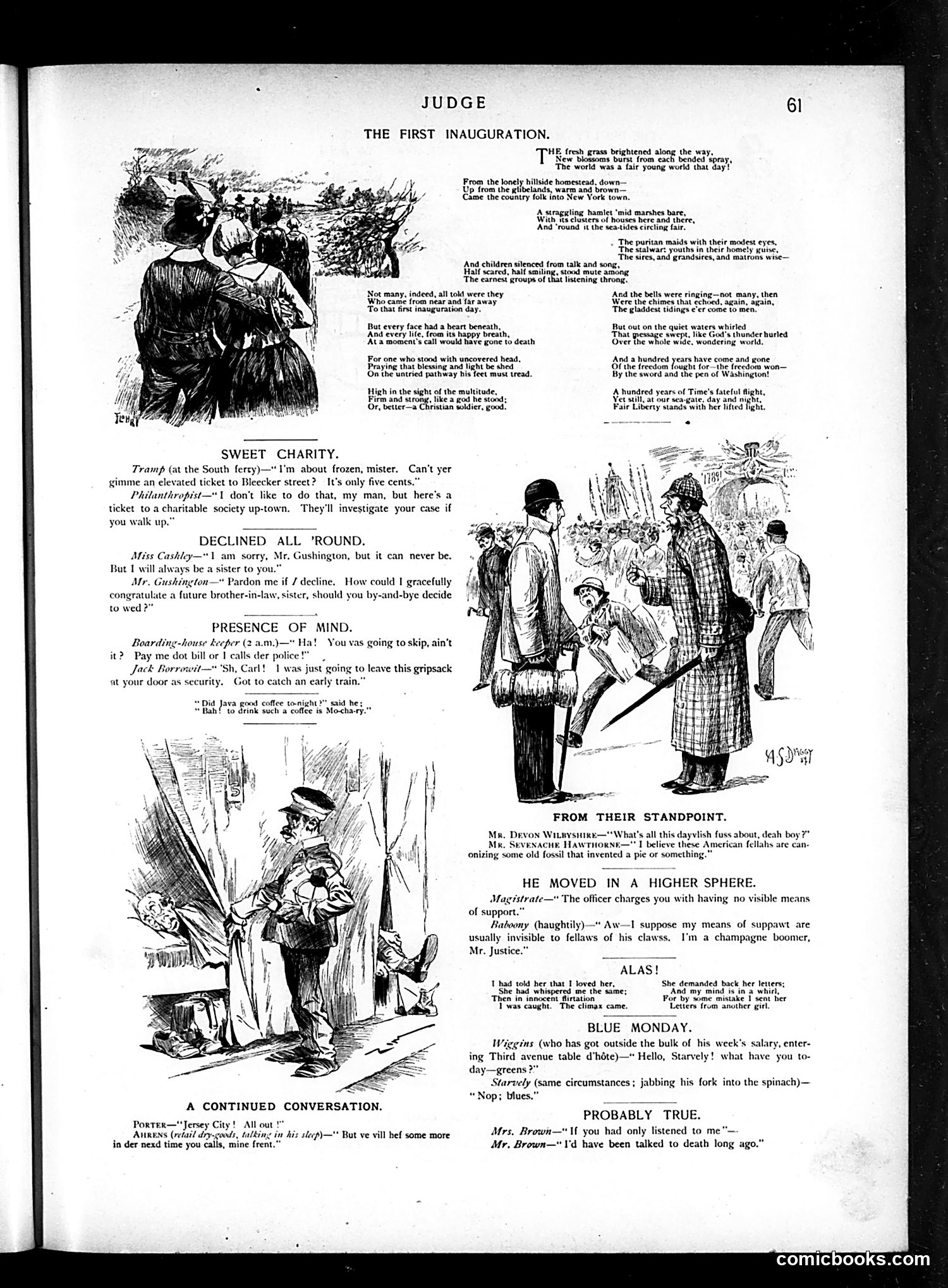
This page from *Judge* (appears to be late 19th century, likely around Washington's inauguration centennial) contains multiple satirical sketches mocking American social types. **"The First Inauguration"** is a patriotic poem accompanying an illustration of crowds traveling to witness a presidential inaugural ceremony, celebrating American democracy. The remaining content comprises short humorous dialogues targeting recognizable social archetypes: a vagrant seeking charity, a rejected suitor, a boarding-house keeper, working-class men, and a pompous character claiming invisible wealth. These sketches ridicule common urban characters—the poor, the delusional, the incompetent. **"Blue Monday"** mocks working men eating cheap food. The final dialogue satirizes a chattering merchant and a nagging wife, suggesting marriage as mutual torment. The humor relies on period-specific class stereotypes, broken English (suggesting immigrant characters), and gentle mockery of everyday urban life rather than direct political commentary.
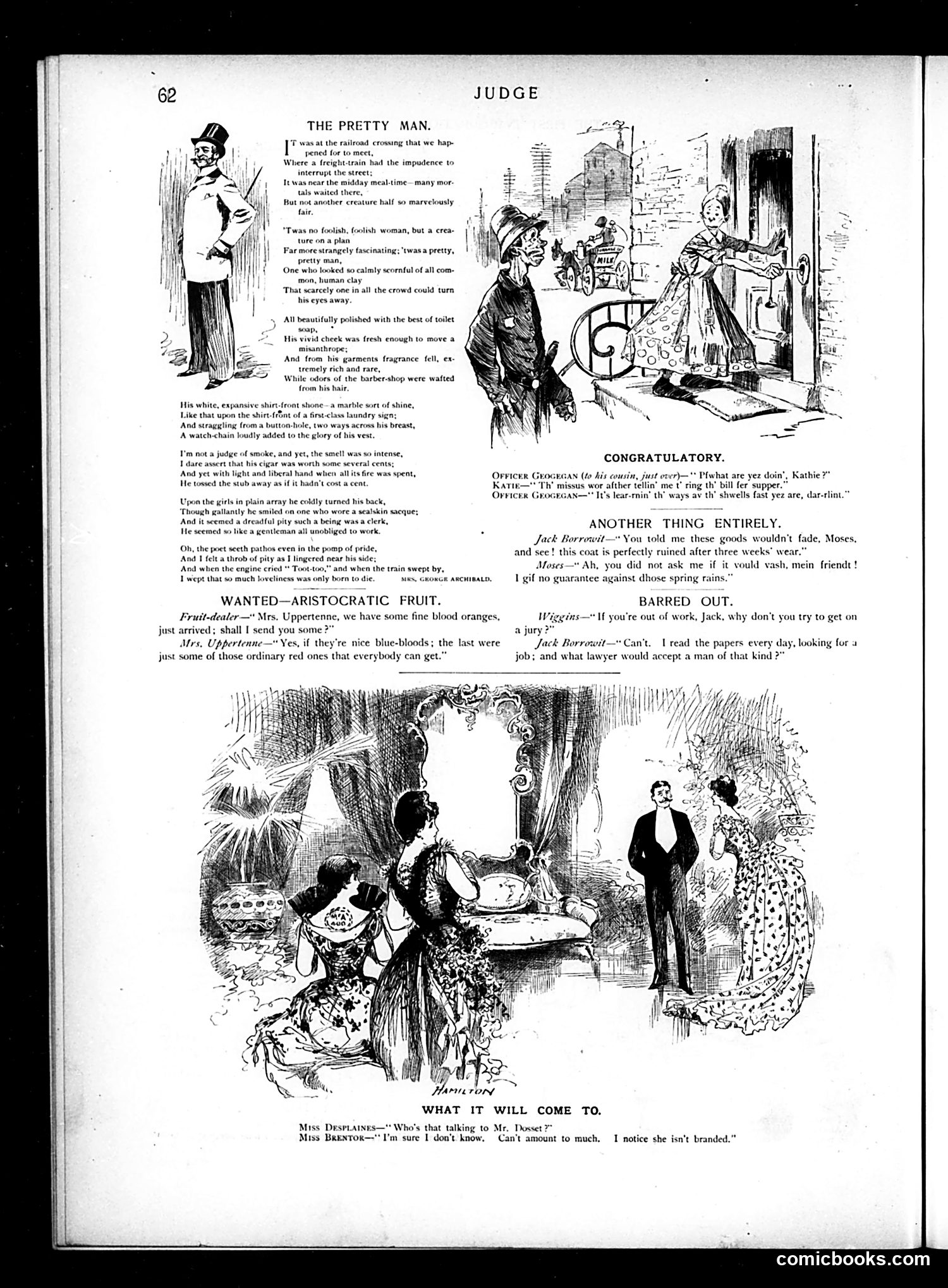
This page contains several satirical short humor pieces typical of late 19th-century American magazines: **"The Pretty Man"** mocks the vanity of an excessively well-groomed man at a railroad crossing—obsessively polished, fragrant, wearing expensive cigars and jewelry. The satire targets the vanity and feminine affectation of such men, contrasting his meticulous appearance with his lowly clerk job. **"Wanted—Aristocratic Fruit"** jokes about class pretension: a wealthy woman (Mrs. Uppertenne) refuses ordinary oranges, requesting only "blue-bloods"—a pun on aristocratic lineage applied to fruit. **"Congratulatory"** depicts Irish immigrants (suggested by dialect spelling) where one teaches another the mannerisms of "swells" (wealthy people). **"Barred Out"** and other brief jokes satirize economic hardship and professional exclusion during this era. The page reflects turn-of-the-century American anxieties about class, appearance, pretension, and social mobility—mocking both the wealthy's snobbery and the poor's aspirations to mimic it.
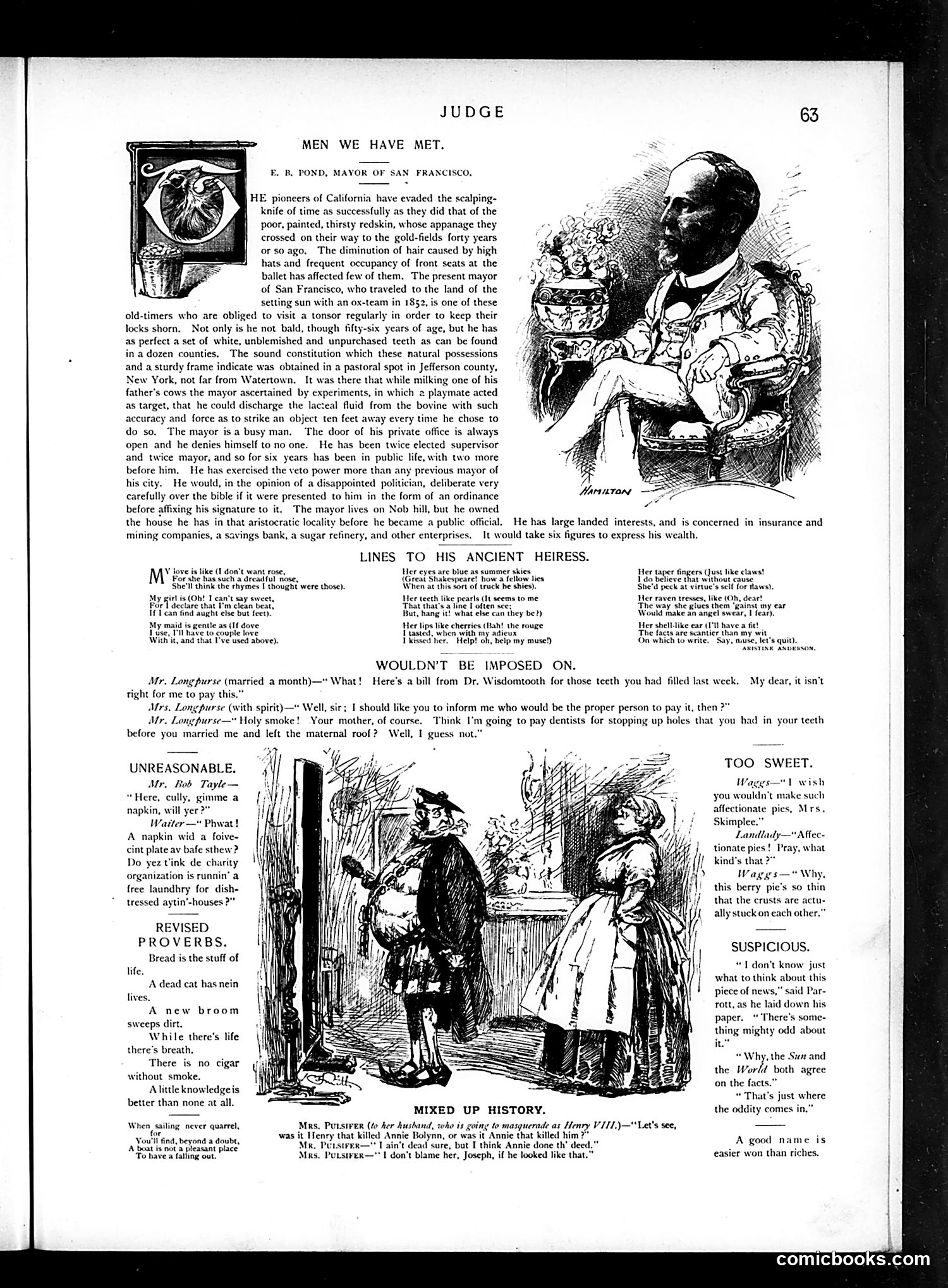
**Main Feature: "Men We Have Met"** This profile celebrates E.B. Pond, Mayor of San Francisco, highlighting his longevity and vigor. The satire emphasizes his youthful appearance—full head of hair and natural teeth at 56—despite being a California pioneer who arrived by ox-team in 1852. The piece praises his vigor while gently mocking his prolific use of the veto power, suggesting he'd scrutinize even the Bible if presented as an ordinance. His wealth is noted as substantial but unquantifiable. **Comic Sketches Below:** Several brief satirical dialogues mock domestic and social absurdities: a newlywed husband refusing to pay his wife's pre-marriage dental bills (blaming her mother), and bad romantic poetry attempting flattery of an unattractive woman. These represent typical Judge humor—domestic quarrels and social pretension of the era. The page exemplifies Judge's formula: biographical sketches of local notables mixed with humorous commentary on everyday life.
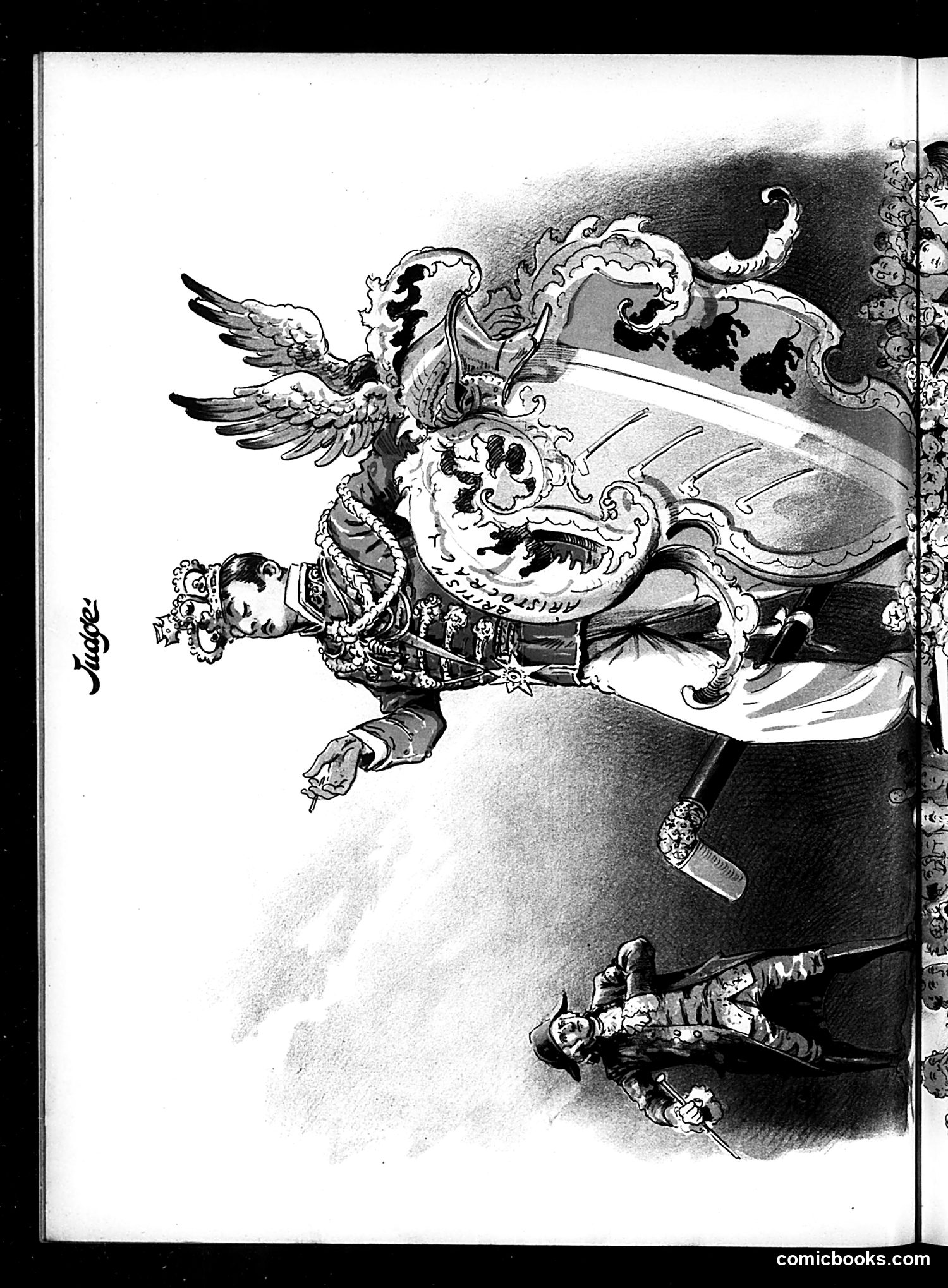
This political cartoon appears to show two figures in elaborate 18th or 19th-century aristocratic dress engaged in some form of confrontation or negotiation. The figure on the left wears ornate military regalia with wings (suggesting angelic or noble status), while the figure on the right is positioned lower, also in formal period attire. The decorative shield or coat-of-arms held by the upper figure displays heraldic symbols, likely representing a nation or dynasty. The overall composition suggests a satirical commentary on diplomatic relations or power dynamics between nations or political entities, though without additional context from the magazine's publication date and accompanying text, the specific figures and their dispute remain unclear. The style is consistent with late-19th or early-20th-century political satire.
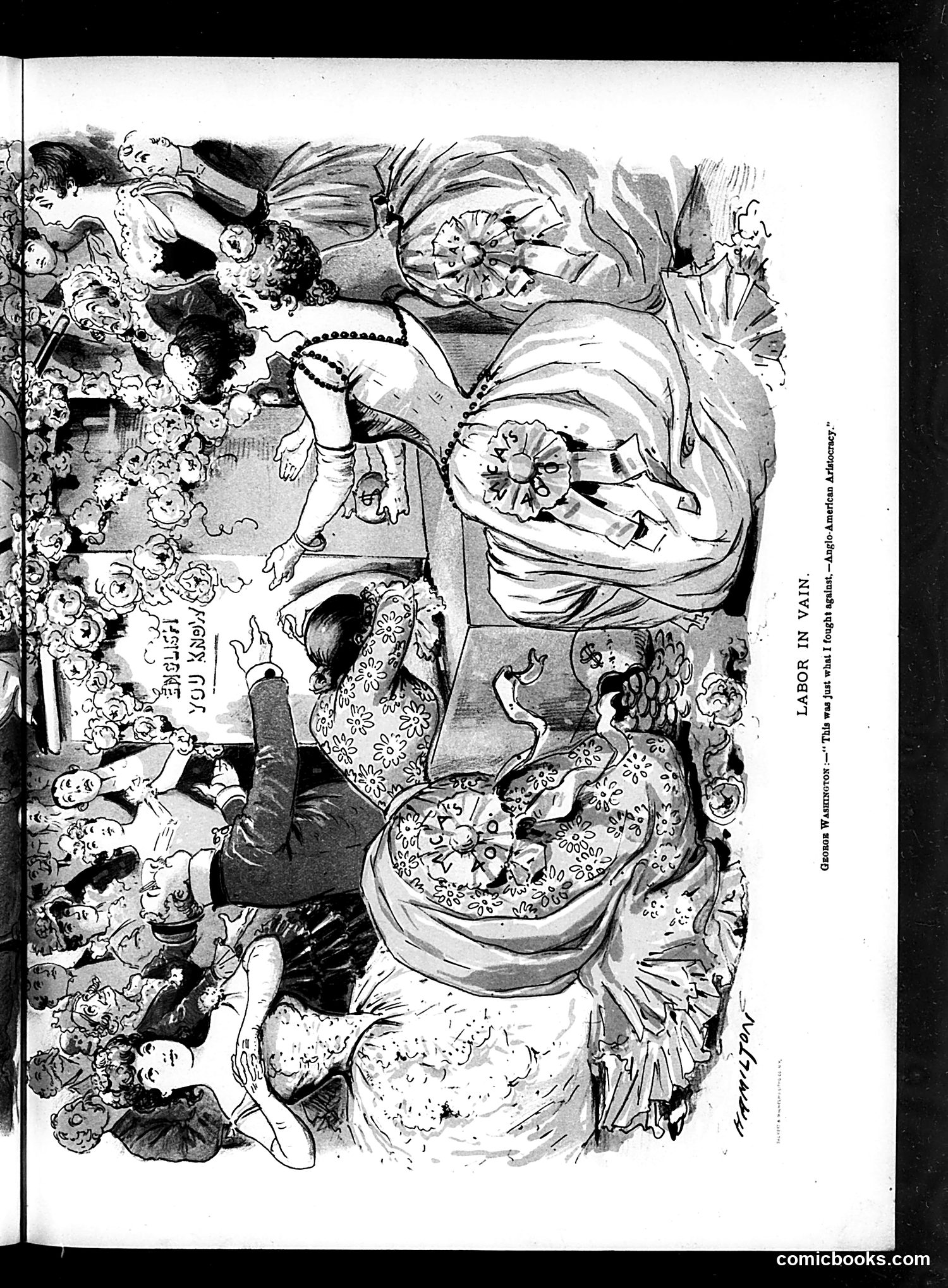
I cannot reliably read the OCR text on this page—it appears heavily corrupted or rotated. However, examining the image itself: this appears to be a satirical illustration showing multiple figures in elaborate dress amid profusions of flowers and decorative elements. The style and composition suggest late 19th or early 20th-century American political or social satire from *Judge* magazine. The drawing depicts what seems to be figures in formal/theatrical costume surrounded by abundant floral imagery. Without legible text identifying specific political figures or events, I cannot accurately explain the satire's particular target or meaning to a modern reader. The artistic execution is detailed, but the specific political or social references remain unclear from the image alone.
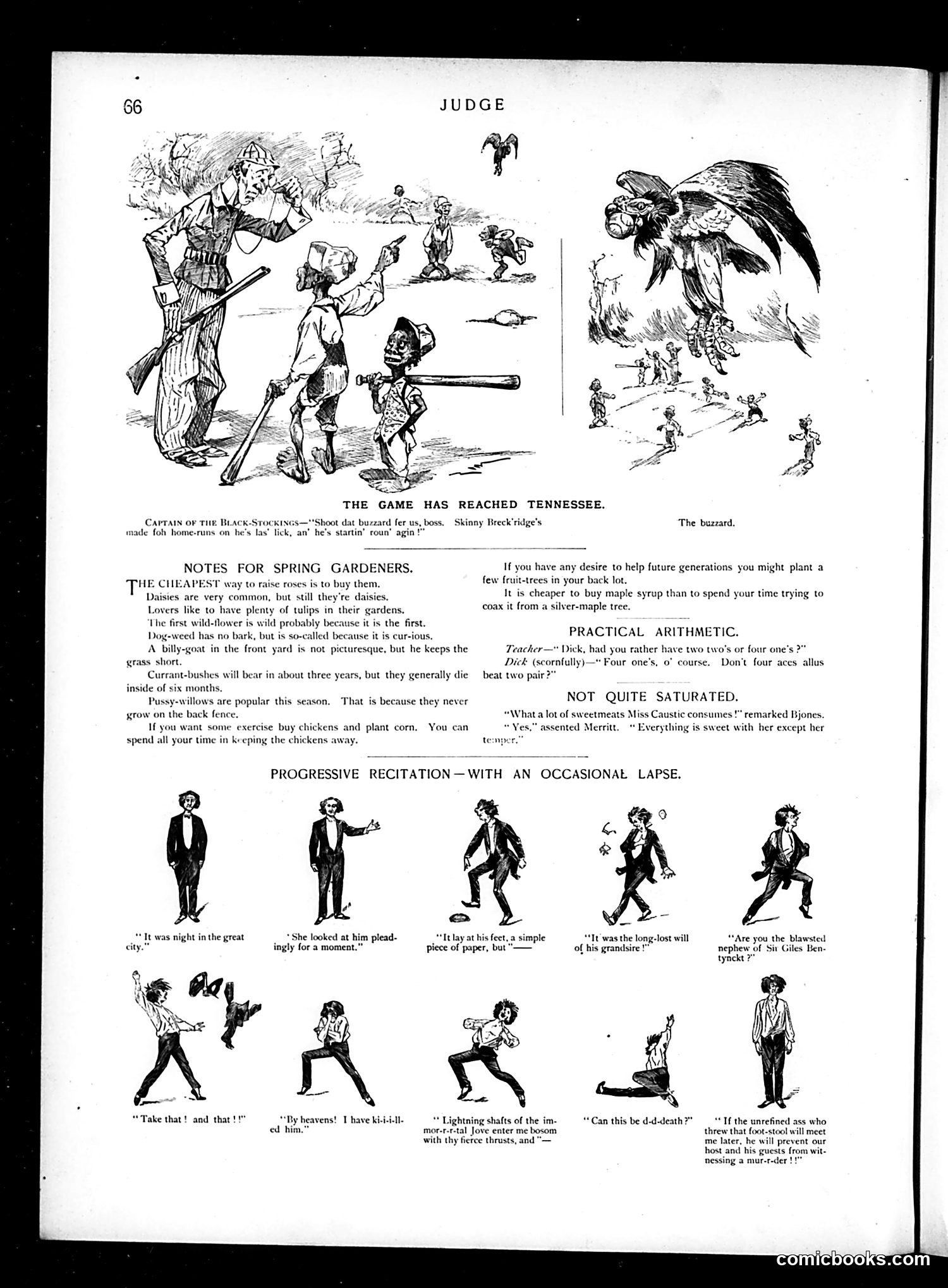
This page from *Judge* magazine contains three distinct humor pieces: **"The Game Has Reached Tennessee"** (top): A political cartoon satirizing the 1884 presidential campaign. It depicts a "buzzard" (representing one candidate, likely James Blaine) descending on Tennessee voters, with a crude dialect caption mocking Southern political participation. The reference to "home-runs" suggests baseball as a metaphor for electoral competition. **"Notes for Spring Gardeners"** and **"Practical Arithmetic"**: Brief joke columns offering absurdist advice and wordplay—typical *Judge* filler content poking fun at common knowledge and student responses. **"Progressive Recitation—With an Occasional Lapse"** (bottom): A visual gag sequence showing a dramatic melodrama performance progressively falling apart. Each panel presents theatrical lines that deteriorate from serious drama into slapstick chaos, satirizing overwrought Victorian stage acting and the gap between ambitious performances and their actual execution. The humor relies on the reader recognizing dramatic clichés being undermined.
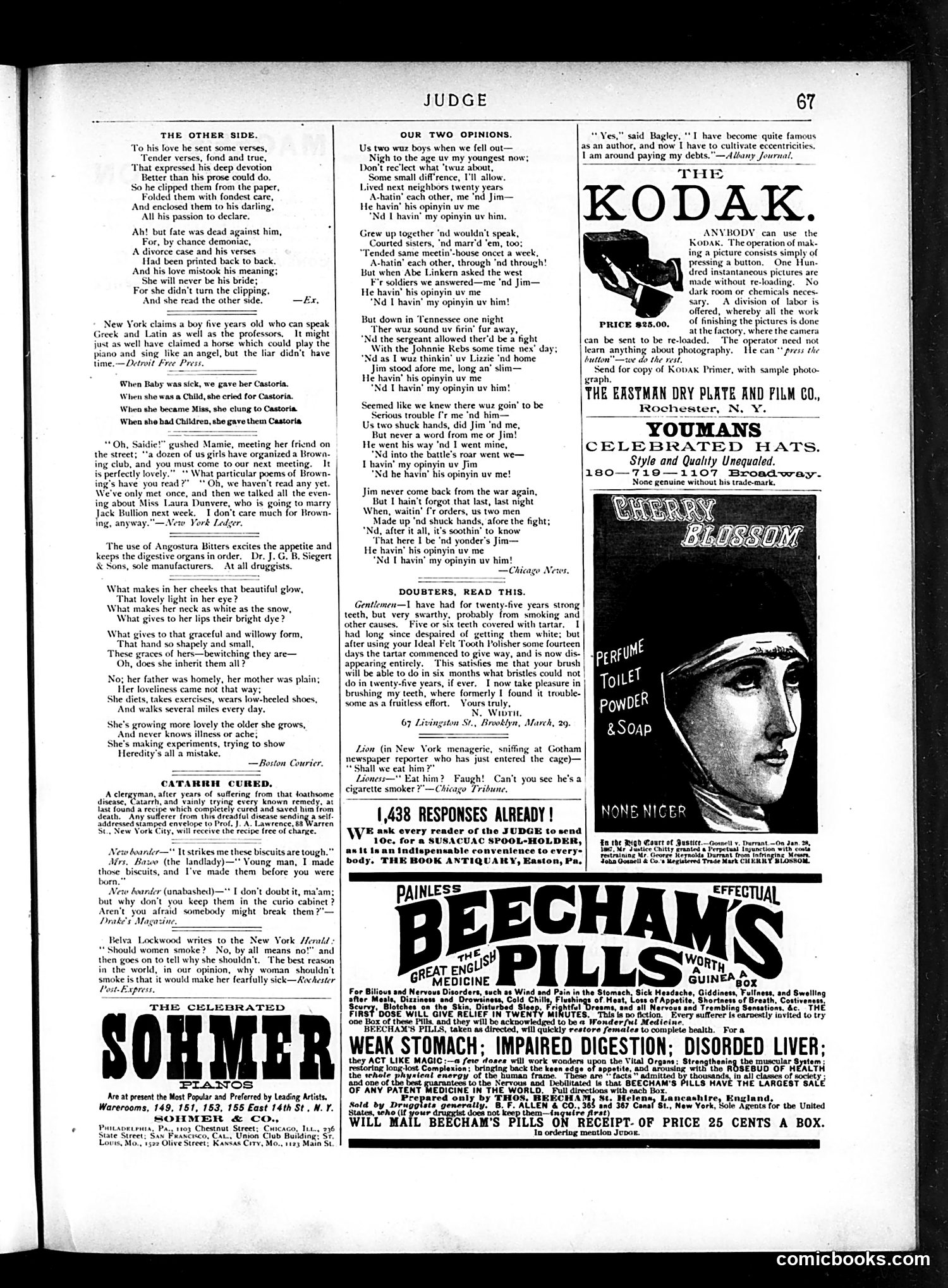
This page is primarily a **collection of short humorous anecdotes and advertisements** rather than political cartoons. The satirical content includes: - **"The Other Side"**: A joke about a man who sends clipped love verses to his sweetheart, but she reads the divorce case printed on the back instead—missing his romantic intent - **"Browning Club"**: Satire on women's literary clubs that discuss gossip rather than actual literature - **Various humorous observations**: Including jokes about a five-year-old claiming to speak Greek and Latin, women's beauty routines, and clerical catarrh cures The **advertisements dominate the page**: promoting Kodak cameras, Beecham's Pills, Sohmer pianos, perfume, and other patent medicines. These ads reflect turn-of-the-century consumer culture. **No specific political figures or events** are referenced. The satire targets general social pretensions—literary affectation, false health claims, and domestic humor—typical of Judge's lighthearted approach to American society.
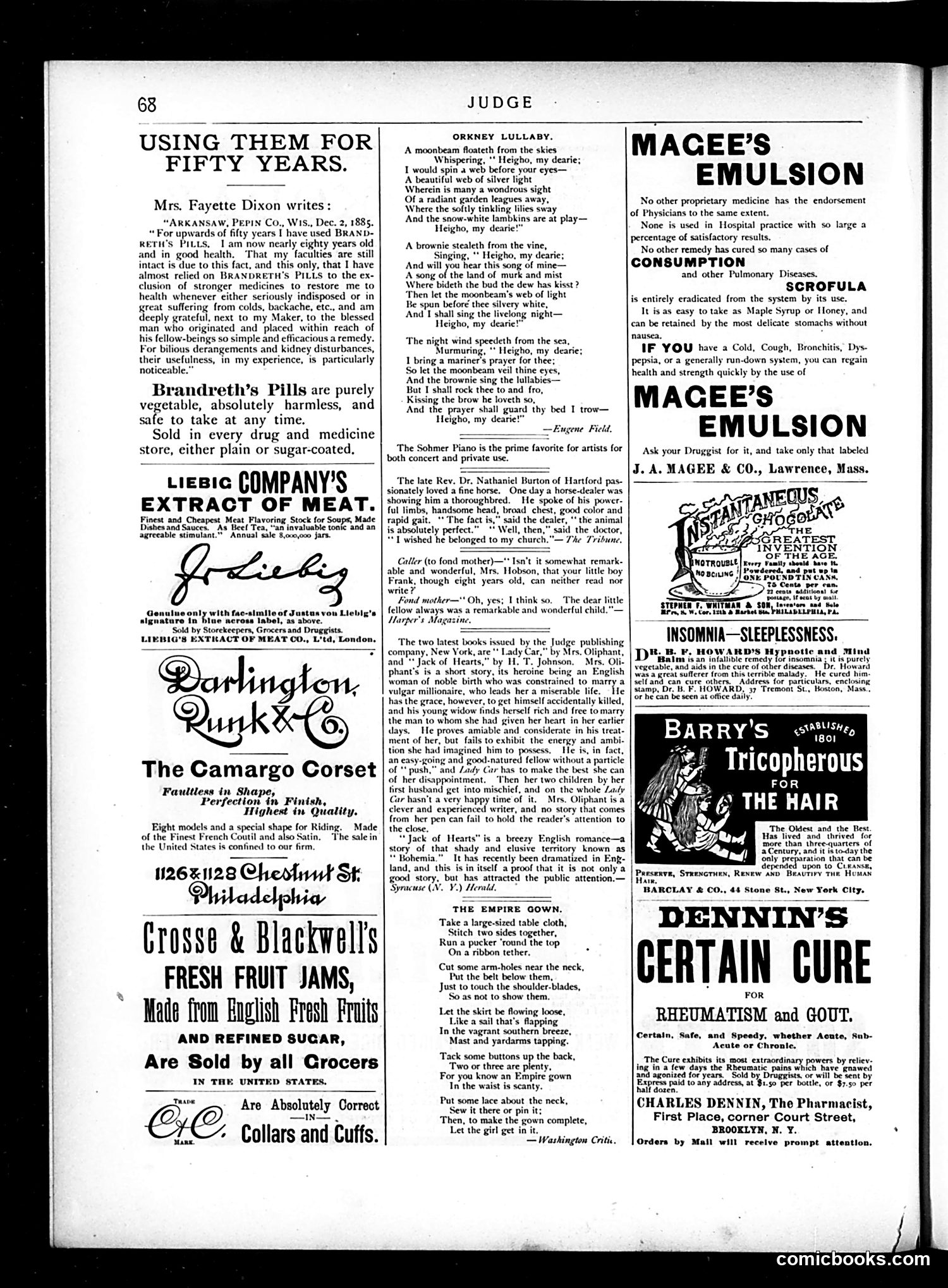
This page is primarily **advertisements and literary content** rather than political satire or cartoons. The main elements are: **Advertisements** dominate the page, promoting patent medicines (Brandreth's Pills, Magee's Emulsion for consumption), corsets, food products (meat extract, jam), and pianos—typical of late 19th-century magazines. These ads relied on testimonials and health claims that would be regulated or banned today. **Literary content** includes "Orkney Lullaby" by Eugene Field, a sentimental poem featuring personified natural elements (moonbeam, brownie, wind) singing a child to sleep—reflecting the era's taste for whimsical, moralistic verse. **A brief humorous anecdote** about a minister praising a horse's perfection but wishing it belonged to his church—gentle satire on clerical ambitions. There are **no political cartoons** visible on this page. The "satire" in Judge is minimal here; the page reflects how 19th-century magazines monetized advertising alongside cultural content.
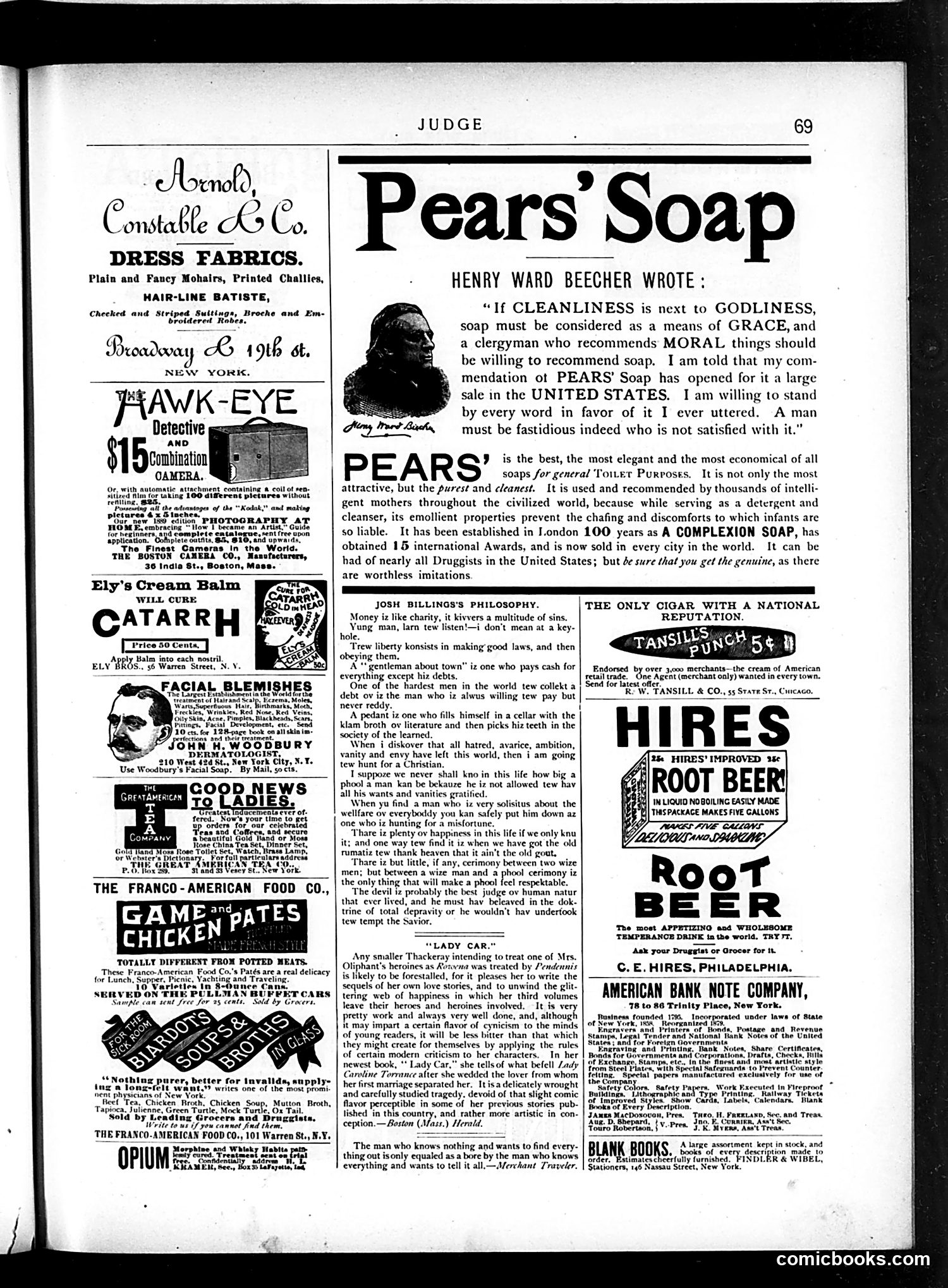
This page is primarily devoted to advertising Pears' Soap, a British product. The advertisement features an endorsement from **Henry Ward Beecher**, the famous 19th-century American clergyman and abolitionist, who argues that soap—like cleanliness itself—is a moral good worthy of religious recommendation. The ad emphasizes Pears' Soap's gentleness for infants and its 100-year history in London with 15 international awards. It addresses a concern that matters in this era: **counterfeit products**—the ad warns readers to ensure they purchase "the genuine" rather than "worthless imitations." The page includes various other period advertisements (cameras, creams, patent medicines) and a humor column by **Josh Billings** offering satirical observations on human nature—money, youth, debt collection, and hypocrisy. The Beecher endorsement was likely genuine and valuable because his moral authority carried significant commercial weight with American consumers of the era.
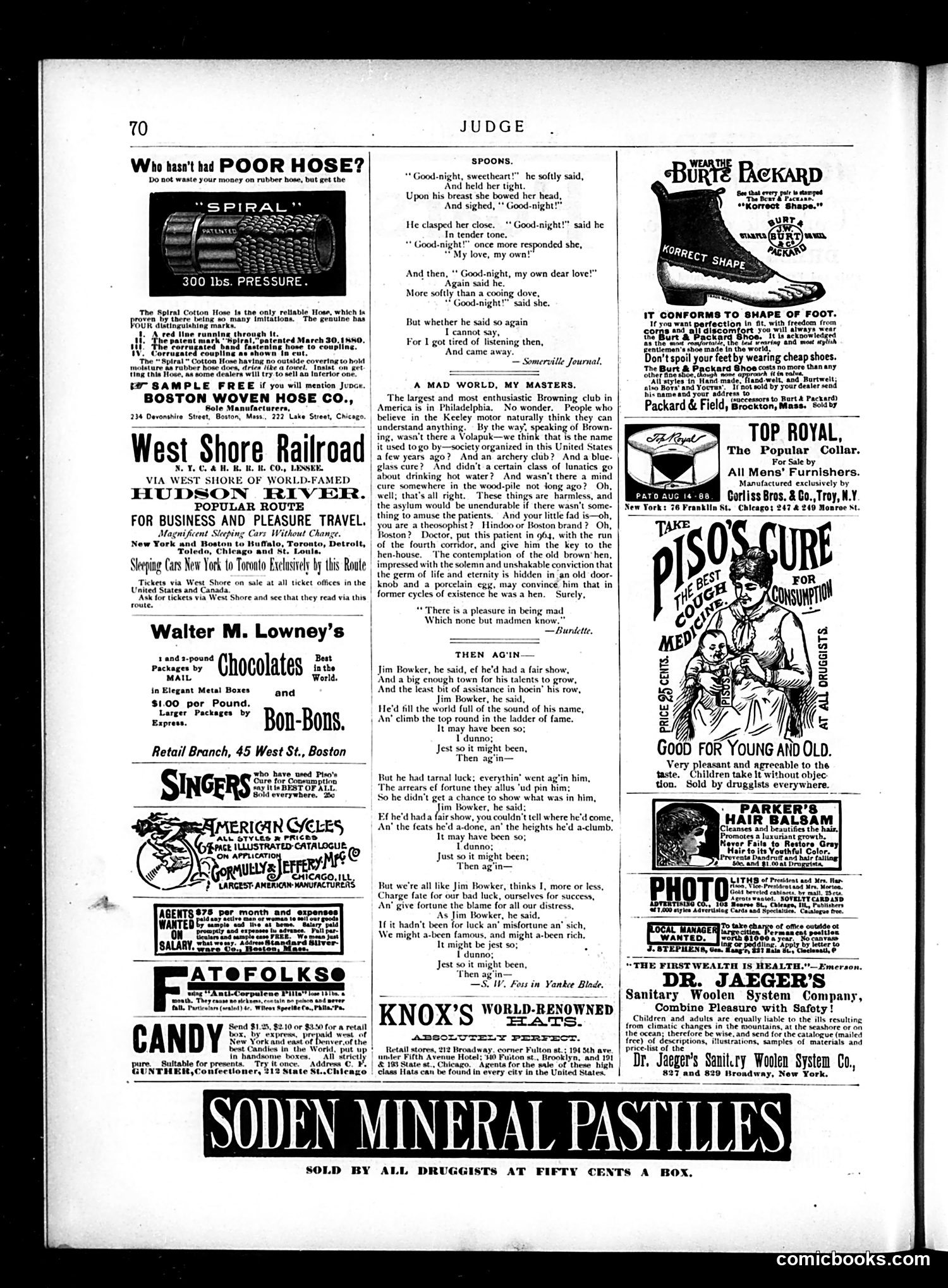
This page is primarily **advertisements and light verse** rather than political satire. The main content includes: **"Spoons"** — A sentimental poem about repeated "good-night" exchanges between lovers, ending when the narrator tires of listening. It's gentle romantic humor about courtship rituals. **"A Mad World, My Masters"** — Social commentary mocking various Victorian fads and movements: the Keeley motor (a fraudulent medical device), Volapük (an artificial language), mind cure, theosophy, and spiritualism. The author suggests these crazes belong in asylums, satirizing the era's susceptibility to pseudoscience and bizarre trends. **"Then Ag'in"** — A humorous poem about Jim Bowker's unfulfilled boasts that with proper circumstances, he'd become famous—a gentle jab at self-aggrandizing ambition. The remainder of the page consists entirely of period advertisements: railroad travel, chocolates, bicycles, candy, and patent medicines—typical Judge magazine revenue sources reflecting late 19th-century consumer culture.
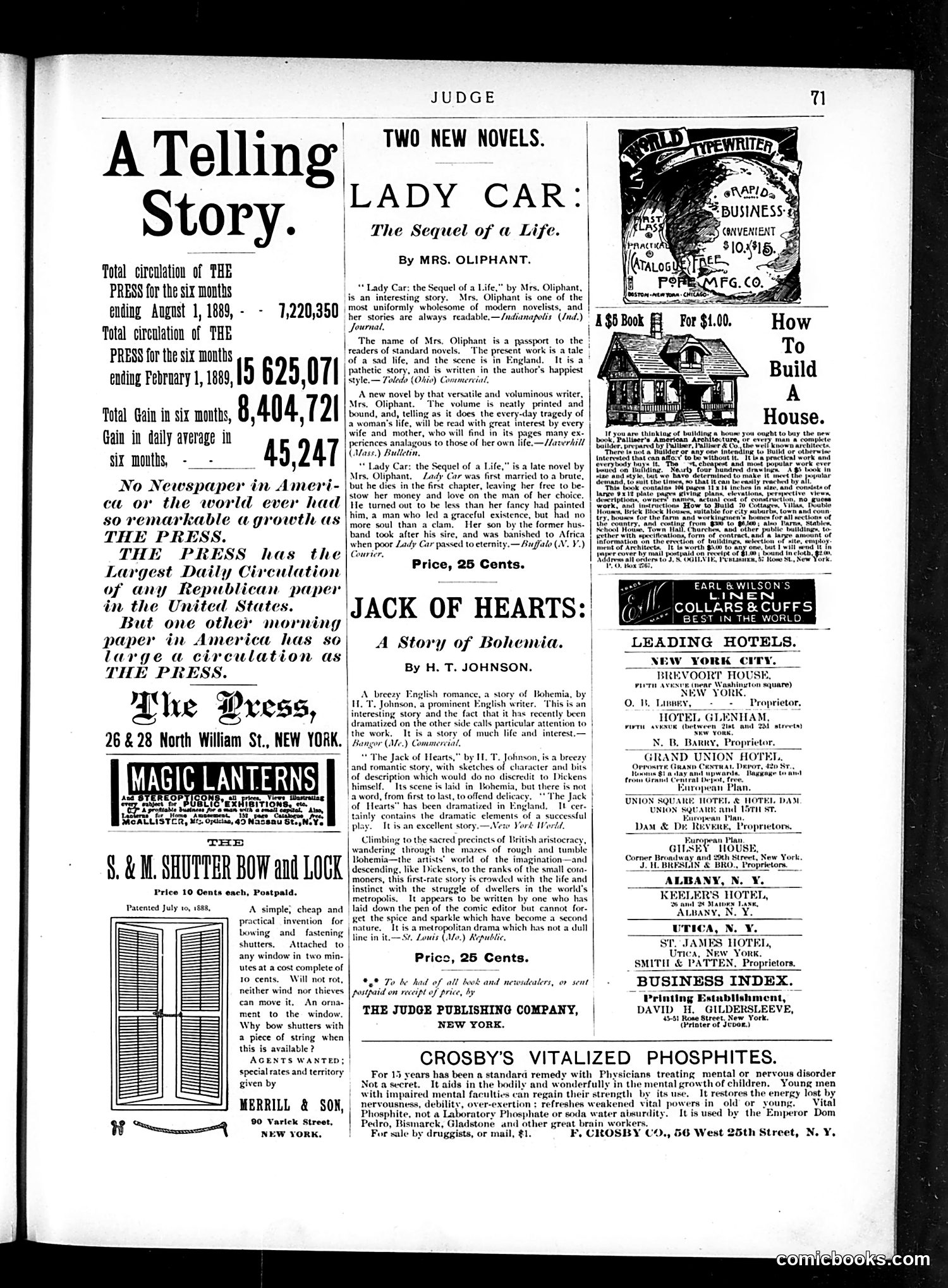
This page is primarily **advertising and circulation boasting**, not political satire. The main content celebrates "The Press" newspaper's dramatic circulation growth—from 5.6 million to 7.2 million copies in six months (1889). The text makes bombastic claims that no newspaper in America or "the world" achieved comparable growth. The page also advertises two novels: *Lady Car* by Mrs. Oliphant (a melodrama about a widow choosing between men) and *Jack of Hearts* by H.T. Johnson (a bohemian romance). Additionally, there are ads for practical inventions: window shutters and Magic Lanterns (early projection devices). **No political cartoons or satire appear here.** The "telling story" is simply The Press's commercial success—a self-promotional advertisement typical of 19th-century newspapers competing fiercely for readership and advertising revenue. The tone is celebratory boasting rather than satirical commentary.
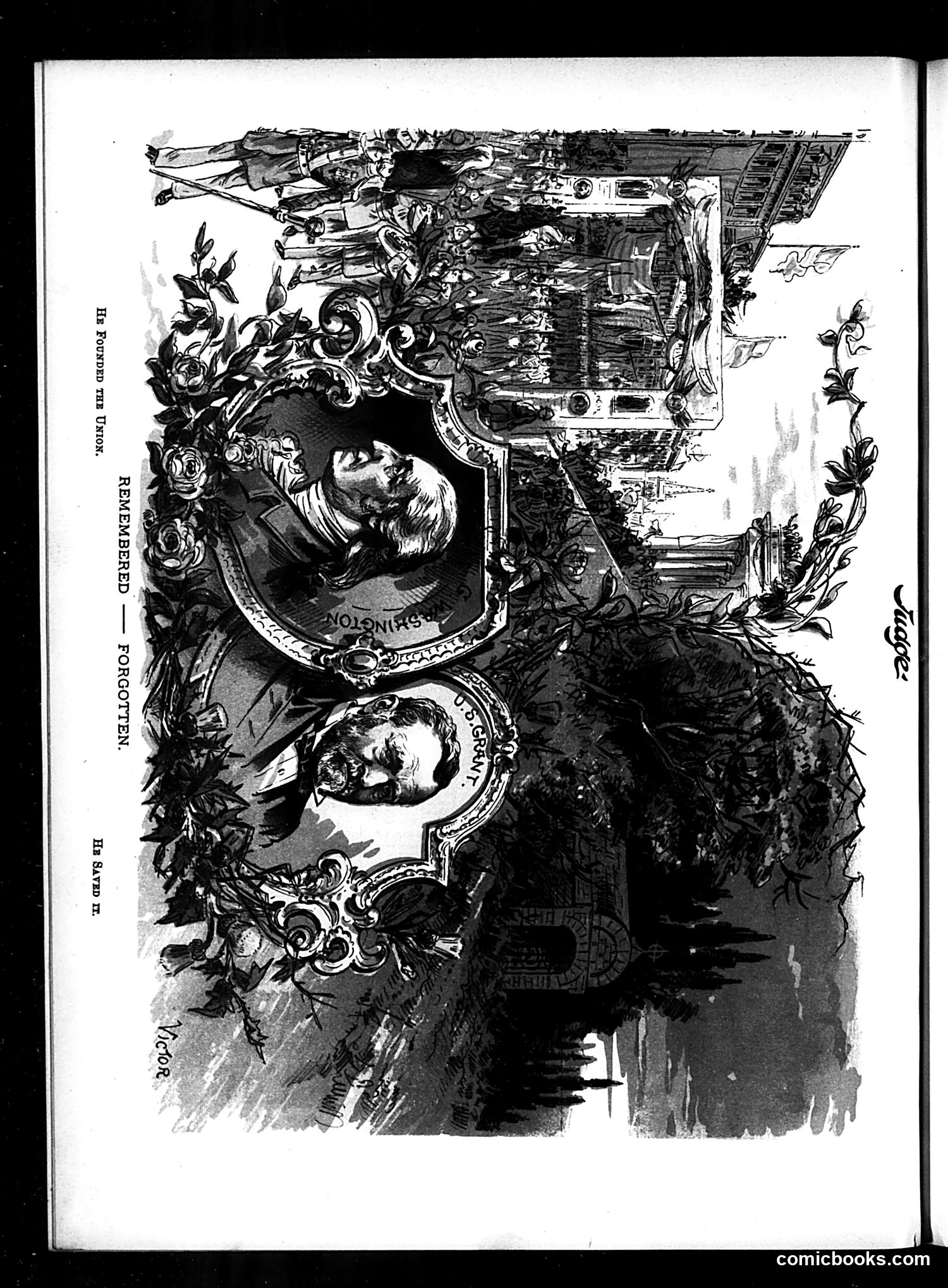
This page appears to contain two framed portrait medallions arranged vertically, decorated with ornate floral borders. The upper portrait is labeled "REMEMBERED" and the lower is labeled "FORGOTTEN." The text "HE FOUNDED THE UNION" appears at the top. The cartoon uses visual contrast to compare two historical figures—likely American founders or early leaders—judging one worthy of remembrance and the other consigned to historical obscurity. The elaborate decorative frames emphasize the formal, monumental nature of historical memory itself. Without clearer identification of the specific individuals depicted, the precise political critique remains unclear, though the satire likely comments on selective historical memory and how Americans choose to honor or dismiss their leaders.