
A complete issue · 16 pages · 1889
Judge — April 20, 1889
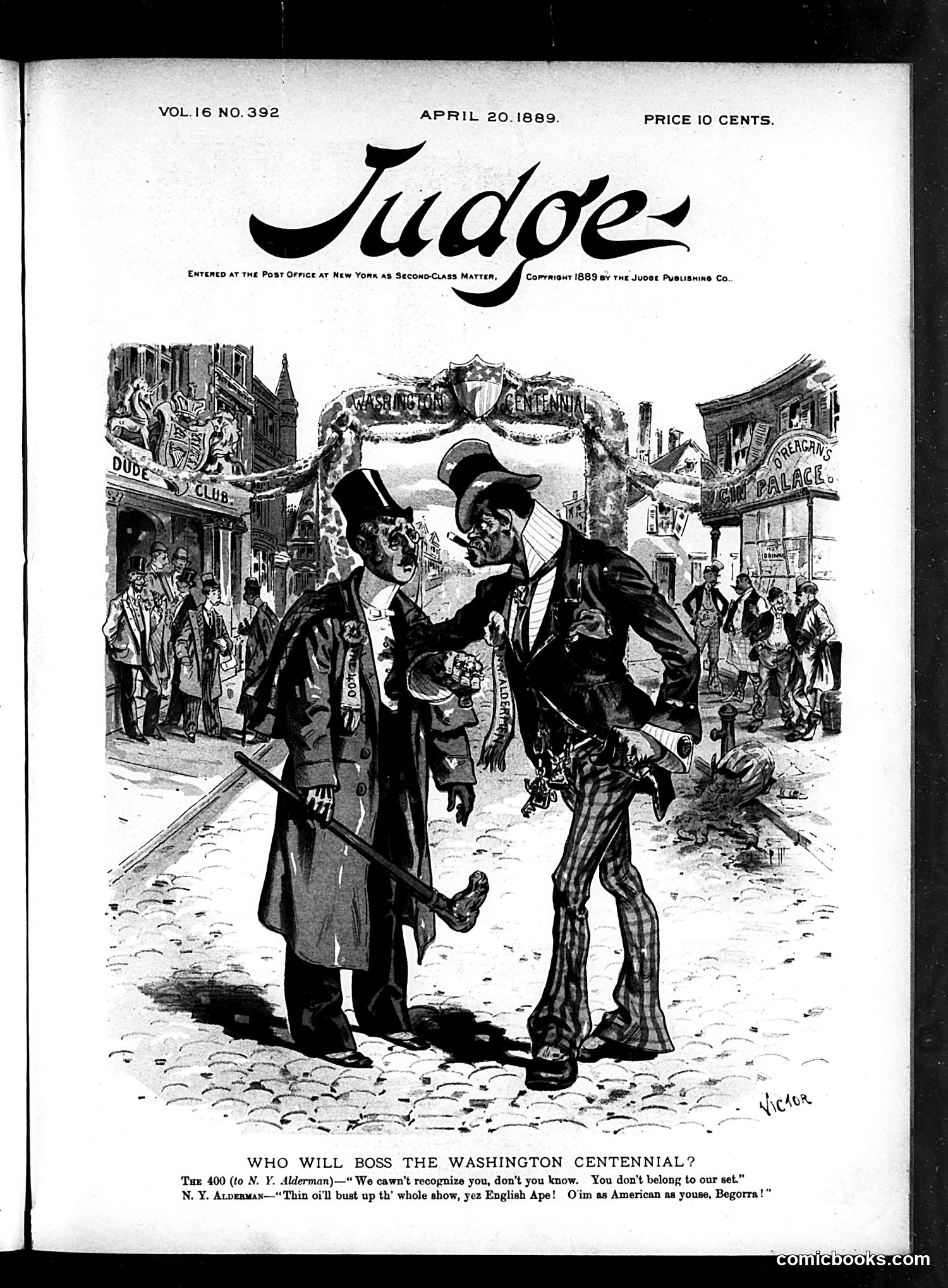
This cartoon satirizes rivalry over control of Washington D.C.'s centennial celebration (commemorating the city's 100th anniversary). Two figures representing New York political factions confront each other on a street decorated with centennial banners. The "400" (New York's wealthy social elite) and the "N.Y. Alderman" (representing common political machine operators) argue about who will "boss" the event. The Alderman boasts he'll "bust up th' whole show" and assert American—not English—dominance. The satire mocks New York's class divisions and political infighting, suggesting both factions want to control the prestigious national celebration. The caricatures use period ethnic stereotyping typical of Judge magazine's satirical style.
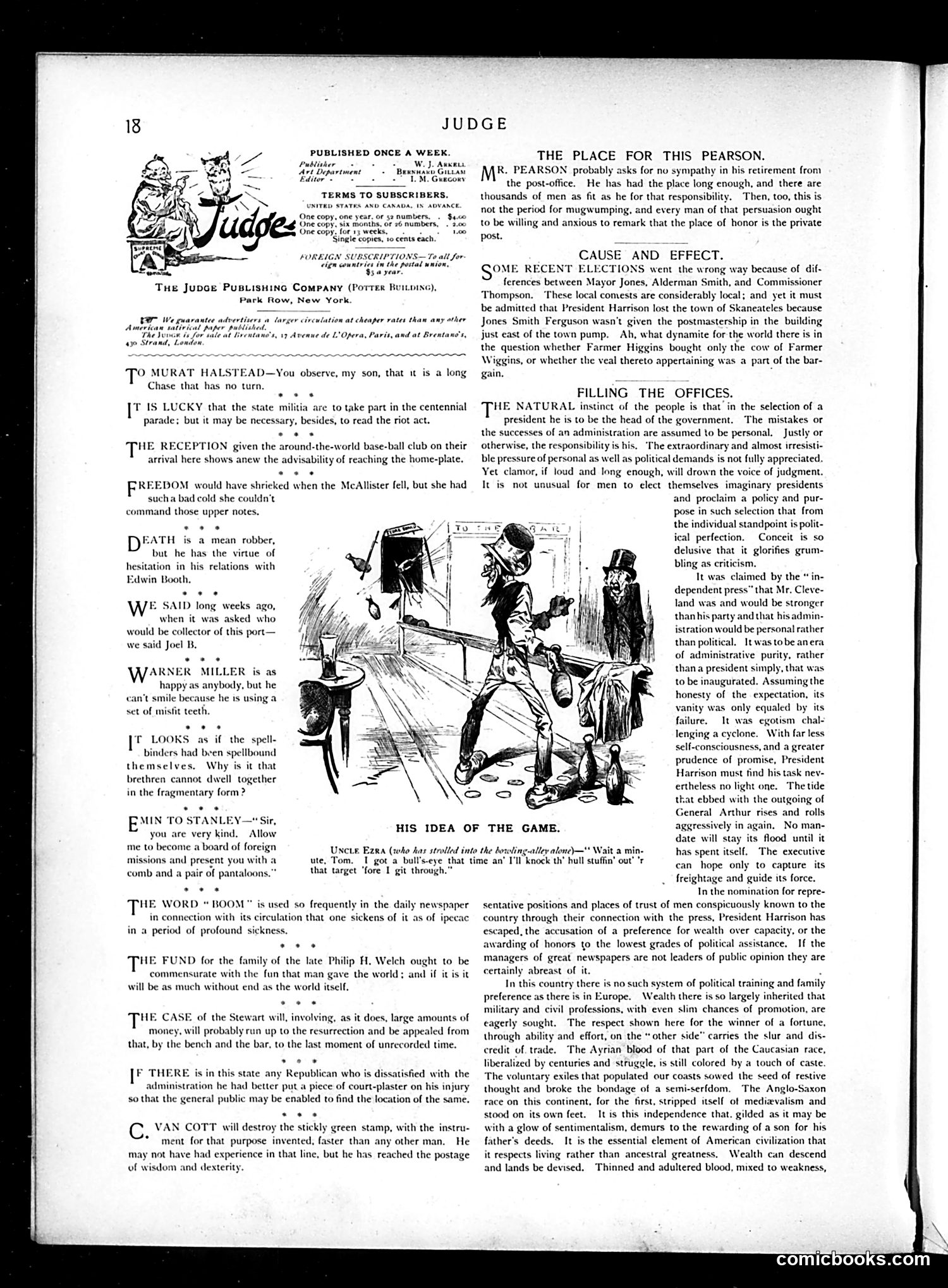
This page contains editorial commentary and a political cartoon titled "His Idea of the Game." The main cartoon depicts what appears to be political figures engaged in a chaotic scene—one figure kicks another through a doorway while others look on, suggesting corrupt or underhanded political maneuvering. The accompanying text discusses issues of municipal governance, specifically referencing disputes between "Mayor Jones, Alderman Smith, and Commissioner Thompson" regarding local elections and presidential politics. The editorial argues that selecting qualified administrators requires merit rather than political favoritism or pressure from party interests. The cartoon satirizes how political appointments are made through backroom dealing and personal connections rather than merit-based selection. The "game" referenced appears to be the corrupt practice of filling government offices through political manipulation rather than honest qualification.
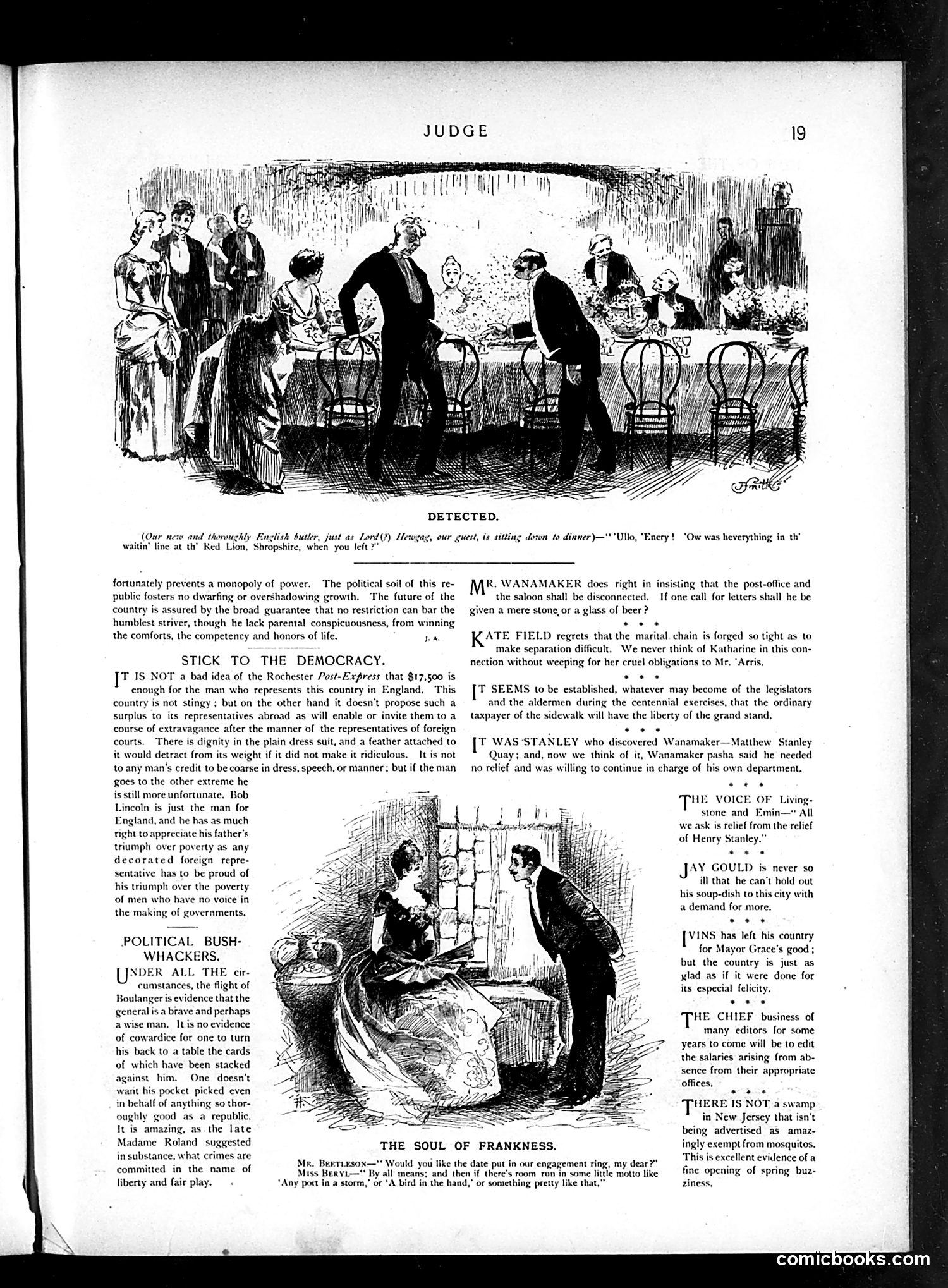
This page contains several brief satirical commentaries on American politics and society, typical of Judge's format. **Top cartoon ("Detected")**: Shows a butler being questioned about an English guest. The joke plays on class pretension—an English butler discussing another aristocratic visitor, likely mocking Americans' fascination with foreign nobility. **"Stick to the Democracy"**: Defends a $17,500 salary for the U.S. ambassador to England, arguing against excessive spending that mimics foreign court extravagance. It praises Robert Lincoln (son of Abraham Lincoln) as appropriately humble despite his father's achievements. **"Political Bushwhackers"**: References General Boulanger's flight from France, suggesting even noble causes (republics) can justify questionable actions—a cynical commentary on political expediency. **Brief items**: Mock various figures—Wanamaker (postal official), Kate Field (journalist), Jay Gould (industrialist), and newspaper editors—for hypocrisy, greed, or self-interest. The "Soul of Frankness" cartoon satirizes shallow engagement proposals. Overall, the page criticizes political corruption, class pretension, and the gap between democratic ideals and self-serving behavior.
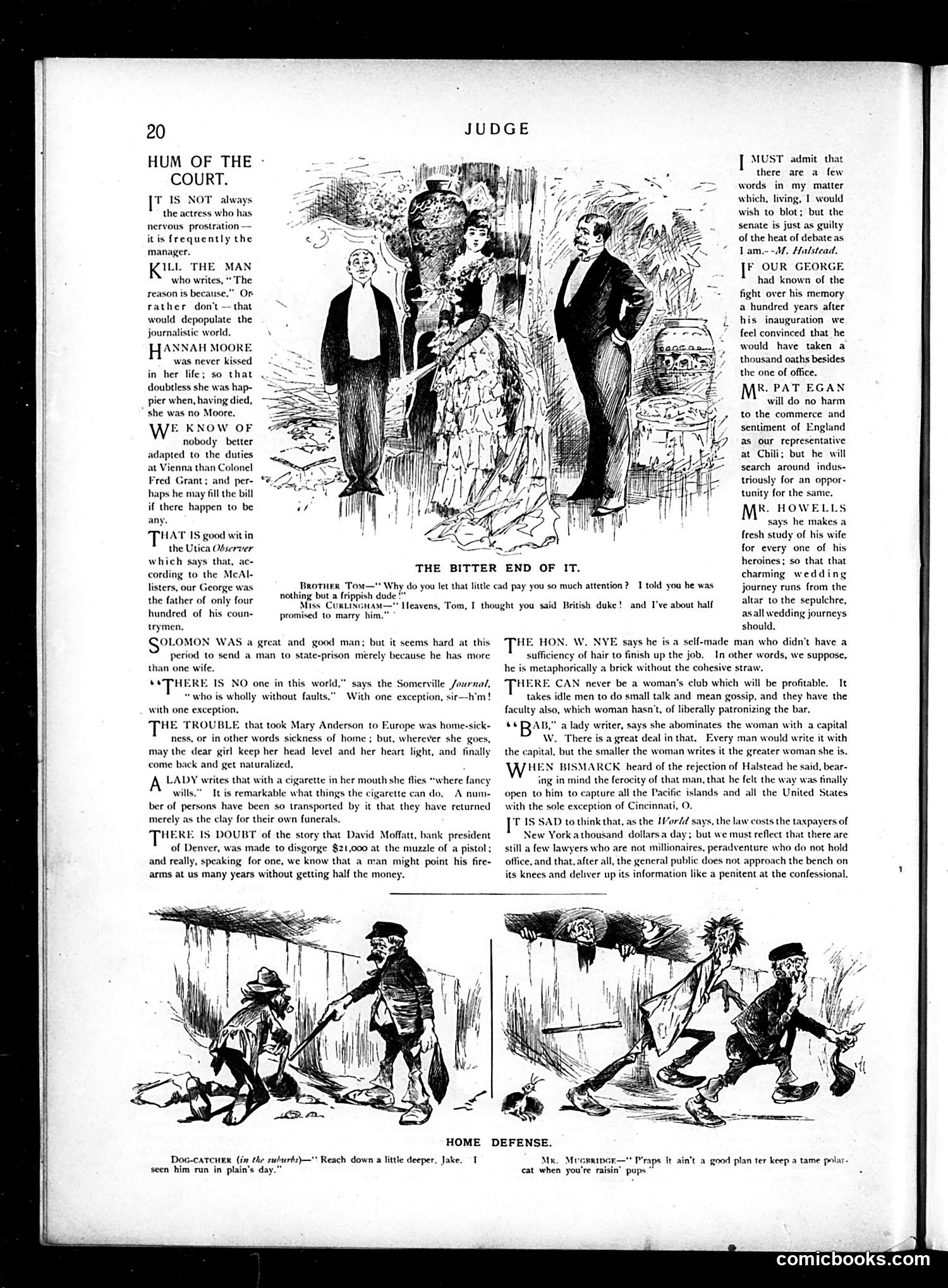
This page from *Judge* magazine contains brief satirical observations on contemporary figures and issues, plus two cartoon sections. **Upper section** ("Hum of the Court"): Short quips mock various targets—journalists who write "reason is because," Mary Anderson's homesickness, and David Moffatt, a Denver banker allegedly forced at gunpoint to pay $21,000. References to "our George" appear to concern a historical figure's legacy. The section ridicules Solomon-like polygamy and celebrates cigarettes' peculiar social power. **"The Bitter End of It" cartoon**: A woman complains a suitor is a "frippish dud" rather than the "British duke" she expected—satire on mercenary matchmaking among the wealthy. **"Home Defense" cartoons**: Sketches depicting boys with sticks and other crude implements, captioned about dog-catchers and keeping "tame polar-cat[s]"—likely satirizing amateur or makeshift approaches to urban problems. The page reflects late 19th-century upper-class anxieties: immigration, gender roles, wealth, and social pretension.
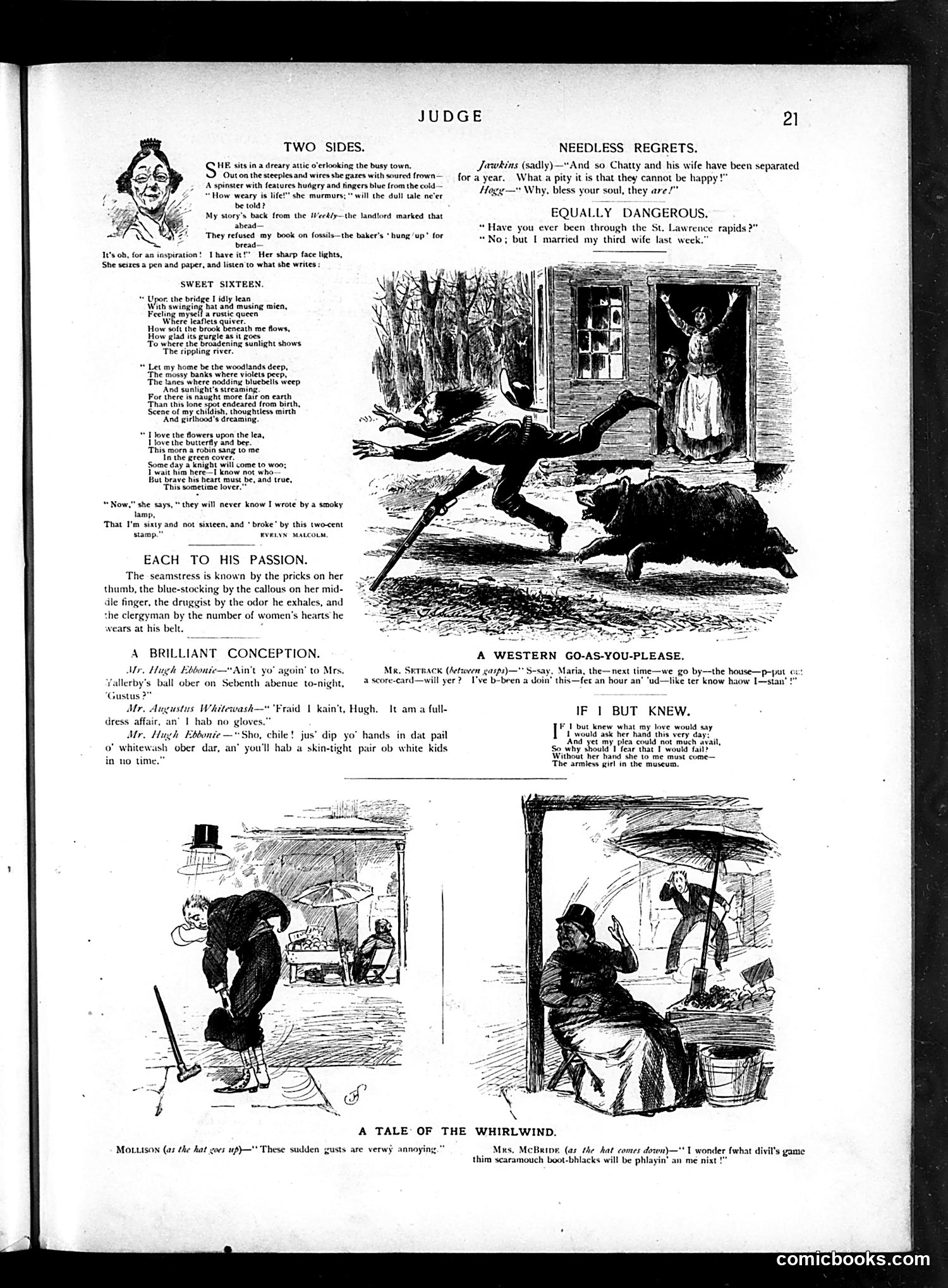
This page contains several short humorous pieces mocking Victorian society's pretensions and absurdities. **"Two Sides"** depicts a poor, aging female writer living in poverty who writes saccharine romantic poetry about "Sweet Sixteen" while actually being sixty, broke, and struggling. The satire targets sentimentalist literature and the gap between artistic fantasy and harsh reality. **"Each to His Passion"** offers cynical one-liners about professions, ending with clergy being defined by romantic conquests—satirizing clerical hypocrisy. **"A Brilliant Conception"** uses dialect humor (likely racist caricature, typical of the era) about a Black man whitewashing his hands to simulate white gloves for a formal event—mocking both racial attitudes and social pretension. The remaining pieces are brief joke vignettes about marital discord, dangerous activities, and romantic uncertainty. The illustrations show domestic/social situations with exaggerated expressions typical of period humor. The overall tone is cynical commentary on romance, class aspiration, and social conventions of the era.
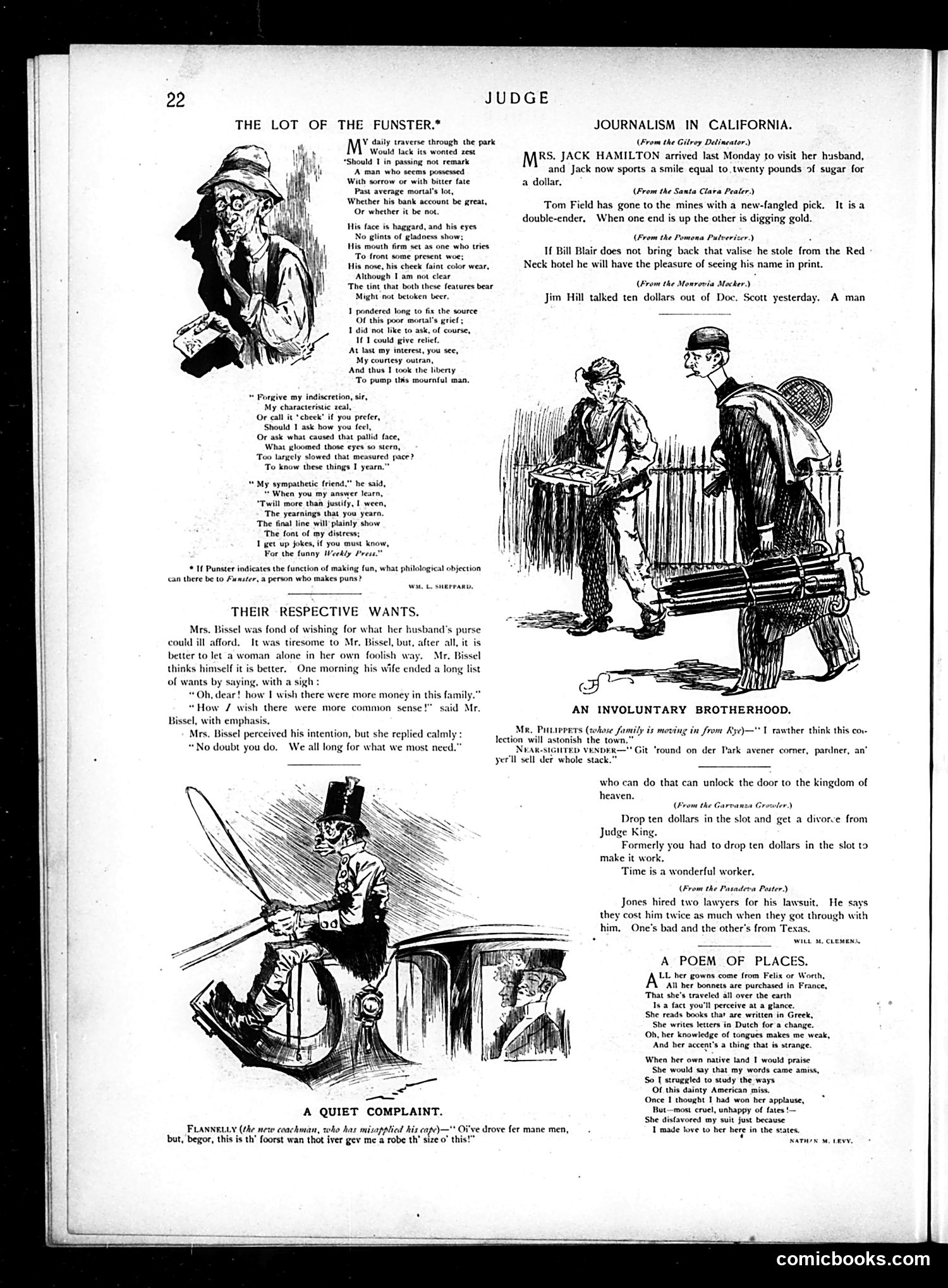
**Main Cartoon (Left):** A haggard man explains his misery to a sympathetic listener. The punchline reveals he's a joke-writer for the "funny Weekly Press"—his suffering comes from the professional demand to constantly produce humor. The satire mocks both the grueling work of comic journalism and the audience's endless appetite for jokes. **"Journalism in California" (Right):** A series of brief, sardonic local news items from California papers. These mock small-town journalism's sensationalism: a wife's brief visit becomes noteworthy, mining gossip, threats of public shaming over theft, and financial chicanery all treated as important news. The satire suggests provincial papers inflate trivial local scandals into headlines. **"Their Respective Wants":** A married couple's exchange satirizes gender stereotypes—she wishes for money, he wishes she had common sense—reflecting period attitudes about women's frivolous spending versus masculine practicality. The page overall ridicules American journalism, from exhausted comic writers to small-town papers' trivial sensationalism.
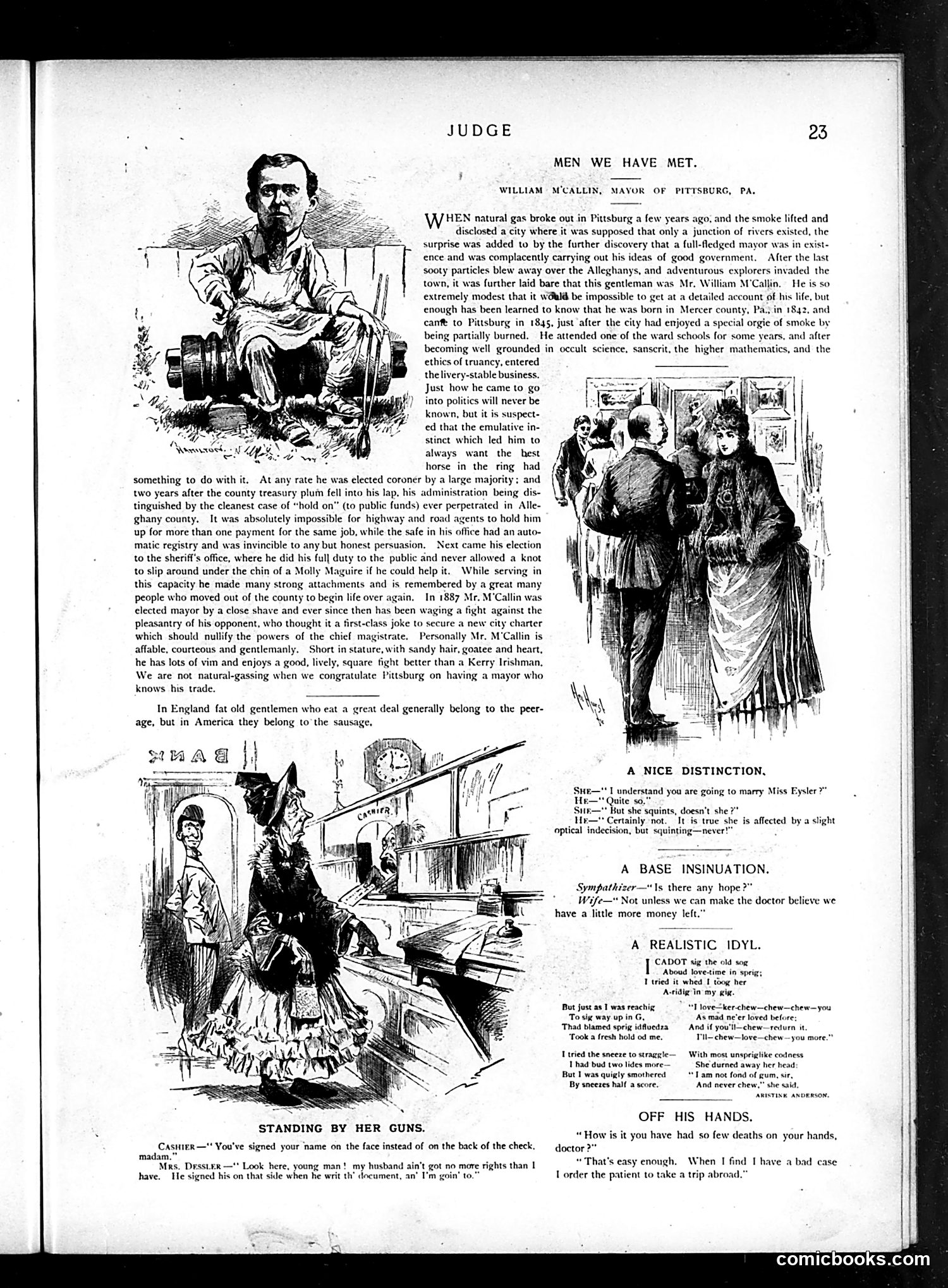
This page features a biographical profile of **William M'Callin, Mayor of Pittsburgh**, presented with gentle satirical humor typical of Judge magazine's "Men We Have Met" series. The main text humorously chronicles M'Callin's rise from livery-stable worker through various political offices (coroner, county treasurer, sheriff, mayor), emphasizing his reputation for honesty—a backhanded compliment suggesting Pittsburgh politicians were typically corrupt. References to "Molly Maguires" (Irish-American labor activists) and "hold on" (embezzlement) reflect late-19th-century Pennsylvania industrial-era scandals. The smaller cartoons and jokes below are unrelated humor: one depicts a woman signing documents "standing by her guns" (maintaining independence in marriage); others are light domestic comedy about optical illusions, financial desperation, and a man's allergies ruining romantic declarations. The closing quip contrasts English aristocrats with American industrialists, suggesting Pittsburgh's wealthy earned fortunes in sausage manufacturing rather than inheriting titles.
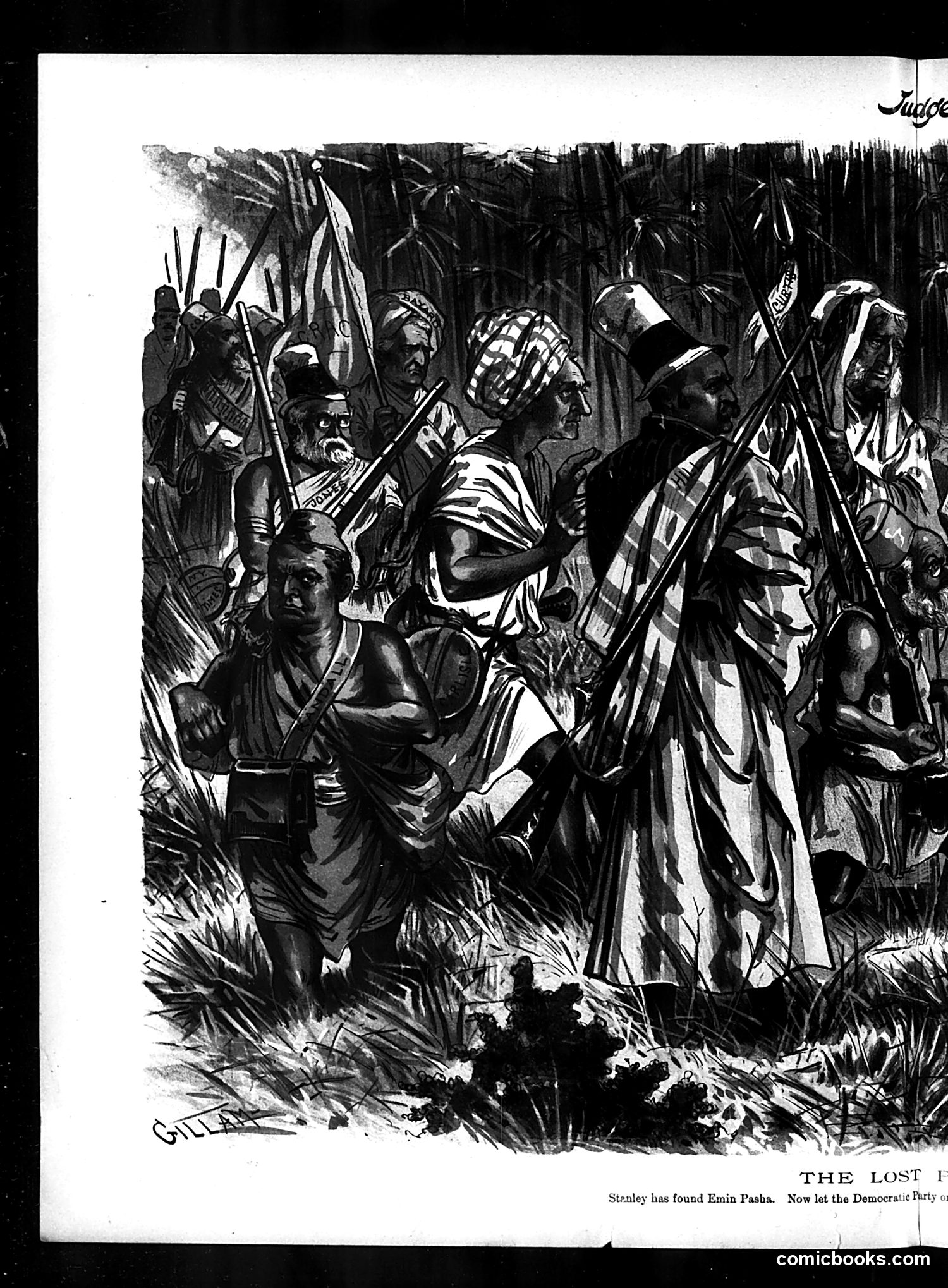
This Judge magazine cartoon depicts Henry Morton Stanley's famous 1871 expedition to find Emin Pasha, a European official in Africa. The illustration shows Stanley encountering Emin Pasha (center, in distinctive white clothing and hat) surrounded by what appears to be African warriors or soldiers holding spears, set in tall grass. The satire's political angle emerges in the caption: "Stanley has found Emin Pasha. Now let the Democratic Party o[f]..." The incomplete text suggests the cartoonist is making a joke equating the Democratic Party's search for leadership or direction with Stanley's expedition—implying Democrats are similarly "lost" and need finding. This is satirical commentary on Democratic Party disorganization or lack of clear leadership during this period.
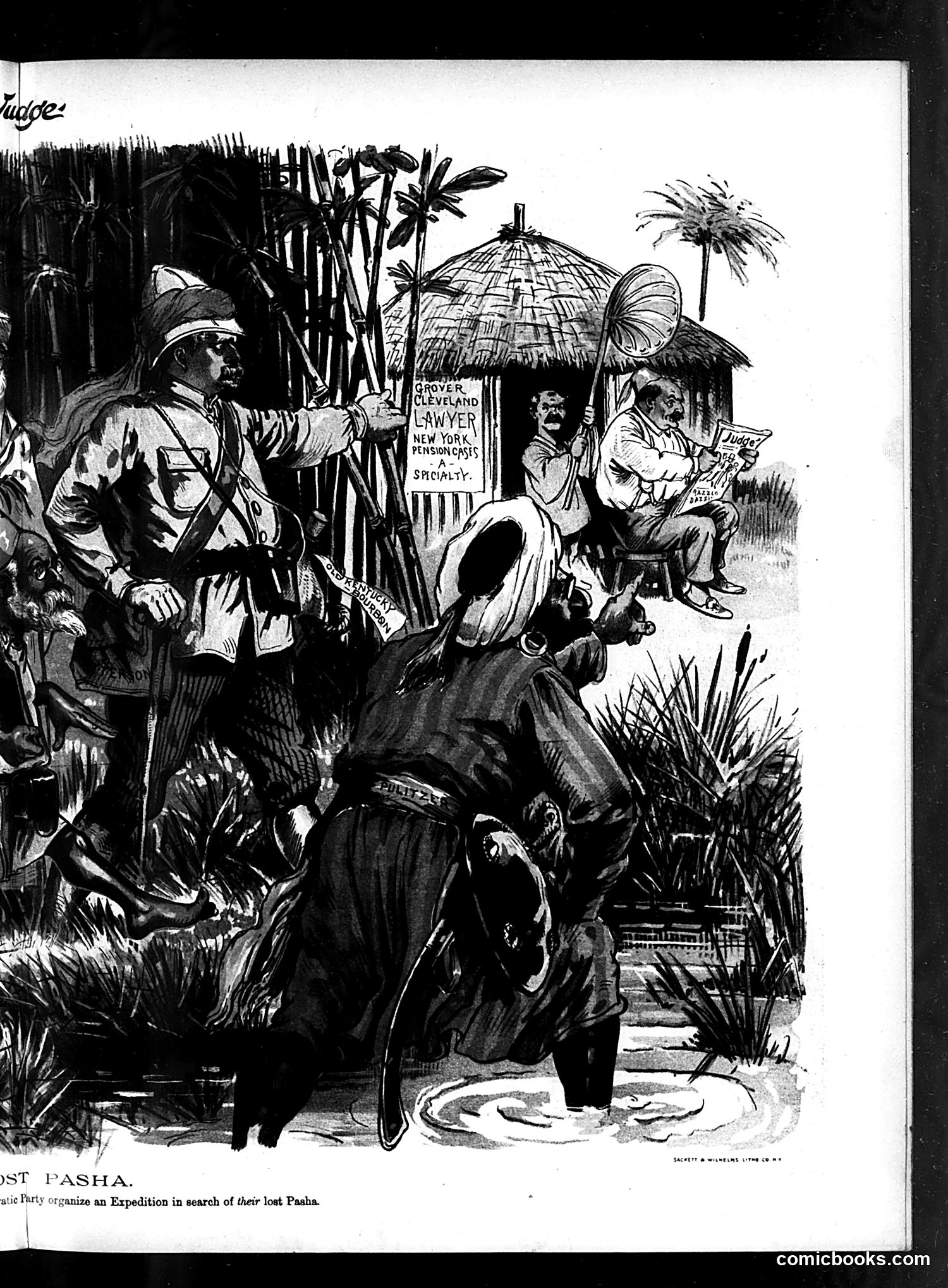
This satirical cartoon depicts a military expedition in a tropical setting, organized to search for a "lost Pasha" (Ottoman military leader). A sign visible in the hut reads "GROVER CLEVELAND LAWYER NEW YORK PERSONALS A SPECIALTY," suggesting the cartoon satirizes President Grover Cleveland's legal background or personal affairs. The soldiers appear to be searching for someone important who has gone missing. The joke likely mocks Cleveland's administration or a specific scandal involving him, using the absurdist premise of mounting a military expedition to retrieve a lost official. The tropical setting and uniformed figures suggest this references actual colonial or military operations of the era, applying them mockingly to American political figures. Without additional context about the specific date or incident, the precise target of satire remains somewhat unclear, though Cleveland's presidency is definitely the subject.
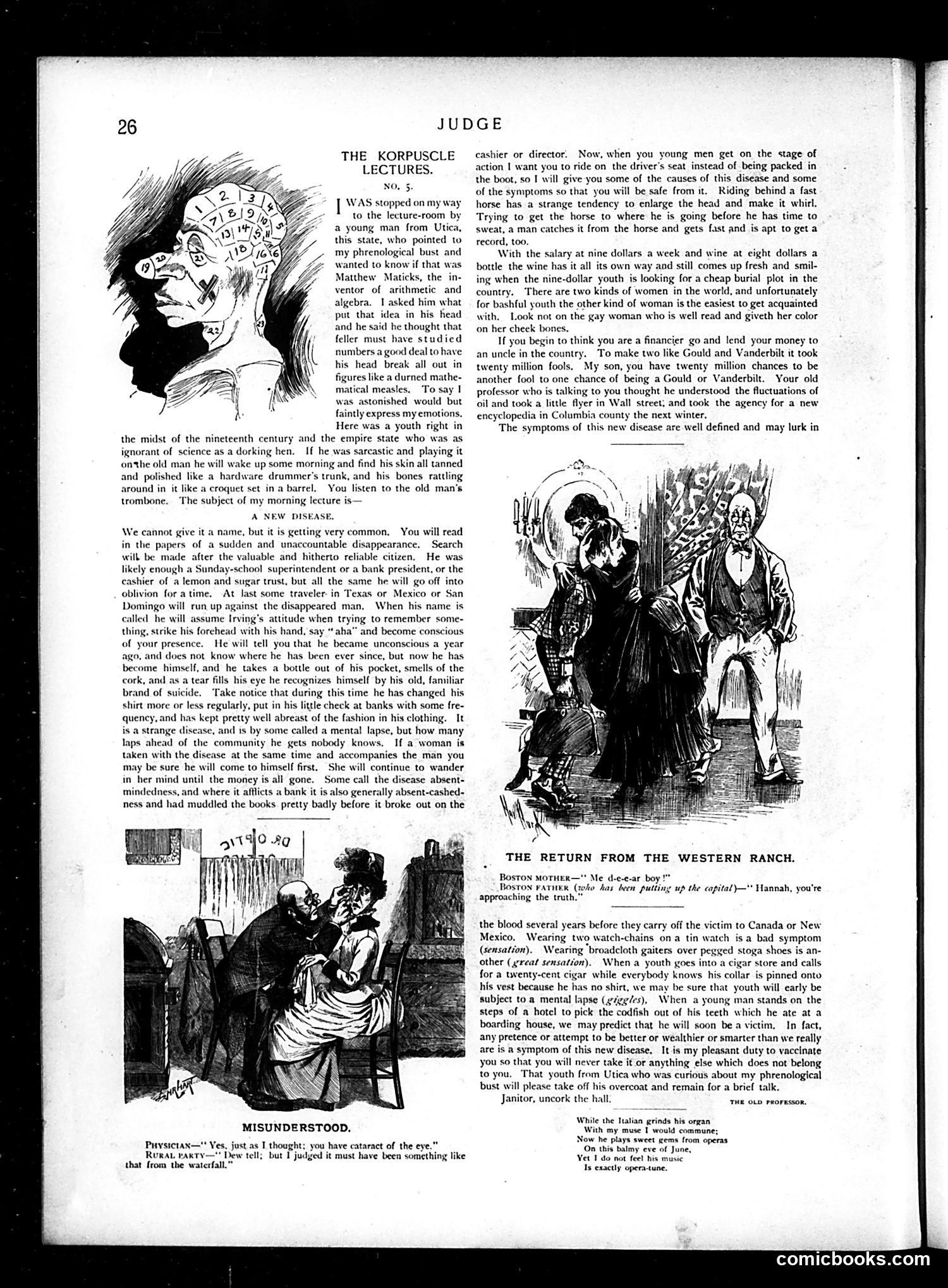
This page satirizes contemporary American social problems through "The Korpuscle Lectures," a recurring column. The main cartoon depicts a phrenological bust—a pseudoscientific head used to "read" character and intelligence through bumps. A naive young man from Utica mistakes it for "Matthew Maticks, inventor of arithmetic," mocking rural ignorance of science. The lecture itself describes a "new disease"—mysterious disappearances of respectable men (bank presidents, Sunday-school superintendents) who reappear later with amnesia, having changed clothes and managed finances unconsciously. This appears to satirize embezzlement and financial crime by suggesting perpetrators claimed mental lapses. The satirist implies this "absent-mindedness" conveniently allows criminals to deny responsibility. A secondary cartoon jokes about a rural man confusing "cataract" eye disease with "waterfall," mocking rural illiteracy. The overall message critiques both urban vice (alcohol, financial corruption) and rural ignorance.
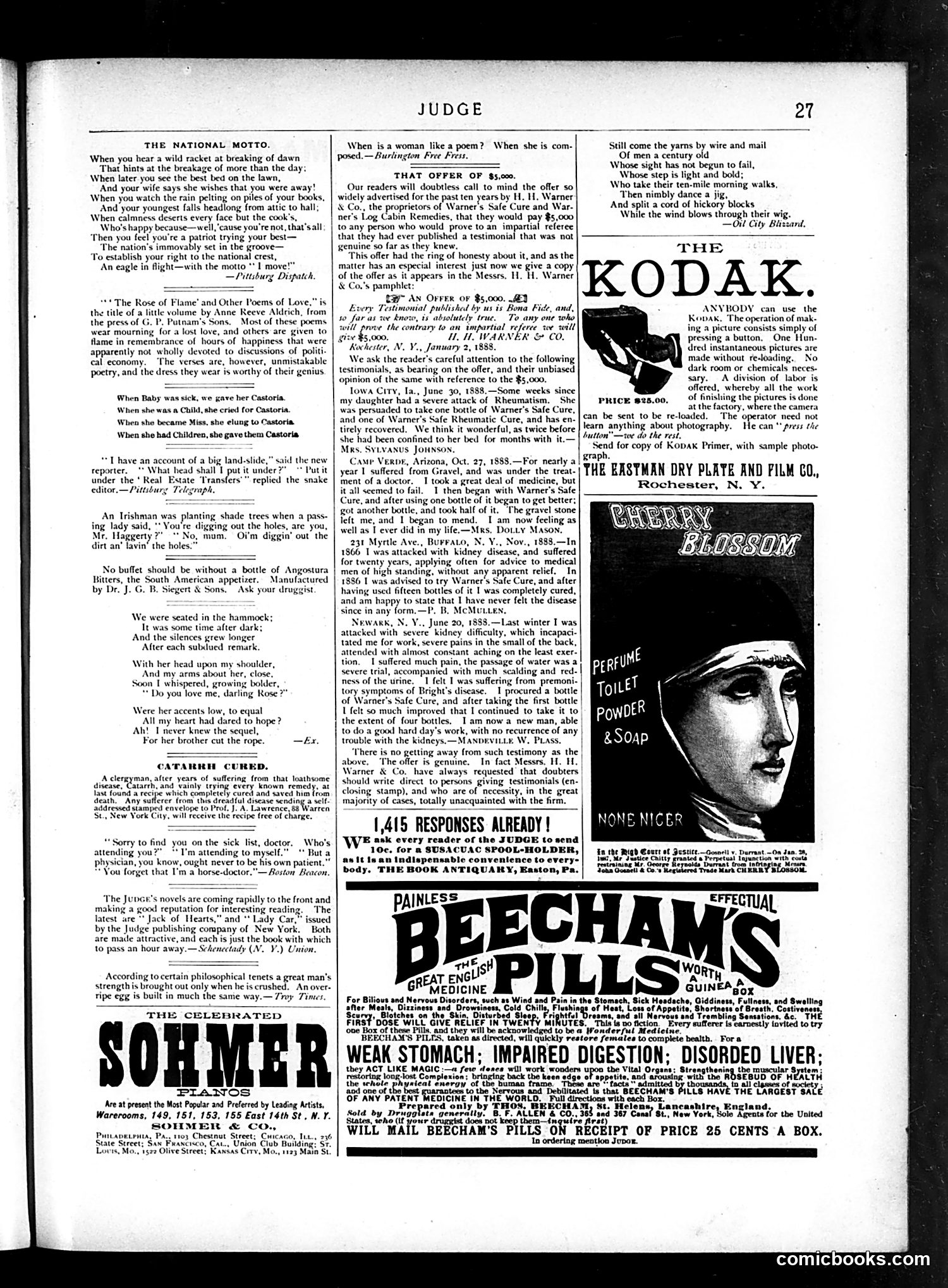
This page is primarily **advertising and humor pieces** rather than political cartoons. The main satirical content is "The National Motto," a poem satirizing domestic chaos as supposedly patriotic American resilience. The piece mocks middle-class family life: a man endures his wife's complaints, children's accidents, ruined possessions, and general household disorder. The joke is that he frames this misery as patriotic duty—adopting "I move!" (suggesting both resignation and motion) as his national motto. The satire targets the *earnest glorification of domestic suffering* as masculine virtue, common in late-19th-century ideology. The remainder consists of advertisements (Castoria, Sohmer pianos, Beecham's Pills) and miscellaneous humor pieces—jokes about landslides, doctors, and romantic rejection. These reflect typical *Judge* magazine content: light domestic comedy aimed at middle-class readers.
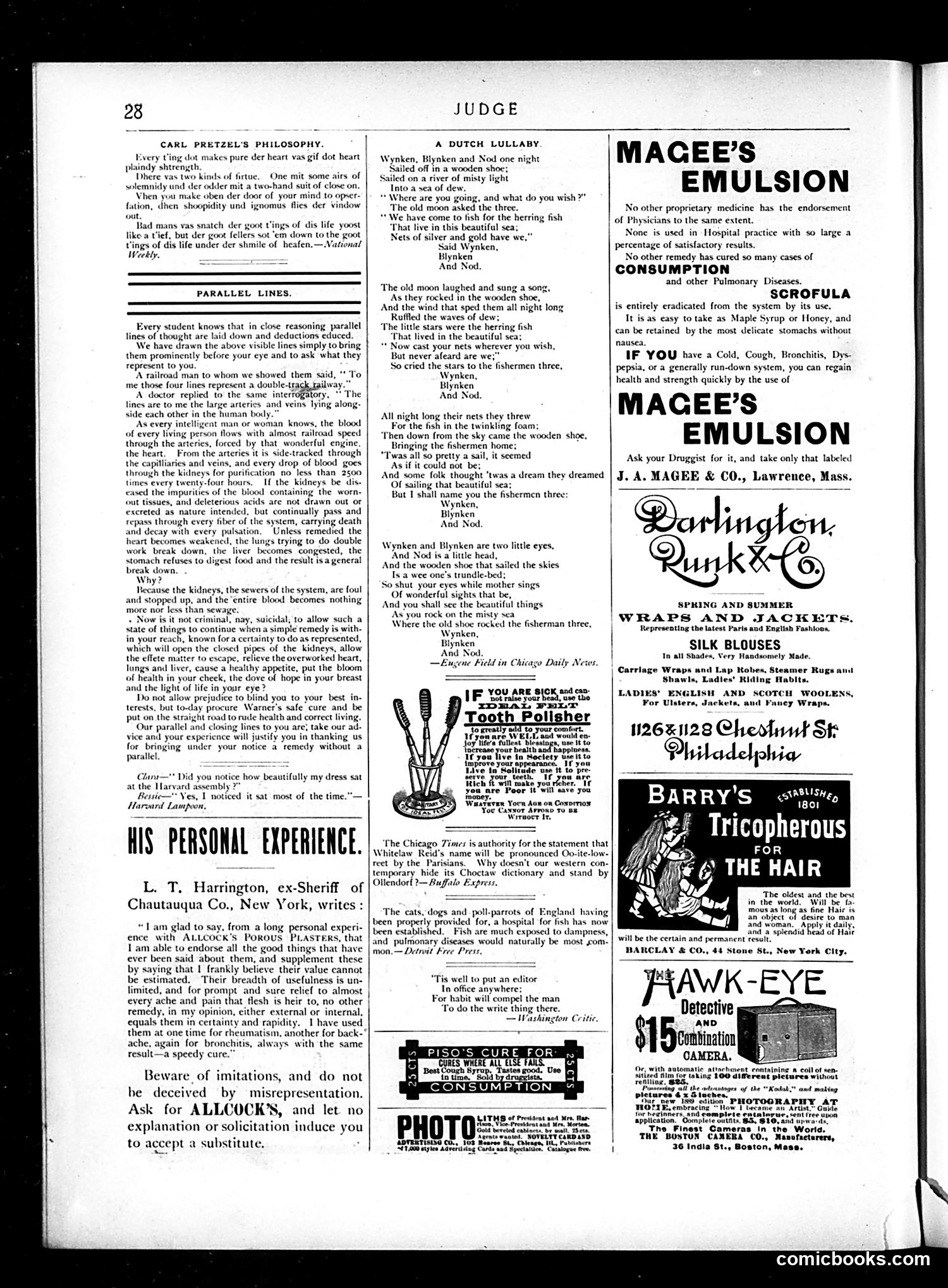
This page is primarily **advertising** with minimal editorial cartoon content. The main satirical pieces are: **"Carl Pretzel's Philosophy"**: A dialect humor column featuring a German-accented character offering folk wisdom. This was typical Judge content—ethnic humor based on immigrant speech patterns that would be considered offensive today. **"Parallel Lines"**: A longer piece using visual parallel lines as a metaphor for arteries/veins to promote "Warner's Safe Cure," a patent medicine. It argues that kidney failure causes systemic illness and advertises this product as a remedy. **The remainder** consists of testimonials and advertisements for patent medicines (Allcock's Porous Plasters, Magee's Emulsion, Barry's Tricopherous Hair Tonic) and products like clothing, cameras, and tooth polish. The page reflects late 19th-century Judge content: ethnic stereotypes for humor, extensive patent medicine advertising (unregulated at this time), and commercial rather than political satire. The "parallel lines" piece exemplifies how pseudoscientific health claims were presented as logical reasoning to sell dubious remedies.
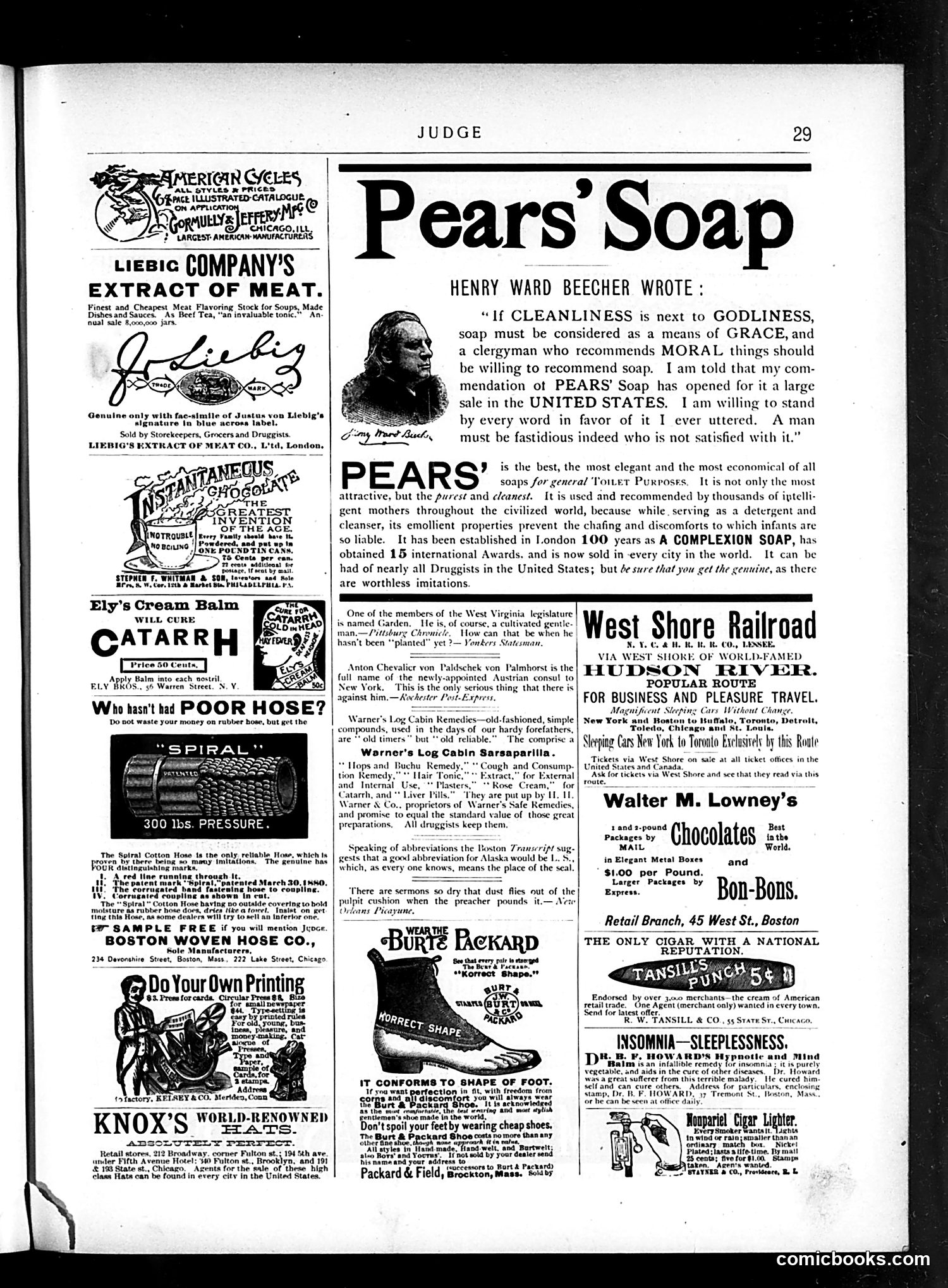
This page is primarily **advertising**, typical of Judge magazine's revenue model. The dominant feature is a large Pears' Soap advertisement quoting Henry Ward Beecher (a famous 19th-century clergyman) endorsing the product as a moral good—linking cleanliness to godliness and grace. This reflects Victorian-era attitudes treating hygiene as morally virtuous. The surrounding ads promote period products: Liebig's meat extract, Ely's Cream Balm for catarrh, the "Spiral" cotton hose, Warner's Log Cabin Remedies, and Packard shoes. Scattered between ads are brief satirical items: jokes about a West Virginia legislator named Garden who hasn't been "planted," a long-named Austrian consul, and a preacher's dry sermons. These are lightweight social humor targeting recognizable public figures or absurd situations rather than sustained political satire. The page demonstrates how Judge blended advertising revenue with light editorial content—the ads themselves often carried humorous or quasi-journalistic framing rather than hard-hitting satire.
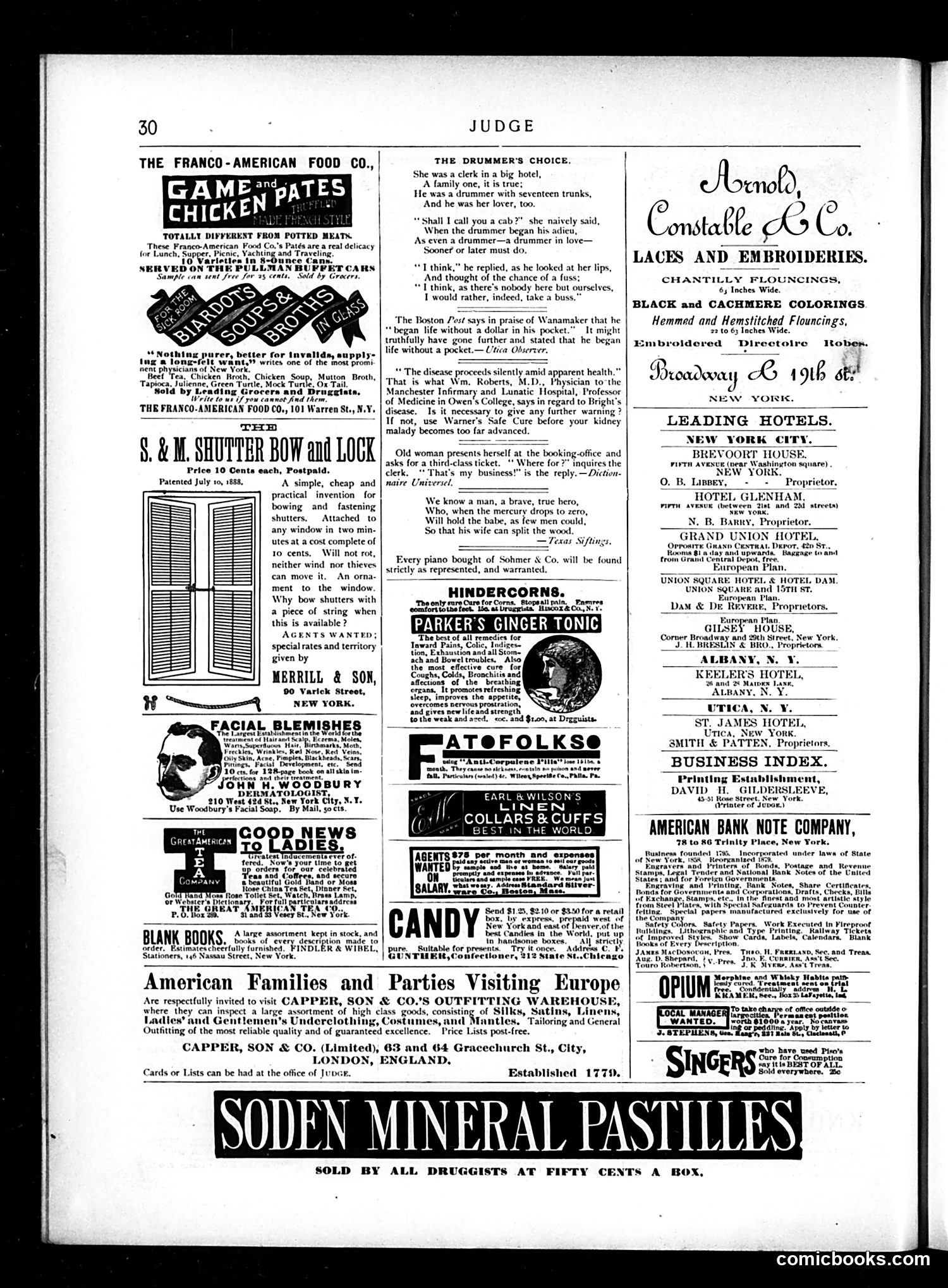
This is primarily a **commercial advertising page** with minimal editorial cartooning. The page consists almost entirely of product advertisements from the 1880s-1890s era: Franco-American food products, facial treatments, shutters, blank books, and patent medicines. The few non-advertising items are brief satirical **quips** rather than political cartoons: - "The Drummer's Choice" is a flirtatious anecdote about a traveling salesman - A joke about a woman's vague travel plans - A quip about a man holding a baby while his wife chops wood (satire on gender roles) - A reference to Wanamaker beginning life "without a dollar...without a pocket" (financial satire) The page reflects Judge's typical format: mixing advertisements with short humor pieces. There are no significant political cartoons or figures to analyze. The content targets middle-class readers through product pitches and gentle domestic humor characteristic of the era's satirical magazines.
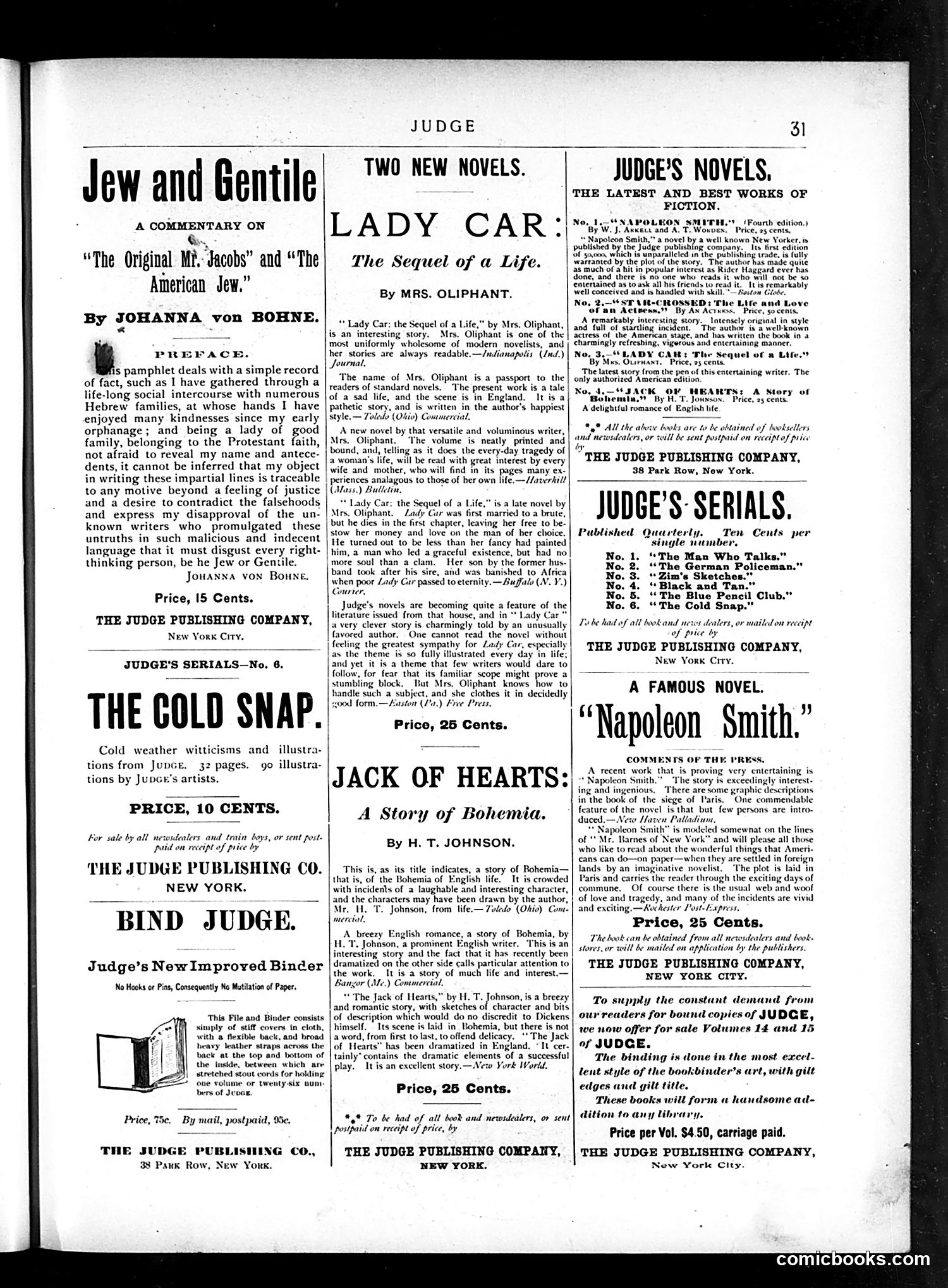
This page is primarily **advertising and book announcements** rather than political satire or cartoons. The prominent feature is a commentary titled "Jew and Gentile" by Johanna von Bohne, responding to earlier articles called "The Original Mr. Jacobs" and "The American Jew." Von Bohne, identifying herself as a Protestant woman of good family, defends Jewish people against what she characterizes as malicious, indecent falsehoods written by "unknown writers." She claims authority through her lifelong social relationships with Hebrew families and her willingness to publicly attach her name to the defense. The rest of the page contains standard Judge Publishing advertisements for novels ("Lady Car," "Jack of Hearts," "Napoleon Smith") and promotional items like their improved binder for collecting issues. The "Jew and Gentile" piece suggests Judge's editorial environment included anti-Semitic content that prompted defensive responses—indicating contemporary tensions around Jewish representation in American media.
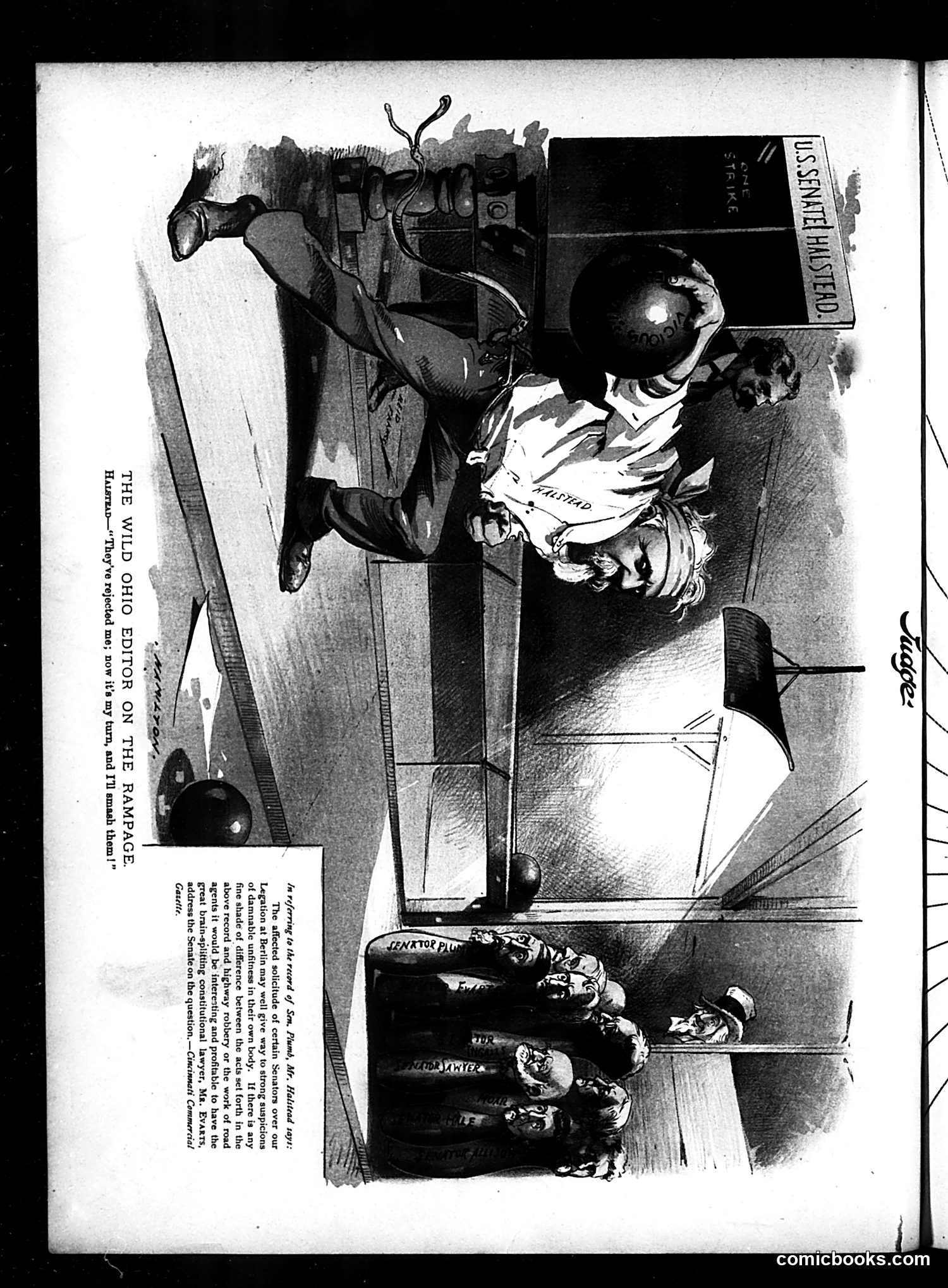
This Judge magazine cartoon satirizes an Ohio newspaper editor who, rejected by the Senate (likely for a position or policy), responds with threats of violent retaliation ("They've rejected me; now it's my turn, and I'll smash them!"). The accompanying text references Senate misconduct—possibly corruption or abuse of power—comparing it to "highway robbery" and calling out Senators' "damnable unfitness." It challenges constitutional lawyer Mr. Evarts to address whether the Senators' actions constitute actual crimes. The cartoon mocks the editor's melodramatic rage as a response to political rejection, while the text ironically suggests the real scandal lies with the Senate itself. This appears to critique both editorial overreach and Senate corruption during the Gilded Age, when such scandals were common. The "wild" characterization suggests the editor is presented as unreasonable, even if his underlying grievances about Senate behavior may have merit.