
A complete issue · 18 pages · 1889
Judge — February 23, 1889
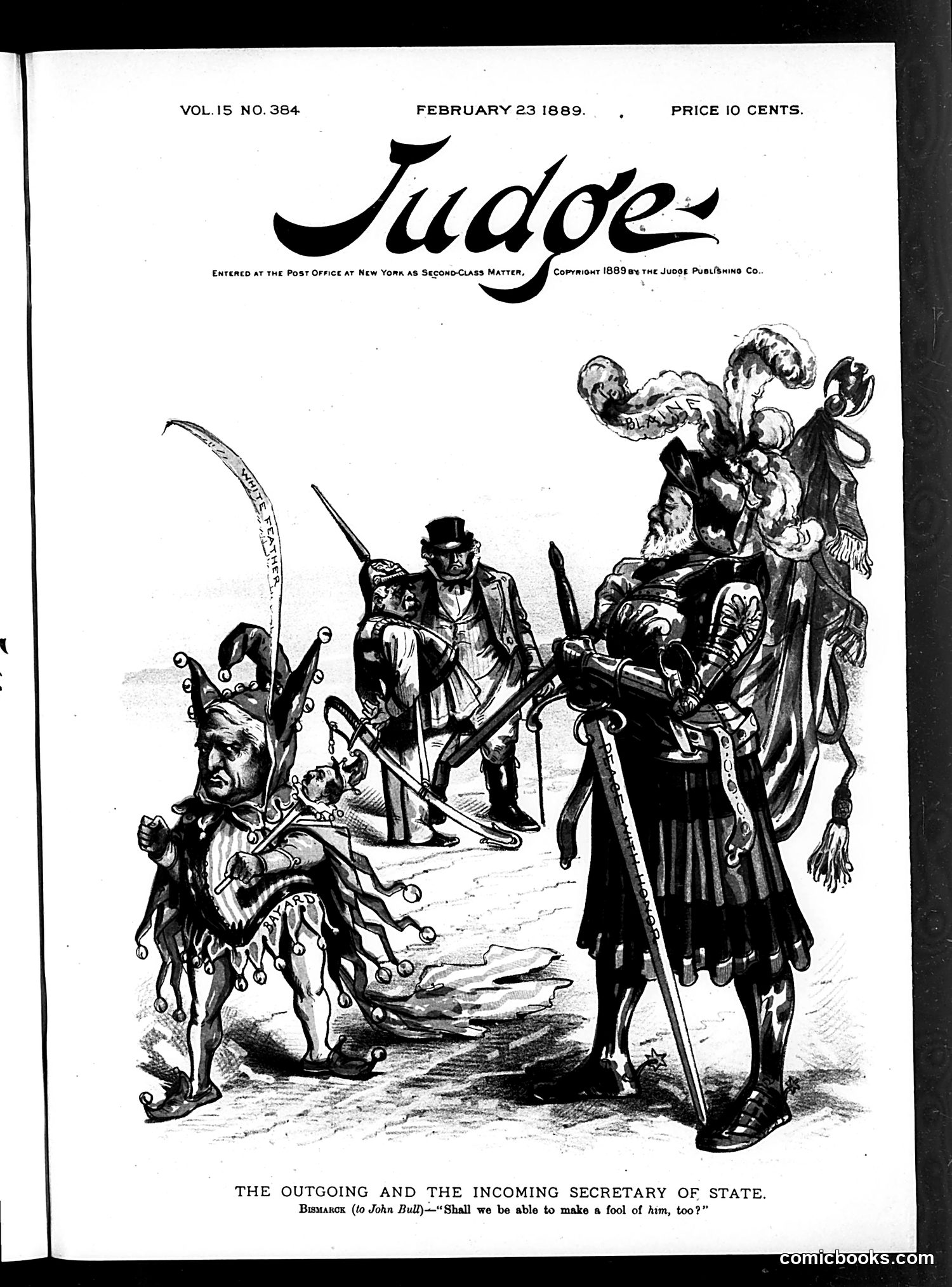
This February 1889 Judge cartoon depicts a transition between Secretaries of State. The caption attributes a quote to Bismarck (the German Chancellor, shown left in jester's costume with elaborate headpiece) asking whether the incoming secretary can be made "a fool of." The cartoon satirizes concerns about American diplomatic competence during a presidential transition. The figure on the right, dressed formally with military elements, represents the incoming Secretary of State. The jester's costume for Bismarck suggests foreign powers view American leadership as foolish or easily manipulated. The artistic contrast—Bismarck as a mocking jester versus the incoming official's formal bearing—emphasizes American vulnerability in international relations during this period of transition.
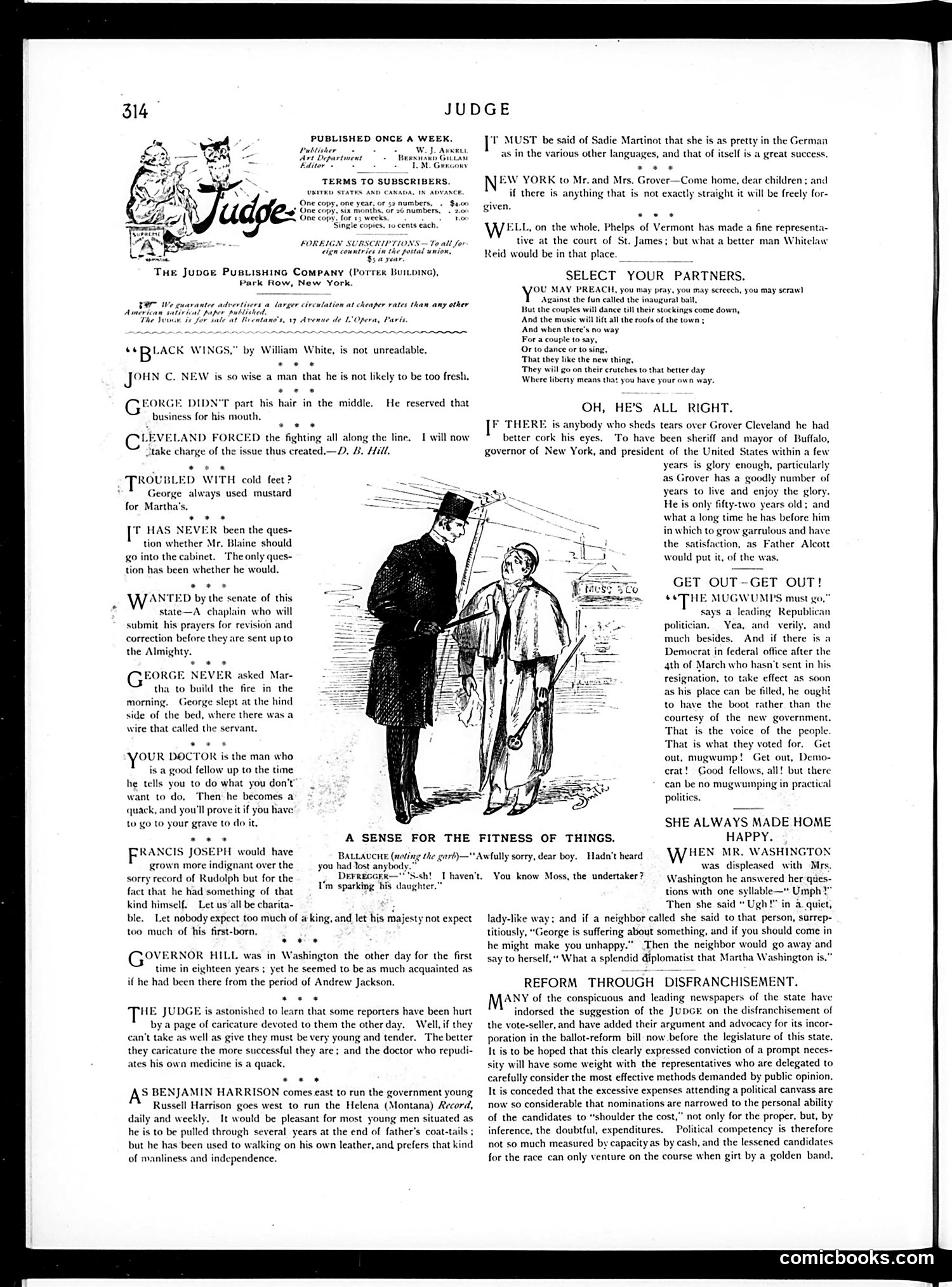
The main cartoon, titled "A Sense for the Fitness of Things," depicts an interaction between what appears to be a tall official or authority figure and a small boy. The dialogue suggests the adult is questioning the boy about someone named "Moss the undertaker," implying the boy has been discussing death or funerals. The surrounding text includes various short satirical observations about political figures like Governor Cleveland and references to election politics, suggesting this is from the 1880s when Grover Cleveland was prominent in New York politics. The cartoon's humor appears to rely on the boy's misunderstanding or frank observation about adult concerns, a common Victorian-era Judge magazine trope. The specific political and social references are difficult to parse without additional historical context about contemporary events.
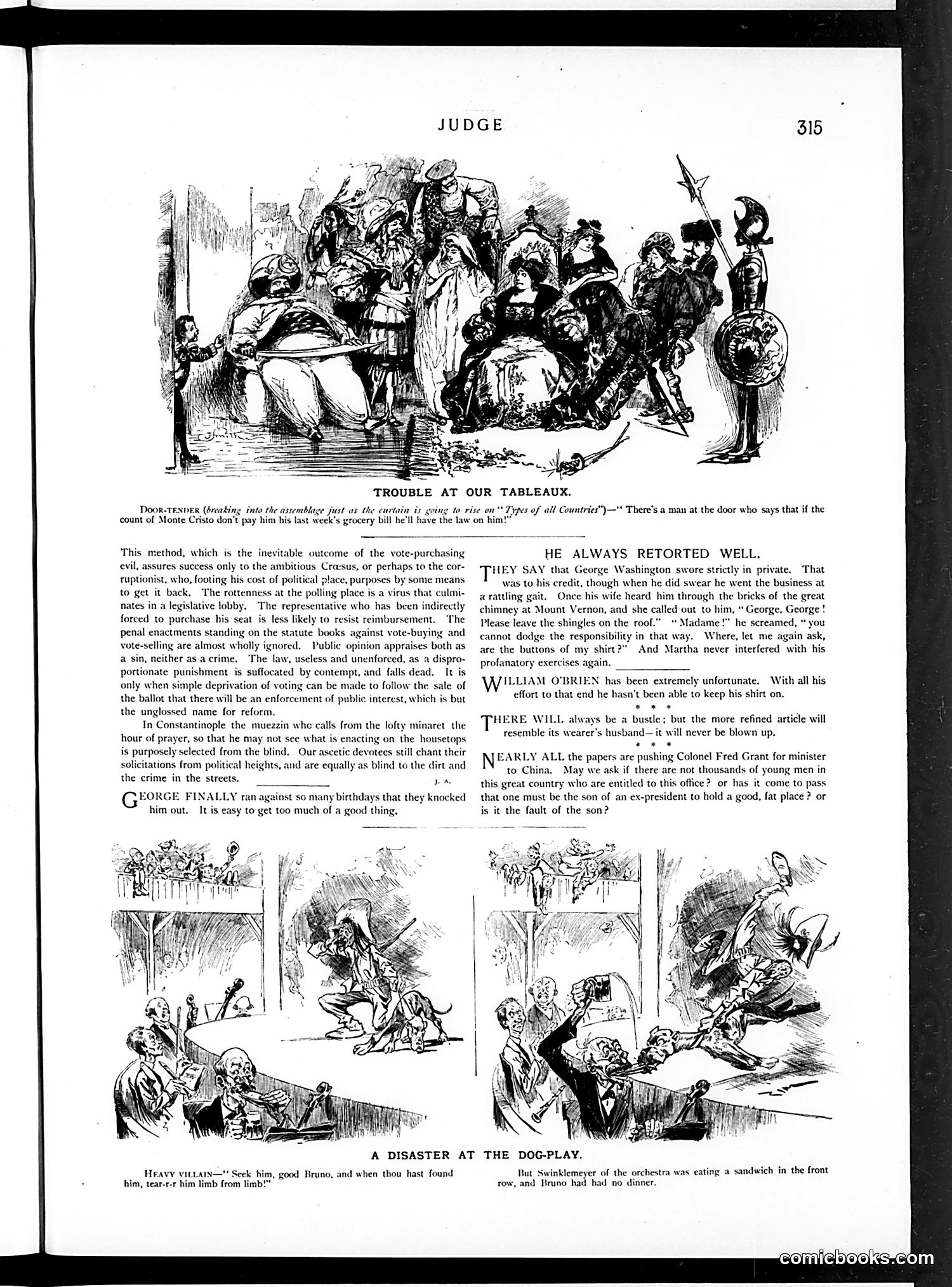
This page from *Judge* contains three distinct satirical pieces: **"Trouble at Our Tableaux"** (top): A theatrical scene interrupted by a creditor demanding payment. The satire targets vote-buying corruption in politics, using the Monte Cristo drama as backdrop. The editorial text condemns the practice of purchasing political office—comparing it to disease in the body politic—and criticizes how public opinion treats vote-selling as sin rather than crime, making laws unenforceable. **"He Always Retorted Well"** (middle): Anecdotes about George Washington and William O'Brien's marital disputes. These are lighthearted character sketches, with Washington defending his profanity to Martha and O'Brien struggling to keep his composure. **"A Disaster at the Dog-Play"** (bottom): A theatrical melodrama where a villain orders a dog to attack an actor, but the trained dog refuses because the orchestra musician (Swinklemeyer) is eating a sandwich—the dog's dinner—during the performance. This absurdist humor mocks overwrought theatrical productions. The page primarily satirizes political corruption and theatrical pretension.
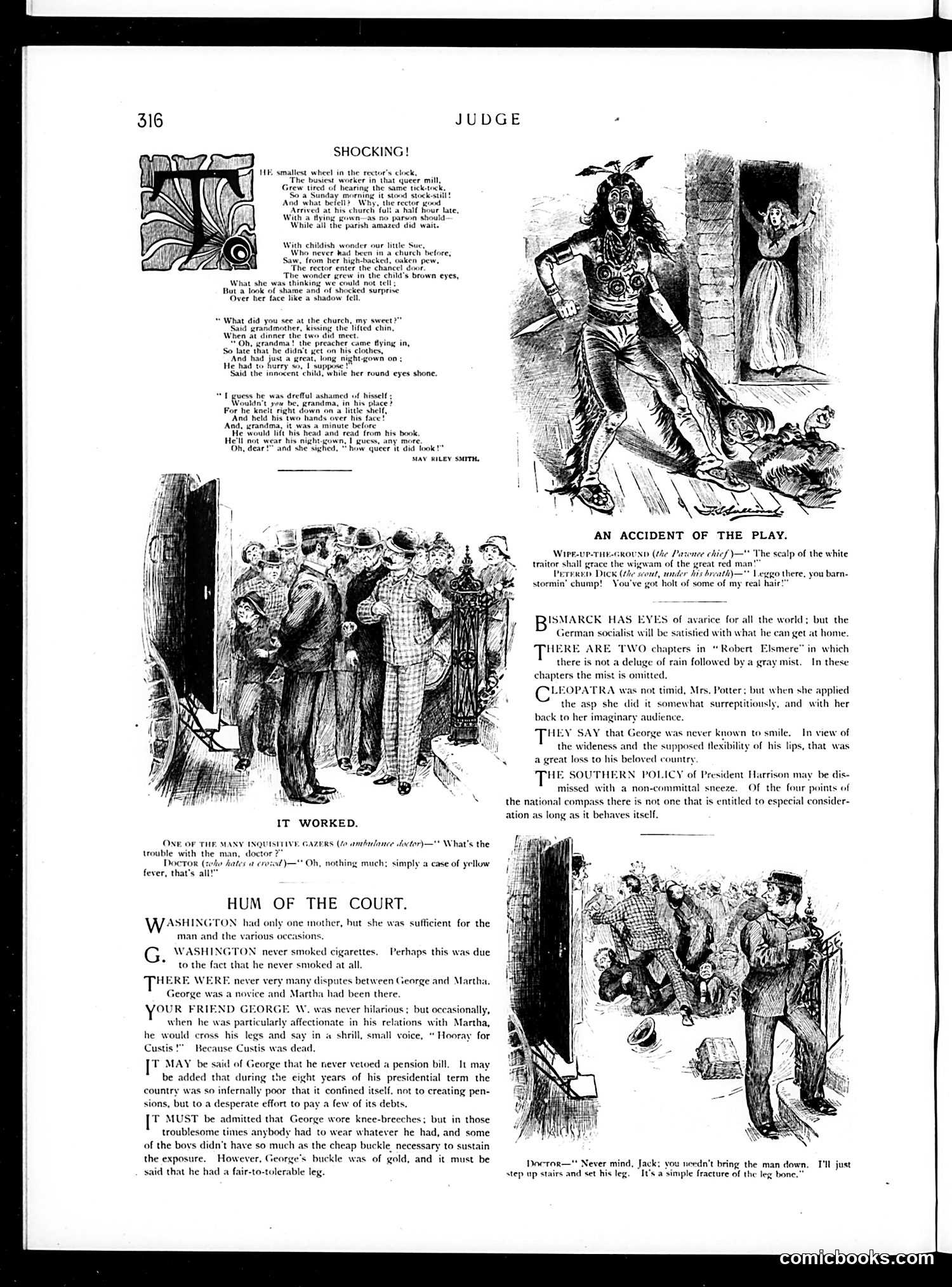
This page contains several satirical pieces typical of late 19th-century American humor: **"SHOCKING!"** mocks Victorian propriety through a child's innocent report of seeing the church rector's *pants* fall down during service—the grandmother's scandalized reaction suggests the era's extreme prudishness. **"IT WORKED"** jokes about a doctor dismissing a patient's serious yellow fever as trivial—satire of medical indifference or incompetence. **"HUM OF THE COURT"** affectionately parodies George Washington through exaggerated "facts" (he never smoked, never smiled, wore gold buckles while others had nothing). This celebrates American history while gently mocking reverence for the Founding Father. The remaining pieces are brief satirical quips on contemporary topics: German socialism, the novel "Robert Elsmere," Cleopatra, and President Harrison's "Southern Policy" (Reconstruction-era politics). The illustrations depict theatrical scenes and social situations supporting these comedic commentaries on manners, medicine, history, and politics.
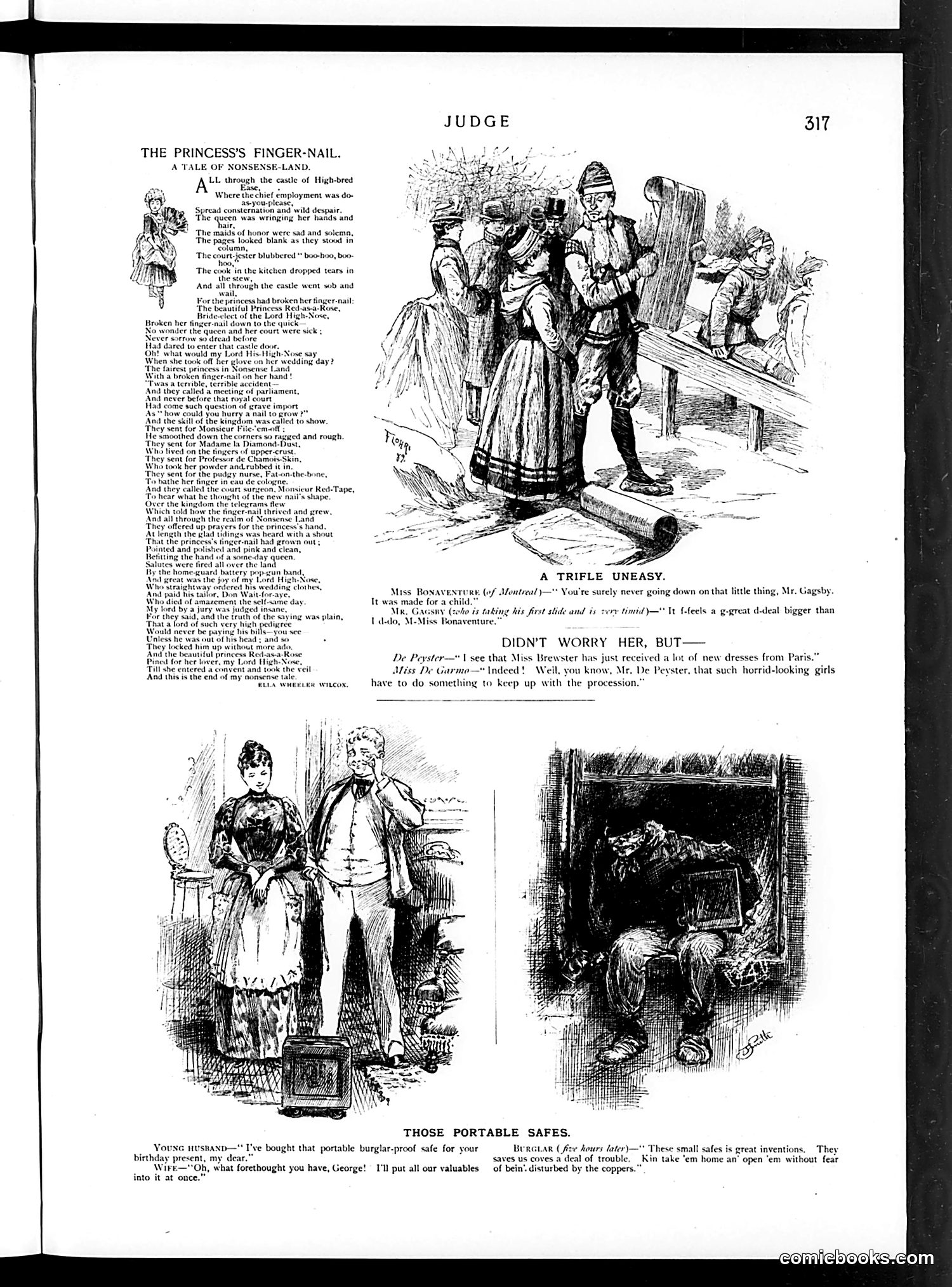
This page contains three separate satirical pieces typical of late 19th-century humor: 1. **"The Princess's Finger-Nail"**: A mock-heroic poem mocking aristocratic vanity. The joke is that an entire royal court descends into crisis over a princess breaking a fingernail—a trivial matter treated with absurd gravity. It satirizes upper-class obsession with appearance and status. 2. **"A Trifle Uneasy"**: A joke about a nervous Montreal woman (Miss Bonaventure) intimidated by a toboggan slide, with the man reassuring her. The humor relies on double entendre about the slide's size versus her nervousness. 3. **"Those Portable Safes"**: A darker joke about burglars. A man proudly buys a "burglar-proof" portable safe as a gift, but criminals reveal they appreciate such safes because they can steal them and crack them safely at home without police interference. It satirizes the false sense of security such devices provide. The cartoons mock upper-class pretension, gender anxieties, and the gap between marketed security and actual protection.
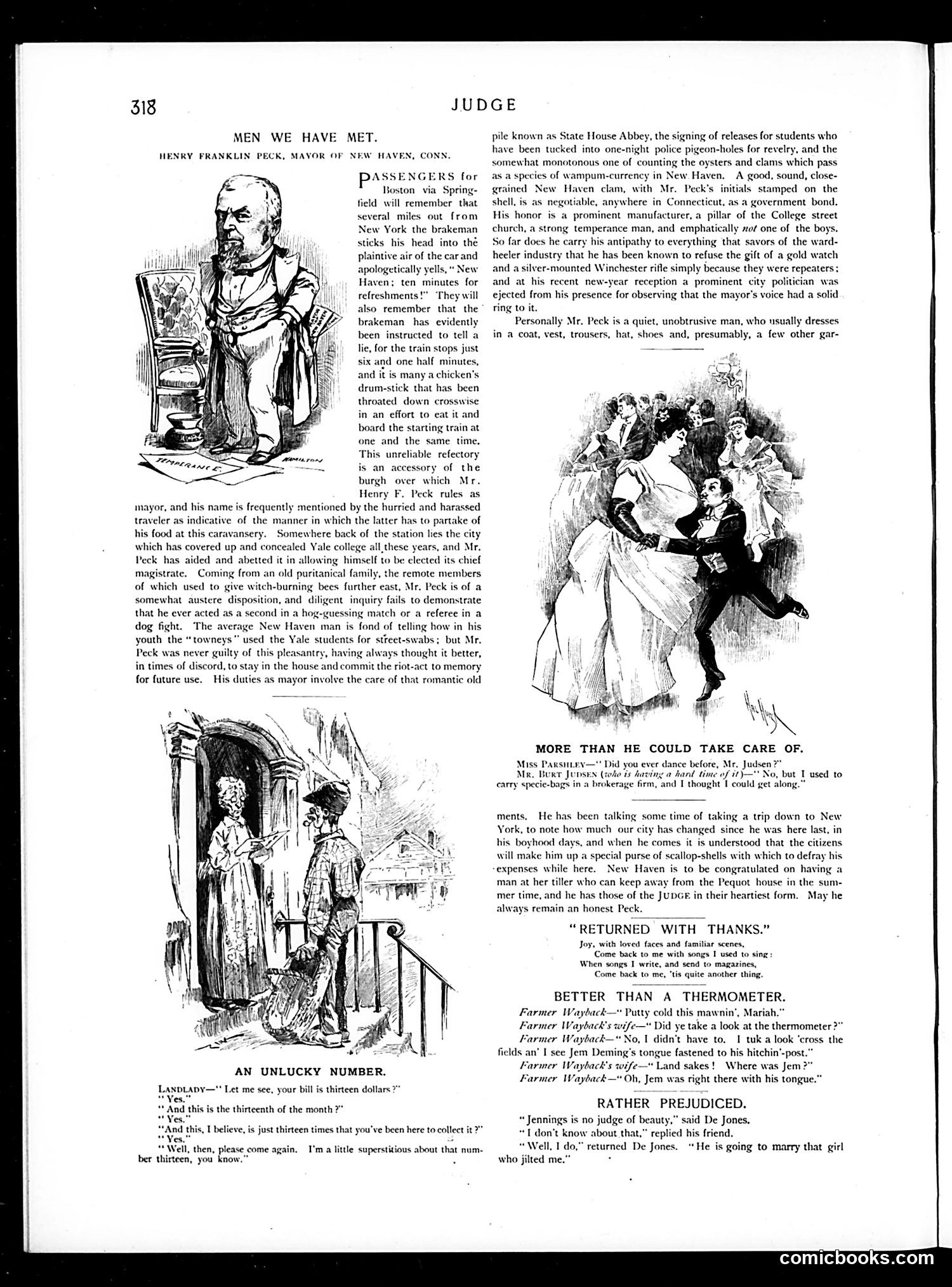
This page from *Judge* magazine profiles **Henry F. Peck, Mayor of New Haven, Connecticut**. The satire works through ironic praise of Peck's austere, rigid personality. The cartoon mocks Peck as an excessively proper Puritan killjoy—descended from witch-burning ancestors—who refuses to participate in normal vice or corruption. He rejected bribes (a gold watch and Winchester rifle) because they were "repeaters," and he's so anti-corruption that he won't associate with ward-heelers. The joke is that New Haven's mayor is *too* honest and stern for a political figure. Judge sarcastically celebrates this as virtuous while poking fun at his joyless demeanor. References to Yale students, the State House, and the famous poor-quality refreshment stop at New Haven station ground the humor in local New Haven politics and reputation circa the late 19th century. The page also includes unrelated humor about superstition and dancing.
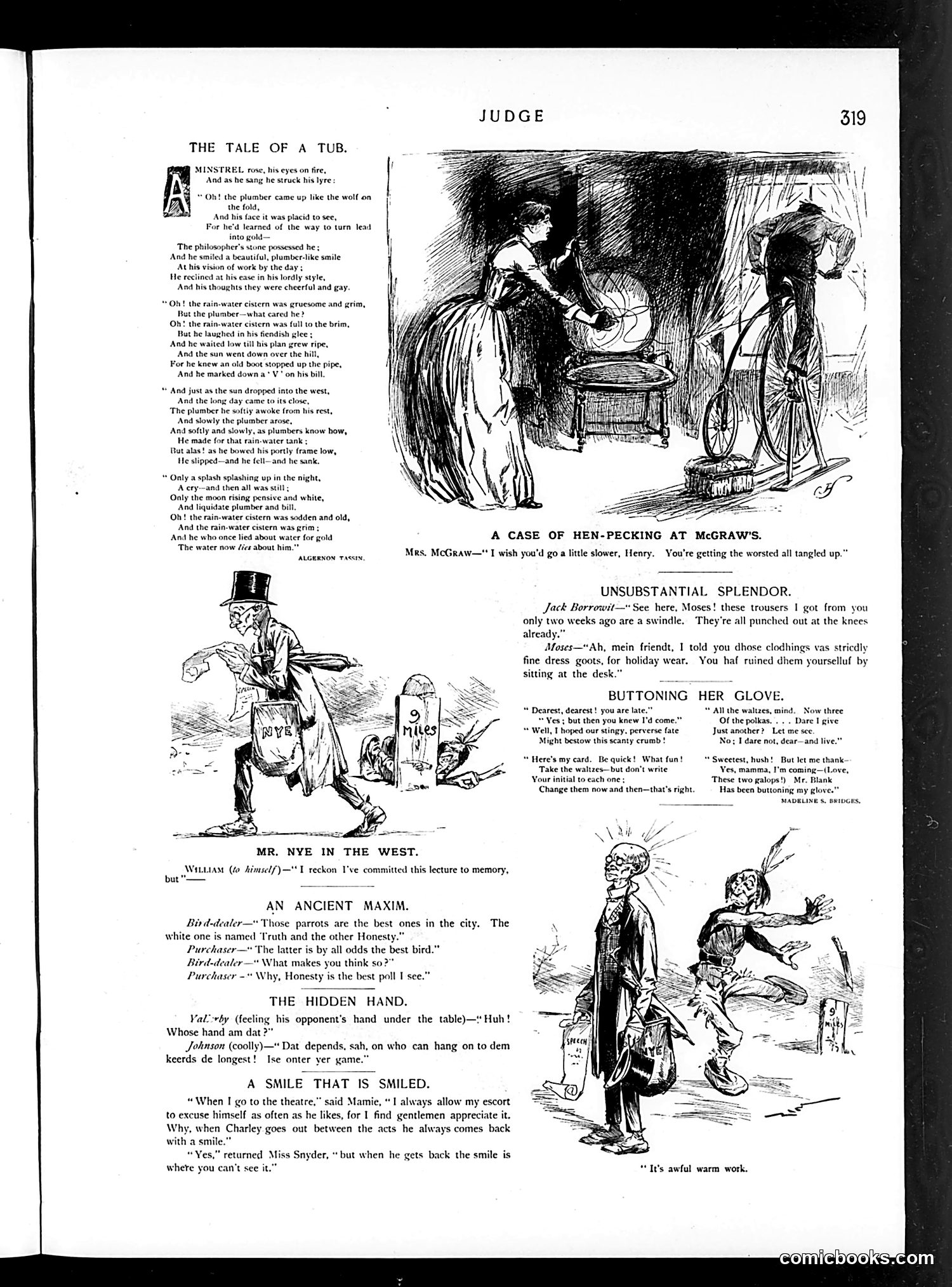
This page contains multiple satirical pieces typical of Judge's humor: **"The Tale of a Tub"** (main poem): A darkly humorous narrative about a plumber who drowns in a rain cistern. The satire targets plumbers' reputation for overcharging and dishonesty—the plumber "lied about water for gold" but ultimately drowns in water. It's a moralistic joke about greed meeting ironic comeuppance. **"A Case of Hen-Pecking at McGraw's"**: Gentle domestic satire showing a wife micromanaging her husband's knitting, illustrating the common Victorian joke about nagging wives. **"Unsubstantial Splendor"**: A clothes merchant (Moses, likely a Jewish stereotype) defends cheap trousers by claiming the buyer ruined them through desk-sitting, satirizing both dishonest merchants and customers blaming others for poor quality. **"Buttoning Her Glove"** and other brief sketches: Light romantic/social comedy about courtship and theater etiquette. The illustrations use exaggerated line-work characteristic of period comic art. Overall, the page reflects Judge's mix of class commentary, ethnic stereotypes, domestic humor, and moral tales typical of 1880s-90s American satire.
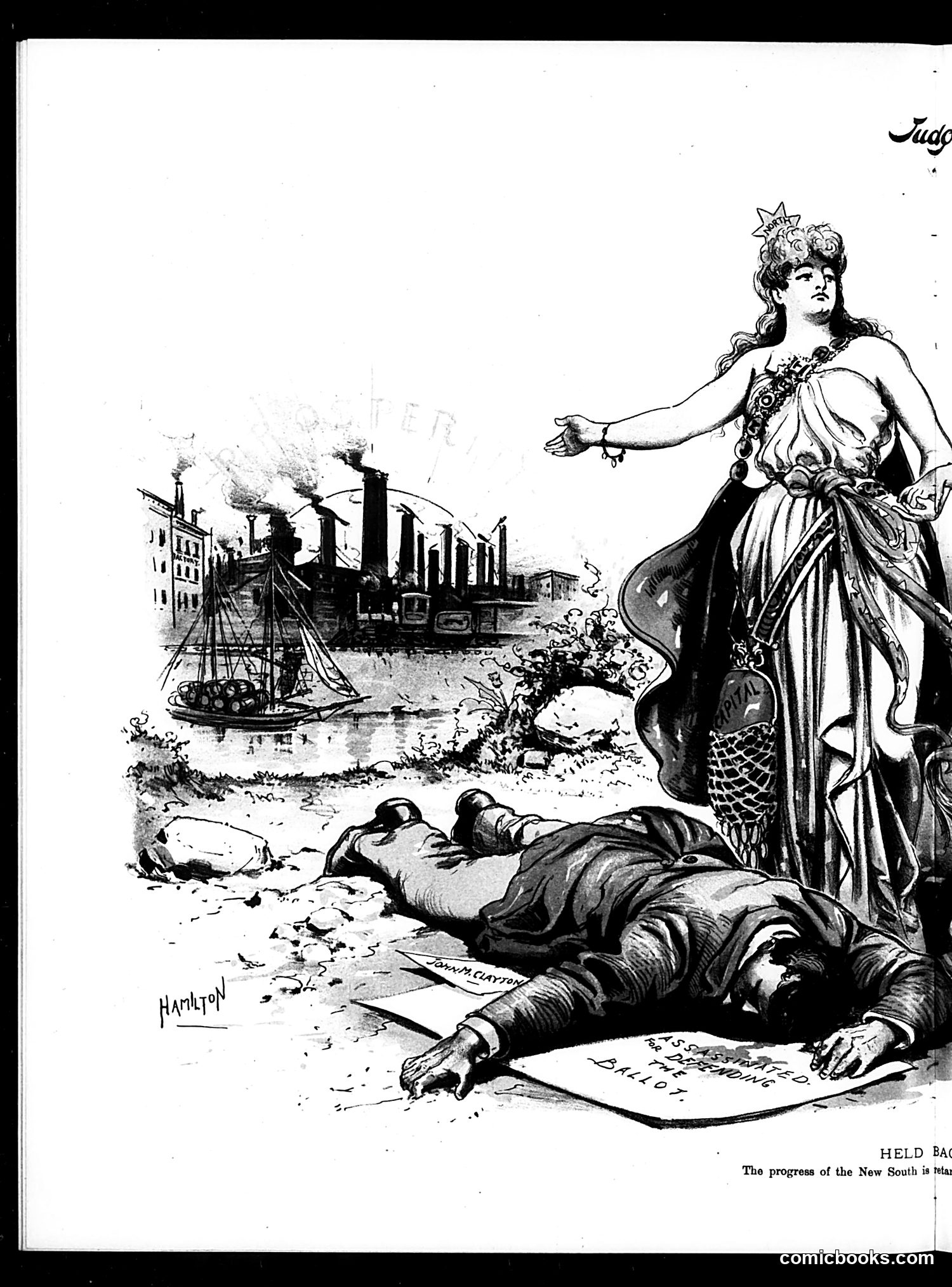
This Judge magazine cartoon satirizes the industrial development of the American South following Reconstruction. The allegorical female figure (likely representing the South or America) gestures expansively toward industrial factories with smoking smokestacks. Two dead or dying figures lie in the foreground, labeled documents beside them—appearing to represent casualties or victims of this "progress." The satire critiques rapid industrialization's human cost: the dead workers suggest industrial deaths, dangerous conditions, or exploitation. The contrast between the idealized female figure celebrating advancement and the corpses beneath her feet points to Judge's skepticism about whether industrial "progress" genuinely benefited ordinary workers, particularly in the post-Reconstruction South where labor protections remained minimal. The artist is Hamilton (visible signature).
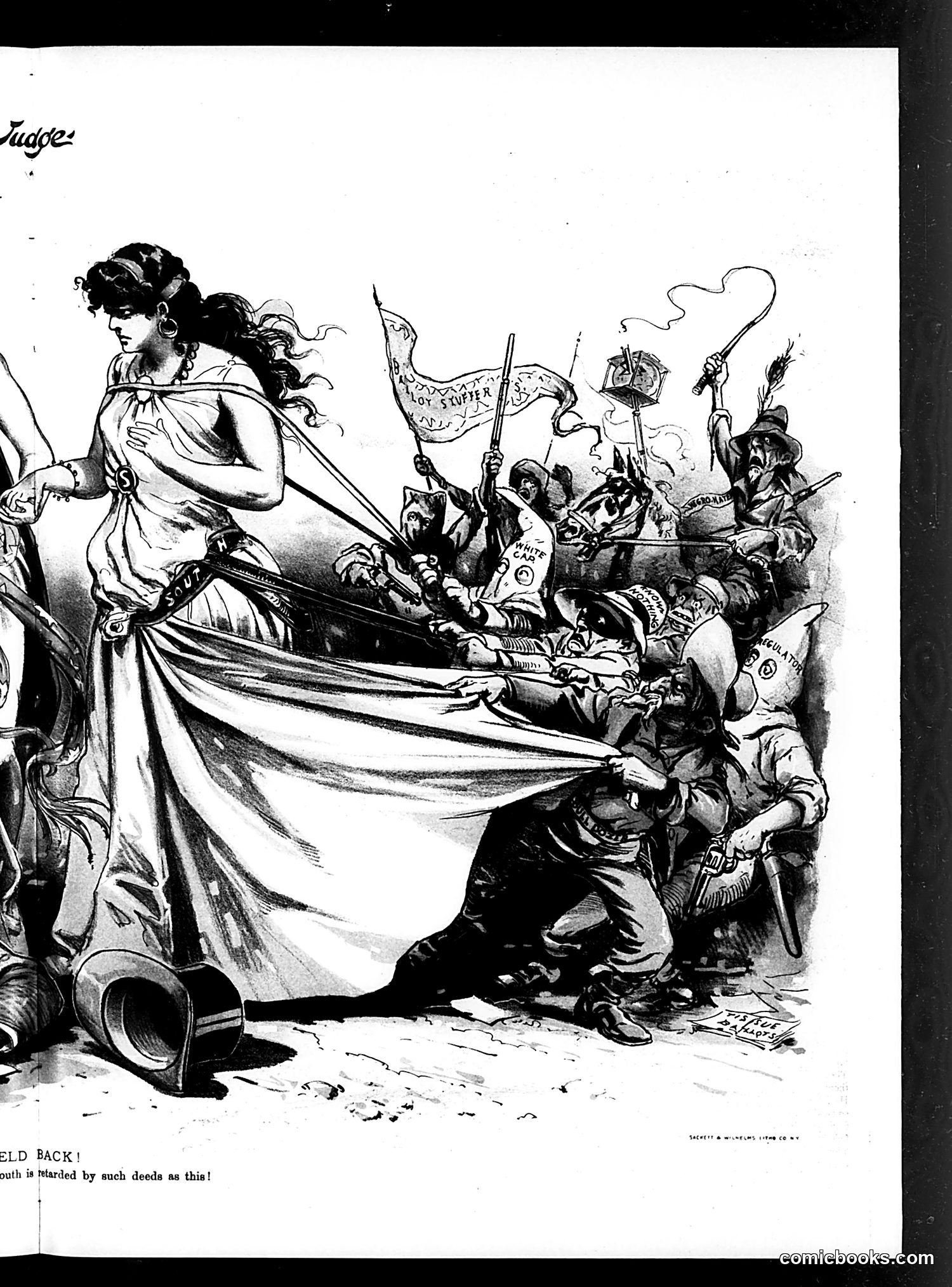
This satirical Judge cartoon depicts a classical female figure (representing Liberty or the Nation) being pulled backward by a group of armed military or political figures carrying flags and weapons. The text "HELD BACK!" and "Youth is retarded by such deeds as this!" suggests the cartoon criticizes how military actions or aggressive policies harm national progress and the future generation. The caricatured figures appear to represent militaristic or warmongering political elements dragging the nation backward. Without a visible date or clearer text, the specific historical event remains uncertain, but the imagery suggests commentary on American imperialism, militarism, or foreign intervention during the late 19th or early 20th century—periods when Judge frequently satirized such policies.
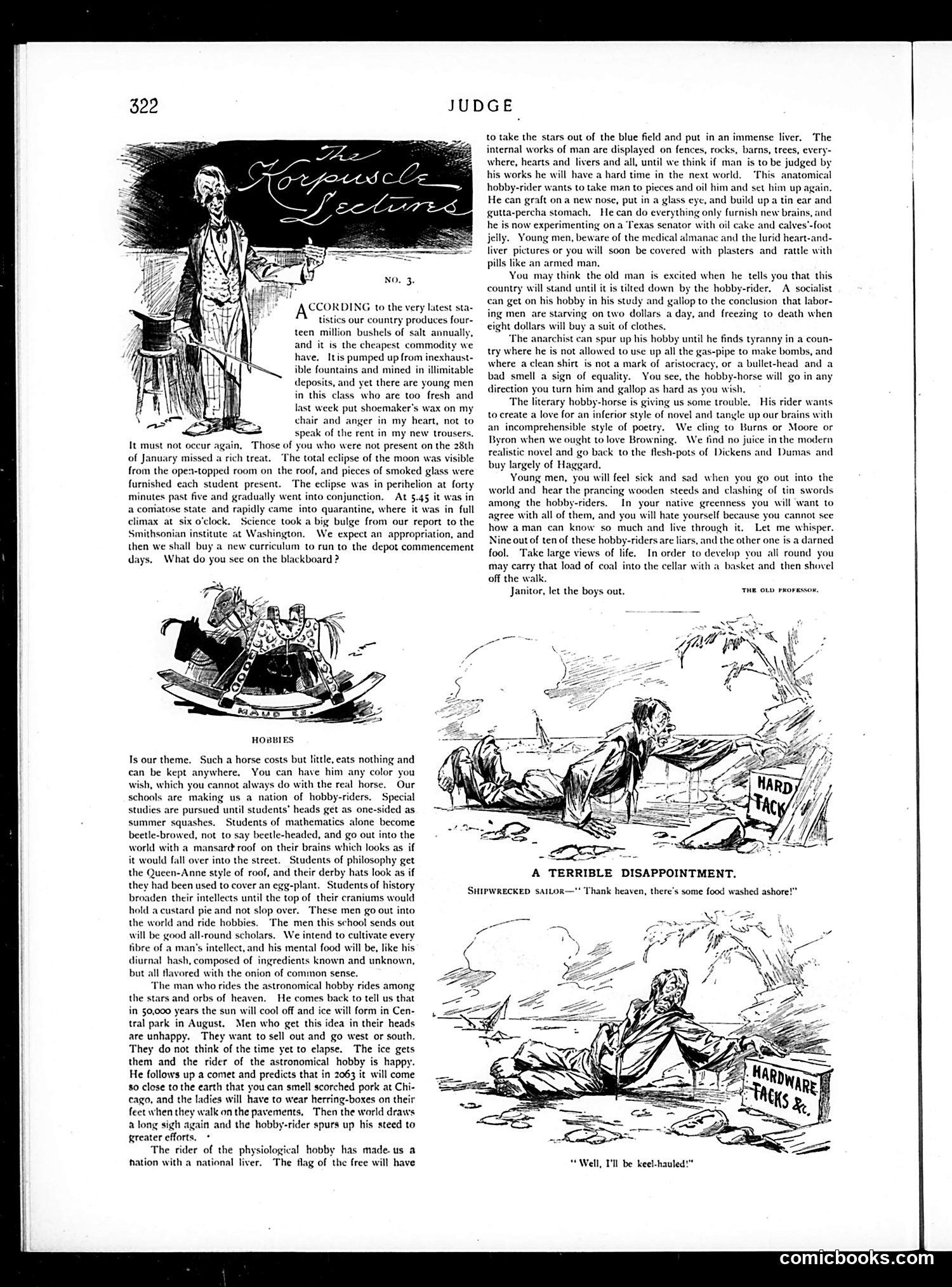
This page satirizes American "hobby-riders"—people obsessively devoted to single intellectual pursuits at the expense of well-rounded knowledge. The framing device is a schoolmaster's complaint about misbehaving students (one put wax on his chair), which transitions into broader social criticism. The main target is specialized education and expertise. The text mocks various hobbyists: astronomers predicting apocalyptic scenarios (sun cooling Central Park in 50,000 years); physiological enthusiasts obsessed with internal organs who want to reconstruct humans like machines with interchangeable parts; and mathematicians whose minds become deformed like "summer squashes." The illustrations show shipwrecked sailors disappointed to find hardware supplies instead of food—a visual pun on misplaced priorities. The satire argues American schools are producing one-dimensional specialists rather than educated generalists, creating anxious, impractical citizens fixated on unlikely catastrophes instead of living balanced lives.
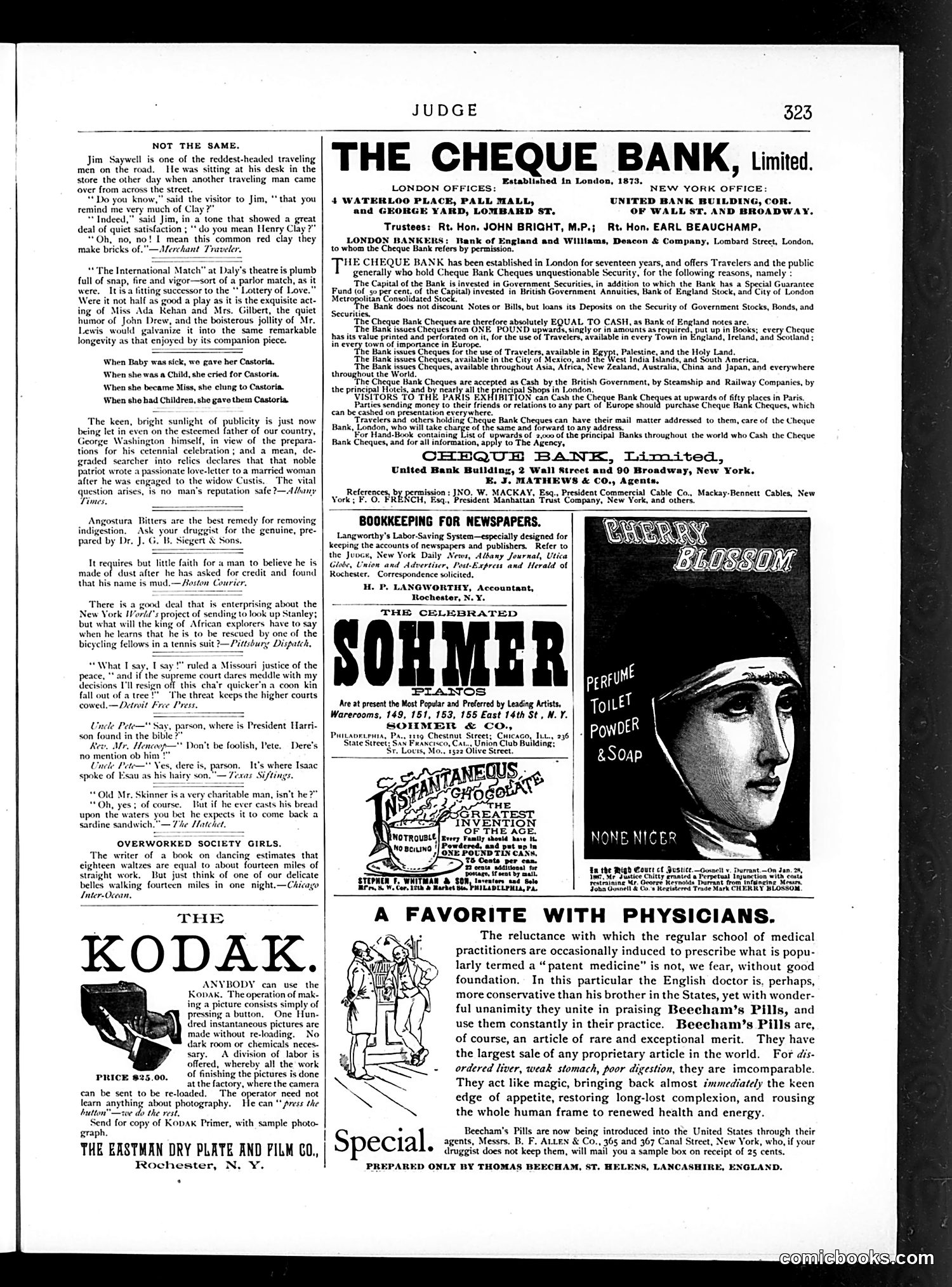
This page is **primarily advertising and filler content**, with minimal satire. The main elements are: **"Not the Same"**: A mild joke about Jim Saywell, a red-headed traveling salesman, being compared to Henry Clay (19th-century politician/statesman). The punchline is the comparison is to red clay (brick material), not the famous statesman—a simple play on words with no deeper political meaning. **Other brief humor snippets** reference contemporary topics: George Washington's love letters (during centennial celebrations), the New York World's expedition to "rescue" explorer Stanley, and a judge threatening to resign—all topical jokes for 1880s readers but lacking sustained satire. **The bulk of the page comprises advertisements**: The Cheque Bank, Sohmer Pianos, Beecham's Pills (with a medical endorsement), Kodak cameras, and various other products. There is no coherent political cartoon or sustained satirical commentary. The page functions mainly as a revenue-generating mix of brief witticisms and paid advertisements.
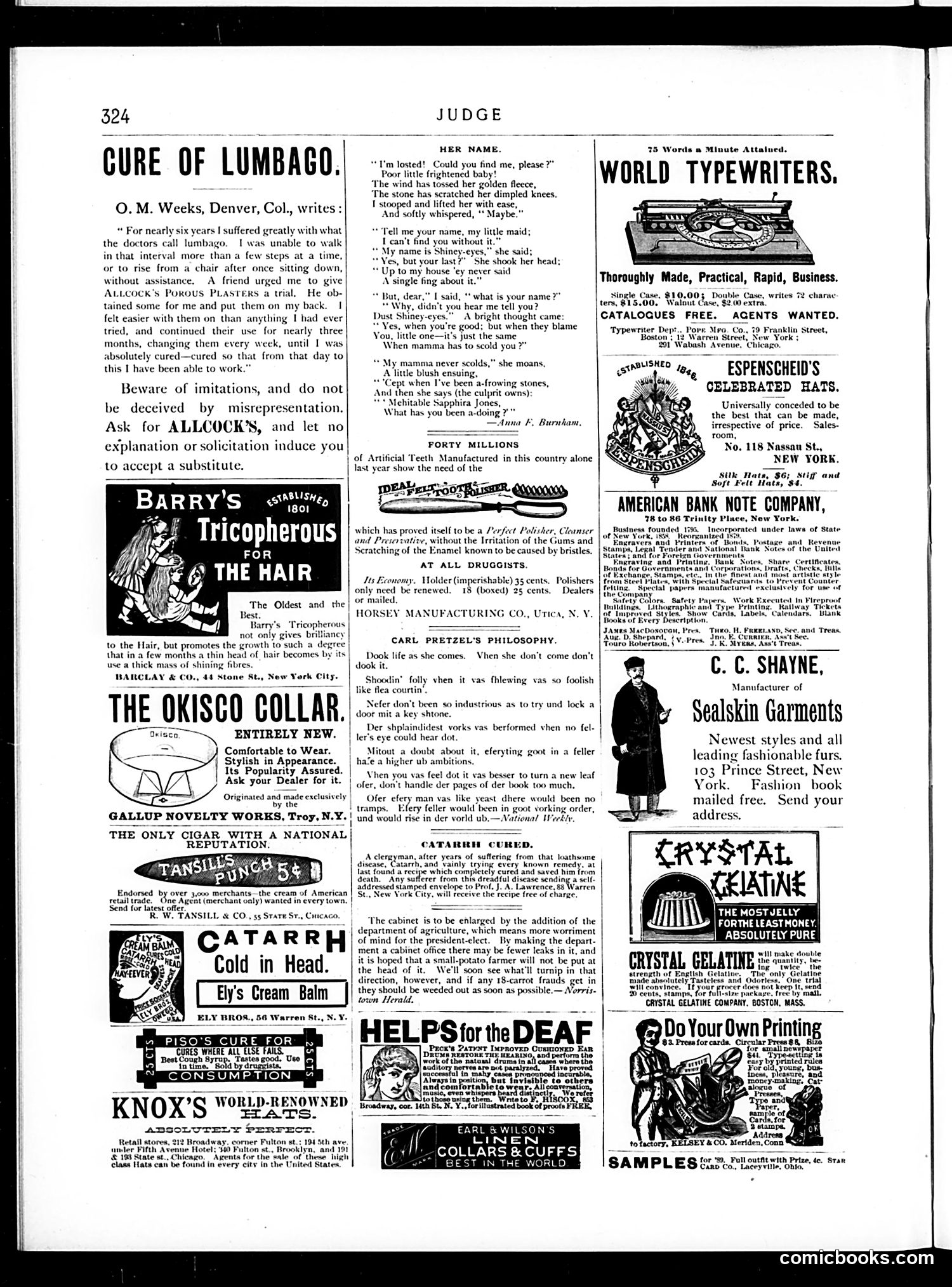
This page is primarily **advertisements** for patent medicines and consumer goods typical of the late 19th/early 20th century, interspersed with brief humorous content. The main satirical content includes "Her Name" — a sentimental poem about a lost child whose mother is named "Mehitable Sapphira Jones," a deliberately awkward, old-fashioned name used for comic effect. The joke plays on the contrast between the child's innocence and the comical severity of her actual name. "Carl Pretzel's Philosophy" features a German-accented character dispensing folksy wisdom in broken English — a common ethnic stereotype humor of the era. The accent-based humor ("dook," "vhen," "shplaindidest") was standard Judge fare. The advertisements reflect period health anxieties: Allcock's Porous Plasters for lumbago, Barry's hair tonic, remedies for catarrh and consumption (tuberculosis). The dental polish ad notes "forty millions" of artificial teeth manufactured annually, indicating widespread tooth loss. This is entertainment and marketing combined — typical of Judge's business model.
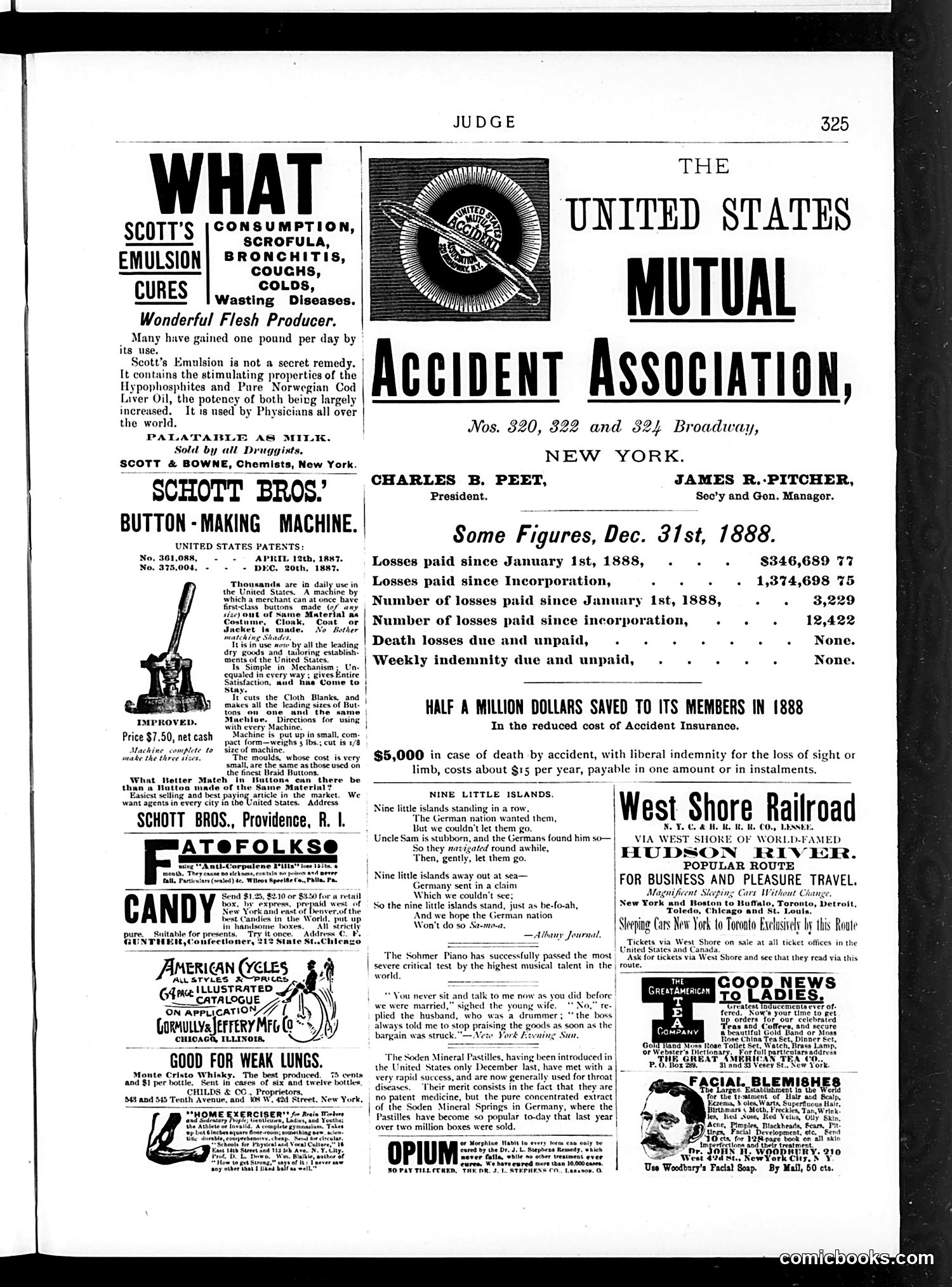
This page is predominantly **advertisements** with one notable satirical poem. The main content of interest is "NINE LITTLE ISLANDS," a patriotic verse apparently referencing a recent diplomatic dispute. The poem celebrates America's refusal to cede nine islands to Germany, portraying Uncle Sam as "stubborn" and successfully resisting German territorial claims. The context likely involves a specific late-1880s maritime or territorial dispute between the U.S. and Germany—possibly relating to Pacific island claims or fishing rights—though the page doesn't name the specific islands or incident. The remainder of the page consists of period advertisements for Scott's Emulsion (a health tonic), button-making machines, whiskey, pianos, and the West Shore Railroad, typical of Judge's revenue model. No political cartoons or caricatured figures are visible on this particular page.
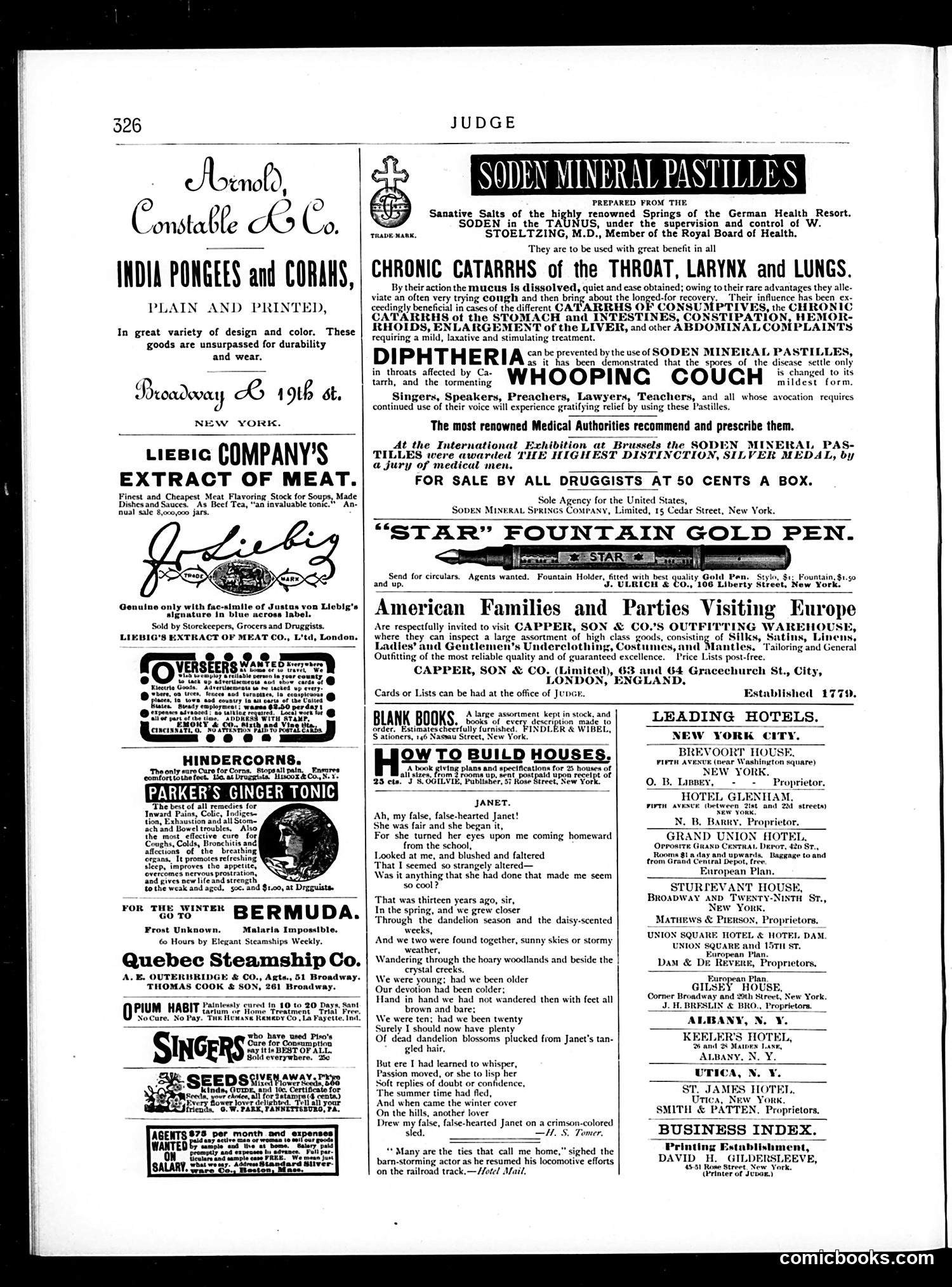
This page is **primarily advertising**, not political satire. It consists almost entirely of commercial advertisements typical of a late 19th-century American magazine. The advertisements include: - **Soden Mineral Pastilles**: A patent medicine from a German health resort, marketed for throat, larynx, and lung ailments, diphtheria, and whooping cough - **Liebig's Extract of Meat**: A meat-based flavoring product - **Parker's Ginger Tonic**: A supposed cure-all for digestive and respiratory problems - **Steamship companies**: Promoting travel to Bermuda and Europe - **Piso's Cure for Consumption**: Another patent medicine - **Various hotels and business services** No political cartoons or social satire are visible on this page. The content reflects the era's widespread marketing of dubious patent medicines with exaggerated health claims—practices that would later be regulated by the FDA. The advertisements reveal contemporary consumer culture and medical misconceptions of the period.
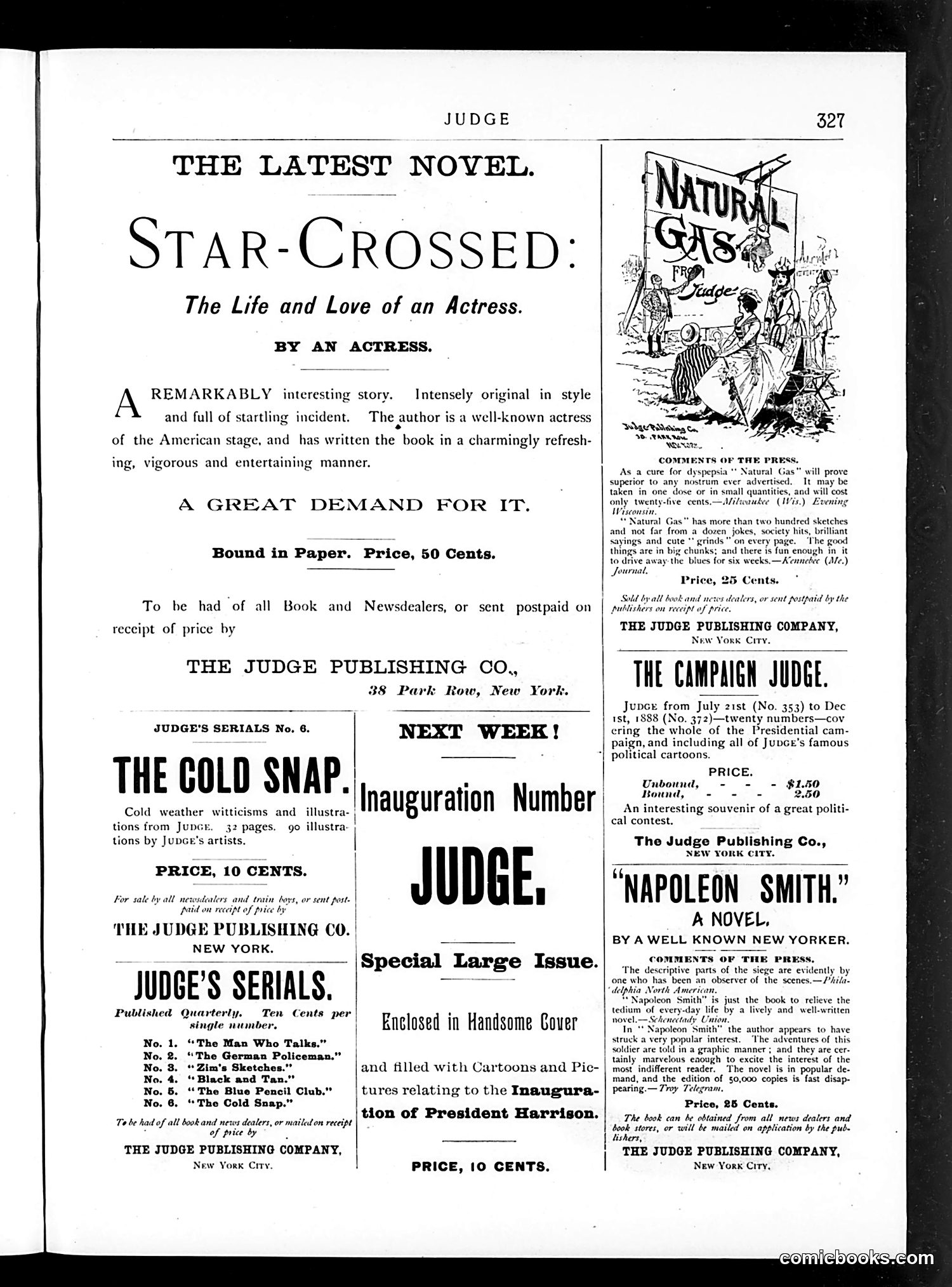
This page is primarily **advertising and promotional content** from Judge magazine, not political satire. It announces upcoming publications by the Judge Publishing Company, including a novel titled "Star-Crossed" (about an actress) and "The Cold Snap" (cold weather humor illustrations). The key political content is the announcement of an "Inauguration Number" special issue covering President **Harrison's inauguration** (appears to be from 1889) with political cartoons. There's also promotional material for "The Campaign Judge"—a collection of issues from July-December 1888 covering the presidential election. The main cartoon visible shows what appears to be people in 19th-century dress in a domestic scene advertising "Natural Gas"—likely promoting gas utility services, not making political commentary. This is primarily a **trade publication page** showcasing Judge's commercial offerings rather than editorial political content.
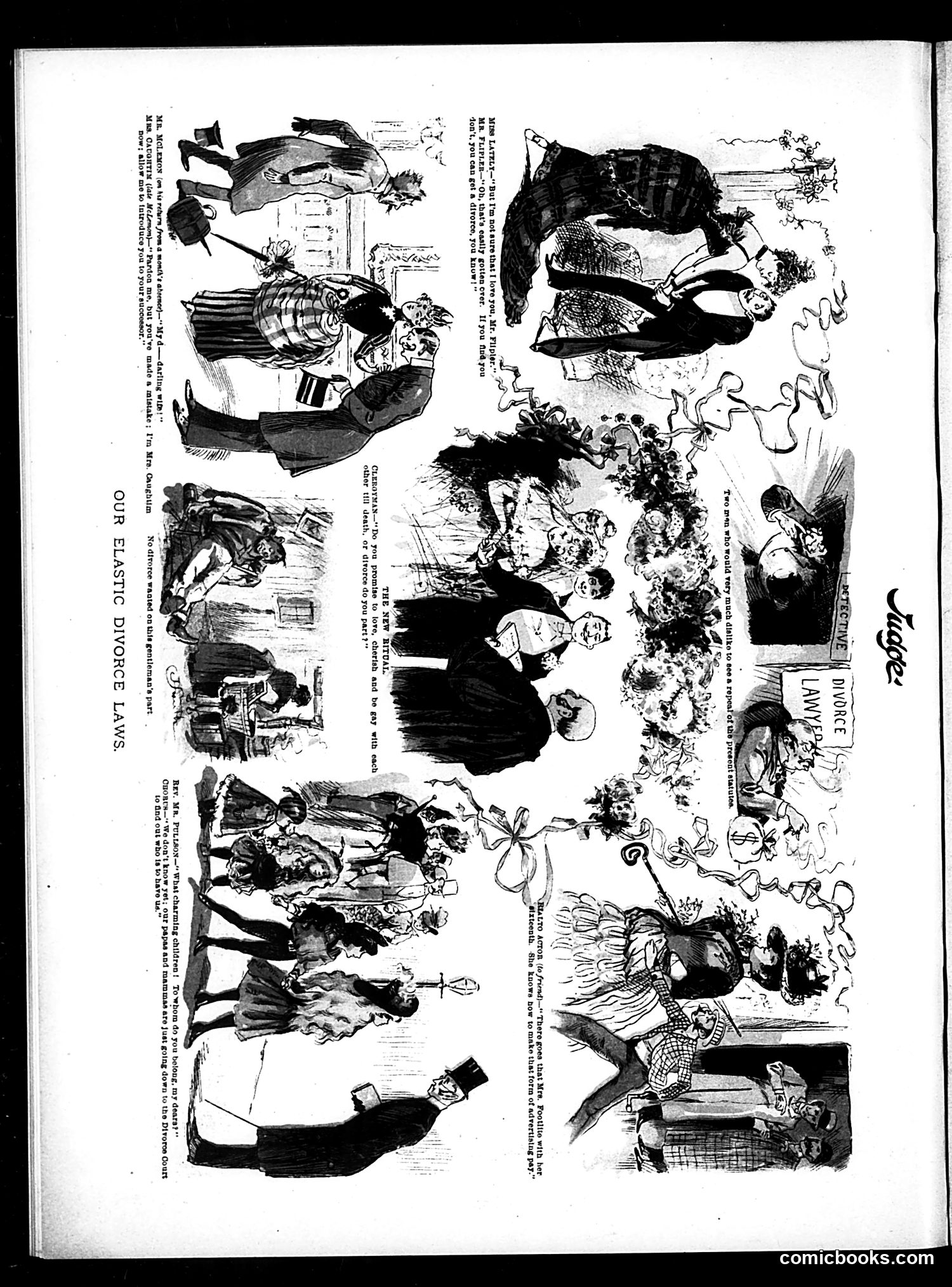
This page satirizes America's permissive divorce laws through multiple cartoons. The central theme, titled "Our Elastic Divorce Laws," critiques how easily marriages dissolve. **Key cartoons:** 1. **Top image**: An actress uses her appearance/form as "advertising" to profit—likely suggesting women weaponize beauty or scandal for publicity, which divorce cases provided. 2. **Main cartoon**: A clergyman conducts a wedding while children cheerfully ask "to whom do we belong?" since their parents are "just going down to the Divorce Court." This satirizes how divorce has become so routine and normalized that even children expect it. The satire targets the contradiction between marriage vows ("till death do us part") and the reality of easy divorce. The humor comes from children treating parental divorce as inevitable and ordinary, exposing how the "elastic" (flexible/expandable) divorce laws have made marriage contracts meaningless. This reflects Progressive-era social anxiety about deteriorating family structures.
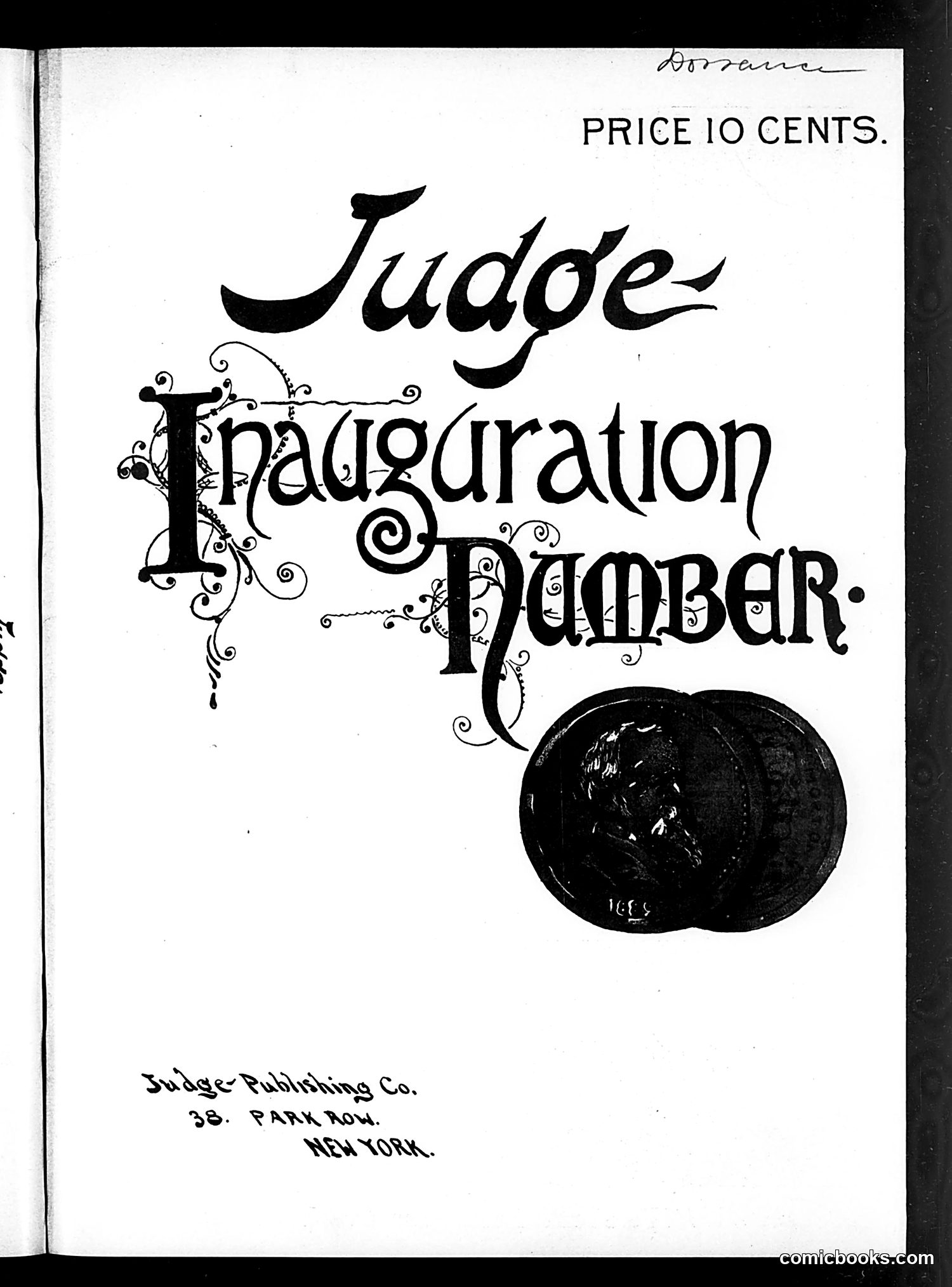
This is the title page for a Judge magazine issue themed around a presidential inauguration in December. The publication cost 10 cents. The ornate decorative lettering and formal presentation suggest this was a special commemorative issue focused on the swearing-in of a new president. The large pomegranate illustration at the bottom is unclear in its specific satirical meaning without additional context about which inauguration this references. The Judge Publishing Company was based at 38 Park Row in New York. Without knowing the specific date or presidency commemorated, I cannot definitively explain what political point the pomegranate symbolizes or what contemporary events the issue addressed.
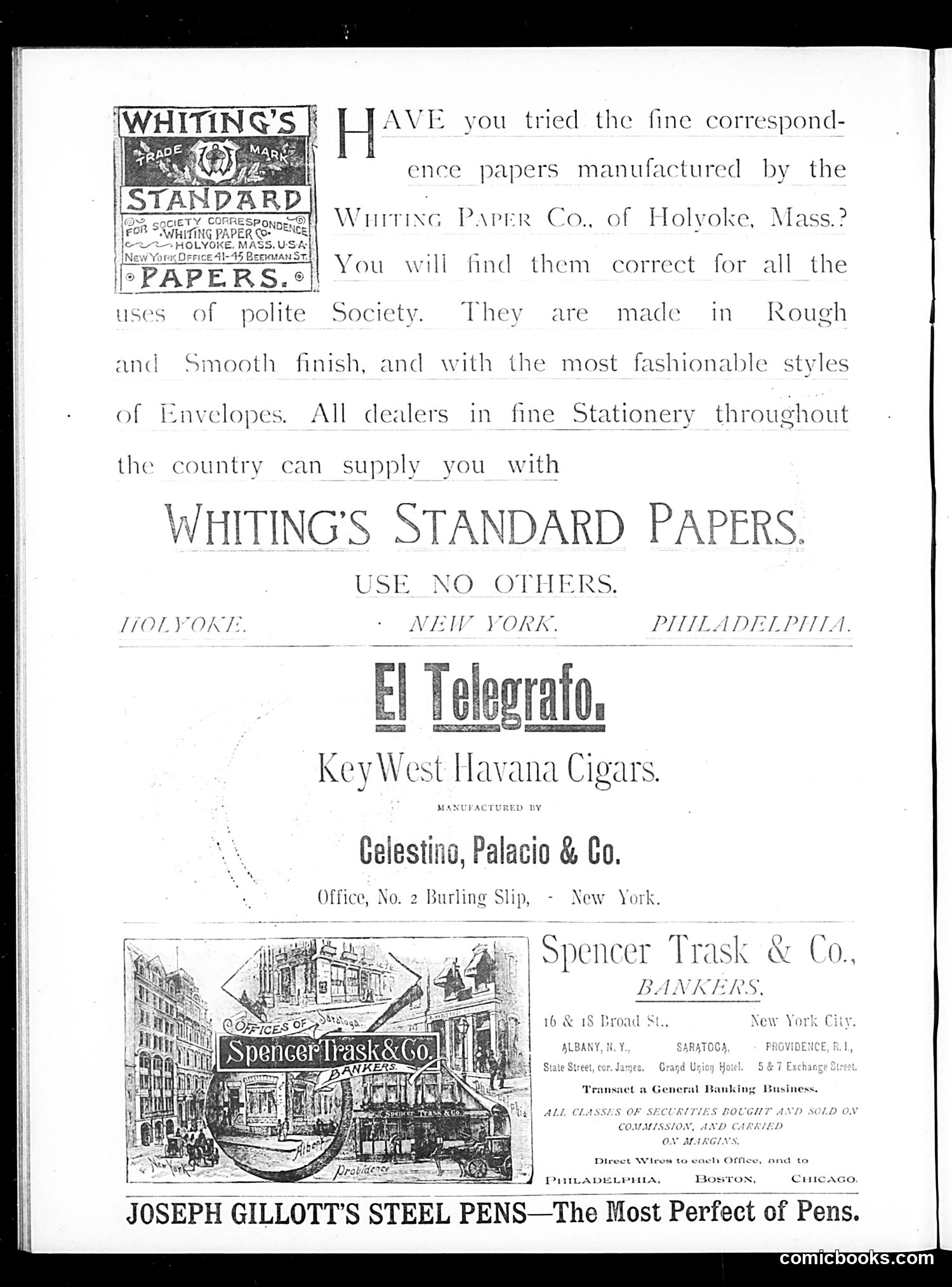
This is primarily an **advertising page** from *Judge* magazine, not a political cartoon. It contains four commercial advertisements: 1. **Whiting Paper Co.** — promoting fine correspondence papers for "polite Society" 2. **El Telegrafo** — Key West Havana cigars by Celestino, Palacio & Co. 3. **Spencer Trask & Co.** — a banking firm with offices in New York, Albany, Saratoga, and Providence, featuring an illustrated engraving of their offices 4. **Joseph Gillott's Steel Pens** — promotional line at bottom There is **no political satire or cartoon content** visible here. The page represents typical late 19th-century magazine advertising, mixing luxury goods (fine stationery, cigars, pens) with financial services. The illustrated Spencer Trask building is decorative advertising, not satirical commentary.