
Judge, 1889-02-23 · page 6 of 18
Judge — February 23, 1889 — page 6: what you’re looking at
What you’re looking at
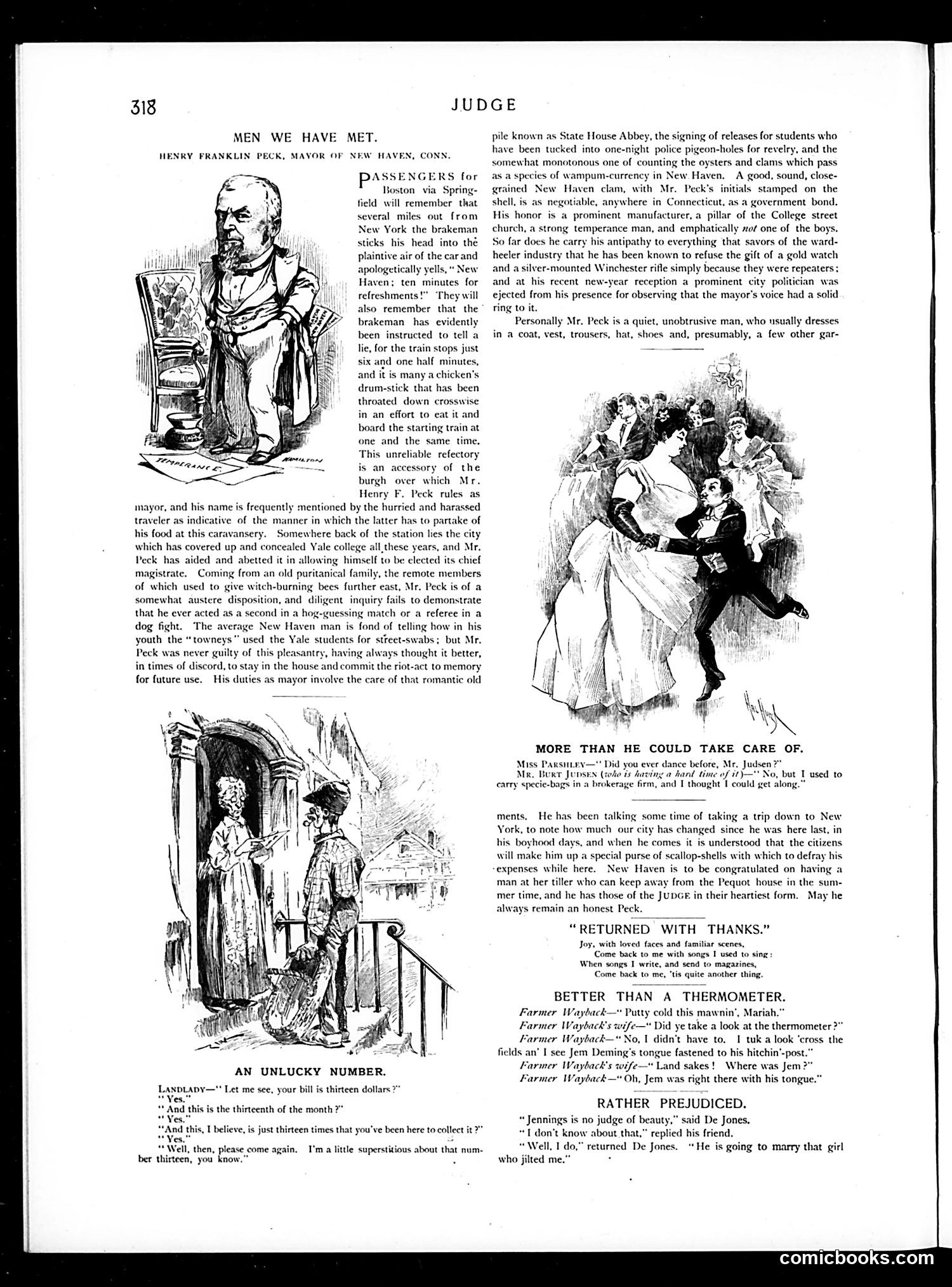
This page from *Judge* magazine profiles **Henry F. Peck, Mayor of New Haven, Connecticut**. The satire works through ironic praise of Peck's austere, rigid personality. The cartoon mocks Peck as an excessively proper Puritan killjoy—descended from witch-burning ancestors—who refuses to participate in normal vice or corruption. He rejected bribes (a gold watch and Winchester rifle) because they were "repeaters," and he's so anti-corruption that he won't associate with ward-heelers. The joke is that New Haven's mayor is *too* honest and stern for a political figure. Judge sarcastically celebrates this as virtuous while poking fun at his joyless demeanor. References to Yale students, the State House, and the famous poor-quality refreshment stop at New Haven station ground the humor in local New Haven politics and reputation circa the late 19th century. The page also includes unrelated humor about superstition and dancing.
📄 Transcribed text from this page (OCR, searchable)
Machine-transcribed from the original scan — historical spelling and the odd misread are preserved.
318 MEN WE HAVE HENRY FRANKLIN PE MET. . MAYOR OF NEW HAV! field will remember that several miles out from New York the brakeman sticks his head into thé plaintive air of the car and apologetically yells, * New Haven; ten minutes for refreshments!" They will also remember that the brakeman has evidently been instructed to tell a lie, for the train stops just six and one half minui and it is many a chicken’s drumestick that has been throated down crosswise in an effort to eat it and board the starting train at one and the same time, This unreliable refectory is an accessory of the burgh over which Mr. Henry F. Peck rules mentioned by the hurried and harassed traveler as indicative of the manner in which the latter hi c of his food at this caravansery. Somewhere back of the station lies the city which has covered up and concealed Yale college all,these years, and Mr. Peck has aided and abetted it in allowing himself to be elected its chief magistrate. Coming from an old puritanical family, the remote members of which used to give witch-burning bees further east, Mr. Peck is of a somewhat austere disposition, and diligent inquiry fails to demonstrate that he ever acted as a second in a hog-guessing match or a referee in a dog fight. The average New Haven man is fond of telling how in his youth the “towneys" used the Yale students for street-swabs; but Mr. Peck was never guilty of this pleasantr 1g always thought it better, in times of discord, to st nd commit the riot-act to memory for future use. His duties as mayor involve the care of that romantic old mayor, and his name is frequent! AN UNLUCKY NUMBER. LanpLapy—" Let me see, your bill is thirteen dollars?" “* Well, then, please come again, I'm a little superstitious about that num- ber thirteen, you’ know.” JUDGE pile known as State House Abbey, the signing of releases for students who have been tucked into one-night police pigeon-holes for revelry, and the somewhat monotonous one of counting the oysters and clams which pass asa species of wampum-currency in New Haven, A good, sound, close- grained h Mr. Peck's initials stamped on the anywhere in Connecticut, as a government bond. His honor is a prominent manufacturer, a pillar of the College street church, a strong temperance man, and emphatically sof one of the boys. So far does he carry his antipathy to everything that savors of the ward- heeler industry that he has been known to refuse the gift of a gold watch and a silver-mounted Winchester rifle simply because they were repeaters; and at his recent new-year reception a prominent city polit ejected from his presence for observing that the mayor's voice had a solid ring to it. ian was Personally Mr. Peck is a quiet, unobtrusive man, who usually dresses in a coat, vest, trousers, hat, shoes and, presumably, a few other gar- MORE THAN HE COULD TAKE CARE OF. Miss Parsitey—"' Did you ever dance before, Mr. Judsen ?" BURT JUDSEN (soho ts having a hand tin No, but I used to and I thought I could et along.” ments, He has been talking some time of taking a trip down to New York, to note how much our city has changed since he was here last his boyhood days, and when he comes it is understood that the citizens will make him up a special purse of scallop-shells with which to defray his expenses while here. New Haven is to be congratulated on having a man at her tiller who can keep away from the Pequot house in the sum- mer time, and he has those of the JUDGE in their heartiest form. May he always remain an honest Peck. “RETURNED WITH THANKS.” Joy, with loved faces and familiar scenes, ‘Come back to me with songs I used to sing: When songs I write, and send to magazines, Come back to me, ‘tis quite another thing. BETTER THAN A THERMOMETER. Farmer Wayback—* Putty cold this mawnin’, Mariah.” Farmer Wayback's wife— Did ye take a look at the thermometer ? Farmer Wayback—" No, | didn’t have to. 1 tuk a look ‘cross the ficlds an’ I see Jem Deming’s tongue fastened to his hitchin’-post. Farmer Wayback's wife—* Land sakes! Where was Jem? Farmer Wayback— Oh, Jem was right there with his tongue.” RATHER PREJUDICED. “Jennings is no judge of beauty,” said De Jones. I don’t know about that,” replied his friend. Well, I do,” returned De Jones. “He is going to marry that girl who jilted me.” : comicbooks.com