
A complete issue · 16 pages · 1889
Judge — February 16, 1889
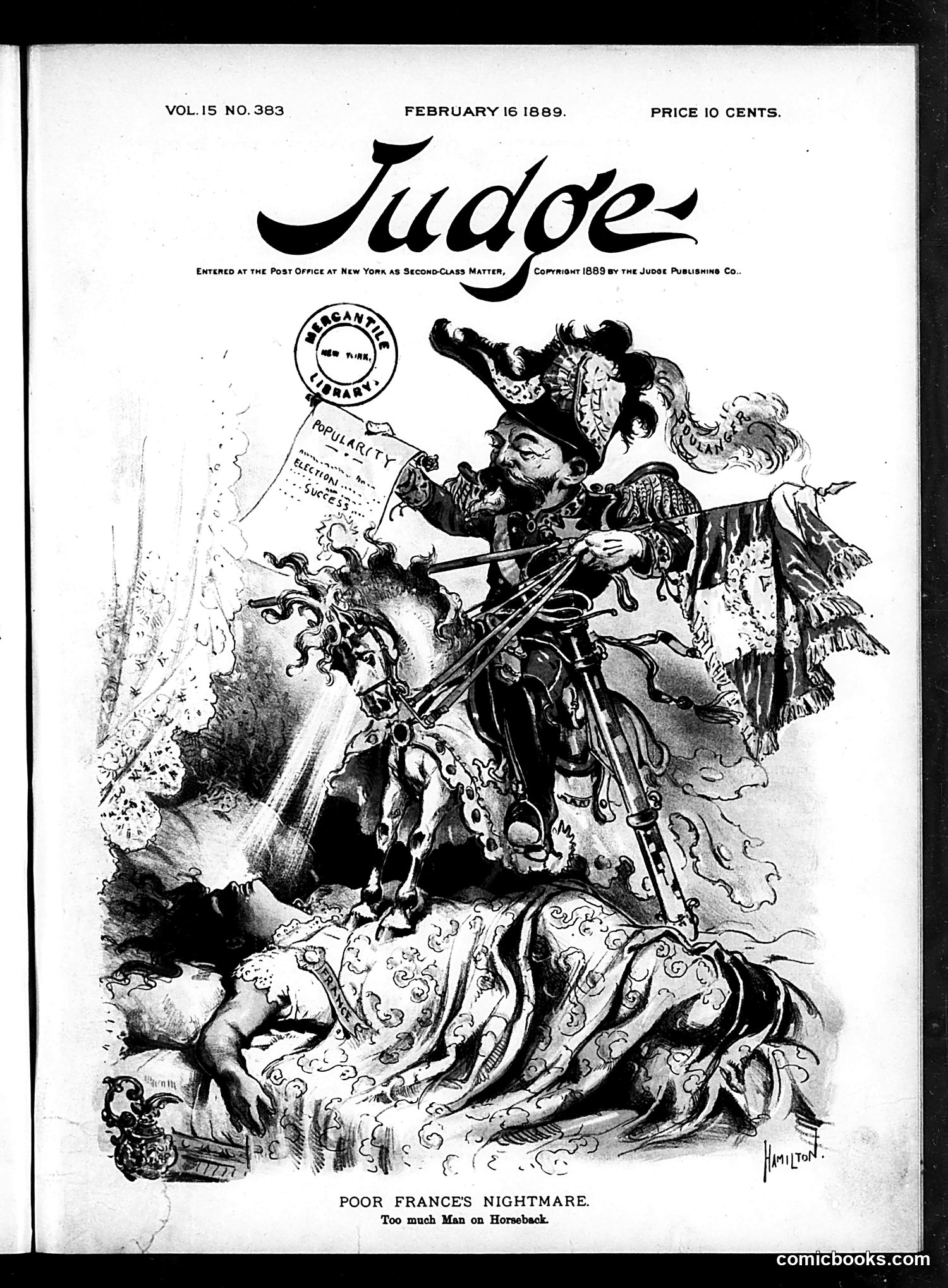
This is a political cartoon from *Judge* magazine (February 16, 1889) satirizing French anxieties about military strongmen. The central figure appears to be a caricatured general on horseback, wielding a sword—likely referencing General Boulanger, a popular French military figure who threatened republican stability in the late 1880s through his nationalist appeal and hints at authoritarianism. The sleeping female figure beneath represents "France" (personified as Liberty or the Republic), vulnerable to being trampled. The nightmare imagery suggests French fear that excessive military power could destroy democratic institutions. The "Bergantile Library" stamp indicates this was archived for historical research purposes.
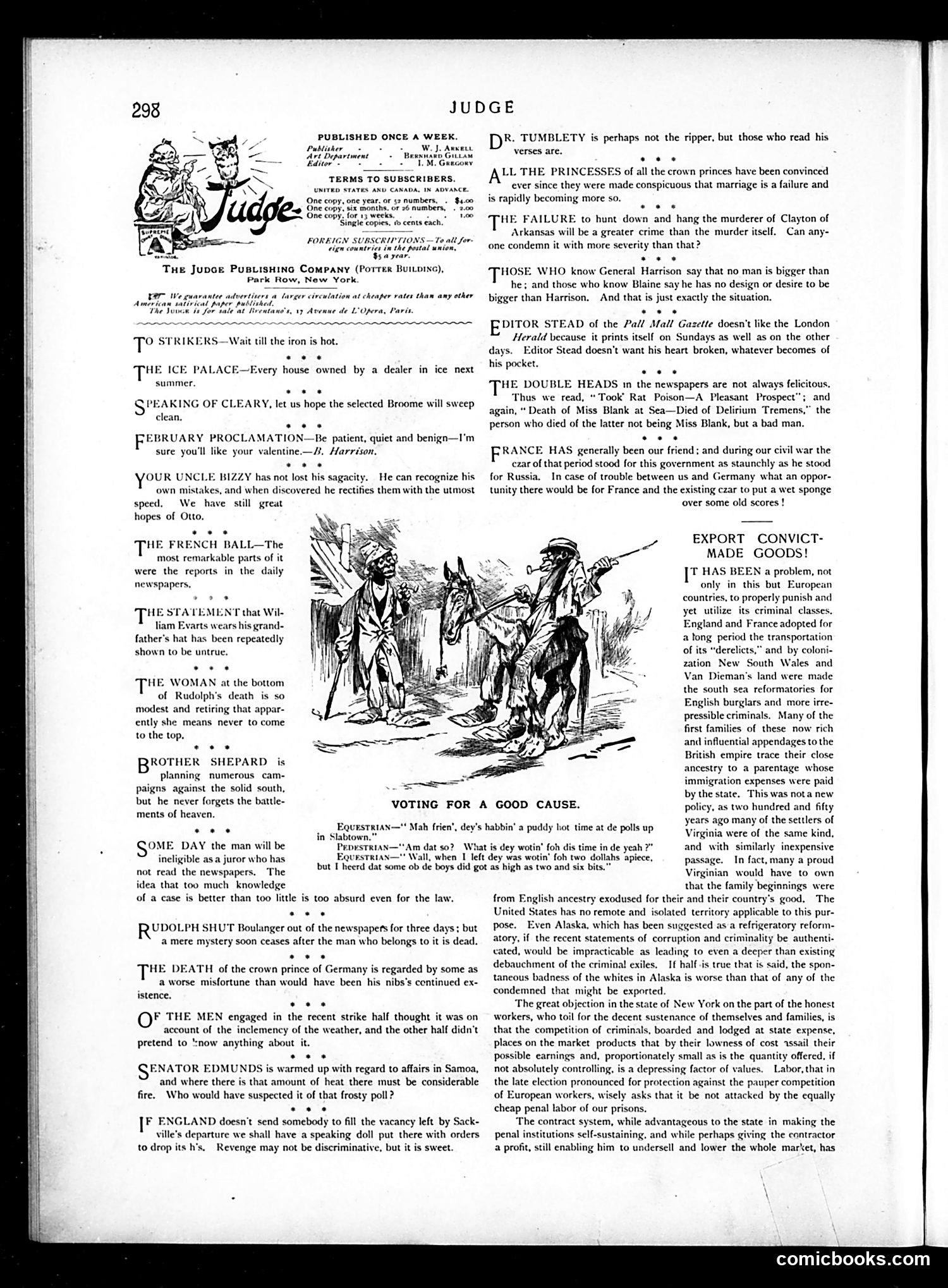
This cartoon depicts rural voters at a polling place. The dialogue parodies the ignorance of working-class voters: an Equestrian asks "Miss Iess, dey's habbin' a paddy lad time at de polls up in Blakesown," and the Pedestrian responds with fractured dialect about voting, ultimately admitting "I heerd dat some ob de boys did got as high as two and six bits." The satire targets voter manipulation and bribery—suggesting that rural or poor voters could be bought for small sums ("two and six bits" being a modest amount). The crude dialect emphasizes the cartoonist's contempt for these voters' education level. This reflects Gilded Age anxieties about electoral corruption and the "wrong" people participating in democracy.
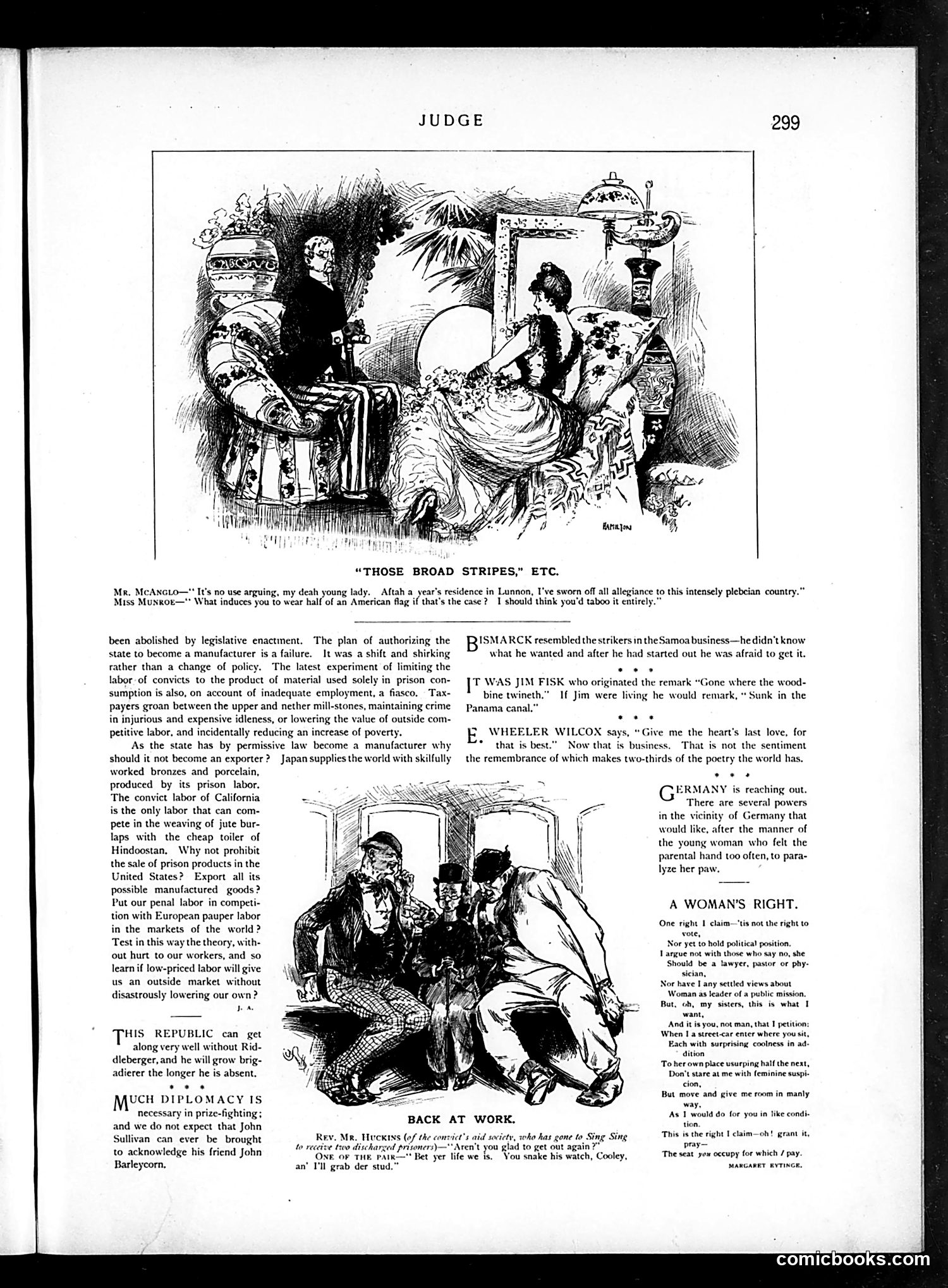
This cartoon satirizes American expatriates who adopt British affectations while abroad. Mr. McAngle claims to have renounced allegiance to America after a year in London, calling the country "intensely plebeian." Miss Munroe points out the hypocrisy: he's wearing half an American flag (likely in his clothing or accessories), contradicting his stated rejection of American identity. The joke targets a recognizable Gilded Age phenomenon—wealthy Americans who affected European sophistication and looked down on their homeland while still benefiting from or displaying American markers. It's social satire on class pretension and cosmopolitan snobbery, mocking those who abandoned American patriotism for European polish without fully committing to either identity.
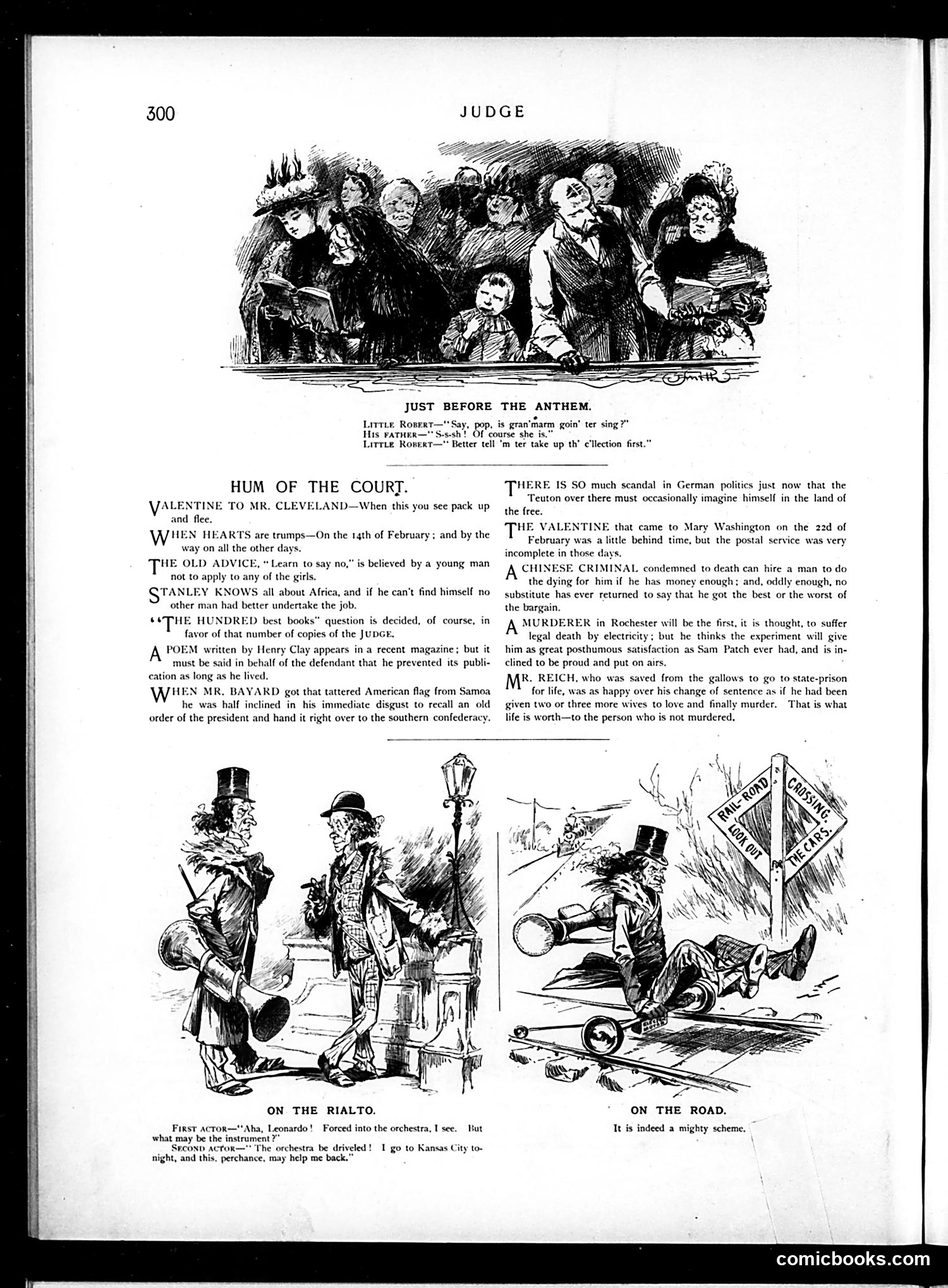
This page collects brief satirical commentary on contemporary issues (circa 1880s-90s). Key items include: **"Just Before the Anthem"**: A child's joke about his grandmother singing at church—he suggests collecting money first, implying her singing is so bad it requires compensation. **Political/Social Jabs**: References to Cleveland (likely President Grover Cleveland), Secretary of State Bayard's handling of a damaged American flag from Samoa (a diplomatic incident), and Stanley's African explorations. The German politics comment satirizes corrupt European governments versus American democracy. **Dark Humor Items**: Cynical observations on capital punishment (electricity execution in Rochester), Chinese substitute execution practice, and a murderer who prefers death to state prison—all commentary on contemporary justice system absurdities. **Theater Sketches** ("On the Rialto" and "On the Road"): Satirize struggling actors and theatrical life, with an Italian reference suggesting pretension. The overall tone is sardonic commentary on politics, justice, entertainment, and social hypocrisy.
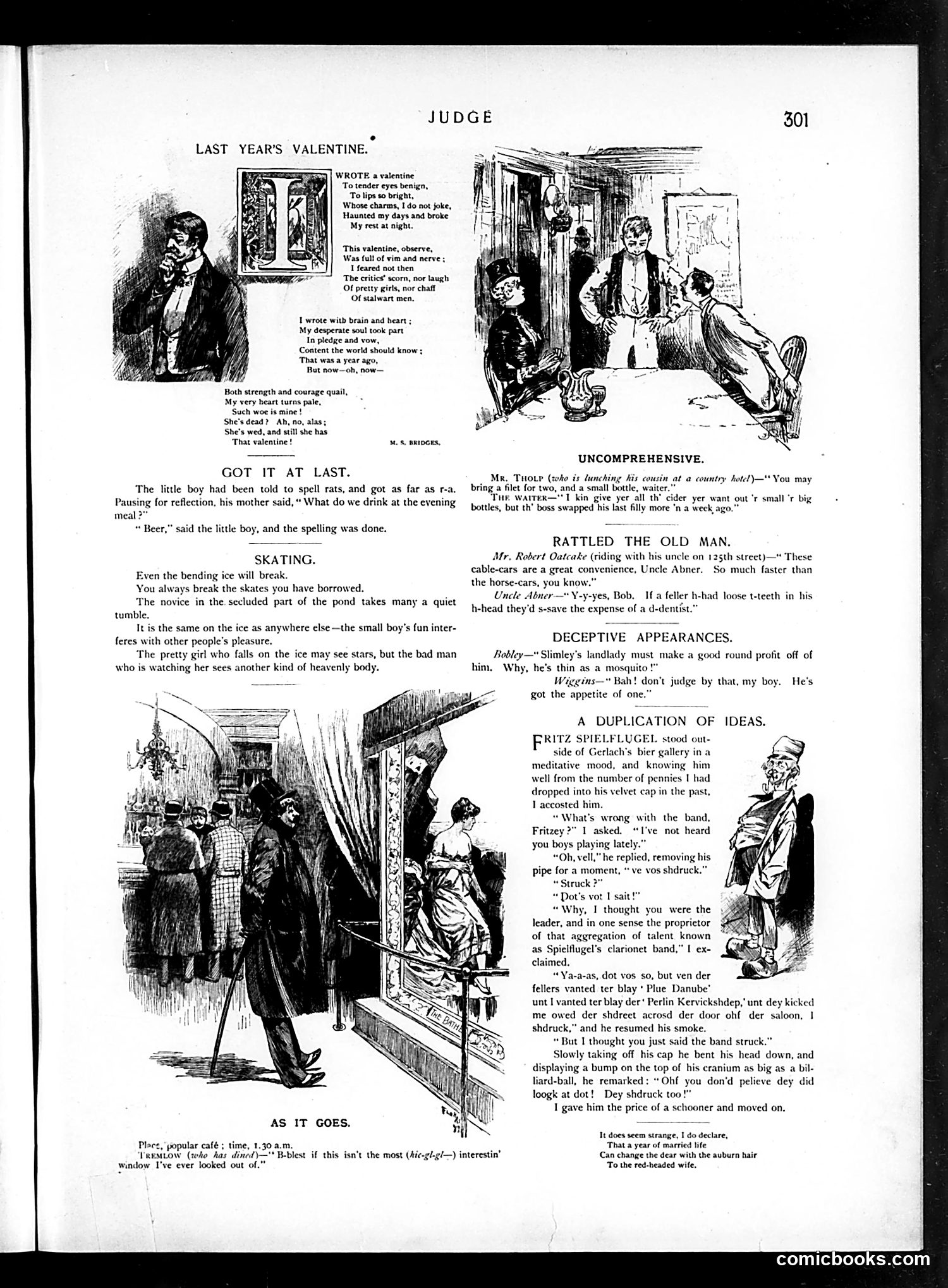
This page contains several short humorous pieces typical of *Judge* magazine's satirical style: **"Last Year's Valentine"** mocks romantic desperation—a man's passionate love letter becomes embarrassing once the woman marries someone else and retains the valentine as evidence of his foolishness. **"Got It At Last"** is a children's joke playing on homophone confusion: a boy spells "rats" as "r-a-t-" then answers "beer" when prompted about evening meals, accidentally completing "r-a-t-beer." **"Skating"** and other brief pieces satirize social pretension and class differences—the humor derives from contrasting how different people experience the same situation (wealthy vs. working-class behavior, or male vs. female perspectives). **"A Duplication of Ideas"** features Fritz Spielflugel, an apparent immigrant musician (indicated by heavy dialect spelling), arguing with his band about which song to play. The punchline reveals he was literally struck—hit—by his own band members, explaining the double meaning of "struck." The satire targets immigrant accents, social awkwardness, marital disappointment, and class pretension common to *Judge's* audience expectations.
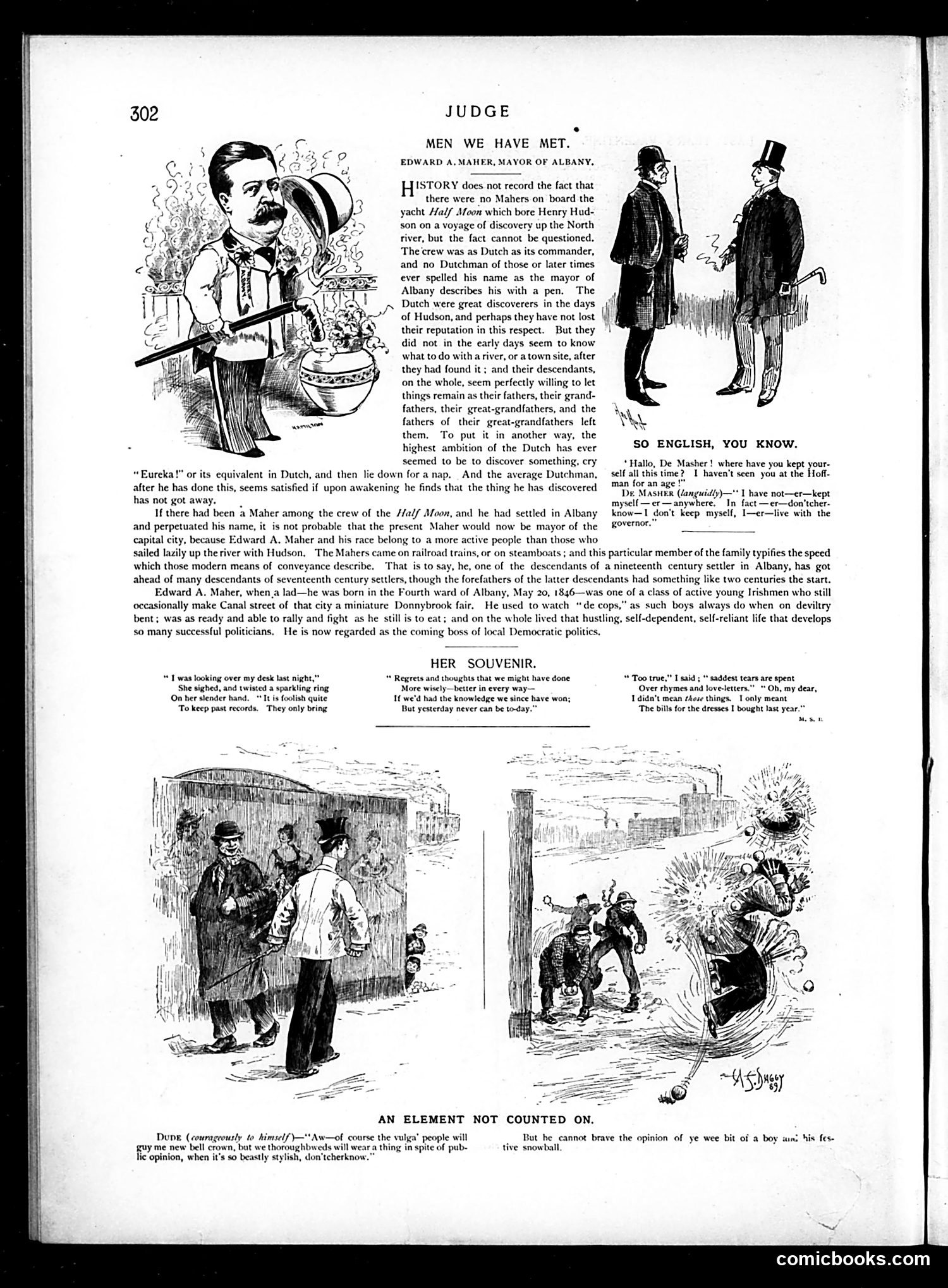
This page profiles **Edward A. Maher, Mayor of Albany**, contrasting his Irish-immigrant dynamism with the supposed stagnation of Dutch settlers. The satire argues that while the Dutch discovered Hudson River territory centuries earlier, they accomplished nothing with it—literally napping after discovery. Maher, a 19th-century Irish immigrant's descendant, has surpassed these "lazy" Dutch forebears through hustling and self-reliance, typifying the ambitious Irish-American politician. The accompanying cartoons mock social pretension: one shows an Irishman (De Masher) feigning English sophistication while admitting he "lives with the governor"; another depicts a woman mourning lost love—until revealing she actually regrets unpaid dress bills; the final cartoon shows a fashionable snob undone by a child's snowball, unable to withstand "vulgar" opinion despite claiming superiority. The overall theme celebrates Irish-American meritocratic advancement while satirizing both Dutch complacency and affectation.
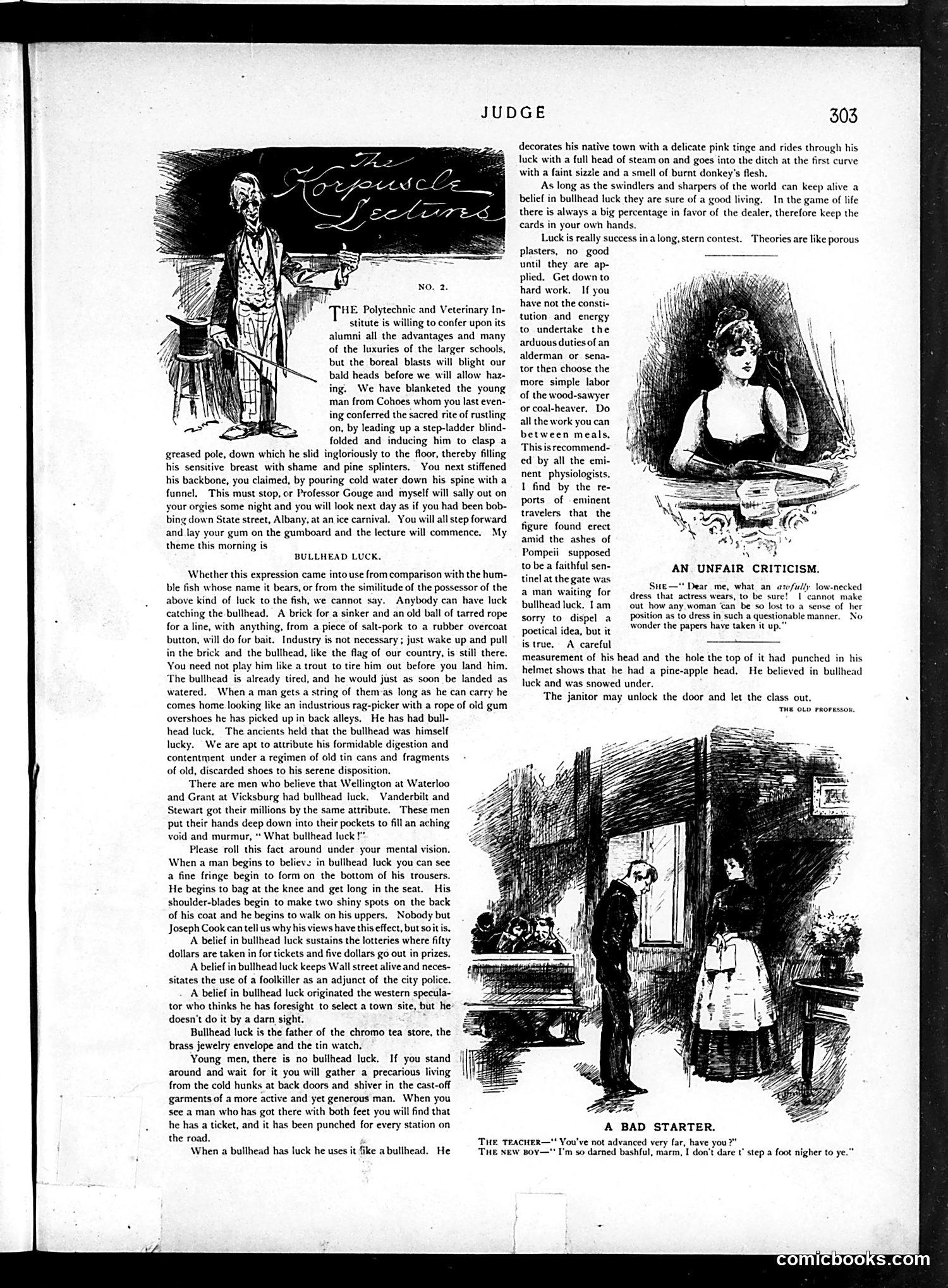
This page from *Judge* magazine satirizes the concept of "luck" as a justification for idleness and poor decision-making. The main essay, "Bullhead Luck," uses the image of catching bullhead fish (which require no skill—just bait and a brick for a sinker) as a metaphor for passive, unearned success. The author argues that belief in "bullhead luck" is a dangerous delusion afflicting Americans across society—from lottery players to Wall Street speculators to small-town developers. The satire suggests this false belief in providence or chance undermines genuine work ethic and personal advancement. The two cartoon vignettes ("An Unfair Criticism" and "A Bad Starter") appear to illustrate related social commentary, likely mocking vanity or inexperience. The anti-hazing lecture opening the page suggests the magazine was also critiquing institutional violence at educational institutions, positioned as absurd institutional hypocrisy.
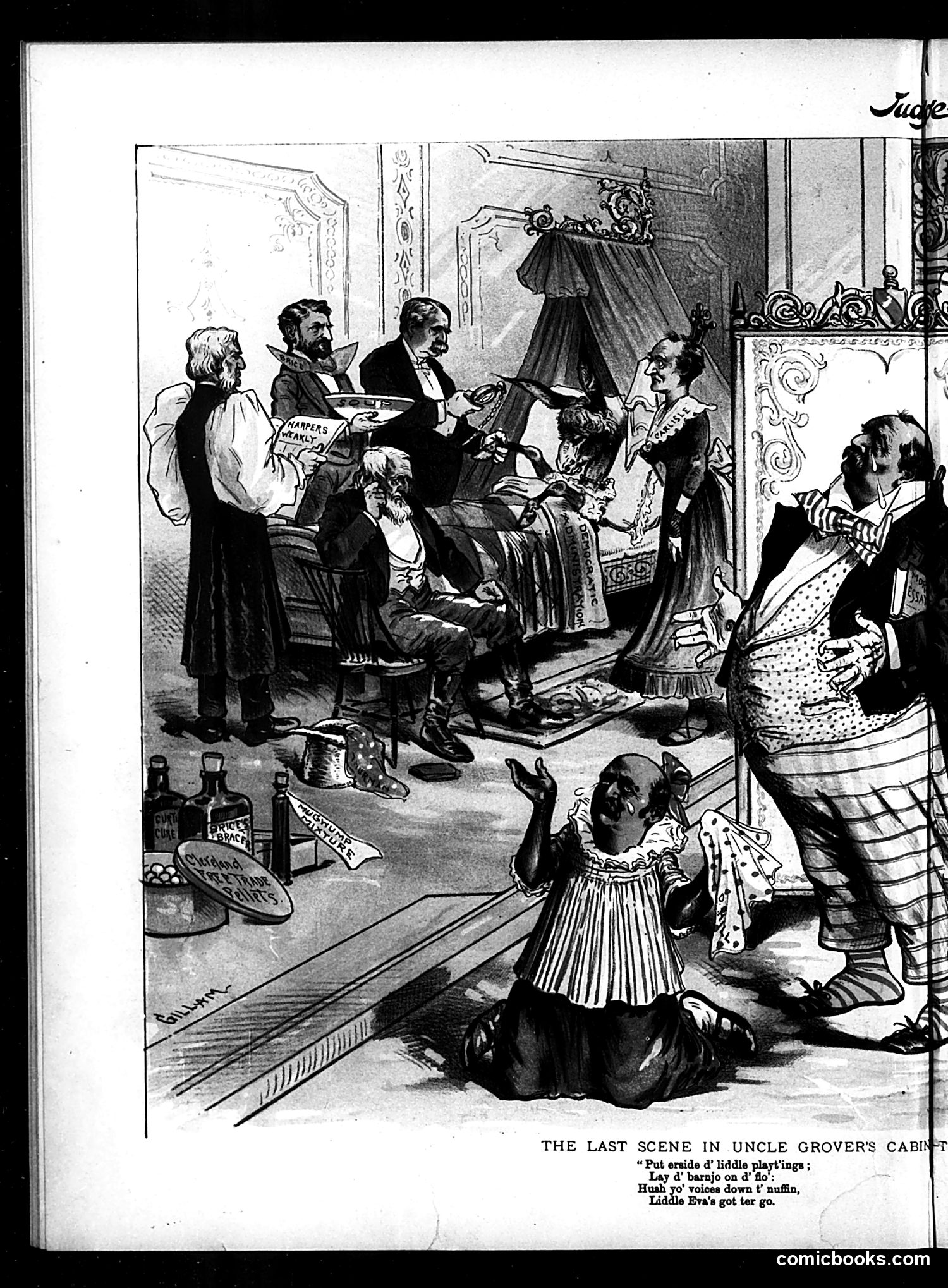
This satirical illustration appears to reference *Uncle Tom's Cabin*, Harriet Beecher Stowe's famous anti-slavery novel. The caption quotes lyrics suggesting a minstrel show or blackface performance: "Put aside d' little playthings; Lay d' banjo on d' flo'; Made voices down t' muffin, Liddle Eva's got ter go." The cartoon likely satirizes how *Uncle Tom's Cabin*—originally an abolitionist work—had been adapted into popular entertainment, particularly minstrel shows that distorted its message through racist performance traditions. The crude dialect in the caption reflects the degrading way such performances represented African Americans. Judge magazine, as a satirical publication, appears to be mocking both the sanitized, entertainment-focused versions of the novel and the racist theatrical conventions that trivialized Stowe's serious moral commentary.
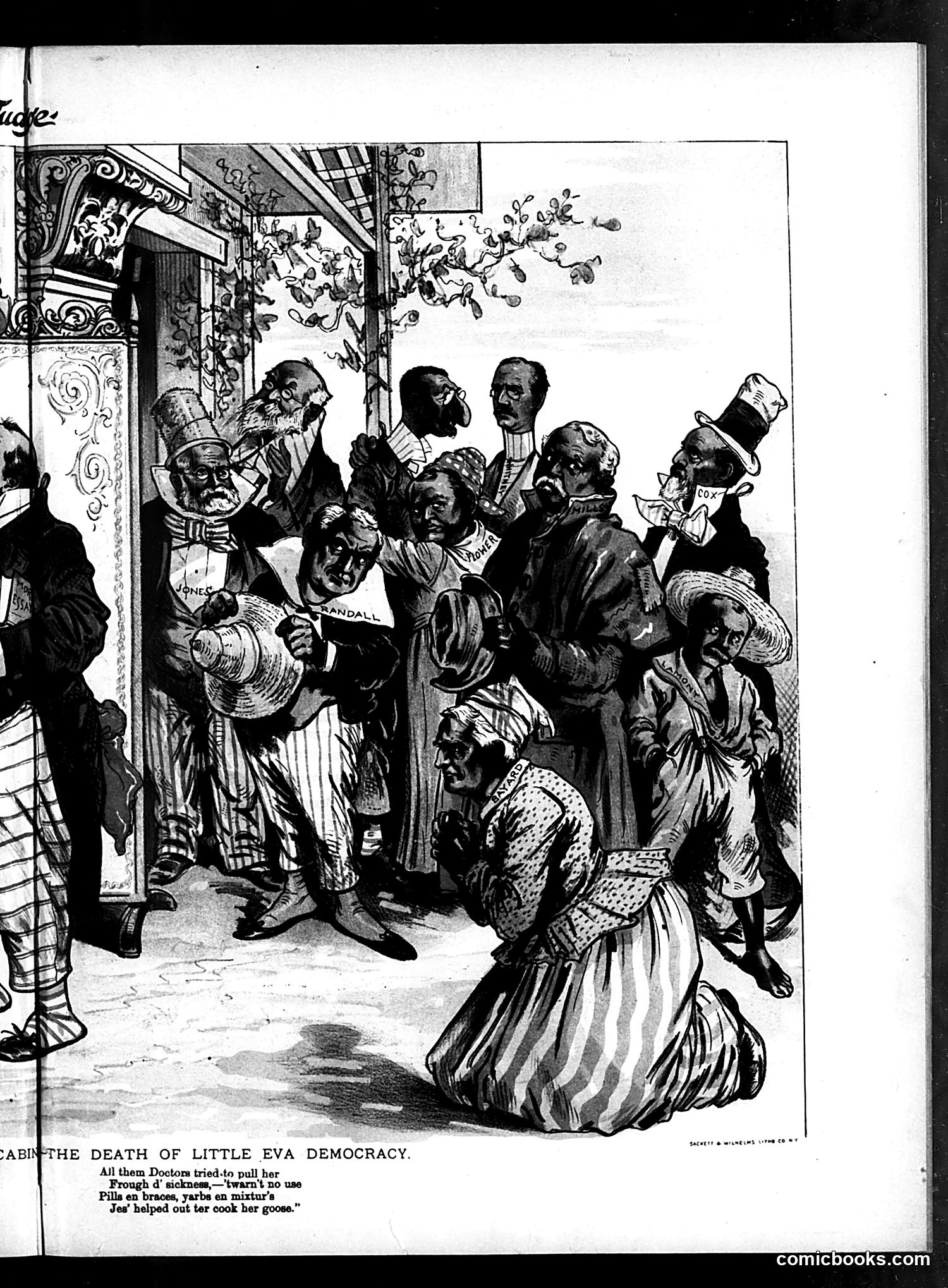
This political cartoon satirizes the decline of democratic principles, personified as "Little Eva" (a dying child). The title references Uncle Tom's Cabin, evoking sentiment around a beloved character's demise. The image shows various caricatured figures—appearing to represent politicians and public figures of the era—gathered around the dying figure, suggesting complicity in democracy's weakening. The caption's dialect ("Pills en braces," "Jes' helped out ter cook her goose") uses vernacular speech, likely mocking incompetent or corrupt political actors who claim to be helping but actually harm democratic institutions. The ornate setting and formal dress of the gathered figures contrast with the cartoon's darkly humorous tone, suggesting hypocrisy among the political establishment. Without additional context about Judge's specific publication date, precise identification of the figures remains unclear, though the satire targets political corruption and democratic decay in late 19th or early 20th-century America.
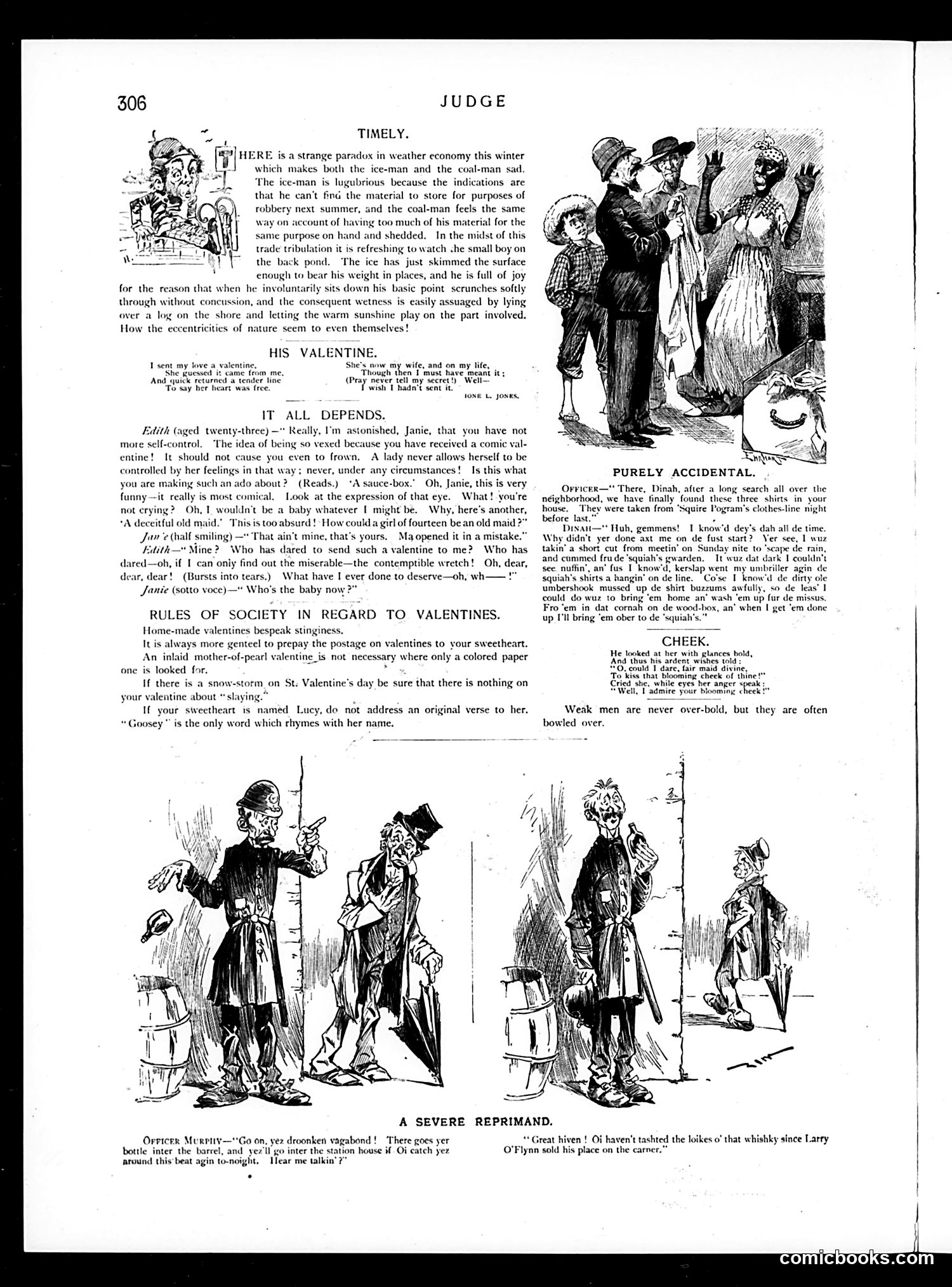
This page from *Judge* contains Valentine's Day-themed satirical content typical of late 19th-century American humor. **"Timely"** opens with paradoxical satire about winter weather: ice-men and coal-men both suffer economically—the former can't harvest ice, the latter has excess coal. The humor lies in nature's cruel irony, contrasted with a boy's simple joy sliding on thin ice. **"It All Depends"** satirizes Victorian female propriety. A mother scolds her daughter for receiving a valentines, lecturing about "self-control," then discovers one was addressed to herself—revealing her own hypocrisy through tears and dramatics. **"Rules of Society in Regard to Valentines"** mocks upper-class etiquette obsessions with tongue-in-cheek "advice" about valentine propriety. **"A Severe Reprimand"** depicts an Irish police officer threatening a drunk vagrant, who responds by nostalgically remembering better whisky from years past—humor from class contrast and Irish stereotyping. **"Purely Accidental"** shows a Black woman caught with stolen shirts, claiming accidental discovery—period racial humor relying on dialect and servant stereotypes.
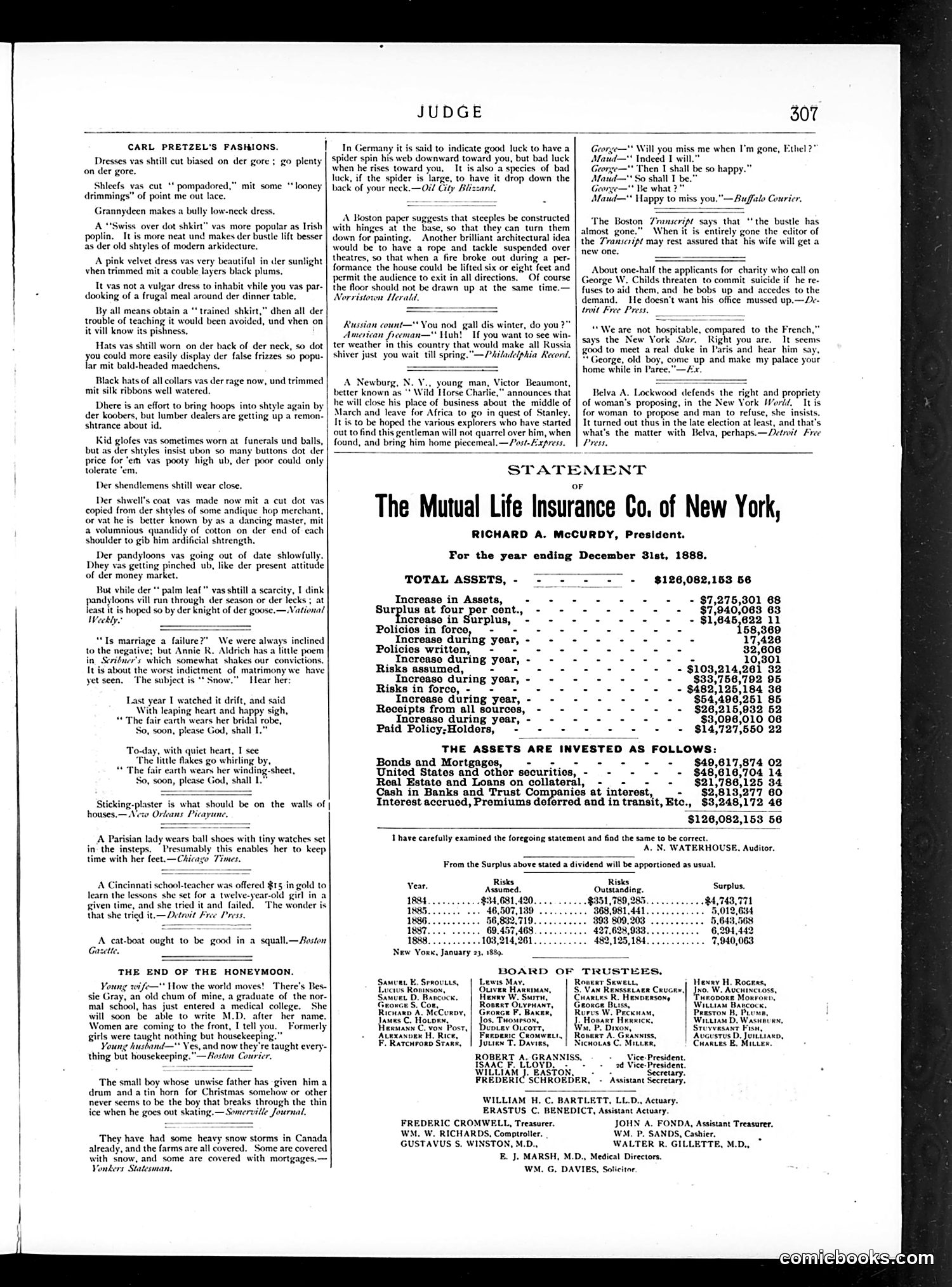
This page contains fashion commentary and brief satirical items rather than traditional political cartoons. The main piece, "Carl Pretzel's Fashions," is a humorous fashion column written in a heavy German-Jewish accent, mocking both contemporary women's fashion trends and the immigrant perspective observing them. References include bustle styles, "pompadored" sleeves, trained skirts, and the return of hoops—all 1880s concerns. The accent-heavy dialect itself is the satire, playing on stereotypes of German-Jewish immigrants as outsiders commenting on American fashion. The other brief items mock contemporary social issues: women entering medicine, the decline of honeymoon romance, and parental poor judgment in gift-giving. The page also includes an insurance company statement for Mutual Life Insurance Co. of New York. The humor relies on period-specific fashion knowledge and immigrant stereotype caricature—elements largely lost to modern readers unfamiliar with 1880s clothing terminology or vaudeville-style dialect humor.
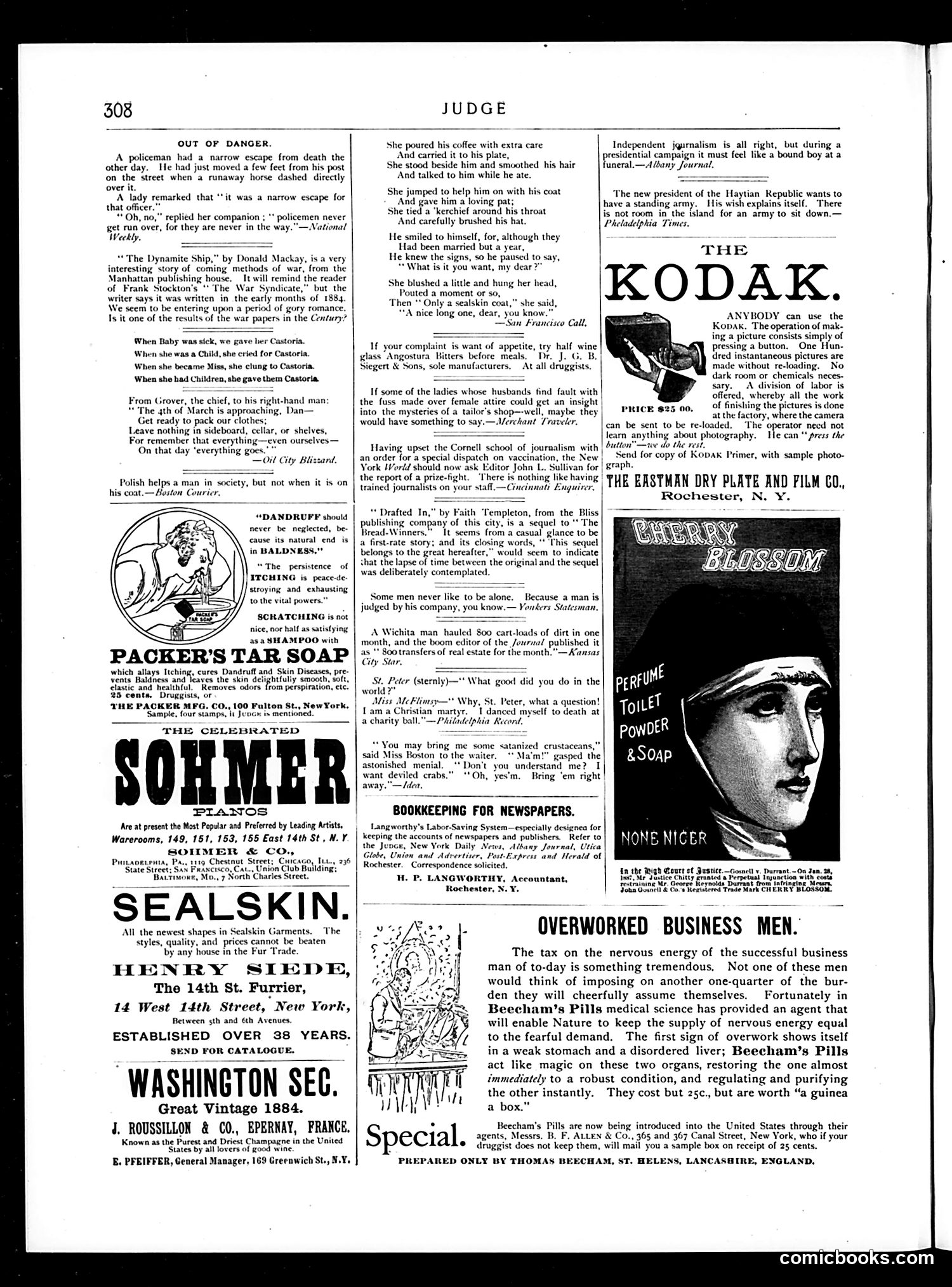
This is primarily an **advertising page** from Judge magazine, interspersed with brief editorial humor and book reviews. The advertisements include tar soap, pianos, sealskin garments, and a camera (Kodak). The small editorial content includes satirical remarks on contemporary topics: - A joke about a policeman's narrow escape suggests police aren't "in the way" of danger - References to contemporary fiction ("The Dynamite Ship," "Drafted In") - A quip about Haitian President wanting a standing army—implying he needs it for internal control, not external defense - Commentary on "independent journalism" during presidential campaigns feeling constraining The page's dominant feature is **commercial advertising** rather than political satire. The few political references are mild observations about Haiti and press freedom. Most humor concerns domestic life (a wife making her husband comfortable) and consumer goods. This reflects Judge's dual nature as both satirical commentary and advertising vehicle.
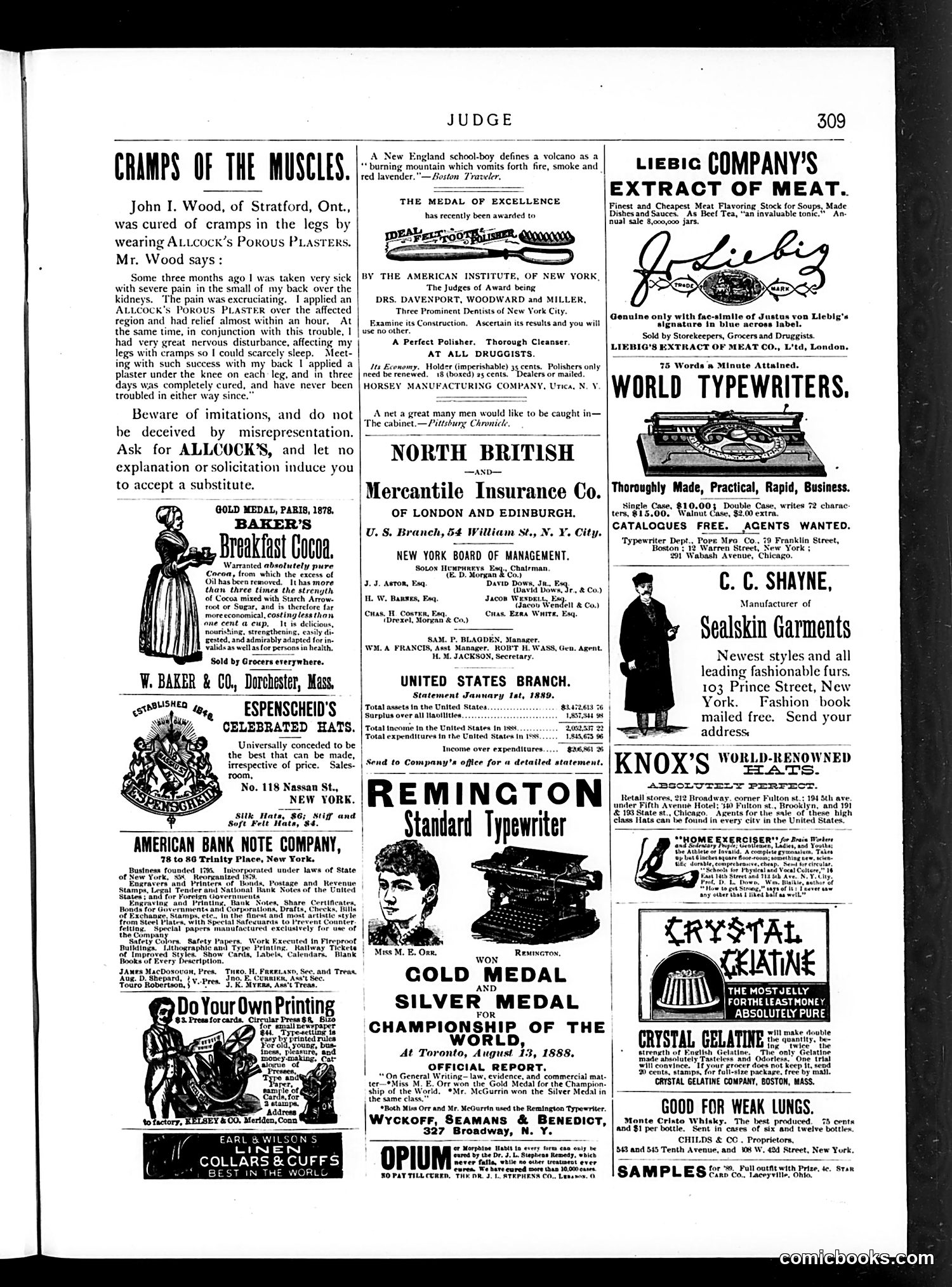
This page is primarily **advertisements** with one small verbal joke. The dominant content includes patent medicine ads (Allcock's Porous Plasters, Baker's Breakfast Cocoa), typewriter and hat advertisements, and insurance company notices. The sole humor appears near the top: a quote from a "New England school-boy" who defines a volcano as a "burning mountain which vomits forth fire, smoke and red lavender." The joke relies on absurdist misdefinition—"red lavender" is nonsensical where volcanic description is expected, creating humor through the child's innocent malapropism. Below that is a one-liner: "A net a great many men would like to be caught in—The cabinet," a political joke about being trapped in government service (cabinet position), appearing amid the insurance advertisements. The page reflects late 19th-century American consumer culture with no significant satirical cartoons or political commentary beyond these brief, passing quips.
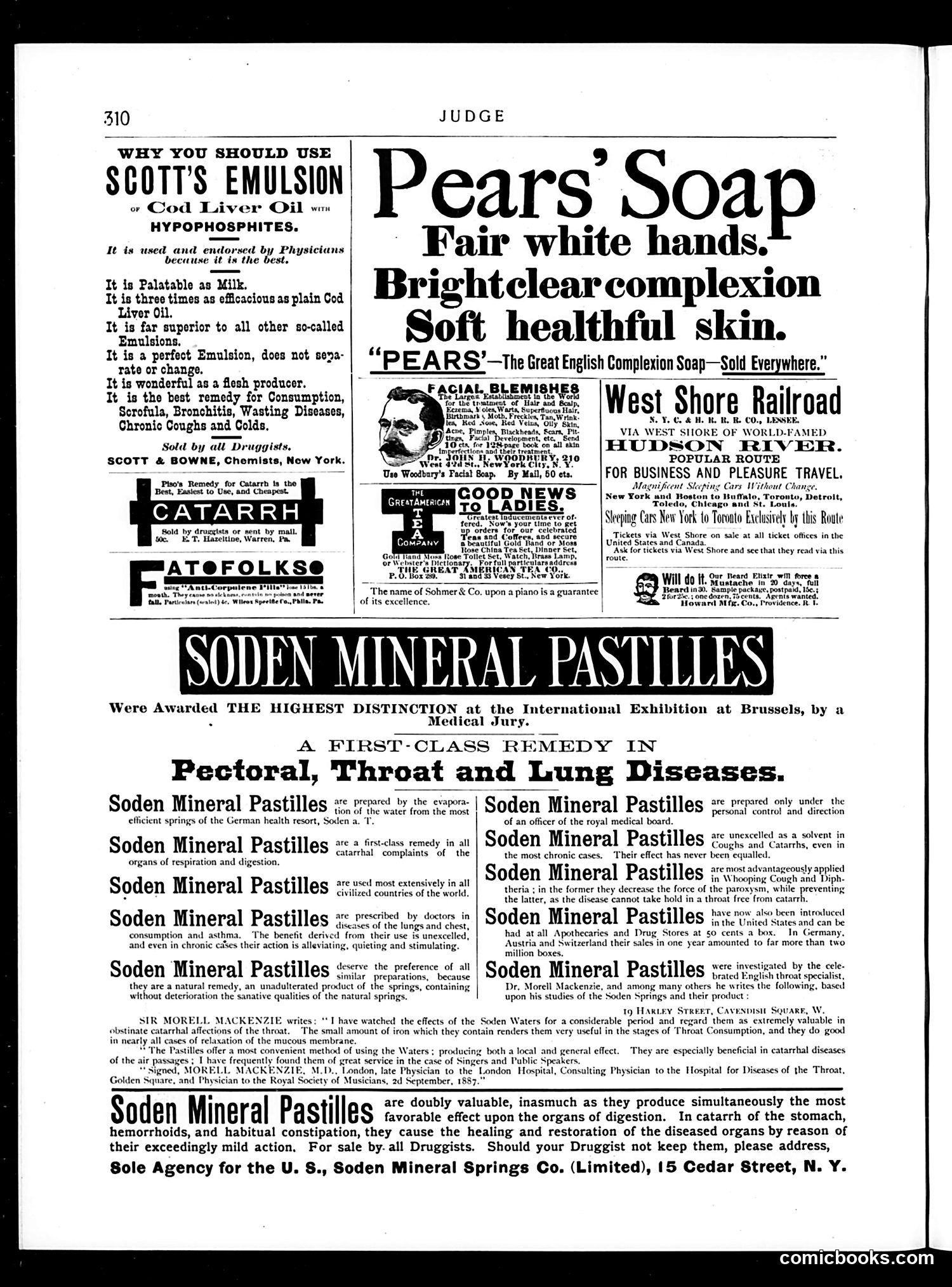
This page is primarily **advertising content** rather than editorial satire or political cartooning. It contains multiple product advertisements typical of late 19th-century magazines: **Main advertisements:** - **Pears' Soap**: Promotes "fair white hands" and "bright clear complexion"—reflecting Victorian beauty standards emphasizing pale skin - **Scott's Emulsion**: Cod liver oil remedy for consumption and chronic illness - **Soden Mineral Pastilles**: German health-resort mineral lozenges for throat/lung diseases - **West Shore Railroad**: Travel advertisement - Various patent medicines and remedies **Historical context**: This reflects the era's unregulated patent medicine market, where manufacturers made expansive health claims without FDA oversight. The emphasis on skin whitening in soap advertising reflects period racial attitudes. **No significant political satire or caricature is evident** on this page—it represents standard commercial content interspersed throughout Judge magazine to fund publication.
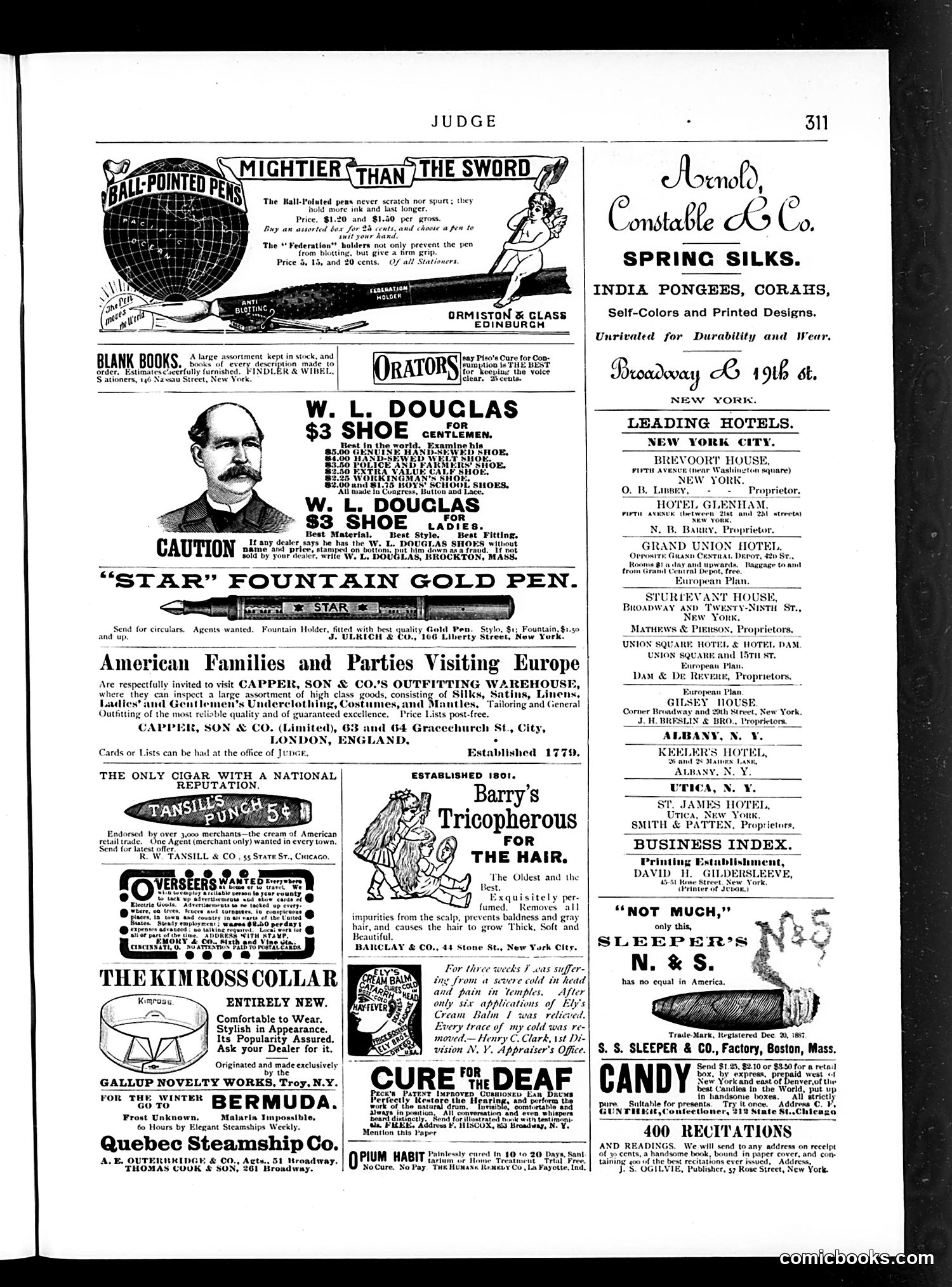
This is primarily an **advertising page** from Judge magazine (circa 1890s), with no significant political cartoons or satirical content to analyze. The page features standard period advertisements for: - **W.L. Douglas shoes** (with his portrait) - Fountain pens, blank books, and office supplies - Hair products (Barry's Tricopherous) and patent medicines ("Cure for the Deaf," "Opium Habit") - Hotels and travel services - Luxury goods (silks, cigars) The only visual element with cartoon styling is a small illustration for "Ball-Pointed Pens" at the top, which is merely decorative product marketing rather than satire. **No political figures, social commentary, or jokes are present**—this is a straightforward commercial page typical of 19th-century magazines, which subsidized editorial content through advertising revenue. The ads themselves reveal period attitudes (unregulated patent medicine claims, class-based luxury marketing), but carry no intentional satirical message.
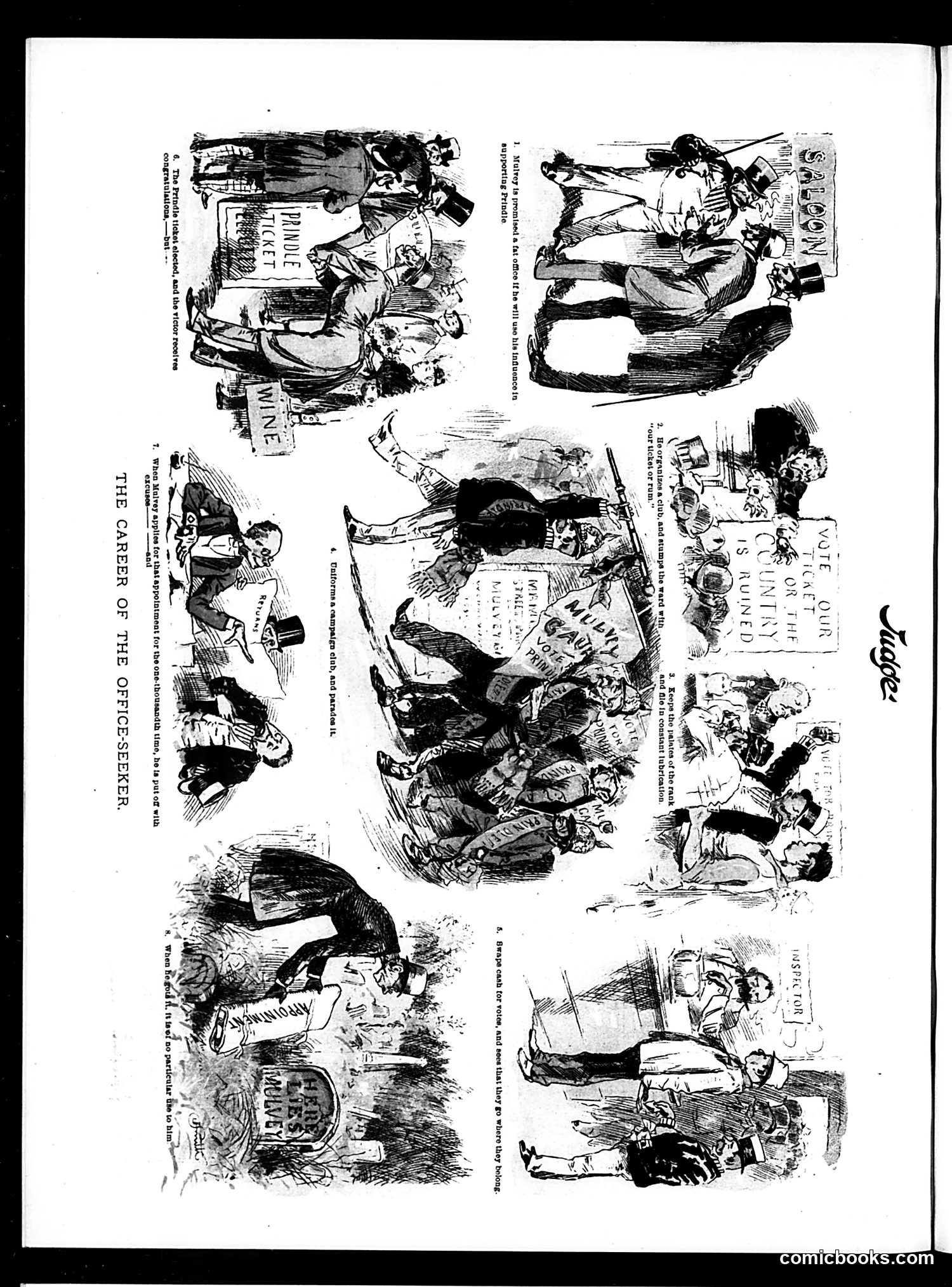
This is a satirical cartoon sequence mocking the broken promises of machine politics. The narrative follows Mulvey, an office-seeker who is promised a lucrative government position if he uses his influence to support a candidate named Prindle. The sequence shows the classic pattern of political corruption: Mulvey delivers votes, Prindle wins election and receives congratulations, but when Mulvey repeatedly demands his promised reward, he's brushed off with excuses. The cartoon satirizes how politicians routinely betray their supporters after gaining office, using the loyal but ultimately duped Mulvey as an everyman figure to expose this hypocrisy. This reflects the widespread frustration with patronage and corrupt political dealings in Gilded Age America.