
Judge, 1889-02-16 · page 3 of 16
Judge — February 16, 1889 — page 3: what you’re looking at
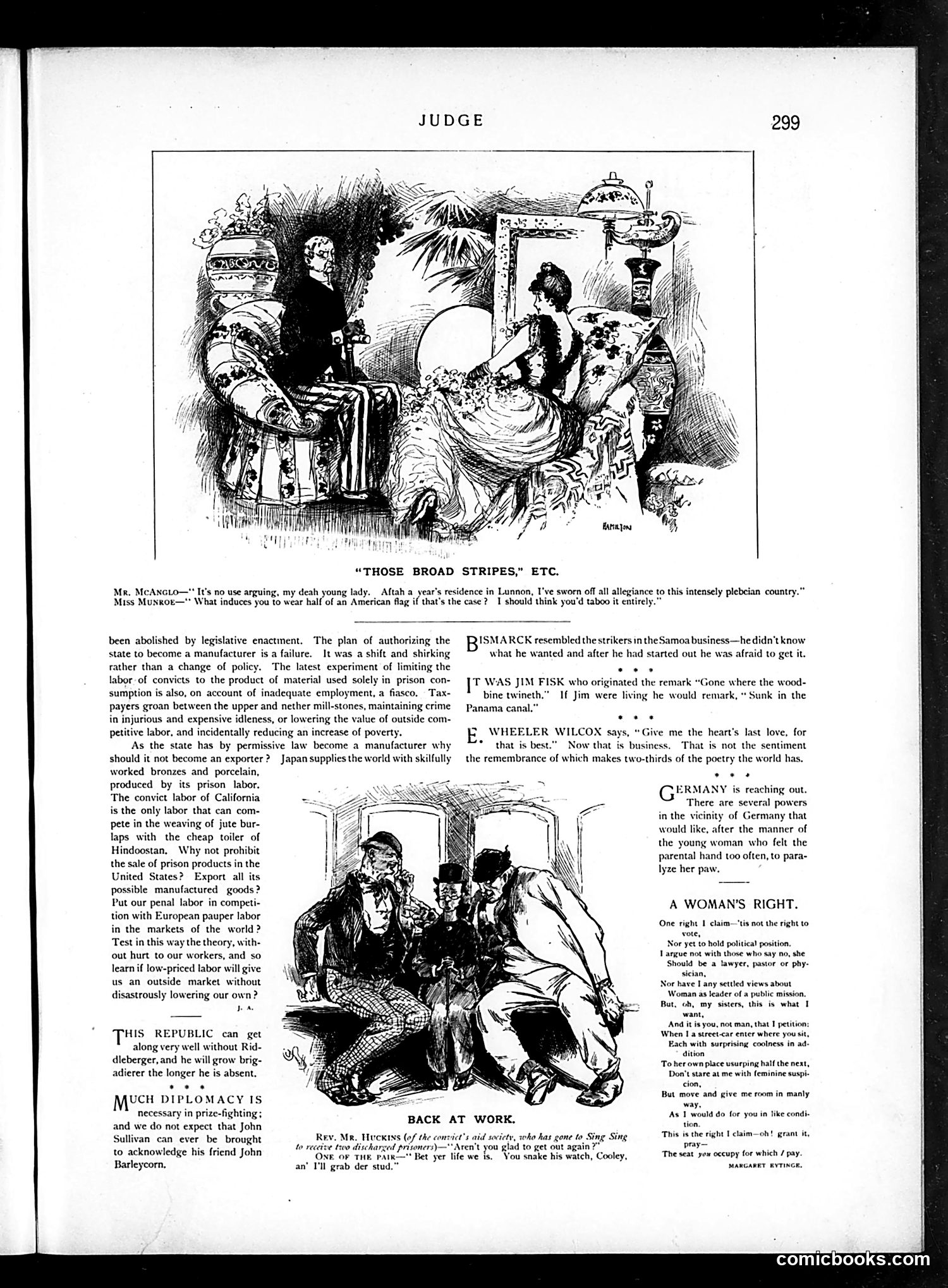
What you’re looking at
This cartoon satirizes American expatriates who adopt British affectations while abroad. Mr. McAngle claims to have renounced allegiance to America after a year in London, calling the country "intensely plebeian." Miss Munroe points out the hypocrisy: he's wearing half an American flag (likely in his clothing or accessories), contradicting his stated rejection of American identity. The joke targets a recognizable Gilded Age phenomenon—wealthy Americans who affected European sophistication and looked down on their homeland while still benefiting from or displaying American markers. It's social satire on class pretension and cosmopolitan snobbery, mocking those who abandoned American patriotism for European polish without fully committing to either identity.
📄 Transcribed text from this page (OCR, searchable)
Machine-transcribed from the original scan — historical spelling and the odd misread are preserved.
“THOSE BROAD STRIPES,” ETC. Mr, McANcLo—" It’s no use arguing, my deah young lady. Aftah a_year’s residence in Lunnon, I've sworn off all allegiance to this intensely plebcian country.” Miss Munnoe—" What induces you to wear half of an American flag if that’s the case? I should think you'd taboo it entirely.” been abolished by legislative enactment. The plan of authorizing the state to become a manufacturer is a failure. It was a shift and shirking rather than a change of policy. The latest experiment of limiting the labor of convicts to the product of material used solely in prison con- sumption is also, on account of inadequate employment, a fiasco. Tax- payers groan between the upper and nether mill-stones, maintaining crime in injurious and expensive idleness, or lowering the value of outside com- petitive labor, and incidentally reducing an increase of poverty. As the state has by permissive law become a manufacturer why should it not become an exporter? Japan supplies the world with skilfully worked bronzes and porcelain, produced by its prison labor. The convict labor of California is the only labor that can com- pete in the weaving of jute bur- laps with the cheap toiler of Hindoostan, Why not prohibit the sale of prison products in the United States? Export all its possible manufactured goods? Put our penal labor in competi- tion with European pauper labor in the markets of the world ? Test in this way the theory, with- out hurt to our workers, and so learn if low-priced labor will give us an outside market without disastrously lowering our own ? wa HIS REPUBLIC can get along very well without Rid- dleberger, and he will grow brig- adierer the longer he is absent. MUCH DIPLoMAcy Is necessary in prize-fighting; and we do not expect that John Sullivan can ever be brought to acknowledge his friend John Barleycorn, EOF THE an’ I'll grab der stud. rd prisoners) —""Aren't you glad to get out again 7" “Bet yer life we is. B's™ ARCK resembled the strikers in the Samoa business—he didn't know what he wanted and after he had started out he was afraid to get it. I" WAS JIM FISK who originated the remark “Gone where the wood- bine twineth.” If Jim were living he would remark, “Sunk in the Panama canal,” ER WILCOX says, best. me the heart's Now that is business. jast love, for That is not the sentiment E, WHEE + that the remembrance of which makes two-thirds of the poetry the world has. MANY is reaching out. There are several powers in the vicinity of Germany that would like, after the manner of the young woman who felt the parental hand too often, to para- lyze her paw. A WOMAN'S RIGHT. One right 1 claim. vote, Nor yet to hold politica! position, Targue not with those who say no, she Should be a lawyer, pastor or phy- sician, Nor have I any settled views about ‘Woman as leader of a public mission, But, oh, my sisters, this is what T And it is you, not man, that I petition: When I a streetcar enter where you sit, Each with surprising coolness in ad- dition To her own place usurping half the next, Don’t stare at me with feminine suspi- cion, But move and give me room in manly way, As 1 would do for you in like condi- tion. This is the right I claim—oh! grant it, pray— The seat you occupy for which / pay. MARGARET RYTINGE. “tis not the right to You snake his watch, Cooley, comicbooks.com