
A complete issue · 16 pages · 1889
Judge — January 26, 1889
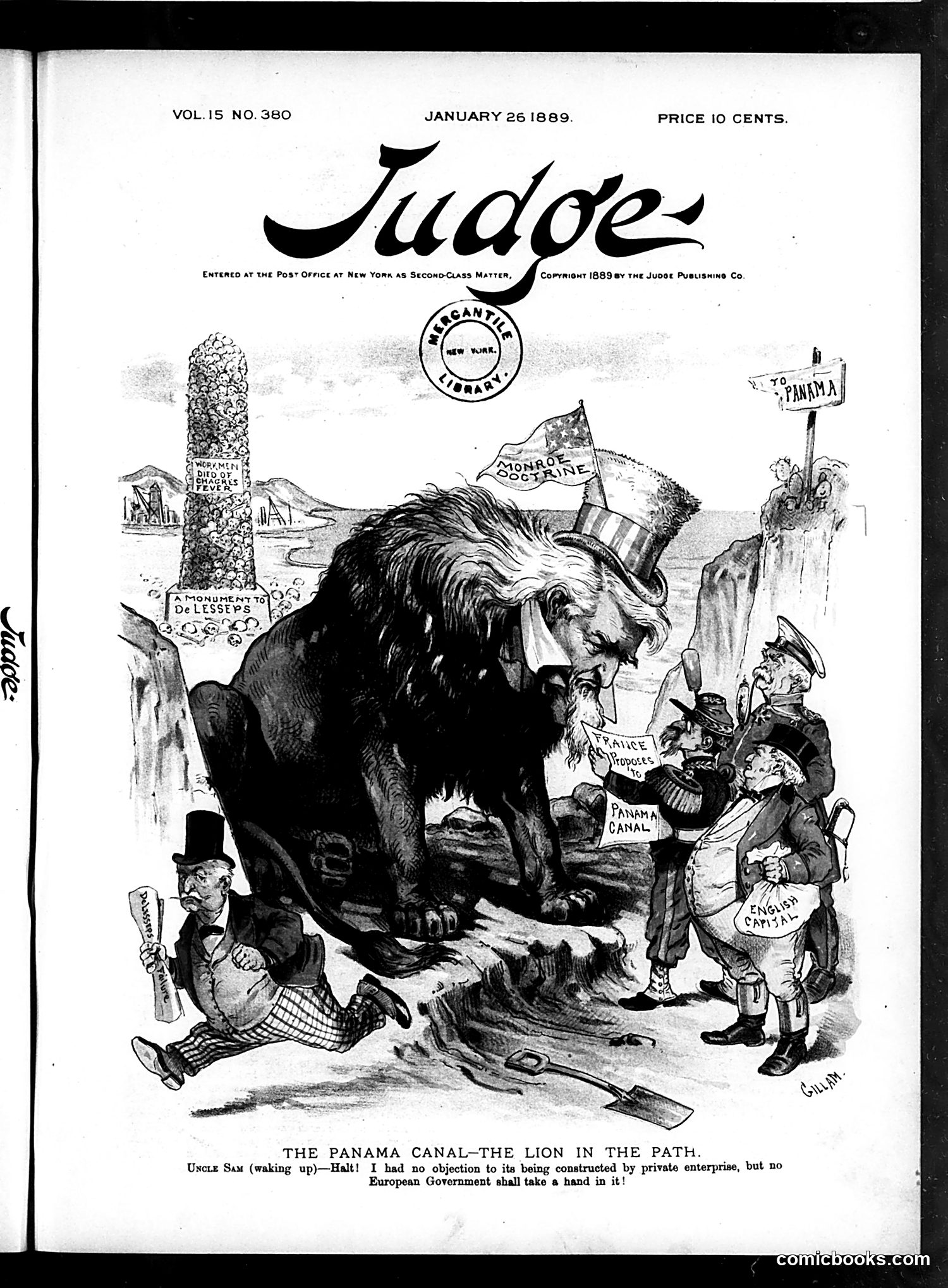
This January 1889 *Judge* cartoon satirizes American anxieties about the Panama Canal's construction. Uncle Sam (representing the U.S.) awakens to find a large lion blocking the canal's path—the lion represents European powers, particularly France, which was actively involved in early canal construction attempts. The surrounding figures labeled "France," "England," and "English Capital" depict competing European interests. The monument to De Lesseps (the French engineer leading the French canal effort) and the flag reading "Monroe Doctrine" emphasize the conflict between American Monroe Doctrine principles (opposing European interference in the Americas) and European involvement in this crucial strategic project. Uncle Sam declares he won't object to private enterprise but warns no European government should participate—asserting American dominance over hemispheric affairs.
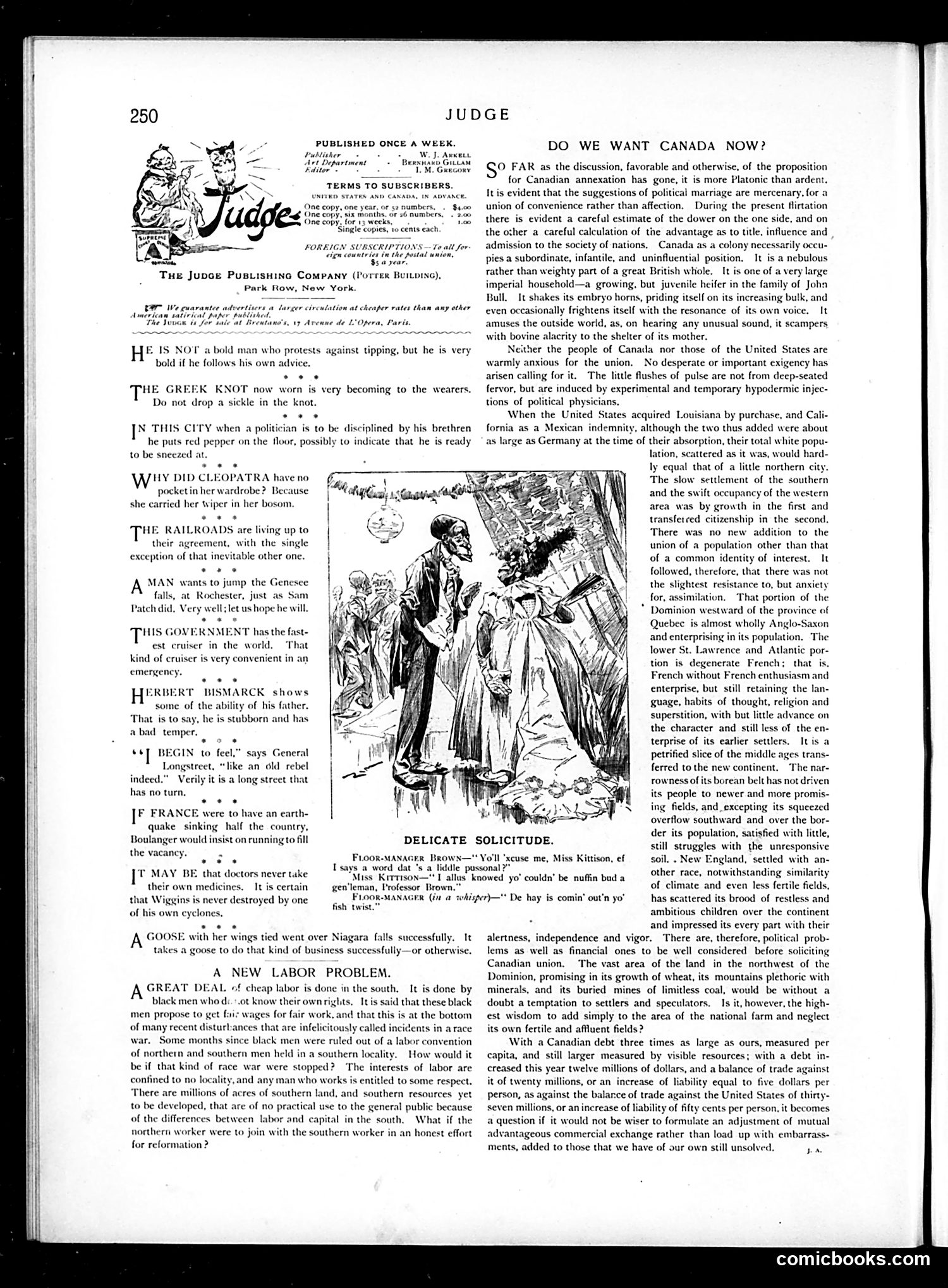
This cartoon depicts a dialogue between **Floor-Manager Brown** and **Miss Kitson** (identifiable by the OCR'd caption). The sketch illustrates a workplace interaction, likely satirizing gender dynamics or labor relations of the era. The main article "Do We Want Canada Now?" debates Canadian annexation to the United States, discussing whether union serves mutual benefit or represents American opportunism. The piece references Canada's economic debt, population growth, and cultural concerns—particularly French Quebec's resistance to Anglo-Saxon dominance. The political humor targets American expansionism and the complications of absorbing diverse populations with distinct languages, religions, and traditions. This reflects turn-of-the-century debates about imperial ambition and continental integration.
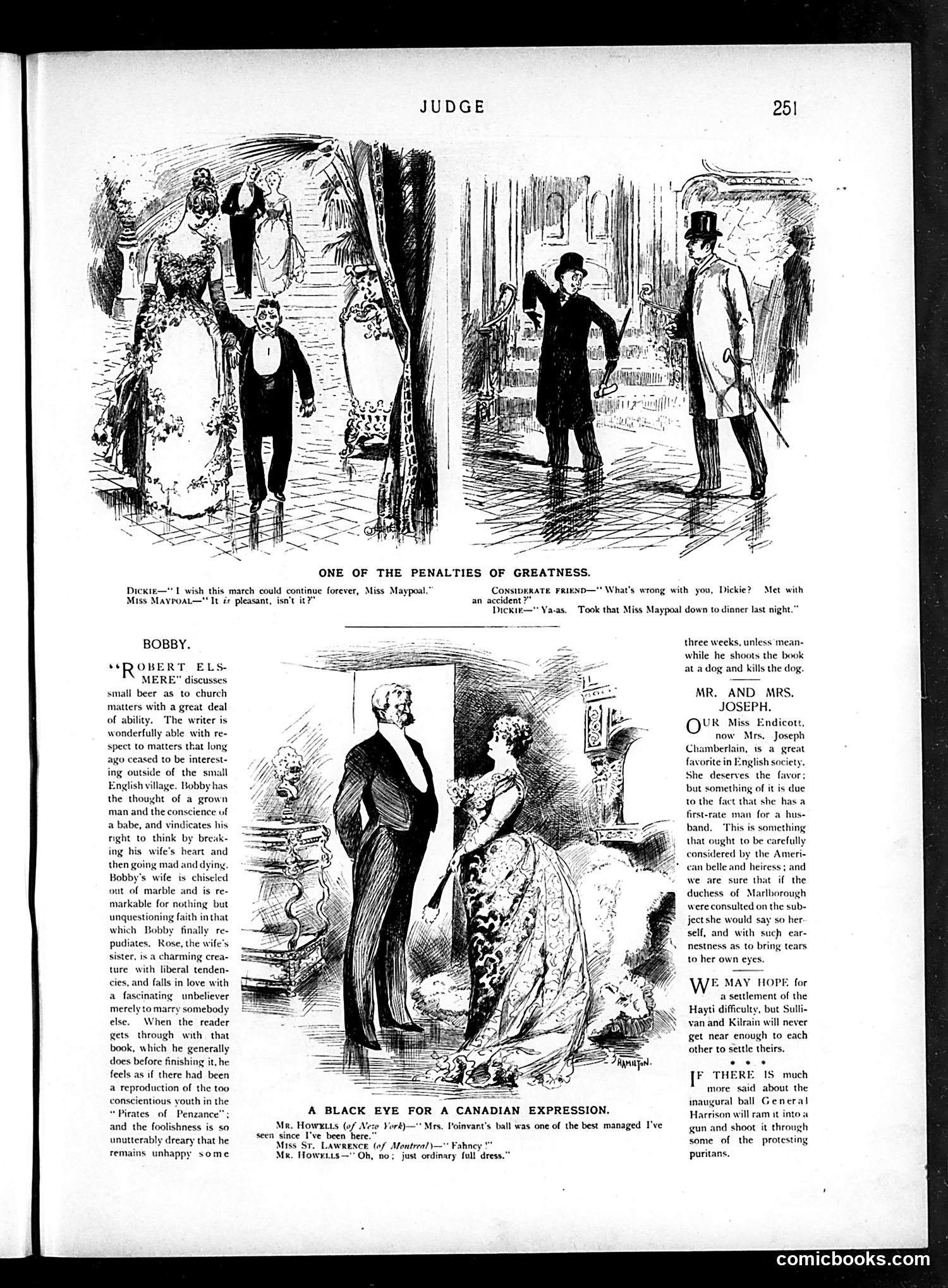
This page contains three separate satirical pieces targeting Victorian social pretensions: **"One of the Penalties of Greatness"** mocks romantic sentimentality—a man wishes a pleasant social march could last forever, but his companion reveals he took another woman to dinner the previous night, exposing his shallow insincerity. **"Bobby"** is a lengthy book review of what appears to be a novel (likely by Henry James or similar), satirizing earnest Victorian fiction about morally conflicted protagonists who create suffering through self-righteous philosophizing. The critic complains the work is tedious and self-indulgent. **"A Black Eye for a Canadian Expression"** ridicules a Canadian woman's use of "fahey" (apparently slang) as an exclamation. When a New York man compliments an event's management, she responds with colloquial Canadian speech, which he dismisses as merely "ordinary full dress"—mocking provincial expressions. The page reflects Judge's typical targets: literary pretension, romantic phoniness, and regional/national stereotyping, all presented through ink sketches in Victorian satirical style.
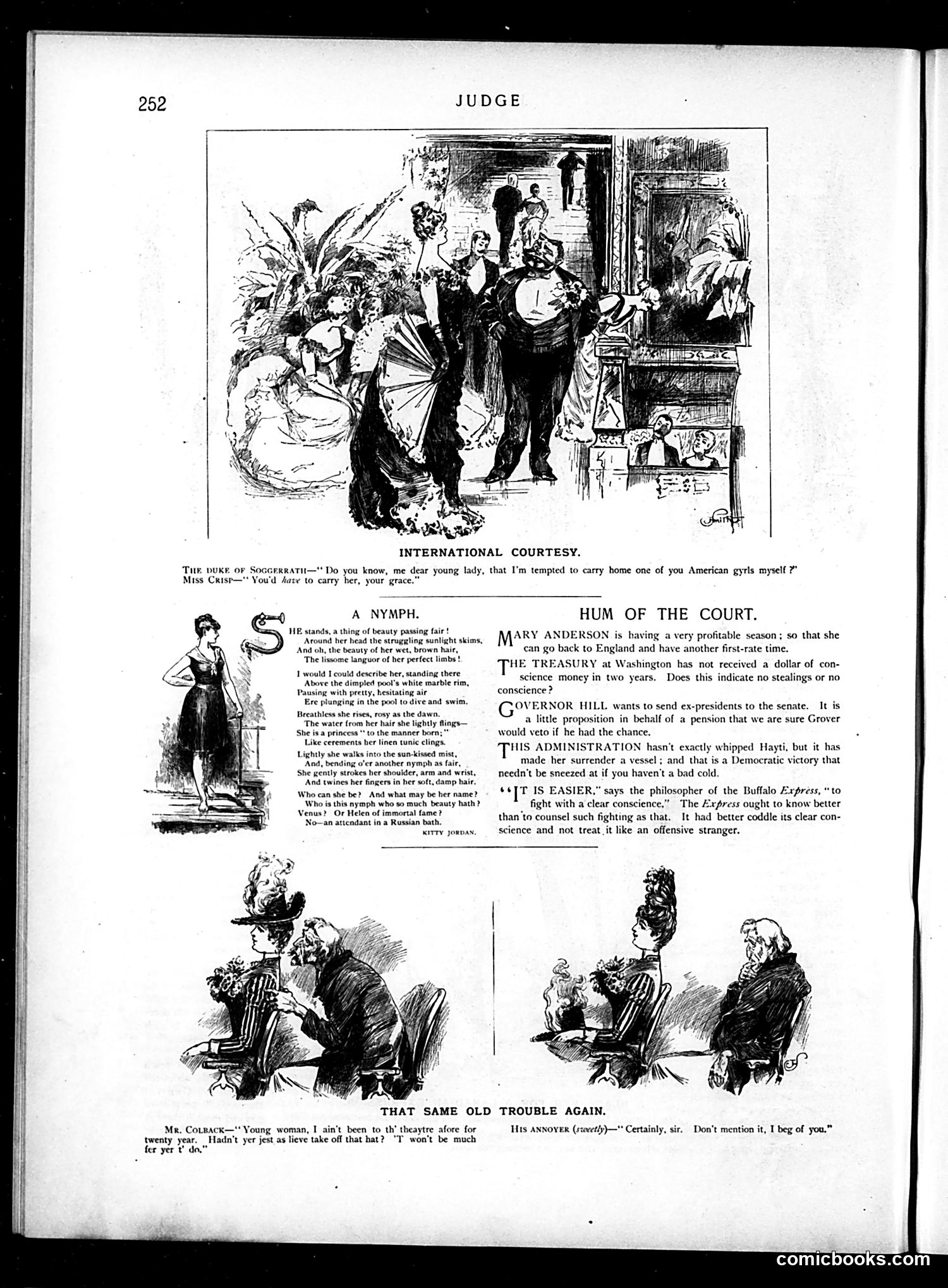
This page contains multiple satirical items typical of late 19th-century American humor: **"International Courtesy"** mocks European aristocratic attitudes toward American women, showing a duke attempting to flirt with "Miss Crisp," who delivers a witty retort about his age. **"A Nymph"** is a poem celebrating female beauty, likely referencing theatrical culture of the period. **"Hum of the Court"** contains brief political jabs: Mary Anderson (an actress) enjoys profitable performances; the Treasury hasn't received "conscience money" (voluntary restitution payments) in two years; Governor Hill proposes pensioning ex-presidents; the administration's Haiti policy is criticized; and the Buffalo Express newspaper is mocked for endorsing aggressive tactics. **"That Same Old Trouble Again"** depicts a theater-goer complaining about women wearing hats that block sightlines—a recurring social irritation of the era when large, decorative hats were fashionable. The page blends social satire, political commentary, and domestic humor typical of Judge's content.
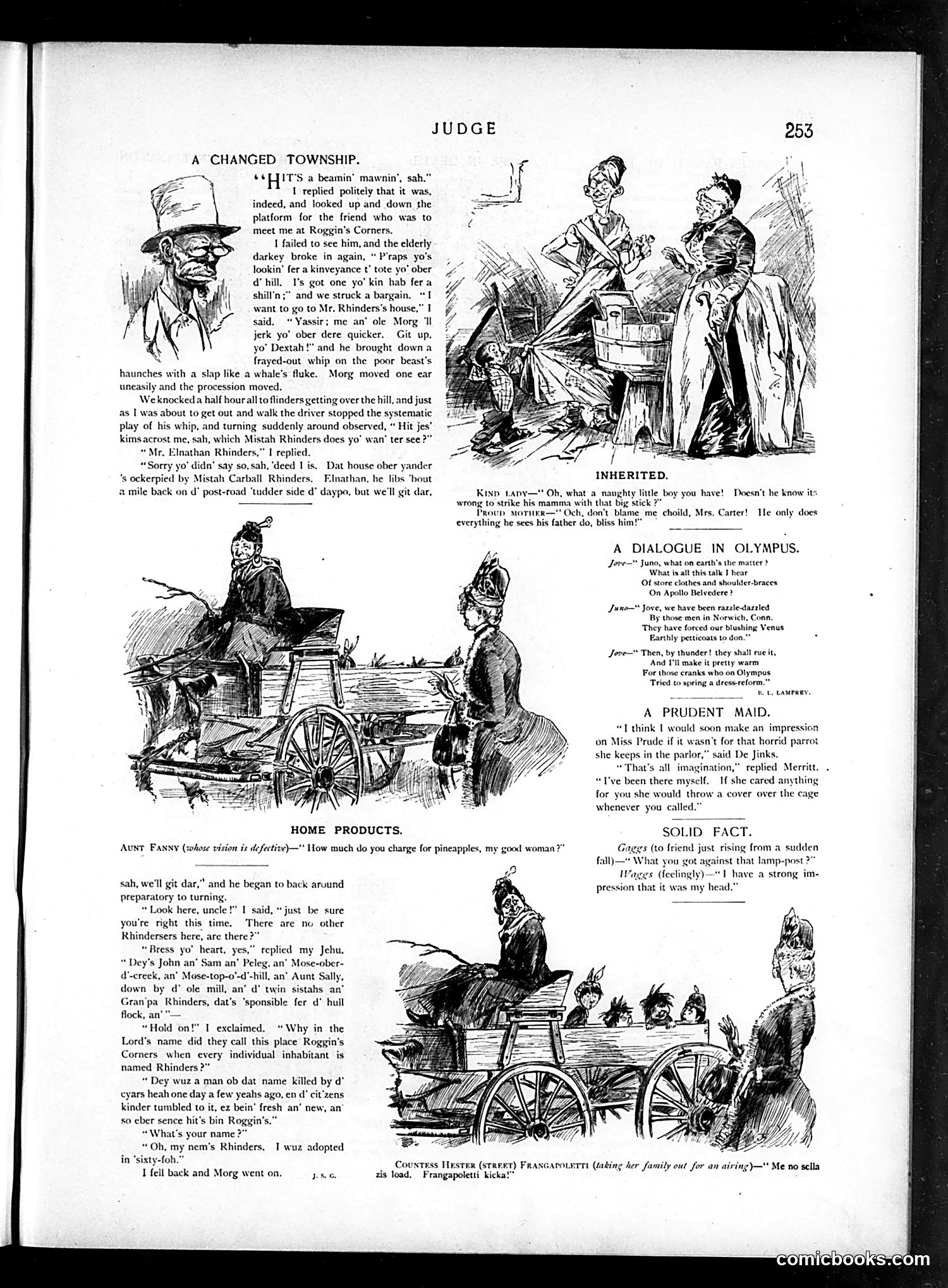
This page contains several satirical pieces typical of 1880s-90s American humor: **"A Changed Township"** mocks rural dialect and demographic shifts. A Black driver in the South explains that a town named "Roggin's Corners" (after a man killed by train) is now inhabited entirely by people with the surname "Rhinders"—a joke about either immigration patterns or intermarriage creating homogeneous communities that rendered the original place name obsolete. **"Home Products"** depicts an elderly Black woman selling produce, playing on stereotypes about Southern agricultural labor. **"Inherited"** suggests a working-class child mimics his father's violence toward his mother—social commentary on domestic brutality and generational behavior. The remaining sketches are light romantic/domestic humor unrelated to politics. The dialect-heavy depictions of Black characters reflect the casual racism standard in period American magazines, though the rural Southern setting suggests these pieces primarily target rural white Americana rather than explicit racial commentary.
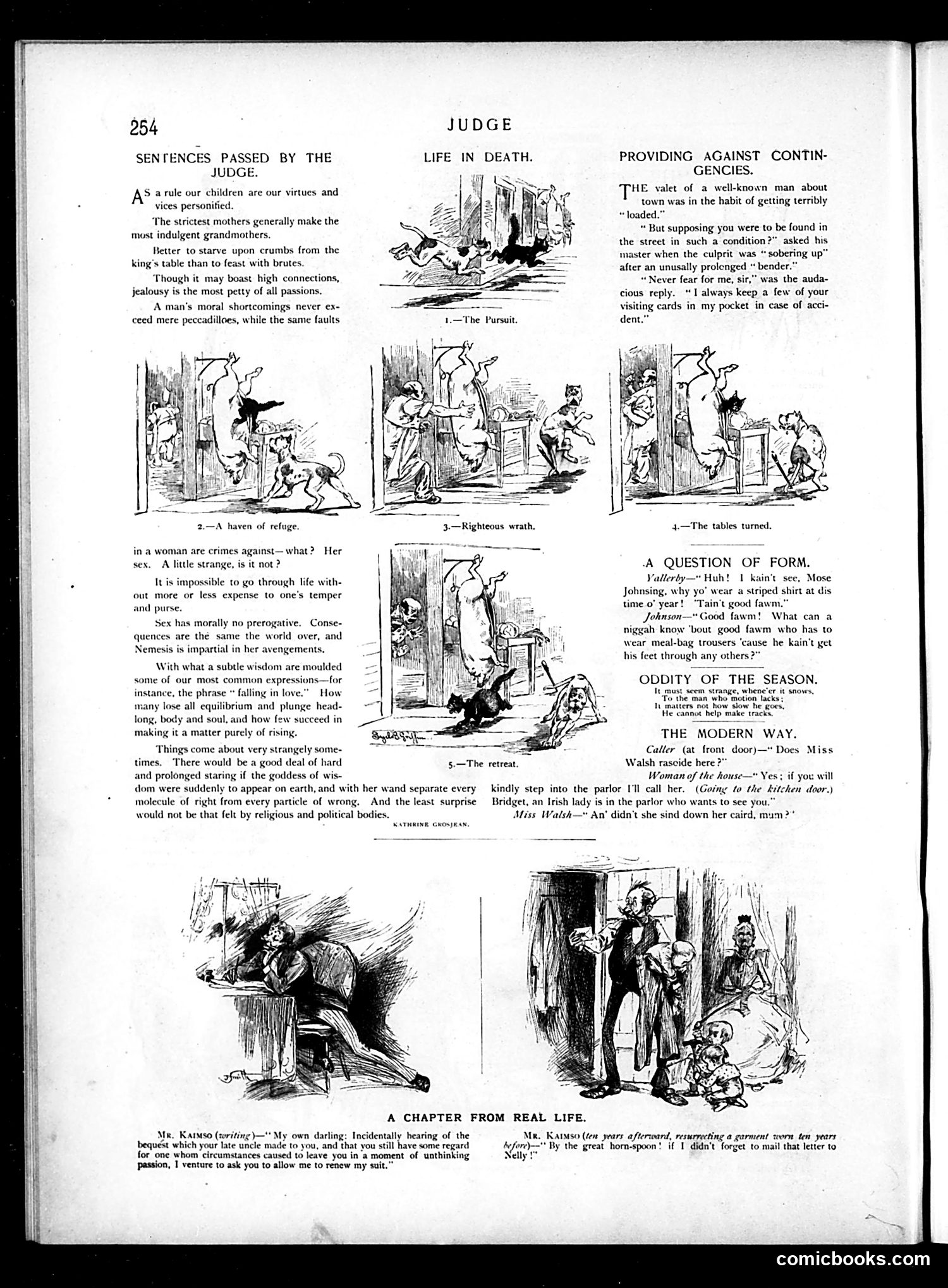
This page collects moral aphorisms, humorous anecdotes, and satirical vignettes typical of late-19th-century Judge magazine. **Key content:** - **"Sentences Passed by the Judge"**: Moralizing observations about human nature and society's double standards—particularly how identical moral failings are judged differently in women versus men. - **"Life in Death" series**: Five sequential drawings depicting a domestic chase scene where a man pursues a woman through a house, with furniture overturning. - **"Providing Against Contingencies"**: A class-based joke where a drunk servant reveals he carries his employer's calling cards to establish respectability if found intoxicated in the street. - **"A Question of Form"**: A racist dialect joke mocking African Americans' speech and poverty (meal-bag trousers). - **"A Chapter from Real Life"**: A sentimental scene where a man's old love letter resurfaces years later, unmailed due to forgetfulness. The satire targets Victorian hypocrisy, social pretension, and class consciousness rather than specific political figures or events.
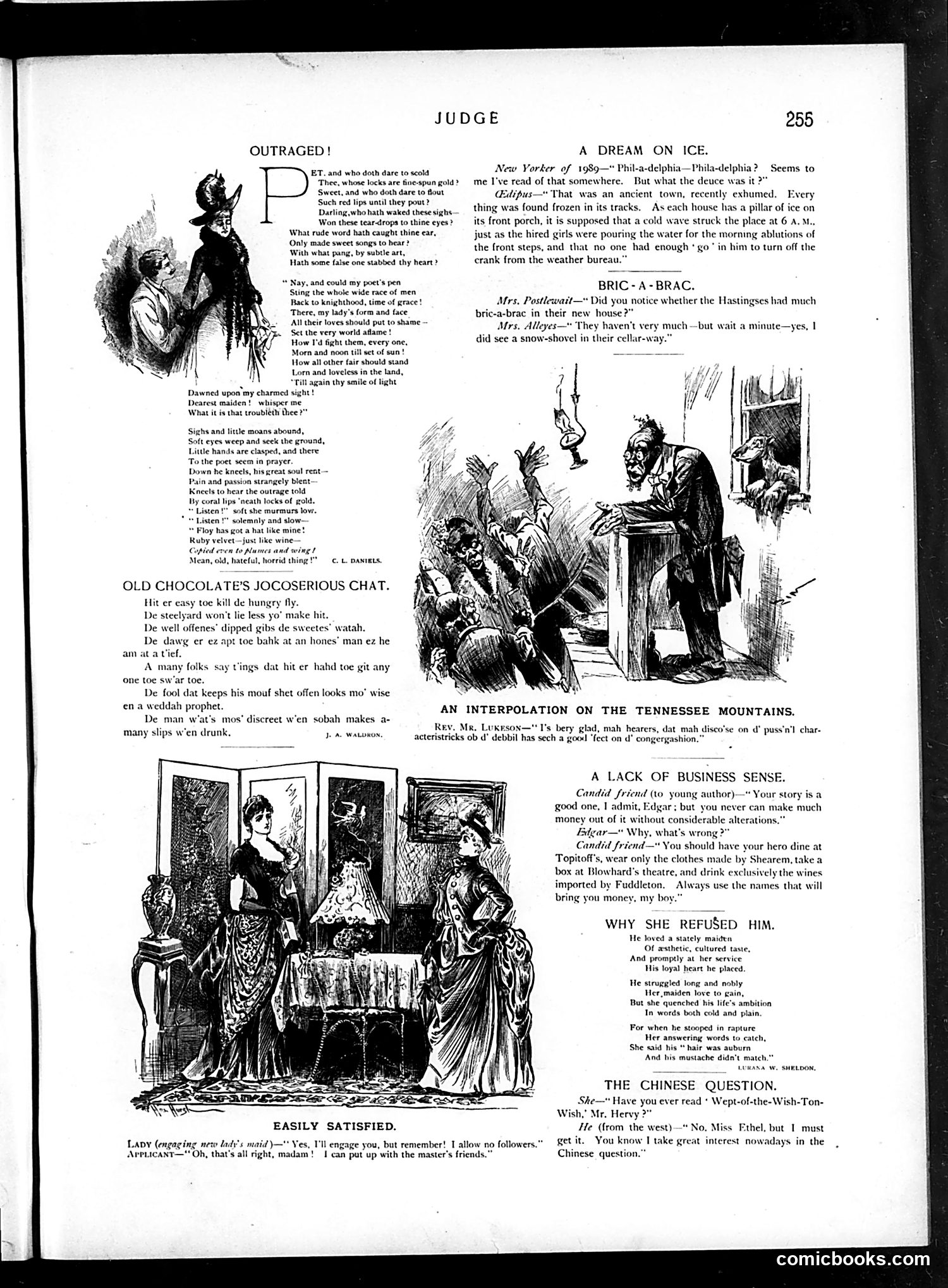
This page contains several satirical pieces typical of late 19th-century American humor: **"Outraged!"** mocks romantic melodrama. A lovelorn poet kneels dramatically to comfort a "wronged" maiden, building suspense about her terrible suffering—only to reveal her devastation is trivial: "Floy has got a hat like mine!" The satire targets overwrought sentimentality and the frivolousness of society women. **"Old Chocolate's Jocose Chat"** presents dialect humor (now offensive) attributed to a Black character offering folk wisdom about honesty, discretion, and human nature. **"A Dream on Ice"** satirizes futuristic speculation, imagining Philadelphia as an ancient frozen city discovered in 1989. **"Why She Refused Him"** jokes about aesthetic pretension—the woman rejects her suitor not for character but because his hair color doesn't match his mustache. **"The Chinese Question"** appears to reference contemporary anxieties about Chinese immigration through a woman asking about exotic literature, with Western dismissal of "Chinese" interests. The overall tone reflects Gilded Age preoccupations: social climbing, aesthetic affectation, and racial attitudes typical of the era.
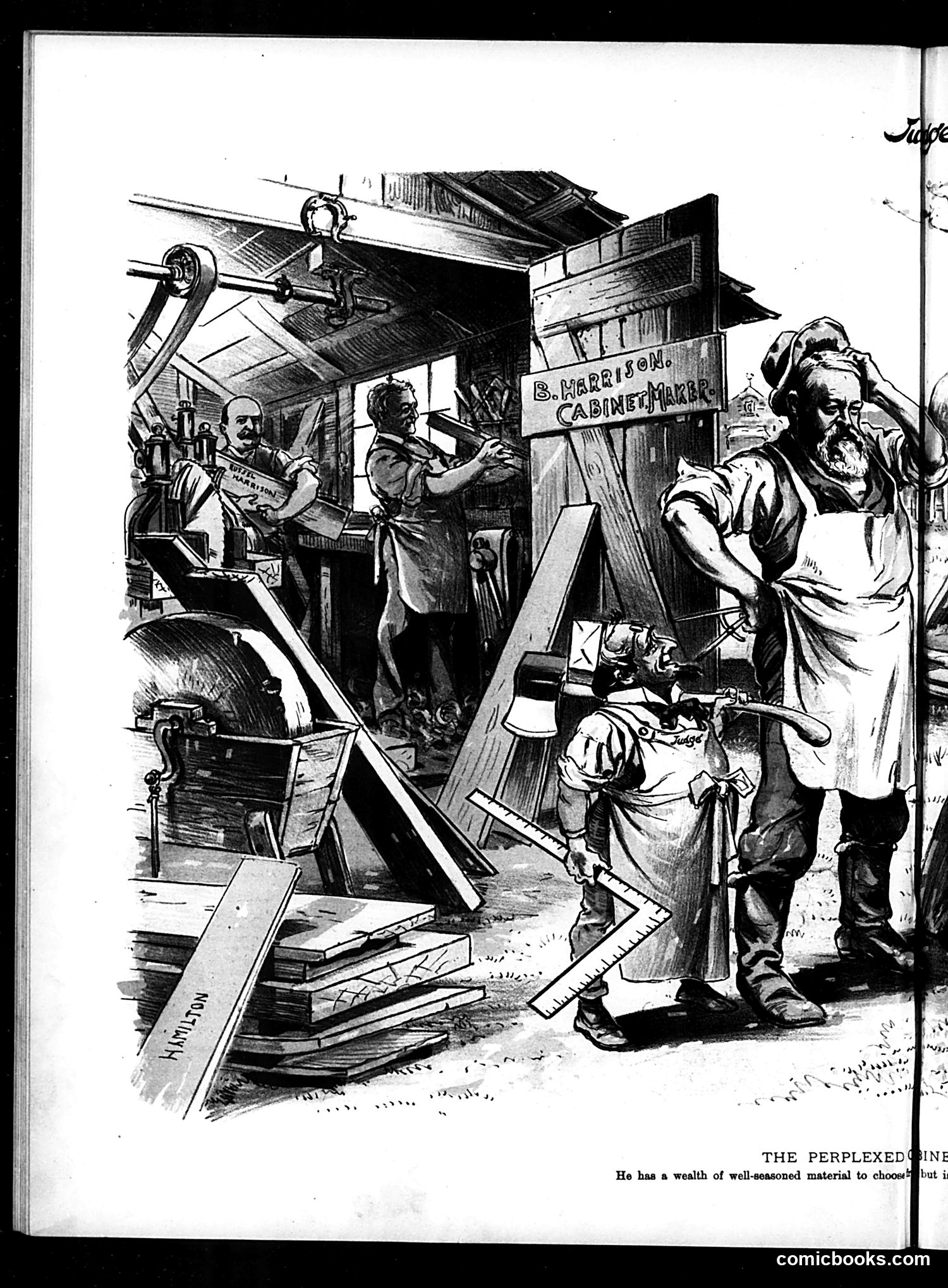
This Judge cartoon satirizes a carpenter or craftsman facing abundant choice. The sign reads "S. MORRISON, CABINET MAKER," and the figure stands amid scattered wood and materials in his workshop, appearing overwhelmed or uncertain. The satire's point appears to be about having "a wealth of well-seasoned material to choose" but struggling to decide what to make—a commentary on either: - **Indecision despite resources** (having plenty but lacking direction) - **Choice paralysis** (too many options creating confusion) The "perplexed" woodworker serves as the visual joke: a skilled craftsman surrounded by opportunity yet bewildered. Without the publication date visible, the specific political or economic reference remains unclear, though it may comment on post-WWI American economic conditions or labor issues circa Judge's early 20th-century period.
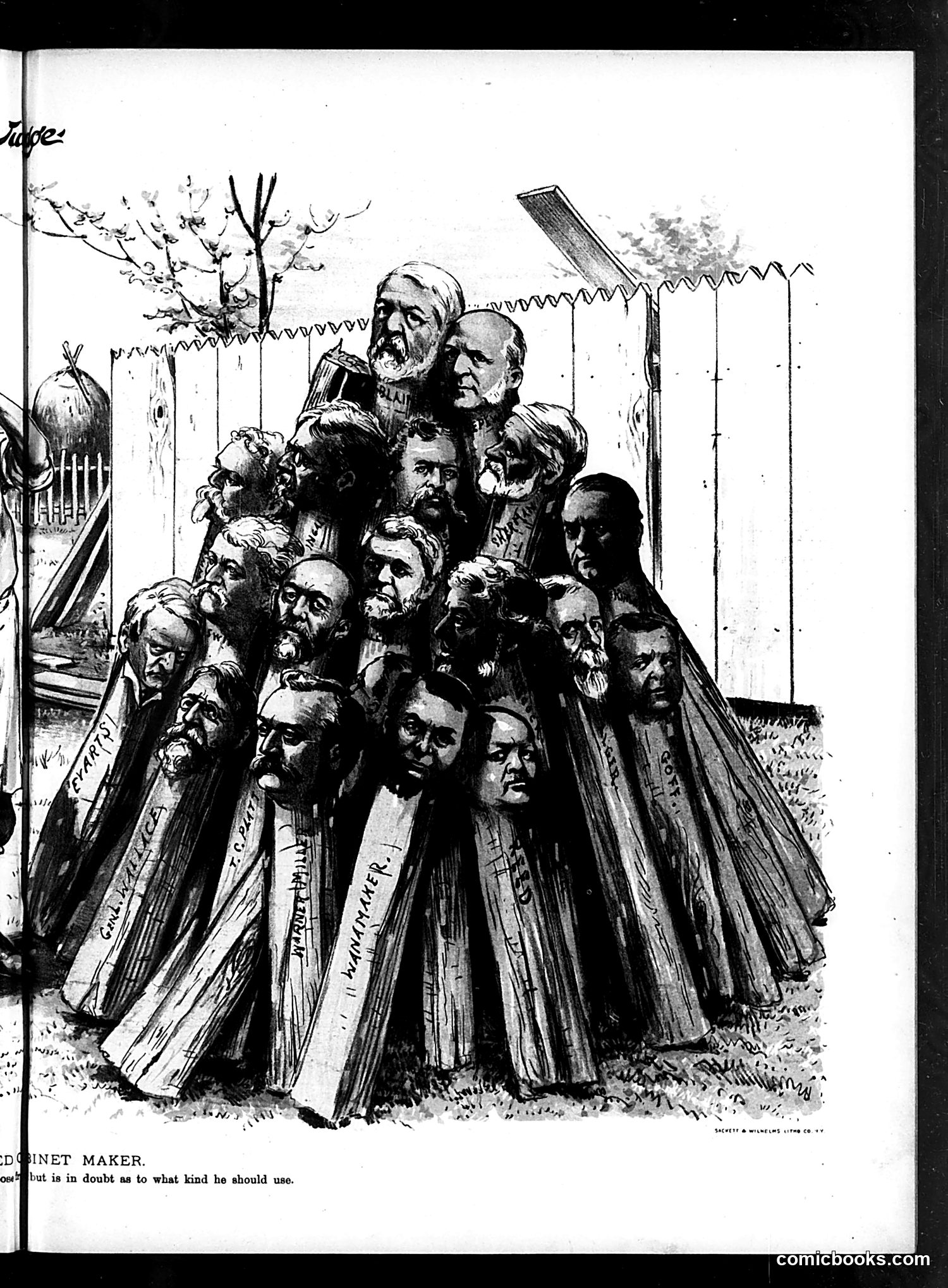
This is a satirical cartoon titled "Cabinet Maker" depicting a political figure (likely a U.S. President, given the context) standing atop a group of men emerging from coffins or boxes labeled with names. The cartoon suggests the "cabinet maker" is literally assembling a government from the dead or politically defunct. The satire criticizes the selection of cabinet members—implying they are either politically "dead," recycled from previous administrations, or otherwise unsuitable choices. The coffin imagery is deliberately grotesque, suggesting these appointees lack vitality or fresh ideas. The caption's reference to uncertainty about "what kind he should use" reinforces the critique: the cartoon questions whether these selections represent quality governing choices. This reflects broader political skepticism about patronage and cabinet appointments common in Gilded Age American politics.
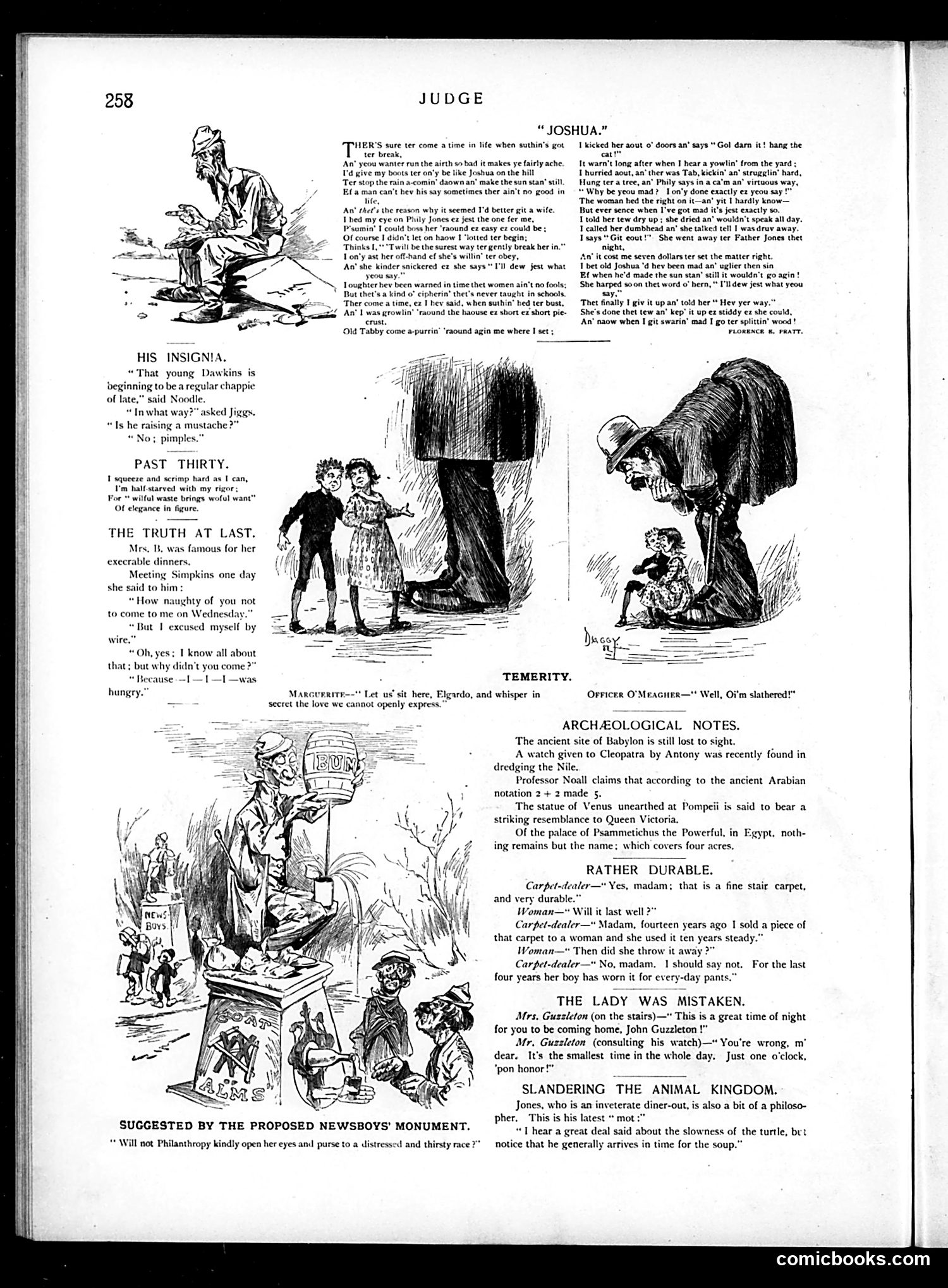
This page from *Judge* (a prominent American humor magazine) contains several satirical pieces: **Main Feature - "Joshua"**: A dialect poem satirizing marital dynamics. A rural husband believes he can control his wife like the Biblical Joshua controlled nature. When he kicks the family cat in anger, his wife calmly does exactly as he commanded—hanging the cat. This reversal humiliates him. The satire mocks men's assumptions about easily "managing" wives and their shock when women weaponize obedience against them. **Minor Jokes**: Brief comedic bits including: - A reference to a young man's new pimples as a "insignia" of maturity - A woman's dinner party excuses - A carpet salesman's dubious durability claims - Fake "Archaeological Notes" making absurd false claims (2+2=5 in ancient Arabia; Venus statue resembles Queen Victoria) The overall theme critiques male pretension and reveals women's quiet power through compliance rather than confrontation—a surprisingly modern feminist undertone for the era.
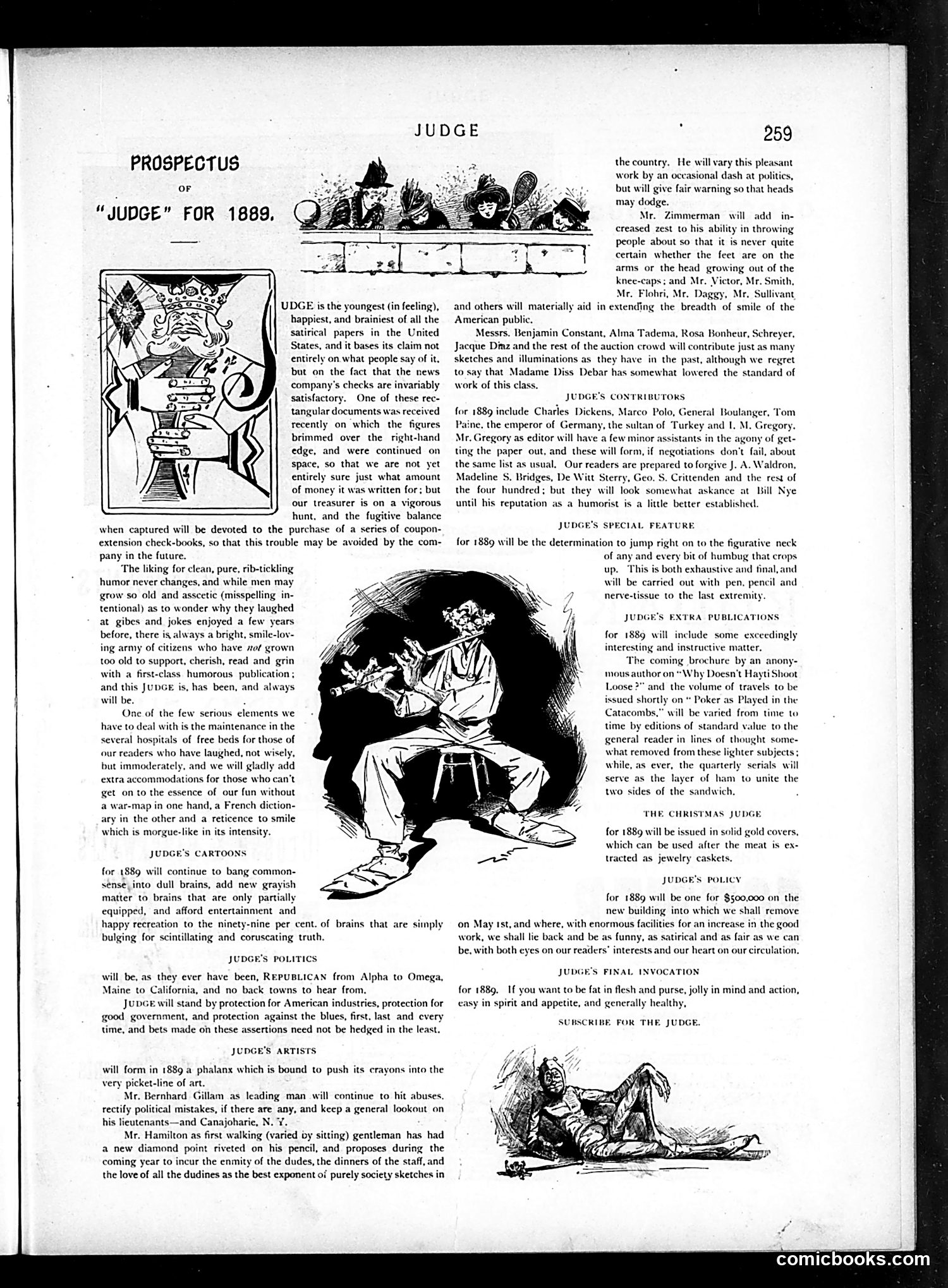
This is a self-promotional page where Judge magazine announces its 1889 editorial direction. The main text describes Judge as "the youngest (in feeling), happiest, and brainiest" satirical publication in America, claiming financial success as proof. The prospectus outlines Judge's commitments: continuing "rib-tickling humor" for general audiences, maintaining Republican political positions on protection and good government, and featuring prominent artists including Bernhard Gillam and other cartoonists who will target social abuses and political mistakes. The page includes a large illustration of a figure reading, and decorative header showing what appears to be Judge editors or typical subjects. The tone is self-congratulatory and somewhat self-parodying—particularly the joke about a check with figures extending off the page, requiring a "fugitive balance hunt." This reflects Judge's position as a major American satirical weekly in the Gilded Age, focused on entertainment combined with Republican political advocacy.
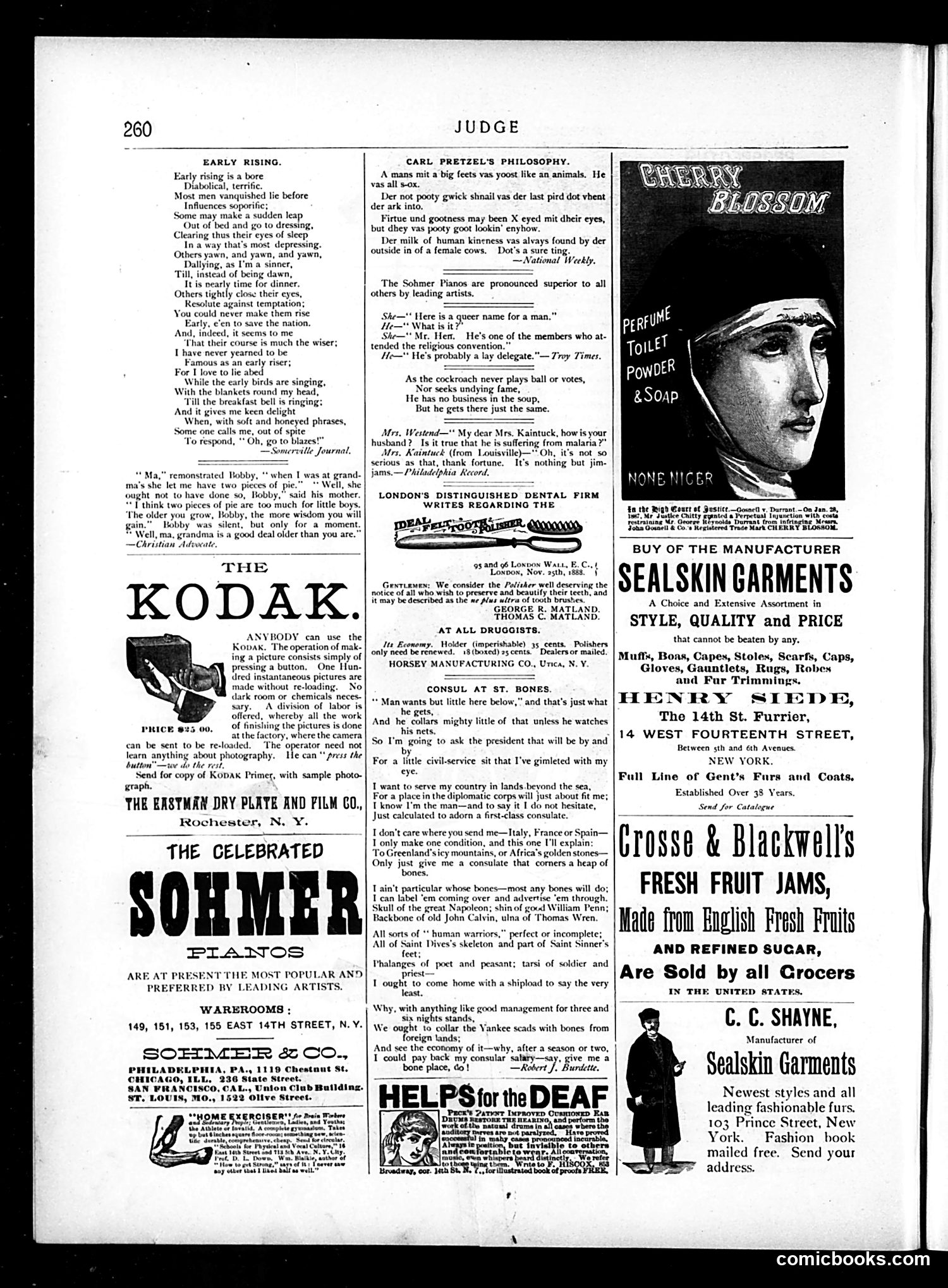
This page is primarily **advertising with light satirical content**. The main elements are: **Satirical Pieces:** - "Early Rising" — a humorous poem mocking the virtue of waking early, arguing it's wiser to stay in bed - "Carl Pretzel's Philosophy" — ethnic humor featuring a German-accented character offering folksy observations (common in late 19th-century American humor) - Brief joke about "Mr. Hert" attending a religious convention, playing on "heart" **Advertisements:** The page is dominated by product ads: Kodak cameras (emphasizing ease-of-use—"press the button, we do the rest"), Sohmer pianos, dental products, perfume, sealskin garments, and fruit jams. **Historical Context:** The "Carl Pretzel" dialect humor reflects period attitudes; such stereotyped immigrant characters were standard Judge fare. The Kodak ad is historically significant—it represents the revolutionary consumer camera technology that democratized photography in the 1880s. This is a typical Judge page: light satire mixed with commercial advertising targeting middle-class readers.
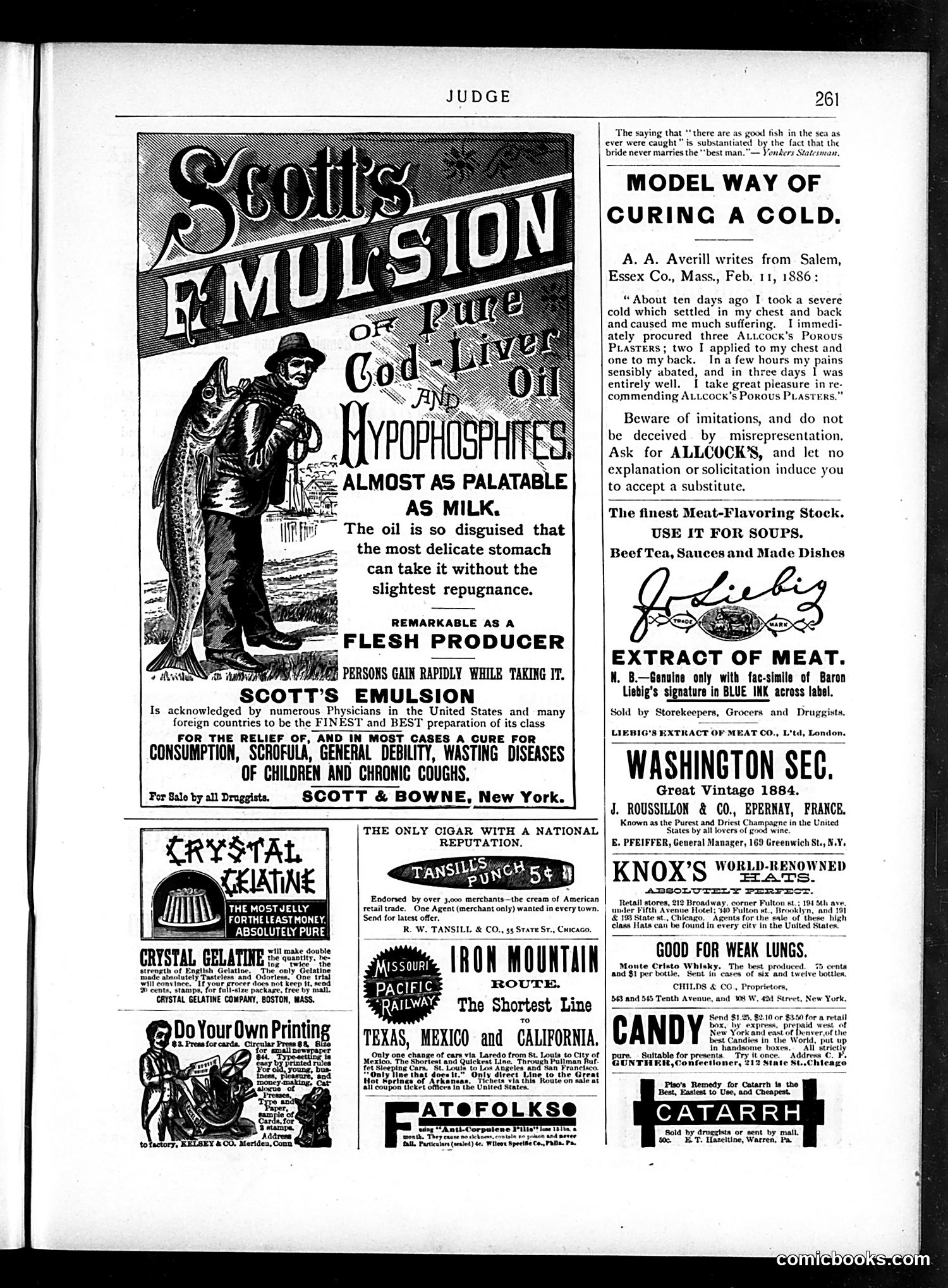
This page is **primarily advertisements**, not satirical content. The dominant feature is a large Victorian-era product advertisement for **Scott's Emulsion**, a cod liver oil supplement marketed as a cure-all for consumption, scrofula, and wasting diseases—the tuberculosis and malnutrition scares of the 1880s. The accompanying image shows a fisherman with his catch, emphasizing the "natural" source. The sales copy absurdly claims the oil tastes "almost as palatable as milk" and causes people to "gain rapidly"—characteristic inflated health claims of patent medicines from this era. The page is surrounded by other period advertisements: gelatin, cigars, meat extract, champagne, whisky, and candy—all types of products aggressively marketed with exaggerated health or quality claims. **Historical context**: This reflects the unregulated advertising environment before the FDA (established 1906) and Pure Food and Drug Act, when any seller could make any claim. The small quote at top about "the best man" appears to be filler text, not related to the advertisements.
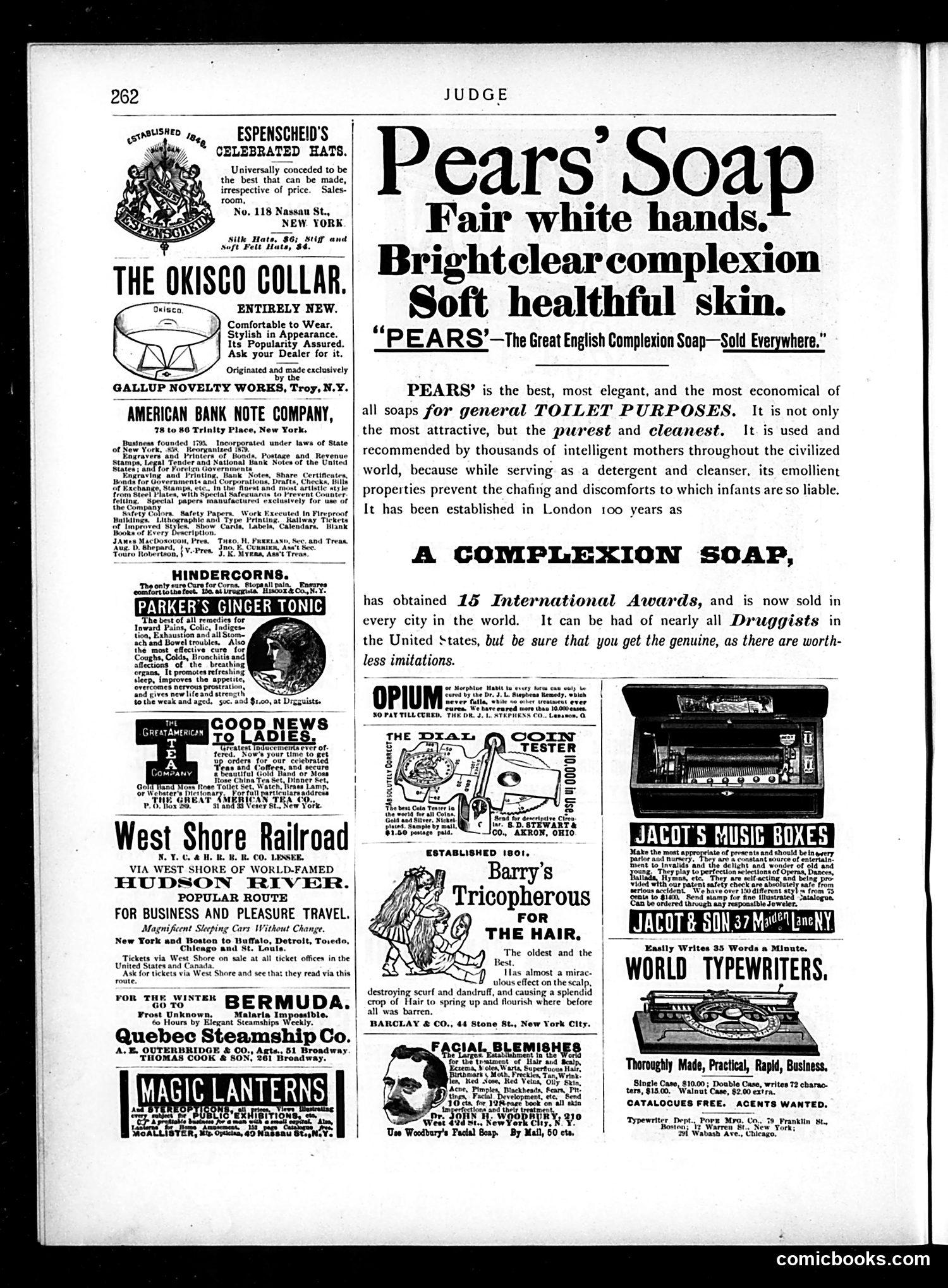
This is primarily an **advertising page** from Judge magazine, not a political cartoon. The page features various commercial advertisements typical of the late 19th/early 20th century. The dominant advertisement is for **Pears' Soap**, a British complexion soap claiming "fair white hands" and "bright clear complexion." The ad emphasizes the product's purity, 100-year London heritage, and 15 international awards. It notably targets "intelligent mothers" concerned with infant care. The page also advertises: - Espenscheid's celebrated hats - American Bank Note Company - Parker's Ginger Tonic (stomach remedy) - West Shore Railroad - Quebec Steamship Company (Bermuda travel) - Barry's Tricopherous (hair product) - Jacot's Music Boxes - World Typewriters **Context for modern readers**: This reflects Victorian-era consumer culture emphasizing refinement, hygiene, and gentility—particularly the soap ad's appeal to middle-class motherhood and aspirations toward "fair" complexions, reflecting period beauty standards.
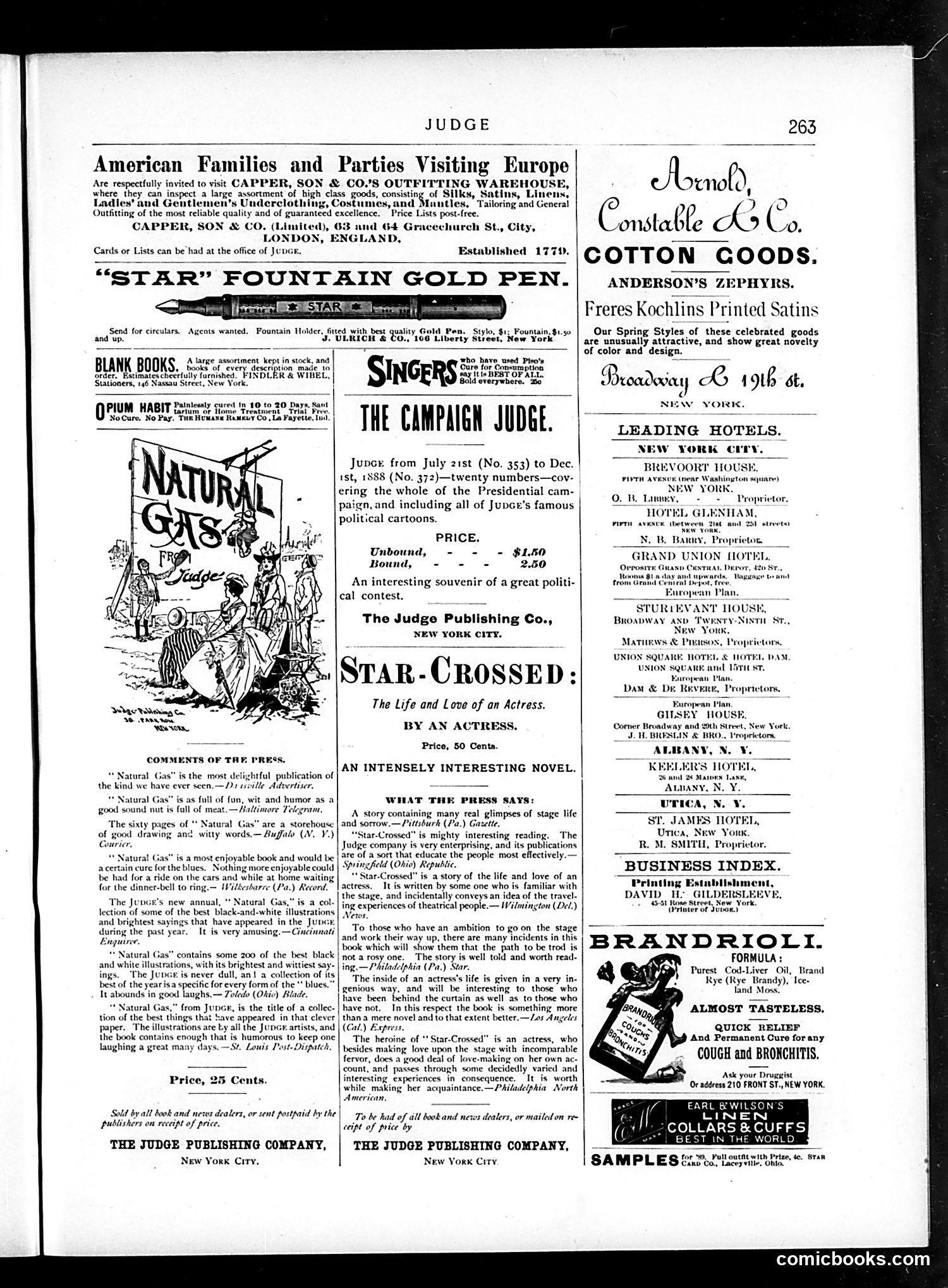
This page is primarily **advertising for Judge magazine's special 1888 election edition**. The central item advertises "The Campaign Judge"—a bound collection of Judge's political cartoons covering the entire 1888 Presidential campaign (July 21 - December 1, 1888). The surrounding ads promote other Judge publications: "Natural Gas" (their annual collection of illustrations and humor), and a novel called "Star-Crossed" about an actress's life. The page includes testimonials praising Judge's humor and illustrations. There is **no primary political cartoon visible**—this is essentially a catalog page selling Judge's own merchandise to readers interested in campaign satire and entertainment. The 1888 election between Republican Benjamin Harrison and Democrat Grover Cleveland was apparently significant enough that Judge published this special retrospective collection.
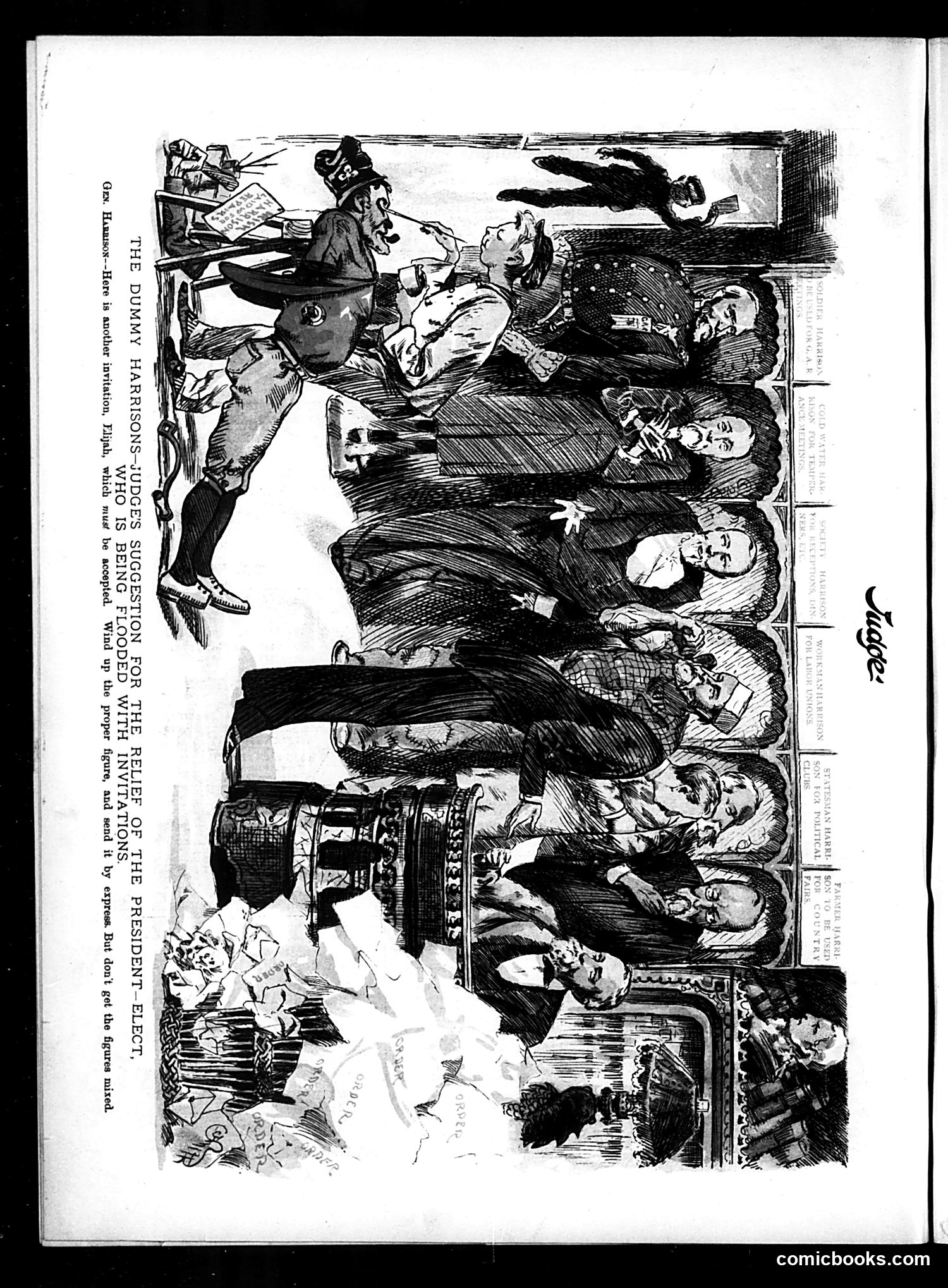
This is a satirical cartoon about President-elect Harrison (likely William Henry Harrison, elected 1840) being overwhelmed by social invitations. The joke proposes a practical solution: use mechanical dummy figures to attend events in his place, so he needn't personally attend every invitation. The humor relies on several layers: 1. **The social burden**: Harrison is drowning in obligatory social engagements—a common complaint for public figures then and now. 2. **The absurd "solution"**: Sending wind-up dummy figures instead is obviously ridiculous, but presented matter-of-factly by the servant character (appears to be named Elijah). 3. **The warning**: "Don't get the figures mixed" suggests the dummies are interchangeable—implying all these social appearances are equally hollow and meaningless anyway. The satire critiques both the exhausting nature of presidential social obligations and, more sharply, the superficiality of such formal events where mechanical attendance would suffice.