
Judge, 1889-01-26 · page 3 of 16
Judge — January 26, 1889 — page 3: what you’re looking at
What you’re looking at
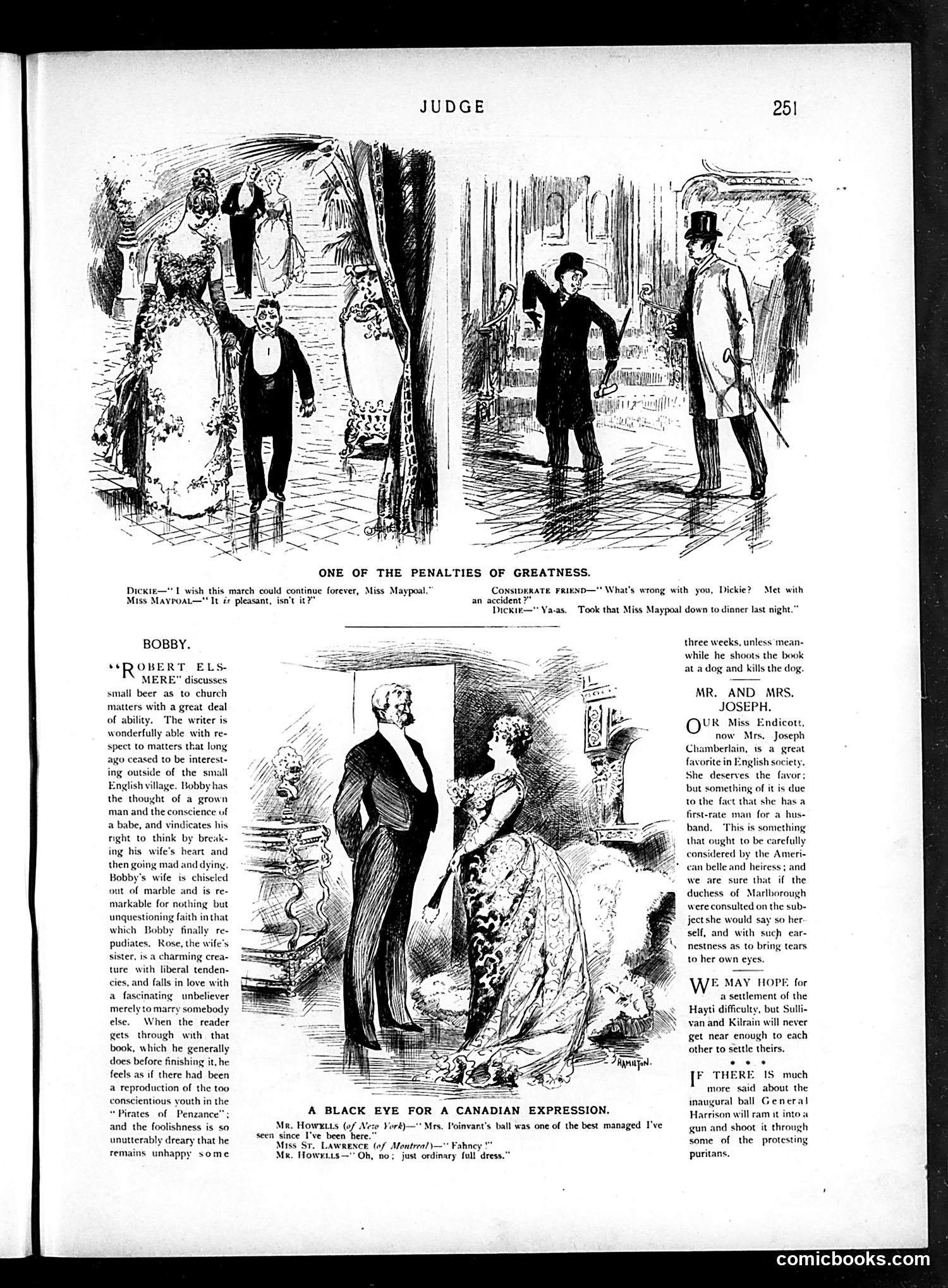
This page contains three separate satirical pieces targeting Victorian social pretensions: **"One of the Penalties of Greatness"** mocks romantic sentimentality—a man wishes a pleasant social march could last forever, but his companion reveals he took another woman to dinner the previous night, exposing his shallow insincerity. **"Bobby"** is a lengthy book review of what appears to be a novel (likely by Henry James or similar), satirizing earnest Victorian fiction about morally conflicted protagonists who create suffering through self-righteous philosophizing. The critic complains the work is tedious and self-indulgent. **"A Black Eye for a Canadian Expression"** ridicules a Canadian woman's use of "fahey" (apparently slang) as an exclamation. When a New York man compliments an event's management, she responds with colloquial Canadian speech, which he dismisses as merely "ordinary full dress"—mocking provincial expressions. The page reflects Judge's typical targets: literary pretension, romantic phoniness, and regional/national stereotyping, all presented through ink sketches in Victorian satirical style.
📄 Transcribed text from this page (OCR, searchable)
Machine-transcribed from the original scan — historical spelling and the odd misread are preserved.
Dickie—" I wish this march could continue forever, Miss Maypoal.” ONE OF THE PENALTIES OF GREATNESS. Miss MayPOAL—"' It és pleasant, isn’t i an accident . Dickir—" Ya-as. Took that Miss Maypoal down to dinner last night.” BOBBY. SSROBERT ELS- MERE" discusses small beer as to church matters with a great deal of ability. The writer is wonderfully able with re- spect to matters that long ago ceased to be interest- ing outside of the small English village. Bobby has the thought of a grown man and the conscience of a babe, and vindicates his right to think by break- ing his wife's heart and then going mad and dying. Bobby's wife is chiseled out of marble and is re- markable for nothing but unquestioning faith in that which Bobby finally r pudiates. Rose, the wife's sister, is a charming crea- ture with liberal tenden- cies, and falls in love with a fascinating unbeliever merely to marry somebody else. When the reader gets through with that book, which he generally does before finishing it, he feels as if there had been a reproduction of the too conscientious youth in the “Pirates of Penzance and the foolishness is so unutterably dreary that he remains unhappy some A BLACK EYE FOR A CANADIAN EXPRESSION. Mr. Howntts (of Nez Yort)—'* Mrs. Poinvant's ball was one of the best managed I've seen since I've been here. Miss Sr. LAwReNce (of Montreal)—"' Fahey" Mr. Howetts—" Oh, no; just ordinary full dress.” CONSIDERATE FRIEND—"* What's wrong with you, Dickie? Met with three weeks, unless’ mean- while he shoots the book at a dog and kills the dog. MR. AND MRS. Endicott, now Mrs. Joseph Chamberlain, is a_ great favorite in English society. She deserves the favor: but something of it is due to the fact that she has a first-rate man for a hus- band. This is something that ought to be carefully considered by the Ameri- * can belle and heiress ; and we are sure that if the duchess of Marlborough were consulted on the sub- ject she would say so her: self, and with such car- nestness as to bring tears to her own eyes. MAY HOPE. for a settlement of the Hayti difficulty, but Sulli- van and Kilrain will never get near enough to cach other to settle theirs. eee F THERE 1S _ much more said about the inaugural ball General Harrison will ram it into a gun and shoot it through some of the protesting puritans. comicbooks.com