
A complete issue · 16 pages · 1888
Judge — December 8, 1888
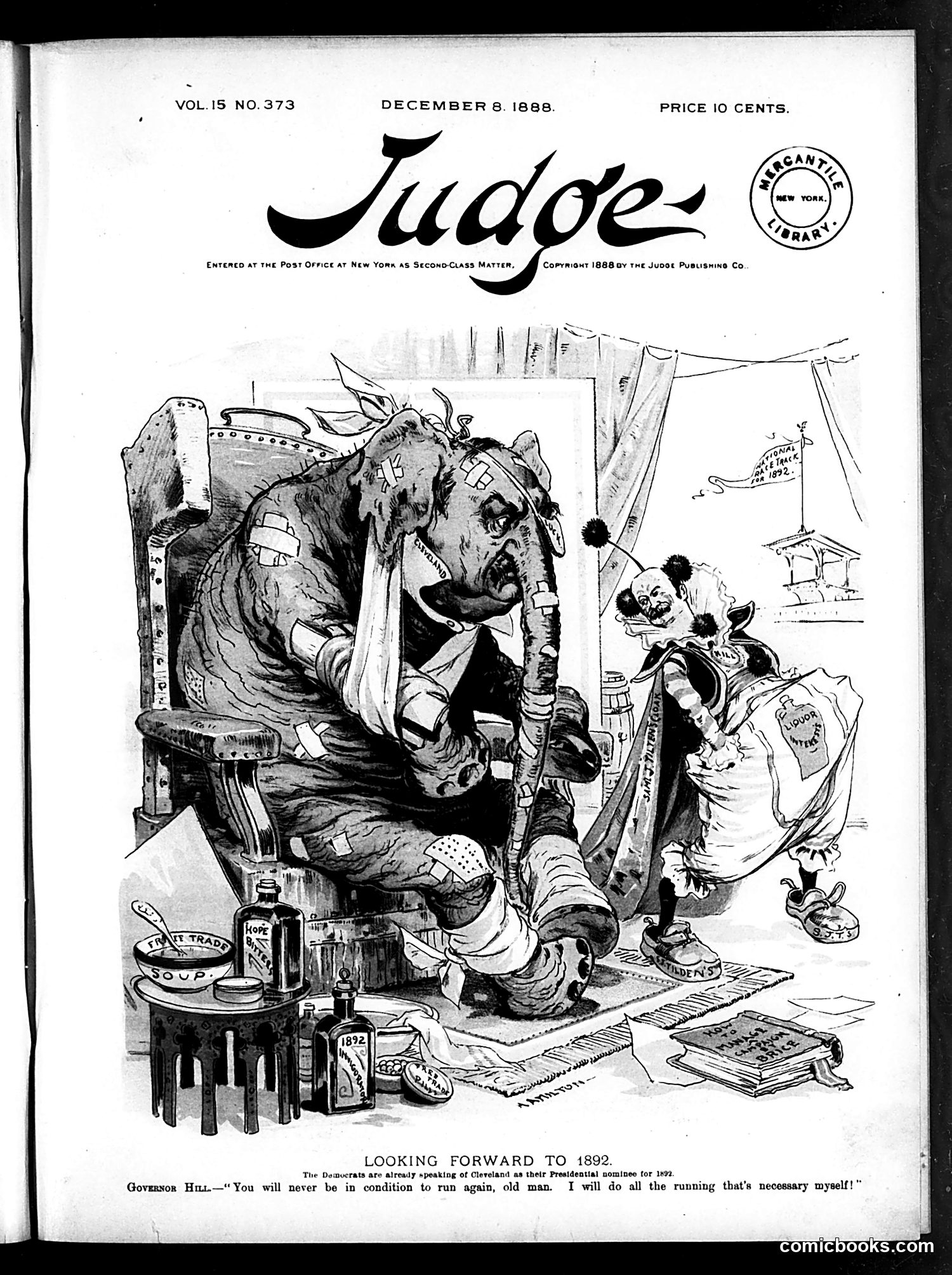
This December 1888 *Judge* cartoon satirizes Democratic prospects for the 1892 presidential election. The central figure appears to be Governor Hill (identified in the caption), depicted as a disheveled, patched-up political machine held together with tape and bandages—suggesting the Democratic Party's damaged condition after recent defeats. The caption quotes Hill claiming he'll handle all necessary "running" for the 1892 campaign, implying overconfidence despite the party's visible decay. Various elements (bottles, scattered papers, campaign materials) surround him, emphasizing chaos and disrepair. The satire mocks Democratic leadership's ability to mount a credible presidential challenge, portraying their political apparatus as barely functional and requiring substantial repair before 1892's election.
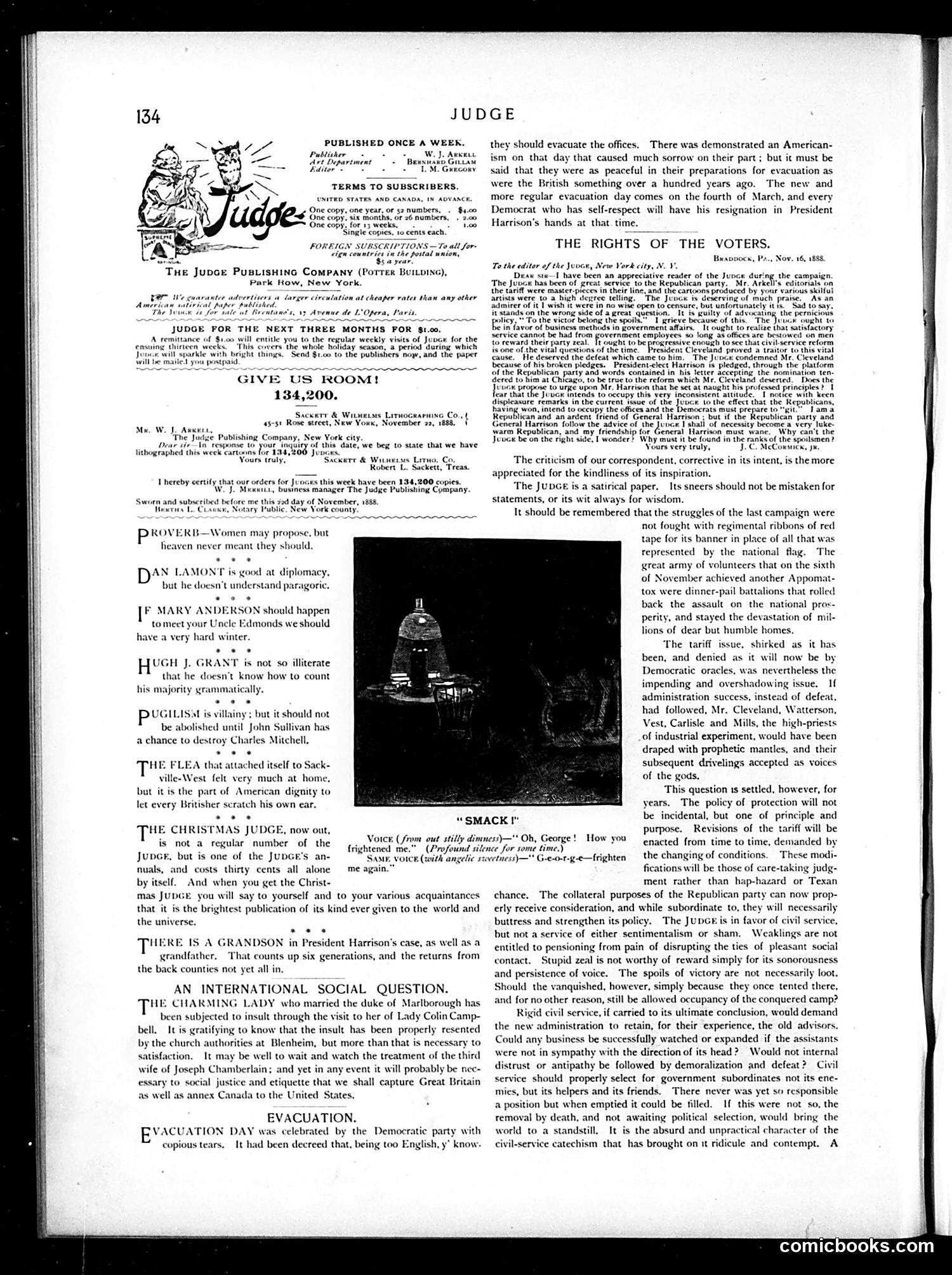
The main cartoon titled "SMACK!" depicts a figure being struck, with the caption referencing someone being "frightened" and asking "How you frightened me!" This appears to be political commentary, though the specific figures and context are unclear from the image alone. The page primarily contains editorial text addressing "The Rights of the Voters" and civil service reform debates. The text criticizes Democratic party positions and defends Republican approaches to government administration, particularly regarding evacuation procedures and the tariff question. Several short, untitled satirical quips appear throughout, including jibes at politicians like Hugh J. Grant and references to contemporary political figures. The overall tone is staunchly Republican, attacking Democratic policies and leadership from this era's partisan perspective.
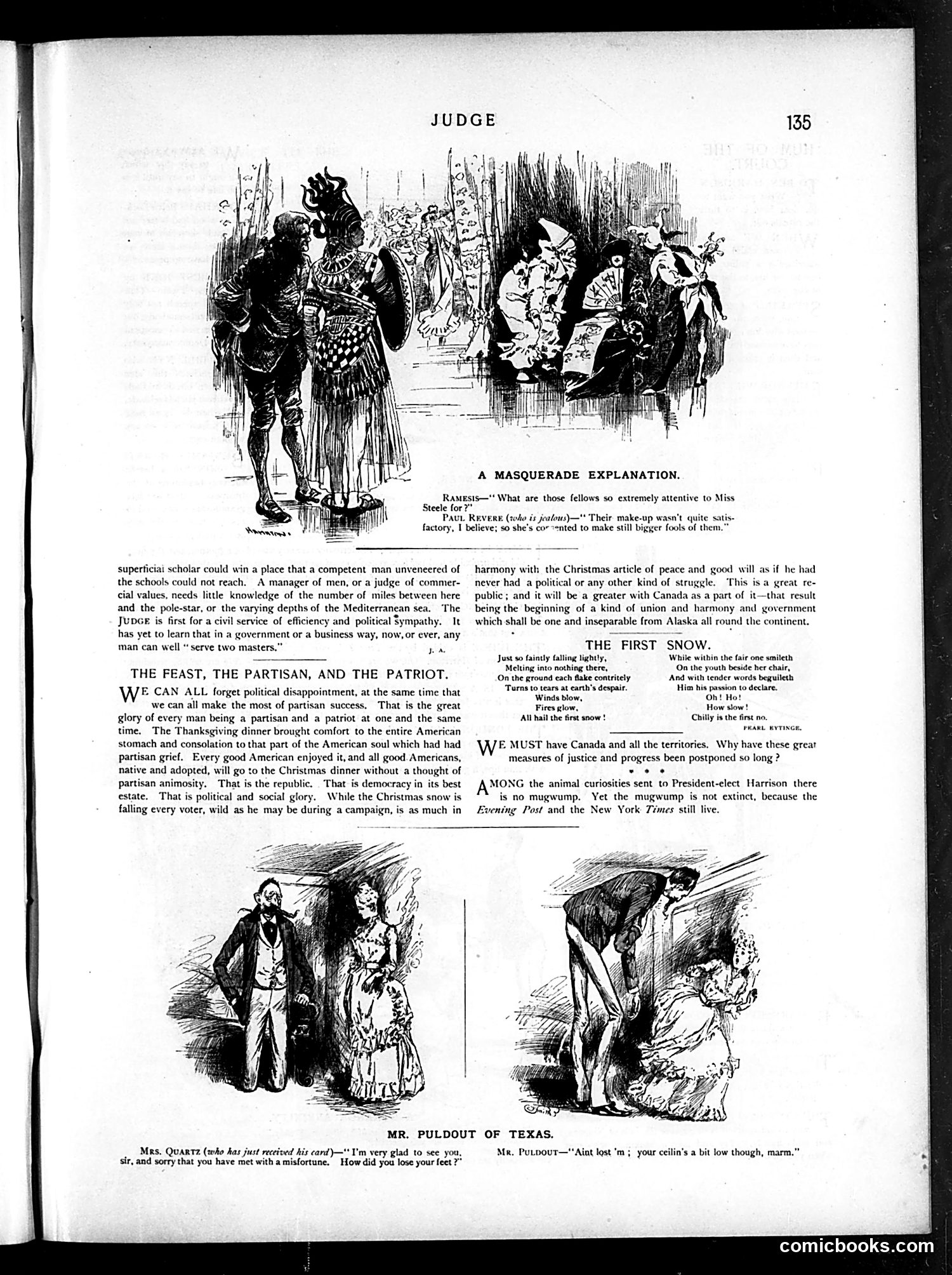
This page contains several disconnected satirical pieces typical of 1880s-90s American humor. **"A Masquerade Explanation"** (top cartoon): A joke about courtship deception—men are being foolish toward Miss Steele, and a jealous "Paul Revere" suggests their poor disguises at a masquerade ball prompted her to deliberately make bigger fools of them. **"The Feast, the Partisan, and the Patriot"** (editorial): Celebrates how Americans transcend partisan political disappointment during holidays like Thanksgiving and Christmas, uniting as patriots. It also advocates for Canadian territorial expansion and union with Alaska. **"Mr. Puldout of Texas"** (bottom cartoons): A crude joke playing on the surname "Puldout"—Mrs. Quartz asks how he lost his feet; he responds her ceiling is "a bit low," implying he's tall enough to have struck his head. The humor relies on the suggestive name. The page reflects late-19th-century concerns: political unity, American expansionism, and genteel Victorian humor standards.
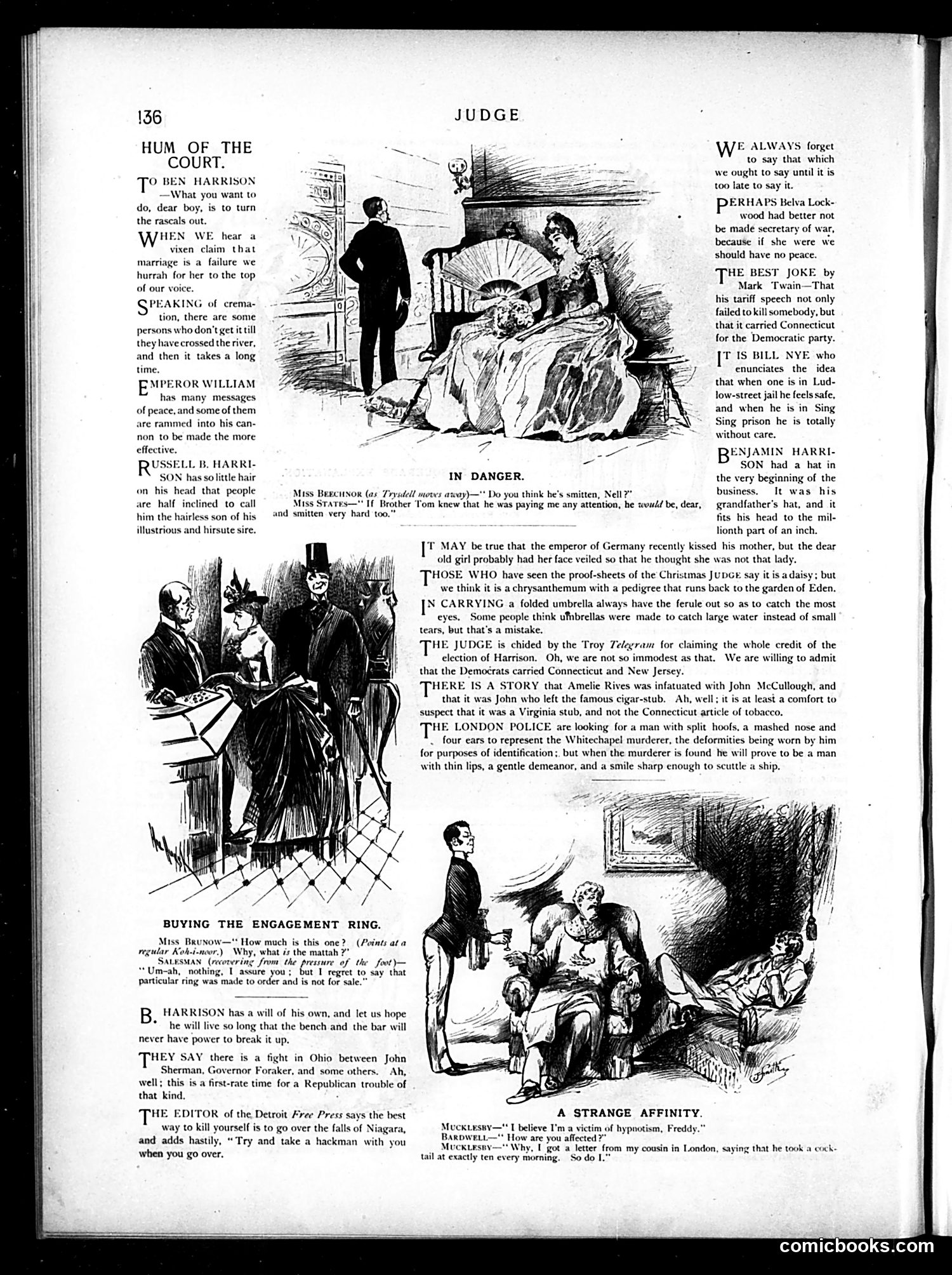
This page from Judge satirizes 1880s-90s American politics and society through brief commentary and three cartoon vignettes. **"In Danger"** depicts a woman (Miss Beechinor) flirting with a man while her brother Tom remains unaware—the joke being she'd face serious consequences if discovered. **"Buying the Engagement Ring"** shows a salesman pressed under a woman's foot after mentioning a ring "made to order and is not for sale"—satirizing marriage negotiations as coercive transactions. **"A Strange Affinity"** jokes about hypnosis and British crime, with a character claiming hypnotic victimization after receiving a letter from his cousin in London. The editorial snippets mock political figures including Benjamin Harrison (recently elected president), Emperor William II of Germany, and satirize contemporary issues: women in government, the Whitechapel murders, and Republican Party infighting in Ohio. The tone is cynical, treating marriage, politics, and crime as mutually absurd human follies.
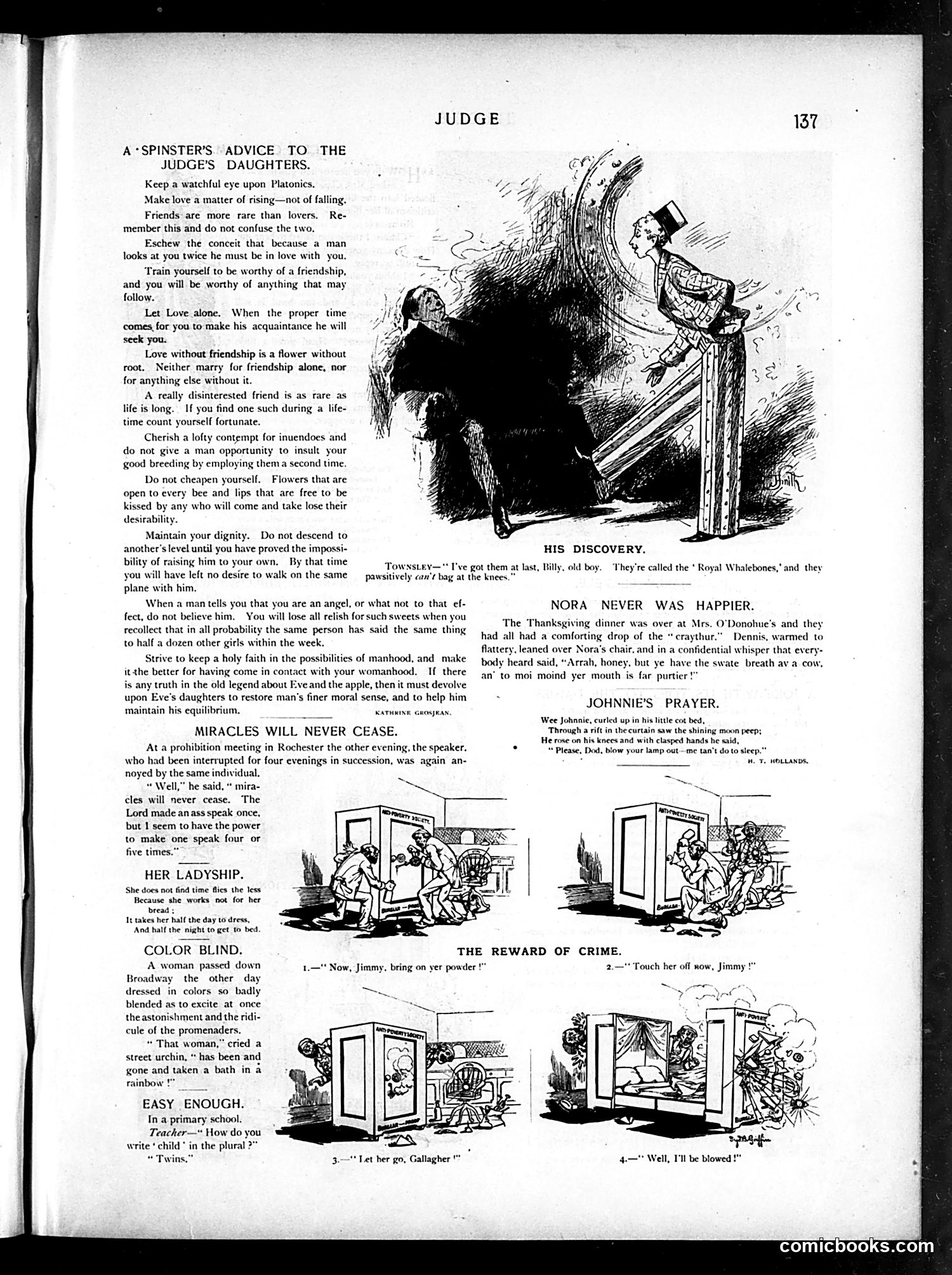
This page contains multiple satirical pieces typical of Judge's late 19th/early 20th-century humor: **Main Text:** "A Spinster's Advice to the Judge's Daughters" offers conventional wisdom about courtship—distinguishing friendship from romance, maintaining dignity, and rejecting flattery. It reflects Victorian anxieties about women's conduct and marriage prospects. **Cartoons:** - **"His Discovery"**: A man shows off "Royal Whalebones" (corset stays) that "can't bag at the knees"—mocking both male vanity and women's restrictive fashion. - **"The Reward of Crime"**: A four-panel domestic comedy about a man sneaking in through windows, apparently depicting marital infidelity or misbehavior with consequences. - **"Color Blind"**: Ridicules a woman's clashing outfit; a street child compares her to "a bath in a rainbow." - **Minor pieces**: Brief jokes about prayer, prohibition speakers, and classroom grammar. The page reflects period attitudes toward gender, fashion, and social propriety, with gentle mockery of both sexes.
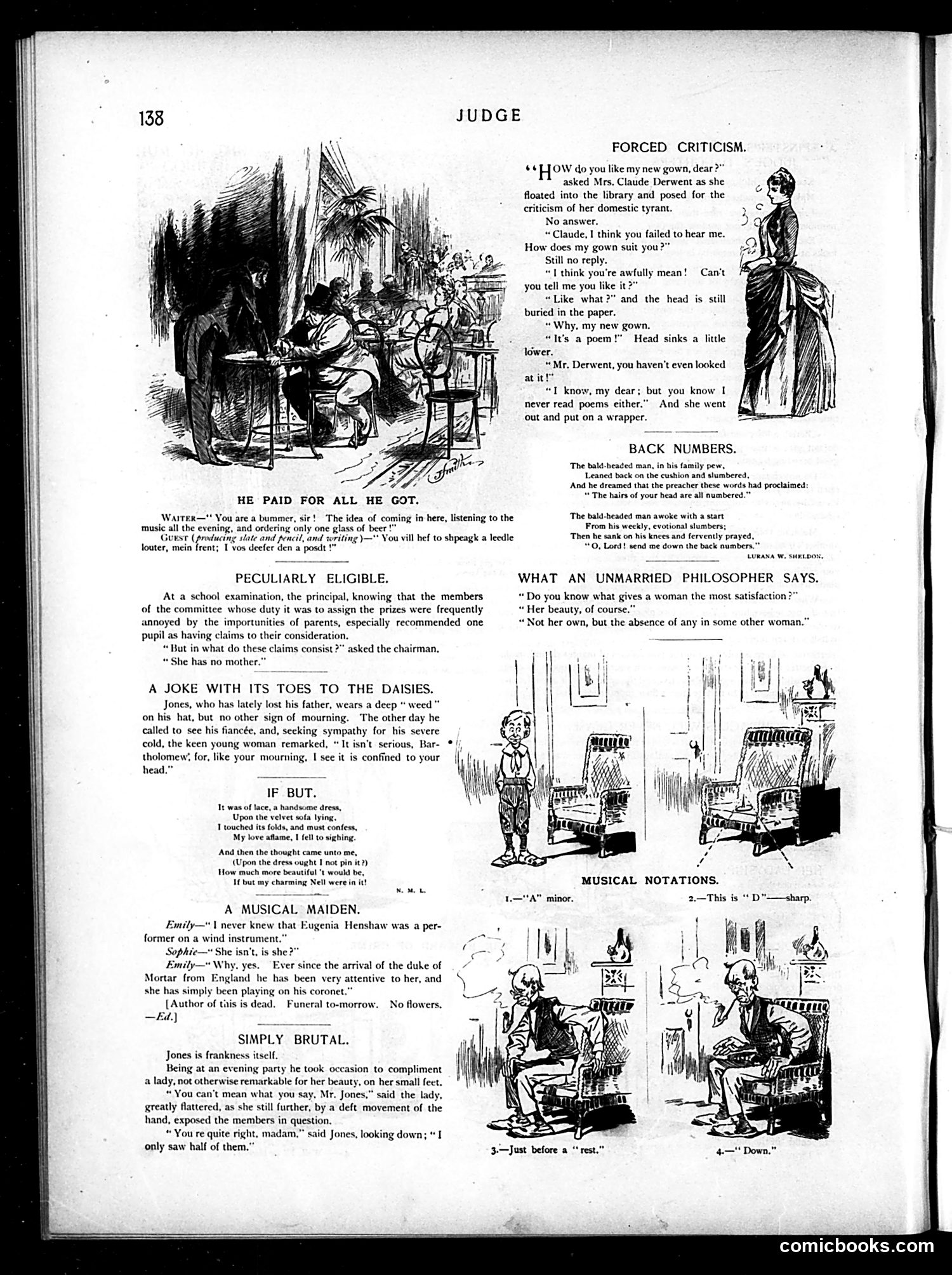
This page contains multiple brief satirical pieces typical of *Judge* magazine's humor: **"Forced Criticism"** mocks marital dynamics—a wife seeks compliments on her new gown, but her husband ignores her from behind his newspaper. The joke satirizes husbands' indifference to wives' appearance and concerns. **"He Paid for All He Got"** depicts a waiter confronting a cheap customer who ordered one beer while listening to music all evening. The guest retorts he's deaf and therefore got what he paid for—mocking both penny-pinching patrons and working-class dialect humor. **Other pieces** include jokes about unmarried women's jealousy, a mourning hat described as "confined to the head" (mocking insincere grief), and a "musical maiden" who plays a nobleman's "coronet"—sexual innuendo about social climbing. The cartoons use period stereotypes about gender relations, class behavior, and romantic pursuit. Most humor relies on wordplay, physical comedy, and satirizing contemporary social pretensions rather than political content.
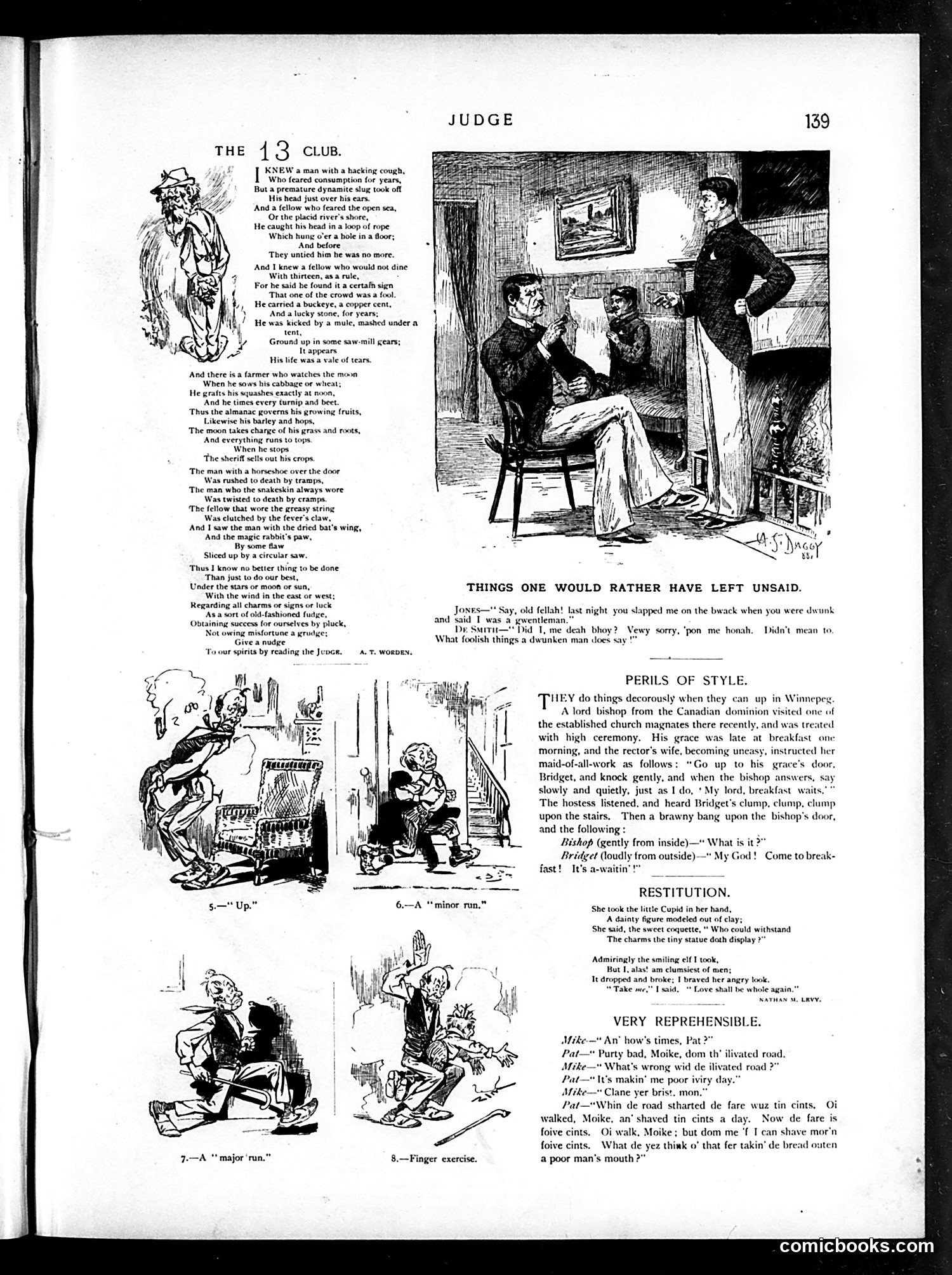
This page from *Judge* magazine contains several satirical pieces mocking superstition and social awkwardness: **"The 13 Club"** (left): A poem by A.T. Worden satirizes people who rely on lucky charms and superstitions. It catalogs individuals—one who avoids dining with 13 people, another who plants by the moon, a man with a horseshoe over his door—all of whom meet ridiculous deaths anyway. The joke: superstitions are useless; fate doesn't care about your talismans. **"Things One Would Rather Have Left Unsaid"** (top right): An anecdote mocking poor etiquette. A Canadian bishop's maid, instructed to knock "gently," instead loudly shouts "My God! Come to breakfast!" The humor lies in the servant's crude directness versus the refined politeness expected. **Bottom sketches and poems**: These continue mocking social missteps—drunken apologies, broken statues, Irish laborers complaining about fare increases—all capturing period class humor and dialect comedy typical of *Judge's* approach. Overall: The page satirizes human folly through superstition, class pretension, and social blundering.
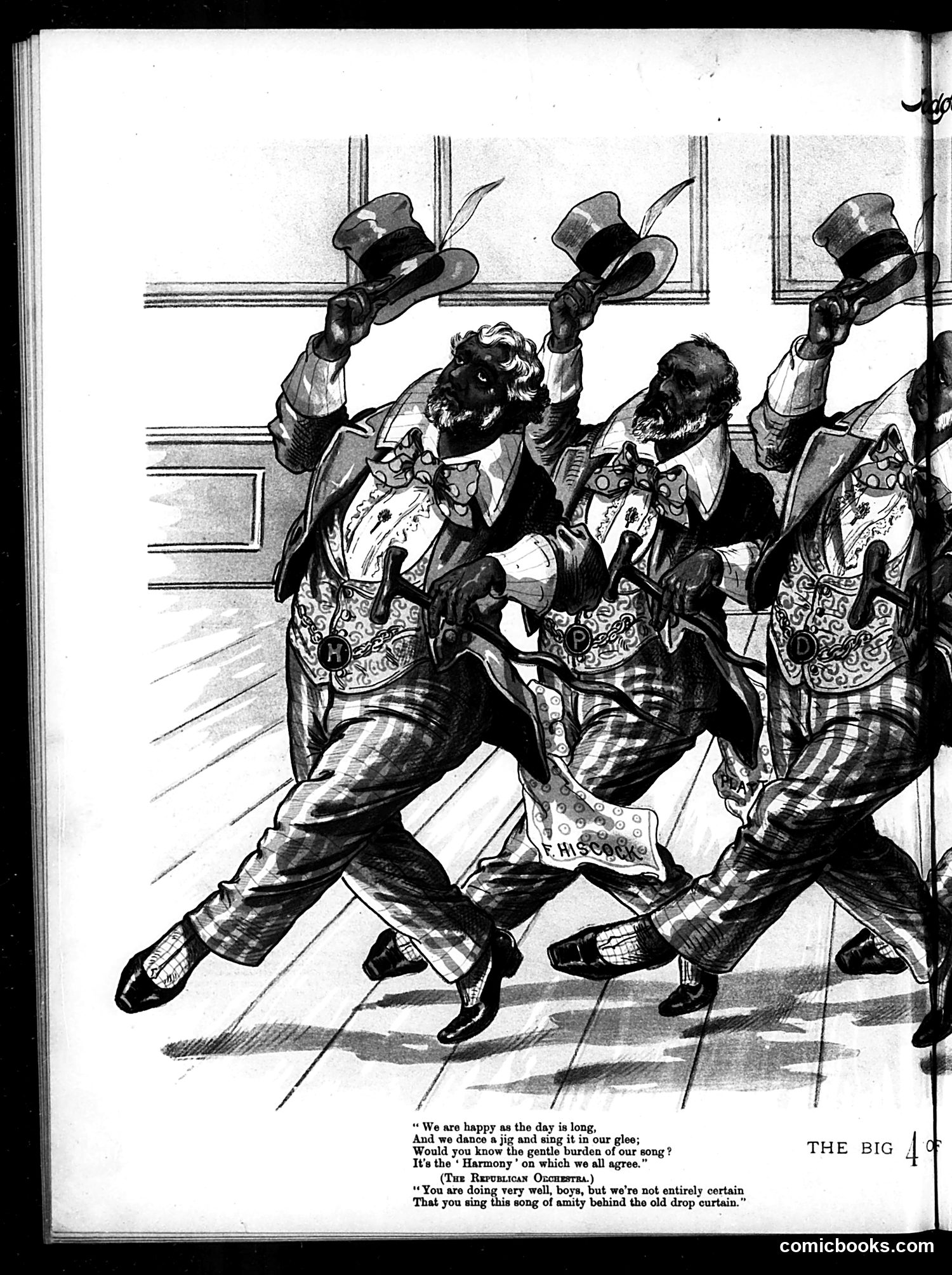
This satirical cartoon depicts four Republican figures as musicians performing "Harmony," celebrating their unity and agreement. The cartoon is skeptical of this supposed harmony, suggesting it's merely performative—a public show ("behind the old drop curtain" implies theatrical artifice). The four men represent Republican Party leadership, likely from the early 20th century, dancing and singing together while raising their top hats. The accompanying text mocks their claims of internal unity, implying private disagreements contradict their public displays of agreement. The satire criticizes Republican leaders for presenting false unity to voters while harboring real discord behind closed doors—a commentary on political hypocrisy and manufactured consensus. The "drop curtain" reference specifically suggests their harmony is mere theater for public consumption.
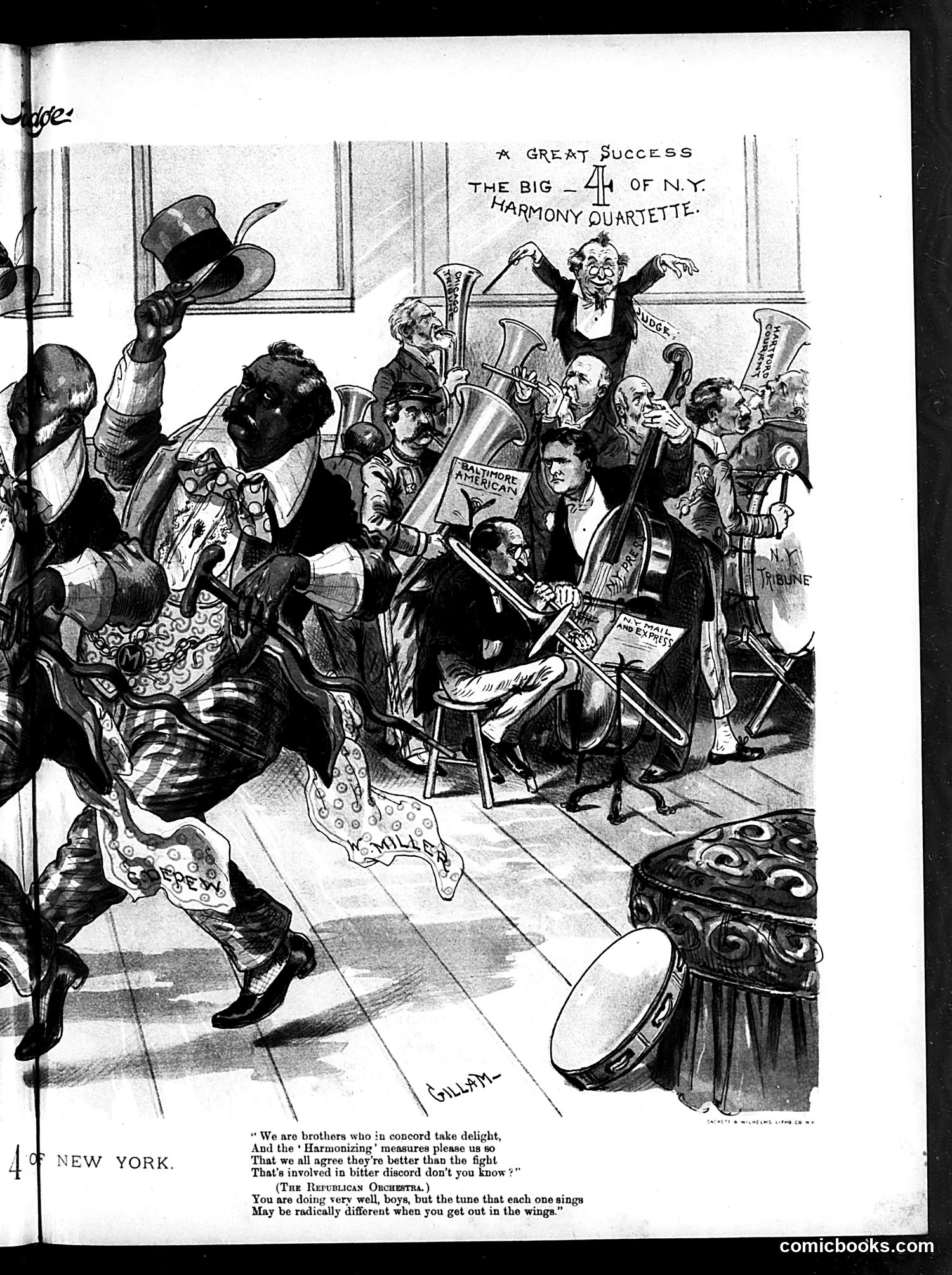
This Judge magazine cartoon satirizes the Republican Party's claimed unity during what appears to be a New York political campaign. The "Big 4" refers to four prominent Republican figures performing together as a "harmony quartette"—singing about brotherhood and agreement. The satire's point is sharp: the caption's closing lines mock this unity as performative theater. The figures harmonize beautifully *on stage* ("doing very well, boys"), but the cartoonist suggests their actual positions "radically differ" backstage. They're presenting false unity to voters while harboring genuine disagreements. The caricatured orchestra members likely represent specific New York Republican politicians, though their individual identities aren't labeled here. The cartoon criticizes political theater—the gap between public unity messaging and private factional conflict within the party.
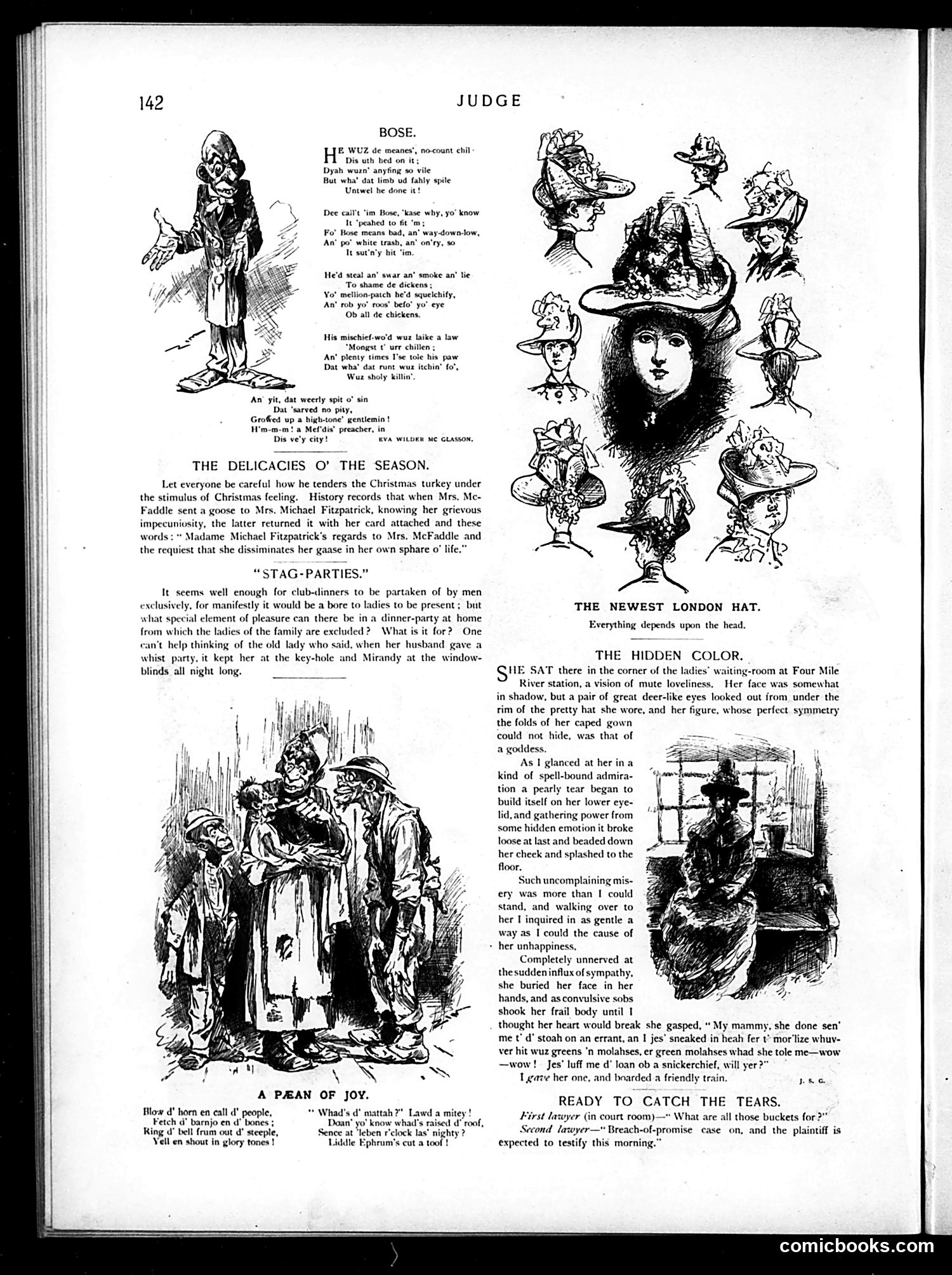
This page contains three distinct pieces of satirical content: **"BOSE"** is a dialect poem (by Ava Wilder McGlassan) about a disreputable poor white character who steals, swears, and causes trouble in his community—yet somehow becomes a Methodist preacher. The satire mocks both the character's improbable reformation and likely the hypocrisy of religious institutions accepting morally questionable members. **"Stag-Parties"** satirizes men-only dinner parties as pointless and excludes wives unfairly, comparing husbands to a man who made his wife spy through keyholes while he entertained. **"The Hidden Color"** and **"Ready to Catch the Tears"** are humorous short pieces: the first a sentimental story about a sad girl in dialect who confused vegetable orders; the second a courtroom joke about buckets placed to catch tears during a breach-of-promise case (a common lawsuit type). The page uses heavy dialect humor typical of the era, mixing social commentary with slapstick comedy and romance parody.
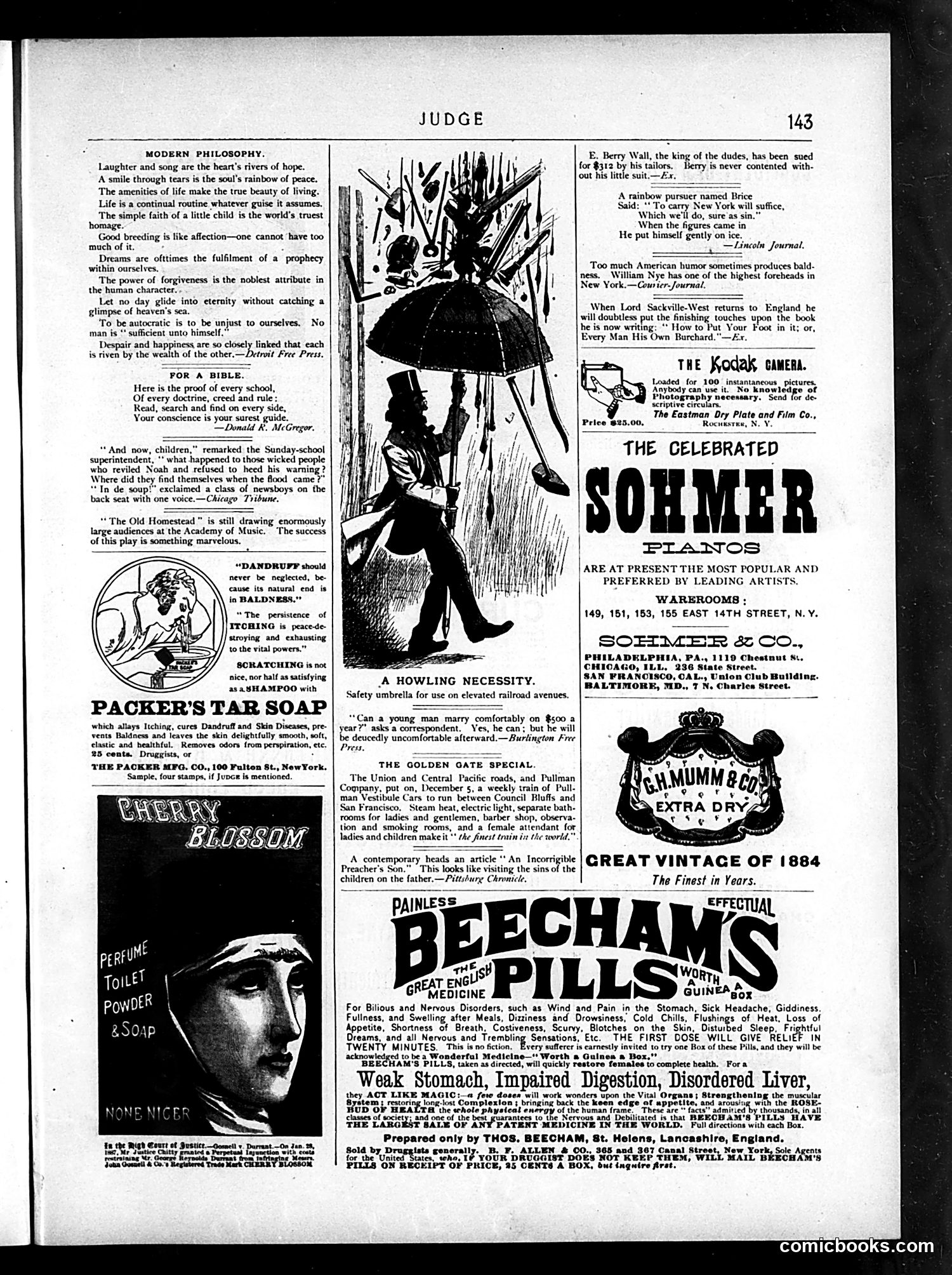
The central cartoon depicts a man struggling with an umbrella on an elevated railroad platform during heavy rain—with the umbrella blown inside-out by the wind. The caption identifies it as a "Safety umbrella for use on elevated railroad avenues," presenting the comically useless device as if it were a practical solution. This is satire on the newly-built elevated railways (elevated trains) that were transforming American cities in the 1880s. The joke: these trains ran high above streets, exposing passengers waiting on platforms to harsh wind and weather with no shelter. Rather than criticize the railroads for this obvious design flaw, Judge sarcastically proposes an absurd personal remedy—an umbrella that cannot possibly work in such conditions—mocking both the inadequate infrastructure and the expectation that individuals suffer inconvenience from modern "progress."
This page is primarily **advertisements and reader correspondence** rather than political satire. The notable content includes: **"Confident of Their Merit"**: A testimonial letter from an Alabama woman praising Brandreth's Pills as a cure for yellow fever, reflecting 1880s medical quackery—patent medicines made unsubstantiated health claims. **Poetry**: A sentimental verse about an unrequited love for actress Mary Anderson (a famous stage performer of the era), ending with the suitor going insane—contemporary melodrama fodder. **Brief Satires**: - A joke about women's education focused on elaborate hats blocking theater views—mocking both women's fashion excess and contemporary debates about female education. - A quip doubting whether Belva Lockwood (an early women's rights activist and presidential candidate) could "sweep the country" politically, with a sexist pun about housekeeping. The page reflects 1880s concerns: dubious medical treatments, women's evolving social roles (treated humorously), and celebrity culture.
This page is primarily **advertising**, not political satire or editorial cartooning. It contains various product advertisements typical of 1880s American magazines. The only figurative element is a **portrait of W. L. Douglas**, a shoe manufacturer, accompanying his shoe advertisements. This appears to be a standard commercial endorsement rather than satirical content. The ads themselves reflect period concerns: Scott's Emulsion (cod liver oil) for tuberculosis/consumption treatment; the Wabash Railway promoting luxury train service; American Bank Note Company advertising currency and security printing; and various patent medicines and consumer goods. The Douglas shoe ads emphasize durability and value ("$3 Shoe for Gentlemen"). **No political cartoon or satirical message is evident** on this page. Judge magazine mixed editorial satire (on other pages) with conventional advertising. This particular page represents the commercial side of the publication rather than its satirical content.
This page is primarily **advertising**, not satire or political cartoon content. It contains multiple commercial advertisements typical of Judge magazine's revenue model: **Main advertisements include:** - Darlington, Rusk & Co. (fabric/clothing) - Pears' Soap (emphasizing "fair white hands" and "bright clear complexion"—language reflecting period beauty standards) - Webster's Unabridged Dictionary - World Typewriters - Pleasant Valley Wine Co. (champagne and catawba wines from New York) - A gold-plated hunting case watch/timepiece offered as a premium giveaway **Notable for modern readers:** The Pears' Soap ad uses language about "fair white hands" and skin that reflects period racial attitudes embedded in beauty advertising—something that would be considered offensive today. The page contains no identifiable political cartoons or satirical commentary. It represents Judge functioning as a commercial publication funding its operations through paid advertisements.
This page is primarily **advertising**, typical of late 19th-century magazines. The upper left contains a small advertisement for "Ball-Pointed Pens" with a globe illustration and the slogan "Mightier Than the Sword"—a play on the famous phrase about pen versus sword, here applied to commercial writing instruments. Other notable ads include: - **Hutchinson's Best Made Gloves** for driving/street wear - **West Shore Railroad** promoting travel via the Hudson River to Buffalo, Detroit, Toledo, Chicago - **"Star-Crossed"** novel advertisement—a book about an actress's dramatic life by an unnamed female author - Various other services: blank books, magic lanterns, printing supplies, patent medicines (Crystal Pepsin Tablets for dyspepsia) The right side features **Arnold Constable & Co.'s luxury fur business** in New York, listing sable capes, sealskin jackets, and bear-skin robes. There is **no significant political satire or social commentary** visible on this page—it's a straightforward commercial advertising section typical of Judge magazine's revenue model.
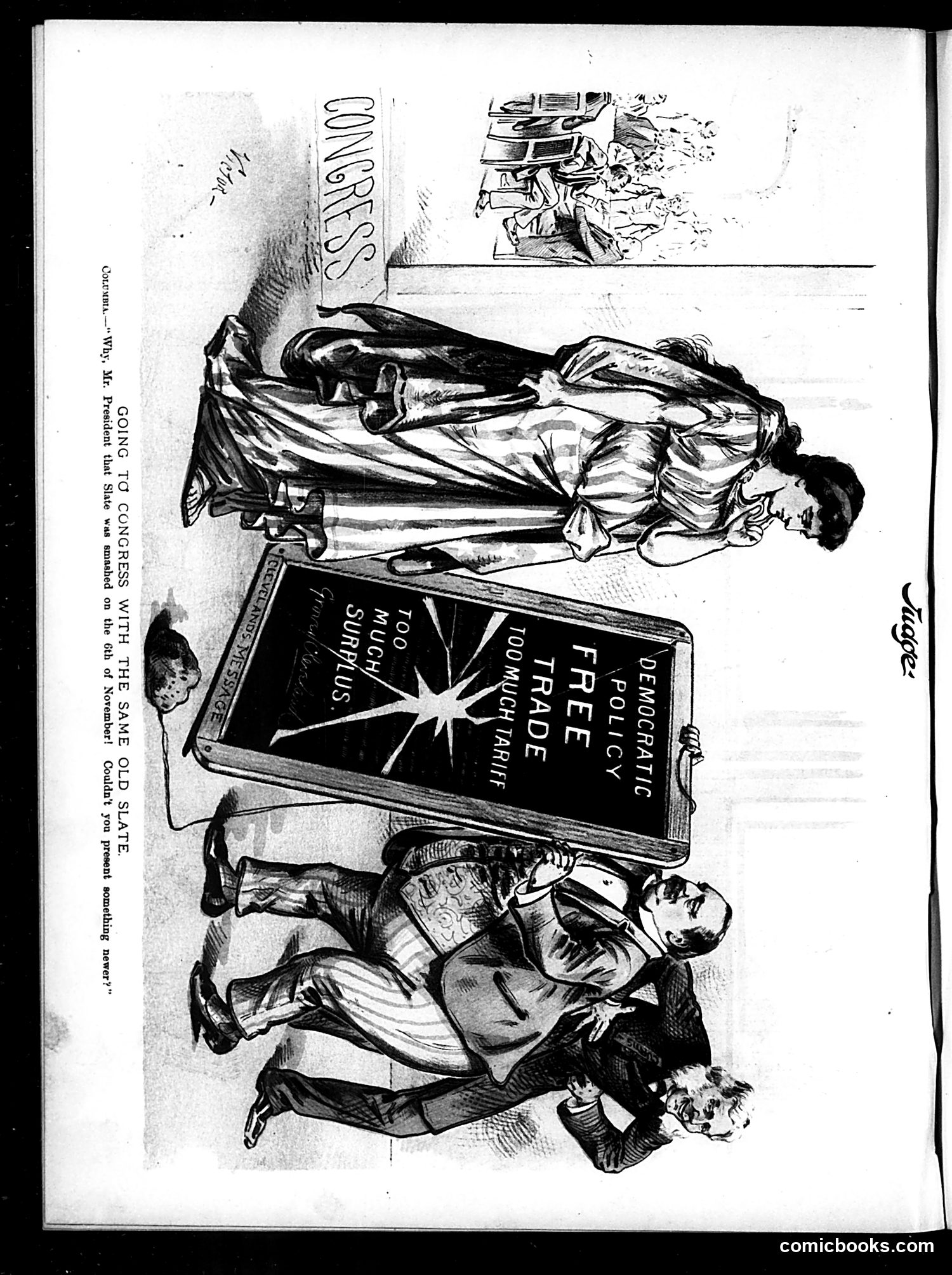
This Judge magazine cartoon satirizes Democratic Party leadership for recycling the same political slate despite electoral defeat. The image shows a figure (likely representing Democratic leadership) presenting a worn slate to Congress, despite it being "smashed on the 6th of November"—referring to a Republican electoral victory. The joke targets Democratic inflexibility: rather than adapting their political strategy or candidate roster following their loss, they're attempting to push forward with identical failed policies and personnel. The "slate" is both literal (the writing surface shown) and metaphorical (their political ticket/platform). The cartoon criticizes what it portrays as Democratic stubbornness and lack of innovation in response to public rejection of their platform.