
A complete issue · 17 pages · 1888
Judge — October 6, 1888
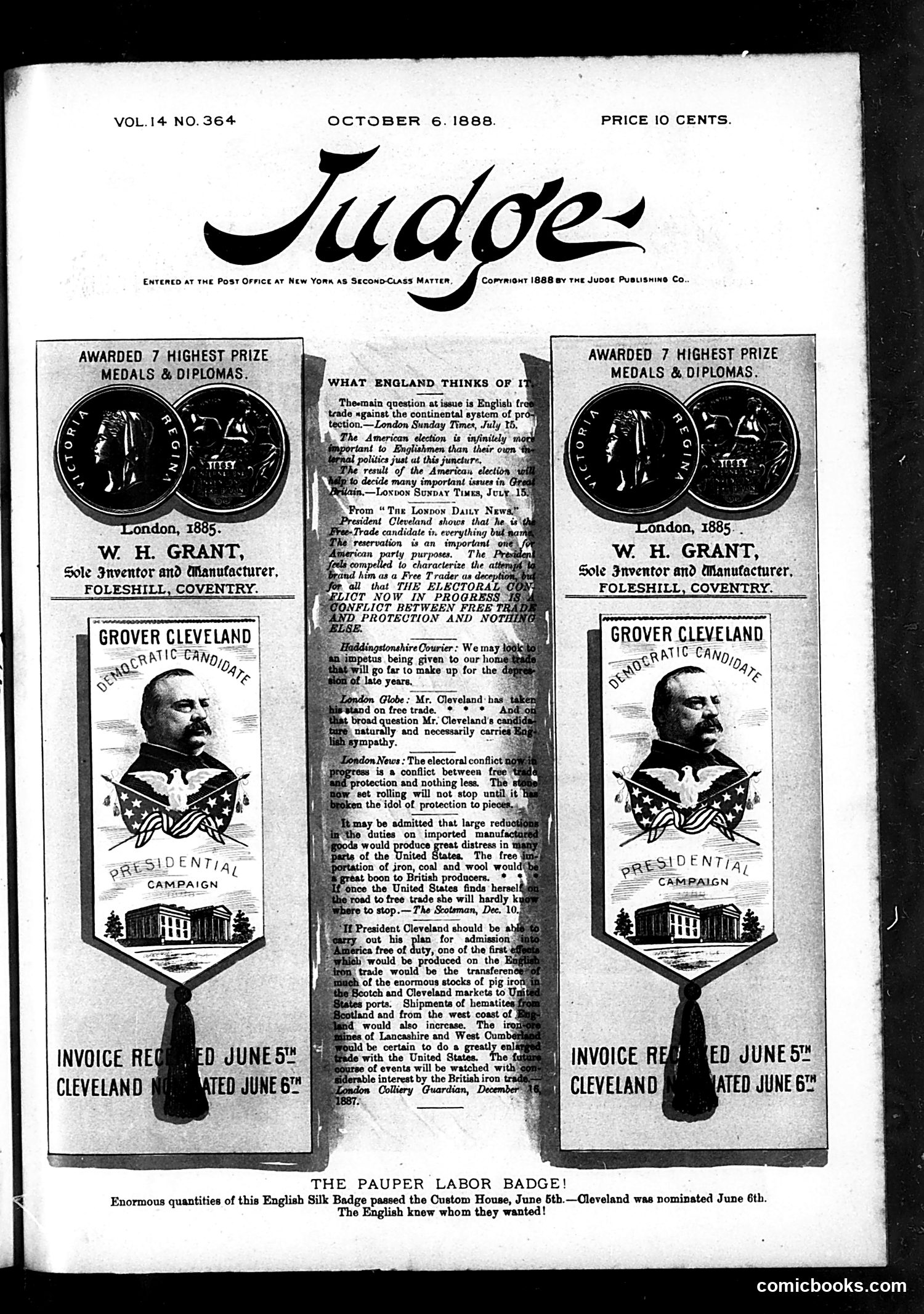
This October 6, 1888 Judge page satirizes the 1888 U.S. presidential election featuring Democrat Grover Cleveland (the incumbent president, shown in the campaign ribbons). The central article "What England Thinks of It" mocks Cleveland's free-trade position by presenting British newspaper commentary supporting his candidacy—the satire being that English approval damages an American politician. The page implies Cleveland's free-trade stance benefits British manufacturing interests over American ones. The repeated "Pauper Labor Badge" caption at bottom refers to the Republican argument that free trade would expose American workers to unfair British competition. W.H. Grant's medal imagery represents industrial achievement, contrasting with the political/trade debate. The satire suggests Cleveland is effectively a tool of British economic interests.
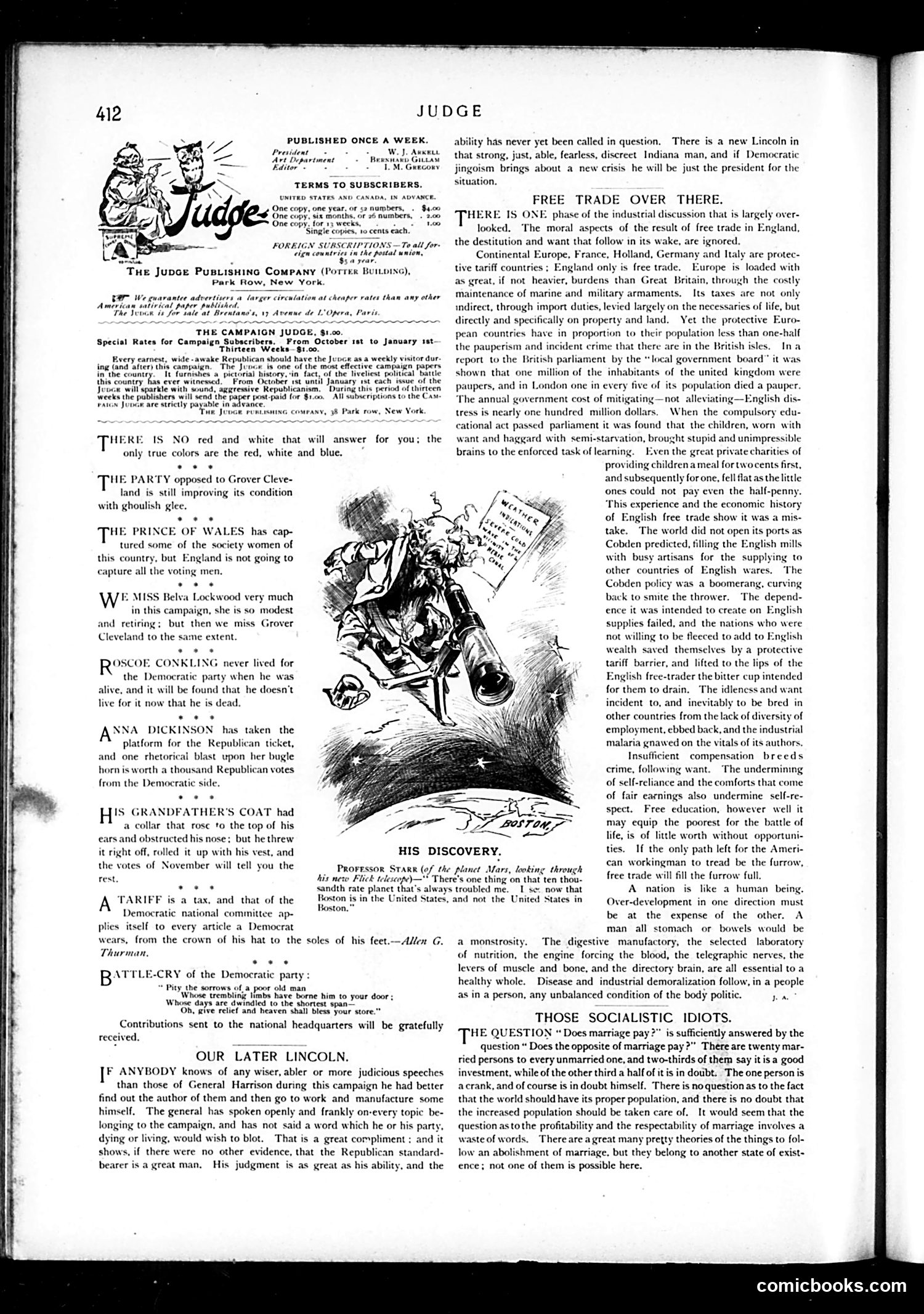
The main cartoon titled "HIS DISCOVERY" depicts a figure discovering that free trade creates economic problems. The accompanying article "FREE TRADE OVER THERE" critiques English free-trade policy as causing poverty, crime, and industrial decline in Britain. The text argues that protective tariffs—which the Democratic party opposed—would benefit American workers by preventing cheap foreign imports from undercutting wages. The page also includes brief satirical items mocking Democratic positions (Grover Cleveland, the party's tariff stance) and Republican figures. The overall message: Judge, a Republican publication, supports protective tariffs and attacks Democratic free-trade advocacy as economically destructive, using England as a cautionary example of free trade's alleged failures.
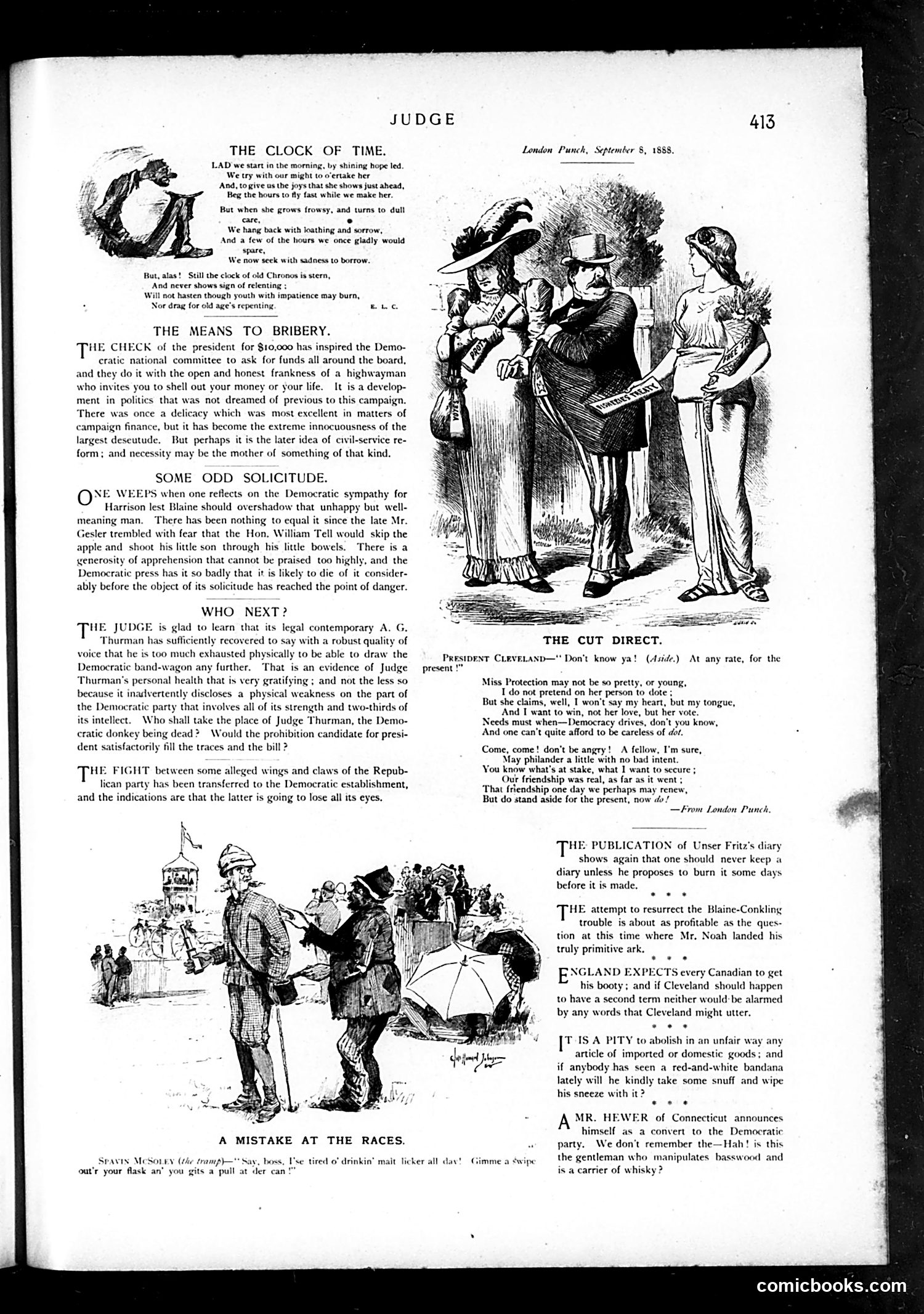
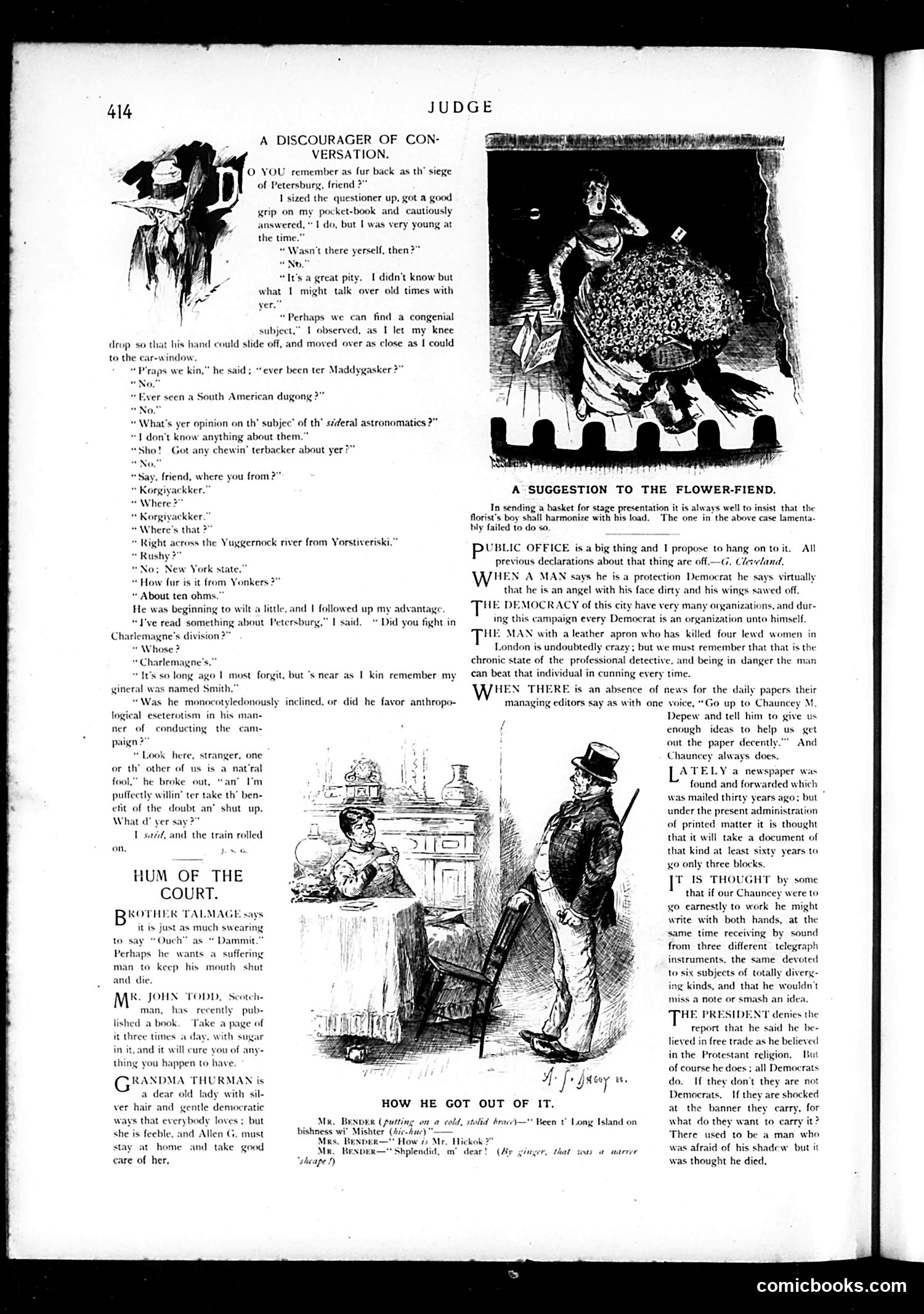
## "A Discourager of Conversation" The main cartoon satirizes the bore—a persistent questioner who corners the narrator asking increasingly absurd questions (about Petersburg siege, Maddygasker, "federal astronomatics," the fictional "Charlemagne's division"). The narrator, trying to escape, finally admits they're both fools, ending the ordeal. The satire mocks people who relentlessly buttonhole strangers with pointless conversation. ## "A Suggestion to the Flower-Fiend" A brief joke about stage floral presentations: the small boy carrying an enormous basket of flowers is visually comical—he's dwarfed by his load, creating an absurd contrast. The humor is visual rather than political. ## Political Commentary Brief items mock Cleveland's claims about protecting Democrats ("an angel with his face dirty"), reference the Jack the Ripper murders in London, and joke about editors needing Chauncey Depew's ideas to fill newspapers. The page is primarily humor/satire of social behavior rather than focused political commentary.
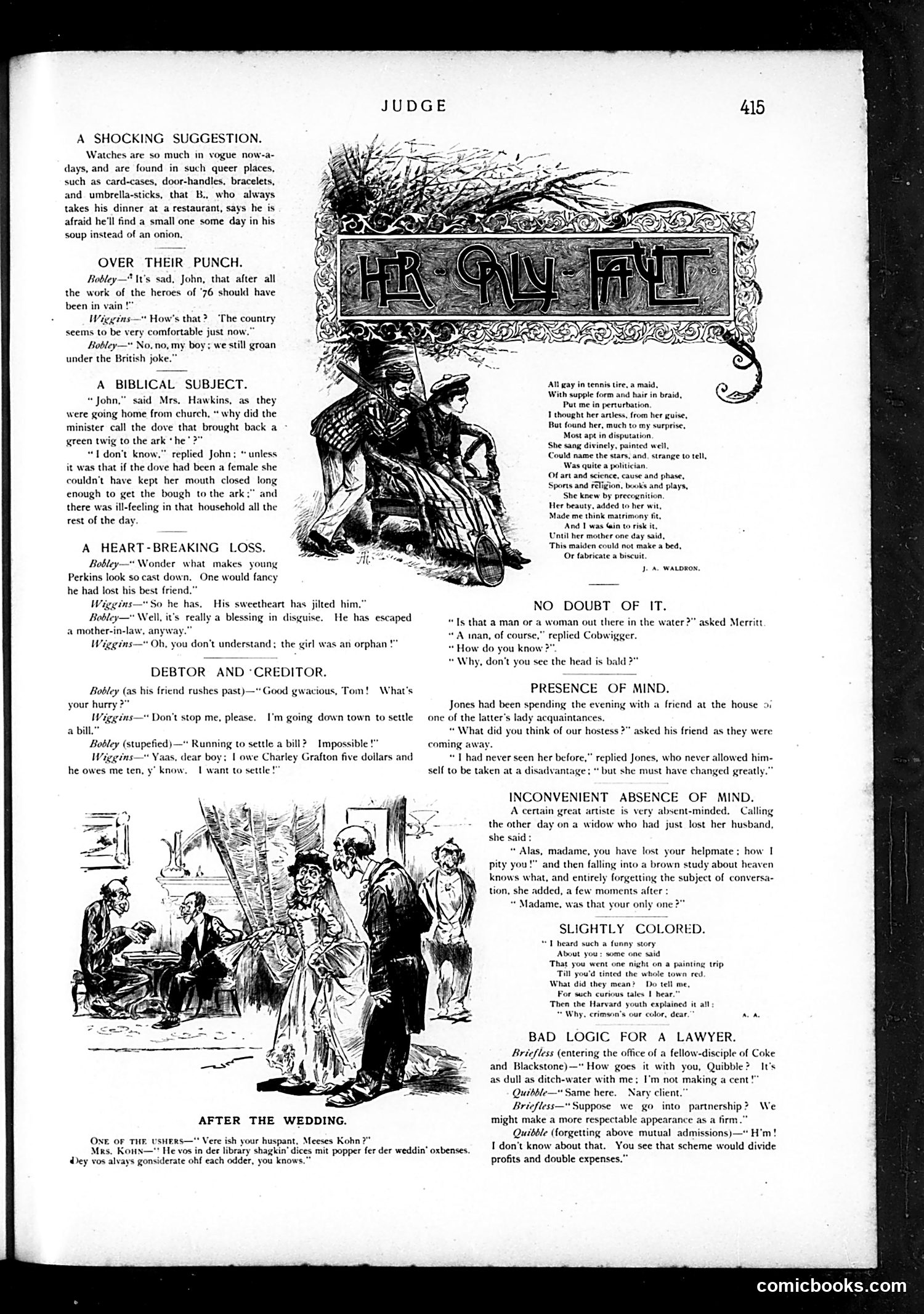
This page contains multiple short humorous anecdotes typical of Judge magazine's satirical style, rather than political cartoons. The jokes target Victorian-era social conventions and gender stereotypes: **Key jokes include:** - A man worried tiny watches will appear in restaurant soup (mocking the fashion obsession with miniaturized watches) - A husband's cynical comment that women can't keep secrets (misogynistic humor) - A man settling debts in illogical order (absurdist humor about financial priorities) - A woman praised for beauty, intelligence, and talent but condemned for not cooking or baking (satirizing impossible standards for women) - A man pretending not to recognize his hostess to avoid social awkwardness (social pretense) - An artist forgetting a widow just lost her husband mid-condolence (absent-mindedness humor) The illustrations show Victorian-era clothing and settings. These are gentle, drawing-room comedies rather than sharp political satire—reflecting Judge's appeal to middle-class readers through relatable domestic scenarios and conventional morality jokes.
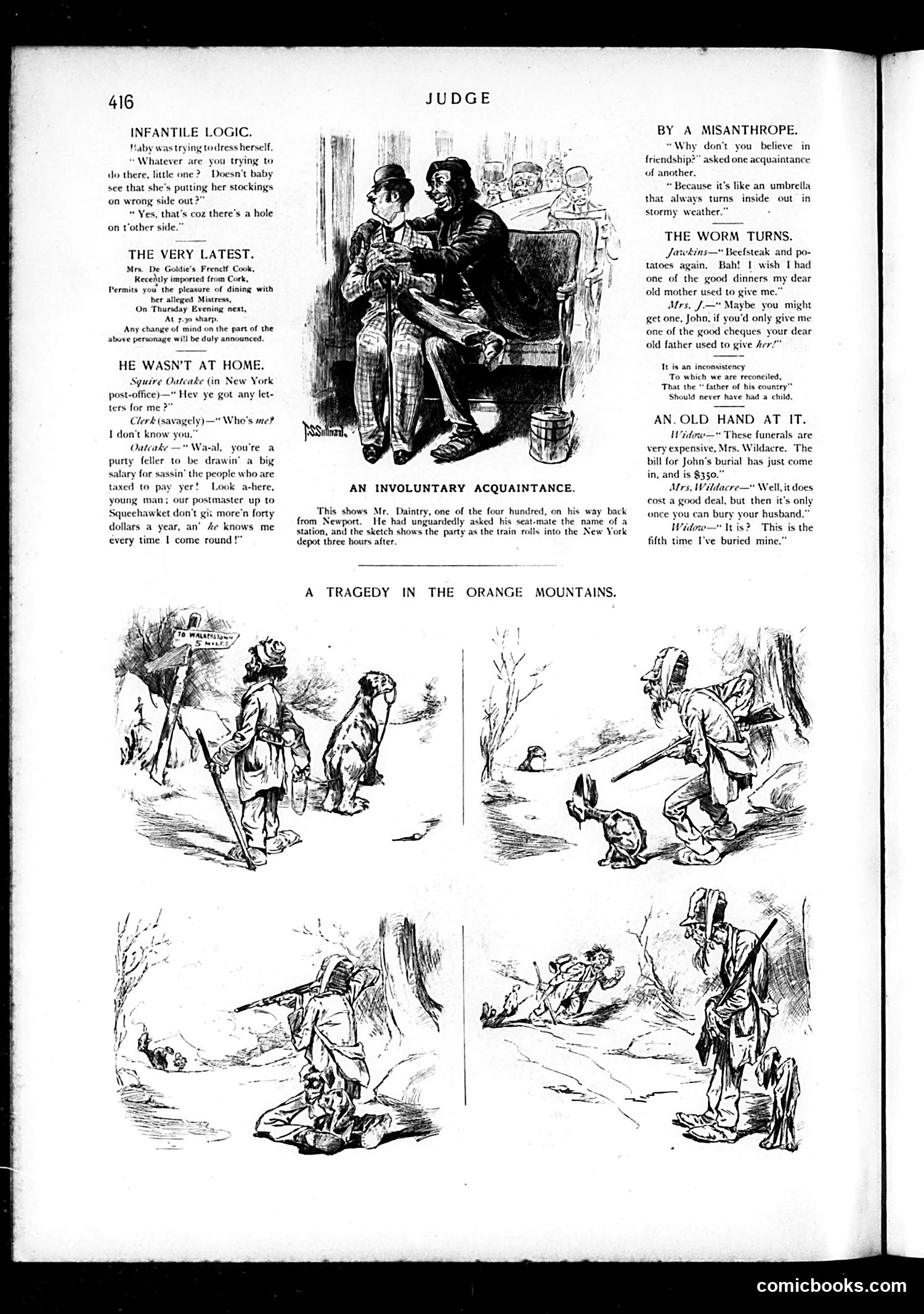
This page contains five separate brief satirical items typical of Judge's format: **"Infantile Logic"**: A simple joke about a child's faulty reasoning—she puts stockings on inside-out because there's a hole on the other side, not grasping the actual problem. **"The Very Latest"**: Satirizes pretentious French cuisine and social climbing. A newly imported "French cook" from Cork (Ireland, not France) hosts dinners, mocking both the affectation and the immigrant deception. **"He Wasn't at Home"**: Rural satire contrasting a rural postmaster's superior local knowledge with a city clerk's indifference to patrons, poking fun at urban bureaucratic apathy. **"By a Misanthrope"**: A cynical quip about friendship being unreliable like an umbrella that fails in storms. **"The Worm Turns" and "An Old Hand at It"**: Domestic humor satirizing marriage—the first about a wife withholding good meals/money, the second a dark joke about a widow having buried multiple husbands, suggesting either serial marriage or widow-making. **"A Tragedy in the Orange Mountains"**: A four-panel visual narrative about awkward social encounters on trains.
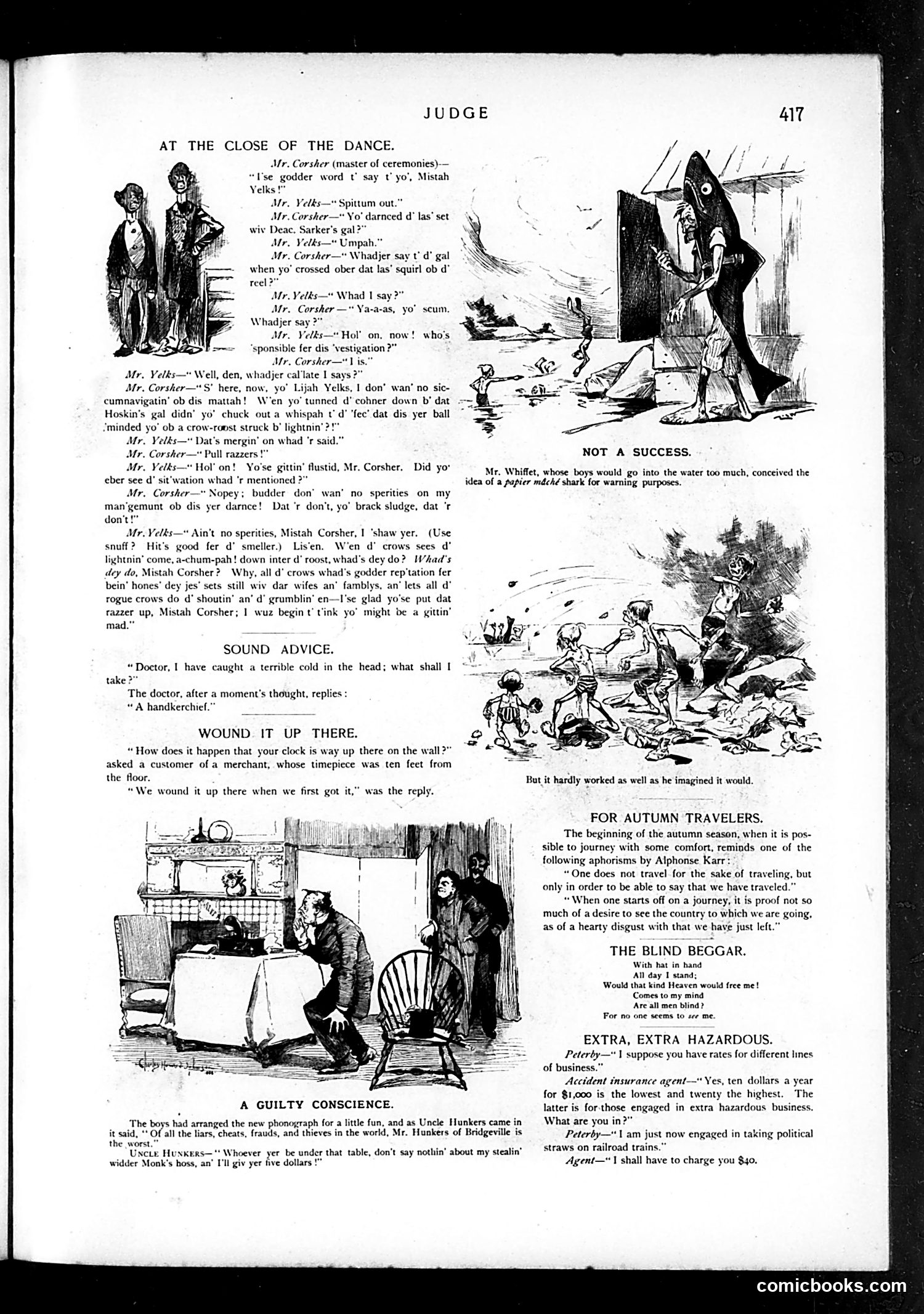
This page contains multiple unrelated satirical pieces typical of Judge magazine's format. **"At the Close of the Dance"** depicts two Black men in dialect-heavy conversation about a dance hall incident. The humor relies on racist stereotypes and exaggerated African American vernacular common to period comedy. **"Not a Success"** shows a man's failed attempt to use a papier-mâché shark to keep his boys out of the water—a visual gag about ineffective parenting devices. **"A Guilty Conscience"** describes a phonograph prank where a machine publicly accuses a man of theft, causing him to panic and offer bribes—satirizing guilt and moral anxiety. **"For Autumn Travelers"** quotes philosopher Alphonse Karr's observations about travel motivations (status-seeking, escape from home). **"Extra, Extra Hazardous"** jokes that taking political surveys on trains—presumably amid heated debate during an election season—constitutes such dangerous work that insurance rates skyrocket to $40 annually. The page reflects early 20th-century American humor: racist caricature, slapstick, wordplay, and commentary on contemporary social anxieties.
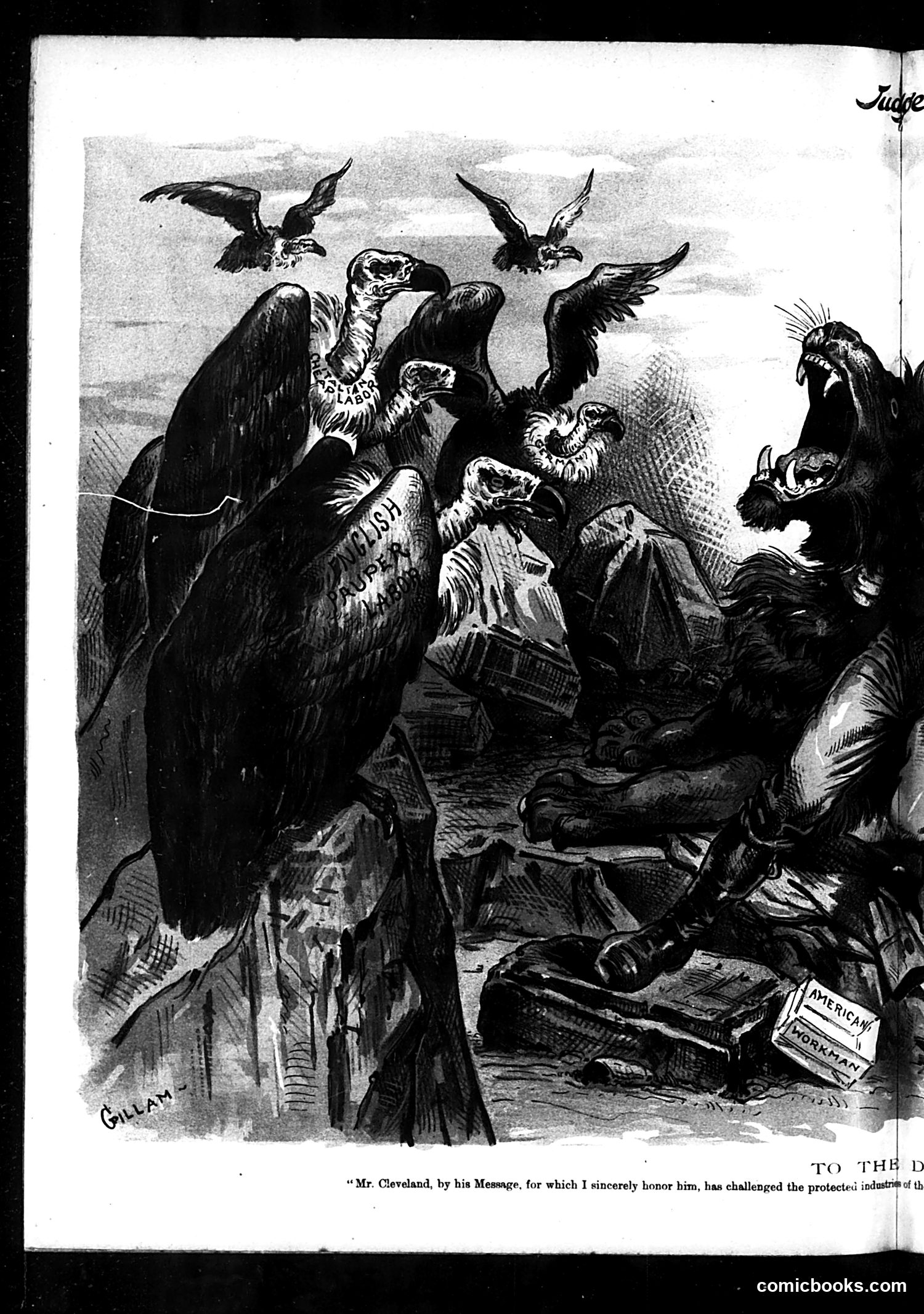
This is a satirical cartoon by Gillam critiquing President Cleveland's message regarding tariff policy. The image depicts vultures labeled with American industries (text partially visible: "LABOR," "BRITISH") surrounding and attacking a human figure, likely representing American workers or industries. The cartoon argues that Cleveland's challenge to protective tariffs—policies that shield American industries from foreign competition—would unleash destructive forces (represented as scavenging vultures) on protected American industries and labor. The "American Workman" label visible on a document suggests the satire targets the impact on workers. This reflects the fierce 19th-century debate over tariffs, with Cleveland's free-trade position opposed by those who believed protectionist policies safeguarded American jobs and industry.
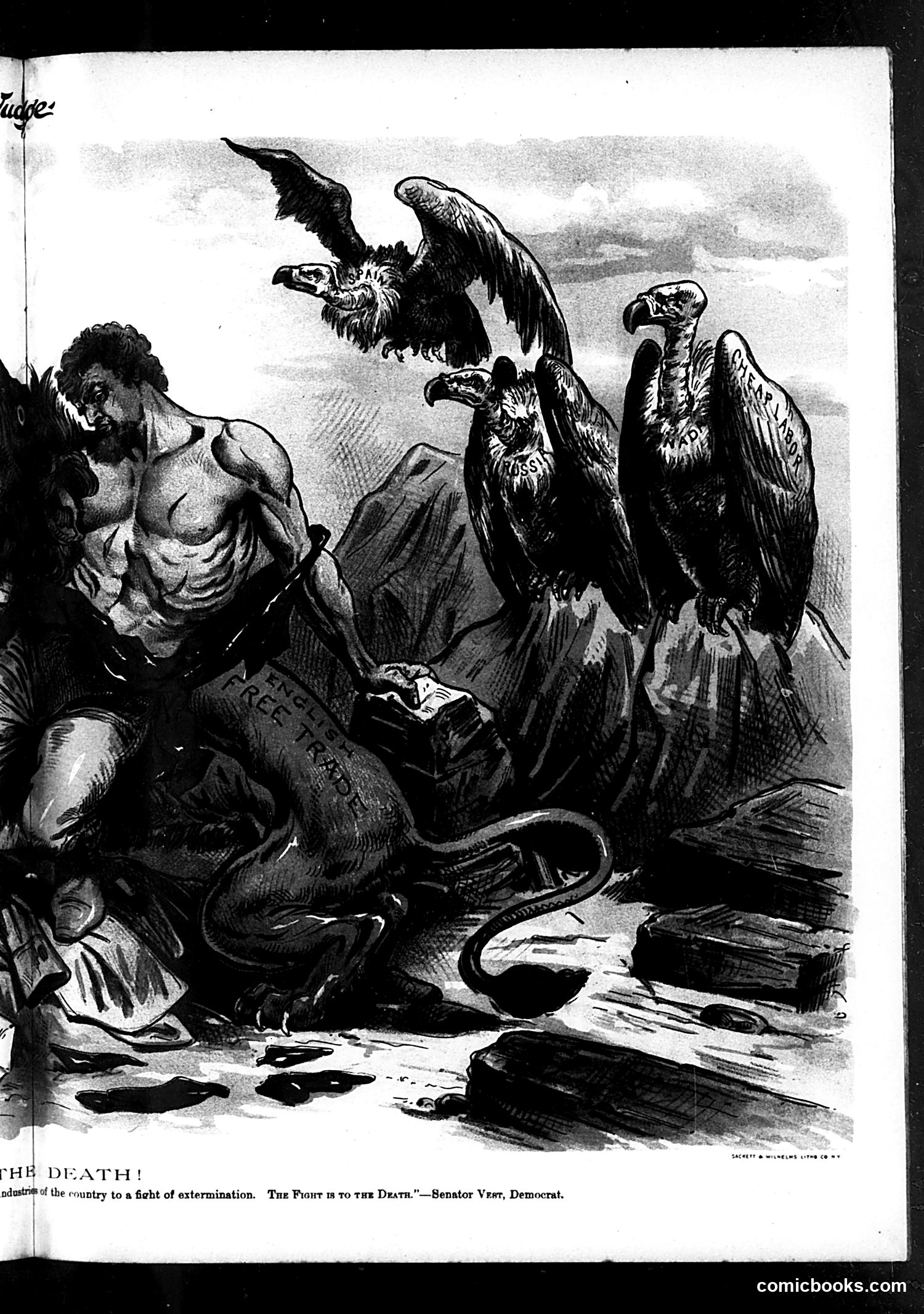
This Judge magazine cartoon illustrates a quote from Senator Vest (Democrat), warning that the nation faces "a fight of extermination" and "the front is to the death." The image depicts a shirtless man—likely representing the American nation or industry—confronted by three aggressive eagles (symbols of militarism or political opposition). The man appears wounded or embattled, surrounded by scattered debris and weapons. The satire appears to critique the Democrats' apocalyptic rhetoric about political conflict, suggesting they exaggerate threats to the country as existential warfare. The vultures/eagles may represent Republican opposition or expansionist policies. The cartoon mocks the sensationalized language of partisan politics, presenting the senator's dire warnings as overwrought and destructive to national stability.
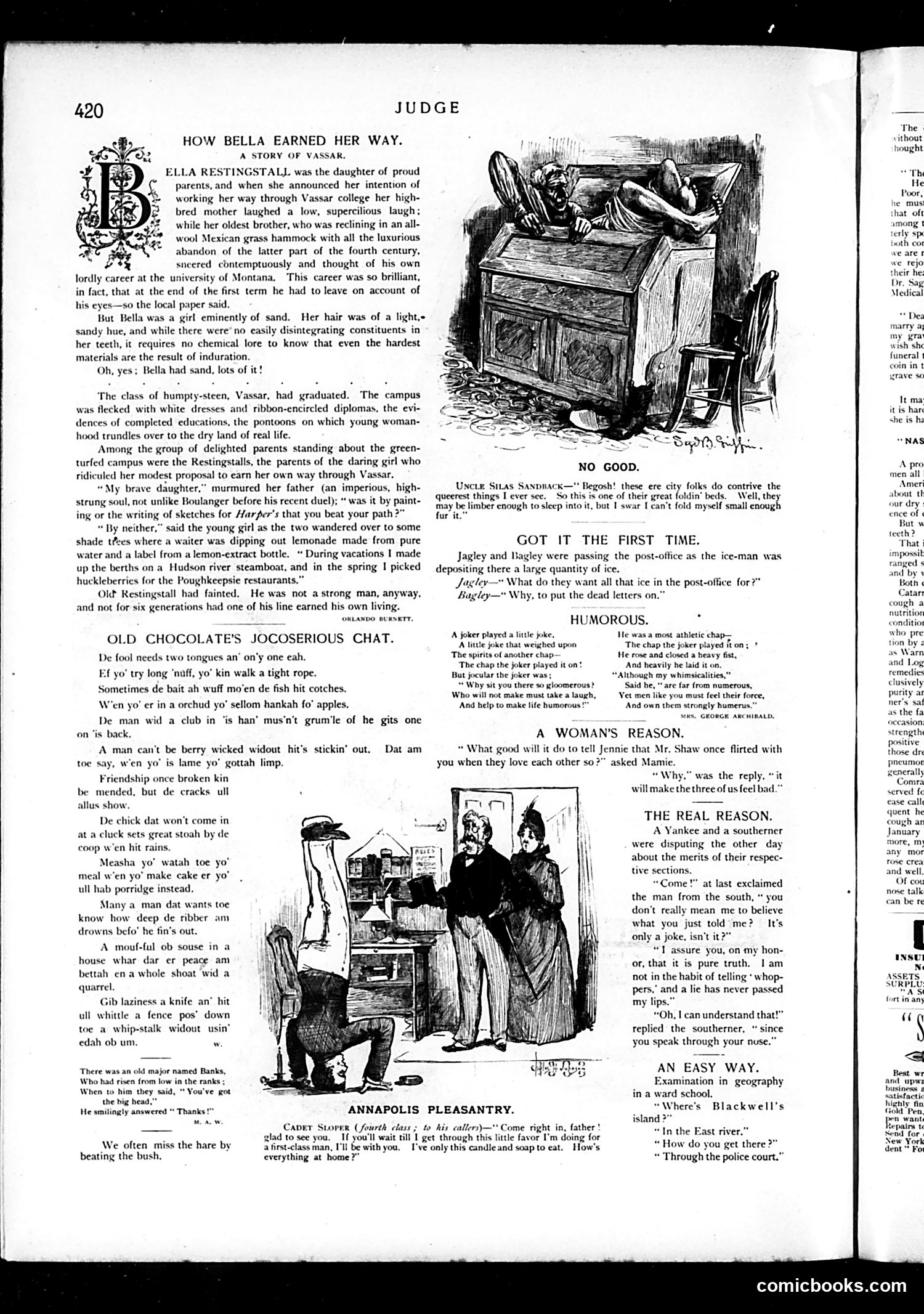
This page contains multiple short humorous pieces typical of Judge magazine's satirical format. **"How Bella Earned Her Way"** is the main feature—a satirical story mocking wealthy, idle aristocrats. Bella Restingstall shocks her snobbish family by working her way through Vassar College (a prestigious women's institution). Her mother and brother—who lounges in luxury—sneer at manual labor. The joke targets the hypocrisy of the upper class: they consider honest work beneath them, yet one family member apparently left university under dubious circumstances ("on account of his eyes"). Bella's determination to earn money through steamboat work and berry-picking humbles her father, who faints at learning his family has actually *worked*. The page also includes several brief jokes and aphorisms in "Old Chocolate's Jocoserious Chat" (written in dialect humor typical of the era), short comic anecdotes, and an illustration showing two women in a kitchen scene. The satire ridicules inherited wealth, snobbery about manual labor, and celebrates self-reliance.
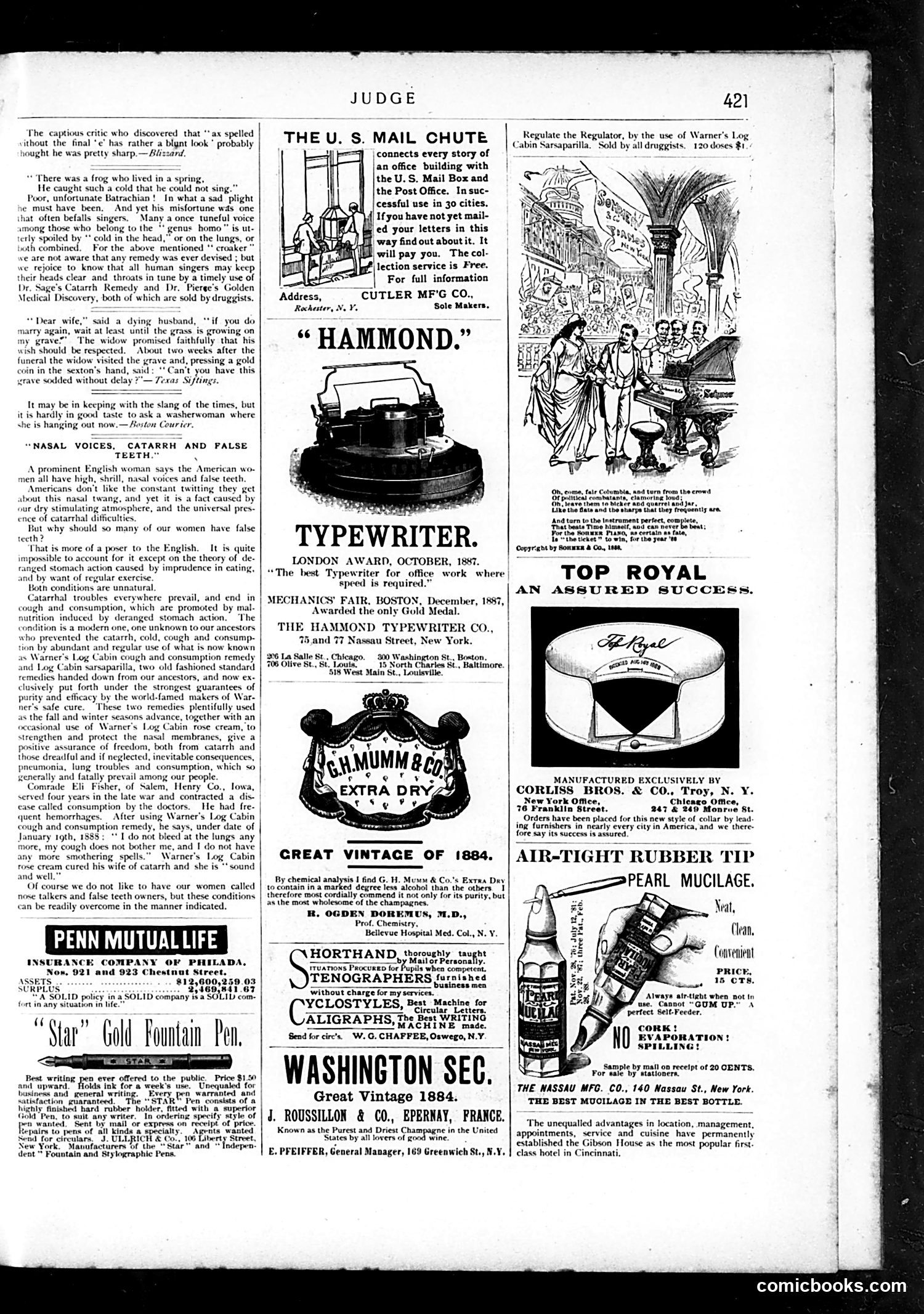
This page is primarily **advertising**, with minimal satirical content. The main cartoon depicts a street scene with figures in Victorian dress, but lacks clear political messaging—it appears to be generic urban genre illustration. The page's dominant content consists of patent medicine advertisements and testimonials, reflecting late-19th-century publishing practices. Notable ads include Dr. Sage's Catarrh Remedy, Hammond Typewriters, and Warner's Log Cabin products, each making exaggerated health claims typical of the era. One brief satirical item mocks American women, claiming they have "high, shrill, nasal voices and false teeth"—a stereotype the text attributes to America's "dry stimulating atmosphere" and poor diet/exercise. This reflects period xenophobia and gender attitudes. The page demonstrates how Judge, despite its satirical reputation, relied heavily on patent medicine advertising revenue, which dominated American magazines of this period.
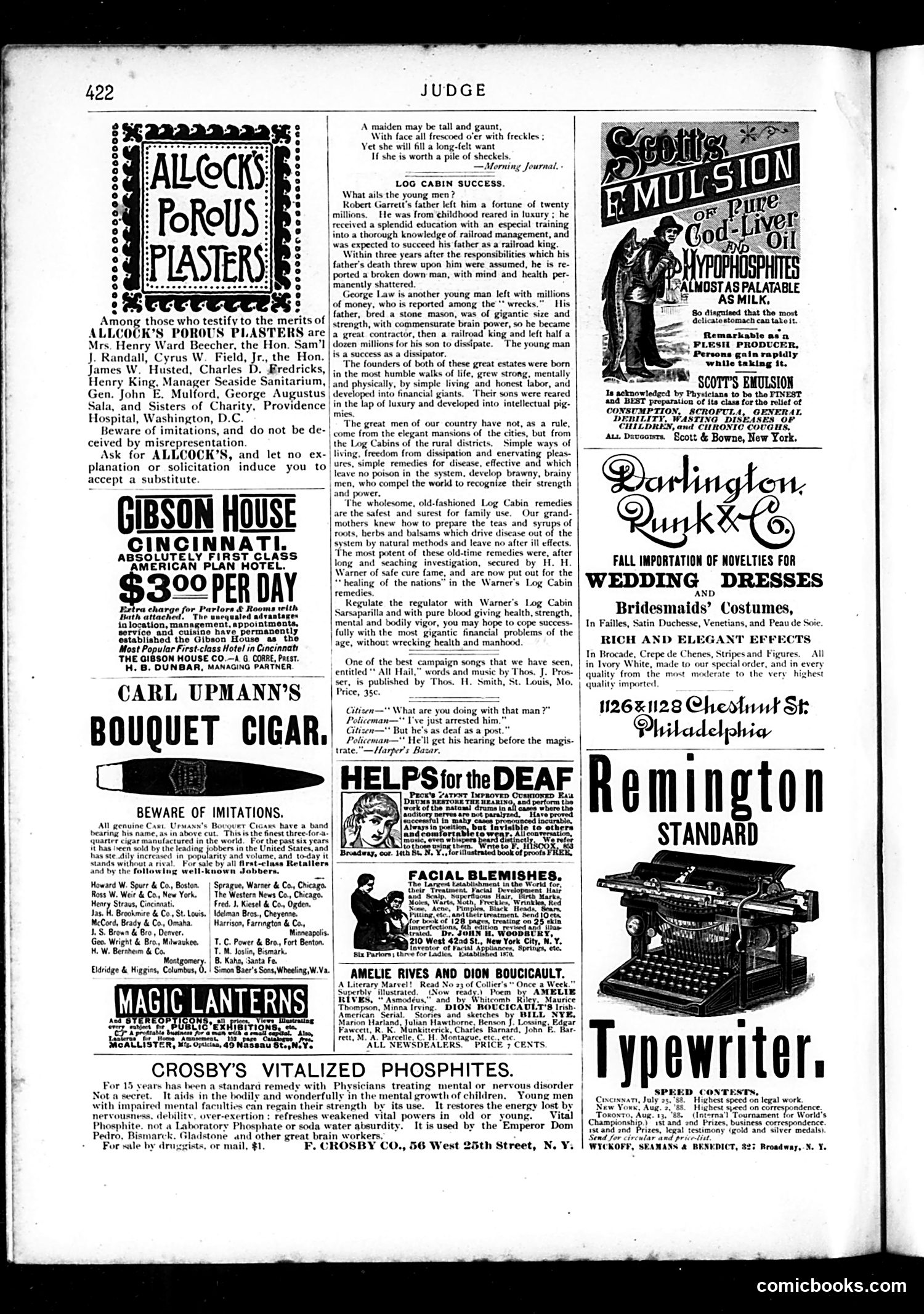
This page is primarily **advertisements with one editorial article**, not political satire. The main editorial content discusses the decline of wealthy young men (Robert Garrett and George Law) who inherited millions but became "wrecks" or dissipators, contrasting them with their self-made fathers who rose from poverty. The piece advocates "Log Cabin" values—simple living, hard work, and honest labor—as superior to luxury-bred weakness. This reflects 19th-century American ideology romanticizing frontier self-reliance over inherited privilege. The advertisements emphasize authenticity and warn "Beware of Imitations"—for Allcock's Porous Plasters, Carl Upmann's Bouquet Cigars, and other products. This reflects widespread concern about counterfeit goods in the period. Other ads promote hotels, typewriters, bridal costumes, and patent medicines (like Crosby's Vitalized Phosphites for "mental or nervous disorder"). There is **no political cartoon** visible on this page—it's primarily commercial.
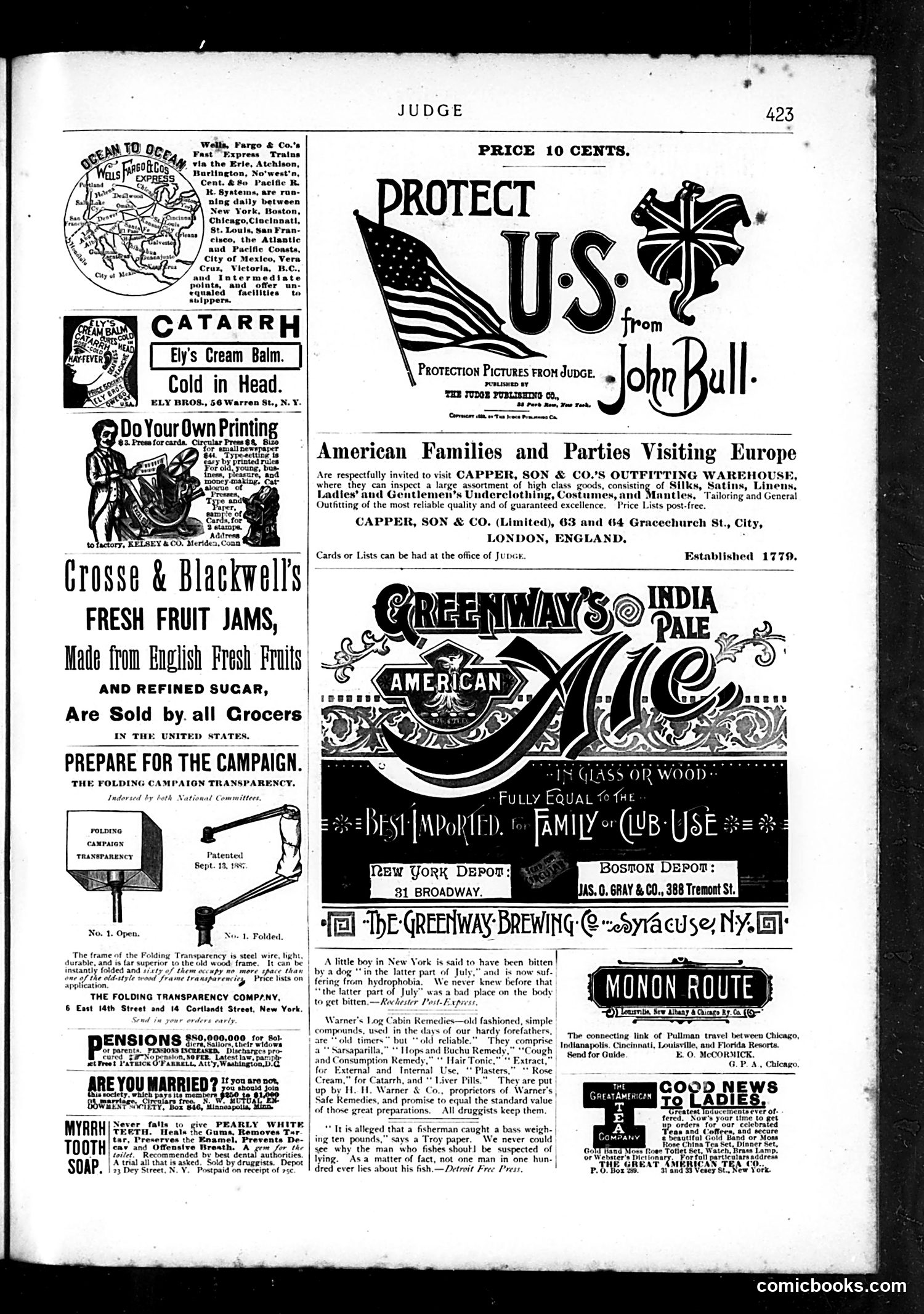
This is primarily an **advertising page** with one minor satirical piece embedded among the ads. ## The Satire The small text items scattered throughout are brief jokes, likely filler: - A quip about a boy bitten by a dog "in the latter part of July"—mocking the absurd notion that the *time of day* affects rabies risk - A jab at fishermen who exaggerate catches, sarcastically suggesting they never actually lie about fish These are light, generic humor pieces with no specific political targets. ## The Advertisements The page is dominated by period product ads: patent medicines (Ely's Cream Balm, Warner's Log Cabin Remedies), jams, tooth soap, pensions information, and notably—a campaign transparency device (apparently endorsed by "both National Committees"), suggesting this was published during an election year. The largest advertisement promotes "Protect U.S." protection pictures by John Bull, though the specific meaning is unclear from the visible content.
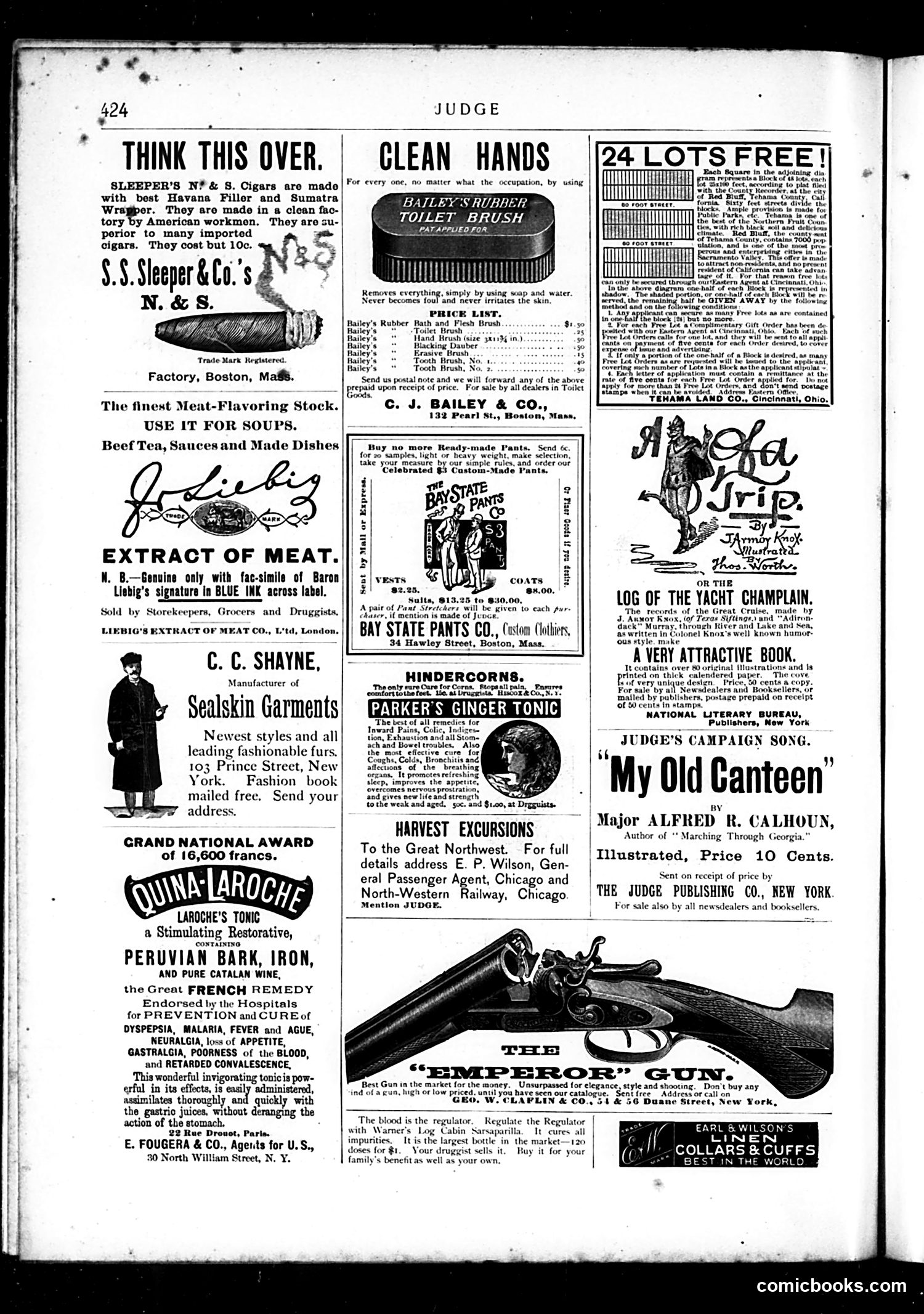
This page is **primarily advertising**, with no visible political cartoons. It's a typical late-19th or early-20th century magazine advertisement section featuring patent medicines, clothing, and consumer goods. Notable ads include: - **Liebig's Extract of Meat** and **Laroche's Tonic**—patent medicines claiming to cure dyspepsia, malaria, and various ailments (common snake-oil remedies of the era) - **Bailey's Rubber Toilet Brush**—marketed for hygiene - **Sealskin Garments** and **Bay State Pants**—clothing - **Parker's Ginger Tonic** and **Quinaroche**—tonics The page includes promotional materials for books like "Log of the Yacht Champlain" and Judge's own campaign song. The only possibly satirical element is the page's title "THINK THIS OVER" paired with an advertisement for cheap cigars, but this appears to be standard promotional copy rather than editorial commentary. The page functions as a revenue-generating advertising section typical of magazines from this period.
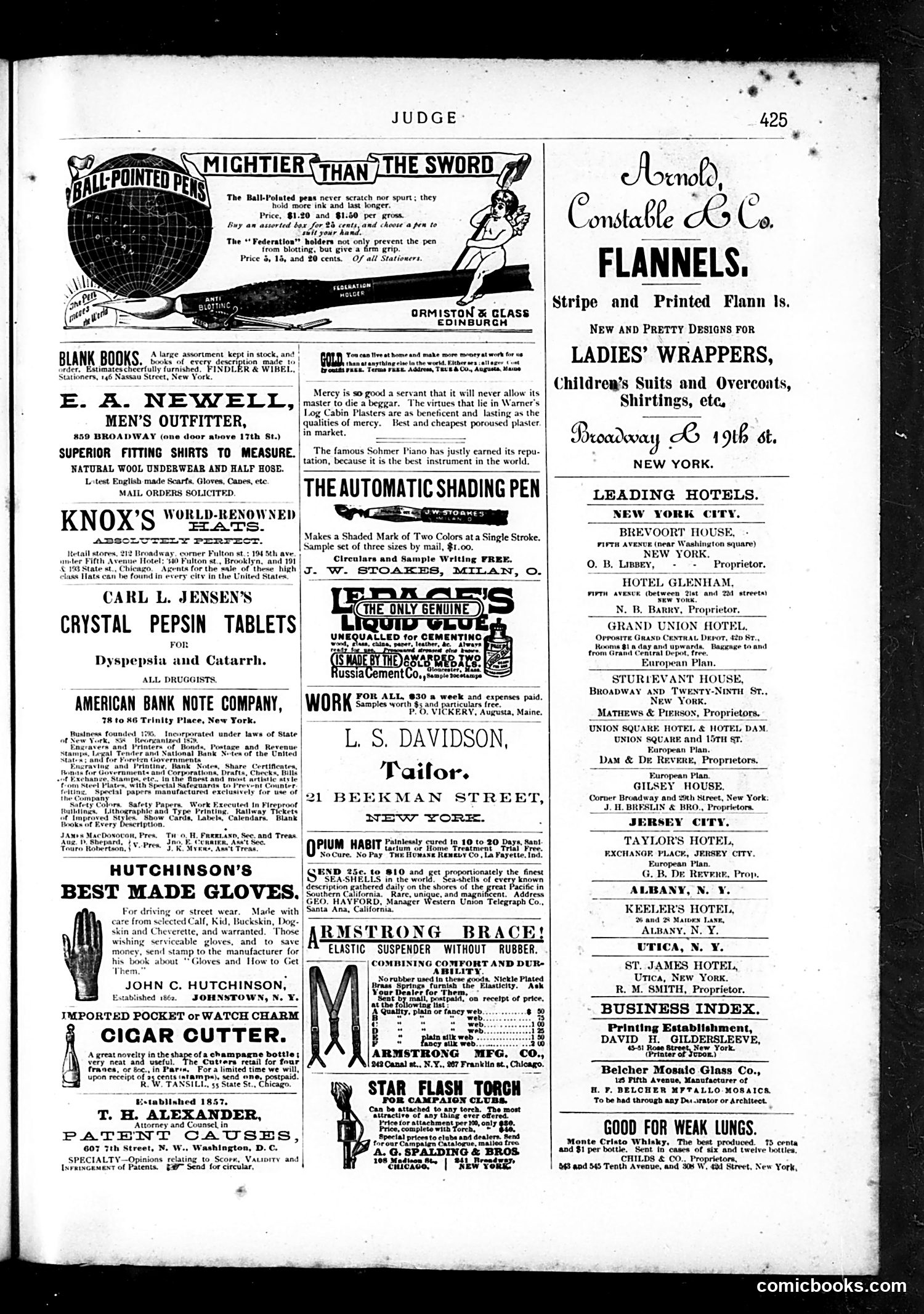
This page is essentially an **advertising section** from Judge magazine, not primarily a satirical cartoon page. The only substantive visual content is a small advertisement at the top-left for "Ball-Pointed Pens" by Ormiston & Glass (Edinburgh), depicting a ball-point pen with its globe-shaped nib. The surrounding copy emphasizes the pen's durability and non-blotting properties. The rest of the page consists of classified advertisements for goods and services typical of the era: men's outfitters, gloves, office supplies, patent attorneys, hotels in New York City, and various medicinal products (crystal pepsin tablets for dyspepsia, plasters, etc.). **There is no political satire or cultural commentary visible on this page**—it appears to be a straightforward commercial directory or advertising compilation rather than editorial content. Modern readers seeking Judge's characteristic satirical content would need to look elsewhere in the magazine.
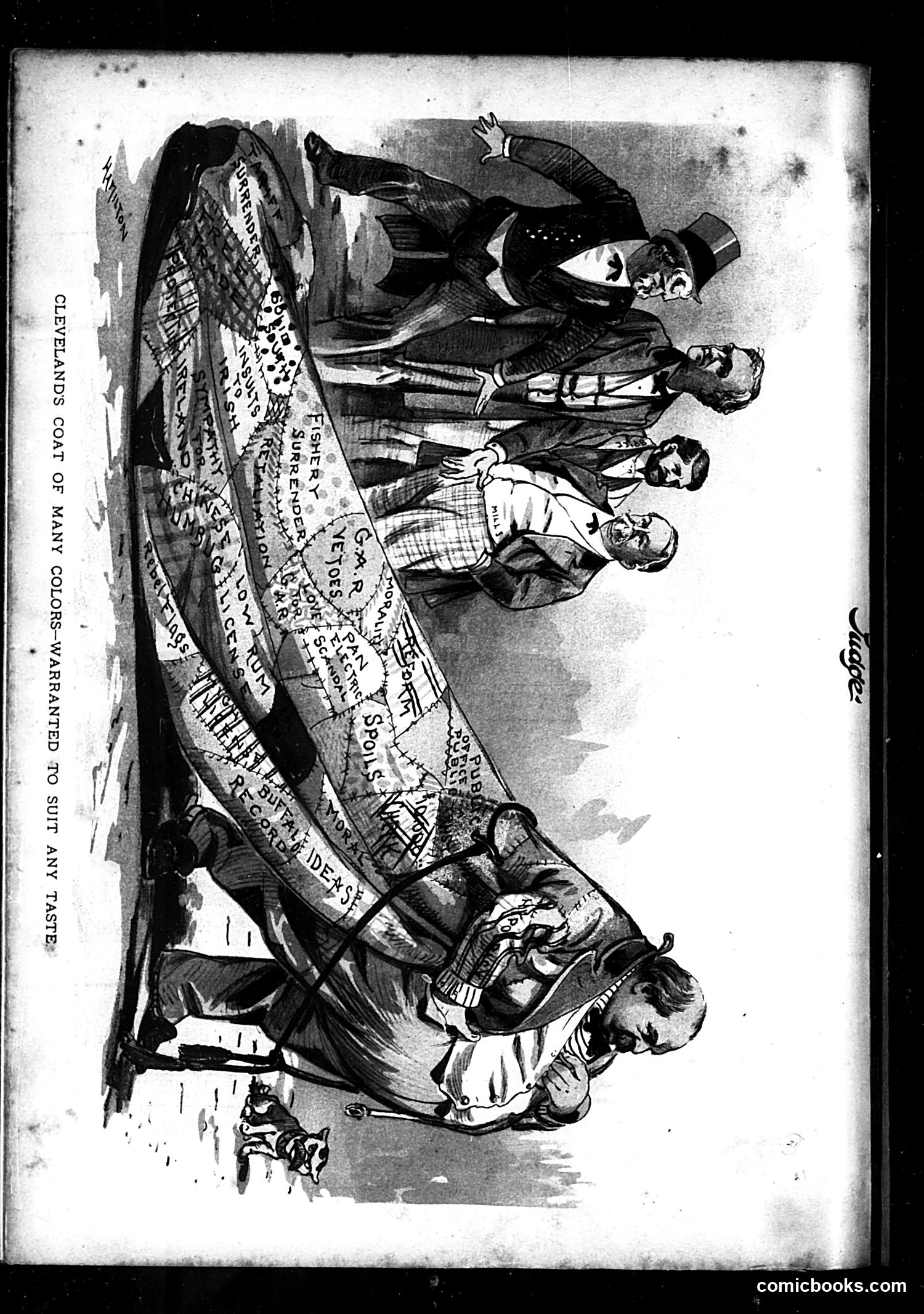
This political cartoon satirizes President Grover Cleveland as a coat of many colors—a reference to the biblical "coat of many colors" symbolizing inconsistency or changeability. The image shows Cleveland depicted as a garment with various patterns and text labels representing different political positions or promises. The satire suggests Cleveland was opportunistically adopting contradictory stances to appeal to different constituencies ("warranted to suit any taste"). Multiple figures are shown wearing or examining different sections of this "coat," implying various groups believed Cleveland represented their interests—when in fact his positions were inconsistent or self-serving. This reflects common late-19th-century criticism that Cleveland shifted his political positions to maintain political viability during his presidency.

I cannot reliably analyze this page. The image is extremely dark and degraded, with minimal visible detail beyond vertical striping on the left and right edges. The OCR text appears to be largely corrupted characters and fragments, providing no coherent content to work from. To properly identify political figures, satirical targets, and historical context—as requested—I would need either a clearer image or legible text. Without these, any interpretation would be speculation rather than analysis grounded in what the source actually shows. If you have a higher-quality scan of this Judge magazine page, I'd be happy to provide the historical analysis you're seeking.