
A complete issue · 16 pages · 1888
Judge — September 22, 1888
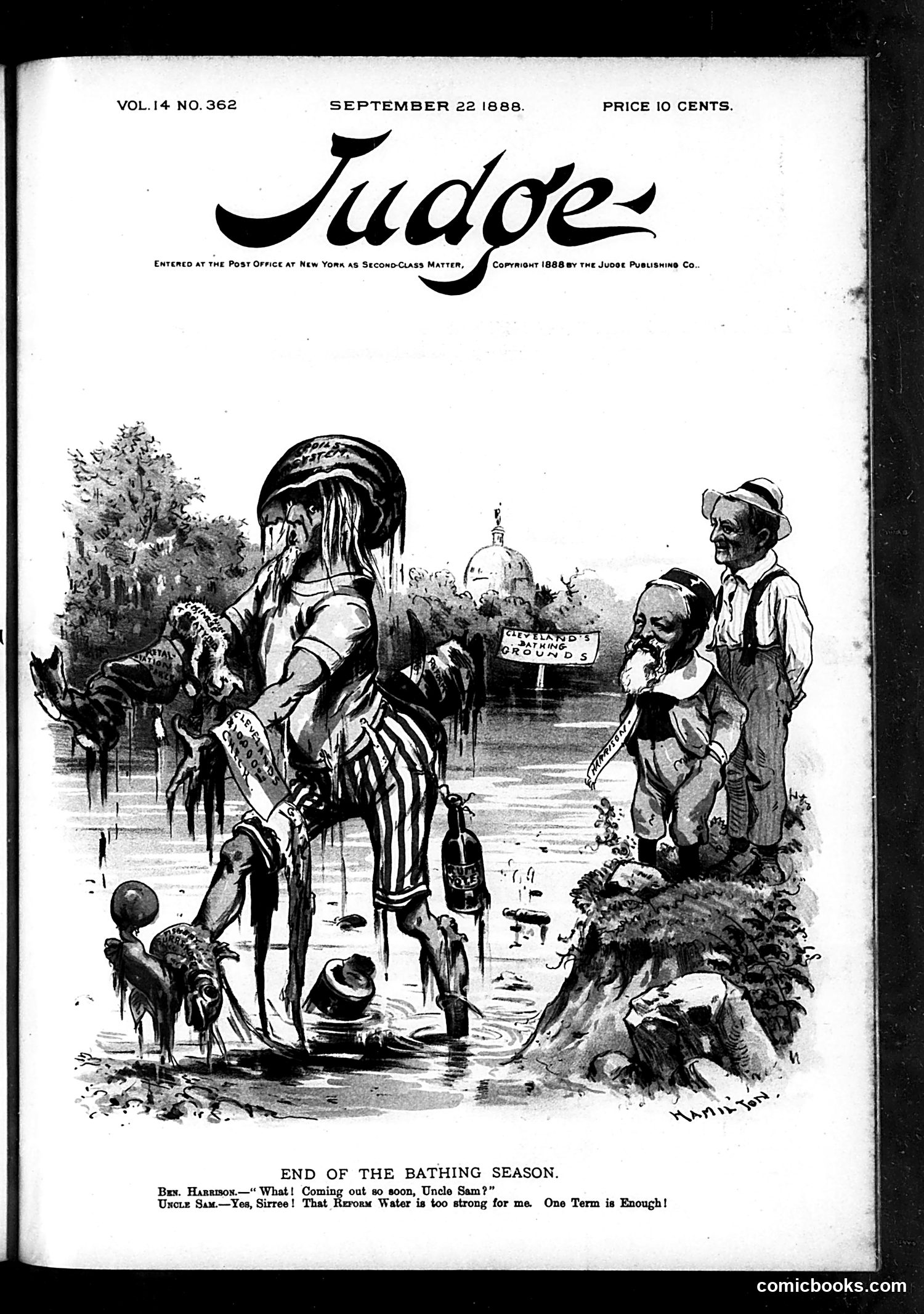
This 1888 Judge cartoon satirizes the uncomfortable end of summer bathing season. Ben Harrison (likely President Benjamin Harrison, based on the era) emerges from the water in Reform Water—a reference to political reform efforts or possibly a specific location. Uncle Sam, depicted as an older bearded man, comments that the "Reform Water is too strong for me. One Term is Enough!" The joke operates on multiple levels: the literal discomfort of cold water ending the bathing season, combined with political commentary. "One term" suggests Uncle Sam's reluctance about Harrison's political agenda or another candidate serving only one presidential term. The cartoon uses the innocent summer bathing scenario to critique contemporary political issues, a typical Judge approach blending social observation with political commentary.
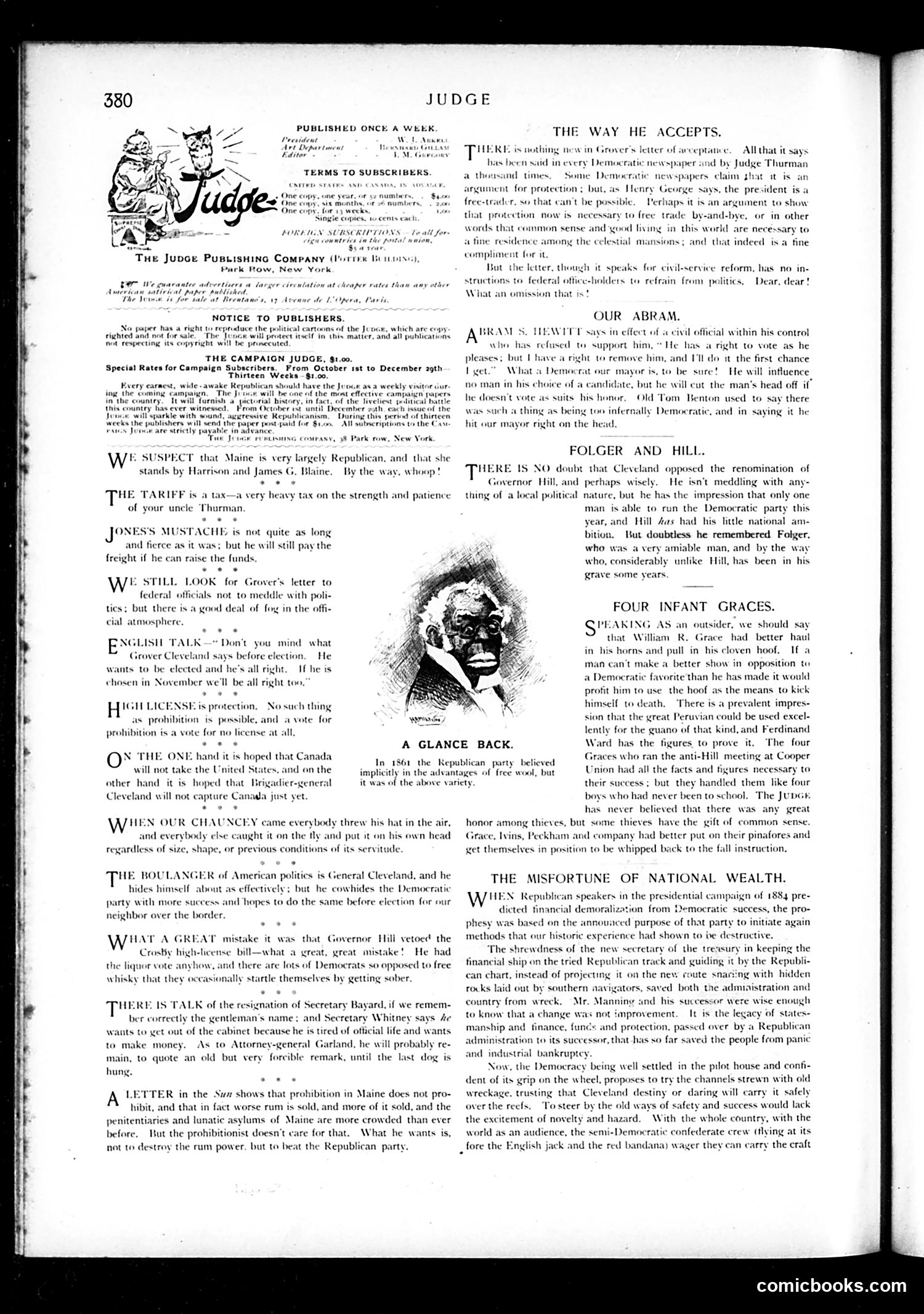
The page contains political commentary and editorial sections rather than cartoons. A caricatured face labeled "A GLANCE BACK" appears mid-page but lacks clear identification. The text discusses 1884 Republican and Democratic politics, critiquing the Democratic party's financial management and the presidential campaign. References include "Governor Hill," "Folger and Hill," and commentary on free trade versus tariff protection. One section mocks a Democrat claiming protection is necessary while supporting free trade—a contradiction. Another criticizes Democratic financial stewardship and compares it to Republican governance. The overall thrust: Judge, a Republican-leaning publication, attacks Democratic hypocrisy and competence regarding economic policy during the 1884 election cycle. Without clearer image resolution, specific figure identifications remain uncertain.
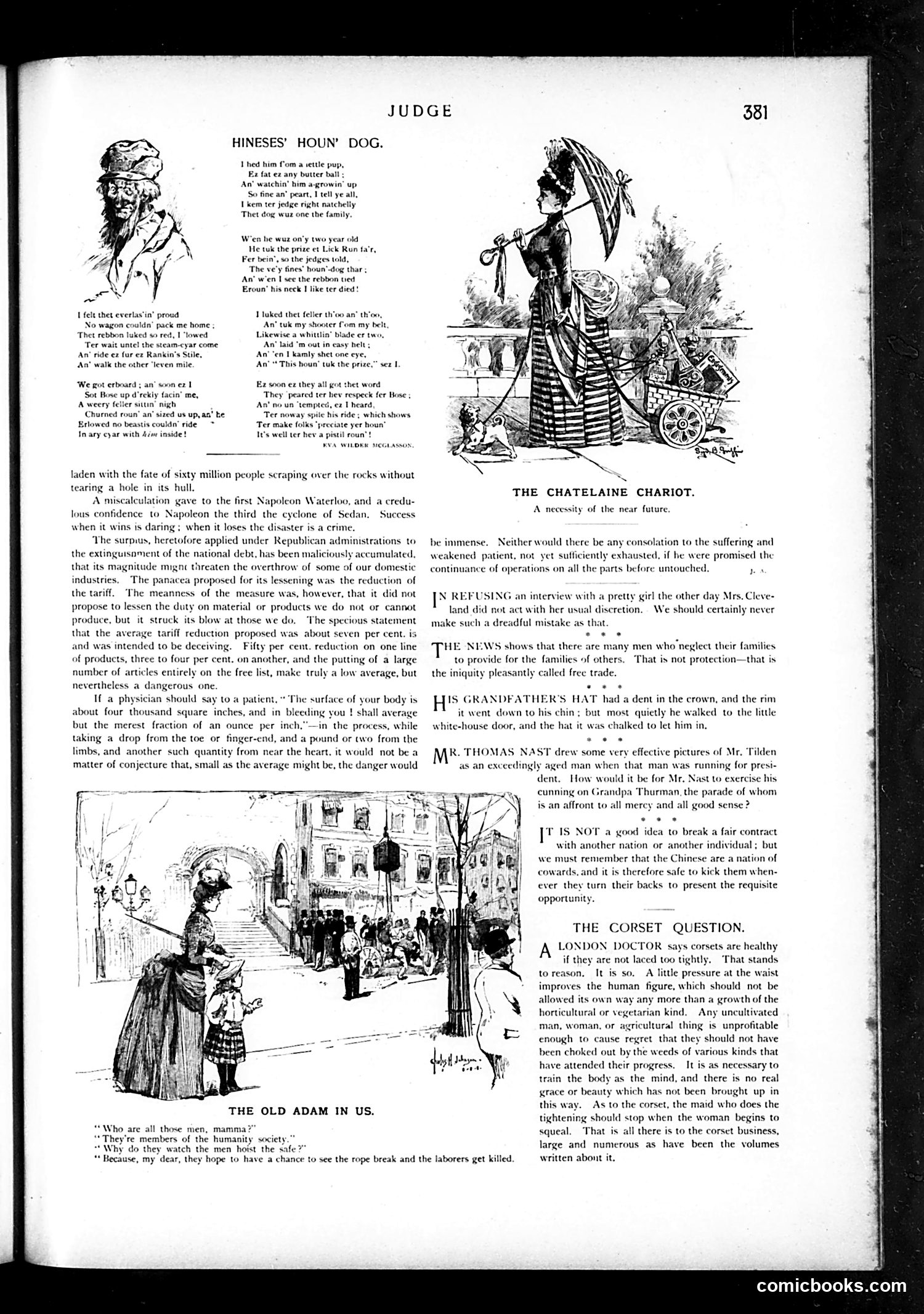
This page contains several satirical pieces from Judge, a late 19th-century American humor magazine: **"Hineses' Houn' Dog"** is a dialect poem celebrating a prize-winning hunting dog, written in rural Southern vernacular. The joke culminates when the narrator reveals he threatened fellow passengers with a gun to prevent them from bothering his dog—the "pistol" being the ultimate social currency for gaining "respect." **"The Chatelaine Chariot"** shows a fashionably dressed woman with an elaborate parasol in a baby carriage, captioned as "a necessity of the near future"—satirizing upper-class women's vanity and leisure. The page also contains political commentary criticizing tariff reduction policy, comparing it to bloodletting that averages small loss but causes severe localized damage. "The Old Adam in Us" jokes darkly that a "humanity society" watching workers hoist a safe actually hopes for a fatal accident. The content reflects Judge's conservative, anti-reform editorial stance and its humor rooted in class observation and period stereotypes.
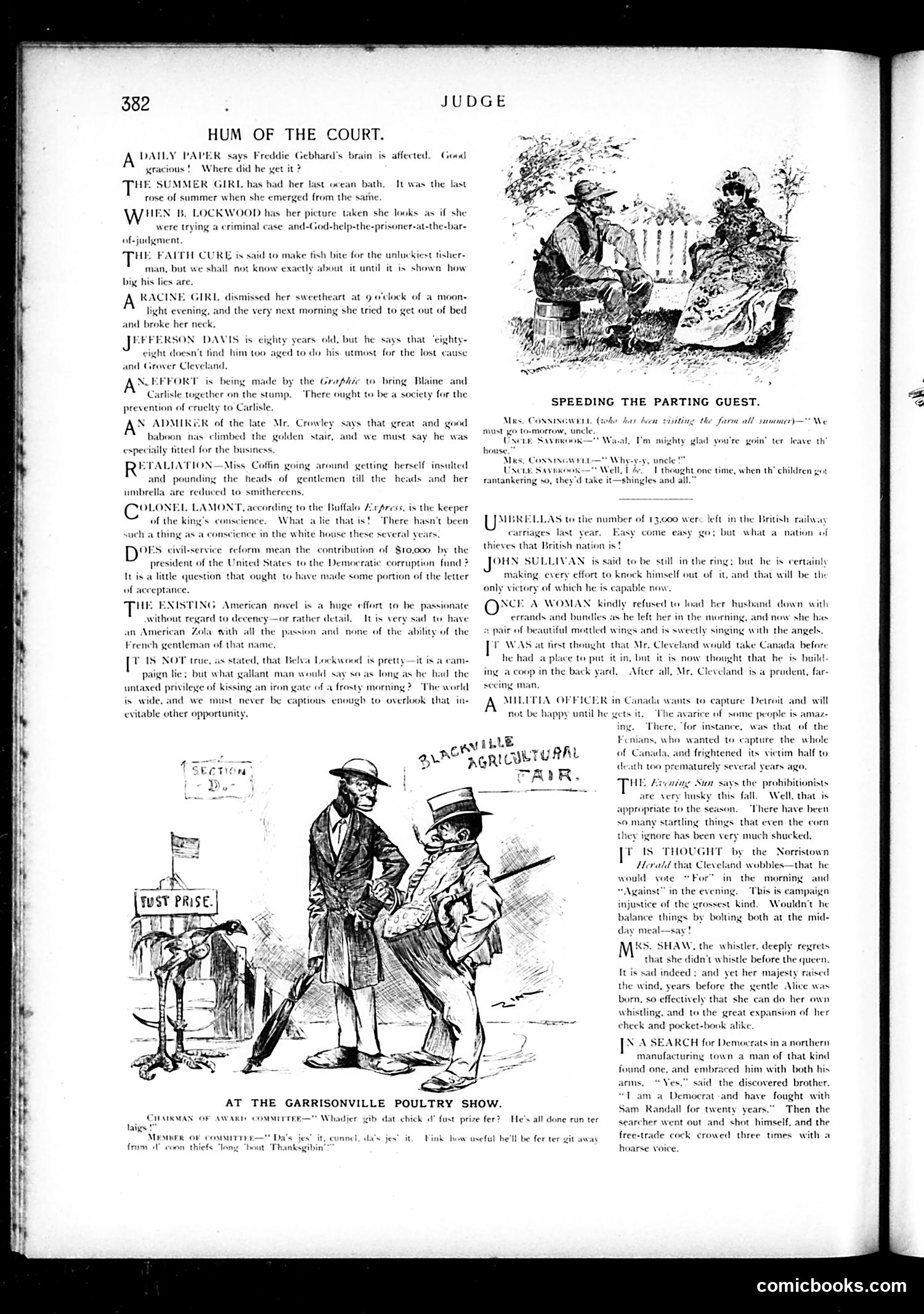
This page contains brief satirical jabs at contemporary figures and events (likely 1880s, based on references to Cleveland and Blaine). The cartoons mock: **Top cartoon ("Speeding the Parting Guest")**: A country uncle bluntly tells his visiting niece he's "mighty glad" she's leaving—crude frontier humor about unwanted houseguests. **Bottom cartoon ("At the Garrisonville Poultry Show")**: Rural dialect humor about a livestock competition, where a committee chairman uses exaggerated backwoods speech. The text items lampoon politicians (Jefferson Davis, Cleveland), social figures (Freddie Gebhard, Belva Lockwood—a real political candidate), current events (faith healing, civil service reform), and cultural trends (American novels). The humor relies on wordplay, irony, and stereotypes typical of 1880s satirical magazines.
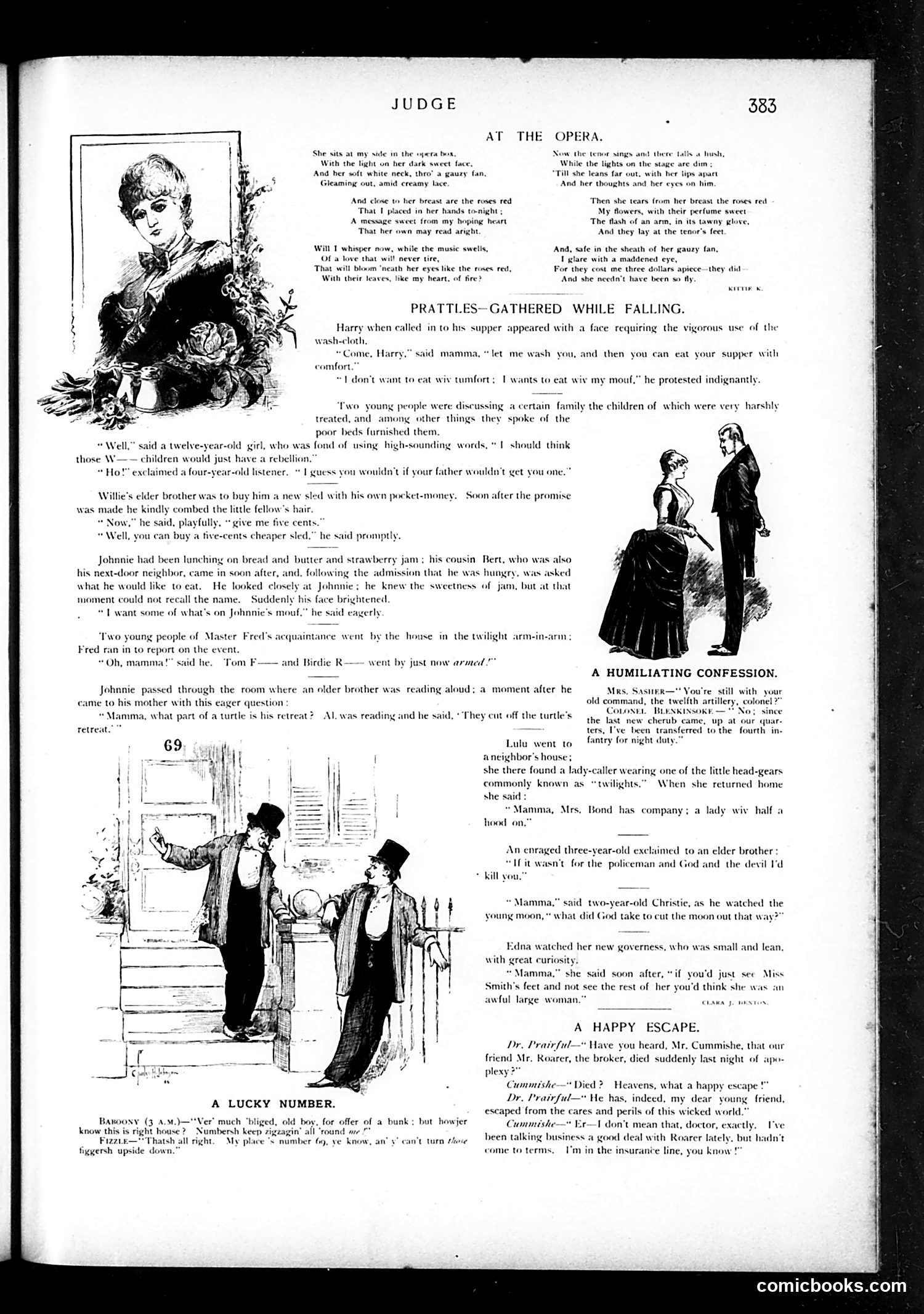
This page from *Judge* contains several unrelated humorous sketches typical of the magazine's format. **"At the Opera"** (top): A romantic poem with illustration depicting a gentleman who placed roses in his date's hands at the opera, only to watch her toss them to the tenor on stage. The satire targets both romantic pretension and female fickleness—the man's elaborate gesture and emotional investment are casually discarded for the glamorous performer. The final complaint about the roses costing "three dollars apiece" undercuts the romance with mercenary reality, satirizing masculine vanity and wasted expense on courtship. **Lower sections**: Brief humorous anecdotes about children's innocent malapropisms and misunderstandings—a boy wanting to eat "wiv my mouf" instead of with comfort, children mishearing "rebellion" and "armed," and misremembering words like "retreat." These mock both childhood logic and parental pretension. The satire throughout is gentle domestic humor rather than political commentary.
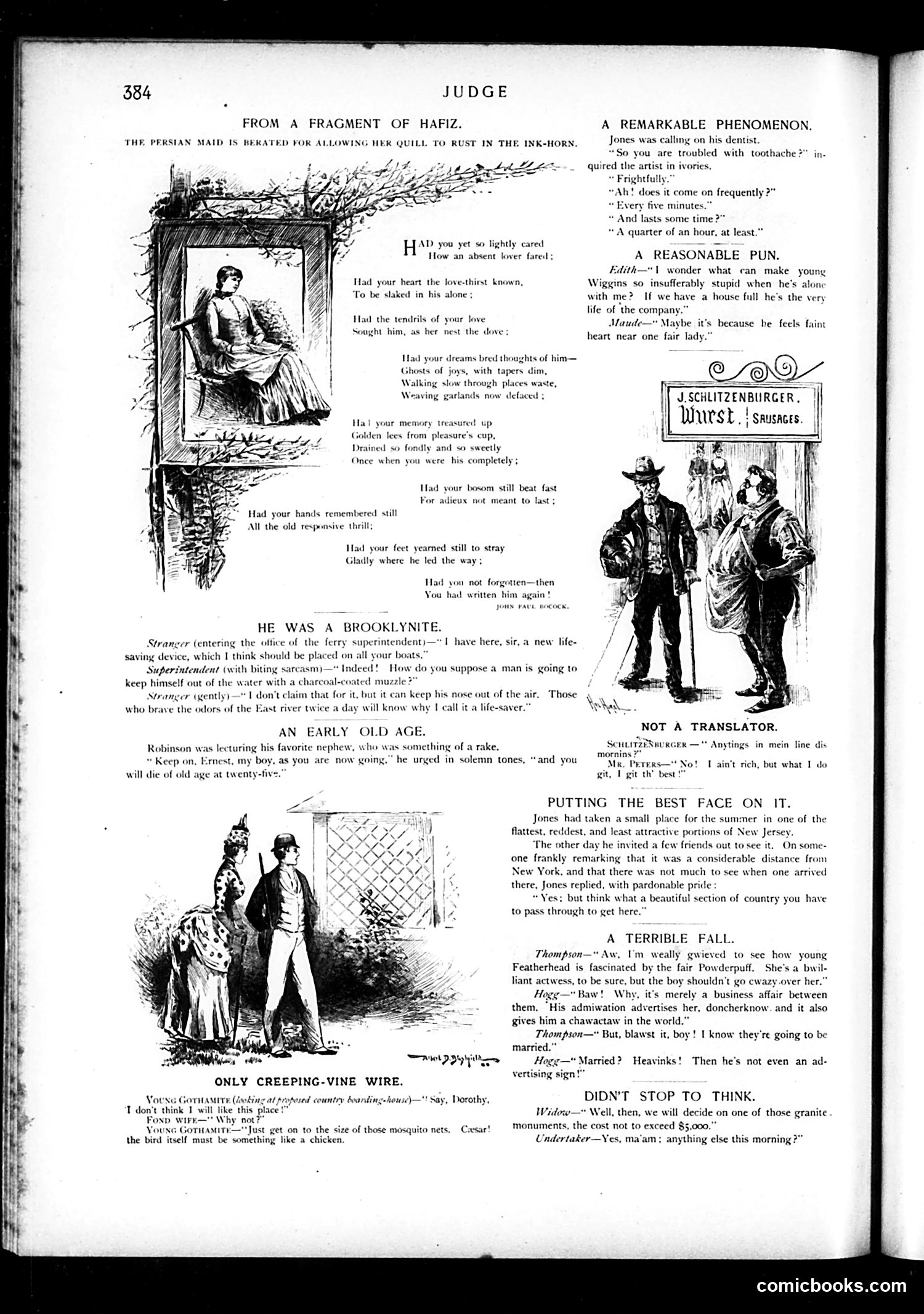
This page contains multiple brief humorous sketches typical of Judge's satirical format: **"A Remarkable Phenomenon"** jokes about a patient with severe toothache lasting 15 minutes every 5 minutes—absurd exaggeration for comic effect. **"A Reasonable Pun"** features wordplay: a young man seems stupid when alone with his girlfriend but charming in groups because he's intimidated ("faint heart"). **"He Was a Brooklynite"** satirizes a Staten Island Ferry commuter pitching a "life-saving device" (charcoal muzzle) to keep noses out of the air—implying the East River smells so foul that regular commuters need protection. This mocks Brooklyn/working-class New Yorkers. **"An Early Old Age"** depicts an uncle lecturing a nephew about dissolute living. **"Putting the Best Face On It"** shows Jones defending his unattractive New Jersey summer place by praising the scenery you pass *through* to reach it—self-deprecating humor. Other sketches cover toothaches, romance, and funeral monuments. The humor is gentle, pun-based, and class-conscious rather than politically pointed.
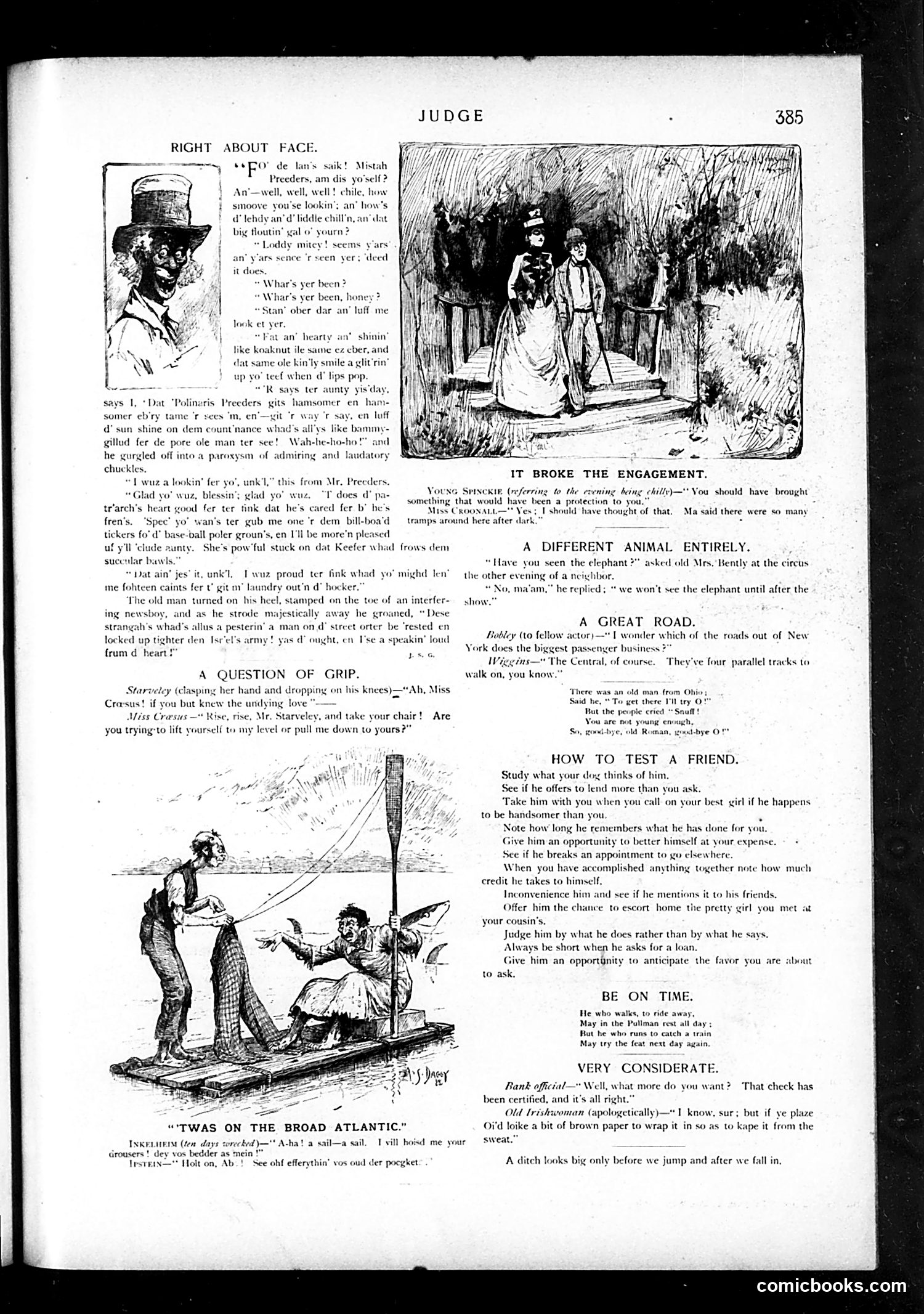
This page contains multiple unrelated satirical pieces typical of Judge's format: **"Right About Face"** features a dialect-heavy conversation between what appears to be an African American man and "Mr. Preeders." The humor relies on stereotypical speech patterns of the era. The narrative involves a complaint about the man's improved appearance and a request for baseball tickets that goes unfulfilled, ending with the rejected party grumbling about "newsboys" and "pesterin'" him. **Other sketches** include romantic comedies ("A Question of Grip," "It Broke the Engagement"), puns about theater and transportation ("A Great Road"), and practical advice columns ("How to Test a Friend," "Be on Time"). **Visual elements** show period illustrations accompanying these pieces, including what appears to be a fishing scene and various character sketches. The page reflects late 19th/early 20th-century American humor conventions: heavy use of ethnic/racial dialect humor, class-based comedy, and sentimental or cynical observations about relationships and social behavior. Most jokes would require period-specific cultural knowledge to fully appreciate.
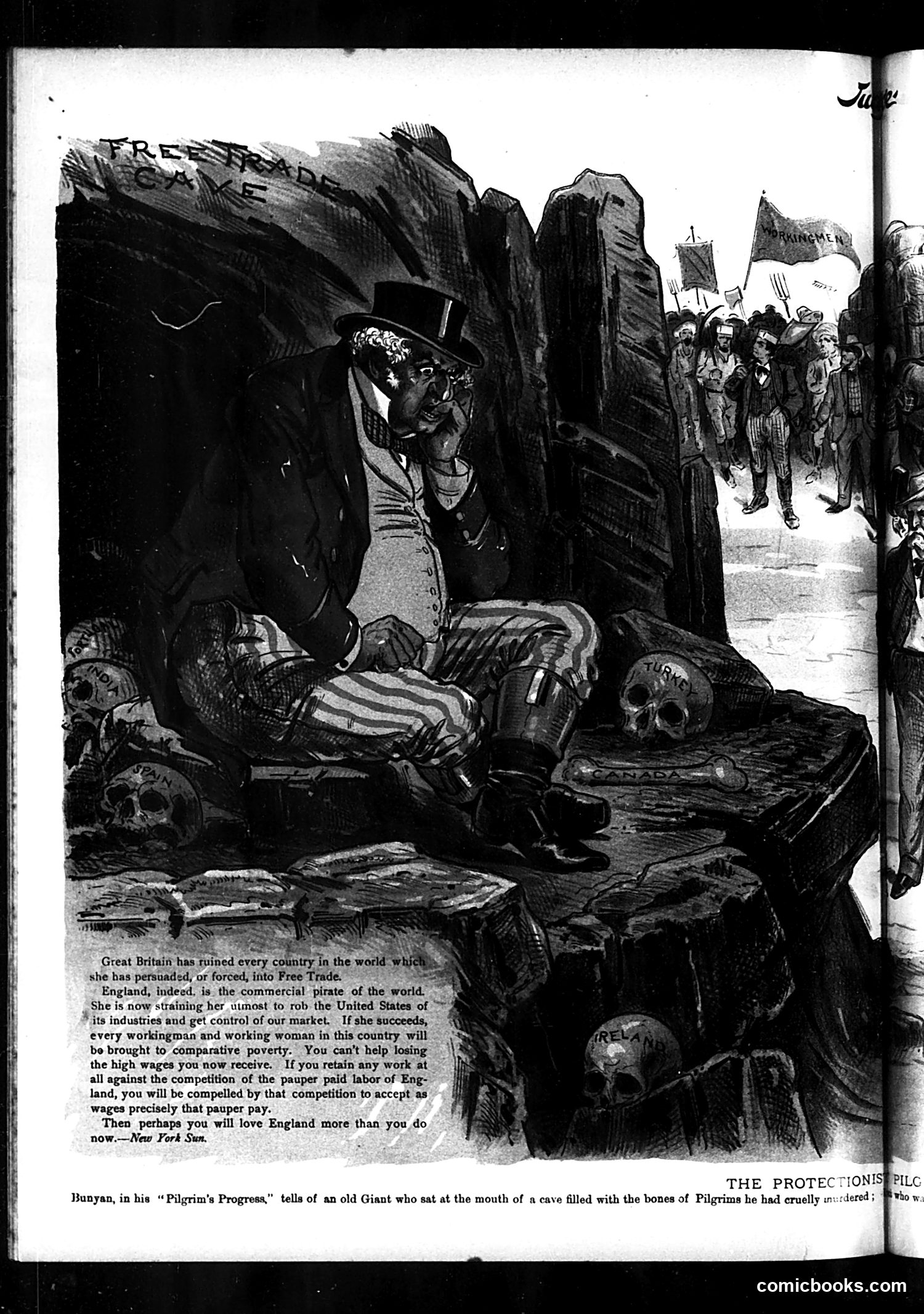
This anti-free-trade cartoon depicts **Great Britain as Death or a skeleton**, seated amid bones and skulls in a cave labeled "Free Trade." The figure wears a top hat and formal dress, personifying Britain as a wealthy but morally corrupt nation. The satire argues that Britain—called "the commercial pirate of the world"—uses free trade to undercut American workers' wages by flooding markets with cheaply-made goods produced by "pauper paid labor." The skeleton imagery suggests Britain's predatory economic policies kill American industry and prosperity. The crowd outside the cave appears to represent American workers and citizens, likely meant to show the nation's population being exploited. The accompanying New York Sun quote warns American workers that accepting free trade will reduce their wages to British poverty levels. This reflects **late-19th/early-20th century protectionist arguments** against free trade, positioning tariffs as necessary to protect American labor from foreign competition.
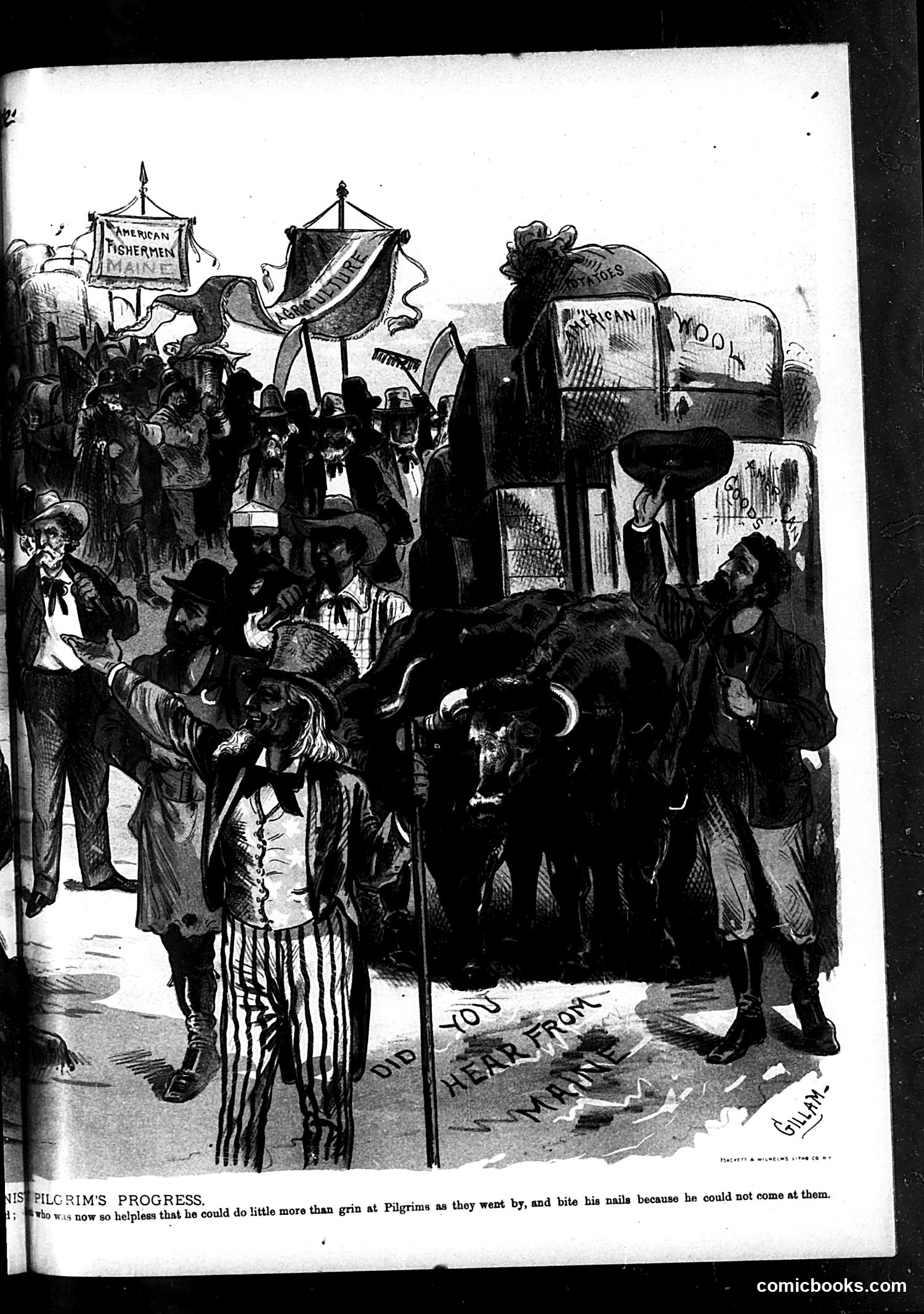
This political cartoon satirizes American industrial and commercial interests as predatory forces. The central figure—a man in striped pants labeled "Pilgrim"—is beset by various threats: oxen labeled "Herr From" (possibly "Here From"), a structure marked "American Wool," and banners including "American Fishermen" and what appears to be trade-related signage. The satire appears to critique how American business monopolies and tariff protections harass or "bite" at ordinary citizens ("Pilgrims") trying to navigate economic life. The pilgrim is depicted as helpless, "grinning" while beset by commercial forces he cannot escape. This likely references late 19th-century concerns about trusts, monopolies, and protectionist trade policies harming average Americans. The cartoon's title invokes *Pilgrim's Progress*, suggesting the citizen's difficult journey through an obstacle course of corporate interests.
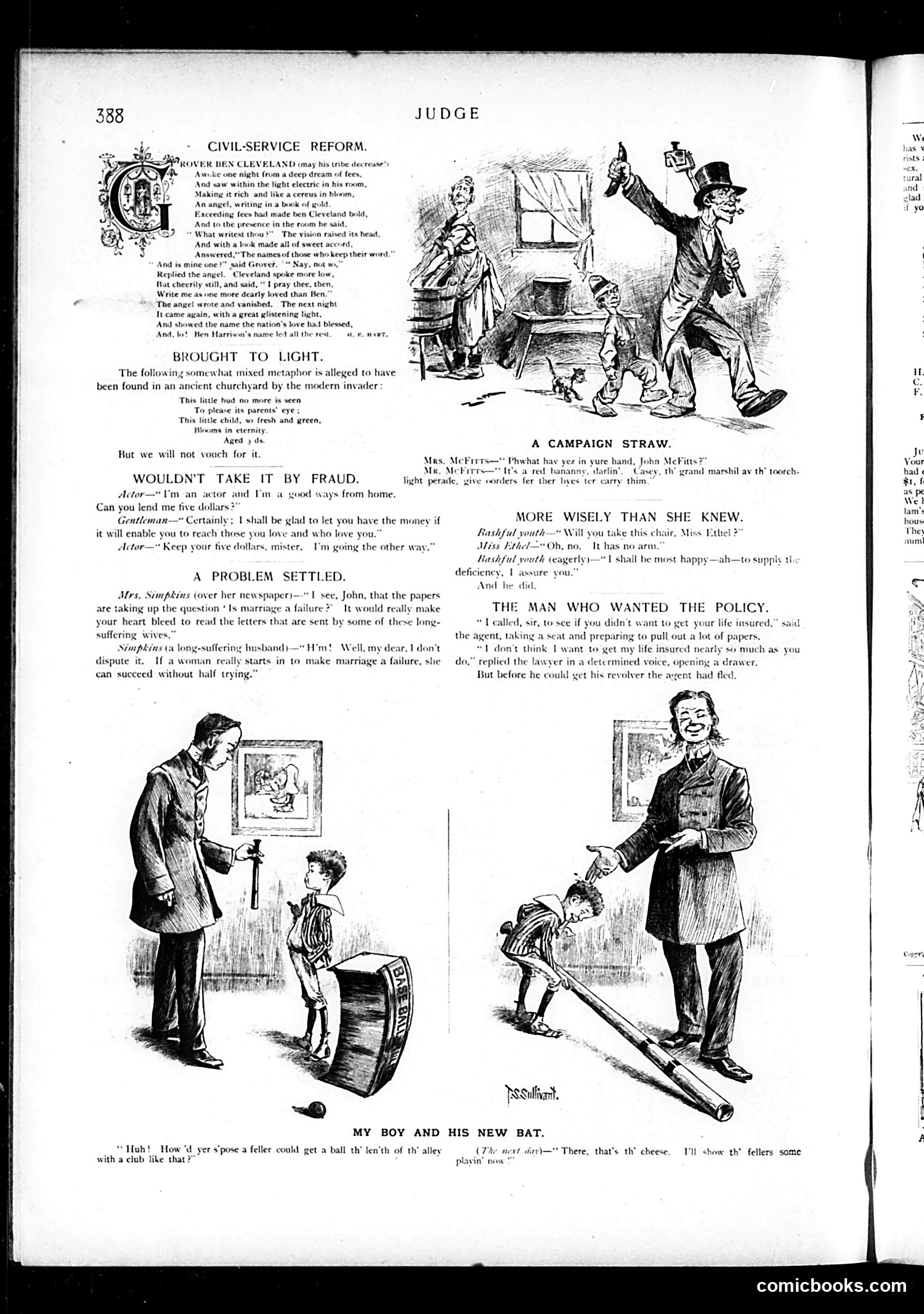
This page from *Judge* contains multiple satirical pieces typical of the late 19th/early 20th century: **"Civil-Service Reform"** mocks President Grover Cleveland's promises to reform government hiring practices by replacing patronage with merit-based selection. The poem suggests Cleveland's stated commitment to virtue is questionable—an angel asks if his name belongs among the honest, implying skepticism about political sincerity. **"A Problem Settled"** satirizes contemporary debates about whether marriage constitutes failure. The husband's flip response—that wives deliberately sabotage marriages with ease—plays on period anxieties about domestic discord and women's agency. **"The Man Who Wanted the Policy"** inverts insurance-sales comedy: the lawyer implies he'd rather insure the desperate agent's life than his own, suggesting the agent's job is more dangerous/precarious. **"A Campaign Straw"** and **"My Boy and His New Bat"** are lighter domestic humor pieces requiring no special historical knowledge. The page reflects Gilded Age concerns: political corruption, marriage stability, and economic uncertainty.
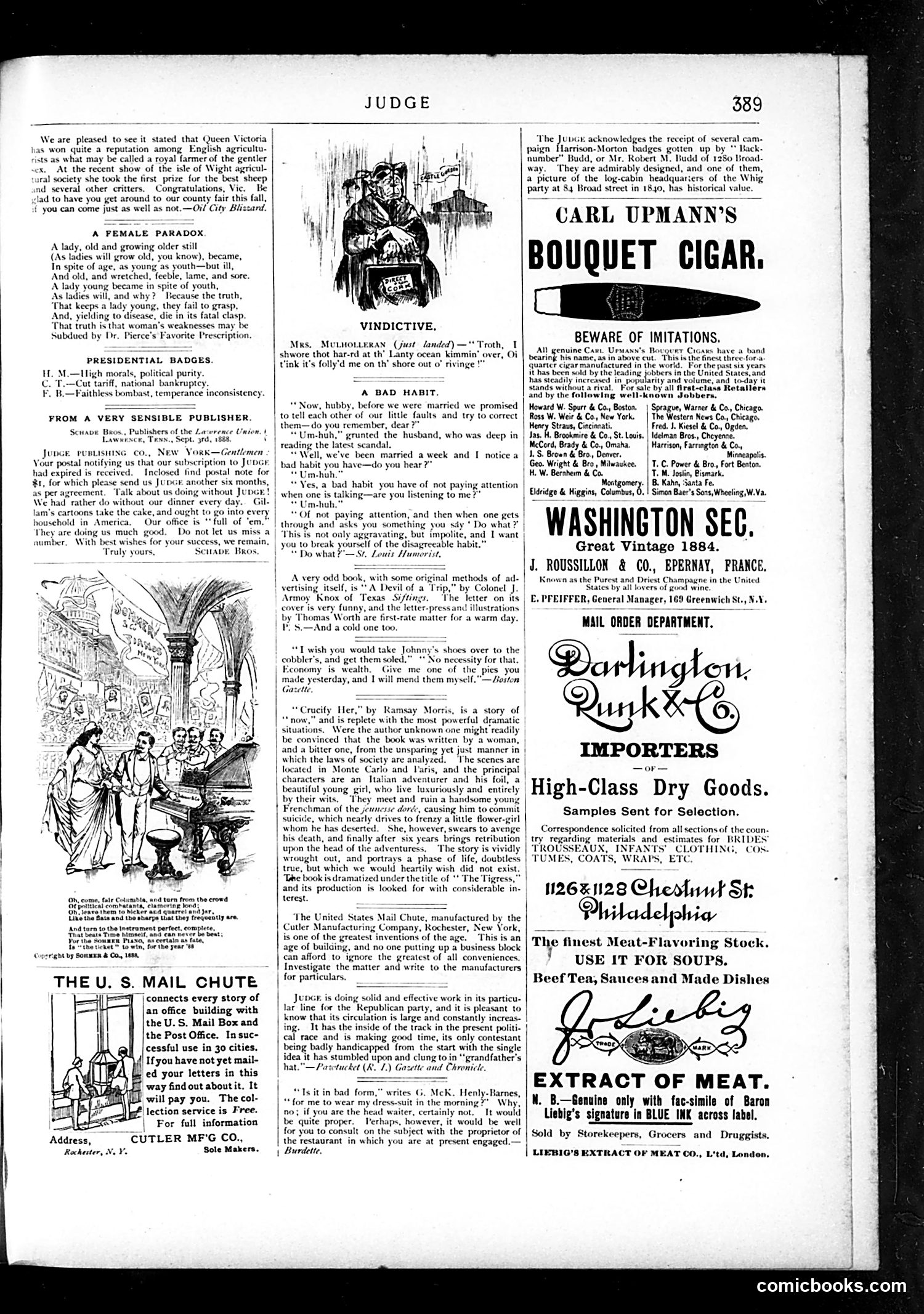
This page is primarily **advertising with some light satirical content**. The main elements include: **Satirical Content:** - A brief item praising Queen Victoria's agricultural success, gently poking fun at her participation in farming competitions - "Presidential Badges" offering humorous definitions of candidates' positions (likely referencing the 1888 election) - Two short comic dialogues: "Vindictive" featuring an Irish immigrant woman complaining about the ocean, and "A Bad Habit" depicting marital friction over inattentive listening **Advertisements:** The page is dominated by ads for consumer products—cigars, dry goods importers, meat extract, and mail-delivery systems—typical of Judge's commercial content. **Historical Context:** The 1888 date and presidential references suggest this reflects that year's campaign. The Irish immigrant stereotype ("shwore," "Oi Vink") was common in period humor. Overall, this appears to be a regular issue mixing light domestic humor with commercial notices.
This page is primarily **advertising**, with two brief satirical pieces interspersed. The main cartoon appears to be "Chicago Ahead," a social satire about regional rivalry. A woman from Chicago and one from Boston engage in pointed conversation aboard a train. When the Boston woman asks if the Chicagoan is "from the west," the Chicago woman requests the conductor fetch a map to locate "Haws-ton" (Boston), suggesting Boston is so insignificant it doesn't appear on maps. The satire mocks both cities' pretensions while declaring Chicago superior—a timely jab given Chicago's rapid growth in the 1880s. The second piece, "The Wanderer's Return," is a sentimental tale with dark comedy: a boy leaves home with a can of milk, becomes a wealthy sailor, and returns decades later—only to discover his parents have died and remarried multiple times. The joke plays on the gap between romantic homecoming narratives and harsh reality. The remainder comprises patent medicine, typewriter, and beer advertisements typical of *Judge's* era.
This page is primarily **advertising** for various products and services, with minimal satirical content. The dominant feature is a large advertisement for **Buffalo Lithia Water**, marketed as a cure for Bright's Disease, gout, and rheumatism. The ad includes testimonials from doctors claiming medical efficacy—typical of late-19th-century patent medicine advertising before FDA regulation. The only satirical piece visible is a brief text section titled "They Are, But They're Hard to Find," which appears to mock **college-educated cowboys**—a popular figure in American literature and magazines of this era. The joke suggests that "genuine" cowboys with Harvard or Yale education exist only in magazine fiction, not in reality. This satirizes both the romantic mythology surrounding the American West and contemporary literary trends. The remainder of the page contains advertisements for railroads, campaign supplies, cigars, and other commercial products typical of Judge's revenue model.
This page is **primarily advertising** with one brief political reference at the top. The main satirical content is a short quoted jab at James G. Blaine, likely the 1884 Republican presidential candidate. The joke claims that when Blaine arrived in Maine, an earthquake occurred (literal trembling), and when he reached New York, people trembled from "fear for the safety of their ticket"—suggesting his presence endangered Republican electoral prospects. The reference attributes this to the *Norristown Herald*. This reflects contemporary anxieties about Blaine's candidacy, implying he was a political liability rather than asset to his party. The tone is dismissive and mocking. The bulk of the page consists of period advertisements for gloves, soap, fountain pens, music boxes, and tailoring services—typical Judge magazine content mixed with political commentary.
This page is primarily **advertising and promotional content** rather than political satire. The dominant feature is an advertisement for "Napoleon Smith," a novel published by Judge Publishing Company, prominently displayed in the center with favorable press excerpts. The page includes typical late 19th-century commercial ads: pens (Ball-Pointed and "Federation"), blank books, campaign supplies, bank notes, shading pens, and a tailor's advertisement. There's also a humorous household hint about hanging objects. **The "Napoleon Smith" promotion** appears designed to boost sales of this apparently successful novel—the first edition of 50,000 copies is touted as "unparalleled in the publishing trade." Press quotes compare it favorably to popular adventure fiction of the era (Rider Haggard). The top-left contains what appears to be a **product advertisement** for ball-pointed pens with a small illustration, not political commentary. This is essentially a **commercial page** showcasing Judge's own publishing ventures and related advertising rather than the magazine's satirical editorial content.
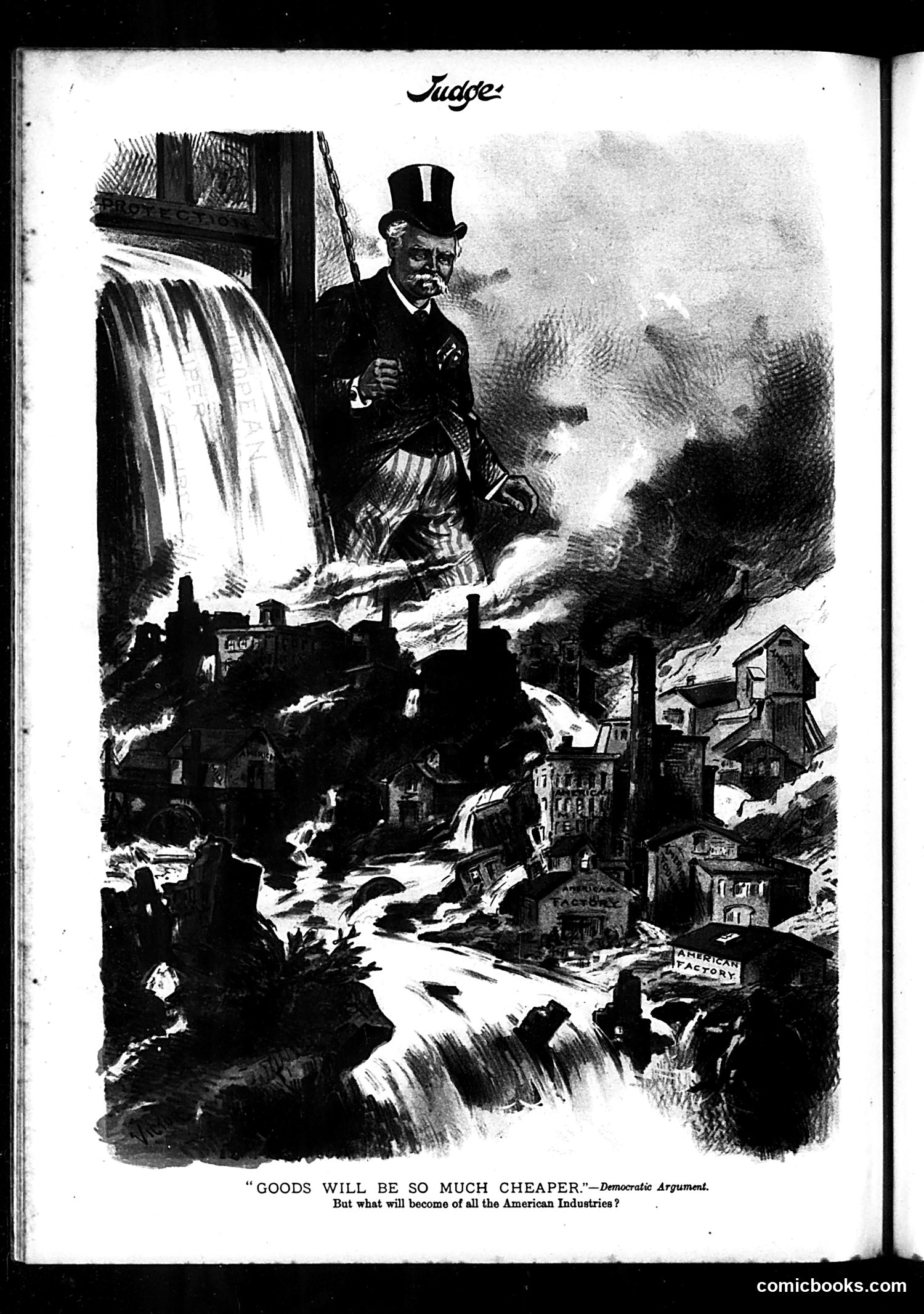
This Judge magazine cartoon satirizes a Democratic argument for lowering tariffs. The image depicts a well-dressed figure (representing a Democratic politician or advocate) standing atop a waterfall, gesturing toward an industrialized American landscape below filled with factories, mills, and buildings marked "American Factory." The satire works by contrasting the Democratic promise that "goods will be so much cheaper" against the cartoon's implied consequence: the destruction of American industries through cheaper foreign competition. The waterfall becomes a visual metaphor for the cascade of economic ruin threatening domestic manufacturing. This reflects the late 19th/early 20th-century American political debate over protectionist tariffs, where Republicans championed high tariffs to shield domestic industry while Democrats advocated for free trade and lower tariffs.