
A complete issue · 16 pages · 1888
Judge — September 15, 1888
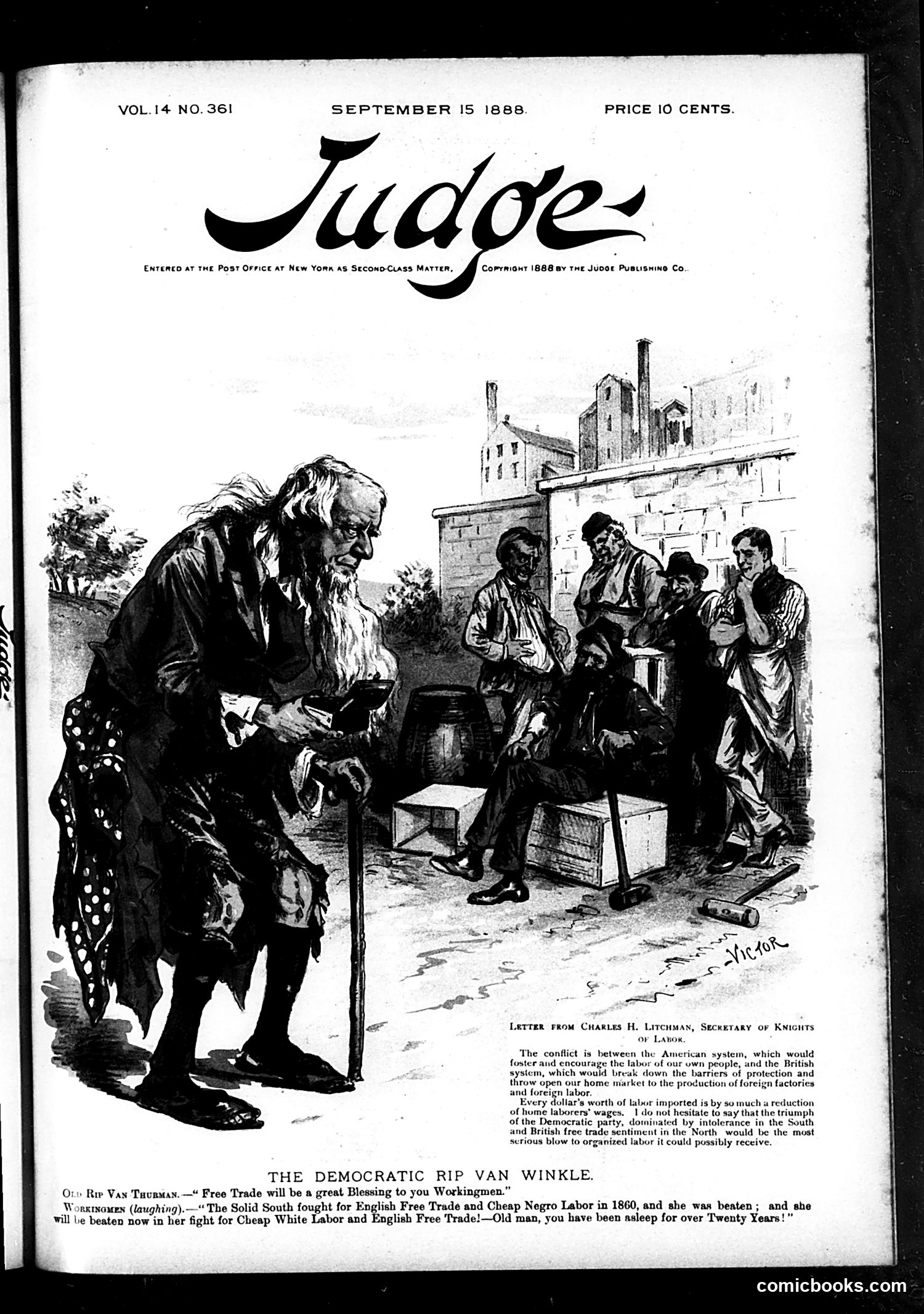
This 1888 cartoon satirizes Democratic Party blindness to economic reality. An elderly bearded man (representing the Democratic Party as "Rip Van Winkle"—the literary character who slept through major changes) awakens to find workers organizing for labor rights. The accompanying letter from Charles H. Litchman, Secretary of Knights of Labor, criticizes Democrats for ignoring the conflict between American and British free-trade systems. The cartoon mocks Democratic leadership for sleeping through twenty years of labor movement development, now shocked to discover organized labor demanding fair wages and protection against cheap foreign labor imports. The satire suggests Democrats are dangerously out of touch with contemporary working-class concerns and industrial realities of the 1880s.
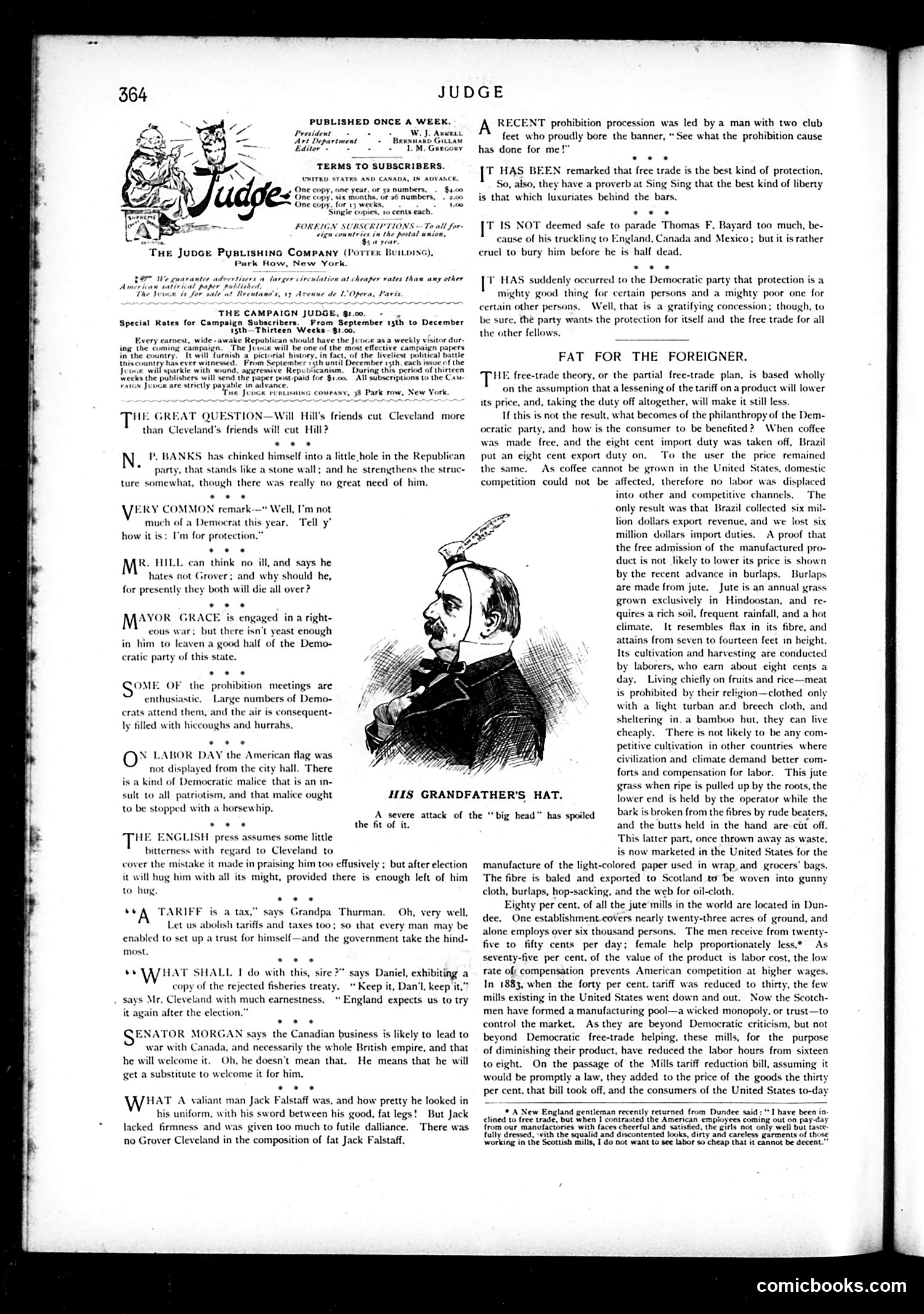
This page contains political commentary and satirical observations rather than a single unified cartoon. The main illustrated piece shows a man wearing traditional Asian clothing and a distinctive hat, titled "HIS GRANDFATHER'S HAT." The accompanying text discusses jute production in Hindustan (India), describing cultivation methods, labor practices, and manufacturing processes. The piece appears to critique free-trade policies and their effects on international commerce, particularly regarding jute imports and tariffs. The scattered political remarks mock various figures—including references to Cleveland, Banks, Hill, and others—regarding protectionism, tariffs, and Democratic party politics. The overall tone suggests satirizing debates over trade policy and their real-world economic consequences for American workers and manufacturers.
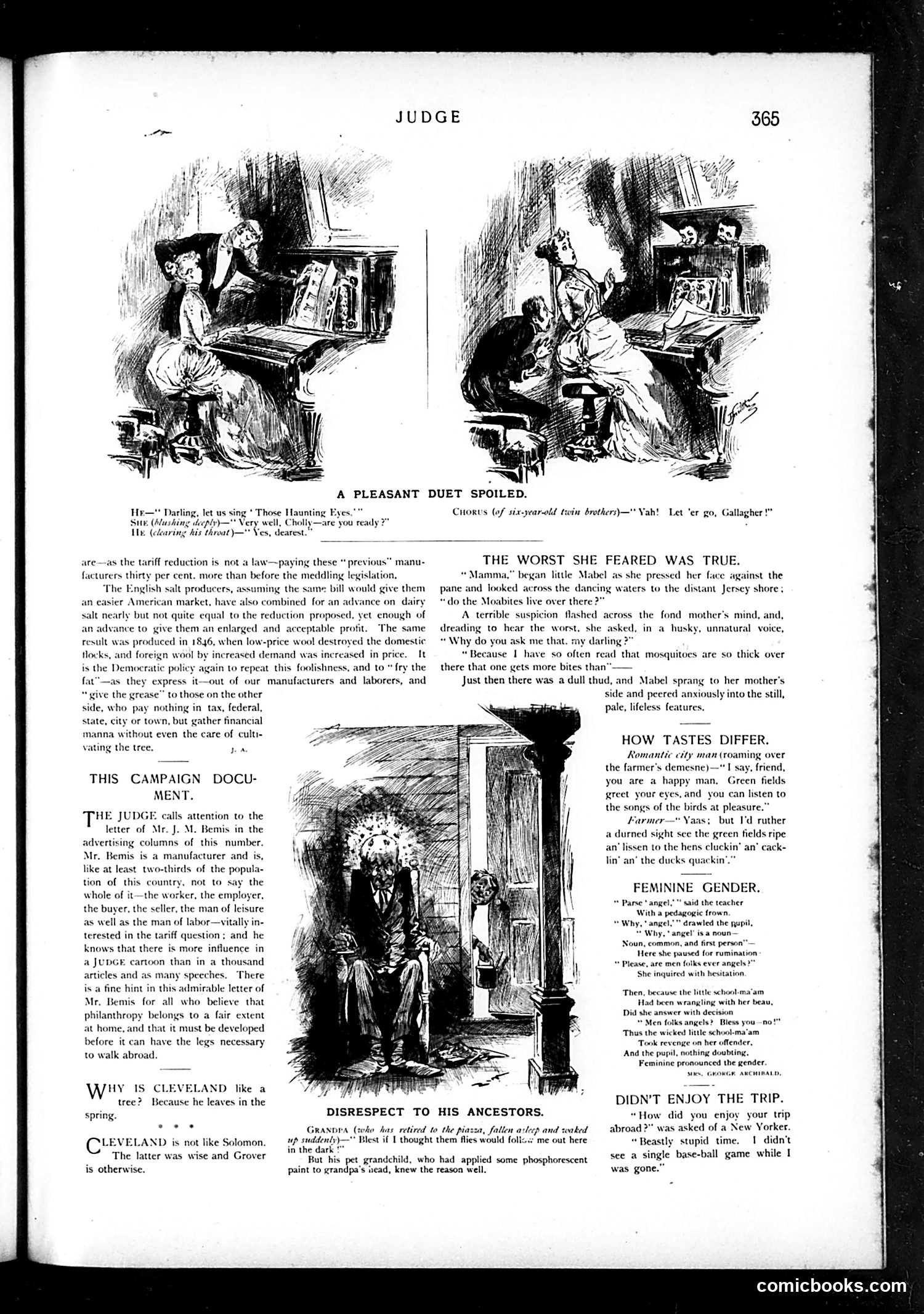
This page contains multiple satirical pieces typical of Judge's late 19th-century content: **"A Pleasant Duet Spoiled"** depicts a couple interrupted mid-romantic song by tariff discussion—satirizing how contemporary trade policy debates dominated public discourse even private moments. **The main editorial section** argues against Democratic tariff reduction policies, claiming they benefit foreign manufacturers while harming American workers and producers. The writing presents this as a campaign document advocating protectionism. **"Why is Cleveland like a tree?"** delivers anti-Cleveland jokes, likely referencing President Grover Cleveland's policies (he served non-consecutive terms in the 1880s-90s). **Various short comedic pieces** ("Disrespect to His Ancestors," "How Tastes Differ," "Feminine Gender") offer genteel humor about family life, rural-urban contrasts, and gender roles—standard Judge fare unrelated to politics. The page exemplifies Judge's mix of pointed political satire and genteel domestic humor, with the tariff debate serving as the substantive political content.
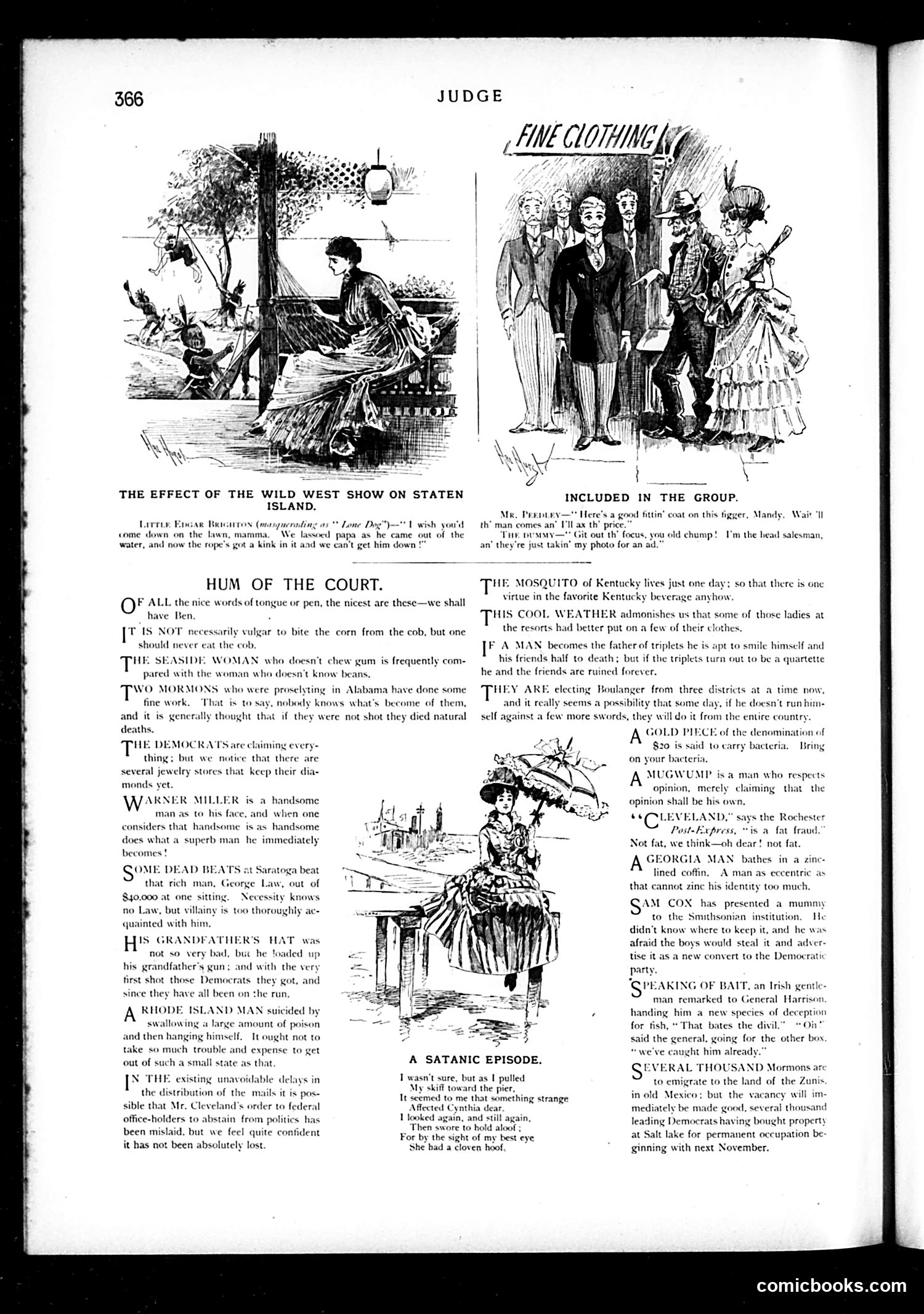
This page combines humor pieces with two illustrated cartoons mocking contemporary American society. **"Wild West Show on Staten Island"** (left): References Buffalo Bill's Wild West Show's popularity. A child, imitating the show, has lassoed their father emerging from swimming. The satire targets how frontier entertainment craze influenced even children's play. **"Fine Clothing" (right)**: A clothing store scene where a salesman is being photographed for advertisement while negotiating with customers—satirizing commercialism and the awkwardness of early advertising photography. **"Hum of the Court"**: The text section offers political and social jabs, including mocking Democrats for claiming credit while "several jewelry stores keep their diamonds" (implying theft), jibes at Mormons, and criticism of President Cleveland (a Democrat). References to "Boulanger" likely allude to French General Boulanger's popularity. The scattered quips reflect Judge's conservative Republican editorial stance, typical of Gilded Age political satire. The page reflects late 19th-century concerns: political corruption, religious outsiders, commercial excess, and entertainment's cultural influence.
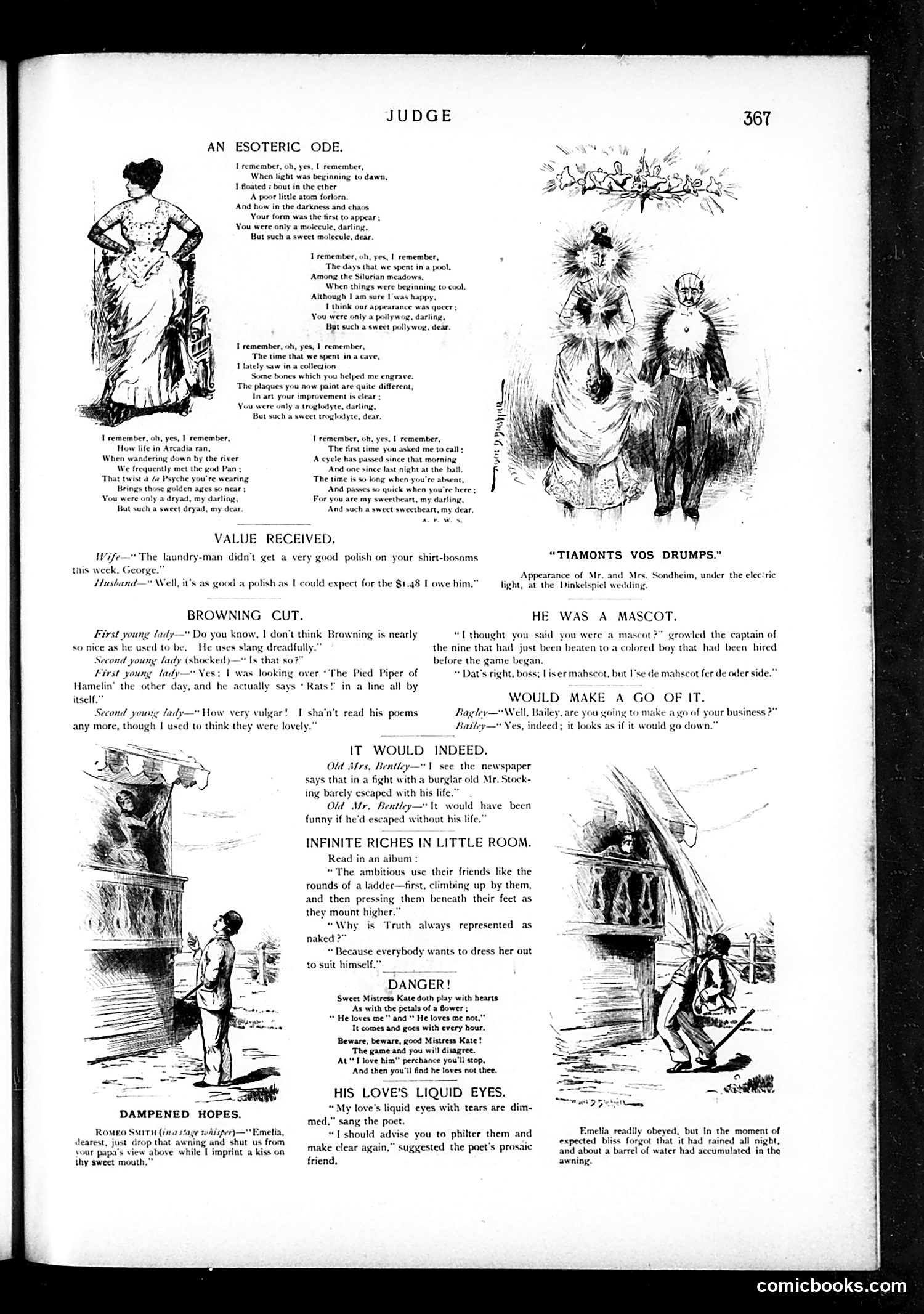
This page from the satirical magazine *Judge* contains primarily **light social humor and poetry** rather than political cartoons. The main content includes: - **"An Esoteric Ode"**: A humorous poem tracing a couple's relationship through evolutionary stages (atoms, organisms, cave-dwellers, classical figures), mocking both Darwinian evolution and romantic nostalgia. - **"Browning Cut"**: A joke about Robert Browning's poetry becoming less refined, with a young lady shocked he used "Rats!" in *The Pied Piper of Hamelin*. - **Various brief comic sketches** on courtship, mascots, and romance, typical of *Judge*'s middle-class humor. The accompanying illustrations are decorative sketches of period figures and scenes. The page reflects **late-19th-century genteel humor** targeting educated readers, focusing on manners, literature, and courtship rather than substantive social or political satire. The tone is lighthearted rather than biting critique.
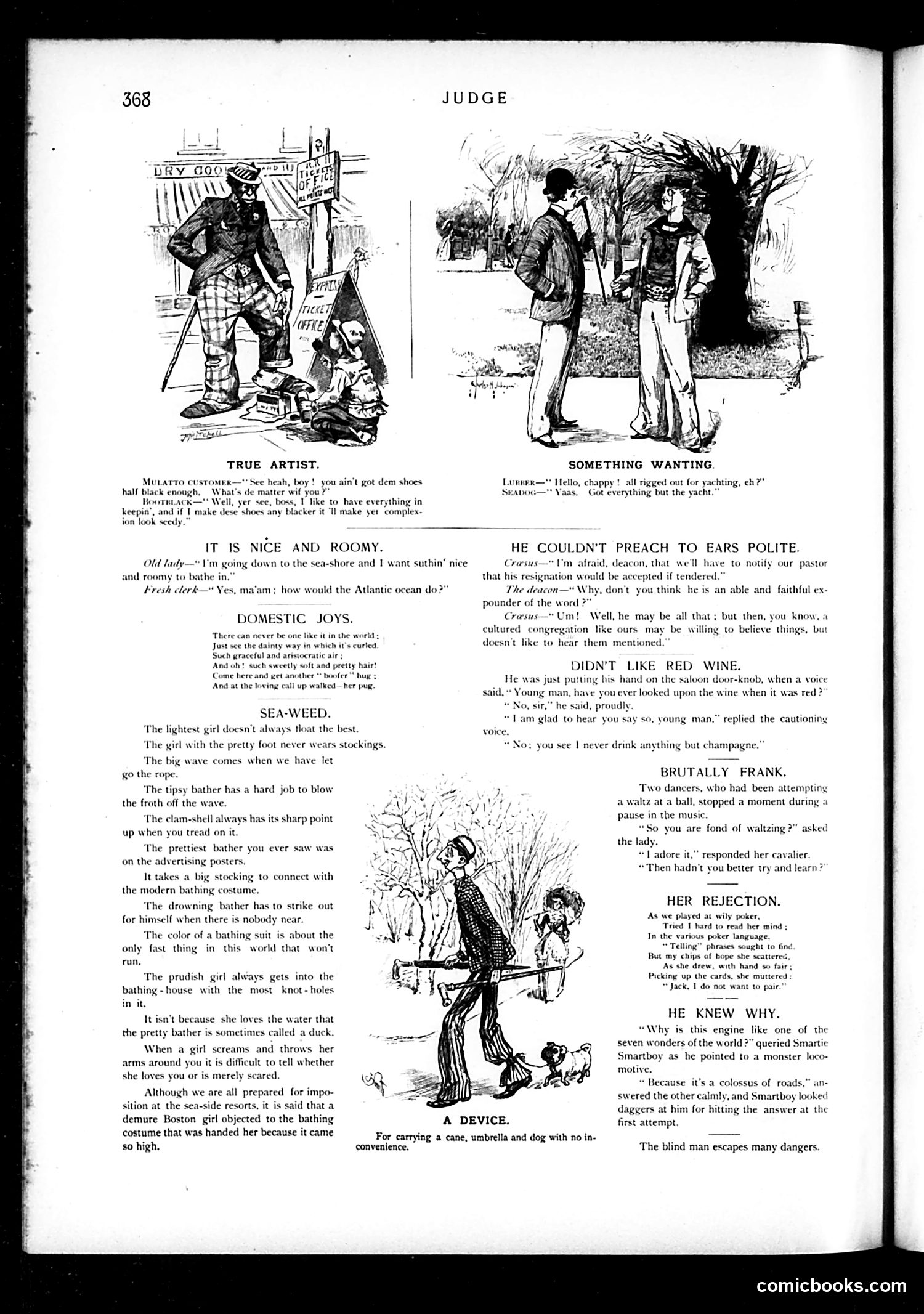
This page from *Judge* contains multiple short satirical pieces typical of the publication's humor style: **"True Artist"** mocks racial stereotypes through exaggerated dialect, depicting a shoemaker unable to make shoes "black enough" for a customer—crude ethnic humor common to the era. **"It Is Nice and Roomy"** and other brief jokes are genteel seaside resort humor with no specific political content—just observations about bathing costumes, prudishness, and vacation behavior. **"He Couldn't Preach to Ears Polite"** satirizes religious hypocrisy: a church congregation will accept dubious doctrine but objects when the pastor *speaks* uncomfortable truths aloud, critiquing selective morality. **"Didn't Like Red Wine"** pokes fun at teetotalers who claim sobriety while drinking champagne—satirizing inconsistent temperance claims. The remaining pieces ("Brutally Frank," "Her Rejection," "He Knew Why") are light romantic and wordplay humor with no political dimension. Overall: primarily social satire about manners, bathing culture, and hypocrisy, with minimal political content.
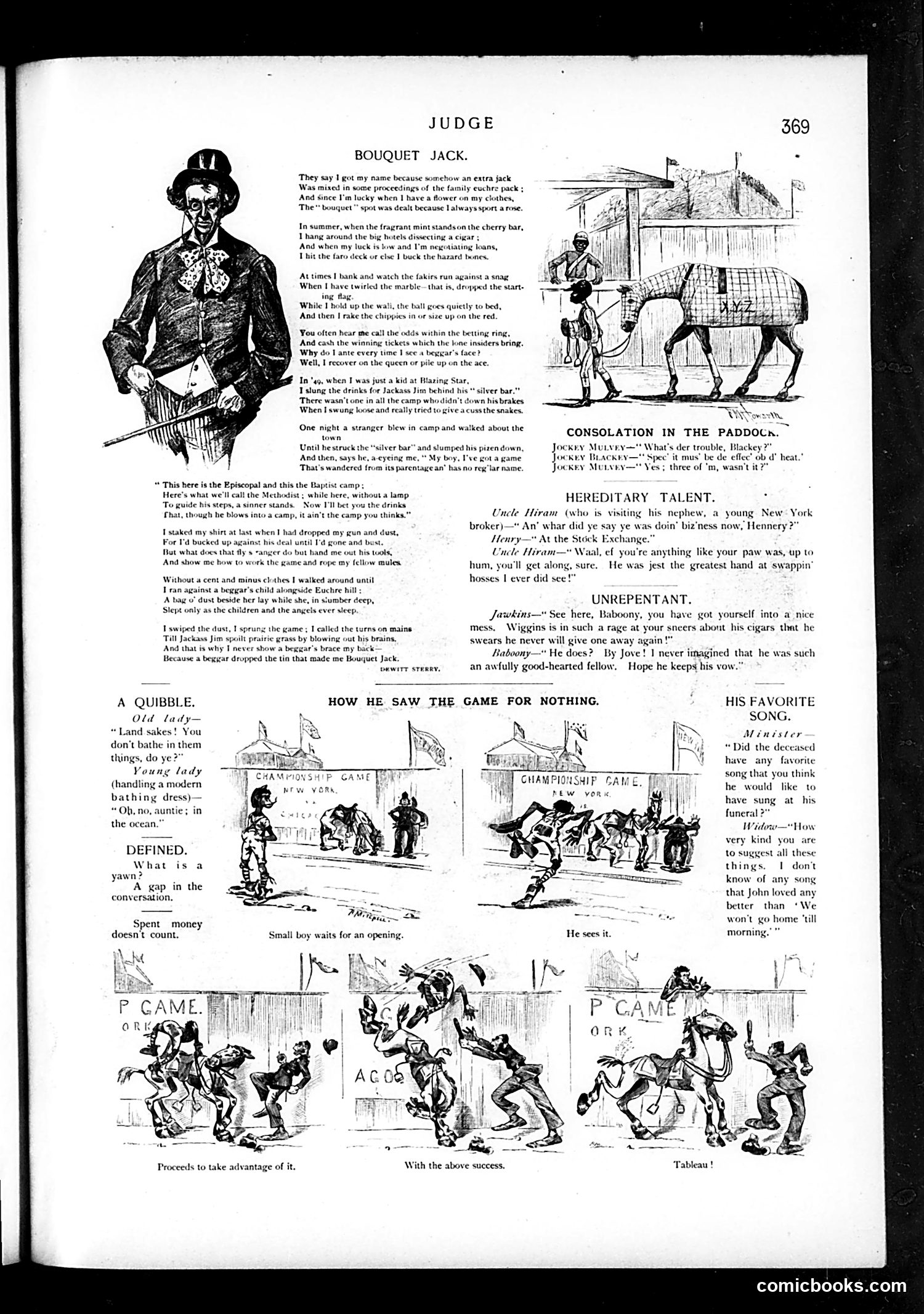
This page from *Judge* (a 19th-century American satirical magazine) contains several unrelated humorous pieces typical of the publication's format. The dominant feature is "Bouquet Jack," a poem about a gambling-era character whose nickname derives from a lucky playing card. The accompanying illustration shows a well-dressed man in period attire. The narrative recounts his history in frontier mining camps ("'49"), his work as a bartender, and his evolution into a professional gambler—reflecting themes of luck, vice, and survival in the Old West. Smaller satirical sections include: "A Quibble" (mocking a woman's misunderstanding of "bathing in the ocean"), "Defined" (jokes about gaps and wasted money), and brief domestic dialogues like "Hereditary Talent" (a nephew following his father's horse-trading ways) and "Unrepentant" (about damaged friendships over cigars). The cartoons throughout show period figures in comedic situations involving horses, gambling, and social awkwardness—typical *Judge* humor emphasizing class contrasts and character flaws rather than specific political commentary.
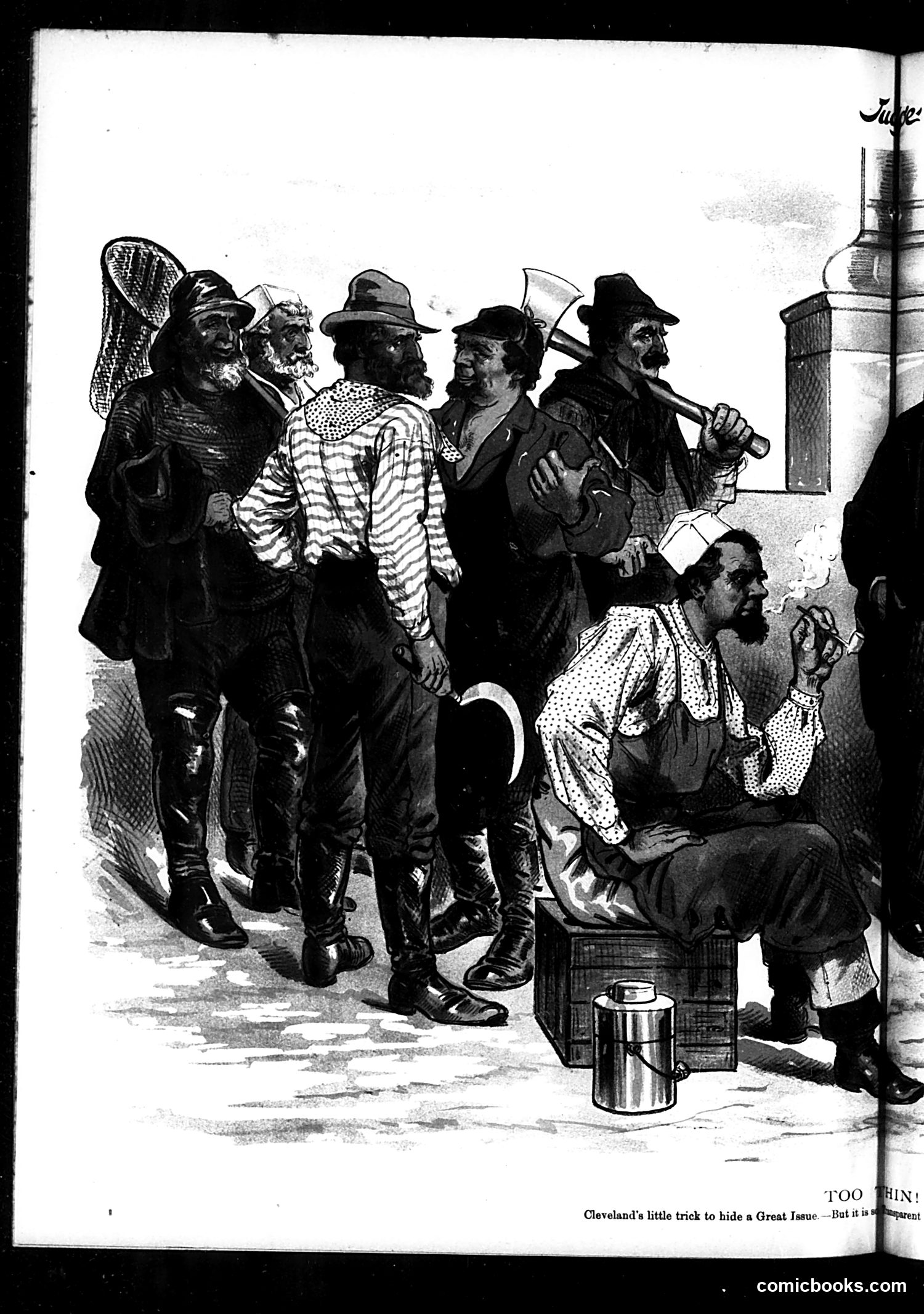
This Judge magazine cartoon satirizes President Cleveland's attempt to conceal something significant, as indicated by the caption "Cleveland's little trick to hide a Great [Issue]—But it is a 'bren[t]...'" (text cut off). The image depicts Cleveland surrounded by various working-class and immigrant figures—identifiable by their period dress, hats, and caricatured features typical of 1880s-90s satirical art. The group appears to be confronting or questioning him, while one seated figure in the foreground gestures emotionally. The satire suggests Cleveland was trying to avoid addressing a major political issue affecting ordinary citizens—likely labor unrest, immigration policy, or economic hardship. The "trick" referenced appears to be his evasion of public pressure, making him the target of ridicule for avoiding accountability to the people demanding his attention.
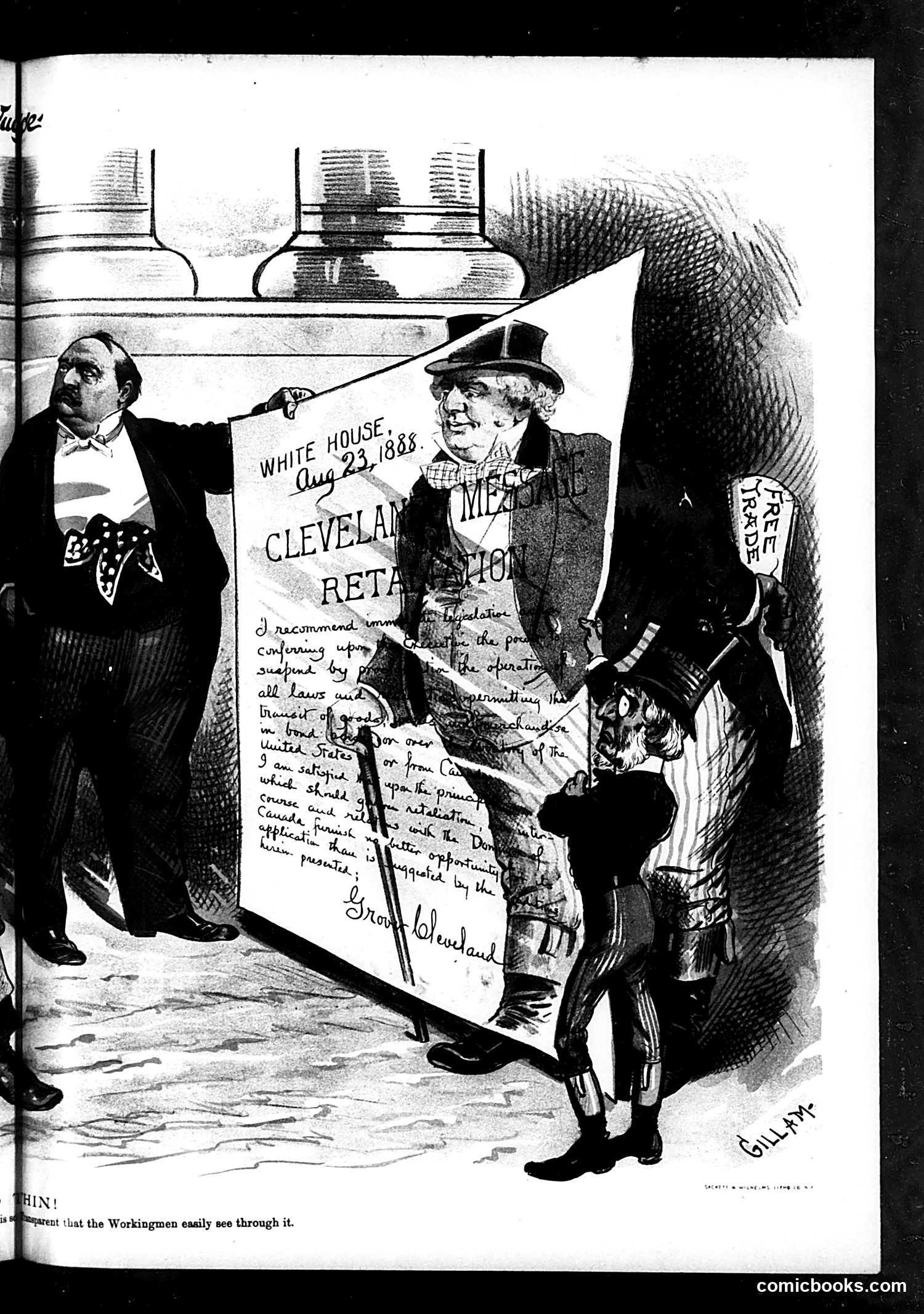
This appears to be a satirical cartoon from *Judge* magazine dated August 23, 1888, concerning Cleveland's tariff policy. The central figure holds a document labeled "WHITE HOUSE" and "CLEVELAND RETALI[ATION]," displaying what appears to be a presidential message or policy statement. The cartoon criticizes a political position as transparent deception—the caption notes "that the Workingmen easily see through it," suggesting the satire targets working-class awareness of dishonest political maneuvering. The figures appear to represent political figures or allegorical characters examining or promoting this policy. Without clearer identification of all parties shown, the precise political argument remains somewhat unclear, though it clearly mocks a Cleveland administration initiative regarding tariffs or retaliation, likely a major campaign issue in the 1888 election.
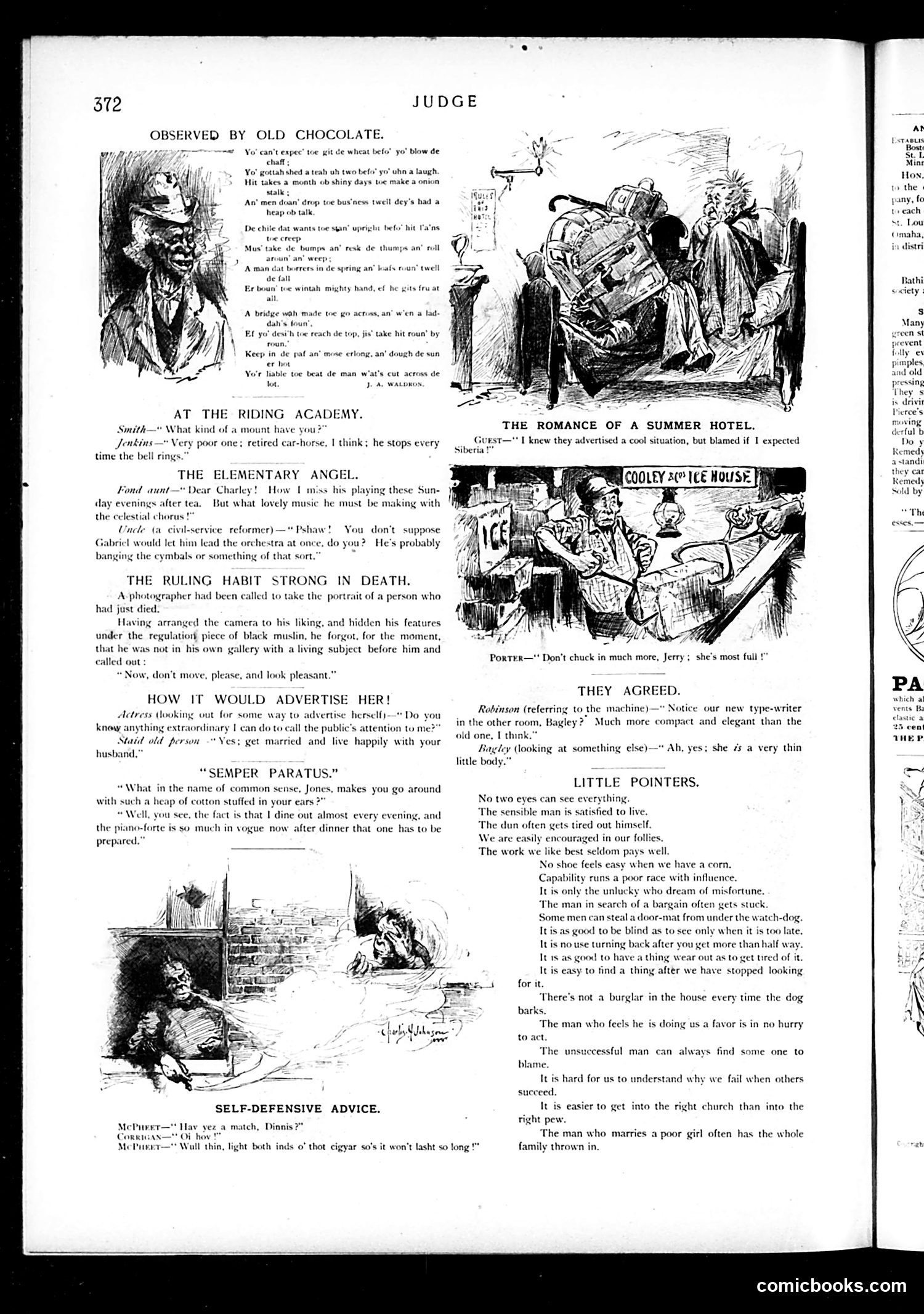
This page contains multiple brief satirical pieces typical of Judge magazine's humor: **"Observed by Old Chocolate"** presents dialect verse offering folk wisdom about patience and perseverance—reflecting period attitudes toward African American vernacular speech used for comedic effect. **"At the Riding Academy"** jokes about a retired horse that stops at bell rings, suggesting the animal is conditioned by stable routine. **"The Elementary Angel"** satirizes a civil-service reformer's assumption that a deceased musician would immediately lead the celestial orchestra rather than start as a novice. **"The Ruling Habit Strong in Death"** depicts a photographer instructing a corpse to "look pleasant"—humor derived from professional habit overriding circumstances. **"How It Would Advertise Her"** suggests marriage and domestic happiness as the best publicity for an actress seeking attention—commentary on women's limited options and society's priorities. **"Semper Paratus"** mocks someone wearing cotton ear plugs to avoid dinner-party piano music, now fashionable. The page also includes "Little Pointers," cynical aphorisms about human nature, business, and relationships. The humor is genteel, topical, and relies on social observation rather than political content.
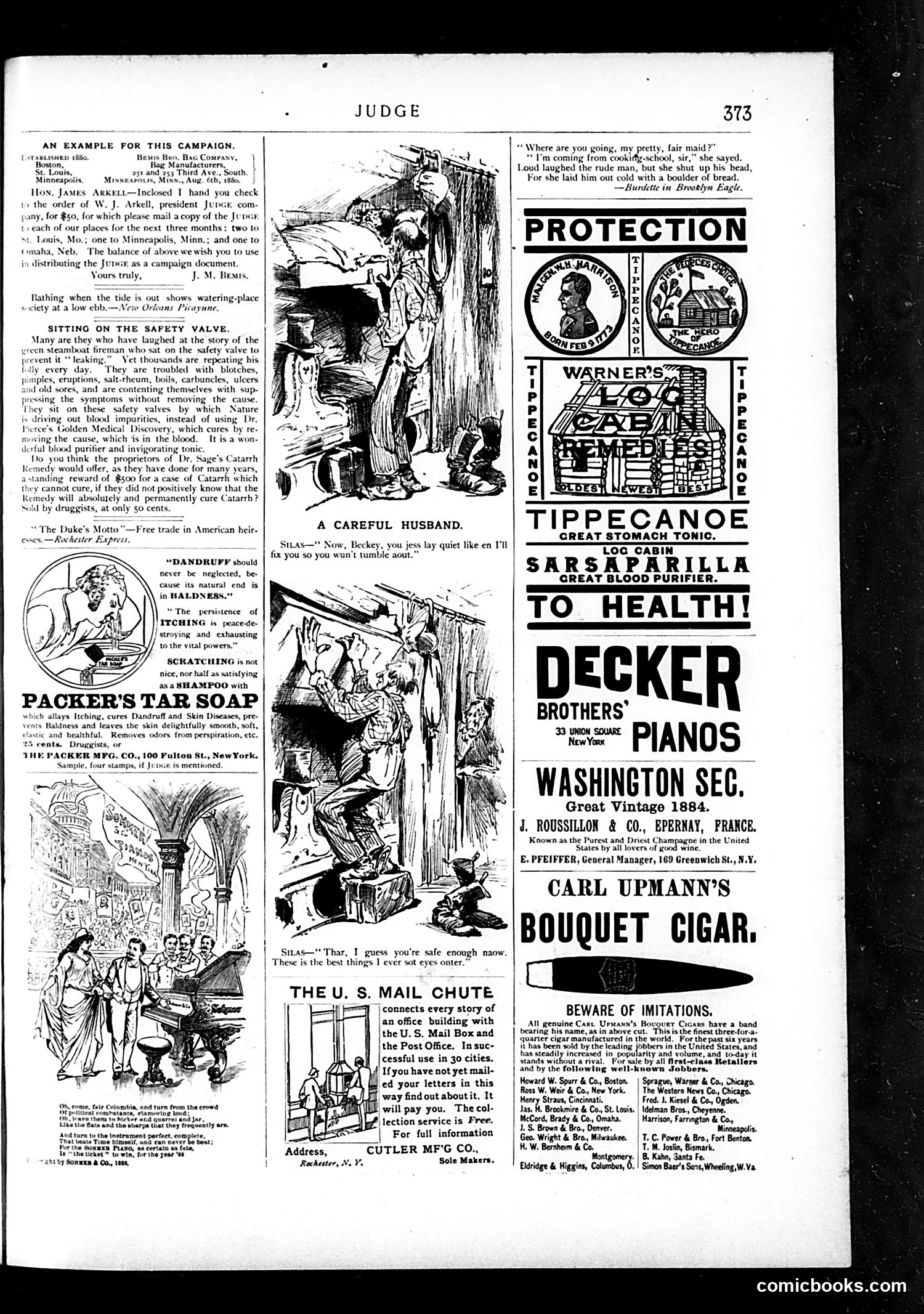
This page primarily features **advertisements and light humor** rather than political satire. The cartoon titled "A Careful Husband" depicts a rural man securing his pregnant wife to a tree before leaving, with the caption suggesting he's preventing her from falling. It's a crude joke about rural life, treating childbirth preparation as a comedic domestic mishap. The page also includes testimonial letters praising *Judge* magazine's circulation value for campaigning (appearing to reference the 1880 election cycle), alongside advertisements for patent medicines (Dr. Pierce's remedies, Packer's Tar Soap) and consumer products (pianos, cigars, champagne). The repeated emphasis on medical "cures" reflects late-19th-century America's embrace of dubious patent medicines. The "Safety Valve" article satirizes people who ignore root causes of ailments rather than treating them properly—a metaphor for both health and, potentially, social issues of the era.
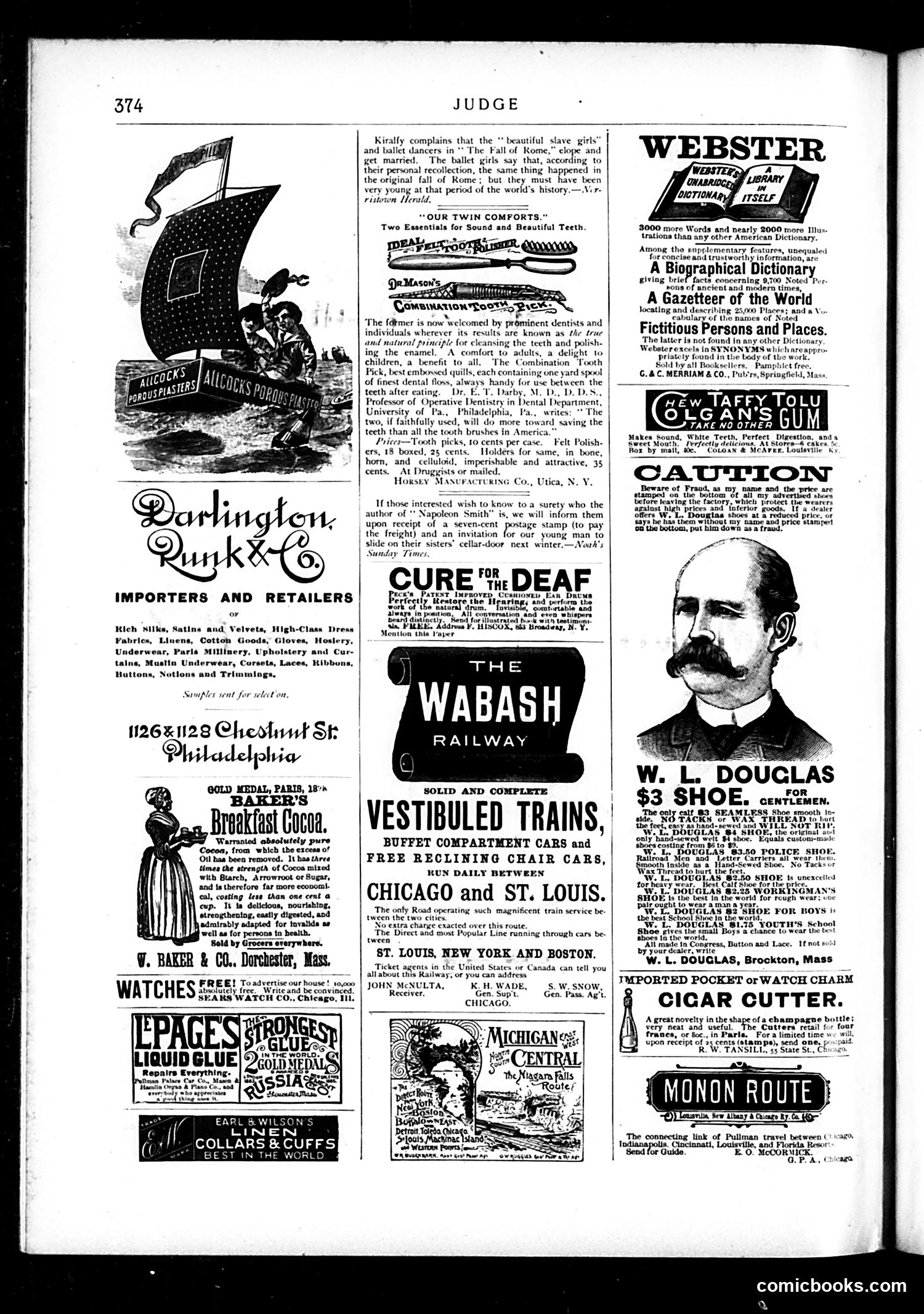
This is primarily an **advertising page** from a satirical magazine, with one brief joke item at the top. **The Main Content:** The single cartoon/joke references **Imre Kiralfy**, a Hungarian-American theatrical impresario, who complained that "beautiful slave girls" and ballet dancers in his production "The Fall of Rome" were eloping and marrying instead of continuing in the show. The satirical response (attributed to the Vintontown Herald) jokes that according to the dancers' recollection, the same thing happened during *the actual* fall of Rome—implying the dancers are claiming to be impossibly ancient. It's a mild joke about the theatrical production's casting issues. **The Advertisements:** The remainder is filled with period products: dental care items (tooth picks and floss), Breakfast Cocoa, shoes (W. L. Douglas brand), railway service, watches, and various dry goods retailers—typical late 19th-century commercial messaging. **Historical Context:** The Kiralfy reference suggests this is from the 1880s-1890s era of American theater and entertainment.
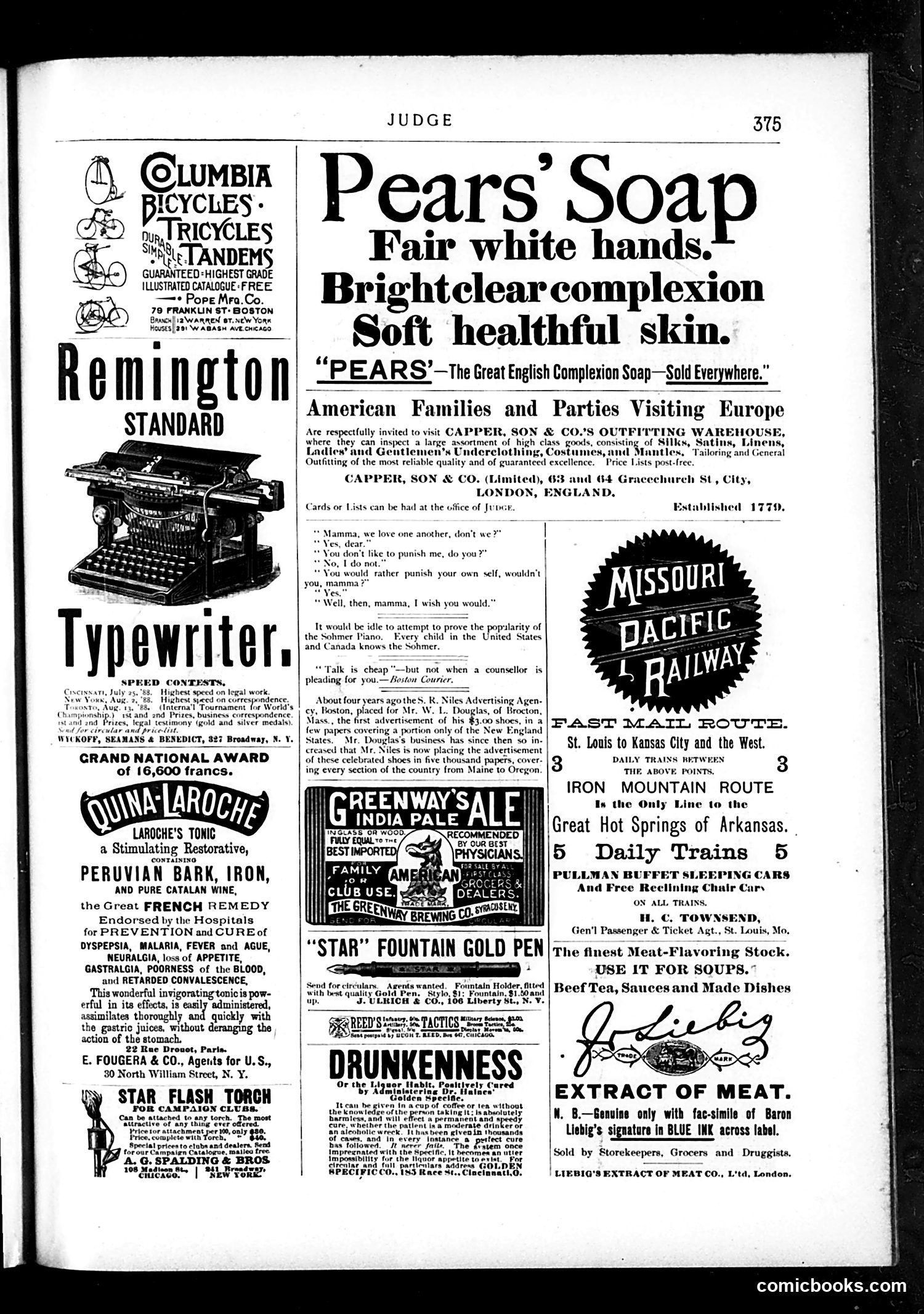
This is primarily an **advertising page** with minimal editorial cartoon content. The page consists almost entirely of period advertisements for products like bicycles, typewriters, soap, railway service, and patent medicines. The only narrative content appears in a brief **dialogue exchange** between a mother and child about punishment—a gentle domestic joke playing on the child's illogical reasoning (the child argues the mother should punish them because she loves them). This was typical sentimental humor of the era. The advertisements themselves reflect **late 19th-century consumer culture**: Pears' Soap promises "fair white hands" and "bright clear complexion" (reflecting period beauty standards); Laroche's Tonic advertises as a cure-all for numerous ailments; and the Missouri Pacific Railway advertises service to Hot Springs, Arkansas. There are **no political cartoons or satirical commentary** visible on this page—it functions as a revenue-generating advertising section typical of magazines from this period, where paid advertisements subsidized publication costs.
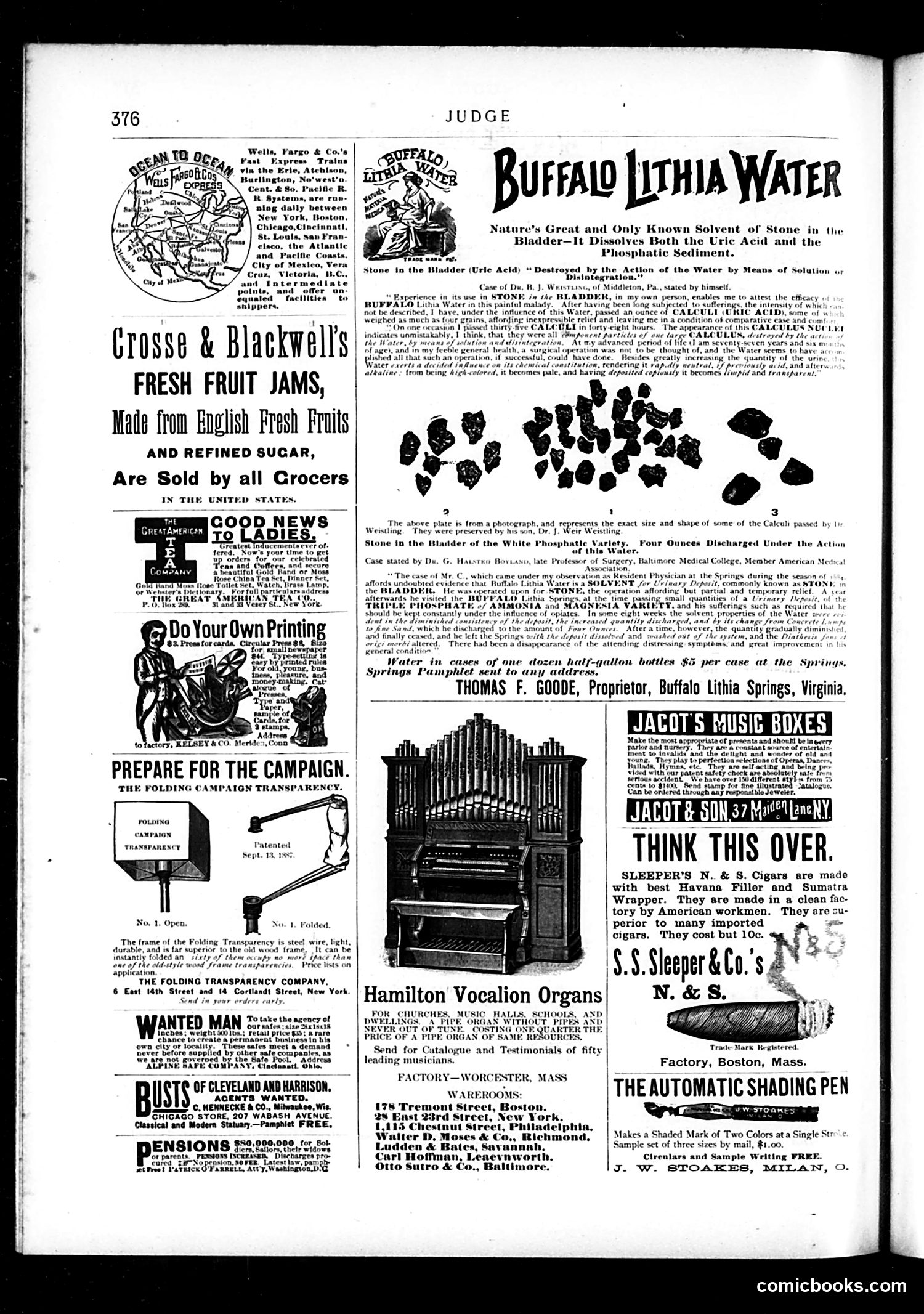
This page is primarily filled with **advertisements** rather than political cartoons or satire. The content includes: - Medical claims for Buffalo Lithia Water, marketed as dissolving bladder stones through case studies featuring photographs of actual kidney stones passed by patients - Consumer product ads (Crosse & Blackwell jams, Jacot music boxes, Hamilton organs) - Business opportunities (printing presses, safes, statuary business) - A "Folding Campaign Transparency" device for political campaigns—a collapsible wire frame for displaying campaign messages The only explicit political reference is the "**Prepare for the Campaign**" section advertising a reusable transparency frame for what appears to be the Cleveland-Harrison presidential campaign (likely 1888 or 1892). This allowed candidates to efficiently display messaging across multiple locations. Rather than satirizing politicians, this issue uses campaign infrastructure to sell advertising space.
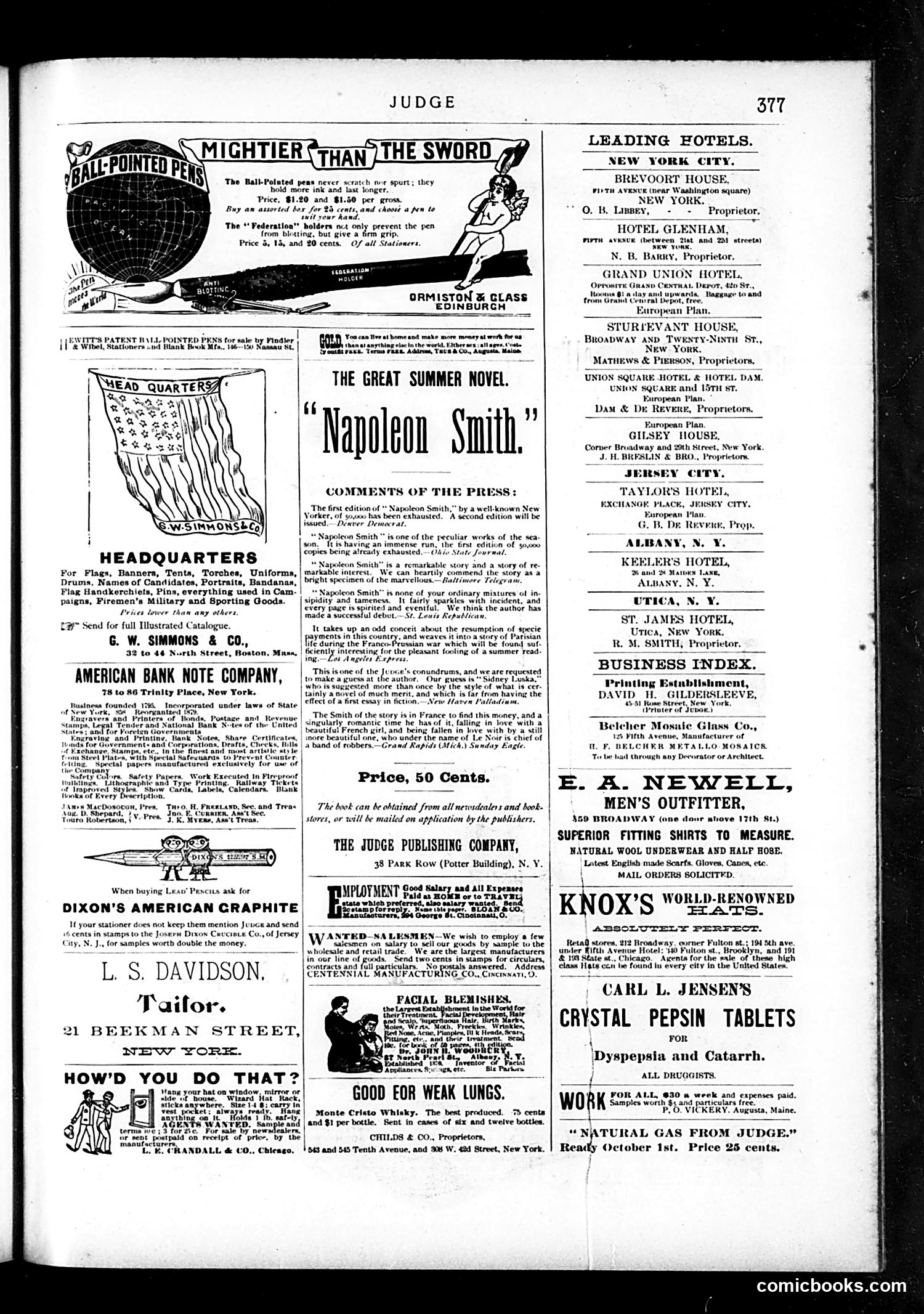
This page is **primarily advertising**, with minimal satirical content. The dominant feature is a large advertisement for "Napoleon Smith," a serialized novel marketed as "The Great Summer Novel." Press excerpts praise it as an entertaining work about resuming specie payments during the Franco-Prussian War, featuring romantic plots. The upper left contains a small advertisement for **Ball-Pointed pens** by Ormiston & Glass, with a stock illustration of a pen as "mightier than the sword"—a conventional advertising visual, not political satire. The rest of the page comprises business advertisements (bank notes, flags/campaign materials, pencils, tailoring services) and job listings. There is **no identifiable political cartoon or satirical content** on this page. It represents Judge's revenue model: mixing humor magazine content with paid commercial advertising. The "Napoleon Smith" promotion suggests this novel appeared serially in Judge, a common practice for magazines of this era.
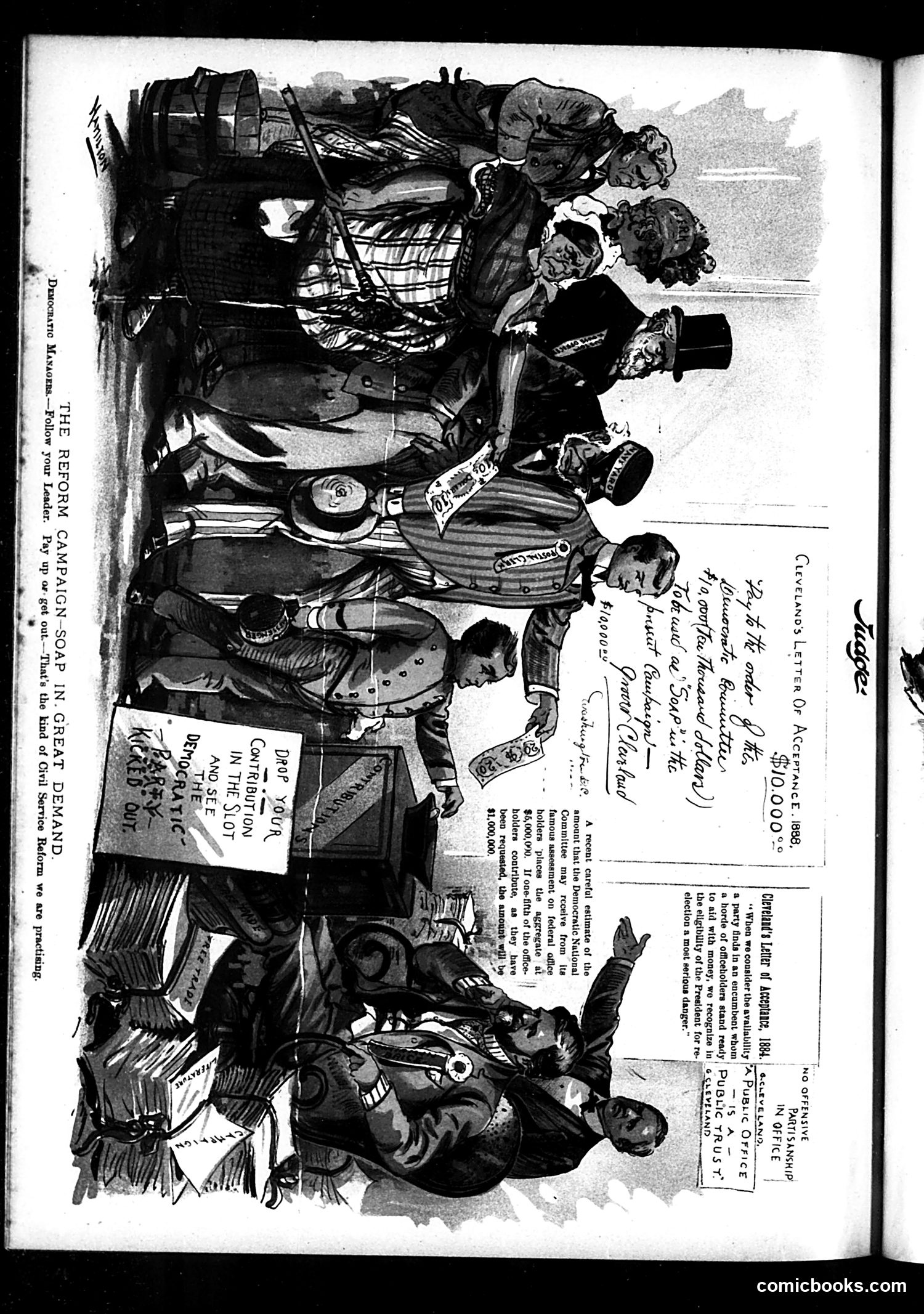
This satirical cartoon critiques President **Grover Cleveland's** 1884 re-election campaign and his claimed commitment to "civil service reform"—a major political issue of the era. **The Satire:** Despite Cleveland's public stance against corruption and patronage in government, the cartoon shows him and Democratic officials literally *selling* positions to officeholders for money. The "soap" metaphor suggests their reform rhetoric is merely window dressing to clean up a dirty system—but they're actually perpetuating it. **Key Point:** The accompanying text estimates Democratic officeholders contributed $5 million to the campaign, implying that Cleveland's anti-corruption message was hollow. Officials were still expected to "pay up or get out," revealing that the party practiced the very patronage abuse it claimed to oppose. The cartoon exposes the hypocrisy between Cleveland's reform platform and the actual machine politics at work.