
Judge, 1888-09-15 · page 3 of 16
Judge — September 15, 1888 — page 3: what you’re looking at
What you’re looking at
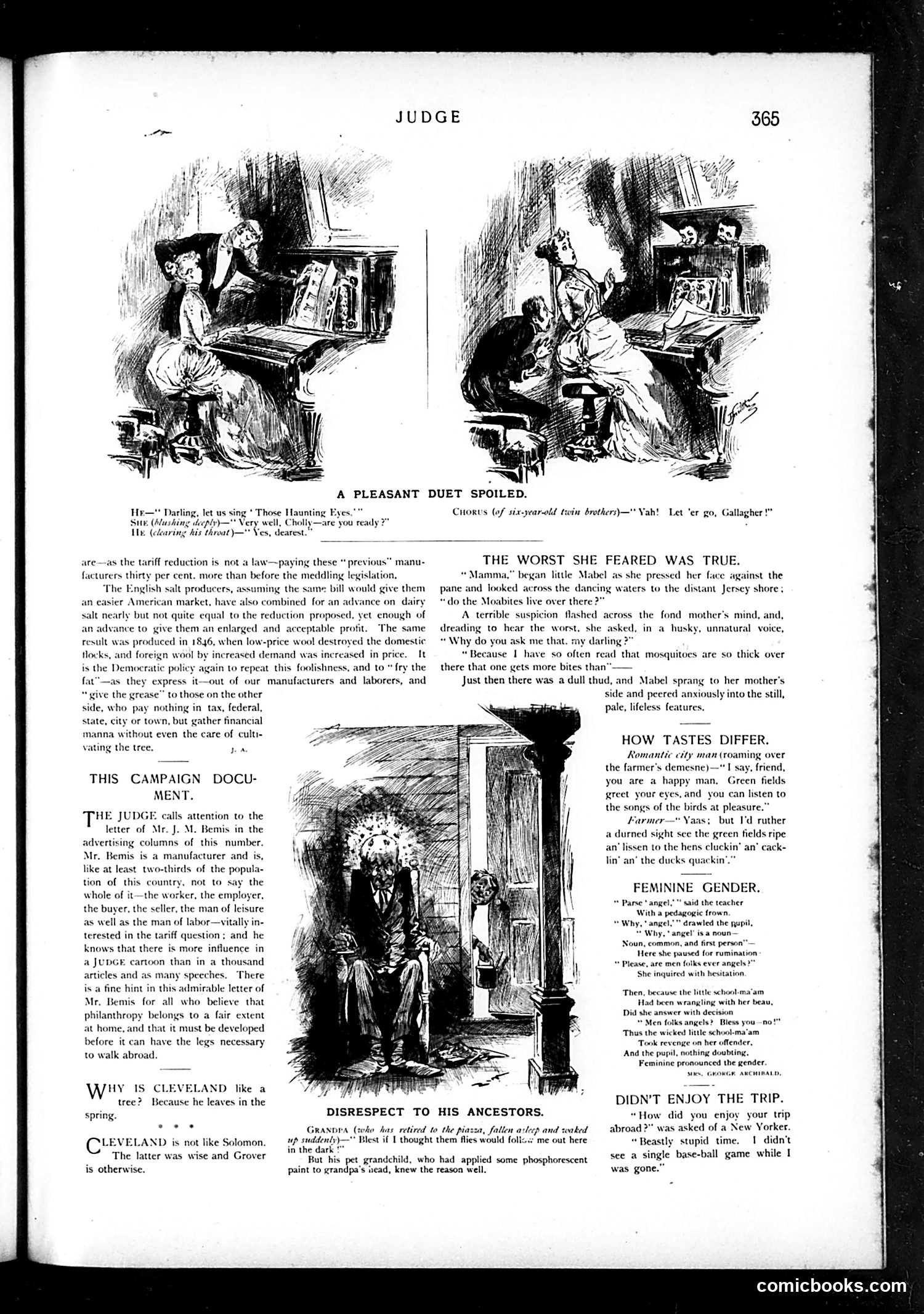
This page contains multiple satirical pieces typical of Judge's late 19th-century content: **"A Pleasant Duet Spoiled"** depicts a couple interrupted mid-romantic song by tariff discussion—satirizing how contemporary trade policy debates dominated public discourse even private moments. **The main editorial section** argues against Democratic tariff reduction policies, claiming they benefit foreign manufacturers while harming American workers and producers. The writing presents this as a campaign document advocating protectionism. **"Why is Cleveland like a tree?"** delivers anti-Cleveland jokes, likely referencing President Grover Cleveland's policies (he served non-consecutive terms in the 1880s-90s). **Various short comedic pieces** ("Disrespect to His Ancestors," "How Tastes Differ," "Feminine Gender") offer genteel humor about family life, rural-urban contrasts, and gender roles—standard Judge fare unrelated to politics. The page exemplifies Judge's mix of pointed political satire and genteel domestic humor, with the tariff debate serving as the substantive political content.
📄 Transcribed text from this page (OCR, searchable)
Machine-transcribed from the original scan — historical spelling and the odd misread are preserved.
A PLEASANT DUET SPOILED. Hr—" Darling, let us sing * Those Haunting Eyes." Sue (blushing deeply)—"* Very well, Cholly—are you ready Me. (clearing his throat)—" Ves, dearest are—as the tariff reduction is not a law—paying these “ pre facturers thirty per cent. more than before the meddling | The English salt producers, jous” manu- islation, assuming the same bill would give them an easier American market, have also combined for an advance on dairy salt nearly but not quite equal to the reduction proposed, yet enough of an advance to give them an enlarged and acceptable profit. The same result was produced in 1846, when low-price wool destroyed the domestic Hlocks, and foreign wool by increased demand was increased in price. It is the Democratic policy again to repeat this foolishness, and to“ fry the fat"—as they express it—out of our manufacturers and laborers, and * give the grease” to those on the other side, who pay nothing in tax, federal, state, city or town, but gather financial manna without even the care of culti- vating the tree, ja THIS CAMPAIGN DOCU- MENT. THE JUDGE calls attention to the letter of Mr. J. M. Bemis in the advertising columns of this number. Mr. Bemis is a manufacturer and is, like at least. two-thirds of the popula- tion of this country, not to say the whole of it—the worker, the employer, the buyer, the seller, the man of leisure as well as the man of labor—vitally in- terested in the tariff question; and he knows that there is more influence in a JUDGE cartoon than in a thousand articles and as many speeches. There is a fine hint in this admirable letter of Mr. Bemis for all who believe that philanthropy belongs to a fair extent at home, and that it must be developed before it can have the legs necessary to walk abroad. Wy Is CL ND like a tree? Because he leaves in the spring. CLE AND is not like Solomon. The latter was wise and Grover is otherwise. GRANDr up suddents in the dark But his pe paint to grandpa’ DISRESPECT TO HIS ANCESTORS. 0 has retired to the p Blest if I thought them flies would fol randchild, who had applied some phosphorescent ad, knew the reason well. Cuorus (of six-year-old twin brothers)—" Yah! Let ‘er go, Gallagher THE WORST SHE FEARED WAS TRU! “Mamma,” began litle Mabel as she pressed her face pane and looked across the dancing waters to the distant Je “do the Moabites live over there?” A terrible suspicion flashed across the fond mother’s mind, and, dreading to hear the worst “ Why do you ask me that, in a husky, unnatural voice, “Because 1 have so often read that mosquitoes are so thick over there that one gets more bites than” — Just then there was a dull thud, and Mabel sprang to her mother's side and peered anxiously into the still, pale, lifeless features. HOW TASTES DIFFER. Romantic city man (roaming over the farmer's demesne)—"I say, friend, you are a happy man. Green fields greet your eyes, and you can listen to the songs of the birds at pleasure.” Farmer—" Naas; but I'd ruther a durned sight see the green fields ripe an’ lissen to the hens cluckin’ an’ cack- lin’ an’ the ducks quackin’.” FEMININE GENDER, * Parse *angel,"" said the teacher With a pedagogic frown, angel,’ drawled the pupil, "angel isa noun— Noun, common, and first person"— Here she paused for rumination “ Please, are men folks ever angels?” She inquired with hesitation Then, because the little school-ma‘am Had been weangling with her beau, Did she answer with decision * Men folks angels? Bless you no!" ‘Thus the wicked little schoolma‘am Took revenge on her offender, And the pupil, nothing doubting, Feminine pronounced the gender. Mis, GHORGH ARCHIBALD. DIDN’T ENJOY THE TRIP. “How did you enjoy your trip abroad 2” was asked of a New Yorker. a, fallen arleep and waked ‘me out here “Beastly stupid time. 1 didn’t see a single base-ball game while I was gone.” comicbooks.com