
Judge, 1888-09-15 · page 2 of 16
Judge — September 15, 1888 — page 2: what you’re looking at
What you’re looking at
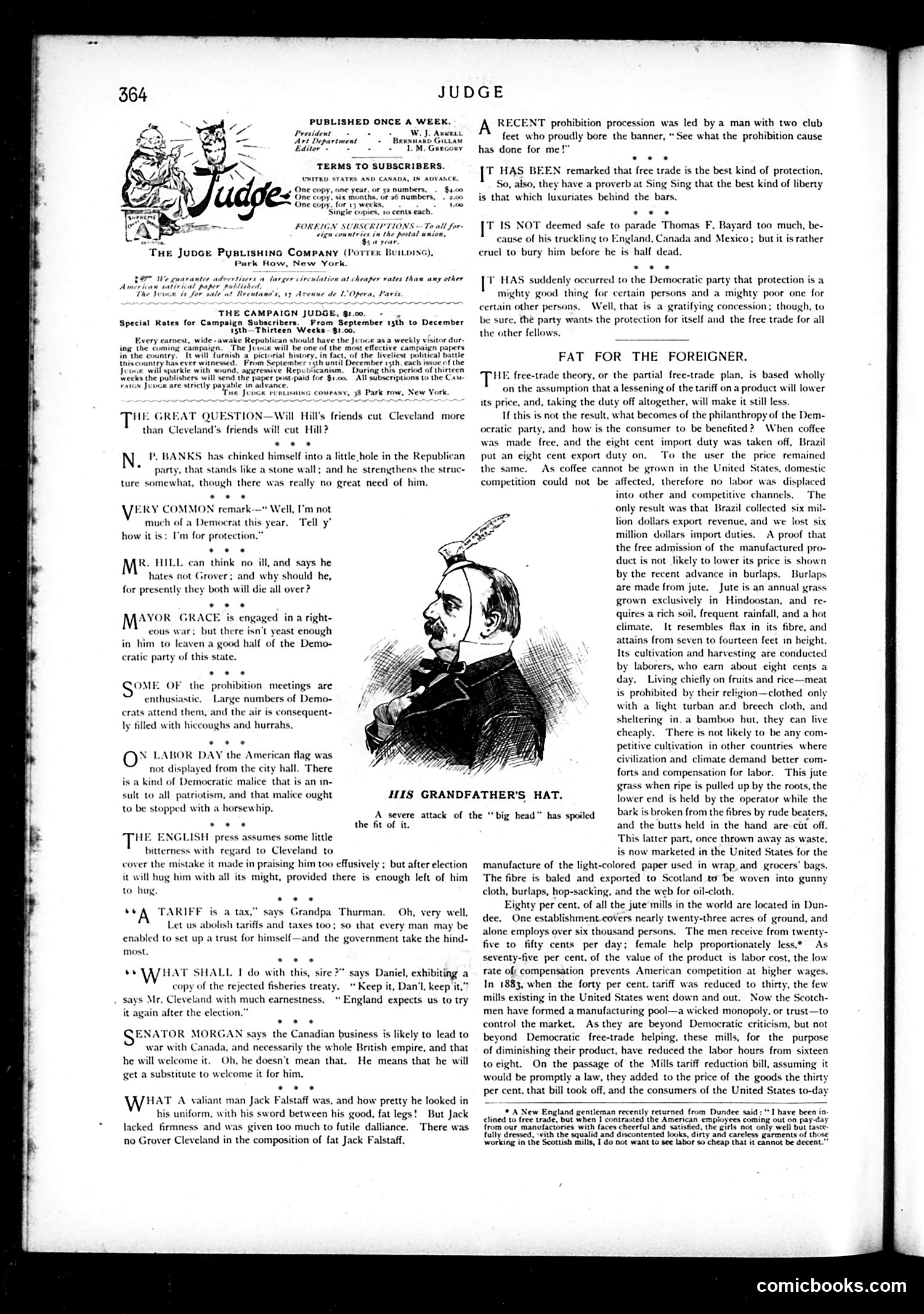
This page contains political commentary and satirical observations rather than a single unified cartoon. The main illustrated piece shows a man wearing traditional Asian clothing and a distinctive hat, titled "HIS GRANDFATHER'S HAT." The accompanying text discusses jute production in Hindustan (India), describing cultivation methods, labor practices, and manufacturing processes. The piece appears to critique free-trade policies and their effects on international commerce, particularly regarding jute imports and tariffs. The scattered political remarks mock various figures—including references to Cleveland, Banks, Hill, and others—regarding protectionism, tariffs, and Democratic party politics. The overall tone suggests satirizing debates over trade policy and their real-world economic consequences for American workers and manufacturers.
📄 Transcribed text from this page (OCR, searchable)
Machine-transcribed from the original scan — historical spelling and the odd misread are preserved.
JUDGE PUBLISHED ONCE A WEEK. Praident vt Department Tiler re TM. Geecouy TERMS TO SUBSCRIBERS. UNITRD STATES AND CANADA, IN ADVANCE . One copy, one year. or sz numbers, . $4.00 One copy. six months, oF 26 numbers, 3.00 One copy, for 13 weeks, LT eo ‘Single copies, to cents each, To all for. the postal unio FOREIGN SUBSCRIPTIONS cign countrics THe Juvoe Pysiisuina Company (lorrre Buivinc), Park Row, New York. American sativival paper published. The Suucn ts for sale at Brentane's, any other 17 Avenue de L’Opera, Paris THE CAMPAIGN JUDGE, @1.00. + Special Rates for Campaign Subscribers, Prom September 1sth to December 15th Thirteen Weeks $1.00. Every earnest, wide -awake Republican should have the Junce asa weekly visitor dur- ing the coming campaign. The Juvce will be one of the most effective campaign papers in'the country. Ie will furnish a pic story, in fact, of the liveliest political battl thiscountey has ever witnessed. From September rath until December 1th. each issue of the Jour will sparkle with sound, agyressive Repebiicanism. During this period of thirteen ‘cis the publishers will send the paper post-paid for 1.0m, All subscriptions to the Cas Paton Junee are strictly payable in advanc sy, 38 Parle HE GREAT QUESTION—Will Hill's friends cut Clevel: than Cleveland's friends will cut Hill? IN, 2: BANKS has chinked himself into a little,hole in the Republican * party, that stands like a stone wal ture somew ow, New York, nd more and he strengthens the struc~ . though there was really no great need of him. VERY COMMON remark —" W much of a Democrat this year. how it is: I'm for protection.” ME: HILL can think no ill, and says he hates not Grover; and why should he, for presently they both will die all over? 1, I'm not Telly’ eee cee AYOR GRACE is engaged ina right- cous war; but there isn’t yeast enough in him to leaven a good half of the Demo- cratic party of this state. )ME OF the prohibition meetings are enthusiastic. Large numbers of Demo- crats attend them, and the air is consequent- ly filled with hiccoughs and hurrahs. rw N LABOR DAY the American flag was not displayed from the city hall. There is a kind of Democratic malice that is an in sult to all patriotism, and that malice ought to be stopped with a horsewhip. A severe attack of the “big head” has spoiled cee the fit of it. HE ENGLISH press assumes some little bitterness with regard to Cleveland to cover the mistake it made in praising him too effusively ; but after election it will hug him with all its might, provided there is enough left of him to hug. SA. TARIFF is a tax,” says Grandpa Thurman. Let us abolish tariffs and taxes too; so that € enabled to set up a trust for himself most. SOYVHAT SHALL I do with this, sire?” says Daniel, exhibiting a copy of the rejected fisheries treaty.“ Keep it, Dan'l, keep it,” says Mr. Cleveland with much earnestness,“ England expects us to try it again after the el eee Oh, very well. ery man may be and the government take the hind- ection.” SENATOR MORGAN says the Canadian business is likely to lead to war with Canada, and necessarily the whole British empire, and that he will welcome it. Oh, he doesn't mean that. He means that he will get a substitute to welcome it for him. HAT A valiant man Jack Falstaff was, and how pretty he looked in his uniform, with his sword between his good, fat legs! But Jack lacked firmness and was given too much to futile dalliance. There was no Grover Cleveland in the composition of fat Jack Falstaff. HIS GRANDFATHER'S HAT. RECENT prohibition procession was led by a man with two club feet who proudly bore the banner, “See what the prohibition cause has done for me!" eee T HAS BEEN remarked that free trade is the best kind of protection, So, also, they have a proverb at Sing Sing that the best kind of liberty is that which luxuriates behind the bars. T IS NOT deemed safe to parade Thomas F, Bayard too much, be- cause of his truckling to England, Canada and Mexico; but it is rather cruel to bury him before he is half dead. T HAS suddenly occurred to the Democratic party that protection is a mighty good thing for certain persons and a mighty poor one for certain other persons, Well, that is a gratifying concession; though, to be sure, the party wants the protection for itself and the free trade for all the other fellows. FAT FOR THE FOREIGNER. HE free-trade theory, or the partial free-trade plan, is based wholly on the assumption that a lessening of the tariff on a product will lower its price, and, taking the duty off altogether, will make it still less. If this is not the result, what becomes of the philanthropy of the Dem- ic party, and how is the consumer to be benefited? When coffee was made free, and the eight cent import duty was taken off, Brazil put an eight cent export duty on, To the user the price remained the same. As coffee cannot be grown in the United States, domestic competition could not be affected, therefore no labor was displaced into other and competitive channels, The only result was that Brazil collected six mil- lion dollars export revenue, and we lost six million dollars import duties. A proof that the free admission of the manufactured pro- duct is not likely to lower its price is shown by the recent advance in burlaps. Burlaps are made from jute. Jute is an annual grass grown exclusively in Hindoostan, and re- quires a rich soil, frequent rainfall, and a hot climate, It resembles flax in its fibre, and attains from seven to fourteen feet in height. Its cultivation and harvesting are conducted y laborers, who earn about eight cents a y. Living chiefly on fruits and rice—meat is prohibited by their religion—clothed only with a light turban ard breech cloth, and sheltering in. a bamboo hut. they can live cheaply. ‘There is not likely to be any com- petitive cultivation in other countries where civilization and climate demand better com- forts and compensation for labor. This jute grass when ripe is pulled up by the roots, the lower end is held by the operator while the bark is broken from the fibres by rude beaters, and the butts held in the hand are: cat off. This latter part, once thrown away as waste, is now marketed in the United States for the manufacture of the light-colored paper used in wrap, and grocers’ bags. The fibre is baled and exported to Scotland to be woven into gunny cloth, burlaps, hop-sacking, and the web for oil-cloth. Eighty per cent. of all the jute'mills in the world are located in Dun- One establishment-covers nearly twenty-three acres of ground, and alone employs over six thousand persons. The men receive from twenty- five to fifty cents per day; female help proportionately less.* As seventy-five per cent. of the value of the product is labor cost, the low rate of; compensation prevents American competition at higher wages. In 1883, when the forty per cent. tariff was reduced to thirty, the few mills existing in the United States went down and out. Now the Scotch- men have formed a manufacturing pool—a wicked monopoly, or trust—to control the market. As they are beyond Democratic criticism, but not beyond Democratic free-trade helping, these mills, for the purpose of diminishing their product, have reduced the labor hours from sixteen tocight. On the passage of the Mills tariff reduction bill, assuming it would be promptly a law, they added to the price of the goods the thirty per cent, that bill took off, and the consumers of the United States to-day dee. * A New England gentleman recently returned from Dundee said : “I have been in- clined to free trade, but when I contrasted the American employees coming out on pay-day from our manufactories with faces cheerful and satisfied, the girls not only well but taste. fully dressed, ‘vith the squalid and discontented looks, dirty and careless garments of those ‘working in the Scottish mills, I do not want to see labor so cheap that it cannot be decent.” comicbooks.com