
A complete issue · 16 pages · 1888
Judge — August 25, 1888
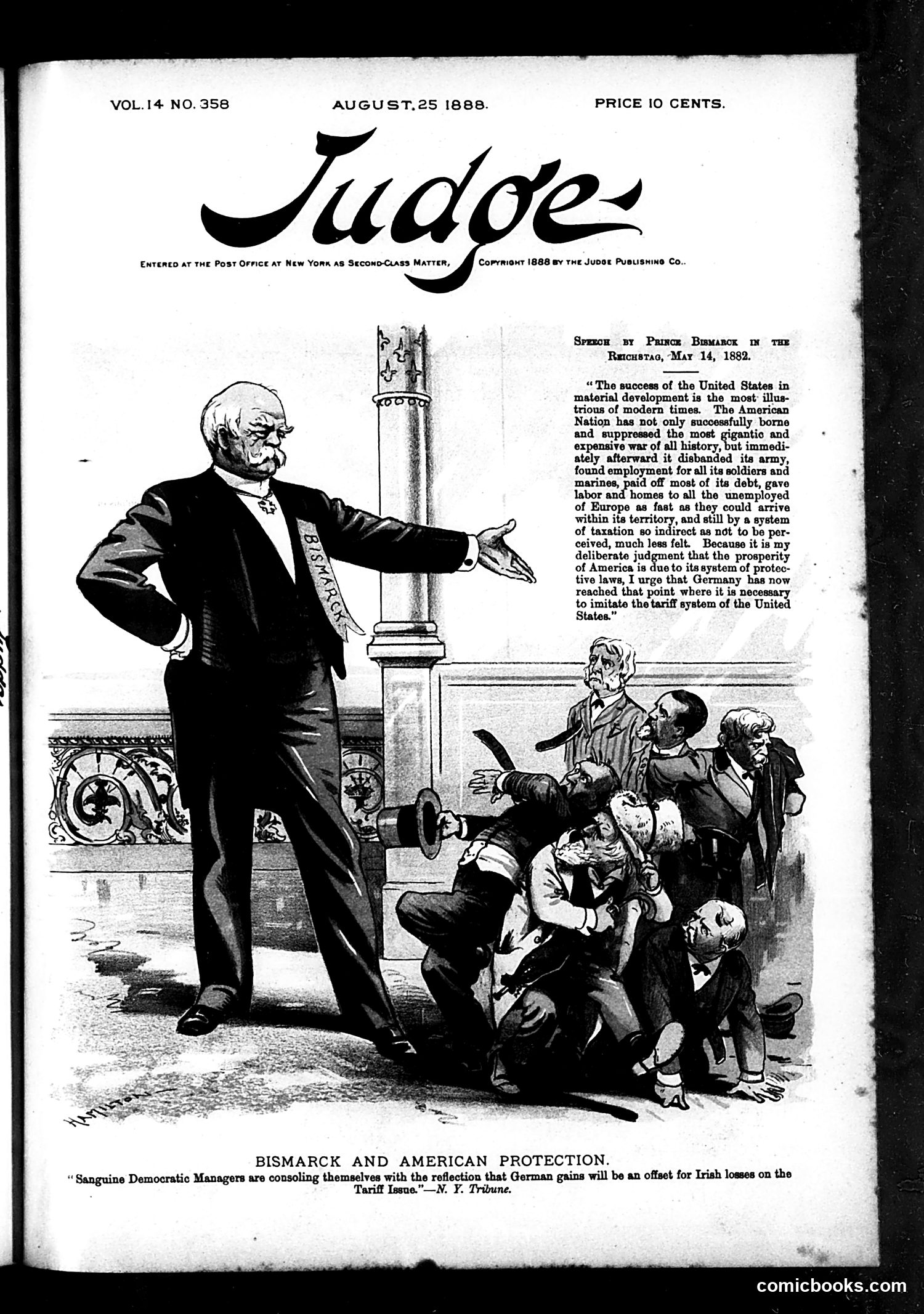
This 1888 political cartoon satirizes the protectionist tariff debate. The large figure appears to be **Otto von Bismarck**, the German Chancellor, depicted as lecturing smaller figures—likely representing **Irish-American Democrats** concerned about tariffs affecting Irish trade. The speech bubble quotes Bismarck endorsing protective tariffs as key to America's economic success. The cartoon's satire is directed at **Democratic politicians** who opposed high tariffs: the caption mocks them for finding "consolation" that German gains will offset Irish tariff losses. The joke targets the political hypocrisy of Democrats claiming to help Irish-Americans while opposing the very protectionist policies Bismarck championed—suggesting their position is logically incoherent.
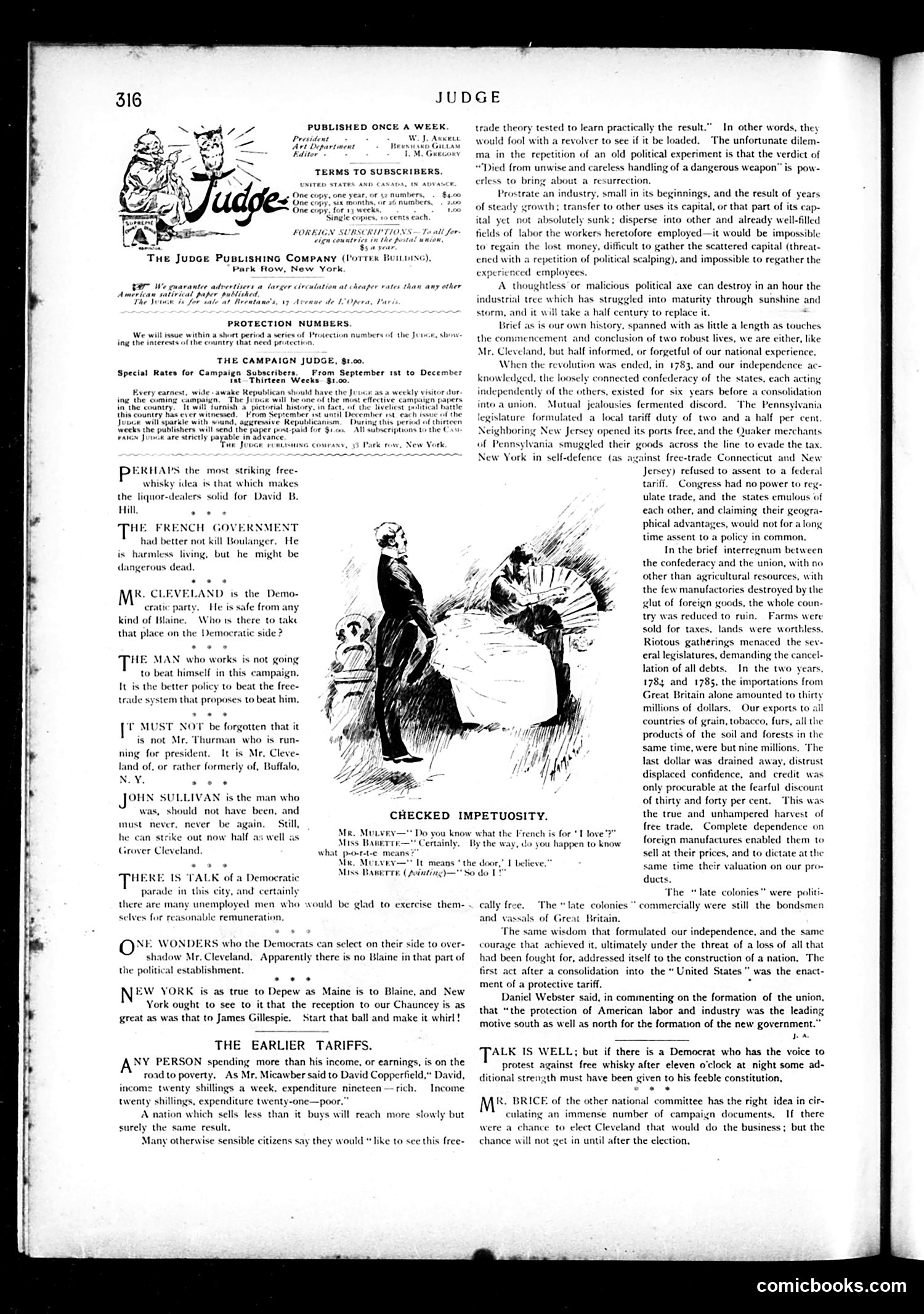
This cartoon depicts two figures in what appears to be a confrontational encounter. The dialogue references "the French" and "love," with one figure (likely representing a political opponent) being corrected or "checked" by another. Based on the surrounding text discussing Cleveland, tariffs, and Democratic politics, this likely satirizes a political debate of the 1880s era. The cartoon's title "Checked Impetosity" suggests criticism of hasty or reckless political action. The specific identities and exact political situation remain unclear from the image alone, though the page focuses on trade policy debates and critiques of Democratic positions under Cleveland's administration. The cartoon exemplifies Judge's typical approach of using dialogue-driven humor to mock political figures and policy positions.
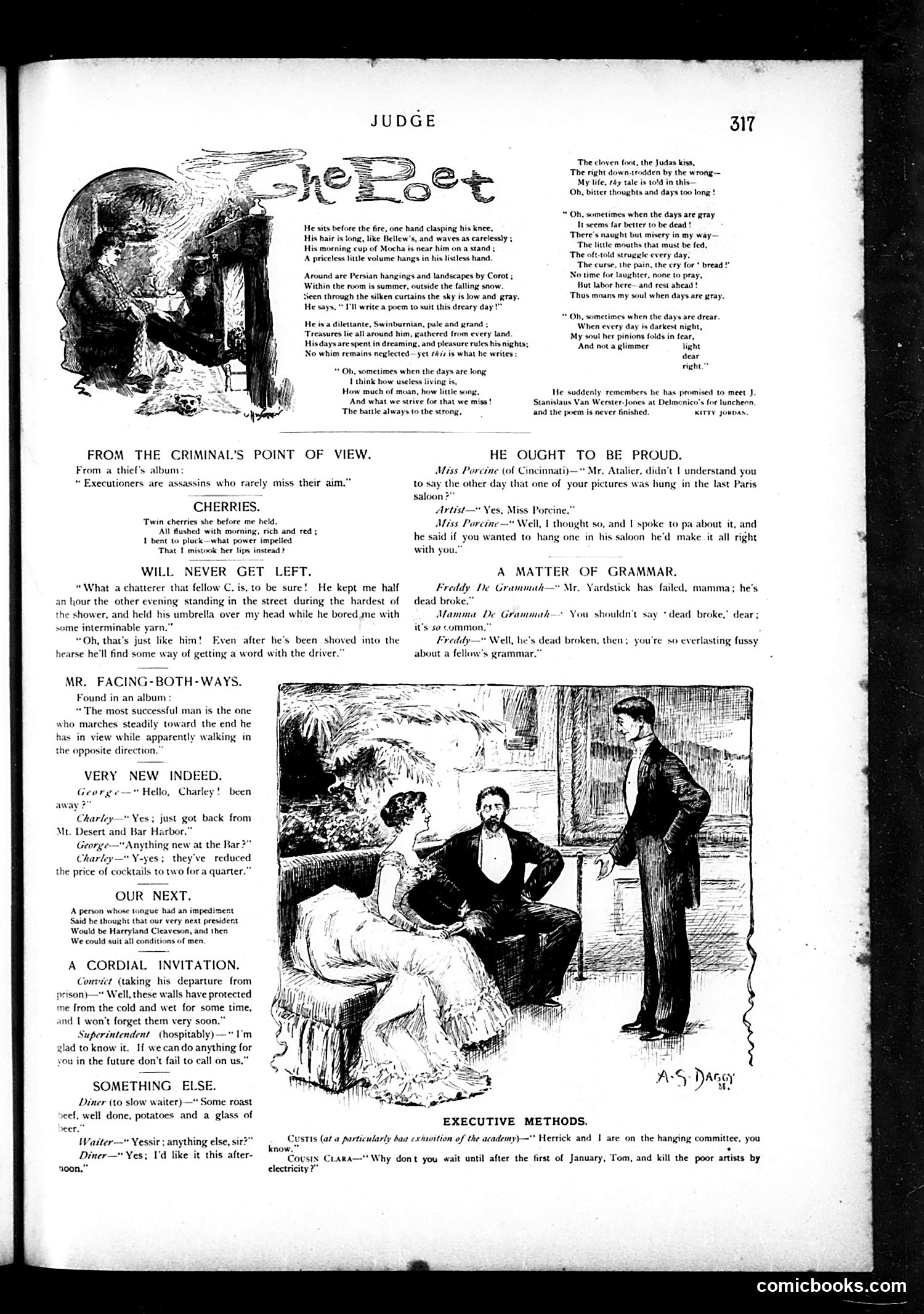
This page contains multiple brief satirical humor pieces typical of Judge magazine's format. The main illustrated cartoon, "A Matter of Grammar," depicts a domestic scene where a man corrects a woman's grammar—she's said her husband "broke" rather than "is broken." The satire mocks pedantic correction of language in casual conversation. Other brief pieces include "Will Never Get Left" (mocking an unfaithful husband), "Mr. Facing-Both-Ways" (about political opportunism), and "Executive Methods" (suggesting poor artists should be eliminated for efficiency). The cartoon style and domestic/social humor reflect early 20th-century American middle-class anxieties about propriety, language, and marital dynamics. No specific historical figures or events appear identifiable in this particular page.
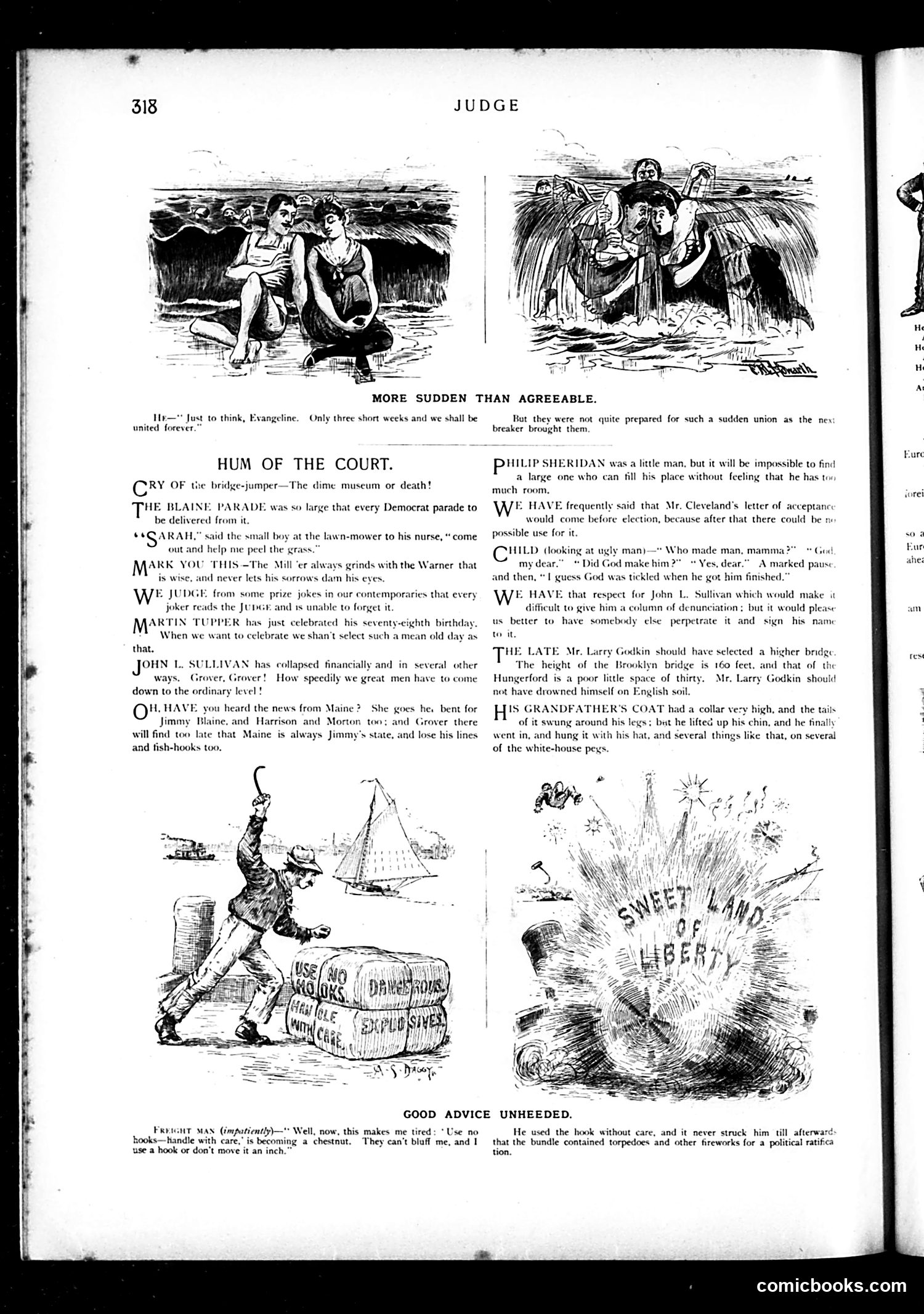
This page contains brief satirical items typical of Judge's "Hum of the Court" humor section, mixed with social commentary on 1880s American politics. **Key references:** - **Blaine/Maine**: Allusions to James G. Blaine's 1884 presidential campaign and election results in Maine, a politically significant state - **Cleveland's letter**: References President Grover Cleveland's letter accepting the Democratic nomination - **John L. Sullivan**: The famous boxer, used here for moral commentary - **Larry Godkin**: Appears to reference a suicide by jumping from Brooklyn Bridge—a sensationalized news event of the era - **Philip Sheridan**: The recently deceased Civil War general **The satire's point**: These are quick jabs at politicians (Cleveland, Blaine), celebrities, and public figures, using wordplay and ironic observations. The bottom cartoon warns against ignoring warning labels—a practical joke about carelessness with fireworks during political celebrations. The tone is typical Judge irreverence: mocking politicians' competence, celebrity scandals, and social pretension.
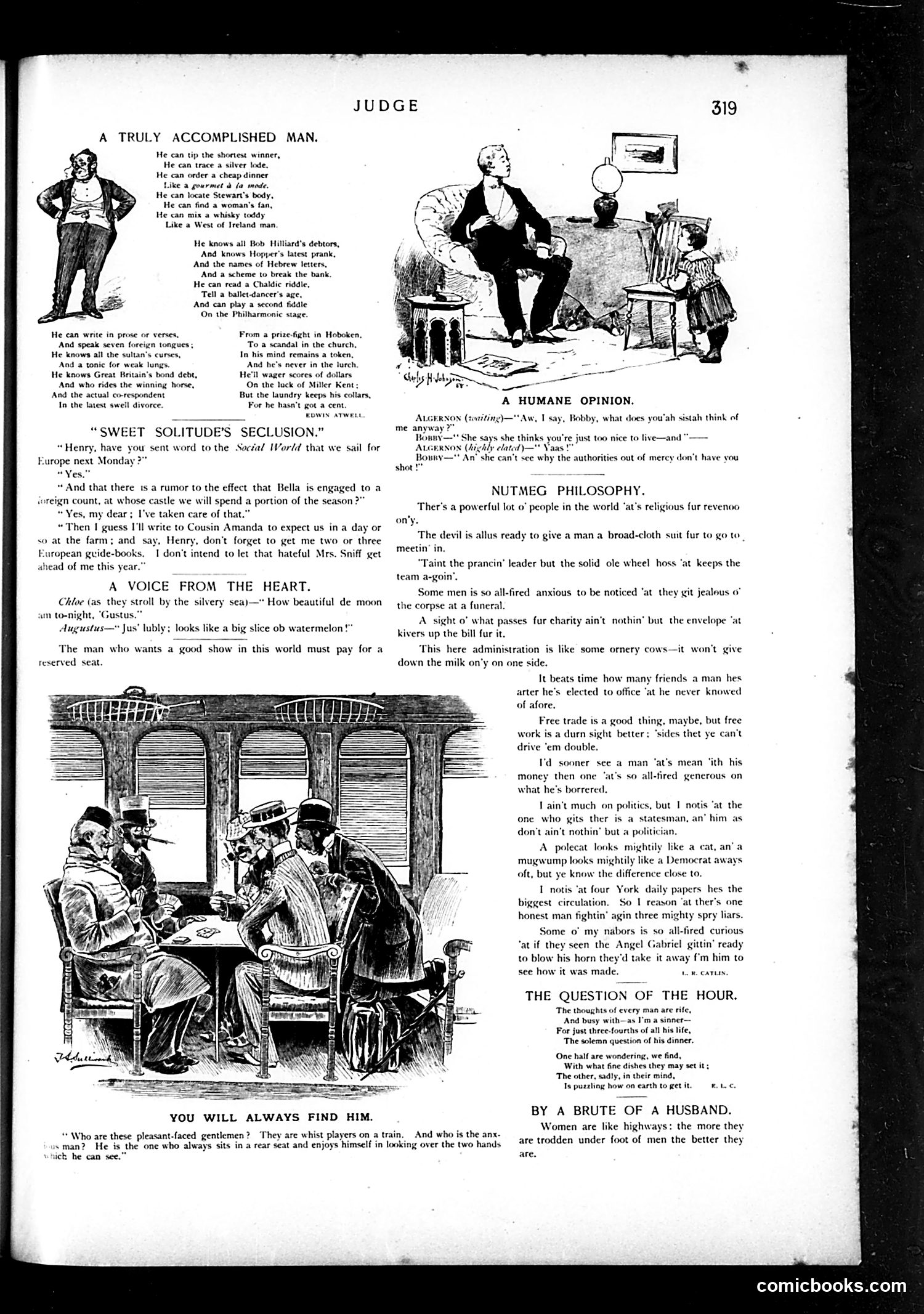
This page from Judge (a late 19th-century satirical magazine) contains several satirical pieces mocking social pretensions and human nature. **"A Truly Accomplished Man"** ridicules the ostentatiously knowledgeable person—someone who claims expertise in everything from financial schemes (Bob Hilliard's debts, breaking the bank) to high society gossip and current scandals, yet remains perpetually broke because "the laundry keeps his collars." The satire targets social climbers who advertise their worldliness while living beyond their means. **"Sweet Solitude's Seclusion"** mocks the competitive snobbery of wealthy women, particularly one eager to one-up the despised "Mrs. Sniff" through European travel and manufactured social advantages (a daughter's engagement to a foreign count). **Other pieces** like "Nutmeg Philosophy" offer rural/folksy aphorisms satirizing hypocrisy—religious people motivated by profit, politicians versus statesmen, and charitable donations that merely cover bills. The humor relies on period-specific references (tariff politics, scandal sheets) now requiring historical context.
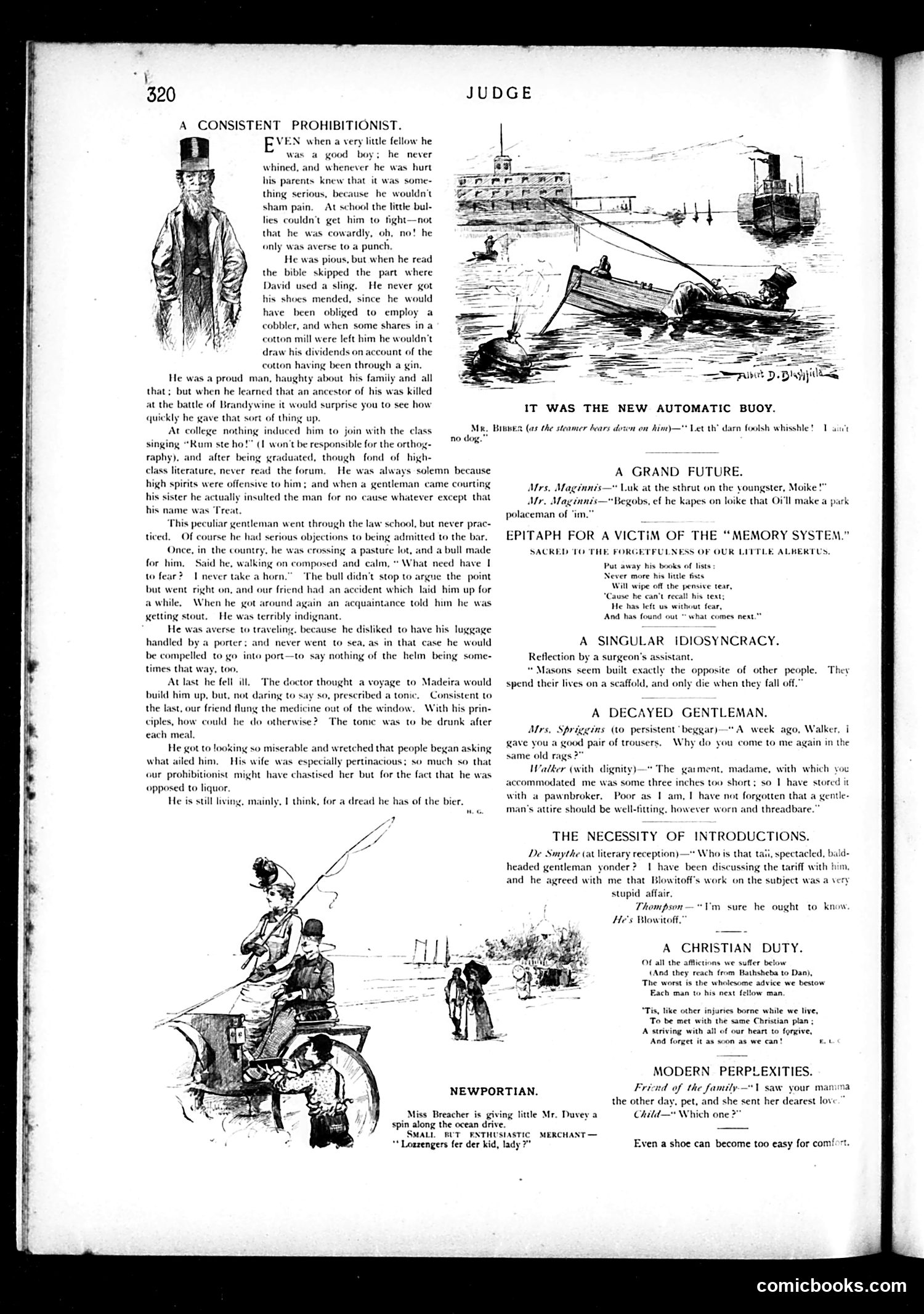
This satirical biography mocks an extreme prohibitionist—a man so rigidly committed to avoiding anything remotely connected to sin or harm that his principles become absurd. He refuses to fight (pacifism), won't read biblical violence, avoids cobblers (shoe repair involves leather work animals), and rejects cotton mill dividends because cotton passes through gins. He won't sing drinking songs, abandons family pride when discovering an ancestor died in battle, and throws out prescribed medicine on principle. The joke's culmination: this man of perfect moral consistency becomes weak and sickly precisely *because* of his extremism. Judge suggests prohibitionists' rigid ideology produces pathological, even self-destructive behavior. The satire targets not just temperance advocates but any political movement whose adherents prioritize dogma over practical living.
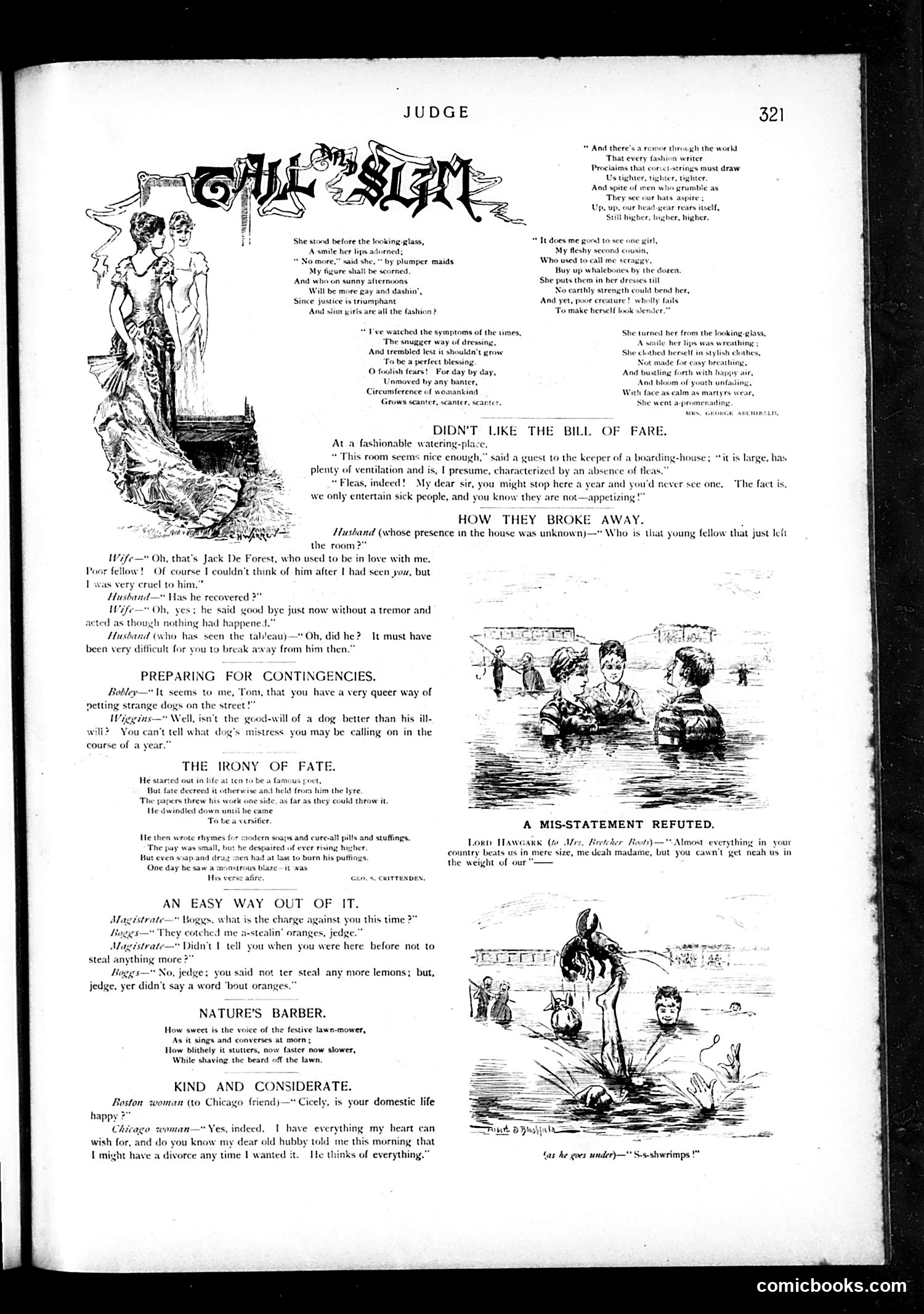
This page contains multiple satirical sketches typical of Judge magazine's social commentary. The main content mocks Victorian fashion obsessions and social pretensions: **"DIDN'T LIKE THE BILL OF FARE"** jokes about a boarding-house keeper who admits only entertaining sick guests—implying they're less "appetizing" (less likely to complain about poor food). **"HOW THEY BROKE AWAY"** presents a domestic comedy where a husband, overhearing his wife claim she was "cruel" to her ex-suitor Jack De Forest, sarcastically notes the breakup must have been difficult—suggesting the wife's account is self-aggrandizing fiction. The sketches address marriage dynamics, class pretension, and female vanity. The illustrations feature period dress and social scenarios. Various short humorous dialogues mock everything from dog-petting etiquette to magisterial justice (a defendant claiming he was only told not to steal lemons, not oranges). The overall tone is lighthearted mockery of middle and upper-class American social conventions and domestic life in this era.
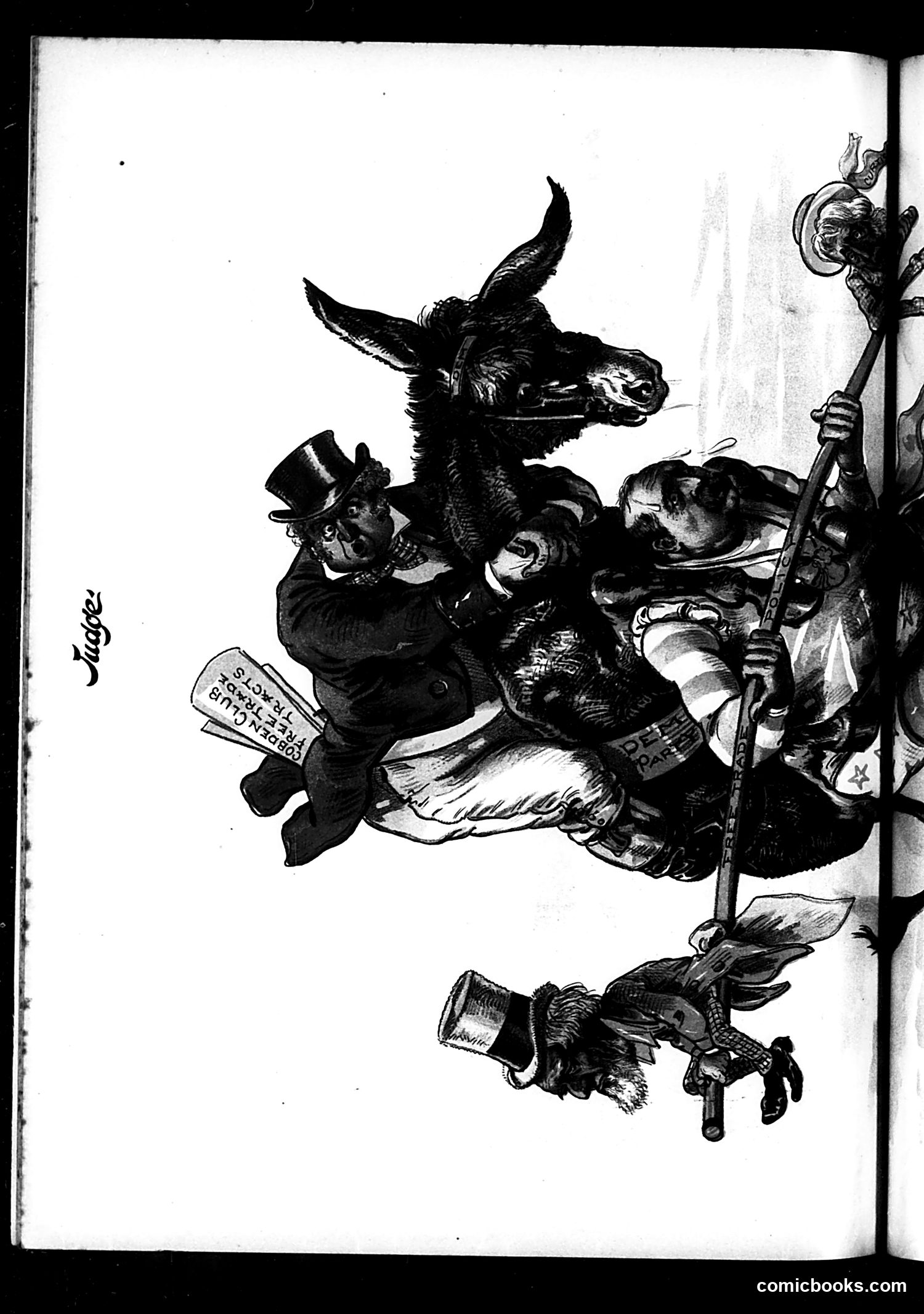
This appears to be a satirical cartoon from *Judge* magazine, though the OCR text is too degraded to read the caption or title clearly. The image shows anthropomorphic animals (a donkey and what appears to be other creatures) dressed as human figures engaged in political activity. The donkey—a traditional symbol of the Democratic Party in American political cartooning—is central to the composition, surrounded by figures in formal attire and top hats. The presence of what appears to be an official staff or symbol on the right suggests this depicts political authority or governance. Without legible text identifying the specific figures or context, the precise political reference remains unclear, but the cartoon likely satirizes Democratic political maneuvering or leadership during the period when *Judge* was published.
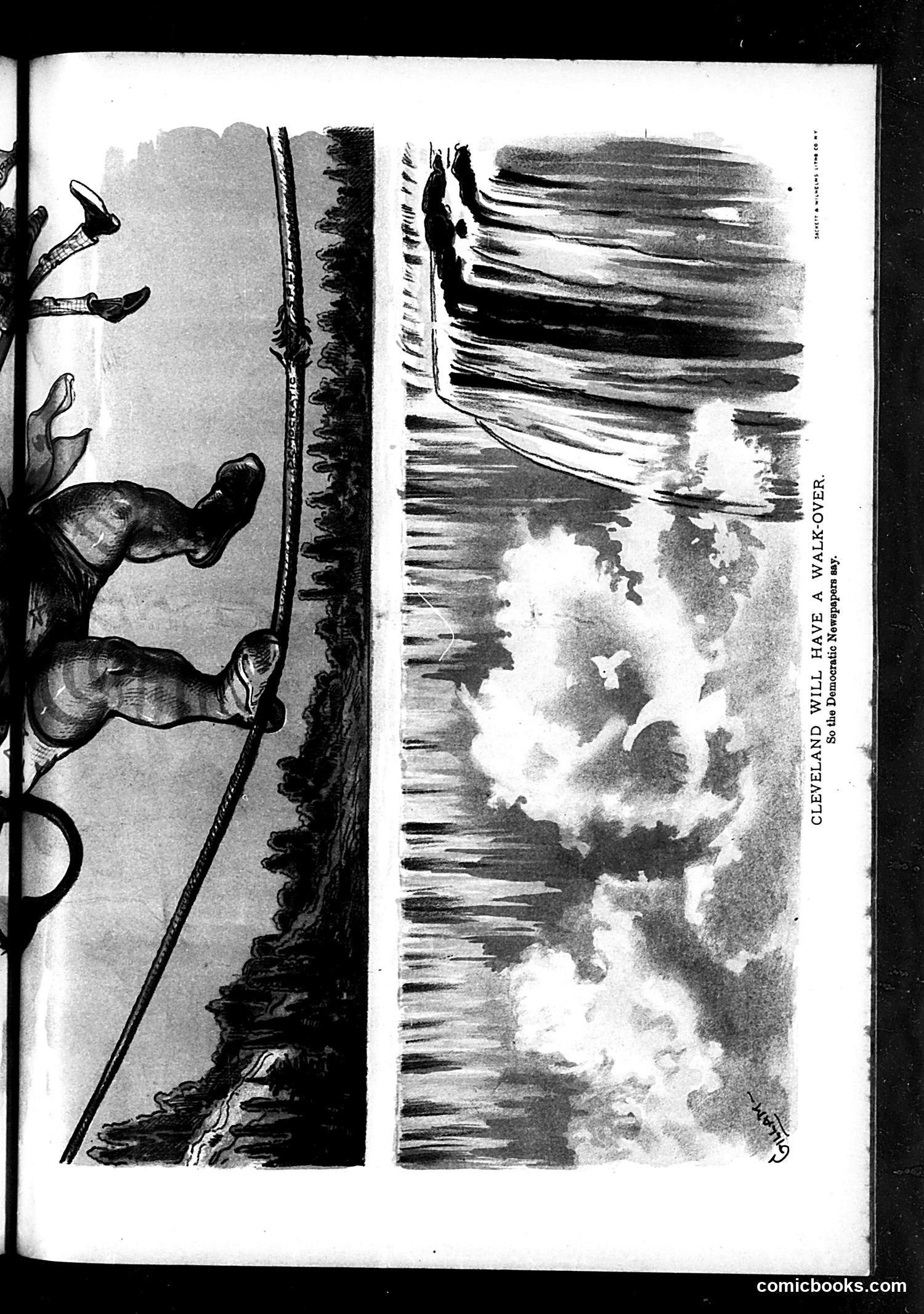
The OCR text is severely corrupted and unreadable, making it impossible to identify the specific political or social references with confidence. However, the **image** shows two distinct illustrations. The left panel depicts a figure holding what appears to be a rope or noose near an elephant—likely the Republican Party symbol. The right panel, labeled "CLEVELAND WILL HAVE A WALKOVER," shows a landscape scene with dramatic clouds and movement. Without legible text, I cannot definitively identify which political figures or events are being satirized. The elephant suggests Republican politics, and the "Walkover" reference suggests an electoral prediction, but **determining the specific context, date, and satirical point requires readable text** that this page does not provide. The corruption of the OCR makes responsible historical analysis impossible here.
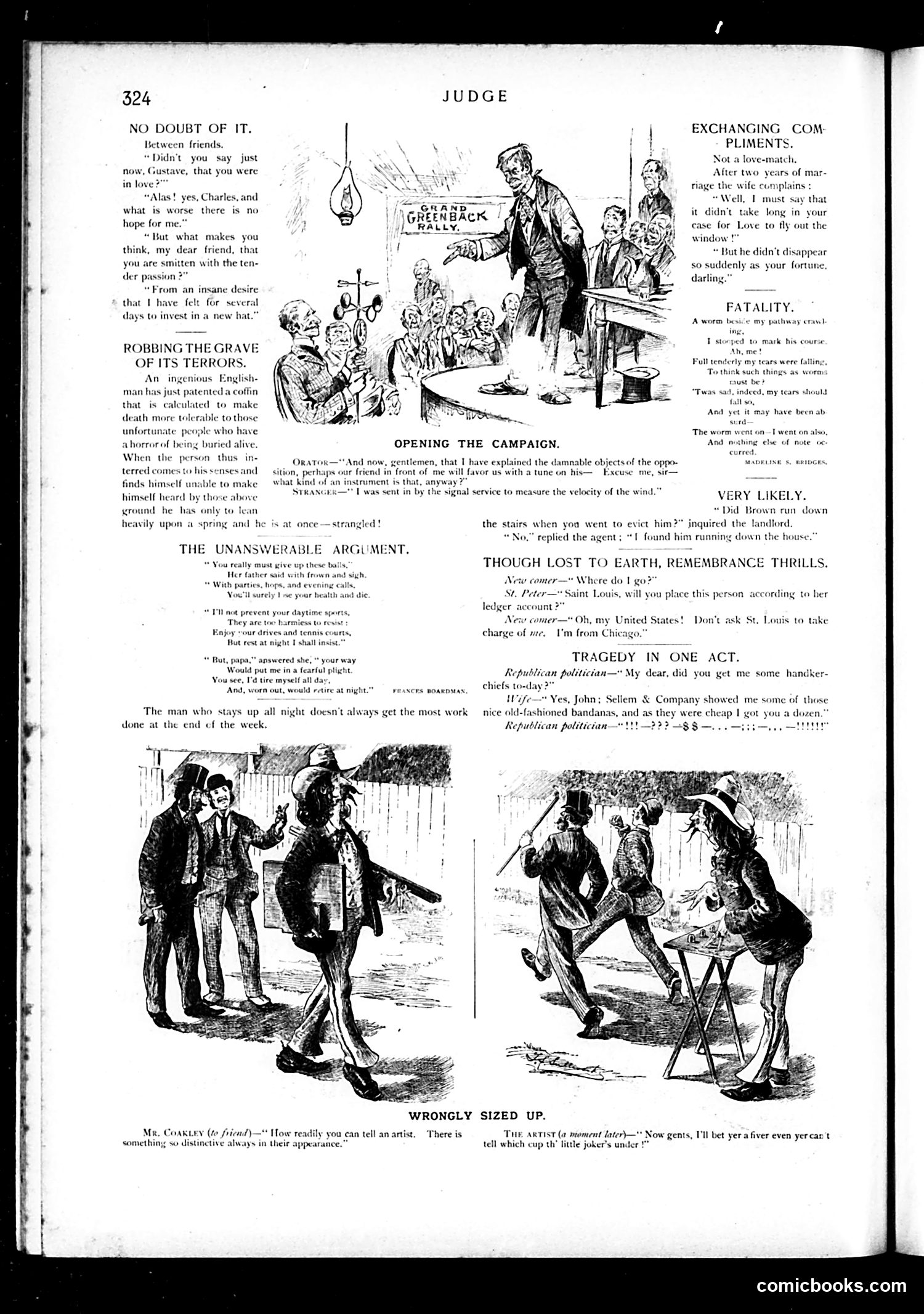
This page contains multiple short satirical pieces typical of Judge magazine's humor: **"No Doubt of It"** and **"Exchanging Compliments"** are conversational jokes about love and marriage—standard domestic humor mocking romantic delusions. **"Robbing the Grave of Its Terrors"** satirizes a patent for a coffin mechanism: if someone is buried alive, they can pull a spring that strangles them. The dark joke critiques both the fear of premature burial (a genuine Victorian anxiety) and absurd "solutions" to it. **"Opening the Campaign"** shows a political speaker beginning a campaign rally, likely mocking campaign rhetoric about opponents' "damnable objects." **"Though Lost to Earth, Remembrance Thrills"** jokes about a Chicago resident being sent to St. Louis in the afterlife—she protests, not wanting to be associated with another city even in heaven. This reflects inter-city rivalries of the era. **"Wrongly Sized Up"** depicts Mr. Coakley confidently identifying someone as an artist by appearance, only to be proven wrong—a joke about stereotypes and first impressions. The page's humor relies on domestic situations, social pretension, and period anxieties rather than specific political events.
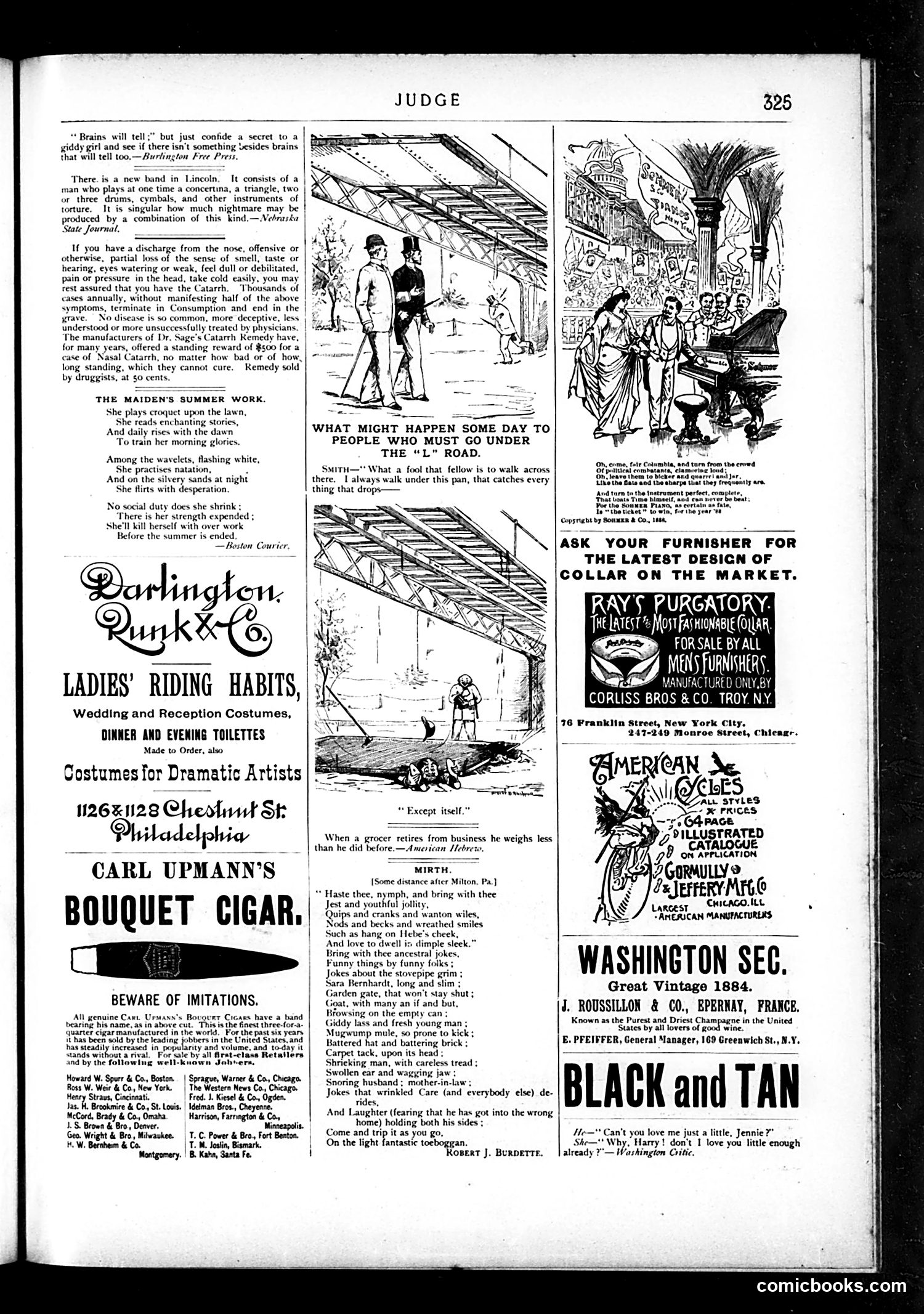
This page primarily contains **advertisements and light humor** rather than political satire. The main content includes: **Advertisements:** Darlington, Punk & Co. (ladies' riding habits), Carl Upmann's Bouquet Cigars, Ray's Purgatory collars, American Cycles, and Washington Securities. **The Cartoon:** The central illustration depicts the Chicago "L" (elevated railway) with a pedestrian walking underneath. The caption warns of falling debris—Smith jokes about catching things that drop from the train overhead. This reflects genuine urban hazard concerns of the 1880s, as the elevated railways created nuisances for street-level pedestrians. **Light Verse:** "The Maiden's Summer Work" humorously catalogs a young woman's exhausting leisure activities—croquet, reading, gardening, swimming—suggesting that even "rest" was labor-intensive for Victorian women. **Minor Items:** Brief jokes about catarrh medicine and a grocer's weight loss are filler content typical of period magazines. The page reflects late 19th-century urban life's practical concerns and Victorian gender expectations rather than sharp political commentary.
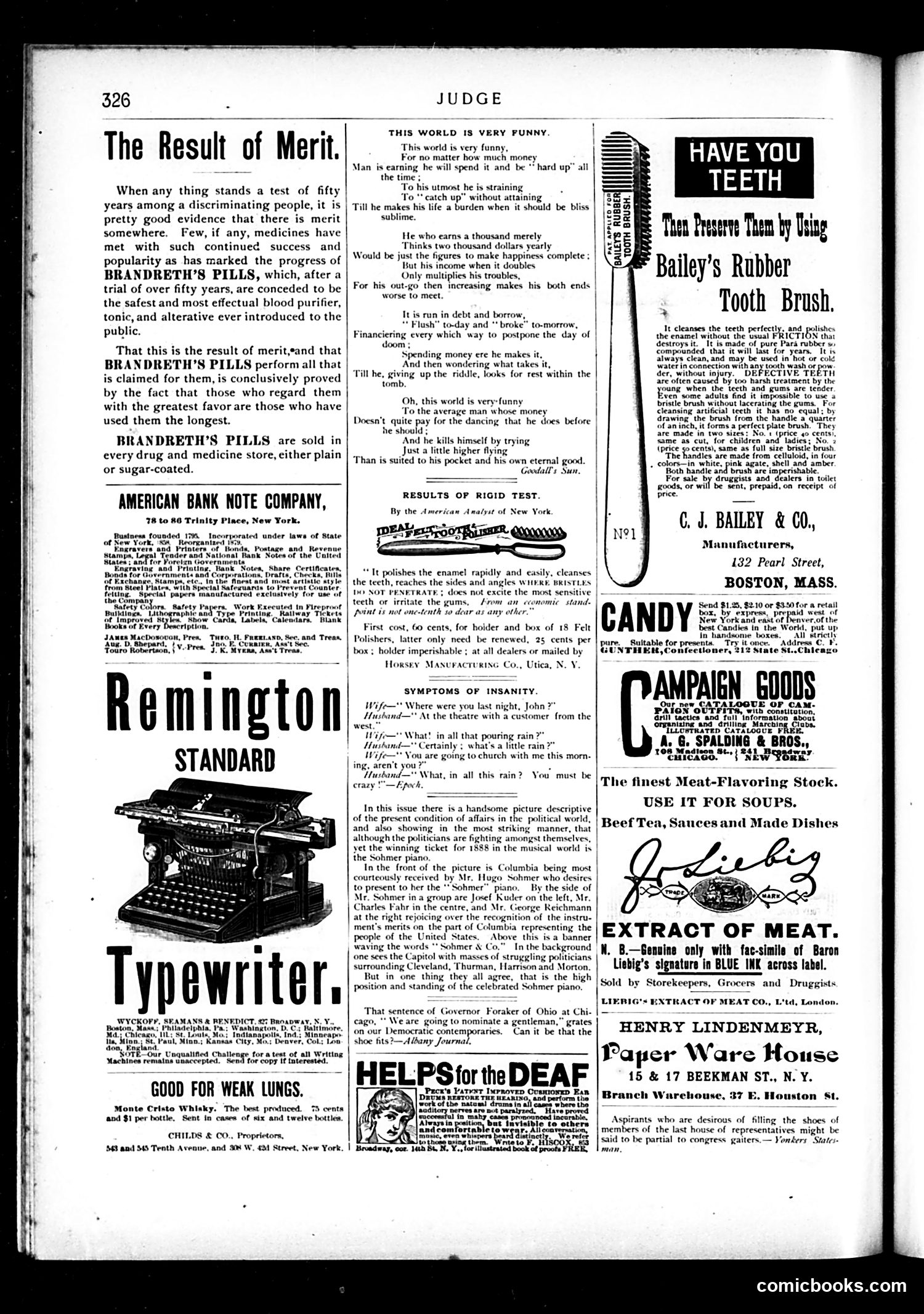
This page is primarily **advertisements and filler content** rather than political satire. The main elements are: **"This World Is Very Funny"** - A light comic poem about financial irresponsibility, mocking how people at all income levels spend beyond their means and perpetually feel broke. It's generic social commentary on human nature, not tied to specific politics. **"Symptoms of Insanity"** - A domestic humor sketch where a husband contradicts himself (refusing rain as excuse for church but accepting it for theater), depicting marital absurdity. The bulk of the page consists of **product advertisements**: Brandreth's Pills (patent medicine), typewriters, whisky, toothbrushes, and other commercial goods typical of 1880s-90s magazines. There is a reference to "a handsome picture descriptive of the present condition of affairs in the political world" but **the actual cartoon is not visible** on this page—it apparently continues elsewhere in the issue. **No specific political figures or dated references appear here.**
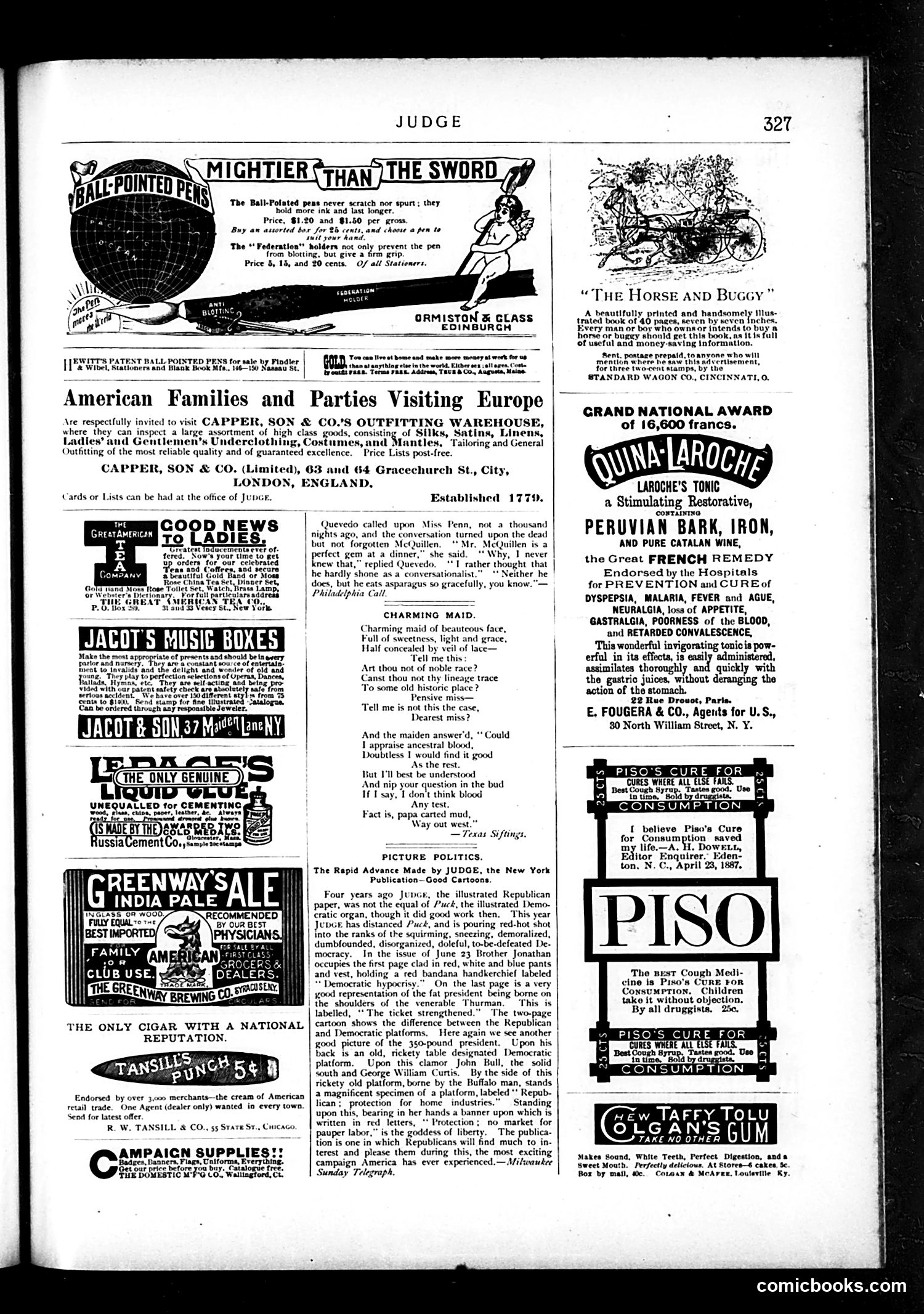
This page is primarily **advertising and editorial content** rather than political satire. The main article, "Picture Politics," is Judge magazine's own boastful commentary on its growing influence. Judge claims it has surpassed its rival **Puck** (a Democratic-leaning illustrated paper) in quality and impact. The article praises Judge's Republican cartoons attacking the Democratic party, describing them as "red-hot shot" against a "demoralized" opposition. Specific cartoons mentioned include Brother Jonathan (a patriotic American symbol) in patriotic clothing holding a "Democratic hypocrisy" banner, and a depiction of "the fat president" (likely President Cleveland) being carried by older figures, labeled "The ticket strengthened." The piece reflects the intensely partisan nature of 1880s political journalism, where illustrated magazines served as explicit propaganda organs for their respective parties. Judge's boasting reveals how central these visual satirists considered themselves to electoral politics.
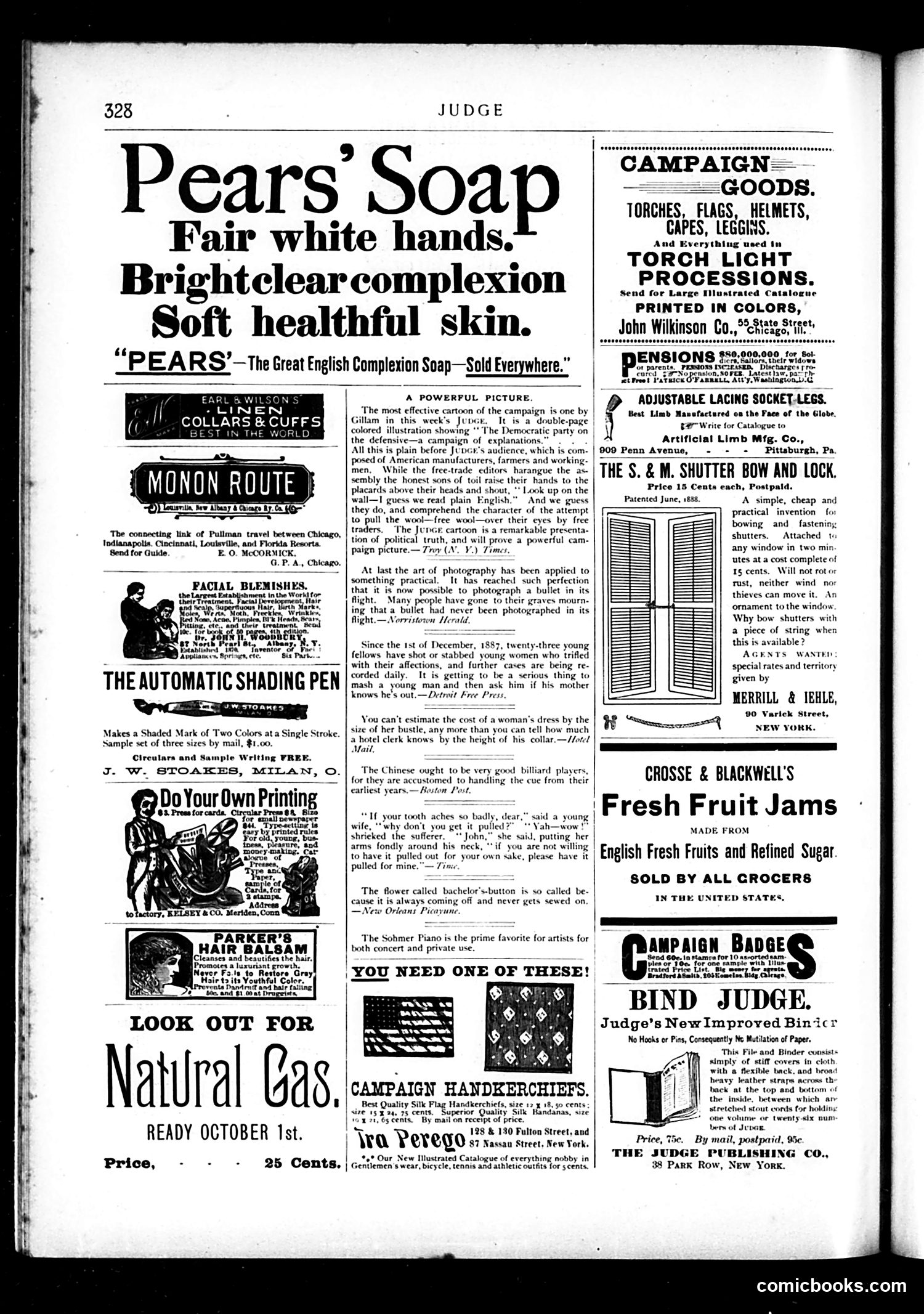
This page is predominantly **advertisements** rather than political cartoons. However, the text references a significant "powerful picture" cartoon by artist Gillam elsewhere in the issue, depicting **"The Democratic party on the defensive—a campaign of explanations."** The brief commentary suggests this was campaign-season satire (the reference to "natural gas ready October 1st" and campaign merchandise indicates an election year, likely 1888). The quoted commentary frames Democrats as evasive, with working men and farmers rejecting their "free trade" arguments—illustrated by workers pointing to wall signs reading truth about tariffs. The page itself is cluttered with period advertisements (Pears Soap, printing services, campaign handkerchiefs) typical of Judge's commercial model. The short humorous items scattered throughout are mild social observations about photography, young romance, and billiards—standard magazine filler of the era.
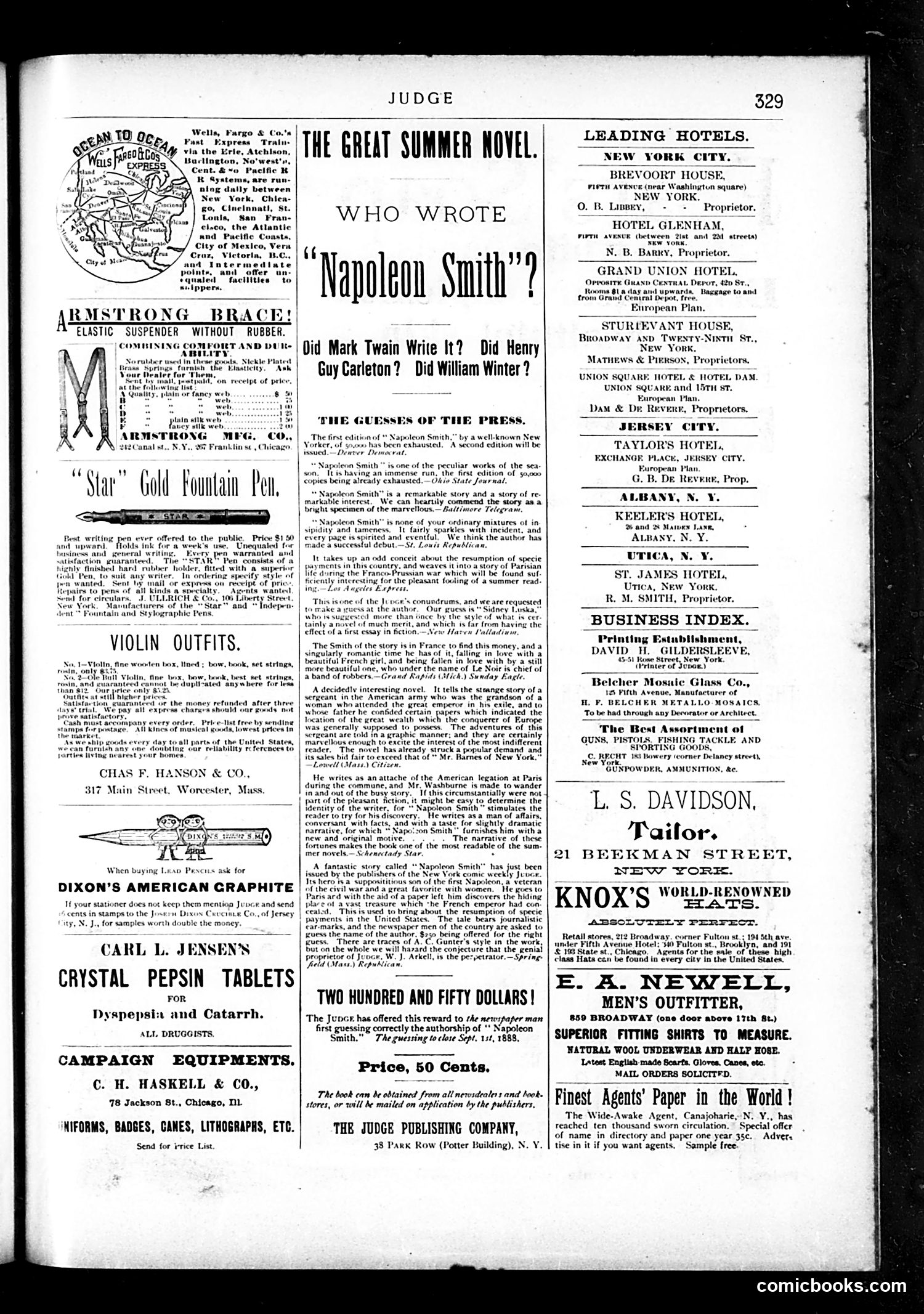
This page promotes *Judge* magazine's serialized novel "Napoleon Smith" as a summer mystery. The central feature is a humorous guessing game: readers are challenged to identify the author, with famous writers Mark Twain, Henry Guy Carleton, and William Winter proposed as possibilities. The novel itself concerns a Union Army sergeant who is supposedly Napoleon's grandson, sent to France during the Commune to recover hidden treasure. He romances a French woman while entangled with a criminal band led by someone called "Le Noir." Judge—a comic weekly—published this serialized novel and offered a $250 reward (substantial for 1885) to whoever correctly identified its true author. The page includes enthusiastic reviews from various newspapers praising the story's "incident" and romantic intrigue, building suspense around the authorship mystery. This was a marketing strategy: the guessing game drove readership and circulation.
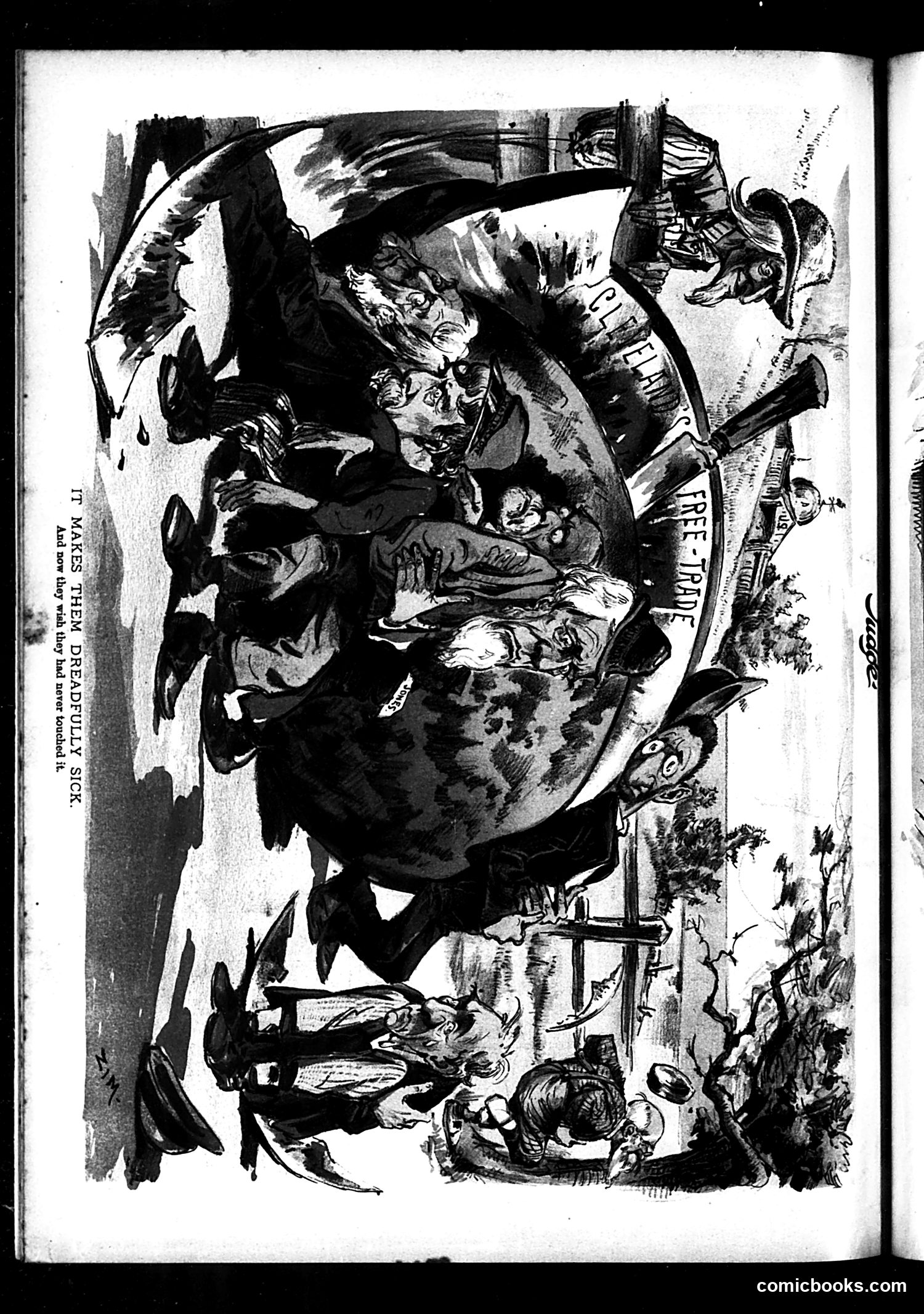
This appears to be a satirical cartoon depicting multiple figures experiencing illness or distress around a large globe. The caption suggests they've "touched" something that now makes them regret their actions. Without clearer identification of specific figures or visible dates, the exact political reference is uncertain. However, the imagery—showing multiple people afflicted by consequences of their involvement with a global matter—likely satirizes a contemporary political or diplomatic situation where American or international leaders faced negative repercussions from their foreign policy choices or international entanglement. The cartoon's point appears to be mocking politicians who discovered their international involvement had undesirable consequences they hadn't anticipated, now wishing they'd never engaged with it.