
Judge, 1888-08-25 · page 2 of 16
Judge — August 25, 1888 — page 2: what you’re looking at
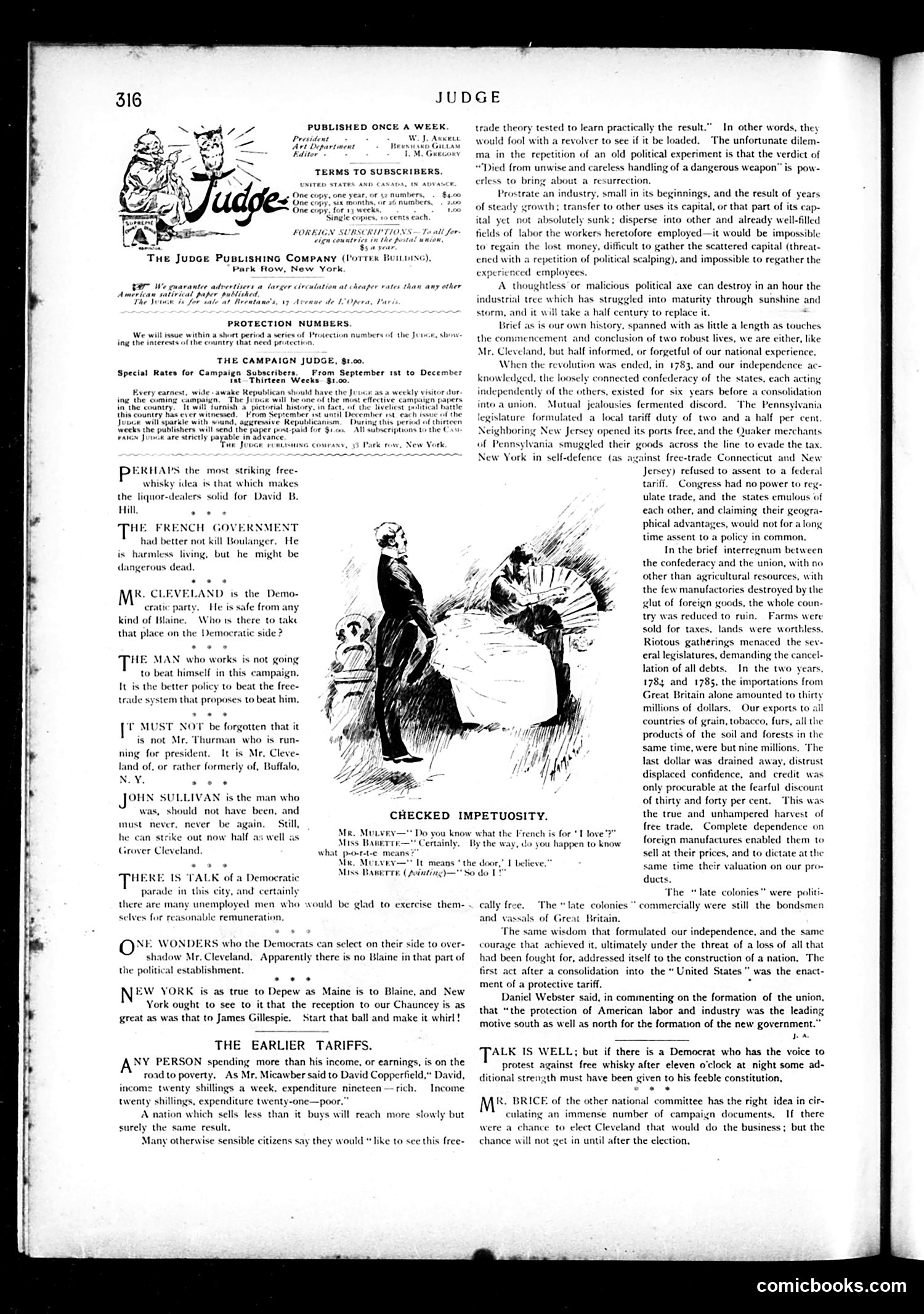
What you’re looking at
This cartoon depicts two figures in what appears to be a confrontational encounter. The dialogue references "the French" and "love," with one figure (likely representing a political opponent) being corrected or "checked" by another. Based on the surrounding text discussing Cleveland, tariffs, and Democratic politics, this likely satirizes a political debate of the 1880s era. The cartoon's title "Checked Impetosity" suggests criticism of hasty or reckless political action. The specific identities and exact political situation remain unclear from the image alone, though the page focuses on trade policy debates and critiques of Democratic positions under Cleveland's administration. The cartoon exemplifies Judge's typical approach of using dialogue-driven humor to mock political figures and policy positions.
📄 Transcribed text from this page (OCR, searchable)
Machine-transcribed from the original scan — historical spelling and the odd misread are preserved.
JUDGE PUBLISHED ONCE A WEEK. President W. J. Auceut Art Department Hewsiieo Gutast Editor ¢ 1M. Guecony TERMS TO SUBSCRIBERS One copy, one year. of 42 numbers, PF One copy, six shonthss, oF 26 numbers, ‘One copy, for 13 weeks. ‘Single copies. to cents each FOREIGN SUBSCRIPTIONS ~ To all for $s ar year Tue Jupce PustisHinc Company (lorrrk | Park Flow, New York. Ss $400 $A We guarantee advertisers a larger circulation at cheaper rates than any other American sativical paper published. The Swuwn is for sale at Brentano's, 17 Avenue de Lo Opera, Par PROTECTION NUMBERS. We will issue within a short period a series of Protect ing the interests of the country that need priitectic A numbers of the JunGK, show: THE CAMPAIGN JUDGE, $1.00. Special Rates for Campaign Subscribers. From September rst to December ist Thirteen Weeks. $1.00. Every earnest, wide -awake Republican should have the J ‘The Juouk will be furnish teased wiund, aggressive Repul wrecks the pblshers wil end the fper tt aid Paicn Junee are strictly payable in advance tsk each issue During th th Sten All subscriptions to the ( ZRHAPS the most striking free- whisky idea is that which makes the liquor-dealers solid for David B. Hill, ae 8 HE FRENCH GOVERNMENT had better not kill Boulanger. He is harmless living, but he might be dangerous dead. MB&: CLEVELAND is the Demo- cratic party. kind of Blaine, Who ts there to take that place on the Democratic side ? He is safe from any HE MAN who works is not going to beat himself in this campa It is the better policy to beat the free- trade system that proposes to beat him. TY MUST NOT be forgotten that it is not Mr. Thurman who is run- ning for president. It is Mr. Cleve- land of, of rather formerly of, Buffalo, JOHN SULLIVAN is the man who was, not have been, and never be again. Still, he can strike out now half as well as Grover Cle should must never, Me. Motvey— Miss Banerrr— what p-o-rt-e means?” Mk. Menvey—" It means Miss Banerre (fointingy—"* Certainly. and. HERE IS TALK of a Democratic parade in this city, and certainly there are many unemployed men who selves for vould be glad to exercise them- onable remuneration, NE WONDERS who the Democrats can select on their side to over- shadow Mr, Cleveland, Apparently there is no Blaine in that part of the political establishment. EW YORK jis as true to Depew as Maine is to Blaine, and New York ought to see to it that the reception to our Chauncey is as great as was that to James Gillespie. Start that ball and make it whirl! THE EARLIER TARIFFS. Y PERSON spending more than his income, or earnings, is on the road to poverty. As Mr, Micawber said to David Copperfield," David, income twenty shillings a week, expenditure nineteen —rich. Income twenty shillings, expenditure twenty-one—poor,” A nation which sells less than it. buys will reach more surely the same result, Many otherwise sensible citizens say th lowly but would “like to see this free- CHECKED IMPETUOSITY. Do you know what the French is for ‘1 love'?" By the way, trade theory tested to learn practically the result.” In other words, they would fool with a revolver to see if it be loaded. The unfortunate dilem- ma in the repetition of an old political experiment is that the verdict of died from unwise and careless handling of a dangerous weapon” is pow- crless to bring about a resurrection. Prostrate an industry, small in its beginnings of steal and the result of years , or that part of its cap- ital yet not absolutely sunk; disperse into other and already well-filled fields of labor the workers heretofore employed—it would be impossible to regain the lost money, difficult to gather the scattered capital (th ened with a repetition of political scalping), and impossible to regather the experienced employees. y growth; transfer to other uses its A thoughtless or malicious political axe can destroy in an hour the industrial tree which has struggled into maturity through sunshine and storm, and it will take a half century to replace it. “ Brief as is our own history, spanned with as id conclusion of two robust lives, we are either, like Mr. Cleveland, but half informed, or forgetful of our national experience. When the revolution was ended, in 1783, and our independence ac- knowledged, the loosely connected confederacy of the states, independently of the others, existed for six years before a consolidation into a union, Mutual jealousies fermented discord. The Pennsylvania legislature formulated a local tariff duty of two and a half per cent Neighboring New Jersey opened its ports free, and the Qui of Pennsylvania smuggled their goods across the line to evade the tax New York in self-defence (as against free-trade Connecticut and New Jersey) refused to assent to a federal iff. Congress had no power to reg- ulate trade, and the states emulous of each other, and claiming their g phical advantages, would not for along time assent to a policy in common. In the brief interregnum between the confederacy and the union, with no other than agricultural resources, with the few manufactories destroyed by the glut of foreign goods, the whole coun- try was reduced to ruin. Fr ttle a length as touches the com ach acting er merchants ms were sold for taxes, lands were worthless. Riotous gatherings menaced the sev- eral legislatures, demanding the cancel- lation of all debts. In the two years. 178; and 1785, the importations from Great Britain alone amounted to thirty millions of dollars. Our exports to al countries of grain, tobacco, furs, all the products of the soil and forests in the same time, were but nine millions. ‘The last dollar was drained away, distrust displaced confidence, and credit was only procurable at the fearful discount of thirty and forty per cent. This was the true and unhampered harvest of free trade, Complete dependence on foreign manufactures enabled them to sell at their prices, and to dictate at the same time their valuation on our pro- duct The “late colonies” were politi- cally free. The “late colonies ” commercially were still the bondsmen and vassals of Great Britain, The same wisdom that formulated our independence, and the same courage that achieved it, ultimately under the threat of a loss of all that had been fought for, addressed itself to the construction of a nation, The first act after a consolidation into the “United States” was the enact- ment of a protective tariff. : Daniel Webster said, in commenting on the formation of the union, that “the protection of American labor and industry was the leading motive south as well as north for the formation of the new government.” ha ALK IS WELL; but if there is a Democrat who has the voice to protest against free whisky after eleven o'clock at night some ad- ditional strength must have been given to his feeble constitution, R. BRICE of the other national committee has the right idea in cir- culating an immense number of campaign documents. If there were a chance to elect Cleveland that would do the business; but the chance will not get in until after the election, appen to know comicbooks.com