
A complete issue · 18 pages · 1888
Judge — August 18, 1888
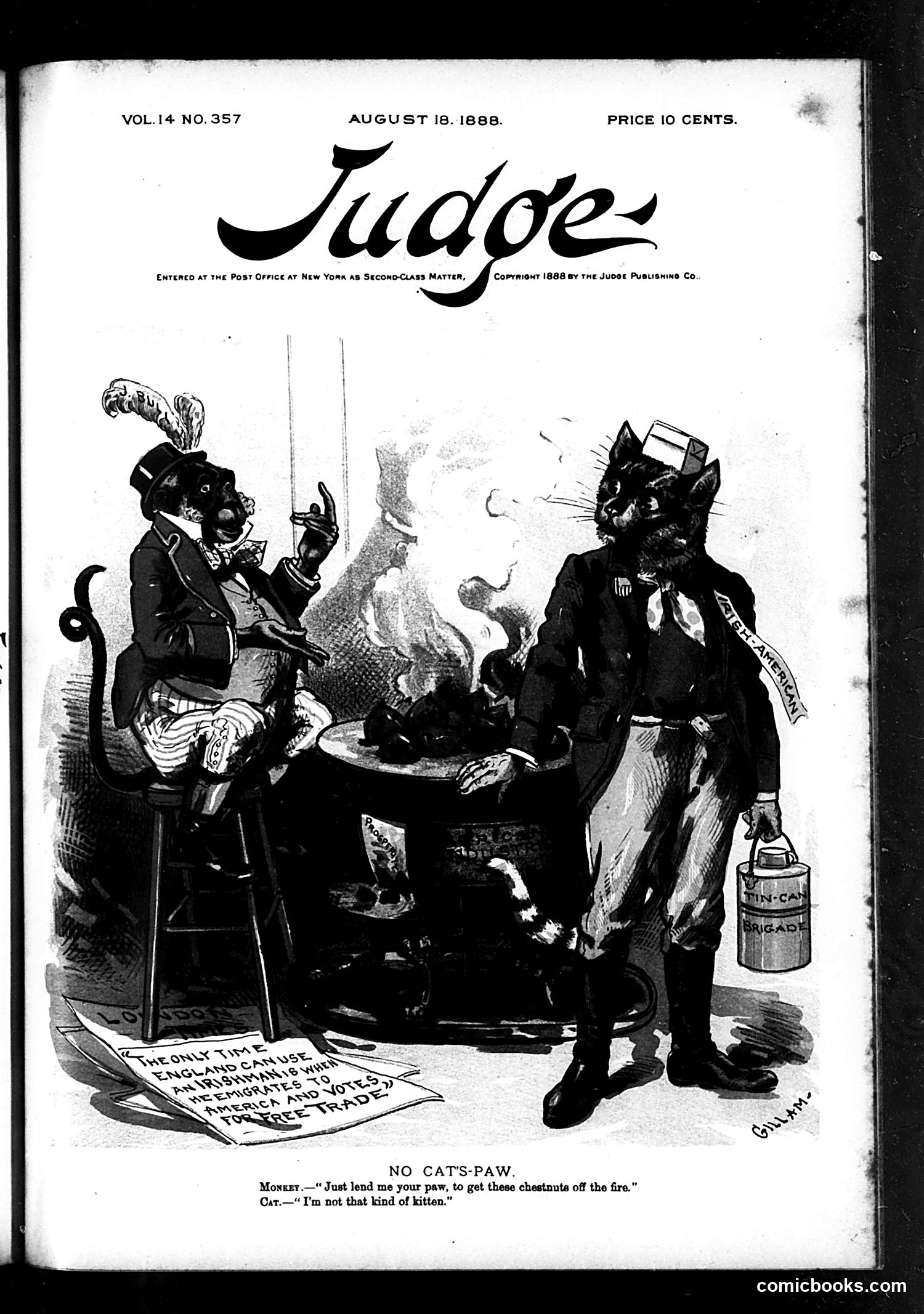
This political cartoon depicts a **Monkey and a Cat** in an anthropomorphic debate. The Monkey requests the Cat's paw to retrieve chestnuts from a fire, while the Cat refuses, saying "I'm not that kind of kitten." This references the classic Aesop's fable where a monkey tricks a cat into retrieving roasted chestnuts, burning the cat's paws while the monkey eats the nuts—a metaphor for being manipulated into doing dangerous work for another's benefit. The cartoon likely comments on **English-American political relations** (text visible on papers suggests colonial/trade tensions). The "fire" probably represents a dangerous geopolitical situation, with one nation refusing to become the other's unwilling tool. The satirical point: don't let others exploit you under false pretenses.
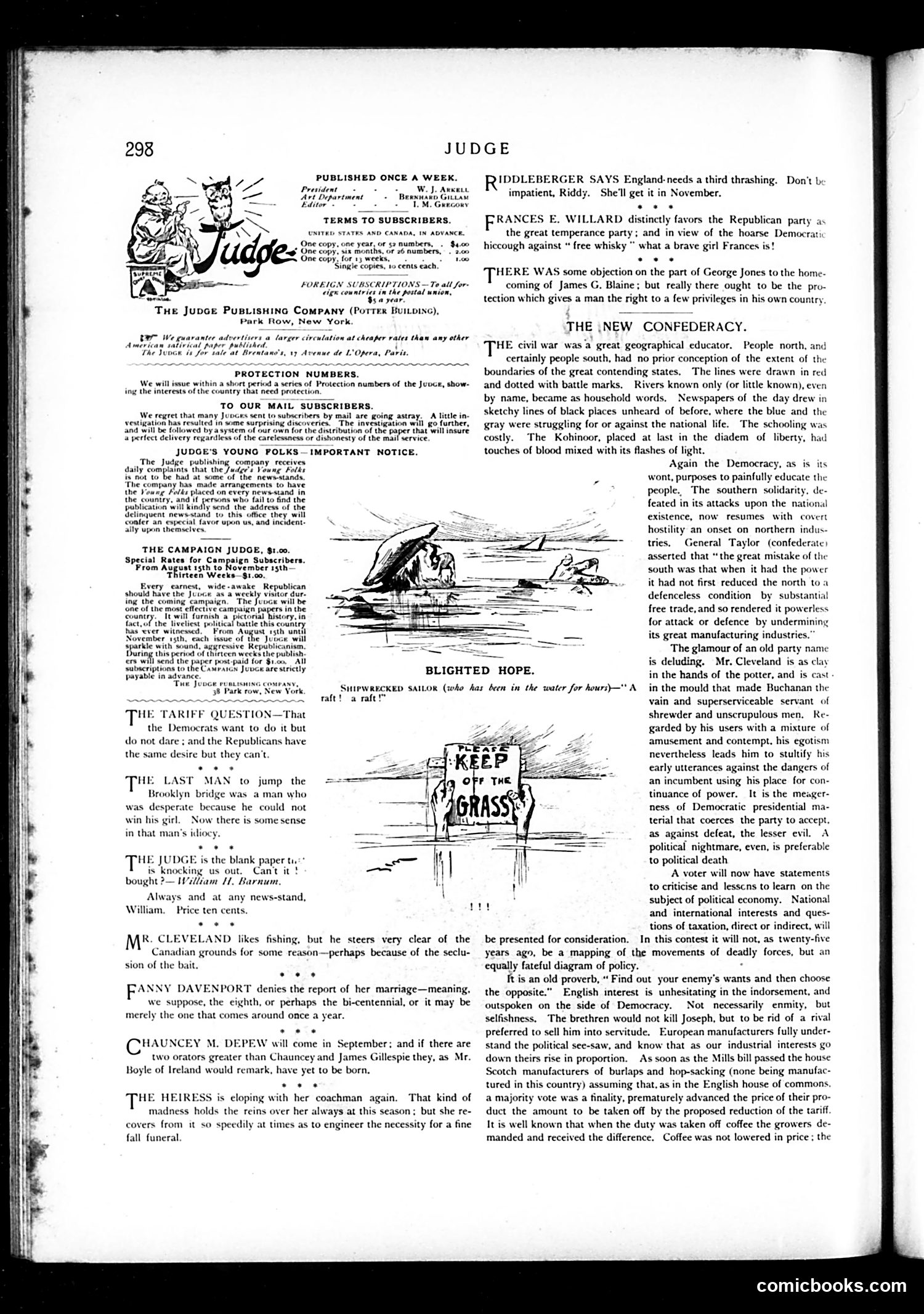
This page contains political commentary and brief satirical items rather than single cartoons. Key content includes: **"The New Confederacy"** - A lengthy article discussing how the Civil War geographically divided the nation, with references to contemporary political tensions. It mentions General Taylor and debates about tariffs and free trade affecting Northern manufacturing versus Southern interests. **"Blighted Hope"** - A cartoon showing a shipwrecked sailor, captioned about being "lost" and referencing "salt." **Various brief items** mock political figures including Cleveland, Chauncey Depew, and an heiress eloping with her coachman—typical society gossip satirized. The page appears from the Gilded Age era, focusing on post-Civil War sectional tensions, tariff debates, and aristocratic scandal. Without the magazine's date clearly visible, precise historical context remains unclear.
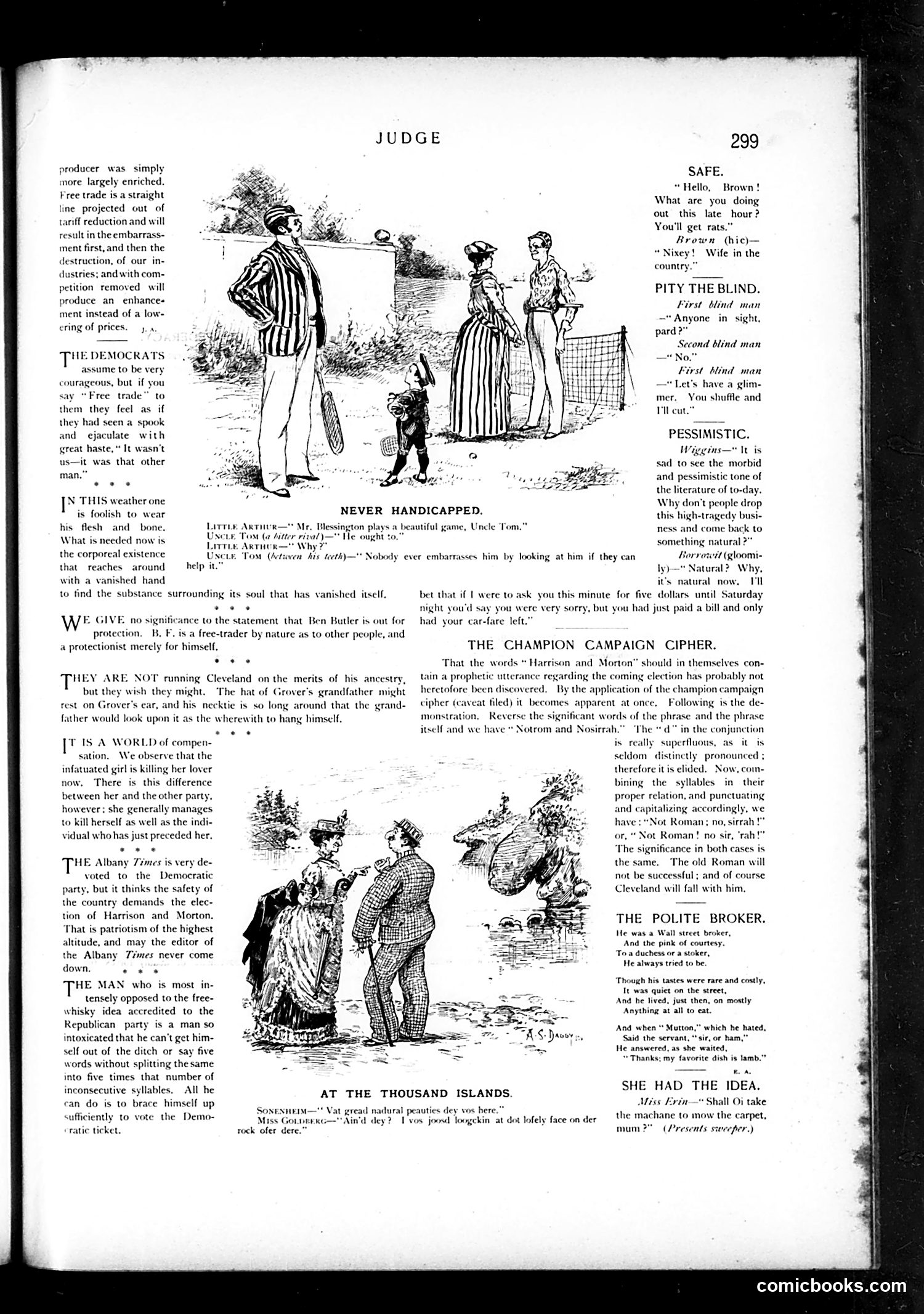
This page contains several short satirical pieces typical of Judge's political humor circa the 1880s-90s. **"Never Handicapped"** mocks Little Arthur's acting, suggesting he performs without natural talent or barriers to overcome. **Political commentary** criticizes Democrats' fear of "free trade" rhetoric, comparing their reaction to seeing a ghost. It also attacks Ben Butler as a hypocrite—preaching free trade for others while protecting his own interests. **Cleveland mockery** ridicules Democratic efforts to defend President Grover Cleveland's ancestry, suggesting his grandfather's necktie was so long it could hang him. **"The Champion Campaign Cipher"** decodes "Harrison and Morton" (Republican 1888 candidates) as hidden messages, satirizing campaign mystification. Other pieces joke about domestic life, blindness, and Wall Street brokers in typical period comic-strip style. The overarching theme: mocking Democratic vulnerability on trade policy and defending Cleveland against Republican challengers.
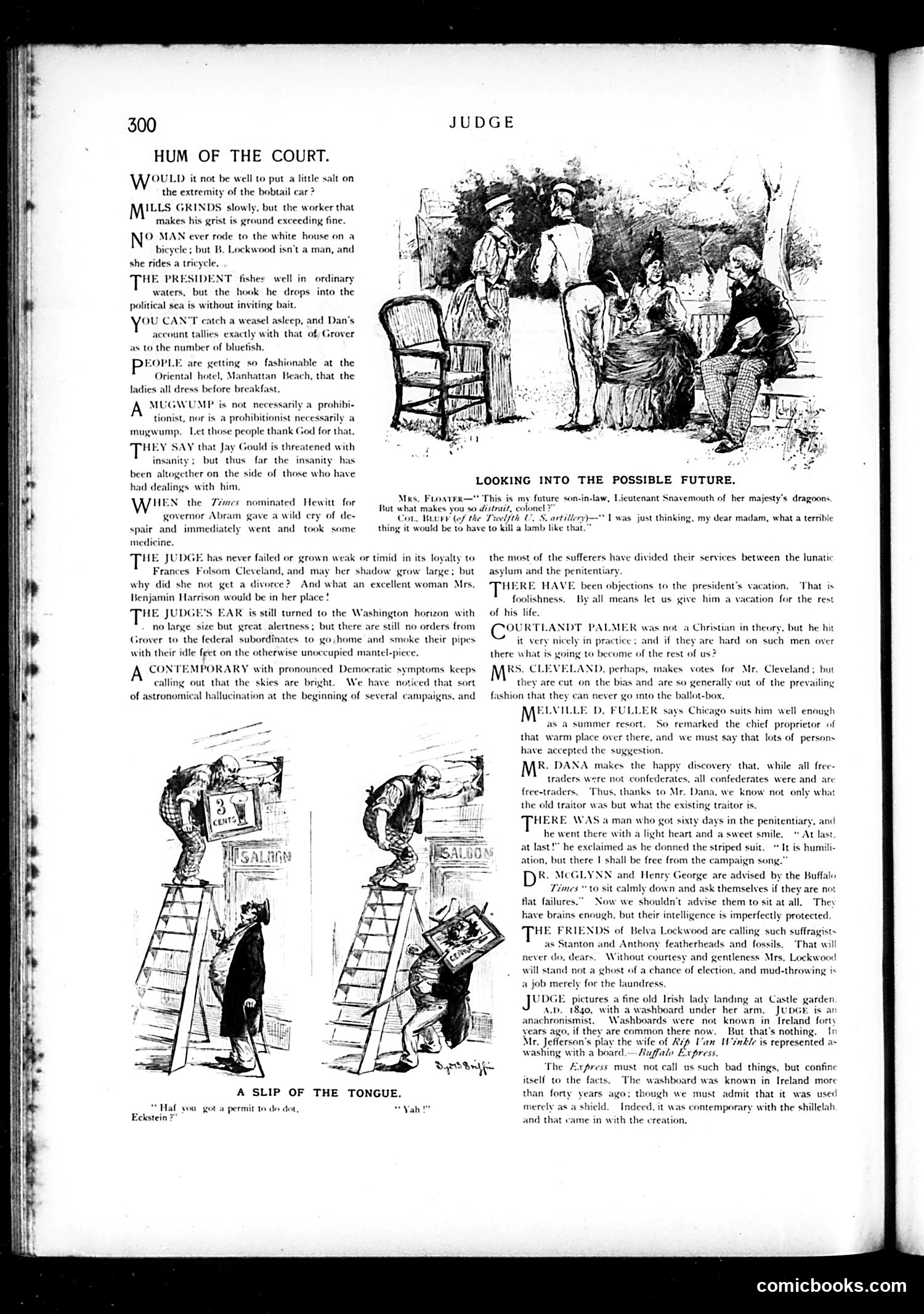
This page contains political humor targeting 1880s American figures and controversies. Key references include: **"Looking Into the Possible Future"** (top cartoon): Mrs. Floater discusses her future son-in-law, a military officer, expressing concern about his moral character—satirizing anxieties about marrying into questionable circles. **Political jibes**: References to President Cleveland's fishing habits, B. Lockwood (likely Belva Lockwood, 1884 presidential candidate who rode a tricycle—mocked for being unwomanly), and Jay Gould (wealthy industrialist criticized as ruthless). **"A Slip of the Tongue"** (bottom): A wordplay cartoon showing someone making an embarrassing verbal gaffe. The column also mocks Cleveland's vacation, debates about Mugwumps (Republican reformers), and references to Frances Folsom Cleveland (the president's young wife), suggesting contemporary gossip about Cleveland's personal life. The humor assumes readers' familiarity with current political personalities and scandals now largely forgotten.
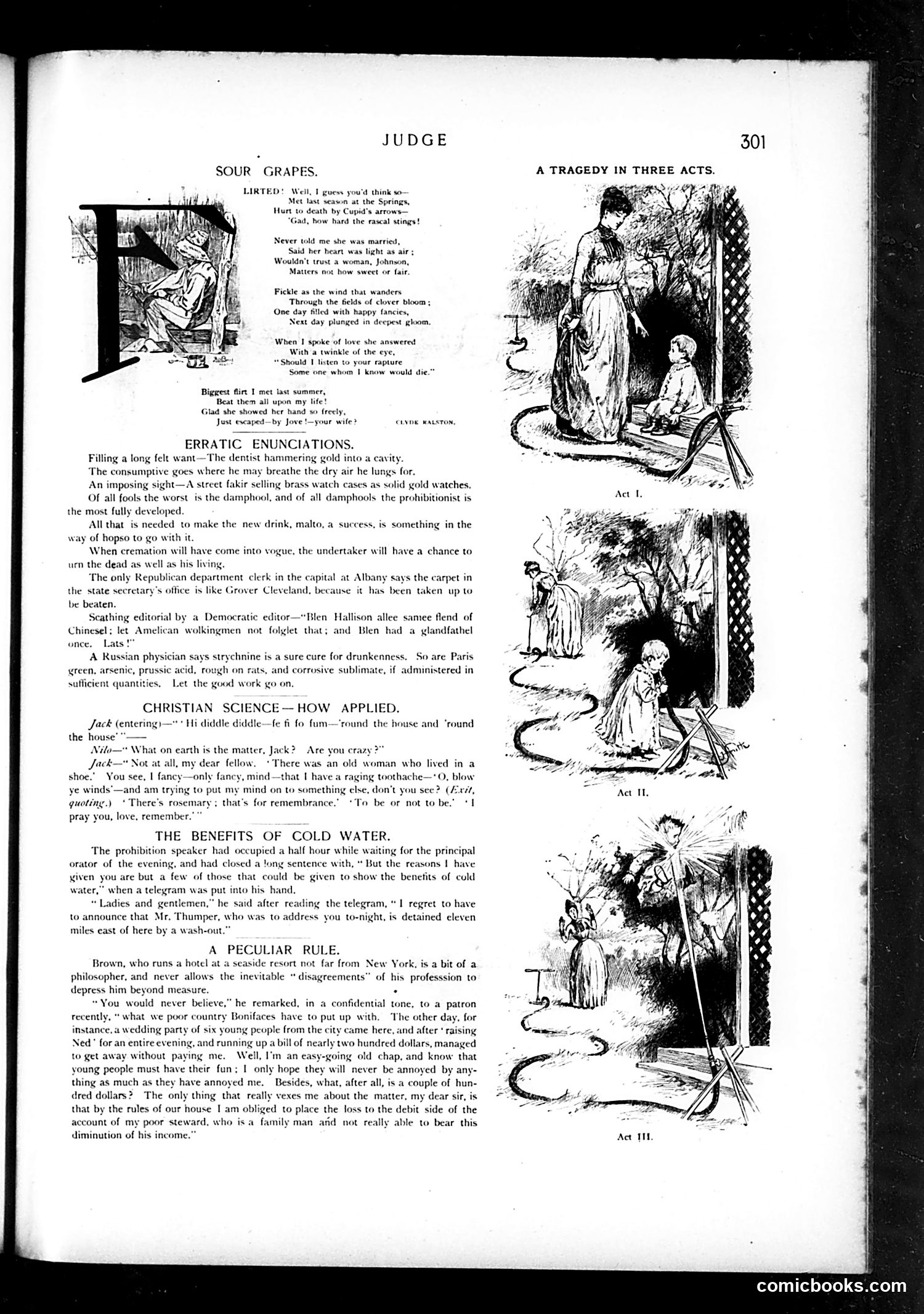
This page contains several satirical pieces typical of late 19th-century American humor journalism: **"Sour Grapes"** presents a jilted man complaining about a woman who deceived him—she claimed to be unmarried but was already married. The twist ending suggests his complaint is hypocritical, as he himself nearly ran off with someone else's wife. **"Erratic Enunciations"** offers short, punchy one-liners mocking various targets: prohibitionists (called "damphools"), politicians like Grover Cleveland, and doctors. These satirize contemporary social movements and public figures through wordplay. **"Christian Science—How Applied"** ridicules the Christian Science movement (popular at the time) by showing a man using distraction and recitation rather than medicine for a toothache, poking fun at the religion's rejection of conventional treatment. **"The Benefits of Cold Water"** satirizes prohibition advocates whose speeches about cold water's benefits are interrupted—ironically by news of a washout, suggesting nature's indifference to temperance arguments. The right side shows illustrations for "A Tragedy in Three Acts," though the narrative remains unclear from this page alone.
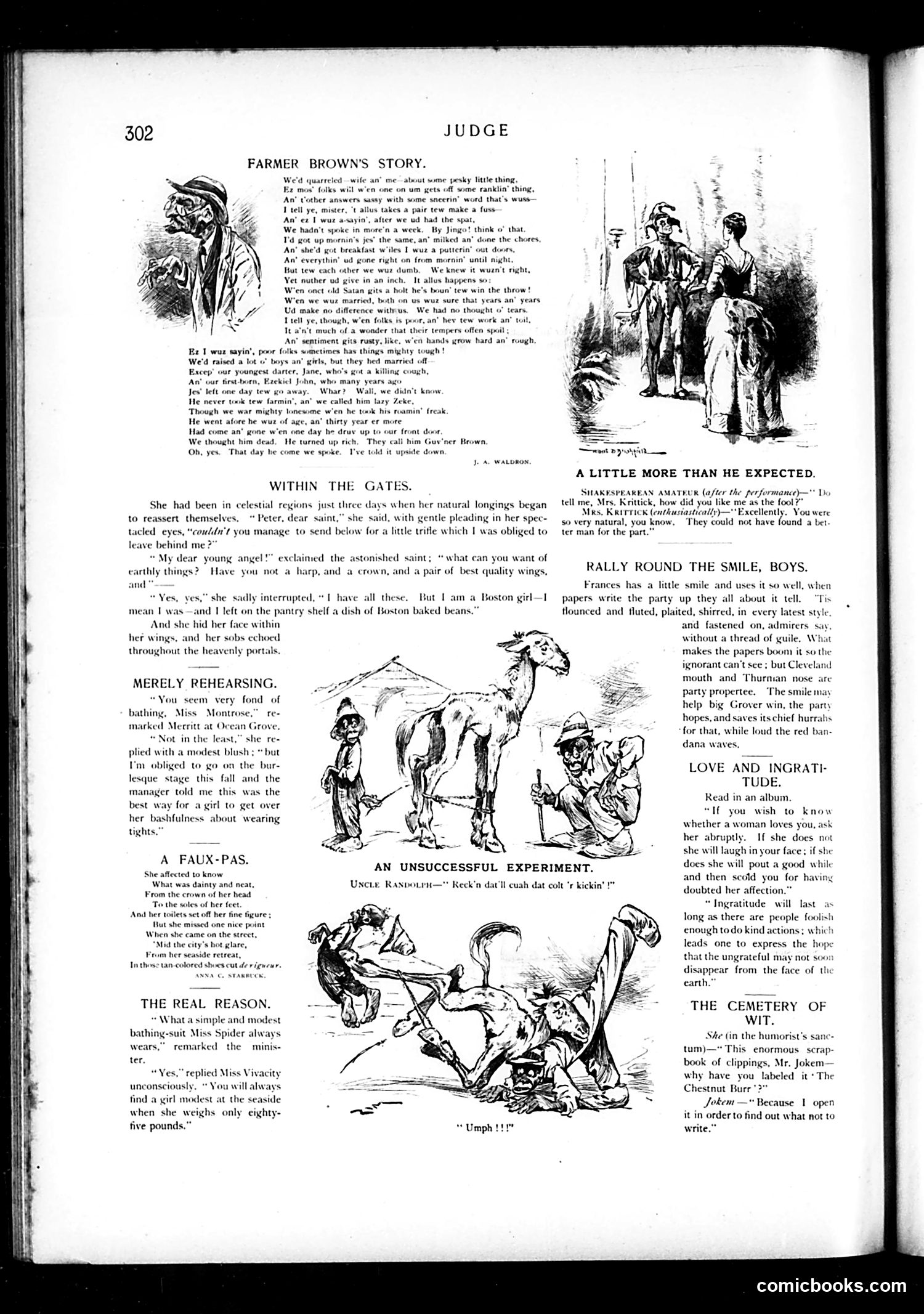
This page contains several short humorous pieces typical of late 19th-century American satirical journalism: **"Farmer Brown's Story"** presents a rural narrative in dialect about marital discord and reconciliation, culminating in a wayward son's unexpected return as wealthy—a sentimental resolution common to period entertainment. **"Within the Gate"** satirizes Boston culture through a deceased woman's homesickness for baked beans despite heavenly rewards—poking fun at regional stereotypes and materialism. The remaining pieces are brief social comedies about vanity and pretense: a woman in heaven's discomfort, a modest-seeming bather, theatrical affectation, and the power of feminine charm in newspaper coverage. The cartoon illustrations depict domestic and pastoral scenes reinforcing these themes. The humor relies on dialect, class observation, and gentle mockery of human weakness rather than explicit political commentary. This reflects Judge's focus on lifestyle satire for middle-class readers.
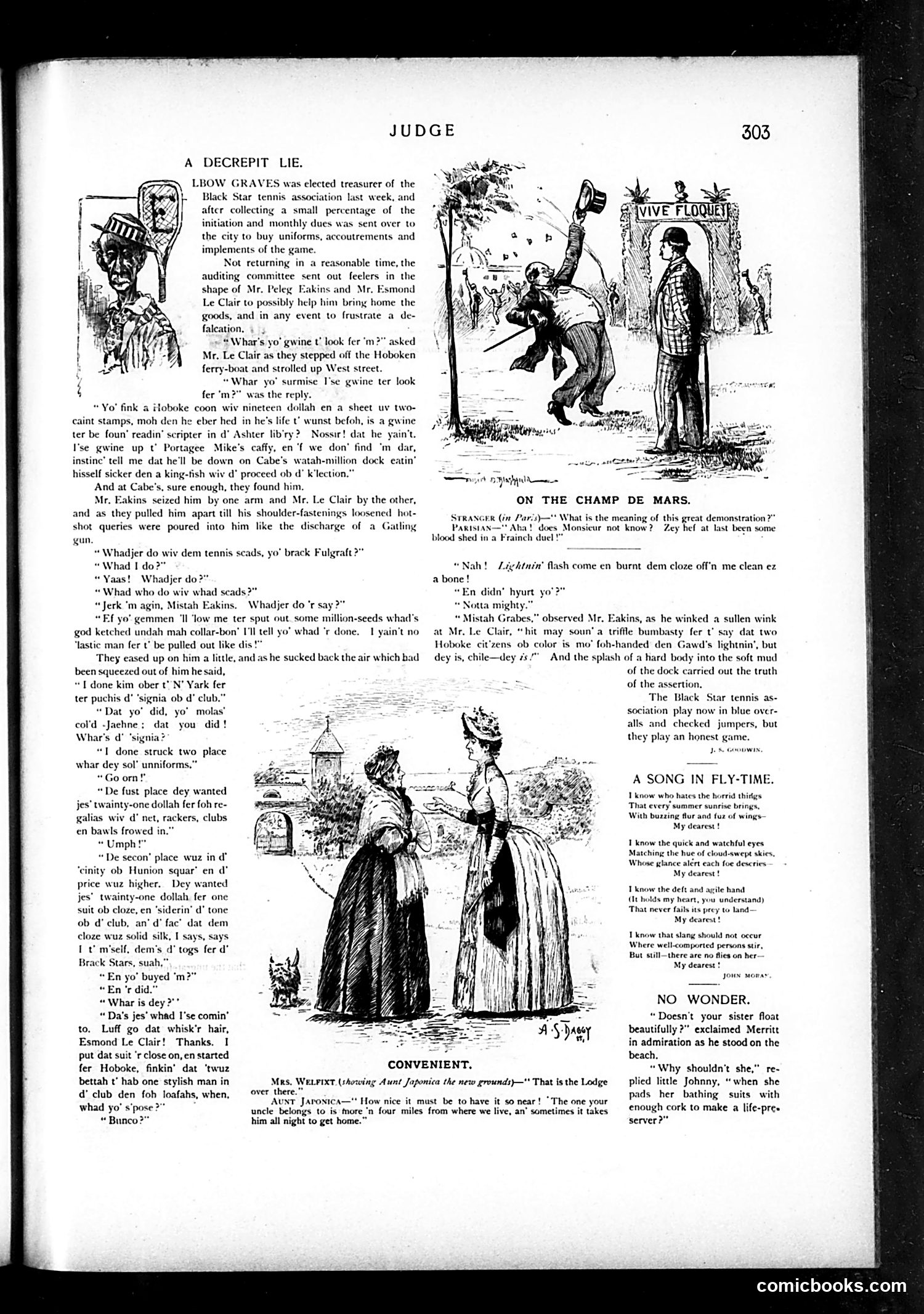
This page satirizes racial stereotypes prevalent in early 20th-century American humor. The main story features Elbow Graves, a Black treasurer of a tennis club, who is confronted by two white auditors (Peleg Eakins and Esmond Le Clair) after funds go missing. The narrative employs heavy dialect stereotyping to depict Graves as incompetent and dishonest. The "joke" hinges on Graves claiming he purchased club uniforms in New York, but the garments were struck by lightning and burned off him at the dock—an implausible excuse presented as evidence of his deceit. The cartoon mocks both Black characters and working-class corruption through exaggerated dialect and physical comedy. The satire targets urban incompetence and misappropriation of club funds, but relies entirely on racist caricature and offensive language for its "humor." This reflects Judge's editorial perspective: using racial mockery to frame social criticism about financial dishonesty.
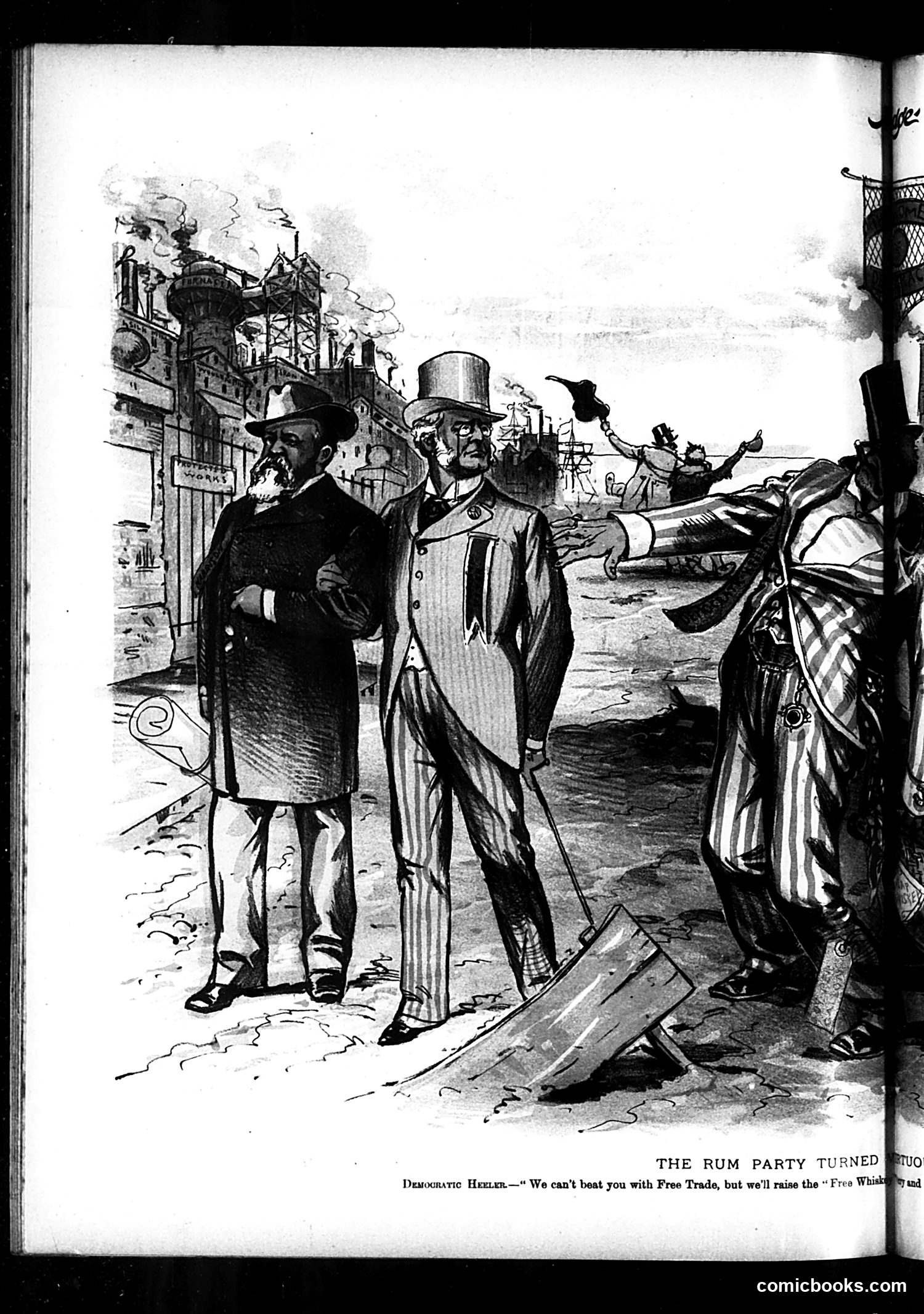
This satirical cartoon appears from Judge magazine and addresses late 19th-century American protectionist politics. The caption reads: "Democratic Heckler—'We can't beat you with Free Trade, but we'll raise the 'Free Whisky' and..." The cartoon depicts two well-dressed gentlemen (likely representing Republican and Democratic politicians) at what appears to be an industrial or port setting. The joke plays on "Free Trade" versus "Free Whisky"—a political jab suggesting Democrats, unable to win economic arguments about free trade policy, resort instead to appealing to voters through cheap whisky (alcohol). This satirizes how political parties allegedly distract working-class voters from substantive policy debates by offering liquor. The industrial backdrop emphasizes the trade/tariff debate's economic stakes, while the "Rum Party" reference puns on both alcohol and the Republican Party's historical dominance on trade issues.
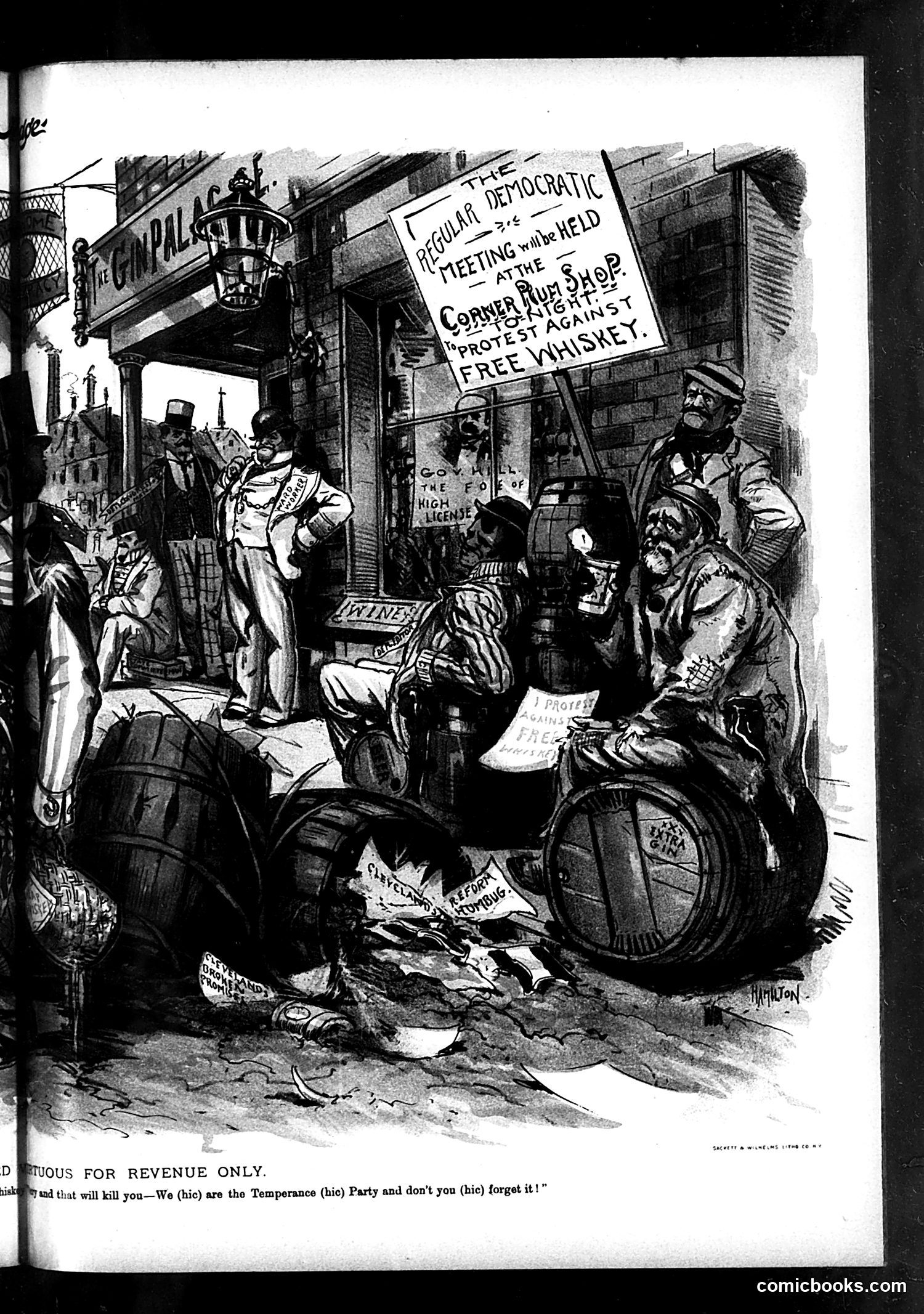
This political cartoon satirizes the hypocrisy of the Temperance movement—advocates for alcohol prohibition who are themselves intoxicated. The scene depicts drunk men outside "The Corner Dru(g) Shop," holding a sign advertising "The Regular Democratic Meeting" and "Protest Against Free Whiskey." The hiccupping dialogue ("hic") emphasizes their drunkenness while they champion temperance. The satire targets Temperance Party activists who publicly oppose alcohol while privately consuming it. This likely references early-20th-century Prohibition-era politics, when temperance advocacy was contentious. The cartoon mocks the moral contradiction between the movement's stated principles and its members' actual behavior, suggesting their crusade is motivated by hypocrisy rather than genuine conviction.
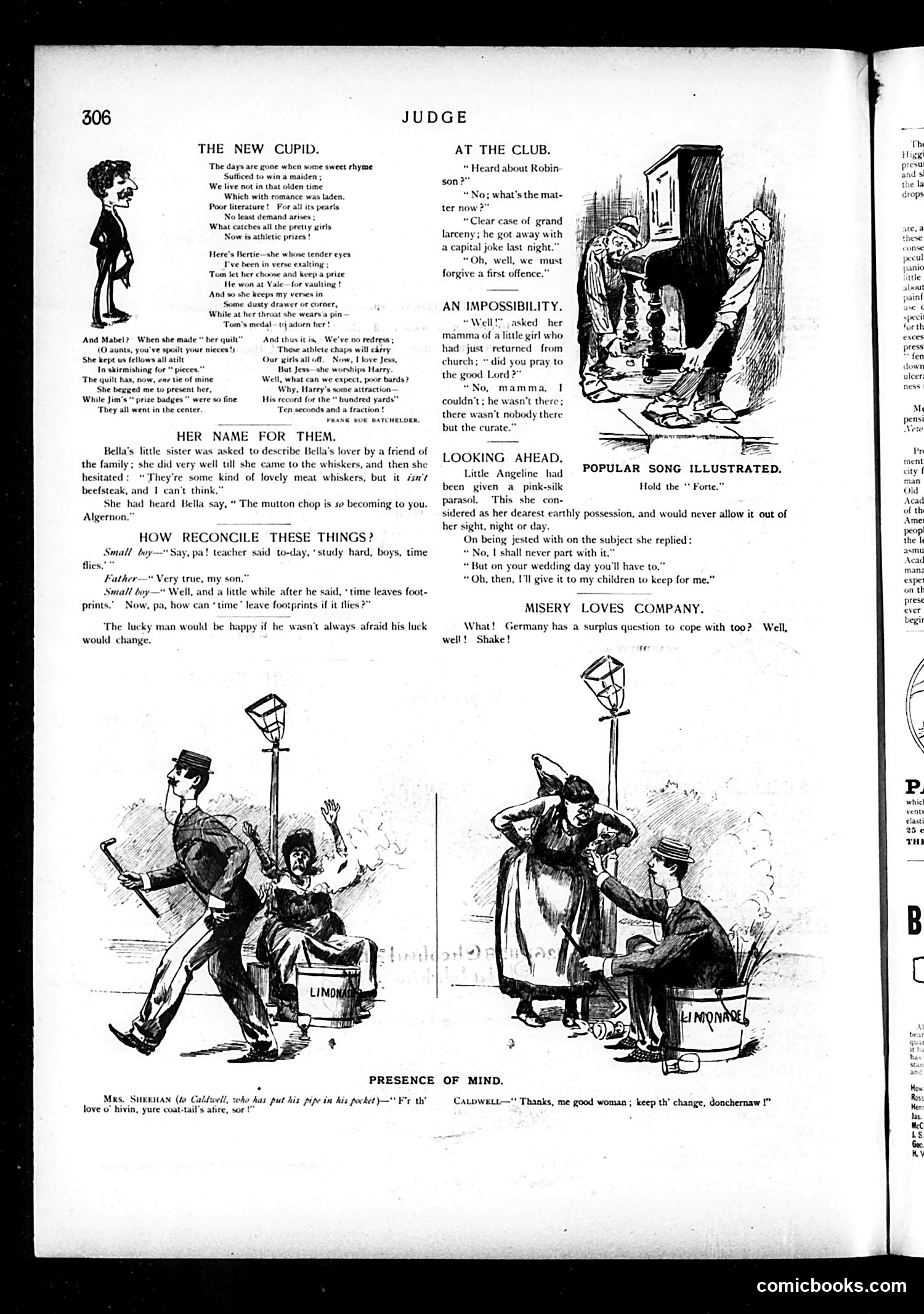
This page from *Judge* contains several short satirical pieces reflecting turn-of-the-century American social attitudes: **"The New Cupid"** mocks romantic literature's declining appeal among young women, who now prefer athletic men. The satire suggests that modern girls value athletic achievement (Yale vault records, "hundred yards" sprint times) over poetry—a commentary on shifting courtship values and women's growing interest in athleticism. **"Her Name for Them"** is a brief children's joke about a girl confusing "mutton chop" whiskers (a facial hair style) with actual meat. **"An Impossibility"** satirizes the Catholic Church by having a child report that during services "there wasn't nobody there but the curate"—implying the priest's absence of spiritual presence, a jab at clergy. **"Looking Ahead"** humor involves a girl's wedding-day parasol attachment. **"Misery Loves Company"** references Germany's "surplus question"—likely relating to post-WWI German economic problems or arms/military surplus. **"Presence of Mind"** depicts working-class characters making light of danger (coat catching fire), showing period class-based humor stereotypes.
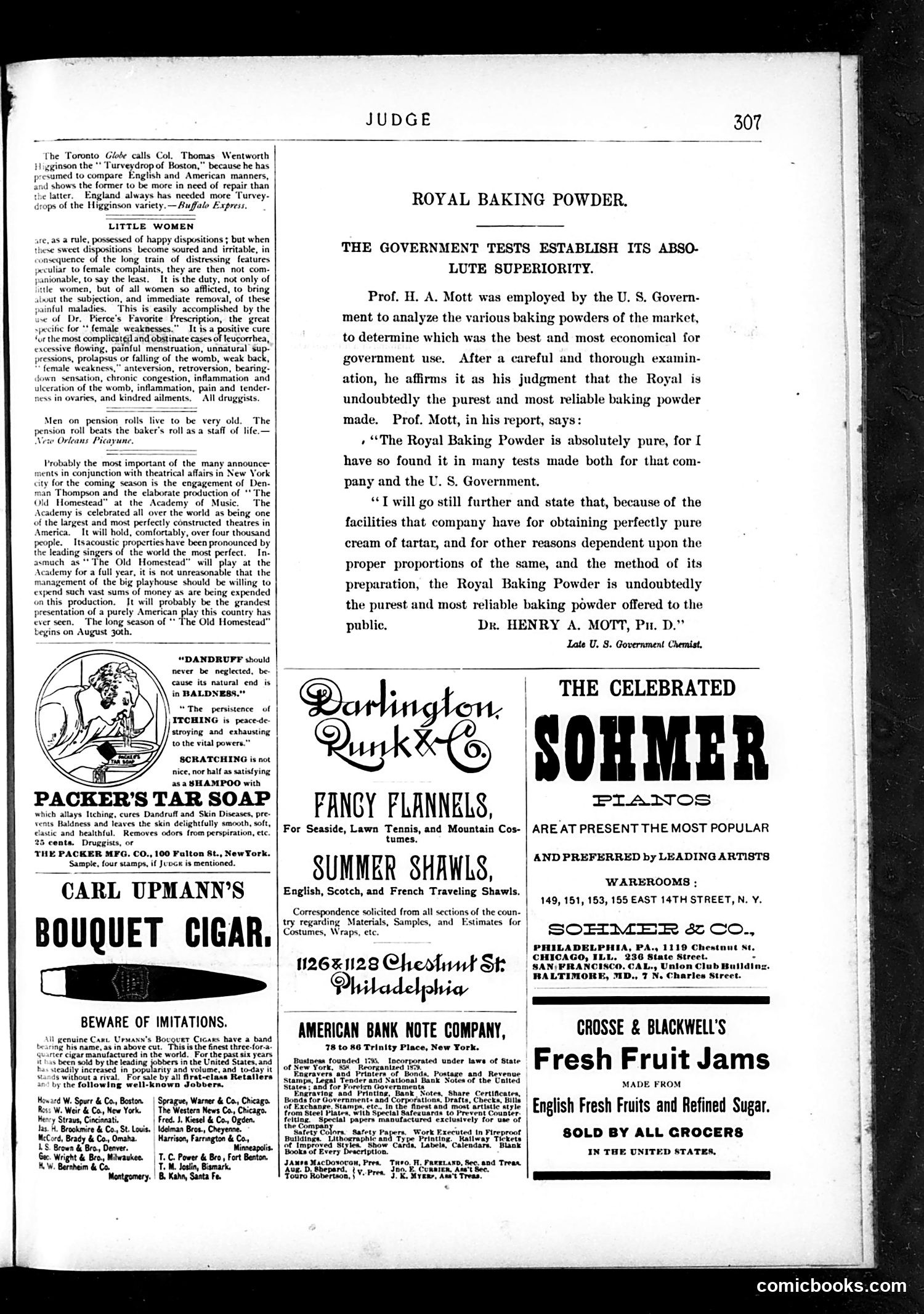
This page is primarily **advertising with some brief satirical commentary** rather than political cartoons. The main content includes: **Satirical items:** - A jab at Col. Thomas Wentworth Higginson for comparing English and American manners unfavorably to America—calling him a "Turveydrop" (a Dickens character representing affected pretension) - A quip about pension recipients living longer than bakers - Medical advertisements disguised as advice about "female complaints" **Advertisements:** The bulk of the page features product ads: Royal Baking Powder (with endorsement from a government chemist), Packer's Tar Soap (for dandruff/baldness), Carl Upmann's cigars, various pianos and sheet music, and Crosse & Blackwell jams. The "Little Women" section appears to be an advertisement for Dr. Pierce's medical remedy rather than commentary on Alcott's novel. **No clear political cartoons** are visible on this page—it reflects Judge's primary function as a commercial publication supporting itself through advertising while providing light satirical commentary.
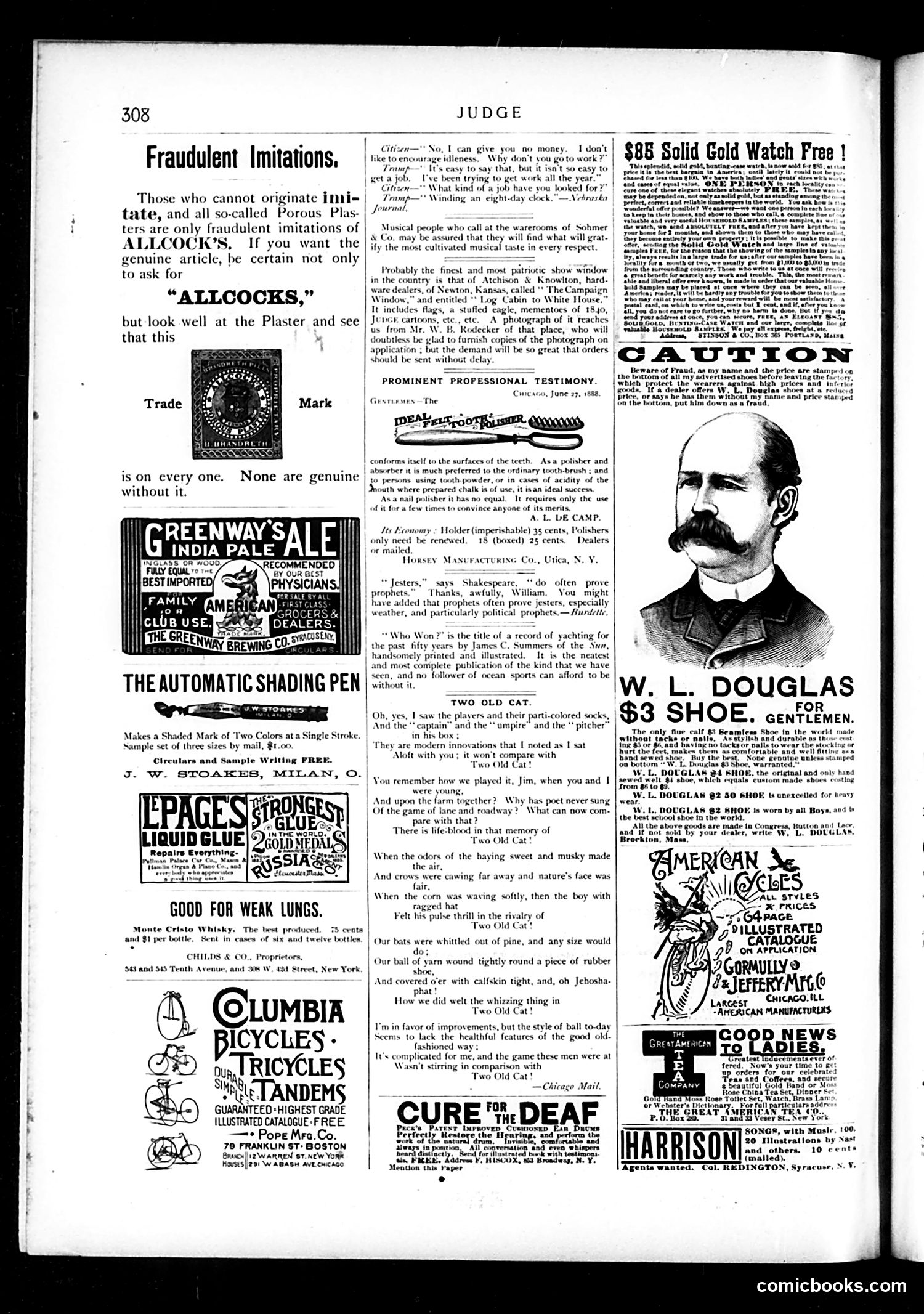
This page is primarily **advertisements** for commercial products typical of the 1880s-90s era, with minimal satirical content. The main editorial piece, "Two Old Cat," is a nostalgic poem comparing the modern baseball game to a simpler children's game from the author's youth. It's not political satire but rather gentle social commentary on modernization and lost simplicity—a common Judge theme lamenting how "progress" has complicated innocent pleasures. The page includes promotional testimonials (the dental product endorsement from "A. L. De Camp"), product advertisements (bicycles, whisky, shoes), and classified notices. The single dialogue snippet at top presents a brief social-realist exchange between a citizen and a jobless man—touching on unemployment, but without partisan political commentary. Overall, this appears to be a typical late-19th-century magazine page mixing advertising revenue with light editorial content, rather than showcasing Judge's satirical cartooning tradition.
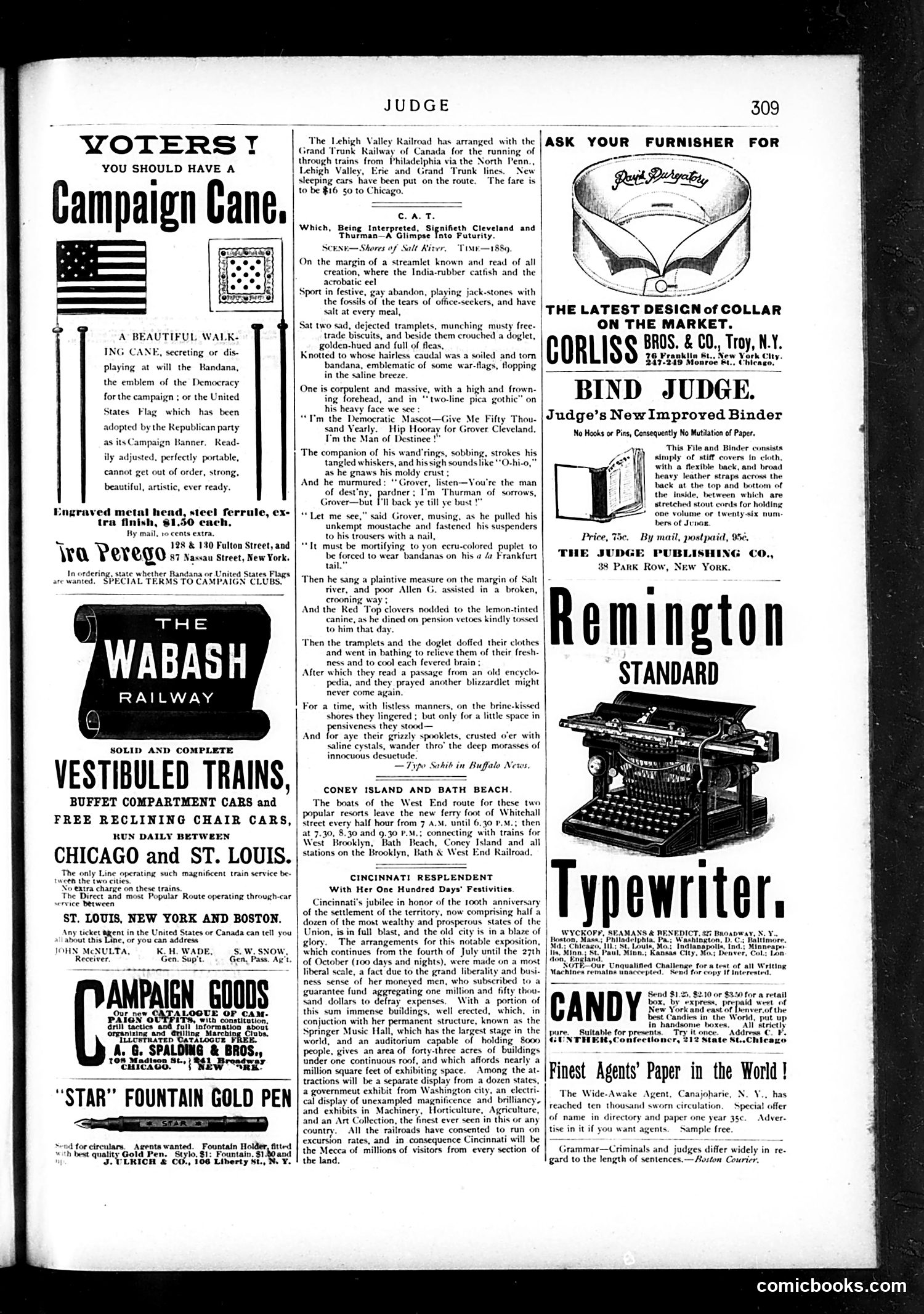
This page features a satirical poem titled "Which, Being Interpreted, Signifieth Cleveland and Thurman—A Glimpse Into Futurity," set in 1880 at "Salt River" (a symbolic location representing political defeat). The cartoon depicts **Grover Cleveland** and **Allen G. Thurman** (the Democratic presidential ticket) as dejected tramps beside Salt River after electoral loss. The poem mocks their failed campaign through deliberately absurd imagery: they're depicted as impoverished wanderers accompanied by a mangy dog wearing a torn Democratic bandana. The satire criticizes Democratic policies, particularly **free trade** (the "musty free-trade biscuits"), and portrays Cleveland as delusional about his political destiny. The imagery of Salt River—traditionally representing political ruin—suggests Republicans (Judge's audience) expected Democratic defeat. The poem's exaggerated, mock-heroic tone ridicules Democratic pretensions while celebrating their anticipated electoral failure, making this essentially partisan Republican propaganda dressed as humor.
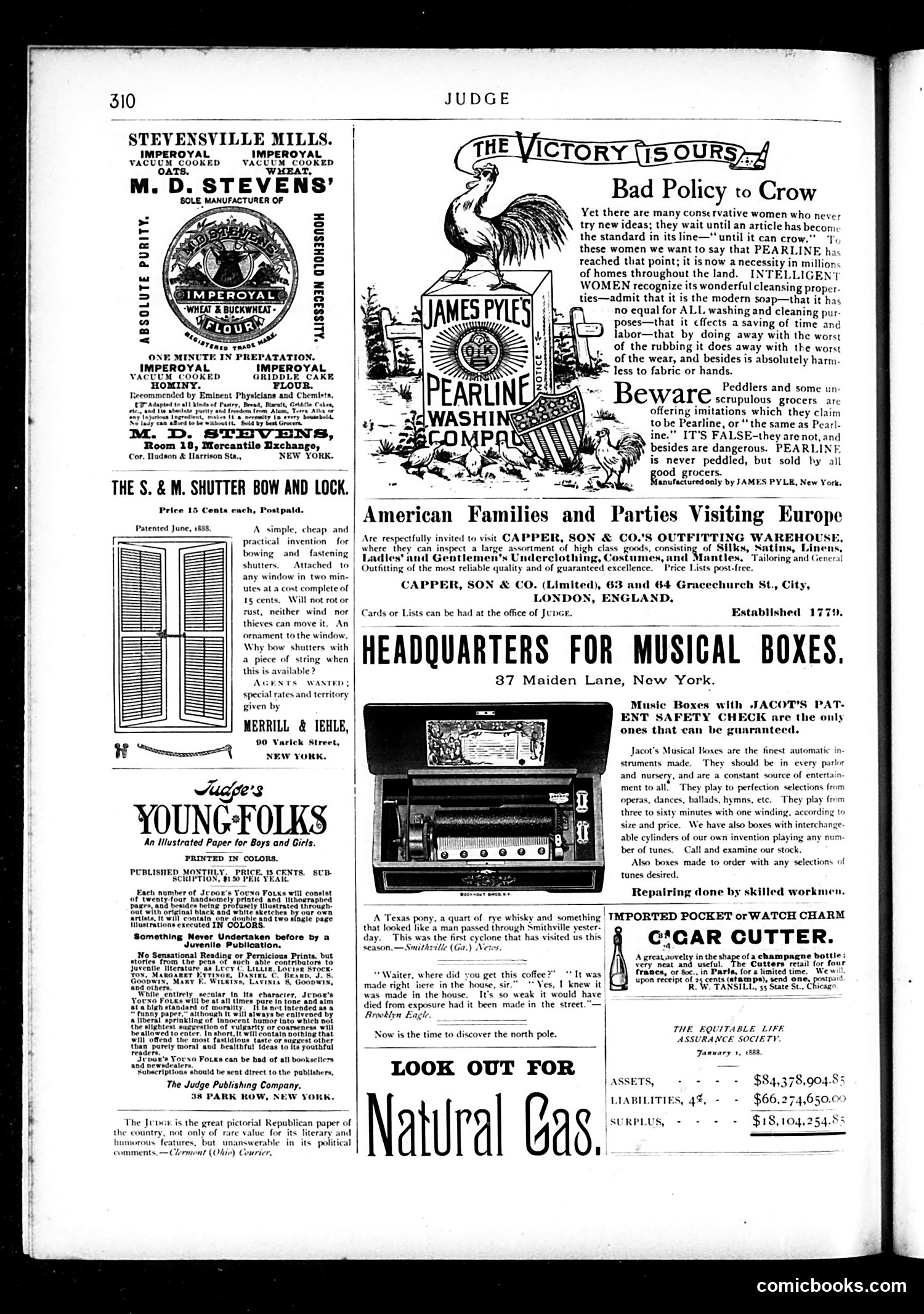
This page is primarily **advertisements and product promotions** rather than political satire. The main content includes: **Key Advertisements:** - **Pearline soap** (center-right): A cleaning product advertisement emphasizing it's the "modern soap" and warning against imitations - **Musical boxes** by Jacot's (center): Featuring automatic instruments for entertainment - **Stevensville Mills oats/wheat** (left): Promoted as "absolutely pure" - **S. & M. Shutter bow and lock** (left): A window fastening device - **Judge's Young Folks** magazine (left): An illustrated paper for children - **Capper, Son & Co.** (center): An outfitting warehouse for European travelers **The Rooster Mascot:** The prominent illustration of a rooster atop Pearline's logo likely references the phrase "bad policy to crow"—a pun suggesting consumers shouldn't wait for new products to become old standards before trying them. This is a **typical late-19th-century magazine page** dominated by commercial announcements rather than satirical content, reflecting the publishing model where advertisements funded editorial content.
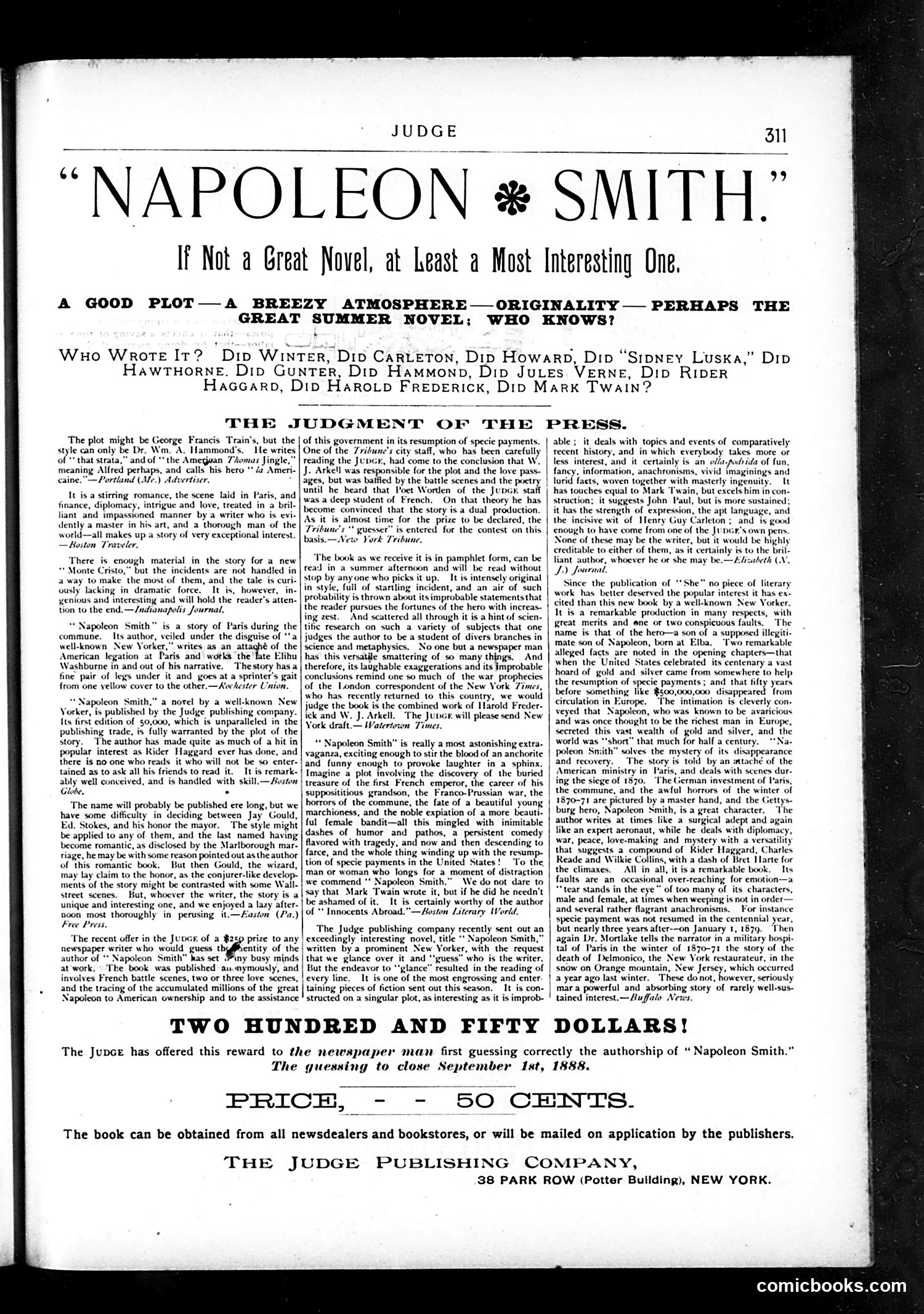
This page advertises a mystery novel titled *"Napoleon Smith,"* published by Judge Publishing Company. The satire centers on the book's anonymous authorship—Judge is running a contest offering $250 (substantial money in 1888) for readers to guess who wrote it. The humor lies in the **authorship guessing game**. The page lists famous contemporary writers as possible authors—including Mark Twain, Jules Verne, and Rider Haggard—creating suspense about the real writer's identity. The text also mockingly suggests wealthy/notorious figures like **Jay Gould** (railroad magnate) or the New York mayor as potential authors, implying the book's quality or style could match various writers of vastly different talents. The *Judge* itself participates in the joke, hinting at clues: the plot involves French history, battle scenes, and romance set during the Paris Commune. This was a popular marketing stunt—mystery authorship generated publicity and reader engagement in the 1880s.
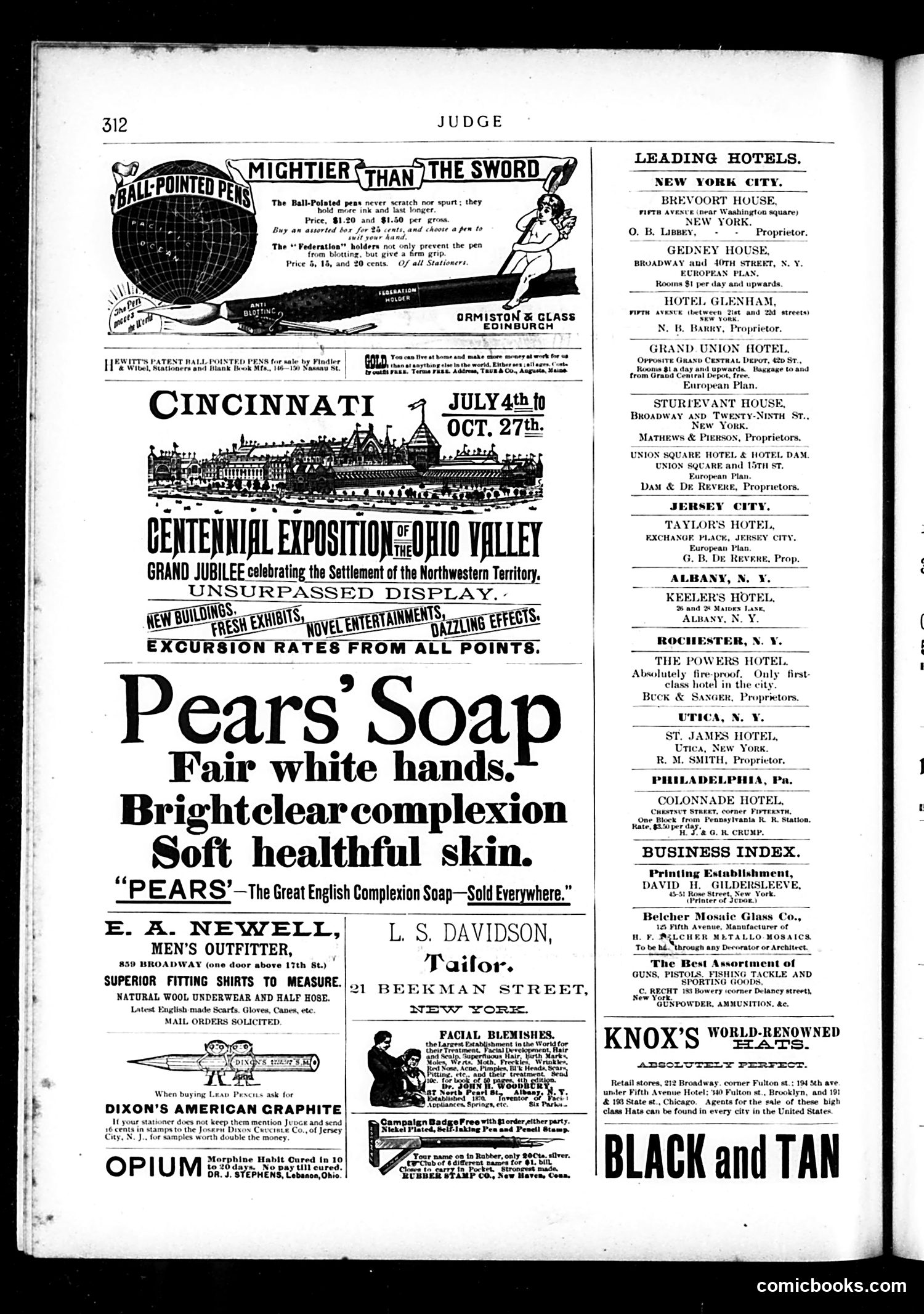
This page is primarily **advertisements and business listings**, not political satire. The layout consists of: **Upper section**: Product ads including ball-pointed pens, the Cincinnati Centennial Exposition (July 4–October 27), and Pears' Soap—a British complexion soap marketed with claims of "fair white hands" and "bright clear complexion," reflecting period beauty standards emphasizing pale skin. **Lower section**: Business advertisements for men's clothing (E.A. Newell), tailoring services, pencils (Dixon's), and various hotels in New York, Jersey City, and Albany. **Notable ads include** treatments for opium and morphine addiction ("cured in 10 days"), and facial blemish remedies—common patent medicine marketing of the era. **The only cartoon element** appears to be a small illustration accompanying the Dixon's pencil ad, but it's too unclear to interpret specifically. This is primarily a **commercial directory page** rather than satirical content. Judge's editorial cartoons appeared elsewhere in the magazine.
This is primarily an **advertising page** from Judge magazine, with one notable editorial comment embedded within. The only non-advertising content of interest is a brief note about **Levi P. Morton**, a prominent Republican politician of the era (he served as Vice President 1889-1893). The *Troy Telegram* quip suggests that artists struggle to capture Morton's facial expression accurately, implying his appearance or demeanor is difficult or peculiar to render—a mild satirical jab at Morton's character or public persona. The bulk of the page consists of period advertisements for products typical of the 1880s-90s: rubber-tipped mucilage, pearl mucilage, railroad services, organs, meat extract, fountain pens, stomach remedies, and patent medicines. These ads reflect the commercial ecosystem of the era and Judge's revenue model. **Historical context for modern readers**: Judge was a weekly satirical magazine that survived partly through advertising. Morton's prominence and the artist's difficulty capturing him suggests he was newsworthy enough to warrant editorial comment, even if minor.
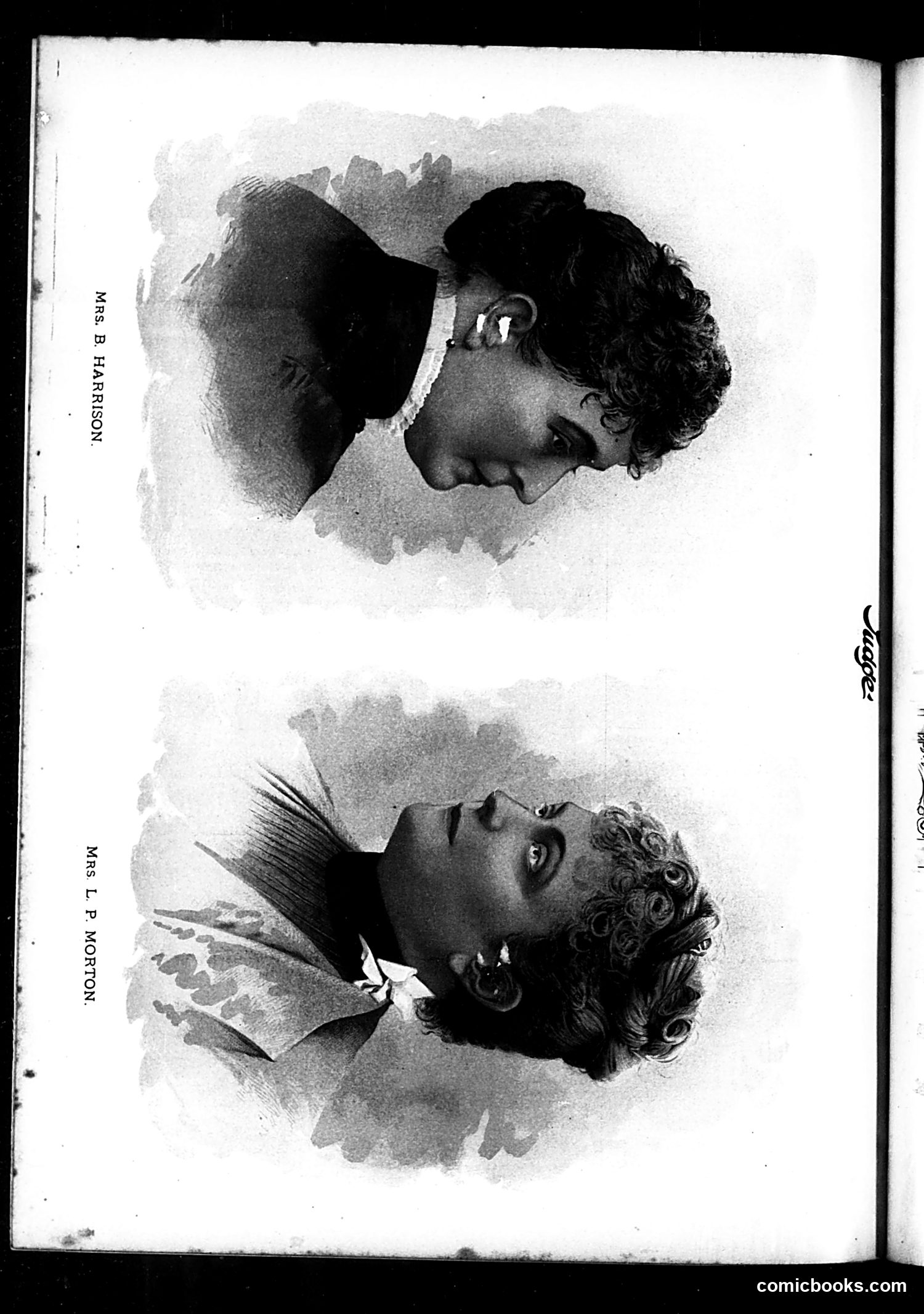
This page from *Judge* presents two portrait photographs labeled "Mrs. B. Harrison" and "Mrs. L. P. Morton." These appear to be wives of prominent political figures from the late 19th century—likely Benjamin Harrison (U.S. President 1889-1893) and Levi P. Morton (Vice President under Harrison). The page functions as a straightforward society portrait feature rather than satirical commentary. *Judge* regularly included such imagery of prominent social figures alongside its humor content. Without additional text context visible, the specific satirical intent—if any—remains unclear. The soft-focus photographic style was typical of the era's portrait conventions.