
Judge, 1888-08-18 · page 6 of 18
Judge — August 18, 1888 — page 6: what you’re looking at
What you’re looking at
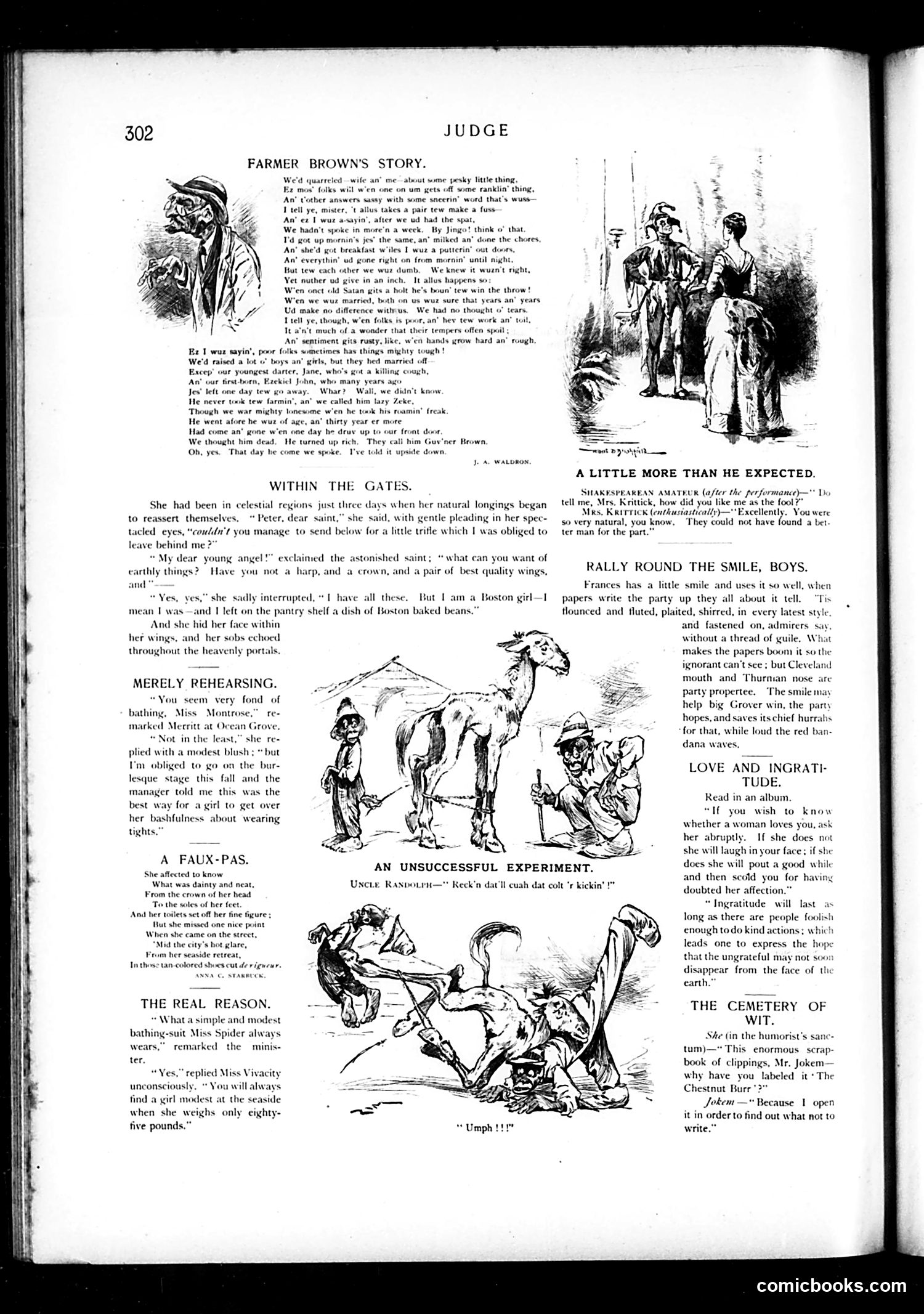
This page contains several short humorous pieces typical of late 19th-century American satirical journalism: **"Farmer Brown's Story"** presents a rural narrative in dialect about marital discord and reconciliation, culminating in a wayward son's unexpected return as wealthy—a sentimental resolution common to period entertainment. **"Within the Gate"** satirizes Boston culture through a deceased woman's homesickness for baked beans despite heavenly rewards—poking fun at regional stereotypes and materialism. The remaining pieces are brief social comedies about vanity and pretense: a woman in heaven's discomfort, a modest-seeming bather, theatrical affectation, and the power of feminine charm in newspaper coverage. The cartoon illustrations depict domestic and pastoral scenes reinforcing these themes. The humor relies on dialect, class observation, and gentle mockery of human weakness rather than explicit political commentary. This reflects Judge's focus on lifestyle satire for middle-class readers.
📄 Transcribed text from this page (OCR, searchable)
Machine-transcribed from the original scan — historical spelling and the odd misread are preserved.
JUDGE FARMER BROWN’S STORY. * me about some pesky little thing, on um gets off some ranklin’ thing, An’ other answers sassy with some sneerin” word that's wuss Tell ye, mister, “t allus takes a pair tew make a fuss An’ ex 1 wuz asayia’, after we ud had the spat, We hadn't spoke in more’ a week. By Jingo! think o° that T'd got up mornin’s jes’ the same, an’ milked an’ done the chores, An’ she'd got breakfast wiles I wuz a putterin® out doors, An’ everythin’ ud gone right on from mornin’ until night But tew cach other we wuz dumb. We knew it wuzn't right, Vet nuther ud give in an inch. It allus happens so “en onct old Satan gits a holt he's boun’ tew win the throw ! ‘en we wuz martied, both on us wuz sure that years an” years Ua make no difference withwus, We had no thought 0° tears Ttell ye, though, wen folks is poor, an” hew tew work an’ toil, Te a'n’t much of a wonder that their tempers offen spoil: An’ sentiment gits rusty, like, w'en hands grow hard an’ rough, Ss wimetimes has things mighty ! youngest darter, J An’ our first-born, Ezekiel John, who many years ayo Jes’ left one day tew Wall, we didn’t know He never tok tew farmin’, an’ lazy Zek ‘Though we war mighty lonesome wien he took his roamin’ freak. He went afore he wuz of age, an’ thirty year er more Had come an’ gone w'en one day he druy up to our front door We thought him dead. He turned up rich, They call him Guv'ner Brown, Ob, yes. That day he come we spoke. I've told it upside down J. A. WALDRON. WITHIN THE GATE She had been in celestial regions just three days when her natural longings began to reassert themselves. “Peter, dear saint,” she said, with gentle pleading in her spec- tacled eyes, “couldn't you manage to send below for a little trifle which 1 was obliged to el!” exclaimed the astonished saint; “what can you want of earthly things? Have you not a harp, and a crown, and a pair of best quality wings, and” “Yes, yes,” she sadly interrupted, “1 have all these. But 1am a Boston girl mean I was —and I left on the pantry shelf a dish of Boston baked beans, And she hid her face within heF wings, and her sobs echoed throughout the heavenly portals. MERELY REHEARSING. “You seem very fond of bathing, Miss Montrose marked Merritt at Oc “Not in the least.” she re- plied with a modest blush; “but I'm obliged to go on the bur- lesque stage this fall and the manager told me this was the best way for a girl to get over her bashfulness about wearing tights. A FAUX-PAS. She affected to know What was dainty and neat, Uncie Raxpourn—"* Reck’n dat'll cuah dat colt ‘r kickin’ !” From the crown of her head To the soles of her feet. And her toilets set off her fine figure ; But she missed one nice point on the street, In those tan-colored shoes cut de rigwewr. THE REAL REASON. “What a simple and modest bathing-suit Miss Spider always wears,” remarked the minis- ter, “Yes,” replied Miss Vivacity unconsciously, * You will always. find a girl modest at the seaside when she weighs only eighty- five pounds. *Umph t!!" aoe A LITTLE MORE THAN HE EXPECTED. SHAKESPEAREAN AMATEUR (after the performance)—" Vo tell me, Mrs. Krittick, how did you like me as the fool?” Mrs, KRirrick (enthusiastically) —"Excellently, You were so very natural, you know, They could not have found a bet ter man for the part.” RALLY ROUND THE SMILE, BOYS. Frances has a little smile and uses it so well, when papers write the party up they all about it tell. “Tis tlounced and fluted, plaited, shirred, in every latest style and fastened on, admirers say. without a thread of guile. What makes the papers boom it so the ignorant can’t sce ; but Cleve mouth and Thurman nose are party propertee. ‘The smile may help big Grover win, the party hopes, and saves its chief hurrahs for that, while loud the red ban- dana waves. LOVE AND INGRATI- TUDE. Read in an album “If you wish to know whether a woman loves you, ask her abruptly. If she does not she will laugh in your face; if she AN UNSUCCESSFUL EXPERIMENT. does she will pout a good whi and then scold you for havi doubted her affection.” “Ingratitude will last as long as there are people foolish enough todo kind actions; which leads one to express the hope that the ungrateful may not soo disappear from the face of th earth.” THE CEMETERY OF WIT. She (in the humorist’s sane- tum)—* This enormous. scrap- book of clippings, Mr. Jokem— why have you labeled it * The Chestnut Burr *? Jokem —" Because 1 open it in order to find out what not to write.” comicbooks.com