
Judge, 1888-08-18 · page 15 of 18
Judge — August 18, 1888 — page 15: what you’re looking at
What you’re looking at
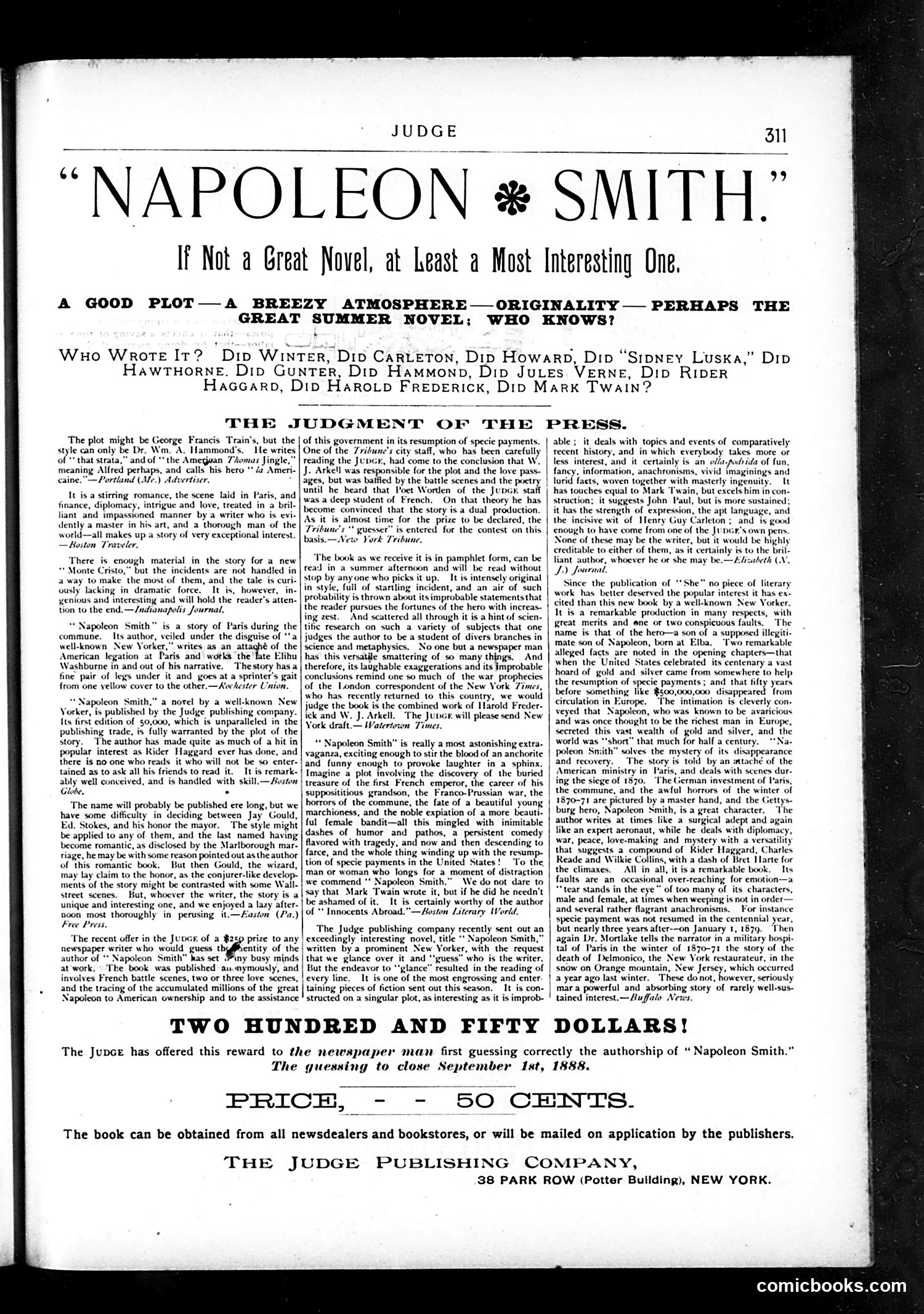
This page advertises a mystery novel titled *"Napoleon Smith,"* published by Judge Publishing Company. The satire centers on the book's anonymous authorship—Judge is running a contest offering $250 (substantial money in 1888) for readers to guess who wrote it. The humor lies in the **authorship guessing game**. The page lists famous contemporary writers as possible authors—including Mark Twain, Jules Verne, and Rider Haggard—creating suspense about the real writer's identity. The text also mockingly suggests wealthy/notorious figures like **Jay Gould** (railroad magnate) or the New York mayor as potential authors, implying the book's quality or style could match various writers of vastly different talents. The *Judge* itself participates in the joke, hinting at clues: the plot involves French history, battle scenes, and romance set during the Paris Commune. This was a popular marketing stunt—mystery authorship generated publicity and reader engagement in the 1880s.
📄 Transcribed text from this page (OCR, searchable)
Machine-transcribed from the original scan — historical spelling and the odd misread are preserved.
JUDGE ail “NAPOLEON # SMITH’ If Not a Great Novel, at Least a Most Interesting One, A GOOD PLOT—-A BREEZY ATMOSPHERE ORIGINALITY— PERHAPS THE GREAT SOMMER NOVEL; WHO KNOWS? Wuo Wrote Ir? ‘Dip “WINTER, “Dip CarteTon, Dip Howarp, Dip “Sipney Luska,” Hawrtuorne. Dip Gunter, Dip Hammonp, Dip JuLEs VERNE, Dip RIDER Dip Haccarp, Dip Harotp Freperick, Dip Mark Twain? THE ‘The plot might be George Francis Train's, but the style can only be Dr. Wm. A. Hammond's, Ie writes of ** that strata,” and of **the Amegaan Thomas Jingle,” meaning Alfred perhaps, and calls his hero ** 4d Ameri caine." —Portland (Me.) pertiser, It isa stirring romance, the scene laid in Paris, and finance, diplomacy, intrigue and love, treated in a’ bril- liant_and impassioned manner by a writer who is evi- dently a master in his art, and a thorough man of the world—all makes up a story of very exceptional interest. —Boston Traveler, There is enough material in the story for a new * Monte Cristo,” but the incidents are not handled in a way to make the most of them, and the tale is curi- ously lacking in dramatic force.’ It is, however, in xenious and interesting and will hold the reader's atten- tion to the end.—/ndianapolis Journal, “Napoleon Smith” is a. story of Paris during the commune. Its author, veiled under the disguise of "a well-known New Yorker,” writes as an attaghé of the American legation at Paris and works the fate Elihu Washburne in and out of his narrative. Thestory has a fine pair of legs under it and goes at a sprinter’s gait from one yellow cover to the other,—Aechester Union. “Napoleon Smith,” a norel by a well-known New Yorker, is published by the Judge publishing company Its first edition of 50,000, which is unparalleled in the publishing trade, is fully warranted by the plot of the story. ‘The author has made quite as much of a hit in popular interest as Kider Haggard ever has done, and there is no one who reads it who will not be so enter tained as to ask all his friends to read it, It is remark- ably well conceived, and is handled with skill.—Aeston | Globe, . The name will probably be published ere long, but we have some difficulty in deciding between Jay Gould, Ed. Stokes, and his honor the mayor. ‘The style might be applied to any of them, and the last named having become romantic, as disclosed by the Marlborough mar- riage, he may be with some reason pointed out asthe author of this romantic book, But then Gould, the wizard, may lay claim to the honor, as the conjurer-like develop- ments of the story might be contrasted with some Wall- street scenes. But, whoever the writer, the story is a unique and interesting one, and we enjoyed a lazy after- noon most thoroughly in’ perusing it.—Aaston (Pa.) Free Press. ‘The recent offer in the JupcE of a $2s0 prize to any newspaper writer who would guess toghecsty of the author of "* Napoleon Smith” kas set .Piny busy minds at work, ‘The book was published anonymously, and involves French battle scenes, two or three love scenes, and the tracing of the accumulated millions of the great Napoleon to American ownership and to the assistance JUDGMENT OF of this government in its resumption of specie payments. One of the 7ribune's city staff, who has been carefully reading the JUDGE, had come to the conclusion that W, | J. Arkell was responsible for the plot and the love pass- | ages, but was bailed by the battle scenes and the poetry | until he heard that Poet Worten of the JUDGE. staff was a deep student of French, On that theory he has become convinced that the story is a dual production. As it is almost time for the prize to be declared, the Tribune's ** guesser” is entered for the contest on this v Vork Tribune. basis. — ‘The book as we receive it is in pamphlet form, can be real in a summer afternoon and will be read without stop by anyone who picks it up. It is intensely original style, full of startling incident, and an air of such probability is thrown about its improbable statements th the reader pursues the fortunes of the hero with incr ing zest. And scattered all through it is a hint of scien- tie research on such a variety of subjects that one judges the author to be a student of divers branches in science and metaphysics. No one but a newspaper man has this versatile smattering of so many things, And therefore, its laughable exaggerations and its improbable conclusions remind one so much of the war prophecies of the London correspondent of the New York Times, who has recently returned to this country, we would judge the book is the combined work of Harold Freder- ick and W. J. Arkell. The Junce. will please send New York draft. Watertown Times, “* Napoleon Smith” is really a most astonishing extra- vaganza, exciting enough to stir the blood of an anchorite and funny enough to provoke laughter in a sphinx. Imagine a plot involving the discovery of the buried treasure of the first French emperor, the carcer of his supposititious grandson, the Franco-Prussian war, the horrors of the commune, the fate of a beautiful young marchioness, and the noble expiation of a more beauti- ful female ‘bandit—all this mingled with inimitable dashes of humor and pathos, a persistent comedy favored with tragedy, and now and then descending to farce, and the whole thing winding up with the resump- tion of specie payments in the United States! To the man or woman who longs for a moment of distraction we commend “* Napoleon Smith.” We do not dare to say that Mark Twain wrote it, but if he did he needn't be ashamed of it. It is certainly worthy of the author of “Innocents Abroad."—Boston Literary World. The Judge publishing company recently sent_out exceedingly interesting novel, title “* Napoleon Smith, written by a prominent New Yorker, with the request | that we glance over it and “guess” who is the writer, | But the endeavor to ““glance” resulted in the reading of | every line. It is one of the most engrossing and enter. | taining pieces of fiction sent out this season. It is con- structed on a singular plot, as interesting as it is improb- ! | death of Delmonico, the THE PRESS. able ; it deals with topics and events of comparatively recent history, and in which everybody takes more or less interest, and it certainly is an ollepxbida of fun, fancy, information, anachronisms, vivid imaginings and lurid faets, woven together with masterly ingenuity, It has touches equal to Mark Twain, but excels him in con- struction; it suggests John Paul, but is more sustained: it has the strength of ‘expression, the apt language, and the incisive wit of Henry Guy Carleton ; and is good enough to have come from one of the JUDGE'S own pens. None of these may be the writer, but it would be highly creditable to either of them, as it certainly is to the bril- liant author, whoever he or she may be.—Elizabeth (WV, J) Journal. Since the publication of ‘She no piece of literary work has better deserved the popular interest it has ex- cited than this new book by a well-known New Yorker. | It is a remarkable production in many respects, with great merits and ene or two conspicuous faults.| The name is that of the hero—a son of a supposed illegiti- mate son of Napoleon, born at Elba, ‘Two remarkable alleged facts are noted in the opening chapters—that when the United States celebrated its centenary a vast hoard of gold and silver came from somewhere to help the resumption of specie payments ; and that fifty years before something like 500,000,000 disappeared from circulation in Europe. ‘The’ intimation is cleverly con- veyed that Napoleon, who was known to be avaricious and was once thought to be the richest man in Europe, secreted this vast wealth of gold and silver, and the world was “‘short” that much for half a century. *'Na- poleon Smith” solves the mystery of its disappearance and recovery. The story is told by an attaché of the American ministry in Paris, and deals with scenes dur- ing the siege of 1870. ‘The German investment of Varis, the commune, and the awful horrors of the winter of 1870-71 are pictured by a master hand, and the ( burg hero, Napoleon Smith, is a great character. author writes at times like a surgical adept and aga like an expert aeronaut, while he deals with diplomacy, war, peace, love-making and mystery with a versatility that’ suggests a compound of Rider Haggard, Charles Reade and Wilkie Collins, with a dash of Bret Harte for the climaxes, All in all, it isa remarkable book. Its faults are an occasional ‘over-reaching for emotion—a “tear stands in the eye” of too many of its characters, male and female, at times when weeping is not in order— and several rather flagrant anachronisms. For instance specie payment was not resumed in the centennial year, but nearly three years after—on January 1, 1879. ‘Then again Dr. Mortlake tells the narrator in a military hospi- tal of Paris in the winter of 1870-71 the story of the New York restaurateur, in the snow on Orange mountain, New Jersey, which occurred a year ago last winter. These donot, however, seriously mar a powerful and absorbing story of rarely well-sus- tained interest.—Buffalo News. TWO HUNDRED AND FIFTY DOLLARS! The Jupce has offered this reward to the newspaper man first guessing correctly the authorship of “ Napoleon Smith.” The guessing to close September Ist, 1888. PRICE, 50 CENTS. The book can be obtained from all newsdealers and bookstores, or will be mailed on application by the publishers. THE JUDGE PUBLISHING COMPANY, 38 PARK ROW (Potter Building), NEW YORK. comicbooks.com